Table of Contents
- Notice and Disclaimer
- Foreword
- 1. Scope
- 2. Conformance
- 3. Normative References
- 4. Terms and Definitions
- 5. Symbols and Abbreviated Terms
- 6. Data Communication Requirements
-
- 6.1. Interaction
- 6.2. WADO-URI Request
- 6.3. WADO-URI Response
- 6.4. WADO-WS Request/Response
- 6.5. WADO-RS Request/Response
- 6.6. STOW-RS Request/Response
- 6.7. QIDO-RS Request/Response
- 6.8. RS Capabilities Service
- 6.9. UPS-RS Worklist Service
- 7. Persistent Object Types
- 8. Parameters of the Request
-
- 8.1. Parameters Available for all DICOM Persistent Objects
- 8.2. Parameters for DICOM Image Persistent Objects
- 8.2.1. Annotation On The Object
-
- 8.2.2. Number of Pixel Rows
- 8.2.3. Number of Pixel Columns
- 8.2.4. Region of the Image
- 8.2.5. Window Center of the Image
- 8.2.6. Window Width of the Image
- 8.2.7. Frame Number
- 8.2.8. Image Quality
- 8.2.9. Unique Identifier of the Presentation Object
- 8.2.10. Unique Identifier of the Series Containing The Presentation Object
- 8.2.11. Transfer Syntax UID
- A. URI Query Component Syntax (Normative)
- B. Examples (Informative)
- C. Applications (Informative)
- D. IANA Mapping (Informative)
- E. WADO WS Schemas and Examples
- F. DICOM JSON Model
-
- F.1. Introduction to JavaScript Object Notation (JSON)
- F.2. DICOM JSON Model
- F.3. Transformation with other DICOM Formats
- F.4. DICOM JSON Model Example
- F.5. References
- G. WADL JSON Representation
List of Figures
List of Tables
- 6.4-1. Error Codes
- 6.5-1. Media Type Mapping to Transfer Syntax
- 6.5-2. Error Codes
- 6.6.1-1. HTTP/1.1 Standard Response Code
- 6.6.1-2. Store Instances Response Module Attributes
- 6.7.1-1. QIDO-RS STUDY Search Query Keys
- 6.7.1-1a. QIDO-RS SERIES Search Query Keys
- 6.7.1-1b. QIDO-RS INSTANCE Search Query Keys
- 6.7.1-2. QIDO-RS STUDY Returned Attributes
- 6.7.1-2a. QIDO-RS SERIES Returned Attributes
- 6.7.1-2b. QIDO-RS INSTANCE Returned Attributes
- 6.7-1. QIDO-RS HTTP/1.1 Status Codes
- 6.8-1. Resources and Methods
- 6.8-2. Server Options HTTP/1.1 Status Codes
- 6.9-1. UPS Interface Mapping
- 6.9.1-1. Status Codes
- 6.9.2-1. Status Codes
- 6.9.3-1. Status Codes
- 6.9.4-1. Status Codes
- 6.9.5-1. Status Codes
- 6.9.6-1. Status Codes
- 6.9.7-2. Status Codes
- 6.9.8-1. Status Codes
- 6.9.7-1. Status Codes
- 6.9.10-1. Status Codes
- D-1. IANA Mapping
- F.2.3-1. DICOM VR to JSON Data Type Mapping
- F.3.1-1. XML to JSON Mapping
The information in this publication was considered technically sound by the consensus of persons engaged in the development and approval of the document at the time it was developed. Consensus does not necessarily mean that there is unanimous agreement among every person participating in the development of this document.
NEMA standards and guideline publications, of which the document contained herein is one, are developed through a voluntary consensus standards development process. This process brings together volunteers and/or seeks out the views of persons who have an interest in the topic covered by this publication. While NEMA administers the process and establishes rules to promote fairness in the development of consensus, it does not write the document and it does not independently test, evaluate, or verify the accuracy or completeness of any information or the soundness of any judgments contained in its standards and guideline publications.
NEMA disclaims liability for any personal injury, property, or other damages of any nature whatsoever, whether special, indirect, consequential, or compensatory, directly or indirectly resulting from the publication, use of, application, or reliance on this document. NEMA disclaims and makes no guaranty or warranty, expressed or implied, as to the accuracy or completeness of any information published herein, and disclaims and makes no warranty that the information in this document will fulfill any of your particular purposes or needs. NEMA does not undertake to guarantee the performance of any individual manufacturer or seller's products or services by virtue of this standard or guide.
In publishing and making this document available, NEMA is not undertaking to render professional or other services for or on behalf of any person or entity, nor is NEMA undertaking to perform any duty owed by any person or entity to someone else. Anyone using this document should rely on his or her own independent judgment or, as appropriate, seek the advice of a competent professional in determining the exercise of reasonable care in any given circumstances. Information and other standards on the topic covered by this publication may be available from other sources, which the user may wish to consult for additional views or information not covered by this publication.
NEMA has no power, nor does it undertake to police or enforce compliance with the contents of this document. NEMA does not certify, test, or inspect products, designs, or installations for safety or health purposes. Any certification or other statement of compliance with any health or safety-related information in this document shall not be attributable to NEMA and is solely the responsibility of the certifier or maker of the statement.
This DICOM Standard was developed according to the procedures of the DICOM Standards Committee.
The DICOM Standard is structured as a multi-part document using the guidelines established in [ISO/IEC Directives, Part 3].
PS3.1 should be used as the base reference for the current parts of this standard.
This standard specifies a web-based service for accessing and presenting DICOM (Digital Imaging and Communications in Medicine) persistent objects (e.g., images, medical imaging reports). This is intended for distribution of results and images to healthcare professionals. It provides a simple mechanism for accessing a DICOM persistent object, through HTTP/HTTPS protocol, using DICOM UIDs (Unique Identifiers). Data may be retrieved either in a presentation-ready form as specified by the requester (e.g., JPEG or GIF) or in a native DICOM format. It does not support facilities for web searching of DICOM images. This standard relates only to DICOM persistent objects (not to other DICOM objects or to non-DICOM objects). Access control beyond the security mechanisms generally available to web applications is outside the scope of this standard.
Systems claiming conformance to this standard shall function in accordance with all its mandatory sections.
The following normative documents contain provisions that, through reference in this text, constitute provisions of this part of DICOM. For dated references, subsequent amendments to, or revisions of, any of these publications do not apply. However, parties to agreements based on this part of DICOM are encouraged to investigate the possibility of applying the most recent editions of the normative documents indicated below. For undated references, the latest edition of the normative document referred to applies. Members of ISO and IEC maintain registers of currently valid International Standards.
HL7 CDA Health Level Seven, Clinical Document Architecture (CDA)
IETF RFC 822 Standard for ARPA Internet Text Messages http://tools.ietf.org/html/rfc822
IETF RFC 2045 and followings MIME Multipurpose Internet Mail Extension http://tools.ietf.org/html/rfc2045
IETF RFC 3240 Application/dicom MIME Sub-type Registration http://tools.ietf.org/html/rfc3240
IETF RFC 3986 Uniform Resource Identifiers (URI): Generic Syntax http://tools.ietf.org/html/rfc3986
IETF RFC 4627 The application/json Media Type for JavaScript Object Notation (JSON) http://tools.ietf.org/html/rfc4627
IETF RFC 6455 The WebSocket Protocol http://tools.ietf.org/html/rfc6455
IETF RFC 6570 URI Template http://tools.ietf.org/html/rfc6570
IETF RFC 7230 Hypertext Transfer Protocol (HTTP/1.1): Message Syntax and Routing http://tools.ietf.org/html/rfc7230
IETF RFC 7231 Hypertext Transfer Protocol (HTTP/1.1): Semantics and Content http://tools.ietf.org/html/rfc7231
IETF RFC 7232 Hypertext Transfer Protocol (HTTP/1.1): Conditional Requests http://tools.ietf.org/html/rfc7232
IETF RFC 7233 Hypertext Transfer Protocol (HTTP/1.1): Range Requests http://tools.ietf.org/html/rfc7233
IETF RFC 7234 Hypertext Transfer Protocol (HTTP/1.1): Caching http://tools.ietf.org/html/rfc7234
IETF RFC 7235 Hypertext Transfer Protocol (HTTP/1.1): Authentication http://tools.ietf.org/html/rfc7235
IETF RFC 7236 Initial Hypertext Transfer Protocol (HTTP) Authentication Scheme Registrations http://tools.ietf.org/html/rfc7236
IETF RFC 7237 Initial Hypertext Transfer Protocol (HTTP) Method Registrations http://tools.ietf.org/html/rfc7237
ISO/IEC 10918 JPEG Standard for digital compression and encoding of continuous-tone still images
IHE ITI TF-2x: Appendix V IHE IT Infrastructure Technical Framework, Volume 2x, Appendix V (Web Services for IHE Transactions)
SUBM-wadl-20090831 Web Application Description Language (WADL), W3C Member Submission 31 August 2009 http://www.w3.org/Submission/wadl/)
For the purposes of this part of DICOM, the following terms and definitions apply.
An instance of a data object as defined by PS3.3 that has been allocated an unique identifier in the format specified for SOP Instance UID in PS3.3 and has been chosen as an object to be saved securely for some period of time. Within the DICOM Standard, a DICOM Persistent Object is referred to as a Composite Service Object Pair (SOP) Instance.
A system using Internet technologies (web, e-mail…) interested in retrieving DICOM Persistent Objects from a Web Enabled DICOM Server, through HTTP/HTTPS protocol.
- DICOM
- HL7
- HTML
- HTTP
- HTTPs
- IHE
- MIME
- MTOM
- QIDO-RS
- REST
- RESTful
-
A RESTful Web service is a Web service implemented using REST architecture and HTTP (see http://www.ics.uci.edu/~fielding/pubs/dissertation/fielding_dissertation.pdf)
- SOAP
- SOP
- STOW-RS
- UID
- UPS-RS
- URL/URI
- WADL
- WADO-RS
- WADO-URI
- WADO-WS
- WS
- WSDL
- XML
- XOP
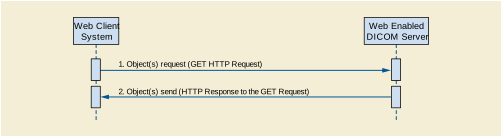
The HTTP Request used shall use the GET method as defined in IETF RFC7230.
The parameters of the <query> component of the Request-URI to be sent to the web Server through the HTTP GET method request shall be represented as defined in IETF RFC3986.
The "Accept" field of the GET method request shall specify the Media type(s) acceptable to the Web Client System. The(se) Media type(s) shall include at least the items of the list of MIME types specified in Section 7 of this standard devoted to the DICOM persistent object types.
The "Accept-charset" field of the GET method request shall specify the character set of the object to be retrieved. If the "Accept-charset" field of the GET method is not present, or the Web Enabled DICOM Server does not support the specified character set, the character set of the response will be at the discretion of the Web Enabled DICOM Server.
Note Typically the user of a Web Client does not have control over the "Accept-charset" field. An optional parameter specifies the character set to be used in the returned object.
The response shall be an HTTP Response Message as specified in IETF RFC7230.
The body content shall be a "Part 10 File" that includes a meta-header as defined in PS3.10.
The returned DICOM object shall be encoded using one of the transfer syntaxes specified in the transfer syntax query parameter as defined in Section 8.2.11 below. By default, the transfer syntax shall be "Explicit VR Little Endian".
The MIME type shall be one on the MIME types defined in the contentType parameter, preferably the most desired by the Web Client, and shall be in any case compatible with the 'Accept' field of the GET method.
The content shall be a single MIME part containing the object to be retrieved.
Note
Multiple objects in a response are not supported by this standard. The parameters select only a single object to retrieve. Most current Web Clients are able to retrieve single objects, within a "non multipart" MIME body, and are not able to support multipart/related or multipart/mixed responses.
The DICOM Web Service defines several action types. An implementation shall support at least one of these actions. The three action types are:
-
This action retrieves a set of DICOM instances and other objects. This action corresponds to the IHE XDS-I.b transaction RAD-69. The DICOM instances are formatted in accordance with PS3.10, and encapsulated in a Web Services response.
-
RetrieveRenderedImagingDocumentSet
This action retrieves a set of DICOM instances that have been rendered into the requested format. For example, if rendering into JPEG was requested, these will be the JPEG renderings of the requested set of DICOM objects.
-
RetrieveImagingDocumentSetMetadata
This action retrieves a set of DICOM instances presented as an Infoset with the bulk data removed. This service can retrieve either the full metadata, or a subset selected by XPath arguments. The XML encoding for the DICOM attributes is defined in PS3.19.
The Web Services actions shall be fully compliant with the Basic Profile of WS-I as defined in IHE IT Infrastructure Technical Framework Vol 2x Annex V. All <wsa:Action> elements shall have the mustUnderstand attribute set (mustUnderstand="1").
The specific Web Services parameters to be used for the Retrieve Imaging Document Set action shall be as follows, in the order that they would appear in the WSDL definition:
-
The following types shall be imported (xsd:import) in the /definitions/types section:
-
The /definitions/message/part/@element attribute of the Retrieve Imaging Document Set Request message shall be an "iherad:RetrieveImagingDocumentSetRequest" as defined below.
-
The /definitions/message/part/@element attribute of the Retrieve Imaging Document Set Response message shall be an "ihe:RetrieveDocumentSetResponse" as defined below.
-
The /definitions/portType/operation/input/@wsaw:Action attribute for the Retrieve Imaging Document Set Request message shall be "urn:ihe:rad:2009:RetrieveImagingDocumentSet".
-
The /definitions/portType/operation/output/@wsaw:Action attribute for the Retrieve Imaging Document Set Response message shall be "urn:ihe:iti:2007:RetrieveDocumentSetResponse".
-
The /definitions/binding/operation/soap12:operation/@soapAction attribute shall be "urn:ihe:rad:2009:RetrieveImagingDocumentSet".
The <iherad:RetrieveImagingDocumentSetRequest/> element for use with the Retrieve Imaging Document Set Request Message is defined as:
-
One or more <iherad:StudyRequest/> elements each of which includes a "studyInstanceUID" attribute identifying the study associated with the DICOM images/ objects being retrieved. Each <iherad:StudyRequest/> element shall contain:
-
One or more <iherad:SeriesRequest/> elements each of which includes a "seriesInstanceUID" attribute identifying the series associated with the DICOM images/ objects being retrieved. Each <iherad:SeriesRequest/> element shall contain:
-
One or more <ihe:DocumentRequest/> elements, each one representing an individual document that the requestor wants to retrieve from the Web Server. Each <ihe:DocumentRequest/> element contains:
-
An optional <ihe:RepositoryUniqueId/> element that identifies the Web Server from which the document is to be retrieved. This value corresponds to XDSDocumentEntry.repositoryUniqueId. The RepositoryUniqueID is similar to a DICOM AETitle, but is a uniqueID assigned to the WADO-WS Web Server rather than a locally assigned string identifier. There will be a separate RepositoryUniqueID for each web service end point.
-
A required <ihe:DocumentUniqueId/> element that identifies the document within the source. For example, this value could be a SOP Instance UID obtained from a Key Object Selection (KOS) instance.
-
An optional <ihe:HomeCommunityId/> element. See the IHE Profiles for the definition and possible uses of this element.
-
A required <iherad:TransferSyntaxUIDList/> element that contains a list of one or more <ihe:TransferSyntaxUID> elements. Each of the <iherad:TransferSyntaxUID> elements represent one of the transfer syntax encodings that the Imaging Document Consumer is capable of processing.
-
-
-
A Web Server shall provide the document(s) indicated in the request. The Web Server shall return the document(s) or an error code when the document could not be returned. The pixel data shall be encoded using one of the DICOM transfer syntaxes included in the Retrieve Imaging Document Set Request Message. If the Imaging Document Source cannot encode the pixel data using any of the requested transfer syntaxes then an error status shall be returned.
The <ihe:RetrieveDocumentResponse/> element for use with the Retrieve Imaging Document Set Response Message is defined as:
-
A required /ihe:RetrieveDocumentSetResponse/rs:RegistryResponse element
-
An optional sequence of <ihe:DocumentResponse/> elements containing
-
An optional <ihe:HomeCommunityId/> element. The value of this element shall be the same as the value of the /RetrieveImagingDocumentSetRequest/StudyRequest/SeriesRequest/DocumentRequest/HomeCommunityId element in the Retrieve Document Set Request Message. If the <ihe:HomeCommunityId/> element is not present in the Retrieve Document Set Request Message, this value shall not be present.
-
An optional <ihe:RepositoryUniqueId/> that identifies the Imaging Document Source from which the document is to be retrieved. The value of this element shall be the same as the value of the /RetrieveImagingDocumentSetRequest/StudyRequest/SeriesRequest/DocumentRequest/RepositoryUniqueId element in the original Retrieve Imaging Document Set Request Message. This value corresponds to XDSDocumentEntry.repositoryUniqueId.
-
A required <ihe:DocumentUniqueId/> that identifies the document within the Imaging Document Source. The value of this element shall be the same as the value of the /RetrieveImagingDocumentSetRequest/StudyRequest/SeriesRequest/DocumentRequest/DocumentUniqueId element in the original Retrieve Imaging Document Set Request Message. This value corresponds to the SOP Instance UID in the Retrieve Document Request.
-
A conditional <wado:FrameNumber/> that identifies the frame within the source document. It shall be present if and only if <wado:FrameNumber/> was in the request
-
A required <ihe:Document/> element that contains the retrieved document as an XOP Infoset.
-
A required <ihe:mimeType/> element that indicates the MIME type of the retrieved document.
-
The /RetrieveDocumentSetResponse/rs:RegistryResponse/@status attributes provides the overall status of the request: It shall contain one of the following values:
See ITI TF-2a: 4.1.13 Error Reporting for the interpretation of these values.
For each document requested in a /RetrieveImagingDocumentSetRequest/StudyRequest/SeriesRequest/DocumentRequest element:
-
If the document is successfully retrieved (without warning) then no /RetrieveDocumentSetResponse/rs:RegistryResponse/rs:RegistryErrorList/ rs:RegistryError element shall be present and a /RetrieveDocumentSetResponse/DocumentResponse/Document element shall be returned containing the document as base64binary encoded data.
-
If a warning is reported when retrieving the document, then a /RetrieveDocumentSetResponse/rs:RegistryResponse/rs:RegistryErrorList/ rs:RegistryError element shall be returned with:
-
@severity is urn:oasis:names:tc:ebxml-regrep:ErrorSeverityType:Warning
-
@location contains the DocumentUniqueId of the document requested
-
The document shall be returned in an instance of /RetrieveDocumentSetResponse/DocumentResponse/Document as base64binary encoded data. The returned document and warning are correlated via the DocumentUniqueId.
-
-
If an error is reported when retrieving a document, then a /RetrieveDocumentSetResponse/rs:RegistryResponse/rs:RegistryErrorList/ rs:RegistryError element shall be returned with:
The error conditions for failures and associated error codes are given below in section 6.4.4. These errors shall be detected and the associated errorCode returned if that error occurs. Additional errors defined in the ebRS standard, in ITI TF-2: 4.1.13 "Error Reporting", and defined by the implementer may be returned.
If the Web Client specifies a transfer syntax field of 1.2.840.10008.1.2.4.94 (DICOM JPIP Referenced Transfer Syntax) or 1.2.840.10008.1.2.4.95 (DICOM JPIP Referenced Deflate Transfer Syntax), and the Web Server supports the requested transfer syntax the following behavior is expected:
-
If the DICOM Image Object(s) already have the same JPIP transfer syntax as the one indicated in the request, the Retrieve Imaging Document Set Response shall include the DICOM Image Objects unchanged.
-
If the DICOM Image Object(s) have a transfer syntax that differs from that of the request, the Retrieve Imaging Document Set Response shall include the DICOM image with the transfer syntax changed to the requested transfer syntax. In addition, the pixel data Attribute (7FE0,0010 tag) will have been removed and replaced with a Pixel Data Provider URL (0028,7FE0 tag). The URL represents the JPIP request and will include the specific target information.
-
Upon receipt of this Retrieve Imaging Document Set Response, the Imaging Document Consumer may request the pixel data from the pixel data provider using the supplied URL. Additional parameters required by the application may be appended to the URL when accessing the pixel data provider.
-
For example, a JPIP request for a 200 by 200 pixel rendition of the entire image can be constructed from the Pixel Data Provider URL as follows:
The specific Web Services parameters to be used for the Retrieve Rendered Imaging Document Set action shall be as follows, in the order that they would appear in the WSDL definition:
-
The following types shall be imported (xsd:import) in the /definitions/types section:
-
The /definitions/message/part/@element attribute of the Retrieve Rendered Imaging Document Set Request message shall be a "wado:RetrieveRenderedImagingDocumentSetRequest" as defined below.
-
The /definitions/message/part/@element attribute of the Retrieve Rendered Imaging Document Set Response message shall be a "wado:RetrieveRenderedImagingDocumentSetResponse" as defined below.
-
The /definitions/portType/operation/input/@wsaw:Action attribute for the Retrieve Rendered Imaging Document Set Request message shall be "urn:dicom:ws:wado:2011:RetrieveRenderedImagingDocumentSet".
-
The /definitions/portType/operation/output/@wsaw:Action attribute for the Retrieve Imaging Document Set Response message shall be "urn:dicom:ws:wado:2011:RetrieveRenderedImagingDocumentSetResponse".
-
The /definitions/binding/operation/soap12:operation/@soapAction attribute shall be "urn:dicom:ws:wado:2011:RetrieveRenderedImagingDocumentSet".
The <wado:RetrieveRenderedImagingDocumentSetRequest/> element for use with the Retrieve Imaging Document Set Request Message is defined as:
-
One or more <wado:StudyRequest/> elements each of which includes a "studyInstanceUID" attribute identifying the study associated with the DICOM images/ objects being retrieved. Each <iherad:StudyRequest/> element shall contain:
-
One or more <wado:SeriesRequest/> elements each of which includes a "seriesInstanceUID" attribute identifying the series associated with the DICOM images/ objects being retrieved. Each <iherad:SeriesRequest/> element shall contain:
-
One or more <wado:RenderedDocumentRequest/> elements, each one representing an individual document that the requestor wants to retrieve from the Web Server. Each <wado:DocumentRequest/> element contains:
-
An optional <ihe:RepositoryUniqueId/> element that identifies the Web Server from which the document is to be retrieved. This value corresponds to XDSDocumentEntry.repositoryUniqueId. The RepositoryUniqueID is similar to a DICOM AETitle, but is a uniqueID assigned to the WADO-WS Web Server rather than a locally assigned string identifier. There will be a separate RepositoryUniqueID for each web service end point.
-
A required <ihe:DocumentUniqueId/> element that identifies the document within the source. This value corresponds to the SOP Instance UID referenced within the DICOM manifest.
-
An optional <ihe:HomeCommunityId/> element that corresponds to the home attribute of the Identifiable class in ebRIM.
-
A required <wado:ContentTypeList/> element that contains a list of one or more <wado:ContentType> elements.
-
An optional <wado:CharsetList/> element that contains a list of one or more <wado:Charset> elements.
-
-
-
An Web Server shall render and then provide the document(s) indicated in the request. The Web Server shall return the rendered documents or an error code when the document could not be returned. The rendered forms shall be the subset specified, and in the format requested. If the Imaging Document Source cannot render the pixel data in that manner then an error status shall be returned.
The <wado:RetrieveRenderedImagingDocumentResponse/> element for use with the Retrieve Imaging Document Set Response Message, Retrieve Rendered Imaging Document Set Response Message and Retrieve Imaging Document Set Metadata Response Message is defined as:
-
A required /ihe:RetrieveDocumentSetResponse/rs:RegistryResponse element
-
An optional sequence of <wado:RenderedDocumentResponse/> elements containing:
-
A <ihe:HomeCommunityId/> element. The value of this element shall be the same as the value of the StudyRequest/SeriesRequest/DocumentRequest/HomeCommunityId element in the Request Message. If the <ihe:HomeCommunityId/> element is not present in the Request Message, this value shall not be present.
-
A required <ihe:RepositoryUniqueId/> that identifies the Imaging Document Source from which the document was retrieved. The value of this element shall be the same as the value of the StudyRequest/SeriesRequest/DocumentRequest/RepositoryUniqueId element in the original Request Message.
-
A required <wado:SourceDocumentUniqueId/> that identifies the source document. The value of this element shall be the same as the value of the StudyRequest/SeriesRequest/DocumentRequest/DocumentUniqueId element in the original Request Message. This value identifies the source, and is not an ID for the resulting rendered document.
-
A conditional <wado:FrameNumber/> that identifies the frame within the source document. It shall be present if and only if <wado:FrameNumber/> was in the request.
-
A required <wado:Annotation/> element that contains the actual value used.
-
A required <wado:Rows/> element that contains the actual value used.
-
A required <wado:Columns/> element that contains the actual value used.
-
A required <wado:Region/> element that contains the actual value used.
-
A required <wado:WindowCenter/> element that contains the actual value used.
-
A required <wado:WindowWidth/> element that contains the actual value used.
-
A required <wado:ImageQuality/> element that contains the actual value used.
-
A required <wado:PresentationUID/> element that contains the actual value used if a PresentationUID was used.
-
A required <wado:PresentationSeriesUID/> element that contains the actual value used if a PresentationSeriesUID was used.
-
An optional <wado:Anonymize/> element that shall be present if the rendered instance was anonymized.
-
A required <ihe:Document/> element that contains the rendered document encoded as an XOP Infoset.
-
A required <ihe:mimeType/> element that indicates the MIME type of the retrieved document.
-
The /RetrieveDocumentSetResponse/rs:RegistryResponse/@status attributes provides the overall status of the request: It shall contain one of the following values:
For each document requested in a /RetrieveRenderedImagingDocumentSetRequest/StudyRequest/SeriesRequest/DocumentRequest element:
-
If the document is successfully rendered (without warning) then no /RetrieveRenderedImagingDocumentSetResponse/rs:RegistryResponse/rs:RegistryErrorList/ rs:RegistryError element shall be present and a /RetrieveRenderedImagingDocumentSetResponse/DocumentResponse/Document element shall be returned containing the rendered document as base64binary encoded data.
-
If a warning is reported when retrieving the document, then a /RetrieveRenderedImagingDocumentSetResponse/rs:RegistryResponse/rs:RegistryErrorList/ rs:RegistryError element shall be returned with:
-
@severity is urn:oasis:names:tc:ebxml-regrep:ErrorSeverityType:Warning
-
@location contains the DocumentUniqueId of the document requested
-
The rendered document shall be returned in an instance of /RetrieveRenderedImagingDocumentSetResponse/DocumentResponse/Document as base64binary encoded data. The returned document and warning are correlated via the DocumentUniqueId.
-
-
If an error is reported when retrieving a document, then a /RetrieveRenderedImagingDocumentSetResponse/rs:RegistryResponse/rs:RegistryErrorList/ rs:RegistryError element shall be returned with:
The error conditions for failures and associated error codes are given below in section 6.4.4. These errors shall be detected and the associated errorCode returned if that error occurs. Additional errors defined in the ebRS standard, in ITI TF-2: 4.1.13 "Error Reporting", and defined by the implementer may be returned.
The specific Web Services parameters to be used for the Retrieve Imaging Document Set Metadata action shall be as follows, in the order that they would appear in the WSDL definition:
-
The following types shall be imported (xsd:import) in the /definitions/types section:
-
The /definitions/message/part/@element attribute of the Retrieve Imaging Document Information Set Request message shall be defined an "wado:RetrieveImagingDocumentSetInformationRequest" as defined below.
-
The /definitions/message/part/@element attribute of the Retrieve Imaging Document Set Information Response message shall be defined an "wado:RetrieveImagingDocumentSetInformationResponse" as defined below.
-
The /definitions/portType/operation/input/@wsaw:Action attribute for the Retrieve Imaging Document Set Information Request message shall be "urn:wado:2011:RetrieveImagingDocumentSetInformation".
-
The /definitions/portType/operation/output/@wsaw:Action attribute for the Retrieve Imaging Document Set Information Response message shall be "urn:wado:2011:RetrieveImagingDocumentSetInformationResponse".
-
The /definitions/binding/operation/soap12:operation/@soapAction attribute shall be "urn:wado:2011:RetrieveImagingDocumentSetInformation".
The <wado:RetrieveImagingDocumentSetInformationRequest/> element for use with the Retrieve Imaging Document Set Request Message is defined as:
-
One or more <wado:StudyRequest/> elements each of which includes a "studyInstanceUID" attribute identifying the study associated with the DICOM images/objects being retrieved. Each <iherad:StudyRequest/> element shall contain:
-
One or more <wado:SeriesRequest/> elements each of which includes a "seriesInstanceUID" attribute identifying the series associated with the DICOM images/objects being retrieved. Each <iherad:SeriesRequest/> element shall contain:
-
One or more <wado:DocumentInformationRequest/> elements, each one representing an individual document that the requestor wants to retrieve from the Web Server. Each < wado:DocumentInformationRequest /> element contains:
-
· An required <ihe:RepositoryUniqueId/> element that identifies the Web Server from which the document is to be retrieved. This value corresponds to XDSDocumentEntry.repositoryUniqueId. The RepositoryUniqueID is similar to a DICOM AE Title, but is a uniqueID assigned to the WADO-WS Web Server rather than a locally assigned string identifier. There will be a separate RepositoryUniqueID for each web service end point.
-
A required <ihe:DocumentUniqueId/> element that identifies the document within the source. For example, this value could be a SOP Instance UID obtained from a Key Object Selection (KOS) instance.
-
An optional <ihe:HomeCommunityId/> element. See the IHE Profiles for the definition and possible uses of this element.
-
A required <wado:XPath/> that contains the text corresponding to the XPath "filter" applied to the Native DICOM Model transposition of the object, as defined in PS3.19.
-
-
-
A Web Server shall extract information from each document specified in a Document Set Information Request. This shall be done by the logical equivalent of:
See PS3.19 for details on conversion to XML encoded form.
The Web Server shall return the XPath results or an error code when the document could not be processed.
The <wado:RetrieveImagingDocumentSetInformationResponse/> element for use with the Retrieve Imaging Document Set Response Message is additionally defined as:
-
A required /wado:RetrieveImagingDocumentSetInformationResponse/rs:RegistryResponse element
-
An optional sequence of <wado:DocumentInformationResponse/> elements containing:
-
A <ihe:HomeCommunityId/> element. The value of this element shall be the same as the value of the StudyRequest/SeriesRequest/DocumentRequest/HomeCommunityId element in the Request Message. If the <ihe:HomeCommunityId/> element is not present in the Request Message, this value shall not be present.
-
A required <ihe:DocumentUniqueId/> that identifies the document within the Web Server. The value of this element shall be the same as the value of the StudyRequest/SeriesRequest/DocumentRequest/DocumentUniqueId element in the original Request Message. This value corresponds to the SOP Instance UID.
-
A conditional <wado:FrameNumber/> that identifies the frame within the source document. It shall be present if and only if <wado:FrameNumber/> was in the request.
-
The /RetrieveImagingDocumentSetInformationResponse/rs:RegistryResponse/@status attributes provides the overall status of the request: It shall contain one of the following values:
For each document requested in a /RetrieveImagingDocumentSetInformationRequest/StudyRequest/SeriesRequest/DocumentRequest element:
-
If the document is successfully retrieved (without warning) then no /RetrieveImagingDocumentSetInformationResponse/rs:RegistryResponse/rs:RegistryErrorList/ rs:RegistryError element shall be present and a /RetrieveImagingDocumentSetInformationResponse/DocumentResponse/Document element shall be returned containing the document as base64binary encoded data.
-
If a warning is reported when retrieving the document, then a /RetrieveImagingDocumentSetInformationResponse/rs:RegistryResponse/rs:RegistryErrorList/ rs:RegistryError element shall be returned with:
-
@severity is urn:oasis:names:tc:ebxml-regrep:ErrorSeverityType:Warning
-
@location contains the DocumentUniqueId of the document requested
-
The document shall be returned in an instance of /RetrieveDocumentSetResponse/DocumentResponse/Document as base64binary encoded data. The returned document and warning are correlated via the DocumentUniqueId.
-
-
If an error is reported when retrieving a document, then a /RetrieveImagingDocumentSetInformationResponse/rs:RegistryResponse/rs:RegistryErrorList/ rs:RegistryError element shall be returned with:
The error conditions for failures and associated error codes are given below in section 6.4.4. These errors shall be detected and the associated errorCode returned if that error occurs. Additional errors defined in the ebRS standard, in ITI TF-2: 4.1.13 "Error Reporting", and defined by the implementer may be returned.
The following errorCodes are defined and shall be used to report any of the associated error and warning situations. Other errorCodes may be present for other error and warning situations.
Table 6.4-1. Error Codes
|
The requested instance(s) are not immediately available, but can be made available by manual request. |
|
|
Instance is no longer available, e.g., document retention rules have caused it to be removed or relocated. |
|
|
The requested instance(s) cannot be returned because the size or count exceeds resource limits. |
|
|
Web Server does not support the requested format or transfer syntax. |
|
|
The requested instance(s) cannot be provided in the requested format or transfer syntax. |
|
|
Single image format is not available for multi-frame images. |
|
|
Identifier does not match SOP Class (see PS3.7 C-MOVE) |
|
|
Inconsistent identifiers, e.g., Study and Series are correct but Series is in a different Study (see PS3.7 C-MOVE) |
|
|
SOP Class not supported (see PS3.7 C-MOVE) |
|
|
Invalid parameter value in request (see PS3.7 C-MOVE) |
|
|
Unsupported parameter in request (see PS3.7 C-MOVE) |
|
|
Processing Failure (see PS3.7 C-MOVE) |
|
The DICOM RESTful Service defines several action types. An implementation shall support all the following six action types:
-
This action retrieves the set of DICOM instances associated with a given study unique identifier (UID). The response can be DICOM or bulk data depending on the "Accept" type, and is encapsulated in a multipart MIME response.
-
This action retrieves the set of DICOM instances associated with a given study and series UID. The response can be DICOM or bulk data depending on the "Accept" type, and is encapsulated in a multipart MIME response.
-
This action retrieves the DICOM instance associated with the given study, series, and SOP Instance UID. The response can be DICOM or bulk data depending on the "Accept" type, and is encapsulated in a multipart MIME response.
-
This action retrieves the DICOM frames for a given study, series, SOP Instance UID, and frame numbers. The response is pixel data, and encapsulated in a multipart MIME response.
-
This action retrieves the bulk data for a given bulk data URL. The response is a single bulk data item.
-
This action retrieves the DICOM instances presented as the study, series, or instance metadata with the bulk data removed.
DICOM objects returned shall be PS3.10 binary objects encoded in a requested Transfer Syntax (Explicit VR Little Endian by default) with one message part per DICOM Instance.
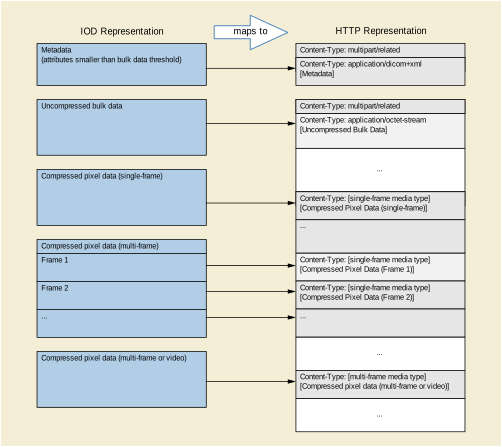
Other types of responses will be encoded in the following manner: (see Figure 6.5-1).
-
All XML responses shall be encoded as described in the Native DICOM Model defined in PS3.19 with one message part per XML object.
-
All JSON responses shall be encoded as a DICOM JSON Model Object as defined in Annex F.
-
Uncompressed bulk and pixel data shall be encoded in a Little Endian format using the application/octet-stream media type with one message part per bulk data item.
Compressed pixel data shall be encoded using the following Media Types. Media Types corresponding to several DICOM Transfer Syntax UIDs require a transfer-syntax parameter, as shown in Table 6.5-1, to disambiguate the request.
Note
For the media type image/dicom+jp2 Transfer Syntaxes, 1.2.840.10008.1.2.4.90 and 1.2.840.10008.1.2.4.91, the image does not include the jp2 wrapper.
HTTP Request field Accept is used in the header lines by the client in a HTTP protocol transaction to indicate the data responses that are acceptable from the server. HTTP Response fields Content-Type and parameters are used in the header lines by the server in a HTTP protocol transaction to indicate the type and encoding of data returning to the client. All lines are RFC822 format headers. All HTTP header fields whose use is not defined by WADO-RS are presumed to have the meaning defined by the HTTP standard.
The server is required to support uncompressed bulk and pixel data (application/octet-stream) and must be able to deliver all bulk data in that form unless it is available only in a lossy-compressed format.
This action retrieves the set of DICOM instances associated with a given study unique identifier (UID). The response can be DICOM or bulk data depending on the "Accept" type, and is encapsulated in a multipart MIME response.
The specific Services resource to be used for the RetrieveStudy action shall be as follows:
-
-
Accept - A comma-separated list of representation schemes, in preference order, which will be accepted by the service in the response to this request. The types allowed for this request header are as follows:
-
multipart/related; type=application/dicom; [transfer-syntax={TransferSyntaxUID}]
Specifies that the response can be DICOM Instances encoded in PS3.10 format. If transfer-syntax is not specified the server can freely choose which Transfer Syntax to use for each Instance.
-
multipart/related; type=application/octet-stream
Specifies that the response can be Little Endian uncompressed bulk data.
-
multipart/related; type={MediaType}
Specifies that the response can be pixel data encoded using a {MediaType} listed in Table 6.5-1 (including parameters).
-
-
The Server shall provide the document(s) indicated in the request. In order to parse the bulk data items it is necessary to also retrieve the metadata for the Study.
The Server shall return the document(s), or an error code when the document(s) cannot be returned. If the server cannot convert all of the data to any of the requested media types/Transfer Syntaxes, then an error code shall be returned, either a "Not Acceptable" response if no data is returned or a "Partial Content" response if only some data is returned.
The client can compare the SOP Instance UIDs or bulk data URLs in the metadata and the message response to determine which bulk data elements have been returned.
All response formats have a content type of multipart/related with a message boundary separator. The response format depends on the Accept header specified in the request.
-
The entire multipart response contains all bulk data for the specified Study that can be converted to one of the requested media types.
-
Each item in the response is one of:
-
an uncompressed bulk data element encoded in Little Endian binary format with the following headers:
-
a compressed bulk data element from a SOP Instance in the Study encoded in a single-frame compression {MediaType} with the following headers:
-
a compressed frame from a multi-frame SOP Instance in the Study encoded in a single-frame media type with the following headers:
-
a set of compressed frames from a SOP Instance in the Study encoded in a multi-frame media type with the following headers:
-
This action retrieves the set of DICOM instances associated with a given study and series UID. The response can be DICOM or bulk data depending on the "Accept" type, and is encapsulated in a multipart MIME response.
The specific resource to be used for the RetrieveSeries action shall be as follows:
-
-
-
Accept - A comma-separated list of representation schemes, in preference order, which will be accepted by the service in the response to this request. The types allowed for this request header are as follows:
-
multipart/related; type=application/dicom; [transfer-syntax={TransferSyntaxUID}]
Specifies that the response can be DICOM Instances encoded in PS3.10 format. If transfer-syntax is not specified the server can freely choose which Transfer Syntax to use for each Instance.
-
multipart/related; type=application/octet-stream;
Specifies that the response can be Little Endian uncompressed bulk data.
-
multipart/related; type={MediaType}
Specifies that the response can be pixel data encoded using a {MediaType} listed in Table 6.5-1 (including parameters).
-
-
The Server shall provide the document(s) indicated in the request. In order to parse the bulk data items it is necessary to also retrieve the corresponding metadata for the specified Study, Series, or Instance.
The Server shall return the document(s), or an error code when the document(s) cannot be returned. If the server cannot convert all of the data to any of the requested media types/Transfer Syntaxes, then an error code shall be returned, either a "Not Acceptable" response if no data is returned or a "Partial Content" response if only some data is returned.
The client can compare the SOP Instance UIDs or bulk data URLs in the metadata and the message response to determine which bulk data elements have been returned.
All response formats have a content type of multipart/related with a message boundary separator. The response format depends on the Accept header specified in the request.
-
The entire multipart response contains all bulk data for the specified Series that can be converted to one of the requested media types.
-
Each item in the response is one of:
-
an uncompressed bulk data element encoded in Little Endian binary format with the following headers:
-
a compressed bulk data element from a SOP Instance in the Series encoded in a single-frame media type with the following headers:
-
a compressed frame from a multi-frame SOP Instance in the Series encoded in a single-frame media type with the following headers:
-
a set of compressed frames from a multi-frame SOP Instance in the Series encoded in a multi-frame media type with the following headers:
-
This action retrieves the DICOM instance associated with the given study, series, and SOP Instance UID. The response can be DICOM or bulk data depending on the "Accept" type, and is encapsulated in a multipart MIME response.
The specific resource to be used for the RetrieveInstance action shall be as follows:
-
-
{SERVICE}/studies/{StudyInstanceUID}/series/{SeriesInstanceUID}/instances/{SOPInstanceUID}, where
-
{SERVICE} is the base URL for the service. This may be a combination of protocol (either http or https), host, port, and application.
-
{StudyInstanceUID} is the study instance UID for a single study.
-
{SeriesInstanceUID} is the series instance UID for a single series.
-
{SOPInstanceUID} is the SOP Instance UID for a single SOP Instance.
-
-
-
-
Accept - A comma-separated list of representation schemes, in preference order, which will be accepted by the service in the response to this request. The types allowed for this request header are as follows:
-
multipart/related; type=application/dicom; [transfer-syntax={TransferSyntaxUID}]
Specifies that the response can be DICOM Instances encoded in PS3.10 format. If transfer-syntax is not specified the server can freely choose which Transfer Syntax to use for each Instance.
-
multipart/related; type=application/octet-stream;
Specifies that the response can be Little Endian uncompressed bulk data.
-
multipart/related; type={MediaType}
Specifies that the response can be pixel data encoded using a {MediaType} listed in Table 6.5-1 (including parameters).
-
-
The Server shall provide either a single DICOM PS3.10 object for the SOP Instance or one or more bulk data items. In order to parse the bulk data items it is necessary to also retrieve the corresponding metadata for the specified Study, Series, or Instance.
The Server shall return the document(s), or an error code when the document(s) cannot be returned. If the server cannot convert all of the bulk data to any of the requested media types, then an error code shall be returned, either a "Not Acceptable" response if no data is returned or a "Partial Content" response if only some data is returned.
The client can compare the bulk data URLs in the metadata and the message response to determine which bulk data elements have been returned.
All response formats have a content type of multipart/related with a message boundary separator. The response format depends on the Accept header specified in the request.
-
The entire multipart response contains all bulk data for the specified Instance that can be converted to one of the requested media types.
-
Each item in the response is one of:
-
an uncompressed bulk data element encoded in Little Endian binary format with the following headers:
-
a compressed bulk data element from a SOP Instance encoded in a single-frame media type with the following headers:
-
a compressed frame from a multi-frame SOP Instance encoded in a single-frame media type with the following headers:
-
a set of compressed frames from a multi-frame SOP Instance encoded in a multi-frame media type with the following headers:
-
This action retrieves the DICOM frames for a given study, series, SOP Instance UID, and frame numbers. The response is pixel data, and is encapsulated in a multipart MIME response.
The specific Services resources to be used for the RetrieveFrames action shall be as follows:
-
-
{SERVICE}/studies/{StudyInstanceUID}/series/{SeriesInstanceUID}/instances/{SOPInstanceUID}/frames/{FrameList}, where
-
{SERVICE} is the base URL for the service. This may be a combination of protocol (either http or https), host, port, and application.
-
{StudyInstanceUID} is the study instance UID for a single study.
-
{SeriesInstanceUID} is the series instance UID for a single series.
-
{SOPInstanceUID} is the SOP Instance UID for a single SOP Instance.
-
{FrameList} is a comma or %2C separated list of one or more non duplicate frame numbers. These may be in any order (e.g., ../frames/1,2,4,3).
-
-
-
-
-
multipart/related; type=application/octet-stream
Specifies that the response can be Little Endian uncompressed pixel data
-
multipart/related; type={MediaType}
Specifies that the response can be pixel data encoded using a {MediaType} and {TransferSyntaxUID} listed in Table 6.5-1 (including parameters).
-
-
The Server shall provide the document(s) indicated in the request. In order to parse the bulk data items it is necessary to also retrieve the corresponding metadata for the specified Study, Series, or Instance.
The Server shall return the document(s) or an error code when the document(s) cannot be returned. If the server cannot encode the pixel data using any of the requested media types, then an error status shall be returned.
All response formats has a content type of multipart/related with a message boundary separator.
This action retrieves the bulk data for a given bulk data URL. The response is a single bulk data item.
The specific Services resource to be used for the RetrieveBulkdata action shall be as follows:
-
-
-
{BulkDataURL} is the URL of a bulk data element. This may be the URL attribute of a BulkData element received in response to a WADO-RS RetrieveMetadataRequest.
-
The server shall always return the same bulk data for a specified BulkData URL if the data is available.
-
If the resource specified by the BulkData URL is not available, the server shall return:
-
The server determines the period of time a BulkData URL resource is available.
-
-
-
-
-
multipart/related; type=application/octet-stream
Specifies that the response can be Little Endian uncompressed bulk data.
-
multipart/related; type={MediaType}
Specifies that the response can be pixel data encoded using a {MediaType} listed in Table 6.5-1 (including parameters).
-
-
The Server shall provide the document(s) indicated in the request. In order to parse the bulk data items it is necessary to also retrieve the corresponding metadata for the specified Study, Series, or Instance.
The Server shall return the document(s) or an error code when the document(s) cannot be returned. If the server cannot encode the pixel data using any of the requested media types, then an error status shall be returned.
All response formats have a content type of multipart/related with a message boundary separator. The response format depends on the Accept header specified in the request.
This action retrieves the DICOM instances presented as the study, series, or instance metadata with the bulk data removed. The response is metadata for the DICOM attributes.
The study, series, or instance metadata includes all attributes; however, a RESTful Service is permitted to replace the Value Field of an attribute with a BulkDataURL for attributes with Value Representations (VR) of FL, FD, IS, LT, OB, OD, OF, OW, SL, SS, ST, UL, UN, US, and UT. The client can use the BulkDataURL with the RetrieveBulkData action to retrieve the original Value Field of that attribute.
Note
-
The server is not required to replace any attribute with a BulkDataURL; this is intended to allow the server to provide clients with metadata of a reasonably small size by leaving out large data Value Fields.
-
Attributes with binary Value Fields are encoded as XML Base64 binary values.
-
Some DICOM instances, such as SR documents, may be entirely described in the metadata.
The specific Services resources to be used for the RetrieveMetadata action shall be as follows:
-
-
{SERVICE} is the base URL for the service. This may be a combination of protocol (either http or https), host, port, and application.
-
{StudyInstanceUID} is the study instance UID for a single study.
-
{SeriesInstanceUID} is the series instance UID for a single series.
-
{SOPInstanceUID} is the SOP Instance UID for a single SOP Instance.
-
The Server shall provide the document(s) indicated in the request. The Server shall return the document(s) or an error code when the document(s) could not be returned.
The response has a content type of either:
The response must include the URL attribute for each BulkData element.
Note
The metadata is consistent with the characteristics of the bulk data on the server. If bulk data is requested using specified Transfer Syntaxes or media types, it is possible that the bulk data retrieved may be inconsistent with the metadata. For example, for a Study whose DICOM Tag (0028,2110) "LossyImageCompression" is set to "00", indicating no lossy compression, calling RetrieveStudy and requesting a lossy compression media type will provide pixel data that is inconsistent with the metadata. It is the responsibility of the client to deal with these inconsistencies appropriately.
-
The response is a JSON array that contains all metadata for the specified Study.
-
Each element in the array is the DICOM JSON encoded metadata for an Instance (see Annex F).
The following error codes are defined and shall be used to report any of the associated error and warning situations. Other error codes may be present for other error and warning situations.
Table 6.5-2. Error Codes
The STOW-RS Service defines one action type. An implementation shall support the following action type:
All request messages are HTTP/1.1 multipart messages. The organization of SOP Instances into message parts depends on whether the SOP Instances are structured as PS3.10 binary instances, or metadata and bulk data.
PS3.10 binary instances shall be encoded with one message part per DICOM Instance.
Metadata and bulk data requests will be encoded in the following manner:(see Figure 6.5-1 Mapping between IOD and HTTP message parts):
-
All XML request messages shall be encoded as described in the Native DICOM Model defined in PS3.19 with one message part per XML object.
-
All JSON requests shall be encoded as an array of DICOM JSON Model Objects defined in Annex F.
-
Uncompressed bulk and pixel data shall be encoded in a Little Endian format using the application/octet-stream media type with one message part per bulk data item.
Compressed pixel data shall be encoded using the Media Types as described in Table 6.5-1 WADO-RS Media Type Mapping to Transfer Syntax UID. Media Types corresponding to several DICOM Transfer Syntax UIDs may require a transfer-syntax parameter to disambiguate the request.
HTTP Request field Content-Type is used in the header lines by the client in an HTTP/1.1 transaction to indicate the type of data being sent to the Service. All lines are RFC822 or RFC7230 format headers. All HTTP header fields whose use is not defined by STOW-RS shall have the meaning defined by the HTTP standard.
The Service is required to support uncompressed bulk and pixel data (multipart/related; type= application/octet-stream).
This action stores one or more DICOM instances associated with one or more study instance unique identifiers (SUID). The request message can be DICOM or metadata and bulk data depending on the"Content-Type", and is encapsulated in a multipart request body.
The specific Service resource to be used for the Store Instances action shall be as follows:
-
-
{SERVICE}/studies[/{StudyInstanceUID}], where
-
{SERVICE} is the base URL for the service. This may be a combination of scheme (either HTTP or HTTPS), host, port, and application.
-
{StudyInstanceUID} (optional) is the study instance UID for a single study. If not specified, instances can be from multiple studies. If specified, all instances shall be from that study; instances not matching the StudyInstanceUID shall be rejected.
-
-
-
-
Content-Type - The representation scheme being posted to the RESTful service. The types allowed for this request header are as follows:
-
multipart/related; type=application/dicom; boundary={messageBoundary}
Specifies that the post is PS3.10 binary instances. All STOW-RS providers must accept this Content-Type.
-
multipart/related; type=application/dicom+xml; boundary={messageBoundary}
Specifies that the post is PS3.19 XML metadata and bulk data. All STOW-RS providers must accept this Content-Type.
-
multipart/related; type=application/json; boundary={messageBoundary}
Specifies that the post is DICOM JSON metadata and bulk data. A STOW-RS provider may optionally accept this Content-Type.
-
-
Note
It is not necessary that the study referenced by the StudyInstanceUID in the resource (and in the provided instances) exists on the server, however it is necessary that it be a valid UID. The client may have obtained an appropriate UID from elsewhere or generated it as described in Chapter 9 “Unique Identifiers (UIDs)” in PS3.5 and Annex B “Creating a Privately Defined Unique Identifier (Informative)” in PS3.5.
The XML Metadata and Bulk Data Request Message has a multipart body.
-
The multipart request body contains all the metadata and bulk data to be stored. If the number of bulk data parts does not correspond to the number of unique BulkDataURIs in the metadata then the entire message is invalid and will generate an error status line.
-
Each body part is either DICOM PS3.19 XML metadata or a bulk data item from a SOP Instance sent as part of the Store operation. The first part of the multipart message must be XML metadata.
-
The first part in the multipart request will contain the following HTTP headers:
-
Subsequent items will contain the following HTTP headers (order is not guaranteed):
-
Metadata and its associated bulk data shall always be sent in the same POST request.
The JSON Metadata and Bulk Data Request Message has a multipart body.
-
The multipart request body contains all the metadata and bulk data to be stored. If the number of bulk data parts does not correspond to the number of unique BulkDataURIs in the metadata then the entire message is invalid and will generate an error status line.
-
The first part in the multipart request will contain a JSON array of DICOM JSON Model Objects (defined in Annex F). Each array element is the metadata from a SOP Instance sent as part of the Store operation. This message part will have the following headers:
-
Subsequent items will be one of the following:
-
JSON Metadata and its associated bulk data shall always be sent in the same POST request.
The Service may coerce or replace values of attributes such as Patient Name, ID, Accession Number, for example, during import of media from an external institution, reconciliation against a master patient index, or reconciliation against an imaging procedure order. The Service may correct, or replace incorrect values, such as Patient Name or ID, for example, when incorrect worklist item was chosen or operator input error occurs.
If any element is coerced or corrected, the Original Attribute Sequence (0400,0561) shall be included in the DICOM Object that is stored and may be included in the PS3.18 XML Store Instances Response Module in the response.
Note
For more information on populating the Original Attribute Sequence, see Section C.12.1 “SOP Common Module” in PS3.3 .
The RESTful Service shall return an HTTP status line, including a status code and associated textual phrase for the entire set of stored SOP Instances, followed by a message body containing the Store Instances Response Module as defined in Table 6.6.1-2. The message body shall be encoded as either:
If the status for all instances included in the POST request is Success, the RESTful Service shall return an "HTTP 200 - Success" response code.
If the status for all instances included in the POST request is Failure, the RESTful Service shall return an appropriate failure status line with a response code from Table 6.6.1-1. If there are instance specific errors, the response code shall be a 409 and the response payload shall contain the Store Instances Response Module, which contains additional information regarding instance errors.
In all other conditions, the RESTful Service shall return an "HTTP 202 - Accepted" response code. The response payload may contain a Store Instances Response Module, which specifies additional information regarding instance warnings or failures.
Table 6.6.1-1. HTTP/1.1 Standard Response Code
Note
HTTP Status Codes for Failures and Warnings are returned in HTTP response headers. It is recommended that the text returned in the HTTP Response Warning contain a DICOM Status Code and descriptive reason as defined in Section 6.6.1.3.2.1. For example,
The message body shall provide appropriate status codes for individual SOP Instances indicating success, warning, or failure as defined below.
The message body may also include details about the processing of attributes by the service.
Table 6.6.1-2 defines the Attributes for referencing SOP Instances that are contained in a Store Instances Response Module in the response message body.
Table 6.6.1-2. Store Instances Response Module Attributes
|
The URL where the Study is available for retrieval via a WADO-RS Retrieve Study service. |
|||
|
A sequence of Items where each Item references a single SOP Instance for which storage could not be provided. |
|||
|
>Table 10-11 “SOP Instance Reference Macro Attributes” in PS3.3 |
|||
|
The reason that storage could not be provided for this SOP Instance. |
|||
|
A sequence of Items where each Item references a single SOP Instance that was successfully stored. Required if one or more SOP Instances were successfully stored. |
|||
|
>Table 10-11 “SOP Instance Reference Macro Attributes” in PS3.3 |
|||
|
The URL where the SOP Instance is available for retrieval via a WADO-RS service. |
|||
|
The reason that this SOP Instance was accepted with warnings. |
|||
|
Sequence of Items containing all attributes that were removed or replaced by other values. |
|||
|
Identification of the system that removed and/or replaced the attributes. |
|||
|
Reason for the attribute modification. Defined terms are: COERCE = Replace values of attributes such as Patient Name, ID, Accession Number, for example, during import of media from an external institution, or reconciliation against a master patient index. CORRECT = Replace incorrect values, such as Patient Name or ID, for example, when incorrect worklist item was chosen or operator input error. |
|||
|
Sequence that contains all the Attributes, with their previous values, that were modified or removed from the main data set. |
|||
|
>>Any Attribute from the main data set that was modified or removed; may include Sequence Attributes and their Items. |
|||
For the following semantics the associated value shall be used for the Warning Reason (0008,1196):
- B000 - Coercion of Data Elements
-
The STOW-RS Service modified one or more data elements during storage of the instance. See Section 6.6.1.3.
- B006 - Elements Discarded
-
The STOW-RS Service discarded some data elements during storage of the instance. See Section 6.6.1.3.
- B007 - Data Set does not match SOP Class
-
The STOW-RS Service observed that the Data Set did not match the constraints of the SOP Class during storage of the instance.
Additional codes may be used for the Warning Reason (0008,1196) to address the semantics of other issues.
In the event that multiple codes may apply, the single most appropriate code shall be used.
For the following semantics the associated value shall be used for the Failure Reason (0008,1197). Implementation specific warning and error codes shall be defined in the conformance statement:
- A7xx - Refused out of Resources
-
The STOW-RS Service did not store the instance because it was out of resources.
- A9xx - Error: Data Set does not match SOP Class
-
The STOW-RS Service did not store the instance because the instance does not conform to its specified SOP Class.
- Cxxx - Error: Cannot understand
-
The STOW-RS Service did not store the instance because it cannot understand certain Data Elements.
- C122 - Referenced Transfer Syntax not supported
-
The STOW-RS Service did not store the instance because it does not support the requested Transfer Syntax for the instance.
- 0110 - Processing failure
-
The STOW-RS Service did not store the instance because of a general failure in processing the operation.
- 0122 - Referenced SOP Class not supported
-
The STOW-RS Service did not store the instance because it does not support the requested SOP Class.
Additional codes may be used for the Failure Reason (0008,1197) to address the semantics of other issues.
In the event that multiple codes may apply, the single most appropriate code shall be used.
The following is an example of a PS3.18 XML Store Instances Response Module in the response message body containing 2 failed SOP Instances, 1 successful SOP Instance, and 1 accepted SOP Instance with a warning:
<?xml version="1.0" encoding="utf-8"?>
<NativeDicomModel xmlns="http://dicom.nema.org/PS3.19/models/NativeDICOM"
xsi:schemaLocation="http://dicom.nema.org/PS3.19/models/NativeDICOM"
xmlns:xsi="http://www.w3.org/2001/XMLSchema-instance">
  <DicomAttribute tag="00081198" vr="SQ" keyword="FailedSOPSequence">
    <Item number="1">
      <DicomAttribute tag="00081150" vr="UI" keyword="ReferencedSOPClassUID">
        <Value number="1">1.2.840.10008.3.1.2.3.1</Value>
      </DicomAttribute>
      <DicomAttribute tag="00081155" vr="UI"
      keyword="ReferencedSOPInstanceUID">
        <Value number="1">
        2.16.124.113543.6003.1011758472.49886.19426.2085542308</Value>
      </DicomAttribute>
      <DicomAttribute tag="00081197" vr="US" keyword="FailureReason">
        <Value number="1">290</Value>
      </DicomAttribute>
    </Item>
    <Item number="2">
      <DicomAttribute tag="00081150" vr="UI" keyword="ReferencedSOPClassUID">
        <Value number="1">1.2.840.10008.3.1.2.3.1</Value>
      </DicomAttribute>
      <DicomAttribute tag="00081155" vr="UI"
      keyword="ReferencedSOPInstanceUID">
        <Value number="1">
        2.16.124.113543.6003.1011758472.49886.19426.2085542309</Value>
      </DicomAttribute>
      <DicomAttribute tag="00081197" vr="US" keyword="FailureReason">
        <Value number="1">290</Value>
      </DicomAttribute>
    </Item>
  </DicomAttribute>
  <DicomAttribute tag="00081199" vr="SQ" keyword="ReferencedSOPSequence">
    <Item number="1">
      <DicomAttribute tag="00081150" vr="UI" keyword="ReferencedSOPClassUID">
        <Value number="1">1.2.840.10008.5.1.4.1.1.2</Value>
      </DicomAttribute>
      <DicomAttribute tag="00081155" vr="UI"
      keyword="ReferencedSOPInstanceUID">
        <Value number="1">
        2.16.124.113543.6003.189642796.63084.16748.2599092903</Value>
      </DicomAttribute>
      <DicomAttribute tag="00081190" vr="UR" keyword="RetrieveURL">
        <Value number="1">
        https://wadors.hospital.com/studies/2.16.124.113543.6003.1154777499.30246.19789.3503430045/
        series/2.16.124.113543.6003.2588828330.45298.17418.2723805630/
        instances/2.16.124.113543.6003.189642796.63084.16748.2599092903</Value>
      </DicomAttribute>
    </Item>
    <Item number="2">
      <DicomAttribute tag="00081150" vr="UI" keyword="ReferencedSOPClassUID">
        <Value number="1">1.2.840.10008.5.1.4.1.1.2</Value>
      </DicomAttribute>
      <DicomAttribute tag="00081155" vr="UI"
      keyword="ReferencedSOPInstanceUID">
        <Value number="1">
        2.16.124.113543.6003.189642796.63084.16748.2599092905</Value>
      </DicomAttribute>
      <DicomAttribute tag="00081196" vr="US" keyword="WarningReason">
        <Value number="1">45056</Value>
      </DicomAttribute>
      <DicomAttribute tag="00081190" vr="UR" keyword="RetrieveURL">
        <Value number="1">
        https://wadors.hospital.com/studies/2.16.124.113543.6003.1154777499.30246.19789.3503430045/
        series/2.16.124.113543.6003.2588828330.45298.17418.2723805630/
        instances/2.16.124.113543.6003.189642796.63084.16748.2599092905</Value>
      </DicomAttribute>
    </Item>
  </DicomAttribute>
  <DicomAttribute tag="00081190" vr="UR" keyword="RetrieveURL">
    <Value number="1">
    https://wadors.hospital.com/studies/2.16.124.113543.6003.1154777499.30246.19789.3503430045</Value>
  </DicomAttribute>
</NativeDicomModel>
DICOM QIDO-RS defines several action types. An implementation shall support the following action types:
-
This action searches for DICOM Studies that match specified search parameters and returns a list of matching studies and the requested attributes for each study.
-
This action searches for DICOM Series that match specified search parameters and returns a list of matching series and the requested attributes for each series.
-
This action searches for DICOM Instances that match specified search parameters and returns a list of matching instances and the requested attributes for each instance.
The specific resources to be used for the search actions shall be as follows:
-
-
-
Accept - The Media Type of the query results. The types allowed for this request header are:
-
multipart/related; type=application/dicom+xml (default)
Specifies that the results should be DICOM PS3.19 XML (one part per result)
-
-
Cache-control: no-cache (recommended)
If included, specifies that search results returned should be current and not cached.
-
-
Each {attributeID} must refer to one of:
-
Series IE attributes (SearchForSeries or SearchForInstances requests only)
-
Composite Instance IE attributes (SearchForInstances requests only)
-
Additional Query/Retrieve Attributes (Section C.3.4 in PS3.4 )
See Section 6.7.1.1.1 for {attributeID} and {value} encoding rules
Each {attributeID} query key shall be unique unless the associated DICOM Attribute allows UID List matching (see Section C.2.2.2.2 in PS3.4 ), in which case each {value} will be interpreted to be an element of the UID List.
The acceptable values for {value} are determined by the types of matching allowed by C-FIND for its associated {attributeID} (see Section C.2.2.2 in PS3.4 ). All characters in {value} that are disallowed for URIs shall be percent-encoded. See IETF RFC 3986 for details.
If an {attributeID} is passed as the value of an "includefield" query key this is equivalent to C-FIND Universal matching for the specified attribute (see Section C.2.2.2.3 in PS3.4 ).
{attributeID} can be one of the following:
{dicomTag} is the eight character hexadecimal string corresponding to the Tag of a DICOM Attribute (see Chapter 6 in PS3.6 ).
{dicomKeyword} is the Keyword of a DICOM Attribute (see Chapter 6 in PS3.6 ).
Note
Note
Examples of valid QIDO-RS URLs:
-
http://dicomrs/studies?PatientID=11235813&StudyDate=20130509
-
http://dicomrs/studies?00100010=SMITH*&00101002.00100020=11235813&limit=25
-
http://dicomrs/studies?00100010=SMITH*&OtherPatientIDsSequence.00100020=11235813
-
http://dicomrs/studies?PatientID=11235813&includefield=00081048&includefield=00081049&includefield=00081060
-
http://dicomrs/studies?PatientID=11235813&StudyDate=20130509-20130510
-
http://dicomrs/studies?StudyInstanceUID=1.2.392.200036.9116.2.2.2.2162893313.1029997326.94587%2c1.2.392.200036.9116.2.2.2.2162893313.1029997326.94583
The Server shall perform the query indicated in the request. The Server shall return the query results or, when the query cannot be performed, an error code.
If the limit query key is not specified or its value exceeds the total number of matching results then {maximumResults} is the lesser of the number of matching results and the maximum number of results supported by the Server.
If the offset query key is not specified or its value is less than zero then {skippedResults} is zero.
The first result returned shall be result number ({skippedResults} + 1). The last result returned shall be result number ({skippedResults} + {maximumResults}). If ({skippedResults} + 1) exceeds {maximumResults} then no results are returned.
If the number of results exceeds the maximum supported by the server, the server shall return the maximum supported results and the response shall include the following HTTP/1.1 Warning header (see RFC 7230 Section 14.46):
Warning: 299 {SERVICE}: "The number of results exceeded the maximum supported by the server. Additional results can be requested.
The server shall be idempotent so that if the list of results is the same, the response to a request with a specific set of parameters shall always be the same, including order. If the complete list of results is different for subsequent transactions the responses may be different. In a situation where results are changing due to changes in the server contents, queries using the limit and offset may be inconsistent.
The response format depends on the Accept header specified in the request.
The matching semantics for each attribute are determined by the types of matching allowed by C-FIND (see Section C.2.2.2 in PS3.4 ).
Matching results shall be generated according to the Hierarchical Search Method described in Section C.4.1.3.1.1 in PS3.4 .
Combined Datetime matching shall be performed (see Section C.2.2.2.5 in PS3.4 ).
Note
If a QIDO-RS provider is acting as a proxy for a C-FIND SCP that does not support combined Datetime matching the QIDO-RS provider will need to perform a C-FIND request using Date only and filter results outside the time range before returning a QIDO-RS response
If the TimezoneOffsetFromUTC / 00080201 query key is included in the request, dates and times in the request are to be interpreted in the specified time zone.
If the "fuzzymatching=true" query key/value is included in the request and it is supported then additional fuzzy semantic matching of person names shall be performed in the manner specified in the DICOM Conformance Statement for the service provider.
If the "fuzzymatching=true" query key/value is included in the request and it is not supported, the response shall include the following HTTP/1.1 Warning header (see RFC 7230 Section 14.46):
Warning: 299 {SERVICE}: "The fuzzymatching parameter is not supported. Only literal matching has been performed."
where {SERVICE} is the base URL for the QIDO-RS provider. This may be a combination of scheme (http or https), host, port, and application.
Note
The Warning header is separate from the Status Line and does not affect the returned Status Code.
Providers of the SearchForStudies service shall support the search query keys described in Table 6.7.1-1:
Providers of the SearchForSeries service shall support the search query keys described in Table 6.7.1-1a:
If {StudyInstanceUID} is not specified in the URL and this form of Relational Query is supported, all Study-level attributes specified in Table 6.7.1-1 shall also be supported.
Providers of the SearchForInstances service shall support the search query keys described in Table 6.7.1-1b:
If {StudyInstanceUID} is not specified in the URL and this form of Relational Query is supported, all Study-level attributes specified in Table 6.7.1-1 shall also be supported.
If {SeriesInstanceUID} is not specified in the URL and this form of Relational Query is supported, all Series-level attributes specified in Table 6.7.1-1a shall also be supported.
For each matching Study, the QIDO-RS provider shall return all attributes in accordance with Table 6.7.1-2:
Table 6.7.1-2. QIDO-RS STUDY Returned Attributes
Series Level and Instance Level attributes passed as "includefield" query values shall not be returned.
Note
The above list is consistent with those required for IHE RAD-14 (see http://www.ihe.net/Technical_Framework/upload/IHE_RAD_TF_Vol2.pdf Table 4.14-1).
For each matching Series, the QIDO-RS provider shall return all attributes listed in Table 6.7.1-2a:
Table 6.7.1-2a. QIDO-RS SERIES Returned Attributes
|
Shall be empty if the resource cannot be retrieved via WADO-RS |
||
|
All other Series Level DICOM Attributes passed as {attributeID} query keys that are supported by the service provider as matching or return attributes |
||
|
All other Study or Series Level DICOM Attributes passed as "includefield" query values that are supported by the service provider as return attributes |
||
|
All available Instance Level DICOM Attributes if the "includefield" query key is included with a value of "all" |
||
|
If {StudyInstanceUID} is not specified, all Study-level attributes specified in Table 6.7.1-2 |
||
Instance Level attributes passed as "includefield" query values shall not be returned.
Note
The above list is consistent with the attributes required for IHE RAD-14 (see http://www.ihe.net/Technical_Framework/upload/IHE_RAD_TF_Vol2.pdf Table 4.14-1).
For each matching instance, the QIDO-RS provider shall return all attributes listed in Table 6.7.1-2b:
Table 6.7.1-2b. QIDO-RS INSTANCE Returned Attributes
|
Shall be empty if the resource cannot be retrieved via WADO-RS |
||
|
All other Instance Level DICOM Attributes passed as {attributeID} query keys that are supported by the service provider as matching or return attributes |
||
|
All other Study, Series or Instance Level DICOM Attributes passed as "includefield" query values that are supported by the service provider as return attributes |
||
|
All available Instance Level DICOM Attributes if the "includefield" query key is included with a value of "all" |
||
|
If {StudyInstanceUID} is not specified, all Study-level attributes specified in Table 6.7.1-2 |
||
|
If {SeriesInstanceUID} is not specified, all Series-level attributes specified in Table 6.7.1-2a |
||
Note
The above list is consistent with the attributes required for IHE RAD-14 (see http://www.ihe.net/Technical_Framework/upload/IHE_RAD_TF_Vol2.pdf Table 4.14-1 and Table 4.14-2).
The server shall support returning query results as:
The result format used shall depend on the Accept header of the request.
-
Content-Type: multipart/related; type=application/dicom+xml
-
The response is a multipart message body where each part is a DICOM PS3.19 XML NativeDicomModel element containing the attributes for one matching Study, Series or Instance (see Section A.1 in PS3.19 ).
-
The provider of the QIDO service may use a BulkData reference at its discretion (see Table A.1.5-2 in PS3.19 and Section 6.5.6). For example, this might be done to avoid encoding a large DICOM Value Field, such as an image thumbnail.
-
If there are no matching results, the message body will be empty.
-
-
Each item in the multipart response will contain the following HTTP/1.1 headers:
-
Content-Type: application/json
-
The response is a DICOM JSON message containing a DICOM JSON property for each matching study, series or instance containing sub-properties describing the matching attributes for each study, series or instance (see Section F.2).
-
The provider of the QIDO service may use a BulkDataURI reference at its discretion (see Section F.2.6). For example, this might be done to avoid encoding a large DICOM Value Field, such as an image thumbnail.
-
If there are no matching results, the JSON message is empty.
-
Table 6.7-1 lists the HTTP/1.1 status codes that shall be used to report any of the associated error and warning situations. Other error codes may be present for other error and warning situations.
Table 6.7-1. QIDO-RS HTTP/1.1 Status Codes
DICOM RS Capabilities Service defines a single transaction type which shall be supported by all implementations
The Retrieve Server Options transaction can be requested for the following resources:
All responses are http single part messages. A successful response will return a Web Application Description Language (WADL) document encoded in a Media Type consistent with the Accept header of the request.
The WADL document shall contain one top-level "application" element.
The "application" element shall contain one "resources" element whose "base" attribute value is {SERVICE}, where {SERVICE} is the base URL for the service. This may be a combination of protocol (either http or https), host, port, and application.
Additionally, the WADL content shall include a "resource" element for the resource specified in the request (see 6.8.1.1) describing all methods (see 6.8.1.2.2.2 for description and examples) and child resources (see 6.8.1.2.2.1 for description and examples) for the specified resource and each of its children.
The full WADL resource tree follows directly and unambiguously from the RESTful resource endpoints defined in 6.5, 6.6, 6.7 and 6.9.
For informative purposes, the full resource tree and the methods defined for each resource are described in Table 6.8-1.
The Retrieve methods define the capabilities of a WADO-RS resource (see 6.5) or a RetrieveUPS resource (see 6.9.4).
The Retrieve methods shall contain the following attributes:
The Retrieve methods shall contain a "request" element with "param" elements documenting the following:
The Retrieve methods shall contain one or more "response" elements documenting the following:
<method name="GET" id="RetrieveStudies">
	<request>
		<param name="Accept" style="header" default="multipart/related; type=application/dicom">
			<option value="multipart/related; type=application/dicom" />
			<option value="multipart/related; type=application/dicom";
			        transfer-syntax=1.2.840.10008.1.2 />
			<option value="multipart/related; type=application/dicom";
			        transfer-syntax=1.2.840.10008.1.2.1 />
			<option value="multipart/related; type=application/octet-stream" />
			<option value="multipart/related; type=image/dicom+jpx" />
			<option value="multipart/related; type=image/dicom+jpx;
			        transfer-syntax=1.2.840.10008.1.2.4.92" />
			<option value="multipart/related; type= video/mpeg;
			        transfer-syntax=1.2.840.10008.1.2.4.100" />
		</param>
	</request>
	<response status="200,206">
		<representation mediaType="multipart/related; type=application/dicom";
		                transfer-syntax=1.2.840.10008.1.2 />
		<representation mediaType="multipart/related; type=application/dicom";
		                transfer-syntax=1.2.840.10008.1.2.1 />
		<representation mediaType="multipart/related; type=application/octet-stream" />
		<representation mediaType="multipart/related; type= image/dicom+jpx" />
		<representation mediaType="multipart/related; type= image/dicom+jpx;
		                transfer-syntax=1.2.840.10008.1.2.4.92" />
		<representation mediaType="multipart/related; type= video/mpeg;
		                transfer-syntax=1.2.840.10008.1.2.4.100" />
	</response>
	<response status="400 404 406 410 503" />
</method>
The Store methods define the capabilities of a STOW-RS resource (see 6.6) or a CreateUPS resource (see 6.9.1).
The Store methods shall contain the following attributes:
The Store methods shall contain a "request" element with "param" elements documenting the following:
The Store methods shall contain one or more "response" elements documenting the following:
<method name="GET" id="StoreInstances">
	<request>
		<param name="Accept" style="header" default="application/dicom+xml">
			<option value="application/dicom+xml" />
		</param>
		<representation mediaType="multipart/related; type=application/dicom" />
		<representation mediaType="multipart/related; type=application/dicom;
		                transfer-syntax=1.2.840.10008.1.2" />
		<representation mediaType="multipart/related; type=application/dicom;
		                transfer-syntax=1.2.840.10008.1.2.1" />
		<representation mediaType="multipart/related; type=application/dicom+xml" />
		<representation mediaType="multipart/related; type=application/dicom+xml;
		                transfer-syntax=1.2.840.10008.1.2" />
		<representation mediaType="multipart/related; type=application/dicom+xml;
						transfer-syntax=1.2.840.10008.1.2.1" />
		<representation mediaType="multipart/related; type=application/dicom+xml;
		                transfer-syntax=1.2.840.10008.1.2.4.92" />
		<representation mediaType="multipart/related; type=application/dicom+xml;
		                transfer-syntax=1.2.840.10008.1.2.4.100" />
	</request>
	<response status="200" />
	<response status="202,409">
		<representation mediaType="application/dicom+xml" />
	</response>
	<response status="400,401,403,503" />
</method>
The Search methods define the capabilities of a QIDO-RS resource (see 6.7) or a SearchForUPS resource (see 6.9.3).
The Search methods shall contain the following attributes:
The Search methods shall contain a "request" element with "param" elements documenting the following:
The Search methods shall contain one or more "response" elements documenting the following:
<method name="GET" id="SearchForStudies">
	<request>
		<param name="Accept" style="header" default="multipart/related; type=application/dicom+xml">
			<option value="multipart/related; type=application/dicom+xml" />
			<option value="application/json" />
		</param>
		<param name="Cache-control" style="header">
			<option value="no-cache" />
		</param>
		<param name="limit" style="query" />
		<param name="offset" style="query" />
		<param name="fuzzymatching" style="query" />
		<param name="StudyDate" style="query" />
		<param name="00080020" style="query" />
		<param name="StudyTime" style="query" />
		<param name="00080030" style="query" />
		…
		<param name="includefield" style="query" repeating="true" />
		<option value="all" />
		<option value="00081049" />
		<option value="PhysiciansOfRecordIdentificationSequence" />
		<option value="00081060" />
		<option value="NameOfPhysiciansReadingStudy" />
		…
	</param>
</request>
<response status="200">
	<representation mediaType="multipart/related; type=application/dicom+xml" />
	<representation mediaType="application/json" />
</response>
<response status="400 401 403 413 503" />
</method>
The Update methods define the capabilities of an UpdateUPS, a ChangeUPSState or a RequestUPSCancellation resource (see 6.9.2).
The Update methods shall contain the following attributes:
The Update methods shall contain a "request" element with "param" elements documenting the following:
The Update methods shall contain one or more "response" elements documenting the following:
<method name="POST" id="UpdateUPS">
  <request>
    <representation mediaType="application/dicom+xml" />
    <representation mediaType="application/json" />
  </request>
  <response status="200">
    <param name="Warning" style="header" fixed="299 {+SERVICE}: The UPS was created with modifications." />
    <param name="Warning" style="header" fixed="299 {+SERVICE}: Requested optional Attributes are not supported." />
  </response>
  <response status="409">
    <param name="Warning" style="header" fixed="299 {+SERVICE}: The Transaction UID is missing." />
    <param name="Warning" style="header" fixed="299 {+SERVICE}: The Transaction UID is incorrect." />
    <param name="Warning" style="header" fixed="299 {+SERVICE}: The submitted request is inconsistent
                                                                with the current state of the UPS Instance." />
  </response>
  <response status="400 401 403 404 503" />
</method>
The Subscribe methods define the capabilities of a CreateSubscription, a SuspendGlobalSubscription or a DeleteSubscription resource (see 6.9.7, 6.9.8 and 6.9.9).
The Subscribe methods shall contain the following attributes:
The Subscribe methods shall contain a "request" element with "param" elements documenting the following:
The Subscribe methods shall contain one or more "response" elements documenting the following:
<method name="POST" id="CreateSubscription">
  <request>
    <param name="deletionlock" style="query" default="false">
      <option value="true" />
      <option value="false" />
    </param>
  </request>
  <response status="201">
    <param name="Warning" style="header" fixed="299 {+SERVICE}: Deletion Lock not granted." />
   </response>
  <response status="403">
    <param name="Warning" style="header" fixed="299 {+SERVICE}: The Origin-Server does not support
                                                                Global Subscription Filtering." />
  </response>
  <response status="400 401 404 409 503" />
</method>
Table 6.8-2 lists the HTTP/1.1 status codes that shall be used to report any of the associated error and warning situations. Other error codes may be present for other error and warning situations.
Table 6.8-2. Server Options HTTP/1.1 Status Codes
This DICOM Web Service defines a RESTful interface to the UPS SOP Classes (see PS3.3 and PS3.4). It consists of the following action types:
-
This action requests the creation of a UPS Instance on the Origin-Server. It corresponds to the UPS DIMSE N-CREATE operation.
-
This action sets the attributes of a UPS Instance managed by the Origin-Server. It corresponds to the UPS DIMSE N-SET operation.
-
This action searches for UPS Instances known to the Origin-Server. It corresponds to the UPS DIMSE C-FIND operation.
-
This action retrieves a UPS Instances. It corresponds to the UPS DIMSE N-GET operation.
-
This action sets the state of a UPS Instance managed by the Origin-Server. It corresponds to the UPS DIMSE N-ACTION operation "Change UPS State".
-
This action requests the cancellation of a UPS Instance managed by the Origin-Server. It corresponds to the UPS DIMSE N-ACTION operation "Request UPS Cancel".
-
This action subscribes to a UPS Instance or the Global Worklist managed by the Origin-Server. It corresponds to the UPS DIMSE N-ACTION operation "Subscribe to Receive UPS Event Reports".
-
This action suspends an existing subscription to the Global Worklist managed by the Origin-Server. It corresponds to the UPS DIMSE N-ACTION operation "Suspend Global Subscription".
-
This action cancels an existing subscription to a UPS Instance or the Global Worklist managed by the Origin-Server. It corresponds to the UPS DIMSE N-ACTION operation "Unsubscribe from Receiving UPS Event Reports".
-
This action initiates a WebSocket connection to allow the User-Agent to start receiving Event Report messages.
-
This action sends an Event Report using an open WebSocket connection. It corresponds to the UPS DIMSE N-EVENT-REPORT operation.
An Origin-Server shall support all of the above action types.
The requirements for a UPS-RS Origin-Server that is also a Unified Worklist and Procedure Step SCP are described in Section CC.1 in PS3.4
Table 6.9-1. UPS Interface Mapping
The Origin-Server shall comply with all requirements placed on the SCP for the corresponding services in Annex CC “Unified Procedure Step Service and SOP Classes (Normative)” in PS3.4.
This resource allows a User-Agent to instruct an Origin-Server to create a UPS instance.
The request message shall be formed as follows:
-
-
Content-Type - The representation scheme being posted to the RESTful service. The types allowed for this request header are as follows:
-
Specifies that the post is DICOM PS3.19 XML metadata. See Section 6.9.1.1.1.
-
Specifies that the post is DICOM PS3.18 JSON metadata. See Section 6.9.1.1.1.
-
-
-
The request body shall convey a single Unified Procedure Step Instance. The instance shall comply with all requirements in the Req. Type N-CREATE column of Table CC.2.5-3 in PS3.4 .
The Request Message has a single part body.
-
The request body contains all attributes to be stored in either DICOM PS3.19 XML or DICOM JSON. Any binary data contained in the message shall be inline.
The Origin-Server shall create and maintain UPS instances as instructed by CreateUPS requests and as specified by the SCP behavior in Section CC.2.5.3 in PS3.4 .
The Origin-Server shall return the HTTP/1.1 Status Line applicable to the associated request.
The Origin-Server shall return an HTTP/1.1 response message.
If the Create request is successful, the Origin-Server shall return an HTTP/1.1 "201 - Created" response code.
If the request fails, the Origin-Server shall return an appropriate failure status line with a response code from Table 6.9.1-1.
Table 6.9.1-1. Status Codes
If the request is successful, the HTTP/1.1 response message shall include the following HTTP/1.1 header:
-
Content-Location: {+WorkitemURL}
Where {+WorkitemURL} is the URL from which the created UPS Instance can be retrieved (see Section 6.9.4)
If the UPS instance was created with modifications, the response message shall include the following HTTP/1.1 header:
This resource supports the modification of attribute values of an existing UPS Instance.
The request message shall be formed as follows:
-
-
{+SERVICE}/workitems/{UPSInstanceUID}{?transaction}
-
{+SERVICE} is the base URL for the service. This may be a combination of protocol (either HTTP or HTTPS), authority and path.
-
{UPSInstanceUID} is the UID of the Unified Procedure Step Instance
-
{transaction} specifies the Transaction UID / Locking UID for the specified Unified Procedure Step Instance
If the UPS instance is currently in the SCHEDULED state, {transaction} shall not be specified.
If the UPS instance is currently in the IN PROGRESS state, {transaction} shall be specified.
-
-
-
-
Content-Type - The representation scheme being posted to the RESTful service. The types allowed for this request header are as follows:
-
Specifies that the post is DICOM PS3.19 XML metadata. See Section 6.9.2.1.1.
-
Specifies that the post is DICOM PS3.18 JSON metadata. See Section 6.9.2.1.1.
-
-
-
The request body describes changes to a single Unified Procedure Step Instance. It shall include all Attributes for which Attribute Values are to be set. The changes shall comply with all requirements described in Section CC.2.6.2 in PS3.4 .
-
Because the request will be treated as atomic (indivisible) and idempotent (repeat executions have no additional effect), all changes contained in the request shall leave the UPS instance in an internally consistent state.
The Origin-Server shall support the Attribute changes to the UPS instance specified by the User-Agent in the UpdateUPS request and as specified by the SCP behavior in Section CC.2.6.3 in PS3.4 .
The Origin-Server shall return the HTTP/1.1 Status applicable to the associated request.
The Origin-Server shall return an HTTP/1.1 response message.
If the Set request is successful, the Origin-Server shall return an HTTP/1.1 "200 - OK" response code.
If the request fails, the Origin-Server shall return an appropriate failure status line with a response code from Table 6.9.2-1.
Table 6.9.2-1. Status Codes
If the UPS instance was updated but with modifications made by the Origin-Server, the response message shall include the following HTTP/1.1 header:
If optional attributes were rejected, the response message shall include the following HTTP/1.1 Warning header field:
If the request was rejected with an HTTP/1.1 409 status code, the response message shall include one of following messages encoded in an HTTP/1.1 Warning header field describing the nature of the conflict:
This resource returns a list of UPS Instances that match specified search query parameters along with requested attributes for each Instance.
The request message shall be formed as follows:
-
-
-
includefield={attributeID} | all
0-n includefield / {attributeID} pairs allowed, where "all" indicates that all attributes with values should be included for each response.
Each {attributeID} shall refer to an attribute of the Unified Procedure Step IOD (see Section B.26.2 in PS3.3 ).
See Section 6.7.1.1 for {attributeID} and {value} encoding rules
The Origin-Server shall perform a search according the requirements for the QIDO-RS services (see Section 6.7.1.2).
An Origin-Server shall support matching against all Unified Procedure Step Instance Attributes in Table CC.2.5-3 in PS3.4 with a Match Key Type value of U, R or *.
See Section 6.7.1.2.1 for matching behavior.
The Origin-Server shall return an HTTP/1.1 response message.
If the SearchForUPS request is successful, the Origin-Server shall return an HTTP/1.1 "200 - OK" response code.
If the request fails, the Origin-Server shall return an appropriate failure status line with a response code from Table 6.9.3-1.
Table 6.9.3-1. Status Codes
For each matching UPS Instance, the Origin-Server shall return:
-
All Unified Procedure Step Instance Attributes in Table CC.2.5-3 in PS3.4 with a Return Key value of 1 and 2.
-
All Unified Procedure Step Instance Attributes in Table CC.2.5-3 in PS3.4 with a Return Key value of 1C for which the conditional requirements are met.
-
All other Unified Procedure Step Instance Attributes passed as {attributeID} query keys that are supported by the Origin-Server as matching or return attributes
-
All other Unified Procedure Step Instance Attributes passed as "includefield" query values that are supported by the Origin-Server as return attributes.
The response message body contains the results.
The format of the response message body shall contain one of the Media Types specified by the request Accept header field. An Origin-Server shall support all Media-Types allowed in the request.
-
The response is a multipart message body where each part is a DICOM PS3.19 XML DicomNativeModel element containing the attributes for one matching UPS Instance (see Section A.1 in PS3.19 ).
-
If there are no matching results, the message body shall be empty.
-
Each part in the multipart body includes the following HTTP/1.1 headers:
-
The response is a DICOM JSON message containing a DICOM JSON property for each matching UPS Instance containing sub-properties describing the matching attributes for each UPS Instance (see Section F.2).
-
If there are no matching results, the JSON message shall be empty.
This resource supports the retrieval of a UPS Instance.
The Origin-Server shall return, via the HTTP/1.1 response, the indicated Unified Procedure Step Instance to the User-Agent.
Note
The requirement for the Origin-Server to respond to GET requests for UPS Instances that have moved to the COMPLETED or CANCELED state is limited. See Section CC.2.1.3 in PS3.4 .
The User-Agent shall not return the Transaction UID (0008,1195) Attribute. This is necessary to preserve this Attribute's role as an access lock.
The User-Agent shall return the HTTP/1.1 Response Status Code applicable to the associated request. A Failure Code shall indicate that the Origin-Server has not returned the SOP Instance.
The Origin-Server shall return an HTTP/1.1 response message.
If the Retrieve request is successful, the Origin-Server shall return an HTTP/1.1 "200 - OK" response code.
If the request fails, the Origin-Server shall return an appropriate failure status line with a response code from Table 6.9.4-1.
Table 6.9.4-1. Status Codes
The response message body contains the results.
The format of the response message body shall contain one of the Media Types specified by the request Accept header field. An Origin-Server shall support all Media-Types allowed in the request.
-
The response contains a DICOM PS3.19 XML DicomNativeModel element containing the attributes for the requested UPS Instance (see Section A.1 in PS3.19 ).
-
The response is a DICOM JSON array containing a DICOM JSON representation of the requested UPS Instance (see Section F.2).
This resource supports the modification of the state of an existing UPS Instance.
The request message shall be formed as follows:
-
-
Content-Type - The representation scheme being posted to the RESTful service. The types allowed for this request header are as follows:
-
Specifies that the post is DICOM PS3.19 XML metadata. See Section 6.9.5.1.1.
-
Specifies that the post is DICOM PS3.18 JSON metadata. See Section 6.9.5.1.1.
-
-
-
The request body describes a state change to a single Unified Procedure Step Instance. It shall include all Attributes required for an SCU in Table CC.2.1-1 in PS3.4 .
The Origin-Server shall support the state changes to the UPS instance specified in the request as described by the SCP behavior in Section CC.2.1.3 in PS3.4 .
After completing the ChangeUPSState request, the Origin-Server shall return the HTTP/1.1 Response Line applicable to the associated request.
The Origin-Server shall return an HTTP/1.1 response message.
If the State Change was successful, the Service shall return an HTTP/1.1 "200 - OK" response code.
If the State Change fails, the Service shall return an appropriate failure status line with a response code from Table 6.9.5-1.
Table 6.9.5-1. Status Codes
If the User-Agent specifies a Procedure Step State (0074,1000) attribute with a value of "CANCELED" and the UPS Instance is already in that state, the response message shall include the following HTTP/1.1 Warning header field:
If the User-Agent specifies a Procedure Step State (0074,1000) attribute with a value of "COMPLETED" and the UPS Instance is already in that state, the response message shall include the following HTTP/1.1 Warning header field:
If the request was rejected with an HTTP/1.1 409 status code, the response message shall include one of following messages in the HTTP/1.1 Warning header field describing the nature of the conflict:
This resource records a request that the specified UPS Instance be canceled.
-
-
Content-Type - The representation scheme being posted to the RESTful service. The types allowed for this request header are as follows:
-
Specifies that the post is DICOM PS3.19 XML metadata. See Section 6.9.5.1.1.
-
Specifies that the post is DICOM PS3.18 JSON metadata. See Section 6.9.5.1.1.
-
-
-
The request body describes a request to cancel a single Unified Procedure Step Instance. The request body shall comply with all attribute requirements described in Table CC.2.2-1 in PS3.4 .
RequestUPSCancellation is used to request to the Origin-Server that the state of a UPS Instance be changed to CANCELED as shown in Figure CC.1.1-1 in PS3.4 . The Origin-Server shall process the request as described by the SCP behavior in Section CC.2.2.3 in PS3.4 .
The request may include a Reason For Cancellation and/or a proposed Procedure Step Discontinuation Reason Code Sequence.
The request may also include a Contact Display Name and/or a Contact URI for the person with whom the cancel request may be discussed.
Note
An HTTP/1.1 Status Code indicating success means that the Request was accepted, not that the UPS has been canceled. The system performing the UPS is not obliged to honor the request to cancel and in some scenarios, may not even receive notification of the request. See Section CC.2.4 in PS3.4 .
To cancel an IN PROGRESS UPS that the User-Agent is itself performing, the User-Agent shall instead use the ChangeUPSState action as described in Section 6.9.5.
The Origin-Server shall return an HTTP/1.1 response message.
If the cancel request was accepted, the Service shall return an HTTP/1.1 "202 - Accepted" response code.
If the cancel request was rejected, the Service shall return an appropriate failure status line with a response code from Table 6.9.6-1.
Table 6.9.6-1. Status Codes
This resource records subscribers to whom future events associated with the specified UPS Instances will be reported.
The request message shall be formed as follows:
-
-
{+SERVICE}/workitems/{UPSInstanceUID}/subscribers/{AETitle}}{?deletionlock}
-
{+SERVICE}/workitems/1.2.840.10008.5.1.4.34.5/subscribers/{AETitle}{?deletionlock}
-
{+SERVICE}/workitems/1.2.840.10008.5.1.4.34.5.1/subscribers/{AETitle}{?deletionlock,query*}
-
{+SERVICE} is the base URL for the service. This may be a combination of protocol (either HTTP or HTTPS), authority and path.
-
{UPSInstanceUID} is the UID of the Unified Procedure Step Instance or a well-known UID
-
{AETitle} is an Application Entity Title that conforms to the "AE" Value Representation (see Table 6.2-1 in PS3.5 ) and identifies the Application Entity to be subscribed
-
{deletionlock}, if present, shall have a value of either "true" or "false", indicating whether or not the User-Agent is requesting a Deletion Lock
-
{query} specifies the query key/value pairs describing the filter parameters
-
-
-
-
0-n / {attributeID}={value} pairs allowed
Each {attributeID} shall refer to an attribute of the Unified Procedure Step IOD (see Section B.26.2 in PS3.3 ).
See Section 6.7.1.1 for {attributeID} and {value} encoding rules.
The Origin-Server shall support the management of UPS instance subscriptions as specified by the SCP behavior in Section CC.2.3.3 in PS3.4 .
Upon receipt of the CreateSubscription, SuspendGlobalSubscription or DeleteSubscription request, the Origin-Server shall attempt to update the Global Subscription State, Filtered Global Subscription and/or UPS Subscription State of the specified Application Entity with respect to the specified SOP Instance UID as described in Table CC.2.3-2 in PS3.4 and then return the appropriate HTTP/1.1 response.
The Service shall return an HTTP/1.1 status line, including a status code and associated reason phrase.
If the CreateSubscription request was successful, the Service shall return an "HTTP/1.1 201 - Created" response code. The response shall contain a "Content-Location" header of the following format:
If the subscription fails, the Service shall return an appropriate failure status line with a response code from Table 6.9.7-2.
Table 6.9.7-2. Status Codes
If the CreateSubscriptionrequest was accepted but the deletion lock was not, the response message shall include the following HTTP/1.1 Warning header field:
If the request was rejected with an HTTP/1.1 403 status code because Filtered Global Subscription is not supported, the response message shall include the following HTTP/1.1 Warning header field:
This resource suspends an existing Global Subscription or Filtered Global Subscription. The Origin-Server will no longer automatically subscribe the User-Agent to newly-created UPS Instances. This does not delete any existing subscriptions to specific UPS Instances.
The SuspendGlobalSubscription Origin-Server shall behave as described in Section 6.9.7.2.
The Service shall return an HTTP/1.1 status line, including a status code and associated reason phrase.
If the SuspendGlobalSubscriptionrequest was successful, the Service shall return an HTTP/1.1 "200 - OK" response code.
If the subscription change fails, the Service shall return an appropriate failure status line with a response code from Table 6.9.8-1.
Table 6.9.8-1. Status Codes
This resource removes existing subscriptions from the specified UPS Instances.
The DeleteSubscription Origin-Server shall behave as described in Section 6.9.7.2.
The Service shall return an HTTP/1.1 status line, including a status code and associated reason phrase.
If the DeleteSubscriptionrequest was successful, the Service shall return an HTTP/1.1 "200 - OK" response code.
If the subscription fails, the Service shall return an appropriate failure status line with a response code from Table 6.9.7-1.
Table 6.9.7-1. Status Codes
This resource opens a WebSocket channel that will be used to send Event Reports to the client.
See RFC-6455 for details on the WebSocket protocol.
The Origin-Server maintains the active WebSocket connection and uses it to send Event Report messages for UPS Instances which have subscriptions association with {AETitle} (see Section 6.9.7.2).
If the WebSocket connection is lost at any point the User-Agent can re-establish it by repeating the request.
The state of a WebSocket connection does not affect subscriptions and an Origin-Server is not required to queue messages when the connection is down.
The Service shall return an HTTP/1.1 status line, including a status code and associated reason phrase.
If the request was successful, the Service shall return an HTTP/1.1 "101 - Switching Protocols" response code.
If the request fails, the Service shall return an appropriate failure status line with a response code from Table 6.9.10-1.
Table 6.9.10-1. Status Codes
The response message body shall be empty.
The connection remains open and may be used by the server to send Event messages (see Section 6.9.11).
This operation sends an Event Report over an established WebSocket connection.
The request message shall be formed as follows:
-
The Event Report shall contain all mandatory attributes described indescribed in Table CC.2.4-1 in PS3.4 and Table 10.3-1 in PS3.7 for the event type.
WebSocket Events are encoded as WebSocket data frames with an opcode of "%x1" (text).
The frame payload data shall be a DICOM JSON dataset containing the attributes of the Event Report.
Note
-
{ "00000002": [ "1.2.840.10008.5.1.4.34.6.4" ], "00000100": [ 256 ], "00000110": [ 23 ], "00001000": [ "1.2.840.10008.5.1.4.34.6.4.2.3.44.22231" ], "00001001": [ 1 ], "00741238": [ "SCHEDULED" ], "00744041": [ "READY" ] } -
The WebSocket protocol does not allow content negotiation so it is not possible to support both XML and JSON encoding of Event Report messages without extending the protocol.
Section CC.2.4.3 in PS3.4 describes the scenarios in which an Origin-Server sends Event Reports to a subscriber and the content of the Event Report messages.
The provisions for some specific object types shall be as defined in this section.
Note
In all cases the categorization depends on the SOP Class of the objects, enabling a client, or application building an HTML page for the client, to determine in advance of the request what the requirements will be.
In this category are all object instances of SOP classes defined in PS3.3 that consist of a single image frame, instances of multi-frame SOP Classes that contain only one frame, or object instances that consist of single frame accessed from instances of multi-frame SOP Classes using the "frameNumber" parameter.
The Server shall be able to send a response for each of the following MIME types:
If the contentType parameter is not present in the URI or WADO-WS request, the response shall contain an image/jpeg MIME type, if compatible with the 'Accept' field of the GET method. If the contentType parameter is not present in the WADO-RS request, the response is dependent on the 'Accept' field and the requested resource.
When an image/jpeg MIME type is returned, the image shall be encoded using the JPEG baseline lossy 8 bit Huffman encoded non-hierarchical non-sequential process ISO/IEC 10918.
Note
The choice of image/jpeg as the default for continuous tone images is a consequence of the universal support by Web Clients.
The Server should also support the following MIME types for WADO-URI or WADO-WS:
The Server should also support the following MIME types for WADO-RS:
In this category are all SOP classes defined in PS3.3 that are multi-frame or video image objects.
The Server shall be able to send a response for the following MIME types:
If the contentType parameter is not present in the WADO-URI or WADO-WS request, the response shall contain a application/dicom MIME type.
The Server can optionally support the following MIME types for WADO-URI and WADO-WS:
The Server can optionally support the following MIME types for WADO-RS:
In this category are all SOP classes defined in PS3.3 that include the SR Document Content Module.
The Server shall be able to send a response in each of the following MIME types:
If the contentType parameter is not present in the request, or contains only MIME types that the Server does not support, the response shall contain a text/html MIME type.
It is recommended that the Server also support the following MIME types:
Parameters specified in this section are applicable to all supported DICOM SOP Classes.
Note
To identify a DICOM Object, only one UID is required, because any UID is globally unique. However, the standard requires that the UID of the higher levels in the DICOM Information Model are specified (i.e., series and study), in order to support the use of DICOM devices that support only the baseline hierarchical (rather than extended relational) Query/Retrieve model, which requires the Study Instance UID and Series Instance UID to be defined when retrieving an SOP Instance, as defined in PS3.4.
Type of request performed. This parameter is REQUIRED for URI based mode.
Study Instance UID as defined in PS3.3. This parameter is REQUIRED.
The parameter name shall be "studyUID" for URI based mode, and "StudyRequest" that contains a required "studyInstanceUID" attribute for the WS mode.
The value shall be encoded as a Unique Identifier (UID) string, as specified in PS3.5, except that it shall not be padded to an even length with a NULL character.
Series Instance UID as defined in PS3.3. This parameter is REQUIRED.
The parameter name shall be "seriesUID" for URI based mode, and, for the WS mode, one or multiple "SeriesRequest" that is included into the above described "StudyRequest" and that contains a required "seriesInstanceUID" attribute.
The value shall be encoded as a Unique Identifier (UID) string, as specified in PS3.5, except that it shall not be padded to an even length with a NULL character.
SOP Instance UID as defined in PS3.3. This parameter is REQUIRED.
The parameter name shall be "objectUID" for URI based mode, and for the WS mode one or multiple "DocumentRequest" that is included into the above described "SeriesRequest" and that include each one:
The value shall be encoded as a unique identifier (UID) string, as specified in PS3.5, except that it shall not be padded to an even length with a NULL character.
MIME type(s) desired by the Web Client for the response from the Server, as defined in the IETF RFC7230. This parameter is OPTIONAL for URI based mode, it shall be present for the WS mode "Rendered Requester" and shall not be present in the other WS mode transactions.
The parameter name shall be "contentType" for URI based mode, and, for the WS mode, "ContentTypeList" that contains one or multiple "ContentType".
In URI based mode, the value shall be a list of MIME types, separated by a "," character, and potentially associated with relative degree of preference, as specified in IETF RFC7230. In WS mode, it contains one or more "ContentType" elements containing each one MIME type.
In URI based mode, the Web Client shall provide list of content types it supports in the "Accept" field of the GET method. The value of the contentType parameter of the request shall be one of the values specified in that field.
Character set with which the returned objects are to be encoded, as defined in the IETF RFC7230. This parameter is OPTIONAL for URI based mode, and for the WS mode "Rendered Requester" and shall not be present in the other WS mode transactions.
The parameter name shall be "charset" for URI based mode, and "CharsetList" containing one or more elements "Charset" for the WS mode.
For the URI mode, the value shall be a list of character sets, separated by a "," character, and potentially associated with relative degree of preference, as specified in IETF RFC7230.
In URI based mode, the Web Client may provide a list of character sets it supports in the "Accept-charset" field of the GET method. If this field is present, the value of the charset parameter of the request shall be one of the values specified in it.
The Web Server may or may not support character set conversion. If character set conversion is supported:
-
text based DICOM objects retrieved other than as application/dicom MIME type (e.g., text/plain) may be returned in the requested character set (converted if necessary)
-
DICOM objects retrieved as application/dicom MIME type have all contained strings returned in the requested character set (converted if necessary) and the Specific Character Set (0008,0005) updated (if necessary)
Note
-
The IANA Character Set registrations specify names and multiple aliases for most character sets. The standard value for use in WADO is the one marked by IANA as "preferred for MIME." If IANA has not marked one of the aliases as "preferred for MIME", the name used in DICOM shall be the value used for WADO.
-
The table in Annex D provides an informative mapping of some IANA values to DICOM Specific Character Set Defined Terms.
Removal of all patient identification information from within the DICOM objects, if not already done, as defined in PS3.15. This parameter is OPTIONAL. In the URI based mode, it shall only be present if contentType is application/dicom.
The parameter name shall be "anonymize" for URI based mode, and "Anonymize" for the WS mode.
The Server may return an error if it either cannot or refuses to anonymize these objects.
In WS mode, the metadata describing the objects or information extracted from them in the response shall be anonymized if requested.
The Server shall return a new SOP Instance UID if the content of the object has not already been anonymized.
Note
-
This standard does not introduce any security-related requirements. It is likely that the information contained within DICOM objects identifies the patient. The protocol used (that is HTTP) can be replaced by HTTPs, which is its secure extension, to protect the information in transit. The underlying DICOM implementation decides whether or not to grant access to a particular DICOM object based on whatever security policy or mechanism it has in place. A server is unlikely to fulfill a request from an unknown user (e.g., accessed via the HTTP protocol) unless it is certain that the data requested has no patient identifying information within it and has been approved for public viewing.
-
The Anonymize object enables, for example, teaching files systems or clinical trial applications to offer an access to original images stored in a PACS, without disclosing the patients identity, and requiring storage of a (de-identified) copy of the original image. Anonymization is the responsibility of the Server. In order to preserve patient confidentiality, the Server likely will refuse to deliver an anonymized SOP instance to an unknown or unauthorized person unless the Server is certain that the SOP instance holds no patient identifying information. This would include "blanking out" any annotation area(s) containing nominative information burned into the pixels or in the overlays.
Retrieval of additional information from the DICOM objects, using a filtering mechanism based on the XML mapping of DICOM IODs, as described in the Native DICOM Model defined in PS3.19. This parameter is defined only for the WS mode "Information Requester" transaction.
These parameters shall only be included when a request is made for a Single Frame Image Objects or Multi-Frame Image or video Objects as defined in Section 7.2.
Annotation of objects retrieved and displayed as an image. This parameter is OPTIONAL for the URI based mode and the WS mode "Rendered Requester" transaction. It shall not be present if contentType is application/dicom, or is a non-image MIME type (e.g., text/*). When it is not present for image objects, no additional annotation may be burnt in.
When used in conjunction with a presentation state object, it shall be applied after the presentation on the images. When used in conjunction with the region parameter, it shall be applied after the selection of the region.
The parameter name shall be "annotation" for URI based mode, and "Annotation" for the WS mode. Its value is a non-empty list of one or more of the following items, separated by a "," character:
Note
The exact nature and presentation of the annotation is determined by the Server. The annotation is burned into the returned image pixels.
The parameter name shall be "rows" for URI based mode, and "Rows" for the WS mode.
The value shall be expressed as an integer, representing the image height to be returned. It is OPTIONAL for the URI based mode and the WS mode "Rendered Requester" transaction. It shall not be present for other WS mode transactions. It shall not be present if contentType is application/dicom.
If both "rows" and "columns" are specified, then each shall be interpreted as a maximum, and a size will be chosen for the images within these constraints, maintaining the correct aspect ratio. If the number of rows is absent and the number of columns is present, the number of rows shall be chosen in order to maintain the correct aspect ratio. If both are absent, the images (or selected region) are sent in their original size (or the size of the presentation state applied on the images), resulting as one pixel of screen image for each value in the images data matrix.
The value shall be encoded as an integer string (IS), as specified in PS3.5.
The parameter name shall be "columns" for URI based mode, and "Columns" for the WS mode.
The value shall be expressed as an integer, representing the image width to be returned. It is OPTIONAL for the URI based mode and the WS mode "Rendered Requester" transaction. It shall not be present if contentType is application/dicom.
If both "rows" and "columns" are specified, then each shall be interpreted as a maximum, and a size will be chosen for the images within these constraints, maintaining the correct aspect ratio. If the number of columns is absent and the number of rows is present, the number of columns shall be chosen in order to maintain the correct aspect ratio. If both are absent, the images (or selected region) is sent in its original size (or the size of the presentation state applied on the images), resulting as one pixel of screen for one pixel of the images.
The value shall be encoded as an integer string (IS), as specified in PS3.5.
This parameter allows selection of a rectangular region of an image matrix to be retrieved. The purpose of this parameter is to allow a user to view a selected area of the image matrix, for example at higher magnification.
The parameter is OPTIONAL for the URI based mode and the WS mode "Rendered Requester" transaction. It shall not be present for other WS mode transactions.
The parameter name shall be "region" for URI based mode, and "Region" for the WS mode.
It shall not be present if contentType is application/dicom.
The value shall be expressed as a list of four positive decimal strings, separated by the ',' character, representing the region of the source images to be returned. These decimal values shall be values in a normalized coordinate system relative to the size of the original image matrix measured in rows and columns, with values ranging from 0.0 to 1.0, and representing in the following order:
-
the x position of the top left hand corner of the region to be retrieved, 0.0 corresponding to the first column of the image matrix. In the WS mode, this value is encoded into an XML element "XMin".
-
the y position of the top left hand corner of the region to be retrieved, 0.0 corresponding to the top row of the image matrix. In the WS mode, this value is encoded into an XML element "YMin".
-
the x position of the bottom right hand extent of the region, 1.0 corresponding to the last column of the image matrix, 0.0 being forbidden. In the WS mode, this value is encoded into an XML element "XMax".
-
the y position of the bottom right hand extent of the region, 1.0 corresponding to the last row of the image matrix, 0.0 being forbidden. In the WS mode, this value is encoded into an XML element "YMax".
If this parameter is supported, an image matrix corresponding to the specified region shall be returned with size corresponding to the specified normalized coordinate values otherwise the complete image matrix shall be returned. If the presentationUID parameter is present, the region shall be selected after the corresponding presentation state has been applied on the images.
The parameter name shall be "windowCenter" for URI based mode, and "WindowCenter" for the WS mode.
Controls the luminosity of the images as defined in PS3.3. This parameter is OPTIONAL for the URI based mode and the WS mode "Rendered Requester" transaction. It shall not be present for other WS mode transactions. This parameter is REQUIRED if "windowWidth" or "WindowWidth" is present. This parameter shall not be present if there is a presentationUID parameter. It shall not be present if contentType is application/dicom.
The value shall be encoded as a decimal string (DS), as specified in PS3.5.
The parameter name shall be "windowWidth" for URI based mode, and "WindowWidth" for the WS mode.
Controls the contrast of the images as defined in PS3.3. This parameter is OPTIONAL for the URI based mode and the WS mode "Rendered Requester" transaction. It shall not be present for other WS mode transactions. It is REQUIRED if "windowCenter" or "WindowCenter" is present. This parameter shall not be present if there is a presentationUID parameter. It shall not be present if contentType is application/dicom.
The value shall be encoded as a decimal string (DS), as specified in PS3.5.
The parameter name shall be "frameNumber" for URI based mode, and "FrameNumber" for the WS mode.
Specifies that the single frame with that number within a multi-frame image object, as defined in PS3.3 that shall be returned. It is OPTIONAL and shall be ignored in the case of all objects other than multi-frame objects. It shall not be present if contentType is application/dicom.
The value shall be encoded as an integer string (IS), as specified in PS3.5.
The parameter name shall be "imageQuality" for URI based mode, and "ImageQuality" for the WS mode. It is OPTIONAL for the URI based mode and the WS mode "DICOM requester" and "Rendered Requester" transactions. It shall not be present if contentType is application/dicom, except if the transferSyntax parameter is present and corresponds to a lossy compression.
If the requested MIME type is for a lossy compressed image (e.g., image/jpeg), this parameter indicates the required quality of the image to be returned within the range 1 to 100, 100 being the best quality.
Note
Decompression and re-compression may degrade the image quality if the original image was already irreversibly compressed. In case the image has been already lossy compressed using the same format as required (e.g., jpeg), it may be sent as it is without decompressing and re-compressing it.
The value shall be encoded as an integer string (IS), as specified in PS3.5.
The parameter name shall be "presentationUID" for URI based mode, and "PresentationUID" for the WS mode.
SOP Instance UID of the presentation state storage object to be applied to the images. This parameter is OPTIONAL for the URI based mode and the WS mode "Rendered Requester" transaction. It shall not be present if contentType is application/dicom.
The value shall be encoded as a unique identifier (UID) string, as specified in PS3.5, except that it shall not be padded to an even length with a NULL character.
If this parameter is combined with region and/or annotation parameter(s), the presentation state shall be applied to the images prior to selecting a region and burning in annotations.
If the Presentation Size Mode in the presentation state is SCALE TO FIT or TRUE SIZE, then the displayed area specified in the presentation shall be scaled to fit the size specified by the rows and columns parameters if present, otherwise the displayed area selected in the presentation state will be returned without scaling.
Note
-
The intent of the TRUE SIZE mode in the presentation state cannot be satisfied, since the physical size of the pixels displayed by the web browser is unlikely to be known. If the Presentation Size Mode in the presentation state is MAGNIFY, then the displayed area specified in the presentation shall be magnified (scaled) as specified in the presentation state. It will then be cropped to fit the size specified by the rows and columns parameters, if present.
-
Any Displayed Area relative annotations specified in the presentation state are rendered relative to the Specified Displayed Area within the presentation state, not the size of the returned image.
Though the output of the presentation state is defined in DICOM to be in P-Values (grayscale values intended for display on a device calibrated to the DICOM Grayscale Standard Display Function PS3.14), the grayscale or color space for the images returned by the request is not defined by this standard.
The parameter name shall be "presentationSeriesUID" for URI based mode, and "PresentationSeriesUID" for the WS mode.
Series Instance UID of the series containing the presentation state storage object to be applied on the images. This parameter is REQUIRED and shall only be present if "presentationUID" is present.
The value shall be encoded as a unique identifier (UID) string, as specified in PS3.5, except that it shall not be padded to an even length with a NULL character.
The parameter name shall be "transferSyntax" for URI based mode, and "TransferSyntaxUIDList" containing one or more "TransferSyntaxUID" elements for the WS mode.
The Transfer Syntax to be used within the DICOM image objects, as specified in PS3.6. This parameter is OPTIONAL for the URI based mode and the WS mode "DICOM Requester" transaction. It shall not be present if contentType is other than application/dicom.
By default the DICOM object(s) returned shall be encoded in Explicit VR Little Endian. Neither Implicit VR, nor Big Endian shall be used. The response shall be the Transfer Syntax requested if possible. If it is not possible for the response to be sent using the requested transfer syntax then the Explicit VR Little Endian Uncompressed Transfer Syntax shall be used.
Note
The transfer syntax can be chosen as one of the values of TransferSyntaxUID corresponding to JPIP, in case of which the returned objects will contain the URL of the JPIP session to launch for retrieving the corresponding image.
The value shall be encoded as an unique identifier (UID) string, as specified in PS3.5, except that it shall not be padded to an even length with a NULL character.
This Standard uses the URI syntax as defined in IETF RFC 3986 Uniform Resource Identifier (URI): Generic Syntax and extends it by specifying the syntax of the query component of DICOM URIs. The grammar for the query component is defined using IETF RFC 5234 Augmented BNF for Syntax Specifications: ABNF.
DICOM URIs may use the query component of the URI to specify request parameters. The following grammar defines the general syntax of parameters contained in the query component of the URI. Specific HTTP transactions defined elsewhere in this standard may further refine the legal <name> and/or <value> rules.
    query-component = parameter [ *("&" parameter) ]
    parameter       = name "="" value
    name            = *qchar
    value           = *qchar
    qchar           = unreserved / pct-encoded / qspecial
    qspecial        = "/" / "?" / ":" / "@" / "!" / "$" / "'"
                    / "(" / ")" / "*" / "+" / "," / ";"
The following rules are defined in IETF RFC3986 (Normative). They are reproduced here for convenience.
    unreserved     = ALPHA / DIGIT / "-" / "." / "_" / "~"
    pct-encoded    = "%" HEXDIG HEXDIG
Note
-
This grammar allows the query component to contain any of the legal characters as defined by RFC 3986.
-
No whitespace is permitted in URIs. Whitespace around line breaks and the line breaks themselves should be stripped before parsing the URI (See RFC 3986 Appendix C).
-
RFC 3986 does not permit an empty query component, i.e. if the "?" appears in the URI then there must be some legal query parameters in the URI.
-
The <qchar> rule defined above is the <pchar> rule of RFC 3986, which defines the legal character for the query component, minus the characters "="" and "&".
http://www.hospital-stmarco/radiology/wado.php?requestType=WADO
  &studyUID=1.2.250.1.59.40211.12345678.678910
  &seriesUID=1.2.250.1.59.40211.789001276.14556172.67789
  &objectUID=1.2.250.1.59.40211.2678810.87991027.899772.2
http://server234/script678.asp?requestType=WADO
  &studyUID=1.2.250.1.59.40211.12345678.678910
  &seriesUID=1.2.250.1.59.40211.789001276.14556172.67789
  &objectUID=1.2.250.1.59.40211.2678810.87991027.899772.2
  &charset=UTF-8
Retrieving a region of a DICOM image, converted if possible in JPEG2000, with annotations burned into the image containing the patient name and technical information, and mapped into a defined image size:
https://aspradio/imageaccess.js?requestType=WADO &studyUID=1.2.250.1.59.40211.12345678.678910 &seriesUID=1.2.250.1.59.40211.789001276.14556172.67789 &objectUID=1.2.250.1.59.40211.2678810.87991027.899772.2 &contentType=image%2Fjp2;level=1,image%2Fjpeg;q=0.5 &annotation=patient,technique &columns=400 &rows=300 ®ion=0.3,0.4,0.5,0.5 &windowCenter=-1000 &windowWidth=2500
Retrieving a DICOM image object using the baseline 8-bit lossy JPEG transfer syntax, and de-identified:
http://www.medical-webservice.st/RetrieveDocument?requestType=WADO
  &studyUID=1.2.250.1.59.40211.12345678.678910
  &seriesUID=1.2.250.1.59.40211.789001276.14556172.67789
  &objectUID=1.2.250.1.59.40211.2678810.87991027.899772.2
  &contentType=application%2Fdicom
  &anonymize=yes
  &transferSyntax=1.2.840.10008.1.2.4.50
There are multiple applications, in which DICOM and "web-based" environments are interacting. "Web-based" means information and communication systems that are using Internet related technologies (Web, e-mail…). The basic feature supported by this standard is a mechanism for the "Web-based" system to retrieve a DICOM persistent object from the "DICOM-based" system.
-
Referencing an image or a report from an electronic patient record (EPR)
-
Providing access by outside referring doctors to a hospital web server that contains references to reports, images and waveforms
-
Providing access to anonymized DICOM reports, images and waveforms via a web server, for teaching purposes and for clinical trials.
To retrieve DICOM persistent objects using "WADO", the "web-based" system must "know" the UIDs (Study, Series, SOP Instance) of the objects it needs to retrieve. These may be obtained through different methods (reception of a standardized message containing a document containing the reference to the DICOM objects, query of other systems…) that are beyond the scope of this standard.
The following table provides an informative mapping of some IANA values to DICOM Specific Character Set Defined Terms:
The following XSD schema can be used for the WADO WS implementation:
<?xml version="1.0" encoding="utf-8"?>
<xs:schema xmlns="urn:ihe:rad:xdsi-b:2009"
xmlns:xs="http://www.w3.org/2001/XMLSchema"
targetNamespace="urn:ihe:rad:xdsi-b:2009" elementFormDefault="qualified"
attributeFormDefault="unqualified"
xmlns:tns="urn:oasis:names:tc:ebxml-regrep:xsd:rs:3.0">
  <xs:import namespace="urn:oasis:names:tc:ebxml-regrep:xsd:rs:3.0" />
  <xs:import namespace="urn:ihe:iti:xds-b:2007" />
  <xs:simpleType name="LongName">
    <xs:restriction base="xs:string">
      <xs:maxLength value="256" />
    </xs:restriction>
  </xs:simpleType>
  <xs:complexType name="RetrieveDocumentSetRequestType">
    <xs:sequence>
      <xs:element name="DocumentRequest" maxOccurs="unbounded">
        <xs:complexType>
          <xs:sequence>
            <xs:element name="HomeCommunityId" type="LongName" minOccurs="0">
              <xs:annotation>
                <xs:documentation>This corresponds to the home attribute of the
                Identifiable class in regrep RIM (regrep-rim-3.0-os.pdf, page
                20)</xs:documentation>
              </xs:annotation>
            </xs:element>
            <xs:element name="RepositoryUniqueId" type="LongName"
            minOccurs="0">
              <xs:annotation>
                <xs:documentation>This is the
                XDSDocumentEntry.repositoryUniqueId attribute in the XDS
                metadata</xs:documentation>
              </xs:annotation>
            </xs:element>
            <xs:element name="DocumentUniqueId" type="LongName">
              <xs:annotation>
                <xs:documentation>This is the XDSDocumentEntry.uniqueId
                attribute in the XDS metadata</xs:documentation>
              </xs:annotation>
            </xs:element>
          </xs:sequence>
        </xs:complexType>
      </xs:element>
    </xs:sequence>
  </xs:complexType>
  <xs:complexType name="RegistryErrorType">
    <xs:simpleContent>
      <xs:extension base="xs:string">
        <xs:attribute name="codeContext" type="xs:string" use="required" />
        <xs:attribute name="errorCode" type="xs:string" use="required" />
        <xs:attribute default="urn:oasis:names:tc:ebxml-regrep:ErrorSeverityType:Error"
        name="severity" type="xs:anyURI" />
        <xs:attribute name="location" type="xs:string" use="optional" />
      </xs:extension>
    </xs:simpleContent>
  </xs:complexType>
  <xs:complexType name="RegistryErrorListType">
    <xs:annotation>
      <xs:documentation xml:lang="en">The RegistryErrorList is derived from the
      ErrorList element from the ebXML Message Service
      Specification</xs:documentation>
    </xs:annotation>
    <xs:sequence>
      <xs:element maxOccurs="unbounded" name="RegistryError"
      type="RegistryErrorType" />
    </xs:sequence>
    <xs:attribute name="highestSeverity" type="xs:anyURI" use="optional" />
  </xs:complexType>
  <xs:complexType name="RegistryResponseType">
    <xs:annotation>
      <xs:documentation xml:lang="en">Base type for all ebXML Registry
      responses</xs:documentation>
    </xs:annotation>
    <xs:sequence>
      <!-- every response may be extended using Slots. -->
      <xs:element minOccurs="0" type="RegistryErrorListType"
      name="RegistryErrorList" />
    </xs:sequence>
    <xs:attribute name="status" type="xs:anyURI" use="required" />
    <!-- id is the request if for the request for which this is a response -->
    <xs:attribute name="requestId" type="xs:anyURI" use="optional" />
  </xs:complexType>
  <xs:element name="RetrieveDocumentSetRequest"
  type="RetrieveDocumentSetRequestType" />
  <xs:complexType name="RetrieveDocumentSetResponseType">
    <xs:sequence>
      <xs:element name="RegistryResponse" type="RegistryResponseType" />
      <xs:sequence minOccurs="0">
        <xs:element maxOccurs="unbounded" name="DocumentResponse">
          <xs:complexType>
            <xs:sequence>
              <xs:element minOccurs="0" name="HomeCommunityId" type="LongName">
                <xs:annotation>
                  <xs:documentation>This corresponds to the home attribute of
                  the Identifiable class in regrep RIM (regrep-rim-3.0-os.pdf,
                  page 20)</xs:documentation>
                </xs:annotation>
              </xs:element>
              <xs:element name="RepositoryUniqueId" type="LongName">
                <xs:annotation>
                  <xs:documentation>This is the
                  XDSDocumentEntry.repositoryUniqueId attribute in the XDS
                  metadata</xs:documentation>
                </xs:annotation>
              </xs:element>
              <xs:element name="DocumentUniqueId" type="LongName">
                <xs:annotation>
                  <xs:documentation>This is the XDSDocumentEntry.uniqueId
                  attribute in the XDS metadata</xs:documentation>
                </xs:annotation>
              </xs:element>
              <xs:element minOccurs="0" name="Document"
              type="xs:base64Binary" />
            </xs:sequence>
          </xs:complexType>
        </xs:element>
      </xs:sequence>
    </xs:sequence>
  </xs:complexType>
  <xs:element name="RetrieveDocumentSetResponse"
  type="RetrieveDocumentSetResponseType" />
  <xs:complexType name="RetrieveRenderedImagingDocumentSetRequestType">
    <xs:sequence>
      <xs:element maxOccurs="unbounded" name="StudyRequest">
        <xs:complexType>
          <xs:sequence>
            <xs:element maxOccurs="unbounded" name="SeriesRequest">
              <xs:complexType>
                <xs:sequence>
                  <xs:element maxOccurs="unbounded"
                  name="RenderedDocumentRequest">
                    <xs:complexType>
                      <xs:sequence>
                        <xs:element name="HomeCommunityId" type="LongName"
                        minOccurs="0">
                          <xs:annotation>
                            <xs:documentation>This corresponds to the home
                            attribute of the Identifiable class in regrep RIM
                            (regrep-rim-3.0-os.pdf, page 20)</xs:documentation>
                          </xs:annotation>
                        </xs:element>
                        <xs:element name="RepositoryUniqueId" type="LongName"
                        minOccurs="0">
                          <xs:annotation>
                            <xs:documentation>This is the
                            XDSDocumentEntry.repositoryUniqueId attribute in
                            the XDS metadata</xs:documentation>
                          </xs:annotation>
                        </xs:element>
                        <xs:element name="DocumentUniqueId" type="LongName">
                          <xs:annotation>
                            <xs:documentation>This is the
                            XDSDocumentEntry.uniqueId attribute in the XDS
                            metadata</xs:documentation>
                          </xs:annotation>
                        </xs:element>
                        <xs:element minOccurs="0" name="Annotation"
                        type="xs:string" />
                        <xs:element minOccurs="0" name="Rows"
                        type="xs:string" />
                        <xs:element minOccurs="0" name="Columns"
                        type="xs:string" />
                        <xs:element minOccurs="0" name="Region"
                        type="xs:string" />
                        <xs:element minOccurs="0" name="WindowWidth"
                        type="xs:string" />
                        <xs:element minOccurs="0" name="WindowCenter"
                        type="xs:string" />
                        <xs:element minOccurs="0" name="ImageQuality"
                        type="xs:string" />
                        <xs:element minOccurs="0" name="PresentationSeriesUID"
                        type="xs:string" />
                        <xs:element minOccurs="0" name="Anonymize"
                        type="xs:string" />
                        <xs:element minOccurs="0" name="FrameNumber"
                        type="xs:string" />
                        <xs:element minOccurs="1" name="ContentTypeList"
                        type="xs:string" maxOccurs="unbounded" />
                        <xs:element minOccurs="1" name="CharsetList"
                        type="xs:string" maxOccurs="unbounded" />
                      </xs:sequence>
                    </xs:complexType>
                  </xs:element>
                </xs:sequence>
              </xs:complexType>
            </xs:element>
          </xs:sequence>
        </xs:complexType>
      </xs:element>
    </xs:sequence>
  </xs:complexType>
  <xs:element name="RetrieveRenderedImagingDocumentSetRequest"
  type="RetrieveRenderedImagingDocumentSetRequestType" />
  <xs:complexType name="RetrieveRenderedImagingDocumentSetResponseType">
    <xs:sequence>
      <xs:element name="RegistryResponse" type="RegistryResponseType" />
      <xs:element maxOccurs="unbounded" name="RenderedDocumentSetResponse"
      minOccurs="0">
        <xs:complexType>
          <xs:sequence>
            <xs:element name="HomeCommunityId" type="LongName" minOccurs="0">
              <xs:annotation>
                <xs:documentation>This corresponds to the home attribute of the
                Identifiable class in regrep RIM (regrep-rim-3.0-os.pdf, page
                20)</xs:documentation>
              </xs:annotation>
            </xs:element>
            <xs:element name="RepositoryUniqueId" type="LongName"
            minOccurs="1">
              <xs:annotation>
                <xs:documentation>This is the
                XDSDocumentEntry.repositoryUniqueId attribute in the XDS
                metadata</xs:documentation>
              </xs:annotation>
            </xs:element>
            <xs:element name="SourceDocumentUniqueId" type="LongName">
              <xs:annotation>
                <xs:documentation>This is the XDSDocumentEntry.uniqueId
                attribute in the XDS metadata</xs:documentation>
              </xs:annotation>
            </xs:element>
            <xs:element minOccurs="1" name="Annotation" type="xs:string" />
            <xs:element minOccurs="1" name="Rows" type="xs:string" />
            <xs:element minOccurs="1" name="Columns" type="xs:string" />
            <xs:element minOccurs="1" name="Region" type="xs:string" />
            <xs:element name="WindowWidth" type="xs:string" />
            <xs:element minOccurs="1" name="WindowCenter" type="xs:string" />
            <xs:element minOccurs="1" name="ImageQuality" type="xs:string" />
            <xs:element minOccurs="1" name="PresentationSeriesUID"
            type="xs:string" />
            <xs:element minOccurs="0" name="Anonymize" type="xs:string" />
            <xs:element minOccurs="0" name="FrameNumber" type="xs:string" />
            <xs:element minOccurs="1" name="mimeType" type="xs:string"
            maxOccurs="1" />
            <xs:element minOccurs="1" name="Document" type="xs:base64Binary" />
          </xs:sequence>
        </xs:complexType>
      </xs:element>
    </xs:sequence>
  </xs:complexType>
  <xs:element name="RetrieveRenderedImagingDocumentSetResponse"
  type="RetrieveRenderedImagingDocumentSetResponseType" />
  <xs:complexType name="RetrieveImagingDocumentSetInformationRequestType">
    <xs:sequence>
      <xs:element maxOccurs="unbounded" name="StudyRequest">
        <xs:complexType>
          <xs:sequence>
            <xs:element maxOccurs="unbounded" name="SeriesRequest">
              <xs:complexType>
                <xs:sequence>
                  <xs:element maxOccurs="unbounded"
                  name="DocumentInformationRequest">
                    <xs:complexType>
                      <xs:sequence>
                        <xs:element name="HomeCommunityId" type="LongName"
                        minOccurs="0">
                          <xs:annotation>
                            <xs:documentation>This corresponds to the home
                            attribute of the Identifiable class in regrep RIM
                            (regrep-rim-3.0-os.pdf, page 20)</xs:documentation>
                          </xs:annotation>
                        </xs:element>
                        <xs:element name="RepositoryUniqueId" type="LongName"
                        minOccurs="1">
                          <xs:annotation>
                            <xs:documentation>This is the
                            XDSDocumentEntry.repositoryUniqueId attribute in
                            the XDS metadata</xs:documentation>
                          </xs:annotation>
                        </xs:element>
                        <xs:element name="DocumentUniqueId" type="LongName">
                          <xs:annotation>
                            <xs:documentation>This is the
                            XDSDocumentEntry.uniqueId attribute in the XDS
                            metadata</xs:documentation>
                          </xs:annotation>
                        </xs:element>
                        <xs:element minOccurs="0" name="Anonymize"
                        type="xs:string" />
                        <xs:element minOccurs="1" name="XPath" type="xs:string"
                        maxOccurs="1" />
                      </xs:sequence>
                    </xs:complexType>
                  </xs:element>
                </xs:sequence>
              </xs:complexType>
            </xs:element>
          </xs:sequence>
        </xs:complexType>
      </xs:element>
    </xs:sequence>
  </xs:complexType>
  <xs:element name="RetrieveImagingDocumentSetInformationRequest"
  type="RetrieveImagingDocumentSetInformationRequestType" />
  <xs:complexType name="RetrieveImagingDocumentSetInformationResponseType">
    <xs:sequence>
      <xs:element name="RegistryResponse" type="RegistryResponseType" />
      <xs:element maxOccurs="unbounded" name="DocumentInformationResponse"
      minOccurs="0">
        <xs:complexType>
          <xs:sequence>
            <xs:element name="HomeCommunityId" type="LongName" minOccurs="0">
              <xs:annotation>
                <xs:documentation>This corresponds to the home attribute of the
                Identifiable class in regrep RIM (regrep-rim-3.0-os.pdf, page
                20)</xs:documentation>
              </xs:annotation>
            </xs:element>
            <xs:element name="RepositoryUniqueId" type="LongName"
            minOccurs="1">
              <xs:annotation>
                <xs:documentation>This is the
                XDSDocumentEntry.repositoryUniqueId attribute in the XDS
                metadata</xs:documentation>
              </xs:annotation>
            </xs:element>
            <xs:element name="DocumentUniqueId" type="LongName">
              <xs:annotation>
                <xs:documentation>This is the XDSDocumentEntry.uniqueId
                attribute in the XDS metadata</xs:documentation>
              </xs:annotation>
            </xs:element>
            <xs:element minOccurs="0" name="FrameNumber" type="xs:string" />
            <xs:element minOccurs="1" name="XPathResponseList">
              <xs:complexType>
                <xs:sequence>
                  <xs:element maxOccurs="unbounded" name="XPathResponse"
                  type="xs:string" />
                </xs:sequence>
              </xs:complexType>
            </xs:element>
          </xs:sequence>
        </xs:complexType>
      </xs:element>
    </xs:sequence>
  </xs:complexType>
  <xs:element name="RetrieveImagingDocumentSetInformationResponse"
  type="RetrieveImagingDocumentSetInformationResponseType" />
</xs:schema>
POST /tf6/services/xdsrepositoryb HTTP/1.1
Content-Type: multipart/related; boundary=MIMEBoundaryurn_uuid_DCD262C64C22DB97351256303951323;
   type="application/xop+xml"; start="<0.urn:uuid:DCD262C64C22DB97351256303951324@apache.org>";
   start-info="application/soap+xml";
   action="urn:dicom:ws:wado:2011:RetrieveRenderedImagingDocumentSet"
User-Agent: Axis2
Host: localhost:5000

--MIMEBoundaryurn_uuid_DCD262C64C22DB97351256303951323
Content-Type: application/xop+xml; charset=UTF-8; type="application/soap+xml"
Content-Transfer-Encoding: binary
Content-ID: <0.urn:uuid:DCD262C64C22DB97351256303951324@apache.org>
<s:Envelope
    xmlns:s="http://www.w3.org/2003/05/soap-envelope"
    xmlns:a="http://www.w3.org/2005/08/addressing">
  <s:Header>
    <a:Action s:mustUnderstand="1">
       urn:dicom:ws:wado:2011:RetrieveRenderedImagingDocumentSet</a:Action>
    <a:MessageID>urn:uuid:0fbfdced-6c01-4d09-a110-2201afedaa02</a:MessageID>
    <a:ReplyTo s:mustUnderstand="1">
      <a:Address>http://www.w3.org/2005/08/addressing/anonymous</a:Address>
    </a:ReplyTo>
    <a:To >http://localhost:2647/XdsService/DocSource.svc</a:To>
  </s:Header>
  <s:Body>
    <RetrieveImagingDocumentSetRequest xmlns:iherad="urn:ihe:rad:xdsi-b:2009"
                                       xmlns:ihe="urn:ihe:iti:xds-b:2007">
      <StudyRequest studyInstanceUID="1.3.6.1.4...101">
          <SeriesRequest seriesInstanceUID="1.3.6.1.4...201">
              <ihe:DocumentRequest>
                  <ihe:RepositoryUniqueId>1.3.6.1.4...1000</ihe:RepositoryUniqueId>
                  <ihe:DocumentUniqueId>1.3.6.1.4...2300</ihe:DocumentUniqueId>
                  <Rows>300</Rows>
                  <Columns>300</Columns>
                  <ContentTypeList>
                    <ContentType>image/jpeg</ContentType>
                  </ContentTypeList>
              </ihe:DocumentRequest>
              <ihe:DocumentRequest>
  <ihe:RepositoryUniqueId>1.3.6.1.4...1000</ihe:RepositoryUniqueId>
                  <ihe:DocumentUniqueId>1.3.6.1.4...2301</ihe:DocumentUniqueId>
                  <Rows>300</Rows>
                  <Columns>300</Columns>
                  <ContentTypeList>
                    <ContentType>image/jpeg</ContentType>
                  </ContentTypeList>
              </ihe:DocumentRequest>
          </SeriesRequest>
      </StudyRequest>
    </RetrieveRenderedImagingDocumentSetRequest>
  </s:Body>
</s:Envelope>

--MIMEBoundaryurn_uuid_DCD262C64C22DB97351256303951323—
Example of the response corresponding to the above request:
HTTP/1.1 200 OK
Server: Apache-Coyote/1.1
Content-Type: multipart/related; boundary=MIMEBoundaryurn_uuid_F862C3E04D9E35266C1256303956115;
      type="application/xop+xml"; start="0.urn:uuid:F862C3E04D9E35266C1256303956116@apache.org";
      start-info="application/soap+xml"; action="urn:ihe:iti:2007:RetrieveDocumentSetResponse"
Date: Fri, 23 Oct 2009 13:19:11 GMT

--MIMEBoundaryurn_uuid_F862C3E04D9E35266C1256303956115
Content-Type: application/xop+xml; charset=UTF-8; type="application/soap+xml"
Content-Transfer-Encoding: binary
Content-ID: <0.urn:uuid:F862C3E04D9E35266C1256303956116@apache.org>

<s:Envelope xmlns:s="http://www.w3.org/2003/05/soap-envelope"
            xmlns:a="http://www.w3.org/2005/08/addressing">
  <s:Header>
    <a:Action s:mustUnderstand="1">
      urn:ihe:iti:2007:RetrieveRenderedImagingDocumentSetResponse</a:Action>
    <a:RelatesTo>urn:uuid:0fbfdced-6c01-4d09-a110-2201afedaa02</a:RelatesTo>
  </s:Header>
  <s:Body>
    <RetrieveDocumentSetResponse
        xmlns="urn:ihe:iti:xds-b:2007"
        xmlns:lcm="urn:oasis:names:tc:ebxml-regrep:xsd:lcm:3.0"
        xmlns:query="urn:oasis:names:tc:ebxml-regrep:xsd:query:3.0"
        xmlns:rim="urn:oasis:names:tc:ebxml-regrep:xsd:rim:3.0"
        xmlns:rs="urn:oasis:names:tc:ebxml-regrep:xsd:rs:3.0">
      <rs:RegistryResponse status="urn:oasis:names:tc:ebxml-regrep:ResponseStatusType:Success"/>
      <DocumentResponse>
        <ihe:RepositoryUniqueId>1.3.6.1.4...1000</ihe:RepositoryUniqueId>
        <SourceDocumentUniqueId>1.3.6.1.4...2300</SourceDocumentUniqueId>
        <Annotation>patient</Annotation>
        <Rows>300</Rows>
        <Columns>300</Columns>
         <Region>
          <Xmin>0.0</Xmin>
          <Ymin>0.0</Ymin>
          <Xmax>1.0</Xmax>
          <Ymax>1.0<Ymax>
        </Region>
        <WindowCenter>2000</WindowCenter>
        <WindowWidth>4096</WindowWidth>
        <ImageQuality>30</ImageQuality>
        <mimeType>image/jpeg</mimeType>
        <Document>
<xop:Include href="cid:1.urn:uuid:F862C3E04D9E35266C1256303956117@apache.org"
xmlns:xop="http://www.w3.org/2004/08/xop/include"/>
        </Document>
      </DocumentResponse>
      <DocumentResponse>
        <RepositoryUniqueId>1.3.6.1.4...1000</RepositoryUniqueId>
        <DocumentUniqueId>1.3.6.1.4...2301</DocumentUniqueId>
        <Annotation>patient</Annotation>
        <Rows>300</Rows>
        <Columns>250</Columns>
         <Region>
          <Xmin>0.0</Xmin>
          <Ymin>0.0</Ymin>
          <Xmax>1.0</Xmax>
          <Ymax>1.0<Ymax>
        </Region>
        <WindowCenter>2000</WindowCenter>
        <WindowWidth>4096</WindowWidth>
        <ImageQuality>30</ImageQuality>
        <mimeType>image/jpeg</mimeType>
        <Document>
<xop:Include href="cid:2.urn:uuid:F862C3E04D9E35266C1256303956117@apache.org"
xmlns:xop="http://www.w3.org/2004/08/xop/include"/>
        </Document>
      </DocumentResponse>
    </RetrieveDocumentSetResponse>
  </s:Body>
</s:Envelope>


--MIMEBoundaryurn_uuid_F862C3E04D9E35266C1256303956115
Content-Type: application/octet-stream
Content-Transfer-Encoding: binary
Content-ID: <1.urn:uuid:F862C3E04D9E35266C1256303956117@apache.org>

This is the binary JPEG payload for the first image.

--MIMEBoundaryurn_uuid_F862C3E04D9E35266C1256303956115
Content-Type: application/octet-stream
Content-Transfer-Encoding: binary
Content-ID: <2.urn:uuid:F862C3E04D9E35266C1256303956117@apache.org>

This is the binary JPEG payload for the second image.

--MIMEBoundaryurn_uuid_F862C3E04D9E35266C1256303956115—
JSON is a text-based open standard, derived from JavaScript, for representing data structures and associated arrays. It is language-independent, and primarily used for serializing and transmitting lightweight structured data over a network connection. It is described in detail by the Internet Engineering Task Force (IETF) in RFC 4627, available at http://www.ietf.org/rfc/rfc4627.txt.
The DICOM JSON Model complements the XML-based Native DICOM Model, by providing a lightweight representation of data returned by DICOM web services. While this representation can be used to encode any type of DICOM Data Set it is expected to be used by client applications, especially mobile clients, such as described in the QIDO-RS use cases (see Annex HHH “Evolution of WADO to Web and Rest Services (Informative)” in PS3.17).
The DICOM JSON Model follows the Native DICOM Model for XML very closely, so that systems can take advantage of both formats without much retooling. The Media Type for DICOM JSON is application/json. The default character repertoire shall be UTF-8 / ISO_IR 192.
Multiple results returned in JSON are organized as a single top-level array of JSON objects. This differs from the Native DICOM Model, which returns multiple results as a multi-part collection of singular XML documents.
<?xml version="1.0" encoding="UTF-8" xml:space="preserve" ?>
<NativeDicomModel>
  <DicomAttribute tag="0020000D" vr="UI" keyword="StudyInstanceUID">
    <Value number="1">1.2.392.200036.9116.2.2.2.1762893313.1029997326.945873</Value>
  </DicomAttribute>
</NativeDicomModel>
…
<?xml version="1.0" encoding="UTF-8" xml:space="preserve" ?>
<NativeDicomModel>
  <DicomAttribute tag="0020000D" vr="UI" keyword="StudyInstanceUID">
    <Value number="1">1.2.444.200036.9116.2.2.2.1762893313.1029997326.945876</Value>
  </DicomAttribute>
</NativeDicomModel>
The DICOM JSON Model object is a representation of a DICOM Data Set.
The internal structure of the DICOM JSON Model object is a sequence of objects representing attributes within the DICOM Data Set.
Attribute objects within a DICOM JSON Model object must be ordered by their property name in ascending order.
Group Length (gggg,0000) attributes shall not be included in a DICOM JSON Model object.
The name of each attribute object is:
Each attribute object contains the following named child objects:
-
vr: A string encoding the DICOM Value Representation. The mapping between DICOM Value Representations and JSON Value Representations is described in Section F.2.3.
-
-
Value: An array containing one of:
-
The Value Field elements of a DICOM attribute with a VR other than PN, SQ, OB, OD, OF, OW, or UN (described in Section F.2.4)
The encoding of empty Value Field elements is described in Section F.2.5
-
The Value Field elements of a DICOM attribute with a VR of PN. The non-empty name components of each element are encoded as a JSON strings with the following names:
-
JSON DICOM Model objects corresponding to the sequence items of an attribute with a VR of SQ
-
-
BulkDataURI: A string encoding the WADO-RS URL of a bulk data item describing the Value Field of an enclosing Attribute with a VR of FL, FD, IS, LT, OB, OD, OF, OW, SL, SS, ST, UL, UN, US, or UT (described in Section F.2.6)
-
InlineBinary: A base64 string encoding the Value Field of an enclosing Attribute with a VR of OB, OD, OF, OW, or UN (described in Section F.2.7)
-
Note
-
For Private Data Elements, the group and element numbers will follow the rules specified in Section 7.8.1 in PS3.5
-
The person name representation is more closely aligned with the DICOM Data Element representation than the DICOM PS3.19 XML representation.
The value representation (VR) is included in each DICOM JSON Model attribute object and named "vr". For example:
"vr": "CS"
All DICOM Value Representations are mapped to specified JSON Data Types (see Table F.2.3-1). The JSON encodings shall conform to the Definition, Character Repertoire (if applicable) and Length of Value specified for that Value Representation (see Section 6.2 “Value Representation (VR)” in PS3.5 ) with the following exceptions:
Table F.2.3-1. DICOM VR to JSON Data Type Mapping
|
Object containing Person Name component groups as strings (see Section F.2.2) |
||
Although data, such as dates, are represented in the DICOM JSON model as strings, it is expected that they will be treated in the same manner as the original attribute as defined by Chapter 6 in PS3.6 .
The value or values of a given DICOM attribute are given in the "Value" array. The value multiplicity (VM) is not contained in the DICOM JSON object.
"Value": [ "bar", "foo" ]
"Value": [ "bar" ]
If an attribute is present in DICOM but empty (i.e., Value Length is 0), it shall be preserved in the DICOM JSON attribute object containing no "Value", "BulkDataURI" or "InlineBinary".
If a multi-valued attribute has one or more empty values these are represented as "null" array elements. For example:
"Value": [ "bar", null, "foo" ]
If a sequence contains empty items these are represented as empty JSON object in the array.
"Value": [ { … }, { }, { … } ]
If an attribute contains a "BulkDataURI" , this contains the URI of a bulk data element as defined in Table A.1.5-2 in PS3.19 .
If an attribute contains an "InlineBinary", this contains the base64 encoding of the enclosing attribute's Value Field.
There is a single InlineBinary value representing the entire Value Field, and not one per Value in the case where the Value Multiplicity is greater than one. E.g., a LUT with 4096 16 bit entries that may be encoded in DICOM with a Value Representation of OW, with a VL of 8192 and a VM of 1, or a US VR with a VL of 8192 and a VM of 4096 would both be represented as a single InlineBinary string.
All rules (e.g., byte ordering and swapping) in DICOM PS3.5 apply.
Note
Implementers should in particular pay attention to the PS3.5 rules regarding the value representations of OD, OF and OW.
The transformation between the Native DICOM Model XML and the DICOM JSON model cannot be done through the use of generic XML - JSON converters.
The mapping between the two formats is as follows (see also Table F.3.1-1):
-
The XML "NativeDicomModel" element maps to the DICOM JSON Model Object
-
Each "DicomAttribute" element maps to an attribute object within the DICOM JSON model object
-
The "tag" attribute maps to the JSON object name
-
The Native DICOM Model XML allows for duplicate Tag values and the DICOM JSON model does not. To resolve this, private attribute Tag values must be remapped according to the conflict avoidance rules specified in Section 7.8.1 “Private Data Element Tags” in PS3.5 .
-
-
-
"PersonName" elements map to objects within the "Value" array. For a "PersonName" element with the attribute "number=n":
-
The "uri" attribute of the "BulkData" element maps to the "BulkDataURI" string
-
The "InlineBinary" element maps to the "InlineBinary" string
Table F.3.1-1. XML to JSON Mapping
|
DICOM PS3.19 XML |
|
|---|---|
|
|
|
|
|
|
|
|
|
|
|
|
|
|
|
|
|
// The following example is a QIDO-RS SearchForStudies response consisting
// of two matching studies, corresponding to the example QIDO-RS request:
// GET http://qido.nema.org/studies?PatientID=12345&includefield=all&limit=2
[
    {   // Result 1
        "00080005": {
            "vr": "CS",
            "Value": [ "ISO_IR192" ]
        },
        "00080020": {
            "vr": "DT",
            "Value": [ "20130409" ]
        },
        "00080030": {
            "vr": "TM",
            "Value": [ "131600.0000" ]
        },
        "00080050": {
            "vr": "SH",
            "Value": [ "11235813" ]
        },
        "00080056": {
            "vr": "CS",
            "Value": [ "ONLINE" ]
        },
        "00080061": {
            "vr": "CS",
            "Value": [
                "CT",
                "PET"
            ]
        },
        "00080090": {
            "vr": "PN",
            "Value": [
              {
                "Alphabetic": "^Bob^^Dr."
              }
            ]
        },
        "00081190": {
            "vr": "UR",
            "Value": [ "http://wado.nema.org/studies/
            1.2.392.200036.9116.2.2.2.1762893313.1029997326.945873" ]
        },
        "00090010": {
            "vr": "LO",
            "Value": [ "Vendor A" ]
        },
        "00091002": {
            "vr": "UN",
            "Value": [ "z0x9c8v7" ]
        },
        "00100010": {
            "vr": "PN",
            "Value": [
              {
                "Alphabetic": "Wang^XiaoDong",
                "Ideographic": "王^小東"
              }
            ]
        },
        "00100020": {
            "vr": "LO",
            "Value": [ "12345" ]
        },
        "00100021": {
            "vr": "LO",
            "Value": [ "Hospital A" ]
        },
        "00100030": {
            "vr": "DT",
            "Value": [ "19670701" ]
        },
        "00100040": {
            "vr": "CS",
            "Value": [ "M" ]
        },
        "00101002": {
            "vr": "SQ",
            "Value": [
                {
                    "00100020": {
                        "vr": "LO",
                        "Value": [ "54321" ]
                    },
                    "00100021": {
                        "vr": "LO",
                        "Value": [ "Hospital B" ]
                    }
                },
                {
                    "00100020": {
                        "vr": "LO",
                        "Value": [ "24680" ]
                    },
                    "00100021": {
                        "vr": "LO",
                        "Value": [ "Hospital C" ]
                    }
                }
            ]
        },
        "0020000D": {
            "vr": "UI",
            "Value": [ "1.2.392.200036.9116.2.2.2.1762893313.1029997326.945873" ]
        },
        "00200010": {
            "vr": "SH",
            "Value": [ "11235813" ]
        },
        "00201206": {
            "vr": "IS",
            "Value": [ 4 ]
        },
        "00201208": {
            "vr": "IS",
            "Value": [ 942 ]
        }
    },
    {   // Result 2
        "00080005": {
            "vr": "CS",
            "Value": [ "ISO_IR192" ]
        },
        "00080020": {
            "vr": "DT",
            "Value": [ "20130309" ]
        },
        "00080030": {
            "vr": "TM",
            "Value": [ "111900.0000" ]
        },
        "00080050": {
            "vr": "SH",
            "Value": [ "11235821" ]
        },
        "00080056": {
            "vr": "CS",
            "Value": [ "ONLINE" ]
        },
        "00080061": {
            "vr": "CS",
            "Value": [
                "CT",
                "PET"
            ]
        },
        "00080090": {
            "vr": "PN",
            "Value": [
              {
                "Alphabetic": "^Bob^^Dr."
              }
            ]
        },
        "00081190": {
            "vr": "UR",
            "Value": [ "http://wado.nema.org/studies/
            1.2.392.200036.9116.2.2.2.2162893313.1029997326.945876" ]
        },
        "00090010": {
            "vr": "LO",
            "Value": [ "Vendor A" ]
        },
        "00091002": {
            "vr": "UN",
            "Value": [ "z0x9c8v7" ]
        },
        "00100010": {
            "vr": "PN",
            "Value": [
              {
                "Alphabetic": "Wang^XiaoDong",
                "Ideographic": "王^小東"
              }
            ]
        },
        "00100020": {
            "vr": "LO",
            "Value": [ "12345" ]
        },
        "00100021": {
            "vr": "LO",
            "Value": [ "Hospital A" ]
        },
        "00100030": {
            "vr": "DT",
            "Value": [ "19670701" ]
        },
        "00100040": {
            "vr": "CS",
            "Value": [ "M" ]
        },
        "00101002": {
            "vr": "SQ",
            "Value": [
                {
                    "00100020": {
                        "vr": "LO",
                        "Value": [ "54321" ]
                    },
                    "00100021": {
                        "vr": "LO",
                        "Value": [ "Hospital B" ]
                    }
                },
                {
                    "00100020": {
                        "vr": "LO",
                        "Value": [ "24680" ]
                    },
                    "00100021": {
                        "vr": "LO",
                        "Value": [ "Hospital C" ]
                    }
                }
            ]
        },
        "0020000D": {
            "vr": "UI",
            "Value": [ "1.2.392.200036.9116.2.2.2.2162893313.1029997326.945876" ]
        },
        "00200010": {
            "vr": "SH",
            "Value": [ "11235821" ]
        },
        "00201206": {
            "vr": "IS",
            "Value": [ 5 ]
        },
        "00201208": {
            "vr": "IS",
            "Value": [ 1123 ]
        }
    }
]
IETF RFC 4627 http://www.ietf.org/rfc/rfc4627.txt (Normative JSON definition)
JSON. http://www.json.org/ (Informative)
Wikipedia, definition of JSON. http://en.wikipedia.org/wiki/JSON (Informative)
JSON in FHIR. http://www.hl7.org/implement/standards/fhir/formats.htm#json (Informative)
While the WADL specification only specifies an XML encoding for the WADL payload, the data structure can easily be represented using JSON. Additionally, conversion from XML to JSON and vice-versa can be done in a lossless manner.
The JSON encoding of WADL XML elements depends on whether the element is:
A "doc" element is represented as an array of objects, where each object may contain:
"doc": [
		{
			"@xml:lang": "en",
			"value": "Granular cell tumor"
		},
		{
			"@xml:lang": "ja",
			"value": "顆粒細胞腫"
		},
		{
			"@xml:lang": "fr",
			"value": "Tumeur à cellules granuleuses"
		}
]
All unique WADL XML elements are represented as an object whose name is the name of the XML element and where each member may contain:
"request": {
			"param": [ ... ],
			"representation": [ ... ]
}