Table C.8.30.3-1 specifies the Attributes that describe the corneal Topography map analysis.
Table C.8.30.3-1. Corneal Topography Map Analysis Module Attributes
|
Attribute Name |
Tag |
Type |
Attribute Description |
|---|---|---|---|
|
Ophthalmic Mapping Device Type |
(0022,1415) |
1 |
Describes the type of ophthalmic mapping acquisition device. See Section C.8.30.3.1.1 for further explanation. Defined Terms:
|
|
Corneal Vertex Location |
(0046,0202) |
1 |
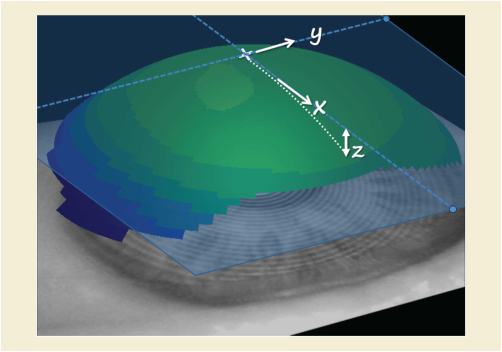
Location of the corneal vertex. This is used for the reference point for other Attributes within this SOP Instance and determined by the Image referenced in the Attribute Source Image Sequence (0008,2112). Given as column\row. Column is the horizontal offset and row is the vertical offset. Image relative position specified with sub-pixel resolution such that the origin at the Top Left Hand Corner (TLHC) of the TLHC pixel is 0.0\0.0, the Bottom Right Hand Corner (BRHC) of the TLHC pixel is 1.0\1.0, and the BRHC of the BRHC pixel is Columns\Rows (see Figure C.10.5-1). The values must be within the range 0\0 to Columns\Rows. This location shall anchor the corneal vertex at the x, y and z coordinates of 0.0, 0.0, 0.0, in mm. See Section C.8.30.3.1.4 for further explanation. |
|
Corneal Topography Surface |
(0046,0201) |
1 |
Identifies the surface of the corneal topography map. Enumerated Values:
|
|
Pupil Centroid X-Coordinate |
(0046,0203) |
1C |
The horizontal coordinate of the centroid of the pupil relative to location of the cornea vertex specified in the Attribute Corneal Vertex Location (0046,0202), in mm, such that toward the right is positive. See Section C.8.30.3.1.4 for further explanation. Required if Attribute Corneal Topography Surface (0046,0201) is A (Anterior). NoteThis Attribute is conveyed in mm from the corneal vertex because display applications will have zoom and 3-D rotational capabilities. |
|
Pupil Centroid Y-Coordinate |
(0046,0204) |
1C |
The vertical coordinate of the centroid of the pupil relative to location of the cornea vertex specified in the Attribute Corneal Vertex Location (0046,0202), in mm, such that up is positive. See Section C.8.30.3.1.4 for further explanation. Required if Attribute Corneal Topography Surface (0046,0201) is A (Anterior). NoteThis Attribute is conveyed in mm from the corneal vertex because display applications will have zoom and 3-D rotational capabilities. |
|
Equivalent Pupil Radius |
(0046,0205) |
1C |
The average physical distance in mm from the pupil centroid specified in the Attributes Pupil Centroid X-Coordinate (0046,0203) and Pupil Centroid Y-Coordinate (0046,0204) to the measured perimeter of the pupil. Required if Attribute Corneal Topography Surface (0046,0201) is A (Anterior). NoteWhen the pupil is not able to be determined the typical estimate is 4mm. |
|
Vertices of the Outline of Pupil |
(0046,0208) |
1C |
A set of row/column vertices that outline the perimeter of the pupil. Two or more pairs of values follow and are the row and column coordinates of the other vertices that outline the perimeter of the pupil. For a two dimensional curve: X1, Y1, X2, Y2, etc. The first (X) dimension corresponds to the image column (horizontal offset), and the second (Y) dimension corresponds to the image row (vertical offset). This is a Polyline and the points are to be interpreted as an n-tuple list of end points between which straight lines are to be drawn. Required if Attribute Corneal Topography Surface (0046,0201) is A (Anterior). |
|
Include Table C.8.25.10-2 “Keratometric Measurements Macro Attributes” |
|||
|
Minimum Keratometric Sequence |
(0046,0215) |
1 |
A sequence that specifies the lowest power obtained when averaging individual meridian. Only one item shall be permitted. NoteThe measurement is typically taken at 3-4 mm from the corneal vertex. |
|
>Radius of Curvature |
(0046,0075) |
1 |
The radius of curvature of the principal meridian of the cornea, measured in mm. |
|
>Keratometric Power |
(0046,0076) |
1 |
The refractive power of the cornea at the principal meridian, measured in diopters. |
|
>Keratometric Axis |
(0046,0077) |
1 |
The meridian where the keratometric radius of curvature or power is measured, measured in degrees. |
|
Simulated Keratometric Cylinder Sequence |
(0046,0218) |
1 |
A sequence that specifies simulated keratometric cylinder power of the corneal surface, measured in diopters. Only one item shall be permitted. NoteThis information is obtained from the Steep and Flat Keratometric Axis readings. |
|
>Keratometric Power |
(0046,0076) |
1 |
The refractive power of the cornea at the principal meridian, measured in diopters. |
|
>Keratometric Axis |
(0046,0077) |
1 |
The meridian where the keratometric cylinder or power is measured, measured in degrees. |
|
Average Corneal Power |
(0046,0220) |
1 |
The area-corrected average of the corneal power ahead of the entrance pupil, measured in diopters. NoteIt is generally equal to the keratometric spherical equivalent except for decentered refractive surgical procedures. It is used in intraocular lens calculations. |
|
Corneal I-S Value |
(0046,0224) |
1 |
Quantifies the inferior-superior dioptric asymmetry along the vertical meridian to discriminate Keratoconus, measured in diopters. Note
|
|
Analyzed Area |
(0046,0227) |
1 |
The corneal surface area that can be analyzed, measured in mm squared. |
|
Maximum Corneal Curvature Sequence |
(0046,0211) |
3 |
A Sequence to convey the maximum curvature and location of the measured corneal topography. Only a single Item is permitted in this sequence. |
|
>Maximum Corneal Curvature |
(0046,0212) |
1 |
Maximum curvature in diopters of the measured corneal topography. |
|
>Maximum Corneal Curvature Location |
(0046,0213) |
1 |
Location of the corneal maximum curvature. Given as column\row. Column is the horizontal offset and row is the vertical offset. Image relative position specified with sub-pixel resolution such that the origin at the Top Left Hand Corner (TLHC) of the TLHC pixel is 0.0\0.0, the Bottom Right Hand Corner (BRHC) of the TLHC pixel is 1.0\1.0, and the BRHC of the BRHC pixel is Columns\Rows (see Figure C.10.5-1). The values must be within the range 0\0 to Columns\Rows. |
|
Surface Regularity Index |
(0046,0230) |
3 |
Measures local fluctuations in corneal power (i.e., irregular astigmatism) over the pupil (no units). NoteThis value would be about 0.4 for a cornea with good optical quality; at 1.5 and higher, vision falls below normal calculations. |
|
Surface Asymmetry Index |
(0046,0232) |
3 |
This index sums the meridional mire-to-mire power changes over the entire corneal surface, increasing as topographic irregularities increase (no units). |
|
Corneal Eccentricity Index |
(0046,0234) |
3 |
Index used to measure the eccentricity of the cornea (no units). |
|
Keratoconus Prediction Index |
(0046,0236) |
3 |
Index used to indicate the presence of Keratoconus (no units) NoteIt is obtained by discrete analysis of the corneal topographic data. (e.g., Invest Ophthalmol Vis Sci 35:2749-2757, 1994). |
|
Decimal Potential Visual Acuity |
(0046,0238) |
3 |
The range of best spectacle-corrected distance that might be expected from a functionally normal eye with the topographical characteristics of the analyzed cornea, measured in decimal. Note
|
|
Corneal Topography Map Quality Evaluation |
(0046,0242) |
1C |
Identifies the quality of the topography examination. Enumerated Values:
Required if a quality rating value exists for the corneal topography map |
|
Corneal Topography Map Type Code Sequence |
(0046,0207) |
1 |
The type of corneal topography map encoded in this SOP Instance. It specifies the meaning of the pixel values. Only a single Item shall be permitted in this sequence. |
|
Corneal Topography Mapping Normals Sequence |
(0046,0210) |
1C |
Identifies the data set used for corneal topography mapping values from a normative data base. Required if a normative data base was used. Only a single Item shall be permitted in this sequence. |
|
>Include Table 10-22 “Data Set Identification Macro Attributes” |
|||
|
Source Image Sequence |
(0008,2112) |
1 |
The Image SOP Class/Instance pair of the Image that was used to generate this corneal topography map. NoteAttribute Corneal Vertex Location (0046,0202) in this corneal topography map has been generated by the source image and provides the registration of the Corneal Topography Map to the Source Image. See Section C.8.30.3.1.2 for further explanation. Only a single Item shall be permitted in this sequence. |
|
>Include Table 10-3 “Image SOP Instance Reference Macro Attributes” |
|||
|
>Purpose of Reference Code Sequence |
(0040,A170) |
1 |
Describes the purpose for which the reference is made, (i.e., the role the source image or frame(s) played in the generation of this image). Only a single Item shall be permitted in this sequence. |
|
The code used shall be (121322, DCM, "Source image for image processing operation"). |
|||
|
Source Image Corneal Processed Data Sequence |
(0046,0244) |
1 |
Attributes that contain various power, elevation and wavefront measurements at specific points on the cornea of the SOP Instance referenced in Attribute Source Image Sequence (0008,2112). The Attributes are obtained from measurements of curvature or shape of the cornea. See Section C.8.30.3.1.3 for further explanation. One or more Items shall be present. |
|
>Corneal Point Location |
(0046,0247) |
1 |
The x, y, and z coordinate of a point in the image within the cornea, in mm. Where the origin is conveyed by the Attribute Corneal Vertex Location (0046,0202). NoteFor two dimensional maps z=0. |
|
>Corneal Point Estimated |
(0046,0248) |
1 |
The point defined in Attribute Corneal Point Location (0046,0247) is an estimated point (i.e., interpolated or extrapolated; not an actual measured point). Enumerated Values:
|
|
>Axial Power |
(0046,0249) |
1 |
Conveys corneal shape characteristics, in diopters. It is determined from the curvature, r in mm, of the equivalent sphere with the same slope at a given point on the surface. Axial power = Km/r, where Km is the Keratometric Index. |
|
>Tangential Power |
(0046,0250) |
1 |
Determined from the curvature (2nd derivative = d2y/dx2) of a point on the cornea, in diopters; also called Instantaneous Power. Emphasizes irregular astigmatism (large variations in higher order aberrations). |
|
>Refractive Power |
(0046,0251) |
1 |
Conveys the optical refraction properties of the cornea, in diopters. It is determined from ray tracing using Snell's Law to calculate the true refractive power. NoteIt is used to evaluate ocular optics. |
|
>Relative Elevation |
(0046,0252) |
1 |
Relative elevation, in micrometers, is calculated from the corneal surface distance from a reference surface (i.e., a sphere or ellipsoid) that intersects the corneal vertex. This value is determined from z - zref. Where z is conveyed in Attribute Corneal Point Location (0046,0247) and zref is the elevation of the reference surface. |
|
>Corneal Wavefront |
(0046,0253) |
1 |
Corneal wavefront, in micrometers, is calculated from the elevation data by fitting with the Zernike Series expansion. NoteThis permits measurement of both low and higher order aberrations and provides the total amount of distortion of the Corneal Wavefront with a Root Mean Square (RMS) value. |
For Ophthalmic Mapping Device Type (0022,1415), Reflection corneal topography, which measures corneal curvature directly, is based on the reflection of a specific pattern from the corneal surface. Placido-based topographers use variations of circular mires, while grid-based topographers use a rectangular array of point reflections. Slit-based corneal tomography, which measures elevation directly, is based on the projection of multiple slit beams in succession through the cornea (and anterior segment). Some use the Schiempflug optical principle to achieve high resolution over a broad depth of field. Swept source OCT uses high speed scanning to produce its optical sections. Source images for these devices are shown in Figure C.8.30.3.1-1. Example A and B are for reflection types, C is an interferometry type, and D is a slit based type.
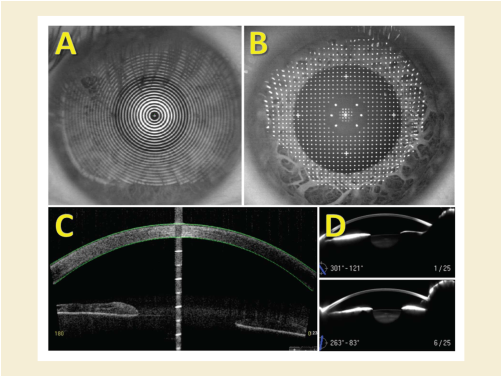
Equipment generating a corneal topography map image first obtains a source image. This image may be single frame or multi-framed such as when the Attribute Ophthalmic Mapping Device Type (0022,1415) is SLIT_BASED or INTERFEROMETRY. From this source image, the necessary measurement data is obtained to build the corneal topography map.
A typical source image may be generated by the Ophthalmic Photography 8 bit or 16 bit SOP Classes for device types of REFLECTION and SLIT_BASED. A typical source image for device type of INTERFEROMETRY would be Ophthalmic Tomography Image SOP Class.
Figure C.8.30.3.1-2 illustrates an example where the source image (left) is generated using a device type of REFLECTION. The corneal topography map and color scale is shown in the center (this is the output of this SOP Class). The right figure shows an example of the corneal topography map and color scale superimposed on the source image.
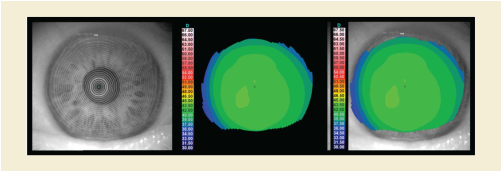
Figure C.8.30.3.1-2. Source Image (left), Corneal Topography Map Image (Center), Corneal Topography Map Presented as an Overlay on the Source Image (right)
The Source Image Corneal Processed Data Sequence (0046,0244) provides power, elevation and wavefront measurements taken at specific points of the Source Image. These Attributes were used to generate the corneal topography map and indices of this SOP Instance. This processed data can also be used to generate other corneal topography maps and indices.
The Corneal Vertex Location (0046,0202) establishes the reference point for the corneal vertex. It is used as the frame of reference that establishes the spatial relationship for the corneal vertex (i.e., used within corneal topography maps) for a set of Images within a Series. It also allows Images across multiple Series to share the same corneal vertex Frame Of Reference. The corneal vertex is the point located at the intersection of the patient's line of sight (visual axis) and the corneal surface. It is represented by the corneal light reflex when the cornea is illuminated coaxially with fixation.
Note
Since the criteria used to group images into a Series is application specific, it is possible for imaging applications to define multiple Series within a Study that share the same imaging space. Therefore the images with the same Frame of Reference UID (0020,0052) Attribute value share the same corneal vertex location within the patient's eye.
Figure C.8.30.3.1-3 illustrates the representation of corneal topography. The corneal vertex lies at the center of the rulers. Typical circular grids are 3, 5, 7, and 9 mm diameters centered on the vertex. The annotations in Figure C.8.30.3.1-3 are R, right; L, left; H = Head; F = Foot.
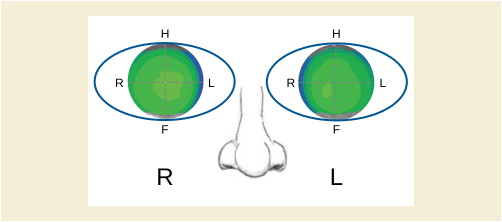
Numerical position data shall use the Cartesian (i.e., two dimensional rectangular) coordinate system. The direction of the axes are determined by Patient Orientation (0020,0020), see Section C.7.6.1.1.1 for further explanation.
Devices that internally capture data in polar coordinates will need to convert to Cartesian coordinates, see Figure C.8.30.3.1-4.
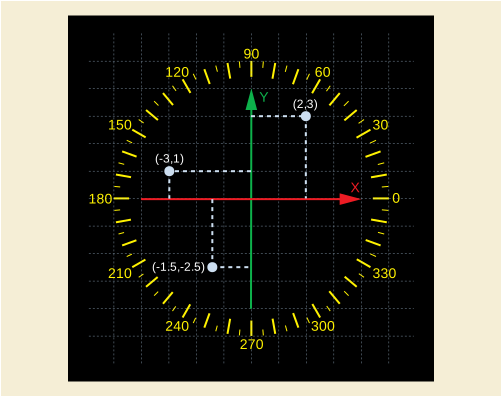
When using the 3 dimensional coordinates (X, Y, Z), the Z axis shall represent corneal elevation. Z shall be measured from the length of a vector normal to the plane that is normal to and intersects the corneal vertex at the intersection of the x, y, z, axes. It is shown in the diagram as "+" (0.0, 0.0, 0.0). The Z axis shall be positive towards the anterior direction of the eye; (i.e., it is a right-hand rule coordinate system. Thus the Z values (see Figure C.8.30.3.1-5) will be predominantly negative, as they are posterior to the plane of the corneal vertex.