The Current Requested Procedure Evidence Sequence (0040,A375) of the KO instance lists all the SOP Instances referenced in the IMAGE content items in their hierarchical Study/Series/Instance context. It is recommended that this list be transcoded to CDA Entries in a Section with Section.Title "DICOM Object Catalog" and a Section.Code of 121181 from the DICOM Controlled Terminology (see PS3.16).
Note
-
Structured Entries are not defined in CDA Release 1.
-
Since the image hypertext links in the Section narrative may refer to both an image and a softcopy presentation state, as well as possibly being constrained to specific frame numbers, in general there is not a simple mapping from the <linkHtml> to an entry. Therefore it is not expected that there would be ID reference links between the <linkHtml> and related entries.
The purpose of the Structured Entries is to allow DICOM-aware applications to access the referenced images in their hierarchical context.
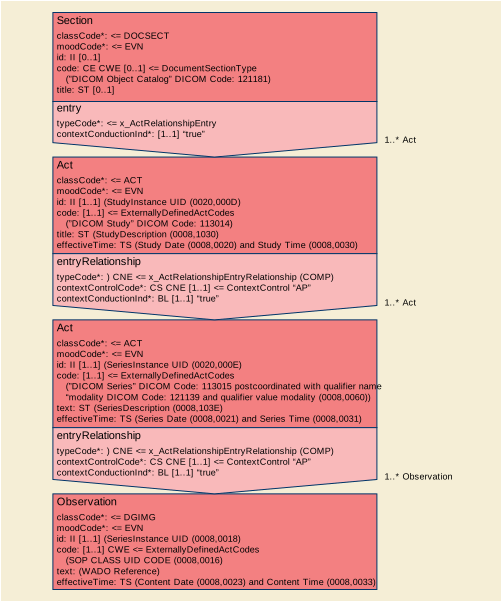
The encoding of the DICOM Object References in CDA Entries is shown in Figure X.3-1 and Tables X.3-2 through X.3-6. All of the mandatory data elements for the Entries are available in the Current Requested Procedure Evidence Sequence; optional elements (e.g., instance DateTimes) may also be included if known by the encoding application.
Note
The format of Figure X.3-1 follows the conventions of HL7 v3 Reference Information Model diagrams.
Table X.3-2. DICOM Study Reference in an HL7 V3 Act (CDA Act Entry)
|
Attribute |
Data Type |
Multiplicity |
Value |
|---|---|---|---|
|
classCode |
CS |
1..1 |
ACT |
|
moodCode |
CS |
1..1 |
EVN |
|
id |
II |
1..1 |
<Study Instance UID (0020,000D) as root property with no extension property > |
|
code |
CD |
1..1 |
<113014 as code property, 1.2.840.10008.2.16.4 as codeSystem property, DCM as codeSystemName property, "DICOM Study" as displayName property> |
|
text |
ST |
0..1 |
<Study Description (0008,1030) > |
|
effectiveTime |
TS |
0..1 |
< Study Date (0008,0020) and Study Time (0008,0030) > |
Table X.3-3. DICOM Series Reference in an HL7 V3 Act (CDA Act Entry)
|
Attribute |
Data Type |
Multiplicity |
Value |
|---|---|---|---|
|
classCode |
CS |
1..1 |
ACT |
|
moodCode |
CS |
1..1 |
EVN |
|
id |
II |
1..1 |
<Series Instance UID (0020,000E) as root property with no extension property > |
|
code |
CD |
0..1 |
<113015 as code property, 1.2.840.10008.2.16.4 as codeSystem property, DCM as codeSystemName property, "DICOM Series" as displayName property, Modality as qualifier property (see text and Table X.3-4) > |
|
text |
ST |
0..1 |
< Series Description (0008,103E) > |
|
effectiveTime |
TS |
0..1 |
< Series Date (0008,0021) and Series Time (0008,0031) > |
The code for the Act representing a Series uses a qualifier property to indicate the modality. The qualifier property is a list of coded name/value pairs. For this use, only a single list entry is used, as described in Table X.3-4.
Table X.3-4. Modality Qualifier for The Series Act.Code
|
Property |
Data Type |
Value |
|---|---|---|
|
name |
CV |
<121139 as code property, 1.2.840.10008.2.16.4 as codeSystem property, DCM as codeSystemName property, "Modality" as displayName property> |
|
value |
CD |
< Modality (0008,0060) as code property, 1.2.840.10008.2.16.4 as codeSystem property, DCM as codeSystemName property, Modality code meaning (from PS3.16) as displayName property> |
Table X.3-5. DICOM Composite Object Reference in an HL7 V3 Act (CDA Observation Entry)
|
Attribute |
Data Type |
Multiplicity |
Value |
|---|---|---|---|
|
classCode |
CS |
1..1 |
DGIMG |
|
moodCode |
CS |
1..1 |
EVN |
|
id |
II |
1..1 |
< SOP Instance UID (0008,0018) as root property with no extension property> |
|
code |
CD |
1..1 |
< SOP Class UID (0008,0016) as code property, 1.2.840.10008.2.6.1 as codeSystem property, DCMUID as codeSystemName property, SOP Class UID Name (from PS3.6) as displayName property> |
|
text |
ED |
0..1 |
<application/DICOM as mediaType property, WADO reference (see Table X.3-6) as reference property> |
|
effectiveTime |
TS |
0..1 |
< Content Date (0008,0023) and Content Time (0008,0033) > |
Note
-
The DGIMG class is used to reference all DICOM Composite Instances, not just diagnostic images.
-
The Observation.Text reference property may alternatively use a DICOM protocol based URI, rather than WADO, should such a URI be defined.
Table X.3-6. WADO Reference in an HL7 DGIMG Observation.Text
|
WADO Component |
Source |
|---|---|
|
<scheme>:// <authority> / <path> |
Configuration setting, used by the conversion process, identifying the WADO server |
|
?requestType=WADO |
Fixed |
|
&studyUID =<uid> |
Study Instance UID for referenced instance |
|
&seriesUID= <uid> |
Series Instance UID for referenced instance |
|
&objectUID= <uid> |
SOP Instance UID for referenced instance |
|
&contentType=application/DICOM |
Fixed |