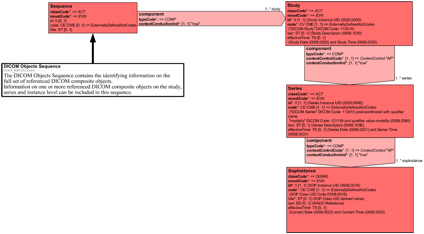
The A_DicomSequence minimal CMET is used to reference DICOM composite objects within HL7 Version 3 messages. It provides a single location for the identifying information of the study/series/instance hierarchical context of DICOM composite objects that are referenced for a specific purpose. Additional information on this context (e.g., Study Description) may optionally be added. Mappings from DICOM object attributes to the various Act attributes are provided. The CMETs for the HL7 V3 message sequence and the CDA Release 2 section are structurally identical. For the CDA section pattern different clone names are used according to the specified entry names of CDA Release 2.
Note
The A_DicomSequence minimal CMET may be used in combination with COCT_RM830120 to provide additional structured information on individual references to DICOM composite objects. COCT_RM830120 is used to put the references into the context of other acts and observations (e.g., relate referenced DICOM images to lab observations).
The following description of the act classes and act relationships contains the attribute mappings of HL7 V3 attributes to DICOM (Digital Imaging and Communications in Medicine) tags. The group and element number of the mapped DICOM tags are listed in parenthesis. The CDA mappings specify the use of the CMET act classes and act relationships for a CDA Release 2 document section that contains section entries.
The DICOM Objects Sequence contains the identifying information on DICOM composite objects referenced in a HL7 V3 message for a specific purpose. The sequence can be used for any HL7 V3 message that includes references to composite DICOM objects, such as images and structured reports. Information on one or more referenced DICOM composite objects on the study, series and instance level can be included in a sequence.
Table A.7.1-1. Sequence Act
|
Attribute |
Data Type |
Multiplicity |
Value |
|---|---|---|---|
|
classCode |
CS |
1..1 |
ACT |
|
moodCode |
CS |
1..1 |
EVN |
|
id |
II |
0..1 |
Sequence Identifier |
|
code |
CE |
1..1 |
Externally defined DICOM codes, e.g., <121181 as code property, 1.2.840.10008.2.16.4 as codeSystem property, DCM as codeSystemName property, e.g., "DICOM Object Catalog" as displayName property> |
|
title |
ST |
0..1 |
<e.g., "DICOM Object Catalog"> |
Section (replaces Sequence)
The CDA DICOM Objects Section contains the identifying information on DICOM composite objects referenced in a CDA Release 2 document for a specific purpose. The CDA DICOM Objects Section can be used within any CDA Release 2 document that includes references to composite DICOM objects in the structured part of the CDA document, such as images and structured reports. Information on one or more referenced DICOM composite objects on the study, series and instance level can be included in this section.
Table A.7.1-2. Section Act
|
Attribute |
Data Type |
Multiplicity |
Value |
|---|---|---|---|
|
classCode |
CS |
1..1 |
ACT |
|
moodCode |
CS |
1..1 |
EVN |
|
id |
II |
0..1 |
Section Identifier |
|
code |
CE |
1..1 |
Externally defined DICOM codes, e.g., <121181 as code property, 1.2.840.10008.2.16.4 as codeSystem property, DCM as codeSystemName property, e.g., "DICOM Object Catalog" as displayName property> |
|
title |
ST |
0..1 |
<e.g., "DICOM Object Catalog"> |
Section X.3.5 Structured Entries in PS3.17 specifies the semantics of the section e.g., "DICOM Object Catalog" (DICOM Code Value: 121181) that contains information on the full set of DICOM composite objects referenced in the CDA document:
“It is recommended that this list be transcoded to CDA Entries in a Section with Section.Title "DICOM Object Catalog" and a Section.Code of 121181 from the DICOM Controlled Terminology (refer to PS3.16).”
This actRelationship "COMPONENT" is used to link Sequence with one or more associated study acts.
The Study act class contains the DICOM study information that defines the characteristics of a referenced medical study performed on a patient. A study is a collection of one or more series of medical images, presentation states, SR documents, overlays and/or curves that are logically related for the purpose of diagnosing a patient. Each study is associated with exactly one patient. A study may include composite instances that are created by a single modality, multiple modalities or by multiple devices of the same modality. The study information is modality independent.
Table A.7.1-3. DICOM Study Reference in an HL7 V3 Act
|
Attribute |
Data Type |
Multiplicity |
Value |
|---|---|---|---|
|
classCode |
CS |
1..1 |
ACT |
|
moodCode |
CS |
1..1 |
EVN |
|
templateId |
LIST<II> |
1..* |
|
|
id |
II |
1..1 |
<Study Instance UID (0020,000D) as root property with no extension property>: Unique identifier for the Study |
|
code |
CV |
1..1 |
<113014 as code property, 1.2.840.10008.2.16.4 as codeSystem property, DCM as codeSystemName property, "DICOM Study" as displayName property> |
|
text |
ST |
0..1 |
<Study Description (0008,1030) > Institution-generated description or classification of the Study (component) performed. |
|
effectiveTime |
TS |
0..1 |
<Study Date (0008,0020): Date the Study started; and Study Time (0008,0030): Time the Study started.> |
-
Act clone name of the CDA entry is "Act" instead of "Study". The attributes and attribute values of this CDA entry "Act" are identical to those listed in table 3.
-
templateId value (Table A.7.1-3): Set root portion of II to "2.16.840.1.113883.10.20.6.2.6"
(identifies the template that defines constraints on "Study Act" of CDA Diagnostic Imaging Reports as specified by CDA R2 DIR IG).
This actRelationship "COMPONENT" is used to link one study act with one or more associated series acts.
-
ActRelationship Clone name: entryRelationship (replaces COMPONENT)
-
ActRelationship.typeCode: x_ActRelationshipEntry (Constraint: Fixed value = COMP)
-
ActRelationship.contextControlCode: "AP" (Additive Propagating)
-
ContextConductionInd: "true"
The Series act class contains the DICOM series information for referenced DICOM composite objects. The series information defines the attributes that are used to group composite instances into distinct logical sets. Each series is associated with exactly one study.
Table A.7.1-4. DICOM Series Reference in an HL7 V3 Act
|
Attribute |
Data Type |
Multiplicity |
Value |
|---|---|---|---|
|
classCode |
CS |
1..1 |
ACT |
|
moodCode |
CS |
1..1 |
EVN |
|
id |
II |
1..1 |
< Series Instance UID (0020,000E) as root property with no extension property>: Unique identifier of the Series. |
|
code |
CD |
0..1 |
<113015 as code property, 1.2.840.10008.2.16.4 as codeSystem property, DCM as codeSystemName property, "DICOM Series" as displayName property, Modality as qualifier property (see text and Table A.7.1-5) > |
|
text |
ST |
0..1 |
< Series Description (0008,103E)> User provided description of the Series |
|
effectiveTime |
TS |
0..1 |
< Series Date (0008,0021): Date the Series started. and Series Time (0008,0031): Time the Series started.> |
The code for the Act representing a Series uses a qualifier property to indicate the modality. The qualifier property is a list of coded name/value pairs. For this use, only a single list entry is used, as described in Table A.7.1-5.
Table A.7.1-5. Modality Qualifier for the Series Act.code
|
Property |
Data Type |
Value |
|---|---|---|
|
name |
CV |
<121139 as code property, 1.2.840.10008.2.16.4 as codeSystem property, DCM as codeSystemName property, "Modality" as displayName property> |
|
value |
CD |
< Modality (0008,0060) as code property, 1.2.840.10008.2.16.4 as codeSystem property, DCM as codeSystemName property, Modality code meaning (PS3.16) as displayName property> |
-
Act Clone Name: Act
-
Act clone name of the CDA entry is "Act" instead of "Series". The attributes and attribute values of this CDA entry "Act" are identical to those listed in Table A.7.1-4 and Table A.7.1-5.
This actRelationship "COMPONENT" is used to link one series act with one or more associated SopInstance acts.
-
ActRelationship Clone name: entryRelationship (replaces COMPONENT)
-
ActRelationship.typeCode: x_ActRelationshipEntry (Constraint: Fixed value = COMP)
-
ActRelationship.contextControlCode: "AP" (Additive Propagating)
-
ContextConductionInd: "true"
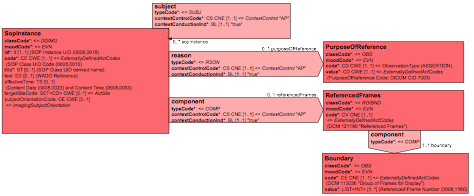
The A_DicomCompositeObjectReference minimal pattern has been updated for harmonization with the HL7 V3 assertion pattern. It is used to reference DICOM composite objects within HL7 Version 3 messages in the context of acts and observations. It provides detailed information on the referenced DICOM composite object such as images, presentation states and DICOM structured documents. Mappings from DICOM object attributes to the various Act attributes are provided. The CMETs for the HL7 V3 message DICOM composite object references and the corresponding CDA Release 2 section entries are structurally identical. For the CDA section entries different clone names are used according to the specified entry names in the CDA Release 2.
Note
The A_DicomCompositeObjectReference minimal CMET COCT_RM830120 may be used in combination with COCT_RM830110 that provides a single location for lookup of referenced DICOM composite objects of an HL7 V3 message (identifying information on the DICOM study/series/instance hierarchy can be found there).
The following description of the act classes and act relationships contains the attribute mappings of HL7 V3 attributes to DICOM (Digital Imaging and Communications in Medicine) tags. The group and element number of the mapped DICOM tags are listed in parenthesis. The CDA mappings specify the use of the CMET act classes and act relationships as CDA Release 2 document section entries.
The SopInstance act class contains the DICOM Service Object Pair (SOP) Instance information for referenced DICOM composite objects. The SopInstance act class is used to reference both, image and non-image DICOM instances. The text attribute contains the DICOM WADO (PS 3.18 Web Access to DICOM Objects) reference.
Table A.7.2-1. DICOM Composite Object Reference in an HL7 V3 Act
|
Attribute |
Data Type |
Multiplicity |
Value |
|---|---|---|---|
|
classCode |
CS |
1..1 |
DGIMG |
|
moodCode |
CS |
1..1 |
EVN |
|
templateId |
LIST<II> |
1..* |
|
|
id |
II |
1..1 |
< SOP Instance UID (0008,0018) as root property with no extension property> Uniquely identifies the SOP Instance. |
|
code |
CE |
1..1 |
< SOP Class UID (0008,0016) as code property, 1.2.840.10008.2.6.1 as codeSystem property, DCMUID as codeSystemName property, SOP Class UID Name (from PS3.6) as displayName property>: Unique Identifier for the SOP Class as Code Property |
|
title |
ST |
0..1 |
SOP Class UID derived name |
|
text |
ED |
0..1 |
<"application/DICOM" as mediaType property, WADO reference (see Table A.7.2-2) as reference property> |
|
effectiveTime |
TS |
0..1 |
< Content Date (0008,0023): The date the content creation (e.g., image pixel data, document) started; and Content Time (0008,0033): The time the content creation (e.g., image pixel data, document) started. > |
The DGIMG classCode is used to reference all DICOM Composite Instances, not just diagnostic images.
WADO is a service that enables the Web Client System to retrieve DICOM Persistent Objects managed by a Web Enabled DICOM Server, through the HTTP/HTTPs protocol. The WADO reference uses an URI with query parameters (Table A.7.2-2). Access to the content of a data object is enabled by specifying a "link" pointing to a specific DICOM Persistent Object by means of its URL/URI and specifying its DICOM object Instance UID and the transfer syntax to be employed.
Table A.7.2-2. WADO Reference in HL7 DGIMG Observation.text
|
WADO Component |
Source |
|---|---|
|
<scheme>://<authority>/<path> |
Configuration setting, used by the conversion process, identifying the WADO server |
|
?requestType=WADO |
Fixed |
|
&studyUID=<uid> |
Study Instance UID for referenced instance |
|
&seriesUID=<uid> |
Series Instance UID for referenced instance |
|
&objectUID=<uid> |
SOP Instance UID for referenced instance |
|
&contentType=application/DICOM |
Fixed |
-
Act clone name of the CDA entry is "Observation" instead of "SopInstance". The attributes and attribute values of this CDA entry "Observation" are identical to those listed in table 1 and 2, except for the optional title attribute (Value: SOP Class UID derived name) that is not mapped because it is not supported by CDA Act Entries.
-
templateId value (Table A.7.1-1): Set root portion of II to "2.16.840.1.113883.10.20.6.2.8" (identifies the template that defines constraints on "SopInstance Observation" of CDA Diagnostic Imaging Reports as specified by CDA R2 DIR IG).
This optional recursive "SUBJECT" actRelationship is used to link a referenced DICOM Presentation State to one or more associated referenced DICOM images (SopInstance act class is used in both cases) it is applied to.
-
ActRelationship Clone name: entryRelationship (replaces SUBJECT)
-
ActRelationship.typeCode: x_ActRelationshipEntry (Constraint: Fixed value = SUBJ)
-
ActRelationship.contextControlCode: "AP" (Additive Propagating)
-
ContextConductionInd: "true"
This optional "REASON" actRelationship is used to relate a referenced DICOM composite object (SopInstance ActClass) with the PurposeOfReference ActClass that includes the coded purpose(s) of reference.
-
ActRelationship Clone name: entryRelationship (replaces REASON)
-
ActRelationship.typeCode: x_ActRelationshipEntry (Constraint: Fixed value = RSON)
-
ActRelationship.contextControlCode: "AP" (Additive Propagating)
-
ContextConductionInd: "true"
Describes the purpose the DICOM composite object reference is made for. Appropriate codes such as externally defined DICOM codes may be used to specify the semantics of the purpose of reference. When absent, implies that the reason for the reference is unknown.
Codes specified in PS3.16 shall be used to designate the coded purpose of reference by using the value attribute. Candidate codes are contained in the DICOM Context Group 7003. The attribute mapping for the code attributes are listed in table 3.
Table A.7.2-3. DICOM Coded Purpose of Reference in an HL7 V3 Act
|
Attribute |
Data Type |
Multiplicity |
Value |
|---|---|---|---|
|
classCode |
CS |
1..1 |
OBS |
|
moodCode |
CS |
1..1 |
EVN |
|
templateId |
LIST<II> |
1..* |
|
|
code |
CD |
1..1 |
<"ASSERTION" as code property, 2.16.840.1.113883.5.4 as codeSystem property> (HL7 observation type code specified for assertions) |
|
value |
CD |
1..1 |
< Code Value (0008,0100) as code property, 1.2.840.10008.2.16.4 as codeSystem property, Coding Scheme Designator (0008,0102) as codeSystemName property, Code Meaning (0008,0104) as displayName property> |
-
Act Clone Name: Observation
-
Act clone name of the CDA entry is "Observation" instead of "PurposeOfReference"
-
The attributes and attribute values of this "Observation" CDA entry are identical to those listed in table 3
-
templateId value (Table A.7.1-3): Set root portion of II to "2.16.840.1.113883.10.20.6.2.9" (identifies the template that defines constraints on "Purpose of Reference Observation" of CDA Diagnostic Imaging Reports as specified by CDA R2 DIR IG).
This optional "COMPONENT" actRelationship is used to link a referenced DICOM composite object to one or more frames of a DICOM multi-frame image SOP instance.
-
ActRelationship Clone name: entryRelationship (replaces COMPONENT)
-
ActRelationship.typeCode: x_ActRelationshipEntry (Constraint: Fixed value = COMP)
-
ActRelationship.contextControlCode: "AP" (Additive Propagating)
-
ContextConductionInd: "true"
This act class shall be used if the referenced DICOM SOP instance is a multi-frame image and the reference does not apply to all frames. The list of integer values for the referenced frames of a DICOM multi-frame image SOP instance is contained in the Boundary ActClass.
Table A.7.2-4. DICOM Referenced Frames in an HL7 V3 Act
|
Attribute |
Data Type |
Multiplicity |
Value |
|---|---|---|---|
|
classCode |
CS |
1..1 |
ROIBND |
|
moodCode |
CS |
1..1 |
EVN |
|
templateId |
LIST<II> |
1..* |
|
|
code |
CV |
1..1 |
< Code Value (0008,0100): 121190 as code property, 1.2.840.10008.2.16.4 as codeSystem property, DCM as codeSystemName property, Code Meaning (0008,0104): "Referenced Frames" as displayName property> |
-
Act Clone Name: Observation
-
Act clone name of the CDA entry is "Observation" instead of "ReferencedFrames"
-
templateId value (Table A.7.1-4): Set root portion of II to "2.16.840.1.113883.10.20.6.2.10" (identifies the template that defines constraints on "Referenced Frames Observation" of CDA Diagnostic Imaging Reports as specified by CDA R2 DIR IG).
This "COMPONENT" actRelationship is used to link the ReferencedFrames ActClass to the Boundary ActClass that contains the list of integer values for the referenced frames of a DICOM multi-frame image SOP instance.
The act class contains a list of integer values for the referenced frames of a DICOM multi-frame image SOP instance. It identifies the frame numbers within the Referenced SOP Instance to which the reference applies. The first frame shall be denoted as frame number 1. This act class shall be used if the referenced DICOM SOP instance is a multi-frame image and the reference does not apply to all frames.
Table A.7.2-5. Boundary Act Class
|
Attribute |
Data Type |
Multiplicity |
Value |
|---|---|---|---|
|
classCode |
CS |
1..1 |
OBS |
|
moodCode |
CS |
1..1 |
EVN |
|
templateId |
LIST<II> |
1..* |
|
|
code |
CE |
1..1 |
< Code Value (0008,0100): 113036 as code property, 1.2.840.10008.2.16.4 as codeSystem property, DCM as codeSystemName property, Code Meaning (0008,0104): "Group of Frames for Display" as displayName property > |
|
value |
LIST<INT> |
1..* |
< Referenced Frame Number (0008,1160)> Identifies the frame numbers within the Referenced SOP Instance to which the reference applies. The first frame shall be denoted as frame number 1. Values shall be provided if the Referenced SOP Instance is a multi-frame image and the reference does not apply to all frames. |
-
Act Clone Name: ObservationAct clone name of the CDA entry is "Observation" instead of "Boundary".
-
templateId value (Table A.7.1-5): Set root portion of II to "2.16.840.1.113883.10.20.6.2.11" (identifies the template that defines constraints on "Boundary Observation" of CDA Diagnostic Imaging Reports as specified by CDA R2 DIR IG).