Table of Contents
- Notice and Disclaimer
- Foreword
- 1. Scope and Field of Application
- 2. Normative References
- 3. Definitions
- 4. Symbols and Abbreviations
- 5. Conventions
- 6. DICOM Information Model
- 7. DICOM Model of the Real World
- 7.1. DICOM Information Model
- 7.2. Organization of Annexes A, B and C
- 7.3. Extension of the DICOM Model of the Real World
- 7.3.1. Definition of the Extensions of the DICOM Real World Model
- 7.3.1.1. Patient
- 7.3.1.2. Service Episode and Visit
- 7.3.1.3. Imaging Service Request
- 7.3.1.4. Procedure Type
- 7.3.1.5. Requested Procedure
- 7.3.1.6. Scheduled Procedure Step
- 7.3.1.7. Procedure Plan
- 7.3.1.8. Protocol
- 7.3.1.9. Modality Performed Procedure Step
- 7.3.1.10. General Purpose Scheduled Procedure Step (Retired)
- 7.3.1.11. General Purpose Performed Procedure Step (Retired)
- 7.3.1.12. Workitem (Retired)
- 7.3.1.13. Clinical Document
- 7.4. Extension of the DICOM Model of the Real World for the General Purpose Worklist (Retired)
- 7.5. Organizing Large Sets of Information
- 7.6. Extension of the DICOM Model of the Real World for Clinical Trials
- 7.7. Extension of the DICOM Model of the Real World for Hanging Protocols
- 7.8. Extension of the DICOM Model of the Real World for Color Palettes
- 7.9. Extension of the DICOM Model of the Real World for Specimens
- 7.10. Extension of DICOM Model of the Real World for Implant Templates
- 7.11. Extension of the DICOM Model of the Real World for the Unified Procedure Step (UPS)
- 7.12. Extension of The DICOM Model of The Real World For Display System
- 8. Encoding of Coded Entry Data
- 9. Template Identification Macro (Retired)
- 10. Miscellaneous Macros
- 10.1. Person Identification Macro
- 10.2. Content Item Macro
- 10.3. Image SOP Instance Reference Macro
- 10.4. Series and Instance Reference Macro
- 10.5. General Anatomy Macros
- 10.6. Request Attributes Macro
- 10.7. Basic Pixel Spacing Calibration Macro
- 10.8. SOP Instance Reference Macro
- 10.9. Content Identification Macro
- 10.10. General Contributing Sources Macro
- 10.11. Contributing Image Sources Macro
- 10.12. Patient Orientation Macro
- 10.13. Performed Procedure Step Summary Macro
- 10.14. HL7v2 Hierarchic Designator Macro
- 10.15. Issuer of Patient ID Macro
- 10.16. Algorithm Identification Macro
- 10.17. Selector Attribute Macro
- 10.18. Data Set Identification Macro
- 10.19. Exposure Index Macro
- 10.20. Mandatory View and Slice Progression Direction Macro
- 10.21. Optional View and Slice Progression Direction Macro
- 10.22. Numeric Value Macro
- 10.23. RT Equipment Correlation Macro
- A. Composite Information Object Definitions (Normative)
- A.1. Elements of An Information Object Definition
- A.1.1. IOD Description
- A.1.2. IOD Entity-Relationship Model
- A.1.2.1. Patient IE
- A.1.2.2. Study IE
- A.1.2.3. Series IE
- A.1.2.4. Equipment IE
- A.1.2.5. Frame of Reference IE
- A.1.2.6. Image IE
- A.1.2.7. Overlay IE
- A.1.2.8. Curve IE
- A.1.2.9. Modality LUT IE
- A.1.2.10. VOI LUT IE
- A.1.2.11. Presentation State IE
- A.1.2.12. Waveform IE
- A.1.2.13. SR Document IE
- A.1.2.14. MR Spectroscopy IE
- A.1.2.15. Raw Data IE
- A.1.2.16. Encapsulated Document IE
- A.1.2.17. Real World Value Mapping IE
- A.1.2.18. Surface IE
- A.1.2.19. Measurements IE
- A.1.3. IOD Module Table and Functional Group Macro Table
- A.1.4. Overview of the Composite IOD Module Content
- A.2. Computed Radiography Image IOD
- A.3. Computed Tomography Image IOD
- A.4. Magnetic Resonance Image IOD
- A.5. Nuclear Medicine Image IOD
- A.6. Ultrasound Image IOD
- A.7. Ultrasound Multi-frame Image IOD
- A.8. Secondary Capture Image IOD
- A.8.1. SC Image Information Objection Definition
- A.8.2. Multi-frame Single Bit Secondary Capture Image IOD
- A.8.3. Multi-frame Grayscale Byte Secondary Capture Image IOD
- A.8.3.1. Multi-frame Grayscale Byte Image IOD Description
- A.8.3.2. Multi-frame Grayscale Byte SC Image IOD Entity-Relationship Model
- A.8.3.3. Multi-frame Grayscale Byte SC Image IOD Module Table
- A.8.3.4. Multi-frame Grayscale Byte SC Image IOD Content Constraints
- A.8.3.5. Multi-frame Grayscale Byte SC Image Functional Group Macros
- A.8.4. Multi-frame Grayscale Word Secondary Capture Image IOD
- A.8.4.1. Multi-frame Grayscale Word SC Image IOD Description
- A.8.4.2. Multi-frame Grayscale Word SC Image IOD Entity-Relationship Model
- A.8.4.3. Multi-frame Grayscale Word SC Image IOD Module Table
- A.8.4.4. Multi-frame Grayscale Word SC Image IOD Content Constraints
- A.8.4.5. Multi-frame Grayscale Word SC Image Functional Group Macros
- A.8.5. Multi-frame True Color Secondary Capture Image IOD
- A.8.5.1. Multi-frame True Color Image IOD Description
- A.8.5.2. Multi-frame True Color SC Image IOD Entity-Relationship Model
- A.8.5.3. Multi-frame True Color SC Image IOD Module Table
- A.8.5.4. Multi-frame True Color SC Image IOD Content Constraints
- A.8.5.5. Multi-frame True Color SC Image Functional Group Macros
- A.9. Standalone Overlay IOD
- A.10. Standalone Curve IOD
- A.11. Basic Study Descriptor IOD
- A.12. Standalone Modality LUT IOD
- A.13. Standalone VOI LUT IOD
- A.14. X-Ray Angiographic Image IOD
- A.15. X-Ray Angiographic Bi-plane Image Information Object Definition (Retired)
- A.16. X-Ray RF Image IOD
- A.17. RT Image IOD
- A.18. RT Dose IOD
- A.19. RT Structure Set IOD
- A.20. RT Plan IOD
- A.21. Positron Emission Tomography Image IOD
- A.22. Standalone PET Curve IOD
- A.23. Stored Print IOD
- A.24. Hardcopy Grayscale Image IOD
- A.25. Hardcopy Color Image IOD
- A.26. Digital X-Ray Image IOD
- A.27. Digital Mammography X-Ray Image IOD
- A.28. Digital Intra-Oral X-Ray Image IOD
- A.29. RT Beams Treatment Record IOD
- A.30. RT Brachy Treatment Record IOD
- A.31. RT Treatment Summary Record IOD
- A.32. Visible Light Image Information Object Definitions
- A.32.1. VL Endoscopic Image IOD
- A.32.2. VL Microscopic Image IOD
- A.32.3. VL Slide-coordinates Microscopic Image IOD
- A.32.4. VL Photographic Image IOD
- A.32.5. Video Endoscopic Image IOD
- A.32.6. Video Microscopic Image IOD
- A.32.7. Video Photographic Image IOD
- A.32.8. VL Whole Slide Microscopy Image IOD
- A.33. Softcopy Presentation State Information Object Definitions
- A.34. Waveform Information Object Definitions
- A.34.1. Waveform IOD Entity-Relationship Model
- A.34.2. Basic Voice Audio IOD
- A.34.3. 12-Lead Electrocardiogram IOD
- A.34.3.1. 12-Lead ECG IOD Description
- A.34.3.2. 12-Lead ECG IOD Entity-Relationship Model
- A.34.3.3. 12-Lead ECG IOD Module Table
- A.34.3.4. 12-Lead ECG IOD Content Constraints
- A.34.3.4.1. Modality
- A.34.3.4.2. Acquisition Context Module
- A.34.3.4.3. Waveform Sequence
- A.34.3.4.4. Number of Waveform Channels
- A.34.3.4.5. Number of Waveform Samples
- A.34.3.4.6. Sampling Frequency
- A.34.3.4.7. Channel Source
- A.34.3.4.8. Waveform Sample Interpretation
- A.34.3.4.9. Waveform Annotation Module
- A.34.4. General Electrocardiogram IOD
- A.34.5. Ambulatory Electrocardiogram IOD
- A.34.6. Hemodynamic IOD
- A.34.7. Basic Cardiac Electrophysiology IOD
- A.34.8. Arterial Pulse Waveform IOD
- A.34.9. Respiratory Waveform IOD
- A.34.10. General Audio Waveform IOD
- A.35. Structured Report Document Information Object Definitions
- A.35.1. Basic Text SR IOD
- A.35.2. Enhanced SR IOD
- A.35.3. Comprehensive SR IOD
- A.35.4. Key Object Selection Document IOD
- A.35.5. Mammography CAD SR IOD
- A.35.6. Chest CAD SR IOD
- A.35.7. Procedure Log IOD
- A.35.8. X-Ray Radiation Dose SR IOD
- A.35.9. Spectacle Prescription Report IOD
- A.35.10. Colon CAD SR IOD
- A.35.11. Macular Grid Thickness and Volume Report IOD
- A.35.12. Implantation Plan SR Document IOD
- A.35.13. Comprehensive 3D SR IOD
- A.35.14. Radiopharmaceutical Radiation Dose SR Information Object Definition
- A.36. Enhanced MR Information Object Definitions
- A.37. Raw Data IOD
- A.38. Enhanced Computed Tomography Image IOD
- A.39. Spatial Registration Information Object Definitions
- A.40. Spatial Fiducials IOD
- A.41. Ophthalmic Photography 8 Bit Image IOD
- A.42. Ophthalmic Photography 16 Bit Image IOD
- A.43. Stereometric Relationship IOD
- A.44. Hanging Protocol IOD
- A.45. Encapsulated Document IOD
- A.46. Real World Value Mapping IOD
- A.47. Enhanced X-Ray Angiographic Image IOD
- A.48. Enhanced X-Ray RF Image IOD
- A.49. RT Ion Plan IOD
- A.50. RT Ion Beams Treatment Record IOD
- A.51. Segmentation IOD
- A.52. Ophthalmic Tomography Image IOD
- A.53. X-Ray 3D Angiographic Image IOD
- A.54. X-Ray 3D Craniofacial Image IOD
- A.55. Breast Tomosynthesis Image IOD
- A.56. Enhanced PET Image IOD
- A.57. Surface Segmentation IOD
- A.58. Color Palette IOD
- A.59. Enhanced US Volume IOD
- A.60. Ophthalmic Refractive Measurements Information Object Definitions
- A.61. Generic Implant Template IOD
- A.62. Implant Assembly Template IOD
- A.63. Implant Template Group IOD
- A.64. RT Beams Delivery Instruction IOD
- A.65. Ophthalmic Visual Field Static Perimetry Measurements IOD
- A.66. Intravascular OCT IOD
- A.67. Ophthalmic Thickness Map IOD
- A.68. Surface Scan Mesh IOD
- A.69. Surface Scan Point Cloud IOD
- A.70. Legacy Converted Enhanced CT Image IOD
- A.71. Legacy Converted Enhanced MR Image IOD
- A.72. Legacy Converted Enhanced PET Image IOD
- A.73. Corneal Topography Map IOD
- A.74. Breast Projection X-Ray Image Information Object Definition
- B. Normalized Information Object Definitions (Normative)
- B.1. Patient Information Object Definition
- B.2. Visit Information Object Definition
- B.3. Study Information Object Definition
- B.4. Study Component Information Object Definition
- B.5. Results Information Object Definition
- B.6. Interpretation Information Object Definition
- B.7. Basic Film Session Information Object Definition
- B.8. Basic Film Box Information Object Definition
- B.9. Basic Image Box Information Object Definition
- B.10. Basic Annotation Box Information Object Definition
- B.11. Print Job Information Object Definition
- B.12. Printer Information Object Definition
- B.13. VOI LUT Box Information Object Definition (Retired)
- B.14. Image Overlay Box Information Object Definition (Retired)
- B.15. Storage Commitment Information Object Definition
- B.16. Print Queue Information Object Definition
- B.17. Modality Performed Procedure Step Information Object Definition
- B.18. Presentation LUT Information Object Definition
- B.19. Pull Print Request Information Object Definition
- B.20. Printer Configuration Information Object Definition
- B.21. Basic Print Image Overlay Box Information Object Definition
- B.22. General Purpose Scheduled Procedure Step Information Object Definition (Retired)
- B.23. General Purpose Performed Procedure Step Information Object Definition (Retired)
- B.24. Instance Availability Notification Information Object Definition
- B.25. Media Creation Management Information Object Definition
- B.26. Unified Procedure Step Information Object Definition
- B.27. RT Conventional Machine Verification Information Object Definition
- B.28. RT Ion Machine Verification Information Object Definition
- B.29. Display System Information Object Definition
- C. Information Module Definitions (Normative)
- C.1. Elements of a Module Definition
- C.2. Patient Modules
- C.3. Visit Modules
- C.4. Study Modules
- C.4.1. Study Relationship Module
- C.4.2. Study Identification Module
- C.4.3. Study Classification Module
- C.4.4. Study Scheduling Module
- C.4.5. Study Acquisition Module
- C.4.6. Study Read Module
- C.4.7. Study Component Module
- C.4.8. Study Component Relationship Module
- C.4.9. Study Component Acquisition Module
- C.4.10. Scheduled Procedure Step Module
- C.4.11. Requested Procedure Module
- C.4.12. Imaging Service Request Module
- C.4.13. Performed Procedure Step Relationship
- C.4.14. Performed Procedure Step Information
- C.4.15. Image Acquisition Results Module
- C.4.16. Radiation Dose Module
- C.4.17. Billing and Material Management Codes
- C.4.18. General Purpose Scheduled Procedure Step Relationship Module (Retired)
- C.4.19. General Purpose Scheduled Procedure Step Information Module (Retired)
- C.4.20. General Purpose Performed Procedure Step Relationship Module (Retired)
- C.4.21. General Purpose Performed Procedure Step Information Module (Retired)
- C.4.22. General Purpose Results (Retired)
- C.4.23. Instance Availability Notification Module
- C.5. Results Modules
- C.6. Interpretation Modules
- C.7. Common Composite Image IOD Modules
- C.7.1. Common Patient IE Modules
- C.7.2. Common Study IE Modules
- C.7.3. Common Series IE Modules
- C.7.4. Common Frame of Reference Information Entity Modules
- C.7.5. Common Equipment IE Modules
- C.7.6. Common Image IE Modules
- C.7.6.1. General Image Module
- C.7.6.2. Image Plane Module
- C.7.6.3. Image Pixel Module
- C.7.6.4. Contrast/Bolus Module
- C.7.6.4b. Enhanced Contrast/Bolus Module
- C.7.6.5. Cine Module
- C.7.6.6. Multi-frame Module
- C.7.6.7. Bi-plane Sequence Module (Retired)
- C.7.6.8. Bi-plane Image Module (Retired)
- C.7.6.9. Frame Pointers Module
- C.7.6.10. Mask Module
- C.7.6.11. Display Shutter Module
- C.7.6.12. Device Module
- C.7.6.13. Intervention Module
- C.7.6.14. Acquisition Context Module
- C.7.6.15. Bitmap Display Shutter Module
- C.7.6.16. Multi-frame Functional Groups Module
- C.7.6.16.1. Multi-frame Functional Groups Module Attribute Description
- C.7.6.16.2. Common Functional Group Macros
- C.7.6.16.2.1. Pixel Measures Macro
- C.7.6.16.2.2. Frame Content Macro
- C.7.6.16.2.2.1. Timing Parameter Relationships
- C.7.6.16.2.2.2. Frame Reference DateTime
- C.7.6.16.2.2.3. Frame Acquisition Duration
- C.7.6.16.2.2.4. Concatenations and Stacks
- C.7.6.16.2.2.5. Frame Label
- C.7.6.16.2.2.6. Temporal Position Index and Stack ID in PET images
- C.7.6.16.2.2.7. Stack ID usage in PET static, whole body and gated images
- C.7.6.16.2.3. Plane Position (Patient) Macro
- C.7.6.16.2.4. Plane Orientation (Patient) Macro
- C.7.6.16.2.5. Referenced Image Macro
- C.7.6.16.2.6. Derivation Image Macro
- C.7.6.16.2.7. Cardiac Synchronization Macro
- C.7.6.16.2.8. Frame Anatomy Macro
- C.7.6.16.2.9. Pixel Value Transformation Macro
- C.7.6.16.2.9b. Identity Pixel Value Transformation Macro
- C.7.6.16.2.10. Frame VOI LUT Macro
- C.7.6.16.2.10b. Frame VOI LUT With LUT Macro
- C.7.6.16.2.11. Real World Value Mapping Macro
- C.7.6.16.2.12. Contrast/Bolus Usage Macro
- C.7.6.16.2.13. Pixel Intensity Relationship LUT Macro
- C.7.6.16.2.14. Frame Pixel Shift Macro
- C.7.6.16.2.15. Patient Orientation in Frame Macro
- C.7.6.16.2.16. Frame Display Shutter
- C.7.6.16.2.17. Respiratory Synchronization Macro
- C.7.6.16.2.18. Irradiation Event Identification Macro
- C.7.6.16.2.19. Radiopharmaceutical Usage Macro
- C.7.6.16.2.20. Patient Physiological State Macro
- C.7.6.16.2.21. Plane Position (Volume) Macro
- C.7.6.16.2.22. Plane Orientation (Volume) Macro
- C.7.6.16.2.23. Temporal Position Macro
- C.7.6.16.2.24. Image Data Type Macro
- C.7.6.16.2.25. Unassigned Shared and Per-frame Converted Attributes Macros
- C.7.6.17. Multi-frame Dimension Module
- C.7.6.18. Physiological Synchronization
- C.7.6.19. Supplemental Palette Color Lookup Table Module
- C.7.6.20. Patient Orientation Module
- C.7.6.21. Image - Equipment Coordinate Relationship Module
- C.7.6.22. Specimen Module
- C.7.6.23. Enhanced Palette Color Lookup Table Module
- C.7.7. Patient Summary Module
- C.7.8. Study Content Module
- C.7.9. Palette Color Lookup Table Module
- C.8. Modality Specific Modules
- C.8.1. Computed Radiography Modules
- C.8.2. CT Modules
- C.8.3. MR Modules
- C.8.4. Nuclear Medicine Modules
- C.8.4.1. NM Series Module (Retired)
- C.8.4.2. NM Equipment Module (Retired)
- C.8.4.3. NM Image Module (Retired)
- C.8.4.4. NM Spect Acquisition Image Module (Retired)
- C.8.4.5. NM Multi-gated Acquisition Image Module (Retired)
- C.8.4.6. NM/PET Patient Orientation Module
- C.8.4.7. NM Image Pixel Module
- C.8.4.8. NM Multi-frame Module
- C.8.4.8.1. NM Multi-frame Attribute Descriptions
- C.8.4.8.1.1. Frame Increment Pointer
- C.8.4.8.1.2. Number of Energy Windows and Energy Window Vector
- C.8.4.8.1.3. Number of Detectors and Detector Vector
- C.8.4.8.1.4. Number of Phases and Phase Vector
- C.8.4.8.1.5. Number of Rotations and Rotation Vector
- C.8.4.8.1.6. Number of R-R Intervals and R-R Interval Vector
- C.8.4.8.1.7. Number of Time Slots and Time Slot Vector
- C.8.4.8.1.8. Number of Slices and Slice Vector
- C.8.4.8.1.9. Angular View Vector
- C.8.4.8.1.10. Time Slice Vector
- C.8.4.9. NM Image Module
- C.8.4.10. NM Isotope Module
- C.8.4.10.1. NM Isotope Module Attribute Descriptions
- C.8.4.10.1.1. Energy Window Lower Limit
- C.8.4.10.1.2. Energy Window Upper Limit
- C.8.4.10.1.3. (Retired)
- C.8.4.10.1.4. (Retired)
- C.8.4.10.1.5. Radiopharmaceutical Start Time
- C.8.4.10.1.6. Radiopharmaceutical Stop Time
- C.8.4.10.1.7. Radionuclide Total Dose
- C.8.4.10.1.8. Syringe Counts
- C.8.4.10.1.9. Residual Syringe Counts
- C.8.4.10.1.10. (Retired)
- C.8.4.10.1.11. (Retired)
- C.8.4.11. NM Detector Module
- C.8.4.12. NM Tomo Acquisition Module
- C.8.4.13. NM Multi-gated Acquisition Module
- C.8.4.14. NM Phase Module
- C.8.4.15. NM Reconstruction Module
- C.8.5. Ultrasound Modules
- C.8.5.1. US Frame of Reference Module (Retired)
- C.8.5.2. US Region Calibration (Retired)
- C.8.5.3. US Image Module (Retired)
- C.8.5.4. US Frame of Reference Module
- C.8.5.5. US Region Calibration Module
- C.8.5.5.1. US Region Calibration Attribute Descriptions
- C.8.5.5.1.1. Region Spatial Format
- C.8.5.5.1.2. Region Data Type
- C.8.5.5.1.3. Region Flags
- C.8.5.5.1.4. Pixel Component Organization
- C.8.5.5.1.5. Pixel Component Mask
- C.8.5.5.1.6. Pixel Component Physical Units
- C.8.5.5.1.7. Pixel Component Data Type
- C.8.5.5.1.8. Number of Table Break Points
- C.8.5.5.1.9. Table of X Break Points and Table of Y Break Points
- C.8.5.5.1.10. TM-line Position X0, Y0, X1 and Y1
- C.8.5.5.1.11. Number of Table Entries
- C.8.5.5.1.12. Table of Pixel Values
- C.8.5.5.1.13. Table of Parameter Values
- C.8.5.5.1.14. Region Location Min X0, Min Y0, Max X1 and Max Y1
- C.8.5.5.1.15. Physical Units X Direction and Physical Units Y Direction
- C.8.5.5.1.16. Reference Pixel X0 and Reference Pixel Y0
- C.8.5.5.1.16.1. 2D - Tissue or Color Flow
- C.8.5.5.1.16.2. Spectral - CW or PW Doppler or Doppler Trace
- C.8.5.5.1.16.3. M-Mode - Tissue or Color Flow
- C.8.5.5.1.16.4. Waveform - ECG, Phonocardiogram and Pulse Traces
- C.8.5.5.1.16.5. Waveform - Doppler Mode, Mean and Max Trace
- C.8.5.5.1.16.6. Graphics Spatial Formats
- C.8.5.5.1.16.7. Treatment of Sweeping Regions
- C.8.5.5.1.17. Physical Delta X and Physical Delta Y
- C.8.5.5.1.18. Pixel Value Mapping Code Sequence
- C.8.5.6. US Image Module
- C.8.5.6.1. US Image Attribute Descriptions
- C.8.5.6.1.1. Image Type
- C.8.5.6.1.2. Photometric Interpretation
- C.8.5.6.1.3. Pixel Representation
- C.8.5.6.1.4. Frame Increment Pointer
- C.8.5.6.1.5. (Retired)
- C.8.5.6.1.6. (Retired)
- C.8.5.6.1.7. (Retired)
- C.8.5.6.1.8. Mechanical Index, Bone Thermal Index, Cranial Thermal Index, Soft Tissue Thermal Index
- C.8.5.6.1.9. Image Transformation Matrix and Image Translation Vector
- C.8.5.6.1.10. Ultrasound Color Data Present
- C.8.5.6.1.11. Overlay Subtype
- C.8.5.6.1.12. Samples Per Pixel
- C.8.5.6.1.13. Bits Allocated
- C.8.5.6.1.14. Bits Stored
- C.8.5.6.1.15. High Bit
- C.8.5.6.1.16. Planar Configuration
- C.8.5.6.1.19. View Code Sequence
- C.8.5.6.1.20. (Retired)
- C.8.5.6.1.21. IVUS Acquisition
- C.8.5.6.1.22. IVUS Pullback Rate
- C.8.5.6.1.23. IVUS Gated Rate
- C.8.5.6.1.24. IVUS Pullback Start Frame Number
- C.8.5.6.1.25. IVUS Pullback Stop Frame Number
- C.8.5.6.1.26. Lesion Number
- C.8.6. Secondary Capture Modules
- C.8.7. X-Ray Modules
- C.8.7.1. X-Ray Image Module
- C.8.7.1.1. X-Ray Image Attribute Descriptions
- C.8.7.1.1.1. Image Type
- C.8.7.1.1.2. Pixel Intensity Relationship
- C.8.7.1.1.3. Acquisition Device Processing Description
- C.8.7.1.1.4. Scan Options
- C.8.7.1.1.5. Derivation Description
- C.8.7.1.1.6. Bits Allocated
- C.8.7.1.1.7. Bits Stored
- C.8.7.1.1.8. High Bit
- C.8.7.1.1.9. Synchronization of Frame and Waveform Times
- C.8.7.1.1.12. Frame Dimension Pointer
- C.8.7.1.1.13. Referenced Image Sequence
- C.8.7.2. X-Ray Acquisition Module
- C.8.7.3. X-Ray Collimator
- C.8.7.4. X-Ray Table Module
- C.8.7.5. XA Positioner Module
- C.8.7.6. XRF Positioner Module
- C.8.7.7. X-Ray Tomography Acquisition Module
- C.8.7.8. X-Ray Acquisition Dose Module
- C.8.7.9. X-Ray Generation Module
- C.8.7.10. X-Ray Filtration Module
- C.8.7.11. X-Ray Grid Module
- C.8.8. Radiotherapy Modules
- C.8.8.1. RT Series Module
- C.8.8.2. RT Image Module
- C.8.8.3. RT Dose Module
- C.8.8.4. RT DVH Module
- C.8.8.5. Structure Set Module
- C.8.8.6. ROI Contour Module
- C.8.8.7. RT Dose ROI Module
- C.8.8.8. RT ROI Observations Module
- C.8.8.9. RT General Plan Module
- C.8.8.10. RT Prescription Module
- C.8.8.11. RT Tolerance Tables Module
- C.8.8.12. RT Patient Setup Module
- C.8.8.13. RT Fraction Scheme Module
- C.8.8.14. RT Beams Module
- C.8.8.14.1. Meterset Calculations
- C.8.8.14.2. Planned Verification Image Sequence
- C.8.8.14.3. X-Ray Image Receptor Angle
- C.8.8.14.4. Multiple Aperture Blocks
- C.8.8.14.5. Control Point Sequence
- C.8.8.14.6. Absolute and Relative Machine Coordinates
- C.8.8.14.7. Cumulative Dose Reference Coefficient
- C.8.8.14.8. Machine Rotations
- C.8.8.14.9. Compensator Thickness Data and Source to Compensator Distance
- C.8.8.14.10. Compensator Transmission and Thickness Data Direction
- C.8.8.14.11. Block and Compensator Precedence for Dosimetric Calculations
- C.8.8.14.12. Table Top Pitch and Table Top Roll
- C.8.8.14.13. Angular Values in RT Beams Module
- C.8.8.15. RT Brachy Application Setups Module
- C.8.8.15.1. Permanent Implants
- C.8.8.15.2. Referenced ROI Number
- C.8.8.15.3. Channel Length
- C.8.8.15.4. Oscillating Source Movement
- C.8.8.15.5. Channel Shields
- C.8.8.15.6. Time Calculations
- C.8.8.15.7. Brachy Control Point Sequence
- C.8.8.15.8. Source Transit Time
- C.8.8.15.9. Control Point Relative Position
- C.8.8.15.10. Control Point 3D Position
- C.8.8.15.11. Cumulative Dose Reference Coefficient
- C.8.8.15.12. Nominal Thickness and Nominal Transmission
- C.8.8.15.13. Reference Point for Calibration of Beta Emitting Isotopes
- C.8.8.15.14. Orientation of Brachy Sources
- C.8.8.16. Approval Module
- C.8.8.17. RT General Treatment Record Module
- C.8.8.18. RT Treatment Machine Record Module
- C.8.8.19. Measured Dose Reference Record Module
- C.8.8.20. Calculated Dose Reference Record Module
- C.8.8.21. RT Beams Session Record Module
- C.8.8.22. RT Brachy Session Record Module
- C.8.8.23. RT Treatment Summary Record Module
- C.8.8.24. RT Ion Tolerance Tables Module
- C.8.8.25. RT Ion Beams Module
- C.8.8.25.1. Beam Identifying Information
- C.8.8.25.2. Treatment Machine Name
- C.8.8.25.3. Leaf Position Boundaries
- C.8.8.25.4. Virtual Source-Axis Distances and the Use of Trays in Ion Therapy
- C.8.8.25.5. Range Shifter and Lateral Spreading Device Settings
- C.8.8.25.6. Coordinate Systems
- C.8.8.25.7. Ion Control Point Sequence
- C.8.8.26. RT Ion Beams Session Record Module
- C.8.8.27. Beam Limiting Device Position Macro
- C.8.8.28. Patient Support Identification Macro
- C.8.8.29. RT Beams Delivery Instruction Module
- C.8.9. PET Information Module Definitions
- C.8.9.1. PET Series Module
- C.8.9.1.1. PET Series Attribute Descriptions
- C.8.9.1.1.1. Specialization of Image Plane Module and Image Pixel Module Attributes
- C.8.9.1.1.2. Series Date, Series Time
- C.8.9.1.1.3. Units
- C.8.9.1.1.4. Series Type
- C.8.9.1.1.5. Decay Correction
- C.8.9.1.1.6. Acquisition Start Condition
- C.8.9.1.1.7. Gantry/Detector Tilt
- C.8.9.1.1.8. Axial Mash
- C.8.9.1.1.9. Transverse Mash
- C.8.9.1.1.10. Energy Window Range Sequence
- C.8.9.1.1.11. Temporal Relationships of Images in PET Series
- C.8.9.2. PET Isotope Module
- C.8.9.3. PET Multi-gated Acquisition Module
- C.8.9.4. PET Image Module
- C.8.9.4.1. PET Image Module Attribute Descriptions
- C.8.9.4.1.1. Image Type
- C.8.9.4.1.2. Photometric Interpretation
- C.8.9.4.1.3. Frame Time
- C.8.9.4.1.4. Acquisition Date, Acquisition Time
- C.8.9.4.1.5. Frame Reference Time
- C.8.9.4.1.6. Actual Frame Duration
- C.8.9.4.1.7. Secondary Counts Accumulated
- C.8.9.4.1.8. Dose Calibration Factor
- C.8.9.4.1.9. Image Index
- C.8.9.5. PET Curve Module
- C.8.10. Hardcopy Modules
- C.8.11. DX Modules
- C.8.11.1. DX Series Module
- C.8.11.2. DX Anatomy Imaged Module
- C.8.11.3. DX Image Module
- C.8.11.4. DX Detector Module
- C.8.11.5. DX Positioning Module
- C.8.11.6. Mammography Series Module
- C.8.11.7. Mammography Image Module
- C.8.11.8. Intra-Oral Series Module
- C.8.11.9. Intra-Oral Image Module
- C.8.11.10. Enhanced Mammography Series Module
- C.8.12. VL Modules and Functional Group Macros
- C.8.12.1. VL Image Module
- C.8.12.2. Slide Coordinates Module
- C.8.12.3. VL Whole Slide Microscopy Series Module
- C.8.12.4. VL Whole Slide Microscopy Image Module
- C.8.12.5. Optical Path Module
- C.8.12.6. Whole Slide Microscopy Functional Group Macros
- C.8.12.7. Multi-Resolution Navigation Module
- C.8.12.8. Slide Label Module
- C.8.13. Enhanced MR Image
- C.8.13.1. Enhanced MR Image Module
- C.8.13.1.1. Enhanced MR Image Module Attribute Description
- C.8.13.2. MR Image and Spectroscopy Instance Macro
- C.8.13.3. MR Image Description Macro
- C.8.13.4. MR Pulse Sequence Module
- C.8.13.5. Enhanced MR Image Functional Group Macros
- C.8.13.5.1. MR Image Frame Type Macro
- C.8.13.5.2. MR Timing and Related Parameters Macro
- C.8.13.5.3. MR FOV/Geometry Macro
- C.8.13.5.4. MR Echo Macro
- C.8.13.5.5. MR Modifier Macro
- C.8.13.5.6. MR Imaging Modifier Macro
- C.8.13.5.7. MR Receive Coil Macro
- C.8.13.5.8. MR Transmit Coil Macro
- C.8.13.5.9. MR Diffusion Macro
- C.8.13.5.10. MR Averages Macro
- C.8.13.5.11. MR Spatial Saturation Macro
- C.8.13.5.12. MR Metabolite Map Macro
- C.8.13.5.13. MR Velocity Encoding Macro
- C.8.13.5.14. MR Arterial Spin Labeling Macro
- C.8.13.6. MR Series Module
- C.8.14. MR Spectroscopy Modules
- C.8.14.1. MR Spectroscopy Module
- C.8.14.2. MR Spectroscopy Pulse Sequence Module
- C.8.14.3. MR Spectroscopy Functional Group Macros
- C.8.14.4. MR Spectroscopy Data Module
- C.8.14.5. MR Spectroscopy Description Macro
- C.8.15. Enhanced CT Image
- C.8.15.1. CT Series Module
- C.8.15.2. Enhanced CT Image Module
- C.8.15.3. Enhanced CT Image Functional Group Macros
- C.8.15.3.1. CT Image Frame Type Macro
- C.8.15.3.2. CT Acquisition Type Macro
- C.8.15.3.3. CT Acquisition Details Macro
- C.8.15.3.4. CT Table Dynamics Macro
- C.8.15.3.5. CT Position Macro
- C.8.15.3.6. CT Geometry Macro
- C.8.15.3.7. CT Reconstruction Macro
- C.8.15.3.8. CT Exposure Macro
- C.8.15.3.9. CT X-Ray Details Macro
- C.8.15.3.10. CT Pixel Value Transformation Macro
- C.8.15.3.11. CT Additional X-Ray Source Macro
- C.8.16. Common CT and MR Descriptions
- C.8.17. Ophthalmic Photography and Tomography Modules
- C.8.17.1. Ophthalmic Photography Series Module
- C.8.17.2. Ophthalmic Photography Image Module
- C.8.17.3. Ophthalmic Photographic Parameters Module
- C.8.17.4. Ophthalmic Photography Acquisition Parameters Module
- C.8.17.5. Ocular Region Imaged Module
- C.8.17.6. Ophthalmic Tomography Series Module
- C.8.17.7. Ophthalmic Tomography Image Module
- C.8.17.8. Ophthalmic Tomography Acquisition Parameters Module
- C.8.17.9. Ophthalmic Tomography Parameters Module
- C.8.17.10. Ophthalmic Tomography Functional Group Macros
- C.8.18. Stereometric Modules
- C.8.19. Enhanced XA/XRF Image
- C.8.19.1. XA/XRF Series Module
- C.8.19.2. Enhanced XA/XRF Image Module
- C.8.19.3. XA/XRF Acquisition Module
- C.8.19.4. X-Ray Image Intensifier Module
- C.8.19.5. X-Ray Detector Module
- C.8.19.6. Enhanced XA/XRF Image Functional Group Macros
- C.8.19.6.1. X-Ray Frame Characteristics Macro
- C.8.19.6.2. X-Ray Field of View Macro
- C.8.19.6.3. X-Ray Exposure Control Sensing Regions Macro
- C.8.19.6.4. X-Ray Frame Pixel Data Properties Macro
- C.8.19.6.5. X-Ray Frame Detector Parameters Macro
- C.8.19.6.6. X-Ray Calibration Device Usage Macro
- C.8.19.6.7. X-Ray Object Thickness Macro
- C.8.19.6.8. X-Ray Frame Acquisition Macro
- C.8.19.6.9. X-Ray Projection Pixel Calibration Macro
- C.8.19.6.10. X-Ray Positioner Macro
- C.8.19.6.11. X-Ray Table Position Macro
- C.8.19.6.12. X-Ray Collimator Macro
- C.8.19.6.13. X-Ray Isocenter Reference System Macro
- C.8.19.6.14. X-Ray Geometry Macro
- C.8.19.7. XA/XRF Multi-frame Presentation Module
- C.8.20. Segmentation
- C.8.21. X-Ray 3D
- C.8.21.1. X-Ray 3D Image Module
- C.8.21.2. X-Ray 3D Contributing Image Sources Modules
- C.8.21.3. X-Ray 3D Acquisition Modules
- C.8.21.4. X-Ray 3D Reconstruction Module
- C.8.21.5. X-Ray 3D Image Functional Group Macros
- C.8.21.6. Breast View Module
- C.8.22. Enhanced PET Modules
- C.8.22.1. Enhanced PET Series Module
- C.8.22.2. Enhanced PET Acquisition Module
- C.8.22.3. Enhanced PET Image Module
- C.8.22.4. Enhanced PET Isotope Module
- C.8.22.5. Enhanced PET Image Functional Group Macros
- C.8.22.6. Enhanced PET Corrections Module
- C.8.23. Surface Segmentation
- C.8.24. Enhanced US Volume Modules and Functional Group Macros
- C.8.24.1. Enhanced US Series Module
- C.8.24.2. Ultrasound Frame of Reference Module
- C.8.24.3. Enhanced US Image Module
- C.8.24.4. IVUS Image Module
- C.8.24.5. Excluded Intervals Module
- C.8.24.6. Enhanced US Volume Functional Group Macros
- C.8.25. Ophthalmic Refractive Measurements Modules
- C.8.25.1. Lensometry Measurements Series Module
- C.8.25.2. Autorefraction Measurements Series Module
- C.8.25.3. Keratometry Measurements Series Module
- C.8.25.4. Subjective Refraction Measurements Series Module
- C.8.25.5. Visual Acuity Measurements Series Module
- C.8.25.6. General Ophthalmic Refractive Macros
- C.8.25.7. General Ophthalmic Refractive Measurements Module
- C.8.25.8. Lensometry Measurements Module
- C.8.25.9. Autorefraction Measurements Module
- C.8.25.10. Keratometry Measurements Module
- C.8.25.11. Subjective Refractive Measurements Module
- C.8.25.12. Visual Acuity Measurements Module
- C.8.25.13. Ophthalmic Axial Measurements Series Module
- C.8.25.14. Ophthalmic Axial Measurements Module
- C.8.25.14.1. Ophthalmic Axial Measurements Macro
- C.8.25.14.1.1. Ophthalmic Axial Measurements Macro Attribute Descriptions
- C.8.25.14.1.1.1. Lens Status Code Sequence
- C.8.25.14.1.1.2. Vitreous Status Code Sequence
- C.8.25.14.1.1.3. Ophthalmic Axial Length
- C.8.25.14.1.1.4. Ophthalmic Axial Length Measurements Segment Name Code Sequence
- C.8.25.14.1.1.5. Observer Type
- C.8.25.14.1.1.6. Referenced Ophthalmic Axial Length Measurement QC Image Sequence
- C.8.25.14.2. Ophthalmic Axial Length Segmental Measurements Macro
- C.8.25.14.3. Ophthalmic Axial Measurements Related Information Macro
- C.8.25.14.4. Ophthalmic Axial Measurements Selected Macro
- C.8.25.14.5. Ophthalmic Axial Measurements Quality Metric Macro
- C.8.25.15. Intraocular Lens Calculations Series Module
- C.8.25.16. Intraocular Lens Calculations Module
- C.8.25.16.1. Intraocular Lens Calculations Module Attributes
- C.8.25.16.2. Intraocular Lens Calculations Macro
- C.8.25.16.3. Keratometry Macro
- C.8.25.16.4. Iol Ophthalmic Axial Length Macro
- C.8.25.16.5. Calculated Iol Macro
- C.8.25.16.6. Ophthalmic Axial Measurements Quality Image SOP Instance Reference Macro
- C.8.26. Visual Field Static Perimetry Measurements Modules
- C.8.26.1. Visual Field Static Perimetry Measurements Series Module
- C.8.26.2. Visual Field Static Perimetry Test Parameters Module
- C.8.26.3. Visual Field Static Perimetry Test Reliability Module
- C.8.26.4. Visual Field Static Perimetry Test Measurements Module
- C.8.26.5. Visual Field Static Perimetry Test Results Module
- C.8.26.6. Ophthalmic Patient Clinical Information and Test Lens Parameters Module
- C.8.27. Intravascular Optical Coherence Tomography Modules
- C.8.27.1. Intravascular OCT Series Module
- C.8.27.2. Intravascular OCT Image Module
- C.8.27.3. Intravascular OCT Acquisition Parameters Module
- C.8.27.4. Intravascular OCT Processing Parameters Module
- C.8.27.5. Intravascular Image Acquisition Parameters Module
- C.8.27.6. Intravascular OCT Functional Group Macros
- C.8.28. Ophthalmic Thickness Map Modules
- C.8.29. Optical Surface Scanner Modules
- C.8.30. Corneal Topography Map Modules
- C.8.31. Breast Projection Image Modules
- C.8.31.1. Enhanced Mammography Image Module
- C.8.31.2. Breast X-Ray Positioner Macro
- C.8.31.3. Breast X-Ray Detector Macro
- C.8.31.4. Breast X-Ray Geometry Macro
- C.8.31.5. Breast X-Ray Acquisition Dose Macro
- C.8.31.6. Breast X-Ray Isocenter Reference System Macro
- C.9. Overlays
- C.10. Curve, Graphic and Waveform
- C.10.1. Curve Identification Module (Retired)
- C.10.2. Curve Module (Retired)
- C.10.3. Audio Module (Retired)
- C.10.4. Displayed Area Module
- C.10.5. Graphic Annotation Module
- C.10.5.1. Graphic Annotation Attribute Descriptions
- C.10.5.1.1. Unformatted Text Value
- C.10.5.1.2. Graphic Data and Graphic Type
- C.10.5.1.3. Compound Graphic Sequence
- C.10.5.1.3.1. Compound Graphic Instance ID
- C.10.5.1.3.2. Rotation
- C.10.5.1.3.3. Ellipses
- C.10.5.1.3.4. Rectangles
- C.10.5.1.3.5. Multi-lines
- C.10.5.1.3.6. Cut and Infinite-lines
- C.10.5.1.3.7. Range Lines
- C.10.5.1.3.8. Ruler
- C.10.5.1.3.9. Axis
- C.10.5.1.3.10. Crosshairs
- C.10.5.1.3.11. Arrows
- C.10.5.1.3.12. Text Style Sequence
- C.10.5.1.3.13. Line Style Sequence
- C.10.5.1.3.14. Fill Style Sequence
- C.10.6. Spatial Transformation Module
- C.10.7. Graphic Layer Module
- C.10.8. Waveform Identification Module
- C.10.9. Waveform Module
- C.10.9.1. Waveform Attribute Descriptions
- C.10.9.1.1. Multiplex Group Time Offset
- C.10.9.1.2. Trigger Sample Position
- C.10.9.1.3. Waveform Originality
- C.10.9.1.4. Channel Definition Sequence
- C.10.9.1.5. Waveform Bits Allocated and Waveform Sample Interpretation
- C.10.9.1.6. Waveform Padding Value
- C.10.9.1.7. Waveform Data
- C.10.9.1.8. Waveform Data Display Scale
- C.10.10. Waveform Annotation Module
- C.10.11. Graphic Group Module
- C.11. Look Up Tables and Presentation States
- C.11.1. Modality LUT Module
- C.11.2. VOI LUT Module
- C.11.3. LUT Identification Module
- C.11.4. Presentation LUT Module
- C.11.5. Image Histogram Module
- C.11.6. Softcopy Presentation LUT Module
- C.11.7. Overlay Activation Module
- C.11.8. Softcopy VOI LUT Module
- C.11.9. Presentation Series Module
- C.11.10. Presentation State Identification Module
- C.11.11. Presentation State Relationship Module
- C.11.12. Presentation State Shutter Module
- C.11.13. Presentation State Mask Module
- C.11.14. Presentation State Blending Module
- C.11.15. ICC Profile Module
- C.11.16. Structured Display Module
- C.11.17. Structured Display Image Box Module
- C.11.18. Structured Display Annotation Module
- C.11.19. XA/XRF Presentation State Mask Module
- C.11.20. XA/XRF Presentation State Shutter Module
- C.11.21. XA/XRF Presentation State Presentation Module
- C.12. General Modules
- C.12.1. SOP Common Module
- C.12.2. Common Instance Reference Module
- C.12.3. Frame Extraction Module
- C.13. Print Management Specific Modules
- C.13.1. Basic Film Session Presentation Module
- C.13.2. Basic Film Session Relationship Module
- C.13.3. Basic Film Box Presentation Module
- C.13.4. Basic Film Box Relationship Module
- C.13.5. Image Box Pixel Presentation Module
- C.13.6. Image Box Relationship Module (Retired)
- C.13.7. Basic Annotation Presentation Module
- C.13.8. Print Job Module
- C.13.9. Printer Module
- C.13.10. Image Overlay Box Presentation Module (Retired)
- C.13.11. Image Overlay Box Relationship Module (Retired)
- C.13.12. Print Request Module
- C.13.13. Printer Configuration Module
- C.14. Storage Commitment Module
- C.15. Queue Management Specific Modules
- C.16. Stored Print Specific Modules
- C.17. SR Document Modules
- C.17.1. SR Document Series Module
- C.17.2. SR Document General Module
- C.17.2.1. Hierarchical SOP Instance Reference Macro
- C.17.2.2. Identical Documents Sequence
- C.17.2.3. Current Requested Procedure Evidence Sequence and Pertinent Other Evidence Sequence
- C.17.2.4. Identified Person or Device Macro
- C.17.2.5. Verifying Observer, Author Observer and Participant Sequences
- C.17.2.6. Equivalent CDA Document
- C.17.2.7. Completion Flag
- C.17.3. SR Document Content Module
- C.17.4. SR Content Tree Example (Informative)
- C.17.5. Observation Context Encoding
- C.17.6. Key Object Selection Modules
- C.18. Content Macros
- C.19. Raw Data Specific Modules
- C.20. Spatial Registration
- C.21. Spatial Fiducials
- C.22. Media Creation Management Specific Modules
- C.23. Hanging Protocol Specific Modules
- C.24. Encapsulated Document Modules
- C.25. Real World Value Mapping Modules
- C.26. Substance Administration Modules
- C.27. Common Surface IE Modules
- C.28. Color Palette Modules
- C.29. Implant Modules
- C.29.1. Generic Implant Template Modules
- C.29.2. Implant Assembly Template
- C.29.3. Implant Template Group Module
- C.30. Unified Procedure Step Specific Modules
- C.31. Radiotherapy Workflow Modules
- C.32. Display System Modules
- D. Codes and Controlled Terminology (Informative)
- E. Explanation of Patient Orientation (Normative)
- F. Basic Directory Information Object Definition (Normative)
- F.1. Scope of the Basic Directory Information IOD
- F.2. Basic Directory IOD Overview
- F.3. Basic Directory IOD
- F.4. Basic Directory IOD Information Model
- F.5. Definition of Specific Directory Records
- F.5.1. Patient Directory Record Definition
- F.5.2. Study Directory Record Definition
- F.5.3. Series Directory Record Definition
- F.5.4. Image Directory Record Definition
- F.5.5. Standalone Overlay Directory Record Definition
- F.5.6. Standalone Modality LUT Directory Record Definition
- F.5.7. Standalone VOI LUT Directory Record Definition
- F.5.8. Standalone Curve Directory Record Definition
- F.5.9. Topic Directory Record Definition
- F.5.10. Visit Directory Record Definition
- F.5.11. Results Directory Record Definition
- F.5.12. Interpretation Directory Record Definition
- F.5.13. Study Component Directory Record Definition
- F.5.14. Print Queue Directory Record Definition
- F.5.15. Film Session Directory Record Definition
- F.5.16. Film Box Directory Record Definition
- F.5.17. Basic Image Box Directory Record Definition
- F.5.18. Stored Print Directory Record Definition
- F.5.19. RT Dose Directory Record Definition
- F.5.20. RT Structure Set Directory Record Definition
- F.5.21. RT Plan Directory Record Definition
- F.5.22. RT Treatment Record Directory Record Definition
- F.5.23. Presentation State Directory Record Definition
- F.5.24. Waveform Directory Record Definition
- F.5.25. SR Document Directory Record Definition
- F.5.26. Key Object Document Directory Record Definition
- F.5.27. Spectroscopy Directory Record Definition
- F.5.28. Raw Data Directory Record Definition
- F.5.29. Registration Directory Record Definition
- F.5.30. Fiducial Directory Record Definition
- F.5.31. Hanging Protocol Directory Record Definition
- F.5.32. Encapsulated Document Directory Record Definition
- F.5.33. HL7 Structured Document Directory Record Definition
- F.5.34. Real World Value Mapping Directory Record Definition
- F.5.35. Stereometric Relationship Directory Record Definition
- F.5.36. Palette Directory Record Definition
- F.5.37. Implant Directory Record Definition
- F.5.38. Implant Assembly Directory Record Definition
- F.5.39. Implant Group Directory Record Definition
- F.5.40. Plan Directory Record Definition
- F.5.41. Measurement Directory Record Definition
- F.5.42. Surface Directory Record Definition
- F.5.43. Surface Scan Mesh Directory Record Definition
- F.6. Special Directory Records
- F.7. Icon Image Key Definition
- G. Integration of Modality Worklist and Modality Performed Procedure Step in the Original DICOM Standard (Informative)
- H. Retired Composite Information Object Definitions (Normative) (Retired)
- I. Retired Modules (Normative) (Retired)
- J. Waveforms (Informative)
- K. SR Encoding Example (Informative)
- L. Mammography CAD (Informative)
- M. Chest CAD (Informative)
- N. Explanation of Grouping Criteria for Multi-frame Functional Group IODs (Informative)
- O. Clinical Trial Identification Workflow Examples (Informative)
List of Figures
- 5.1-1. Entity Convention
- 5.1-2. Relationship Convention
- 6-1. Major Structures of DICOM Information Model
- 7-1a. DICOM Model of the Real World
- 7-1b. DICOM Model of the Real World - PRINT
- 7-2a. DICOM Information Model
- 7-2b. DICOM Information Model - PRINT
- 7-2c. DICOM Information Model - RADIOTHERAPY
- 7-2d. DICOM Information Model - IMPLANT TEMPLATES
- 7-3. Model of the Real World for the Purpose of Modality-IS Interface
- 7.5-1. Extension of the Real World Model with Concatenations and Dimensions
- 7.6-1. DICOM Model of the Real World - Clinical Trials
- 7.7-1. DICOM Model of the Real World - Hanging Protocol
- 7.8-1. DICOM Model of the Real World - Color Palette
- 7.9-1. DICOM Model of the Real World - Specimens
- 7.10-1. Implant Template Model of the Real World
- 7.10-2. Implant Assembly Template Model of the Real World
- 7.10-3. Implant Template Group Model of the Real World
- 7.11-1. DICOM Model of the Real World - Unified Procedure Step
- 7.12-1. DICOM Model of the Real World - Display System
- 7.12-2. Display Subsystem Composition in the Display System IOD
- 10.7.1.3-1. Example of Pixel Spacing Value Order
- A.1-1. DICOM Composite Instance IOD Information Model
- A.17-1. DICOM RT Image IOD Information Model
- A.18-1. DICOM RT Dose IOD Information Model
- A.19-1. DICOM RT Structure Set IOD Information Model
- A.20-1. DICOM RT Plan IOD Information Model
- A.29-1. DICOM RT Beams Treatment Record IOD Information Model
- A.30-1. DICOM RT Brachy Treatment Record IOD Information Model
- A.31-1. DICOM RT Treatment Summary Record IOD Information Model
- A.34-1. DICOM Waveform IOD Information Model
- A.34.3-1. 12-Lead ECG Example (Informative)
- A.36-1. Relationships between Enhanced MR IODs
- A.39-1. Spatial Registration Information Object Definition E-R Model
- A.40-1. Spatial Fiducials Information Object Definition E-R Model
- A.43-1. Stereometric Relationship Information Object Definition E-R Model
- A.44.2-1. Hanging Protocol IOD E-R Model
- A.46-1. Real World Value Mapping Information Object Definition E-R Model
- A.58.2-1. Color Palette IOD E-R Model
- A.59-1. Types of 3D Ultrasound Source and Derived Images (Informative)
- A.61-1. Generic Implant Template IOD Information Model
- A.62-1. Implant Assembly Template IOD Information Model
- A.63-1. Implant Template Group IOD Information Model
- A.64-1. DICOM RT Beams Delivery Instruction IOD Information Model
- C.7.2-1. Functions of Physicians
- C.7.3.1.1.2-1. Representation of the Eight Different Patient Positions on the X-Ray Table
- C.7.6.3.1.7-1. Example of Pixel Size and Aspect Ratio
- C.7.6.4b-1. X-Ray beam intensity vs. Contrast/Bolus Ingredient Opaque
- C.7.6.10-1. Example of TID Offset
- C.7-1. Rectangular Display Shutter (1:1 aspect ratio image)
- C.7-2. Rectangular Display Shutter (2:1 aspect ratio images as they would appear before interpolation for display)
- C.7-3. Circular Display Shutter (1:1 aspect ratio image)
- C.7-4. Circular Display Shutter (2:1 aspect ratio images as they would appear before interpolation for display)
- C.7-4b. Combined Rectangular and Circular Display Shutter
- C.7.6.16-1. A Graphical Presentation of the Multi-frame Functional Groups Structure
- C.7.6.16-1a. SOP Instance UID of Concatenation Source
- C.7.6.16-2. Relationship of Timing Related Attributes
- C.7.6.16-3. Identifying Attributes for Concatenation, SOP Instances, Frames and Stacks
- C.7.6.16-4. Example of multiple stacks
- C.7.6.16-4b. PET dynamic frame organization
- C.7.6.16-5a. Cardiac Timing Tags
- C.7.6.16-5b. Cardiac Timing Relationships
- C.7.6.16-6. The Real World Value LUT and the Image Viewing Pipeline
- C.7.6.16-7. Example of mapping stored values to real world values
- C.7.6.16-7a. Purpose of Pixel Intensity Relationship LUT
- C.7.6.16-8. Example of usage of Subtraction Item ID in a per-frame Macro
- C.7.6.16-9a. Respiratory Timing Tags
- C.7.6.16-9b. Relationship of Respiratory Amplitude Attributes
- C.7.6.17-1. Example of Dimension Index Sequence and Dimension Index Values Attributes
- C.7.6.17-2. Example of Use of Dimension Organization Module
- C.7.6.23-1. Enhanced Blending and Display Pipeline
- C.8-6. Intersecting Spatial Format Regions and Overlapping Measurement
- C.8-7. Pixel Component Calibration
- C.8-8. Pixel Component Calibration Example
- C.8-1. 2D Regions with Reference Pixel
- C.8-2. 2D & Doppler Regions with Reference Pixel
- C.8-3. 2D & M-Mode Regions with Reference Pixel Example
- C.8-4. 2D, M-Mode, & Waveform Regions with Reference Pixel
- C.8-5. Sweep Example Using Two Regions
- C.8-9. Relationships of X-Ray Collimator
- C.8-9a. Table Longitudinal Movement
- C.8-9b. Table Lateral Movement
- C.8-10. Table Motion Vector Coordinates
- C.8-11. Positioner Primary Angle
- C.8-12. Positioner Secondary Angle
- C.8.8.3-1. Dose Grid Frame Example
- C.8.8.6-1. Example of ROI with excluded inner volume
- C.8.8.14-1. Table Top Pitch Angle
- C.8.8.14-2. Table Top Roll Angle
- C.8.8.21-1. Control Point Example 1: 2 Control Points, 2 Complete Partial Treatments
- C.8.8.21-2. Control Point Example 1: 2 Control Points, 2 Complete Partial Treatments
- C.8.8.21-3. Control Point Example 3: 7 Control Points, 2 Partial Treatments with Small Gap
- C.8.8.25-1. Virtual Source-Axis Distances
- C.8.8.25-2a. Fixed Beam Line - View Along IEC FIXED Y-axis
- C.8.8.25-2b. Fixed Beam Line - View From Top (Along IEC FIXED Z-axis)
- C.8.8.25-5. Patient's eye view
- C.8.8.25-6. Lateral view along the positive axis Xb
- C.8.8.25-7. Gantry Pitch Angle
- C.8.8.29-1. Double Exposure Field Delta
- C.8.9.1.1.11-1a. Example DYNAMIC PET Series
- C.8.9.1.1.11-1b. Example GATED PET Series
- C.8-13. Explanation of Presentation Intent Type
- C.8-14. Explanation of Digital Detector Attributes
- C.8-15. Explanation of Digital Detector Attributes
- C.8.11.7-1. X-Ray Beam for a Digital Mammography System
- C.8.11.7-2. CC, FB, XCCL and XCCM partial views
- C.8.11.7-3. ML, MLO, LM, LMO, SIO and ISO partial views
- C.8-16. Reference Slide Orientation
- C.8-17. Z-Axis Center Point Location, View From Right Edge of Slide
- C.8.13.5.14-1. Attributes for Quantitative ASL
- C.8.14.1-1. Example Result without and with Zero Filling
- C.8.14.1-2. Echo Acquisition with Applying Zero Fill
- C.8.14.1-3. Free Induction Decay Acquisition with Applying Zero Fill
- C.8.14.1-4. Relation Between Spectroscopy Instances
- C.8-18. Dimensions of Spectroscopy Data
- C.8-19. Geometry of CT Acquisition System
- C.8-20. MONOCHROME2 Photometric Interpretation with Supplemental Palette Color Mapping
- C.8.17.10-1. Relationship of Longitudinal (Nominally Perpendicular) OCT Frames to Reference Frame
- C.8.17.10-2. Relationship of Transverse (Nominally Parallel) OCT Frame to Reference Frame
- C.8.19.6.4-1. Explanation of Pixel Data Area Attributes
- C.8.19.6-1. Project Calibration Without Angulation of the X-Ray Beam (Beam Angle = 0)
- C.8.19.6-2. Project Calibration With Angulation of the X-Ray Beam (Beam Angle Not Equal to 0)
- C.8.19.6-3. Table Position Vectors
- C.8.19.6-4. Isocenter Coordinate System
- C.8.19.6-5. Positioner Coordinate System
- C.8.19.6-6. Positioner Isocenter Angles
- C.8.19.6-7. Positioner Isocenter Detector Rotation Angle when Ap1 = 0 and Ap2 = 0
- C.8.19.6-8. Table Translation with respect to the Isocenter Reference System
- C.8.19.6-9. Table Angulations with respect to the Isocenter Reference System
- C.8.21.3-1. Example of Usage Acquisition
- C.8.21.3-2. Example of Contents of Contributing Sources Sequence
- C.8.21.3-3. Example of Contents of X-Ray 3D Acquisition Sequence
- C.8.21.3-4. Example of Contents of X-Ray 3D Reconstruction Sequence
- C.8.21.3-5. Example of Contents of X-Ray 3D Frame Type Sequences
- C.8.22-1. Geometry of PET Acquisition System
- C.8.24.2-1. Volume Frame of Reference
- C.8.24.2-2. Transducer Frame of Reference
- C.8.24.2-3. Table Frame of Reference
- C.8.24.3.3-1. Dimension Organization Type Frame Relationships
- C.8.24.5-1. Relationship of Timing Related Attributes
- C.8.26.4.1-1. Convention of coordinate system used in visual field representation.
- C.8.27-1. Explanation of Presentation Intent Type
- C.8.27-2. OCT Z Offset Correction Example
- C.8.28.2.1-1. Reference/Localizer Image Related to OPM Image
- C.8.28.2.1-2. Optic Nerve Head Thickness Example
- C.8.28.2.1-3. Polarimetry Optic Nerve Head Thickness Example
- C.8.29.2-1. Timing Attributes Illustration
- C.8.30.2.1-1. Corneal Topography Map Real World Value and Image Transformation Pipeline
- C.8.30.3.1-1. Device types: A. Placido; B. Grid; C. OCT; D. Slit Based
- C.8.30.3.1-2. Source Image (left), Corneal Topography Map Image (Center), Corneal Topography Map Presented as an Overlay on the Source Image (right)
- C.8.30.3.1-3. Representation of Corneal Topography
- C.8.30.3.1-4. Sample Coordinate Data Points
- C.8.30.3.1-5. Schematic of the 3-Dimensional Representation of Corneal Elevation
- C.8.31.2-1. Illustration of Positioner Primary Angle Direction
- C.8.31.6-1. Patient/Detector Relationship (Patient Standing)
- C.8.31.6-2. Gantry Sides
- C.8.31.6-3. Isocenter Coordinate System
- C.8.31.6-4. X-Ray Source Coordinate System
- C.8.31.6-5. X-Ray Source Isocenter Angles
- C.8.31.6-6. Breast Support Orientation
- C.8.31.6-7. Breast Support Angles with respect to the Isocenter Reference System
- C.8.31.6-8. Breast Support Translation with respect to the Isocenter Reference System
- C.8.31.6-9. Detector Coordinate System
- C.8.31.6-10. Detector Isocenter Angles
- C.8.31.6-11. Translation of the Detector Coordinate System
- C.8.31.6-12. Examples of Detector Active Area TLHC Position and Orientation
- C.10.4-1. Example of Displayed Area Selection Addressing of Pixels Before and After Spatial Transformation
- C.10.5-1. Sub-pixel Addressing Units in PIXEL Space
- C.10.5-2. ELLIPSE on the left and RECTANGLE object on the right
- C.10.5-3. Example for MULTILINE Object
- C.10.5-4. INFINITELINE
- C.10.5-5. CUTLINE on the Left and CUTLINE with gap on the Right
- C.10.5-6. RANGELINE Example
- C.10.5-7. RULER / AXIS Example Showing TOP Tick Alignment and TOP Tick Label Alignment
- C.10.5-8. CROSSHAIR Example Showing BOTTOM Tick Labels Alignment
- C.10.5-9. ARROW Example
- C.10.5-10. Example of Horizontal and Vertical CENTER Alignment
- C.10.5-11. Example for Shadow Style (0070,0244) NORMAL
- C.10.5-12. Example for Shadow Style (0070,0244) OUTLINED
- C.11.5-1. Image Histogram Example
- C.11.19-1. Applicable pixel shift in case of multiple pixel shift regions
- C.11.19-2. Example of Contents of Mask Subtraction Sequence
- C.11.19-3. Example of three different pixel shift regions
- C.12-1. Example of Nesting Digital Signatures (Informative)
- C.12-2. Example of Encoding of Encrypted Attributes Data Set (Informative)
- C.12-3. HL7 Structured Document References
- C.17.3-1. SR Information Model
- C.17.3-2. Example of an SR Content Tree (Informative)
- C.17.3-3. Use of Position as SR Content Item Identifier (Informative)
- C.17.4-1. SR Content Tree for an Example Diagnostic Interpretation (Informative)
- C.17.5-1. Definition and Inheritance of Observation Context (Informative)
- C.23.2-1. Example Hanging Protocol Screen Environment
- C.27.1.1-1. Finite Volume Illustration
- C.27.1.1-2. Manifold Illustration
- C.27.1.1-3. Triangle Normal Computation
- C.27.6.1.1-1. Example of mapping textures to point coordinates.
- C.29.1.2-1. DICOM-HPGL Document
- C.29.1.2-2. DICOM-HPGL Document - Example
- C.29.3.1.1.1-1. Implant Template Groups Example.
- C.29.3.1.1.2-1. Implant Template Group for 2 Dimensions Example
- F.1-1. The DICOMDIR File. A Central Role in a DICOM File-set
- F.2-1. Basic Directory Information Object E-R Model
- F.2-2. Example of a Directory Organization and Content
- F.2-3. Example of Data Structure for the DICOM Directory Information
- F.4-1. Basic Directory IOD Information Model
List of Tables
- 5.4-1. Example Module Table
- 5.4-2. Example Macro Attributes
- 5.4-3. Example Module Table Without The Use of An Attribute Macro
- 8.8-1. Code Sequence Macro Attributes
- 10-1. Person Identification Macro Attributes Description
- 10-2. Content Item Macro Attributes Description
- 10-3. Image SOP Instance Reference Macro Attributes
- 10-3b. Referenced Instances and Access Macro Attributes
- 10-4. Series and Instance Reference Macro Attributes
- 10-5. General Anatomy Mandatory Macro Attributes
- 10-6. General Anatomy Required Macro Attributes
- 10-7. General Anatomy Optional Macro Attributes
- 10-8. Primary Anatomic Structure Macro Attributes
- 10-9. Request Attributes Macro Attributes
- 10-10. Basic Pixel Spacing Calibration Macro Attributes
- 10-11. SOP Instance Reference Macro Attributes
- 10-12. Content Identification Macro Attributes
- 10-13. General Contributing Sources Macro Attributes
- 10-14. Contributing Image Sources Macro Attributes
- 10-15. Patient Orientation Macro Attributes
- 10-16. Performed Procedure Step Summary Macro Attributes
- 10-17. HL7v2 Hierarchic Designator Macro Attributes
- 10-18. Issuer of Patient ID Macro Attributes
- 10-19. Algorithm Identification Macro Attributes
- 10-20. Selector Attribute Macro Attributes
- 10-21. Selector Attribute Macro Example
- 10-22. Data Set Identification Macro Attributes
- 10-23. Exposure Index Macro Attributes
- 10-24. Mandatory View and Slice Progression Direction Attributes
- 10-25. Optional View and Slice Progression Direction Attributes
- 10-26. Numeric Value Macro Attributes
- 10-27. RT Equipment Correlation Macro Attributes Description
- A.1-1a. Composite Information Object Modules Overview - Images
- A.1-1b. Composite Information Object Modules Overview - Images
- A.1-1c. Composite Information Object Modules Overview - More Images
- A.1-2. Composite Information Object Modules Overview - Non-Images
- A.1-3. Composite Information Object Modules Overview - More Non-Images
- A.1-4. Composite Information Object Modules Overview - Radiotherapy
- A.1-5. Composite Information Object Modules Overview - Implants
- A.2-1. CR Image IOD Modules
- A.3-1. CT Image IOD Modules
- A.4-1. MR Image IOD Modules
- A.5-1. NM Image IOD Modules
- A.6-1. US Image IOD Modules
- A.7-1. US Multi-frame Image IOD Modules
- A.8-1. SC Image IOD Modules
- A.8-2. Multi-frame Single Bit SC Image IOD Modules
- A.8-3. Multi-frame Grayscale Byte SC Image IOD Modules
- A.8-3b. Multi-frame Grayscale Byte SC Image Functional Group Macros
- A.8-4. Multi-frame Grayscale Word SC Image IOD Modules
- A.8-4b. Multi-frame Grayscale Word SC Image Functional Group Macros
- A.8-5. Multi-frame True Color SC Image IOD Modules
- A.8-5b. Multi-frame True Color SC Image Functional Group Macros
- A.14-1. X-Ray Angiographic Image IOD Modules
- A.16-1. XRF Image IOD Modules
- A.17.3-1. RT Image IOD Modules
- A.18.3-1. RT Dose IOD Modules
- A.19.3-1. RT Structure Set IOD Modules
- A.20.3-1. RT Plan IOD Modules
- A.21.3-1. PET Image IOD Modules
- A.26-1. Digital X-Ray Image IOD Modules
- A.27-1. Digital Mammography X-Ray Image IOD Modules
- A.28-1. Digital Intra-Oral X-Ray Image IOD Modules
- A.29.3-1. RT Beams Treatment Record IOD Modules
- A.30.3-1. RT Brachy Treatment Record IOD Modules
- A.31.3-1. RT Treatment Summary Record IOD Modules
- A.32.1-1. VL Endoscopic Image IOD Modules
- A.32.1-2. VL Microscopic Image IOD Modules
- A.32.1-3. VL Slide-Coordinates Microscopic Image IOD Modules
- A.32.4-1. VL Photographic Image IOD Modules
- A.32.5-1. Video Endoscopic Image IOD Modules
- A.32.6-1. Video Microscopic Image IOD Modules
- A.32.7-1. Video Photographic Image IOD Modules
- A.32.8-1. VL Whole Slide Microscopy Image IOD Modules
- A.32.8-2. VL Whole Slide Microscopy Functional Group Macros
- A.33.1-1. Grayscale Softcopy Presentation State IOD Modules
- A.33.2-1. Color Softcopy Presentation State IOD Modules
- A.33.3-1. Pseudo-Color Softcopy Presentation State IOD Modules
- A.33.4-1. Blending Softcopy Presentation State IOD Modules
- A.33.5.1-1. Basic Structured Display IOD Modules
- A.33.6-1. XA/XRF Grayscale Softcopy Presentation State IOD Modules
- A.34.2-1. Basic Voice Audio IOD Modules
- A.34.3-1. 12-Lead ECG IOD Modules
- A.34.4-1. General ECG IOD Modules
- A.34.5-1. Ambulatory ECG IOD Modules
- A.34.6-1. Hemodynamic IOD Modules
- A.34.7-1. Basic Cardiac EP IOD Modules
- A.34.8-1. Arterial Pulse Waveform IOD Modules
- A.34.9-1. Respiratory Waveform IOD Modules
- A.34.10-1. General Audio Waveform IOD Modules
- A.35.1-1. Basic Text SR IOD Modules
- A.35.1-2. Relationship Content Constraints for Basic Text SR IOD
- A.35.2-1. Enhanced SR IOD Modules
- A.35.2-2. Relationship Content Constraints for Enhanced SR IOD
- A.35.3-1. Comprehensive SR IOD Modules
- A.35.3-2. Relationship Content Constraints for Comprehensive SR IOD
- A.35.4-1. Key Object Selection Document IOD Modules
- A.35.4-2. Relationship Content Constraints for Key Object Selection Document IOD
- A.35.5-1. Mammography CAD SR IOD Modules
- A.35.5-2. Relationship Content Constraints for Mammography CAD SR IOD
- A.35.6-1. Chest CAD SR IOD Modules
- A.35.6-2. Relationship Content Constraints for Chest CAD SR IOD
- A.35.7-1. Procedure Log IOD Modules
- A.35.7-2. Relationship Content Constraints for Procedure Log IOD
- A.35.8-1. X-Ray Radiation Dose SR IOD Modules
- A.35.8-2. Relationship Content Constraints for X-Ray Radiation Dose SR IOD
- A.35.9-1. Spectacle Prescription Report IOD Modules
- A.35.9-2. Relationship Content Constraints for Spectacle Prescription Report IOD
- A.35.10-1. Colon CAD SR IOD Modules
- A.35.10-2. Relationship Content Constraints for Colon CAD SR IOD
- A.35.11-1. Macular Grid Thickness and Volume Report IOD Modules
- A.35.11-2. Relationship Content Constraints for Macular Grid Thickness and Volume Report IOD
- A.35.12-1. Implantation Plan SR Document IOD Modules
- A.35.12-2. Relationship Content Constraints for Implantation Plan SR Document IOD
- A.35.13-1. Comprehensive 3D SR IOD Modules
- A.35.13-2. Relationship Content Constraints for Comprehensive 3D SR IOD
- A.35.14-1. Radiopharmaceutical Radiation Dose SR IOD Modules
- A.35.14-2. Relationship Content Constraints for Radiopharmaceutical Radiation Dose SR IOD
- A.36-1. Enhanced MR Image IOD Modules
- A.36-2. Enhanced MR Image Functional Group Macros
- A.36-3. MR Spectroscopy IOD Modules
- A.36-4. MR Spectroscopy Functional Group Macros
- A.36-5. Enhanced MR Color Image IOD Modules
- A.37-1. Raw Data IOD Modules
- A.38-1. Enhanced CT Image IOD Modules
- A.38-2. Enhanced CT Image Functional Group Macros
- A.39.1-1. Spatial Registration IOD Modules
- A.39.2-1. Deformable Spatial Registration IOD Modules
- A.40-1. Spatial Fiducials IOD Modules
- A.41-1. Ophthalmic Photography 8 Bit Image IOD Modules
- A.42-1. Ophthalmic Photography 16 Bit Image IOD Modules
- A.43-2. Stereometric Relationship IOD Modules
- A.44.3-1. Hanging Protocol IOD Modules
- A.45.1-1. Encapsulated PDF IOD Modules
- A.45.2-1. Encapsulated CDA IOD Modules
- A.46-1. Real World Value Mapping IOD Modules
- A.47-1. Enhanced X-Ray Angiographic Image IOD Modules
- A.47-2. Enhanced XA Image Functional Group Macros
- A.48.-1. Enhanced X-Ray RF Image IOD Modules
- A.48-2. Enhanced XRF Image Functional Group Macros
- A.49-1. RT Ion Plan IOD Modules
- A.50-1. RT Ion Beams Treatment Record IOD Modules
- A.51-1. Segmentation IOD Modules
- A.51-2. Segmentation Functional Group Macros
- A.52.3-1. Ophthalmic Tomography Image IOD Modules
- A.52.4.3-1. Ophthalmic Tomography Functional Group Macros
- A.53-1. X-Ray 3D Angiographic Image IOD Modules
- A.53-2. X-Ray 3D Angiographic Image Functional Group Macros
- A.54-1. X-Ray 3D Craniofacial Image IOD Modules
- A.54-2. X-Ray 3D Craniofacial Image Functional Group Macros
- A.55-1. Breast Tomosynthesis Image IOD Modules
- A.55-2. Breast Tomosynthesis Image Functional Group Macros
- A.56-1. Enhanced PET Image IOD Modules
- A.56-2. Enhanced PET Image Functional Group Macros
- A.57-1. Surface Segmentation IOD Modules
- A.58.3-1. Color Palette IOD Modules
- A.59-1. Enhanced US Volume IOD Modules
- A.59-2. Enhanced US Volume Functional Group Macros
- A.60.1-1. Lensometry Measurements IOD Modules
- A.60.2-1. Autorefraction Measurements IOD Modules
- A.60.3-1. Keratometry Measurements IOD Modules
- A.60.4-1. Subjective Refraction Measurements IOD Modules
- A.60.5-1. Visual Acuity Measurements IOD Modules
- A.60.6-1. Ophthalmic Axial Measurements IOD Modules
- A.60.7-1. Intraocular Lens Calculations IOD Modules
- A.61-1. Generic Implant Template IOD Modules
- A.62-1. Implant Assembly Template IOD Modules
- A.63-1. Implant Template Group IOD Modules
- A.64.3-1. RT Beams Delivery Instruction IOD Modules
- A.65.3-1. Ophthalmic Visual Field Static Perimetry Measurements IOD Modules
- A.66.3-1. Intravascular OCT Image IOD Modules
- A.66.4.3-1. Intravascular OCT Functional Group Macros
- A.67.3-1. Ophthalmic Thickness Map IOD Modules
- A.68-1. Surface Scan Mesh IOD Modules
- A.69-1. Surface Scan Point Cloud IOD Modules
- A.70-1. Legacy Converted Enhanced CT Image IOD Modules
- A.70-2. Legacy Converted Enhanced CT Image Functional Group Macros
- A.71-1. Legacy Converted Enhanced MR Image IOD Modules
- A.71-2. Legacy Converted Enhanced MR Image Functional Group Macros
- A.72-1. Legacy Converted Enhanced PET Image IOD Modules
- A.72-2. Legacy Converted Enhanced PET Image Functional Group Macros
- A.73.3-1. Corneal Topography Map IOD Modules
- A.74-1. Breast Projection X-Ray Image IOD Modules
- A.74-2. Breast Projection X-Ray Image Functional Group Macros
- B.7-1. Film Session IOD Modules
- B.8-1. Basic Film Box IOD Modules
- B.9-1. Basic Image Box IOD Modules
- B.10-1. Basic Annotation Box IOD Modules
- B.11-1. Print Job IOD Modules
- B.12-1. Printer IOD Modules
- B.15-1. Storage Commitment IOD Modules
- B.17.2-1. Modality Performed Procedure Step IOD Modules
- B.18.2-1. Presentation LUT IOD Modules
- B.20-1. Printer Configuration IOD Modules
- B.24.2-1. Instance Availability Notification IOD Modules
- B.25.2-1. Media Creation Management IOD Modules
- B.26.2-1. Unified Procedure Step IOD Modules
- B.27.2-1. RT Conventional Machine Verification IOD Modules
- B.28.2-1. RT Ion Machine Verification IOD Modules
- B.29-1. Display System IOD Modules
- C.2-1. Patient Relationship Module Attributes
- C.2-2. Patient Identification Module Attributes
- C.2-3. Patient Demographic Module Attributes
- C.2-4. Patient Medical Module Attributes
- C.3-1. Visit Relationship Module Attributes
- C.3-2. Visit Identification Module Attributes
- C.3-3. Visit Status Module Attributes
- C.3-4. Visit Admission Module Attributes
- C.4-10. Scheduled Procedure Step Module Attributes
- C.4-11. Requested Procedure Module Attributes
- C.4-12. Imaging Service Request Module Attributes
- C.4-13. Performed Procedure Step Relationship Module Attributes
- C.4-14. Performed Procedure Step Information Module Attributes
- C.4-15. Image Acquisition Results Module Attributes
- C.4-16. Radiation Dose Module Attributes
- C.4-17. Billing and Material Management Code Module Attributes
- C.4.23-1. Instance Availability Notification Module Attributes
- C.7-1. Patient Module Attributes
- C.7-2b. Clinical Trial Subject Module Attributes
- C.7-3. General Study Module Attributes
- C.7-4a. Patient Study Module Attributes
- C.7-4b. Clinical Trial Study Module Attributes
- C.7-5a. General Series Module Attributes
- C.7-5b. Clinical Trial Series Module Attributes
- C.7-5c. Enhanced Series Module Attributes
- C.7-6. Frame of Reference Module Attributes
- C.7-7. Synchronization Module Attributes
- C.7-8. General Equipment Module Attributes
- C.7-8b. Enhanced General Equipment Module Attributes
- C.7-9. General Image Module Attributes
- C.7-10. Image Plane Module Attributes
- C.7-11a. Image Pixel Module Attributes
- C.7-11b. Image Pixel Macro Attributes
- C.7-12. Contrast/Bolus Module Attributes
- C.7-12b. Enhanced Contrast/Bolus Module Attributes
- C.7-13. Cine Module Attributes
- C.7-14. Multi-frame Module Attributes
- C.7-15. Frame Pointers Module Attributes
- C.7-16. Mask Module Attributes
- C.7.6.10-1. Example Mask Frame Numbers for Mask Operation REV_TID
- C.7-17. Display Shutter Module Attributes
- C.7-17a. Display Shutter Macro Attributes
- C.7-18. Device Module Attributes
- C.7-19. Intervention Module Attributes
- C.7.6.14-1. Acquisition Context Module Attributes
- C.7.6.15-1. Bitmap Display Shutter Module Attributes
- C.7.6.16-1. Multi-frame Functional Groups Module Attributes
- C.7.6.16-2. Pixel Measures Macro Attributes
- C.7.6.16-3. Frame Content Macro Attributes
- C.7.6.16-4. Plane Position (Patient) Macro Attributes
- C.7.6.16-5. Plane Orientation (Patient) Macro Attributes
- C.7.6.16-6. Referenced Image Macro Attributes
- C.7.6.16-7. Derivation Image Macro Attributes
- C.7.6.16-8. Cardiac Synchronization Macro Attributes
- C.7.6.16-9. Frame Anatomy Macro Attributes
- C.7.6.16-10. Pixel Value Transformation Macro Attributes
- C.7.6.16-10b. Identity Pixel Value Transformation Macro Attributes
- C.7.6.16-11. Frame VOI LUT Macro Attributes
- C.7.6.16-11b. Frame VOI LUT with LUT Macro Attributes
- C.7.6.16-12. Real World Value Mapping Macro Attributes
- C.7.6.16-12b. Real World Value Mapping Item Macro Attributes
- C.7.16-13. Contrast/Bolus Usage Macro Attributes
- C.7.6.16-14. Pixel Intensity Relationship LUT Macro Attributes
- C.7.6.16-15. Frame Pixel Shift Macro Attributes
- C.7.6.16-16. Patient Orientation in Frame Macro Attributes
- C.7.6.16-17. Frame Display Shutter Macro Attributes
- C.7.6.16-18. Respiratory Synchronization Macro Attributes
- C.7.6.16-19. Irradiation Event Identification Macro Attributes
- C.7.6.16.2-20. Radiopharmaceutical Usage Macro Attributes
- C.7.6.16.2-21. Patient Physiological State Macro Attributes
- C.7.6.16.2.21-1. Plane Position (Volume) Macro Attributes
- C.7.6.16.2.22-1. Plane Orientation (Volume) Macro Attributes
- C.7.6.16.2.23-1. Temporal Position Macro Attributes
- C.7.6.16.2.24-1. Image Data Type Macro Attributes
- C.7.6.16.2.24.1-1. Data Type Defined Terms
- C.7.6.16.2.25.1-1. Unassigned Shared Converted Attributes Macro Attributes
- C.7.6.16.2.25.2-1. Unassigned Per-Frame Converted Attributes Macro Attributes
- C.7.6.16.2.25.3-1. Image Frame Conversion Source Macro Attributes
- C.7.6.17-1. Multi-frame Dimension Module Attributes
- C.7.6.18-1. Cardiac Synchronization Module Attributes
- C.7.6.18-2. Respiratory Synchronization Module Attributes
- C.7.6.18-3. Bulk Motion Synchronization Module Attributes
- C.7.6.19-1. Supplemental Palette Color Table Lookup Module Attributes
- C.7.6.20-1. Patient Orientation Module Attributes
- C.7.6.21-1. Image - Equipment Coordinate Relationship Module Attributes
- C.7.6.22-1. Specimen Module Attributes
- C.7.6.22-2. Specimen Macro Attributes
- C.7.6.23-1. Enhanced Palette Color Lookup Table Module Attributes
- C.7-22. Palette Color Lookup Table Module Attributes
- C.7-22a. Palette Color Lookup Table Macro Attributes
- C.7-23. Compressed Palette Color Lookup Table Data
- C.7-24. Segment Types
- C.7-25. Discrete Segment Type
- C.7-26. Linear Segment Type
- C.7-27. Indirect Segment Type
- C.8-1. CR Series Module Attributes
- C.8-2. CR Image Module Attributes
- C.8-3. CT Image Module Attributes
- C.8-4. MR Image Module Attributes
- C.8-5. NM/PET Patient Orientation Module Attributes
- C.8-6. NM Image Pixel Module Attributes
- C.8-7. NM Multi-frame Module Attributes
- C.8-8. Enumerated Values for Frame Increment Pointer
- C.8-9. NM Image Module Attributes
- C.8-10. NM Isotope Module Attributes
- C.8-11. NM Detector Module Attributes
- C.8-12. NM Tomo Acquisition Module Attributes
- C.8-13. NM Multi-Gated Acquisition Module Attributes
- C.8-14. NM Phase Module Attributes
- C.8-15. NM Reconstruction Module Attributes
- C.8-17. US Region Calibration Module Attributes
- C.8-18. US Image Module Attributes
- C.8-19. US Samples Per Pixel
- C.8-20. US Bits Allocated
- C.8-21. US Bits Stored
- C.8-22. US High Bit
- C.8-23. US Planar Configuration
- C.8-24. SC Equipment Module Attributes
- C.8-25. SC Image Module Attributes
- C.8-25b. SC Multi-frame Image Module Attributes
- C.8-25c. SC Multi-frame Vector Module Attributes
- C.8-26. X-Ray Image Module Attributes
- C.8-27. X-Ray Acquisition Module Attributes
- C.8-28. X-Ray Collimator Module Attributes
- C.8-28b. X-Ray Collimator Dimensions Macro Attributes
- C.8-29. X-Ray Table Module Attributes
- C.8-30. XA Positioner Module Attributes
- C.8-31. XRF Positioner Module Attributes
- C.8-32. X-Ray Tomography Acquisition Module Attributes
- C.8-33. X-Ray Acquisition Dose Module Attributes
- C.8-34. X-Ray Generation Module Attributes
- C.8-35. X-Ray Filtration Module Attributes
- C.8-35a. X-Ray Filtration Macro Attributes
- C.8-36. X-Ray Grid Module Attributes
- C.8-36b. X-Ray Grid Description Macro Attributes
- C.8-37. RT Series Module Attributes
- C.8-38. RT Image Module Attributes
- C.8-39. RT Dose Module Attributes
- C.8-39b. Values of Dose Grid Frame Offset Vector Under Relative (A) and Absolute (B) Interpretations
- C.8-40. RT DVH Module Attributes
- C.8-41. Structure Set Module Attributes
- C.8-42. ROI Contour Module Attributes
- C.8-43. RT Dose ROI Module Attributes
- C.8-44. RT ROI Observations Module Attributes
- C.8-45. RT General Plan Module Attributes
- C.8-46. RT Prescription Module Attributes
- C.8-47. RT Tolerance Tables Module Attributes
- C.8-48. RT Patient Setup Module Attributes
- C.8-49. RT Fraction Scheme Module Attributes
- C.8-50. RT Beams Module Attributes
- C.8-51. RT Brachy Application Setups Module Attributes
- C.8-52. Approval Module Attributes
- C.8-53. RT General Treatment Record Module Attributes
- C.8-54. RT Treatment Machine Record Module Attributes
- C.8-55. Measured Dose Reference Record Module Attributes
- C.8-56. Calculated Dose Reference Record Module Attributes
- C.8-57. RT Beams Session Record Module Attributes
- C.8-58. RT Brachy Session Record Module Attributes
- C.8-59. RT Treatment Summary Record Module Attributes
- C.8.8.24-1. RT Ion Tolerance Tables Module Attributes
- C.8.8.25-1. RT Ion Beams Module Attributes
- C.8.8.26-1. RT Ion Beams Session Record Module Attributes
- C.8.8.27-1. Beam Limiting Device Position Macro Attributes
- C.8.8.28-1. Patient Support Identification Macro Attributes
- C.8.8.29-1. RT Beams Delivery Instruction Module Attributes
- C.8-60. PET Series Module Attributes
- C.8-61. PET Isotope Module Attributes
- C.8-62. PET Multi-Gated Acquisition Module Attributes
- C.8-63. PET Image Module Attributes
- C.8-68. DX Series Module Attributes
- C.8-69. DX Anatomy Imaged Module Attributes
- C.8-70. DX Image Module Attributes
- C.8-71. DX Detector Module Attributes
- C.8-71b. Digital X-Ray Detector Macro Attributes
- C.8-72. DX Positioning Module Attributes
- C.8-73. Mammography Series Module Attributes
- C.8-74. Mammography Image Module Attributes
- C.8-74a. Enumerated Values of Image Type (0008,0008) Value 3 for Stereotactic Mammography
- C.8-74b. Enumerated Values of Image Type (0008,0008) Value 3 for Digital Breast Tomosynthesis Projection and Generated 2D Images
- C.8-74c. Enumerated Values of Image Type (0008,0008) Value 3 for Contrast Enhanced Images
- C.8-74d. Defined Terms of Image Type (0008,0008) Value 4 for Contrast Enhanced and Generated 2D Images
- C.8-74e. Defined Terms of Image Type (0008,0008) Value 5 for Contrast Enhanced 2D Images
- C.8-75. Intra-Oral Series Module Attributes
- C.8-76. Intra-Oral Image Module Attributes
- C.8-76b. Enhanced Mammography Series Module Attributes
- C.8-77. VL Image Module Attributes
- C.8-78. Slide Coordinates Module Attributes
- C.8.12.3-1. VL Whole Slide Microscopy Series Module Attributes
- C.8.12.4-1. VL Whole Slide Microscopy Image Module Attributes
- C.8.12.4-2. VL Whole Slide Microscopy Image Flavors
- C.8.12.4-3. VL Whole Slide Microscopy Derived Pixels
- C.8.12.5-1. Optical Path Module Attributes
- C.8.12.6.1-1. Plane Position (Slide) Macro Attributes
- C.8.12.6.2-1. Optical Path Identification Macro Attributes
- C.8.12.6.3-1. Specimen Reference Macro Attributes
- C.8.12.7-1. Multi-Resolution Navigation Module Attributes
- C.8.12.8-1. Slide Label Module Attributes
- C.8-79. Enhanced MR Image Module Attributes
- C.8-80. MR-Specific Image Type and Frame Type Value 3
- C.8-81. MR-Specific Image Type and Frame Type Value 4
- C.8-82. Allowed Combinations of Attribute Values for Photometric Interpretation, Samples Per Pixel, Planar Configuration, Pixel Representation, Bits Allocated and Bits Stored
- C.8-83. MR Image and Spectroscopy Instance Macro Attributes
- C.8-84. MR Image Description Macro Attributes
- C.8-85. Complex Image Component Attribute Values
- C.8-86. Acquisition Contrast Values
- C.8-87. MR Pulse Sequence Module Attributes
- C.8-88. MR Image Frame Type Macro Attributes
- C.8-89. MR Timing and Related Parameters Macro Attributes
- C.8-90. MR FOV/Geometry Macro Attributes
- C.8-91. MR Echo Macro Attributes
- C.8-92. MR Modifier Macro Attributes
- C.8-93. MR Imaging Modifier Macro Attributes
- C.8-94. MR Receive Coil Macro Attributes
- C.8-95. MR Transmit Coil Macro Attributes
- C.8-96. MR Diffusion Macro Attributes
- C.8-97. MR Averages Macro Attributes
- C.8-98. MR Spatial Saturation Macro Attributes
- C.8-99. MR Metabolite Map Macro Attributes
- C.8-100. MR Velocity Encoding Macro Attributes
- C.8-100b. MR Arterial Spin Labeling Macro Attributes
- C.8-101. MR Series Module Attributes
- C.8-102. MR Spectroscopy Module Attributes
- C.8-103. MR Spectroscopy Pulse Sequence Module Attributes
- C.8-104. MR Spectroscopy Frame Type Macro Attributes
- C.8-105. MR Spectroscopy FOV/Geometry Macro Attributes
- C.8-106. MR Spectroscopy Data Module Attributes
- C.8-107. MR Spectroscopy Description Macro Attributes
- C.8-108. MR Spectroscopy Image Type and Frame Type Value 3
- C.8-109. MR Spectroscopy Image Type and Frame Type Value 4
- C.8-110. Volume Based Calculation Technique Attribute Values
- C.8-111. Complex Image Component Attribute Values
- C.8-112. Acquisition Contrast Values
- C.8-113. CT Series Module Attributes
- C.8-114. Enhanced CT Image Module Attributes
- C.8-115. Image Type and Frame Type Value 3 for CT
- C.8-116. Image Type and Frame Type Value 4 for Ct
- C.8-117. CT Image Frame Type Macro Attributes
- C.8-118. CT Acquisition Type Macro Attributes
- C.8-119. CT Acquisition Details Macro Attributes
- C.8-120. CT Table Dynamics Macro Attributes
- C.8-121. CT Position Macro Attributes
- C.8-122. CT Geometry Macro Attributes
- C.8-123. CT Reconstruction Macro Attributes
- C.8-124. CT Exposure Macro Attributes
- C.8-125. CT X-Ray Details Sequence Macro Attributes
- C.8-126. CT Pixel Value Transformation Macro Attributes
- C.8-126b. CT Additional X-Ray Source Macro Attributes
- C.8-127. Image Type and Frame Type Value 1
- C.8-128. Image Type and Frame Type Value 2
- C.8-129. Image Type and Frame Type Value 3 Common
- C.8-130. Image Type and Frame Type Value 4 Common
- C.8-131. Common CT/MR Image Description Macro Attributes
- C.8-132. Pixel Presentation Attribute Values
- C.8-133. Volumetric Properties Attribute Values
- C.8-134. Volume Based Calculation Technique Attribute Values
- C.8.17.1-1. Ophthalmic Photography Series Module Attributes
- C.8.17.2-1. Ophthalmic Photography Image Module Attributes
- C.8.17.3-1. Ophthalmic Photographic Parameters Module Attributes
- C.8.17.4-1. Ophthalmic Photography Acquisition Parameters Module Attributes
- C.8.17.5-1. Ocular Region Imaged Module Attributes
- C.8.17.6-1. Ophthalmic Tomography Series Module Attributes
- C.8.17.7-1. Ophthalmic Tomography Image Module Attributes
- C.8.17.8-1. Ophthalmic Tomography Acquisition Parameters Module Attributes
- C.8.17.8-2. Ophthalmic Acquisition Parameters Macro Attributes
- C.8.17.9-1. Ophthalmic Tomography Parameters Module Attributes
- C.8.17.10-1. Ophthalmic Frame Location Macro Attributes
- C.8.18.1-1. Stereometric Series Module Attributes
- C.8.18.2-1. Stereometric Relationship Module Attributes
- C.8.19.1-1. XA/XRF Series Module Attributes
- C.8.19.2-1. Enhanced XA/XRF Image Module Table
- C.8.19.2-2. Allowed Combinations of Attribute Values for Bits Allocated and Bits Stored
- C.8.19.3-1. XA/XRF Acquisition Module Attributes
- C.8.19.4-1. X-Ray Image Intensifier Module Attributes
- C.8.19.5-1. X-Ray Detector Module Attributes
- C.8.19.6-1. X-Ray Frame Characteristics Macro Attributes
- C.8.19.6-2. X-Ray Field of View Macro Attributes
- C.8.19.6-3. X-Ray Exposure Control Sensing Regions Macro Attributes
- C.8.19.6-4. X-Ray Frame Pixel Data Properties Macro Attributes
- C.8.19.6-5. X-Ray Frame Detector Parameters Macro Attributes
- C.8.19.6-6. X-Ray Calibration Device Usage Macro Attributes
- C.8.19.6-7. X-Ray Object Thickness Macro Attributes
- C.8.19.6-8. X-Ray Frame Acquisition Macro Attributes
- C.8.19.6-9. X-Ray Projection Pixel Calibration Macro Attributes
- C.8.19.6-10. X-Ray Positioner Macro Attributes
- C.8.19.6-11. X-Ray Table Position Macro Attributes
- C.8.19.6-12. X-Ray Collimator Macro Attributes
- C.8.19.6-13. X-Ray Isocenter Reference System Macro Attributes
- C.8.19.6-14. X-Ray Geometry Macro Attributes
- C.8.19.7-1. XA/XRF Multi-frame Presentation Module Attributes
- C.8.20-1. Segmentation Series Module Attributes
- C.8.20-2. Segmentation Image Module Attributes
- C.8.20-3. Segmentation Macro Attributes
- C.8.20-4. Segment Description Macro Attributes
- C.8.21.1-1. X-Ray 3D Image Module Attributes
- C.8.21.1.1.3-1. Additional Volume Based Calculation Technique Attribute Values for X-Ray 3D
- C.8.21.2.1-1. X-Ray 3D Angiographic Image Contributing Sources Module Attributes
- C.8.21.2.2-1. X-Ray 3D Craniofacial Image Contributing Sources Module Attributes
- C.8.21.2.3-1. Breast Tomosynthesis Contributing Sources Module Attributes
- C.8.21.3.1.1-1. X-Ray 3D General Shared Acquisition Macro Attributes
- C.8.21.3.1.2-1. X-Ray 3D General Per Projection Acquisition Macro Attributes
- C.8.21.3.1.3-1. X-Ray 3D General Positioner Movement Macro Attributes
- C.8.21.3.2-1. X-Ray 3D Angiographic Acquisition Module Attributes
- C.8.21.3.3-1. X-Ray 3D Craniofacial Acquisition Module Attributes
- C.8.21.3.4-1. Breast Tomosynthesis Acquisition Module Attributes
- C.8.21.4-1. X-Ray 3D Reconstruction Module Attributes
- C.8.21.5.1-1. X-Ray 3D Frame Type Macro Attributes
- C.8.21.6-1. Breast View Module Attributes
- C.8.21.6-1a. Defined Terms of Image Type (0008,0008) Value 3 for Contrast Enhanced, Tomosynthesis and Biopsy
- C.8.21.6-1b. Defined Terms of Image Type (0008,0008) Value 4 for Contrast Enhanced and Tomosynthesis
- C.8.21.6-1c. Defined Terms of Image Type (0008,0008) Value 5 for Contrast Enhanced Images
- C.8.22-1. Enhanced PET Series Module Attributes
- C.8.22-2. Enhanced PET Acquisition Module Attributes
- C.8.22-3. Enhanced PET Image Module Attributes
- C.8.22-9. Enhanced PET Isotope Module Attributes
- C.8.22-10. PET Frame Type Macro Attributes
- C.8.22-11. PET Frame Acquisition Macro Attributes
- C.8.22-12. PET Detector Motion Details Macro Attributes
- C.8.22-14. PET Position Macro Attributes
- C.8.22-15. PET Frame Correction Factors Macro Attributes
- C.8.22-17. PET Reconstruction Macro Attributes
- C.8.22-18. PET Table Dynamics Macro Attributes
- C.8.22-19. Enhanced PET Corrections Module Attributes
- C.8.23-1. Surface Segmentation Module Attributes
- C.8.24.1-1. Enhanced US Series Module Attributes
- C.8.24.2-1. Ultrasound Frame of Reference Module Attributes
- C.8.24.3-1. Enhanced US Image Module Attributes
- C.8.24.3.3-1. Dimension Definition for US Acquisition 3D Images
- C.8.24.3.4-1. Sample Transducer Characteristics
- C.8.24.4-1. IVUS Image Module Attributes
- C.8.24.5-1. Excluded Intervals Module Attributes
- C.8.24.6.1-1. US Image Description Macro Attributes
- C.8.25.1-1. Lensometry Measurements Series Module Attributes
- C.8.25.2-1. Autorefraction Measurements Series Module Attributes
- C.8.25.3-1. Keratometry Measurements Series Module Attributes
- C.8.25.4-1. Subjective Refraction Measurements Series Module Attributes
- C.8.25.5-1. Visual Acuity Measurements Series Module Attributes
- C.8.25.6.1-1. Cylinder Sequence Macro Attributes
- C.8.25.6.2-1. Prism Sequence Macro Attributes
- C.8.25.7-1. General Ophthalmic Refractive Measurements Module Attributes
- C.8.25.8-1. Lensometry Measurements Module Attributes
- C.8.25.8-2. Lensometry Measurements Macro Attributes
- C.8.25.9-1. Autorefraction Measurements Module Attributes
- C.8.25.10-1. Keratometry Measurements Module Attributes
- C.8.25.10-2. Keratometric Measurements Macro Attributes
- C.8.25.11-1. Subjective Refractive Measurements Module Attributes
- C.8.25.11-2. Subjective Refractive Measurements Macro Attributes
- C.8.25.12-1. Visual Acuity Measurements Module Attributes
- C.8.25.12-2. Visual Acuity Measurements Macro Attributes
- C.8.25.13-1. Ophthalmic Axial Measurements Series Module Attributes
- C.8.25.14-1. Ophthalmic Axial Measurements Module Attributes
- C.8.25.14-2. Ophthalmic Axial Measurements Macro Attributes
- C.8.25.14-3. Ophthalmic Axial Length Segmental Measurements Macro Attributes
- C.8.25.14-4. Ophthalmic Axial Measurements Related Information Macro Attributes
- C.8.25.14-5. Ophthalmic Axial Measurements Selected Macro Attributes
- C.8.25.14-6. Ophthalmic Axial Length Quality Metric Macro Attributes
- C.8.25.15-1. Intraocular Lens Calculations Series Module Attributes
- C.8.25.16-1. Intraocular Lens Calculations Module Attributes
- C.8.25.16-2. Intraocular Lens Calculations Macro Attributes
- C.8.25.16-3. Keratometry Macro Attributes
- C.8.25.16-4. IOL Ophthalmic Axial Length Macro Attributes
- C.8.25.16-5. Calculated IOL Macro Attributes
- C.8.25.16-6. Ophthalmic Axial Measurements Quality Image SOP Instance Reference Macro Attributes
- C.8.26.1-1. Visual Field Static Perimetry Measurements Series Module Attributes
- C.8.26.2-1. Visual Field Static Perimetry Test Parameters Module Attributes
- C.8.26.3-1. Visual Field Static Perimetry Test Reliability Module Attributes
- C.8.26.3-2. Ophthalmic Visual Field Global Index Macro Attributes
- C.8.26.4-1. Visual Field Static Perimetry Test Measurements Module Attributes
- C.8.26.5-1. Visual Field Static Perimetry Test Results Module Attributes
- C.8.26.6-1. Ophthalmic Patient Clinical and Test Lens Parameters Module Attributes
- C.8.26.6-2. Ophthalmic Patient Clinical Information and Test Lens Parameters Macro Attributes
- C.8.27.1-1. Intravascular OCT Series Module Attributes
- C.8.27.2-1. Intravascular OCT Image Module Attributes
- C.8.27.2-2. IVOCT Image Type and Frame Type Value 3
- C.8.27.2-3. Volumetric Properties Attribute Values
- C.8.27.2-4. Pixel Presentation Attribute Values
- C.8.27.2-5. Bits Allocated/Stored
- C.8.27.3-1. Intravascular OCT Acquisition Parameters Module Attributes
- C.8.27.4-1. Intravascular OCT Processing Parameters Module Attributes
- C.8.27.5-1. Intravascular Image Acquisition Parameters Module Attributes
- C.8.27.6.1-1. Intravascular OCT Frame Type Macro Attributes
- C.8.27.6.2-1. Intravascular Frame Content Macro Attributes
- C.8.27.6.3-1. Intravascular OCT Frame Content Macro Attributes
- C.8.28.1-1. Ophthalmic Thickness Map Series Module Attributes
- C.8.28.2-1. Ophthalmic Thickness Map Module Attributes
- C.8.28.3-1. Ophthalmic Thickness Map Quality Rating Module Attributes
- C.8.29-1. Optical Surface Scanner Series Module Attributes
- C.8.29-2. Scan Procedure Attributes
- C.8.30.1-1. Corneal Topography Map Series Module Attributes
- C.8.30.2-1. Corneal Topography Map Image Module Attributes
- C.8.30.3-1. Corneal Topography Map Analysis Module Attributes
- C.8.31-1. Enhanced Mammography Image Module Attributes
- C.8.31.1.1-1. Types of Positioner and Detector Motion
- C.8.31.2-1. Breast X-Ray Positioner Macro Attributes
- C.8.31.3-1. Breast X-Ray Detector Macro Attributes
- C.8.31.4-1. Breast X-Ray Geometry Macro Attributes
- C.8.31.5-1. Breast X-Ray Acquisition Dose Macro Attributes
- C.8.31.6-1. Breast X-Ray Isocenter Reference System Macro Attributes
- C.8.31.7-1. X-Ray Grid Macro Attributes
- C.8.31.8-1. X-Ray Filter Macro Attributes
- C.9-2. Overlay Plane Module Attributes
- C.9-3. Multi-frame Overlay Module Attributes
- C.10-4. Displayed Area Module Attributes
- C.10-5. Graphic Annotation Module Attributes
- C.10-5a. Text Style Sequence Macro Attributes
- C.10-5b. Line Style Sequence Macro Attributes
- C.10-5c. Fill Style Sequence Macro Attributes
- C.10-6. Spatial Transformation Module Attributes
- C.10-7. Graphic Layer Module Attributes
- C.10-8. Waveform Identification Module Attributes
- C.10-9. Waveform Module Attributes
- C.10-10. Waveform Bits Allocated and Waveform Sample Interpretation
- C.10-11. Waveform Annotation Module Attributes
- C.10-12. Graphic Group Module Attributes
- C.11-1. Modality LUT Module Attributes
- C.11-1b. Modality LUT Macro Attributes
- C.11-2. VOI LUT Module Attributes
- C.11-2b. VOI LUT Macro Attributes
- C.11-4. Presentation LUT Module Attributes
- C.11.5-1. Image Histogram Module Attributes
- C.11.6-1. Softcopy Presentation LUT Module Attributes
- C.11.7-1. Overlay Activation Module Attributes
- C.11.8-1. Softcopy VOI LUT Module Attributes
- C.11.9-1. Presentation Series Module Attributes
- C.11.10-1. Presentation State Identification Module Attributes
- C.11.11-1. Presentation State Relationship Module Attributes
- C.11.11-1b. Presentation State Relationship Macro Attributes
- C.11.12-1. Presentation State Shutter Module Attributes
- C.11.13-1. Presentation State Mask Module Attributes
- C.11.14-1. Presentation State Blending Module Attributes
- C.11.15-1. ICC Profile Module Attributes
- C.11.16-1. Structured Display Module Attributes
- C.11.17-1. Structured Display Image Box Attributes
- C.11.18-1. Structured Display Annotation Attributes
- C.11.19-1. XA/XRF Presentation State Mask Module Attributes
- C.11.20-1. XA/XRF Presentation State Shutter Module Attributes
- C.11.21-1. XA/XRF Presentation State Presentation Module Attributes
- C.12-1. SOP Common Module Attributes
- C.12-2. Defined Terms for Single-Byte Character Sets Without Code Extensions
- C.12-3. Defined Terms for Single-Byte Character Sets with Code Extensions
- C.12-4. Defined Terms for Multi-Byte Character Sets with Code Extensions
- C.12-5. Defined Terms for Multi-Byte Character Sets Without Code Extensions
- C.12-6. Digital Signatures Macro Attributes
- C.12-7. Encrypted Attributes Data Set Attributes
- C.12-8. Common Instance Reference Module Attributes
- C.12-9. Frame Extraction Module Attributes
- C.13-1. Basic Film Session Presentation Module Attributes
- C.13-2. Basic Film Session Relationship Module Attributes
- C.13-3. Basic Film Box Presentation Module Attributes
- C.13-4. Basic Film Box Relationship Module Attributes
- C.13-5. Image Box Pixel Presentation Module Attributes
- C.13-7. Basic Annotation Presentation Module Attributes
- C.13-8. Print Job Module Attributes
- C.13-9. Printer Module Attributes
- C.13.9.1-1. Defined Terms for Printer and Execution Status Info
- C.13-13. Printer Configuration Module Attributes
- C.14-1. Storage Commitment Module Attributes
- C.17-1. SR Document Series Module Attributes
- C.17-2. SR Document General Module Attributes
- C.17-3. Hierarchical SOP Instance Reference Macro Attributes
- C.17-3a. Hierarchical Series Reference Macro Attributes
- C.17-3b. Identified Person or Device Macro Attributes
- C.17-4. SR Document Content Module Attributes
- C.17-5. Document Content Macro Attributes
- C.17-6. Document Relationship Macro Attributes
- C.17.3-7. Value Type Definitions
- C.17.3-8. Relationship Type Definitions
- C.17.6-1. Key Object Document Series Module Attributes
- C.17.6-2. Key Object Document Module Attributes
- C.18.1-1. Numeric Measurement Macro Attributes
- C.18.2-1. Code Macro Attributes
- C.18.3-1. Composite Object Reference Macro Attributes
- C.18.4-1. Image Reference Macro Attributes
- C.18.5-1. Waveform Reference Macro Attributes
- C.18.6-1. Spatial Coordinates Macro Attributes
- C.18.7-1. Temporal Coordinates Macro Attributes
- C.18.8-1. Container Macro Attributes
- C.18.9-1. 3D Spatial Coordinates Macro Attributes
- C.19-1. Raw Data Module Attributes
- C.20.1-1. Spatial Registration Series Module Attributes
- C.20.2-1. Spatial Registration Module Attributes
- C.20.3-1. Deformable Spatial Registration Module Attributes
- C.21.1-1. Spatial Fiducials Series Module Attributes
- C.21.2-1. Spatial Fiducials Module Attributes
- C.22.1-1. Media Creation Management Module Attributes
- C.23.1-1. Hanging Protocol Definition Module Attributes
- C.23.2-1. Hanging Protocol Environment Module Attributes
- C.23.2-2. Screen Specifications Macro Attributes
- C.23.3-1. Hanging Protocol Display Module Attributes
- C.23.4-1. Hanging Protocol Selector Attribute Context Macro Attributes
- C.23.4-2. Hanging Protocol Selector Attribute Value Macro Attributes
- C.24-1. Encapsulated Document Series Module Attributes
- C.24-2. Encapsulated Document Module Attributes
- C.25.1-1. Real World Value Mapping Series Module Attributes
- C.25.2-1. Real World Value Mapping Module Attributes
- C.26-1. Product Characteristics Module Attributes
- C.26-2. Substance Approval Module Attributes
- C.26-3. Substance Administration Module Attributes
- C.26-4. Substance Administration Log Module Attributes
- C.27-1. Surface Mesh Module Attributes
- C.27-2. Points Macro Attributes
- C.27-3. Vectors Macro Attributes
- C.27-4. Surface Mesh Primitives Macro Attributes
- C.27.5-1. Point Cloud Module Attributes
- C.27.6-1. UV Mapping Module Attributes
- C.28.1-1. Color Palette Definition Module Attributes
- C.29.1.1-1. Generic Implant Template Description Module Attributes
- C.29.1.2-1. Generic Implant Template 2D Drawings Module Attributes
- C.29.1.2-2. Permitted HPGL Commands
- C.29.1.3-1. Generic Implant Template 3D Models Module Attributes
- C.29.1.4-1. Generic Implant Template Mating Features Module Attributes
- C.29.1.5-1. Generic Implant Template Planning Landmarks Module Attributes
- C.29.1.5-2. Planning Landmark Point Macro Attributes
- C.29.1.5-3. Planning Landmark Line Macro Attributes
- C.29.1.5-4. Planning Landmark Plane Macro Attributes
- C.29.2-1. Implant Assembly Template Module Attributes
- C.29.3-1. Implant Template Group Module Attributes
- C.30.1-1. Unified Procedure Step Progress Information Module Attributes
- C.30.2-1. Unified Procedure Step Scheduled Procedure Information Module Attributes
- C.30.3-1. Unified Procedure Step Performed Procedure Information Module Attributes
- C.30.4-1. Unified Procedure Step Relationship Module Attributes
- C.31-1. RT General Machine Verification Module Attributes
- C.31-2. RT Conventional Machine Verification Module Attributes
- C.31-3. RT Ion Machine Verification Module Attributes
- C.32.1-1. Display System Module Attributes
- C.32.2-1. Target Luminance Characteristics Module Attributes
- C.32.3-1. QA Results Module Attributes
- C.32.3.1-1. Display QA Result Context Macro Attributes
- C.32.3.2-1. Visual Evaluation Result Macro Attributes
- C.32.3.3-1. Luminance Uniformity Result Macro Attributes
- C.32.3.4-1. Luminance Result Macro Attributes
- F.3-1. Basic Directory IOD Modules
- F.3-2. File-Set Identification Module Attributes
- F.3-3. Directory Information Module Attributes
- F.4-1. Relationship Between Directory Records
- F.5-1. Patient Keys
- F.5-2. Study Keys
- F.5-3. Series Keys
- F.5-4. Image Keys
- F.5-19. RT Dose Keys
- F.5-20. RT Structure Set Keys
- F.5-21. RT Plan Keys
- F.5-22. RT Treatment Record Keys
- F.5-23. Presentation Keys
- F.5-24. Waveform Keys
- F.5-25. SR Document Keys
- F.5-26. Key Object Document Keys
- F.5-27. Spectroscopy Keys
- F.5-28. Raw Data Keys
- F.5-29. Registration Keys
- F.5-30. Fiducial Keys
- F.5-31. Hanging Protocol Keys
- F.5-32. Encapsulated Document Keys
- F.5-33. HL7 Structured Document Keys
- F.5-34. Real World Value Mapping Keys
- F.5-35. Stereometric Relationship Keys
- F.5-36. Palette Keys
- F.5-37. Implant Keys
- F.5-38. Implant Assembly Keys
- F.5-39. Implant Group Keys
- F.5-40. Plan Keys
- F.5-41. Measurement Keys
- F.5-42. Surface Keys
- F.5-43. Surface Scan Keys
The information in this publication was considered technically sound by the consensus of persons engaged in the development and approval of the document at the time it was developed. Consensus does not necessarily mean that there is unanimous agreement among every person participating in the development of this document.
NEMA standards and guideline publications, of which the document contained herein is one, are developed through a voluntary consensus standards development process. This process brings together volunteers and/or seeks out the views of persons who have an interest in the topic covered by this publication. While NEMA administers the process and establishes rules to promote fairness in the development of consensus, it does not write the document and it does not independently test, evaluate, or verify the accuracy or completeness of any information or the soundness of any judgments contained in its standards and guideline publications.
NEMA disclaims liability for any personal injury, property, or other damages of any nature whatsoever, whether special, indirect, consequential, or compensatory, directly or indirectly resulting from the publication, use of, application, or reliance on this document. NEMA disclaims and makes no guaranty or warranty, expressed or implied, as to the accuracy or completeness of any information published herein, and disclaims and makes no warranty that the information in this document will fulfill any of your particular purposes or needs. NEMA does not undertake to guarantee the performance of any individual manufacturer or seller's products or services by virtue of this standard or guide.
In publishing and making this document available, NEMA is not undertaking to render professional or other services for or on behalf of any person or entity, nor is NEMA undertaking to perform any duty owed by any person or entity to someone else. Anyone using this document should rely on his or her own independent judgment or, as appropriate, seek the advice of a competent professional in determining the exercise of reasonable care in any given circumstances. Information and other standards on the topic covered by this publication may be available from other sources, which the user may wish to consult for additional views or information not covered by this publication.
NEMA has no power, nor does it undertake to police or enforce compliance with the contents of this document. NEMA does not certify, test, or inspect products, designs, or installations for safety or health purposes. Any certification or other statement of compliance with any health or safety-related information in this document shall not be attributable to NEMA and is solely the responsibility of the certifier or maker of the statement.
This DICOM Standard was developed according to the procedures of the DICOM Standards Committee.
The DICOM Standard is structured as a multi-part document using the guidelines established in [ISO/IEC Directives, Part 3].
PS3.1 should be used as the base reference for the current parts of this standard.
This Part of the DICOM Standard specifies the set of Information Object Definitions (IODs) that provide an abstract definition of real-world objects applicable to communication of digital medical information. For each IOD, this Part specifies:
any necessary information for the semantic description of the IOD
relationships to associated real-world objects relevant to the IOD
Attributes that describe the characteristics of the IOD
For each IOD, this Part does not specify:
the nature of any Service Class Definition intended to reference the IOD
the nature of any interactions that result in the usage of the IOD
This Part is related to other parts of the DICOM Standard in that:
PS3.4 Service Class Specifications, specifies application level services by grouping DIMSE services with IODs as defined in this Part;
PS3.5 Data Structure and Semantics, defines the data encoding used in the DIMSE Protocol when applied to IODs defined in this Part;
PS3.6 Data Dictionary, contains an index by Tag of all IOD Attributes defined in this Part. This index includes the Value Representation and Value Multiplicity for each Attribute;
PS3.7 Message Exchange Protocol, defines the DIMSE Services and Protocol that may be applied to IODs defined in this Part.
The following standards contain provisions that, through reference in this text, constitute provisions of this Standard. At the time of publication, the editions indicated were valid. All standards are subject to revision, and parties to agreements based on this Standard are encouraged to investigate the possibilities of applying the most recent editions of the standards indicated below.
2.1 International Organization for Standardization (ISO) and International Electrotechnical Commission (IEC)
[ISO 7498-1] 1994. Information Processing Systems - Open Systems Interconnection - Basic Reference Model.
[ISO 7498-2] 1989. Information processing systems - Open Systems Interconnection - Basic reference Model - Part 2: Security Architecture.
[ISO/TR 8509] Information Processing Systems - Open Systems Interconnection - Service Conventions. ISO/TR 8509 has been withdrawn. See ISO/IEC 2382-26:1993 Information technology -- Vocabulary -- Part 26: Open systems interconnection .
[ISO 8825-1] 2002. Information technology - ASN.1 encoding rules: Specification of Basic Encoding Rules (BER), Canonical Encoding Rules (CER) and Distinguished Encoding Rules (DER).
[ISO/IEC 10118-3] 1998. Information technology - Security techniques - Hash-functions - Part 3: Dedicated hash-functions (RIPEMD-160 reference). The draft RIPEMD-160 specification and sample code are also available at http://homes.esat.kuleuven.be/~bosselae/ripemd160.html .
[ISO/IEC 10646] 2003. Information Technology -- Universal Multiple-Octet Coded Character Set (UCS). ISO/IEC 10646-2003 is the same as Unicode Version 4.0, available at http://unicode.org .
[ISO 11664-4] 2008. Colorimetry -- Part 4: CIE 1976 L*a*b* Colour space. ISO 11664-4 2008 is the same as CIE S 014-4/E:2007 .
[ISO/IEC 13818-1] 2000. Information technology -- Generic coding of moving pictures and associated audio information: Systems.
[ISO/IEC 13818-2] 2000. Information technology -- Generic coding of moving pictures and associated audio information: Video.
[ISO/IEC 13818-3] 1998. Information technology -- Generic coding of moving pictures and associated audio information -- Part 3: Audio.
[ISO/IEC 13818-4] 2004. Information technology -- Generic coding of moving pictures and associated audio information -- Part 4: Conformance testing.
[ISO/IEC 14496-10] 2009. Information technology -- Coding of audio-visual objects -- Part 210: Advanced Video Coding. http://www.iso.org/iso/iso_catalogue/catalogue_tc/catalogue_detail.htm?csnumber=52974 .
[ISO/IEC 14496-22] Information technology -- Coding of audio-visual objects -- Part 22: Open Font Format. http://www.iso.org/iso/iso_catalogue/catalogue_tc/catalogue_detail.htm?csnumber=52136 .
[ISO 15076-1] 2005. Image technology colour management - Architecture, profile format, and data structure. Also available as ICC.1:2004-10 (Profile version 4.2.0.0), International Color Consortium, available at http://www.color.org/v4spec.xalter .
[ISO 32000-1] Document management -- Portable document format -- Part 1. http://www.iso.org/iso/catalogue_detail.htm?csnumber=51502 .
[IEC 60601-2-44] 2002. Ed.2.1. Medical Electrical Equipment - Part 2-44: Particular Requirements for the Safety of X-Ray Equipment for Computed Tomography.
[IEC 61966-2.1] 1999. Multimedia systems and equipment - colour measurement and management - Part 2.1: colour management - Default RGB colour space - sRGB.
2.2 International Telecommunications Union (ITU)
[ITU-T X.509] 2000. Information technology - Open Systems Interconnection - The directory: Public-key and attribute certificate frameworks. ITU-T Recommendation X.509 is similar to ISO/IEC 9594-8 1990. However, the ITU-T recommendation is the more familiar form, and was revised in 1993 and 2000, with two sets of corrections in 2001. ITU-T was formerly known as CCITT. .
2.3 Internet Engineering Task Force (IETF)
[RFC 2046] November 1996. Multipurpose Internet Mail Extensions (MIME) Part Two: Media Types. http://tools.ietf.org/html/rfc2046 .
[RFC 2437] PKCS #1 RSA Cryptography Specifications. http://tools.ietf.org/html/rfc2437 . The RSA Encryption Standard is also defined in informative Annex A of ISO/IEC 9796, and in Normative Annex A of the CEN/TC251 European Prestandard prENV 12388:1996. .
[RFC 2630] June 1999. Cryptographic Message Syntax. http://tools.ietf.org/html/rfc2630 .
[RFC 3161] Internet X.509 Public Key Infrastructure; Time Stamp Protocols. http://tools.ietf.org/html/rfc3161 .
[RFC 3986] Uniform Resource Identifiers (URI): Generic Syntax. http://tools.ietf.org/html/rfc3986 .
2.4 Health Level Seven (HL7)
[HL7 V2.5] 2003. HL7 Standard Version 2.5 - An Application Protocol for Electronic Data Exchange in Healthcare Environments. http://www.hl7.org/documentcenter/private/standards/V25/HL7_Messaging_v25_PDF.zip .
[HL7 CDA R1] 2000. HL7 Version 3 Standard: Clinical Document Architecture Framework, Release 1. http://www.hl7.org/documentcenter/private/standards/cda/r1/HL7_CDA_R1_FINAL.zip .
[HL7 CDA R2] 2005. HL7 Version 3 Standard: Clinical Document Architecture Framework, Release 2. http://www.hl7.org/documentcenter/private/standards/cda/r2/cda_r2_normativewebedition2010.zip .
[HL7 SPL R1.0] 2004. HL7 Structured Product Labeling Standard, Release 1.0. http://www.hl7.org/documentcenter/private/standards/SPL/SPL_Specification_ANSI_R1.0-2004.zip .
2.5 United States National Institute of Standards and Technology (NIST)
[FIPS PUB 46] . Data Encryption Standard (DES). Withdrawn . http://csrc.nist.gov/publications/fips/archive/fips46-3/fips46-3.pdf .
2.6 Other References
[Anderson 1986] Medical Physics. 1986. 6. 898-903. “A "natural" volume-dose histogram for brachytherapy”. doi:10.1118/1.595815
[ANSI X9.52] 1998. Triple Data Encryption Algorithm Modes of Operation, Accredited Standards Committee (ASC) X9, Financial Services.
[BI-RADS®] 1998. 3.0. Breast Imaging Reporting and Data System Atlas. http://www.acr.org/Quality-Safety/Resources/BIRADS .
[ECMA 235] 1996. The ECMA GSS-API Mechanism. http://www.ecma-international.org/publications/standards/Ecma-235.htm .
[GB 18030] 2000. Information Technology -- Chinese ideograms coded character set for information interchange -- Extension for the basic set.
[NEMA UD3] 2004. Standard for Real-Time Display of Thermal and Mechanical Acoustic Output Indices on Diagnostic Ultrasound Equipment.
[IEEE 754] 1985. 32-bit and 64-bit Floating Point Number Representations. http://grouper.ieee.org/groups/754/ .
[IEEE 1588] 2008. Standard for a Precision Clock Synchronization Protocol for Networked Measurement and Control Systems. doi:10.1109/IEEESTD.2008.4579760
[PDF] 1985. Fifth Edition. PDF Reference, version 1.6. http://www.adobe.com/devnet/pdf/pdf_reference_archive.html .
[TIS 620-2533] 1990. Thai Characters Code for Information Interchange. http://www.nectec.or.th/it-standards/std620/std620.htm .
[McCollough 2007] Radiology. 2007. 2. 527. “A multi-institutional, multi-manufacturer, international standard for the quantification of coronary artery calcium using cardiac CT”. doi:10.1148/radiol.2432050808
[CSS2] 2011. Cascading Style Sheet (CSS) CSS2 generic font families. http://www.w3.org/TR/REC-CSS2/fonts.html#generic-font-families .
[HPGL] . PCL/PJL Reference PCL5 Printer Language Technical Reference Manual. IIHP 5961-0509. http://h20000.www2.hp.com/bc/docs/support/SupportManual/bpl13211/bpl13211.pdf .
[AAPM TG 116] July 2009. Report of AAPM Task Group 116 - An Exposure Indicator for Digital Radiography. http://www.aapm.org/pubs/reports/rpt_116.pdf .
[AAPM OR 03] 2005. Assessment of Display Performance for Medical Imaging Systems. http://www.aapm.org/pubs/reports/OR_03.pdf .
For the purposes of this Standard the following definitions apply.
3.1 Reference Model Definitions
This Part of the Standard is based on the concepts developed in [ISO 7498-1] and [ISO 7498-2] and makes use of the following terms defined in them:
- Application Entity (AE)
See [ISO 7498-1].
- Service or Layer Service
See [ISO 7498-1].
3.2 Service Conventions Definitions
This Part of the Standard makes use of the following terms defined in [ISO/TR 8509]:
- Primitive
See [ISO/TR 8509].
3.3 DICOM Introduction and Overview Definitions
This Part of the Standard makes use of the following terms defined in PS3.1:
3.4 DICOM Service Class Specifications
This Part of the Standard makes use of the following terms defined in PS3.4:
- Real-World Activity
See PS3.4.
- Real-World Object
See PS3.4.
- Service Class
See PS3.4.
- Service Class User (SCU)
See PS3.4.
- Service Class Provider (SCP)
See PS3.4.
- Service-Object Pair Class (SOP Class)
See PS3.4.
- Service-Object Pair Instance (SOP Instance)
See PS3.4.
- Preformatted Grayscale Image
See PS3.4.
- Preformatted Color Image
See PS3.4.
- Related General SOP Class
See PS3.4.
3.5 DICOM Data Structures and Encoding
This Part of the Standard makes use of the following terms defined in PS3.5:
3.6 DICOM Message Exchange
This Part of the Standard makes use of the following terms defined in PS3.7:
3.7 DICOM Upper Layer Service
This Part of the Standard makes use of the following terms defined in PS3.8:
- DICOM Upper Layer Service
See PS3.8.
3.8 DICOM Information Object
- Attribute tag
A unique identifier for an Attribute of an Information Object composed of an ordered pair of numbers (a Group Number followed by an Element number).
- Composite IOD
an Information Object Definition that represents parts of several entities in the DICOM Application Model. Such an IOD includes Attributes that are not inherent in the Real-World Object that the IOD represents but rather are inherent in related Real-World Objects.
- Derived image
an image in which the pixel data was constructed from pixel data of one or more other images (source images).
- DICOM information model
an Entity-Relationship diagram that is used to model the relationships between the Information Object Definitions representing classes of Real-World Objects defined by the DICOM Application Model.
- DICOM application model
an Entity-Relationship diagram used to model the relationships between Real-World Objects that are within the area of interest of the DICOM Standard.
- Information entity
that portion of information defined by a Composite IOD that is related to one specific class of Real-World Object. There is a one-to-one correspondence between Information Entities and entities in the DICOM Application Model.
- Information object definition (IOD)
a data abstraction of a class of similar Real-World Objects that defines the nature and Attributes relevant to the class of Real-World Objects represented.
- Module
A set of Attributes within an Information Entity or Normalized IOD that are logically related to each other.
- Multi-frame image
Image that contains multiple two-dimensional pixel planes.
- Normalized IOD
an Information Object Definition that represents a single entity in the DICOM Application Model. Such an IOD includes Attributes that are only inherent in the Real-World Object that the IOD represents.
- Cine run
A set of temporally related frames acquired at constant or variable frame rates. This term incorporates the general class of serialography.
Note
A Cine run is typically encoded as a multi-frame image.
- Specialization
Specialization is the replacement of the Type, value range and/or description of an Attribute in a general Module of an IOD, by its Type, value range and/or description defined in a modality-specific Module of an IOD.
Note
The same Attribute may be present in multiple Modules in the same IOD but not specified to be "Specialized".
- Functional Group
A set of logically related Attributes that are likely to vary together. May be used in Multi-frame IODs to describe parameters that change on a per frame basis.
- Code Sequence Attribute
Attribute that (usually) includes the string "Code Sequence" in the Attribute Name and has a VR of SQ (Sequence of Items). Its purpose is to encode concepts using code values and optional text meanings from coding schemes. Section 8.1 through Section 8.8 specify the Attributes of which the Sequence Items (Attribute Sets) of Code Sequence Attributes are constructed.
3.9 Character Handling Definitions
This part of the standard makes use of the following terms defined in [ISO/IEC 2022]:
- Coded character set; code
See [ISO/IEC 2022].
- Code extension
See [ISO/IEC 2022].
- Escape sequence
See [ISO/IEC 2022].
3.10 Radiotherapy
This Part of the Standard is based on the concepts developed in [IEC 61217] and makes use of the following terms defined in it:
- FIXED REFERENCE system
See [IEC 61217].
- GANTRY system
See [IEC 61217].
- BEAM LIMITING DEVICE system
See [IEC 61217].
- WEDGE FILTER system
See [IEC 61217].
- X-RAY IMAGE RECEPTOR system
See [IEC 61217].
- PATIENT SUPPORT system
See [IEC 61217].
- TABLE TOP ECCENTRIC system
See [IEC 61217].
- TABLE TOP system
See [IEC 61217].
3.11 Macros
- Attribute Macro
A set of Attributes that are described in a single table that is referenced by multiple Module or other tables.
3.12 Device Independent Pixel Values
This Part of the Standard makes use of the following terms defined in PS3.14:
- P-Value
The definition in PS3.14 is "A device independent value defined in a perceptually linear grayscale space. The output of the DICOM Presentation LUT is P-Values, i.e., the pixel value after all DICOM defined grayscale transformations have been applied. P-Values are the input to a Standardized Display System."
- Profile Connection Space Value (PCS-Value)
A device independent color value that is created by the application of the transformation specified in an ICC profile.
3.13 Codes and Controlled Terminology Definitions
This Part of the Standard makes use of the following terms defined in PS3.16:
- Baseline Context Group Identifier (BCID)
See PS3.16.
- Defined Context Group Identifier (DCID)
See PS3.16.
- Context Group
See PS3.16.
- Context Group Version
See PS3.16.
- Context ID (CID)
See PS3.16.
- Mapping Resource
See PS3.16.
- Relationship Type
See PS3.16.
- DICOM Content Mapping Resource (DCMR)
See PS3.16.
- Template
See PS3.16.
- Template ID (TID)
See PS3.16.
- Value Set
See PS3.16.
- Baseline Template Identifier (BTID)
See PS3.16.
- Defined Template Identifier (DTID)
See PS3.16.
- Coding schemes
See PS3.16.
3.14 Reference Model Security Architecture Definitions
This Part of the Standard makes use of the following terms defined in [ISO 7498-2]:
- Digital Signature
The definition is "Data appended to, or a cryptographic transformation of, a data unit that allows a recipient of the data unit to prove the source and integrity of that unit and protect against forgery e.g., by the recipient."
- Data Confidentiality
The definition is "the property that information is not made available or disclosed to unauthorized individuals, entities or processes."
- Data Origin Authentication
The definition is "the corroboration that the source of data received is as claimed."
- Data Integrity
The definition is "the property that data has not been altered or destroyed in an unauthorized manner."
- Key Management
The definition is "the generation, storage, distribution, deletion, archiving and application of keys in accordance with a security policy."
3.15 Security Definitions
This Part of the Standard makes use of the following terms defined in [ECMA 235]:
- Security Context
The definition is "security information that represents, or will represent a Security Association to an initiator or acceptor that has formed, or is attempting to form such an association."
3.16 DICOM Security Profiles
This Part of the Standard makes use of the following terms defined in PS3.15:
3.17 Multi-dimensional Definitions
- Reference Coordinate System (RCS)
The RCS is the spatial coordinate system in a DICOM Frame of Reference. It is the chosen origin, orientation and spatial scale of an Image IE in a Cartesian space. The RCS is a right-handed Cartesian coordinate system i.e., the vector cross product of a unit vector along the positive x-axis and a unit vector along the positive y-axis is equal to a unit vector along the positive z-axis. The unit length is one millimeter. Typically, the Image IE contains a spatial mapping that specifies the relationship of the image samples to the Cartesian spatial domains of the RCS.
- Fiducial
A fiducial is some unique feature or landmark suitable as a spatial reference or correlation between similar objects. The fiducial may contribute to the definition of the origin and orientation of a chosen coordinate system. Identifying fiducials in different data sets is a common means to establish the spatial relationship between similar objects.
- Fiducial Point
A Fiducial Point defines a specific location of a Fiducial. A Fiducial Point is relative an image or to an RCS.
3.18 Display Equipment Definitions
- Display System, as applies to emissive displays only
- Display Subsystem
A part of a Display System. A Display Subsystem consists of one Display Device and zero or more other devices (such as controllers). A Display System has one or more Display Subsystems.
- Display Device
See [IEC 62563-1].
Note
The definition is "specific hardware/medium used to display images presented through an analogue or digital interface".
The following symbols and abbreviations are used in this Part of the Standard.
- ACR
American College of Radiology
- ASCII
American Standard Code for Information Interchange
- AE
Application Entity
- ANSI
American National Standards Institute
- BEV
Beam's-eye view
- Brachy
Brachytherapy
- BRHC
Bottom Right Hand Corner
- CC
Counter-clockwise
- CDA
Clinical Document Architecture (HL7)
- CEN TC251
Comité Européen de Normalisation - Technical Committee 251 - Medical Informatics
- CCIR
Consultative Committee, International Radio
- Chest CAD
Computer-Aided Detection and/or Computer-Aided Diagnosis for chest radiography
- CTV
Clinical target volume
- CW
Clockwise
- DICOM
Digital Imaging and Communications in Medicine
- DIMSE
DICOM Message Service Element
- DIMSE-C
DICOM Message Service Element-Composite
- DIMSE-N
DICOM Message Service Element-Normalized
- DRR
Digitally-reconstructed radiograph
- DVH
Dose-volume histogram
- EPI
Electronic Portal Image
- EPID
Electronic Portal Imaging Device
- GTV
Gross tumor volume
- Gy
Gray
- HISPP
Healthcare Information Standards Planning Panel
- HL7
Health Level 7
- HMD
Hierarchical Message Description (HL7)
- ICRU
International Commission on Radiation Units
- IE
Information Entity
- IEC
International Electrotechnical Commission
- IEEE
Institute of Electrical and Electronics Engineers
- IHE
Integrating the Healthcare Enterprise
- II
Instance Identifier (HL7)
- IOD
Information Object Definition
- ISO
International Standards Organization
- ITU-T
International Telecommunications Union - Telecommunications Standardization Sector
- IVOCT
Intravascular Optical Coherence Tomography
- JIRA
Japan Medical Imaging and Radiological Systems Industries Association
- JPIP
JPEG 2000 Interactive Protocol
- LUT
Lookup Table
- MAC
Message Authentication Code
- Mammography CAD
Computer-Aided Detection and/or Computer-Aided Diagnosis for Mammography
- MeV
Mega electron Volt
- MLC
Multileaf (multi-element) collimator
- MSDS
Healthcare Message Standard Developers Sub-Committee
- MU
Monitor unit
- MV
Megavolt
- NaN
Not a Number (see IEEE 754)
- NEMA
National Electrical Manufacturers Association
- OID
Object Identifier (ISO 8824)
- OPT
Ophthalmic Tomography
- OSI
Open Systems Interconnection
Portable Document Format
- PTV
Planning target volume
- R&V
Record and verify
- RCS
Reference Coordinate System
- ROI
Region of interest
- RT
Radiotherapy
- SAD
Source-axis distance
- SCP
Service Class Provider
- SCTP
Structured Clinical Trial Protocol (HL7)
- SCU
Service Class User
- SD
Structured Documents (HL7)
- SID
Source Image Receptor Distance
- SOD
Source Object Distance
- SOP
Service-Object Pair
- SPL
Structured Product Labeling (HL7)
- SR
Structured Reporting
- SSD
Source-skin distance
- TLHC
Top Left Hand Corner
- UID
Unique Identifier
- UUID
Universal Unique Identifier (ISO/IEC 11578)
- XDS
Cross-Enterprise Document Sharing Profile (IHE)
- XML
Extensible Markup Language
An entity is used in an Entity-Relationship (E-R) model to represent a Real-World Object, class of Real-World Objects, or DICOM data representation (such as an IOD or Module). An entity is depicted as shown in Figure 5.1-1.

A relationship, which defines how entities are related, is depicted as a diamond within this Part of the DICOM Standard as shown in Figure 5.1-2.

The relationship is read from source to destination entity as indicated by the arrows. The a and b show the source and destination cardinality of the relationship respectively. The following cardinalities are permitted:
(a = 1, b = 1) - one source entity is related to one destination entity
(a = 1, b = 0-n) - one source entity is related to zero or more destination entities
(a = 1, b = 1-n) - one source entity is related to one or more destination entities
(a = 1-n, b = 1) - one or more source entities are related to one destination entity
(a = 1-n, b = 0-n) - one or more source entities are related to zero or more destination entities
(a = 1-n, b = 1-n) - one or more source entities are related to one or more destination entities
In a relationship where (a = 1-n, b = 1-n) the values of the source and destination cardinalities may be different. The value "n" simply denotes one or more.
Note
DICOM has added the use of arrows to the E-R diagramming conventions often used in other literature. This has been done to avoid the possibility of inferring an incorrect relationship that can result from reading a relationship in the reverse order of that intended. For example, a relationship "Cat Catches Mouse" could be read "Mouse Catches Cat" if the arrows were not present.
A relationship may be bi-directional (i.e., the relationship is true in both directions). In such a case, the convention used is arrows pointing toward both the source and the destination entities.
Certain Tables in this Standard describe Sequences of Items by using the symbol: '>'. The symbol '>' precedes the Attribute (or Module) Name of the members of an Item. All marked Attributes (or Modules) belong to the generic description of an Item that may be repeated to form a Sequence of Items. This Sequence of Items is nested in the Attribute (or Module) that precedes in the table the first member marked with a '>'.
Note
The following table describes the "Referenced Series Sequences" Attribute as a Sequence of one or more Items where each Item contains the three Attributes marked by a '>'. The Sequence of Items is nested inside the value of the Referenced Series Sequence Attribute. The following Attribute (not marked) is not part of the Items of the Sequence.
|
… |
… |
|
Referenced Series Sequence |
… |
|
>Series Date |
… |
|
>Series Time |
… |
|
>Series Instance UID |
… |
|
Modality |
… |
This notation may be used to create nested hierarchical structures by using '>>' at the second level of nesting and so on.
The Type of the Sequence attribute defines whether the Sequence attribute itself must be present, and the Attribute Description of the Sequence attribute may define whether and how many Items shall be present in the Sequence. The Types of the attributes of the Data Set included in the Sequence, including any conditionality, are specified within the scope of each Data Set, i.e., for each Item present in the Sequence. See PS3.5.
For describing the number of items in the attribute description the following sentences are preferred:
|
Sequence Attribute Type |
Number of Items |
Sentence |
|---|---|---|
|
1 or 1C |
1 |
Only a single Item shall be included in this sequence. |
|
1 or 1C |
1-n |
One or more Items shall be included in this sequence. |
|
2 or 2C |
0-1 |
Zero or one Item shall be included in this sequence. |
|
2 or 2C |
0-n |
Zero or more Items shall be included in this sequence. |
|
3 |
1 |
Only a single Item is permitted in this sequence. |
|
3 |
1-n |
One or more Items are permitted in this sequence. |
Note
The encoding of empty sequence attributes is described in PS3.5.
In a number of cases for Normalized IODs, the Data Element Type and Conditions are defined in the appropriate Service definition in PS3.4, in other cases in the attribute description in PS3.3.It is not necessary to specify for any Attribute within a Sequence the condition that it is "required if a Sequence Item is present", since this is always implicit, whether or not there are additional requirements.
This section has been retired. See Section 8.
Some tables contain references to Attribute Macros. This convention is used in cases where the same Attributes are used in multiple tables or multiple places in one Module. The reference means that the Attributes of the Attribute Macro shall be included in the Module in place of the row that contains the reference to the Attribute Macro.
In some cases, the Attribute Macro is used in a Sequence (the VR of the Data Element in which the Attribute is encoded is SQ, see PS3.5). When this is done, the reference is preceded by one or more ">" characters. The number of ">" characters indicates the level in the sequence that all of the Attributes in the Attribute Macro occupy.
There may be specialization of the description of the Attributes in the Attribute Macro. In these cases, this specialization is described in the Description column of the Module.
Following is an example of this convention.
Table 5.4-1 is an example of a Module table using the Attribute Macro convention.
Table 5.4-1. Example Module Table
|
Attribute Name |
Tag |
Type |
Attribute Description |
|---|---|---|---|
|
Attribute A |
(aaaa,aaaa) |
1 |
This is an example. |
|
Attribute B Sequence |
(bbbb,bbbb) |
1 |
This is an example of a Sequence Attribute |
|
In this Module, Attribute D (dddd,dddd) is Type 1 |
|||
Table 5.4-2 is an example of the Attribute Macro referenced in Table 5.4-1.
Table 5.4-2. Example Macro Attributes
|
Attribute Name |
Tag |
Type |
Attribute Description |
|---|---|---|---|
|
Attribute C |
(cccc,cccc) |
1 |
This is an example. |
|
Attribute D |
(dddd,dddd) |
3 |
This Attribute is generally a Type 3. |
The contents of the Example Module Table, if it had not been described with the Example Macro would have been as shown in Table 5.4-3.
Table 5.4-3. Example Module Table Without The Use of An Attribute Macro
|
Attribute Name |
Tag |
Type |
Attribute Description |
|---|---|---|---|
|
Attribute A |
(aaaa,aaaa) |
1 |
This is an example. |
|
Attribute B Sequence |
(bbbb,bbbb) |
1 |
This is an example of a Sequence Attribute. |
|
>Attribute C |
(cccc,cccc) |
1 |
This is an example. |
|
>Attribute D |
(dddd,dddd) |
1 |
In this Module, this Attribute has been specialized to Type 1 as indicated in Table 5.4-1. |
When a Normalized Information Object Definition in PS3.3 invokes Modules (e.g., the SOP Common Module) or Attribute Macros that are specified with Data Element Types, those specified Data Element Types and Conditions do not apply. Rather, the Data Element Types and Conditions have to be specified for each Attribute for both SCU and SCP in the appropriate Service definition in PS3.4.
The DICOM Information Model defines the structure and organization of the information related to the communication of medical images. Figure 6-1 shows the relationships between the major structures of the DICOM Information Model.
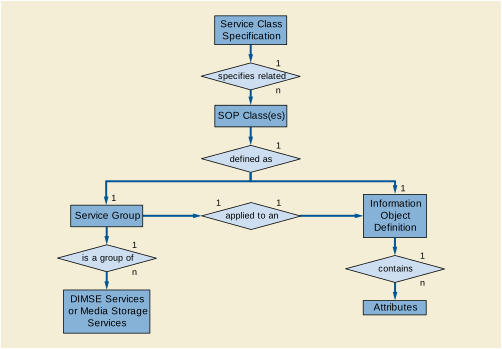
An Information Object Definition (IOD) is an object-oriented abstract data model used to specify information about Real-World Objects. An IOD provides communicating Application Entities with a common view of the information to be exchanged.
An IOD does not represent a specific instance of a Real-World Object, but rather a class of Real-World Objects that share the same properties. An IOD used to generally represent a single class of Real-World Objects is called a Normalized Information Object. An IOD that includes information about related Real-World Objects is called a Composite Information Object.
A Composite IOD is an Information Object Definition that represents parts of several entities included in the DICOM Model of the Real World. This Model is introduced in Section 7. Such an IOD includes Attributes that are not inherent in the Real-World Object that the IOD represents but rather are inherent in related Real-World Objects.
These related Real-World Objects provide a complete context for the exchanged information. When an instance of a Composite IOD is communicated, this entire context is exchanged between Application Entities. Relationships between Composite IOD Instances shall be conveyed in this contextual information.
The Composite IODs are specified in Annex A.
A Normalized IOD is an Information Object Definition that generally represents a single entity in the DICOM Model of the Real World.
When an instance of a Normalized IOD is communicated, the context for that instance is not actually exchanged. Instead, the context is provided through the use of pointers to related Normalized IOD Instances.
The Normalized IODs are specified in Annex B.
The Attributes of an IOD describe the properties of a Real-World Object Instance. Related Attributes are grouped into Modules that represent a higher level of semantics documented in the Module Specifications found in Annex C.
Attributes are encoded as Data Elements using the rules, the Value Representation and the Value Multiplicity concepts specified in PS3.5. For specific Data Elements, the Value Representation and Value Multiplicity are specified in the Data Dictionary in PS3.6.
When multiple modules containing the same Attributes(s) are included in an IOD, the Attribute shall be encoded only once into a Data Element.
For on-line communication the DIMSE Services allow a DICOM Application Entity to invoke an operation or notification across a network or a point-to-point interface. DIMSE Services are defined in PS3.7.
For media storage interchange, Media Storage Services allow a DICOM Application Entity to invoke media storage related operations.
Note
These Media Storage Services are discussed in PS3.10.
DIMSE-C Services are services applicable only to a Composite IOD, except for C-FIND that may apply to both normalized and composite instances. DIMSE-C Services provide only operation services.
A DIMSE Service Group specifies one or more operations/notifications defined in PS3.7 that are applicable to an IOD.
DIMSE Service Groups are defined in PS3.4 in the specification of a Service-Object Pair Class.
A Service-Object Pair (SOP) Class is defined by the union of an IOD and a DIMSE Service Group. The SOP Class definition contains the rules and semantics that may restrict the use of the services in the DIMSE Service Group and/or the Attributes of the IOD.
The selection of SOP Classes is used by Application Entities to establish an agreed set of capabilities to support their interaction. This negotiation is performed at association establishment time as described in PS3.7. An extended negotiation allows Application Entities to further agree on specific options within a SOP Class.
Note
The SOP Class as defined in the DICOM Information Model is equivalent in ISO/OSI terminology to the Managed Object Class. Readers familiar with object oriented terminology will recognize the SOP Class operations (and notifications) as comprising the methods of an object class.
DICOM defines two types of SOP Classes, Normalized and Composite. Normalized SOP Classes are defined as the union of a Normalized IOD and a set of DIMSE-N Services. Composite SOP Classes are defined as the union of a Composite IOD and a set of DIMSE-C Services.
Note
SOP Class Specifications play a central role for defining DICOM conformance requirements. It allows DICOM Application Entities to select a well-defined application level subset of the DICOM V3.0 Standard to which they may claim conformance. See PS3.2.
Association establishment is the first phase of communication between peer DICOM compliant Application Entities. The Application Entities shall use association establishment to negotiate which SOP Classes can be exchanged and how this data will be encoded.
Association Negotiation is defined in PS3.7.
A Service Class Specification defines a group of one or more SOP Classes related to a specific function that is to be accomplished by communicating Application Entities. A Service Class Specification also defines rules that allow implementations to state some pre-defined level of conformance to one or more SOP Classes. Applications may conform to SOP Classes as either a Service Class User (SCU) or Service Class Provider (SCP).
Service Class Specifications are defined in PS3.4.
Note
Such interaction between peer Application Entities work on a 'client/server model'. The SCU acts as the 'client', while the SCP acts as the 'server'. The SCU/SCP roles are determined during association establishment.
Figure 7-1a, Figure 7-1b and Figure 7-3 depict the DICOM view of the Real-World that identifies the relevant Real-World Objects and their relationships within the scope of the DICOM Standard. It provides a common framework to ensure consistency between the various Information Objects defined by the DICOM Standard.
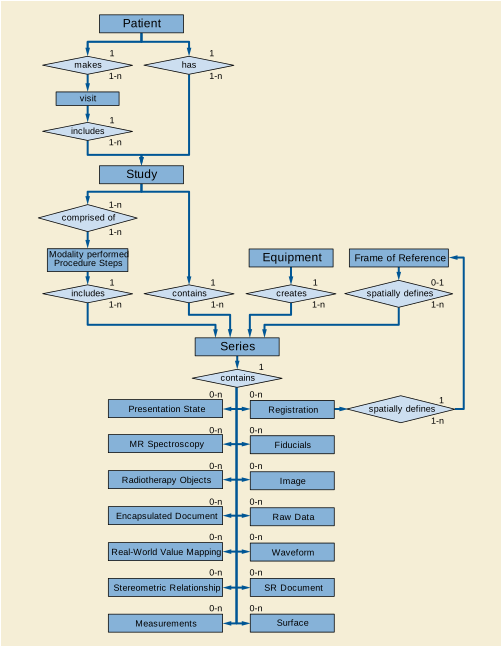
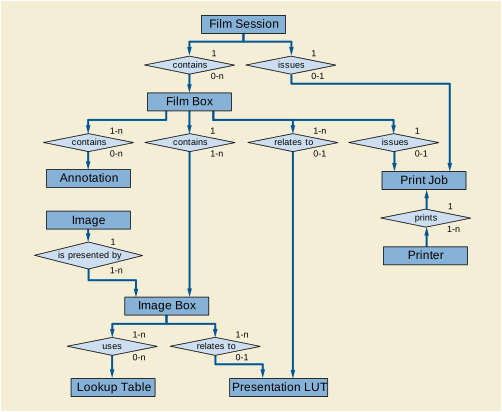
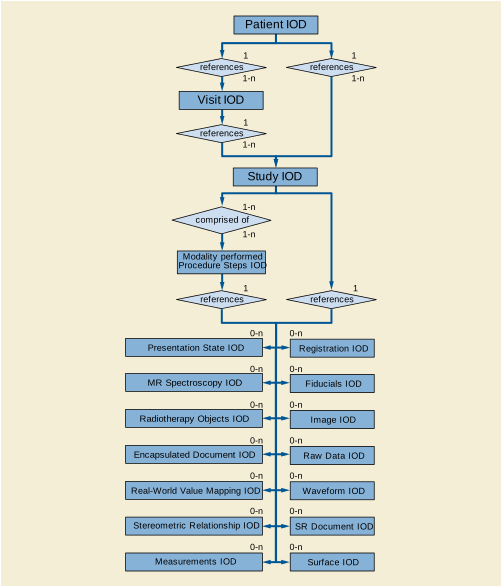
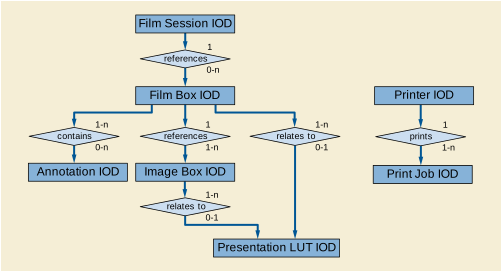
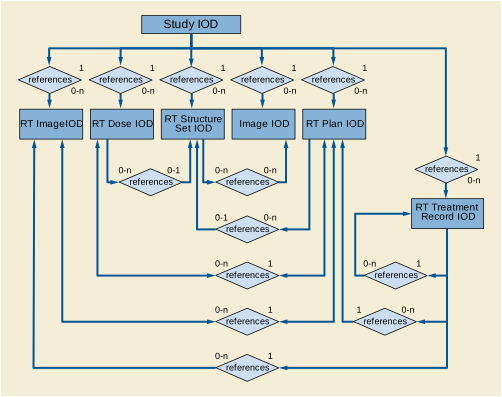
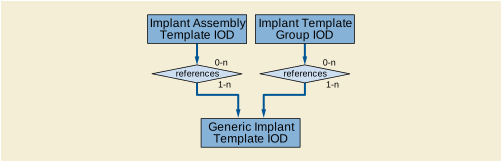
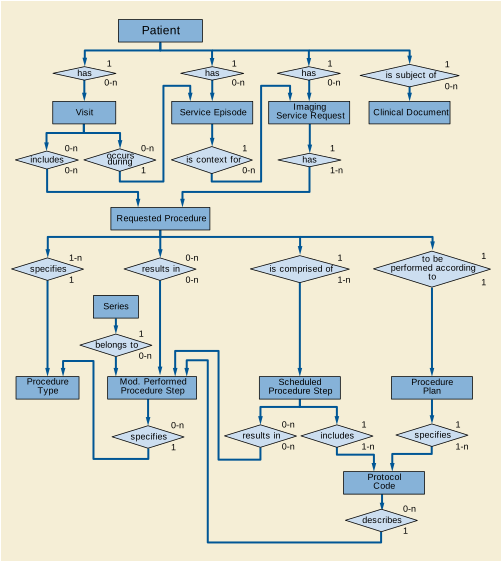
The DICOM Information Model is derived from the DICOM Model of the Real World. The DICOM Information Model presented by Figure 7-2a, Figure 7-2b, Figure 7-2c and Figure 7-2d identify the various IODs specified by this Standard and their relationships. There is not always a one-to-one correspondence between DICOM Information Object Definitions and Real-World Objects. For example a Composite IOD contains Attributes of multiple real-world objects such as series, equipment, frame of reference, study and patient.
The entities in Figure 7-2a, Figure 7-2b, Figure 7-2c and Figure 7-2d correspond to IODs defined in Annex A, Annex B and Annex C.
Annex A defines Composite IODs (e.g., Images) acquired on a number of Modalities (e.g., CT, MR, NM, US, CR, Secondary Capture). These Composite IODs reference Modules found in Annex C.
Annex B defines Normalized IODs (e.g., Film Session, Print Job) for a number of Service Classes specified in PS3.4. These Normalized IODs reference Module definitions found in Annex C.
For the purpose of the Basic Worklist Management Service Class and the Modality Performed Procedure Step SOP Classes an enhancement of the original DICOM Model of the Real World is made, as depicted in Figure 7-3.
Annex B “Integration of Modality Worklist and Modality Performed Procedure Step in The Original DICOM Standard (Informative)” in PS3.17 discusses the relationship of this extension to the original DICOM model of the real world.
Figure 7-3 is an abstract description of the real world objects invoked in the Modality-IS Interface. It is not to be seen as a database scheme for an implementation.
A Patient is a person receiving, or registered to receive, healthcare services, or is the subject of one or more studies for some other purpose, such as research.
Note
A patient may be a human or an animal.
A Service Episode is a collection of events, aggregated during an interval bounded by start and stop times. A Service Episode is the context in which the treatment or management of an arbitrary subset of a Patient's medical conditions occurs. The definition of the start time, stop time, and included events of a Service Episode is entirely arbitrary; it may include a single outpatient visit or a hospitalization, or extend over significant period of time, e.g., the duration of a pregnancy, or an oncology treatment regimen, or a cardiac episode from infarction through rehabilitation. A Service Episode may involve one or more Healthcare Organizations (administrative entities that authorize Healthcare Providers to provide services within their legal administrative domain, e.g., hospitals, private physician's offices, multispecialty clinics, nursing homes).
A subset of Service Episode, the Visit, is the collection of events that fall under the accountability of a particular Healthcare Organization in a single facility. A Visit may be associated with one or more physical locations (e.g., different rooms, departments, or buildings) within the Healthcare Organization's definition of a facility, with admission and discharge diagnoses and with time boundaries of the visit.
Note
The Visit is a part of the Service Episode. The Service Episode describes several administrative aspects of healthcare, while the Visit is limited to the description of one visit of a Patient to a facility.
In the context of the Modality Worklist SOP Class, the attributes of the Service Episode are defined in the Visit modules.
The attributes for Visit often use the term "admission" for historical reasons, although a visit in an ambulatory clinic does not involve an admission as an in-patient.
An Imaging Service Request is a set of one or more Requested Procedures selected from a list of Procedure Types. An Imaging Service Request is submitted by one authorized imaging service requester to one authorized imaging service provider in the context of one Service Episode. An Imaging Service Request includes pertinent specific and general information. Each instance of an Imaging Service Request carries the information common to one or more Requested Procedures requested at the same moment. An Imaging Service Request may be associated with one or more Visits that occur within the same Service Episode. The existence of an Imaging Service Request will typically result in the creation of one or more Imaging Service Reports and the distribution of Imaging Service Reports to one or more destinations.
In the context of the Modality Worklist the information provided by the Imaging Service Request aims at performing one or more imaging procedures, i.e., at acquiring new images.
A Procedure Type identifies a class of procedures. In the context of imaging services, a Procedure Type is an item in a catalog of imaging procedures that can be requested and reported upon in an imaging service facility. An instance of a Procedure Type typically has a name and one or more other identifiers. A Procedure Type is associated with one or more Procedure Plans.
Note
The information content of this entity relates to the general identification of a Procedure Type rather than to its decomposition into the protocol(s) required to perform a specific instance of a Requested Procedure for a particular Patient.
A Requested Procedure is an instance of a Procedure of a given Procedure Type. An instance of a Requested Procedure includes all of the items of information that are specified by an instance of a Procedure Plan that is selected for the Requested Procedure by the imaging service provider. This Procedure Plan is defined by the imaging service provider on the basis of the Procedure Plan templates associated with the considered Procedure Type. An Imaging Service Request may include requests for several different Requested Procedures. The purpose of this entity is to establish the association between Imaging Service Requests and Procedure Types, to convey the information that belongs to this association and to establish the relationships between Requested Procedures and the other entities that are needed to describe them. A single Requested Procedure of one Procedure Type is the smallest unit of service that can be requested, reported, coded and billed. Performance of one instance of a Requested Procedure is specified by exactly one Procedure Plan. A Requested Procedure leads to one or more Scheduled Procedure Steps involving Protocols as specified by a Procedure Plan. A Requested Procedure may be associated with one or more Visits. A Requested Procedure may involve one or more pieces of equipment.
A Modality Scheduled Procedure Step is an arbitrarily defined scheduled unit of service, that is specified by the Procedure Plan for a Requested Procedure. A Modality Scheduled Procedure Step prescribes a Protocol, which may be identified by one or more protocol codes. A Modality Scheduled Procedure Step involves equipment (e.g., imaging Modality equipment, anesthesia equipment, surgical equipment, transportation equipment), human resources, consumable supplies, location, and time (e.g., start time, stop time, duration). While in the context of imaging services the scheduling of a Modality Scheduled Procedure Step might include only a general designation of imaging Modality that could be satisfied by multiple pieces of the same equipment type, the performance of one instance of a Modality Scheduled Procedure Step involves one and only one piece of imaging Modality equipment.
The performance of a Modality Scheduled Procedure Step may result in the creation of zero or more Modality Performed Procedure Step instances.
Note
The Procedure Step entity is provided to support management of the logistical aspects of procedures (e.g., materials management, human resources, scheduling). The full definition of the contents of Procedure Steps and protocols according to which they are performed is implementation dependent and is beyond the scope of this Standard.
A Modality Scheduled Procedure Step may contribute to more than one Requested Procedure (e.g., a Modality Scheduled Procedure Step requiring an intravenous iodine contrast injection might be shared by an intravenous pyelogram and a CT examination). However, for billing purposes an instance of a Modality Scheduled Procedure Step is typically considered to be a part of only one Requested Procedure.
A Procedure Plan is a specification that defines the set of Protocols that must be done in order to perform the Scheduled Procedure Steps of a Requested Procedure. Each Scheduled Procedure Step is performed according to a single Protocol, which may be identified by one or more Protocol Codes. The Protocols actually performed during a Procedure Step may differ from those prescribed in the related Procedure Plan. Audit of actually performed Protocols versus the prescribed Procedure Plan is an important element of quality control, but is not specified by this Standard.
Note
The fact that Protocols Codes are in a given order in a Procedure Plan is not evident in Figure 7-3. However, the order of Protocols is represented at the syntax level (i.e., as the sequence of items present in the Protocol Code Sequence (0040,0008)).
A Protocol is a specification of actions prescribed by a Procedure Plan to perform a specific Procedure Step. A Scheduled Procedure Step contains only one Protocol, which may be conveyed by one or more Protocol Codes. Typically, the code or codes identifying a Protocol instance would be selected from a catalog of protocols. Multiple Protocols may not exist in one Scheduled Procedure Step.
A Performed Procedure Step is an arbitrarily defined unit of service that has actually been performed (not just scheduled). Logically it corresponds to a Scheduled Procedure Step, but real-world conditions may dictate that what is actually performed does not correspond exactly with what was requested or scheduled.
Note
For example, two or more Scheduled Procedure Steps, Requested Procedures or Imaging Service Requests may have been generated by different Referring Physicians but may be satisfied be a single Performed Procedure Step at the discretion of a Performing Physician or Operator. Alternatively, a single Scheduled Procedure Step may need to be satisfied by multiple Performed Procedure Steps on different types or instances of equipment, due to clinical need or failure conditions, or over extended periods of time.
It contains information describing the type of procedure actually performed. This information is represented by the Performed Protocol that may be defined by one or more Protocol Codes.
A Requested Procedure results in the creation of zero or more Performed Procedure Steps.
A Scheduled Procedure Step results in the creation of zero or more Performed Procedure Steps.
The Performed Procedure Step contains information about its state (e.g., in progress, discontinued or completed).
A Modality Performed Procedure Step is a Performed Procedure Step that results from activity (such as the acquisition of images from a Patient or other Imaging Subject) on a Modality.
It contains information describing the performance of a step of an imaging procedure, including data about the performance of the procedure itself, and data for billing and material management.
The Modality Performed Procedure Step contains references to zero or more Series of Images and other Composite SOP Instances that may be created as part of the procedure step. A particular Series is part of only one Modality Performed Procedure Step.
The purpose of the Modality Performed Procedure Step is to report what was performed; it does not imply any storage semantics. While the MPPS represents a unit of service within a workflow, the specification of the workflow itself is beyond the scope of the Standard, and the MPPS does not identify or control any subsequent activities to be performed.
Note
For example, a modality may create both "for processing" images for automated analysis and "for presentation" images for human review from the same acquisition. The Standard does not specify whether the production of these is a single unit of service, or two. A single Modality Performed Procedure Step instance could list both the "for processing" images and the "for presentation" images, regardless of whether or not both sets of images were stored to the same or different AEs, or indeed were stored at all, since the MPPS is independent of the storage semantics. Alternatively, the modality may treat these two sets of images as two separate units of service, and send two separate MPPS Instances.
A Radiation Dose SR from the irradiation events of an acquisition could be referenced in the same MPPS Instance as that of the acquired images, again irrespective of where such a Radiation Dose Structured Report might be sent, if at all. Alternatively, the modality may treat the production of the Radiation Dose SR as a separate unit of service, and report it in a distinct MPPS.
Another example is the case of thin and thick slice CT images acquired from the same acquisition (raw) data. When the reconstruction of both sets of images is prospectively defined and automatically initiated by the protocol selection, then both sets might be referenced from a single MPPS Instance. However, if the reconstruction of one or the other set is performed retrospectively by manual intervention some time after the acquisition MPPS had been completed, the subsequent instances will necessarily be referenced in a new MPPS Instance, since the acquisition MPPS cannot be modified once completed.
The completion of an MPPS may be a significant event that triggers or enables downstream activity, but it is not the intent to require the modality to be configured to "manage" such activity. The "units of service" that the modality describes in an MPPS, and how the modality relates those Performed Procedure Steps to Scheduled Procedure Steps, are implementation decisions beyond the scope of the Standard. The IHE Radiology Scheduled Workflow Profile provides additional guidance for implementation.
An MPPS may describe instances that were acquired but that have not been, nor may ever be, stored. For example, a modality may be capable of storing a CT acquisition as multiple single frame CT Image Storage SOP Instances, as a single multi-frame Enhanced CT Image Storage SOP Instance, or as several Enhanced CT Image Storage SOP Instances that together comprise a Concatenation. An MPPS may describe all three possibilities, even though only one choice may ultimately be stored, perhaps depending on the negotiated capabilities of the storage recipient. Alternatively, separate MPPS instances could be used for different storage SOP Classes.
The MPPS contains only the instances that the modality created, not instances converted and created subsequently in response to a query (e.g., during legacy conversion).
The MPPS is not a substitute for, nor is equivalent to, a Storage Commitment request, nor an Instance Availability Notification.
Retired. See PS3.3-2011.
Retired. See PS3.3-2011.
Retired. See PS3.3-2011.
A Clinical Document is a part of the medical record of a patient. A Clinical Document is a documentation of clinical observations and services and has the following characteristics:
Persistence - A clinical document continues to exist in an unaltered state, for a time period defined by local and regulatory requirements.
Stewardship - A clinical document is maintained by an organization entrusted with its care.
Potential for authentication - A clinical document is an assemblage of information that is intended to be legally authenticated.
Context - A clinical document establishes the default context for its contents.
Wholeness - Authentication of a clinical document applies to the whole and does not apply to portions of the document without the full context of the document.
Human readability - A clinical document is human readable.
Note
This definition is from ANSI/HL7 CDA R1.0-2000, and HL7 v3 CDA R2-2005.
Clinical Documents may provide significant context for the performance of imaging and related procedures, e.g., patient clinical history, pre-imaging-procedure lab test results, or patient advance medical directives.
Clinical Documents may be associated with Service Episodes, Service Requests, Requested Procedures, or other entities subsidiary to the Patient in the Real-World Model. Such associations are not explicitly modeled for the purposes of the Modality-IS context.
Clinical Documents are one sub-class of the class of healthcare Structured Documents; Structured Documents, in general, are not necessarily related to a patient. Structured Documents may be used for imaging procedure operational instructions, e.g., in product labeling, Procedure Plans, or patient care plans.
Note
The format and semantics of Structured Documents, including Clinical Documents, are defined outside the scope of the DICOM Standard (e.g., by HL7). DICOM provides the means to reference Structured Documents within the Modality-IS context.
The general class of Structured Documents is not modeled in the Real-World Model; only specific sub-classes, e.g., Clinical Documents, are modeled.
Retired. See PS3.3-2011.
For the purpose of accommodating large sets of frames in Multi-frame Image SOP Instances the Real-World Entity Relationship Diagram has been extended to describe the relationships of these instances: Concatenation (see Section 7.5.1) and Dimension Organization (see Section 7.5.2). Figure 7.5-1 depicts the additions to Figure 7-2a.
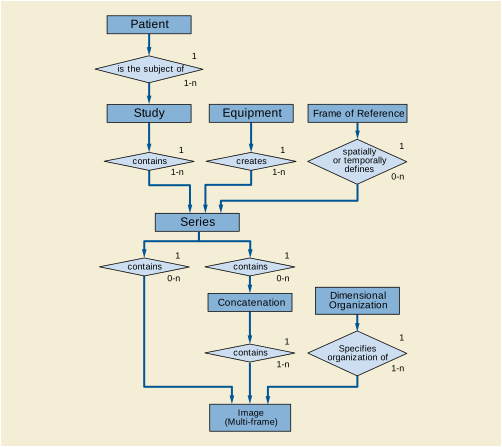
For implementation specific reasons (such as practical limits on the maximum size of an individual SOP Instance) the content of a multi-frame image may need to be split into more than one SOP Instance. These SOP Instances together form a Concatenation, which is a group of SOP Instances within a Series that is uniquely identified by Concatenation UID (0020,9161).
The Dimension Organization contains a set of dimensions. A dimension is a set of attributes that change on a per-frame basis in a manner that is known before the image is acquired, are defined by the generating application and are especially intended for presentation. Other attributes may also change on a per-frame basis but if they are not present in the Dimension Organization, they are not considered significant as a dimension for organizational purposes.
Receiving applications shall use the order of dimensions for guidance when presenting images if the Multi-frame Dimension Module is present. The first item of the Dimension Index Sequence shall be the slowest varying index.
Note
See Multi-frame Dimension Module section (C.7.6.17) for an example.
The DICOM Model of the Real World is extended for Clinical Trials with the addition of several objects whose relationships to each other and existing DICOM Real World objects are shown in Figure 7.6-1.
Attributes of the Clinical Trial Sponsor, Clinical Trial Protocol, Clinical Trial Subject, and Clinical Trial Site objects are represented in the Clinical Trial Subject Module within the Patient IOD. Attributes of the Clinical Trial Time Point object are represented in the Clinical Trial Study Module within the Study IOD. The Clinical Trial Coordinating Center attribute is represented in the Clinical Trial Series Module within Image IODs.
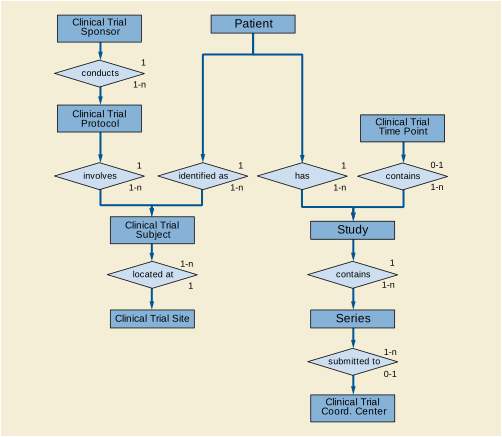
For the purpose of Clinical Trial Information, an extension of the DICOM Model of the Real World is made, as depicted in Figure 7.6-1.
A Clinical Trial Sponsor identifies the agency, group, or institution responsible for conducting the clinical trial and for assigning a Protocol Identifier.
A Clinical Trial Protocol identifies the investigational Protocol in which the Subject has been enrolled. The Protocol has a Protocol Identifier and Protocol Name.
A Clinical Trial Subject identifies the Patient who is enrolled as a Subject in the investigational Protocol.
A Clinical Trial Site identifies the location or institution at which the Subject is treated or evaluated and that is responsible for submitting clinical trial data. Images and/or clinical trial data may be collected for a given Subject at alternate institutions, e.g., follow-up scans at a satellite imaging center, but the Clinical Trial Site represents the primary location for Patient management and data submission in the context of a clinical trial.
The Clinical Trial Time Point identifies an imaging Study within the context of an investigational protocol. A Time Point defines a set of studies that are grouped together as a clinical time point or submission in a clinical trial.
The Clinical Trial Coordinating Center identifies the institution responsible for coordinating the collection, management, processing, and/or analysis of images and associated data for Subjects enrolled in a clinical trial. Within a given Clinical Trial Protocol, there may be multiple Clinical Trial Coordinating Centers, each handling different aspects of the clinical data submitted by the Clinical Trial Sites.
The DICOM Model of the Real World is extended for Hanging Protocols with the addition of an entity that is separate from the rest of the DICOM Real World objects, as shown in Figure 7.7-1. A Hanging Protocol is not associated with any specific objects in the existing DICOM Information Model, because it is not associated with a specific patient. There is no hierarchy applied to Hanging Protocol objects.

A Hanging Protocol entity specifies the viewing preferences of a specific user or group, for a specific type of study (Modality, Anatomy, Laterality combination, and optionally Procedure, and/or Reason). A Hanging Protocol definition includes descriptors that identify the Hanging Protocol, the creator, the type of study it addresses, the type of image sets to display, the intended display environment, and the intended layout for the screen(s).
The DICOM Model of the Real World is extended for Color Palettes with the addition of an entity that is separate from the rest of the DICOM Real World objects, as shown in Figure 7.8-1. A Color Palette is not associated with any specific objects in the existing DICOM Information Model, because it is not associated with a specific patient. There is no hierarchy applied to Color Palette objects.

The DICOM Model of the Real World is extended for Specimens with the addition of several objects whose relationships to each other and existing DICOM Real World objects are shown in Figure 7.9-1.
Attributes of the Specimen, Container, Component and Preparation Step objects are represented in the Specimen Module within the Image IODs.
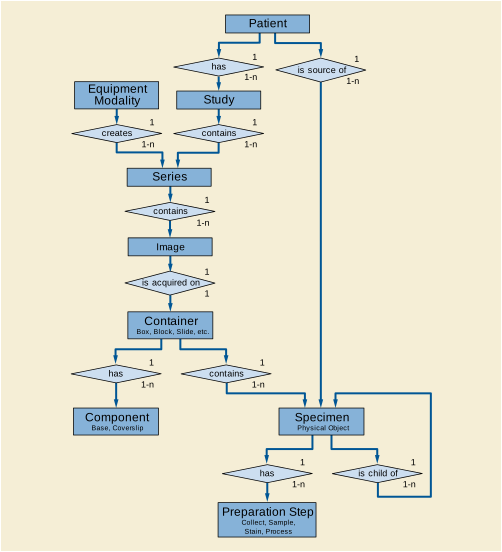
A physical object (or a collection of objects) is a specimen when the laboratory considers it a single discrete, uniquely identified unit that is the subject of one or more steps in the laboratory (diagnostic) workflow.
Specimen containers (or just "containers") play an important role in laboratory (diagnostic) processes. In most, but not all, process steps, specimens are held in containers, and a container often carries its specimen's ID. Sometimes the container becomes intimately involved with the specimen (e.g., a paraffin block), and in some situations (such as examining tissue under the microscope) the container (the slide and coverslip) become part of the optical path.
Containers are often made up of components. For example, a "slide" is container that is made up of the glass slide, the cover slip and the "glue" the binds them together.
Before a slide is imaged, the preparation of the specimen (including sampling, processing and staining) will take place. Specimen preparation is described as a sequence of time-stamped process steps. Multiple steps are possible, and may include sampling from ancestor specimens.
For the purpose of Implant Template SOP Classes the DICOM Model of the Real World is described in this section. This subset of the real-world model covers the requirements for the planning of surgical implantation of implants using 2D and/or 3D templates. In this context, a Manufacturer may be a company, an institution or a person that issues Implant Templates.
Figure 7.10-1 is an abstract description of the Real World objects involved in Implant Templates.
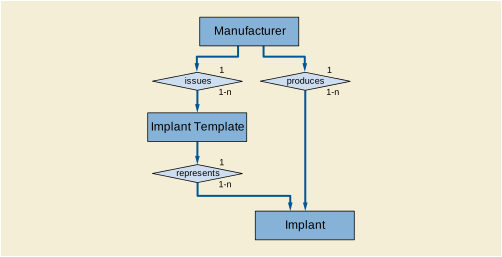

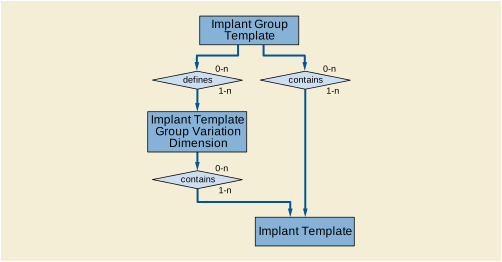
The DICOM Model of the Real World is extended with the addition of a Unified Procedure Step object whose relationship to existing DICOM Real World objects is shown in Figure 7.11-1.
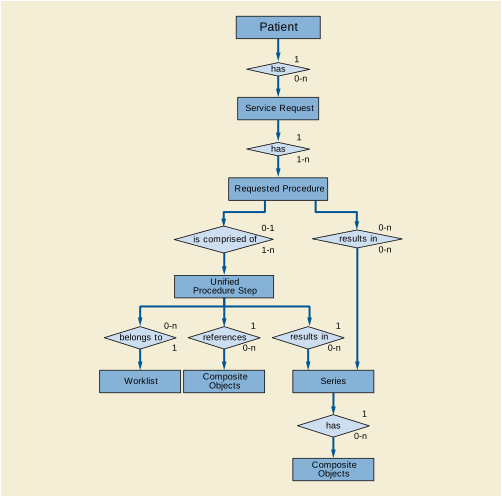
A Unified Procedure Step (UPS) represents an arbitrary unit of service. Unified Procedure Steps are generally scheduled in response to a Requested Procedure, although a UPS may be triggered by other events, such as a scheduled calibration, completion of prior work in a pipeline, etc.
The Unified Procedure Step (UPS) unifies the details of the procedure step that has been requested, the progress details during performance, and the details of the procedure step actually performed. The details can describe the specific service activity, the subject and/or data acted on, the originator and context of the request, the human/equipment/application resources involved, the priority, date, time and location of the activity, and references to resulting output data.
Normally the details about the activity as performed correspond to the details of the activity as requested, however real-world conditions may dictate that what is actually performed does not correspond exactly with what was requested or scheduled.
The DICOM Model of the Real World is extended for Display System with the addition of an entity that is separate from the rest of the DICOM Real World objects, as shown in Figure 7.12-1. A Display System is not associated with any specific objects in the existing DICOM Information model, because it is not associated with a specific patient. One Display System object is included in a Display System IOD.
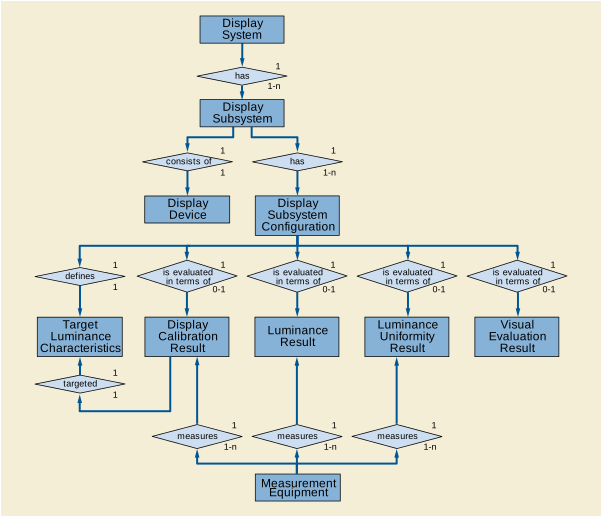
A Display Subsystem represents the target of a Display QA task such as calibration. For example, a PACS reading station with one color controller driving one display, and 4 grayscale displays each driven by two controllers is modeled as 5 Display Subsystems, each of which can be the target of a Display QA task. A tablet represents one Display System with a Display Device but no externally exposed controller. Although Display Subsystem may include components beyond the Display Device, this Model focuses on the Display Device only.
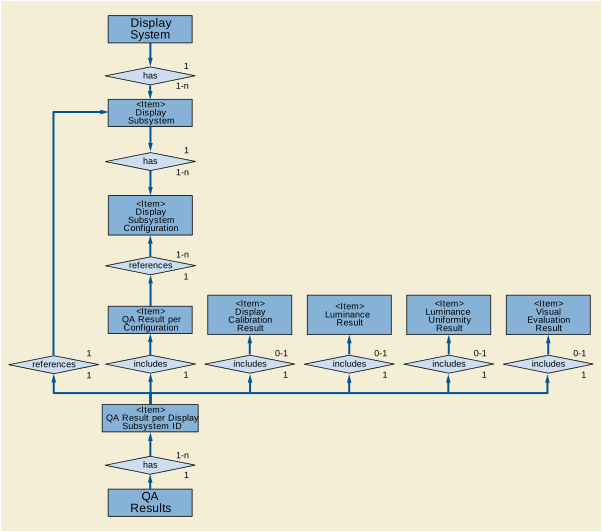
Figure 7.12-2 illustrates how the composition of Display Subsystems is represented in the Display System IOD.
The primary method of incorporating coded entry data in DICOM IODs is the Code Sequence Attribute. Code Sequence Attributes are encoded as a Sequence of Items using a macro that is described in this section. These Attributes typically include the string "Code Sequence" in the Attribute Name. Their purpose is to encode terms by using codes from coding schemes.
Note
In this Standard, Code Sequence Attributes are defined for a variety of concepts, for example: Primary Anatomic Structure Sequence (0008,2228) and other Attributes to describe anatomy; and Intervention Drug Code Sequence (0018,0029), to document administration of drugs that have special significance in Imaging Procedures.
Each Item of a Code Sequence Attribute contains the triplet of Coding Scheme Designator, the Code Value, and Code Meaning. Other optional and conditional attributes may also be present.
For any particular Code Sequence Attributes, the range of codes that may be used for that attribute (the Value Set) may be suggested or constrained by specification of a Context Group. The Module or Template in which the attribute is used will specify whether or not the context group is baseline or defined. A Baseline Context Group lists codes for terms that are suggested and may be used, but are not required to be used. A Defined Context Group lists codes for terms that shall be used if the term is used.
Context Groups are defined in a Mapping Resource, such as the DICOM Content Mapping Resource (DCMR) specified in PS3.16. Context Groups consist of lists of contextually related coded concepts, including Code Value (0008,0100) and Coding Scheme Designator (0008,0102). Each concept is unique within the Context Group and identified by its Code Value (0008,0100) and Coding Scheme Designator (0008,0102). The Context Group specification identifies whether it is extensible, i.e., whether it may be modified in an Application to use additional terms (see PS3.16). Whether a Context Group is used as a Baseline or Defined Context Group is defined not in the mapping resource, but rather in the Template or Module in which the Code Sequence Attribute is used.
Context Groups are identified by labels referred to as Context Identifiers (CID). Formally, the Context Identifier specifies the context of use, not the specific list of coded values selected for that context of use in the Context Group. The set of values specified in the Standard for a particular context may change over time, and set of values used by an Application Entity for a particular context may include a local or private extension beyond the Standard value set.
Note
A specific set of coded values used by an Application Entity is therefore identified by the Mapping Resource Identifier, plus the Context Identifier, plus the Context Group Version, plus the identifiers for any private extension.
The use by an Application Entity of coded terms not in the Standard specified Context Group does not require the explicit identification of a private extension. The Application Entity is then the implicit source of the extension.
For the purpose of harmonization with HL7 vocabulary concepts, Context Groups are equivalent to HL7 Value Sets.
Code Value (0008,0100) is an identifier that is unambiguous within the Coding Scheme denoted by Coding Scheme Designator (0008,0102) and Coding Scheme Version (0008,0103).
Note
The Code Value is typically not a natural language string, e.g., "T-04000".
The attribute Coding Scheme Designator (0008,0102) identifies the coding scheme in which the code for a term is defined. Standard coding scheme designators used in DICOM information interchange are listed in PS3.16. Other coding scheme designators, for both private and public coding schemes, may be used, in accordance with PS3.16. Further identification of the coding scheme designators used in a SOP Instance may be provided in the Coding Scheme Identification Sequence (0008,0110) (see Section C.12).
Note
Typical coding schemes used in DICOM include "DCM" for DICOM defined codes, "SRT" for SNOMED, and "LN" for LOINC. See Annex 8 “Coding Schemes” in PS3.16.
Coding scheme designators beginning with "99" and the coding scheme designator "L" are defined in HL7 V2 to be private or local coding schemes.
Most IODs that define the use of coded terms provide for the use of private codes and coding schemes through replacement of Baseline Context Groups or extension of Defined Context Groups. Systems supporting such private code use must provide a mechanism for the configuration of sets of Coding Scheme Designator, Code Value, and Code Meaning to support interoperation of the private codes with other systems.
It is highly recommended that local or non-standard coding schemes be identified in the Coding Scheme Identification Sequence.
The attribute Coding Scheme Version (0008,0103) may be used to identify the version of a coding scheme if necessary to resolve ambiguity in Code Value (0008,0100) or Code Meaning (0008,0104). Coding Scheme Version (0008,0103) is not required for backward-compatible revisions of a coding scheme, as the Coding Scheme Designator (0008,0102) identifies the coding scheme as a whole as currently published by the responsible organization.
Note
See PS3.16 for a discussion of SNOMED Coding Scheme Designators 99SDM, SNM3, and SRT.
ICD-10, for example, is not a backward-compatible revision of ICD-9, and hence it has a different Coding Scheme Designator, not simply a different Coding Scheme Version.
Code Meaning (0008,0104) is text that has meaning to a human and conveys the meaning of the term defined by the combination of Code Value and Coding Scheme Designator. Though such a meaning can be "looked up" in the dictionary for the coding scheme, it is encoded for the convenience of applications that do not have access to such a dictionary.
It should be noted that for a particular Coding Scheme Designator (0008,0102) and Code Value (0008,0100), several alternative values for Code Meaning (0008,0104) may be defined. These may be synonyms in the same language or translations of the Coding Scheme into other languages. Hence the value of Code Meaning (0008,0104) shall never be used as a key, index or decision value, rather the combination of Coding Scheme Designator (0008,0102) and Code Value (0008,0100) may be used. Code Meaning (0008,0104) is a purely annotative, descriptive Attribute.
This does not imply that Code Meaning (0008,0104) can be filled with arbitrary free text. Available values from the Coding Scheme or translation in the chosen language shall be used.
The value of Mapping Resource (0008,0105) denotes the message/terminology Mapping Resource that specifies the Context Group that specifies the Value Set. The Defined Terms for the value of Mapping Resource (0008,0105) shall be:
Defined Terms:
- DCMR
DICOM Content Mapping Resource
- SDM
SNOMED DICOM Microglossary (Retired)
PS3.16 specifies the DICOM Content Mapping Resource (DCMR).
Note
Unless otherwise specified, the DCMR is the source of all Context Groups and Templates specified in this Standard.
Context Group Version (0008,0106) conveys the version of the Context Group identified by Context Identifier (0008,010F). This Attribute uses VR DT, but for Context Groups defined in PS3.16 the precision of Context Group Version is limited to the day, and the time zone offset is not used.
The value of Context Identifier (0008,010F) identifies the Context Group defined by Mapping Resource (0008,0105) from which the values of Code Value (0008,0100) and Code Meaning (0008,0104) were selected, or to which Code Value (0008,0100) and Code Meaning (0008,0104) have been added as a private Context Group extension (see Section 8.7). The Context Identifier Attribute uses VR CS, and for Context Groups defined in PS3.16 the value shall be the Context Group Identifier as a string of digits without leading zeros, and does not include the string "CID".
The value of Context UID (0008,0117) uniquely identifies the Context Group. See PS3.6.
Note
Privately defined Context Groups are not identified by Context Identifier and Mapping Resource.
Context Group Extension Flag (0008,010B) may be used to designate a Code Value/Code Meaning pair as a selection from a private extension of a Context Group. If the Context Group Extension Flag is present, and has a value of "Y", Context Group Extension Creator UID (0008,010D) shall be used to identify the person or organization who created the extension to the Context Group. Context Group Local Version (0008,0107) conveys an implementation-specific private version DateTime of a Context Group that contains private extensions
Note
These Attributes provide the means for implementations to extend code sets conveniently, while preserving referential integrity with respect to the original Context Group Version.
The locally-defined (private) value of Context Group Local Version (0008,0107) typically would be a more recent date than the standard value of Context Group Version (0008,0106) specified in the standard message/terminology Mapping Resource that defines the Context Group.
Table 8.8-1 specifies the default set of Attributes encapsulated in the Items of Code Sequence Attributes. These Attributes comprise the Code Sequence Macro.
Note
The instruction "Include Table 8.8-1 “Code Sequence Macro Attributes”" may be used in an Information Object Definition as a concise way to indicate that the attributes of Table 8.8-1 are included in the specification of the Attribute Set of a Sequence of items. Additional constraints on the Code Sequence Data Element (such as a Context Group that defines the value set) may be appended to the "Include Table 8.8-1 “Code Sequence Macro Attributes”" instruction.
The default specifications of this Section are overridden within the scope of a Sequence Item or Code Sequence Attribute or IOD by corresponding specifications defined within the scope of that Sequence Item or Code Sequence Attribute or IOD. Additional Attributes may also be specified by the instantiation of the macro.
The Basic Coded Entry Attributes fully define a Coded Entry. If it is desired to convey the list from which a code has been chosen, then the optional Enhanced Encoding Mode Attributes may also be sent.
Table 8.8-1. Code Sequence Macro Attributes
|
Attribute Name |
Tag |
Type |
Attribute Description |
|---|---|---|---|
|
BASIC CODED ENTRY ATTRIBUTES |
|||
|
Code Value |
(0008,0100) |
1 |
See Section 8.1. |
|
Coding Scheme Designator |
(0008,0102) |
1 |
See Section 8.2. |
|
Coding Scheme Version |
(0008,0103) |
1C |
See Section 8.2. Required if the value of Coding Scheme Designator (0008,0102) is not sufficient to identify Code Value (0008,0100) unambiguously. May be present otherwise. |
|
Code Meaning |
(0008,0104) |
1 |
See Section 8.3. |
|
ENHANCED ENCODING MODE |
|||
|
Context Identifier |
(0008,010F) |
3 |
See Section 8.6. |
|
Context UID |
(0008,0117) |
3 |
See Section 8.6. |
|
Mapping Resource |
(0008,0105) |
1C |
See Section 8.4. Required if Context Identifier (0008,010F) is present. |
|
Context Group Version |
(0008,0106) |
1C |
See Section 8.5. Required if Context Identifier (0008,010F) is present. |
|
Context Group Extension Flag |
(0008,010B) |
3 |
Indicates whether the Code Value/Coding Scheme/Code Meaning is selected from a private extension of the Context Group identified in Context Identifier (0008,010F). See Section 8.7. Enumerated Values:
|
|
Context Group Local Version |
(0008,0107) |
1C |
See Section 8.7. Required if the value of Context Group Extension Flag (0008,010B) is "Y". |
|
Context Group Extension Creator UID |
(0008,010D) |
1C |
Identifies the person or organization who created an extension to the Context Group. See Section 8.7. Required if the value of Context Group Extension Flag (0008,010B) is "Y". |
Section 9 was defined in a previous version of the DICOM Standard (see PS3.3-2004). The Section is now retired, and its contents have been consolidated into Section C.18.8.
This Macro may be invoked to specify a coded representation of a person such as a healthcare worker, and the organization to which they are responsible.
Note
This macro is typically invoked within a Sequence Item used to identify an individual such as a physician or a device operator.
The free-text name of the individual is not included in this Macro since there are already widely used specific Attributes to hold such values.
No Baseline, Defined or Enumerated CIDs are defined nor is any particular coding scheme specified. In practice, workers are usually identified by using a locally or nationally specific coding scheme. For example, a local Coding Scheme Designator might be used and the individual's internal hospital ID number user in Code Value.
The organization is specified by either a coded sequence or a free text name but not both. A Baseline CID of standard organizations is provided for the purpose of identifying standard organizations responsible for creation of well known instances.
Table 10-1. Person Identification Macro Attributes Description
|
Attribute Name |
Tag |
Type |
Attribute Description |
|---|---|---|---|
|
Person Identification Code Sequence |
(0040,1101) |
1 |
A coded entry that identifies a person. The Code Meaning attribute, though it will be encoded with a VR of LO, may be encoded according to the rules of the PN VR (e.g., caret '^' delimiters shall separate name components), except that a single component (i.e., the whole name unseparated by caret delimiters) is not permitted. Name component groups for use with multi-byte character sets are permitted, as long as they fit within the 64 characters (the length of the LO VR). One or more Items shall be included in this Sequence. |
|
No Baseline CID is defined. |
|||
|
Person's Address |
(0040,1102) |
3 |
Person's mailing address |
|
Person's Telephone Numbers |
(0040,1103) |
3 |
Person's telephone number(s) |
|
Institution Name |
(0008,0080) |
1C |
Institution or organization to which the identified individual is responsible or accountable. Required if Institution Code Sequence (0008,0082) is not present. |
|
Institution Address |
(0008,0081) |
3 |
Mailing address of the institution or organization to which the identified individual is responsible or accountable. |
|
Institution Code Sequence |
(0008,0082) |
1C |
Institution or organization to which the identified individual is responsible or accountable. Required if Institution Name (0008,0080) is not present. Only a single Item shall be included in this Sequence. |
|
Baseline CID 5002 “Organizations”. |
|||
A Content Item is a flexible means of encoding attribute identifiers and attribute values using the Code Sequence Macro (see Section 8) for coded terminology defined by a coding scheme. The Content Item provides a name-value pair, i.e., a Concept Name, encoded as a Code Sequence, and a Concept Value. The Concept Value may be encoded by any of a set of generic Attributes, as specified by a Value Type, including text, personal name, numeric, and coded concept (Code Sequence) values.
Note
Comparing a Content Item to a native DICOM Data Element, the Concept Name Code Sequence corresponds to the Data Element Tag and Attribute Name, the Value Type to the Value Representation, and the Concept Value to the Data Element Value Field. See PS3.5.
The IMAGE Value Type of this Macro does not include the Type 3 attributes of the IMAGE Value Type defined in Section C.17.3, as they are not required for Acquisition Context or Protocol Context Content Items.
Specific uses of the Content Item may invoke the Content Item Macro defined in this Section, the Document Content Macro of Section C.17.3, or another similar construct. An invocation of the Content Item Macro may constrain the allowed values of Value Type (0040,A040).
Note
The NUMERIC Value Type of this Macro differs from the NUM Value Type defined in Section C.17.3, since the encoding of the Concept Value is different.
The Value Type uses Enumerated Values so as to assure that non-standard Value Types are not used, and to prevent the nefarious use, for example, of a CONTAINER Value Type in an SR-like manner to create nested content, which is not the intent.
Some invocations of this macro may use the Content Item Modifier Sequence (0040,0441) to achieve a single level of "nesting". That Attribute is not included in this macro itself, to prevent recursive inclusion.
See Section 5.4 for the meaning of the Type column in this Macro when applied to Normalized IODs.
Table 10-2. Content Item Macro Attributes Description
|
Attribute Name |
Tag |
Type |
Attribute Description |
|---|---|---|---|
|
Value Type |
(0040,A040) |
1 |
The type of the value encoded in this name-value Item. Enumerated Values:
|
|
Concept Name Code Sequence |
(0040,A043) |
1 |
Coded concept name of this name-value Item. Only a single Item shall be included in this Sequence. |
|
No Baseline CID is defined. |
|||
|
DateTime |
(0040,A120) |
1C |
DateTime value for this name-value Item. Required if Value Type (0040,A040) is DATETIME. |
|
Date |
(0040,A121) |
1C |
Date value for this name-value Item. Required if Value Type (0040,A040) is DATE. |
|
Time |
(0040,A122) |
1C |
Time value for this name-value Item. Required if Value Type (0040,A040) is TIME. |
|
Person Name |
(0040,A123) |
1C |
Person name value for this name-value Item. Required if Value Type (0040,A040) is PNAME. |
|
UID |
(0040,A124) |
1C |
UID value for this name-value Item. Required if Value Type (0040,A040) is UIDREF. |
|
Text Value |
(0040,A160) |
1C |
Text value for this name-value Item. Required if Value Type (0040,A040) is TEXT. |
|
Concept Code Sequence |
(0040,A168) |
1C |
Coded concept value of this name-value Item. Only a single Item shall be included in this Sequence. Required if Value Type (0040,A040) is CODE. |
|
No Baseline CID is defined. |
|||
|
Numeric Value |
(0040,A30A) |
1C |
Numeric value for this name-value Item. Only a single value shall be present. Required if Value Type (0040,A040) is NUMERIC. |
|
Floating Point Value |
(0040,A161) |
1C |
The floating point representation of Numeric Value (0040,A30A). The same number of values as Numeric Value (0040,A30A) shall be present. Required if Numeric Value (0040,A30A) has insufficient precision to represent the value as a string. May be present otherwise. |
|
Rational Numerator Value |
(0040,A162) |
1C |
The integer numerator of a rational representation of Numeric Value (0040,A30A). Encoded as a signed integer value. The same number of values as Numeric Value (0040,A30A) shall be present. Required if Numeric Value (0040,A30A) has insufficient precision to represent a rational value as a string. May be present otherwise. |
|
Rational Denominator Value |
(0040,A163) |
1C |
The integer denominator of a rational representation of Numeric Value (0040,A30A). Encoded as a non-zero unsigned integer value. The same number of values as Numeric Value (0040,A30A) shall be present. Required if Rational Numerator Value (0040,A162) is present. |
|
Measurement Units Code Sequence |
(0040,08EA) |
1C |
Units of measurement for a numeric value in this name-value Item. Only a single Item shall be included in this Sequence. Required if Value Type (0040,A040) is NUMERIC. |
|
Baseline CID 82 “Units of Measurement”. |
|||
|
Referenced SOP Sequence |
(0008,1199) |
1C |
Composite SOP Instance Reference value for this name-value Item. Only a single Item shall be included in this Sequence. Required if Value Type (0040,A040) is COMPOSITE or IMAGE. |
|
>Include Table 10-11 “SOP Instance Reference Macro Attributes” |
|||
|
>Referenced Frame Number |
(0008,1160) |
1C |
Identifies the frame numbers within the Referenced SOP Instance to which the reference applies. The first frame shall be denoted as frame number 1. NoteThis Attribute may be multi-valued. Required if the Referenced SOP Instance is a multi-frame image and the reference does not apply to all frames, and Referenced Segment Number (0062,000B) is not present. |
|
>Referenced Segment Number |
(0062,000B) |
1C |
Identifies the segments to which the reference applies identified by Segment Number (0062,0004). Required if the Referenced SOP Instance is a Segmentation or Surface Segmentation and the reference does not apply to all segments and Referenced Frame Number (0008,1160) is not present. |
Table 10-3. Image SOP Instance Reference Macro Attributes
|
Attribute Name |
Tag |
Type |
Attribute Description |
|---|---|---|---|
|
Include Table 10-11 “SOP Instance Reference Macro Attributes” |
|||
|
Referenced Frame Number |
(0008,1160) |
1C |
Identifies the frame numbers within the Referenced SOP Instance to which the reference applies. The first frame shall be denoted as frame number 1. NoteThis Attribute may be multi-valued. Required if the Referenced SOP Instance is a multi-frame image and the reference does not apply to all frames, and Referenced Segment Number (0062,000B) is not present. |
|
Referenced Segment Number |
(0062,000B) |
1C |
Identifies the Segment Number to which the reference applies. Required if the Referenced SOP Instance is a Segmentation or Surface Segmentation and the reference does not apply to all segments and Referenced Frame Number (0008,1160) is not present. |
Table 10-3b “Referenced Instances and Access Macro Attributes” contains identifiers and access details for a collection of instances. It is intended to provide sufficient information to retrieve the referenced instances.
Table 10-3b. Referenced Instances and Access Macro Attributes
|
Attribute Name |
Tag |
Type |
Attribute Description |
|---|---|---|---|
|
Type of Instances |
(0040,E020) |
1 |
Type of object instances referenced. Defined Terms:
|
|
Study Instance UID |
(0020,000D) |
1C |
Unique identifier for the Study. Required if Type of Instances (0040,E020) is DICOM |
|
Series Instance UID |
(0020,000E) |
1C |
Unique identifier for the Series that is part of the Study identified in Study Instance UID (0020,000D), if present, and contains the referenced object instance(s). Required if Type of Instances (0040,E020) is DICOM |
|
Referenced SOP Sequence |
(0008,1199) |
1 |
References to object instances. One or more Items shall be included in this sequence |
|
>Referenced SOP Class UID |
(0008,1150) |
1 |
Uniquely identifies the referenced SOP Class. |
|
>Referenced SOP Instance UID |
(0008,1155) |
1 |
Uniquely identifies the referenced SOP Instance. |
|
>HL7 Instance Identifier |
(0040,E001) |
1C |
Instance Identifier of the encapsulated HL7 Structured Document, encoded as a UID (OID or UUID), concatenated with a caret ("^") and Extension value (if Extension is present in Instance Identifier). Required if Type of Instances (0040,E020) is CDA. |
|
>Referenced Frame Number |
(0008,1160) |
1C |
Identifies the frame numbers within the Referenced SOP Instance to which the reference applies. The first frame shall be denoted as frame number 1. NoteThis Attribute may be multi-valued. Required if the Referenced SOP Instance is a multi-frame image and the reference does not apply to all frames, and Referenced Segment Number (0062,000B) is not present. |
|
>Referenced Segment Number |
(0062,000B) |
1C |
Identifies the Segment Number to which the reference applies. Required if the Referenced SOP Instance is a Segmentation and the reference does not apply to all segments and Referenced Frame Number (0008,1160) is not present. |
|
DICOM Retrieval Sequence |
(0040,E021) |
1C |
Details for retrieving instances via the DICOM Retrieve Service. Required if DICOM Media Retrieval Sequence (0040,E022), WADO Retrieval Sequence (0040,E023), and XDS Retrieval Sequence (0040,E024) are not present. May be present otherwise. This sequence shall only identify sources known to have instances referenced in Referenced SOP Sequence (0008,1199). One or more Items shall be included in this sequence. |
|
>Retrieve AE Title |
(0008,0054) |
1 |
Title of a DICOM Application Entity where the referenced instance(s) may be retrieved on the network. |
|
DICOM Media Retrieval Sequence |
(0040,E022) |
1C |
Details for retrieving instances from Media. Required if DICOM Retrieval Sequence (0040,E021), WADO Retrieval Sequence (0040,E023), and XDS Retrieval Sequence (0040,E024) are not present. May be present otherwise. This sequence shall only identify media known to have instances referenced in Referenced SOP Sequence (0008,1199). One or more Items shall be included in this sequence. |
|
>Storage Media File-Set ID |
(0088,0130) |
2 |
The user or implementation specific human readable identifier that identifies the Storage Media on which the referenced instance(s) reside. |
|
>Storage Media File-Set UID |
(0088,0140) |
1 |
Uniquely identifies the Storage Media on which the referenced instance(s) reside. |
|
WADO Retrieval Sequence |
(0040,E023) |
1C |
Details for retrieving instances available as Uniform Resources via WADO. NoteThis sequence addresses use of the URI-based Web Access to DICOM Objects. Retrieval via the Web Services-based WADO-WS is addressed in the XDS Retrieval Sequence (0040,E024). Required if DICOM Retrieval Sequence (0040,E021), DICOM Media Retrieval Sequence (0040,E022), and XDS Retrieval Sequence (0040,E024) are not present. May be present otherwise. One or more Items shall be included in this sequence. |
|
>Retrieve URI |
(0040,E010) |
1 |
Retrieval access path to the referenced instance(s). Includes fully specified scheme, authority, path, and query in accordance with [RFC 3986]. NoteThe VR of this attribute has changed from UT to UR. |
|
XDS Retrieval Sequence |
(0040,E024) |
1C |
Details for retrieving instances using WADO-WS or IHE XDS transactions. NoteThis sequence addresses use of the Web Services-based WADO-WS. Retrieval via the URI-based Web Access to DICOM Objects is addressed in the WADO Retrieval Sequence (0040,E023). Required if DICOM Retrieval Sequence (0040,E021), DICOM Media Retrieval Sequence (0040,E022), and WADO Retrieval Sequence (0040,E023) are not present. May be present otherwise. This sequence shall only identify repositories known to have instances referenced in Referenced SOP Sequence (0008,1199). One or more Items shall be included in this sequence. |
|
>Repository Unique ID |
(0040,E030) |
1 |
Uniquely identifies a Repository from which the referenced instances can be retrieved. |
|
>Home Community ID |
(0040,E031) |
3 |
Uniquely identifies a Community to which requests for the referenced instances can be directed. |
Table 10-4 defines the Attributes that list Series and SOP Instances within those Series.
Table 10-4. Series and Instance Reference Macro Attributes
|
Attribute Name |
Tag |
Type |
Attribute Description |
|---|---|---|---|
|
Referenced Series Sequence |
(0008,1115) |
1 |
Sequence of Items each of which includes the Attributes of one Series. One or more Items shall be included in this sequence. |
|
>Series Instance UID |
(0020,000E) |
1 |
Unique identifier of the Series containing the referenced Instances. |
|
>Referenced Instance Sequence |
(0008,114A) |
1 |
Sequence of Items each providing a reference to an Instance that is part of the Series defined by Series Instance UID (0020,000E) in the enclosing Item. One or more Items shall be included in this sequence. |
|
>>Include Table 10-11 “SOP Instance Reference Macro Attributes” |
|||
Tables 10-5 through 10-7 describe the attributes for identifying the general region of the patient anatomy examined using coded terminology, as well as the principal structure(s) within that region that is the target of the current SOP Instance. The only difference between the three macros is the Type of the Anatomic Region Sequence (0008,2218) attribute. Table 10-8 describe the attributes for the coding of the principal structure only.
The invocation of these macros may specify Baseline or Defined CIDs for the Anatomic Region Sequence (0008,2218), the Anatomic Region Modifier Sequence (0008,2220), and/or the Primary Anatomic Structure Sequence (0008,2228).
The general region of the body (e.g., the anatomic region, organ, or body cavity being examined) is identified by the Anatomic Region Sequence (0008,2218). Characteristics of the anatomic region being examined, such as sub-region (e.g., medial, lateral, superior, inferior, lobe, quadrant) and laterality (e.g., right, left, both), may be refined by the Anatomic Region Modifier Sequence (0008,2220).
Note
These Attributes allow the specification of the information encoded by the Body Part Examined (0018,0015) in the General Series Module in a more robust, consistent way.
The specific anatomic structures of interest within the image (e.g., a particular artery within the anatomic region) is identified by the Primary Anatomic Structure Sequence (0008,2228). Characteristics of the anatomic structure, such as its location (e.g., subcapsular, peripheral, central), configuration (e.g., distended, contracted), and laterality (e.g., right, left, both), and so on, may be refined by the Primary Anatomic Structure Modifier Sequence (0008,2230).
Table 10-5. General Anatomy Mandatory Macro Attributes
|
Attribute Name |
Tag |
Type |
Attribute Description |
|---|---|---|---|
|
Anatomic Region Sequence |
(0008,2218) |
1 |
Sequence that identifies the anatomic region of interest in this Instance (i.e., external anatomy, surface anatomy, or general region of the body). Only a single Item shall be included in this sequence. |
|
Context ID may be defined in the macro invocation. |
|||
|
>Anatomic Region Modifier Sequence |
(0008,2220) |
3 |
Sequence of Items that modifies the anatomic region of interest of this Instance. One or more Items are permitted in this sequence. |
|
Defined CID 2 “Anatomic Modifier”, unless otherwise defined in the macro invocation. |
|||
|
Include Table 10-8 “Primary Anatomic Structure Macro Attributes” |
Context ID may be defined in the macro invocation. |
||
Table 10-6. General Anatomy Required Macro Attributes
|
Attribute Name |
Tag |
Type |
Attribute Description |
|---|---|---|---|
|
Anatomic Region Sequence |
(0008,2218) |
2 |
Sequence that identifies the anatomic region of interest in this Instance (i.e., external anatomy, surface anatomy, or general region of the body). Zero or one Item shall be included in this Sequence. |
|
Context ID may be defined in the macro invocation. |
|||
|
>Anatomic Region Modifier Sequence |
(0008,2220) |
3 |
Sequence of Items that modifies the anatomic region of interest of this Instance One or more Items are permitted in this sequence. |
|
Defined CID 2 “Anatomic Modifier”, unless otherwise defined in the macro invocation. |
|||
|
Include Table 10-8 “Primary Anatomic Structure Macro Attributes” |
Context ID may be defined in the macro invocation. |
||
Table 10-7. General Anatomy Optional Macro Attributes
|
Attribute Name |
Tag |
Type |
Attribute Description |
|---|---|---|---|
|
Anatomic Region Sequence |
(0008,2218) |
3 |
Sequence that identifies the anatomic region of interest in this Instance (i.e., external anatomy, surface anatomy, or general region of the body). Only a single Item is permitted in this sequence. |
|
Context ID may be defined in the macro invocation. |
|||
|
>Anatomic Region Modifier Sequence |
(0008,2220) |
3 |
Sequence of Items that modifies the anatomic region of interest of this Instance One or more Items are permitted in this sequence. |
|
Defined CID 2 “Anatomic Modifier”, unless otherwise defined in the macro invocation. |
|||
|
Include Table 10-8 “Primary Anatomic Structure Macro Attributes” |
Context ID may be defined in the macro invocation. |
||
Table 10-8. Primary Anatomic Structure Macro Attributes
|
Attribute Name |
Tag |
Type |
Attribute Description |
|---|---|---|---|
|
Primary Anatomic Structure Sequence |
(0008,2228) |
3 |
Sequence of Items that identifies the primary anatomic structure(s) of interest in this Instance. One or more Items are permitted in this sequence. |
|
Context ID may be defined in the macro invocation. |
|||
|
>Primary Anatomic Structure Modifier Sequence |
(0008,2230) |
3 |
Sequence of Items that modifies the primary anatomic structure of interest in this Instance. One or more Items are permitted in this sequence. |
|
Defined CID 2 “Anatomic Modifier”. |
|||
Table 10-9. Request Attributes Macro Attributes
|
Attribute Name |
Tag |
Type |
Attribute Description |
|---|---|---|---|
|
Requested Procedure ID |
(0040,1001) |
1C |
Identifier that identifies the Requested Procedure in the Imaging Service Request. Required if procedure was scheduled. May be present otherwise. NoteThe condition is to allow the contents of this macro to be present (e.g., to convey the reason for the procedure, such as whether a mammogram is for screening or diagnostic purposes) even when the procedure was not formally scheduled and a value for this identifier is unknown, rather than making up a dummy value. |
|
Accession Number |
(0008,0050) |
3 |
An identifier of the Imaging Service Request for this Requested Procedure. |
|
Issuer of Accession Number Sequence |
(0008,0051) |
3 |
Identifier of the Assigning Authority that issued the Accession Number. Only a single Item is permitted in this sequence. |
|
>Include Table 10-17 “HL7v2 Hierarchic Designator Macro Attributes” |
|||
|
Study Instance UID |
(0020,000D) |
3 |
The unique identifier for the Study provided for this Requested Procedure. |
|
Referenced Study Sequence |
(0008,1110) |
3 |
Uniquely identifies the Study SOP Instances associated with this SOP Instance. One or more items are permitted in this sequence. See Section 10.6.1. |
|
>Include Table 10-11 “SOP Instance Reference Macro Attributes” |
|||
|
Requested Procedure Description |
(0032,1060) |
3 |
Institution-generated administrative description or classification of Requested Procedure. |
|
Requested Procedure Code Sequence |
(0032,1064) |
3 |
A sequence that conveys the Procedure Type of the requested procedure. Only a single Item is permitted in this sequence. |
|
No Baseline CID is defined. |
|||
|
Reason for the Requested Procedure |
(0040,1002) |
3 |
Reason for requesting this procedure. |
|
Reason for Requested Procedure Code Sequence |
(0040,100A) |
3 |
Coded Reason for requesting this procedure. One or more Items are permitted in this sequence. |
|
Context ID may be defined in the macro invocation. |
|||
|
Scheduled Procedure Step ID |
(0040,0009) |
1C |
Identifier that identifies the Scheduled Procedure Step. Required if procedure was scheduled. NoteThe condition is to allow the contents of this macro to be present (e.g., to convey the reason for the procedure, such as whether a mammogram is for screening or diagnostic purposes) even when the procedure step was not formally scheduled and a value for this identifier is unknown, rather than making up a dummy value. |
|
Scheduled Procedure Step Description |
(0040,0007) |
3 |
Institution-generated description or classification of the Scheduled Procedure Step to be performed. |
|
Scheduled Protocol Code Sequence |
(0040,0008) |
3 |
Sequence describing the Scheduled Protocol following a specific coding scheme. One or more Items are permitted in this sequence. |
|
Context ID may be defined in the macro invocation. |
|||
|
>Protocol Context Sequence |
(0040,0440) |
3 |
Sequence that specifies the context for the Scheduled Protocol Code Sequence Item. One or more Items are permitted in this sequence. |
|
>>Include Table 10-2 “Content Item Macro Attributes Description” |
Context ID may be defined in the macro invocation. |
||
|
>>Content Item Modifier Sequence |
(0040,0441) |
3 |
Sequence that specifies modifiers for a Protocol Context Content Item. One or more Items are permitted in this sequence. See Section C.4.10.1. |
|
>>>Include Table 10-2 “Content Item Macro Attributes Description” |
Context ID may be defined in the macro invocation. |
||
Since Referenced Study Sequence (0008,1110) is Type 2 or 3 in each usage, the attribute may be zero length or omitted, respectively.
If Referenced Study Sequence (0008,1110) is present with an Item, the SOP Class UID of the Detached Study Management SOP Class (Retired) may be used in Referenced SOP Class UID (0008,1150).
Table 10-10 defines the Attributes for the Basic Pixel Spacing Calibration Macro.
Table 10-10. Basic Pixel Spacing Calibration Macro Attributes
|
Attribute Name |
Tag |
Type |
Attribute Description |
|---|---|---|---|
|
Pixel Spacing |
(0028,0030) |
1C |
Physical distance in the patient between the center of each pixel, specified by a numeric pair - adjacent row spacing (delimiter) adjacent column spacing in mm. See Section 10.7.1.1 and Section 10.7.1.3. Required if the image has been calibrated. May be present otherwise. |
|
Pixel Spacing Calibration Type |
(0028,0A02) |
3 |
The type of correction for the effect of geometric magnification or calibration against an object of known size, if any. See Section 10.7.1.2. |
|
Pixel Spacing Calibration Description |
(0028,0A04) |
1C |
A free text description of the type of correction or calibration performed. Note
Required if Pixel Spacing Calibration Type (0028,0A02) is present. |
Pixel Spacing (0028,0030) specifies the physical distance in the patient between the center of each pixel.
If Pixel Spacing (0028,0030) is present and the image has not been calibrated to correct for the effect of geometric magnification, the values of this attribute shall be the same as in Imager Pixel Spacing (0018,1164) or Nominal Scanned Pixel Spacing (0018,2010), if either of those attributes are present.
If Pixel Spacing (0028,0030) is present and the values are different from those in Imager Pixel Spacing (0018,1164) or Nominal Scanned Pixel Spacing (0018,2010), then the image has been corrected for known or assumed geometric magnification or calibrated with respect to some object of known size at known depth within the patient.
If Pixel Spacing Calibration Type (0028,0A02) and Imager Pixel Spacing (0018,1164) and Nominal Scanned Pixel Spacing (0018,2010) are absent, then it cannot be determined whether or not correction or calibration have been performed.
Note
Imager Pixel Spacing (0018,1164) is a required attribute in DX family IODs.
Nominal Scanned Pixel Spacing (0018,2010) is a required attribute in Multi-frame SC family IODs
The Pixel Spacing Calibration Type (0028,0A02) attribute specifies the type of correction for the effect of geometric magnification or calibration against an object of known size, if any.
Enumerated Values:
- GEOMETRY
The Pixel Spacing (0028,0030) values account for assumed or known geometric magnification effects and correspond to some unspecified depth within the patient; the Pixel Spacing (0028,0030) values may thus be used for measurements of objects located close to the central ray and at the same depth.
- FIDUCIAL
The Pixel Spacing (0028,0030) values have been calibrated by the operator or image processing software by measurement of an object (fiducial) that is visible in the pixel data and is of known size and is located close to the central ray; the Pixel Spacing (0028,0030) values may thus be used for measurements of objects located close to the central ray and located at the same depth within the patient as the fiducial.
All pixel spacing related attributes are encoded as the physical distance between the centers of each two-dimensional pixel, specified by two numeric values.
The first value is the row spacing in mm, that is the spacing between the centers of adjacent rows, or vertical spacing.
The second value is the column spacing in mm, that is the spacing between the centers of adjacent columns, or horizontal spacing.
To illustrate, consider the example shown in Figure 10.7.1.3-1.
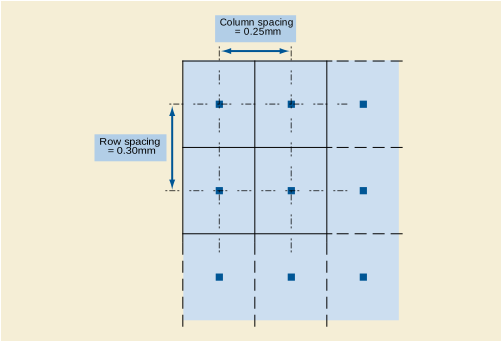
Pixel Spacing = Row Spacing \ Column Spacing = 0.30\0.25.
All pixel spacing related attributes shall have positive non-zero values, except when there is only a single row or column or pixel of data present, in which case the corresponding value may be zero.
Note
A single row or column or "pixel" may occur in MR Spectroscopy instances.
This description applies to:
Pixel Spacing (0028,0030)
Imager Pixel Spacing (0018,1164)
Nominal Scanned Pixel Spacing (0018,2010)
Image Plane Pixel Spacing (3002,0011)
Compensator Pixel Spacing (300A,00E9)
Detector Element Spacing (0018,7022)
Presentation Pixel Spacing (0070,0101)
Printer Pixel Spacing (2010,0376)
Object Pixel Spacing in Center of Beam (0018,9404)
Table 10-11 specifies the attributes that reference an SOP instance.
Table 10-11. SOP Instance Reference Macro Attributes
|
Attribute Name |
Tag |
Type |
Description |
|---|---|---|---|
|
Referenced SOP Class UID |
(0008,1150) |
1 |
Uniquely identifies the referenced SOP Class. |
|
Referenced SOP Instance UID |
(0008,1155) |
1 |
Uniquely identifies the referenced SOP Instance. |
Table 10-12 describe the attributes for identifying a SOP Instance potentially created by a human user interacting with an application.
Table 10-12. Content Identification Macro Attributes
|
Attribute Name |
Tag |
Type |
Attribute Description |
|---|---|---|---|
|
Instance Number |
(0020,0013) |
1 |
A number that identifies this SOP Instance. |
|
Content Label |
(0070,0080) |
1 |
A label that is used to identify this SOP Instance. |
|
Content Description |
(0070,0081) |
2 |
A description of the content of the SOP Instance. |
|
Alternate Content Description Sequence |
(0070,0087) |
3 |
A sequence containing alternate descriptions suitable for presentation to the user, e.g., in different languages. One or more Items are permitted in this sequence. NoteThe values of Specific Character Set for the entire Data set need to be sufficient to encode all Items of this sequence correctly, e.g., using a single value with broad support such as UTF-8, or multiple values with escape sequences. |
|
>Content Description |
(0070,0081) |
1 |
An alternate description that is used to identify this SOP Instance. |
|
>Language Code Sequence |
(0008,0006) |
1 |
The language in which Content Description (0070,0081) within this sequence item is written. A single Item shall be present. |
|
Defined CID 5000 “Languages”. |
|||
|
Content Creator's Name |
(0070,0084) |
2 |
Name of operator (such as a technologist or physician) creating the content of the SOP Instance. |
|
Content Creator's Identification Code Sequence |
(0070,0086) |
3 |
Identification of the person who created the content. Only a single item is permitted in this sequence. |
|
>Include Table 10-1 “Person Identification Macro Attributes Description” |
|||
Table 10-13 contains IOD Attributes that describe the general characteristics of the contributing sources used to create a new SOP Instance.
Table 10-13. General Contributing Sources Macro Attributes
|
Attribute Name |
Tag |
Type |
Attribute Description |
|---|---|---|---|
|
Contributing SOP Instances Reference Sequence |
(0020,9529) |
1C |
A sequence that identifies the contributing SOP Instances. Required if this SOP Instance is created from other DICOM SOP Instances. NoteThe attribute is absent in the case where the sources used to create this SOP Instance are not SOP Instances, e.g., a volume that was directly generated by an acquisition system. One or more Items shall be included in this sequence. |
|
>Study Instance UID |
(0020,000D) |
1 |
Unique identifier for the Study of the Contributing SOP Instances. |
|
>Referenced Series Sequence |
(0008,1115) |
1 |
Sequence of Items each of which includes the Attributes of one Series. One or more Items shall be included in this sequence. |
|
>>Series Instance UID |
(0020,000E) |
1 |
Unique identifier of the Series containing the referenced Instances. |
|
>>Series Number |
(0020,0011) |
2 |
A number that identifies this Series. |
|
>>Referenced Instance Sequence |
(0008,114A) |
1 |
Sequence of Items each providing a reference to an Instance that is part of the Series defined by Series Instance UID (0020,000E) in the enclosing Item. One or more Items shall be included in this sequence. |
|
>>>Include Table 10-11 “SOP Instance Reference Macro Attributes” |
|||
|
>>>Instance Number |
(0020,0013) |
2 |
A number that identifies this instance. |
|
Manufacturer |
(0008,0070) |
2 |
Manufacturer of the equipment that produced the sources. |
|
Manufacturer's Model Name |
(0008,1090) |
1C |
Manufacturer's model name of the equipment that produced the sources. Required if present and consistent in the contributing SOP Instances. |
|
Device Serial Number |
(0018,1000) |
1C |
Manufacturer's serial number of the equipment that produced the sources. Required if present and consistent in the contributing SOP Instances. |
|
Software Versions |
(0018,1020) |
1C |
Manufacturer's designation of software version of the equipment that produced the sources. See Section C.7.5.1.1.3. Required if present and consistent in the contributing SOP Instances. |
|
Acquisition DateTime |
(0008,002A) |
1C |
The time the acquisition of data that resulted in sources started. The value shall be the start date and time of the first contributing SOP Instance of the group specified by the Contributing SOP Instances Reference Sequence (0020,9529). Required if present and consistent in the contributing SOP Instances. NoteThe Acquisition DateTime may be created by combining the values of Acquisition Date (0008,0022) and Acquisition Time (0008,0032) attributes in the contributing SOP Instances. |
|
Station Name |
(0008,1010) |
1C |
User defined name identifying the machine that produced the sources. Required if present and consistent in the contributing SOP Instances. |
|
Operators' Name |
(0008,1070) |
1C |
Name(s) of the operator(s) supporting the Series. Required if present and consistent in the contributing SOP Instances. |
|
Operator Identification Sequence |
(0008,1072) |
1C |
Identification of the operator(s) supporting the Series. One or more items shall be included in this sequence. If more than one Item, the number and order shall correspond to the value of Operators' Name (0008,1070), if present. Required if present and consistent in the contributing SOP Instances. |
|
>Include Table 10-1 “Person Identification Macro Attributes Description” |
|||
|
Protocol Name |
(0018,1030) |
1C |
User-defined description of the conditions under which the Series was performed. Required if present and consistent in the contributing SOP Instances. NoteThis attribute conveys series-specific protocol identification and may or may not be identical to the one presented in the Performed Protocol Code Sequence (0040,0260). |
|
Performed Protocol Code Sequence |
(0040,0260) |
1C |
Sequence describing the Protocol performed for the Procedure Step creating the sources. One or more Items shall be included in this Sequence. Required if present and consistent in the contributing SOP Instances. |
|
No Baseline CID is defined. |
|||
|
Acquisition Protocol Name |
(0018,9423) |
1C |
User defined name of the protocol used to acquire this image. Required if present and consistent in the contributing SOP Instances. |
Note
The attributes at the first level of the General Contributing Sources macro contain information that is common to all the Referenced SOP Instances included in the Contributing SOP Instances Reference Sequence. This allows to not duplicate information when the contributing instances are single-frame objects and/or when they are in different Series with the same protocol and manufacturer information.
Typically the General Contributing Sources macro is invoked from inside another sequence. Therefore, if the "common" attributes of the macro are different among the Referenced SOP Instances, like different acquisition protocols, software versions etc., the invoking sequence will contain several items.
Table 10-14 contains IOD Attributes that describe the image related characteristics of the contributing image sources used to create a new SOP Instance (e.g., a volume SOP Instance).
Table 10-14. Contributing Image Sources Macro Attributes
|
Attribute Name |
Tag |
Type |
Attribute Description |
|---|---|---|---|
|
Rows |
(0028,0010) |
1 |
Number of rows in the images. |
|
Columns |
(0028,0011) |
1 |
Number of columns in the images. |
|
Bits Stored |
(0028,0101) |
1 |
Number of bits stored for each pixel sample. Each sample shall have the same number of bits stored. See PS3.5 for further explanation. |
|
Lossy Image Compression |
(0028,2110) |
1C |
Specifies whether the Source Images have undergone lossy compression (at a point in their lifetime). Enumerated Values:
See Section C.7.6.1.1.5. Required if it is known whether or not Lossy Compression has been performed on the Images. NoteIn some SOP Class definitions the Lossy Image Compression attribute is optional. |
|
Lossy Image Compression Ratio |
(0028,2112) |
1C |
Describes the approximate lossy compression ratio(s) that have been applied to this image. See Section C.7.6.1.1.5 for further explanation. May be multi-valued if successive lossy compression steps have been applied; the value order shall correspond to the values of Lossy Image Compression Method (0028,2114). Note
Required if Lossy Image Compression (0028,2110) is "01". |
|
Lossy Image Compression Method |
(0028,2114) |
1C |
A label for the lossy compression method(s) that have been applied to the source images. See Section C.7.6.1.1.5 for further explanation. May be multi-valued if successive lossy compression steps have been applied; the value order shall correspond to the values of Lossy Image Compression Ratio (0028,2112). NoteFor historical reasons, the lossy compression method may also be described in Derivation Description (0008,2111). Required if Lossy Image Compression (0028,2110) is "01". |
This section describes attributes of the Patient Orientation Macro by specifying the patient orientation related to gravity and equipment. Table 10-15 contains IOD Attributes that describe the Patient Orientation related to gravity and equipment.
Table 10-15. Patient Orientation Macro Attributes
|
Attribute Name |
Tag |
Type |
Attribute Description |
|---|---|---|---|
|
Patient Orientation Code Sequence |
(0054,0410) |
1 |
Sequence that describes the orientation of the patient with respect to gravity. See Section C.8.11.5.1.2 for further explanation. Only a single Item shall be included in this Sequence. |
|
Baseline CID 19 “Patient Orientation”. |
|||
|
>Patient Orientation Modifier Code Sequence |
(0054,0412) |
1C |
Patient orientation modifier. Required if needed to fully specify the orientation of the patient with respect to gravity. Only a single Item shall be included in this Sequence. |
|
Baseline CID 20 “Patient Orientation Modifier”. |
|||
|
Patient Gantry Relationship Code Sequence |
(0054,0414) |
3 |
Sequence that describes the orientation of the patient with respect to the head of the table. See Section C.8.4.6.1.3 for further explanation. Only a single Item is permitted in this Sequence. |
|
Baseline CID 21 “Patient Equipment Relationship”. |
|||
The attributes of this macro may be used to correlate the patient based coordinate system (see Section C.7.6.2) and the equipment.
Note
The Patient Orientation Code Sequence (0054,0410) allows a more precise and comprehensive positioning than Patient Position (0018,5100). If this sequence is present Patient Position (0018,5100) is not used.
Table 10-16. Performed Procedure Step Summary Macro Attributes
|
Attribute Name |
Tag |
Type |
Attribute Description |
|---|---|---|---|
|
Performed Procedure Step ID |
(0040,0253) |
3 |
User or equipment generated identifier of that part of a Procedure that has been carried out within this step. |
|
Performed Procedure Step Start Date |
(0040,0244) |
3 |
Date on which the Performed Procedure Step started. |
|
Performed Procedure Step Start Time |
(0040,0245) |
3 |
Time on which the Performed Procedure Step started. |
|
Performed Procedure Step End Date |
(0040,0250) |
3 |
Date on which the Performed Procedure Step ended. |
|
Performed Procedure Step End Time |
(0040,0251) |
3 |
Time at which the Performed Procedure Step ended. |
|
Performed Procedure Step Description |
(0040,0254) |
3 |
Institution-generated description or classification of the Procedure Step that was performed. |
|
Performed Protocol Code Sequence |
(0040,0260) |
3 |
Sequence describing the Protocol performed for this Procedure Step. One or more Items are permitted in this sequence. |
|
Context ID may be defined in the macro invocation. |
|||
|
>Protocol Context Sequence |
(0040,0440) |
3 |
Sequence that specifies the context for the Performed Protocol Code Sequence Item. One or more Items are permitted in this sequence. |
|
>>Include Table 10-2 “Content Item Macro Attributes Description” |
Context ID may be defined in the macro invocation. |
||
|
>>Content Item Modifier Sequence |
(0040,0441) |
3 |
Sequence that specifies modifiers for a Protocol Context Content Item. One or more Items are permitted in this sequence. See Section C.4.10.1. |
|
>>>Include Table 10-2 “Content Item Macro Attributes Description” |
Context ID may be defined in the macro invocation. |
||
|
Comments on the Performed Procedure Step |
(0040,0280) |
3 |
User-defined comments on the Performed Procedure Step. |
Table 10-17 describes the attributes for identifying an entity (system, organization, agency, or department) that has responsibility for managing or assigning a defined set of instance identifiers (such as placer or filler number, patient identifiers, provider identifiers, etc.). This entity could be a particular health care application such as a registration system that assigns patient identifiers, a governmental entity such as a licensing authority that assigns professional identifiers or drivers' license numbers, or a facility where such identifiers are assigned.
Note
This definition is identical to HL7 v2.5, Section 2.A.33, with only minor changes for editorial style.
These attributes are equivalent to the components of the HL7 v2 Hierarchic Designator (HD) and Entity Identifier (EI) data types (see HL7 v2 Chapter 2.A).
If both Local Namespace Entity ID (0040,0031) and Universal Entity ID (0040,0032) are present, they shall refer to the same entity.
Table 10-17. HL7v2 Hierarchic Designator Macro Attributes
|
Attribute Name |
Tag |
Type |
Attribute Description |
|---|---|---|---|
|
Local Namespace Entity ID |
(0040,0031) |
1C |
Identifies an entity within the local namespace or domain. Required if Universal Entity ID (0040,0032) is not present; may be present otherwise. |
|
Universal Entity ID |
(0040,0032) |
1C |
Universal or unique identifier for an entity. Required if Local Namespace Entity ID (0040,0031) is not present; may be present otherwise. |
|
Universal Entity ID Type |
(0040,0033) |
1C |
Standard defining the format of the Universal Entity ID. Required if Universal Entity ID (0040,0032) is present. Enumerated Values:
|
Table 10-18 describes the attributes for identifying the source of Patient ID (0010,0020).
These attributes are equivalent to components of the HL7 v2 Extended Composite ID with Check Digit (CX) data type (see HL7 v2 Chapter 2.A.14), as used in the HL7 v2 PID-3 Patient Identifier List field.
Table 10-18. Issuer of Patient ID Macro Attributes
|
Attribute Name |
Tag |
Type |
Attribute Description |
|---|---|---|---|
|
Issuer of Patient ID |
(0010,0021) |
3 |
Identifier of the Assigning Authority (system, organization, agency, or department) that issued the Patient ID. NoteEquivalent to HL7 v2 CX component 4 subcomponent 1. |
|
Issuer of Patient ID Qualifiers Sequence |
(0010,0024) |
3 |
Attributes specifying or qualifying the identity of the issuer of the Patient ID, or scoping the Patient ID. Only a single Item is permitted in this sequence. |
|
>Universal Entity ID |
(0040,0032) |
3 |
Universal or unique identifier for the Patient ID Assigning Authority. The authority identified by this attribute shall be the same as that of Issuer of Patient ID (0010,0021), if present. NoteEquivalent to HL7 v2 CX component 4 subcomponent 2 (Universal ID). |
|
>Universal Entity ID Type |
(0040,0033) |
1C |
Standard defining the format of the Universal Entity ID (0040,0032). Required if Universal Entity ID (0040,0032) is present. NoteEquivalent to HL7 v2 CX component 4 subcomponent 3 (Universal ID Type). See Section 10.14 for Defined Terms. |
|
>Identifier Type Code |
(0040,0035) |
3 |
Type of Patient ID. Refer to HL7 v2 Table 0203 for Defined Terms. NoteEquivalent to HL7 v2 CX component 5 (Identifier Type Code). |
|
>Assigning Facility Sequence |
(0040,0036) |
3 |
The place or location identifier where the identifier was first assigned to the patient. This component is not an inherent part of the identifier but rather part of the history of the identifier. Only a single Item is permitted in this sequence. NoteEquivalent to HL7 v2 CX component 6 (Assigning Facility). |
|
>>Include Table 10-17 “HL7v2 Hierarchic Designator Macro Attributes” |
|||
|
>Assigning Jurisdiction Code Sequence |
(0040,0039) |
3 |
The geo-political body that assigned the patient identifier. Typically a code for a country or a state/province. Only a single Item is permitted in this sequence. NoteEquivalent to HL7 v2 CX component 9 (Identifier Type Code). |
|
Baseline CID 5001 “Countries” for country codes. |
|||
|
>Assigning Agency or Department Code Sequence |
(0040,003A) |
3 |
The agency or department that assigned the patient identifier. Only a single Item is permitted in this sequence. NoteEquivalent to HL7 v2 CX component 10 (Identifier Type Code). |
|
No Baseline CID is defined. |
|||
Table 10-19 describes the Attributes for encoding the algorithm used to create or derive a SOP Instance contents. An algorithm is described by the Algorithm Family, a specific Algorithm Name, and an Algorithm Version. A character string containing parameters that were used in the algorithm can be included.
Table 10-19. Algorithm Identification Macro Attributes
|
Attribute Name |
Tag |
Type |
Attribute Description |
|---|---|---|---|
|
Algorithm Family Code Sequence |
(0066,002F) |
1 |
The family of algorithm(s) that best describes the software algorithm used. Only a single item shall be included in this sequence. |
|
Context ID may be defined in the macro invocation. |
|||
|
Algorithm Name Code Sequence |
(0066,0030) |
3 |
The code assigned by a manufacturer to a specific software algorithm. Only a single item is permitted in this sequence. |
|
No Baseline CID is defined. |
|||
|
Algorithm Name |
(0066,0036) |
1 |
The name assigned by a manufacturer to a specific software algorithm. |
|
Algorithm Version |
(0066,0031) |
1 |
The software version identifier assigned by a manufacturer to a specific software algorithm. |
|
Algorithm Parameters |
(0066,0032) |
3 |
The input parameters used by a manufacturer to configure the behavior of a specific software algorithm. |
|
Algorithm Source |
(0024,0202) |
3 |
Source of the algorithm, e.g., the name of the manufacturer, researcher, university, etc. |
Table 10-20 specifies the Attributes that identify the context for a Data Element Tag that is used as a Selector Attribute (0072,0026). The attribute may be an attribute nested within one or more Sequences, and/or a Private Attribute.
Table 10-20. Selector Attribute Macro Attributes
|
Attribute Name |
Tag |
Type |
Attribute Description |
|---|---|---|---|
|
Selector Attribute |
(0072,0026) |
1 |
Data Element Tag of the attribute to be referenced. |
|
Selector Value Number |
(0072,0028) |
1 |
Positive integer identifying which value of a multi-valued attribute identified by Selector Attribute (0072,0026) is to be referenced. The value 1 identifies the first value. The value zero identifies any value. |
|
Selector Sequence Pointer |
(0072,0052) |
1C |
Contains the Data Element Tags of the path to the Sequence that contains the Attribute that is identified by Selector Attribute (0072,0026). This attribute shall have the same number of items as the level of nesting of Selector Attribute (0072,0026). Required if Selector Attribute (0072,0026) is nested in one or more Sequences. See Section 10.17.1.1. |
|
Selector Sequence Pointer Private Creator |
(0072,0054) |
1C |
Identification of the creator of a group of private data elements used to encode attributes in the Selector Sequence Pointer (0072,0052). This attribute shall have the same number of items as the level of nesting of Selector Attribute (0072,0026). For values of the Selector Sequence Pointer (0072,0052) that are not the Data Element Tag of a Private Attribute, the corresponding value in Selector Sequence Pointer Private Creator (0072,0054) shall be empty. Required if Selector Sequence Pointer (0072,0052) is present and one or more of the values of Selector Sequence Pointer (0072,0052) is the Data Element Tag of a Private Attribute. See Section 10.17.1.2. |
|
Selector Sequence Pointer Items |
(0074,1057) |
1C |
Identification of the Item indices in the Selector Sequence Pointer (0072,0052). This attribute shall have the same number of items as the level of nesting of Selector Attribute (0072,0026). Required if Selector Sequence Pointer (0072,0052) is present. See Section 10.17.1.1. |
|
Selector Attribute Private Creator |
(0072,0056) |
1C |
Identification of the creator of a group of private data elements. Required if the Selector Attribute (0072,0026) value is the Data Element Tag of a Private Attribute. See Section 10.17.1.2. |
Examples of use are shown in Table 10-21.
Table 10-21. Selector Attribute Macro Example
|
Example |
Selector Attribute (0072,0026) |
Selector Value Number (0072,0028) |
Selector Sequence Pointer (0072,0052) |
Selector Sequence Pointer Items (0074,1057) |
|---|---|---|---|---|
|
Entire Patient's Name |
(0010,0010) |
0 |
absent |
absent |
|
Second value (e.g., PRIMARY or SECONDARY) in Image Type Attribute |
(0008,0008) |
2 |
absent |
absent |
|
Entire RT Beam Limiting Device Sequence attribute for the third Beam in an RT Plan |
(300A,00B6) |
0 |
(300A,00B0) |
3 |
|
RT Beam Limiting Device Type attribute for the second jaw specified for the first Beam in an RT Plan |
(300A,00B8) |
0 |
(300A,00B0), (300A,00B6) |
1\2 |
|
Code value attribute for the first item in View Code Sequence |
(0008,0100) |
1 |
(0054,0220) |
1 |
The Selector Sequence Pointer Private Creator (0072,0054) and the Selector Attribute Private Creator (0072,0056) each have a value that corresponds to the Private Creator Data Element numbers (gggg,00pp), where gggg is odd and pp ranges from 10 to FF. These identify a block of Private Data Elements within the block (gggg,ppxx). When Selector Attribute (0072,0026) or Selector Sequence Pointer (0072,0052) points to a Private Data Element (gggg,ppxx), it shall have the value (gggg,00xx).
Table 10-22 describes the attributes for the identification of an externally sourced data set.
Table 10-22. Data Set Identification Macro Attributes
|
Attribute Name |
Tag |
Type |
Attribute Description |
|---|---|---|---|
|
Data Set Name |
(0024,0306) |
1 |
The name assigned to the data set. |
|
Data Set Version |
(0024,0307) |
1 |
The software version identifier assigned to the data set. |
|
Data Set Source |
(0024,0308) |
1 |
Source of the data set e.g., the name of the manufacturer, researcher, university, etc. |
|
Data Set Description |
(0024,0309) |
3 |
Description of the data set. |
Table 10-23 describes the attributes for describing the Exposure Index for single projection X-ray images, as described by IEC 62494-1 and the report of AAPM Task Group 116.
Table 10-23. Exposure Index Macro Attributes
|
Attribute Name |
Tag |
Type |
Attribute Description |
|---|---|---|---|
|
Exposure Index |
(0018,1411) |
3 |
Measure of the detector response to radiation in the relevant image region of an image acquired with a digital x-ray imaging system as defined in IEC 62494-1. Note
|
|
Target Exposure Index |
(0018,1412) |
3 |
The target value used to calculate Deviation Index (0018,1413) as defined in IEC 62494-1. |
|
Deviation Index |
(0018,1413) |
3 |
A scaled representation of the difference of the Exposure Index compared to the Target Exposure Index as defined in IEC 62494-1 and the report of AAPM TG 116. |
Table 10-24 specifies the Attributes that describe the view, and in the case of cardiac views, the direction of the slices relative to the cardiac anatomy.
Table 10-24. Mandatory View and Slice Progression Direction Attributes
|
Attribute Name |
Tag |
Type |
Attribute Description |
|---|---|---|---|
|
View Code Sequence |
(0054,0220) |
1 |
Sequence that describes the projection of the anatomic region of interest. Only a single Item shall be included in this sequence. |
|
Baseline CID 26 “Nuclear Medicine Projections” unless otherwise specified in invocation. |
|||
|
>View Modifier Code Sequence |
(0054,0222) |
2C |
View Modifier. Required if needed to fully specify the View. Zero or more items shall be included in this sequence. |
|
Baseline CID 23 “Cranio-Caudad Angulation” unless otherwise specified in invocation. |
|||
|
Slice Progression Direction |
(0054,0500) |
1C |
Describes the anatomical direction in which a set of slices is progressing (see Section 10.20.1.1). Meaningful only for cardiac images. Enumerated Values are defined in Section 10.20.1.1. Required if View Code Sequence (0054,0220) equals (G-A186, SRT,"Short Axis") or (G-A18A,SRT,"Vertical Long Axis") or (G-A18B,SRT, "Horizontal Long Axis"). May be present otherwise. |
The image or frame order to which the Slice Progression Direction (0054,0500) applies depends on the IOD:
In the case of Enhanced Multi-frame IODs, in which a Stack ID (0020,9056) may be defined, Stack ID (0020,9056) shall be used, and the slices are considered in order by In Stack Position Number (0020,9057)
In the case of Multi-frame IODs that are not Enhanced, the slices are considered in encoded frame order
In the case of single-frame IODs, the order is defined by increasing values of Instance Number
The Enumerated Values depend on the view:
If View Code Sequence (0054,0220) indicates a short axis view, such as when it equals (G-A186, SRT,"Short Axis"):
Enumerated Values
- APEX_TO_BASE
- BASE_TO_APEX
If View Code Sequence (0054,0220) indicates a vertical long axis view, such as when it equals (G-A18A,SRT,"Vertical Long Axis"):
Enumerated Values
- ANT_TO_INF
Anterior to Inferior
- INF_TO_ANT
Inferior to Anterior
If View Code Sequence (0054,0220) indicates a horizontal long axis view, such as when it equals (G-A18B,SRT, "Horizontal Long Axis"):
Enumerated Values
- SEPTUM_TO_WALL
Septum to Lateral Wall
- WALL_TO_SEPTUM
Lateral Wall to Septum
Note
The conditions on the choice of Enumerated Values are relatively general, rather than specific to a single coded view, in order to accommodate the echocardiography views defined in CID 12226 “Echocardiography Image View” in PS3.16, in addition to the views for CT, MR, NM and PET defined in CID 26 “Nuclear Medicine Projections” in PS3.16.
Table 10-25 specifies the Attributes that describe the view, and in the case of cardiac views, the direction of the slices relative to the cardiac anatomy.
Table 10-25. Optional View and Slice Progression Direction Attributes
|
Attribute Name |
Tag |
Type |
Attribute Description |
|---|---|---|---|
|
View Code Sequence |
(0054,0220) |
3 |
Sequence that describes the projection of the anatomic region of interest. Only a single Item is permitted in this sequence. |
|
Baseline CID 26 “Nuclear Medicine Projections” unless otherwise specified in invocation. |
|||
|
>View Modifier Code Sequence |
(0054,0222) |
3 |
View Modifier. One or more Items are permitted in this sequence. |
|
Baseline CID 23 “Cranio-Caudad Angulation” unless otherwise specified in invocation. |
|||
|
Slice Progression Direction |
(0054,0500) |
3 |
Describes the anatomical direction in which a set of slices is progressing (see Section 10.20.1.1). Meaningful only for cardiac images. Enumerated Values are defined in Section 10.20.1.1. |
Table 10-26 describes the attributes used to relate and convey a numeric value to a coded concept.
Table 10-26. Numeric Value Macro Attributes
|
Attribute Name |
Tag |
Type |
Attribute Description |
|---|---|---|---|
|
Concept Name Code Sequence |
(0040,A043) |
1 |
Coded concept name of this name-value Item. Only a single Item shall be included in this sequence. |
|
No Context ID is defined. |
|||
|
Numeric Value |
(0040,A30A) |
1 |
Numeric value for this name-value Item. |
|
Measurement Units Code Sequence |
(0040,08EA) |
1 |
Units of Numeric Value (0040,A30A) in this name-value Item. Only a single Item shall be included in this sequence. |
|
Defined CID 82 “Units of Measurement”. |
|||
Table 10-27. RT Equipment Correlation Macro Attributes Description
|
Attribute Name |
Tag |
Type |
Attribute Description |
|---|---|---|---|
|
Patient Support Angle |
(300A,0122) |
3 |
Patient Support angle, i.e., orientation of IEC PATIENT SUPPORT coordinate system with respect to IEC FIXED REFERENCE coordinate system (degrees). |
|
Table Top Pitch Angle |
(300A,0140) |
3 |
Table Top Pitch Angle, i.e., the rotation of the IEC TABLE TOP coordinate system about the X-axis of the IEC TABLE TOP coordinate system (degrees). See Section C.8.8.25.6.2. |
|
Table Top Roll Angle |
(300A,0144) |
3 |
Table Top Roll Angle, i.e., the rotation of the IEC TABLE TOP coordinate system about the Y-axis of the IEC TABLE TOP coordinate system (degrees). See Section C.8.8.25.6.2. |
|
Table Top Longitudinal Position |
(300A,0129) |
3 |
Table Top Longitudinal position in IEC TABLE TOP coordinate system (mm). |
|
Table Top Lateral Position |
(300A,012A) |
3 |
Table Top Lateral position in IEC TABLE TOP coordinate system (mm). |
Each Composite Information Object Definition is composed of the following Sections
IOD Description
IOD Entity-Relationship Model
IOD Module Table
Optionally, a Functional Group Macros Table used by the Multi-frame Functional Groups Module
Section A.1.1, Section A.1.2 and Section A.1.3 define the requirements of a) through d) above.
This Section provides a brief description of the IOD. Specifically, this description includes:
The Real-World Object that is represented by the IOD
Information as to the scope of the represented object if appropriate
This Section of an IOD provides the Entity-Relationship (E-R) Model that depicts the relationships of the components or Information Entities (IE) of the specified IOD. It forms an IOD specific information model. This E-R model provides the complete context of how the composite instance information shall be interpreted when a composite instance is exchanged between two DICOM Application Entities.
Even though composite instances are sent as discrete individual components, each Composite Instance IOD E-R Model requires that all composite instances that are part of a specific study shall share the same context. That is, all composite instances within a specific patient study share the same patient and study information; all composite instances within the same series share the same series information; etc.
Figure A.1-1 is the DICOM Composite Instance IOD Information Model. It applies to all of the Composite Instance IODs defined in Annex A. However, a subset of this model may be specified by each individual Composite Instance IOD to accurately define the context for specific composite instance exchange.
The sub-sections of this Section describe the Information Entities (IE) that comprise the Composite Instance IODs defined in this Annex.
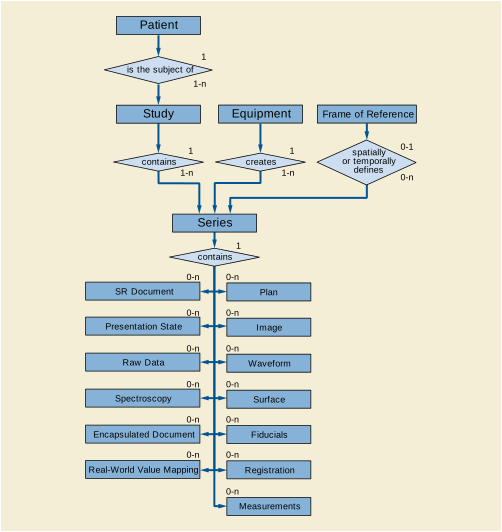
The Patient IE defines the characteristics of a patient who is the subject of one or more medical studies.
Note
A patient may be a human or an animal.
The Patient IE is modality independent.
The Study IE defines the characteristics of a medical study performed on a patient. A study is a collection of one or more series of medical images, presentation states, and/or SR documents that are logically related for the purpose of diagnosing a patient. Each study is associated with exactly one patient.
A study may include composite instances that are created by a single modality, multiple modalities or by multiple devices of the same modality.
The Study IE is modality independent.
The Series IE defines the Attributes that are used to group composite instances into distinct logical sets. Each series is associated with exactly one Study.
The following criteria group composite instances into a specific series:
All composite instances within a series must be of the same modality
Each series may be associated with exactly one Frame of Reference IE, and if so associated all composite instances within the series shall be spatially or temporally related to each other
All composite instances within the series shall be created by the same equipment; therefore, each series is associated with exactly one Equipment IE
All composite instances within a series shall have the same series information
Presentation States shall be grouped into Series without Images (i.e., in a different Series from the Series containing the Images to which they refer).
Note
The Series containing Grayscale, Color and Pseudo-Color Softcopy Presentation States and the Series containing the Images to which they refer are both contained within the same Study, except for Blended Presentation States, which may refer to images from different Studies.
Waveforms shall be grouped into Series without Images. A Frame of Reference IE may apply to both Waveform Series and Image Series.
SR Documents shall be grouped into Series without Images. The Frame of Reference IE may apply to SR Document Series, for SR Documents that contain 3D spatial coordinates relative to one or more spatial Frames of Reference, or temporal coordinates that require a temporal Frame of Reference.
The Equipment IE describes the particular device that produced the series of composite instances. A device may produce one or more series within a study. The Equipment IE does not describe the data acquisition or image creation Attributes used to generate the composite instances within a series. These Attributes are described in the composite instance specific IEs (e.g., the Image IE).
The Frame of Reference IE identifies the coordinate system that conveys spatial and/or temporal information of composite instances in a series.
When present, a Frame of Reference IE may be related to one or more series. In this case, it provides the ability to spatially or temporally relate multiple series to each other. In such cases, the series may share the UID of the Frame of Reference, or alternatively, a Registration SOP Instance may specify the spatial relationship explicitly, as a spatial transformation. A Frame of Reference IE may also spatially register a Frame of Reference to an atlas.
The Image IE defines the Attributes that describe the pixel data of an image. The pixel data may be generated as a direct result of patient scanning (termed an Original Image) or the pixel data may be derived from the pixel data of one or more other images (termed a Derived Image). An image is defined by its image plane, pixel data characteristics, gray scale and/or color mapping characteristics, overlay planes and modality specific characteristics (acquisition parameters and image creation information).
An image is related to a single series within a single study.
The pixel data within an Image IE may be represented as a single frame of pixels or as multiple frames of pixel data. The frames of a Multi-frame image (a cine run or the slices of a volume) are sequentially ordered and share a number of common properties. A few Attributes may vary between frames (e.g., Time, Angular Displacement, Slice Increment). All common Image IE Attributes refer to the first frame of a multiple frame image.
Overlay and Lookup Table data may be included within an Image IE only if this information is directly associated with the image.
The Overlay IE defines the Attributes that describe an independent set of Overlay Planes. The Overlay IE may represent in a bit-map format, graphics or text and is used to indicate such items as region of interest, reference marks and annotations. Sufficient information shall be available to allow an overlay to be presented at a display station superimposed on a particular image with which it is associated. An Overlay IE shall be related to only one Series IE.
An Overlay Plane may be represented as a single frame (when associated with a single frame image) or as multiple frames of overlay planes (when associated with a Multi-frame image).
Retired. See PS3.3-2004.
The Modality LUT IE defines the Attributes that describe the transformation of manufacturer dependent pixel values into pixel values that are manufacturer independent (e.g., Hounsfield units for CT, Optical Density for film digitizers, etc.). The Modality LUT may be contained within an image, or a presentation state that references an image. When the transformation is linear, the Modality LUT is described by Rescale Slope (0028,1053) and Rescale Intercept (0028,1052). When the transformation is non-linear, the Modality LUT is described by Modality LUT Sequence (0028,3000).
The VOI LUT IE defines the Attributes that describe the transformation of the modality pixel values into pixel values that are meaningful for print, display, etc. This transformation is applied after any Modality LUT. The VOI LUT may be contained within an image, or a presentation state that references an image. When the transformation is linear, the VOI LUT is described by Window Center (0028,1050) and Window Width (0028,1051). When the transformation is non-linear, the VOI LUT is described by VOI LUT Sequence (0028,3010). A non-linear interpretation of Window Center (0028,1050) and Window Width (0028,1051) may be defined by VOI LUT Function (0028,1056).
The Presentation State IE defines how a referenced image (or images) will be presented (e.g., displayed) in a device independent grayscale space (i.e., in P-Values) or color space (i.e., in PCS-values), and what graphical annotations and spatial and grayscale contrast transformations will be applied to the referenced image pixel data.
The Waveform IE represents a multi-channel time-based digitized waveform. The waveform consists of measurements of some physical qualities (e.g., electrical voltage, pressure, gas concentration, or sound), sampled at constant time intervals. The measured qualities may originate, for example, in any of the following sources:
the anatomy of the patient,
therapeutic equipment (e.g., a cardiac pacing signal or a radio frequency ablation signal),
equipment for diagnostic synchronization (e.g., a clock or timing signal used between distinct devices),
the physician's voice (e.g., a dictated report).
The sample data within a Waveform IE may represent one or more acquired channels. Several signal channels acquired at the same sampling rate can be multiplexed (by interleaving samples) in a single multiplex group. (see also Annex C “Waveforms (Informative)” in PS3.17.)
The SR Document IE defines the Attributes that describe the content of an SR Document. These include semantic context as well as Attributes related to document completion, verification and other characteristics. An SR Document SOP Instance is related to a single Series within a single Study.
The MR Spectroscopy IE defines the attributes that describe the data of a MR spectroscopy acquisition created by a magnetic resonance spectroscopy device.
The Raw Data IE defines the attributes that describe a data set that may be used for further processing to produce image data or other data.
Note
For example, raw data may be used with CT and MR systems to reconstruct sets of images or for MR to reconstruct spectroscopic data. The format of the raw data is vendor specific.
The Encapsulated Document IE defines the Attributes that describe the content of a non-DICOM formatted document that is encapsulated in a DICOM Attribute. These include Attributes related to document origin, title, and other characteristics. An Encapsulated Document SOP Instance is related to a single Series within a single Study.
The Real World Value Mapping IE defines the attributes that describe the mapping of stored pixel data to Real World values.
The Surface IE defines the Attributes that describe a surface in a spatial coordinate system. A surface is defined by its shape and can be further defined by normals on that shape. The surface may be reconstructed from either spatial scans (e.g., laser scanners) or based on images. A surface is described by its finite volume and manifold property, gray scale and color mapping characteristics, presentation type, opacity, and modality specific characteristics.
A surface is related to a single Series.
This Section of each IOD defines in a tabular form the Modules comprising the IOD. The following information must be specified for each Module in the table:
The name of the Module or Functional Group
A reference to the Section in Annex C that defines the Module or Functional Group
The usage of the Module or Functional Group; whether it is:
Mandatory (see Section A.1.3.1), abbreviated M
Conditional (see Section A.1.3.2), abbreviated C
User Option (see Section A.1.3.3), abbreviated U
The Modules referenced are defined in Annex C.
For each IOD, Mandatory Modules shall be supported per the definitions, semantics and requirements defined in Annex C.
Conditional Modules are Mandatory Modules if specific conditions are met. If the specified conditions are not met, this Module shall not be supported; that is, no information defined in that Module shall be sent.
User Option Modules may or may not be supported. If an optional Module is supported, the Attribute Types specified in the Modules in Annex C shall be supported.
The Tables in this Section provide an overview of the Modules used throughout the Composite IODs. This table is for informative purposes only. It is based on the IOD definitions found in the remaining Sections of Annex A that are normative.
Table A.1-1a. Composite Information Object Modules Overview - Images
|
IODs Modules |
CR |
CT |
Enh CT |
MR |
Enh MR |
Enh MR Col |
NM |
US |
US MF |
Enh US Vol |
SC |
SC MF SB |
SC MF GB |
SC MF GW |
SC MF TC |
PT |
Enh PT |
|---|---|---|---|---|---|---|---|---|---|---|---|---|---|---|---|---|---|
|
Patient |
M |
M |
M |
M |
M |
M |
M |
M |
M |
M |
M |
M |
M |
M |
M |
M |
M |
|
Clinical Trial Subject |
U |
U |
U |
U |
U |
U |
U |
U |
U |
U |
U |
U |
U |
U |
U |
U |
U |
|
General Study |
M |
M |
M |
M |
M |
M |
M |
M |
M |
M |
M |
M |
M |
M |
M |
M |
M |
|
Patient Study |
U |
U |
U |
U |
U |
U |
U |
U |
U |
U |
U |
U |
U |
U |
U |
U |
U |
|
Clinical Trial Study |
U |
U |
U |
U |
U |
U |
U |
U |
U |
U |
U |
U |
U |
U |
U |
U |
U |
|
General Series |
M |
M |
M |
M |
M |
M |
M |
M |
M |
M |
M |
M |
M |
M |
M |
M |
M |
|
Clinical Trial Series |
U |
U |
U |
U |
U |
U |
U |
U |
U |
U |
U |
U |
U |
U |
U |
U |
U |
|
CR Series |
M |
||||||||||||||||
|
NM/PET Patient Orientation |
M |
M |
|||||||||||||||
|
PET Series |
M |
||||||||||||||||
|
PET Isotope |
M |
||||||||||||||||
|
PET Multi-gated Acquisition |
C |
||||||||||||||||
|
Enhanced PET Series |
M |
||||||||||||||||
|
Enhanced US Series |
M |
||||||||||||||||
|
Frame of Reference |
M |
M |
M |
M |
M |
U |
U |
U |
M |
C |
C |
C |
M |
M |
|||
|
Ultrasound Frame of Reference |
M |
||||||||||||||||
|
Synchronization |
C |
C |
C |
C |
U |
U |
M |
U |
U |
U |
C |
C |
|||||
|
Cardiac Synchronization |
C |
C |
C |
C |
C |
||||||||||||
|
Respiratory Synchronization |
C |
C |
C |
C |
C |
||||||||||||
|
Bulk Motion Synchronization |
C |
C |
|||||||||||||||
|
General Equipment |
M |
M |
M |
M |
M |
M |
M |
M |
M |
M |
U |
U |
U |
U |
U |
M |
M |
|
Enhanced General Equipment |
M |
M |
M |
M |
M |
||||||||||||
|
SC Equipment |
M |
M |
M |
M |
M |
||||||||||||
|
General Image |
M |
M |
M |
M |
M* |
M |
M |
M |
M |
M |
M |
M |
M |
||||
|
Image Plane |
M |
M |
M |
||||||||||||||
|
Image Pixel |
M |
M |
M |
M |
M |
M |
M |
M* |
M |
M |
M |
M |
M |
M |
M |
M |
M |
|
NM Image Pixel |
M |
||||||||||||||||
|
Palette Color Lookup Table |
C |
C |
|||||||||||||||
|
Supplemental Palette Color Lookup Table |
C |
C |
|||||||||||||||
|
Enhanced Palette Color Lookup Table |
U |
||||||||||||||||
|
Contrast/Bolus |
C |
C |
C |
C* |
C |
||||||||||||
|
Enhanced Contrast/Bolus |
C |
C |
C |
C |
|||||||||||||
|
Cine |
M |
C |
C |
C |
C |
||||||||||||
|
Multi-frame |
M |
M |
M |
M |
M |
M |
|||||||||||
|
NM Multi-frame |
M |
||||||||||||||||
|
Frame Pointers |
U |
U |
U |
U |
U |
||||||||||||
|
Multi-frame Functional Groups |
M |
M |
M |
M |
U |
U |
U |
M |
|||||||||
|
Multi-frame Dimension |
M |
M |
M |
M |
U |
U |
U |
M |
|||||||||
|
Excluded Intervals |
U |
||||||||||||||||
|
Display Shutter |
U |
||||||||||||||||
|
Device |
U |
U |
U |
U |
U |
U |
U |
U |
U |
U |
U |
U |
U |
U |
U |
U |
|
|
Intervention |
U |
||||||||||||||||
|
Specimen |
U |
U |
U |
U |
U |
C |
U |
U |
U |
U |
U |
U |
U |
U |
U |
U |
U |
|
CR Image |
M |
||||||||||||||||
|
CT Image |
M |
||||||||||||||||
|
Enhanced CT Image |
M |
||||||||||||||||
|
MR Image |
M |
||||||||||||||||
|
Enhanced MR Image |
M |
M |
|||||||||||||||
|
MR Pulse Sequence |
C |
C |
|||||||||||||||
|
NM Image |
M |
||||||||||||||||
|
NM Isotope |
M |
||||||||||||||||
|
NM Detector |
M |
||||||||||||||||
|
NM TOMO Acquisition |
C |
||||||||||||||||
|
NM Multi-Gated Acquisition |
C |
||||||||||||||||
|
NM Phase |
C |
||||||||||||||||
|
NM Reconstruction |
C |
||||||||||||||||
|
US Region Calibration |
U* |
U |
|||||||||||||||
|
US Image |
M* |
M |
|||||||||||||||
|
Enhanced US Image |
M |
||||||||||||||||
|
IVUS Image |
C |
||||||||||||||||
|
SC Image |
M |
U |
U |
U |
U |
||||||||||||
|
SC Multi-frame Image |
M |
M |
M |
M |
|||||||||||||
|
SC Multi-frame Vector |
C |
C |
C |
C |
|||||||||||||
|
PET Image |
M |
||||||||||||||||
|
Enhanced PET Isotope Module |
M |
||||||||||||||||
|
Enhanced PET Acquisition |
M |
||||||||||||||||
|
Enhanced PET Image |
M |
||||||||||||||||
|
Overlay Plane |
U |
U |
U |
U |
U* |
U |
U |
||||||||||
|
Multi-frame Overlay |
U |
||||||||||||||||
|
Modality LUT |
U |
U |
|||||||||||||||
|
VOI LUT |
U |
U |
U |
U |
U* |
U |
U |
C |
C |
U |
|||||||
|
Common Instance Reference |
U |
U |
U |
U |
U |
U |
U |
U |
U |
U |
U |
U |
U |
U |
U |
U |
U |
|
Acquisition Context |
M |
M |
M |
U |
M |
U |
M |
||||||||||
|
ICC Profile |
U |
U |
M |
U |
U |
U |
U |
U |
U |
||||||||
|
SOP Common |
M |
M |
M |
M |
M |
M |
M |
M* |
M* |
M |
M |
M |
M |
M |
M |
M |
M |
|
Frame Extraction |
C |
C |
C |
C |
C |
C |
C |
C |
C |
C |
C |
* The notation next to M and U indicates a special condition for these modules. Refer to the corresponding Information Object Definitions in this Annex for details.
Note
The original US Image IOD and US multi-frame IOD, and the associated US and US multi-frame Storage SOP Class UID have been retired. New US and US multi-frame Image IODs are defined, as shown in Table A.1-1a, which includes the Palette Color Lookup Table module.
The original NM Image IOD and the associated NM Storage SOP Class UID have been retired. A completely new NM Image IOD is defined, as shown in Table A.1-1a.
Table A.1-1b. Composite Information Object Modules Overview - Images
|
IODs Modules |
XA |
Enh XA |
RF |
Enh RF |
3D XA |
3D CF |
Br Tomo |
Br Proj |
RT IM |
DX |
MG |
IO |
|---|---|---|---|---|---|---|---|---|---|---|---|---|
|
Patient |
M |
M |
M |
M |
M |
M |
M |
M |
M |
M |
M |
M |
|
Clinical Trial Subject |
U |
U |
U |
U |
U |
U |
U |
U |
U |
U |
U |
U |
|
General Study |
M |
M |
M |
M |
M |
M |
M |
M |
M |
M |
M |
M |
|
Patient Study |
U |
U |
U |
U |
U |
U |
U |
U |
U |
U |
U |
U |
|
Clinical Trial Study |
U |
U |
U |
U |
U |
U |
U |
U |
U |
U |
U |
U |
|
General Series |
M |
M |
M |
M |
M |
M |
M |
M |
M |
M |
M |
|
|
Clinical Trial Series |
U |
U |
U |
U |
U |
U |
U |
U |
U |
U |
U |
U |
|
Enhanced Series |
M |
M |
||||||||||
|
RT Series |
M |
|||||||||||
|
DX Series |
M |
M |
M |
M |
||||||||
|
Mammo Series |
M |
|||||||||||
|
Enhanced Mammo Series |
M |
M |
||||||||||
|
Intra-Oral Series |
M |
|||||||||||
|
XA/XRF Series |
M |
M |
||||||||||
|
Frame of Reference |
C |
U |
M |
M |
M |
M |
U |
U |
C |
U |
||
|
Synchronization |
U |
C |
U |
C |
C |
C |
||||||
|
Cardiac Synchronization |
C |
C |
C |
|||||||||
|
Respiratory Synchronization |
C |
C |
C |
|||||||||
|
General Equipment |
M |
M |
M |
M |
M |
M |
M |
M |
M |
M |
M |
M |
|
Enhanced General Equipment |
M |
M |
M |
M |
M |
M |
||||||
|
General Image |
M |
M |
M |
M |
M |
M |
||||||
|
Image Pixel |
M |
M |
M |
M |
M |
M |
M |
M |
M |
M |
M |
M |
|
Contrast/Bolus |
C |
C |
C |
U |
U |
U |
||||||
|
Enhanced Contrast/Bolus |
C |
C |
C |
C |
C |
C |
||||||
|
Cine |
C |
C |
C |
|||||||||
|
Multi-frame |
C |
C |
C |
|||||||||
|
Frame Pointers |
U |
U |
||||||||||
|
Multi-frame Functional Groups |
M |
M |
M |
M |
M |
M |
||||||
|
Multi-frame Dimension |
U |
U |
U |
U |
U |
U |
||||||
|
Mask |
C |
U |
C |
U |
||||||||
|
Display Shutter |
U |
U |
U |
U |
U |
|||||||
|
Device |
U |
U |
U |
U |
U |
U |
U |
U |
U |
U |
U |
U |
|
Intervention |
U |
U |
U |
U |
U |
U |
U |
U |
U |
U |
U |
|
|
Specimen |
U |
U |
U |
U |
U |
U |
U |
U |
U |
U |
U |
|
|
Patient Orientation |
U |
U |
M |
|||||||||
|
Image - Equipment Coordinate Relationship |
U |
U |
U |
|||||||||
|
X-Ray Image |
M |
M |
||||||||||
|
Enhanced XA/XRF Image |
M |
M |
||||||||||
|
X-Ray Acquisition |
M |
M |
||||||||||
|
XA/XRF Acquisition |
C |
C |
||||||||||
|
X-Ray Collimator |
U |
U |
U |
U |
U |
|||||||
|
X-Ray Table |
C |
U |
||||||||||
|
XRF Positioner |
U |
|||||||||||
|
X-Ray Tomo Acquisition |
C |
U |
U |
U |
U |
|||||||
|
X-Ray Acquisition Dose |
U |
U |
U |
|||||||||
|
X-Ray Generation |
U |
U |
U |
|||||||||
|
X-Ray Filtration |
U |
U |
U |
U |
U |
|||||||
|
X-Ray Grid |
U |
U |
U |
U |
U |
|||||||
|
XA Positioner |
M |
|||||||||||
|
X-Ray Image Intensifier |
C |
C |
||||||||||
|
X-Ray Detector |
C |
C |
||||||||||
|
XA/XRF Multi-frame Presentation |
U |
U |
||||||||||
|
X-Ray 3D Image |
M |
M |
M |
|||||||||
|
X-Ray 3D Angiographic Image Contributing Sources |
U |
|||||||||||
|
X-Ray 3D Craniofacial Image Contributing Sources |
U |
|||||||||||
|
Breast Tomosynthesis Contributing Sources |
U |
|||||||||||
|
X-Ray 3D Angiographic Acquisition |
U |
|||||||||||
|
X-Ray 3D Craniofacial Acquisition |
U |
|||||||||||
|
Breast Tomosynthesis Acquisition |
U |
|||||||||||
|
X-Ray 3D Reconstruction |
U |
U |
U |
|||||||||
|
Enhanced Mammography Image |
M |
|||||||||||
|
Breast View |
M |
M |
||||||||||
|
DX Anatomy Imaged |
M |
M |
M |
|||||||||
|
DX Image |
M |
M |
M |
|||||||||
|
DX Detector |
U |
U |
M |
M |
M |
|||||||
|
DX Positioning |
U |
U |
U |
|||||||||
|
Mammo Image |
M |
|||||||||||
|
Intra-Oral Image |
M |
|||||||||||
|
RT Image |
M |
|||||||||||
|
Approval |
U |
|||||||||||
|
Overlay Plane |
U |
U |
C |
C |
C |
|||||||
|
Multi-frame Overlay |
C |
C |
||||||||||
|
Modality LUT |
C* |
C* |
U |
|||||||||
|
VOI LUT |
U |
U |
U |
C |
C |
C |
||||||
|
Image Histogram |
U |
U |
U |
|||||||||
|
Common Instance Reference |
U |
U |
U |
U |
U |
U |
U |
U |
U |
U |
U |
U |
|
Acquisition Context |
M |
M |
M |
M |
M |
M |
M |
M |
M |
|||
|
SOP Common |
M |
M |
M |
M |
M |
M |
M |
M |
M |
M |
M |
M |
|
Frame Extraction |
C |
C |
C |
C |
C |
C |
C |
C |
C |
Table A.1-1c. Composite Information Object Modules Overview - More Images
|
IODs Modules |
VL EN |
VL MC |
VL SL |
VL WS |
VL PH |
Vid VL EN |
Vid VL MC |
Vid VL PH |
Oph 8 Bit |
Oph 16 Bit |
OPT |
IVOCT |
Seg |
OPM |
CM |
|---|---|---|---|---|---|---|---|---|---|---|---|---|---|---|---|
|
Patient |
M |
M |
M |
M |
M |
M |
M |
M |
M |
M |
M |
M |
M |
M |
M |
|
Clinical Trial Subject |
U |
U |
U |
U |
U |
U |
U |
U |
U |
U |
U |
U |
U |
U |
U |
|
General Study |
M |
M |
M |
M |
M |
M |
M |
M |
M |
M |
M |
M |
M |
M |
M |
|
Patient Study |
U |
U |
U |
U |
U |
U |
U |
U |
U |
U |
U |
U |
U |
U |
U |
|
Clinical Trial Study |
U |
U |
U |
U |
U |
U |
U |
U |
U |
U |
U |
U |
U |
U |
U |
|
General Series |
M |
M |
M |
M |
M |
M |
M |
M |
M |
M |
M |
M |
M |
M |
M |
|
Clinical Trial Series |
U |
U |
U |
U |
U |
U |
U |
U |
U |
U |
U |
U |
U |
U |
U |
|
Segmentation Series |
M |
||||||||||||||
|
Whole Slide Microscopy Series |
M |
||||||||||||||
|
Intravascular OCT Series |
M |
||||||||||||||
|
Ophthalmic Thickness Map Series |
M |
||||||||||||||
|
Corneal Topography Map Series |
M |
||||||||||||||
|
Frame of Reference |
M |
M |
C |
M |
C |
M |
|||||||||
|
Synchronization |
M |
M |
C |
M |
|||||||||||
|
Cardiac Synchronization |
C |
C |
|||||||||||||
|
General Equipment |
M |
M |
M |
M |
M |
M |
M |
M |
M |
M |
M |
M |
M |
M |
M |
|
Enhanced General Equipment |
M |
M |
M |
M |
M |
M |
|||||||||
|
General Image |
M |
M |
M |
M |
M |
M |
M |
M |
M |
M |
M |
M |
M |
||
|
Image Pixel |
M |
M |
M |
M |
M |
M |
M |
M |
M |
M |
M |
M |
M |
M |
M |
|
Palette Color Lookup Table |
M |
||||||||||||||
|
Supplemental Palette Color Lookup Table |
C |
C |
|||||||||||||
|
Enhanced Contrast/Bolus |
C |
C |
C |
M |
|||||||||||
|
Cine |
M |
M |
M |
C |
C |
||||||||||
|
Multi-frame |
M |
M |
M |
M |
M |
||||||||||
|
Multi-frame Functional Groups |
M |
M |
M |
M |
|||||||||||
|
Multi-frame Dimension |
M |
M |
M |
M |
|||||||||||
|
Bitmap Display Shutter |
C |
||||||||||||||
|
Device |
U |
U |
U |
U |
U |
U |
U |
U |
U |
U |
|||||
|
Specimen |
U |
C |
M |
M |
C |
C |
C |
C |
U |
||||||
|
VL Image |
M |
M |
M |
M |
M |
M |
M |
||||||||
|
Slide Coordinates |
M |
||||||||||||||
|
Whole Slide Microscopy Image |
M |
||||||||||||||
|
Optical Path |
U |
U |
M |
||||||||||||
|
Multi-Resolution Navigation |
C |
||||||||||||||
|
Slide Label |
C |
||||||||||||||
|
Ophthalmic Photography Image |
M |
M |
|||||||||||||
|
Ocular Region Imaged |
M |
M |
M |
||||||||||||
|
Ophthalmic Photography Acquisition Parameters |
M |
M |
M |
M |
|||||||||||
|
Ophthalmic Photographic Parameters |
M |
M |
|||||||||||||
|
Ophthalmic Tomography Image |
M |
||||||||||||||
|
Ophthalmic Tomography Parameters |
M |
||||||||||||||
|
Ophthalmic Tomography Acquisition Parameters |
M |
||||||||||||||
|
Ophthalmic Thickness Map |
M |
||||||||||||||
|
Ophthalmic Thickness Map Quality Rating |
C |
||||||||||||||
|
Corneal Topography Map Image |
M |
||||||||||||||
|
Corneal Topography Map Analysis |
M |
||||||||||||||
|
Intravascular OCT Image |
M |
||||||||||||||
|
Intravascular OCT Acquisition Parameters |
M |
||||||||||||||
|
Intravascular OCT Processing Parameters |
C |
||||||||||||||
|
Intravascular Image Acquisition Parameters |
M |
||||||||||||||
|
Segmentation Image |
M |
||||||||||||||
|
Overlay Plane |
U |
U |
U |
U |
|||||||||||
|
Common Instance Reference |
U |
U |
U |
M |
U |
U |
U |
U |
U |
U |
U |
M |
C |
U |
|
|
Acquisition Context |
M |
M |
M |
M |
M |
M |
M |
M |
U |
U |
M |
M |
M |
M |
|
|
ICC Profile |
U |
U |
U |
U |
U |
U |
U |
U |
U |
U |
U |
||||
|
SOP Common |
M |
M |
M |
M |
M |
M |
M |
M |
M |
M |
M |
M |
M |
||
|
Frame Extraction |
C |
C |
C |
C |
C |
C |
C |
C |
C |
Table A.1-2. Composite Information Object Modules Overview - Non-Images
|
IODs Modules |
Gy Pr St |
Cl Pr St |
Ps Cl Pr St |
Bl Pr St |
XA RF Pr St |
MR Sp |
Rw Dt |
Bs Vc Au |
12 Ld ECG |
Gen ECG WF |
Amb ECG WF |
Hm WF |
Bas Crd EP |
Pl WF |
Rs WF |
Gn Au WF |
Bs Tx SR |
Enh SR |
Cp SR |
Key Obj Sel |
Mam CAD |
Ch CAD |
Col CAD |
Srf Scn Pt Cld |
Srf Scn Msh |
|---|---|---|---|---|---|---|---|---|---|---|---|---|---|---|---|---|---|---|---|---|---|---|---|---|---|
|
Patient |
M |
M |
M |
M |
M |
M |
M |
M |
M |
M |
M |
M |
M |
M |
M |
M |
M |
M |
M |
M |
M |
M |
M |
M |
M |
|
Clinical Trial Subject |
U |
U |
U |
U |
U |
U |
U |
U |
U |
U |
U |
U |
U |
U |
U |
U |
U |
U |
U |
U |
U |
U |
U |
U |
U |
|
General Study |
M |
M |
M |
M |
M |
M |
M |
M |
M |
M |
M |
M |
M |
M |
M |
M |
M |
M |
M |
M |
M |
M |
M |
M |
M |
|
Patient Study |
U |
U |
U |
U |
U |
U |
U |
U |
U |
U |
U |
U |
U |
U |
U |
U |
U |
U |
U |
U |
U |
U |
U |
U |
U |
|
Clinical Trial Study |
U |
U |
U |
U |
U |
U |
U |
U |
U |
U |
U |
U |
U |
U |
U |
U |
U |
U |
U |
U |
U |
U |
U |
U |
U |
|
General Series |
M |
M |
M |
M |
M |
M |
M |
M |
M |
M |
M |
M |
M |
U |
U |
U |
M |
M |
|||||||
|
Clinical Trial Series |
U |
U |
U |
U |
U |
U |
U |
U |
U |
U |
U |
U |
U |
U |
U |
U |
U |
U |
U |
U |
U |
U |
U |
U |
U |
|
Presn. Series |
M |
M |
M |
M |
M |
||||||||||||||||||||
|
SR Document Series |
M |
M |
M |
M |
M |
M |
|||||||||||||||||||
|
Key Object Document Series |
M |
||||||||||||||||||||||||
|
Optical Surface Scanner Series |
M |
M |
|||||||||||||||||||||||
|
Frame of Reference |
M |
U |
U |
||||||||||||||||||||||
|
Sync. |
C |
C |
U |
U |
U |
U |
C |
C |
M |
M |
M |
U |
|||||||||||||
|
Cardiac Sync. |
C |
||||||||||||||||||||||||
|
Respiratory Sync. |
C |
||||||||||||||||||||||||
|
Bulk Motion Sync. |
C |
||||||||||||||||||||||||
|
General Equip. |
M |
M |
M |
M |
M |
M |
M |
M |
M |
M |
M |
M |
M |
M |
M |
M |
M |
M |
M |
M |
M |
M |
M |
M |
M |
|
Enhanced General Equip. |
M |
M |
M |
M |
M |
M |
M |
M |
|||||||||||||||||
|
Multi-frame Functional Groups |
M |
||||||||||||||||||||||||
|
Multi-frame Dim. |
M |
||||||||||||||||||||||||
|
Mask |
C |
C |
|||||||||||||||||||||||
|
Display Shutter |
C |
C |
C |
||||||||||||||||||||||
|
Bitmap Display Shutter |
C |
C |
C |
C |
|||||||||||||||||||||
|
Palette Color LUT |
M |
M |
|||||||||||||||||||||||
|
Specimen |
U |
U |
U |
U |
|||||||||||||||||||||
|
Raw Data |
M |
||||||||||||||||||||||||
|
MR Spect. |
M |
||||||||||||||||||||||||
|
MR Spect. Pulse Sequence |
C |
||||||||||||||||||||||||
|
MR Spect. Data |
M |
||||||||||||||||||||||||
|
SR Document General |
M |
M |
M |
M |
M |
M |
|||||||||||||||||||
|
SR Document Content |
M |
M |
M |
M |
M |
M |
M |
||||||||||||||||||
|
Key Object Document |
M |
||||||||||||||||||||||||
|
Overlay Plane |
C |
C |
C |
C |
|||||||||||||||||||||
|
Wfrm. Ident. |
M |
M |
M |
M |
M |
M |
M |
M |
M |
||||||||||||||||
|
Wfrm. |
M |
M |
M |
M |
M |
M |
M |
M |
M |
||||||||||||||||
|
Wfrm. Annot. |
U |
C |
C |
C |
C |
C |
C |
C |
C |
||||||||||||||||
|
Disp. Area |
M |
M |
M |
M |
M |
||||||||||||||||||||
|
Overlay Actvn. |
C |
C |
C |
C |
|||||||||||||||||||||
|
Graphic Annot. |
C |
C |
C |
C |
C |
||||||||||||||||||||
|
Spatial Trans. |
C |
C |
C |
C |
C |
||||||||||||||||||||
|
Graphic Layer |
C |
C |
C |
C |
C |
||||||||||||||||||||
|
Graphic Group |
U |
U |
U |
U |
|||||||||||||||||||||
|
Modality LUT |
C |
C |
|||||||||||||||||||||||
|
Softcopy VOI LUT |
C |
C |
C |
||||||||||||||||||||||
|
Softcopy Presn. LUT |
M |
M |
|||||||||||||||||||||||
|
Presn. State Ident. |
M |
M |
M |
M |
M |
||||||||||||||||||||
|
Presn. State Reln. |
M |
M |
M |
M |
|||||||||||||||||||||
|
Presn. State Shutter |
M |
M |
M |
M |
|||||||||||||||||||||
|
Presn. State Mask |
M |
M |
|||||||||||||||||||||||
|
Presn. State Blending |
M |
||||||||||||||||||||||||
|
XA/XRF Presn. State Mask |
C |
||||||||||||||||||||||||
|
XA/XRF Presn. State Shutter |
C |
||||||||||||||||||||||||
|
XA/XRF Presn. State Presn. |
C |
||||||||||||||||||||||||
|
Point Cloud |
M |
||||||||||||||||||||||||
|
Surface Mesh |
M |
||||||||||||||||||||||||
|
UV Mapping |
U |
U |
|||||||||||||||||||||||
|
Scan Procedure |
M |
M |
|||||||||||||||||||||||
|
ICC Profile |
M |
M |
M |
||||||||||||||||||||||
|
Acquisition Context |
M |
M |
M |
M |
M |
U |
M |
M |
M |
M |
M |
||||||||||||||
|
SOP Common |
M |
M |
M |
M |
M |
M |
M |
M |
M |
M |
M |
M |
M |
M |
M |
M |
M |
M |
M |
M |
M |
M |
M |
M |
M |
|
Frame Extraction |
C |
Table A.1-3. Composite Information Object Modules Overview - More Non-Images
|
IODs Modules |
Prc Log |
RD SR |
Ln Mx |
Aut Ref Mx |
Ker Mx |
Sub Ref Mx |
Vis Acy Mx |
Sp Rx Rp |
Mac Grd Rp |
Op Ax Mx |
IO Ln Cl |
OPV |
Reg |
Def Reg |
Fid |
RWV |
Str Rl |
HP |
Enc PDF |
Enc CDA |
Sfc Seg |
Col Pal |
Bs St Dsp |
|---|---|---|---|---|---|---|---|---|---|---|---|---|---|---|---|---|---|---|---|---|---|---|---|
|
Patient |
M |
M |
M |
M |
M |
M |
M |
M |
M |
M |
M |
M |
M |
M |
M |
M |
M |
M |
M |
M |
M |
||
|
Clinical Trial Subject |
U |
U |
U |
U |
U |
U |
U |
U |
U |
U |
U |
U |
U |
U |
U |
U |
U |
U |
U |
U |
U |
||
|
General Study |
M |
M |
M |
M |
M |
M |
M |
M |
M |
M |
M |
M |
M |
M |
M |
M |
M |
M |
M |
M |
M |
||
|
Patient Study |
M |
U |
U |
U |
U |
U |
U |
U |
U |
U |
U |
U |
U |
U |
U |
U |
U |
U |
U |
U |
|||
|
Clinical Trial Study |
U |
U |
U |
U |
U |
U |
U |
U |
U |
U |
U |
U |
U |
U |
U |
U |
U |
U |
U |
U |
U |
||
|
General Series |
M |
M |
M |
M |
M |
M |
M |
M |
M |
M |
M |
M |
M |
M |
|||||||||
|
Clinical Trial Series |
U |
U |
U |
U |
U |
U |
U |
U |
U |
U |
U |
U |
U |
U |
U |
U |
U |
U |
|||||
|
Presentation Series |
M |
||||||||||||||||||||||
|
Spatial Registration Series |
M |
M |
|||||||||||||||||||||
|
Spatial Fiducials Series |
M |
||||||||||||||||||||||
|
Real World Value Mapping Series |
M |
||||||||||||||||||||||
|
Stereometric Series |
M |
||||||||||||||||||||||
|
Encapsulated Document Series |
M |
M |
|||||||||||||||||||||
|
SR Document Series |
M |
M |
M |
M |
|||||||||||||||||||
|
Key Object Document Series |
|||||||||||||||||||||||
|
Segmentation Series |
M |
||||||||||||||||||||||
|
Lensometry Msrmnts. Series |
M |
||||||||||||||||||||||
|
Autorefraction Msrmnts. Series |
M |
||||||||||||||||||||||
|
Keratometry Msrmnts. Series |
M |
||||||||||||||||||||||
|
Subjective Refraction Msrmnts. Series |
M |
||||||||||||||||||||||
|
Visual Acuity Msrmnts. Series |
M |
||||||||||||||||||||||
|
Ophthalmic Axial Msrmnts. Series |
M |
||||||||||||||||||||||
|
Intraocular Lens Calculations Series |
M |
||||||||||||||||||||||
|
Visual Field Static Perimetry Msrmnts. Series |
M |
||||||||||||||||||||||
|
Frame of Reference |
M |
M |
M |
||||||||||||||||||||
|
Sync. |
M |
C |
|||||||||||||||||||||
|
General Equipment |
M |
M |
M |
M |
M |
M |
M |
M |
M |
M |
M |
M |
M |
M |
M |
M |
M |
M |
M |
M |
M |
||
|
Enhanced General Equipment |
M |
M |
M |
M |
M |
M |
M |
M |
M |
M |
M |
M |
M |
M |
|||||||||
|
SC Equipment |
M |
M |
|||||||||||||||||||||
|
Palette Color LUT |
M |
||||||||||||||||||||||
|
Stereometric Relationship |
M |
||||||||||||||||||||||
|
SR Document General |
M |
M |
M |
M |
|||||||||||||||||||
|
SR Document Content |
M |
M |
M |
M |
|||||||||||||||||||
|
ICC Profile |
M |
||||||||||||||||||||||
|
Spatial Registration |
M |
||||||||||||||||||||||
|
Deformable Spatial Registration |
M |
||||||||||||||||||||||
|
Spatial Fiducials |
M |
||||||||||||||||||||||
|
Real World Value Mapping |
M |
||||||||||||||||||||||
|
Surface Segmentation |
M |
||||||||||||||||||||||
|
Surface Mesh |
M |
||||||||||||||||||||||
|
Color Palette Definition |
M |
||||||||||||||||||||||
|
Structured Display |
M |
||||||||||||||||||||||
|
Structured Display Image Box |
M |
||||||||||||||||||||||
|
Structured Display Annotation |
U |
||||||||||||||||||||||
|
General Ophthalmic Refractive Msrmnts. |
M |
M |
M |
M |
M |
M |
M |
||||||||||||||||
|
Lensometry Msrmnts. |
M |
||||||||||||||||||||||
|
Autorefraction Msrmnts. |
M |
||||||||||||||||||||||
|
Keratometry Msrmnts. |
M |
||||||||||||||||||||||
|
Subjective Refraction Msrmnts. |
M |
||||||||||||||||||||||
|
Visual Acuity Msrmnts. |
M |
||||||||||||||||||||||
|
Ophthalmic Axial Msrmnts. |
M |
||||||||||||||||||||||
|
Intraocular Lens Calculations |
M |
||||||||||||||||||||||
|
Visual Field Static Perimetry Test Parameters |
M |
||||||||||||||||||||||
|
Visual Field Static Perimetry Test Reliability |
M |
||||||||||||||||||||||
|
Visual Field Static Perimetry Test Msrmnts. |
M |
||||||||||||||||||||||
|
Visual Field Static Perimetry Test Results |
M |
||||||||||||||||||||||
|
Ophthalmic Patient Clinical Information and Test Lens Parameters |
U |
||||||||||||||||||||||
|
Common Instance Reference |
M |
M |
M |
M |
M |
C |
M |
||||||||||||||||
|
Hanging Protocol Definition |
M |
||||||||||||||||||||||
|
Hanging Protocol Environment |
M |
||||||||||||||||||||||
|
Hanging Protocol Display |
M |
||||||||||||||||||||||
|
Encapsulated Document |
M |
M |
|||||||||||||||||||||
|
SOP Common |
M |
M |
M |
M |
M |
M |
M |
M |
M |
M |
M |
M |
M |
M |
M |
M |
M |
M |
M |
M |
M |
M |
M |
Table A.1-4. Composite Information Object Modules Overview - Radiotherapy
|
IODs Modules |
RT Dose |
RT Struc Set |
RT Plan |
RT Beam Rec |
RT Brachy Rec |
RT Sum |
RT Ion Plan |
RT Ion Beams Treat Rec |
RT Beams Delivery Inst |
|---|---|---|---|---|---|---|---|---|---|
|
Patient |
M |
M |
M |
M |
M |
M |
M |
M |
M |
|
Clinical Trial Subject |
U |
U |
U |
U |
U |
U |
U |
U |
U |
|
General Study |
M |
M |
M |
M |
M |
M |
M |
M |
M |
|
Patient Study |
U |
U |
U |
U |
U |
U |
U |
U |
U |
|
Clinical Trial Study |
U |
U |
U |
U |
U |
U |
U |
U |
U |
|
General Series |
M |
||||||||
|
Clinical Trial Series |
U |
U |
U |
U |
U |
U |
U |
U |
U |
|
RT Series |
M |
M |
M |
M |
M |
M |
M |
M |
|
|
Frame of Reference |
M |
U |
M |
||||||
|
General Equipment |
M |
M |
M |
M |
M |
M |
M |
M |
M |
|
General Image |
C |
||||||||
|
Image Plane |
C |
||||||||
|
Image Pixel |
C |
||||||||
|
Multi-frame |
C |
||||||||
|
RT Dose |
M |
||||||||
|
RT DVH |
U |
||||||||
|
Structure Set |
C |
M |
|||||||
|
ROI Contour |
C |
M |
|||||||
|
RT Dose ROI |
C |
||||||||
|
RT ROI Observations |
M |
||||||||
|
RT General Treatment Record |
M |
M |
M |
M |
|||||
|
RT Treatment Machine Record |
M |
M |
M |
||||||
|
Measured Dose Reference Record |
U |
U |
U |
||||||
|
Calculated Dose Reference Record |
U |
U |
U |
||||||
|
RT Beams Session Record |
M |
||||||||
|
RT Ion Beams Session Record |
M |
||||||||
|
RT Brachy Session Record |
M |
||||||||
|
RT Treatment Summary Record |
U |
U |
M |
||||||
|
RT General Plan |
M |
M |
|||||||
|
RT Prescription |
U |
U |
|||||||
|
RT Tolerance Tables |
U |
||||||||
|
RT Ion Tolerance Tables |
U |
||||||||
|
RT Patient Setup |
U |
U |
U |
U |
U |
||||
|
RT Fraction Scheme |
U |
U |
|||||||
|
RT Beams |
C |
||||||||
|
RT Ion Beams |
M |
||||||||
|
RT Brachy Application Setups |
C |
||||||||
|
RT Beams Delivery Instruction |
M |
||||||||
|
Approval |
U |
U |
U |
||||||
|
Overlay Plane |
U |
||||||||
|
Multi-frame Overlay |
U |
||||||||
|
Modality LUT |
U |
||||||||
|
Common Instance Reference |
U |
U |
U |
U |
U |
U |
U |
U |
C |
|
SOP Common |
M |
M |
M |
M |
M |
M |
M |
M |
M |
|
Frame Extraction |
C |
Table A.1-5. Composite Information Object Modules Overview - Implants
|
IODs Modules |
Generic Implant Template |
Implant Assembly Template |
Implant Template Group |
|---|---|---|---|
|
Generic Implant Template Description |
M |
||
|
Generic Implant Template 2D Drawings |
C |
||
|
Generic Implant Template 3D Models |
C |
||
|
Generic Implant Template Mating Features |
U |
||
|
Generic Implant Template Planning Landmarks |
U |
||
|
Implant Assembly Template |
M |
||
|
Implant Template Group |
M |
||
|
SOP Common |
M |
M |
M |
|
Surface Mesh |
U |
The Computed Radiography (CR) Image Information Object Definition specifies an image that has been created by a computed radiography imaging device.
Note
Digital Luminescence Radiography is an equivalent term for computed Radiography.
The E-R Model in Section A.1.2 depicts those components of the DICOM Information Model that directly reference the CR Image IOD. The Frame of Reference IE, Overlay IE, Modality LUT IE, VOI LUT IE and Curve IE are not components of the CR Image IOD.
Table A.2-1. CR Image IOD Modules
|
IE |
Module |
Reference |
Usage |
|---|---|---|---|
|
Patient |
Patient |
M |
|
|
Clinical Trial Subject |
U |
||
|
Study |
General Study |
M |
|
|
Patient Study |
U |
||
|
Clinical Trial Study |
U |
||
|
Series |
General Series |
M |
|
|
CR Series |
M |
||
|
Clinical Trial Series |
U |
||
|
Equipment |
General Equipment |
M |
|
|
Image |
General Image |
M |
|
|
Image Pixel |
M |
||
|
Contrast/Bolus |
C - Required if contrast media was used in this image |
||
|
Display Shutter |
U |
||
|
Device |
U |
||
|
Specimen |
U |
||
|
CR Image |
M |
||
|
Overlay Plane |
U |
||
|
Modality LUT |
U |
||
|
VOILUT |
U |
||
|
SOP Common |
M |
||
|
Common Instance Reference |
U |
Note
The Curve Module was previously included in the Image IE for this IOD but has been retired. See PS3.3-2004.
The Computed Tomography (CT) Image Information Object Definition (IOD) specifies an image that has been created by a computed tomography imaging device.
The E-R Model in Section A.1.2 depicts those components of the DICOM Information Model that directly reference the CT Image IOD. The Overlay IE, Modality LUT IE, VOI LUT IE and Curve IE are not components of the CT Image IOD.
Table A.3-1. CT Image IOD Modules
|
IE |
Module |
Reference |
Usage |
|---|---|---|---|
|
Patient |
Patient |
M |
|
|
Clinical Trial Subject |
U |
||
|
Study |
General Study |
M |
|
|
Patient Study |
U |
||
|
Clinical Trial Study |
U |
||
|
Series |
General Series |
M |
|
|
Clinical Trial Series |
U |
||
|
Frame of Reference |
Frame of Reference |
M |
|
|
Equipment |
General Equipment |
M |
|
|
Image |
General Image |
M |
|
|
Image Plane |
M |
||
|
Image Pixel |
M |
||
|
Contrast/Bolus |
C - Required if contrast media was used in this image |
||
|
Device |
U |
||
|
Specimen |
U |
||
|
CT Image |
M |
||
|
Overlay Plane |
U |
||
|
VOI LUT |
U |
||
|
SOP Common |
M |
||
|
Common Instance Reference |
U |
The Magnetic Resonance (MR) Image Information Object Definition (IOD) specifies an image that has been created by a magnetic resonance imaging device.
The E-R Model in Section A.1.2 depicts those components of the DICOM Information Model that directly reference the MR Image IOD. The Overlay IE, Modality LUT IE, VOI LUT IE and Curve IE are not components of the MR Image IOD.
Table A.4-1. MR Image IOD Modules
|
IE |
Module |
Reference |
Usage |
|---|---|---|---|
|
Patient |
Patient |
M |
|
|
Clinical Trial Subject |
U |
||
|
Study |
General Study |
M |
|
|
Patient Study |
U |
||
|
Clinical Trial Study |
U |
||
|
Series |
General Series |
M |
|
|
Clinical Trial Series |
U |
||
|
Frame of Reference |
Frame of Reference |
M |
|
|
Equipment |
General Equipment |
M |
|
|
Image |
General Image |
M |
|
|
Image Plane |
M |
||
|
Image Pixel |
M |
||
|
Contrast/Bolus |
C - Required if contrast media was used in this image |
||
|
Device |
U |
||
|
Specimen |
U |
||
|
MR Image |
M |
||
|
Overlay Plane |
U |
||
|
VOI LUT |
U |
||
|
SOP Common |
M |
||
|
Common Instance Reference |
U |
The Nuclear Medicine (NM) Image Information Object Definition (IOD) specifies an image that has been created by a nuclear medicine imaging device. This includes data created by external detection devices that create images of the distribution of administered radioactive materials in the body. Depending on the specific radio pharmaceutical administered and the particular imaging procedure performed, problems involving changes in metabolism, function, or physiology can be investigated and various regional pathologies can be studied.
The E-R Model in Section A.1.2 depicts those components of the DICOM Information Model that directly reference the NM Image IOD. The Modality LUT IE is not a component of the NM Image IOD.
This Section was defined in a previous version of the DICOM Standard. The Section is now retired.
Table A.5-1. NM Image IOD Modules
|
IE |
Module |
Reference |
Usage |
|---|---|---|---|
|
Patient |
Patient |
M |
|
|
Clinical Trial Subject |
U |
||
|
Study |
General Study |
M |
|
|
Patient Study |
U |
||
|
Clinical Trial Study |
U |
||
|
Series |
General Series |
M |
|
|
Clinical Trial Series |
U |
||
|
NM/PET Patient Orientation |
M |
||
|
Frame of Reference |
Frame of Reference |
U |
|
|
Synchronization |
C - Required if time synchronization was applied |
||
|
Equipment |
General Equipment |
M |
|
|
Image |
General Image |
M |
|
|
Image Pixel |
M |
||
|
Acquisition Context |
U - See Section A.5.4.1 |
||
|
Device |
U |
||
|
Specimen |
U |
||
|
NM Image Pixel |
M |
||
|
Multi-frame |
M |
||
|
NM Multi-frame |
M |
||
|
NM Image |
M |
||
|
NM Isotope |
M |
||
|
NM Detector |
M |
||
|
NM TOMO Acquisition |
C - Required if Image Type (0008,0008) Value 3 is TOMO, GATED TOMO, RECON TOMO or RECON GATED TOMO |
||
|
NM Multi-gated Acquisition |
C - Required if Image Type (0008,0008) Value 3 is GATED, GATED TOMO, or RECON GATED TOMO |
||
|
NM Phase |
C - Required if Image Type (0008,0008) Value 3 is DYNAMIC |
||
|
NM Reconstruction |
C - Required if Image Type (0008,0008) Value 3 is RECON TOMO or RECON GATED TOMO |
||
|
Overlay Plane |
U |
||
|
Multi-frame Overlay |
U |
||
|
VOI LUT |
U |
||
|
ICC Profile |
U |
||
|
SOP Common |
M |
||
|
Common Instance Reference |
U |
||
|
Frame Extraction |
C - Required if the SOP Instance was created in response to a Frame-Level retrieve request |
Note
The Curve Module was previously included in the Image IE for this IOD but has been retired. See PS3.3-2004.
For Acquisition Context Sequence (0040,0555) the Defined TID is TID 3470 “NM/PET Acquisition Context”, which includes description of the cardiovascular rest or stress state.
The Acquisition Context Sequence (0040,0555) shall always apply to all frames in the Image. Patient State shall always apply to all frames in the Image, therefore, Referenced Frame Numbers (0040,A136) shall not be present.
The Acquisition Context information may be entered during acquisition, or obtained from the Modality Worklist using information supplied in the Protocol Context, using TID 15101 “NM/PET Protocol Context”.
The Ultrasound (US) Image Information Object Definition specifies an image that has been created by an ultrasound imaging device.
The E-R Model in Section A.1.2 depicts those components of the DICOM Information Model that directly reference the US Image IOD. The Overlay IE, Modality LUT IE and VOI LUT IE are not components of the US Image IOD.
This Section was defined in a previous version of the DICOM Standard. The Section is now retired.
Table A.6-1. US Image IOD Modules
|
IE |
Module |
Reference |
Usage |
|---|---|---|---|
|
Patient |
Patient |
M |
|
|
Clinical Trial Subject |
U |
||
|
Study |
General Study |
M |
|
|
Patient Study |
U |
||
|
Clinical Trial Study |
U |
||
|
Series |
General Series |
M |
|
|
Clinical Trial Series |
U |
||
|
Frame of Reference |
Frame of Reference |
U |
|
|
Synchronization |
U |
||
|
Equipment |
General Equipment |
M |
|
|
Image |
General Image |
M |
|
|
Image Pixel |
M |
||
|
Contrast/Bolus |
C - Required if contrast media was used in this image |
||
|
Palette Color Lookup Table |
C - Required if Photometric Interpretation (0028,0004) has a value of PALETTE COLOR |
||
|
Device |
U |
||
|
Specimen |
U |
||
|
US Region Calibration |
U |
||
|
US Image |
M |
||
|
Overlay Plane |
U |
||
|
VOI LUT |
U |
||
|
ICC Profile |
U |
||
|
SOP Common |
M |
||
|
Common Instance Reference |
U |
Note
For the purpose of conveying ultrasound protocol data management information it is recommended that the Performed Protocol Code Sequence (0040,0260) be assigned the code value(s) of the performed ultrasound protocol, if any. The Baseline Context Group for these code values is CID 12001 “Ultrasound Protocol Types”.
The US Frame of Reference Module was previously included in this IOD, but has been retired. See PS3.3-2003.
Note
A Curve IE was previously included in this IOD that was mutually exclusive with the Image IE, but has been retired. See PS3.3-2004.
The Ultrasound (US) Multi-frame Image Information Object Definition specifies a Multi-frame image that has been created by an ultrasound imaging device.
The E-R Model in Section A.1.2 depicts those components of the DICOM Application Information Model that directly reference the US Multi-frame Image IOD. The Overlay IE, Modality LUT IE and VOI LUT IE are not components of the US Multi-frame Image IOD.
This Section was defined in a previous version of the DICOM Standard. The Section is now retired.
Table A.7-1. US Multi-frame Image IOD Modules
|
IE |
Module |
Reference |
Usage |
|---|---|---|---|
|
Patient |
Patient |
M |
|
|
Clinical Trial Subject |
U |
||
|
Study |
General Study |
M |
|
|
Patient Study |
U |
||
|
Clinical Trial Study |
U |
||
|
Series |
General Series |
M |
|
|
Clinical Trial Series |
U |
||
|
Frame of Reference |
Frame of Reference |
U |
|
|
Synchronization |
C - Required if Modality (0008,0060) = IVUS. May be present otherwise. |
||
|
Equipment |
General Equipment |
M |
|
|
Image |
General Image |
M |
|
|
Image Pixel |
M |
||
|
Contrast/Bolus |
C - Required if contrast media was used in this image. |
||
|
Cine |
M |
||
|
Multi-frame |
M |
||
|
Frame Pointers |
U |
||
|
Palette Color Lookup Table |
C - Required if Photometric Interpretation (0028,0004) has a value of PALETTE COLOR |
||
|
Device |
U |
||
|
Specimen |
U |
||
|
US Region Calibration |
U |
||
|
US Image |
M |
||
|
VOI LUT |
U |
||
|
ICC Profile |
U |
||
|
SOP Common |
M |
||
|
Common Instance Reference |
U |
||
|
Frame Extraction |
C - Required if the SOP Instance was created in response to a Frame-Level retrieve request |
Note
For the purpose of conveying ultrasound protocol data management information it is recommended that the Performed Protocol Code Sequence (0040,0260) be assigned the code value(s) of the performed ultrasound protocol, if any. The Baseline Context Group for these code values is CID 12001 “Ultrasound Protocol Types” (defined in PS3.16).
The US Frame of Reference Module was previously included in this IOD, but has been retired. See PS3.3-2003.
Note
A Curve IE was previously included in this IOD that was mutually exclusive with the Image IE, but has been retired. See PS3.3-2004.
The Secondary Capture (SC) Image Information Object Definition (IOD) specifies images that are converted from a non-DICOM format to a modality independent DICOM format.
Examples of types of equipment that create Secondary Capture Images include:
Video interfaces that convert an analog video signal into a digital image
Digital interfaces that are commonly used to transfer non-DICOM digital images from an imaging device to a laser printer
Film digitizers that convert an analog film image to digital data
Workstations that construct images that are sent out as a screen dump
Scanned documents and other bitmap images including hand-drawings
Synthesized images that are not modality-specific, such as cine-loops of 3D reconstructions
Originally, a single, relatively unconstrained, single-frame SC Image IOD was defined in the DICOM Standard. Though this IOD is retained and not retired since it is in common use, more specific IODs for particular categories of application are also defined.
The following IODs are all multi-frame. A single frame image is encoded as a multi-frame image with only one frame. The multi-frame SC IODs consist of:
Multi-frame Single Bit Secondary Capture Image IOD
Multi-frame Grayscale Byte Secondary Capture Image IOD
Multi-frame Grayscale Word Secondary Capture Image IOD
Multi-frame True Color Secondary Capture Image IOD
The Secondary Capture (SC) Image Information Object Definition (IOD) specifies single-frame images that are converted from a non-DICOM format to a modality independent DICOM format, without any constraints on pixel data format.
Note
The use of this IOD is deprecated, and other more specific SC Image IODs should be used.
The E-R Model in Section A.1.2 depicts those components of the DICOM Information Model that directly reference the Secondary Capture Image IOD. The Frame of Reference IE and Curve IE are not components of this IOD.
Table A.8-1. SC Image IOD Modules
|
IE |
Module |
Reference |
Usage |
|---|---|---|---|
|
Patient |
Patient |
M |
|
|
Clinical Trial Subject |
U |
||
|
Study |
General Study |
M |
|
|
Patient Study |
U |
||
|
Clinical Trial Study |
U |
||
|
Series |
General Series |
M |
|
|
Clinical Trial Series |
U |
||
|
Equipment |
General Equipment |
U |
|
|
SC Equipment |
M |
||
|
Image |
General Image |
M |
|
|
Image Pixel |
M |
||
|
Device |
U |
||
|
Specimen |
U |
||
|
SC Image |
M |
||
|
Overlay Plane |
U |
||
|
Modality LUT |
U |
||
|
VOI LUT |
U |
||
|
ICC Profile |
U |
||
|
SOP Common |
M |
||
|
Common Instance Reference |
U |
The Multi-frame Single Bit Secondary Capture (SC) Image Information Object Definition (IOD) specifies images that are converted from a non-DICOM format to a modality independent DICOM format.
This IOD is typically used for scanned documents and bitmap images of hand drawings.
The E-R Model in Section A.1.2 depicts those components of the DICOM Information Model that directly reference the Secondary Capture Image family of IODs. The Frame of Reference IE, Overlay IE, Modality LUT IE, VOI LUT IE and Curve IE are not components of this IOD.
Table A.8-2. Multi-frame Single Bit SC Image IOD Modules
|
IE |
Module |
Reference |
Usage |
|---|---|---|---|
|
Patient |
Patient |
M |
|
|
Clinical Trial Subject |
U |
||
|
Study |
General Study |
M |
|
|
Patient Study |
U |
||
|
Clinical Trial Study |
U |
||
|
Series |
General Series |
M |
|
|
Clinical Trial Series |
U |
||
|
Equipment |
General Equipment |
U |
|
|
SC Equipment |
M |
||
|
Image |
General Image |
M |
|
|
Image Pixel |
M |
||
|
Cine |
C - Required if Frame Increment Pointer (0028,0009) is Frame Time (0018,1063) or Frame Time Vector (0018,1065) |
||
|
Multi-frame |
M |
||
|
Frame Pointers |
U |
||
|
Device |
U |
||
|
Specimen |
U |
||
|
SC Image |
U |
||
|
SC Multi-frame Image |
M |
||
|
SC Multi-frame Vector |
C - Required if Number of Frames is greater than 1 |
||
|
SOP Common |
M |
||
|
Common Instance Reference |
U |
||
|
Frame Extraction |
C - Required if the SOP Instance was created in response to a Frame-Level retrieve request |
In the Image Pixel Module, the following constraints apply:
Samples per Pixel (0028,0002) shall be 1
Photometric Interpretation (0028,0004) shall be MONOCHROME2
Bits Allocated (0028,0100) shall be 1
Bits Stored (0028,0101) shall be 1
High Bit (0028,0102) shall be 0
Pixel Representation (0028,0103) shall be 0
Planar Configuration (0028,0006) shall not be present
Note
As a consequence of these attribute values, single bit pixels are packed eight to a byte as defined by the encoding rules in PS3.5.
The VOI LUT module shall not be present.
The Overlay module shall not be present.
The Multi-frame Grayscale Byte Secondary Capture (SC) Image Information Object Definition (IOD) specifies Grayscale Byte images that are converted from a non-DICOM format to a modality independent DICOM format.
This IOD is typically used for screen captured images for modalities that have pixel values of 8 bits, but may also be appropriate for scanned grayscale documents.
The E-R Model in Section A.1.2 depicts those components of the DICOM Information Model that directly reference the Secondary Capture Image family of IODs. The Frame of Reference IE, Overlay IE, Modality LUT IE and Curve IE are not components of this IOD.
Table A.8-3. Multi-frame Grayscale Byte SC Image IOD Modules
|
IE |
Module |
Reference |
Usage |
|---|---|---|---|
|
Patient |
Patient |
M |
|
|
Clinical Trial Subject |
U |
||
|
Study |
General Study |
M |
|
|
Patient Study |
U |
||
|
Clinical Trial Study |
U |
||
|
Series |
General Series |
M |
|
|
Clinical Trial Series |
U |
||
|
Equipment |
General Equipment |
U |
|
|
SC Equipment |
M |
||
|
Frame of Reference |
Frame of Reference |
C - Required if Pixel Measures or Plane Position (Patient) or Plane Orientation (Patient) Functional Group Macros Present |
|
|
Synchronization |
U |
||
|
Image |
General Image |
M |
|
|
Image Pixel |
M |
||
|
Cine |
C - Required if Frame Increment Pointer (0028,0009) is Frame Time (0018,1063) or Frame Time Vector (0018,1065) |
||
|
Multi-frame |
M |
||
|
Frame Pointers |
U |
||
|
Device |
U |
||
|
Multi-frame Functional Groups |
U |
||
|
Multi-frame Dimension |
U |
||
|
Specimen |
U |
||
|
SC Image |
U |
||
|
SC Multi-frame Image |
M |
||
|
SC Multi-frame Vector |
C - Required if Number of Frames is greater than 1 |
||
|
VOI LUT |
C - Required if the VOI LUT stage is not an identity transformation |
||
|
SOP Common |
M |
||
|
Common Instance Reference |
U |
||
|
Frame Extraction |
C - Required if the SOP Instance was created in response to a Frame-Level retrieve request |
The VOI LUT module is required if the VOI LUT stage is not an identity transformation. Support for both window and LUT is mandatory. The output grayscale space is defined to be in P-Values.
Note
If the VOI LUT module is absent, then the stored pixel values are in P-Values.
In the Image Pixel Module, the following constraints apply:
Samples per Pixel (0028,0002) shall be 1
Photometric Interpretation (0028,0004) shall be MONOCHROME2
Bits Allocated (0028,0100) shall be 8
Bits Stored (0028,0101) shall be 8
High Bit (0028,0102) shall be 7
Pixel Representation (0028,0103) shall be 0
Planar Configuration (0028,0006) shall not be present
Rescale Intercept shall be 0
Rescale Slope shall be 1
Rescale Type shall be US
The Overlay module shall not be present.
Table A.8-3b specifies the use of the Functional Group Macros used in the Multi-frame Functional Groups Module for the Multi-frame Grayscale Byte SC Image IOD.
Table A.8-3b. Multi-frame Grayscale Byte SC Image Functional Group Macros
|
Functional Group Macro |
Section |
Usage |
|---|---|---|
|
Pixel Measures |
C - Required if Plane Position (Patient) or Plane Orientation (Patient) Macros Present |
|
|
Plane Position (Patient) |
C - Required if Pixel Measures or Plane Orientation (Patient) Macros Present |
|
|
Plane Orientation (Patient) |
C - Required if Pixel Measures or Plane Position (Patient) Macros Present |
The Multi-frame Grayscale Word Secondary Capture (SC) Image Information Object Definition (IOD) specifies Grayscale Word images that are converted from a non-DICOM format to a modality independent DICOM format.
This IOD is typically used for screen captured images for modalities that have pixel values greater than 8 bits.
The E-R Model in Section A.1.2 depicts those components of the DICOM Information Model that directly reference the Secondary Capture Image family of IODs. The Frame of Reference IE, Overlay IE, Modality LUT IE and Curve IE are not components this IOD.
Table A.8-4. Multi-frame Grayscale Word SC Image IOD Modules
|
IE |
Module |
Reference |
Usage |
|---|---|---|---|
|
Patient |
Patient |
M |
|
|
Clinical Trial Subject |
U |
||
|
Study |
General Study |
M |
|
|
Patient Study |
U |
||
|
Clinical Trial Study |
U |
||
|
Series |
General Series |
M |
|
|
Clinical Trial Series |
U |
||
|
Equipment |
General Equipment |
U |
|
|
SC Equipment |
M |
||
|
Frame of Reference |
Frame of Reference |
C - Required if Pixel Measures or Plane Position (Patient) or Plane Orientation (Patient) Functional Group Macros Present |
|
|
Synchronization |
U |
||
|
Image |
General Image |
M |
|
|
Image Pixel |
M |
||
|
Cine |
C - Required if Frame Increment Pointer (0028,0009) is Frame Time (0018,1063) or Frame Time Vector (0018,1065) |
||
|
Multi-frame |
M |
||
|
Frame Pointers |
U |
||
|
Device |
U |
||
|
Multi-frame Functional Groups |
U |
||
|
Multi-frame Dimension |
U |
||
|
Specimen |
U |
||
|
SC Image |
U |
||
|
SC Multi-frame Image |
M |
||
|
SC Multi-frame Vector |
C - Required if Number of Frames is greater than 1 |
||
|
VOI LUT |
C - Required if the VOI LUT stage is not an identity transformation |
||
|
SOP Common |
M |
||
|
Common Instance Reference |
U |
||
|
Frame Extraction |
C - Required if the SOP Instance was created in response to a Frame-Level retrieve request |
The VOI LUT module is required if the VOI LUT stage is not an identity transformation. Support for both window and LUT is mandatory. The output grayscale space is defined to be in P-Values.
Note
If the VOI LUT module is absent, then the stored pixel values are in P-Values.
In the Image Pixel Module, the following constraints apply:
Samples per Pixel (0028,0002) shall be 1
Photometric Interpretation (0028,0004) shall be MONOCHROME2
Bits Allocated (0028,0100) shall be 16
Bits Stored (0028,0101) shall be greater than or equal to 9 and less than or equal to 16
High Bit (0028,0102) shall be one less than Bits Stored (0028,0101)
Pixel Representation (0028,0103) shall be 0
Planar Configuration (0028,0006) shall not be present
Note
Rescale Slope and Rescale Intercept are not constrained in this IOD to any particular values. E.g., they may be used to recover floating point values scaled to the integer range of the stored pixel values, Rescale Slope may be less than one, e.g., a Rescale Slope of 1.0/65535 would allow represent floating point values from 0 to 1.0.
The Overlay module shall not be present. Unused high bits shall be filled with zeroes.
Table A.8-4b specifies the use of the Functional Group Macros used in the Multi-frame Functional Groups Module for the Multi-frame Grayscale Word SC Image IOD.
Table A.8-4b. Multi-frame Grayscale Word SC Image Functional Group Macros
|
Functional Group Macro |
Section |
Usage |
|---|---|---|
|
Pixel Measures |
C - Required if Plane Position (Patient) or Plane Orientation (Patient) Macros Present |
|
|
Plane Position (Patient) |
C - Required if Pixel Measures or Plane Orientation (Patient) Macros Present |
|
|
Plane Orientation (Patient) |
C - Required if Pixel Measures or Plane Position (Patient) Macros Present |
The Multi-frame True Color Secondary Capture (SC) Image Information Object Definition (IOD) specifies True Color images that are converted from a non-DICOM format to a modality independent DICOM format.
This IOD is typically used for screen captured or synthetic images where true color is used, but may also be appropriate for scanned color documents.
The E-R Model in Section A.1.2 depicts those components of the DICOM Information Model that directly reference the Secondary Capture Image family of IODs. The Frame of Reference IE, Overlay IE, Modality LUT IE, VOI LUT IE and Curve IE are not components of the this IOD.
Table A.8-5. Multi-frame True Color SC Image IOD Modules
|
IE |
Module |
Reference |
Usage |
|---|---|---|---|
|
Patient |
Patient |
M |
|
|
Clinical Trial Subject |
U |
||
|
Study |
General Study |
M |
|
|
Patient Study |
U |
||
|
Clinical Trial Study |
U |
||
|
Series |
General Series |
M |
|
|
Clinical Trial Series |
U |
||
|
Frame of Reference |
Frame of Reference |
C - Required if Pixel Measures or Plane Position (Patient) or Plane Orientation (Patient) Functional Group Macros Present |
|
|
Synchronization |
U |
||
|
Equipment |
General Equipment |
U |
|
|
SC Equipment |
M |
||
|
Image |
General Image |
M |
|
|
Image Pixel |
M |
||
|
Cine |
C - Required if Frame Increment Pointer (0028,0009) is Frame Time (0018,1063) or Frame Time Vector (0018,1065) |
||
|
Multi-frame |
M |
||
|
Frame Pointers |
U |
||
|
Device |
U |
||
|
Multi-frame Functional Groups |
U |
||
|
Multi-frame Dimension |
U |
||
|
Specimen |
U |
||
|
SC Image |
U |
||
|
SC Multi-frame Image |
M |
||
|
SC Multi-frame Vector |
C - Required if Number of Frames is greater than 1 |
||
|
ICC Profile |
U |
||
|
SOP Common |
M |
||
|
Common Instance Reference |
U |
||
|
Frame Extraction |
C - Required if the SOP Instance was created in response to a Frame-Level retrieve request |
The VOI LUT module shall not be present.
In the Image Pixel Module, the following constraints apply:
Samples per Pixel (0028,0002) shall be 3
Photometric Interpretation (0028,0004) shall be RGB for uncompressed or lossless compressed transfer syntaxes that do not involve color space transformations, YBR_ICT for irreversible JPEG 2000 transfer syntaxes, YBR_RCT for reversible JPEG 2000 transfer syntaxes, YBR_PARTIAL_420 for MPEG2 and MPEG-4 AVC/H.264 transfer syntaxes and YBR_FULL_422 for other lossy compressed transfer syntaxes
Note
Future lossless and lossy transfer syntaxes may lead to the need for new definitions and choices for Photometric Interpretation.
Bits Allocated (0028,0100) shall be 8
Bits Stored (0028,0101) shall be 8
High Bit (0028,0102) shall be 7
Pixel Representation (0028,0103) shall be 0
Planar Configuration (0028,0006) shall be 0 (color-by-pixel) if Photometric Interpretation (0028,0004) is RGB
Planar Configuration (0028,0006) shall be 0 (color-by-pixel) if Photometric Interpretation (0028,0004) is RGB
The Overlay module shall not be present.
Table A.8-5b specifies the use of the Functional Group Macros used in the Multi-frame Functional Groups Module for the Multi-frame True Color SC Image IOD.
Table A.8-5b. Multi-frame True Color SC Image Functional Group Macros
|
Functional Group Macro |
Section |
Usage |
|---|---|---|
|
Pixel Measures |
C - Required if Plane Position (Patient) or Plane Orientation (Patient) Macros Present |
|
|
Plane Position (Patient) |
C - Required if Pixel Measures or Plane Orientation (Patient) Macros Present |
|
|
Plane Orientation (Patient) |
C - Required if Pixel Measures or Plane Position (Patient) Macros Present |
Retired. See PS3.3-2004.
Retired. See PS3.3-2004.
Retired. See PS3.3-2004.
Retired. See PS3.3-2004.
Retired. See PS3.3-2004.
This Section defines the Information Object for single plane X-Ray Angiographic Imaging that includes those data elements and information objects necessary for the interchange of digital X-Ray Angiographic data. This includes images of the heart and all blood vessels.
The XA IOD share a significant amount of common information with the XRF IOD. The differences between the two IODs are that the XRF Image IOD includes a tomography module; and the two IODs utilize different methods to specify positioner angles. The XRF Image IOD contains a single column angulation Data Element that uses an equipment based coordinate system, while XA Image IOD c-arm positioner angles are specified in a patient based coordinate system. RF applications that support a patient-based coordinate system with cranial/caudal, LAO/RAO angles may utilize the XA IOD.
The XA IOD is also applicable to clinical areas other than angiography (e.g., Interventional Procedures, Myelography, Biopsy/Localization, and Neurology).
Note
For the purpose of X-Ray Angiography (XA), this IOD can be used to encode a single frame image, or a Cine Run encoded in a single multi-frame image.
A typical study might include all the images generated between the time a patient gets on and gets off the procedure table. As several separable diagnostic or therapeutic processes may occur during a single study (e.g., pre-intervention CA, left ventriculography, and post-intervention CA), a series may be defined as comprising a set of images (single or multi-frame) associated with one such process within a study.
This IOD can be used to encode a single plane acquisition, or one plane of a biplane acquisition.
The E-R Model in Section A.1.2 depicts those components of the DICOM Application Information Model that directly reference the X-Ray Angiographic Image IOD, with exception of the Frame of Reference and Modality LUT entities, which are not used. Additionally, "Image" in Figure A.1-1 may represent a single frame or a multi-frame image. A frame denotes a two-dimensional organization of pixels recorded as a single exposure.
Table A.14-1. X-Ray Angiographic Image IOD Modules
|
IE |
Module |
Reference |
Usage |
|---|---|---|---|
|
Patient |
Patient |
M |
|
|
Clinical Trial Subject |
U |
||
|
Study |
General Study |
M |
|
|
Patient Study |
U |
||
|
Clinical Trial Study |
U |
||
|
Series |
General Series |
M |
|
|
Clinical Trial Series |
U |
||
|
Frame of Reference |
Synchronization |
U |
|
|
Equipment |
General Equipment |
M |
|
|
Image |
General Image |
M |
|
|
Image Pixel |
M |
||
|
Contrast/Bolus |
C - Required if contrast media was used in this Image |
||
|
Cine |
C - Required if pixel data is Multi-frame Cine data |
||
|
Multi-frame |
C - Required if pixel data is Multi-frame Cine data |
||
|
Frame Pointers |
U |
||
|
Mask |
C - Required if the Image may be subtracted |
||
|
Display Shutter |
U |
||
|
Device |
U |
||
|
Intervention |
U |
||
|
Specimen |
U |
||
|
X-Ray Image |
M |
||
|
X-Ray Acquisition |
M |
||
|
X-Ray Collimator |
U |
||
|
X-Ray Table |
C - Required if Image is created with table motion, may be present otherwise |
||
|
XA Positioner |
M |
||
|
DX Detector |
U |
||
|
Overlay Plane |
U |
||
|
Multi-frame Overlay |
C - Required if Overlay data contains multiple frames. |
||
|
Modality LUT |
C - Required if Pixel Intensity Relationship (0028,1040) is LOG U - Optional if Pixel Intensity Relationship (0028,1040) is DISP |
||
|
VOI LUT |
U |
||
|
SOP Common |
M |
||
|
Common Instance Reference |
U |
||
|
Frame Extraction |
C - Required if the SOP Instance was created in response to a Frame-Level retrieve request |
Note
The Curve Module was previously included in the Image IE for this IOD but has been retired. See PS3.3-2004.
The focus for this X-Ray RF Image IOD (XRF IOD) is to address the requirements for image transfer found in general Radiofluoroscopic applications performed on a table with a column. For applications performed on X-Ray RF acquisition systems that support a patient based coordinate system with cranial/caudal, LAO/RAO angles, etc. the XA Image IOD may be used.
Note
An example of a case where the XA IOD may be preferred to the RF IOD are RF acquisition system equipped with an X-Ray source and an image Receptor positioned by what is generally called a c-arm (e.g., Interventional Procedures, Myelography, Biopsy, and Neurology).
This Section defines the Information Object for X-Ray Radiofluoroscopic Imaging that includes those data elements and information objects necessary for the interchange of digital X-Ray RF Image data. The XRF IOD is applicable to X-Ray acquisition systems equipped with an image receptor whose plane is parallel to the table plane where the patient is. This Table has in general the ability to be tilted. Furthermore the X-Ray source may be supported by a column that can be angulated to adjust the incidence of the X-Ray beam on the image receptor plan. An equipment based coordinated system is used to track these angles.
Note
For the purpose of X-Ray Radiofluoroscopy, this IOD can be used to encode a single frame image, or a cine run encoded in a single multi-frame image.
A typical study might include all the images generated between the time a patient gets on and gets off the procedure table. As several separable diagnostic or therapeutic processes may occur during a single study, a series may be defined as comprising a set of images (single or multi-frame) associated with one such process within a study.
The E-R Model in Section A.1.2 depicts those components of the DICOM Application Information Model that directly reference the X-Ray RF Image IOD, with exception of the Frame of Reference entity that is not used. Additionally, "Image" in Figure A.1-1 may represent a single frame or a multi-frame image. A frame denotes a two-dimensional organization of pixels recorded as a single exposure.
Note
When a Study (or Study Component) contains a number of Multi-frame images that do not need to be grouped under different Series, a single Series may be used with a series number containing an arbitrary value (e.g., 1).
Table A.16-1. XRF Image IOD Modules
|
IE |
Module |
Reference |
Usage |
|---|---|---|---|
|
Patient |
Patient |
M |
|
|
Clinical Trial Subject |
U |
||
|
Study |
General Study |
M |
|
|
Patient Study |
U |
||
|
Clinical Trial Study |
U |
||
|
Series |
General Series |
M |
|
|
Clinical Trial Series |
U |
||
|
Frame of Reference |
Synchronization |
U |
|
|
Equipment |
General Equipment |
M |
|
|
Image |
General Image |
M |
|
|
Image Pixel |
M |
||
|
Contrast/Bolus |
C - Required if contrast media was used in this Image |
||
|
Cine |
C - Required if pixel data is Multi-frame Cine Data |
||
|
Multi-frame |
C - Required if pixel data is Multi-frame Cine Data |
||
|
Frame Pointers |
U |
||
|
Mask |
C - Required if the Image may be subtracted |
||
|
Display Shutter |
U |
||
|
Device |
U |
||
|
Intervention |
U |
||
|
Specimen |
U |
||
|
X-Ray Image |
M |
||
|
X-Ray Acquisition |
M |
||
|
X-Ray Collimator |
U |
||
|
X-Ray Table |
U |
||
|
XRF Positioner |
U |
||
|
X-Ray Tomo Acquisition |
C - Required if Scan Option (0018,0022) is TOMO |
||
|
DX Detector |
U |
||
|
Overlay Plane |
U |
||
|
Multi-frame Overlay |
C - Required if Overlay Data contains multiple frames |
||
|
Modality LUT |
C - Required if Pixel Intensity Relationship (0028,1040) is LOG U - Optional if Pixel Intensity Relationship (0028,1040) is DISP |
||
|
VOI LUT |
U |
||
|
SOP Common |
M |
||
|
Common Instance Reference |
U |
||
|
Frame Extraction |
C - Required if the SOP Instance was created in response to a Frame-Level retrieve request |
Note
The Curve Module was previously included in the Image IE for this IOD but has been retired. See PS3.3-2004.
The focus for this Radiotherapy Image IOD (RT Image IOD) is to address the requirements for image transfer found in general radiotherapy applications performed on conventional simulators, virtual simulators, and portal imaging devices. Such images have a conical imaging geometry and may either be acquired directly from the device, or digitized using a film digitizer. Numeric beam data parameters may also be recorded with the image, indicating the parameter values at the time the image was taken or created.
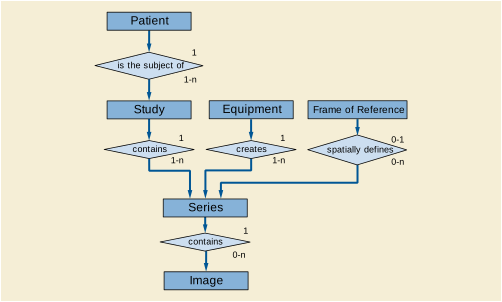
Table A.17.3-1. RT Image IOD Modules
|
IE |
Module |
Reference |
Usage |
|---|---|---|---|
|
Patient |
Patient |
M |
|
|
Clinical Trial Subject |
U |
||
|
Study |
General Study |
M |
|
|
Patient Study |
U |
||
|
Clinical Trial Study |
U |
||
|
Series |
RT Series |
M |
|
|
Clinical Trial Series |
U |
||
|
Frame of Reference |
Frame of Reference |
U |
|
|
Equipment |
General Equipment |
M |
|
|
Image |
General Image |
M |
|
|
Image Pixel |
M |
||
|
Contrast/Bolus |
C - Required if contrast media was used in this image. |
||
|
Cine |
C - Required if multi-frame image is a cine image. |
||
|
Multi-frame |
C - Required if pixel data is multi-frame data. |
||
|
Device |
U |
||
|
RT Image |
M |
||
|
Modality LUT |
U |
||
|
VOI LUT |
U |
||
|
Approval |
U |
||
|
SOP Common |
M |
||
|
Common Instance Reference |
U |
||
|
Frame Extraction |
C - Required if the SOP Instance was created in response to a Frame-Level retrieve request |
Note
The inclusion of the Multi-frame module allows for the expression of time-dependent image series or multiple exposures of identical beam geometries (i.e., multiple exposure portal images). If a time-dependent series of images (such as port images or DRRs) is represented the Cine module is used to indicate this. This would subsequently allow analysis of patient movement during treatment. Multiple exposure images allow individual images of treatment ports and open field ports to be grouped into a single multi-frame image.
The Modality LUT module has been included to allow the possibility of conversion between portal image pixel values and dose transmitted through the patient. The VOI LUT module has been included to allow the possibility of translation between stored pixel values (after the Modality LUT has been applied if specified) and display levels.
The Curve and Audio Modules were previously included in the Image IE for this IOD but has been retired. See PS3.3-2004.
The Equipment module contains information describing the equipment used to acquire or generate the RT Image (such as a portal imager, conventional simulator or treatment planning system). However, the equipment attributes in the RT Image module describe the equipment on which the treatment has been or will be given, typically an electron accelerator.
For RT Images that contain no relevant pixel data, such as BEV images without DRR information, Pixel Data (7FE0,0010) should be filled with a sequence of zeros.
The Frame of Reference module has been included to allow the indication of spatial association of two or more RT Image instances (e.g., where the images have been acquired in the same frame of reference, or have been resampled to share the same frame of reference). If the Frame of Reference occurs within a SOP Instance within a given series, then all SOP Instances within that series will be spatially related. For example, two RT Images may share the same Frame of Reference if they are located on the same physical plane, as determined by the treatment machine Gantry Angle (300A,011E) and source to image plane distance specified by RT Image SID (3002,0026).
The focus for this Radiotherapy Dose IOD (RT Dose IOD) is to address the requirements for transfer of dose distributions calculated by radiotherapy treatment planning systems. These distributions may be represented as 2D or 3D grids, as isodose curves, or as named or unnamed dose points scattered throughout the volume. This IOD may also contain dose-volume histogram data, single or multi-frame overlays and application-defined lookup tables. This IOD does not provide for definition of doses in beam or other coordinate systems. The application is responsible for transforming data in other, non-patient based coordinate systems to the patient based coordinate system described in Section C.7.6.2.1.1.
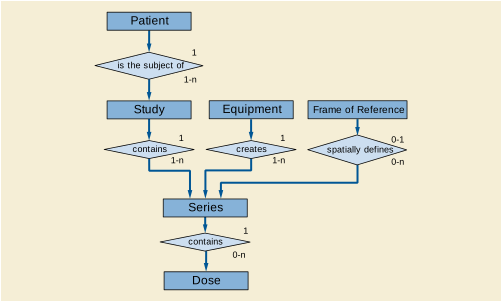
Table A.18.3-1. RT Dose IOD Modules
|
IE |
Module |
Reference |
Usage |
|---|---|---|---|
|
Patient |
Patient |
M |
|
|
Clinical Trial Subject |
U |
||
|
Study |
General Study |
M |
|
|
Patient Study |
U |
||
|
Clinical Trial Study |
U |
||
|
Series |
RT Series |
M |
|
|
Clinical Trial Series |
U |
||
|
Frame of Reference |
Frame of Reference |
M |
|
|
Equipment |
General Equipment |
M |
|
|
Dose |
General Image |
C - Required if dose data contains grid-based doses. |
|
|
Image Plane |
C - Required if dose data contains grid-based doses. |
||
|
Image Pixel |
C - Required if dose data contains grid-based doses. |
||
|
Multi-frame |
C - Required if dose data contains grid-based doses and pixel data is multi-frame data. |
||
|
Overlay Plane |
U |
||
|
Multi-frame Overlay |
U |
||
|
Modality LUT |
U |
||
|
RT Dose |
M |
||
|
RT DVH |
U |
||
|
Structure Set |
C - Required if dose data contains dose points or isodose curves |
||
|
ROI Contour |
C - Required if dose data contains dose points or isodose curves |
||
|
RT Dose ROI |
C - Required if dose data contains dose points or isodose curves |
||
|
SOP Common |
M |
||
|
Common Instance Reference |
U |
||
|
Frame Extraction |
C - Required if the SOP Instance was created in response to a Frame-Level retrieve request |
Note
Within the RT Dose IOD, the RT Dose module supports 2D and 3D dose grids. The Structure Set, ROI Contour and RT Dose ROI modules together support isodose curves and points, and the RT DVH module supports dose-volume histogram data. They are not mutually exclusive: all four representations may be included in a single instance of the object or they may be included in any combination. Product Conformance Statements should clearly state which of these mechanisms is supported and under what conditions.
The RT Dose IOD has been defined as a composite IOD, separate from the RT Plan IOD. This has been done for the following reasons:
to allow for the multiplicity of possible dose calculations using beam models for the same basic plan,
to avoid undesirable transmission of large amounts of data with the treatment plan, and
to accommodate the fact that CT Simulation and other "beam geometry" generating devices that use the RT Plan IOD do not have or require access to this data, either for transmission or storage.
The Audio Module was previously included in this IOD but has been retired. See PS3.3-2004.
The focus for this Radiotherapy Structure Set IOD (RT Structure Set IOD) is to address the requirements for transfer of patient structures and related data defined on CT scanners, virtual simulation workstations, treatment planning systems and similar devices.
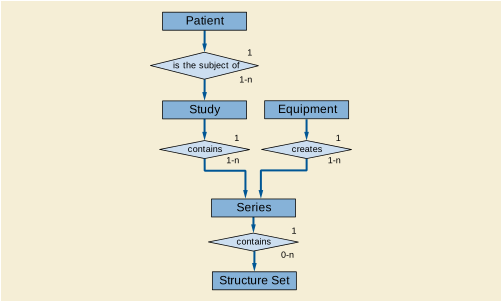
Table A.19.3-1. RT Structure Set IOD Modules
|
IE |
Module |
Reference |
Usage |
|---|---|---|---|
|
Patient |
Patient |
M |
|
|
Clinical Trial Subject |
U |
||
|
Study |
General Study |
M |
|
|
Patient Study |
U |
||
|
Clinical Trial Study |
U |
||
|
Series |
RT Series |
M |
|
|
Clinical Trial Series |
U |
||
|
Equipment |
General Equipment |
M |
|
|
Structure Set |
Structure Set |
M |
|
|
ROI Contour |
M |
||
|
RT ROI Observations |
M |
||
|
Approval |
U |
||
|
SOP Common |
M |
||
|
Common Instance Reference |
U |
Note
The Audio Module was previously included in this IOD but has been retired. See PS3.3-2004.
The focus for this Radiotherapy Plan IOD (RT Plan IOD) is to address the requirements for transfer of treatment plans generated by manual entry, a virtual simulation system, or a treatment planning system before or during a course of treatment. Such plans may contain fractionation information, and define external beams and/or brachytherapy application setups.
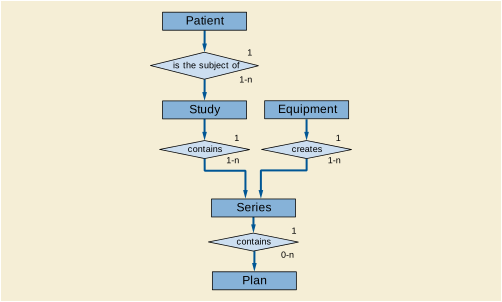
Table A.20.3-1. RT Plan IOD Modules
|
IE |
Module |
Reference |
Usage |
|---|---|---|---|
|
Patient |
Patient |
M |
|
|
Clinical Trial Subject |
U |
||
|
Study |
General Study |
M |
|
|
Patient Study |
U |
||
|
Clinical Trial Study |
U |
||
|
Series |
RT Series |
M |
|
|
Clinical Trial Series |
U |
||
|
Frame of Reference |
Frame of Reference |
U |
|
|
Equipment |
General Equipment |
M |
|
|
Plan |
RT General Plan |
M |
|
|
RT Prescription |
U |
||
|
RT Tolerance Tables |
U |
||
|
RT Patient Setup |
U |
||
|
RT Fraction Scheme |
U |
||
|
RT Beams |
C - Required if RT Fraction Scheme Module exists and Number of Beams (300A,0080) is greater than zero for one or more fraction groups. Shall not be present, if RT Brachy Application Setups module is present. May be present otherwise. |
||
|
RT Brachy Application Setups |
C - Required if RT Fraction Scheme Module exists and Number of Brachy Application Setups (300A,00A0) is greater than zero for one or more fraction groups. Shall not be present, if RT Beams module is present. May be present otherwise. |
||
|
Approval |
U |
||
|
SOP Common |
M |
||
|
Common Instance Reference |
U |
Note
Retired. See PS3.3-2011.
The Audio Module was previously included in this IOD but has been retired. See PS3.3-2004.
The RT Fraction Scheme module is structured to be used together with the RT Beams or RT Brachy Application Setups module. If beams are referenced in the RT Fraction Scheme module, all such beams shall be included in the RT Beams module if it is present. Similarly, if brachy application setups are referenced in the RT Fraction Scheme module, all such setups shall be included in the RT Brachy Application Setups module if it is present. However, the RT Fraction Scheme module can be used without the RT Beams or RT Brachy Application Setups modules if no beams or brachy application setups are referenced, and the RT Beams or RT Brachy Application Setups modules can also be used without the RT Fraction Scheme module if no fraction scheme information is available.
The RT Prescription module provides for the inclusion of dose prescription information pertinent to the complete plan, which may comprise several fraction schemes, themselves consisting of many beams.
The RT Tolerance Tables module provides information concerning machine tolerances as they apply to the whole treatment plan. Tolerances are applied by reference to a tolerance table within the RT Tolerance Tables module for beams contained within the RT Beams module.
The RT Patient Setup module provides information concerning patient setup parameters and fixation devices as they apply to the whole treatment plan. Patient setup information within the RT Patient Setup module is referenced by beams contained within the RT Beams module.
The Positron Emission Tomography (PET) Image Information Object Definition specifies an image that has been created by a Positron Tomograph imaging device, including dedicated PET cameras and Nuclear Medicine imaging devices operating in coincidence mode. This includes data created by external detection devices that create images of the distribution of administered radioactive materials, specifically positron emitters, in the body. Depending on the specific radiopharmaceuticals administered and the particular imaging procedure performed, problems involving changes in metabolism, function, or physiology can be investigated and various region pathologies can be studied. For these problems, quantitation of image data in absolute activity and physiological units is important. In addition, the PET Image IOD specifies attenuation (transmission) images used for correction and anatomical reference of emission images.
The E-R model in Section A.1.2 depicts those components of the DICOM Information Model that directly reference the PET Image IOD. The overlay IE, modality LUT IE, VOI LUT IE, and curve IE are not components of the PET Image IOD.
Table A.21.3-1. PET Image IOD Modules
|
IE |
Module |
Reference |
Usage |
|---|---|---|---|
|
Patient |
Patient |
M |
|
|
Clinical Trial Subject |
U |
||
|
Study |
General Study |
M |
|
|
Patient Study |
U |
||
|
Clinical Trial Study |
U |
||
|
Series |
General Series |
M |
|
|
Clinical Trial Series |
U |
||
|
PET Series |
M |
||
|
PET Isotope |
M |
||
|
PET Multi-gated Acquisition |
C - Required if Series Type (0054,1000) Value 1 is GATED. |
||
|
NM/PET Patient Orientation |
M |
||
|
Frame of Reference |
Frame of Reference |
M |
|
|
Synchronization |
C - Required if time synchronization was applied |
||
|
Equipment |
General Equipment |
M |
|
|
Image |
General Image |
M |
|
|
Image Plane |
M |
||
|
Image Pixel |
M |
||
|
Device |
U |
||
|
Specimen |
U |
||
|
PET Image |
M |
||
|
Overlay Plane |
U |
||
|
VOI LUT |
U |
||
|
Acquisition Context |
U |
||
|
SOP Common |
M |
||
|
Common Instance Reference |
U |
The Defined TID for Acquisition Context Sequence (0040,0555) is TID 3470 “NM/PET Acquisition Context”, which includes description of the cardiovascular rest or stress state, and the blood glucose measurement.
The Acquisition Context information may be entered during acquisition, or obtained from the Modality Worklist using information supplied in the Protocol Context, using TID 15101 “NM/PET Protocol Context”.
Retired. See PS3.3-2004.
Retired. See PS3.3-2004.
Retired. See PS3.3-2004.
Retired. See PS3.3-2004.
The Digital X-Ray (DX) Image Information Object Definition specifies an image that has been created by a digital projection radiography imaging device.
Note
This includes but is not limited to: chest radiography, linear and multi-directional tomography, orthopantomography and skeletal radiography. Acquisition of image data may include but is not limited to: CCD-based sensors, stimulable phosphor imaging plates, amorphous selenium, scintillation based amorphous silicon and secondary capture of film-based images.
Specific IODs are defined for intra-oral radiography and mammography that further specialize the DX IOD.
A DX image shall consist of the result of a single X-Ray exposure, in order to ensure that the anatomical and orientation attributes are meaningful for the image, permitting safe annotation, appropriate image processing and appropriate dissemination.
Note
This requirement specifically deprecates the common film/screen and Computed Radiography practice of making multiple exposures on different areas of a cassette or plate by using lead occlusion between exposures. Such acquisitions could be separated and transformed into multiple DX images during an appropriate quality assurance step by an operator.
This requirement does not deprecate the acquisition of multiple paired structures during a single exposure, provided that they can be described by the relevant orientation Attributes. For example, an AP or PA projection of both hands side by side is typically obtained in a single exposure, and can be described by a Patient Orientation (0020,0020) of R\H or L\H since both hands are in the same traditional Anatomical Position. See Annex A “Explanation of Patient Orientation (Normative)” in PS3.17.
The DX Image IOD is used in two SOP Classes as defined in PS3.4 Storage Service Class, a SOP Class for storage of images intended for presentation, and a SOP Class for storage of images intended for further processing before presentation. These are distinguished by their SOP Class UID and by the Enumerated Value of the mandatory Attribute in the DX Series Module, Presentation Intent Type (0008,0068).
The E-R Model in Section A.1.2 depicts those components of the DICOM Information Model that directly reference the DX Image IOD.
Table A.26-1. Digital X-Ray Image IOD Modules
|
IE |
Module |
Reference |
Usage |
|---|---|---|---|
|
Patient |
Patient |
M |
|
|
Clinical Trial Subject |
U |
||
|
Study |
General Study |
M |
|
|
Patient Study |
U |
||
|
Clinical Trial Study |
U |
||
|
Series |
General Series |
M |
|
|
Clinical Trial Series |
U |
||
|
DX Series |
M |
||
|
Frame of Reference |
Frame of Reference |
U |
|
|
Equipment |
General Equipment |
M |
|
|
Image |
General Image |
M |
|
|
Image Pixel |
M |
||
|
Contrast/Bolus |
U |
||
|
Display Shutter |
U |
||
|
Device |
U |
||
|
Intervention |
U |
||
|
Specimen |
U |
||
|
DX Anatomy Imaged |
M |
||
|
DX Image |
M |
||
|
DX Detector |
M |
||
|
X-Ray Collimator |
U |
||
|
DX Positioning |
U |
||
|
X-Ray Tomo Acquisition |
U |
||
|
X-Ray Acquisition Dose |
U |
||
|
X-Ray Generation |
U |
||
|
X-Ray Filtration |
U |
||
|
X-Ray Grid |
U |
||
|
Overlay Plane |
C - Required if graphic annotation is present - See Section A.26.4 |
||
|
VOI LUT |
C - Required if Presentation Intent Type (0008,0068) is FOR PRESENTATION. Shall not be present otherwise. See Note 8. |
||
|
Image Histogram |
U |
||
|
Acquisition Context |
M - See Section A.26.5 |
||
|
SOP Common |
M |
||
|
Common Instance Reference |
U |
Note
The Overlay Plane requirement is determined by the presence of "graphic annotation". Graphic annotation includes user or machine drawn graphics or text (such as computer assisted diagnosis) to indicate regions of interest or descriptions. It specifically does not include patient or image identification or technique information that is defined in other Attributes of the IOD.
The Device and Intervention Modules are User optional, though it is desirable that, if present, they are stored by an SCP. It is recognized that in some cases the digital image acquisition system will not have a user interface or direct connection that allows acquisition of these parameters, even if device or therapy have been used.
The Frame of Reference, X-Ray Collimator, DX Positioning and DX Tomo Acquisition Modules are User optional, though it is desirable that, if present, they are stored by an SCP. It is recognized that in some cases the parameters of the mechanical devices used for collimation, positioning and tomography may not be available to a digital image acquisition system that is not integrated with the X-Ray generation and positioning system.
The Histogram Module may contain a single or multiple statistical representations of the pixel data used to derive the VOI LUT Module, or intended to be used to derive or replace the VOI LUT Module. The Histogram Module may contain statistics of a subset of the stored image pixel data (such as from a cropped area or region of interest that is not the full field of view) that are useful for deriving a better VOI LUT than might be derived from the statistics obtained from the entire stored pixel data.
The Specimen Identification Module was previously included in this IOD but has been retired, and its functionality replaced by the Specimen Module. See PS3.3-2008.
The VOI LUT Module Attributes and behavior are further specialized in the DX Image Module.
The Curve Module was previously included in this IOD but has been retired. See PS3.3-2004.
If the Overlay Plane Module is present, any Overlays defined in that Module shall store the overlay data in Overlay Data (60xx,3000), and not any unused high bits in Pixel Data (7FE0,0010).
The Acquisition Context Module may be used to encode information about conditions present during acquisition that are not described by specific attributes in other modules of the IOD.
The Baseline TID shall be TID 3460 “Projection Radiography Acquisition Context”.
The Digital Mammography X-Ray Image Information Object Definition specifies an image that has been created by a digital mammography projection radiography imaging device.
Note
It meets all of the requirements of the DX IOD in Section A.26 in addition to those specified in this section.
The Digital Mammography Image IOD is used in two SOP Classes as defined in PS3.4 Storage Service Class, a SOP Class for storage of images intended for presentation, and a SOP Class for storage of images intended for further processing before presentation. These are distinguished by their SOP Class UID and by the Enumerated Value of the mandatory Attribute in the DX Series Module, Presentation Intent Type (0008,0068).
Table A.27-1. Digital Mammography X-Ray Image IOD Modules
|
IE |
Module |
Reference |
Usage |
|---|---|---|---|
|
Patient |
Patient |
M |
|
|
Clinical Trial Subject |
U |
||
|
Study |
General Study |
M |
|
|
Patient Study |
U |
||
|
Clinical Trial Study |
U |
||
|
Series |
General Series |
M |
|
|
Clinical Trial Series |
U |
||
|
DX Series |
M |
||
|
Mammography Series |
M |
||
|
Frame of Reference |
Frame of Reference |
C - Required if multiple images are obtained without releasing breast compression |
|
|
Equipment |
General Equipment |
M |
|
|
Image |
General Image |
M |
|
|
Image Pixel |
M |
||
|
Contrast/Bolus |
U |
||
|
Display Shutter |
U |
||
|
Device |
U |
||
|
Intervention |
U |
||
|
Specimen |
U |
||
|
DX Anatomy Imaged |
M |
||
|
DX Image |
M |
||
|
DX Detector |
M |
||
|
X-Ray Collimator |
U |
||
|
DX Positioning |
U |
||
|
X-Ray Tomo Acquisition |
U |
||
|
X-Ray Acquisition Dose |
U |
||
|
X-Ray Generation |
U |
||
|
X-Ray Filtration |
U |
||
|
X-Ray Grid |
U |
||
|
Mammography Image |
M |
||
|
Overlay Plane |
C - Required if graphic annotation is present - See Section A.27.3 |
||
|
VOI LUT |
C - Required if Presentation Intent Type (0008,0068) is FOR PRESENTATION. Shall not be present otherwise. |
||
|
Image Histogram |
U |
||
|
Acquisition Context |
M |
||
|
SOP Common |
M |
||
|
Common Instance Reference |
U |
Note
The Curve Module was previously included in this IOD but has been retired. See PS3.3-2004.
The Specimen Identification Module was previously included in this IOD but has been retired, and its functionality replaced by the Specimen Module. See PS3.3-2008.
The Digital Intra-Oral X-Ray Image Information Object Definition specifies an image that has been created by an intra-oral projection radiography imaging device.
Note
It meets all of the requirements of the DX IOD in Section A.26 in addition to those specified in this section.
The Digital Intra-Oral X-Ray Image IOD is used in two SOP Classes as defined in PS3.4 Storage Service Class, a SOP Class for storage of images intended for presentation, and a SOP Class for storage of images intended for further processing before presentation. These are distinguished by their SOP Class UID and by the Enumerated Value of the mandatory Attribute in the DX Series Module, Presentation Intent Type (0008,0068).
Table A.28-1. Digital Intra-Oral X-Ray Image IOD Modules
|
IE |
Module |
Reference |
Usage |
|---|---|---|---|
|
Patient |
Patient |
M |
|
|
Clinical Trial Subject |
U |
||
|
Study |
General Study |
M |
|
|
Patient Study |
U |
||
|
Clinical Trial Study |
U |
||
|
Series |
General Series |
M |
|
|
Clinical Trial Series |
U |
||
|
DX Series |
M |
||
|
Intra-Oral Series |
M |
||
|
Frame of Reference |
Frame of Reference |
U |
|
|
Equipment |
General Equipment |
M |
|
|
Image |
General Image |
M |
|
|
Image Pixel |
M |
||
|
Contrast/Bolus |
U |
||
|
Display Shutter |
U |
||
|
Device |
U |
||
|
Intervention |
U |
||
|
Specimen |
U |
||
|
DX Anatomy Imaged |
M |
||
|
DX Image |
M |
||
|
DX Detector |
M |
||
|
X-Ray Collimator |
U |
||
|
DX Positioning |
U |
||
|
X-Ray Tomo Acquisition |
U |
||
|
X-Ray Acquisition Dose |
U |
||
|
X-Ray Generation |
U |
||
|
X-Ray Filtration |
U |
||
|
X-Ray Grid |
U |
||
|
Intra-Oral Image |
M |
||
|
Overlay Plane |
C - Required if graphic annotation is present - See Section A.28.3 |
||
|
VOI LUT |
C - Required if Presentation Intent Type (0008,0068) is FOR PRESENTATION. Shall not be present otherwise. |
||
|
Image Histogram |
U |
||
|
Acquisition Context |
M |
||
|
SOP Common |
M |
||
|
Common Instance Reference |
U |
Note
The Curve Module was previously included in this IOD but has been retired. See PS3.3-2004.
The Specimen Identification Module was previously included in this IOD but has been retired, and its functionality replaced by the Specimen Module. See PS3.3-2008.
The focus for this Radiotherapy Beams Treatment Record IOD (RT Beams Treatment Record IOD) is to address the requirements for transfer of treatment session reports generated by a treatment verification system during a course of external beam treatment, with optional cumulative summary information. It may also be used for transfer of treatment information during delivery.
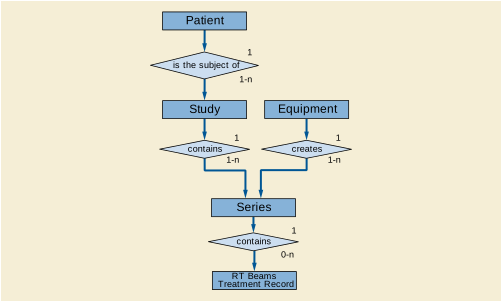
Table A.29.3-1. RT Beams Treatment Record IOD Modules
|
IE |
Module |
Reference |
Usage |
|---|---|---|---|
|
Patient |
Patient |
M |
|
|
Clinical Trial Subject |
U |
||
|
Study |
General Study |
M |
|
|
Patient Study |
U |
||
|
Clinical Trial Study |
U |
||
|
Series |
RT Series |
M |
|
|
Clinical Trial Series |
U |
||
|
Equipment |
General Equipment |
M |
|
|
Treatment Record |
RT General Treatment Record |
M |
|
|
RT Patient Setup |
U |
||
|
RT Treatment Machine Record |
M |
||
|
Measured Dose Reference Record |
U |
||
|
Calculated Dose Reference Record |
U |
||
|
RT Beams Session Record |
M |
||
|
RT Treatment Summary Record |
U |
||
|
SOP Common |
M |
||
|
Common Instance Reference |
U |
Note
The Curve Module was previously included in this IOD but has been retired. See PS3.3-2004.
The focus for this Radiotherapy Brachy Treatment Record IOD (RT Brachy Treatment Record IOD) is to address the requirements for transfer of treatment session reports generated by a treatment verification system during a course of Brachytherapy treatment, with optional cumulative summary information. It may also be used for transfer of treatment information during delivery.
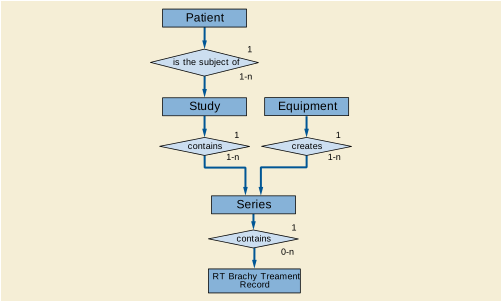
Table A.30.3-1. RT Brachy Treatment Record IOD Modules
|
IE |
Module |
Reference |
Usage |
|---|---|---|---|
|
Patient |
Patient |
M |
|
|
Clinical Trial Subject |
U |
||
|
Study |
General Study |
M |
|
|
Patient Study |
U |
||
|
Clinical Trial Study |
U |
||
|
Series |
RT Series |
M |
|
|
Clinical Trial Series |
U |
||
|
Equipment |
General Equipment |
M |
|
|
Treatment Record |
RT General Treatment Record |
M |
|
|
RT Patient Setup |
U |
||
|
RT Treatment Machine Record |
M |
||
|
Measured Dose Reference Record |
U |
||
|
Calculated Dose Reference Record |
U |
||
|
RT Brachy Session Record |
M |
||
|
RT Treatment Summary Record |
U |
||
|
SOP Common |
M |
||
|
Common Instance Reference |
U |
Note
The Curve Module was previously included in this IOD but has been retired. See PS3.3-2004.
The focus for this Radiotherapy Treatment Summary Record IOD (RT Treatment Summary Record IOD) is to address the requirements for transfer of cumulative summary information, normally generated at the completion of a course of treatment.
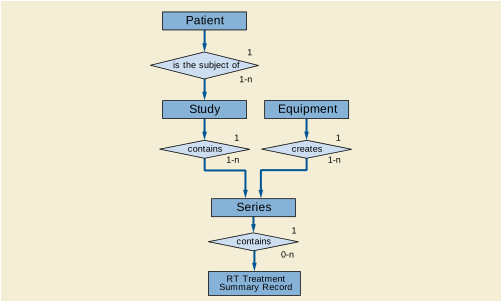
Table A.31.3-1. RT Treatment Summary Record IOD Modules
|
IE |
Module |
Reference |
Usage |
|---|---|---|---|
|
Patient |
Patient |
M |
|
|
Clinical Trial Subject |
U |
||
|
Study |
General Study |
M |
|
|
Patient Study |
U |
||
|
Clinical Trial Study |
U |
||
|
Series |
RT Series |
M |
|
|
Clinical Trial Series |
U |
||
|
Equipment |
General Equipment |
M |
|
|
Treatment Record |
RT General Treatment Record |
M |
|
|
RT Treatment Summary Record |
M |
||
|
SOP Common |
M |
||
|
Common Instance Reference |
U |
Note
The Curve Module was previously included in this IOD but has been retired. See PS3.3-2004.
The Visible Light (VL) Image Information Object Definition (IOD) specifies images that are acquired by means of a camera or other sensors that are sensitive to visible or near-visible light.
Examples of types of equipment that create Visible Light Images include:
Rigid and flexible endoscopy equipment
Operation microscopes / colposcopes
Ophthalmology equipment
Digital or Video Cameras
Analysis microscopes
Separate IODs have been defined for specialized applications. Some support only single frame images, some support both single frame and multi-frame video images.
The VL Endoscopic Image IOD specifies the Attributes of Single-frame VL Endoscopic Images.
The E-R Model in Section A.1.2 depicts those components of the DICOM Information Model that directly reference the VL Endoscopic Image IOD, with exception of the VOI LUT, Frame of Reference and Modality LUT entities, which are not used. Additionally, Image in Figure A.1-1 represents a Single Frame image. A frame denotes a two-dimensional organization of pixels recorded as a single exposure. Table A.32.1-1 specifies the Modules of the VL Endoscopic Image IOD.
Note
An endoscopic procedure might include multiple series of single frame endoscopic images as well as one or more additional series of related diagnostic images. The procedure might involve multiple Performed Procedure Steps, multiple endoscopes, and multiple anatomic regions and might be supervised, performed, and/or interpreted by one or more individuals.
Several distinct diagnostic or therapeutic processes might occur during an endoscopic procedure. For example: Endoscopic examination of duodenal mucosa, biopsy, lavage, or biliary stone removal.
The Curve entity was previously include in the list of entities that are not used, but has been retired from DICOM. It is still not used in this IOD. See PS3.3-2004.
Table A.32.1-1. VL Endoscopic Image IOD Modules
|
IE |
Module |
Reference |
Usage |
|---|---|---|---|
|
Patient |
Patient |
M |
|
|
Clinical Trial Subject |
U |
||
|
Study |
General Study |
M |
|
|
Patient Study |
U |
||
|
Clinical Trial Study |
U |
||
|
Series |
General Series |
M |
|
|
Clinical Trial Series |
U |
||
|
Equipment |
General Equipment |
M |
|
|
Image |
General Image |
M |
|
|
Image Pixel |
M |
||
|
Acquisition Context |
M |
||
|
Device |
U |
||
|
Specimen |
U |
||
|
VL Image |
M |
||
|
Overlay Plane |
U |
||
|
ICC Profile |
U |
||
|
SOP Common |
M |
||
|
Common Instance Reference |
U |
The VL Microscopic Image IOD specifies the Attributes of Single-frame VL Microscopic Images, including both imaging of specimens and direct microscopic imaging of the patient (e.g., perioperative microscopy). Microscopic Images with Slide Coordinates shall not be encoded with this IOD.
The E-R Model in Section A.1.2 depicts those components of the DICOM Information Model that are referenced by the VL Microscopic Image IOD. Below the Series IE, only the Image IE is used, which represents a Single Frame image. Table A.32.1-2 specifies the Modules of the VL Microscopic Image IOD.
Note
The Curve entity was previously include in the list of entities that are not used, but has been retired from DICOM. It is still not used in this IOD. See PS3.3-2004.
The Specimen Identification Module was previously included in this IOD but has been retired, and its functionality replaced by the Specimen Module. See PS3.3-2008.
Table A.32.1-2. VL Microscopic Image IOD Modules
|
IE |
Module |
Reference |
Usage |
|---|---|---|---|
|
Patient |
Patient |
M |
|
|
Clinical Trial Subject |
U |
||
|
Study |
General Study |
M |
|
|
Patient Study |
U |
||
|
Clinical Trial Study |
U |
||
|
Series |
General Series |
M |
|
|
Clinical Trial Series |
U |
||
|
Equipment |
General Equipment |
M |
|
|
Image |
General Image |
M |
|
|
Image Pixel |
M |
||
|
Acquisition Context |
M |
||
|
Device |
U |
||
|
Specimen |
C - Required if Imaging Subject is a specimen |
||
|
VL Image |
M |
||
|
Optical Path |
U |
||
|
Overlay Plane |
U |
||
|
ICC Profile |
U |
||
|
SOP Common |
M |
||
|
Common Instance Reference |
U |
The VL Slide-Coordinates Microscopic Image IOD specifies the Attributes of VL Single-frame Slide-Coordinates Microscopic Images.
The E-R Model in Section A.1.2 depicts those components of the DICOM Information Model that are referenced by the VL Slide-Coordinates Microscopic Image IOD. Below the Series IE, only the Image IE is used, which represents a Single Frame image. Table A.32.1-3 specifies the Modules of the VL Slide-Coordinates Microscopic Image IOD.
Note
The Curve entity was previously include in the list of entities that are not used, but has been retired from DICOM. It is still not used in this IOD. See PS3.3-2004.
The Specimen Identification Module was previously included in this IOD but has been retired, and its functionality replaced by the Specimen Module. See PS3.3-2008.
The Frame of Reference IE was previously (incorrectly) identified as not used in this IOD, although the Frame of Reference Module was specified as Mandatory. See PS3.3-2009.
Table A.32.1-3. VL Slide-Coordinates Microscopic Image IOD Modules
|
IE |
Module |
Reference |
Usage |
|---|---|---|---|
|
Patient |
Patient |
M |
|
|
Clinical Trial Subject |
U |
||
|
Study |
General Study |
M |
|
|
Patient Study |
U |
||
|
Clinical Trial Study |
U |
||
|
Series |
General Series |
M |
|
|
Clinical Trial Series |
U |
||
|
Frame of Reference |
Frame of Reference |
M |
|
|
Equipment |
General Equipment |
M |
|
|
Image |
General Image |
M |
|
|
Image Pixel |
M |
||
|
Acquisition Context |
M |
||
|
Device |
U |
||
|
Specimen |
M |
||
|
VL Image |
M |
||
|
Slide Coordinates |
M |
||
|
Optical Path |
U |
||
|
Overlay Plane |
U |
||
|
ICC Profile |
U |
||
|
SOP Common |
M |
||
|
Common Instance Reference |
U |
The VL Photographic Image IOD specifies the attributes of VL Single-frame photographic Images.
The E-R Model in Section A.1.2 depicts those components of the DICOM Information Model that directly reference the VL Photographic Image IOD, with exception of the VOI LUT, Frame of Reference and Modality LUT entities, which are not used. Additionally, Image in Figure A.1-1 represents a Single Frame image. A frame denotes a two-dimensional organization of pixels recorded as a single exposure. Table A.32.4-1 specifies the Modules of the VL Photographic Image IOD.
Note
The Curve entity was previously include in the list of entities that are not used, but has been retired from DICOM. It is still not used in this IOD. See PS3.3-2004.
The Specimen Identification Module was previously included in this IOD but has been retired, and its functionality replaced by the Specimen Module. See PS3.3-2008.
Table A.32.4-1. VL Photographic Image IOD Modules
|
IE |
Module |
Reference |
Usage |
|---|---|---|---|
|
Patient |
Patient |
M |
|
|
Clinical Trial Subject |
U |
||
|
Study |
General Study |
M |
|
|
Patient Study |
U |
||
|
Clinical Trial Study |
U |
||
|
Series |
General Series |
M |
|
|
Clinical Trial Series |
U |
||
|
Equipment |
General Equipment |
M |
|
|
Image |
General Image |
M |
|
|
Image Pixel |
M |
||
|
Acquisition Context |
M |
||
|
Device |
U |
||
|
Specimen |
C - Required if Imaging Subject is a specimen |
||
|
VL Image |
M |
||
|
Overlay Plane |
U |
||
|
ICC Profile |
U |
||
|
SOP Common |
M |
||
|
Common Instance Reference |
U |
The Video Endoscopic Image IOD specifies the Attributes of Multi-frame Video Endoscopic Images.
The E-R Model in Section A.1.2 depicts those components of the DICOM Information Model that directly reference the Video Endoscopic Image IOD, with exception of the VOI LUT, and Modality LUT entities, which are not used. Table A.32.5-1 specifies the Modules of the Video Endoscopic Image IOD.
Note
The video may include audio channel(s) for acquiring patient voice or physiological sounds, healthcare professionals' commentary, or environmental sounds.
The Frame Pointers Module has not been included because the selection of relevant sub-sequence(s) is usually made in a second workflow step and stored into separate Key Object Selection Documents.
The Curve entity was previously include in the list of entities that are not used, but has been retired from DICOM. It is still not used in this IOD. See PS3.3-2004.
Table A.32.5-1. Video Endoscopic Image IOD Modules
|
IE |
Module |
Reference |
Usage |
|---|---|---|---|
|
Patient |
Patient |
M |
|
|
Clinical Trial Subject |
U |
||
|
Study |
General Study |
M |
|
|
Patient Study |
U |
||
|
Clinical Trial Study |
U |
||
|
Series |
General Series |
M |
|
|
Clinical Trial Series |
U |
||
|
Equipment |
General Equipment |
M |
|
|
Image |
General Image |
M |
|
|
Cine |
M |
||
|
Multi-frame |
M |
||
|
Image Pixel |
M |
||
|
Acquisition Context |
M |
||
|
Device |
U |
||
|
Specimen |
C - Required if the Imaging Subject is a Specimen |
||
|
VL Image |
M |
||
|
ICC Profile |
U |
||
|
SOP Common |
M |
||
|
Common Instance Reference |
U |
||
|
Frame Extraction |
C - Required if the SOP Instance was created in response to a Frame-Level retrieve request |
The value of Modality (0008,0060) shall be ES.
Note
The use of a single value for Modality recognizes the fact that the same acquisition equipment is often used for different purposes (e.g., laparoscopy and colonoscopy). This means that Modality is not useful to distinguish one type of endoscopy from another when browsing a collection of studies. Therefore, the use of Procedure Code Sequence (0008,1032) and Anatomic Region Sequence (0008,2218) in the image instances and in the query response is recommended, though gathering sufficient information to populate these attributes in an unscheduled workflow environment (i.e., in the absence of Modality Worklist) may require operator intervention.
The Modality LUT, VOI LUT, Graphic Annotation and Overlay Modules shall not be present.
Note
The Curve Module was previously include in the list of Modules that shall not be present, but has been retired from DICOM. It is still not permitted to be present. See PS3.3-2004.
The Defined Context Group for Anatomic Region Sequence (0008,2218) shall be CID 4040 “Endoscopy Anatomic Regions”.
The Video Microscopic Image IOD specifies the Attributes of Video Microscopic Images, including both imaging of specimens and direct microscopic imaging of the patient (e.g., perioperative microscopy). Microscopic Images with Slide Coordinates shall not be encoded with this IOD.
The E-R Model in Section A.1.2 depicts those components of the DICOM Information Model that directly reference the Video Microscopic Image IOD, with exception of the VOI LUT, and Modality LUT entities, which are not used. Table A.32.6-1 specifies the Modules of the Video Microscopic Image IOD.
Note
The video may include audio channel for acquiring patient voice or physiological sounds, healthcare professionals comment, or environment sounds.
The Frame Pointers Module has not been included because the selection of relevant sub-sequence(s) is usually made in a second step and stored into separate Key Object Selection Documents.
The Curve entity was previously include in the list of entities that are not used, but has been retired from DICOM. It is still not used in this IOD. See PS3.3-2004.
The Specimen Identification Module was previously included in this IOD but has been retired, and its functionality replaced by the Specimen Module. See PS3.3-2008.
Table A.32.6-1. Video Microscopic Image IOD Modules
|
IE |
Module |
Reference |
Usage |
|---|---|---|---|
|
Patient |
Patient |
M |
|
|
Clinical Trial Subject |
U |
||
|
Study |
General Study |
M |
|
|
Patient Study |
U |
||
|
Clinical Trial Study |
U |
||
|
Series |
General Series |
M |
|
|
Clinical Trial Series |
U |
||
|
Equipment |
General Equipment |
M |
|
|
Image |
General Image |
M |
|
|
Cine |
M |
||
|
Multi-frame |
M |
||
|
Image Pixel |
M |
||
|
Acquisition Context |
M |
||
|
Device |
U |
||
|
Specimen |
C - Required if the Imaging Subject is a Specimen |
||
|
VL Image |
M |
||
|
ICC Profile |
U |
||
|
SOP Common |
M |
||
|
Common Instance Reference |
U |
||
|
Frame Extraction |
C - Required if the SOP Instance was created in response to a Frame-Level retrieve request |
The Modality LUT, VOI LUT, Graphic Annotation and Overlay Modules shall not be present.
Note
The Curve Module was previously include in the list of Modules that shall not be present, but has been retired from DICOM. It is still not permitted to be present. See PS3.3-2004.
The Video Photographic Image IOD specifies the attributes of VL Multi-frame photographic Images.
The E-R Model in Section A.1.2 depicts those components of the DICOM Information Model that directly reference the Video Photographic Image IOD, with exception of the VOI LUT and Modality LUT entities, which are not used. Table A.32.7-1 specifies the Modules of the Video Photographic Image IOD.
Note
The video may include audio channel for acquiring patient voice or physiological sounds, healthcare professionals comment, or environment sounds.
The Frame Pointers Module has not been included because the selection of relevant sub-sequence(s) is usually made in a second step and stored into separate Key Object Selection Documents.
The Curve entity was previously include in the list of entities that are not used, but has been retired from DICOM. It is still not used in this IOD. See PS3.3-2004.
The Specimen Identification Module was previously included in this IOD but has been retired, and its functionality replaced by the Specimen Module. See PS3.3-2008.
Table A.32.7-1. Video Photographic Image IOD Modules
|
IE |
Module |
Reference |
Usage |
|---|---|---|---|
|
Patient |
Patient |
M |
|
|
Clinical Trial Subject |
U |
||
|
Study |
General Study |
M |
|
|
Patient Study |
U |
||
|
Clinical Trial Study |
U |
||
|
Series |
General Series |
M |
|
|
Clinical Trial Series |
U |
||
|
Equipment |
General Equipment |
M |
|
|
Image |
General Image |
M |
|
|
Cine |
M |
||
|
Multi-frame |
M |
||
|
Image Pixel |
M |
||
|
Acquisition Context |
M |
||
|
Device |
U |
||
|
Specimen |
C - Required if the Imaging Subject is a Specimen |
||
|
VL Image |
M |
||
|
ICC Profile |
U |
||
|
SOP Common |
M |
||
|
Common Instance Reference |
U |
||
|
Frame Extraction |
C - Required if the SOP Instance was created in response to a Frame-Level retrieve request |
The Modality LUT, VOI LUT, Graphic Annotation and Overlay Modules shall not be present.
Note
The Curve Module was previously include in the list of Modules that shall not be present, but has been retired from DICOM. It is still not permitted to be present. See PS3.3-2004.
The VL Whole Slide Microscopy Image IOD specifies the Attributes of a multi-frame visible light whole slide microscopy image encoded as a tiled decomposition. Each frame encodes a single tile within a three-dimensional imaged volume at a uniform resolution.
Note
An entire set of tiles for an acquisition may be encoded in the frames of a single SOP Instance, in multiple SOP Instances of a single concatenation, or in multiple SOP Instances in a series (with or without concatenations). E.g., a single SOP Instance may contain an entire low resolution image as a single tile (single frame), or a single SOP Instance may contain an entire high resolution, multi-focal depth, multi-spectral acquisition (multiple frames).
Attention is called to the possibility that conformance with the VL Whole Slide Microscopy Image Storage SOP Class utilizing this IOD may involve the use of claimed Intellectual Property Rights, among which may be US Patent 6,272,235 referenced in Section 2. The DICOM Standards Committee takes no position concerning the evidence, validity or applicability of claimed Intellectual Property Rights, whether asserted by members of the DICOM Standards Committee or others.
The E-R Model in Section A.1.2 depicts those components of the DICOM Information Model that comprise the VL Whole Slide Microscopy IOD.
Table A.32.8-1. VL Whole Slide Microscopy Image IOD Modules
|
IE |
Module |
Reference |
Usage |
|---|---|---|---|
|
Patient |
Patient |
M |
|
|
Clinical Trial Subject |
U |
||
|
Study |
General Study |
M |
|
|
Patient Study |
U |
||
|
Clinical Trial Study |
U |
||
|
Series |
General Series |
M |
|
|
Whole Slide Microscopy Series |
M |
||
|
Clinical Trial Series |
U |
||
|
Frame of Reference |
Frame of Reference |
M |
|
|
Equipment |
General Equipment |
M |
|
|
Enhanced General Equipment |
M |
||
|
Image |
General Image |
M |
|
|
Image Pixel |
M |
||
|
Acquisition Context |
M |
||
|
Multi-frame Functional Groups |
M |
||
|
Multi-frame Dimension |
M |
||
|
Specimen |
M |
||
|
Whole Slide Microscopy Image |
M |
||
|
Optical Path |
M |
||
|
Multi-Resolution Navigation |
C - Required if Image Type (0008,0008) Value 3 is LOCALIZER |
||
|
Slide Label |
C - Required if Image Type (0008,0008) Value 3 is LABEL; may be present otherwise |
||
|
SOP Common |
M |
||
|
Common Instance Reference |
M |
||
|
Frame Extraction |
C - Required if the SOP Instance was created in response to a Frame-Level retrieve request |
The Code Sequences within the Optical Path Sequence (0048,0105) of the Optical Path Module (see Section C.8.12.5) are constrained as follows:
Baseline CID for Illuminator Type Code Sequence (0048,0100) is CID 8125 “Microscopy Illuminator Type”.
Baseline CID for Illumination Color Code Sequence (0048,0108) is CID 8122 “Microscopy Illuminator and Sensor Color”.
Baseline CID for Illumination Type Code Sequence (0022,0016) is CID 8123 “Microscopy Illumination Method”.
Baseline CID for Lenses Code Sequence (0022,0019) is CID 8121 “Microscopy Lens Type”.
Baseline CID for Light Path Filter Type Stack Code Sequence (0022,0017) and for Image Path Filter Type Stack Code Sequence (0022,0018) is CID 8124 “Microscopy Filter”.
Baseline CID for Channel Description Code Sequence (0022,001A) is CID 8122 “Microscopy Illuminator and Sensor Color”.
Table A.32.8-2 specifies the use of the Functional Group Macros used in the Multi-frame Functional Groups Module for the VL Whole Slide Microscopy IOD.
Table A.32.8-2. VL Whole Slide Microscopy Functional Group Macros
|
Functional Group Macro |
Section |
Usage |
|---|---|---|
|
Pixel Measures |
M - Shall be used as a Shared Functional Group. |
|
|
Frame Content |
M - Shall not be used as a Shared Functional Group. |
|
|
Referenced Image |
U |
|
|
Derivation Image |
C - Required if the image or frame has been derived from another SOP Instance. |
|
|
Real World Value Mapping |
U |
|
|
Plane Position (Slide) |
M |
|
|
Optical Path Identification |
M |
|
|
Specimen Reference |
U |
Defined CID for Purpose of Reference Code Sequence (0040,A170) in the Referenced Image Functional Group is CID 8120 “WSI Referenced Image Purposes of Reference”.
Frames shall occupy plane positions in a regular tiling of the Total Image Matrix; the frames may extend beyond the edges of the Total Image Matrix. Therefore, the value of Column Position In Total Pixel Matrix (0048,021E) shall be an integer multiple of the value of Columns (0028,0011) plus a constant, and the value of Row Position In Total Pixel Matrix (0048,021F) shall be an integer multiple of the value of Rows (0028,0010) plus a (possibly different) constant.
Note
Pixels beyond the edge of the Total Image Matrix may be encoded with a fixed padding value. For images with MONOCHROME2 Photometric Interpretation, see Pixel Padding Value (0028,0120) in Section C.7.5.1.1.2.
The encoding of tiles may be sparse; i.e., some tiles may not be encoded in frames. There are no constraints on the ordering of frames within the pixel data; each frame specifies its position in the Plane Position (Slide) Functional Group.
Note
Different SOP Instances within a Series may have different tiling boundaries and sizes.
Frames associated with different optical paths may coincide in any spatial dimension.
The Grayscale Softcopy Presentation State Information Object Definition (IOD) specifies information that may be used to present (display) images that are referenced from within the IOD.
It includes capabilities for specifying:
the output grayscale space in P-Values
grayscale contrast transformations including modality and VOI LUT
mask subtraction for multi-frame images
selection of the area of the image to display and whether to rotate or flip it
image and display relative annotations, including graphics, text and overlays
Table A.33.1-1. Grayscale Softcopy Presentation State IOD Modules
|
IE |
Module |
Reference |
Usage |
|---|---|---|---|
|
Patient |
Patient |
M |
|
|
Clinical Trial Subject |
U |
||
|
Study |
General Study |
M |
|
|
Patient Study |
U |
||
|
Clinical Trial Study |
U |
||
|
Series |
General Series |
M |
|
|
Clinical Trial Series |
U |
||
|
Presentation Series |
M |
||
|
Equipment |
General Equipment |
M |
|
|
Presentation State |
Presentation State Identification |
M |
|
|
Presentation State Relationship |
M |
||
|
Presentation State Shutter |
M |
||
|
Presentation State Mask |
M |
||
|
Mask |
C - Required if the referenced image(s) are multi-frame and are to be subtracted |
||
|
Display Shutter |
C - Required if a Display Shutter is to be applied to referenced image(s) and the Bitmap Display Shutter Module is not present |
||
|
Bitmap Display Shutter |
C - Required if a Display Shutter is to be applied to referenced image(s) and the Display Shutter Module is not present |
||
|
Overlay Plane |
C - Required if Overlay is to be applied to referenced image(s) or the Bitmap Display Shutter Module is present |
||
|
Overlay Activation |
C - Required if referenced image contains overlay data that is to be displayed or Presentation State Instance contains Overlay data other than Bitmap Shutter |
||
|
Displayed Area |
M |
||
|
Graphic Annotation |
C - Required if Graphic Annotations are to be applied to referenced image(s) |
||
|
Spatial Transformation |
C - Required if rotation or flipping are to be applied to referenced image(s) |
||
|
Graphic Layer |
C - Required if Graphic Annotations or Overlays or Curves are to be applied to referenced image(s) |
||
|
Graphic Group |
U |
||
|
Modality LUT |
C - Required if a Modality LUT is to be applied to referenced image(s) |
||
|
Softcopy VOI LUT |
C - Required if a VOI LUT is to be applied to referenced image(s) |
||
|
Softcopy Presentation LUT |
M |
||
|
SOP Common |
M |
In the Grayscale Softcopy Presentation State IOD, the Presentation Series Module specializes some Attributes of the General Series Module, the Presentation State Mask Module specializes some Attributes of the Mask Module, and the Presentation State Shutter Module specializes some Attributes of the Bitmap Display Shutter and Display Shutter Modules.
Note
Subtraction between different images is not supported.
The Mask Module condition implies that it need not be supported by an SCP that supports presentation states only for single frame image storage SOP Classes, or instances of multi-frame image Storage SOP Classes that contain only one frame.
The Display Shutter may be used to darken image areas that surround important information and exclude extraneous bright areas that increase glare and ambient lighting impairing image interpretation. For example, unexposed areas in a CR image might be obscured using the Display Shutter, rather than permanently replacing image pixels in those areas.
This IOD does not support the storage of a multi-frame overlay in the IOD itself, but does support selective activation of multi-frame overlays within the referenced images via the Overlay Activation Module.
The Color Softcopy Presentation State Information Object Definition (IOD) specifies information that may be used to present (display) color images that are referenced from within the IOD.
It includes capabilities for specifying:
the output color space in PCS-Values
color transformations from device-dependent color to PCS-Values using an ICC profile
selection of the area of the image to display and whether to rotate or flip it
image and display relative annotations, including graphics, text and overlays
Table A.33.2-1. Color Softcopy Presentation State IOD Modules
|
IE |
Module |
Reference |
Usage |
|---|---|---|---|
|
Patient |
Patient |
M |
|
|
Clinical Trial Subject |
U |
||
|
Study |
General Study |
M |
|
|
Patient Study |
U |
||
|
Clinical Trial Study |
U |
||
|
Series |
General Series |
M |
|
|
Clinical Trial Series |
U |
||
|
Presentation Series |
M |
||
|
Equipment |
General Equipment |
M |
|
|
Presentation State |
Presentation State Identification |
M |
|
|
Presentation State Relationship |
M |
||
|
Presentation State Shutter |
M |
||
|
Display Shutter |
C - Required if a Display Shutter is to be applied to referenced image(s) and the Bitmap Display Shutter Module is not present |
||
|
Bitmap Display Shutter |
C - Required if a Display Shutter is to be applied to referenced image(s) and the Display Shutter Module is not present |
||
|
Overlay Plane |
C - Required if Overlay is to be applied to referenced image(s) or the Bitmap Display Shutter Module is present |
||
|
Overlay Activation |
C - Required if referenced image contains overlay data that is to be displayed or Presentation State Instance contains Overlay data other than Bitmap Shutter |
||
|
Displayed Area |
M |
||
|
Graphic Annotation |
C - Required if Graphic Annotations are to be applied to referenced image(s) |
||
|
Spatial Transformation |
C - Required if rotation, flipping or magnification are to be applied to referenced image(s) |
||
|
Graphic Layer |
C - Required if Graphic Annotations or Overlays or Curves are to be applied to referenced image(s) |
||
|
Graphic Group |
U |
||
|
ICC Profile |
M |
||
|
SOP Common |
M |
In the Color Softcopy Presentation State IOD, the Presentation Series Module specializes some Attributes of the General Series Module, and the Presentation State Relationship Module specializes some Attributes of the Bitmap Display Shutter and Display Shutter Modules.
The Pseudo-Color Softcopy Presentation State Information Object Definition (IOD) specifies information that may be used to present (display) images that are referenced from within the IOD.
It includes capabilities for specifying:
the output color space in PCS-Values
grayscale contrast transformations including modality and VOI LUT
a color palette to map the transformed grayscale values into pseudo-color
mask subtraction for multi-frame images
selection of the area of the image to display and whether to rotate or flip it
image and display relative annotations, including graphics, text and overlays
Table A.33.3-1. Pseudo-Color Softcopy Presentation State IOD Modules
|
IE |
Module |
Reference |
Usage |
|---|---|---|---|
|
Patient |
Patient |
M |
|
|
Clinical Trial Subject |
U |
||
|
Study |
General Study |
M |
|
|
Patient Study |
U |
||
|
Clinical Trial Study |
U |
||
|
Series |
General Series |
M |
|
|
Clinical Trial Series |
U |
||
|
Presentation Series |
M |
||
|
Equipment |
General Equipment |
M |
|
|
Presentation State |
Presentation State Identification |
M |
|
|
Presentation State Relationship |
M |
||
|
Presentation State Shutter |
M |
||
|
Presentation State Mask |
M |
||
|
Mask |
C - Required if the referenced image(s) are multi-frame and are to be subtracted |
||
|
Display Shutter |
C - Required if a Display Shutter is to be applied to referenced image(s) and the Bitmap Display Shutter Module is not present |
||
|
Bitmap Display Shutter |
C - Required if a Display Shutter is to be applied to referenced image(s) and the Display Shutter Module is not present |
||
|
Overlay Plane |
C - Required if Overlay is to be applied to referenced image(s) or the Bitmap Display Shutter Module is present |
||
|
Overlay Activation |
C - Required if referenced image contains overlay data that is to be displayed or Presentation State Instance contains Overlay data other than Bitmap Shutter |
||
|
Displayed Area |
M |
||
|
Graphic Annotation |
C - Required if Graphic Annotations are to be applied to referenced image(s) |
||
|
Spatial Transformation |
C - Required if rotation or flipping are to be applied to referenced image(s) |
||
|
Graphic Layer |
C - Required if Graphic Annotations or Overlays or Curves are to be applied to referenced image(s) |
||
|
Graphic Group |
U |
||
|
Modality LUT |
C - Required if a Modality LUT is to be applied to referenced image(s) |
||
|
Softcopy VOI LUT |
C - Required if a VOI LUT is to be applied to referenced image(s) |
||
|
Palette Color LUT |
M |
||
|
ICC Profile |
M |
||
|
SOP Common |
M |
In the Pseudo-Color Softcopy Presentation State IOD, the Presentation Series Module specializes some Attributes of the General Series Module, the Presentation State Mask Module specializes some Attributes of the Mask Module, and the Presentation State Shutter Module specializes some Attributes of the Bitmap Display Shutter and Display Shutter Modules.
The Softcopy Presentation LUT Module shall not be present in this IOD.
The Blending Softcopy Presentation State Information Object Definition (IOD) specifies information that may be used to blend two sets of images that are referenced from within the IOD for the purpose of presentation (display).
It includes capabilities for specifying:
the output color space in PCS-Values
grayscale contrast transformations including modality and VOI LUT for both the underlying and superimposed image sets
a color palette to map the transformed grayscale values of the superimposed image set into pseudo-color
selection of the area of the blended images to display and whether to rotate or flip it
image and display relative annotations, including graphics, text and overlays
Table A.33.4-1. Blending Softcopy Presentation State IOD Modules
|
IE |
Module |
Reference |
Usage |
|---|---|---|---|
|
Patient |
Patient |
M |
|
|
Clinical Trial Subject |
U |
||
|
Study |
General Study |
M |
|
|
Patient Study |
U |
||
|
Clinical Trial Study |
U |
||
|
Series |
General Series |
M |
|
|
Clinical Trial Series |
U |
||
|
Presentation Series |
M |
||
|
Equipment |
General Equipment |
M |
|
|
Presentation State |
Presentation State Identification |
M |
|
|
Presentation State Blending |
M |
||
|
Displayed Area |
M |
||
|
Graphic Annotation |
C - Required if Graphic Annotations are to be applied |
||
|
Spatial Transformation |
C - Required if rotation or flipping are to be applied |
||
|
Graphic Layer |
C - Required if Graphic Annotation Module is present |
||
|
Graphic Group |
U |
||
|
Palette Color LUT |
M |
||
|
ICC Profile |
M |
||
|
SOP Common |
M |
In the Blending Softcopy Presentation State IOD, the Presentation Series Module specializes some Attributes of the General Series Module.
The Softcopy Presentation LUT Module shall not be present in this IOD.
The Modality LUT and Softcopy VOI LUT Module shall not be present in this IOD, since the Presentation State Blending Module subsumes their function.
The Palette Color LUT Module describes the color mapping to be used for the superimposed image set.
The Displayed Area and Graphic Annotation Modules specifically identify those images or frames to which they apply, and may include images or frames from the underlying or superimposed set.
The Spatial Transformation Module describes any necessary spatial transformation of the image to be rendered after the blending operation.
The Overlay Plane and Overlay/Curve Activation Modules shall not be present, and any overlays present in the referenced images shall not be displayed.
The Display Shutter and Bitmap Display Shutter Modules shall not be present, since the underlying image geometry may differ between the two sets of images.
The ICC Profile Module shall always be present. If the color space to be used is not calibrated (i.e., a device-specific ICC Input Profile is not available), then an ICC Input Profile specifying a well-known space (such as sRGB) may be specified.
The Basic Structured Display Information Object Definition (IOD) specifies an instance of a single screen structured display that has been created for a patient. It references specific image or other composite SOP instances from one or more studies for that patient, or for other patients for comparison, arranged in a specific presentation layout. Presentation of images within the structured display may be controlled by referenced Softcopy Presentation State instances. The structured display may include text annotations.
Table A.33.5.1-1. Basic Structured Display IOD Modules
|
IE |
Module |
Reference |
Usage |
|---|---|---|---|
|
Patient |
Patient |
M |
|
|
Clinical Trial Subject |
U |
||
|
Study |
General Study |
M |
|
|
Patient Study |
U |
||
|
Clinical Trial Study |
U |
||
|
Series |
General Series |
M |
|
|
Clinical Trial Series |
U |
||
|
Presentation Series |
M |
||
|
Equipment |
General Equipment |
M |
|
|
Enhanced General Equipment |
U |
||
|
Presentation State |
Structured Display |
M |
|
|
Structured Display Image Box |
M |
||
|
Structured Display Annotation |
U |
||
|
Common Instance Reference |
M |
||
|
SOP Common |
M |
The XA/XRF Grayscale Softcopy Presentation State Information Object Definition (IOD) specifies information that may be used to present angiographic projection images that are referenced from within the IOD.
It includes capabilities from the Grayscale Softcopy Presentation State IOD for specifying:
the output grayscale space in P-Values
grayscale contrast transformations including VOI LUT
selection of the area of the image to display and whether to rotate or flip it
image and display relative annotations, including graphics, text and overlays
For the presentation of angiographic projection images the following capabilities are provided:
shutter specifications on a frame-by-frame basis
mask subtraction including regional pixel shift
presentation of sets of frames
Table A.33.6-1. XA/XRF Grayscale Softcopy Presentation State IOD Modules
|
IE |
Module |
Reference |
Usage |
|---|---|---|---|
|
Patient |
Patient |
M |
|
|
Clinical Trial Subject |
U |
||
|
Study |
General Study |
M |
|
|
Patient Study |
U |
||
|
Clinical Trial Study |
U |
||
|
Series |
General Series |
M |
|
|
Clinical Trial Series |
U |
||
|
Presentation Series |
M |
||
|
Equipment |
General Equipment |
M |
|
|
Enhanced General Equipment |
M |
||
|
Presentation State |
Presentation State Identification |
M |
|
|
Presentation State Relationship |
M |
||
|
Presentation State Shutter |
M |
||
|
Bitmap Display Shutter |
C - Required if a Display Shutter is to be applied to referenced image(s) and the XA/XRF Presentation State Shutter Module is not present |
||
|
Overlay Plane |
C - Required if Overlay is to be applied to referenced image(s) or the Bitmap Display Shutter Module is present |
||
|
Overlay Activation |
C - Required if referenced image contains overlay data that is to be displayed or Presentation State Instance contains Overlay data other than Bitmap Shutter |
||
|
Displayed Area |
M |
||
|
Graphic Annotation |
C - Required if Graphic Annotations are to be applied to referenced image(s) |
||
|
Spatial Transformation |
C - Required if rotation or flipping are to be applied to referenced image(s) |
||
|
Graphic Layer |
C - Required if Graphic Annotations or Overlays or Curves are to be applied to referenced image(s) |
||
|
Softcopy VOI LUT |
C - Required if a VOI LUT is to be applied to referenced image(s) |
||
|
XA/XRF Presentation State Mask |
C - Required if the referenced image(s) are to be subtracted |
||
|
XA/XRF Presentation State Shutter |
C - Required if a Display Shutter is to be applied to referenced image(s) and the Bitmap Display Shutter Module is not present |
||
|
XA/XRF Presentation State Presentation |
C - Required if the referenced image(s) are to be displayed with a prescribed preference |
||
|
Softcopy Presentation LUT |
M |
||
|
SOP Common |
M |
In the XA/XRF Grayscale Softcopy Presentation State IOD, the Presentation Series Module specializes some Attributes of the General Series Module, the XA/XRF Presentation State Mask Module specializes some Attributes of the Mask Module, and the XA/XRF Presentation State Shutter Module specializes some Attributes of the Bitmap Display Shutter and Display Shutter Modules.
Note
Subtraction between different images is not supported.
The Display Shutter may be used to darken image areas that surround important information and exclude extraneous bright areas that increase glare and ambient lighting impairing image interpretation. For example, unexposed areas in a XA image might be obscured using the Display Shutter, rather than permanently replacing image pixels in those areas.
This IOD does not support the storage of a multi-frame overlay in the IOD itself, but does support selective activation of multi-frame overlays within the referenced images via the Overlay Activation Module.
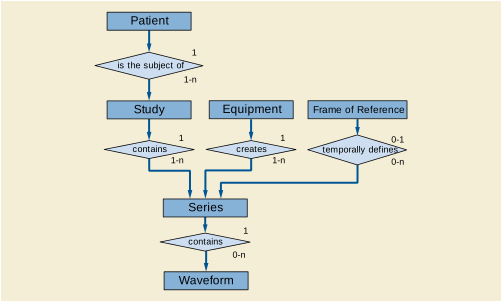
The Basic Voice Audio IOD is the specification of a digitized sound that has been acquired or created by an audio modality or by an audio acquisition function within an imaging modality. A typical use is report dictation.
The E-R Model in Section A.34.1 applies to the Basic Voice Audio IOD.
Table A.34.2-1. Basic Voice Audio IOD Modules
|
IE |
Module |
Reference |
Usage |
|---|---|---|---|
|
Patient |
Patient |
M |
|
|
Clinical Trial Subject |
U |
||
|
Study |
General Study |
M |
|
|
Patient Study |
U |
||
|
Clinical Trial Study |
U |
||
|
Series |
General Series |
M |
|
|
Clinical Trial Series |
U |
||
|
Frame of Reference |
Synchronization |
U |
|
|
Equipment |
General Equipment |
M |
|
|
Waveform |
Waveform Identification |
M |
|
|
Waveform |
M |
||
|
Acquisition Context |
M |
||
|
Waveform Annotation |
U |
||
|
SOP Common |
M |
The value of Number of Waveform Channels (003A,0005) in the Waveform Sequence Item shall be 1 or 2.
The value of Sampling Frequency (003A,001A) in the Waveform Sequence Item shall be 8000.
The 12-Lead Electrocardiogram (12-Lead ECG) IOD is the specification of digitized electrical signals from the patient cardiac conduction system collected on the body surface, which has been acquired by an ECG modality or by an ECG acquisition function within an imaging modality.
The E-R Model in Section A.34.1 applies to the 12-Lead ECG IOD.
Table A.34.3-1. 12-Lead ECG IOD Modules
|
IE |
Module |
Reference |
Usage |
|---|---|---|---|
|
Patient |
Patient |
M |
|
|
Clinical Trial Subject |
U |
||
|
Study |
General Study |
M |
|
|
Patient Study |
U |
||
|
Clinical Trial Study |
U |
||
|
Series |
General Series |
M |
|
|
Clinical Trial Series |
U |
||
|
Frame of Reference |
Synchronization |
U |
|
|
Equipment |
General Equipment |
M |
|
|
Waveform |
Waveform Identification |
M |
|
|
Waveform |
M |
||
|
Acquisition Context |
M |
||
|
Waveform Annotation |
C - Required if annotation is present |
||
|
SOP Common |
M |
For SOP Instances of ECG acquired in the cardiac catheterization lab, the Defined TID for Acquisition Context Sequence (0040,0555) is TID 3403 “Catheterization Acquisition Context”. For routine resting or stress ECG, the Defined TID for Acquisition Context Sequence (0040,0555) is TID 3401 “ECG Acquisition Context”.
The number of Waveform Sequence (5400,0100) Items shall be between 1 and 5, inclusive.
The value of Number of Waveform Channels (003A,0005) in each Waveform Sequence Item shall be between 1 and 13, inclusive. The total number of channels encoded across all Items shall not exceed 13.
Note
This specialization provides for up to five Waveform Sequence Items (multiplex groups), with a total of 13 channels. This allows, for instance, encoding of four sets of three simultaneously recorded channels, the sets being acquired sequentially, plus one continuous channel for the duration of the other sets. This can be used to emulate the behavior of classical 12-lead ECG strip chart recorders with 4x3 presentation, plus a continuous lead II recording (see Figure A.34.3-1).
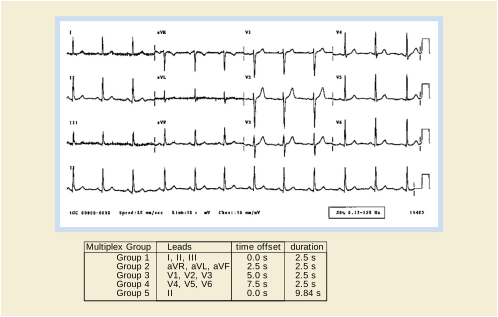
The value of Number of Waveform Samples (003A,0010) in each Waveform Sequence Item shall be less than or equal to 16384.
Note
This allows over 16 seconds per channel at the maximum sampling frequency; if longer recordings are required, the General ECG IOD may be used.
The value of Sampling Frequency (003A,001A) in each Waveform Sequence Item shall be between 200 and 1000, inclusive.
The Baseline CID for the Channel Source Sequence (003A,0208) in each Channel Definition Sequence Item shall be CID 3001 “ECG Leads”.
The value of Waveform Sample Interpretation (5400,1006) in each Waveform Sequence Item shall be SS.
The Defined CID for the Concept Name Code Sequence (0040,A043) in the Waveform Annotation Sequence (0040,B020) shall be CID 3335 “ECG Annotations”. This Context Group supports the annotation of suppressed pacemaker spikes in the ECG waveform.
The General Electrocardiogram (ECG) IOD is the specification of digitized electrical signals from the patient cardiac conduction system collected on the body surface, which has been acquired by an ECG modality or by an ECG acquisition function within an imaging modality.
The E-R Model in Section A.34.1 applies to the General ECG IOD.
Table A.34.4-1. General ECG IOD Modules
|
IE |
Module |
Reference |
Usage |
|---|---|---|---|
|
Patient |
Patient |
M |
|
|
Clinical Trial Subject |
U |
||
|
Study |
General Study |
M |
|
|
Patient Study |
U |
||
|
Clinical Trial Study |
U |
||
|
Series |
General Series |
M |
|
|
Clinical Trial Series |
U |
||
|
Frame of Reference |
Synchronization |
U |
|
|
Equipment |
General Equipment |
M |
|
|
Waveform |
Waveform Identification |
M |
|
|
Waveform |
M |
||
|
Acquisition Context |
M |
||
|
Waveform Annotation |
C - Required if annotation is present |
||
|
SOP Common |
M |
The number of Waveform Sequence (5400,0100) Items shall be between 1 and 4, inclusive.
The value of Number of Waveform Channels (003A,0005) in each Waveform Sequence Item shall be between 1 and 24, inclusive.
The value of Sampling Frequency (003A,001A) in each Waveform Sequence Item shall be between 200 and 1000, inclusive.
The Defined CID for the Channel Source Sequence (003A,0208) in each Channel Definition Sequence Item shall be CID 3001 “ECG Leads”.
Note
Terms from other Context Groups may also be used for extended specification of the Channel Source, as declared in the Conformance Statement for an application (see PS3.2).
The value of Waveform Sample Interpretation (5400,1006) in each Waveform Sequence Item shall be SS.
The Defined CID for the Concept Name Code Sequence (0040,A043) in the Waveform Annotation Sequence (0040,B020) shall be CID 3335 “ECG Annotations”. This Context Group supports the annotation of suppressed pacemaker spikes in the ECG waveform.
The Ambulatory Electrocardiogram (ECG) IOD is the specification of digitized electrical signals from the patient cardiac conduction system collected on the body surface, which has been acquired by an ambulatory electrocardiography (Holter) device.
Note
The duration of acquisition represented in one SOP Instance is not specifically constrained, and is limited only by the maximum size of the Waveform Data attribute.
The E-R Model in Section A.34.1 applies to the Ambulatory ECG IOD.
Table A.34.5-1. Ambulatory ECG IOD Modules
|
IE |
Module |
Reference |
Usage |
|---|---|---|---|
|
Patient |
Patient |
M |
|
|
Clinical Trial Subject |
U |
||
|
Study |
General Study |
M |
|
|
Patient Study |
U |
||
|
Clinical Trial Study |
U |
||
|
Series |
General Series |
M |
|
|
Clinical Trial Series |
U |
||
|
Frame of Reference |
Synchronization |
U |
|
|
Equipment |
General Equipment |
M |
|
|
Waveform |
Waveform Identification |
M |
|
|
Waveform |
M |
||
|
Acquisition Context |
U |
||
|
Waveform Annotation |
C - Required if annotation is present |
||
|
SOP Common |
M |
The value of Number of Waveform Channels (003A,0005) in the Waveform Sequence Item shall be between 1 and 12, inclusive.
The value of Sampling Frequency (003A,001A) in each Waveform Sequence Item shall be between 50 and 1000, inclusive.
The Defined CID for the Channel Source Sequence (003A,0208) in each Channel Definition Sequence Item shall be CID 3001 “ECG Leads”.
The Hemodynamic IOD is the specification of digitized pressure, electrical, and other signals from the patient circulatory system, which has been acquired by a hemodynamic modality.
Note
The duration of acquisition represented in one SOP Instance is not specifically constrained, and is limited only by the maximum size of the Waveform Data attribute.
The E-R Model in Section A.34.1 applies to the Hemodynamic IOD.
Table A.34.6-1. Hemodynamic IOD Modules
|
IE |
Module |
Reference |
Usage |
|---|---|---|---|
|
Patient |
Patient |
M |
|
|
Clinical Trial Subject |
U |
||
|
Study |
General Study |
M |
|
|
Patient Study |
U |
||
|
Clinical Trial Study |
U |
||
|
Series |
General Series |
M |
|
|
Clinical Trial Series |
U |
||
|
Frame of Reference |
Synchronization |
C - Required if Waveform Originality (003A,0004) is ORIGINAL; may be present otherwise |
|
|
Equipment |
General Equipment |
M |
|
|
Waveform |
Waveform Identification |
M |
|
|
Waveform |
M |
||
|
Acquisition Context |
M |
||
|
Waveform Annotation |
C - Required if annotation is present |
||
|
SOP Common |
M |
The Defined TID for Acquisition Context Sequence (0040,0555) is TID 3403 “Catheterization Acquisition Context”.
The number of Waveform Sequence (5400,0100) Items shall be between 1 and 4, inclusive.
The value of Number of Waveform Channels (003A,0005) in each Waveform Sequence Item shall be between 1 and 8, inclusive.
The value of Sampling Frequency (003A,001A) in each Waveform Sequence Item shall be less than or equal to 400.
The Defined CID for the Channel Source Sequence (003A,0208) in each Channel Definition Sequence Item shall be CID 3003 “Hemodynamic Waveform Sources”, CID 3001 “ECG Leads” for surface ECG channels, or CID 3090 “Time Synchronization Channel Types” for time synchronization channels. The Channel Source Code Value shall encode at minimum the metric (measured physical quality) and function (measurement or stimulus); unless otherwise specifically encoded, the default function shall be "measurement".
The Channel Source Modifiers Sequence (003A,0209) in each Channel Definition Sequence Item shall be used to specify additional qualifiers of the semantics of the waveform source, including technique and anatomic location, if not encoded by the Channel Source Code Value. Technique, with terms from Defined CID 3241 “Hemodynamic Measurement Techniques”, shall be specified in Channel Source Modifiers Sequence Items prior to the cardiac anatomic location(s), with terms from Defined CID 3010 “Cardiovascular Anatomic Locations”, CID 3014 “Coronary Artery Segments”, and CID 3019 “Cardiovascular Anatomic Location Modifiers”. If technique is pullback, the sequence of anatomic locations shall be specified in ordered Channel Source Modifiers Sequence Items (e.g., initial, transitional, and final locations).
Note
Terms from other Context Groups may also be used for extended specification of the Channel Source, as declared in the Conformance Statement for an application (see PS3.2).
The value of Waveform Sample Interpretation (5400,1006) in each Waveform Sequence Item shall be SS.
The Defined CID for the Concept Name Code Sequence (0040,A043) in the Waveform Annotation Sequence (0040,B020) shall be CID 3337 “Hemodynamic Annotations”.
The Basic Cardiac Electrophysiology IOD is the specification of digitized electrical signals from the patient cardiac conduction system collected in the heart, which has been acquired by an EP modality.
Note
The duration of acquisition represented in one SOP Instance is not specifically constrained, and is limited only by the maximum size of the Waveform Data attribute.
The E-R Model in Section A.34.1 applies to the Cardiac EP IOD.
Table A.34.7-1. Basic Cardiac EP IOD Modules
|
IE |
Module |
Reference |
Usage |
|---|---|---|---|
|
Patient |
Patient |
M |
|
|
Clinical Trial Subject |
U |
||
|
Study |
General Study |
M |
|
|
Patient Study |
U |
||
|
Clinical Trial Study |
U |
||
|
Series |
General Series |
M |
|
|
Clinical Trial Series |
U |
||
|
Frame of Reference |
Synchronization |
C - Required if Waveform Originality (003A,0004) value is ORIGINAL; may be present otherwise |
|
|
Equipment |
General Equipment |
M |
|
|
Waveform |
Waveform Identification |
M |
|
|
Waveform |
M |
||
|
Acquisition Context |
M |
||
|
Waveform Annotation |
C - Required if annotation is present |
||
|
SOP Common |
M |
The Defined TID for Acquisition Context Sequence (0040,0555) is TID 3450 “Cardiac Electrophysiology Acquisition Context”.
The number of Waveform Sequence (5400,0100) Items shall be between 1 and 4, inclusive.
The value of Sampling Frequency (003A,001A) in each Waveform Sequence Item shall be less than or equal to 20000.
The Defined CID for the Channel Source Sequence (003A,0208) in each Channel Definition Sequence Item shall be CID 3011 “Electrophysiology Anatomic Locations”. The Channel Source Code Value shall encode at minimum the anatomic location of the channel source.
The Channel Source Modifiers Sequence (003A,0209) in each Channel Definition Sequence Item shall be used to specify additional qualifiers of the semantics of the waveform source, including metric (measured physical quality), function (measurement or stimulus), and technique from Defined CID 3240 “Electrophysiology Measurement Functions and Techniques”, and anatomic location qualifiers from Defined CID 3019 “Cardiovascular Anatomic Location Modifiers”, if not encoded by the Channel Source Code Value. If not explicitly encoded, the default metric and function shall be "voltage measurement". If a differential signal is used, that shall be indicated in a Modifier Item, and the positive pole and negative pole identified in the subsequent two modifiers.
Note
Terms from other Context Groups may also be used for extended specification of the Channel Source, as declared in the Conformance Statement for an application (see PS3.2).
A differential signal from the high right atrium, where electrode 1 on the catheter is the positive pole and electrode 3 the negative pole, could be specified by coded terms meaning:Channel Source: "High Right Atrium"Channel Source Modifiers: "Differential", "E1", "E3"(Implicit default modifier: "Voltage Measurement")
The value of Waveform Sample Interpretation (5400,1006) in each Waveform Sequence Item shall be SS.
The Defined CID for the Concept Name Code Sequence (0040,A043) in the Waveform Annotation Sequence (0040,B020) shall be CID 3339 “Electrophysiology Annotations”.
The Arterial Pulse Waveform IOD is the specification of digitized electrical signals from the patient arterial system collected through pulse oximetry or other means by a Pulse modality or by a Pulse acquisition function within an imaging modality.
The E-R Model in Section A.34.1 applies to the Arterial Pulse Waveform IOD.
Table A.34.8-1. Arterial Pulse Waveform IOD Modules
|
IE |
Module |
Reference |
Usage |
|---|---|---|---|
|
Patient |
Patient |
M |
|
|
Clinical Trial Subject |
U |
||
|
Study |
General Study |
M |
|
|
Patient Study |
U |
||
|
Clinical Trial Study |
U |
||
|
Series |
General Series |
M |
|
|
Clinical Trial Series |
U |
||
|
Frame of Reference |
Synchronization |
M |
|
|
Equipment |
General Equipment |
M |
|
|
Enhanced General Equipment |
M |
||
|
Waveform |
Waveform Identification |
M |
|
|
Waveform |
M |
||
|
Acquisition Context |
M |
||
|
Waveform Annotation |
C - Required if annotation is present |
||
|
SOP Common |
M |
The value of Number of Waveform Channels (003A,0005) in the Waveform Sequence Item shall be1.
The value of Sampling Frequency (003A,001A) in each Waveform Sequence Item shall be less than or equal to 600 Hz.
The Defined CID for the Channel Source Sequence (003A,0208) in each Channel Definition Sequence Item shall be CID 3004 “Arterial Pulse Waveform”.
The Respiratory Waveform IOD is the specification of digitized electrical signals from the patient respiratory system, which has been acquired by a Respiratory modality or by a Respiratory acquisition function within an imaging modality.
The E-R Model in Section A.34.1 applies to the Respiratory Waveform IOD.
Table A.34.9-1. Respiratory Waveform IOD Modules
|
IE |
Module |
Reference |
Usage |
|---|---|---|---|
|
Patient |
Patient |
M |
|
|
Clinical Trial Subject |
U |
||
|
Study |
General Study |
M |
|
|
Patient Study |
U |
||
|
Clinical Trial Study |
U |
||
|
Series |
General Series |
M |
|
|
Clinical Trial Series |
U |
||
|
Frame of Reference |
Synchronization |
M |
|
|
Equipment |
General Equipment |
M |
|
|
Enhanced General Equipment |
M |
||
|
Waveform |
Waveform Identification |
M |
|
|
Waveform |
M |
||
|
Acquisition Context |
M |
||
|
Waveform Annotation |
C - Required if annotation is present |
||
|
SOP Common |
M |
The value of Number of Waveform Channels (003A,0005) in the Waveform Sequence Item shall be1.
The value of Sampling Frequency (003A,001A) in each Waveform Sequence Item shall be less than or equal to100 Hz.
The Defined CID for the Channel Source Sequence (003A,0208) in each Channel Definition Sequence Item shall be CID 3005 “Respiration Waveform”.
The General Audio Waveform IOD is the specification of one or two channel digitized audio signals.
The E-R Model in Section A.34.1 applies to the General Audio Waveform IOD.
Table A.34.10-1. General Audio Waveform IOD Modules
|
IE |
Module |
Reference |
Usage |
|---|---|---|---|
|
Patient |
Patient |
M |
|
|
Clinical Trial Subject |
U |
||
|
Study |
General Study |
M |
|
|
Patient Study |
U |
||
|
Clinical Trial Study |
U |
||
|
Series |
General Series |
M |
|
|
Clinical Trial Series |
U |
||
|
Frame of Reference |
Synchronization |
M |
|
|
Equipment |
General Equipment |
M |
|
|
Enhanced General Equipment |
M |
||
|
Waveform |
Waveform Identification |
M |
|
|
Waveform |
M |
||
|
Acquisition Context |
M |
||
|
Waveform Annotation |
C - Required if annotation is present |
||
|
SOP Common |
M |
The value of Number of Waveform Channels (003A,0005) in the Waveform Sequence Item shall be1 or 2.
The value of Sampling Frequency (003A,001A) in each Waveform Sequence Item shall be less than or equal to 44,100 Hz.
The Defined CID for the Channel Source Sequence (003A,0208) in each Channel Definition Sequence Item shall be CID 3000 “Audio Channel Source”.
The Basic Text Structured Report (SR) IOD is intended for the representation of reports with minimal usage of coded entries (typically used in Document Title and headings) and a hierarchical tree of headings under which may appear text and subheadings. Reference to SOP Instances (e.g., images or waveforms or other SR Documents) is restricted to appear at the level of the leaves of this primarily textual tree. This structure simplifies the encoding of conventional textual reports as SR Documents, as well as their rendering.
The E-R Model in Section A.1.2 applies to the Basic Text SR IOD. The Frame of Reference IE, and the IEs at the level of the Image IE in Section A.1.2 are not components of the Basic Text SR IOD. Table A.35.1-1 specifies the Modules of the Basic Text SR IOD.
Table A.35.1-1 specifies the Modules of the Basic Text SR IOD.
Table A.35.1-1. Basic Text SR IOD Modules
|
IE |
Module |
Reference |
Usage |
|---|---|---|---|
|
Patient |
Patient |
M |
|
|
Clinical Trial Subject |
U |
||
|
Study |
General Study |
M |
|
|
Patient Study |
U |
||
|
Clinical Trial Study |
U |
||
|
Series |
SR Document Series |
M |
|
|
Clinical Trial Series |
U |
||
|
Equipment |
General Equipment |
M |
|
|
Document |
SR Document General |
M |
|
|
SR Document Content |
M |
||
|
SOP Common |
M |
Note
The Specimen Identification Module was previously included in this IOD but has been retired. See PS3.3-2008.
Value Type (0040,A040) in Content Sequence (0040,A730) of the SR Document Content Module is constrained to the following Enumerated Values (see Table C.17.3-7 for Value Type definitions):
Enumerated Values:
- TEXT
- CODE
- DATETIME
- DATE
- TIME
- UIDREF
- PNAME
- COMPOSITE
- IMAGE
- WAVEFORM
- CONTAINER
Relationships between Content Items in the content of this IOD shall be conveyed in the by-value mode. See Table C.17.3-8 for Relationship Type definitions.
Note
Relationships by-reference are forbidden. Therefore, Referenced Content Item Identifier (0040,DB73) is not present in any of the Content Items within the SR Document Content Module.
Table A.35.1-2 specifies the relationship constraints of this IOD.
Table A.35.1-2. Relationship Content Constraints for Basic Text SR IOD
|
Source Value Type |
Relationship Type (Enumerated Values) |
Target Value Type |
|---|---|---|
|
CONTAINER |
CONTAINS |
TEXT, CODE, DATETIME, DATE, TIME, UIDREF, PNAME, COMPOSITE1, IMAGE1, WAVEFORM1, CONTAINER |
|
CONTAINER |
HAS OBS CONTEXT |
TEXT, CODE, DATETIME, DATE, TIME, UIDREF, PNAME, COMPOSITE1 |
|
CONTAINER, IMAGE1, WAVEFORM1, COMPOSITE1 |
HAS ACQ CONTEXT |
TEXT, CODE, DATETIME, DATE, TIME, UIDREF, PNAME |
|
any type |
HAS CONCEPT MOD |
TEXT, CODE2 |
|
TEXT |
HAS PROPERTIES |
TEXT, CODE, DATETIME, DATE, TIME, UIDREF, PNAME, IMAGE1, WAVEFORM1, COMPOSITE1 |
|
PNAME |
HAS PROPERTIES |
TEXT, CODE, DATETIME, DATE, TIME, UIDREF, PNAME |
|
TEXT |
INFERRED FROM |
TEXT, CODE, DATETIME, DATE, TIME, UIDREF, PNAME, IMAGE1, WAVEFORM1, COMPOSITE1 |
Note
Which SOP Classes the IMAGE, WAVEFORM or COMPOSITE Value Type may refer to, is documented in the Conformance Statement for an application (see PS3.2 and PS3.4).
The HAS CONCEPT MOD relationship is used to modify the meaning of the Concept Name of a Source Content Item, for example to provide a more descriptive explanation, a different language translation, or to define a post-coordinated concept.
The Enhanced Structured Report (SR) IOD is a superset of the Basic Text SR IOD. It is also intended for the representation of reports with minimal usage of coded entries (typically Document Title and headings) and a hierarchical tree of headings under which may appear text and subheadings. In addition, it supports the use of numeric measurements with coded measurement names and units. Reference to SOP Instances (e.g., images or waveforms or SR Documents) is restricted to appear at the level of the leaves of this primarily textual tree. It enhances references to SOP Instances with spatial regions of interest (points, lines, circle, ellipse, etc.) and temporal regions of interest.
The E-R Model in Section A.1.2 applies to the Enhanced SR IOD. The Frame of Reference IE, and the IEs at the level of the Image IE in Section A.1.2 are not components of the Enhanced SR IOD. Table A.35.2-1 specifies the Modules of the Enhanced SR IOD.
Table A.35.2-1. Enhanced SR IOD Modules
|
IE |
Module |
Reference |
Usage |
|---|---|---|---|
|
Patient |
Patient |
M |
|
|
Clinical Trial Subject |
U |
||
|
Study |
General Study |
M |
|
|
Patient Study |
U |
||
|
Clinical Trial Study |
U |
||
|
Series |
SR Document Series |
M |
|
|
Clinical Trial Series |
U |
||
|
Frame of Reference |
Synchronization |
U |
|
|
Equipment |
General Equipment |
M |
|
|
Document |
SR Document General |
M |
|
|
SR Document Content |
M |
||
|
SOP Common |
M |
Note
The Specimen Identification Module was previously included in this IOD but has been retired. See PS3.3-2008.
Value Type (0040,A040) in Content Sequence (0040,A730) of the SR Document Content Module is constrained to the following Enumerated Values (see Table C.17.3-7 for Value Type definitions):
Enumerated Values:
- TEXT
- CODE
- NUM
- DATETIME
- DATE
- TIME
- UIDREF
- PNAME
- SCOORD
- TCOORD
- COMPOSITE
- IMAGE
- WAVEFORM
- CONTAINER
Relationships between Content Items in the content of this IOD shall be conveyed in the by-value mode. See Table C.17.3-8 for Relationship Type definitions.
Note
Relationships by-reference are forbidden. Therefore, Referenced Content Item Identifier (0040,DB73) is not present in any of the Content Items within the SR Document Content Module.
Table A.35.2-2 specifies the relationship constraints of this IOD.
Table A.35.2-2. Relationship Content Constraints for Enhanced SR IOD
|
Source Value Type |
Relationship Type (Enumerated Values) |
Target Value Type |
|---|---|---|
|
CONTAINER |
CONTAINS |
TEXT, CODE, NUM, DATETIME, DATE, TIME, UIDREF, PNAME, SCOORD, TCOORD, COMPOSITE1, IMAGE1, WAVEFORM1, CONTAINER |
|
CONTAINER |
HAS OBS CONTEXT |
TEXT, CODE, NUM, DATETIME, DATE, TIME, UIDREF, PNAME, COMPOSITE1 |
|
CONTAINER, IMAGE1, WAVEFORM1, COMPOSITE1, NUM |
HAS ACQ CONTEXT |
TEXT, CODE, NUM, DATETIME, DATE, TIME, UIDREF, PNAME |
|
any type |
HAS CONCEPT MOD |
TEXT, CODE2 |
|
TEXT, CODE, NUM |
HAS PROPERTIES |
TEXT, CODE, NUM, DATETIME, DATE, TIME, UIDREF, PNAME, IMAGE1, WAVEFORM1, COMPOSITE1, SCOORD, TCOORD |
|
PNAME |
HAS PROPERTIES |
TEXT, CODE, DATETIME, DATE, TIME, UIDREF, PNAME |
|
TEXT, CODE, NUM |
INFERRED FROM |
TEXT, CODE, NUM, DATETIME, DATE, TIME, UIDREF, PNAME, IMAGE1, WAVEFORM1, COMPOSITE1, SCOORD, TCOORD |
|
SCOORD |
SELECTED FROM |
IMAGE1 |
|
TCOORD |
SELECTED FROM |
SCOORD, IMAGE1, WAVEFORM1 |
Note
Which SOP Classes the IMAGE, WAVEFORM or COMPOSITE Value Type may refer to, is documented in the Conformance Statement for an application (see PS3.2 and PS3.4).
The HAS CONCEPT MOD relationship is used to modify the meaning of the Concept Name of a Source Content Item, for example to provide a more descriptive explanation, a different language translation, or to define a post-coordinated concept.
The Comprehensive SR IOD is a superset of the Basic Text SR IOD and the Enhanced SR IOD, which specifies a class of documents, the content of which may include textual and a variety of coded information, numeric measurement values, references to the SOP Instances and spatial or temporal regions of interest within such SOP Instances. Relationships by-reference are enabled between Content Items.
The E-R Model in Section A.1.2 applies to the Comprehensive SR IOD. The IEs at the level of the Image IE in Section A.1.2 are not components of the Comprehensive SR IOD. Table A.35.3-1 specifies the Modules of the Comprehensive SR IOD.
Table A.35.3-1. Comprehensive SR IOD Modules
|
IE |
Module |
Reference |
Usage |
|---|---|---|---|
|
Patient |
Patient |
M |
|
|
Clinical Trial Subject |
U |
||
|
Study |
General Study |
M |
|
|
Patient Study |
U |
||
|
Clinical Trial Study |
U |
||
|
Series |
SR Document Series |
M |
|
|
Clinical Trial Series |
U |
||
|
Frame of Reference |
Synchronization |
U |
|
|
Equipment |
General Equipment |
M |
|
|
Document |
SR Document General |
M |
|
|
SR Document Content |
M |
||
|
SOP Common |
M |
Note
The Specimen Identification Module was previously included in this IOD but has been retired. See PS3.3-2008.
Value Type (0040,A040) in Content Sequence (0040,A730) of the SR Document Content Module is constrained to the following Enumerated Values (see Table C.17.3-7 for Value Type definitions):
Enumerated Values:
- TEXT
- CODE
- NUM
- DATETIME
- DATE
- TIME
- UIDREF
- PNAME
- SCOORD
- TCOORD
- COMPOSITE
- IMAGE
- WAVEFORM
- CONTAINER
Relationships between content items in the content of this IOD may be conveyed either by-value or by-reference. Table A.35.3-2 specifies the relationship constraints of this IOD. See Table C.17.3-8 for Relationship Type definitions.
Table A.35.3-2. Relationship Content Constraints for Comprehensive SR IOD
|
Source Value Type |
Relationship Type (Enumerated Values) |
Target Value Type |
|---|---|---|
|
CONTAINER |
CONTAINS |
TEXT, CODE, NUM, DATETIME, DATE, TIME, UIDREF, PNAME, SCOORD, TCOORD, COMPOSITE1, IMAGE1, WAVEFORM1, CONTAINER (see below). |
|
TEXT, CODE, NUM, CONTAINER |
HAS OBS CONTEXT |
TEXT, CODE, NUM, DATETIME, DATE, TIME, UIDREF, PNAME, COMPOSITE1 |
|
CONTAINER, IMAGE1, WAVEFORM1, COMPOSITE1, NUM |
HAS ACQ CONTEXT |
TEXT, CODE, NUM, DATETIME, DATE, TIME, UIDREF, PNAME, CONTAINER. |
|
any type |
HAS CONCEPT MOD |
TEXT, CODE2 |
|
TEXT, CODE, NUM |
HAS PROPERTIES |
TEXT, CODE, NUM, DATETIME, DATE, TIME, UIDREF, PNAME, IMAGE1, WAVEFORM1, COMPOSITE1, SCOORD, TCOORD, CONTAINER. |
|
PNAME |
HAS PROPERTIES |
TEXT, CODE, DATETIME, DATE, TIME, UIDREF, PNAME |
|
TEXT, CODE, NUM |
INFERRED FROM |
TEXT, CODE, NUM, DATETIME, DATE, TIME, UIDREF, PNAME, IMAGE1, WAVEFORM1, COMPOSITE1, SCOORD, TCOORD, CONTAINER. |
|
SCOORD |
SELECTED FROM |
IMAGE1 |
|
TCOORD |
SELECTED FROM |
SCOORD, IMAGE1, WAVEFORM1 |
Note
Which SOP Classes the IMAGE, WAVEFORM or COMPOSITE Value Type may refer to, is documented in the Conformance Statement for an application (see PS3.2 and PS3.4).
The HAS CONCEPT MOD relationship is used to modify the meaning of the Concept Name of a Source Content Item, for example to provide a more descriptive explanation, a different language translation, or to define a post-coordinated concept.
The HAS CONCEPT MOD and CONTAINS relationships shall not be conveyed by-reference.
Relationships by-reference to ancestor Content Items are forbidden in this IOD to prevent loops.
The Key Object Selection Document IOD is intended for flagging one or more significant images, waveforms, or other composite SOP Instances.
The E-R Model in Section A.1.2 applies to the Key Object Selection Document IOD. Table A.35.4-1 specifies the Modules of the Key Object Selection Document IOD.
Table A.35.4-1 specifies the Modules of the Key Object Selection Document IOD.
Table A.35.4-1. Key Object Selection Document IOD Modules
|
IE |
Module |
Reference |
Usage |
|---|---|---|---|
|
Patient |
Patient |
M |
|
|
Clinical Trial Subject |
U |
||
|
Study |
General Study |
M |
|
|
Patient Study |
U |
||
|
Clinical Trial Study |
U |
||
|
Series |
Key Object Document Series |
M |
|
|
Clinical Trial Series |
U |
||
|
Equipment |
General Equipment |
M |
|
|
Document |
Key Object Document |
M |
|
|
SR Document Content |
M |
||
|
SOP Common |
M |
Note
The Specimen Identification Module was previously included in this IOD but has been retired. See PS3.3-2008.
Value Type (0040,A040) in Content Sequence (0040,A730) of the SR Document Content Module is constrained to the following Enumerated Values (see Table C.17.3-7 for Value Type definitions):
Enumerated Values:
- TEXT
- CODE
- UIDREF
- PNAME
- COMPOSITE
- IMAGE
- WAVEFORM
- CONTAINER
Relationships between Content Items in the content of this IOD shall be conveyed in the by-value mode. See Table C.17.3-8 for Relationship Type definitions.
Note
Relationships by-reference are forbidden. Therefore, Referenced Content Item Identifier (0040,DB73) is not present in any of the Content Items within the SR Document Content Module.
Table A.35.4-2 specifies the relationship constraints of this IOD.
Table A.35.4-2. Relationship Content Constraints for Key Object Selection Document IOD
|
Source Value Type |
Relationship Type (Enumerated Values) |
Target Value Type |
|---|---|---|
|
CONTAINER |
CONTAINS |
TEXT, IMAGE, WAVEFORM, COMPOSITE |
|
CONTAINER |
HAS OBS CONTEXT |
TEXT, CODE, UIDREF, PNAME |
|
CONTAINER |
HAS CONCEPT MOD |
CODE |
The document shall be constructed from TID 2010 “Key Object Selection” invoked at the root node.
The Mammography CAD SR IOD is used to convey the detection and analysis results of a mammography CAD device. The content may include textual and a variety of coded information, numeric measurement values, references to the SOP Instances, and spatial regions of interest within such SOP Instances. Relationships by-reference are enabled between Content Items.
The E-R Model in Section A.1.2 applies to the Mammography CAD SR IOD. The Frame of Reference IE, and the IEs at the level of the Image IE in Section A.1.2 are not components of the Mammography CAD SR IOD. Table A.35.5-1 specifies the Modules of the Mammography CAD SR IOD.
Table A.35.5-1 specifies the Modules of the Mammography CAD SR IOD.
Table A.35.5-1. Mammography CAD SR IOD Modules
|
IE |
Module |
Reference |
Usage |
|---|---|---|---|
|
Patient |
Patient |
M |
|
|
Clinical Trial Subject |
U |
||
|
Study |
General Study |
M |
|
|
Patient Study |
U |
||
|
Clinical Trial Study |
U |
||
|
Series |
SR Document Series |
M |
|
|
Clinical Trial Series |
U |
||
|
Equipment |
General Equipment |
M |
|
|
Document |
SR Document General |
M |
|
|
SR Document Content |
M |
||
|
SOP Common |
M |
Note
The Specimen Identification Module was previously included in this IOD but has been retired. See PS3.3-2008.
The document shall be constructed from TID 4000 “Mammography CAD Document Root” invoked at the root node.
When a content item sub-tree from a prior document is duplicated by-value, its observation context shall be defined by TID 1001 “Observation Context” and its subordinate templates.
Note
All Template and Context Group definitions are located in Annex A “Structured Reporting Templates (Normative)” in PS3.16 and Annex B “DCMR Context Groups (Normative)” in PS3.16, respectively.
Value Type (0040,A040) in Content Sequence (0040,A730) of the SR Document Content Module is constrained to the following Enumerated Values (see Table C.17.3-7 for Value Type definitions):
Enumerated Values:
- TEXT
- CODE
- NUM
- DATE
- TIME
- PNAME
- SCOORD
- COMPOSITE
- IMAGE
- CONTAINER
The Mammography CAD SR IOD makes extensive use of by-reference INFERRED FROM, by-reference HAS PROPERTIES and by-reference SELECTED FROM relationships. Other relationships by-reference are forbidden. Table A.35.5-2 specifies the relationship constraints of this IOD. See Table C.17.3-8 for Relationship Type definitions.
Table A.35.5-2. Relationship Content Constraints for Mammography CAD SR IOD
|
Source Value Type |
Relationship Type (Enumerated Values) |
Target Value Type |
|---|---|---|
|
CONTAINER |
CONTAINS |
CODE, NUM, SCOORD, IMAGE1, CONTAINER, TEXT, DATE. |
|
TEXT, CODE, NUM, CONTAINER |
HAS OBS CONTEXT |
TEXT, CODE, NUM, DATE, TIME, PNAME, UIDREF, COMPOSITE1. |
|
IMAGE |
HAS ACQ CONTEXT |
TEXT, CODE, DATE, TIME, NUM. |
|
CONTAINER, CODE, NUM, COMPOSITE |
HAS CONCEPT MOD |
TEXT, CODE2. |
|
TEXT, CODE, NUM |
HAS PROPERTIES |
CONTAINER, TEXT, CODE, NUM, DATE, IMAGE1, SCOORD, UIDREF. |
|
CODE, NUM |
INFERRED FROM |
CODE, NUM, SCOORD, CONTAINER, TEXT, IMAGE. |
|
SCOORD |
SELECTED FROM |
IMAGE1. |
Note
Which SOP Classes the IMAGE or COMPOSITE Value Type may refer to, is documented in the Conformance Statement for an application (see PS3.2 and PS3.4).
The HAS CONCEPT MOD relationship is used to modify the meaning of the Concept Name of a Source Content Item, for example to provide a more descriptive explanation, a different language translation, or to define a post-coordinated concept.
The Chest CAD SR IOD is used to convey the detection and analysis results of a chest CAD device. The content may include textual and a variety of coded information, numeric measurement values, references to the SOP Instances, and spatial regions of interest within such SOP Instances. Relationships by-reference are enabled between Content Items.
The E-R Model in Section A.1.2 applies to the Chest CAD SR IOD. The Frame of Reference IE, and the IEs at the level of the Image IE in Section A.1.2 are not components of the Chest CAD SR IOD. Table A.35.6-1 specifies the Modules of the Chest CAD SR IOD.
Table A.35.6-1 specifies the Modules of the Chest CAD SR IOD.
Table A.35.6-1. Chest CAD SR IOD Modules
|
IE |
Module |
Reference |
Usage |
|---|---|---|---|
|
Patient |
Patient |
M |
|
|
Clinical Trial Subject |
U |
||
|
Study |
General Study |
M |
|
|
Patient Study |
U |
||
|
Clinical Trial Study |
U |
||
|
Series |
SR Document Series |
M |
|
|
Clinical Trial Series |
U |
||
|
Frame of Reference |
Synchronization |
U |
|
|
Equipment |
General Equipment |
M |
|
|
Document |
SR Document General |
M |
|
|
SR Document Content |
M |
||
|
SOP Common |
M |
Note
The Specimen Identification Module was previously included in this IOD but has been retired. See PS3.3-2008.
The document shall be constructed from TID 4100 “Chest CAD Document Root” invoked at the root node.
When a content item sub-tree from a prior document is duplicated by-value, its observation context shall be defined by TID 1001 “Observation Context” and its subordinate templates.
Note
All Template and Context Group definitions are located in Annex A “Structured Reporting Templates (Normative)” in PS3.16 and Annex B “DCMR Context Groups (Normative)” in PS3.16, respectively.
Value Type (0040,A040) in Content Sequence (0040,A730) of the SR Document Content Module is constrained to the following Enumerated Values (see Table C.17.3-7 for Value Type definitions):
Enumerated Values:
- TEXT
- CODE
- NUM
- DATE
- TIME
- UIDREF
- PNAME
- SCOORD
- TCOORD
- COMPOSITE
- IMAGE
- WAVEFORM
- CONTAINER
The Chest CAD SR IOD makes use of by-reference INFERRED FROM, by-reference SELECTED FROM, and by-reference HAS PROPERTIES relationships. Other relationships by-reference are forbidden. Table A.35.6-2 specifies the relationship constraints of this IOD. See Table C.17.3-8 for Relationship Type definitions.
Table A.35.6-2. Relationship Content Constraints for Chest CAD SR IOD
|
Source Value Type |
Relationship Type (Enumerated Values) |
Target Value Type |
|---|---|---|
|
CONTAINER |
CONTAINS |
CODE, NUM, IMAGE1, CONTAINER. |
|
TEXT, CODE, NUM, CONTAINER |
HAS OBS CONTEXT |
TEXT, CODE, NUM, DATE, TIME, PNAME, UIDREF, COMPOSITE1. |
|
IMAGE, WAVEFORM |
HAS ACQ CONTEXT |
TEXT, CODE, DATE, TIME, NUM. |
|
CONTAINER, CODE, COMPOSITE, NUM |
HAS CONCEPT MOD |
TEXT, CODE2. |
|
TEXT, CODE, NUM |
HAS PROPERTIES |
CONTAINER, TEXT, CODE, NUM, DATE, IMAGE1, WAVEFORM1, SCOORD, TCOORD, UIDREF. |
|
CODE, NUM |
INFERRED FROM |
CODE, NUM, IMAGE1, WAVEFORM1, SCOORD, TCOORD, CONTAINER, TEXT. |
|
SCOORD |
SELECTED FROM |
IMAGE1. |
|
TCOORD |
SELECTED FROM |
SCOORD, IMAGE1, WAVEFORM1. |
Note
Which SOP Classes the IMAGE or COMPOSITE Value Type may refer to, is documented in the Conformance Statement for an application (see PS3.2 and PS3.4).
The HAS CONCEPT MOD relationship is used to modify the meaning of the Concept Name of a Source Content Item, for example to provide a more descriptive explanation, a different language translation, or to define a post-coordinated concept.
The Procedure Log IOD is intended for the representation of reports or logs of time-stamped events occurring during an extended diagnostic or interventional procedure, typical of the cardiac catheterization lab.
The E-R Model in Section A.1.2 applies to the Procedure Log IOD. Table A.35.7-1 specifies the Modules of the Procedure Log IOD.
Note
Unlike some other SR IODs, the Frame of Reference IE is critical to the synchronized time stamping of events in the Procedure Log IOD and to multi-modality coordination.
Table A.35.7-1. Procedure Log IOD Modules
|
IE |
Module |
Reference |
Usage |
|---|---|---|---|
|
Patient |
Patient |
M |
|
|
Clinical Trial Subject |
U |
||
|
Study |
General Study |
M |
|
|
Clinical Trial Study |
U |
||
|
Series |
SR Document Series |
M |
|
|
Clinical Trial Series |
U |
||
|
Frame of Reference |
Synchronization |
M |
|
|
Equipment |
General Equipment |
M |
|
|
Document |
SR Document General |
M |
|
|
SR Document Content |
M |
||
|
SOP Common |
M |
The document may be constructed from Baseline TID 3001 “Procedure Log” invoked at the root node.
Note
This template defines a container (the root) with subsidiary content items, each of which represents a single procedure log entry. There is a defined recording observer (the person responsible for recording the log, generally a technician or nurse). The log entries follow a canonical model of a coded log entry type (the concept name of the content item), the value associated with the concept name as one of the SR Value Types, and optionally a subsidiary free text comment and/or an identifier of the author or device source of the log entry (which may be other than the recording observer).
Each Item in Content Sequence (0040,A730) of the SR Document Content Module that is a target of a "CONTAINS" relationship from the root node, i.e., the first level Log Content Items, shall include Observation DateTime (0040,A032) as a Type 1 attribute. This attribute shall represent the DateTime at which the event recorded in the Content Item occurred, not the time at which the Item was recorded.
The first level Procedure Log Content Items in the Content Sequence shall be strictly ordered by monotonically increasing Observation DateTime (0040,A032) values.
Observation DateTime (0040,A032) shall be specified to a precision of one second or finer.
Value Type (0040,A040) in Content Sequence (0040,A730) of the SR Document Content Module is constrained to the following Enumerated Values (see Table C.17.3-7 for Value Type definitions):
Enumerated Values:
- TEXT
- CODE
- NUM
- DATETIME
- DATE
- TIME
- UIDREF
- PNAME
- COMPOSITE
- IMAGE
- WAVEFORM
- CONTAINER
Relationships between Content Items in the content of this IOD shall be conveyed in the by-value mode. See Table C.17.3-8 for Relationship Type definitions.
Note
Relationships by-reference are forbidden. Therefore, Referenced Content Item Identifier (0040,DB73) is not present in any of the Content Items within the SR Document Content Module.
CONTAINERs are not permitted as a target of any relationship.
Table A.35.7-2 specifies the relationship constraints of this IOD.
Table A.35.7-2. Relationship Content Constraints for Procedure Log IOD
|
Source Value Type |
Relationship Type (Enumerated Values) |
Target Value Type |
|---|---|---|
|
CONTAINER |
CONTAINS |
TEXT, CODE, NUM, PNAME, COMPOSITE, IMAGE, WAVEFORM |
|
any type |
HAS OBS CONTEXT |
TEXT, CODE, NUM, DATETIME, UIDREF, PNAME |
|
CONTAINER, IMAGE, WAVEFORM, COMPOSITE |
HAS ACQ CONTEXT |
TEXT, CODE, NUM, DATETIME, DATE, TIME, UIDREF, PNAME |
|
any type |
HAS CONCEPT MOD |
TEXT, CODE |
|
any type (except CONTAINER) |
HAS PROPERTIES |
TEXT, CODE, NUM, DATETIME, UIDREF, PNAME |
|
TEXT, CODE, NUM |
INFERRED FROM |
IMAGE, WAVEFORM, COMPOSITE |
The X-Ray Radiation Dose SR IOD is used to convey the exposure characteristics and dose from X-Rays generated by imaging devices.
Note
Therapeutic dose is reported in the RT Dose IOD.
The E-R Model in Section A.1.2 applies to the X-Ray Radiation Dose SR IOD. Table A.35.8-1 specifies the Modules of the X-Ray Radiation Dose SR IOD.
Table A.35.8-1. X-Ray Radiation Dose SR IOD Modules
|
IE |
Module |
Reference |
Usage |
|---|---|---|---|
|
Patient |
Patient |
M |
|
|
Clinical Trial Subject |
U |
||
|
Study |
General Study |
M |
|
|
Patient Study |
U |
||
|
Clinical Trial Study |
U |
||
|
Series |
SR Document Series |
M |
|
|
Clinical Trial Series |
U |
||
|
Frame of Reference |
Synchronization |
C - shall be present if system time is synchronized to an external reference. May be present otherwise. |
|
|
Equipment |
General Equipment |
M |
|
|
Enhanced General Equipment |
M |
||
|
Document |
SR Document General |
M |
|
|
SR Document Content |
M |
||
|
SOP Common |
M |
The document may be constructed from Baseline TID 10001 “Projection X-Ray Radiation Dose” or Baseline TID 10011 “CT Radiation Dose” invoked at the root node.
Note
This IOD maybe used with other Templates defined for Dose Reporting. Such other Templates maybe specialized for specific modalities or future dose measurement techniques.
Value Type (0040,A040) in Content Sequence (0040,A730) of the SR Document Content Module is constrained to the following Enumerated Values (see Table C.17.3-7 for Value Type definitions):
Enumerated Values:
- TEXT
- CODE
- NUM
- DATETIME
- UIDREF
- PNAME
- COMPOSITE
- IMAGE
- CONTAINER
Relationships between content items in the content of this IOD shall be conveyed by-value. Table A.35.8-2 specifies the relationship constraints of this IOD. See Table C.17.3-8 for Relationship Type definitions.
Table A.35.8-2. Relationship Content Constraints for X-Ray Radiation Dose SR IOD
|
Source Value Type |
Relationship Type (Enumerated Values) |
Target Value Type |
|---|---|---|
|
CONTAINER |
CONTAINS |
TEXT, CODE, NUM, DATETIME, UIDREF, PNAME, IMAGE, COMPOSITE, CONTAINER |
|
CONTAINER |
HAS OBS CONTEXT |
DATETIME, CODE, TEXT, UIDREF, PNAME |
|
TEXT, CODE, NUM |
HAS OBS CONTEXT |
TEXT, CODE, NUM, DATETIME, UIDREF, PNAME, COMPOSITE |
|
CONTAINER, IMAGE, COMPOSITE |
HAS ACQ CONTEXT |
TEXT, CODE, NUM, DATETIME, UIDREF, PNAME, CONTAINER. |
|
any type |
HAS CONCEPT MOD |
TEXT, CODE |
|
TEXT, CODE, NUM |
HAS PROPERTIES |
TEXT, CODE, NUM, DATETIME, UIDREF, PNAME, IMAGE, COMPOSITE, CONTAINER. |
|
PNAME |
HAS PROPERTIES |
TEXT, CODE, DATETIME, DATE, TIME, UIDREF, PNAME |
|
TEXT, CODE, NUM |
INFERRED FROM |
TEXT, CODE, NUM, DATETIME, UIDREF, IMAGE, COMPOSITE, CONTAINER. |
The Spectacle Prescription Report IOD is used to represent the spectacle prescription for a patient.
The E-R Model in Section A.1.2 applies to the Spectacle Prescription Report IOD.
Table A.35.9-1 specifies the Modules of the Spectacle Prescription Report IOD.
Table A.35.9-1. Spectacle Prescription Report IOD Modules
|
IE |
Module |
Reference |
Usage |
|---|---|---|---|
|
Patient |
Patient |
M |
|
|
Clinical Trial Subject |
U |
||
|
Study |
General Study |
M |
|
|
Patient Study |
U |
||
|
Clinical Trial Study |
U |
||
|
Series |
SR Document Series |
M |
|
|
Clinical Trial Series |
U |
||
|
Equipment |
General Equipment |
M |
|
|
Enhanced General Equipment |
M |
||
|
Document |
SR Document General |
M |
|
|
SR Document Content |
M |
||
|
SOP Common |
M |
Value Type (0040,A040) in Content Sequence (0040,A730) of the SR Document Content Module is constrained to the following Enumerated Values (see Table C.17.3-7 for Value Type definitions):
Enumerated Values:
- TEXT
- CODE
- NUM
- CONTAINER
Relationships between Content Items in the content of this IOD shall be conveyed in the by-value mode. See Table C.17.3-8 for Relationship Type definitions.
Note
Relationships by-reference are forbidden. Therefore, Referenced Content Item Identifier (0040,DB73) is not present in any of the Content Items within the SR Document Content Module.
Table A.35.9-2 specifies the relationship constraints of this IOD.
Table A.35.9-2. Relationship Content Constraints for Spectacle Prescription Report IOD
|
Source Value Type |
Relationship Type (Enumerated Values) |
Target Value Type |
|---|---|---|
|
CONTAINER |
CONTAINS |
CONTAINER, CODE, NUM, TEXT |
The document shall be constructed from TID 2020 “Spectacle Prescription Report” invoked at the root node.
The Colon CAD SR IOD is used to convey the detection and analysis results of a colon CAD device. The content may include textual and a variety of coded information, numeric measurement values, references to the SOP Instances, and spatial regions of interest within such SOP Instances. Relationships by-reference are enabled between Content Items.
The E-R Model in Section A.1.2 applies to the Colon CAD SR IOD. The Frame of Reference IE, and the IEs at the level of the Image IE in Section A.1.2 are not components of the Colon CAD SR IOD. Table A.35.10-1 specifies the Modules of the Colon CAD SR IOD.
Table A.35.10-1 specifies the Modules of the Colon CAD SR IOD.
Table A.35.10-1. Colon CAD SR IOD Modules
|
IE |
Module |
Reference |
Usage |
|---|---|---|---|
|
Patient |
Patient |
M |
|
|
Clinical Trial Subject |
U |
||
|
Study |
General Study |
M |
|
|
Patient Study |
U |
||
|
Clinical Trial Study |
U |
||
|
Series |
SR Document Series |
M |
|
|
Clinical Trial Series |
U |
||
|
Equipment |
General Equipment |
M |
|
|
Enhanced General Equipment |
M |
||
|
Document |
SR Document General |
M |
|
|
SR Document Content |
M |
||
|
SOP Common |
M |
The document shall be constructed from TID 4120 “Colon CAD Document Root” invoked at the root node.
Note
All Template and Context Group definitions are located in Annex A “Structured Reporting Templates (Normative)” in PS3.16 and Annex B “DCMR Context Groups (Normative)” in PS3.16, respectively.
Value Type (0040,A040) in Content Sequence (0040,A730) of the SR Document Content Module is constrained to the following Enumerated Values (see Table C.17.3-7 for Value Type definitions):
Enumerated Values:
- TEXT
- CODE
- NUM
- DATE
- TIME
- UIDREF
- PNAME
- SCOORD
- SCOORD3D
- TCOORD
- COMPOSITE
- IMAGE
- CONTAINER
The Colon CAD SR IOD makes use of by-reference INFERRED FROM and by-reference HAS ACQ CONTEXT relationships. Other relationships by-reference are forbidden. Table A.35.10-2 specifies the relationship constraints of this IOD. See Table C.17.3-8 for Relationship Type definitions.
Table A.35.10-2. Relationship Content Constraints for Colon CAD SR IOD
|
Source Value Type |
Relationship Type (Enumerated Values) |
Target Value Type |
|---|---|---|
|
CONTAINER |
CONTAINS |
CODE, NUM, IMAGE1, CONTAINER, UIDREF, DATE, TIME. |
|
TEXT, CODE, NUM, CONTAINER |
HAS OBS CONTEXT |
TEXT, CODE, NUM, DATE, TIME, PNAME, UIDREF, COMPOSITE1. |
|
IMAGE |
HAS ACQ CONTEXT |
TEXT, CODE, DATE, TIME, NUM, CONTAINER. |
|
CONTAINER, CODE, COMPOSITE, NUM |
HAS CONCEPT MOD |
TEXT, CODE2. |
|
TEXT, CODE, NUM |
HAS PROPERTIES |
CONTAINER, TEXT, CODE, NUM, DATE, IMAGE1, SCOORD, SCOORD3D, UIDREF. |
|
CODE, NUM |
INFERRED FROM |
CODE, NUM, IMAGE1, SCOORD, SCOORD3D, CONTAINER, TEXT. |
|
SCOORD |
SELECTED FROM |
IMAGE1. |
|
TCOORD |
SELECTED FROM |
SCOORD, SCOORD3D, IMAGE1, WAVEFORM1. |
Note
Which SOP Classes the IMAGE or COMPOSITE Value Type may refer to, is documented in the Conformance Statement for an application (see PS3.2 and PS3.4).
The HAS CONCEPT MOD relationship is used to modify the meaning of the Concept Name of a Source Content Item, for example to provide a more descriptive explanation, a different language translation, or to define a post-coordinated concept.
The Macular Grid Thickness and Volume Report IOD is used to represent the macular grid thickness and volume values derived from ophthalmic images.
The E-R Model in Section A.1.2 applies to the Macular Grid Thickness and Volume Report IOD. Table A.35.11-1 specifies the Modules of the Thickness and Macular Volume Report IOD.
Table A.35.11-1 specifies the Modules of the Macular Grid Thickness and Volume Report IOD.
Table A.35.11-1. Macular Grid Thickness and Volume Report IOD Modules
|
IE |
Module |
Reference |
Usage |
|---|---|---|---|
|
Patient |
Patient |
M |
|
|
Clinical Trial Subject |
U |
||
|
Study |
General Study |
M |
|
|
Patient Study |
U |
||
|
Clinical Trial Study |
U |
||
|
Series |
SR Document Series |
M |
|
|
Clinical Trial Series |
U |
||
|
Equipment |
General Equipment |
M |
|
|
Enhanced General Equipment |
M |
||
|
Document |
SR Document General |
M |
|
|
SR Document Content |
M |
||
|
SOP Common |
M |
Value Type (0040,A040) in Content Sequence (0040,A730) of the SR Document Content Module is constrained to the following Enumerated Values (see Table C.17.3-7 for Value Type definitions):
Enumerated Values:
- TEXT
- CODE
- NUM
- DATE
- UIDREF
- PNAME
- IMAGE
- CONTAINER
Relationships between Content Items in the content of this IOD shall be conveyed in the by-value mode. See Table C.17.3-8 for Relationship Type definitions.
Note
Relationships by-reference are forbidden. Therefore, Referenced Content Item Identifier (0040,DB73) is not present in any of the Content Items within the SR Document Content Module.
Table A.35.11-2 specifies the relationship constraints of this IOD.
Table A.35.11-2. Relationship Content Constraints for Macular Grid Thickness and Volume Report IOD
|
Source Value Type |
Relationship Type (Enumerated Values) |
Target Value Type |
|---|---|---|
|
CONTAINER |
HAS OBS CONTEXT |
CODE, PNAME, TEXT, UIDREF, DATE, NUM |
|
CONTAINER |
CONTAINS |
CONTAINER, NUM, TEXT, CODE |
|
any type |
HAS CONCEPT MOD |
CODE |
|
NUM |
HAS OBS CONTEXT |
TEXT |
|
NUM |
INFERRED FROM |
IMAGE |
The document shall be constructed from TID 2100 “Macular Grid Thickness and Volume Report” invoked at the root node.
The Implantation Plan SR Document IOD contains the results of a planning process for an individual patient, wherein specific implant templates are selected and positioned using images of the patient. The Implantation Plan SR Document references the implant templates, the images, and the registration SOP instances that are used in the planning.
The E-R Model in Section A.1.2 applies to the Implantation Plan SR Document. The Frame of Reference IE, and the IEs at the level of the Image IE in Section A.1.2 are not components of the Implantation Plan SR Document IOD. Table A.35.12-1 specifies the Modules of the Implantation Plan SR Document IOD.
Table A.35.12-1. Implantation Plan SR Document IOD Modules
|
IE |
Module |
Reference |
Usage |
|---|---|---|---|
|
Patient |
Patient |
M |
|
|
Clinical Trial Subject |
U |
||
|
Study |
General Study |
M |
|
|
Patient Study |
U |
||
|
Clinical Trial Study |
U |
||
|
Series |
SR Document Series |
M |
|
|
Clinical Trial Series |
U |
||
|
Equipment |
General Equipment |
M |
|
|
Enhanced General Equipment |
M |
||
|
Document |
SR Document General |
M |
|
|
SR Document Content |
M |
||
|
SOP Common |
M |
The document shall be constructed from TID 7000 “Implantation Plan” invoked at the root node.
Note
All Template and Context Group definitions are located in Annex A “Structured Reporting Templates (Normative)” in PS3.16 and Annex B “DCMR Context Groups (Normative)” in PS3.16, respectively.
Value Type (0040,A040) in Content Sequence (0040,A730) of the SR Document Content Module is constrained to the following Enumerated Values (see Table C.17.3-7 for Value Type definitions):
Enumerated Values:
- TEXT
- CODE
- NUM
- DATE
- UIDREF
- PNAME
- COMPOSITE
- IMAGE
- CONTAINER
Relationships between content items in the content of this IOD may be conveyed by-value. Table A.35.12-2 specifies the relationship constraints of this IOD. See Table C.17.3-8 for Relationship Type definitions.
Table A.35.12-2. Relationship Content Constraints for Implantation Plan SR Document IOD
|
Source Value Type |
Relationship Type (Enumerated Values) |
Target Value Type |
|---|---|---|
|
CONTAINER |
CONTAINS |
TEXT, CODE, NUM, UIDREF, COMPOSITE1, IMAGE1, CONTAINER |
|
CONTAINER |
HAS OBS CONTEXT |
TEXT, CODE, NUM, DATE, UIDREF, PNAME, COMPOSITE1 |
|
any type |
HAS CONCEPT MOD |
TEXT, CODE2 |
|
TEXT, CODE, NUM, IMAGE, UIDREF, COMPOSITE |
HAS PROPERTIES |
TEXT, CODE, NUM, UIDREF, IMAGE1, COMPOSITE1 |
Note
Which SOP Classes the IMAGE or COMPOSITE Value Type may refer to is documented in the Conformance Statement for an application (see PS3.2 and PS3.4).
The HAS CONCEPT MOD relationship is used to modify the meaning of the Concept Name of a Source Content Item, for example, to provide a more descriptive explanation, a different language translation, or to define a post-coordinated concept.
The Comprehensive 3D SR IOD is a superset of the Comprehensive SR IOD, which specifies a class of documents, the content of which may include textual and a variety of coded information, numeric measurement values, references to the SOP Instances and 2D or 3D spatial or temporal regions of interest within such SOP Instances. Relationships by-reference are enabled between Content Items.
The E-R Model in Section A.1.2 applies to the Comprehensive 3D SR IOD. The IEs at the level of the Image IE in Section A.1.2 are not components of the Comprehensive 3D SR IOD. Table A.35.13-1 specifies the Modules of the Comprehensive 3D SR IOD.
Table A.35.13-1. Comprehensive 3D SR IOD Modules
|
IE |
Module |
Reference |
Usage |
|---|---|---|---|
|
Patient |
Patient |
M |
|
|
Clinical Trial Subject |
U |
||
|
Study |
General Study |
M |
|
|
Patient Study |
U |
||
|
Clinical Trial Study |
U |
||
|
Series |
SR Document Series |
M |
|
|
Clinical Trial Series |
U |
||
|
Frame of Reference |
Synchronization |
U |
|
|
Equipment |
General Equipment |
M |
|
|
Document |
SR Document General |
M |
|
|
SR Document Content |
M |
||
|
SOP Common |
M |
Value Type (0040,A040) in Content Sequence (0040,A730) of the SR Document Content Module is constrained to the following Enumerated Values (see Table C.17.3-7 for Value Type definitions):
Enumerated Values:
- TEXT
- CODE
- NUM
- DATETIME
- DATE
- TIME
- UIDREF
- PNAME
- SCOORD
- SCOORD3D
- TCOORD
- COMPOSITE
- IMAGE
- WAVEFORM
- CONTAINER
Relationships between content items in the content of this IOD may be conveyed either by-value or by-reference. Table A.35.13-2 specifies the relationship constraints of this IOD. See Table C.17.3-8 for Relationship Type definitions.
Table A.35.13-2. Relationship Content Constraints for Comprehensive 3D SR IOD
|
Source Value Type |
Relationship Type (Enumerated Values) |
Target Value Type |
|---|---|---|
|
CONTAINER |
CONTAINS |
TEXT, CODE, NUM, DATETIME, DATE, TIME, UIDREF, PNAME, SCOORD, SCOORD3D, TCOORD, COMPOSITE1, IMAGE1, WAVEFORM1, CONTAINER (see below). |
|
TEXT, CODE, NUM, CONTAINER |
HAS OBS CONTEXT |
TEXT, CODE, NUM, DATETIME, DATE, TIME, UIDREF, PNAME, COMPOSITE1 |
|
CONTAINER, IMAGE1, WAVEFORM1, COMPOSITE1, NUM |
HAS ACQ CONTEXT |
TEXT, CODE, NUM, DATETIME, DATE, TIME, UIDREF, PNAME, CONTAINER. |
|
any type |
HAS CONCEPT MOD |
TEXT, CODE2 |
|
TEXT, CODE, NUM |
HAS PROPERTIES |
TEXT, CODE, NUM, DATETIME, DATE, TIME, UIDREF, PNAME, IMAGE1, WAVEFORM1, COMPOSITE1, SCOORD, SCOORD3D, TCOORD, CONTAINER. |
|
PNAME |
HAS PROPERTIES |
TEXT, CODE, DATETIME, DATE, TIME, UIDREF, PNAME |
|
TEXT, CODE, NUM |
INFERRED FROM |
TEXT, CODE, NUM, DATETIME, DATE, TIME, UIDREF, PNAME, IMAGE1, WAVEFORM1, COMPOSITE1, SCOORD, SCOORD3D, TCOORD, CONTAINER. |
|
SCOORD |
SELECTED FROM |
IMAGE1 |
|
TCOORD |
SELECTED FROM |
SCOORD, SCOORD3D, IMAGE1, WAVEFORM1 |
Note
Which SOP Classes the IMAGE, WAVEFORM or COMPOSITE Value Type may refer to, is documented in the Conformance Statement for an application (see PS3.2 and PS3.4).
The HAS CONCEPT MOD relationship is used to modify the meaning of the Concept Name of a Source Content Item, for example to provide a more descriptive explanation, a different language translation, or to define a post-coordinated concept.
SCOORD3D has no children, since its coordinates are patient rather than image-relative.
The HAS CONCEPT MOD and CONTAINS relationships shall not be conveyed by-reference.
Relationships by-reference to ancestor Content Items are forbidden in this IOD to prevent loops.
The Radiopharmaceutical Radiation Dose SR IOD is used to convey the exposure characteristics and dose from the administration of radiopharmaceuticals.
The E-R Model in Section A.1.2 of this Part applies to the Radiopharmaceutical Radiation Dose SR IOD. Table A.35.14-1 specifies the Modules of the Radiopharmaceutical Radiation Dose SR IOD.
Table A.35.14-1. Radiopharmaceutical Radiation Dose SR IOD Modules
|
IE |
Module |
Reference |
Usage |
|---|---|---|---|
|
Patient |
Patient |
M |
|
|
Clinical Trial Subject |
U |
||
|
Study |
General Study |
M |
|
|
Patient Study |
U |
||
|
Clinical Trial Study |
U |
||
|
Series |
SR Document Series |
M |
|
|
Clinical Trial Series |
U |
||
|
Frame of Reference |
Synchronization |
C - shall be present if system time is synchronized to an external reference. May be present otherwise. |
|
|
Equipment |
General Equipment |
M |
|
|
Enhanced General Equipment |
M |
||
|
Document |
SR Document General |
M |
|
|
SR Document Content |
M |
||
|
SOP Common |
M |
The document may be constructed from Baseline TID 10021 “Radiopharmaceutical Radiation Dose” invoked at the root node.
Value Type (0040,A040) in Content Sequence (0040,A730) of the SR Document Content Module is constrained to the following Enumerated Values (see Table C.17.3-7 for Value Type definitions):
Enumerated Values:
- TEXT
- CODE
- NUM
- DATETIME
- UIDREF
- PNAME
- CONTAINER
Relationships between content items in the content of this IOD shall be conveyed by-value. Table A.35.14-2 specifies the relationship constraints of this IOD. See Table C.17.3-8 for Relationship Type definitions.
Table A.35.14-2. Relationship Content Constraints for Radiopharmaceutical Radiation Dose SR IOD
|
Source Value Type |
Relationship Type (Enumerated Values) |
Target Value Type |
|---|---|---|
|
CONTAINER |
CONTAINS |
TEXT, CODE, NUM, DATETIME, UIDREF, PNAME, CONTAINER |
|
TEXT, CODE, NUM |
HAS OBS CONTEXT |
TEXT, CODE, NUM, DATETIME, UIDREF, PNAME |
|
CONTAINER |
HAS ACQ CONTEXT |
TEXT, CODE, NUM, DATETIME, UIDREF, PNAME, CONTAINER. |
|
any type |
HAS CONCEPT MOD |
TEXT, CODE |
|
TEXT, CODE, NUM, PNAME |
HAS PROPERTIES |
TEXT, CODE, NUM, DATETIME, UIDREF, PNAME, CONTAINER. |
|
TEXT, CODE, NUM |
INFERRED FROM |
TEXT, CODE, NUM, DATETIME, UIDREF, CONTAINER. |
Figure A.36-1 illustrates the relationships between the Enhanced MR IODs described in Section A.36.
Source Image Sequence (0008,2112), Referenced Image Sequence (0008,1140) and Referenced Raw Data Sequence (0008,9121) provide references between SOP Instances.
Note
Many attributes have names and descriptions that include the terms "pixel" and "image". Although MR spectroscopy is not pixel based, some of these "pixel" and "image" attributes encode concepts that are still relevant for this technique. Where such attributes appear in the MR Spectroscopy IOD, it may be helpful to consider the term "pixel" to be equivalent to a spectroscopy "voxel", and the term "image" to be equivalent to "MR Spectroscopy SOP Instance".
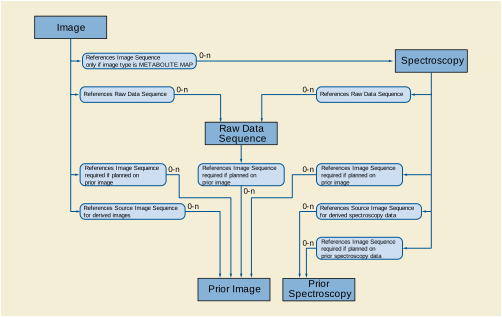
The Enhanced Magnetic Resonance (MR) Image Information Object Definition (IOD) specifies an image, which has been created by a magnetic resonance device.
The E-R Model in Section A.1.2 depicts those components of the DICOM Information Model, which directly reference the Enhanced MR Image IOD.
Table A.36-1. Enhanced MR Image IOD Modules
|
IE |
Module |
Reference |
Usage |
|---|---|---|---|
|
Patient |
Patient |
M |
|
|
Clinical Trial Subject |
U |
||
|
Study |
General Study |
M |
|
|
Patient Study |
U |
||
|
Clinical Trial Study |
U |
||
|
Series |
General Series |
M |
|
|
Clinical Trial Series |
U |
||
|
MR Series |
M |
||
|
Frame of Reference |
Frame of Reference |
M |
|
|
Synchronization |
C - Required if time synchronization was applied. |
||
|
Equipment |
General Equipment |
M |
|
|
Enhanced General Equipment |
M |
||
|
Image |
Image Pixel |
M |
|
|
Enhanced Contrast/Bolus |
C - Required if contrast media were applied. |
||
|
Multi-frame Functional Groups |
M |
||
|
Multi-frame Dimension |
M |
||
|
Cardiac Synchronization |
C - Required if cardiac synchronization was applied. |
||
|
Respiratory Synchronization |
C - Required if respiratory synchronization was applied. |
||
|
Bulk Motion Synchronization |
C - Required if bulk motion synchronization was applied. |
||
|
Supplemental Palette Color Lookup Table |
C - Required if Pixel Presentation (0008,9205) in the Enhanced MR Image Module equals COLOR or MIXED. |
||
|
Acquisition Context |
M |
||
|
Device |
U |
||
|
Specimen |
U |
||
|
Enhanced MR Image |
M |
||
|
MR Pulse Sequence |
C - Required if Image Type (0008,0008) Value 1 is ORIGINAL or MIXED. May be present otherwise. |
||
|
ICC Profile |
U |
||
|
SOP Common |
M |
||
|
Common Instance Reference |
U |
||
|
Frame Extraction |
C - Required if the SOP Instance was created in response to a Frame-Level retrieve request |
The General Image Module, Overlay Plane Module and VOI LUT Module shall not be used in a Standard Extended SOP Class of the Enhanced MR Image.
Note
In order to annotate images, whether during acquisition or subsequently, SOP Instances of the Grayscale Softcopy Presentation State Storage or the Structured Report Storage SOP Classes that reference the image SOP Instance, may be used.
No standard mechanism is provided for inclusion of annotations within the image SOP Instance itself, and implementers are discouraged from using private extensions to circumvent this restriction.
Grayscale Softcopy Presentation State Storage Instances that are generated during acquisition may be referenced from the Image SOP Instance by using the Referenced Grayscale Presentation State Sequence in the MR Image and Spectroscopy Instance Macro invoked from the Enhanced MR Image Module. See Section C.8.13.2.
The Curve Module was previously include in the list of Modules that shall not be present, but has been retired from DICOM. It is still not permitted to be present. See PS3.3-2004.
The Specimen Identification Module was previously included in this IOD but has been retired, and its functionality replaced by the Specimen Module. See PS3.3-2008.
The Photometric Interpretation (0028,0004) defined in Section C.8.13.1 Enhanced MR Image Module, shall be MONOCHROME2.
Table A.36-2 specifies the use of the Functional Group Macros used in the Multi-frame Functional Groups Module for the Enhanced MR Image IOD.
Table A.36-2. Enhanced MR Image Functional Group Macros
|
Functional Group Macro |
Section |
Usage |
|---|---|---|
|
Pixel Measures |
M |
|
|
Frame Content |
M - May not be used as a Shared Functional Group. |
|
|
Plane Position (Patient) |
M |
|
|
Plane Orientation (Patient) |
M |
|
|
Referenced Image |
C - Required if the image or frame has been planned on another image or frame. May be present otherwise |
|
|
Derivation Image |
C - Required if the image or frame has been derived from another SOP Instance. |
|
|
Cardiac Synchronization |
C - Required if Cardiac Synchronization Technique (0018,9037) equals other than NONE and if Image Type (0008,0008) Value 1 is ORIGINAL or MIXED. May be present otherwise. |
|
|
Frame Anatomy |
M |
|
|
Pixel Value Transformation |
C - Required if Photometric Interpretation (0028,0004) is MONOCHROME2. |
|
|
Frame VOI LUT |
U - May be used only if Photometric Interpretation (0028,0004) is MONOCHROME2. |
|
|
Real World Value Mapping |
U - May be used only if Photometric Interpretation (0028,0004) is MONOCHROME2. |
|
|
Contrast/Bolus Usage |
C - Required if Contrast/Bolus Agent Sequence (0018,0012) is used. |
|
|
Respiratory Synchronization |
C - Required if Respiratory Motion Compensation Technique (0018,9170) equals other than NONE, REALTIME or BREATH_HOLD and if Image Type (0008,0008) Value 1 is ORIGINAL or MIXED. May be present otherwise. |
|
|
MR Image Frame Type |
M |
|
|
MR Timing and Related Parameters |
C - Required if Image Type (0008,0008) Value 1 is ORIGINAL or MIXED. May be present otherwise. |
|
|
MR FOV/Geometry |
C - Required if Geometry of k-Space Traversal (0018,9032) equals RECTILINEAR and if Image Type (0008,0008) Value 1 is ORIGINAL or MIXED. May be present otherwise. |
|
|
MR Echo |
C - Required if Image Type (0008,0008) Value 1 is ORIGINAL or MIXED. May be present otherwise. |
|
|
MR Modifier |
C - Required if Image Type (0008,0008) Value 1 is ORIGINAL or MIXED. May be present otherwise. |
|
|
MR Imaging Modifier |
C - Required if Image Type (0008,0008) Value 1 is ORIGINAL or MIXED. May be present otherwise. |
|
|
MR Receive Coil |
C - Required if Image Type (0008,0008) Value 1 is ORIGINAL or MIXED. May be present otherwise. |
|
|
MR Transmit Coil |
C - Required if Image Type (0008,0008) Value 1 is ORIGINAL or MIXED. May be present otherwise. |
|
|
MR Diffusion |
C - Required if Acquisition Contrast (0008,9209) in any MR Image Frame Type Functional Group in the SOP Instance equals DIFFUSION and Image Type (0008,0008) Value 1 is ORIGINAL or MIXED. May be present otherwise. |
|
|
MR Averages |
C - Required if Image Type (0008,0008) Value 1 is ORIGINAL or MIXED. May be present otherwise. |
|
|
MR Spatial Saturation |
C - Required if Spatial Pre-saturation (0018,9027) equals SLAB for any frame in the SOP Instance and Image Type (0008,0008) Value 1 is ORIGINAL or MIXED. May be present otherwise. |
|
|
MR Metabolite Map |
C - Required if Image Type (0008,0008) Value 3 equals METABOLITE_MAP. May be present otherwise. |
|
|
MR Velocity Encoding |
C - Required if Phase Contrast (0018,9014) equals YES and Image Type (0008,0008) Value 1 is ORIGINAL or MIXED. May be present otherwise. |
|
|
MR Arterial Spin Labeling |
C - Required if Image Type (0008,0008) Value 3 is ASL. May be present otherwise. |
The Magnetic Resonance (MR) Spectroscopy Information Object Definition (IOD) specifies spectroscopic data, which has been created by a magnetic resonance device.
The E-R Model in Section A.1.2 depicts those components of the DICOM Information Model, which directly reference the MR Spectroscopy IOD.
Table A.36-3. MR Spectroscopy IOD Modules
|
IE |
Module |
Reference |
Usage |
|---|---|---|---|
|
Patient |
Patient |
M |
|
|
Clinical Trial Subject |
U |
||
|
Study |
General Study |
M |
|
|
Patient Study |
U |
||
|
Clinical Trial Study |
U |
||
|
Series |
General Series |
M |
|
|
Clinical Trial Series |
U |
||
|
MR Series |
M |
||
|
Frame of Reference |
Frame of Reference |
M |
|
|
Synchronization |
C - Required if time synchronization was applied. |
||
|
Equipment |
General Equipment |
M |
|
|
Enhanced General Equipment |
M |
||
|
MR Spectroscopy |
Enhanced Contrast/Bolus |
C - Required if contrast media were applied. |
|
|
Multi-frame Functional Groups |
M |
||
|
Multi-frame Dimension |
M |
||
|
Cardiac Synchronization |
C - Required if cardiac synchronization was applied. |
||
|
Respiratory Synchronization |
C - Required if respiratory synchronization was applied. |
||
|
Bulk Motion Synchronization |
C - Required if bulk motion synchronization was applied. |
||
|
Acquisition Context |
M |
||
|
Specimen |
U |
||
|
MR Spectroscopy |
M |
||
|
MR Spectroscopy Pulse Sequence |
C - Required if Image Type (0008,0008) Value 1 is ORIGINAL. May be present otherwise. |
||
|
MR Spectroscopy Data |
M |
||
|
SOP Common |
M |
||
|
Common Instance Reference |
U |
||
|
Frame Extraction |
C - Required if the SOP Instance was created in response to a Frame-Level retrieve request |
Note
The Specimen Identification Module was previously included in this IOD but has been retired, and its functionality replaced by the Specimen Module. See PS3.3-2008.
Table A.36-4 specifies the use of the Functional Group Macros used in the Multi-frame Functional Groups Module for the MR Spectroscopy IOD.
Table A.36-4. MR Spectroscopy Functional Group Macros
|
Functional Group Macro |
Section |
Usage |
|---|---|---|
|
Pixel Measures |
M |
|
|
Frame Content |
M - May not be used as a Shared Functional Group |
|
|
Plane Position (Patient) |
M |
|
|
Plane Orientation (Patient) |
M |
|
|
Referenced Image |
C - Required if the image or frame has been planned on another image or frame. May be present otherwise |
|
|
Derivation Image |
C - Required if the image or frame has been derived from another SOP Instance. |
|
|
Cardiac Synchronization |
C - Required if Cardiac Synchronization Technique (0018,9037) equals other than NONE and if Image Type (0008,0008) Value 1 is ORIGINAL or MIXED. May be present otherwise. |
|
|
Frame Anatomy |
M |
|
|
Contrast/Bolus Usage |
C - Required if Contrast/Bolus Agent Sequence (0018,0012) is used. |
|
|
Respiratory Synchronization |
C - Required if Respiratory Motion Compensation Technique (0018,9170) equals other than NONE, REALTIME or BREATH_HOLD and if Image Type (0008,0008) Value 1 is ORIGINAL or MIXED. May be present otherwise. |
|
|
MR Spectroscopy Frame Type |
M |
|
|
MR Timing and Related Parameters |
C - Required if Image Type (0008,0008) Value 1 is ORIGINAL or MIXED. May be present otherwise. |
|
|
MR Spectroscopy FOV/Geometry |
C - Required if Geometry of k-Space Traversal (0018,9032) equals RECTILINEAR and if Image Type (0008,0008) Value 1 is ORIGINAL or MIXED. May be present otherwise. |
|
|
MR Echo |
C - Required if Image Type (0008,0008) Value 1 is ORIGINAL or MIXED. May be present otherwise. |
|
|
MR Modifier |
C - Required if Image Type (0008,0008) Value 1 is ORIGINAL or MIXED. May be present otherwise. |
|
|
MR Receive Coil |
C - Required if Image Type (0008,0008) Value 1 is ORIGINAL or MIXED. May be present otherwise. |
|
|
MR Transmit Coil |
C - Required if Image Type (0008,0008) Value 1 is ORIGINAL or MIXED. May be present otherwise. |
|
|
MR Diffusion |
C - Required if Acquisition Contrast (0008,9209) in any MR Image Frame Type Functional Group in the SOP Instance equals DIFFUSION and Image Type (0008,0008) Value 1 is ORIGINAL or MIXED. May be present otherwise. |
|
|
MR Averages |
C - Required if Image Type (0008,0008) Value 1 is ORIGINAL or MIXED. May be present otherwise. |
|
|
MR Spatial Saturation |
C - Required if Spatial Pre-saturation (0018,9027) equals SLAB for any frame in the SOP Instance and Image Type (0008,0008) Value 1 is ORIGINAL or MIXED. May be present otherwise. |
|
|
MR Velocity Encoding |
C - Required if Phase Contrast (0018,9014) equals YES and Image Type (0008,0008) Value 1 is ORIGINAL or MIXED. May be present otherwise. |
The Enhanced Magnetic Resonance (MR) Color Image Information Object Definition (IOD) specifies an image, which has been created by a magnetic resonance device.
The E-R Model in Section A.1.2 depicts those components of the DICOM Information Model, which directly reference the Enhanced MR Color Image IOD.
Table A.36-5. Enhanced MR Color Image IOD Modules
|
IE |
Module |
Reference |
Usage |
|---|---|---|---|
|
Patient |
Patient |
M |
|
|
Clinical Trial Subject |
U |
||
|
Study |
General Study |
M |
|
|
Patient Study |
U |
||
|
Clinical Trial Study |
U |
||
|
Series |
General Series |
M |
|
|
Clinical Trial Series |
U |
||
|
MR Series |
M |
||
|
Frame of Reference |
Frame of Reference |
M |
|
|
Synchronization |
C - Required if time synchronization was applied. |
||
|
Equipment |
General Equipment |
M |
|
|
Enhanced General Equipment |
M |
||
|
Image |
Image Pixel |
M |
|
|
Enhanced Contrast/Bolus |
C - Required if contrast media were applied. |
||
|
Multi-frame Functional Groups |
M |
||
|
Multi-frame Dimension |
M |
||
|
Cardiac Synchronization |
C - Required if cardiac synchronization was applied. |
||
|
Respiratory Synchronization |
C - Required if respiratory synchronization was applied. |
||
|
Bulk Motion Synchronization |
C - Required if bulk motion synchronization was applied. |
||
|
Acquisition Context |
M |
||
|
Specimen |
C - Required if Imaging Subject is a specimen |
||
|
Device |
U |
||
|
Enhanced MR Image |
M |
||
|
MR Pulse Sequence |
C - Required if Image Type (0008,0008) Value 1 is ORIGINAL or MIXED. May be present otherwise. |
||
|
ICC Profile |
M |
||
|
SOP Common |
M |
||
|
Common Instance Reference |
U |
||
|
Frame Extraction |
C - Required if the SOP Instance was created in response to a Frame-Level retrieve request |
The General Image Module, Overlay Plane Module and VOI LUT Module shall not be used in a Standard Extended SOP Class of the Enhanced MR Color Image.
Note
In order to annotate images, whether during acquisition or subsequently, SOP Instances of the Color Softcopy Presentation State Storage or the Structured Report Storage SOP Classes that reference the image SOP Instance, may be used.
No standard mechanism is provided for inclusion of annotations within the image SOP Instance itself, and implementers are discouraged from using private extensions to circumvent this restriction.
Color Softcopy Presentation State Storage Instances that are generated during acquisition may be referenced from the Image SOP Instance by using the Referenced Presentation State Sequence in the MR Image and Spectroscopy Instance Macro invoked from the Enhanced MR Image Module. See Section C.8.13.2.
Photometric Interpretation (0028,0004) shall be RGB for uncompressed or lossless compressed transfer syntaxes that do not involve color space transformations, YBR_ICT for irreversible JPEG2000 transfer syntaxes, YBR_RCT for reversible JPEG2000 transfer syntaxes, YBR_PARTIAL_420 for MPEG2 and MPEG-4 AVC/H.264 transfer syntaxes and YBR_FULL_422 for other lossy compressed transfer syntaxes.
Pixel Presentation (0008,9205) shall be TRUE_COLOR.
Table A.36-2 specifies the use of the Functional Group Macros used in the Multi-frame Functional Groups Module for the Enhanced MR Color Image IOD.
The E-R Model in Section A.1.2 depicts those components of the DICOM Information Model, which directly reference the Raw Data IOD.
Table A.37-1. Raw Data IOD Modules
|
IE |
Module |
Reference |
Usage |
|---|---|---|---|
|
Patient |
Patient |
M |
|
|
Clinical Trial Subject |
U |
||
|
Study |
General Study |
M |
|
|
Patient Study |
U |
||
|
Clinical Trial Study |
U |
||
|
Series |
General Series |
M |
|
|
Clinical Trial Series |
U |
||
|
Frame of Reference |
Frame of Reference |
U |
|
|
Synchronization |
C - Required if time synchronization was applied. |
||
|
Equipment |
General Equipment |
M |
|
|
Raw Data |
Acquisition Context |
M |
|
|
Specimen |
U |
||
|
Raw Data |
M |
||
|
SOP Common |
M |
Note
The Specimen Identification Module was previously included in this IOD but has been retired, and its functionality replaced by the Specimen Module. See PS3.3-2008.
The Enhanced Computed Tomography (CT) Image Information Object Definition (IOD) specifies an image that has been created by a computed tomography imaging device.
The E-R Model in Section A.1.2 depicts those components of the DICOM Information Model that directly reference the Enhanced CT Image IOD.
Table A.38-1. Enhanced CT Image IOD Modules
|
IE |
Module |
Reference |
Usage |
|---|---|---|---|
|
Patient |
Patient |
M |
|
|
Clinical Trial Subject |
U |
||
|
Study |
General Study |
M |
|
|
Patient Study |
U |
||
|
Clinical Trial Study |
U |
||
|
Series |
General Series |
M |
|
|
CT Series |
M |
||
|
Clinical Trial Series |
U |
||
|
Frame of Reference |
Frame of Reference |
M |
|
|
Synchronization |
C - Required if time synchronization was applied. |
||
|
Equipment |
General Equipment |
M |
|
|
Enhanced General Equipment |
M |
||
|
Image |
Image Pixel |
M |
|
|
Enhanced Contrast/Bolus |
C - Required if contrast media was applied. |
||
|
Multi-frame Functional Groups |
M |
||
|
Multi-frame Dimension |
M |
||
|
Cardiac Synchronization |
C - Required if cardiac synchronization was applied. |
||
|
Respiratory Synchronization |
C - Required if respiratory synchronization was applied. |
||
|
Supplemental Palette Color Lookup Table |
C - Required if Pixel Presentation (0008,9205) in the Enhanced CT Image Module equals COLOR or MIXED. |
||
|
Acquisition Context |
M |
||
|
Device |
U |
||
|
Specimen |
U |
||
|
Enhanced CT Image |
M |
||
|
ICC Profile |
U |
||
|
SOP Common |
M |
||
|
Common Instance Reference |
U |
||
|
Frame Extraction |
C - Required if the SOP Instance was created in response to a Frame-Level retrieve request |
The General Image Module, Overlay Plane Module and VOI LUT Module shall not be used in a Standard Extended SOP Class of the Enhanced CT Image.
Note
In order to annotate images, whether during acquisition or subsequently, SOP Instances of the Grayscale Softcopy Presentation State Storage or the Structured Report Storage SOP Classes that reference the image SOP Instance, may be used.
No standard mechanism is provided for inclusion of annotations within the image SOP Instance itself, and implementers are discouraged from using private extensions to circumvent this restriction.
Grayscale Softcopy Presentation State Storage Instances that are generated during acquisition may be referenced from the Image SOP Instance by using the Referenced Grayscale Presentation State Sequence in the Enhanced CT Image Module. See Section C.8.15.2.
The Curve Module was previously include in the list of Modules that shall not be present, but has been retired from DICOM. It is still not permitted to be present. See PS3.3-2004.
The Specimen Identification Module was previously included in this IOD but has been retired, and its functionality replaced by the Specimen Module. See PS3.3-2008.
Table A.38-2 specifies the use of the Functional Group Macros used in the Multi-frame Functional Group Module for the Enhanced CT Image IOD.
Table A.38-2. Enhanced CT Image Functional Group Macros
|
Functional Group Macro |
Section |
Usage |
|---|---|---|
|
Pixel Measures |
M |
|
|
Frame Content |
M - May not be used as a Shared Functional Group. |
|
|
Plane Position (Patient) |
M |
|
|
Plane Orientation (Patient) |
M |
|
|
Referenced Image |
C - Required if the image or frame has been planned on another image or frame, may be present otherwise. |
|
|
Derivation Image |
C - Required if the image or frame has been derived from another SOP Instance. |
|
|
Cardiac Synchronization |
C - Required if Cardiac Synchronization Technique (0018,9037) equals other than NONE and if Image Type (0008,0008) Value 1 is ORIGINAL or MIXED. May be present otherwise. |
|
|
Frame Anatomy |
M |
|
|
Frame VOI LUT |
U |
|
|
Real World Value Mapping |
U |
|
|
Contrast/Bolus Usage |
C - Required if Contrast/Bolus Agent Sequence (0018,0012) is used. |
|
|
Respiratory Synchronization |
C - Required if Respiratory Motion Compensation Technique (0018,9170) equals other than NONE, REALTIME or BREATH_HOLD and if Image Type (0008,0008) Value 1 is ORIGINAL or MIXED. May be present otherwise. |
|
|
Irradiation Event Identification |
M |
|
|
CT Image Frame Type |
M |
|
|
CT Acquisition Type |
C - Required if Image Type (0008,0008) Value 1 is ORIGINAL or MIXED, may be present otherwise. |
|
|
CT Acquisition Details |
C - Required if Image Type (0008,0008) Value 1 is ORIGINAL or MIXED, may be present otherwise. |
|
|
CT Table Dynamics |
C - Required if Image Type (0008,0008) Value 1 is ORIGINAL or MIXED, may be present otherwise. |
|
|
CT Position |
C - Required if Image Type (0008,0008) Value 1 is ORIGINAL or MIXED, may be present otherwise |
|
|
CT Geometry |
C - Required if Image Type (0008,0008) Value 1 is ORIGINAL or MIXED, may be present otherwise. |
|
|
CT Reconstruction |
C - Required if Image Type (0008,0008) Value 1 is ORIGINAL or MIXED and Acquisition Type (0018,9302) is other than CONSTANT_ANGLE, may be present otherwise. |
|
|
CT Exposure |
C - Required if Image Type (0008,0008) Value 1 is ORIGINAL or MIXED, may be present otherwise. |
|
|
CT X-Ray Details |
C - Required if Image Type (0008,0008) Value 1 is ORIGINAL or MIXED, may be present otherwise. |
|
|
CT Pixel Value Transformation |
M |
|
|
CT Additional X-Ray Source |
C - Required if the image is reconstructed from a system with multiple X-Ray sources |
The Registration IOD specifies the spatial relationship between Frames of Reference.
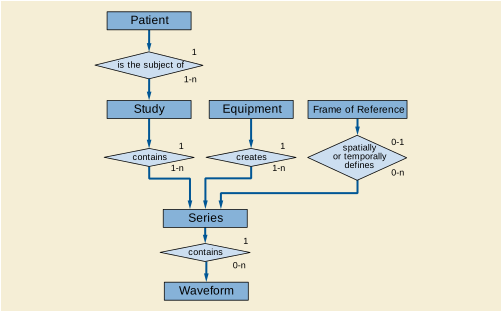
Table A.39.1-1. Spatial Registration IOD Modules
|
IE |
Module |
Reference |
Usage |
|---|---|---|---|
|
Patient |
Patient |
M |
|
|
Clinical Trial Subject |
U |
||
|
Study |
General Study |
M |
|
|
Patient Study |
U |
||
|
Clinical Trial Study |
U |
||
|
Series |
General Series |
M |
|
|
Clinical Trial Series |
U |
||
|
Spatial Registration Series |
M |
||
|
Frame of Reference |
Frame of Reference |
M |
|
|
Equipment |
General Equipment |
M |
|
|
Spatial Registration |
Spatial Registration |
M |
|
|
Common Instance Reference |
M |
||
|
SOP Common |
M |
Note
The Specimen Identification Module was previously included in this IOD but has been retired. See PS3.3-2008.
The Deformable Spatial Registration Information Object Definition (IOD) describes spatial relationships between images in one or more frames of reference via deformation grids and transformation matrices. The deformations and transformations describe to an application how to sample data from one or more Source RCS into the Registered RCS.
The Registered RCS is the Frame of Reference specified within an instance of this IOD. The IOD may specify that only a subset of the entire Source RCS Frame of Reference is affected by the transformation, by specifying specific frames of image SOP Instances that use the Source Frame of Reference.
The deformation is described as a grid of offset vectors. Each grid element contains 3 values representing offset distances in the X, Y, and Z directions at the center position of the deformation grid element. The relationship between the data being deformed and the deformation grid is purely spatial. Therefore the resolution of the grid is independent of the data being deformed.
The E-R Model for the Deformable Spatial Registration IOD is identical to the E-R Model for the Spatial Registration IOD in Figure A.39-1.
Table A.39.2-1. Deformable Spatial Registration IOD Modules
|
IE |
Module |
Reference |
Usage |
|---|---|---|---|
|
Patient |
Patient |
M |
|
|
Clinical Trial Subject |
U |
||
|
Study |
General Study |
M |
|
|
Patient Study |
U |
||
|
Clinical Trial Study |
U |
||
|
Series |
General Series |
M |
|
|
Clinical Trial Series |
U |
||
|
Spatial Registration Series |
M |
||
|
Frame of Reference |
Frame of Reference |
M |
|
|
Equipment |
General Equipment |
M |
|
|
Enhanced General Equipment |
M |
||
|
Spatial Registration |
Deformable Spatial Registration |
M |
|
|
Common Instance Reference |
M |
||
|
SOP Common |
M |
The Fiducials IOD specifies the spatial relationship between the Composite Fiducial instance, to one or more images.
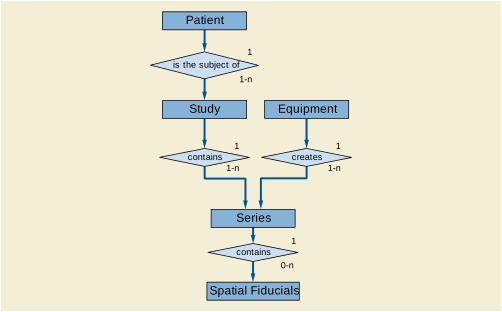
Table A.40-1. Spatial Fiducials IOD Modules
|
IE |
Module |
Reference |
Usage |
|---|---|---|---|
|
Patient |
Patient |
M |
|
|
Clinical Trial Subject |
U |
||
|
Study |
General Study |
M |
|
|
Patient Study |
U |
||
|
Clinical Trial Study |
U |
||
|
Series |
General Series |
M |
|
|
Clinical Trial Series |
U |
||
|
Spatial Fiducials Series |
M |
||
|
Equipment |
General Equipment |
M |
|
|
Spatial Fiducials |
Spatial Fiducials |
M |
|
|
Common Instance Reference |
M |
||
|
SOP Common |
M |
Note
The Specimen Identification Module was previously included in this IOD but has been retired. See PS3.3-2008.
This Section defines an Information Object to be used with several types of ophthalmic photographic imaging devices including fundus cameras, slit lamp cameras, scanning laser devices, stereoscopic cameras, video equipment and digital photographic equipment, with 8 bit resolution per pixel in each image plane.
The Ophthalmic Photography 8 Bit Image IOD specifies a single-frame or a multi-frame image acquired on a digital photographic DICOM modality. This IOD can be used to encode single ophthalmic images and cine sequences.
The E-R Model in Section A.1.2 depicts those components of the DICOM Information Model that directly reference the Ophthalmic Photography 8-Bit Image IOD, with exception of the VOI LUT, and Modality LUT entities, which are not used. Table A.41-1 specifies the Modules of the Ophthalmic Photography 8 Bit Image IOD.
Note
The Curve Module was previously include in the list of Modules that shall not be present, but has been retired from DICOM. It is still not permitted to be present. See PS3.3-2004.
Table A.41-1. Ophthalmic Photography 8 Bit Image IOD Modules
|
IE |
Module |
Reference |
Usage |
|---|---|---|---|
|
Patient |
Patient |
M |
|
|
Clinical Trial Subject |
U |
||
|
Study |
General Study |
M |
|
|
Patient Study |
U |
||
|
Clinical Trial Study |
U |
||
|
Series |
General Series |
M |
|
|
Ophthalmic Photography Series |
M |
||
|
Clinical Trial Series |
U |
||
|
Frame of Reference |
Synchronization |
M |
|
|
Equipment |
General Equipment |
M |
|
|
Image |
General Image |
M |
|
|
Image Pixel |
M |
||
|
Enhanced Contrast/Bolus |
C - Required if contrast was administered, see Section A.41.4.2 |
||
|
Cine |
C - Required if there is a sequential temporal relationship between all frames |
||
|
Multi-frame |
M |
||
|
Device |
U |
||
|
Acquisition Context |
U |
||
|
Ophthalmic Photography Image |
M |
||
|
Ocular Region Imaged |
M |
||
|
Ophthalmic Photography Acquisition Parameters |
M |
||
|
Ophthalmic Photographic Parameters |
M |
||
|
ICC Profile |
U |
||
|
SOP Common |
M |
||
|
Common Instance Reference |
U |
||
|
Frame Extraction |
C - Required if the SOP Instance was created in response to a Frame-Level retrieve request |
Note
The Specimen Identification Module was previously included in this IOD but has been retired. See PS3.3-2008.
The following constraints on Series and Image attributes take precedence over the descriptions given in the Module Attribute Tables.
For Ophthalmic Photography 8 bit images, the Enumerated Value of Bits Allocated (0028,0100) (Image Pixel Module, Section C.7.6.3) shall be 8; the Enumerated Value of Bits Stored (0028,0101) shall be 8; and the Enumerated Value of High Bit (0028,0102) shall be 7.
For Contrast/Bolus Agent Sequence (0018,0012), the defined CID 4200 “Ophthalmic Imaging Agent” shall be used.
This Section defines an Information Object to be used with several types of ophthalmic photographic imaging devices including fundus cameras, slit lamp cameras, scanning laser devices, stereoscopic cameras, video equipment and digital photographic equipment, with16 bit resolution per pixel in each image plane.
The Ophthalmic Photography 16 Bit Image IOD specifies a single-frame or a multi-frame image acquired on a digital photographic DICOM modality. This IOD can be used to encode single ophthalmic images and other combinations including cine sequences.
The E-R Model in Section A.1.2 depicts those components of the DICOM Information Model that directly reference the Ophthalmic Photography 16-Bit Image IOD, with exception of the VOI LUT, Frame of Reference and Modality LUT entities, which are not used. Table A.42-1 specifies the Modules of the Ophthalmic Photography 16 Bit Image IOD.
Note
The Curve Module was previously include in the list of Modules that shall not be present, but has been retired from DICOM. It is still not permitted to be present. See PS3.3-2004.
Table A.42-1. Ophthalmic Photography 16 Bit Image IOD Modules
|
IE |
Module |
Reference |
Usage |
|---|---|---|---|
|
Patient |
Patient |
M |
|
|
Clinical Trial Subject |
U |
||
|
Study |
General Study |
M |
|
|
Patient Study |
U |
||
|
Clinical Trial Study |
U |
||
|
Series |
General Series |
M |
|
|
Ophthalmic Photography Series |
M |
||
|
Clinical Trial Series |
U |
||
|
Frame of Reference |
Synchronization |
M |
|
|
Equipment |
General Equipment |
M |
|
|
Image |
General Image |
M |
|
|
Image Pixel |
M |
||
|
Enhanced Contrast/Bolus |
C - Required if contrast was administered; See Section A.42.4.2 |
||
|
Cine |
C - Required if there is a sequential temporal relationship between all frames |
||
|
Multi-frame |
M |
||
|
Device |
U |
||
|
Acquisition Context |
U |
||
|
Ophthalmic Photography Image |
M |
||
|
Ocular Region Imaged |
M |
||
|
Ophthalmic Photography Acquisition Parameters |
M |
||
|
Ophthalmic Photographic Parameters |
M |
||
|
ICC Profile |
U |
||
|
SOP Common |
M |
||
|
Common Instance Reference |
U |
||
|
Frame Extraction |
C - Required if the SOP Instance was created in response to a Frame-Level retrieve request |
Note
The Specimen Identification Module was previously included in this IOD but has been retired. See PS3.3-2008.
The following constraints on Series and Image attributes take precedence over the descriptions given in the Module Attribute Tables.
For Ophthalmic Photography 16 bit images, the Enumerated Value of Bits Allocated (0028,0100) (Image Pixel Module, Section C.7.6.3) shall be 16; the Enumerated Value of Bits Stored (0028,0101) shall be 16; and the Enumerated Value of High Bit (0028,0102) shall be 15.
For Contrast/Bolus Agent Sequence (0018,0012), the defined CID 4200 “Ophthalmic Imaging Agent” shall be used.
This Section defines an Information Object to be used for linking together images belonging to stereoscopic pairs. A Series IE will typically contain a single Stereometric Relationship IE that references one or more sets of stereoscopic images. Stereoscopic pairs for ophthalmic photographic imaging may include single images, multi-frame images, or cine images.
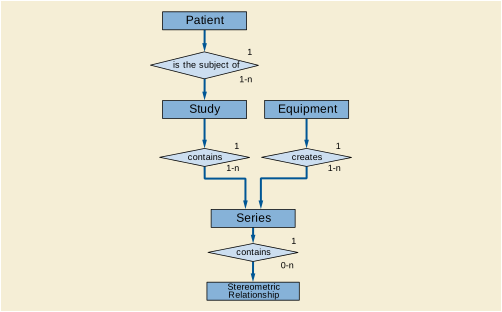
Table A.43-2. Stereometric Relationship IOD Modules
|
IE |
Module |
Reference |
Usage |
|---|---|---|---|
|
Patient |
Patient |
M |
|
|
Clinical Trial Subject |
U |
||
|
Study |
General Study |
M |
|
|
Patient Study |
U |
||
|
Clinical Trial Study |
U |
||
|
Series |
General Series |
M |
|
|
Clinical Trial Series |
U |
||
|
Stereometric Series |
M |
||
|
Equipment |
General Equipment |
M |
|
|
Stereometric Relationship |
Stereometric Relationship |
M |
|
|
Common Instance Reference |
M |
||
|
SOP Common |
M |
Note
The Specimen Identification Module was previously included in this IOD but has been retired. See PS3.3-2008.
A Hanging Protocol entity specifies the viewing preferences of a specific user or group, for a specific type of study (Modality, Anatomy, Laterality combination, and optionally Procedure, and/or Reason), that may be exchanged between connecting devices that claim conformance to the DICOM Standard. The Hanging Protocol contains information about the Hanging Protocol, the creator, the type of study it addresses, the type of image sets to display, the intended display environment, and the intended layout for the screen(s).
A Hanging Protocol is not related to other Information Entities of the DICOM real-world model, as it is not associated with a specific patient. The E-R model for the Hanging Protocol IOD is shown in Figure A.44.2-1.

Table A.44.3-1 lists the modules that make up the Hanging Protocol IOD.
The Encapsulated PDF Information Object Definition (IOD) describes a PDF document that has been encapsulated within a DICOM information object.
The E-R Model in Section A.1.2 applies to the Encapsulated PDF IOD.
Table A.45.1-1 specifies the Encapsulated PDF IOD Modules.
Table A.45.1-1. Encapsulated PDF IOD Modules
|
IE |
Module |
Reference |
Usage |
|---|---|---|---|
|
Patient |
Patient |
M |
|
|
Clinical Trial Subject |
U |
||
|
Study |
General Study |
M |
|
|
Patient Study |
U |
||
|
Clinical Trial Study |
U |
||
|
Series |
Encapsulated Document Series |
M |
|
|
Clinical Trial Series |
U |
||
|
Equipment |
General Equipment |
M |
|
|
SC Equipment |
M |
||
|
Encapsulated Document |
Encapsulated Document |
M |
|
|
SOP Common |
M |
Note
The Specimen Identification Module was previously included in this IOD but has been retired. See PS3.3-2008.
The Encapsulated CDA Information Object Definition (IOD) describes an HL7 Clinical Document Architecture (CDA) document that has been encapsulated within a DICOM information object.
The E-R Model in Section A.1.2 applies to the Encapsulated CDA IOD.
Table A.45.2-1 specifies the Encapsulated CDA IOD Modules.
Table A.45.2-1. Encapsulated CDA IOD Modules
|
IE |
Module |
Reference |
Usage |
|---|---|---|---|
|
Patient |
Patient |
M |
|
|
Clinical Trial Subject |
U |
||
|
Study |
General Study |
M |
|
|
Patient Study |
U |
||
|
Clinical Trial Study |
U |
||
|
Series |
Encapsulated Document Series |
M |
|
|
Clinical Trial Series |
U |
||
|
Equipment |
General Equipment |
M |
|
|
SC Equipment |
M |
||
|
Encapsulated Document |
Encapsulated Document |
M |
|
|
SOP Common |
M |
The Real World Value Mapping Information Object Definition specifies a mapping of the stored pixel values of referenced images into some Real World value in defined units. This allows the capture of retrospectively determined mappings, e.g., for values that cannot be determined at the time of image acquisition and encoding.
Note
A particular use case is mapping of PET pixel values to counts, concentration, or selective uptake values (SUVs) normalized by one of several factors.
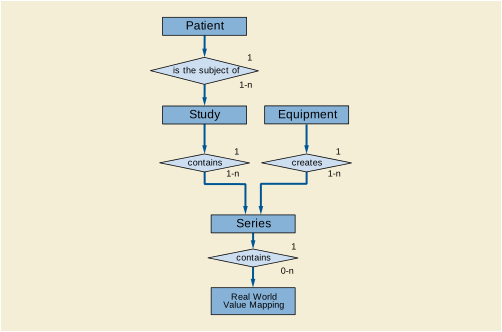
Table A.46-1. Real World Value Mapping IOD Modules
|
IE |
Module |
Reference |
Usage |
|---|---|---|---|
|
Patient |
Patient |
M |
|
|
Clinical Trial Subject |
U |
||
|
Study |
General Study |
M |
|
|
Patient Study |
U |
||
|
Clinical Trial Study |
U |
||
|
Series |
General Series |
M |
|
|
Clinical Trial Series |
U |
||
|
Real World Value Mapping Series |
M |
||
|
Equipment |
General Equipment |
M |
|
|
Real World Value Mapping |
Real World Value Mapping |
M |
|
|
Common Instance Reference |
M |
||
|
SOP Common |
M |
Note
The Specimen Identification Module was previously included in this IOD but has been retired. See PS3.3-2008.
This Section defines the enhanced Information Object for single plane X-Ray Angiographic Imaging that includes those data elements and information objects necessary for the interchange of digital X-Ray Angiographic data. This includes images of the heart and all blood vessels.
The enhanced XA IOD is also applicable to clinical areas other than angiography (e.g., Interventional Procedures, Myelography, Biopsy/Localization, and Neurology).
Note
For the purpose of X-Ray Angiography (XA), this enhanced IOD can be used to encode a single frame image, or a Cine Run, or a single multi-frame image with non-time related dimensions.
A typical study might include all the images generated between the time a patient gets on and gets off the procedure table. As several separable diagnostic or therapeutic processes may occur during a single study (e.g., pre-intervention CA, left ventriculography, and post-intervention CA), a series may be defined as comprising a set of images (single or multi-frame) associated with one such process within a study.
This enhanced IOD can be used to encode a single plane acquisition, or one plane of a biplane acquisition.
The E-R Model in Section A.1.2 depicts those components of the DICOM Application Information Model that directly reference the enhanced X-Ray Angiographic Image IOD. Additionally, "Image" in Figure A.1-1 may represent a single frame or a multi-frame image. A frame denotes a two-dimensional organization of pixels recorded as a single exposure.
Table A.47-1. Enhanced X-Ray Angiographic Image IOD Modules
|
IE |
Module |
Reference |
Usage |
|---|---|---|---|
|
Patient |
Patient |
M |
|
|
Clinical Trial Subject |
U |
||
|
Study |
General Study |
M |
|
|
Patient Study |
U |
||
|
Clinical Trial Study |
U |
||
|
Series |
General Series |
M |
|
|
XA/XRF Series |
M |
||
|
Clinical Trial Series |
U |
||
|
Frame of Reference |
Frame of Reference |
C - Required if C-arm Positioner Tabletop Relationship (0018,9474) equals YES. May be present otherwise. |
|
|
Synchronization |
C - Required if C-arm Positioner Tabletop Relationship (0018,9474) equals YES. May be present otherwise. |
||
|
Equipment |
General Equipment |
M |
|
|
Enhanced General Equipment |
M |
||
|
Image |
Image Pixel |
M |
|
|
Enhanced Contrast/Bolus |
C - Required if contrast media was applied and the system is able to register contrast usage. |
||
|
Mask |
U |
||
|
Device |
U |
||
|
Intervention |
U |
||
|
Acquisition Context |
M |
||
|
Multi-frame Functional Groups |
M |
||
|
Multi-frame Dimension Module |
U |
||
|
Cardiac Synchronization |
C - Required if cardiac synchronization was applied. |
||
|
Respiratory Synchronization |
C - Required if respiratory synchronization was applied. |
||
|
Specimen |
U |
||
|
X-Ray Filtration |
U |
||
|
X-Ray Grid |
U |
||
|
Enhanced XA/XRF Image |
M |
||
|
XA/XRF Acquisition |
C - Required if Image Type (0008,0008) Value 1 equals ORIGINAL. May be present otherwise. |
||
|
X-Ray Image Intensifier |
C - Required if X-Ray Receptor Type (0018,9420) is present and equals IMG_INTENSIFIER. |
||
|
X-Ray Detector |
C - Required if X-Ray Receptor Type (0018,9420) is present and equals DIGITAL_DETECTOR. |
||
|
XA/XRF Multi-frame Presentation |
U |
||
|
SOP Common |
M |
||
|
Common Instance Reference |
U |
||
|
Frame Extraction |
C - Required if the SOP Instance was created in response to a Frame-Level retrieve request |
The Overlay Plane Module, VOI LUT Module and Softcopy Presentation LUT Module shall not be used in a Standard Extended SOP Class of the Enhanced XA Image.
Note
The VOI LUT function is provided by a Frame VOI LUT Functional Group.
The Curve Module was previously include in the list of Modules that shall not be present, but has been retired from DICOM. It is still not permitted to be present. See PS3.3-2004.
The Specimen Identification Module was previously included in this IOD but has been retired, and its functionality replaced by the Specimen Module. See PS3.3-2008.
Table A.47-2 specifies the use of the Functional Group Macros used in the Multi-frame Functional Groups Module for the Enhanced XA Image IOD.
Table A.47-2. Enhanced XA Image Functional Group Macros
|
Functional Group Macro |
Section |
Usage |
|---|---|---|
|
Frame Content |
M - May not be used as a Shared Functional Group. |
|
|
Referenced Image |
U |
|
|
Derivation Image |
C - Required if the image or frame has been derived from another SOP Instance. |
|
|
Cardiac Synchronization |
U |
|
|
Frame Anatomy |
M |
|
|
Frame VOI LUT |
M |
|
|
Contrast/Bolus Usage |
C - Required if the Enhanced Contrast/Bolus Module is present |
|
|
Pixel Intensity Relationship LUT |
C - Required if Pixel Intensity Relationship (0028,1040) equals LOG. May be present otherwise. |
|
|
Frame Pixel Shift |
U |
|
|
Patient Orientation in Frame |
C - Required if C-arm Positioner Tabletop Relationship (0018,9474) is present and equals YES. May be present otherwise. |
|
|
Frame Display Shutter |
U |
|
|
Respiratory Synchronization |
U |
|
|
Irradiation Event Identification |
M |
|
|
X-Ray Frame Characteristics |
U |
|
|
X-Ray Field of View |
C - Required if Isocenter Reference System Sequence (0018,9462) is present. May be present otherwise. |
|
|
X-Ray Exposure Control Sensing Regions |
U |
|
|
X-Ray Frame Pixel Data Properties |
M |
|
|
X-Ray Frame Detector Parameters |
C - Required if X-Ray Receptor Type (0018,9420) is present and equals DIGITAL_DETECTOR. |
|
|
X-Ray Calibration Device Usage |
U |
|
|
X-Ray Object Thickness |
U |
|
|
X-Ray Frame Acquisition |
U |
|
|
X-Ray Projection Pixel Calibration |
C - Required if C-arm Positioner Tabletop Relationship (0018,9474) is present and equals YES. |
|
|
X-Ray Positioner |
C - Required if Image Type (0008,0008) Value 1 equals ORIGINAL and C-arm Positioner Tabletop Relationship (0018,9474) is present and equals YES. May be present otherwise. |
|
|
X-Ray Table Position |
C - Required if Image Type (0008,0008) Value 1 equals ORIGINAL and C-arm Positioner Tabletop Relationship (0018,9474) is present and equals YES. May be present otherwise. |
|
|
X-Ray Collimator |
C - Required if Image Type (0008,0008) Value 1 equals ORIGINAL. May be present otherwise. |
|
|
X-Ray Isocenter Reference System |
U - May not be used if C-arm Positioner Tabletop Relationship (0018,9474) is not present or equals NO. |
|
|
X-Ray Geometry |
C - Required if Projection Pixel Calibration Sequence (0018,9401) is present. May be present otherwise. |
The Defined CID for the Anatomic Region Sequence (0008,2218) shall be CID 4042 “XA/XRF Anatomy Imaged”.
The focus for this enhanced X-Ray RF Image IOD (XRF IOD) is to address the requirements for image transfer found in general Radiofluoroscopic applications performed on a table with a column. For applications performed on X-Ray RF acquisition systems that support a patient based coordinate system with cranial/caudal, LAO/RAO angles, etc. the enhanced XA Image IOD may be used.
Note
An example of a case where the enhanced XA IOD may be preferred to the enhanced RF IOD are RF acquisition system equipped with an X-Ray source and an image Receptor positioned by what is generally called a C-arm (e.g., Interventional Procedures, Myelography, Biopsy, and Neurology).
For the purpose of X-Ray Radiofluoroscopy, this IOD can be used to encode a single frame image, or a cine run, or a single multi-frame image with non-time related dimensions.
A typical study might include all the images generated between the time a patient gets on and gets off the procedure table. As several separable diagnostic or therapeutic processes may occur during a single study, a series may be defined as comprising a set of images (single or multi-frame) associated with one such process within a study.
The E-R Model in Section A.1.2 depicts those components of the DICOM Application Information Model that directly reference the X-Ray RF Image IOD. Additionally, "Image" in Figure A.1-1 may represent a single frame or a multi-frame image. A frame denotes a two-dimensional organization of pixels recorded as a single exposure.
Table A.48.-1. Enhanced X-Ray RF Image IOD Modules
|
IE |
Module |
Reference |
Usage |
|---|---|---|---|
|
Patient |
Patient |
M |
|
|
Clinical Trial Subject |
U |
||
|
Study |
General Study |
M |
|
|
Patient Study |
U |
||
|
Clinical Trial Study |
U |
||
|
Series |
General Series |
M |
|
|
XA/XRF Series |
M |
||
|
Clinical Trial Series |
U |
||
|
Frame of Reference |
Frame of Reference |
U |
|
|
Synchronization |
U |
||
|
Equipment |
General Equipment |
M |
|
|
Enhanced General Equipment |
M |
||
|
Image |
Image Pixel |
M |
|
|
Enhanced Contrast/Bolus |
C - Required if contrast media was applied and the system is able to register contrast usage. |
||
|
Mask |
U |
||
|
Device |
U |
||
|
Intervention |
U |
||
|
Acquisition Context |
M |
||
|
Multi-frame Functional Groups |
M |
||
|
Multi-frame Dimension Module |
U |
||
|
Cardiac Synchronization |
C - Required if cardiac synchronization was applied. |
||
|
Respiratory Synchronization |
C - Required if respiratory synchronization was applied. |
||
|
Specimen |
U |
||
|
X-Ray Tomography Acquisition |
U |
||
|
X-Ray Filtration |
U |
||
|
X-Ray Grid |
U |
||
|
Enhanced XA/XRF Image |
M |
||
|
XA/XRF Acquisition |
C - Required if Image Type (0008,0008) Value 1 equals ORIGINAL. May be present otherwise. |
||
|
X-Ray Image Intensifier |
C - Required if X-Ray Receptor Type (0018,9420) is present and equals IMG_INTENSIFIER. |
||
|
X-Ray Detector |
C - Required if X-Ray Receptor Type (0018,9420) is present and equals DIGITAL_DETECTOR. |
||
|
XA/XRF Multi-frame Presentation |
U |
||
|
SOP Common |
M |
||
|
Common Instance Reference |
U |
||
|
Frame Extraction |
C - Required if the SOP Instance was created in response to a Frame-Level retrieve request |
The Overlay Plane Module, VOI LUT Module and Softcopy Presentation LUT Module shall not be used in a Standard Extended SOP Class of the Enhanced XRF Image.
Note
The VOI LUT function is provided by a Frame VOI LUT Functional Group.
The Curve Module was previously include in the list of Modules that shall not be present, but has been retired from DICOM. It is still not permitted to be present. See PS3.3-2004.
The Specimen Identification Module was previously included in this IOD but has been retired, and its functionality replaced by the Specimen Module. See PS3.3-2008.
Table A.48-2 specifies the use of the Functional Group Macros used in the Multi-frame Functional Groups Module for the Enhanced XRF Image IOD.
Table A.48-2. Enhanced XRF Image Functional Group Macros
|
Functional Group Macro |
Section |
Usage |
|---|---|---|
|
Frame Content |
M - May not be used as a Shared Functional Group. |
|
|
Referenced Image |
U |
|
|
Derivation Image |
C - Required if the image or frame has been derived from another SOP Instance. |
|
|
Cardiac Synchronization |
U |
|
|
Frame Anatomy |
M |
|
|
Frame VOI LUT |
M |
|
|
Contrast/Bolus Usage |
C - Required if the Enhanced Contrast/Bolus Module is present |
|
|
Pixel Intensity Relationship LUT |
C - Required if Pixel Intensity Relationship (0028,1040) equals LOG. May be present otherwise. |
|
|
Frame Pixel Shift |
U |
|
|
Patient Orientation in Frame |
U |
|
|
Frame Display Shutter |
U |
|
|
Respiratory Synchronization |
U |
|
|
Irradiation Event Identification |
M |
|
|
X-Ray Frame Characteristics |
U |
|
|
X-Ray Field of View |
U |
|
|
X-Ray Exposure Control Sensing Regions |
U |
|
|
X-Ray Frame Pixel Data Properties |
M |
|
|
X-Ray Frame Detector Parameters |
C - Required if X-Ray Receptor Type (0018,9420) is present and equals DIGITAL_DETECTOR. |
|
|
X-Ray Calibration Device Usage |
U |
|
|
X-Ray Object Thickness |
U |
|
|
X-Ray Frame Acquisition |
U |
|
|
X-Ray Positioner |
U |
|
|
X-Ray Table Position |
U |
|
|
X-Ray Collimator |
U |
|
|
X-Ray Geometry |
U |
The Defined CID for the Anatomic Region Sequence (0008,2218) shall be CID 4042 “XA/XRF Anatomy Imaged”.
The focus for this Radiotherapy Ion Plan IOD (RT Ion Plan IOD) is to address the requirements for transfer of treatment plans generated by manual entry, a virtual simulation system, or a treatment planning system before or during a course of Ion therapy treatment. Such plans may contain fractionation information, and define Ion beams.
Table A.49-1 identifies and defines the Modules that comprise this IOD. Modules listed are either mandatory or optional as specified in PS3.4. Mandatory Modules contain Attributes that are included in all SOP Instances employing this IOD.
Table A.49-1. RT Ion Plan IOD Modules
|
IE |
Module |
Reference |
Usage |
|---|---|---|---|
|
Patient |
Patient |
M |
|
|
Clinical Trial Subject |
U |
||
|
Study |
General Study |
M |
|
|
Patient Study |
U |
||
|
Clinical Trial Study |
U |
||
|
Series |
RT Series |
M |
|
|
Clinical Trial Series |
U |
||
|
Frame of Reference |
Frame of Reference |
M |
|
|
Equipment |
General Equipment |
M |
|
|
Plan |
RT General Plan |
M |
|
|
RT Prescription |
U |
||
|
RT Ion Tolerance Tables |
U |
||
|
RT Patient Setup |
U |
||
|
RT Fraction Scheme |
U |
||
|
RT Ion Beams |
C - Required if RT Fraction Scheme Module is included and Number of Beams (300A,0080) is greater than zero for one or more fraction groups |
||
|
Approval |
U |
||
|
SOP Common |
M |
||
|
Common Instance Reference |
U |
The Radiotherapy Ion Beams Treatment Record IOD (RT Ion Beams Treatment Record IOD) addresses the requirements for transfer of treatment session reports generated by a treatment verification system during a course of Ion beam treatment, with optional cumulative summary information. It may also be used for transfer of treatment information during delivery.
Table A.50-1 identifies and defines the Modules that comprise this IOD. Modules listed are either mandatory or optional as specified in PS3.4. Mandatory Modules contain Attributes that are included in all SOP Instances employing this IOD.
Table A.50-1. RT Ion Beams Treatment Record IOD Modules
|
IE |
Module |
Reference |
Usage |
|---|---|---|---|
|
Patient |
Patient |
M |
|
|
Clinical Trial Subject |
U |
||
|
Study |
General Study |
M |
|
|
Clinical Trial Study |
U |
||
|
Patient Study |
U |
||
|
Series |
RT Series |
M |
|
|
Clinical Trial Series |
U |
||
|
Equipment |
General Equipment |
M |
|
|
Treatment Record |
RT General Treatment Record |
M |
|
|
RT Patient Setup |
U |
||
|
RT Treatment Machine Record |
M |
||
|
Measured Dose Reference Record |
U |
||
|
Calculated Dose Reference Record |
U |
||
|
RT Ion Beams Session Record |
M |
||
|
RT Treatment Summary Record |
U |
||
|
SOP Common |
M |
||
|
Common Instance Reference |
U |
The Segmentation Information Object Definition (IOD) specifies a multi-frame image representing a classification of pixels in one or more referenced images. Segmentations are either binary or fractional. If the referenced images have a defined frame of reference, the segmentation instance shall have the same frame of reference and is not required to have the same spatial sampling or extent as the referenced images. If the referenced image does not have a defined frame of reference, the segmentation instance shall have the same spatial sampling and extent as the referenced image.
The Segmentation IOD does not include the full set of acquisition parameters of the referenced images, e.g., cardiac phase. An application rendering or processing the segmentation may need to access the referenced images for such information.
The E-R Model in Section A.1.2 depicts those components of the DICOM Information Model that directly reference the Segmentation IOD. The Segmentation is a kind of Image.
Table A.51-1. Segmentation IOD Modules
|
IE |
Module |
Reference |
Usage |
|---|---|---|---|
|
Patient |
Patient |
M |
|
|
Clinical Trial Subject |
U |
||
|
Study |
General Study |
M |
|
|
Patient Study |
U |
||
|
Clinical Trial Study |
U |
||
|
Series |
General Series |
M |
|
|
Segmentation Series |
M |
||
|
Clinical Trial Series |
U |
||
|
Frame of Reference |
Frame of Reference |
C - Required if Derivation Image Functional Group (C.7.16.2.6) is not present. May be present otherwise. |
|
|
Equipment |
General Equipment |
M |
|
|
Enhanced General Equipment |
M |
||
|
Segmentation |
General Image |
M |
|
|
Image Pixel |
M |
||
|
Segmentation Image |
M |
||
|
Multi-frame Functional Groups |
M |
||
|
Multi-frame Dimension |
M |
||
|
Specimen |
U |
||
|
Common Instance Reference |
C - Required if Derivation Image Functional Group (C.7.16.2.6) is present. |
||
|
SOP Common |
M |
||
|
Frame Extraction |
C - Required if the SOP Instance was created in response to a Frame-Level retrieve request |
Note
The Specimen Identification Module was previously included in this IOD but has been retired, and its functionality replaced by the Specimen Module. See PS3.3-2008.
The VOI LUT module shall not be present.
The Modality LUT module shall not be present.
The Overlay Module shall not be present.
Pixel Padding Value (0028,0120) shall not be present.
Table A.51-2 specifies the use of the Functional Group Macros used in the Multi-frame Functional Group Module for the Segmentation IOD.
Table A.51-2. Segmentation Functional Group Macros
|
Functional Group Macro |
Section |
Usage |
|---|---|---|
|
Pixel Measures |
C - Required if Derivation Image Functional Group (C.7.6.16.2.6) is not present. May be present otherwise. See Section A.51.5.1 |
|
|
Plane Position (Patient) |
C - Required if Derivation Image Functional Group (C.7.6.16.2.6) is not present. May be present otherwise. See Section A.51.5.1 |
|
|
Plane Orientation (Patient) |
C - Required if Derivation Image Functional Group (C.7.6.16.2.6) is not present. May be present otherwise. See Section A.51.5.1 |
|
|
Derivation Image |
C - Required if any of Pixel Measures (C.7.6.16.2.1) or Plane Position (Patient) (C.7.6.16.2.3) or Plane Orientation (Patient) (C.7.6.16.2.4) Functional Groups are not present. May be present otherwise. See Section A.51.5.1 |
|
|
Frame Content Macro |
M |
|
|
Segmentation |
M |
When a Frame of Reference UID is present the segment shall be specified within that coordinate system, using the Pixel Measures, Plane Position (Patient) and Plane Orientation (Patient) Functional Groups. Since this defines the spatial relationship of the segment, the size of the segmentation frames need not be the same size, or resolution, as the image data used to generate the segment data. The Derivation Image Functional Group may also be present, to specify on which images the segmentation was actually performed (since there may be others in the same Frame of Reference that are spatially co-located, but were not used to perform the segmentation).
If the Frame of Reference UID is not present, each pixel of the segmentation shall correspond to a pixel in a referenced image, using the Derivation Image Functional Group. Hence, the rows and columns of each referenced image will match the segmentation image. If both the Frame of Reference UID and the Derivation Image Functional Group are present, the segmentation and referenced image pixels need not correspond.
The value of Purpose of Reference Sequence (0040,A170) in the Derivation Image Functional Group Macro shall be (121322, DCM, "Source Image for Image Processing Operation"). The value of Derivation Code Sequence (0008,9215) shall be (113076, DCM, "Segmentation").
This Section defines an Information Object to be used with optical ophthalmic tomographic imaging devices, including optical coherence scanners and confocal scanning laser ophthalmoscopes, but excluding ophthalmic ultrasound devices.
The Ophthalmic Tomography Image IOD specifies a single-frame or a multi-frame image acquired on an Ophthalmic Tomography modality. This IOD can be used to encode both single and multi-frame ophthalmic images.
The E-R Model in Section A.1.2 depicts those components of the DICOM Information Model that directly reference the Ophthalmic Tomography Image IOD. Table A.52.3-1 specifies the Modules of the Ophthalmic Tomography Image IOD.
Table A.52.3-1. Ophthalmic Tomography Image IOD Modules
|
IE |
Module |
Reference |
Usage |
|---|---|---|---|
|
Patient |
Patient |
M |
|
|
Clinical Trial Subject |
U |
||
|
Study |
General Study |
M |
|
|
Patient Study |
U |
||
|
Clinical Trial Study |
U |
||
|
Series |
General Series |
M |
|
|
Clinical Trial Series |
U |
||
|
Ophthalmic Tomography Series |
M |
||
|
Frame of Reference |
Frame of Reference |
C - Required if Ophthalmic Photography Reference Image available |
|
|
Synchronization |
C - Required if Ophthalmic Photography Reference Image available |
||
|
Equipment |
General Equipment |
M |
|
|
Enhanced General Equipment |
M |
||
|
Image |
Image Pixel |
M |
|
|
Enhanced Contrast/Bolus |
C - Required if contrast was administered |
||
|
Multi-frame Functional Groups |
M |
||
|
Multi-frame Dimension |
M |
||
|
Acquisition Context |
M |
||
|
Cardiac Synchronization |
C - Required if cardiac synchronization was used |
||
|
Ophthalmic Tomography Image |
M |
||
|
Ophthalmic Tomography Acquisition Parameters |
M |
||
|
Ophthalmic Tomography Parameters |
M |
||
|
Ocular Region Imaged |
M |
||
|
SOP Common |
M |
||
|
Common Instance Reference |
U |
||
|
Frame Extraction |
C - Required if the SOP Instance was created in response to a Frame-Level retrieve request |
The following constraints on Image attributes take precedence over the descriptions given in the Module Attribute Tables.
For Contrast/Bolus Agent Sequence (0018,0012), the Defined Context Group is 4200.
The Overlay Plane Module and VOI LUT Module shall not be used in a Standard Extended SOP Class of the Ophthalmic Tomography Image.
Note
In order to annotate images, whether during acquisition or subsequently, SOP Instances of the Grayscale Softcopy Presentation State Storage or the Structured Report Storage SOP Classes that reference the image SOP Instance may be used.
Pseudo-color presentation information may be applied through the use of separate Pseudo-color Softcopy Presentation State SOP instances.
No standard mechanism is provided for inclusion of annotations within the image SOP Instance itself and implementers are discouraged from using private extensions to circumvent this restriction.
Table A.52.4.3-1 specifies the use of the Functional Group Macros used in the Multi-frame Functional Group Module for the Ophthalmic Tomography Image IOD.
Table A.52.4.3-1. Ophthalmic Tomography Functional Group Macros
|
Functional Group Macro |
Section |
Usage |
|---|---|---|
|
Pixel Measures |
M |
|
|
Frame Content |
M - May not be used as a Shared Functional Group. |
|
|
Plane Position (Patient) |
C - Required if no Ophthalmic Photography Reference Image available; May be present otherwise |
|
|
Plane Orientation (Patient) |
C - Required if no Ophthalmic Photography Reference Image available; May be present otherwise |
|
|
Referenced Image |
C - Required if Ophthalmic Photography Reference Image available. |
|
|
Derivation Image |
C - Required if the image or frame has been derived from another SOP Instance. |
|
|
Frame Anatomy |
M |
|
|
Cardiac Synchronization |
C - Required if Cardiac Synchronization Technique (0018,9037) equals other than NONE. May be present otherwise. |
|
|
Contrast/Bolus Usage |
C - Required if Contrast/Bolus Agent Sequence (0018,0012) is used. May not be used as a Shared Functional Group |
|
|
Ophthalmic Frame Location |
U |
This Section defines the Information Object for multi-dimensional reconstructed cone beam X-Ray Angiographic Images and includes those data elements and information objects necessary for the interchange of Multi-dimensional X-Ray volumes.
Examples of X-Ray 3D Angiographic Images are: 3D reconstruction of static vascular structures (e.g., in Neuro-Radiology), ECG triggered cardiac volumes at different phases in the cardiac cycle, coronary artery tree reconstructions.
The E-R Model in Section A.1.2 depicts those components of the DICOM Application Information Model that directly reference the X-Ray 3D Angiographic Image IOD.
Table A.53-1. X-Ray 3D Angiographic Image IOD Modules
|
IE |
Module |
Reference |
Usage |
|---|---|---|---|
|
Patient |
Patient |
M |
|
|
Clinical Trial Subject |
U |
||
|
Study |
General Study |
M |
|
|
Patient Study |
U |
||
|
Clinical Trial Study |
U |
||
|
Series |
General Series |
M |
|
|
Clinical Trial Series |
U |
||
|
Enhanced Series |
M |
||
|
Frame of Reference |
Frame of Reference |
M |
|
|
Equipment |
General Equipment |
M |
|
|
Enhanced General Equipment |
M |
||
|
Image |
Image Pixel |
M |
|
|
Enhanced Contrast/Bolus |
C - Required if contrast media was applied. |
||
|
Device |
U |
||
|
Intervention |
U |
||
|
Acquisition Context |
M |
||
|
Multi-frame Functional Groups |
M |
||
|
Multi-frame Dimension |
U |
||
|
Cardiac Synchronization |
C - Required if cardiac synchronization was applied. |
||
|
Respiratory Synchronization |
C - Required if respiratory synchronization was applied. |
||
|
Patient Orientation |
U |
||
|
Image - Equipment Coordinate Relationship |
U |
||
|
Specimen |
U |
||
|
X-Ray 3D Image |
M |
||
|
X-Ray 3D Angiographic Image Contributing Sources |
U |
||
|
X-Ray 3D Angiographic Acquisition |
U |
||
|
X-Ray 3D Reconstruction |
U |
||
|
SOP Common |
M |
||
|
Common Instance Reference |
U |
||
|
Frame Extraction |
C - Required if the SOP Instance was created in response to a Frame-Level retrieve request |
The Overlay Plane Module, VOI LUT Module and Softcopy Presentation LUT Module shall not be used in a Standard Extended SOP Class of the X-Ray 3D Angiographic Image.
Note
The VOI LUT function is provided by a Frame VOI LUT Functional Group.
The Curve Module was previously included in the Image IE for this IOD but has been retired. See PS3.3-2004.
For X-Ray 3D Angiographic Images created from SOP Instances of the Enhanced XA SOP Class (1.2.840.10008.5.1.4.1.1.12.1.1) the isocenter coordinate system is used to describe the positioning of the table and positioner (see Section C.8.19.6.13), and shall use only the Defined Term ISOCENTER for Equipment Coordinate System Identification (0028,9537).
Table A.53-2 specifies the use of the Functional Group Macros used in the Multi-frame Functional Groups Module for the X-Ray 3D Angiographic Image IOD.
Table A.53-2. X-Ray 3D Angiographic Image Functional Group Macros
|
Functional Group Macro |
Section |
Usage |
|---|---|---|
|
Pixel Measures |
M |
|
|
Frame Content |
M - May not be used as a Shared Functional Group. |
|
|
Plane Position (Patient) |
M |
|
|
Plane Orientation (Patient) |
M |
|
|
Referenced Image |
U |
|
|
Derivation Image |
C - Required if Image Type (0008,0008) Value 1 equals DERIVED. |
|
|
Cardiac Synchronization |
U |
|
|
Frame Anatomy |
M |
|
|
Pixel Value Transformation |
U |
|
|
Frame VOI LUT |
M |
|
|
Real World Value Mapping |
U |
|
|
Contrast/Bolus Usage |
C - Required if the Enhanced Contrast/Bolus Module is present. |
|
|
Respiratory Synchronization |
U |
|
|
X-Ray 3D Frame Type |
M |
The Defined CID for the Anatomic Region Sequence (0008,2218) shall be CID 4042 “XA/XRF Anatomy Imaged”.
This Section defines the Information Object for multi-dimensional reconstructed cone beam X-Ray Craniofacial Images and includes those data elements and information objects necessary for the interchange of Multi-dimensional X-Ray volumes.
Examples of X-Ray 3D Craniofacial Images are: 3D reconstruction of craniofacial structures for surgical placement of implants, dimensional analysis for orthodontic therapy and evaluation of craniofacial pathology.
The E-R Model in Section A.1.2 depicts those components of the DICOM Application Information Model that directly reference the X-Ray 3D Craniofacial Image IOD.
Table A.54-1. X-Ray 3D Craniofacial Image IOD Modules
|
IE |
Module |
Reference |
Usage |
|---|---|---|---|
|
Patient |
Patient |
M |
|
|
Clinical Trial Subject |
U |
||
|
Study |
General Study |
M |
|
|
Patient Study |
U |
||
|
Clinical Trial Study |
U |
||
|
Series |
General Series |
M |
|
|
Clinical Trial Series |
U |
||
|
Enhanced Series |
M |
||
|
Frame of Reference |
Frame of Reference |
M |
|
|
Equipment |
General Equipment |
M |
|
|
Enhanced General Equipment |
M |
||
|
Image |
Image Pixel |
M |
|
|
Enhanced Contrast/Bolus |
C - Required if contrast media was applied. |
||
|
Device |
U |
||
|
Intervention |
U |
||
|
Acquisition Context |
M |
||
|
Multi-frame Functional Groups |
M |
||
|
Multi-frame Dimension |
U |
||
|
Patient Orientation |
U |
||
|
Image - Equipment Coordinate Relationship |
U |
||
|
Specimen |
U |
||
|
X-Ray 3D Image |
M |
||
|
X-Ray 3D Craniofacial Image Contributing Sources |
U |
||
|
X-Ray 3D Craniofacial Acquisition |
U |
||
|
X-Ray 3D Reconstruction |
U |
||
|
SOP Common |
M |
||
|
Common Instance Reference |
U |
||
|
Frame Extraction |
C - Required if the SOP Instance was created in response to a Frame-Level retrieve request |
The Overlay Plane Module, VOI LUT Module and Softcopy Presentation LUT Module shall not be used in a Standard Extended SOP Class of the X-Ray 3D Craniofacial Image.
Note
The VOI LUT function is provided by a Frame VOI LUT Functional Group.
The Curve Module was previously included in the Image IE for this IOD but has been retired. See PS3.3-2004.
Table A.54-2 specifies the use of the Functional Group Macros used in the Multi-frame Functional Groups Module for the X-Ray 3D Craniofacial Image IOD.
Table A.54-2. X-Ray 3D Craniofacial Image Functional Group Macros
|
Functional Group Macro |
Section |
Usage |
|---|---|---|
|
Pixel Measures |
M |
|
|
Frame Content |
M- May not be used as a Shared Functional Group. |
|
|
Plane Position (Patient) |
M |
|
|
Plane Orientation (Patient) |
M |
|
|
Referenced Image |
U |
|
|
Derivation Image |
C - Required if Image Type (0008,0008) Value 1 equals DERIVED. |
|
|
Frame Anatomy |
M |
|
|
Pixel Value Transformation |
U |
|
|
Frame VOI LUT |
M |
|
|
Real World Value Mapping |
U |
|
|
Contrast/Bolus Usage |
C - Required if the Enhanced Contrast/Bolus Module is present. |
|
|
X-Ray 3D Frame Type |
M |
The Defined CID for the Anatomic Region Sequence (0008,2218) shall be CID 4028 “Craniofacial Anatomic Regions” or CID 4016 “Anatomic Region for Intra-oral Radiography”.
In the case of CID 4016 “Anatomic Region for Intra-oral Radiography”, the Defined CID for the Anatomic Region Modifier Sequence (0008,2220) shall be CID 4017 “Anatomic Region Modifier for Intra-oral Radiography”, if present, and the Defined CID for the Primary Anatomic Structure Sequence (0008,2228) shall be either CID 4018 “Primary Anatomic Structure for Intra-oral Radiography (permanent Dentition - Designation of Teeth)” or CID 4019 “Primary Anatomic Structure for Intra-oral Radiography (Deciduous Dentition - Designation of Teeth)”, if present.
This Section defines the Information Object for multi-dimensional reconstructed breast tomosynthesis X-Ray Images that includes those data elements and information objects necessary for the interchange of multi-dimensional breast tomosynthesis X-Ray volumes.
Note
This IOD is not intended for interchange of source projection x-ray images.
The E-R Model in Section A.1.2 depicts those components of the DICOM Application Information Model that directly reference the Breast Tomosynthesis Image IOD.
Table A.55-1. Breast Tomosynthesis Image IOD Modules
|
IE |
Module |
Reference |
Usage |
|---|---|---|---|
|
Patient |
Patient |
M |
|
|
Clinical Trial Subject |
U |
||
|
Study |
General Study |
M |
|
|
Patient Study |
U |
||
|
Clinical Trial Study |
U |
||
|
Series |
General Series |
M |
|
|
Clinical Trial Series |
U |
||
|
Enhanced Mammography Series |
M |
||
|
Frame of Reference |
Frame of Reference |
M |
|
|
Synchronization |
C - Required if time synchronization was applied. |
||
|
Equipment |
General Equipment |
M |
|
|
Enhanced General Equipment |
M |
||
|
Image |
Image Pixel |
M |
|
|
Enhanced Contrast/Bolus |
C - Required if contrast media was applied. |
||
|
Device |
U |
||
|
Intervention |
U |
||
|
Acquisition Context |
M |
||
|
Multi-frame Functional Groups |
M |
||
|
Multi-frame Dimension Module |
U |
||
|
Image - Equipment Coordinate Relationship |
U |
||
|
Specimen |
U |
||
|
X-Ray 3D Image |
M |
||
|
Breast Tomosynthesis Contributing Sources |
U |
||
|
Breast Tomosynthesis Acquisition |
U |
||
|
X-Ray 3D Reconstruction |
U |
||
|
Breast View |
M |
||
|
SOP Common |
M |
||
|
Common Instance Reference |
U |
||
|
Frame Extraction |
C - Required if the SOP Instance was created in response to a Frame-Level retrieve request |
The Overlay Plane Module, Modality LUT Module, VOI LUT Module and Softcopy Presentation LUT Module shall not be used in a Standard Extended SOP Class of the Breast Tomosynthesis Image.
Note
The VOI LUT function is provided by a Frame VOI LUT Functional Group.
For Breast Tomosynthesis Image SOP Instances created from SOP Instances of the Breast Projection X-Ray Image SOP Classes (1.2.840.10008.5.1.4.1.1.13.1.4 or 1.2.840.10008.5.1.4.1.1.13.1.5) the isocenter coordinate system shall be used to describe the positioning of the X-Ray Source, Detector and Breast Support (see Section C.8.31.6), and shall use only the value ISOCENTER for Equipment Coordinate System Identification (0028,9537).
Table A.55-2 specifies the use of the Functional Group Macros used in the Multi-frame Functional Groups Module for the Breast Tomosynthesis Image IOD.
Table A.55-2. Breast Tomosynthesis Image Functional Group Macros
|
Functional Group Macro |
Section |
Usage |
|---|---|---|
|
Pixel Measures |
M |
|
|
Frame Content |
M - May not be used as a Shared Functional Group. |
|
|
Plane Position (Patient) |
M |
|
|
Plane Orientation (Patient) |
M |
|
|
Referenced Image |
U |
|
|
Derivation Image |
C - Required if Image Type (0008,0008) Value 1 equals DERIVED. |
|
|
Frame Anatomy |
M |
|
|
Identity Pixel Value Transformation |
M |
|
|
Frame VOI LUT With LUT |
M |
|
|
Real World Value Mapping |
U |
|
|
Contrast/Bolus Usage |
C - Required if the Enhanced Contrast/Bolus Module is present. |
|
|
X-Ray 3D Frame Type |
M - May not be used as a Shared Functional Group. |
The Defined CID for the Anatomic Region Sequence (0008,2218) shall be CID 4013 “Anatomic Region for Mammography”.
The Enhanced Positron Emission Tomography (PET) Image Information Object Definition (IOD) specifies an image that has been created by a positron emission tomography coincidence imaging device.
The E-R Model in Section A.1.2 depicts those components of the DICOM Information Model that directly reference the Enhanced PET Image IOD.
Table A.56-1. Enhanced PET Image IOD Modules
|
IE |
Module |
Reference |
Usage |
|---|---|---|---|
|
Patient |
Patient |
M |
|
|
Clinical Trial Subject |
U |
||
|
Study |
General Study |
M |
|
|
Patient Study |
U |
||
|
Clinical Trial Study |
U |
||
|
Series |
General Series |
M |
|
|
Enhanced PET Series |
M |
||
|
Clinical Trial Series |
U |
||
|
Frame of Reference |
Frame of Reference |
M |
|
|
Synchronization |
C - Required if time synchronization was applied. |
||
|
Equipment |
General Equipment |
M |
|
|
Enhanced General Equipment |
M |
||
|
Image |
Image Pixel |
M |
|
|
Intervention |
U |
||
|
Acquisition Context |
M |
||
|
Multi-frame Functional Groups |
M |
||
|
Multi-frame Dimension |
M |
||
|
Cardiac Synchronization |
C - Required if cardiac synchronization was applied. |
||
|
Respiratory Synchronization |
C - Required if respiratory synchronization was applied. |
||
|
Specimen |
U |
||
|
Enhanced PET Isotope Module |
M |
||
|
Enhanced PET Acquisition |
M |
||
|
Enhanced PET Image |
M |
||
|
Enhanced PET Corrections |
M |
||
|
SOP Common |
M |
||
|
Common Instance Reference |
U |
||
|
Frame Extraction |
C - Required if the SOP Instance was created in response to a Frame-Level retrieve request |
The Modality Type attribute (0008,0060) shall have the value PT.
The General Image Module, Overlay Plane Module, VOI LUT Module, Supplemental Palette Color Lookup Table Module, and the Softcopy Presentation LUT Module shall not be used in a Standard Extended SOP Class of the Enhanced PET Image.
Note
In order to annotate images, whether during acquisition or subsequently, SOP Instances of the Grayscale Softcopy Presentation State Storage, Color Softcopy Presentation State Storage, or the Structured Report Storage SOP Classes that reference the image SOP Instance, may be used.
No standard mechanism is provided for inclusion of annotations within the image SOP Instance itself, and implementers are discouraged from using private extensions to circumvent this restriction.
The Blending Softcopy Presentation State and Spatial Registration SOP Classes can be used to relate this SOP Instance to related image, registration, or fiducial SOP Instances.
If contrast was administered during a CT acquisition used for attenuation correction, this information can be obtained from the CT SOP Instances and is not encoded in the PET SOP Instances.
Table A.56-2 specifies the use of the Functional Group Macros used in the Multi-frame Functional Group Module for the Enhanced PET Image IOD.
Table A.56-2. Enhanced PET Image Functional Group Macros
|
Functional Group Macro |
Section |
Usage |
|---|---|---|
|
Pixel Measures |
M |
|
|
Frame Content |
M - May not be used as a Shared Functional Group. |
|
|
Plane Position (Patient) |
M |
|
|
Plane Orientation (Patient) |
M |
|
|
Referenced Image |
C - Required if the image or frame has been planned on another image or frame, may be present otherwise. |
|
|
Derivation Image |
C - Required if the image or frame has been derived from another SOP Instance. |
|
|
Frame Anatomy |
M |
|
|
Pixel Value Transformation |
M |
|
|
Frame VOI LUT |
M |
|
|
Real World Value Mapping |
M - The Defined CID for Measurement Units Code Sequence shall be CID 84 “PET Units for Real World Value Mapping”. |
|
|
Cardiac Synchronization |
C - Required if Cardiac Synchronization Technique (0018,9037) equals other than NONE. May be present otherwise. |
|
|
Respiratory Synchronization |
C - Required if Respiratory Motion Compensation Technique (0018,9170) equals other than NONE. May be present otherwise. |
|
|
Radiopharmaceutical Usage |
M |
|
|
Patient Physiological State |
C - Required for cardiac rest and stress images. |
|
|
PET Frame Type |
M |
|
|
PET Frame Acquisition |
C - Required if Image Type (0008,0008) Value 1 equals ORIGINAL. May be present otherwise. |
|
|
PET Detector Motion Details |
C - Required if Image Type (0008,0008) Value 1 equals ORIGINAL and Type of Detector Motion (0054,0202) is not equal to STATIONARY. |
|
|
PET Position |
C - Required if Image Type (0008,0008) Value 1 equals ORIGINAL. May be present otherwise. |
|
|
PET Frame Correction Factors |
C - Required if Image Type (0008,0008) Value 1 equals ORIGINAL. May be present otherwise. |
|
|
PET Reconstruction |
C - Required if Image Type (0008,0008) Value 1 equals ORIGINAL. May be present otherwise. |
|
|
PET Table Dynamics |
C - Required if Image Type (0008,0008) Value 1 equals ORIGINAL and Table Motion (0018,1134) is equal to DYNAMIC. |
The Defined TID for Acquisition Context Sequence (0040,0555) is TID 3471 “PET Covariates Acquisition Context”, which includes the blood glucose measurement. In contrast to the PET Image IOD, the description of the cardiovascular rest or stress state is encoded in the Enhanced PET Image IOD using the Patient Physiological State Functional Group Macro, rather than the Acquisition Context.
The Acquisition Context information may be entered during acquisition, or obtained from the Modality Worklist using information supplied in the Protocol Context, using TID 15101 “NM/PET Protocol Context”.
The Surface Segmentation Information Object Definition (IOD) specifies a polygonal representation of a three dimensional surface. A Surface Segmentation SOP Instance may reference an externally defined coordinate system via the Frame of Reference UID (0020,0052) or establish its own coordinate system.
The Surface Segmentation IOD does not include the full set of acquisition parameters of the referenced images, e.g., cardiac phase. An application rendering or processing the segmentation may need to access the referenced images for such information.
One Segmented Surface Instance can contain one or more surfaces. Each surface within a Segmented Surface IE is represented as a single object.
The E-R Model in Section A.1.2 depicts those components of the DICOM Information Model that directly reference the Surface Segmentation IOD. The Surface Segmentation uses a polygonal surface mesh representation to define the contained surfaces.
Table A.57-1. Surface Segmentation IOD Modules
|
IE |
Module |
Reference |
Usage |
|---|---|---|---|
|
Patient |
Patient |
M |
|
|
Clinical Trial Subject |
U |
||
|
Study |
General Study |
M |
|
|
Patient Study |
U |
||
|
Clinical Trial Study |
U |
||
|
Series |
General Series |
M |
|
|
Segmentation Series |
M |
||
|
Clinical Trial Series |
U |
||
|
Frame of Reference |
Frame of Reference |
M |
|
|
Equipment |
General Equipment |
M |
|
|
Enhanced General Equipment |
M |
||
|
Surface |
Surface Segmentation |
M |
|
|
Surface Mesh |
M |
||
|
Common Instance Reference |
C - Required if the surface has been derived from another SOP Instance |
||
|
SOP Common |
M |
A Color Palette entity specifies a color palette suitable for application to a grayscale image.
A Color Palette is not related to other Information Entities of the DICOM real-world model, as it is not associated with a specific patient. The E-R model for the Color Palette IOD is shown in Figure A.58.2-1.

Table A.58.3-1 lists the modules that make up the Color Palette IOD.
Note
The number of bits for each entry in the Lookup Table Data is constrained in the Palette Color Lookup Table Module to be 8 in this IOD.
Image objects of different types may be created from a 3D Ultrasound image acquisition, illustrated in Figure A.59-1. It can be seen that there are two different types of data related to 3D image acquisition: 3D volume data sets and several kinds of 2D image derived from the volume data set.
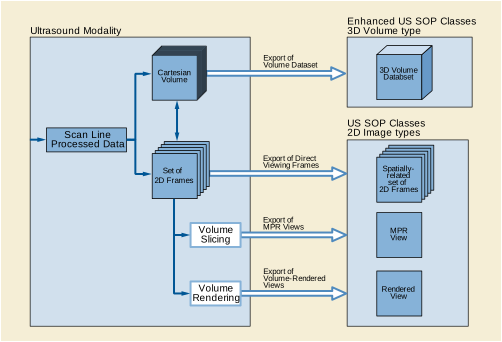
The 3D volume data set (the diagonally shaded box in Figure A.59-1) contains a Cartesian volume or two or more temporally related Cartesian volumes. 3D volume data sets are exchanged using the Enhanced US Volume SOP Class, and are suitable for subsequent Multi-Planar Reconstruction and rendering operations. Within each Enhanced US Volume instance, each Cartesian volume consists of a set of parallel planes, and each plane consists of one or more frames each of a single data type. All Cartesian volumes have the same spacing between adjacent planes.
Most acquisition devices construct the Cartesian volume by resampling data from a different acquisition geometry. The method of generation of the Cartesian volume, its relationship to spatially-related 2D frames (whether the volume was created from spatially-related frames, or spatially-related frames extracted from the Cartesian volume), and the algorithms used for Multi-Planar Reconstruction and rendering operations are outside the scope of this standard.
The 2D image types represent collections of frames that are derived from the volume data set, namely 3D rendered views (projections), separate Multi-Planar Reconstructed (MPR) views, or sets of spatially-related source frames, either parallel or oblique (the cross-hatched boxes in Figure A.59-1). The Ultrasound Image and Ultrasound Multi-frame Image IODs are used to represent these derived images. See Section A.6 for the Ultrasound Image IOD description or Section A.7 for the Ultrasound Multi-frame Image IOD description.
Note
See Chapter PP “3D Ultrasound Volumes (Informative)” in PS3.17 for an informative discussion on the use of these objects for the exchange of 3D ultrasound volume data.
The E-R Model in Section A.1.2 depicts those components of the DICOM Information Model that comprise the Enhanced US Volume IOD.
Table A.59-1. Enhanced US Volume IOD Modules
|
IE |
Module |
Reference |
Usage |
|---|---|---|---|
|
Patient |
Patient |
M |
|
|
Clinical Trial Subject |
U |
||
|
Study |
General Study |
M |
|
|
Patient Study |
U |
||
|
Clinical Trial Study |
U |
||
|
Series |
General Series |
M |
|
|
Enhanced US Series |
M |
||
|
Clinical Trial Series |
U |
||
|
Frame of Reference |
Frame of Reference |
M |
|
|
Ultrasound Frame of Reference |
M |
||
|
Synchronization |
M |
||
|
Equipment |
General Equipment |
M |
|
|
Enhanced General Equipment |
M |
||
|
Image |
General Image |
M |
|
|
Image Pixel |
M |
||
|
Enhanced Contrast/Bolus |
C - Required if contrast media was applied. See Section A.59.3.1.2 for baseline context group ID. |
||
|
Multi-frame Functional Groups |
M |
||
|
Multi-frame Dimension |
M |
||
|
Cardiac Synchronization |
C - Required if cardiac synchronization was applied. |
||
|
Respiratory Synchronization |
C - Required if respiratory synchronization was applied. |
||
|
Device |
U |
||
|
Acquisition Context |
M |
||
|
Specimen |
U |
||
|
Enhanced Palette Color Lookup Table |
U |
||
|
Enhanced US Image |
M |
||
|
IVUS Image |
C - Required if Modality = IVUS |
||
|
Excluded Intervals |
U |
||
|
ICC Profile |
U |
||
|
SOP Common |
M |
||
|
Common Instance Reference |
U |
||
|
Frame Extraction |
C - Required if the SOP Instance was created in response to a Frame-Level retrieve request |
The Acquisition Time Synchronized attribute (0018,1800) shall have a value of 'Y' if associated physiological waveforms are linked to the Enhanced US Volume. As described in the Synchronization Module, the same value of Synchronization Frame of Reference UID (0020,0200) is shared between the Waveform and Enhanced US instances to indicate a common temporal frame of reference for Acquisition DateTime (0008,002A) values in the waveform and Enhanced US instances. Further, Frame Reference DateTime (0018,9151) may be used in optimizing alignment between the displayed image and displayed physiological waveforms.
In the case of gated acquisition in which information from multiple events (such as ECG beats) are used to create sub-volumes that are "spliced" or "interleaved" together to form the volume data set, the Excluded Intervals Module describes the timing of each of the constituent sub-volumes for correlation with the physio waveform.
Note
It is recommended that the Waveform Annotation Module in the General ECG Waveform IOD be used to indicate the times of the R-wave events within the acquisition duration. This allows the viewing application to be able to mark those R-R intervals that contributed to the acquisition of the Enhanced US Volume.
Baseline CID for the Contrast/Bolus Agent Sequence (0018,0012) in the Enhanced Contrast/Bolus Module is CID 12030 “Ultrasound Contrast/Bolus Agents”.
Table A.59-2 specifies the use of the Functional Group Macros used in the Multi-frame Functional Groups Module for the Enhanced US Volume IOD.
Table A.59-2. Enhanced US Volume Functional Group Macros
|
Functional Group Macro |
Section |
Usage |
|---|---|---|
|
Frame Content |
M - May not be used as a Shared Functional Group. |
|
|
Plane Position (Patient) |
U |
|
|
Plane Orientation (Patient) |
U |
|
|
Referenced Image |
U |
|
|
Derivation Image |
C - Required if the image or frame has been derived from another SOP Instance. |
|
|
Cardiac Synchronization |
C - Required if Cardiac Synchronization is used |
|
|
Frame VOI LUT |
M |
|
|
Real World Value Mapping |
U |
|
|
Contrast/Bolus Usage |
C - Required if the Enhanced Contrast/Bolus Module is present |
|
|
Patient Orientation in Frame |
U |
|
|
Frame Display Shutter |
U |
|
|
Respiratory Synchronization |
C - Required if Respiratory Synchronization is used |
|
|
Plane Position (Volume) |
M - May not be used as a Shared Functional Group. See Section A.59.4.1.2. |
|
|
Plane Orientation (Volume) |
M - May not be used as a Per-Frame Functional Group. See Section A.59.4.1.2. |
|
|
Temporal Position |
C - Required if frames are temporally related and not temporally referenced to a Cardiac or Respiratory event |
|
|
Image Data Type |
M |
|
|
US Image Description |
M - May not be used as a Per-Frame Functional Group |
The value of Volumetric Properties (0008,9206) shall be VOLUME. The value of Volume Based Calculation Technique (0008,9207) shall be NONE.
Image Position (Volume) (0020,9301) first value (X) shall be zero and second value (Y) shall be zero. Image Orientation (Volume) (0020,9302) values shall be 1\0\0\0\1\0. This ensures that the origins of each frame lies on the Volume Frame of Reference ZV axis, the rows of each frame are parallel to the Volume Frame of Reference XV axis, and the columns of each frame are parallel to the Volume Frame of Reference YV axis.
Adjacent planes in the volume shall be equally spaced in the Z direction.
Note
More than one frame may be encoded for the same plane, for example, with a different temporal or cardiac cycle position.
Frames with the same value of Image Position (Volume) (0020,9301) will also have the same second value of Dimension Index Value (the spatial position Dimension); See Section C.8.24.3.3.
The following IODs specify module use for storage of the measurements from ophthalmic refractive instruments. These instruments address the power of a lens or of a patient's eye to bend light. There are many ophthalmic refractive instruments used to create this type of information. Some examples include Lensometers, Keratometers, Autorefractors, etc. An Ophthalmic Measurements SOP Instance is related to a single Series within a single Study.
The Lensometry Measurements IOD is used to capture the refractive measurements by a lensometer of spectacles.
The E-R Model in Section A.1.2 applies to the Lensometry Measurements IOD.
Table A.60.1-1 specifies the Modules of the Lensometry Measurements IOD.
Table A.60.1-1. Lensometry Measurements IOD Modules
|
IE |
Module |
Reference |
Usage |
|---|---|---|---|
|
Patient |
Patient |
M |
|
|
Clinical Trial Subject |
U |
||
|
Study |
General Study |
M |
|
|
Patient Study |
U |
||
|
Clinical Trial Study |
U |
||
|
Series |
General Series |
M |
|
|
Lensometry Measurements Series |
M |
||
|
Clinical Trial Series |
U |
||
|
Equipment |
General Equipment |
M |
|
|
Enhanced General Equipment |
M |
||
|
Measurements |
General Ophthalmic Refractive Measurements |
M |
|
|
Lensometry Measurements |
M |
||
|
SOP Common |
M |
The Autorefraction Measurements IOD is used to encode the results of a modality (autorefractor) that automatically determines, without patient input, what a patient's refractive correction should be.
The E-R Model in Section A.1.2 applies to the Autorefraction Measurements IOD.
Table A.60.2-1 specifies the Modules of the Autorefraction Measurements IOD.
Table A.60.2-1. Autorefraction Measurements IOD Modules
|
IE |
Module |
Reference |
Usage |
|---|---|---|---|
|
Patient |
Patient |
M |
|
|
Clinical Trial Subject |
U |
||
|
Study |
General Study |
M |
|
|
Patient Study |
U |
||
|
Clinical Trial Study |
U |
||
|
Series |
General Series |
M |
|
|
Autorefraction Measurements Series |
M |
||
|
Clinical Trial Series |
U |
||
|
Equipment |
General Equipment |
M |
|
|
Enhanced General Equipment |
M |
||
|
Measurements |
General Ophthalmic Refractive Measurements |
M |
|
|
Autorefraction Measurements |
M |
||
|
SOP Common |
M |
The Keratometry Measurements IOD is used to encode the measurements of a modality (keratometer) that measures the curvature, and thus the refractive power, of a patient's cornea.
The E-R Model in Section A.1.2 applies to the Keratometry Measurements IOD.
Table A.60.3-1 specifies the Modules of the Keratometry Measurements IOD.
Table A.60.3-1. Keratometry Measurements IOD Modules
|
IE |
Module |
Reference |
Usage |
|---|---|---|---|
|
Patient |
Patient |
M |
|
|
Clinical Trial Subject |
U |
||
|
Study |
General Study |
M |
|
|
Patient Study |
U |
||
|
Clinical Trial Study |
U |
||
|
Series |
General Series |
M |
|
|
Keratometry Measurements Series |
M |
||
|
Clinical Trial Series |
U |
||
|
Equipment |
General Equipment |
M |
|
|
Enhanced General Equipment |
M |
||
|
Measurements |
General Ophthalmic Refractive Measurements |
M |
|
|
Keratometry Measurements |
M |
||
|
SOP Common |
M |
The Subjective Refraction Measurements IOD is used for encoding the measurements that subjectively determine the refractive correction of the eye that results in best corrected visual acuity.
The E-R Model in Section A.1.2 applies to the Subjective Refraction Measurements IOD.
Table A.60.4-1 specifies the Modules of the Subjective Refraction Measurements IOD.
Table A.60.4-1. Subjective Refraction Measurements IOD Modules
|
IE |
Module |
Reference |
Usage |
|---|---|---|---|
|
Patient |
Patient |
M |
|
|
Clinical Trial Subject |
U |
||
|
Study |
General Study |
M |
|
|
Patient Study |
U |
||
|
Clinical Trial Study |
U |
||
|
Series |
General Series |
M |
|
|
Subjective Refraction Measurements Series |
M |
||
|
Clinical Trial Series |
U |
||
|
Equipment |
General Equipment |
M |
|
|
Enhanced General Equipment |
M |
||
|
Measurements |
General Ophthalmic Refractive Measurements |
M |
|
|
Subjective Refraction Measurements |
M |
||
|
SOP Common |
M |
The Visual Acuity Measurements IOD is used to capture a patient's visual acuity relative to that of a reference standard patient under given viewing conditions (distance, lighting, etc.).
The E-R Model in Section A.1.2 applies to the Visual Acuity Measurements IOD.
Table A.60.5-1 specifies the Modules of the Visual Acuity Measurements IOD.
Table A.60.5-1. Visual Acuity Measurements IOD Modules
|
IE |
Module |
Reference |
Usage |
|---|---|---|---|
|
Patient |
Patient |
M |
|
|
Clinical Trial Subject |
U |
||
|
Study |
General Study |
M |
|
|
Patient Study |
U |
||
|
Clinical Trial Study |
U |
||
|
Series |
General Series |
M |
|
|
Visual Acuity Measurements Series |
M |
||
|
Clinical Trial Series |
U |
||
|
Equipment |
General Equipment |
M |
|
|
Enhanced General Equipment |
M |
||
|
Measurements |
General Ophthalmic Refractive Measurements |
M |
|
|
Visual Acuity Measurements |
M |
||
|
SOP Common |
M |
The Ophthalmic Axial Measurements IOD is used to encode axial measurements of the eye made by an axial measurements device.
The E-R Model in Section A.1.2 applies to the Ophthalmic Axial Measurements IOD.
Table A.60.6-1 specifies the Modules of the Ophthalmic Axial Measurements IOD.
Table A.60.6-1. Ophthalmic Axial Measurements IOD Modules
|
IE |
Module |
Reference |
Usage |
|---|---|---|---|
|
Patient |
Patient |
M |
|
|
Clinical Trial Subject |
U |
||
|
Study |
General Study |
M |
|
|
Patient Study |
U |
||
|
Clinical Trial Study |
U |
||
|
Series |
General Series |
M |
|
|
Ophthalmic Axial Measurements Series |
M |
||
|
Clinical Trial Series |
U |
||
|
Equipment |
General Equipment |
M |
|
|
Enhanced General Equipment |
M |
||
|
Measurements |
Ophthalmic Axial Measurements |
M |
|
|
General Ophthalmic Refractive Measurements |
M |
||
|
SOP Common |
M |
The Intraocular Lens Calculations IOD is used to encode calculations performed by ophthalmic axial measurements devices or by standalone software. Data input to these calculations comes both from the devices and from other sources.
The E-R Model in Section A.1.2 applies to the Intraocular Lens Calculations IOD.
Table A.60.7-1 specifies the Modules of the Intraocular Lens Calculations IOD.
Table A.60.7-1. Intraocular Lens Calculations IOD Modules
|
IE |
Module |
Reference |
Usage |
|---|---|---|---|
|
Patient |
Patient |
M |
|
|
Clinical Trial Subject |
U |
||
|
Study |
General Study |
M |
|
|
Patient Study |
U |
||
|
Clinical Trial Study |
U |
||
|
Series |
General Series |
M |
|
|
Intraocular Lens Calculations Series |
M |
||
|
Clinical Trial Series |
U |
||
|
Equipment |
General Equipment |
M |
|
|
Enhanced General Equipment |
M |
||
|
Measurements |
Intraocular Lens Calculations |
M |
|
|
General Ophthalmic Refractive Measurements |
M |
||
|
SOP Common |
M |
The Generic Implant Template Information Object Definition (IOD) specifies the description of a 2D- and/or 3D-template representing a rigid and passive implant. The specific properties of flexible implants, such as silicone implants, and active implants such as cardiac pacemakers are not reflected. The IOD contains mechanisms for implant assembly, i.e., the rigid connection of two or more implants and implant registration, i.e., the placement of an implant in relation to anatomical landmarks.
The Generic Implant Template is a kind of Implant Template (see Section 7.10).
The E-R Model in Figure A.61-1 depicts those entities of the DICOM Information Model that are used in the following IODs.

Note
Implant templates are not referenced to a patient, a study or a series.
Implant Templates can contain 2D drawings as well as 3D models describing one implant. At least one of the two must be present in one Instance; both may be present in the same Instance.
Table A.61-1. Generic Implant Template IOD Modules
|
IE |
Module |
Reference |
Usage |
|---|---|---|---|
|
Implant Template |
Generic Implant Template Description |
M |
|
|
Generic Implant Template 2D Drawings |
U |
||
|
Generic Implant Template 3D Models |
U |
||
|
Generic Implant Template Mating Features |
U |
||
|
Generic Implant Template Planning Landmarks |
U |
||
|
SOP Common |
M |
||
|
Surface Mesh |
Surface Mesh |
C - Required if Generic Implant Template 3D Models Module is present. |
Implant Assembly Templates describe how to combine several implants to fulfill a certain purpose. The Implant Assembly Templates describe the aspects of component assembly that are relevant to planning only. Implants that are made out of several parts but are treated as a single piece may be described as single Implant Template.
The E-R Model in Figure A.62-1 depicts those entities of the DICOM Information Model that are used in the following IODs.

The Implant Template Group IOD facilitates the aggregation of a set of Implant Template Instances in an ordered set.
The E-R Model in Figure A.63-1 depicts those entities of the DICOM Information Model that are used in the following IODs.
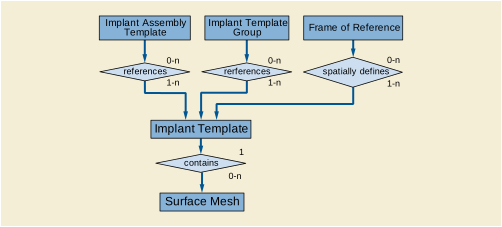
The RT Beams Delivery Instruction IOD contains all the parameters needed to deliver a radiation therapy treatment fraction that are not already described in the referenced RT Plan IOD.
The E-R Model in Figure A.64-1 depicts those components of the DICOM Information Model that directly reference the RT Beams Delivery Instruction IOD. The Frame of Reference IE, and the IEs at the level of the Image IE in Section A.1.2 other than the Instruction IE are not components of the RT Beams Delivery Instruction IOD.
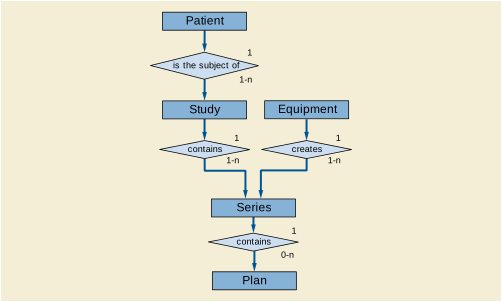
Table A.64.3-1. RT Beams Delivery Instruction IOD Modules
|
IE |
Module |
Reference |
Usage |
|---|---|---|---|
|
Patient |
Patient |
M |
|
|
Clinical Trial Subject |
U |
||
|
Study |
General Study |
M |
|
|
Patient Study |
U |
||
|
Clinical Trial Study |
U |
||
|
Series |
General Series |
M |
|
|
Clinical Trial Series |
U |
||
|
Equipment |
General Equipment |
M |
|
|
Plan |
RT Beams Delivery Instruction |
M |
|
|
Common Instance Reference |
C - Required if not conveyed by a Unified Procedure Step. May be present otherwise. |
||
|
SOP Common |
M |
The Ophthalmic Visual Field Static Perimetry Measurements IOD is used to encode results of static perimetry with visual field devices.
The E-R Model in Section A.1.2 depicts those components of the DICOM Information Model that are referenced by the Ophthalmic Visual Field Static Perimetry Measurements IOD. Below the Series IE, only the Measurements IE is used.
Table A.65.3-1 specifies the Modules of the Ophthalmic Visual Field Static Perimetry Measurements IOD.
Table A.65.3-1. Ophthalmic Visual Field Static Perimetry Measurements IOD Modules
|
IE |
Module |
Reference |
Usage |
|---|---|---|---|
|
Patient |
Patient |
M |
|
|
Clinical Trial Subject |
U |
||
|
Study |
General Study |
M |
|
|
Patient Study |
U |
||
|
Clinical Trial Study |
U |
||
|
Series |
General Series |
M |
|
|
Clinical Trial Series |
U |
||
|
Visual Field Static Perimetry Measurements Series |
M |
||
|
Equipment |
General Equipment |
M |
|
|
Enhanced General Equipment |
M |
||
|
Measurements |
Visual Field Static Perimetry Test Parameters |
M |
|
|
Visual Field Static Perimetry Test Reliability |
M |
||
|
Visual Field Static Perimetry Test Measurements |
M |
||
|
Visual Field Static Perimetry Test Results |
M |
||
|
Ophthalmic Patient Clinical Information and Test Lens Parameters |
U |
||
|
SOP Common |
M |
This Section defines an Information Object to be used with Intravascular Optical Coherence Tomography imaging devices.
The Intravascular Optical Coherence Tomography Image IOD specifies a multi-frame image acquired on an Intravascular Optical Coherence Tomography modality.
The Intravascular OCT Image IOD is used in two SOP Classes as defined in PS3.4 Storage Service Class, a SOP Class for storage of images intended for presentation, and a SOP Class for storage of images intended for further processing before presentation. These are distinguished by their SOP Class UID and by the Enumerated Value of the mandatory Attribute in the Intravascular OCT Series Module, Presentation Intent Type (0008,0068).
IVOCT stores frames of polar data arranged in a rectangular format when "FOR PROCESSING" is specified. The A-lines in a frame are arranged in row order, with the catheter optics toward the left of the image. A-lines are always stored from top to bottom, in order of acquisition. The A-lines are evenly spaced (in angles) to form a complete 360 degrees of acquisition.
Application entities creating IVOCT FOR PRESENTATION SOP instances shall apply all needed processing (e.g., Z offset and refractive index correction) to the IVOCT image for correct presentation.
The E-R Model in Section A.1.2 depicts those components of the DICOM Information Model that are referenced by the Intravascular Optical Coherence Tomography Image IOD. Table A.66.3-1 specifies the Modules of the Intravascular Optical Coherence Tomography Image IOD.
Table A.66.3-1. Intravascular OCT Image IOD Modules
|
IE |
Module |
Reference |
Usage |
|---|---|---|---|
|
Patient |
Patient |
M |
|
|
Clinical Trial Subject |
U |
||
|
Study |
General Study |
M |
|
|
Patient Study |
U |
||
|
Clinical Trial Study |
U |
||
|
Series |
General Series |
M |
|
|
Clinical Trial Series |
U |
||
|
Intravascular OCT Series |
M |
||
|
Frame of Reference |
Frame of Reference |
M |
|
|
Synchronization |
M |
||
|
Equipment |
General Equipment |
M |
|
|
Enhanced General Equipment |
M |
||
|
Image |
Image Pixel |
M |
|
|
Supplemental Palette Color Lookup Table |
C - Required if Pixel Presentation (0008,9205) in the IVOCT Image Module equals COLOR. |
||
|
Enhanced Contrast/Bolus |
M |
||
|
Multi-frame Functional Groups |
M |
||
|
Multi-frame Dimension |
M |
||
|
Device |
U |
||
|
Acquisition Context |
M |
||
|
Cardiac Synchronization |
C - Required if cardiac synchronization was used |
||
|
Intravascular OCT Image |
M |
||
|
Intravascular OCT Acquisition Parameters |
M |
||
|
Intravascular OCT Processing Parameters |
C - Required if Presentation Intent Type (0008,0068) is FOR PROCESSING. |
||
|
Intravascular Image Acquisition Parameters |
M |
||
|
SOP Common |
M |
||
|
Common Instance Reference |
M |
||
|
Frame Extraction |
C - Required if the SOP Instance was created in response to a Frame-Level retrieve request |
The following constraints on Image attributes take precedence over the descriptions given in the Module Attribute Tables.
For Contrast/Bolus Agent Sequence (0018,0012), the Defined Context Group is 3850.
The Overlay Plane Module and VOI LUT Module shall not be used in a Standard Extended SOP Class of the Intravascular Optical Coherence Tomography Image.
Note
In order to annotate images, whether during acquisition or subsequently, SOP Instances of the Grayscale Softcopy Presentation State Storage or the Structured Report Storage SOP Classes that reference the image SOP Instance may be used.
Pseudo-color presentation information may be applied through the use of separate Pseudo-color Softcopy Presentation State SOP instances.
No standard mechanism is provided for inclusion of annotations within the image SOP Instance itself and implementers are discouraged from using private extensions to circumvent this restriction.
Table A.66.4.3-1 specifies the use of the Functional Group Macros used in the Multi-frame Functional Group Module for the Intravascular Optical Coherence Tomography Image IOD.
Table A.66.4.3-1. Intravascular OCT Functional Group Macros
|
Functional Group Macro |
Section |
Usage |
|---|---|---|
|
Pixel Measures |
C - Required if Presentation Intent Type (0008,0068) is FOR PRESENTATION. |
|
|
Frame Content |
M - May not be used as a Shared Functional Group. |
|
|
Derivation Image |
C - Required if the image or frame has been derived from another SOP Instance. |
|
|
Frame Anatomy |
M |
|
|
Cardiac Synchronization |
C - Required if Cardiac Synchronization Technique (0018,9037) equals other than NONE May be present otherwise. |
|
|
Frame VOI LUT |
U |
|
|
Pixel Intensity Relationship LUT |
C - Required if Pixel Intensity Relationship (0028,1040) equals LOG. May be present otherwise. |
|
|
Intravascular OCT Frame Type |
M |
|
|
Intravascular Frame Content |
C - Required if Intravascular Acquisition (0018,3100) equals MEASURED or Presentation Intent Type (0008,0068) equals FORPRESENTATION. |
|
|
Intravascular OCT Frame Content |
C - Required if Presentation Intent Type (0008,0068) equals FOR PROCESSING. |
The Defined CID for the Anatomic Region Sequence (0008,2218) shall be CID 3604 “Arterial Lesion Locations”. The Defined CID for the Anatomic Region Modifier Sequence (0008,2220) shall be CID 3019 “Cardiovascular Anatomic Location Modifiers”.
The Ophthalmic Thickness Map IOD is generated by ophthalmic thickness mapping devices, such as retinal nerve fiber layer analyzers and optic nerve head analyzers, to generate measurements that are presented topographically using a monochromatic image and a pseudo-color map.
The E-R Model in Section A.1.2 depicts those components of the DICOM Information Model that are referenced by the Ophthalmic Thickness Map IOD. Below the Series IE, only the Image IE is used.
Table A.67.3-1 specifies the Modules of the Ophthalmic Thickness Map IOD.
Table A.67.3-1. Ophthalmic Thickness Map IOD Modules
|
IE |
Module |
Reference |
Usage |
|---|---|---|---|
|
Patient |
Patient |
M |
|
|
Clinical Trial Subject |
U |
||
|
Study |
General Study |
M |
|
|
Patient Study |
U |
||
|
Clinical Trial Study |
U |
||
|
Series |
General Series |
M |
|
|
Clinical Trial Series |
U |
||
|
Ophthalmic Thickness Map Series |
M |
||
|
Equipment |
General Equipment |
M |
|
|
Enhanced General Equipment |
M |
||
|
Image |
General Image |
M |
|
|
Image Pixel |
M |
||
|
Supplemental Palette Color Lookup Table |
C - Required if Pixel Presentation (0008,9205) equals COLOR |
||
|
Bitmap Display Shutter |
C - Required if a Shutter is to be applied to the image |
||
|
Ophthalmic Thickness Map |
M |
||
|
Ophthalmic Thickness Map Quality Rating |
C - Required if a quality rating value exists for the ophthalmic map |
||
|
Ophthalmic Photography Acquisition Parameters |
M |
||
|
Acquisition Context |
M |
||
|
SOP Common |
M |
||
|
Common Instance Reference |
U |
The following constraints on Image attributes take precedence over the descriptions given in the Module Attribute Tables.
The Surface Scan Mesh IOD specifies a triangulated surface generated by an optical surface scanner or a 3D post-processing application. The Surface Scan Mesh IOD stores a surface including UV mapping and change history combined with device specific parameters.
The E-R Model in Section A.1.2 depicts those components of the DICOM Information Model that are referenced by the Surface Scan Mesh IOD. Below the Series IE, only the Surface IE is used.
Table A.68-1. Surface Scan Mesh IOD Modules
|
IE |
Module |
Reference |
Usage |
|---|---|---|---|
|
Patient |
Patient |
M |
|
|
Clinical Trial Subject |
U |
||
|
Study |
General Study |
M |
|
|
Patient Study |
U |
||
|
Clinical Trial Study |
U |
||
|
Series |
General Series |
M |
|
|
Clinical Trial Series |
U |
||
|
Optical Surface Scanner Series |
M |
||
|
Equipment |
General Equipment |
M |
|
|
Enhanced General Equipment |
M |
||
|
Surface |
Surface Mesh |
M |
|
|
UV Mapping |
U |
||
|
Scan Procedure |
M |
||
|
Specimen |
U |
||
|
SOP Common |
M |
The Surface Scan Point Cloud IOD specifies a point cloud generated by an optical surface scanner. Multiple Point Clouds within the same series shall be from the same anatomical region, but they do not need to be in the same coordinate system.
The E-R Model in Section A.1.2 depicts those components of the DICOM Information Model that are referenced by the Surface Scan Point Cloud IOD. Below the Series IE, only the Surface IE is used.
Table A.69-1. Surface Scan Point Cloud IOD Modules
|
IE |
Module |
Reference |
Usage |
|---|---|---|---|
|
Patient |
Patient |
M |
|
|
Clinical Trial Subject |
U |
||
|
Study |
General Study |
M |
|
|
Patient Study |
U |
||
|
Clinical Trial Study |
U |
||
|
Series |
General Series |
M |
|
|
Clinical Trial Series |
U |
||
|
Optical Surface Scanner Series |
M |
||
|
Equipment |
General Equipment |
M |
|
|
Enhanced General Equipment |
M |
||
|
Surface |
Point Cloud |
M |
|
|
UV Mapping |
U |
||
|
Scan Procedure |
M |
||
|
Specimen |
U |
||
|
SOP Common |
M |
The Legacy Converted Enhanced Computed Tomography (CT) Image Information Object Definition (IOD) specifies an image that has been converted from images originally created by a computed tomography imaging device.
The E-R Model in Section A.1.2 depicts those components of the DICOM Information Model that directly reference the Legacy Converted Enhanced CT Image IOD.
Table A.70-1. Legacy Converted Enhanced CT Image IOD Modules
|
IE |
Module |
Reference |
Usage |
|---|---|---|---|
|
Patient |
Patient |
M |
|
|
Clinical Trial Subject |
U |
||
|
Study |
General Study |
M |
|
|
Patient Study |
U |
||
|
Clinical Trial Study |
U |
||
|
Series |
General Series |
M |
|
|
CT Series |
M |
||
|
Clinical Trial Series |
U |
||
|
Frame of Reference |
Frame of Reference |
M |
|
|
Synchronization |
U |
||
|
Equipment |
General Equipment |
M |
|
|
Enhanced General Equipment |
U |
||
|
Image |
Image Pixel |
M |
|
|
Contrast/Bolus |
U |
||
|
Enhanced Contrast/Bolus |
U |
||
|
Multi-frame Functional Groups |
M |
||
|
Multi-frame Dimension |
U |
||
|
Cardiac Synchronization |
U |
||
|
Respiratory Synchronization |
U |
||
|
Acquisition Context |
M |
||
|
Device |
U |
||
|
Specimen |
U |
||
|
Enhanced CT Image |
M |
||
|
SOP Common |
M |
||
|
Common Instance Reference |
U |
||
|
Frame Extraction |
C - Required if the SOP Instance was created in response to a Frame-Level retrieve request |
The General Image Module, Overlay Plane Module, VOI LUT Module, Supplemental Palette Color Lookup Table Module and Graphic Annotation Module shall not be used in a Standard Extended SOP Class of the Legacy Converted Enhanced CT Image.
Note
In order to annotate images, whether during acquisition or subsequently, SOP Instances of the Grayscale Softcopy Presentation State Storage or the Structured Report Storage SOP Classes that reference the image SOP Instance, may be used.
No standard mechanism is provided for inclusion of annotations within the image SOP Instance itself, and implementers are discouraged from using private extensions to circumvent this restriction.
Grayscale Softcopy Presentation State Storage Instances that are generated during conversion shall be referenced from the Image SOP Instance by using the Referenced Grayscale Presentation State Sequence in the Enhanced CT Image Module. See Section C.8.15.2.
Note
The Curve Module has been retired from DICOM. It is still not permitted to be present. See PS3.3-2004.
Table A.70-2 specifies the use of the Functional Group Macros used in the Multi-frame Functional Group Module for the Legacy Converted Enhanced CT Image IOD.
Table A.70-2. Legacy Converted Enhanced CT Image Functional Group Macros
|
Functional Group Macro |
Section |
Usage |
|---|---|---|
|
Pixel Measures |
M |
|
|
Frame Content |
M - May not be used as a Shared Functional Group. |
|
|
Plane Position (Patient) |
M |
|
|
Plane Orientation (Patient) |
M |
|
|
Referenced Image |
C - Required if Referenced Image Sequence (0008,1140) was present in any of the Classic Images that were converted. |
|
|
Derivation Image |
C - Required if Source Image Sequence (0008,2112) was present in any of the Classic Images that were converted. |
|
|
Cardiac Synchronization |
U |
|
|
Frame Anatomy |
C - Required if Body Part Examined (0018,0015) is present and contains a value defined in Annex L “Correspondence of Anatomic Region Codes and Body Part Examined Defined Terms” in PS3.16, or Anatomic Region Sequence (0008,2218) was present in any of the Classic Images that were converted. |
|
|
Frame VOI LUT |
M |
|
|
Contrast/Bolus Usage |
U |
|
|
Respiratory Synchronization |
U |
|
|
Irradiation Event Identification |
C - Required if Irradiation Event UID (0008,3010) was present in any of the Classic Images that were converted. |
|
|
CT Image Frame Type |
M |
|
|
CT Pixel Value Transformation |
M |
|
|
Unassigned Shared Converted Attributes |
M - May not be used as a Per-Frame Functional Group |
|
|
Unassigned Per-Frame Converted Attributes |
M - May not be used as a Shared Functional Group |
|
|
Image Frame Conversion Source |
M - May not be used as a Shared Functional Group |
The Legacy Converted Enhanced Magnetic Resonance (MR) Image Information Object Definition (IOD) specifies an image that has been converted from images originally created by a magnetic resonance imaging device.
The E-R Model in Section A.1.2 depicts those components of the DICOM Information Model that directly reference the Legacy Converted Enhanced MR Image IOD.
Table A.71-1. Legacy Converted Enhanced MR Image IOD Modules
|
IE |
Module |
Reference |
Usage |
|---|---|---|---|
|
Patient |
Patient |
M |
|
|
Clinical Trial Subject |
U |
||
|
Study |
General Study |
M |
|
|
Patient Study |
U |
||
|
Clinical Trial Study |
U |
||
|
Series |
General Series |
M |
|
|
MR Series |
M |
||
|
Clinical Trial Series |
U |
||
|
Frame of Reference |
Frame of Reference |
M |
|
|
Synchronization |
U |
||
|
Equipment |
General Equipment |
M |
|
|
Enhanced General Equipment |
U |
||
|
Image |
Image Pixel |
M |
|
|
Contrast/Bolus |
U |
||
|
Enhanced Contrast/Bolus |
U |
||
|
Multi-frame Functional Groups |
M |
||
|
Multi-frame Dimension |
U |
||
|
Cardiac Synchronization |
U |
||
|
Respiratory Synchronization |
U |
||
|
Bulk Motion Synchronization |
U |
||
|
Acquisition Context |
M |
||
|
Device |
U |
||
|
Specimen |
U |
||
|
Enhanced MR Image |
M |
||
|
SOP Common |
M |
||
|
Common Instance Reference |
U |
||
|
Frame Extraction |
C - Required if the SOP Instance was created in response to a Frame-Level retrieve request |
The General Image Module, Overlay Plane Module, VOI LUT Module, Supplemental Palette Color Lookup Table Module and Graphic Annotation Module shall not be used in a Standard Extended SOP Class of the Legacy Converted Enhanced MR Image.
Note
In order to annotate images, whether during acquisition or subsequently, SOP Instances of the Grayscale Softcopy Presentation State Storage or the Structured Report Storage SOP Classes that reference the image SOP Instance, may be used.
No standard mechanism is provided for inclusion of annotations within the image SOP Instance itself, and implementers are discouraged from using private extensions to circumvent this restriction.
Grayscale Softcopy Presentation State Storage Instances that are generated during conversion shall be referenced from the Image SOP Instance by using the Referenced Grayscale Presentation State Sequence in the Enhanced MR Image Module. See Section C.8.15.2.
Note
The Curve Module has been retired from DICOM. It is still not permitted to be present. See PS3.3-2004.
Table A.71-2 specifies the use of the Functional Group Macros used in the Multi-frame Functional Group Module for the Legacy Converted Enhanced MR Image IOD.
Table A.71-2. Legacy Converted Enhanced MR Image Functional Group Macros
|
Functional Group Macro |
Section |
Usage |
|---|---|---|
|
Pixel Measures |
M |
|
|
Frame Content |
M - May not be used as a Shared Functional Group. |
|
|
Plane Position (Patient) |
M |
|
|
Plane Orientation (Patient) |
M |
|
|
Referenced Image |
C - Required if Referenced Image Sequence (0008,1140) was present in any of the Classic Images that were converted. |
|
|
Derivation Image |
C - Required if Source Image Sequence (0008,2112) was present in any of the Classic Images that were converted. |
|
|
Cardiac Synchronization |
U |
|
|
Frame Anatomy |
C - Required if Body Part Examined (0018,0015) is present and contains a value defined in Annex L “Correspondence of Anatomic Region Codes and Body Part Examined Defined Terms” in PS3.16, or Anatomic Region Sequence (0008,2218) was present in any of the Classic Images that were converted. |
|
|
Pixel Value Transformation |
U |
|
|
Frame VOI LUT |
U |
|
|
Real World Value Mapping |
U |
|
|
Contrast/Bolus Usage |
U |
|
|
Respiratory Synchronization |
U |
|
|
MR Image Frame Type |
M |
|
|
Unassigned Shared Converted Attributes |
M - May not be used as a Per-Frame Functional Group |
|
|
Unassigned Per-Frame Converted Attributes |
M - May not be used as a Shared Functional Group |
|
|
Image Frame Conversion Source |
M - May not be used as a Shared Functional Group |
The Legacy Converted Enhanced Positron Emission Tomography (PET) Image Information Object Definition (IOD) specifies an image that has been converted from images originally created by a positron emission tomography coincidence imaging device.
The E-R Model in Section A.1.2 depicts those components of the DICOM Information Model that directly reference the Legacy Converted Enhanced PET Image IOD.
Table A.72-1. Legacy Converted Enhanced PET Image IOD Modules
|
IE |
Module |
Reference |
Usage |
|---|---|---|---|
|
Patient |
Patient |
M |
|
|
Clinical Trial Subject |
U |
||
|
Study |
General Study |
M |
|
|
Patient Study |
U |
||
|
Clinical Trial Study |
U |
||
|
Series |
General Series |
M |
|
|
Enhanced PET Series |
M |
||
|
Clinical Trial Series |
U |
||
|
Frame of Reference |
Frame of Reference |
M |
|
|
Synchronization |
U |
||
|
Equipment |
General Equipment |
M |
|
|
Enhanced General Equipment |
U |
||
|
Image |
Image Pixel |
M |
|
|
Intervention |
U |
||
|
Acquisition Context |
M |
||
|
Multi-frame Functional Groups |
M |
||
|
Multi-frame Dimension |
U |
||
|
Cardiac Synchronization |
U |
||
|
Respiratory Synchronization |
U |
||
|
Specimen |
U |
||
|
Enhanced PET Image |
M |
||
|
SOP Common |
M |
||
|
Common Instance Reference |
U |
||
|
Frame Extraction |
C - Required if the SOP Instance was created in response to a Frame-Level retrieve request |
The General Image Module, Overlay Plane Module, VOI LUT Module, Supplemental Palette Color Lookup Table Module and Graphic Annotation Module shall not be used in a Standard Extended SOP Class of the Legacy Converted Enhanced PET Image.
Note
In order to annotate images, whether during acquisition or subsequently, SOP Instances of the Grayscale Softcopy Presentation State Storage or the Structured Report Storage SOP Classes that reference the image SOP Instance, may be used.
No standard mechanism is provided for inclusion of annotations within the image SOP Instance itself, and implementers are discouraged from using private extensions to circumvent this restriction.
Grayscale Softcopy Presentation State Storage Instances that are generated during conversion shall be referenced from the Image SOP Instance by using the Referenced Grayscale Presentation State Sequence in the Enhanced PET Image Module. See Section C.8.15.2.
Note
The Curve Module has been retired from DICOM. It is still not permitted to be present. See PS3.3-2004.
Table A.72-2 specifies the use of the Functional Group Macros used in the Multi-frame Functional Group Module for the Legacy Converted Enhanced PET Image IOD.
Table A.72-2. Legacy Converted Enhanced PET Image Functional Group Macros
|
Functional Group Macro |
Section |
Usage |
|---|---|---|
|
Pixel Measures |
M |
|
|
Frame Content |
M - May not be used as a Shared Functional Group. |
|
|
Plane Position (Patient) |
M |
|
|
Plane Orientation (Patient) |
M |
|
|
Referenced Image |
C - Required if Referenced Image Sequence (0008,1140) was present in any of the Classic Images that were converted. |
|
|
Derivation Image |
C - Required if Source Image Sequence (0008,2112) was present in any of the Classic Images that were converted. |
|
|
Cardiac Synchronization |
U |
|
|
Frame Anatomy |
C - Required if Body Part Examined (0018,0015) is present and contains a value defined in Annex L “Correspondence of Anatomic Region Codes and Body Part Examined Defined Terms” in PS3.16, or Anatomic Region Sequence (0008,2218) was present in any of the Classic Images that were converted. |
|
|
Pixel Value Transformation |
M |
|
|
Frame VOI LUT |
M |
|
|
Real World Value Mapping |
U |
|
|
Respiratory Synchronization |
U |
|
|
Irradiation Event Identification |
C - Required if Irradiation Event UID (0008,3010) was present in any of the Classic Images that were converted. |
|
|
PET Frame Type |
M |
|
|
Unassigned Shared Converted Attributes |
M - May not be used as a Per-Frame Functional Group |
|
|
Unassigned Per-Frame Converted Attributes |
M - May not be used as a Shared Functional Group |
|
|
Image Frame Conversion Source |
M - May not be used as a Shared Functional Group |
The Corneal Topography Map IOD is generated by ophthalmic corneal topography mapping devices, such as reflection-based topography and elevation-based tomography instruments to generate curvature and/or elevation measurements of corneal anterior and posterior surfaces that are presented topographically using a monochromatic image and a pseudo-color map.
The E-R Model in Section A.1.2 depicts those components of the DICOM Information Model that are referenced by the Corneal Topography Map IOD. Below the Series IE, only the Image IE is used.
Table A.73.3-1 specifies the Modules of the Corneal Topography Map IOD.
Table A.73.3-1. Corneal Topography Map IOD Modules
|
IE |
Module |
Reference |
Usage |
|---|---|---|---|
|
Patient |
Patient |
M |
|
|
Clinical Trial Subject |
U |
||
|
Study |
General Study |
M |
|
|
Patient Study |
U |
||
|
Clinical Trial Study |
U |
||
|
Series |
General Series |
M |
|
|
Clinical Trial Series |
U |
||
|
Corneal Topography Map Series |
M |
||
|
Equipment |
General Equipment |
M |
|
|
Enhanced General Equipment |
M |
||
|
Frame of Reference |
Frame of Reference |
M |
|
|
Image |
General Image |
M |
|
|
Image Pixel |
M |
||
|
Palette Color Lookup Table |
M |
||
|
Corneal Topography Map Image |
M |
||
|
Corneal Topography Map Analysis |
M |
||
|
Ophthalmic Photography Acquisition Parameters |
M |
||
|
Acquisition Context |
M |
||
|
ICC Profile |
U |
||
|
SOP Common |
M |
The following constraints on Image attributes take precedence over the descriptions given in the Module Attribute Tables.
The Breast Projection X-Ray Image Information Object Definition specifies an image set that has been created by a digital mammography projection radiography imaging device.
Note
The preferred IOD for traditional digital mammography is Digital Mammography X-Ray Image.
The Breast Projection X-Ray Image IOD is used in two SOP Classes as defined in PS3.4 Storage Service Class, a SOP Class for storage of images intended for presentation, and a SOP Class for storage of images intended for further processing before presentation. These are distinguished by their SOP Class UID and by the Enumerated Value of the mandatory attribute in the DX Series Module, Presentation Intent Type (0008,0068).
The E-R Model in Section A.1.2 depicts those components of the DICOM Application Information Model that directly reference the Breast Projection X-Ray Image IOD. Additionally, "Image" in Section A.1.1 may represent a Single Frame or a Multi-Frame image. A frame denotes a two-dimensional organization of pixels recorded as a single exposure.
Table A.74-1. Breast Projection X-Ray Image IOD Modules
|
IE |
Module |
Reference |
Usage |
|---|---|---|---|
|
Patient |
Patient |
M |
|
|
Clinical Trial Subject |
U |
||
|
Study |
General Study |
M |
|
|
Patient Study |
U |
||
|
Clinical Trial Study |
U |
||
|
Series |
General Series |
M |
|
|
Clinical Trial Series |
U |
||
|
DX Series |
M |
||
|
Enhanced Mammography Series |
M |
||
|
Frame of Reference |
Frame of Reference |
M |
|
|
Synchronization |
C - Required if time synchronization was applied. |
||
|
Equipment |
General Equipment |
M |
|
|
Enhanced General Equipment |
M |
||
|
Image |
Enhanced Mammography Image |
M |
|
|
Breast View |
M |
||
|
Image Pixel |
M |
||
|
Enhanced Contrast/Bolus |
C - Required if contrast media was applied. |
||
|
Device |
U |
||
|
Intervention |
U |
||
|
Acquisition Context |
M |
||
|
Multi-frame Functional Groups |
M |
||
|
Multi-frame Dimension |
U |
||
|
Patient Orientation |
M |
||
|
Specimen |
U |
||
|
SOP Common |
M |
||
|
Common Instance Reference |
U |
||
|
Frame Extraction |
C - Required if the SOP Instance was created in response to a Frame-Level retrieve request |
The Overlay Plane Module, Curve Module, VOI LUT Module and Softcopy Presentation LUT Module shall not be used in a Standard Extended SOP Class of the Breast Projection X-Ray Image.
Note
The VOI LUT function is provided by a Frame VOI LUT Functional Group.
Table A.74-2 specifies the use of the Functional Group macros used in the Multi-frame Functional Groups Module for the Breast Projection X-Ray Image IOD.
Table A.74-2. Breast Projection X-Ray Image Functional Group Macros
|
Functional Group Macro |
Section |
Usage |
|---|---|---|
|
Frame Content |
M - May not be used as a Shared Functional Group. |
|
|
Referenced Image |
U |
|
|
Derivation Image |
C - Required if the Image Type (0008,0008) Value 1 equals DERIVED or Value 1 is ORIGINAL and Presentation Intent Type equals FOR PRESENTATION. May be present otherwise. |
|
|
Frame Anatomy |
M |
|
|
Identity Pixel Value Transformation |
M |
|
|
Frame VOI LUT With LUT |
M |
|
|
Contrast/Bolus Usage |
C - Required if the Enhanced Contrast/Bolus Module is present |
|
|
Frame Display Shutter |
U |
|
|
Irradiation Event Identification |
M |
|
|
X-Ray Frame Characteristics |
U |
|
|
X-Ray Field of View |
M |
|
|
X-Ray Frame Pixel Data Properties |
M |
|
|
X-Ray Frame Detector Parameters |
U |
|
|
X-Ray Calibration Device Usage |
U |
|
|
X-Ray Frame Acquisition |
U |
|
|
X-Ray Collimator |
M |
|
|
Breast X-Ray Positioner |
C - Required if X-Ray Source moves relative to the patient. May be present otherwise. |
|
|
Breast X-Ray Detector |
C - Required if X-Ray Detector plane is not normal to the X-Ray beam vector. May be present otherwise. |
|
|
Breast X-Ray Geometry |
M |
|
|
Breast X-Ray Acquisition Dose |
M |
|
|
Breast X-Ray Isocenter Reference System |
M |
|
|
X-Ray Grid |
U |
|
|
X-Ray Filter |
U |
The Defined CID for the Anatomic Region Sequence (0008,2218) shall be CID 4013 “Anatomic Region for Mammography”.
Retired. See PS3.3-2004.
Retired. See PS3.3-2004.
Retired. See PS3.3-2004.
Retired. See PS3.3-2004.
Retired. See PS3.3-2004.
Retired. See PS3.3-2004.
The Basic Film Session Information Object Definition describes the presentation parameters that are common for all the films of a film session (e.g., number of films, film destination).
The Basic Film Box Information Object Definition is an abstraction of the presentation of one film of the film session. The Basic Film Box IOD describes the presentation parameters that are common for all images on a given sheet of film.
The Basic Image Box Information Object Definition is an abstraction of the presentation of an image and image related data in the image area of a film. The Basic Image Box IOD describes the presentation parameters and image pixel data that apply to a single image of a sheet of film.
The Basic Annotation Box Information Object Definition is an abstraction of the presentation of an annotation (e.g., text string) on a film. The Basic Annotation Box IOD describes the most used text related presentation parameters.
The Print Job Information Object Definition is an abstraction of the print job transaction and is the basic information entity to monitor the execution of the print process. A print job contains one film or multiple films, all belonging to the same film session.
The Printer Information Object Definition is an abstraction of the hardcopy printer and is the basic information entity to monitor the status of the printer.
This section was previously defined in DICOM. It is now retired. See PS3.3-1998.
This section was previously defined in DICOM. It is now retired. See PS3.3-1998.
The Storage Commitment IOD describes the Attributes that may be present in a Storage Commitment Request or Response. The SOP Instances referenced by the Storage Commitment IOD are not restricted to images and may include other SOP Instances.
Table B.15-1 identifies and defines the Modules that comprise this IOD. The requirements for whether Attributes in these Modules are mandatory or optional are as specified in PS3.4.
Retired. See PS3.3-2004.
A "Modality Performed Procedure Step Information Object Definition" is an abstraction of the information that describes the activities, conditions and results of an imaging procedure performed on a modality. It contains information about the Modality Performed Procedure Step (MPPS) and its relations to other Information Entities of the DICOM real-world model as introduced in this Part.
A Modality Performed Procedure Step is related to the actual imaging procedure carried out at the modality. Other types of Performed Procedure Steps, e.g., reporting or image processing, are not covered by the Modality Performed Procedure Step IOD. The information gathered includes data about the performance of the procedure itself, radiation dose values to which the patient has been exposed, and data for billing and material management. The Modality Performed Procedure Step IOD includes general PPS modules and image acquisition specific ones, such as Image Acquisition Results, Radiation Dose and Billing and Material Management.
Table B.17.2-1 lists the modules that make up the Modality Performed Procedure Step IOD.
Table B.17.2-1. Modality Performed Procedure Step IOD Modules
|
Module |
Reference |
Module Description |
|---|---|---|
|
SOP Common |
Contains SOP common information |
|
|
Performed Procedure Step Relationship |
References the related SOPs and IEs. |
|
|
Performed Procedure Step Information |
Includes identifying and status information as well as place and time |
|
|
Image Acquisition Results |
Identifies Series and Images related to this PPS and specific image acquisition conditions. |
|
|
Radiation Dose |
Contains radiation dose information related to this Performed Procedure Step. |
|
|
Billing and Material Management Codes |
Contains codes for billing and material management. |
Note
The Radiation Dose Module (C.4.16) does not have meaning if the modality does not generate ionizing radiation or if the generator does not provide the area dose product.
The Presentation LUT Information Object is an abstraction of a Presentation LUT. The objective of the Presentation LUT is to realize image display tailored for specific modalities, applications, and user preferences. It is used to prepare image pixel data for display on devices that conform to the Grayscale Standard Display Function defined in PS3.14.
The output of the Presentation LUT is Presentation Values (P-Values). P-Values are approximately related to human perceptual response. They are intended to facilitate common input for both hardcopy and softcopy display devices. P-Values are intended to be independent of the specific class or characteristics of the display device.
Retired. See PS3.3-2004.
The Printer Configuration IOD describes key imaging characteristics of the printer.
Retired. See PS3.3-2004.
Retired. See PS3.3-2011.
Retired. See PS3.3-2011.
An "Instance Availability Notification Information Object Definition" is a summary of the information that describes the availability of a set of Composite Instances.
Table B.24.2-1 lists the modules that make up the Instance Availability Notification IOD.
A "Media Creation Management Information Object Definition" is an abstraction of the information that describes the attributes and the status of a media creation request.
Table B.25.2-1 lists the modules that make up the Media Creation Management IOD.
A Unified Procedure Step (UPS) describes the details of a procedure step that has been scheduled, the progress details during performance, and the details of the procedure step actually performed in response.
Table B.26.2-1 lists the modules that make up the Unified Procedure Step IOD.
Table B.26.2-1. Unified Procedure Step IOD Modules
|
Module |
Reference |
Module Description |
|---|---|---|
|
SOP Common |
Contains SOP common information |
|
|
Unified Procedure Step Relationship Module |
References the related SOPs and IEs |
|
|
Unified Procedure Step Scheduled Procedure Information |
Describes the UPS task to be performed including information about place, time, priority and input data |
|
|
Unified Procedure Step Progress Information |
Describes the progress of a UPS task |
|
|
Unified Procedure Step Performed Procedure Information |
Describes the work performed including information about status, place, time and result data |
The RT Conventional Machine Verification IOD describes the attributes that are required by an external Machine Parameter Verifier (MPV) when performing verification of a conventional (photon or electron) radiation therapy treatment, prior to delivery.
Table B.27.2-1. RT Conventional Machine Verification IOD Modules
|
Module |
Reference |
Module Description |
|---|---|---|
|
SOP Common |
Contains SOP Common Information |
|
|
RT General Machine Verification |
Contains general delivery verification information |
|
|
RT Conventional Machine Verification |
Contains delivery verification information specific to conventional (photon or electron) machines |
The RT Ion Machine Verification IOD describes the attributes that are required by an external Machine Parameter Verifier (MPV) when performing verification of an ion radiation therapy treatment, prior to delivery.
An instance of the Display System IOD describes all of the Display Subsystems in a given Display System.
Display Subsystems are described in terms of their equipment identification, display performance (luminance, uniformity, etc.) and the corresponding configurations. Although a variety of components (controllers, cables, display devices, etc.) contribute to the performance of the Display Subsystem to which they belong, these details are not exposed in the abstraction of the Display Subsystem. Similarly, each Display Subsystem is addressed independently even though one controller might drive display devices in multiple Display Subsystems or multiple controllers might drive a single display device. Effectively, the Display Subsystem represents the display device and any components involved behind it.
The IOD only describes emissive display systems.
Note
Note: Hanging Protocols manage Screens based on their physical location and arrangement. This IOD does not describe the spatial positioning of Display Devices. There is usually a 1:1 relationship between a Display Subsystem in this IOD and a Hanging Protocol Screen.
Table B.29-1. Display System IOD Modules
|
Module |
Reference |
Module Description |
|---|---|---|
|
SOP Common |
Contains SOP Common information. |
|
|
Display System |
Describes the Display System. The Display System has one or more Display Subsystem. A Display Subsystem corresponds to one Display Device. |
|
|
Target Luminance Characteristics |
Describes the target luminance characteristics of the Display Subsystem(s) |
|
|
QA Results |
Describes the results of QA performed on the Display Subsystem(s). |
A Module Definition is composed of the following Sections
Module Description
Module Definition
Attribute Description (Optional)
Section C.1.1, Section C.1.2 and Section C.1.3 define the requirements of a. through c. above.
This Section briefly describes the Module and references the Module Definition.
This Section contains a table that enumerates each Attribute contained in the Module. For each Attribute in the table the following information is given:
Attribute Name (see Section C.1.2.1)
Data Element Tag (see Section C.1.2.2)
Type Designation (see Section C.1.2.3)
Attribute Definition (see Section C.1.2.4)
This name shall be used whenever referencing the Attribute. This name shall also identify the Attribute in PS3.6.
Each Attribute has a tag that uniquely identifies the Attribute (also used for encoding into a Data Set - see PS3.5). This tag also serves as an index into the Data Dictionary of PS3.6.
Each Attribute contained in a Module referenced by a Composite IOD defines a Type designation that indicates if a specific Attribute is required for all DIMSE operations/notifications associated with a SOP Class using this Module. PS3.5 defines a choice of generic Type designations available for DICOM Attributes.
Note
The Type designation specified is generally determined by the value most appropriate for the C-STORE DIMSE Service.
The Type designation given in a Module is a default value and as such may be overridden by an IOD referencing the Module. Some Attributes may also be contained in more than one Module for the IOD. In that case, the Type designation applicable for the Attribute of the specific IOD is the lowest Type value (e.g., if type 2 is specified in one Module and type 3 in another, then type 2 shall apply), unless explicitly stated by the Attribute description.
The Type designation given in a Module (and/or IOD) may also be overridden by Service Class Definitions referencing the IOD containing the Module. PS3.4 specifies the Service Class Definitions.
Modules referenced only by Normalized IODs do not contain Type designations. Modules referenced by both Normalized IODs and Composite IODs will contain a Type designation that only applies to Composite IODs and any specific conditions for Conditional Types (type 1C and 2C) also only apply to Composite IODs.
A brief definition will be provided for each attribute in the Module definition table. The description shall provide a context for the use of the Attribute and provide general elucidation. Defined Terms and Enumerated Values applicable to the Attribute may also be listed in the Attribute Description.
The following Sections specify Modules used for patient management.
Table C.2-1 defines the Attributes that reference SOP Instances related to this SOP Class.
Table C.2-1. Patient Relationship Module Attributes
|
Attribute Name |
Tag |
Attribute Description |
|---|---|---|
|
Referenced Study Sequence |
(0008,1110) |
Uniquely identifies the Study SOP Instances associated with the Patient SOP Instance. One or more Items shall be included in this Sequence. See Section 10.6.1. |
|
>Include Table 10-11 “SOP Instance Reference Macro Attributes” |
||
|
Referenced Visit Sequence |
(0008,1125) |
Uniquely identifies the Visit SOP Instances associated with this Patient SOP Instance. One or more Items shall be included in this Sequence. |
|
>Include Table 10-11 “SOP Instance Reference Macro Attributes” |
||
|
Referenced Patient Alias Sequence |
(0038,0004) |
Uniquely identifies any Patient SOP Instances that also describe this patient. These SOP Instances are aliases. Zero or more Items shall be included in this Sequence. |
|
>Include Table 10-11 “SOP Instance Reference Macro Attributes” |
||
Table C.2-2 defines the Attributes relevant to identifying a patient.
Table C.2-2. Patient Identification Module Attributes
|
Attribute Name |
Tag |
Attribute Description |
|---|---|---|
|
Patient's Name |
(0010,0010) |
Patient's full name |
|
Patient ID |
(0010,0020) |
Primary hospital identification number or code for the patient. |
|
Other Patient IDs |
(0010,1000) |
Other identification numbers or codes used to identify the patient. |
|
Other Patient IDs Sequence |
(0010,1002) |
A sequence of identification numbers or codes used to identify the patient, which may or may not be human readable, and may or may not have been obtained from an implanted or attached device such as an RFID or barcode. |
|
>Patient ID |
(0010,0020) |
An identification number or code used to identify the patient |
|
>Include Table 10-18 “Issuer of Patient ID Macro Attributes” |
||
|
>Type of Patient ID |
(0010,0022) |
The type of identifier in this item. Enumerated Values:
NoteThe identifier is coded as a string regardless of the type, not as a binary value. |
|
Other Patient Names |
(0010,1001) |
Other names used to identify the patient. |
|
Patient's Birth Name |
(0010,1005) |
Patient's birth name. |
|
Patient's Mother's Birth Name |
(0010,1060) |
Birth name of patient's mother. |
|
Medical Record Locator |
(0010,1090) |
An identifier used to find the patient's existing medical record (e.g., film jacket). |
|
Referenced Patient Photo Sequence |
(0010,1100) |
A photo to confirm the identity of a patient. Only a single Item is permitted in this Sequence. See C.2.2.1.1. |
|
>Include Table 10-3b “Referenced Instances and Access Macro Attributes” |
||
A Patient Photo may be provided as an additional means to confirm the identity of the patient.
When the Referenced SOP Sequence (0008,1199) is present, the Referenced SOP Class UID (0008,1150) shall be either VL Photographic Image Storage (1.2.840.10008.5.1.4.1.1.77.1.4) or Secondary Capture Image Storage (1.2.840.10008.5.1.4.1.1.7).
When the WADO Retrieval Sequence (0040,E023) is present, the Retrieve URI (0040,E010) shall refer to a JPEG image if the referenced server is not WADO-compliant.
Table C.2-3 defines the Attributes relevant to generally describing a patient at a specific point in time, e.g., at the time of admission.
Table C.2-3. Patient Demographic Module Attributes
|
Attribute Name |
Tag |
Attribute Description |
|---|---|---|
|
Patient's Age |
(0010,1010) |
Age of the Patient. |
|
Occupation |
(0010,2180) |
Occupation of the Patient. |
|
Confidentiality Constraint on Patient Data Description |
(0040,3001) |
Special indication to the modality operator about confidentiality of patient information (e.g., that he should not use the patients name where other patients are present). |
|
Patient's Birth Date |
(0010,0030) |
Date of birth of the named patient |
|
Patient's Birth Time |
(0010,0032) |
Time of birth of the named patient |
|
Patient's Sex |
(0010,0040) |
Sex of the named patient. Enumerated Values:
|
|
Quality Control Subject |
(0010,0200) |
Indicates whether or not the subject is a quality control phantom. Enumerated Values:
If this Attribute is absent, then the subject may or may not be a phantom. This attribute describes a characteristic of the Imaging Subject. It is distinct from Quality Control Image (0028,0300) in the General Image Module, which is used to describe an image acquired. |
|
Patient's Insurance Plan Code Sequence |
(0010,0050) |
A sequence that conveys the patient's insurance plan. Zero or more Items shall be included in this Sequence. |
|
No Baseline CID is defined. |
||
|
Patient's Primary Language Code Sequence |
(0010,0101) |
The languages that can be used to communicate with the patient. Zero or more Items shall be included in this sequence. The sequence items are ordered by preference (most preferred language to least preferred language). |
|
Baseline CID 5000 “Languages”. |
||
|
>Patient's Primary Language Modifier Code Sequence |
(0010,0102) |
A modifier for a Patient's Primary Language. Can be used to specify a national language variant. Only a single Item shall be included in this sequence. |
|
Baseline CID 5001 “Countries”. |
||
|
Patient's Size |
(0010,1020) |
Patient's height or length in meters |
|
Patient's Weight |
(0010,1030) |
Weight of the patient in kilograms |
|
Patient's Size Code Sequence |
(0010,1021) |
Patient's size category code One or more Items are permitted in this sequence. |
|
Baseline CID is CID 7040 “Broselow-Luten Pediatric Size Categories” for pediatric patients. |
||
|
Patient's Address |
(0010,1040) |
Legal address of the named patient |
|
Military Rank |
(0010,1080) |
Military rank of patient |
|
Branch of Service |
(0010,1081) |
Branch of the military. The country allegiance may also be included (e.g., U.S. Army). |
|
Country of Residence |
(0010,2150) |
Country in which patient currently resides |
|
Region of Residence |
(0010,2152) |
Region within patient's country of residence |
|
Patient's Telephone Numbers |
(0010,2154) |
Telephone numbers at which the patient can be reached |
|
Ethnic Group |
(0010,2160) |
Ethnic group or race of patient |
|
Patient's Religious Preference |
(0010,21F0) |
The religious preference of the patient |
|
Patient Comments |
(0010,4000) |
User-defined comments about the patient |
|
Responsible Person |
(0010,2297) |
Name of person with medical decision making authority for the patient. |
|
Responsible Person Role |
(0010,2298) |
Relationship of Responsible Person to the patient. See Section C.7.1.1.1.2 for Defined Terms. |
|
Responsible Organization |
(0010,2299) |
Name of organization with medical decision making authority for the patient. |
|
Patient Species Description |
(0010,2201) |
The species of the patient. |
|
Patient Species Code Sequence |
(0010,2202) |
The species of the patient. |
|
Defined CID 7454 “Species”. |
||
|
Patient Breed Description |
(0010,2292) |
The breed of the patient.See Section C.7.1.1.1.1. |
|
Patient Breed Code Sequence |
(0010,2293) |
The breed of the patient.See Section C.7.1.1.1.1. |
|
Defined CID 7480 “Breed”. |
||
|
Breed Registration Sequence |
(0010,2294) |
Information identifying an animal within a breed registry. |
|
>Breed Registration Number |
(0010,2295) |
Identification number of a veterinary patient within the registry. |
|
>Breed Registry Code Sequence |
(0010,2296) |
Identification of the organization with which an animal is registered. |
|
Defined CID 7481 “Breed Registry”. |
||
Note
The language codes specified in CID 5000 “Languages”, used in Patient's Primary Language Code Sequence (0010,0101), optionally allow the encoding of the country of language in the code value for the language. Encoding of the country of language in a subsidiary Patient's Primary Language Modifier Code Sequence (0010,0102) is allowed for backward compatibility with previous editions of the Standard.
Table C.2-4 defines the Attributes relevant to a patient's medical state or history.
Table C.2-4. Patient Medical Module Attributes
|
Attribute Name |
Tag |
Attribute Description |
|---|---|---|
|
Medical Alerts |
(0010,2000) |
Conditions to which medical staff should be alerted (e.g., contagious condition, drug allergies, etc.) |
|
Allergies |
(0010,2110) |
Description of prior reaction to contrast agents, or other patient allergies or adverse reactions. |
|
Smoking Status |
(0010,21A0) |
Indicates whether patient smokes. Enumerated Values:
|
|
Additional Patient History |
(0010,21B0) |
Additional information about the patient's medical history |
|
Pregnancy Status |
(0010,21C0) |
Describes pregnancy state of patient. Enumerated Values:
|
|
Last Menstrual Date |
(0010,21D0) |
Date of onset of last menstrual period |
|
Patient's Sex Neutered |
(0010,2203) |
Whether or not a procedure has been performed in an effort to render the patient sterile. Enumerated Values:
|
|
Special Needs |
(0038,0050) |
Medical and social needs (e.g., wheelchair, oxygen, translator, etc.) |
|
Patient State |
(0038,0500) |
Description of patient state (comatose, disoriented, vision impaired, etc.) |
|
Pertinent Documents Sequence |
(0038,0100) |
List of Documents (e.g., SR, or CDA) that contain information considered pertinent for the patient medical condition. Zero or more Items shall be included in this sequence. |
|
>Include Table 10-11 “SOP Instance Reference Macro Attributes” |
||
|
>Purpose of Reference Code Sequence |
(0040,A170) |
Describes the purpose for which the document reference is made. Zero or more Items shall be included in this sequence. |
|
No Baseline CID is defined. |
||
|
>Document Title |
(0042,0010) |
Title of the referenced document. |
|
Patient Clinical Trial Participation Sequence |
(0038,0502) |
Sequence of identifiers for clinical trials in which the patient participates. Zero or more Items shall be included in this sequence. |
|
>Clinical Trial Sponsor Name |
(0012,0010) |
The name of the clinical trial sponsor, responsible for conducting the clinical trial and for defining the Clinical Trial Protocol. |
|
>Clinical Trial Protocol ID |
(0012,0020) |
Identifier for the noted protocol, used by the Clinical Trial Sponsor to uniquely identify the investigational protocol. |
|
>Clinical Trial Protocol Name |
(0012,0021) |
The name or title of the clinical trial protocol. |
|
>Clinical Trial Site ID |
(0012,0030) |
The identifier, issued by the Clinical Trial Sponsor, of the site responsible for submitting clinical trial data. |
|
>Clinical Trial Site Name |
(0012,0031) |
Name of the site responsible for submitting clinical trial data. |
|
>Clinical Trial Subject ID |
(0012,0040) |
The assigned identifier for the patient as a clinical trial subject. |
|
>Clinical Trial Subject Reading ID |
(0012,0042) |
Identifies the patient as a clinical trial subject for blinded evaluations. |
Note
The Patient Clinical Trial Participation Sequence (0038,0502) identifies potentially multiple trials in which the patient is enrolled. Application behavior in the presence of multiple items is outside the scope of the standard.
The following Sections specify Modules relevant to a Real World patient visit.
Table C.3-1 defines the Attributes that reference SOP Instances related to this SOP Class.
Table C.3-1. Visit Relationship Module Attributes
|
Attribute Name |
Tag |
Attribute Description |
|---|---|---|
|
Referenced Study Sequence |
(0008,1110) |
Uniquely identifies the Study SOP Instances associated with the Visit SOP Instance. One or more Items shall be included in this Sequence. See Section 10.6.1. |
|
>Include Table 10-11 “SOP Instance Reference Macro Attributes” |
||
|
Referenced Patient Sequence |
(0008,1120) |
Uniquely identifies the Patient SOP Instance that relates to the Visit SOP Instance. Only a single Item shall be included in this Sequence. |
|
>Include Table 10-11 “SOP Instance Reference Macro Attributes” |
||
Table C.3-2 defines the Attributes relevant to identifying a visit.
Table C.3-2. Visit Identification Module Attributes
|
Attribute Name |
Tag |
Attribute Description |
|---|---|---|
|
Institution Name |
(0008,0080) |
Institution where the equipment is located |
|
Institution Address |
(0008,0081) |
Mailing Address of the institution where the equipment is located |
|
Institution Code Sequence |
(0008,0082) |
A sequence that conveys the healthcare facility identification. Only a single Item shall be included in this Sequence. |
|
No Baseline CID is defined. |
||
|
Admission ID |
(0038,0010) |
Identification number of the visit as assigned by the healthcare provider |
|
Issuer of Admission ID Sequence |
(0038,0014) |
Identifier of the Assigning Authority that issued the Admission ID. Only a single Item shall be included in this sequence. |
|
>Include Table 10-17 “HL7v2 Hierarchic Designator Macro Attributes” |
||
|
Service Episode ID |
(0038,0060) |
Identifier of the Service Episode as assigned by the healthcare provider |
|
Issuer of Service Episode ID Sequence |
(0038,0064) |
Identifier of the Assigning Authority that issued the Service Episode ID. Only a single Item shall be included in this sequence. |
|
>Include Table 10-17 “HL7v2 Hierarchic Designator Macro Attributes” |
||
|
Service Episode Description |
(0038,0062) |
Description of the type of service episode. |
Table C.3-3 defines the Attributes relevant to the patient's stay with the healthcare provider.
Table C.3-3. Visit Status Module Attributes
|
Attribute Name |
Tag |
Attribute Description |
|---|---|---|
|
Visit Status ID |
(0038,0008) |
Identifies the state of the visit. Defined Terms:
|
|
Current Patient Location |
(0038,0300) |
Describes the current known location of the patient |
|
Patient's Institution Residence |
(0038,0400) |
Primary location where patient resides (ward, floor, room, etc. or outpatient) |
|
Visit Comments |
(0038,4000) |
User-defined comments about the visit |
Table C.3-4 defines the Attributes relevant to admitting a patient during a visit.
Table C.3-4. Visit Admission Module Attributes
|
Attribute Name |
Tag |
Attribute Description |
|---|---|---|
|
Referring Physician's Name |
(0008,0090) |
Patient's primary referring physician for this visit |
|
Referring Physician's Address |
(0008,0092) |
Referring physician's address |
|
Referring Physician's Telephone Numbers |
(0008,0094) |
Referring physician's telephone numbers |
|
Referring Physician Identification Sequence |
(0008,0096) |
Identification of the patient's referring physician. Only a single item shall be included in this sequence. |
|
>Include Table 10-1 “Person Identification Macro Attributes Description” |
||
|
Admitting Diagnoses Description |
(0008,1080) |
Description of admitting diagnosis (diagnoses). |
|
Admitting Diagnoses Code Sequence |
(0008,1084) |
A sequence that conveys the admitting diagnosis (diagnoses). One or more Items shall be included in this Sequence. |
|
No Baseline CID is defined. |
||
|
Route of Admissions |
(0038,0016) |
Mode of admission: emergency, normal |
|
Admitting Date |
(0038,0020) |
Date patient visit began |
|
Admitting Time |
(0038,0021) |
Time patient visit began |
Retired. See PS3.3-2004.
Retired. See PS3.3-2004.
The following Sections specify Modules relevant to a Real World diagnostic imaging study performed on a patient.
Retired. See PS3.3-2004.
Retired. See PS3.3-2004.
Retired. See PS3.3-2004.
Retired. See PS3.3-2004.
Retired. See PS3.3-2004.
Retired. See PS3.3-2004.
Retired. See PS3.3-2004.
Retired. See PS3.3-2004.
Retired. See PS3.3-2004.
Table C.4-10. Scheduled Procedure Step Module Attributes
|
Attribute Name |
Tag |
Attribute Description |
|---|---|---|
|
Scheduled Procedure Step Sequence |
(0040,0100) |
One or more Scheduled Procedure Steps for one Requested Procedure. |
|
>Scheduled Station AE Title |
(0040,0001) |
The AE title of the modality on which the Scheduled Procedure Step is scheduled to be performed. |
|
>Scheduled Station Name |
(0040,0010) |
An institution defined name for the modality on which the Scheduled Procedure Step is scheduled to be performed. |
|
>Scheduled Procedure Step Location |
(0040,0011) |
The location at which the Procedure Step is scheduled to be performed. |
|
>Scheduled Procedure Step Start Date |
(0040,0002) |
Date on which the Scheduled Procedure Step is scheduled to start. |
|
>Scheduled Procedure Step Start Time |
(0040,0003) |
Time at which the Scheduled Procedure Step is scheduled to start. |
|
>Scheduled Procedure Step End Date |
(0040,0004) |
Date on which the Scheduled Procedure Step is scheduled to end. |
|
>Scheduled Procedure Step End Time |
(0040,0005) |
Time at which the Scheduled Procedure Step is scheduled to end. |
|
>Scheduled Performing Physician's Name |
(0040,0006) |
Name of the physician scheduled to administer the Scheduled Procedure Step. |
|
>Scheduled Performing Physician Identification Sequence |
(0040,000B) |
Identification of the physician scheduled to administer the Scheduled Procedure Step. Only a single item shall be included in this sequence. |
|
>>Include Table 10-1 “Person Identification Macro Attributes Description” |
||
|
>Scheduled Procedure Step Description |
(0040,0007) |
Institution-generated description or classification of the Scheduled Procedure Step to be performed. NoteThe purpose of this attribute is to store a description or classification that is used at a local level (e.g., a hospital or a managed care network), and this description need not comply to an accepted standard. |
|
>Scheduled Protocol Code Sequence |
(0040,0008) |
Sequence describing the Scheduled Protocol following a specified coding scheme. One or more Items shall be included in this sequence. |
|
No Baseline CID is defined. |
||
|
>>Protocol Context Sequence |
(0040,0440) |
Sequence that specifies the context for the Scheduled Protocol Code Sequence Item. One or more items shall be included in this sequence. See Section C.4.10.1. |
|
>>>Include Table 10-2 “Content Item Macro Attributes Description” |
No Baseline TID is defined. |
|
|
>>>Content Item Modifier Sequence |
(0040,0441) |
Sequence that specifies modifiers for a Protocol Context Content Item. One or more items shall be included in this sequence. See Section C.4.10.1. |
|
>>>>Include Table 10-2 “Content Item Macro Attributes Description” |
No Baseline TID is defined. |
|
|
>Scheduled Procedure Step ID |
(0040,0009) |
Identifier that identifies the Scheduled Procedure Step. |
|
>Scheduled Procedure Step Status |
(0040,0020) |
A Real World condition that may affect the selection of of the Scheduled Procedure Step. Defined Terms:
|
|
>Comments on the Scheduled Procedure Step |
(0040,0400) |
User-defined comments on the Scheduled Procedure Step. NoteThe Comments attribute is intended to transmit non-structured information, which can be displayed to the operator of the Modality. |
|
>Modality |
(0008,0060) |
Source equipment for the image. See Section C.7.3.1.1.1 for Defined Terms. |
|
>Requested Contrast Agent |
(0032,1070) |
Contrast agent requested for use in the Scheduled Procedure Step. |
|
>Pre-Medication |
(0040,0012) |
Medication to be administered at the beginning of the Scheduled Procedure Step, e.g., Nuclear Medicine radiopharmaceutical. |
|
>Anatomical Orientation Type |
(0010,2210) |
The anatomical orientation type appropriate for this patient. Enumerated Values:
|
|
Scheduled Specimen Sequence |
(0040,0500) |
Sequence of Items identifying specimens to be imaged in the identified Scheduled Procedure Step(s), with their characteristics. |
The Protocol Context Sequence (0040,0440) allows the specification of parameters that further qualify the scheduled protocol, provided through a set of generic name/value pairs of context Content Items.
Note
This allows the specification of clinical, acquisition, or procedural qualifiers for the scheduled protocol, such as a specific body part, imaging technique, or parameters of a preparatory event (e.g., radionuclide injection). Specific uses of this Sequence may be documented in a Template defined in accordance with PS3.16.
Table C.4-11. Requested Procedure Module Attributes
|
Attribute Name |
Tag |
Attribute Description |
|---|---|---|
|
Requested Procedure ID |
(0040,1001) |
Identifier that identifies the Requested Procedure in the Imaging Service Request. |
|
Reason for the Requested Procedure |
(0040,1002) |
Reason for requesting this imaging procedure. |
|
Requested Procedure Comments |
(0040,1400) |
User-defined comments on the Requested Procedure. |
|
Reason for Requested Procedure Code Sequence |
(0040,100A) |
Coded Reason for requesting this procedure. One or more Items shall be included in this sequence. |
|
No Baseline CID is defined. |
||
|
Requested Procedure Code Sequence |
(0032,1064) |
A sequence that conveys the Requested Procedure of one Procedure Type. |
|
No Baseline CID is defined. |
||
|
Study Instance UID |
(0020,000D) |
Unique identifier to be used to identify the Study |
|
Study Date |
(0008,0020) |
Date the Study started, if any previous procedure steps within the same study have already been performed. |
|
Study Time |
(0008,0030) |
Time the Study started, if any previous procedure steps within the same study have already been performed. |
|
Referenced Study Sequence |
(0008,1110) |
Uniquely identifies the Study SOP Instances associated with this SOP Instance. One or more Items shall be included in this sequence. See Section 10.6.1. |
|
>Include Table 10-11 “SOP Instance Reference Macro Attributes” |
||
|
Requested Procedure Description |
(0032,1060) |
Institution-generated administrative description or classification of Requested Procedure |
|
Requested Procedure Priority |
(0040,1003) |
Requested Procedure Type Urgency. Defined Terms:
|
|
Patient Transport Arrangements |
(0040,1004) |
Mode of transportation of the patient to the location of examination. |
|
Requested Procedure Location |
(0040,1005) |
Physical location at which the Requested Procedure is to be performed. |
|
Confidentiality Code |
(0040,1008) |
Confidentiality Constraints on the Requested Procedure by the party filling the order. |
|
Reporting Priority |
(0040,1009) |
Requested Reporting Priority. Defined Terms:
|
|
Names of Intended Recipients of Results |
(0040,1010) |
Names of the physicians, who are intended recipients of results. |
|
Intended Recipients of Results Identification Sequence |
(0040,1011) |
Identification of the physicians who are intended recipients of results. One or more items shall be included in this sequence. If more than one Item, the number and order shall correspond to the value of Names of Intended Recipients of Results (0040,1010), if present. |
|
>>Include Table 10-1 “Person Identification Macro Attributes Description” |
||
Note
Attributes (0040,1006) Placer Order Number/Procedure and (0040,1007) Filler Order Number/Procedure were previously defined in DICOM. They are now retired (see PS3.3-1998).
Table C.4-12. Imaging Service Request Module Attributes
|
Attribute Name |
Tag |
Attribute Description |
|---|---|---|
|
Imaging Service Request Comments |
(0040,2400) |
User-defined comments on the Imaging Service Request. NoteThe Comments attribute is intended to transmit non-structured information, which can be displayed to the operator of the equipment (e.g., Modality). |
|
Requesting Physician |
(0032,1032) |
Name of the physician who requested the Imaging Service Request. |
|
Requesting Physician Identification Sequence |
(0032,1031) |
Identification of the physician who requested the Imaging Service Request. Only a single item shall be included in this sequence. |
|
>Include Table 10-1 “Person Identification Macro Attributes Description” |
||
|
Referring Physician's Name |
(0008,0090) |
Name of the patient's referring physician for this Imaging Service Request. |
|
Referring Physician Identification Sequence |
(0008,0096) |
Identification of the patient's referring physician. Only a single item shall be included in this sequence. |
|
>Include Table 10-1 “Person Identification Macro Attributes Description” |
||
|
Requesting Service |
(0032,1033) |
Institutional department where the request initiated. |
|
Requesting Service Code Sequence |
(0032,1034) |
Institutional department where the request initiated. Equivalent to HL7 v2.x ORC-17. Only a single item shall be included in this sequence. See Note 3. |
|
Defined CID 7030 “Institutional Departments, Units and Services”. |
||
|
Accession Number |
(0008,0050) |
A departmental IS generated number that identifies the order for the Imaging Service Request. |
|
Issuer of Accession Number Sequence |
(0008,0051) |
Identifier of the Assigning Authority that issued the Accession Number. Only a single Item shall be included in this sequence. |
|
>Include Table 10-17 “HL7v2 Hierarchic Designator Macro Attributes” |
||
|
Issue Date of Imaging Service Request |
(0040,2004) |
Date on which the Imaging Service Request was issued by the requester. |
|
Issue Time of Imaging Service Request |
(0040,2005) |
Time at which the Imaging Service Request was issued by the requester. |
|
Placer Order Number / Imaging Service Request |
(0040,2016) |
The order number assigned to the Imaging Service Request by the party placing the order. |
|
Order Placer Identifier Sequence |
(0040,0026) |
Identifier of the Assigning Authority that issued the Placer Order Number. Only a single Item shall be included in this sequence. |
|
>Include Table 10-17 “HL7v2 Hierarchic Designator Macro Attributes” |
||
|
Filler Order Number / Imaging Service Request |
(0040,2017) |
The order number assigned to the Imaging Service Request by the party filling the order. |
|
Order Filler Identifier Sequence |
(0040,0027) |
Identifier of the Assigning Authority that issued the Filler Order Number. Only a single Item shall be included in this sequence. |
|
>Include Table 10-17 “HL7v2 Hierarchic Designator Macro Attributes” |
||
|
Order entered by … |
(0040,2008) |
The person who entered the Imaging Service Request into an Information System. |
|
Order Enterer's Location |
(0040,2009) |
The location at which the Imaging Service Request was entered. |
|
Order Callback Phone Number |
(0040,2010) |
Telephone Number at which additional information can be retrieved. |
|
Admission ID |
(0038,0010) |
Identification number of the visit as assigned by the healthcare provider |
|
Issuer of Admission ID Sequence |
(0038,0014) |
Identifier of the Assigning Authority that issued the Admission ID. Only a single Item shall be included in this sequence. |
|
>Include Table 10-17 “HL7v2 Hierarchic Designator Macro Attributes” |
||
Note
Attributes (0040,2016) and (0040,2017) Placer Order Number and Filler Order Number/Imaging Service Request are intended to convey the corresponding order numbers as defined in HL7, in the case where interoperability with an HL7 environment is the objective.
Attributes (0040,2001), (0040,2006) and (0040,2007) were previously defined in DICOM. They are now retired (see PS3.3-1998).
Both the attribute Requesting Service (0032,1033) and Requesting Service Code Sequence (0032,1034) are defined in this table; the latter has been added and is preferred, but the former is not retired since in some uses it may be copied from an HL7 message without the ability to map it to a coded form (e.g., with only ORC-17 component 1 valued).
Table C.4-13 specifies the Attributes used to reference other SOP Classes and other Information Entities of the DICOM real-world model as defined in Section 7.3.1.6.
Table C.4-13. Performed Procedure Step Relationship Module Attributes
|
Attribute Name |
Tag |
Attribute Description |
|---|---|---|
|
Patient's Name |
(0010,0010) |
Patient's full legal name. |
|
Patient ID |
(0010,0020) |
Primary hospital identification number or code for the patient. |
|
Patient's Birth Date |
(0010,0030) |
Date of birth of the named patient |
|
Patient's Sex |
(0010,0040) |
Sex of the named Patient Enumerated Values:
|
|
Referenced Patient Sequence |
(0008,1120) |
Uniquely identifies the Patient SOP Instance. Only a single Item shall be included in this sequence. |
|
>Include Table 10-11 “SOP Instance Reference Macro Attributes” |
||
|
Service Episode ID |
(0038,0060) |
Identifier of the Service Episode as assigned by the healthcare provider |
|
Issuer of Service Episode ID Sequence |
(0038,0064) |
Identifier of the Assigning Authority that issued the Service Episode ID. Only a single Item shall be included in this sequence. |
|
>Include Table 10-17 “HL7v2 Hierarchic Designator Macro Attributes” |
||
|
Service Episode Description |
(0038,0062) |
Description of the type of service episode. |
|
Scheduled Step Attributes Sequence |
(0040,0270) |
Sequence containing attributes that are related to the scheduling of the Procedure Step. One or more Items shall be included in this sequence. |
|
>Study Instance UID |
(0020,000D) |
Unique identifier for the Study. |
|
>Referenced Study Sequence |
(0008,1110) |
Uniquely identifies the Study SOP Instance associated with this Scheduled Procedure Step. Only a single Item shall be included in this sequence. See Section 10.6.1. |
|
>>Include Table 10-11 “SOP Instance Reference Macro Attributes” |
||
|
>Accession Number |
(0008,0050) |
A departmental IS generated number that identifies the order for the Study. |
|
>Issuer of Accession Number Sequence |
(0008,0051) |
Identifier of the Assigning Authority that issued the Accession Number. Only a single Item shall be included in this sequence. |
|
>>Include Table 10-17 “HL7v2 Hierarchic Designator Macro Attributes” |
||
|
>Placer Order Number/Imaging Service Request |
(0040,2016) |
The order number assigned to the Imaging Service Request by the party placing the order. |
|
>Order Placer Identifier Sequence |
(0040,0026) |
Identifier of the Assigning Authority that issued the Placer Order Number. Only a single Item shall be included in this sequence. |
|
>>Include Table 10-17 “HL7v2 Hierarchic Designator Macro Attributes” |
||
|
>Filler Order Number/Imaging Service Request |
(0040,2017) |
The order number assigned to the Imaging Service Request by the party filling the order. |
|
>Order Filler Identifier Sequence |
(0040,0027) |
Identifier of the Assigning Authority that issued the Filler Order Number. Only a single Item shall be included in this sequence. |
|
>>Include Table 10-17 “HL7v2 Hierarchic Designator Macro Attributes” |
||
|
>Requested Procedure ID |
(0040,1001) |
Identifier of the related Requested Procedure. |
|
>Requested Procedure Description |
(0032,1060) |
Institution-generated administrative description or classification of Requested Procedure. |
|
>Requested Procedure Code Sequence |
(0032,1064) |
A sequence that conveys the Procedure Type of the requested procedure. Only a single Item shall be included in this sequence. |
|
No Baseline CID is defined. |
||
|
>Scheduled Procedure Step ID |
(0040,0009) |
Identifier of the related Scheduled Procedure Step. |
|
>Scheduled Procedure Step Description |
(0040,0007) |
Institution-generated description or classification of the Scheduled Procedure Step to be performed. |
|
>Scheduled Protocol Code Sequence |
(0040,0008) |
Sequence describing the Scheduled Protocol following a specific coding scheme. One or more Items shall be included in this sequence. |
|
No Baseline CID is defined. |
||
|
>>Protocol Context Sequence |
(0040,0440) |
Sequence that specifies the context for the Scheduled Protocol Code Sequence Item. One or more items shall be included in this sequence. See Section C.4.10.1. |
|
>>>Include Table 10-2 “Content Item Macro Attributes Description” |
No Baseline TID is defined. |
|
|
>>>Content Item Modifier Sequence |
(0040,0441) |
Sequence that specifies modifiers for a Protocol Context Content Item. One or more items shall be included in this sequence. See Section C.4.10.1. |
|
>>>>Include Table 10-2 “Content Item Macro Attributes Description” |
No Baseline TID is defined. |
|
Note
The patient information is included in order to relate the Modality Performed Procedure Step SOP Instance to the Study Management SOP Instance and other associated IODs in case the SCU (the modality) is unable to obtain or use the Study Instance UID created by the Information System.2. Attributes (0040,2016) and (0040,2017) Placer Order Number and Filler Order Number/Imaging Service Request are intended to convey the corresponding order numbers as defined in HL7, in the case where interoperability with an HL7 environment is the objective.
Attributes (0040,2006) and (0040,2007) were previously defined in DICOM. They are now retired (see PS3.3-1998).
Attributes (0040,1006) Placer Order Number/Procedure and (0040,1007) Filler Order Number/Procedure were previously defined in DICOM. They are now retired (see PS3.3-1998).
Table C.4-14 defines the general attributes that may be used by all specific Procedure Steps.
Table C.4-14. Performed Procedure Step Information Module Attributes
|
Attribute Name |
Tag |
Attribute Description |
|---|---|---|
|
Performed Station AE Title |
(0040,0241) |
AE title of the modality on which the Performed Procedure Step was performed. |
|
Performed Station Name |
(0040,0242) |
An institution defined name for the modality on which the Performed Procedure Step was performed. |
|
Performed Location |
(0040,0243) |
Description of the location at which the Performed Procedure Step was performed. |
|
Performed Procedure Step Start Date |
(0040,0244) |
Date on which the Performed Procedure Step started. NoteThis value may be used to determine the earliest date to use as Study Date (0008,0020) in composite instances and in updated Modality Scheduled Procedure Steps in order to allow Study level attributes to have consistent values if additional Procedure Steps are performed. |
|
Performed Procedure Step Start Time |
(0040,0245) |
Time at which the Performed Procedure Step started. NoteThis value may be used to determine the earliest time to use as Study Time (0008,0030) in composite instances and in updated Modality Scheduled Procedure Steps in order to allow Study level attributes to have consistent values if additional Procedure Steps are performed. |
|
Performed Procedure Step ID |
(0040,0253) |
User or equipment generated identifier of that part of a Procedure that has been carried out within this step. |
|
Performed Procedure Step End Date |
(0040,0250) |
Date on which the Performed Procedure Step ended. |
|
Performed Procedure Step End Time |
(0040,0251) |
Time at which the Performed Procedure Step ended. |
|
Performed Procedure Step Status |
(0040,0252) |
Contains the state of the Performed Procedure Step. Enumerated Values:
|
|
Performed Procedure Step Description |
(0040,0254) |
Institution-generated description or classification of the Procedure Step that was performed. |
|
Comments on the Performed Procedure Step |
(0040,0280) |
User-defined comments on the Performed Procedure Step. |
|
Performed Procedure Type Description |
(0040,0255) |
A description of the type of procedure performed. |
|
Procedure Code Sequence |
(0008,1032) |
A sequence that conveys the (single) type of procedure performed. Only a single Item shall be included in this sequence. |
|
No Baseline CID is defined. |
||
|
Reason For Performed Procedure Code Sequence |
(0040,1012) |
Coded reason(s) for performing this procedure. NoteMay differ from the values in Reason for the Requested Procedure (0040,100A) in Request Attribute Sequence (0040,0275), for example if what was performed differs from what was requested. One or more Items shall be included in this Sequence. |
|
No Baseline CID is defined. |
||
|
Performed Procedure Step Discontinuation Reason Code Sequence |
(0040,0281) |
The reason the Performed Procedure Step Status (0040,0252) was set to DISCONTINUED. |
Table C.4-15 specifies attributes that describe the acquisition of images during the performance of the Procedure Step and that provide references to the Series, Images and other Composite SOP Instances associated with this Modality Performed Procedure Step.
Table C.4-15. Image Acquisition Results Module Attributes
|
Attribute Name |
Tag |
Attribute Description |
|---|---|---|
|
Modality |
(0008,0060) |
Type of equipment that originally acquired the data used to create the images associated with this Modality Performed Procedure Step. See Section C.7.3.1.1.1 for Defined Terms. NoteA Modality value in the created SOP Instances may be different from the MPPS Modality value. For example, multiple series may have been created during the MPPS (images, waveforms, softcopy presentation states and/or structured reports) with SOP Instances in different series having different modality values. |
|
Study ID |
(0020,0010) |
User or equipment generated Study Identifier. |
|
Performed Protocol Code Sequence |
(0040,0260) |
Sequence describing the Protocol performed for this Procedure Step. Zero or more Items shall be included in this sequence. |
|
No Baseline CID is defined. |
||
|
>Protocol Context Sequence |
(0040,0440) |
Sequence that specifies the context for the Performed Protocol Code Sequence Item. One or more items shall be included in this sequence. See Section C.4.10.1. |
|
>>Include Table 10-2 “Content Item Macro Attributes Description” |
No Baseline TID is defined. |
|
|
>>Content Item Modifier Sequence |
(0040,0441) |
Sequence that specifies modifiers for a Protocol Context Content Item. One or more items shall be included in this sequence. See Section C.4.10.1. |
|
>>>Include Table 10-2 “Content Item Macro Attributes Description” |
No Baseline TID is defined. |
|
|
Performed Series Sequence |
(0040,0340) |
Attributes of the Series that comprise this Modality Performed Procedure Step. Zero or more Items shall be included in this sequence. |
|
>Performing Physician's Name |
(0008,1050) |
Name of the physician(s) administering this Series. |
|
>Performing Physician Identification Sequence |
(0008,1052) |
Identification of the physician(s) administering the Series. One or more items shall be included in this sequence. If more than one Item, the number and order shall correspond to the value of Performing Physician's Name (0008,1050), if present. |
|
>>Include Table 10-1 “Person Identification Macro Attributes Description” |
||
|
>Operators' Name |
(0008,1070) |
Name(s) of the operator(s) who supporting this Series. |
|
>Operator Identification Sequence |
(0008,1072) |
Identification of the operator(s) supporting the Series. One or more items shall be included in this sequence. If more than one Item, the number and order shall correspond to the value of Operators' Name (0008,1070), if present. |
|
>>Include Table 10-1 “Person Identification Macro Attributes Description” |
||
|
>Protocol Name |
(0018,1030) |
User-defined description of the conditions under which the Series was performed. NoteThis attribute conveys series-specific protocol identification and may or may not be identical to the one presented in the Performed Protocol Code Sequence (0040,0260). |
|
>Series Instance UID |
(0020,000E) |
Unique Identifier of the Series. |
|
>Series Description |
(0008,103E) |
Description of the Series |
|
>Series Description Code Sequence |
(0008,103F) |
A coded description of the Series. Only a single Item shall beincludedin this sequence. |
|
No Baseline CID is defined. |
||
|
>Retrieve AE Title |
(0008,0054) |
Title of the DICOM Application Entity where the Images and other Composite SOP Instances in this Series may be retrieved on the network. NoteThe duration for which this location remains valid is unspecified. |
|
>Archive Requested |
(0040,A494) |
The instances in this series are expected to be archived in the long term archive. Enumerated Values:
|
|
>Referenced Image Sequence |
(0008,1140) |
A Sequence that provides reference to Composite SOP Instances created during the acquisition of the procedure step. Zero or more Items shall be included in this sequence. NoteThe use of Referenced Image Sequence is historical, and in this context it allows the reference of any Composite SOP Instance. |
|
>>Include Table 10-11 “SOP Instance Reference Macro Attributes” |
||
|
>>Container Identifier |
(0040,0512) |
The identifier for the container that contains the specimen(s) imaged. |
|
>>Specimen Description Sequence |
(0040,0560) |
Sequence of identifiers and detailed description of the specimen(s) imaged. One or more Items shall be included in this Sequence. |
|
>>>Specimen Identifier |
(0040,0551) |
A departmental information system identifier for the Specimen. |
|
>>>Specimen UID |
(0040,0554) |
Unique identifier for the Specimen. |
|
>Referenced Non-Image Composite SOP Instance Sequence |
(0040,0220) |
Uniquely identifies instances, other than images, of any SOP Class that conforms to the DICOM Composite IOD Information Model, such as Waveforms, Presentation States or Structured Reports, created during the acquisition of the procedure step, and that are not referenced in Referenced Image Sequence (0008,1140). Zero or more Items shall be included in this sequence. |
|
>>Include Table 10-11 “SOP Instance Reference Macro Attributes” |
||
Table C.4-16 defines the Attributes that may be used to communicate information related to radiation dose values. The attributes are intended to enable the Information System to store Patient exposure to ionizing radiation for legal purposes. Though these attributes are not intended to be used to accurately calculate volume dose distribution, they may serve for some quality control purposes.
This module provides a means to communicate radiation dose values but DICOM does not define any requirements for the accuracy of these values, which may be defined in other professional, national or international standards.
The scope of the attributes contained in this module covers the entire acquisition that comprises the Modality Performed Procedure Step. Attributes that relate to single images, such as mAs or kVp, may be included in the Image IODs. It is beyond the scope of DICOM to define what attributes may be required to calculate or estimate area dose product values.
Note
The X-Ray Radiation Dose SR SOP Class provides a more comprehensive means of reporting radiation dose. Such a dose report may be referenced in the Image Acquisition Results Module.
Table C.4-16. Radiation Dose Module Attributes
|
Attribute Name |
Tag |
Attribute Description |
|---|---|---|
|
Anatomic Structure, Space or Region Sequence |
(0008,2229) |
Anatomic structure, space or region that has been exposed to ionizing radiation. Zero or one Item shall be included in this Sequence. |
|
No Baseline CID is defined. |
||
|
Total Time of Fluoroscopy |
(0040,0300) |
Total duration of X-Ray exposure during fluoroscopy in seconds (pedal time) during this Performed Procedure Step. |
|
Total Number of Exposures |
(0040,0301) |
Total number of exposures made during this Performed Procedure Step. The number includes non-digital and digital exposures. |
|
Distance Source to Detector |
(0018,1110) |
Distance in mm from the source to detector center. NoteThis value is traditionally referred to as Source Image Receptor Distance (SID). |
|
Distance Source to Entrance |
(0040,0306) |
Distance in mm from the source to the surface of the patient closest to the source during this Performed Procedure Step. NoteThis may be an estimated value based on assumptions about the patient's body size and habitus. |
|
Entrance Dose |
(0040,0302) |
Average entrance dose value measured in dGy at the surface of the patient during this Performed Procedure Step. NoteThis may be an estimated value based on assumptions about the patient's body size and habitus. |
|
Entrance Dose in mGy |
(0040,8302) |
Average entrance dose value measured in mGy at the surface of the patient during this Performed Procedure Step. NoteThis may be an estimated value based on assumptions about the patient's body size and habitus. |
|
Exposed Area |
(0040,0303) |
Typical dimension of the exposed area at the detector plane. If Rectangular: row dimension followed by column; if Round: diameter. Measured in mm. Note
|
|
Image and Fluoroscopy Area Dose Product |
(0018,115E) |
Total area-dose-product to which the patient was exposed, accumulated over the complete Performed Procedure Step and measured in dGy*cm*cm, including fluoroscopy. Note
|
|
Comments on Radiation Dose |
(0040,0310) |
User-defined comments on any special conditions related to radiation dose encountered during this Performed Procedure Step. |
|
Exposure Dose Sequence |
(0040,030E) |
Exposure Dose Sequence will contain Total Number of Exposures (0040,0301) items plus an item for each fluoroscopy episode not already counted as an exposure. Zero or more Items shall be included in this sequence. |
|
>Radiation Mode |
(0018,115A) |
Specifies X-Ray radiation mode. Enumerated Values:
|
|
>KVP |
(0018,0060) |
Peak kilo voltage output of the x-ray generator used. An average in the case of fluoroscopy (continuous radiation mode). |
|
>X-Ray Tube Current in µA |
(0018,8151) |
X-Ray Tube Current in µA. An average in the case of fluoroscopy (continuous radiation mode). |
|
>Exposure Time |
(0018,1150) |
Time of x-ray exposure or fluoroscopy in msec. |
|
>Filter Type |
(0018,1160) |
Type of filter(s) inserted into the X-Ray beam (e.g., wedges). See Section C.8.7.10 and Section C.8.15.3.9 (for enhanced CT) for Defined Terms. |
|
>Filter Material |
(0018,7050) |
The X-Ray absorbing material used in the filter. May be multi-valued. See Section C.8.7.10 and Section C.8.15.3.9 (for enhanced CT) for Defined Terms. |
|
>Comments on Radiation Dose |
(0040,0310) |
User-defined comments on any special conditions related to radiation dose encountered during during the episode described by this Exposure Dose Sequence Item. |
Note
The Anatomic Region may be deduced from attribute values available within the Modality Worklist Management SOP Class, such as Reason for Service Request, Reasons for Requested Procedure, Scheduled Procedure Step Description and Scheduled Protocol Code Sequence.
The Image Area Dose Product should take into account collimator position and filters, and the value for the Exposed Area should also take into account collimator position. If the equipment does not provide the Entrance Dose, it may be calculated using Area Dose Product, Exposed Area, SID and an assumed body thickness.
The Distance Source to Detector (0018,1110) and Exposed Area (0040,0303) are only meaningful if they remain constant for all acquisitions during this Performed Procedure Step.
The Attributes defined in Table C.4-17 provide a means to transmit billing and material management codes from a modality to an Information System. It is beyond the scope of this Standard to define all the required coding schemes and the relevant codes.
Table C.4-17. Billing and Material Management Code Module Attributes
|
Attribute name |
Tag |
Attribute Description |
|---|---|---|
|
Billing Procedure Step Sequence |
(0040,0320) |
Contains billing codes for the Procedure Type performed within the Procedure Step. Zero or more Items shall be included in this sequence. |
|
No Baseline CID is defined. |
||
|
Film Consumption Sequence |
(0040,0321) |
Information about the film consumption for this Performed Procedure Step. Zero or more Items shall be included in this sequence. |
|
>Number of Films |
(2100,0170) |
Number of films actually printed. |
|
>Medium Type |
(2000,0030) |
Type(s) of medium on which images were printed. For Defined Terms see Table C.13-1. |
|
>Film Size ID |
(2010,0050) |
Size(s) of film on which images were printed. For Defined Terms see Table C.13-3. |
|
Billing Supplies and Devices Sequence |
(0040,0324) |
Chemicals, supplies and devices for billing used in the Performed Procedure Step.One or more Items shall be included in this sequence. |
|
>Billing Item Sequence |
(0040,0296) |
Code values of chemicals, supplies or devices required for billing. Zero or one Item shall be included in this Sequence. |
|
No Baseline CID is defined. |
||
|
>Quantity Sequence |
(0040,0293) |
Sequence containing the quantity of used chemicals or devices. Zero or one Item shall be included in this Sequence. |
|
>>Quantity |
(0040,0294) |
Numerical quantity value. |
|
>>Measuring Units Sequence |
(0040,0295) |
Unit of measurement. Zero or one Item shall be included in this Sequence. |
|
>>>Include Table 8.8-1 “Code Sequence Macro Attributes” |
Baseline CID 82 “Units of Measurement”. |
|
Retired. See PS3.3-2011.
Retired. See PS3.3-2011.
Retired. See PS3.3-2011.
Retired. See PS3.3-2011.
Retired. See PS3.3-2011.
Table C.4.23-1 specifies the Attributes used to describe which Instances are available and their relationships.
Table C.4.23-1. Instance Availability Notification Module Attributes
|
Attribute Name |
Tag |
Attribute Description |
|---|---|---|
|
Referenced Performed Procedure Step Sequence |
(0008,1111) |
Uniquely identifies the Performed Procedure Step SOP Instance to which this availability notification instance is related, if any. Zero or one Item shall be included in this sequence. Note
|
|
>Include Table 10-11 “SOP Instance Reference Macro Attributes” |
||
|
>Performed Workitem Code Sequence |
(0040,4019) |
A sequence that conveys the (single) type of procedure performed. Only a single Item shall be included in this sequence. |
|
Baseline CID 9231 “Workitem Definition”. |
||
|
Study Instance UID |
(0020,000D) |
Unique identifier for the Study of which all the Instances referenced in this notification are part. |
|
Referenced Series Sequence |
(0008,1115) |
Sequence of Items where each Item includes references to Instances within the same Series. One or more Items shall be included in this Sequence. |
|
>Series Instance UID |
(0020,000E) |
Unique identifier of the Series of which all the Instances referenced in this Item are part. |
|
>Referenced SOP Sequence |
(0008,1199) |
Sequence of Items where each Item includes a reference to a single Instance within this Series. One or more Items shall be included in this Sequence. |
|
>>Include Table 10-11 “SOP Instance Reference Macro Attributes” |
||
|
>>Instance Availability |
(0008,0056) |
The availability of the referenced Instance. |
|
>>Retrieve AE Title |
(0008,0054) |
Title of the DICOM Application Entity from which the referenced Instance may or may not be retrievable, i.e., the scope for which Instance Availability (0008,0056) applies. See Section C.4.23.1.1. |
|
>>Retrieve Location UID |
(0040,E011) |
Unique identifier of the system where the Composite Object(s) may be retrieved on the network. |
|
>>Retrieve URI |
(0040,E010) |
Retrieval access path to the referenced SOP instance(s). Includes fully specified scheme, authority, path, and query in accordance with [RFC 3986]. NoteThe VR of this attribute has changed from UT to UR. |
|
>>Storage Media File-Set ID |
(0088,0130) |
The user or implementation specific human readable identifier that identifies the offline storage media on which the instance resides. |
|
>>Storage Media File-Set UID |
(0088,0140) |
Uniquely identifies the offline storage media on which the instance resides. |
Enumerated Values:
- ONLINE
The instances are immediately available from the Retrieve AE Title (0008,0054), and if a C-MOVE were to be requested, it would succeed in a reasonably short time.
- NEARLINE
The instances need to be retrieved from relatively slow media such as optical disk or tape, and if a C-MOVE were to be requested from the Retrieve AE Title (0008,0054), it would succeed, but may take a considerable time.
- OFFLINE
A manual intervention is needed before the instances may be retrieved, and if a C-MOVE were to be requested from the Retrieve AE Title (0008,0054), it would fail (e.g., by timeout) without such manual intervention.
- UNAVAILABLE
The instances cannot be retrieved from the Retrieve AE Title (0008,0054), and if a C-MOVE were to be requested, it would fail.
Note
SOP Instances that are unavailable from this AE may be available from other AEs, or may have an alternate representation that is available from this AE.
Retired. See PS3.3-2004.
Retired. See PS3.3-2004.
This Section defines the Modules that are common to all Composite Image IODs.
The following Patient IE Module is common to all Composite Image IODs that reference the Patient IE.
Table C.7-1 specifies the Attributes of the Patient that describe and identify the Patient who is the subject of a diagnostic Study. This Module contains Attributes of the patient that are needed for diagnostic interpretation of the Image and are common for all studies performed on the patient. It contains Attributes that are also included in the Patient Modules in Section C.2.
Table C.7-1. Patient Module Attributes
|
Attribute Name |
Tag |
Type |
Attribute Description |
|---|---|---|---|
|
Patient's Name |
(0010,0010) |
2 |
Patient's full name. |
|
Patient ID |
(0010,0020) |
2 |
Primary hospital identification number or code for the patient. |
|
Patient's Birth Date |
(0010,0030) |
2 |
Birth date of the patient. |
|
Patient's Sex |
(0010,0040) |
2 |
Sex of the named patient. Enumerated Values:
|
|
Referenced Patient Photo Sequence |
(0010,1100) |
3 |
A photo to confirm the identity of a patient. Only a single Item is permitted in this Sequence. See C.2.2.1.1. |
|
>Include Table 10-3b “Referenced Instances and Access Macro Attributes” |
|||
|
Quality Control Subject |
(0010,0200) |
3 |
Indicates whether or not the subject is a quality control phantom. Enumerated Values:
If this Attribute is absent, then the subject may or may not be a phantom. This attribute describes a characteristic of the Imaging Subject. It is distinct from Quality Control Image (0028,0300) in the General Image Module, which is used to describe an image acquired. |
|
Referenced Patient Sequence |
(0008,1120) |
3 |
A sequence that provides reference to a Patient SOP Class/Instance pair. Only a single Item is permitted in this Sequence. |
|
>Include Table 10-11 “SOP Instance Reference Macro Attributes” |
|||
|
Patient's Birth Time |
(0010,0032) |
3 |
Birth time of the Patient. |
|
Other Patient IDs |
(0010,1000) |
3 |
Other identification numbers or codes used to identify the patient. |
|
Other Patient IDs Sequence |
(0010,1002) |
3 |
A sequence of identification numbers or codes used to identify the patient, which may or may not be human readable, and may or may not have been obtained from an implanted or attached device such as an RFID or barcode. One or more Items are permitted in this sequence. |
|
>Patient ID |
(0010,0020) |
1 |
An identification number or code used to identify the patient. |
|
>Include Table 10-18 “Issuer of Patient ID Macro Attributes” |
|||
|
>Type of Patient ID |
(0010,0022) |
1 |
The type of identifier in this item. Defined Terms:
NoteThe identifier is coded as a string regardless of the type, not as a binary value. |
|
Other Patient Names |
(0010,1001) |
3 |
Other names used to identify the patient. |
|
Ethnic Group |
(0010,2160) |
3 |
Ethnic group or race of the patient. |
|
Patient Comments |
(0010,4000) |
3 |
User-defined additional information about the patient. |
|
Patient Species Description |
(0010,2201) |
1C |
The species of the patient. Required if the patient is an animal and if Patient Species Code Sequence (0010,2202) is not present. May be present otherwise. |
|
Patient Species Code Sequence |
(0010,2202) |
1C |
The species of the patient. Only a single Item shall be included in this sequence. Required if the patient is an animal and if Patient Species Description (0010,2201) is not present. May be present otherwise. |
|
Defined CID 7454 “Species”. |
|||
|
Patient Breed Description |
(0010,2292) |
2C |
The breed of the patient. See Section C.7.1.1.1.1. Required if the patient is an animal and if Patient Breed Code Sequence (0010,2293) is empty. May be present otherwise. |
|
Patient Breed Code Sequence |
(0010,2293) |
2C |
The breed of the patient. See Section C.7.1.1.1.1. Zero or more Items shall be included in this sequence. Required if the patient is an animal. |
|
Defined CID 7480 “Breed”. |
|||
|
Breed Registration Sequence |
(0010,2294) |
2C |
Information identifying an animal within a breed registry. Zero or more Items shall be included in this sequence. Required if the patient is an animal. |
|
>Breed Registration Number |
(0010,2295) |
1 |
Identification number of an animal within the registry. |
|
>Breed Registry Code Sequence |
(0010,2296) |
1 |
Identification of the organization with which an animal is registered. Only a single Item shall be included in this sequence. |
|
Defined CID 7481 “Breed Registry”. |
|||
|
Responsible Person |
(0010,2297) |
2C |
Name of person with medical decision making authority for the patient. Required if the patient is an animal. May be present otherwise. |
|
Responsible Person Role |
(0010,2298) |
1C |
Relationship of Responsible Person to the patient. See Section C.7.1.1.1.2 for Defined Terms. Required if Responsible Person is present and has a value. |
|
Responsible Organization |
(0010,2299) |
2C |
Name of organization with medical decision making authority for the patient. Required if patient is an animal. May be present otherwise. |
|
Patient Identity Removed |
(0012,0062) |
3 |
The true identity of the patient has been removed from the Attributes and the Pixel Data Enumerated Values:
|
|
De-identification Method |
(0012,0063) |
1C |
A description or label of the mechanism or method use to remove the patient's identity. May be multi-valued if successive de-identification steps have been performed. Note
Required if Patient Identity Removed (0012,0062) is present and has a value of YES and De-identification Method Code Sequence (0012,0064) is not present. May be present otherwise. |
|
De-identification Method Code Sequence |
(0012,0064) |
1C |
A code describing the mechanism or method use to remove the patient's identity. One or more Items shall be included in this sequence. Multiple items are used if successive de-identification steps have been performed or to describe options of a defined profile. Required if Patient Identity Removed (0012,0062) is present and has a value of YES and De-identification Method (0012,0063) is not present. May be present otherwise. |
|
Defined CID 7050 “De-identification Method”. |
|||
The breed of an animal, if known, shall be encoded in either Patient Breed Description (0010,2292) or Patient Breed Code Sequence (0010,2293) or both.
In the case of a mixed breed, it shall be either:
described in plain text in Patient Breed Description (0010,2292), e.g., "Border Collie American Bulldog mix", or just "Mixed", or
coded as multiple specific breeds by composing the mix as multiple items of Patient Breed Code Sequence (0010,2293), e.g., (L-809A2,SRT,"Border Collie dog breed") followed by (L-80974,SRT, "American Bulldog breed"), or
encoded non-specifically with a code that means "mixed breed" of the appropriate species, as defined in CID 7482 “DX Anatomy Imaged for Animals”, which is included in CID 7480 “Breed”, e.g., (L-809DF,SRT,"Mixed breed dog").
Note
The absence of a value for both Patient Breed Description (0010,2292) and Patient Breed Code Sequence (0010,2293) implies that the breed is unknown, not that it is mixed.
Retired. See PS3.3-2008.
Note
The functionality of the Specimen Identification Module has been replaced by the Specimen Module. See Section C.7.6.22.
Table C.7-2b contains attributes that identify a Patient as a clinical trial Subject.
Table C.7-2b. Clinical Trial Subject Module Attributes
|
Attribute Name |
Tag |
Type |
Attribute Description |
|---|---|---|---|
|
Clinical Trial Sponsor Name |
(0012,0010) |
1 |
The name of the clinical trial sponsor. See Section C.7.1.3.1.1. |
|
Clinical Trial Protocol ID |
(0012,0020) |
1 |
Identifier for the noted protocol. See Section C.7.1.3.1.2. |
|
Clinical Trial Protocol Name |
(0012,0021) |
2 |
The name of the clinical trial protocol. See Section C.7.1.3.1.3. |
|
Clinical Trial Site ID |
(0012,0030) |
2 |
The identifier of the site responsible for submitting clinical trial data. See Section C.7.1.3.1.4. |
|
Clinical Trial Site Name |
(0012,0031) |
2 |
Name of the site responsible for submitting clinical trial data. See Section C.7.1.3.1.5 |
|
Clinical Trial Subject ID |
(0012,0040) |
1C |
The assigned identifier for the clinical trial subject. See Section C.7.1.3.1.6. Shall be present if Clinical Trial Subject Reading ID (0012,0042) is absent. May be present otherwise. |
|
Clinical Trial Subject Reading ID |
(0012,0042) |
1C |
Identifies the subject for blinded evaluations. Shall be present if Clinical Trial Subject ID (0012,0040) is absent. May be present otherwise. See Section C.7.1.3.1.7. |
|
Clinical Trial Protocol Ethics Committee Name |
(0012,0081) |
1C |
Name of the Ethics Committee or Institutional Review Board (IRB) responsible for approval of the Clinical Trial. Required if Clinical Trial Protocol Ethics Committee Approval Number (0012,0082) is present. |
|
Clinical Trial Protocol Ethics Committee Approval Number |
(0012,0082) |
3 |
Approval number issued by committee described in Clinical Trial Protocol Ethics Committee Name (0012,0081). |
Identification of subjects in clinical trials generally requires a combination of the following four attributes:
Clinical Trial Sponsor Name (0012,0010),
Clinical Trial Protocol ID (0012,0020),
Clinical Trial Subject ID (0012,0040) (or Clinical Trial Subject Reading ID (0012,0042) for blinded evaluations), and
Clinical Trial Site ID (0012,0030).
For trials in which subject identifiers are unique within the scope of the Clinical Trial Protocol (e.g., if subject identifiers are centrally assigned or contain the site identifier) the Clinical Trial Site ID (0012,0030) is not required to identify subjects.
The Clinical Trial Sponsor Name (0012,0010) identifies the entity responsible for conducting the clinical trial and for defining the Clinical Trial Protocol ID (0012,0020).
The Clinical Trial Protocol ID (0012,0020) is the number or character sequence used by the Clinical Trial Sponsor to uniquely identify the investigational protocol in which the subject has been enrolled.
The Clinical Trial Protocol Name (0012,0021) contains the title of the investigational protocol in which the subject has been enrolled.
Note
It is recommended that the phase of the clinical trial be noted in the Clinical Trial Protocol Name, if applicable.
The Clinical Trial Site ID (0012,0030) is the identification number or character string (issued by the entity identified by the Clinical Trial Sponsor Name (0012,0010)) used to identify the site responsible for submitting clinical trial data.
The Clinical Trial Site Name (0012,0031) is a character string used to identify the site responsible for submitting clinical trial data.
The Clinical Trial Subject ID (0012,0040) identifies the subject within the investigational protocol specified by Clinical Trial Protocol ID (0012,0020).
The following Study IE Modules are common to all Composite Image IODs that reference the Study IE. These Modules contain Attributes of the patient and study that are needed for diagnostic interpretation of the image. They contain Attributes that are also in the Patient Modules in Section C.2 and Study Modules in Section C.4.
Table C.7-3 specifies the Attributes that describe and identify the Study performed upon the Patient.
Table C.7-3. General Study Module Attributes
|
Attribute Name |
Tag |
Type |
Attribute Description |
|---|---|---|---|
|
Study Instance UID |
(0020,000D) |
1 |
Unique identifier for the Study. |
|
Study Date |
(0008,0020) |
2 |
Date the Study started. |
|
Study Time |
(0008,0030) |
2 |
Time the Study started. |
|
Referring Physician's Name |
(0008,0090) |
2 |
Name of the patient's referring physician |
|
Referring Physician Identification Sequence |
(0008,0096) |
3 |
Identification of the patient's referring physician. Only a single item is permitted in this sequence. |
|
>Include Table 10-1 “Person Identification Macro Attributes Description” |
|||
|
Study ID |
(0020,0010) |
2 |
User or equipment generated Study identifier. |
|
Accession Number |
(0008,0050) |
2 |
A RIS generated number that identifies the order for the Study. |
|
Issuer of Accession Number Sequence |
(0008,0051) |
3 |
Identifier of the Assigning Authority that issued the Accession Number. Only a single Item is permitted in this sequence. |
|
>Include Table 10-17 “HL7v2 Hierarchic Designator Macro Attributes” |
|||
|
Study Description |
(0008,1030) |
3 |
Institution-generated description or classification of the Study (component) performed. |
|
Physician(s) of Record |
(0008,1048) |
3 |
Names of the physician(s) who are responsible for overall patient care at time of Study (see Section C.7.3.1 for Performing Physician) |
|
Physician(s) of Record Identification Sequence |
(0008,1049) |
3 |
Identification of the physician(s) who are responsible for overall patient care at time of Study. One or more items are permitted in this sequence. If more than one Item, the number and order shall correspond to the value of Physician(s) of Record (0008,1048), if present. |
|
>Include Table 10-1 “Person Identification Macro Attributes Description” |
|||
|
Name of Physician(s) Reading Study |
(0008,1060) |
3 |
Names of the physician(s) reading the Study. |
|
Physician(s) Reading Study Identification Sequence |
(0008,1062) |
3 |
Identification of the physician(s) reading the Study. One or more items are permitted in this sequence. If more than one Item, the number and order shall correspond to the value of Name of Physician(s) Reading Study (0008,1060), if present. |
|
>Include Table 10-1 “Person Identification Macro Attributes Description” |
|||
|
Requesting Service Code Sequence |
(0032,1034) |
3 |
Institutional department where the request initiated. Only a single item is permitted in this sequence. |
|
Defined CID 7030 “Institutional Departments, Units and Services”. |
|||
|
Referenced Study Sequence |
(0008,1110) |
3 |
A sequence that provides reference to a Study SOP Class/Instance pair. One or more Items are permitted in this Sequence. See Section 10.6.1. |
|
>Include Table 10-11 “SOP Instance Reference Macro Attributes” |
|||
|
Procedure Code Sequence |
(0008,1032) |
3 |
A Sequence that conveys the type of procedure performed. One or more Items are permitted in this Sequence. |
|
No Baseline CID is defined. |
|||
|
Reason For Performed Procedure Code Sequence |
(0040,1012) |
3 |
Coded reason(s) for performing this procedure. NoteMay differ from the values in Reason for the Requested Procedure (0040,100A) in Request Attribute Sequence (0040,0275), for example if what was performed differs from what was requested. One or more Items are permitted in this Sequence. |
|
No Baseline CID is defined. |
|||
The model used for application of attributes related to different functions of Physicians involved in the care of a patient is shown in Figure C.7.2-1. Figure C.7.2-1 shows some of the relationships and information flows between physician roles that might be present in some healthcare business models.
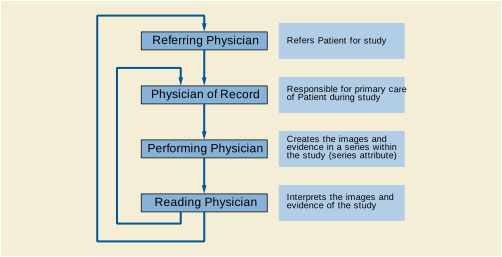
There can be an overlap of functions provided by any given physician. In this case, the various attributes specifying the different roles would convey the same physician name.
Table C.7-4a defines Attributes that provide information about the Patient at the time the Study started.
Table C.7-4a. Patient Study Module Attributes
|
Attribute Name |
Tag |
Type |
Attribute Description |
|---|---|---|---|
|
Admitting Diagnoses Description |
(0008,1080) |
3 |
Description of the admitting diagnosis (diagnoses) |
|
Admitting Diagnoses Code Sequence |
(0008,1084) |
3 |
A sequence that conveys the admitting diagnosis (diagnoses). One or more Items are permitted in this Sequence. |
|
No Baseline CID is defined. |
|||
|
Patient's Age |
(0010,1010) |
3 |
Age of the Patient. |
|
Patient's Size |
(0010,1020) |
3 |
Length or size of the Patient, in meters. |
|
Patient's Weight |
(0010,1030) |
3 |
Weight of the Patient, in kilograms. |
|
Patient's Size Code Sequence |
(0010,1021) |
3 |
Patient's size category code One or more Items are permitted in this sequence. |
|
Baseline CID is CID 7040 “Broselow-Luten Pediatric Size Categories” for pediatric patients Baseline CID is CID 7042 “Calcium Scoring Patient Size Categories” for CT calcium scoring |
|||
|
Occupation |
(0010,2180) |
3 |
Occupation of the Patient. |
|
Additional Patient History |
(0010,21B0) |
3 |
Additional information about the Patient's medical history. |
|
Admission ID |
(0038,0010) |
3 |
Identifier of the visit as assigned by the healthcare provider |
|
Issuer of Admission ID Sequence |
(0038,0014) |
3 |
Identifier of the Assigning Authority that issued Admission ID (0038,0010). Only a single Item is permitted in this sequence. |
|
>Include Table 10-17 “HL7v2 Hierarchic Designator Macro Attributes” |
|||
|
Service Episode ID |
(0038,0060) |
3 |
Identifier of the Service Episode as assigned by the healthcare provider |
|
Issuer of Service Episode ID Sequence |
(0038,0064) |
3 |
Identifier of the Assigning Authority that issued the Service Episode ID (0038,0060). Only a single Item is permitted in this sequence. |
|
>Include Table 10-17 “HL7v2 Hierarchic Designator Macro Attributes” |
|||
|
Service Episode Description |
(0038,0062) |
3 |
Description of the type of service episode. |
|
Patient's Sex Neutered |
(0010,2203) |
2C |
Whether or not a procedure has been performed in an effort to render the patient sterile. Enumerated Values:
NoteIf this Attribute is present but has no value then the status is unknown. Required if patient is an animal. May be present otherwise. |
Table C.7-4b contains attributes that identify a Study in the context of a clinical trial.
Table C.7-4b. Clinical Trial Study Module Attributes
|
Attribute Name |
Tag |
Type |
Attribute Description |
|---|---|---|---|
|
Clinical Trial Time Point ID |
(0012,0050) |
2 |
An identifier specifying the one or more studies that are grouped together as a clinical time point or submission in a clinical trial. See Section C.7.2.3.1.1. |
|
Clinical Trial Time Point Description |
(0012,0051) |
3 |
A description of a set of one or more studies that are grouped together to represent a clinical time point or submission in a clinical trial. See Section C.7.2.3.1.1. |
|
Consent for Clinical Trial Use Sequence |
(0012,0083) |
3 |
A Sequence that conveys information about consent for Clinical Trial use of the composite instances within this Study. One or more Items are permitted in this sequence. See Section C.7.2.3.1.2. |
|
>Distribution Type |
(0012,0084) |
1C |
The type of distribution for which consent to distribute has been granted. Defined Terms:
See Section C.7.2.3.1.2. Required if Consent for Distribution Flag (0012,0085) equals YES or WITHDRAWN. |
|
>Clinical Trial Protocol ID |
(0012,0020) |
1C |
The identifier of the protocol for which consent to distribute has been granted. Required if Distribution Type (0012,0084) is NAMED_PROTOCOL and the protocol is not that which is specified in Clinical Trial Protocol ID (0012,0020) in the Clinical Trial Subject Module. |
|
>Consent for Distribution Flag |
(0012,0085) |
1 |
Whether or not consent to distribute has been granted for the purpose described in Distribution Type (0012,0084). Enumerated Values:
See Section C.7.2.3.1.2. NoteUnder some circumstances, consent may be withdrawn. The purpose of encoding this is to warn receiving systems that further distribution may not be appropriate, but no semantics are defined by the Standard for what action is appropriate under such circumstances, such as what to do with previously received images that had a value of YES. |
The Clinical Trial Time Point ID (0012,0050) attribute identifies an imaging study within the context of an investigational protocol. This attribute is used to define a set of studies that are grouped together as a clinical time point or data submission in a clinical trial. The Clinical Trial Time Point Description (0012,0051) attribute can be used to give a description of the Clinical Trial Time Point to which the set of studies belongs.
For applications such as clinical trials, the distribution of composite instances in Studies, whether containing identifying information or partially or completely de-identified, may need to be controlled. Permission for distribution is usually granted under the control of the patient (through informed consent), the ethics committee or institutional review board responsible for the study, and the sponsor of the study through contractual means. The Consent for Clinical Trial Use Sequence (0012,0083) is intended to encode the result of the consent process to allow appropriate subsequent handling of the instances.
The Defined Terms for Distribution Type (0012,0084) mean that consent has been issued to distribute for the following purposes:
Defined Terms:
- NAMED_PROTOCOL
conducting the protocol named in Clinical Trial Protocol ID (0012,0020)
- RESTRICTED_REUSE
re-use for restricted purposes (not specified here) other than those for which the instances were originally created
- PUBLIC_RELEASE
release to the general public for re-use without restriction
Note
There is no intent to convey in this sequence further details of the often complex consent and approval process. Further information about the protocol and ethics committee may be found in the Clinical Trials modules, if present.
There is no identification of an individual responsible for the approval or granting consent, since in the case of a clinical trial subject granting informed consent, the presence of this information would breach de-identification requirements.
Multiple sequence items may be present; for example a Study may be approved for distribution for conducting multiple explicitly named protocols.
Whether or not the instances have been adequately de-identified for any particular purpose of distribution is not defined by the Attributes in the Consent for Clinical Trial Use Sequence (0012,0083). Other Attributes address this, such as Patient Identity Removed (0012,0062), De-identification Method (0012,0063), De-identification Method Code Sequence (0012,0064) and Burned In Annotation (0028,0301). See also Annex E “Attribute Confidentiality Profiles” in PS3.15.
It is possible that the list of Defined Terms for Distribution Type (0012,0084) may be extended in future for other purposes, not necessarily related to the conduct of clinical trials.
The following Series IE Modules are common to all Composite Image IODs that reference the Series IE.
Table C.7-5a specifies the Attributes that identify and describe general information about the Series within a Study.
Table C.7-5a. General Series Module Attributes
|
Attribute Name |
Tag |
Type |
Attribute Description |
|---|---|---|---|
|
Modality |
(0008,0060) |
1 |
Type of equipment that originally acquired the data used to create the images in this Series. See Section C.7.3.1.1.1 for Defined Terms. |
|
Series Instance UID |
(0020,000E) |
1 |
Unique identifier of the Series. |
|
Series Number |
(0020,0011) |
2 |
A number that identifies this Series. |
|
Laterality |
(0020,0060) |
2C |
Laterality of (paired) body part examined. Required if the body part examined is a paired structure and Image Laterality (0020,0062) or Frame Laterality (0020,9072) are not sent. Enumerated Values:
NoteSome IODs support Image Laterality (0020,0062) at the Image level or Frame Laterality (0020,9072) at the Frame level in the Frame Anatomy functional group macro or Measurement Laterality (0024,0113) at the Measurement level, which can provide a more comprehensive mechanism for specifying the laterality of the body part(s) being examined. |
|
Series Date |
(0008,0021) |
3 |
Date the Series started. |
|
Series Time |
(0008,0031) |
3 |
Time the Series started. |
|
Performing Physician's Name |
(0008,1050) |
3 |
Name of the physician(s) administering the Series. |
|
Performing Physician Identification Sequence |
(0008,1052) |
3 |
Identification of the physician(s) administering the Series. One or more items are permitted in this sequence. If more than one Item, the number and order shall correspond to the value of Performing Physician's Name (0008,1050), if present. |
|
>Include Table 10-1 “Person Identification Macro Attributes Description” |
|||
|
Protocol Name |
(0018,1030) |
3 |
User-defined description of the conditions under which the Series was performed. NoteThis attribute conveys series-specific protocol identification and may or may not be identical to the one presented in the Performed Protocol Code Sequence (0040,0260). |
|
Series Description |
(0008,103E) |
3 |
Description of the Series |
|
Series Description Code Sequence |
(0008,103F) |
3 |
A coded description of the Series. Only a single Item is permitted in this sequence. |
|
No Baseline CID is defined. |
|||
|
Operators' Name |
(0008,1070) |
3 |
Name(s) of the operator(s) supporting the Series. |
|
Operator Identification Sequence |
(0008,1072) |
3 |
Identification of the operator(s) supporting the Series. One or more items are permitted in this sequence. If more than one Item, the number and order shall correspond to the value of Operators' Name (0008,1070), if present. |
|
>Include Table 10-1 “Person Identification Macro Attributes Description” |
|||
|
Referenced Performed Procedure Step Sequence |
(0008,1111) |
3 |
Uniquely identifies the Performed Procedure Step SOP Instance to which the Series is related. Only a single Item is permitted in this sequence. |
|
>Include Table 10-11 “SOP Instance Reference Macro Attributes” |
|||
|
Related Series Sequence |
(0008,1250) |
3 |
Identification of Series significantly related to this Series. One or more Items are permitted in this Sequence. Note
|
|
>Study Instance UID |
(0020,000D) |
1 |
Instance UID of Study to which the related Series belongs |
|
>Series Instance UID |
(0020,000E) |
1 |
Instance UID of Related Series |
|
>Purpose of Reference Code Sequence |
(0040,A170) |
2 |
Describes the purpose for which the reference is made. Zero or more Items shall be included in this sequence. When absent, implies that the reason for the reference is unknown. |
|
Body Part Examined |
(0018,0015) |
3 |
Text description of the part of the body examined. See Annex L “Correspondence of Anatomic Region Codes and Body Part Examined Defined Terms” in PS3.16 for Defined Terms NoteSome IODs support the Anatomic Region Sequence (0008,2218), which can provide a more comprehensive mechanism for specifying the body part being examined. |
|
Patient Position |
(0018,5100) |
2C |
Patient position descriptor relative to the equipment. Required for images where Patient Orientation Code Sequence (0054,0410) is not present and whose SOP Class is one of the following: CT ("1.2.840.10008.5.1.4.1.1.2") or MR ("1.2.840.10008.5.1.4.1.1.4") or Enhanced CT ("1.2.840.10008.5.1.4.1.1.2.1") or Enhanced MR Image ("1.2.840.10008.5.1.4.1.1.4.1") or Enhanced Color MR Image ("1.2.840.10008.5.1.4.1.1.4.3") or MR Spectroscopy ("1.2.840.10008.5.1.4.1.1.4.2") Storage SOP Classes. May be present for other SOP Classes if Patient Orientation Code Sequence (0054,0410) is not present. See Section C.7.3.1.1.2 for Defined Terms and further explanation. |
|
Smallest Pixel Value in Series |
(0028,0108) |
3 |
The minimum value of all images in this Series. |
|
Largest Pixel Value in Series |
(0028,0109) |
3 |
The maximum value of all images in this Series. |
|
Request Attributes Sequence |
(0040,0275) |
3 |
Sequence that contains attributes from the Imaging Service Request. One or more Items are permitted in this sequence. |
|
No Baseline CID is defined. |
|||
|
Include Table 10-16 “Performed Procedure Step Summary Macro Attributes” |
No Baseline CID is defined. |
||
|
Anatomical Orientation Type |
(0010,2210) |
1C |
The anatomical orientation type used in instances generated by this equipment. Enumerated Values:
Required if the patient is an animal and the anatomical frame of reference is not bipedal. May be present otherwise. See Section C.7.6.1.1.1 and Section C.7.6.2.1.1. NoteIf this Attribute is not present, the default human standard anatomical position is used to define the patient orientation of projection images and the patient coordinate system of cross-sectional images. |
Note
If any Performed Procedure Step SOP Class is supported as an SCU by a Storage SCU, the SCU is strongly encouraged to support the attribute Referenced Performed Procedure Step Sequence (0008,1111). This attribute references the Performed Procedure Step SOP Instance, and extraction of this Attribute from a Composite Instance may allow retrieval of the Performed Procedure Step SOP Instance.
If the Storage SCU does not conform to any Performed Procedure Step SOP Class, it is still advisable to include the attributes Performed Procedure Step Start Date (0040,0244), Performed Procedure Step Start Time (0040,0245) and Performed Procedure Step Description (0040,0254) into the Composite Instances.
Defined Terms:
- AR
Autorefraction
- AU
Audio
- BDUS
Bone Densitometry (ultrasound)
- BI
Biomagnetic imaging
- BMD
Bone Densitometry (X-Ray)
- CR
Computed Radiography
- CT
Computed Tomography
- DG
Diaphanography
- DOC
Document
- DX
Digital Radiography
- ECG
Electrocardiography
- EPS
Cardiac Electrophysiology
- ES
Endoscopy
- FID
Fiducials
- GM
General Microscopy
- HC
Hard Copy
- HD
Hemodynamic Waveform
- IO
Intra-Oral Radiography
- IOL
Intraocular Lens Data
- IVOCT
Intravascular Optical Coherence Tomography
- IVUS
Intravascular Ultrasound
- KER
Keratometry
- KO
Key Object Selection
- LEN
Lensometry
- LS
Laser surface scan
- MG
Mammography
- MR
Magnetic Resonance
- NM
Nuclear Medicine
- OAM
Ophthalmic Axial Measurements
- OCT
Optical Coherence Tomography (non-Ophthalmic)
- OPM
Ophthalmic Mapping
- OP
Ophthalmic Photography
- OPT
Ophthalmic Tomography
- OPV
Ophthalmic Visual Field
- OSS
Optical Surface Scan
- OT
Other
- PLAN
Plan
- PR
Presentation State
- PT
Positron emission tomography (PET)
- PX
Panoramic X-Ray
- REG
Registration
- RESP
Respiratory Waveform
- RF
Radio Fluoroscopy
- RG
Radiographic imaging (conventional film/screen)
- RTDOSE
Radiotherapy Dose
- RTIMAGE
Radiotherapy Image
- RTPLAN
Radiotherapy Plan
- RTRECORD
RT Treatment Record
- RTSTRUCT
Radiotherapy Structure Set
- RWV
Real World Value Map
- SEG
Segmentation
- SMR
Stereometric Relationship
- SM
Slide Microscopy
- SRF
Subjective Refraction
- SR
SR Document
- STAIN
Automated Slide Stainer
- TG
Thermography
- US
Ultrasound
- VA
Visual Acuity
- XA
X-Ray Angiography
- XC
External-camera Photography
Retired Defined Terms:
- AS
Angioscopy
- CD
Color flow Doppler
- CF
Cinefluorography
- CP
Culposcopy
- CS
Cystoscopy
- DD
Duplex Doppler
- DF
Digital fluoroscopy
- DM
Digital microscopy
- DS
Digital Subtraction Angiography
- EC
Echocardiography
- FA
Fluorescein angiography
- FS
Fundoscopy
- LP
Laparoscopy
- MA
Magnetic resonance angiography
- MS
Magnetic resonance spectroscopy
- OPR
Ophthalmic Refraction
- ST
Single-photon emission computed tomography (SPECT)
- VF
Videofluorography
Note
The XA modality incorporates the retired modality DS.
The RF modality incorporates the retired modalities CF, DF, VF.
The modality listed in the Modality Data Element (0008,0060) may not match the name of the IOD in which it appears. For example, a SOP instance from XA IOD may list the RF modality when an RF implementation produces an XA object.
The MR modality incorporates the retired modalities MA and MS.
The US modality incorporates the retired modalities EC, CD, and DD.
The NM modality incorporates the retired modality ST.
Patient Position (0018,5100) specifies the position of the patient relative to the imaging equipment space. This attribute is intended for annotation purposes only. It does not provide an exact mathematical relationship of the patient to the imaging equipment.
When facing the front of the imaging equipment, Head First is defined as the patient's head being positioned toward the front of the imaging equipment. Feet First is defined as the patient's feet being positioned toward the front of the imaging equipment. Prone is defined as the patient's face being positioned in a downward (gravity) direction. Supine is defined as the patient's face being in an upward direction. Decubitus Right is defined as the patient's right side being in a downward direction. Decubitus Left is defined as the patient's left side being in a downward direction.
Defined Terms:
- HFP
Head First-Prone
- HFS
Head First-Supine
- HFDR
Head First-Decubitus Right
- HFDL
Head First-Decubitus Left
- FFDR
Feet First-Decubitus Right
- FFDL
Feet First-Decubitus Left
- FFP
Feet First-Prone
- FFS
Feet First-Supine
The Figure C.7.3.1.1.2-1 illustrates these Defined Terms for imaging equipment with a table, such as in X-Ray Angiography. The orientation of the patient related to gravity is always recumbent.
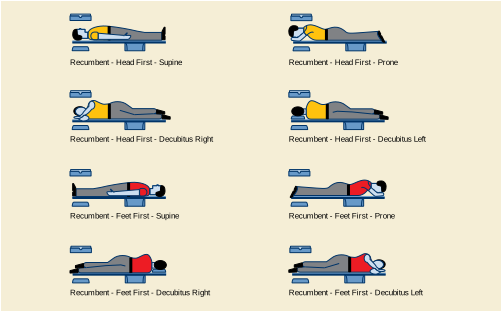
Table C.7-5b contains attributes that identify a Series in the context of a clinical trial.
Table C.7-5b. Clinical Trial Series Module Attributes
|
Attribute Name |
Tag |
Type |
Attribute Description |
|---|---|---|---|
|
Clinical Trial Coordinating Center Name |
(0012,0060) |
2 |
The name of the institution that is responsible for coordinating the medical imaging data for the clinical trial. See Section C.7.3.2.1.1. |
|
Clinical Trial Series ID |
(0012,0071) |
3 |
An identifier of the series in the context of a clinical trial. See Section C.7.3.2.1.2. |
|
Clinical Trial Series Description |
(0012,0072) |
3 |
A description of the series in the context of a clinical trial. See Section C.7.3.2.1.2. |
The Clinical Trial Coordinating Center Name (0012,0060) identifies the institution responsible for coordinating the collection of images and associated data for subjects enrolled in the clinical trial.
The Clinical Trial Series ID (0012,0071) and Clinical Trial Series Description (0012,0072) attributes can be used to identify and describe a Series within the context of a clinical trial without requiring the replacement of the values in Series Number (0020,0011) and Series Description (0008,103E) attributes in the General Series Module, whose manufacturer or user provided values may be relevant and important to retain.
Table C.7-5c Table specifies the Attributes that identify and describe general information about the Series within a Study.
Note
This table contains a subset of the attributes of General Series Module (Table C.7-5a) but the Type designation is changed into Type 1. Including this module in an IOD overwrites the Type designation of the General Series Module.
Table C.7-5c. Enhanced Series Module Attributes
|
Attribute Name |
Tag |
Type |
Attribute Description |
|---|---|---|---|
|
Series Number |
(0020,0011) |
1 |
A number that identifies this Series. Note
|
|
Referenced Performed Procedure Step Sequence |
(0008,1111) |
1C |
Uniquely identifies the Performed Procedure Step SOP Instance to which the Series is related. Only a single Item shall be included in this sequence. Required if a Performed Procedure Step SOP Class was involved in the creation of this Series. |
|
>Include Table 10-11 “SOP Instance Reference Macro Attributes” |
|||
Table C.7-6 specifies the Attributes necessary to uniquely identify a frame of reference that ensures the spatial relationship of Images within a Series. It also allows Images across multiple Series to share the same Frame Of Reference. This Frame Of Reference (or coordinate system) shall be constant for all Images related to a specific Frame Of Reference.
When a Frame of Reference is identified, it is not important how the imaging target (Patient, specimen, or phantom) is positioned relative to the imaging equipment or where the origin of the Frame Of Reference is located. It is important that the position of the imaging target and the origin are constant in relationship to a specific Frame Of Reference.
Note
Since the criteria used to group images into a Series is application specific, it is possible for imaging applications to define multiple Series within a Study that share the same imaging space. Previous versions of the DICOM Standard specified that all images within the Series must be spatially related. However, insufficient information was available to determine if multiple Series within a Study were spatially related.
Table C.7-6. Frame of Reference Module Attributes
|
Attribute Name |
Tag |
Type |
Attribute Description |
|---|---|---|---|
|
Frame of Reference UID |
(0020,0052) |
1 |
Uniquely identifies the frame of reference for a Series. See Section C.7.4.1.1.1 for further explanation. |
|
Position Reference Indicator |
(0020,1040) |
2 |
Part of the imaging target used as a reference. See Section C.7.4.1.1.2 for further explanation. |
The Frame of Reference UID (0020,0052) shall be used to uniquely identify a frame of reference for a series. Each series shall have a single Frame of Reference UID. However, multiple Series within a Study may share a Frame of Reference UID. All images in a Series that share the same Frame of Reference UID shall be spatially related to each other.
Note
Previous versions of this Standard defined a Data Element "Location", which has been retired. Frame of Reference UID provides a completely unambiguous identification of the image location reference used to indicate position.
A common Frame of Reference UID may be used to spatially relate localizer images with a set of transverse images. However, in some cases (e.g., multiple localizer images being related to a single set of transverse images) a common Frame of Reference UID may not be sufficient. The Referenced Image Sequence (0008,1140) provides an unambiguous method for relating localizer images.
The Position Reference Indicator (0020,1040) specifies the part of the imaging target that was used as a reference point associated with a specific Frame of Reference UID. The Position Reference Indicator may or may not coincide with the origin of the fixed frame of reference related to the Frame of Reference UID.
For a Patient-related Frame of Reference, this is an anatomical reference point such as the iliac crest, orbital-medial, sternal notch, symphysis pubis, xiphoid, lower coastal margin, or external auditory meatus, or a fiducial marker placed on the patient. The patient-based coordinate system is described in Section C.7.6.2.1.1.
For a slide-related Frame of Reference, this is the slide corner as specified in Section C.8.12.2.1 and shall be identified in this attribute with the value "SLIDE_CORNER". The slide-based coordinate system is described in Section C.8.12.2.1.
For a corneal vertex based Frame of Reference, this is the corneal vertex determined by the measuring instrument and shall be identified in this attribute with the value CORNEAL_VERTEX_R (for the right eye) or CORNEAL_VERTEX_L (for the left eye). The corneal vertex based coordinate system is described in Section C.8.30.3.1.4.
The Position Reference Indicator shall be used only for annotation purposes and is not intended to be used as a mathematical spatial reference.
Note
The Position Reference Indicator may be sent zero length when it has no meaning, for example, when the Frame of Reference Module is required to relate mammographic images of the breast acquired without releasing breast compression, but where there is no meaningful anatomical reference point as such.
Table C.7-7 specifies the Attributes necessary to uniquely identify a frame of reference that establishes the temporal relationship of SOP Instances. A synchronized environment may be established based on a shared time of day clock, and/or on a shared trigger event or synchronization waveform channel.
Note
Within a synchronized environment, different devices may use the shared data differently. An electrical pulse, for example, may be treated as a trigger event by one device (e.g., an x-ray imaging system), but may be recorded as a synchronization waveform by another device (e.g., a hemodynamics system).
Table C.7-7. Synchronization Module Attributes
|
Attribute Name |
Tag |
Type |
Attribute Description |
|---|---|---|---|
|
Synchronization Frame of Reference UID |
(0020,0200) |
1 |
UID of common synchronization environment. See Section C.7.4.2.1.1. |
|
Synchronization Trigger |
(0018,106A) |
1 |
Data acquisition synchronization with external equipment Enumerated Values:
|
|
Trigger Source or Type |
(0018,1061) |
3 |
Specifies equipment ID of trigger source and/or type of trigger |
|
Synchronization Channel |
(0018,106C) |
1C |
Identifier of waveform channel that records the synchronization channel or trigger, see Section C.7.4.2.1.3. Required if synchronization channel or trigger is encoded in a waveform in this SOP Instance |
|
Acquisition Time Synchronized |
(0018,1800) |
1 |
Acquisition DateTime (0008,002A) synchronized with external time reference. Enumerated Values:
|
|
Time Source |
(0018,1801) |
3 |
ID of equipment or system providing time reference |
|
Time Distribution Protocol |
(0018,1802) |
3 |
Method of time distribution used to synchronize this equipment. Enumerated Values:
|
|
NTP Source Address |
(0018,1803) |
3 |
IP Address of NTP, SNTP, or PTP time source. IPv4 addresses shall be in dotted decimal (e.g., 192.168.1.1). The IPv6 addresses shall be in colon separated hexadecimal (e.g., 12:34:56:78:9a:bc:de:f0). NoteIdentity of this value in two instances acquired contemporaneously implies a common time base. The NTP Source Address might not persist over time. |
A set of equipment may share a common acquisition synchronization environment, which is identified by a Synchronization Frame of Reference UID. All SOP Instances that share the same Synchronization Frame of Reference UID shall be temporally related to each other. If a Synchronization Frame of Reference UID is present, all SOP Instances in the Series must share the same Frame of Reference.
The UTC Synchronization UID, 1.2.840.10008.15.1.1, may be used when the equipment is synchronized to the international standard UTC. In this case the quality of synchronization may be determined by means of the Time Distribution Protocol (0018,1802) and NTP Source Address (0018,1803).
Note
The Synchronization Frame of Reference UID defines an equipment synchronization environment, and does not need to be changed for each unrelated acquisition. SOP Instances may therefore share a Synchronization Frame of Reference UID, but be clinically unrelated (e.g., apply to different patients).
When a synchronization environment is recalibrated, a new UID must be issued.
The method of distributing the Synchronization Frame of Reference UID to multiple devices is not specified.
Time may originate with a primary source (e.g., a national standards bureau) and be distributed through a chain of secondary distribution systems until reaching the imaging equipment. Time Distribution Protocol (0018,1802) specifies the immediate (last link) method used by the equipment to receive time from the immediately prior Time Source (0018,1801). It does not specify the ultimate time reference from which the Time Source may derive its synchronization.
Note
The time value distributed through the specified Time Distribution Protocol may need to be corrected to align with UTC. For example, GPS does not compensate for leap seconds.
Synchronization Channel (0018,106C) is specified as a pair of values (M,C), where the first value is the ordinal of the sequence item of Waveform Sequence (5400,0100) (i.e., the Multiplex Group), and the second value is the ordinal of the sequence item of the Channel Definition Sequence (003A,0200) attribute (i.e., the Waveform Channel Number) within the multiplex group.
The Acquisition Time Synchronized (0018,1800) attribute specifies whether Acquisition DateTime (0008,002A) of the Waveform Identification Module or the General Image Module represents an accurate synchronized timestamp for the acquisition of the waveform and/or image data. For triggered multi-frame images, the Acquisition DateTime applies to the trigger for the first image frame (see attribute Image Trigger Delay (0018.1067) in the Cine Module).
Note
The degree of precision of the Acquisition DateTime and its accuracy relative to the external clock are not specified, but need to be appropriate for the clinical application.
For IODs that include the SR Document Content Module, the Acquisition Time Synchronized (0018,1800) attribute specifies whether Observation DateTime (0040,A032) of Items in Content Sequence (0040,A730) of the SR Document Content Module represents an accurate synchronized timestamp for the Item.
The following Equipment IE Module is common to all Composite IODs that reference the Equipment IE.
Table C.7-8 specifies the Attributes that identify and describe the piece of equipment that produced a Series of Composite Instances.
Table C.7-8. General Equipment Module Attributes
|
Attribute Name |
Tag |
Type |
Attribute Description |
|---|---|---|---|
|
Manufacturer |
(0008,0070) |
2 |
Manufacturer of the equipment that produced the composite instances. |
|
Institution Name |
(0008,0080) |
3 |
Institution where the equipment that produced the composite instances is located. |
|
Institution Address |
(0008,0081) |
3 |
Mailing address of the institution where the equipment that produced the composite instances is located. |
|
Station Name |
(0008,1010) |
3 |
User defined name identifying the machine that produced the composite instances. |
|
Institutional Department Name |
(0008,1040) |
3 |
Department in the institution where the equipment that produced the composite instances is located. |
|
Manufacturer's Model Name |
(0008,1090) |
3 |
Manufacturer's model name of the equipment that produced the composite instances. |
|
Device Serial Number |
(0018,1000) |
3 |
Manufacturer's serial number of the equipment that produced the composite instances. NoteThis identifier corresponds to the device that actually created the images, such as a CR plate reader or a CT console, and may not be sufficient to identify all of the equipment in the imaging chain, such as the generator or gantry or plate. |
|
Software Versions |
(0018,1020) |
3 |
Manufacturer's designation of software version of the equipment that produced the composite instances. See Section C.7.5.1.1.3. |
|
Gantry ID |
(0018,1008) |
3 |
Identifier of the gantry or positioner. |
|
Spatial Resolution |
(0018,1050) |
3 |
The inherent limiting resolution in mm of the acquisition equipment for high contrast objects for the data gathering and reconstruction technique chosen. If variable across the images of the series, the value at the image center. |
|
Date of Last Calibration |
(0018,1200) |
3 |
Date when the image acquisition device calibration was last changed in any way. Multiple entries may be used for additional calibrations at other times. See Section C.7.5.1.1.1 for further explanation. |
|
Time of Last Calibration |
(0018,1201) |
3 |
Time when the image acquisition device calibration was last changed in any way. Multiple entries may be used. See Section C.7.5.1.1.1 for further explanation. |
|
Pixel Padding Value |
(0028,0120) |
1C |
Single pixel value or one limit (inclusive) of a range of pixel values used in an image to pad to rectangular format or to signal background that may be suppressed. See Section C.7.5.1.1.2 for further explanation. Required if Pixel Padding Range Limit (0028,0121) is present and either Pixel Data (7FE0,0010) or Pixel Data Provider URL (0028,7FE0) is present. May be present otherwise only if Pixel Data (7FE0,0010) or Pixel Data Provider URL (0028,7FE0) is present. Note
|
Note
The attributes Manufacturer (0008,0070), Manufacturer's Model Name (0008,1090) and Device Serial Number (0018,1000) are intended to be a primary identification of the system that produces the data (e.g., modality or workstation application providing the content of the SOP Instance) and not the identification of the component that encodes the SOP Instance (e.g., a commonly used DICOM encoding toolkit).
Date of Last Calibration (0018,1200) and Time of Last Calibration (0018,1201) are used to convey the date and time of calibration. The Attribute Date of Last Calibration (0018,1200) may be supported alone, however, Time of Last Calibration (0018,1201) Attribute has no meaning unless Attribute Date of Last Calibration (0018,1200) is also supported. The order for each Attribute shall be from the oldest date/time to the most recent date/time. When the Attributes are both supported they shall be provided as pairs.
Pixel Padding Value (0028,0120) is used to pad grayscale images (those with a Photometric Interpretation of MONOCHROME1 or MONOCHROME2) to rectangular format. The native format of some images is not rectangular. It is common for devices with this format to pad the images to the rectangular format required by the DICOM Standard with a specific pixel value that is not contained in the native image. Further, when resampling, such as after spatial registration, padding may need to be used to fill previously non-existent pixels.
Pixel Padding Value (0028,0120) and Pixel Padding Range Limit (0028,0121) are also used to identify pixels to be excluded from the normal grayscale rendering pipeline for other reasons, such as suppression of background air. Pixel Padding Range Limit (0028,0121) is defined in the Image Pixel Module.
Note
The "native image" is that which is being padded to the required rectangular format, e.g., the area within the circular reconstruction perimeter of a CT image, or the subset of the rectangular area that contains useful image information.
The pixel padding value is explicitly described in order to prevent display applications from taking it into account when determining the dynamic range of an image, since the Pixel Padding Value will be outside the range between the minimum and maximum values of the pixels in the native image
No pixels in the native image will have a value equal to Pixel Padding Value.
Pixel Padding Value (0028,0120) specifies either a single value of this padding value, or when combined with Pixel Padding Range Limit (0028,0121), a range of values (inclusive) that are padding.
The values of Pixel Padding Value (0028,0120) and Pixel Padding Range Limit (0028,0121) shall be valid values within the constraints defined by Bits Allocated (0028,0100), Bits Stored (0028,0101), and High Bit (0028,0102).
Pixel Padding Value (0028,0120) and Pixel Padding Range Limit (0028,0121) shall not be present when padding is performed but the pixel value used for padding does occur in the native image.
If Photometric Interpretation (0028,0004) is MONOCHROME2, Pixel Padding Value (0028,0120) shall be less than (closer to or equal to the minimum possible pixel value) or equal to Pixel Padding Range Limit (0028,0121). If Photometric Interpretation (0028,0004) is MONOCHROME1, Pixel Padding Value (0028,0120) shall be greater than (closer to or equal to the maximum possible pixel value) or equal to Pixel Padding Range Limit (0028,0121).
Note
When the relationship between pixel value and X-Ray Intensity is unknown, it is recommended that the following values be used to pad with black when the image is unsigned:
0 if Photometric Interpretation (0028,0004) is MONOCHROME2.
2Bits Stored - 1 if Photometric Interpretation (0028,0004) is MONOCHROME1.
and when the image is signed:
-2Bits Stored-1 if Photometric Interpretation (0028,0004) is MONOCHROME2.
2Bits Stored-1 - 1 if Photometric Interpretation (0028,0004) is MONOCHROME1.
For projection radiography, when the relationship between pixel value and X-Ray Intensity is known (for example as defined by Pixel Intensity Relationship (0028,1040) and Pixel Intensity relationship Sign (0028,1041)), it is recommended that a pixel value equivalent to, or rendered similarly to, air (least X-Ray absorbance) be used for padding. However, if such a value may occur in the native image, the Pixel Padding Value (0028,0120) Attribute itself should not be sent.
E.g., for an XRF image obtained with an image intensifier, if air is black then a padded perimeter, if any, should also appear black. Typically though, if unpadded, this area would be collimated with a circular collimator, in which case the pixels would appear natively as white (greatest X-Ray absorbance) and a circular shutter would be necessary to neutralize them as black. Whether collimated areas are detected and treated as padded, or neutralized with shutters is at the discretion of the application. See also the Display Shutter Module Section C.7.6.11.
The conditional requirement for the Pixel Padding Value Range Limit (0028,0121) in the Image Pixel Module means that it shall not be present unless Pixel Padding Value (0028,0120) is also present.
The range of values to be suppressed between Pixel Padding Value (0028,0120) and Pixel Padding Value Range Limit (0028,0121) is specified as being inclusive, that is the values themselves as well as all values between are suppressed.
When Pixel Padding Value Range Limit (0028,0121) is present, but not supported by a rendering application, the constraint that Pixel Padding Value (0028,0120) is closest to the "blackest" value, which is typically the most frequently occurring background pixel, will most often result in an acceptable display, permitting "backward compatibility" in the majority of cases.
When modifying equipment changes the pixel padding value in the image, it shall change the values of Pixel Padding Value (0028,0120) and Pixel Padding Range Limit (0028,0121), if present. If modifying equipment changes the pixel padding values in the image to values present in the native image, the attribute Pixel Padding Value (0028,0120) and Pixel Padding Range Limit (0028,0121) shall be removed.
Note
For example, if a CT image containing signed values from -1024 to 3191 and a Pixel Padding Value of -2000 and a Rescale Intercept of 0 is converted to an unsigned image with a Rescale Intercept of -1024 by adding 1024 to all pixels and clipping all more negative pixels to 0, then the padding pixels will be indistinguishable from some of the modified native image pixels, and hence Pixel Padding Value (0028,0120) needs to be removed.
If the modification involves lossy compression, which may result in changes to the pixel values, then the application of Pixel Padding Value and Pixel Padding Range Limit may result in a different appearance, and hence these attributes may need different values also.
Software Versions (0018,1020) is a multi-valued attribute. For equipment that is composed of several components, it may be used to identify the name and version for each of those components. This may also include the identifier and version of libraries or configuration files that significantly affect the production of the SOP Instance.
Table C.7-8b specifies the Attributes that identify and describe the piece of equipment that produced a Series of Composite Instances.
Note
This table contains a subset of the attributes of General Equipment Module (Table C.7-8) but the Type Designation is changed into Type 1. Including this module in an IOD overwrites the Type Designation of the General Equipment Module.
The attributes are intended to be a primary identification of the system that produces the data (e.g., modality or workstation application providing the content of the SOP Instance) and not the identification of the component that encodes the SOP Instance (e.g., a commonly used DICOM encoding toolkit).
Table C.7-8b. Enhanced General Equipment Module Attributes
|
Attribute Name |
Tag |
Type |
Attribute Description |
|---|---|---|---|
|
Manufacturer |
(0008,0070) |
1 |
Manufacturer of the equipment that produced the composite instances. |
|
Manufacturer's Model Name |
(0008,1090) |
1 |
Manufacturer's model name of the equipment that produced the composite instances. |
|
Device Serial Number |
(0018,1000) |
1 |
Manufacturer's serial number of the equipment that produced the composite instances. |
|
Software Versions |
(0018,1020) |
1 |
Manufacturer's designation of software version of the equipment that produced the composite instances. See Section C.7.5.1.1.3. |
The following Image IE Modules are common to all Composite Image IODs that reference the Image IE.
Table C.7-9 specifies the Attributes that identify and describe an image within a particular series.
Table C.7-9. General Image Module Attributes
|
Attribute Name |
Tag |
Type |
Attribute Description |
|---|---|---|---|
|
Instance Number |
(0020,0013) |
2 |
A number that identifies this image. NoteThis Attribute was named Image Number in earlier versions of this Standard. |
|
Patient Orientation |
(0020,0020) |
2C |
Patient direction of the rows and columns of the image. Required if image does not require Image Orientation (Patient) (0020,0037) and Image Position (Patient) (0020,0032). May be present otherwise. See Section C.7.6.1.1.1 for further explanation. NoteIODs may have attributes other than Patient Orientation, Image Orientation, or Image Position (Patient) to describe orientation in which case this attribute will be zero length. |
|
Content Date |
(0008,0023) |
2C |
The date the image pixel data creation started. Required if image is part of a series in which the images are temporally related. May be present otherwise. NoteThis Attribute was formerly known as Image Date. |
|
Content Time |
(0008,0033) |
2C |
The time the image pixel data creation started. Required if image is part of a series in which the images are temporally related. May be present otherwise. |
|
Image Type |
(0008,0008) |
3 |
Image identification characteristics. See Section C.7.6.1.1.2 for Defined Terms and further explanation. |
|
Acquisition Number |
(0020,0012) |
3 |
A number identifying the single continuous gathering of data over a period of time that resulted in this image. |
|
Acquisition Date |
(0008,0022) |
3 |
The date the acquisition of data that resulted in this image started |
|
Acquisition Time |
(0008,0032) |
3 |
The time the acquisition of data that resulted in this image started |
|
Acquisition DateTime |
(0008,002A) |
3 |
The date and time that the acquisition of data that resulted in this image started. NoteThe synchronization of this time with an external clock is specified in the Synchronization Module in Acquisition Time Synchronized (0018,1800). |
|
Referenced Image Sequence |
(0008,1140) |
3 |
Other images significantly related to this image (e.g., post-localizer CT image or Mammographic biopsy or partial view images). One or more Items are permitted in this sequence. |
|
>Include Table 10-3 “Image SOP Instance Reference Macro Attributes” |
|||
|
>Purpose of Reference Code Sequence |
(0040,A170) |
3 |
Describes the purpose for which the reference is made. Only a single Item is permitted in this sequence. |
|
Derivation Description |
(0008,2111) |
3 |
A text description of how this image was derived. See Section C.7.6.1.1.3 for further explanation. |
|
Derivation Code Sequence |
(0008,9215) |
3 |
A coded description of how this image was derived. See Section C.7.6.1.1.3 for further explanation. One or more Items are permitted in this Sequence. More than one Item indicates that successive derivation steps have been applied. |
|
Defined CID 7203 “Image Derivation”. |
|||
|
Source Image Sequence |
(0008,2112) |
3 |
The set of Image SOP Class/Instance pairs of the Images that were used to derive this Image. One or more Items are permitted in this Sequence. See Section C.7.6.1.1.4 for further explanation. |
|
>Include Table 10-3 “Image SOP Instance Reference Macro Attributes” |
|||
|
>Purpose of Reference Code Sequence |
(0040,A170) |
3 |
Describes the purpose for which the reference is made, that is what role the source image or frame(s) played in the derivation of this image. Only a single Item is permitted in this sequence. |
|
>Spatial Locations Preserved |
(0028,135A) |
3 |
The extent to which the spatial locations of all pixels are preserved during the processing of the source image that resulted in the current image Enumerated Values:
Note
|
|
>Patient Orientation |
(0020,0020) |
1C |
The Patient Orientation values of the source image. Required if the value of Spatial Locations Preserved (0028,135A) is REORIENTED_ONLY. |
|
Referenced Instance Sequence |
(0008,114A) |
3 |
Non-image composite SOP Instances that are significantly related to this Image, including waveforms that may or may not be temporally synchronized with this image. One or more Items are permitted in this sequence. |
|
>Include Table 10-11 “SOP Instance Reference Macro Attributes” |
|||
|
>Purpose of Reference Code Sequence |
(0040,A170) |
1 |
Code describing the purpose of the reference to the Instance(s). Only a single Item shall be included in this sequence. |
|
Defined CID 7004 “Waveform Purposes of Reference” for referenced waveforms. |
|||
|
Images in Acquisition |
(0020,1002) |
3 |
Number of images that resulted from this acquisition of data |
|
Image Comments |
(0020,4000) |
3 |
User-defined comments about the image |
|
Quality Control Image |
(0028,0300) |
3 |
Indicates whether or not this image is a quality control or phantom image. Enumerated Values:
If this Attribute is absent, then the image may or may not be a quality control or phantom image. The phantom device in the image can be described using the Device Module. See Section C.7.6.12 |
|
Burned In Annotation |
(0028,0301) |
3 |
Indicates whether or not image contains sufficient burned in annotation to identify the patient and date the image was acquired. Enumerated Values:
If this Attribute is absent, then the image may or may not contain burned in annotation. |
|
Recognizable Visual Features |
(0028,0302) |
3 |
Indicates whether or not the image contains sufficiently recognizable visual features to allow the image or a reconstruction from a set of images to identify the patient. Enumerated Values:
If this Attribute is absent, then the image may or may not contain recognizable visual features. |
|
Lossy Image Compression |
(0028,2110) |
3 |
Specifies whether an Image has undergone lossy compression (at a point in its lifetime). Enumerated Values:
Once this value has been set to 01 it shall not be reset. See Section C.7.6.1.1.5. |
|
Lossy Image Compression Ratio |
(0028,2112) |
3 |
Describes the approximate lossy compression ratio(s) that have been applied to this image. See Section C.7.6.1.1.5 for further explanation. May be multi-valued if successive lossy compression steps have been applied; the value order shall correspond to the values of Lossy Image Compression Method (0028,2114). Note
|
|
Lossy Image Compression Method |
(0028,2114) |
3 |
A label for the lossy compression method(s) that have been applied to this image. See Section C.7.6.1.1.5 for further explanation. May be multi-valued if successive lossy compression steps have been applied; the value order shall correspond to the values of Lossy Image Compression Ratio (0028,2112). NoteFor historical reasons, the lossy compression method may also be described in Derivation Description (0008,2111). |
|
Icon Image Sequence |
(0088,0200) |
3 |
This icon image is representative of the Image. Only a single Item is permitted in this Sequence. |
|
See Section C.7.6.1.1.6 for further explanation. |
|||
|
Presentation LUT Shape |
(2050,0020) |
3 |
When present, specifies an identity transformation for the Presentation LUT such that the output of all grayscale transformations, if any, are defined to be in P-Values. Enumerated Values:
When this attribute is used with a color photometric interpretation then the luminance component is in P-Values. |
|
Irradiation Event UID |
(0008,3010) |
3 |
Unique identification of the irradiation event(s) associated with the acquisition of this image. See Section C.7.6.1.1.7. |
|
Real World Value Mapping Sequence |
(0040,9096) |
3 |
The mapping of stored values to associated Real World values. One or more Items are permitted in this sequence. |
|
>Include Table C.7.6.16-12b “Real World Value Mapping Item Macro Attributes” |
|||
Note
Previous editions of this Standard specified use of the Referenced Waveform Sequence (0008,113A), but that use has been superseded by Referenced Instance Sequence (0008,114A). See PS3.3-2004.
Patient Orientation (0020,0020) relative to the image plane shall be specified by two values that designate the anatomical direction of the positive row axis (left to right) and the positive column axis (top to bottom). The first entry is the direction of the rows, given by the direction of the last pixel in the first row from the first pixel in that row. The second entry is the direction of the columns, given by the direction of the last pixel in the first column from the first pixel in that column. Shall be consistent with Image Orientation (Patient) (0020,0037), if both Attributes are present and Patient Orientation (0020,0020) is not zero length.
If Anatomical Orientation Type (0010,2210) is absent or has a value of BIPED, anatomical direction shall be designated by abbreviations using the capital letters:
A (anterior)
P (posterior)
R (right)
L (left)
H (head)
F (foot)
If Anatomical Orientation Type (0010,2210) has a value of QUADRUPED, anatomical direction shall be designated by the abbreviations using capital letters:
LE (Le or Left)
RT (Rt or Right)
D (Dorsal)
V (Ventral)
CR (Cr or Cranial)
CD (Cd or Caudal)
R (Rostral)
M (Medial)
L (Lateral)
PR (Pr or Proximal)
DI (Di or Distal)
PA (Pa or Palmar)
PL (Pl or Plantar)
Note
These abbreviations are capitalized versions of those defined in Smallwood et al for describing radiographic projections. Because of the Code String (CS) Value Representation of Patient Orientation (0020,0020), lowercase letters cannot be used.
It is unfortunate that the conventional veterinary abbreviations (e.g., R for rostral and Rt for right) differ from those chosen for humans for DICOM usage (e.g., R for right), but confusion with in the respective human and animal domains will be reduced. Hanging protocols may need to account for the difference by checking for the correct species.
Smallwood et al define an O (Oblique) abbreviation, which is useful for describing radiographic projections, but do not specify its use for directional terms, and hence it is not included here for describing the row and column directions.
The terms "anterior" and "posterior" are commonly used in vertebrate zoology to describe the cranial and caudal directions respectively, the veterinary terms are used in preference here, also in order to avoid confusion with the contradictory human use of anterior and posterior to mean ventral and dorsal.
For animals other than quadrupeds, for example, birds and fish, it is anticipated that the same nomenclature can be logically extended to describe, for example, wings and fins.
Each value of the orientation attribute shall contain at least one of these abbreviations. If refinements in the orientation descriptions are to be specified, then they shall be designated by one or two additional abbreviations in each value. Within each value, the abbreviations shall be ordered with the principal orientation designated in the first abbreviations.
Note
For bipeds, since each abbreviation is a single character, no delimiter is required within a single value and none is used. For quadrupeds, though lowercase letters cannot be used, delimiters are not necessary within a single value to eliminate ambiguity, since the abbreviations used are sufficiently distinct, and can be parsed from left to right with a single character of lookahead.
E.g., a medio-lateral oblique projection of the left breast of a human might be encoded with Patient Orientation values of "A\FR" rather than "A\F", since the plane is obliquely inclined such that the columns are directed both downwards and medially, which for a left breast is towards the right, though the downwards direction is the principal column orientation.
E.g., a right dorsal-left ventral oblique view of a quadruped's abdomen might be encoded with Patient Orientation values of "LEV\CD", rather than "LE\CD", since the plane is obliquely inclined such that the rows are directed both to the left and ventrally, though the left direction is the principal row orientation. The abbreviations "LEV", "LE" and "CD", correspond to the designations in Smallwood et al of "LeV", "Le" and "Cd", respectively
Image Type (0008,0008) identifies important image identification characteristics. These characteristics are:
Pixel Data Characteristics
is the image an ORIGINAL Image; an image whose pixel values are based on original or source data
is the image a DERIVED Image; an image whose pixel values have been derived in some manner from the pixel value of one or more other images
Patient Examination Characteristics
is the image a PRIMARY Image; an image created as a direct result of the Patient examination
is the image a SECONDARY Image; an image created after the initial Patient examination
Modality Specific Characteristics
Implementation specific identifiers; other implementation specific identifiers shall be documented in an implementation's conformance statement.
The Image Type attribute is multi-valued and shall be provided in the following manner:
Value 1 shall identify the Pixel Data Characteristics
Enumerated Values:
- ORIGINAL
identifies an Original Image
- DERIVED
identifies a Derived Image
Value 2 shall identify the Patient Examination Characteristics
Enumerated Values:
- PRIMARY
identifies a Primary Image
- SECONDARY
identifies a Secondary Image
Value 3 shall identify any Image IOD specific specialization (optional)
Other Values that are implementation specific (optional)
Any of the optional values (value 3 and beyond) may be sent either with a value or zero-length, independent of other optional values, unless otherwise specified by a specialization of this attribute in an IOD.
If the pixel data of the derived Image is different from the pixel data of the source images and this difference is expected to affect professional interpretation of the image, the Derived Image shall have a UID different than all the source images.
If an Image is identified to be a derived image (see Section C.7.6.1.1.2 Image Type), Derivation Description (0008,2111) and Derivation Code Sequence (0008,9215) describe the way in which the image was derived. They may be used whether or not the Source Image Sequence (0008,2112) is provided. They may also be used in cases when the Derived Image pixel data is not significantly changed from one of the source images and the SOP Instance UID of the Derived Image is the same as the one used for the source image.
Note
Examples of Derived Images that would normally be expected to affect professional interpretation and would thus have a new UID include:
images resulting from image processing of another image (e.g., unsharp masking),
a multiplanar reformatted CT image,
a DSA image derived by subtracting pixel values of one image from another.
an image that has been decompressed after having been compressed with a lossy compression algorithm. To ensure that the user has the necessary information about the lossy compression, the approximate compression ratio may be included in Derivation Description (0008,2111).
An example of a Derived Image that would normally not be expected to affect professional interpretation and thus would not require a new UID is an image that has been padded with additional rows and columns for more display purposes.
An image may be lossy compressed, e.g., for long term archive purposes, and its SOP Instance UID changed. PS3.4 provides a mechanism by which a query for the original image Instance may return a reference to the UID of the lossy compressed version of the image using the Alternate Representation Sequence (0008,3001). This allows an application processing a SOP Instance that references the original image UID, e.g., a Structured Report, to obtain a reference to an accessible version of the image even if the original SOP Instance is no longer available.
If an Image is identified to be a Derived image (see Section C.7.6.1.1.2), Source Image Sequence (0008,2112) is an optional list of Referenced SOP Class UID (0008,1150) / Referenced SOP Instance UID (0008,1155) pairs that identify the source images used to create the Derived image. It may be used whether or not there is a description of the way the image was derived in Derivation Description (0008,2111) or Derivation Code Sequence (0008,9215).
Note
Multiple Items may be present within Source Image Sequence (0008,2112), in which case either:
those images were combined to make the derived image (e.g., multiple source images to make an MPR or MIP), or
each of the items represents a step in the successive derivation of an image (e.g., when an image has had successive lossy compression steps applied to it),
some combination of the above.
The Purpose of Reference Code Sequence (0040,A170) and the Attributes within the referenced images themselves may be used to determine the history of the derivation, which is not otherwise explicitly specified.
The Attribute Lossy Image Compression (0028,2110) conveys that the Image has undergone lossy compression. It provides a means to record that the Image has been compressed (at a point in its lifetime) with a lossy algorithm and changes have been introduced into the pixel data. Once the value has been set to "01", it shall not be reset.
Note
If an image is compressed with a lossy algorithm, the attribute Lossy Image Compression (0028,2110) is set to "01". Subsequently, if the image is decompressed and transferred in uncompressed format, this attribute value remains "01".
The value of Lossy Image Compression (0028,2110) in SOP Instances containing multiple frames in which one or more of the frames have undergone lossy compression shall be "01".
Note
It is recommended that the applicable frames be noted in the Attribute Derivation Description (0008,2111).
If an image is originally obtained as a lossy compressed image from the sensor, then Lossy Image Compression (0028,2110) is set to "01" and Value 1 of the Attribute Image Type (0008,0008) shall be set to ORIGINAL.
If an image is a compressed version of another image, Lossy Image Compression (0028,2110) is set to "01", Value 1 of the Attribute Image Type (0008,0008) shall be set to DERIVED, and if the predecessor was a DICOM image, then the Image shall receive a new SOP Instance UID.
Note
It is recommended that the approximate compression ratio be provided in the Attribute Derivation Description (0008,2111). Furthermore, it is recommended that Derivation Description (0008,2111) be used to indicate when pixel data changes might affect professional interpretation. (see Section C.7.6.1.1.3).
The attribute Lossy Image Compression (0028,2110) is defined as Type 3 for backward compatibility with existing IODs. It is expected to be required (i.e., defined as Type 1C) for new Image IODs and for existing IODs that undergo a major revision (e.g., a new IOD is specified).
Defined Terms for Lossy Image Compression Method (0028,2114):
- ISO_10918_1
JPEG Lossy Compression
- ISO_14495_1
JPEG-LS Near-lossless Compression
- ISO_15444_1
JPEG 2000 Irreversible Compression
- ISO_13818_2
MPEG2 Compression
- ISO_14496_10
MPEG-4 AVC/H.264 Compression
An Icon Image may be used as a key representative of an Image. It is defined as a Sequence that contains a single Item encapsulating the Data Set made of the Data Elements of the Icon Image. The Data Elements are defined by the Image Pixel Macro (see Section C.7.6.3). Unless otherwise specified in the Module or Macro table where the Icon Image Sequence (0088,0200) is used, the following restrictions shall apply on the Image Pixel Macro usage:
Only monochrome and palette color images shall be used. Samples per Pixel (0028,0002) shall have a Value of 1, Photometric Interpretation (0028,0004) shall have a Value of either MONOCHROME 1, MONOCHROME 2 or PALETTE COLOR, Planar Configuration (0028,0006) shall not be present.
Note
True color icon images are not supported. This is due to the fact that the reduced size of the Icon Image makes the quality of a palette color image (with 256 colors) sufficient in most cases.
There is no explicite limitation on the size of an Icon Image specified by Rows (0028,0010) and Columns (0028,0011).
Pixel samples shall have a Value of either 1 or 8 for Bits Allocated (0028,0100) and Bits Stored (0028,0101). High Bit (0028,0102) shall have a Value of one less than the Value used in Bit Stored.
Pixel Representation (0028,0103) shall specify an unsigned integer representation (Value 0000H).
Pixel Aspect Ratio (0028,0034) shall have a Value of 1:1.
If a Palette Color lookup Table is used, Bits Allocated (0028,0100) shall have a Value of 8.
An irradiation event is the loading of X-Ray equipment caused by a single continuous actuation of the equipment's irradiation switch, from the start of the loading time of the first pulse until the loading time trailing edge of the final pulse. Any on-off switching of the irradiation source during the event shall not be treated as separate events, rather the event includes the time between start and stop of irradiation as triggered by the user. E.g., a pulsed fluoro X-Ray acquisition shall be treated as a single irradiation event.
Table C.7-10 specifies the Attributes that define the transmitted pixel array of a two dimensional image plane.
Note
In previous versions of this Standard, image position and image orientation were specified relative to a specific equipment coordinate system. This equipment coordinate system was not fully defined and a number of ambiguities existed. The equipment based coordinate system has been retired and replaced by the patient based coordinate system defined in this Module.
Table C.7-10. Image Plane Module Attributes
|
Attribute Name |
Tag |
Type |
Attribute Description |
|---|---|---|---|
|
Pixel Spacing |
(0028,0030) |
1 |
Physical distance in the patient between the center of each pixel, specified by a numeric pair - adjacent row spacing (delimiter) adjacent column spacing in mm. See Section 10.7.1.3 for further explanation. |
|
Image Orientation (Patient) |
(0020,0037) |
1 |
The direction cosines of the first row and the first column with respect to the patient. See Section C.7.6.2.1.1 for further explanation. |
|
Image Position (Patient) |
(0020,0032) |
1 |
The x, y, and z coordinates of the upper left hand corner (center of the first voxel transmitted) of the image, in mm. See Section C.7.6.2.1.1 for further explanation. |
|
Slice Thickness |
(0018,0050) |
2 |
Nominal slice thickness, in mm. |
|
Slice Location |
(0020,1041) |
3 |
Relative position of the image plane expressed in mm. See Section C.7.6.2.1.2 for further explanation. |
Image Position (0020,0032) specifies the x, y, and z coordinates of the upper left hand corner of the image; it is the center of the first voxel transmitted. Image Orientation (0020,0037) specifies the direction cosines of the first row and the first column with respect to the patient. These Attributes shall be provide as a pair. Row value for the x, y, and z axes respectively followed by the Column value for the x, y, and z axes respectively.
The direction of the axes is defined fully by the patient's orientation.
If Anatomical Orientation Type (0010,2210) is absent or has a value of BIPED, the x-axis is increasing to the left hand side of the patient. The y-axis is increasing to the posterior side of the patient. The z-axis is increasing toward the head of the patient.
If Anatomical Orientation Type (0010,2210) has a value of QUADRUPED, the
x-axis is increasing to the left (as opposed to right) side of the patient
the y-axis is increasing towards
the dorsal (as opposed to ventral) side of the patient for the neck, trunk and tail,
the dorsal (as opposed to ventral) side of the patient for the head,
the dorsal (as opposed to plantar or palmar) side of the distal limbs,
the cranial (as opposed caudal) side of the proximal limbs, and
the z-axis is increasing towards
the cranial (as opposed to caudal) end of the patient for the neck, trunk and tail,
the rostral (as opposed to caudal) end of the patient for the head, and
the proximal (as opposed to distal) end of the limbs
Note
The axes for quadrupeds are those defined and illustrated in Smallwood et al for proper anatomic directional terms as they apply to various parts of the body.
It should be anticipated that when quadrupeds are imaged on human equipment, and particularly when they are position in a manner different from the traditional human prone and supine head or feet first longitudinal position, then the equipment may well not indicate the correct orientation, though it will remain an orthogonal Cartesian right-handed system that could be corrected subsequently.
The patient based coordinate system is a right handed system, i.e., the vector cross product of a unit vector along the positive x-axis and a unit vector along the positive y-axis is equal to a unit vector along the positive z-axis.
Note
If a patient is positioned parallel to the ground, in dorsal recumbency (i.e., for humans, face-up on the table), with the caudo-cranial (i.e., for humans, feet-to-head) direction the same as the front-to-back direction of the imaging equipment, the direction of the axes of this patient based coordinate system and the equipment based coordinate system in previous versions of this Standard will coincide.
The Image Plane Attributes, in conjunction with the Pixel Spacing Attribute, describe the position and orientation of the image slices relative to the patient-based coordinate system. In each image frame Image Position (Patient) (0020,0032) specifies the origin of the image with respect to the patient-based coordinate system. RCS and Image Orientation (Patient) (0020,0037) values specify the orientation of the image frame rows and columns. The mapping of pixel location (i,j) to the RCS is calculated as follows:
Where:
Pxyz The coordinates of the voxel (i,j) in the frame's image plane in units of mm.
Sxyz The three values of Image Position (Patient) (0020,0032). It is the location in mm from the origin of the RCS.
Xxyz The values from the row (X) direction cosine of Image Orientation (Patient) (0020,0037).
Yxyz The values from the column (Y) direction cosine of Image Orientation (Patient) (0020,0037).
i Column index to the image plane. The first column is index zero.
Δi Column pixel resolution of Pixel Spacing (0028,0030) in units of mm.
j Row index to the image plane. The first row index is zero.
Δj Row pixel resolution of Pixel Spacing (0028,0030) in units of mm.
Additional constraints apply:
The row and column direction cosine vectors shall be orthogonal, i.e., their dot product shall be zero.
The row and column direction cosine vectors shall be normal, i.e., the dot product of each direction cosine vector with itself shall be unity.
Table C.7-11a describes the Image Pixel Module.
Table C.7-11a. Image Pixel Module Attributes
|
Attribute Name |
Tag |
Type |
Attribute Description |
|---|---|---|---|
|
Pixel Data Provider URL |
(0028,7FE0) |
1C |
A URL of a provider service that supplies the pixel data of the Image. Required if the image is to be transferred in one of the following presentation contexts identified by Transfer Syntax UID:
NoteThe VR of this attribute has changed from UT to UR. |
|
Pixel Padding Range Limit |
(0028,0121) |
1C |
Pixel value that represents one limit (inclusive) of a range of padding values used together with Pixel Padding Value (0028,0120) as defined in the General Equipment Module. See Section C.7.5.1.1.2 for further explanation. Required if pixel padding is to be defined as a range rather than a single value. Note
|
Table C.7-11b specifies the common attributes that describe the pixel data of the image.
Table C.7-11b. Image Pixel Macro Attributes
|
Attribute Name |
Tag |
Type |
Attribute Description |
|---|---|---|---|
|
Samples per Pixel |
(0028,0002) |
1 |
Number of samples (planes) in this image. See Section C.7.6.3.1.1 for further explanation. |
|
Photometric Interpretation |
(0028,0004) |
1 |
Specifies the intended interpretation of the pixel data. See Section C.7.6.3.1.2 for further explanation. |
|
Rows |
(0028,0010) |
1 |
Number of rows in the image. |
|
Columns |
(0028,0011) |
1 |
Number of columns in the image |
|
Bits Allocated |
(0028,0100) |
1 |
Number of bits allocated for each pixel sample. Each sample shall have the same number of bits allocated. See PS3.5 for further explanation. |
|
Bits Stored |
(0028,0101) |
1 |
Number of bits stored for each pixel sample. Each sample shall have the same number of bits stored. See PS3.5 for further explanation. |
|
High Bit |
(0028,0102) |
1 |
Most significant bit for pixel sample data. Each sample shall have the same high bit. See PS3.5 for further explanation. |
|
Pixel Representation |
(0028,0103) |
1 |
Data representation of the pixel samples. Each sample shall have the same pixel representation. Enumerated Values:
|
|
Pixel Data |
(7FE0,0010) |
1C |
A data stream of the pixel samples that comprise the Image. See Section C.7.6.3.1.4 for further explanation. Required if Pixel Data Provider URL (0028,7FE0) is not present. |
|
Planar Configuration |
(0028,0006) |
1C |
Indicates whether the pixel data are sent color-by-plane or color-by-pixel. Required if Samples per Pixel (0028,0002) has a value greater than 1. See Section C.7.6.3.1.3 for further explanation. |
|
Pixel Aspect Ratio |
(0028,0034) |
1C |
Ratio of the vertical size and horizontal size of the pixels in the image specified by a pair of integer values where the first value is the vertical pixel size, and the second value is the horizontal pixel size. Required if the aspect ratio values do not have a ratio of 1:1 and the physical pixel spacing is not specified by Pixel Spacing (0028,0030), or Imager Pixel Spacing (0018,1164) or Nominal Scanned Pixel Spacing (0018,2010), either for the entire Image or per-frame in a Functional Group Macro. See Section C.7.6.3.1.7. |
|
Smallest Image Pixel Value |
(0028,0106) |
3 |
The minimum actual pixel value encountered in this image. |
|
Largest Image Pixel Value |
(0028,0107) |
3 |
The maximum actual pixel value encountered in this image. |
|
Red Palette Color Lookup Table Descriptor |
(0028,1101) |
1C |
Specifies the format of the Red Palette Color Lookup Table Data (0028,1201). Required if Photometric Interpretation (0028,0004) has a value of PALETTE COLOR or Pixel Presentation (0008,9205) at the image level equals COLOR or MIXED. See Section C.7.6.3.1.5 for further explanation. |
|
Green Palette Color Lookup Table Descriptor |
(0028,1102) |
1C |
Specifies the format of the Green Palette Color Lookup Table Data (0028,1202). Required if Photometric Interpretation (0028,0004) has a value of PALETTE COLOR or Pixel Presentation (0008,9205) at the image level equals COLOR or MIXED. See Section C.7.6.3.1.5 for further explanation. |
|
Blue Palette Color Lookup Table Descriptor |
(0028,1103) |
1C |
Specifies the format of the Blue Palette Color Lookup Table Data (0028,1203). Required if Photometric Interpretation (0028,0004) has a value of PALETTE COLOR or Pixel Presentation (0008,9205) at the image level equals COLOR or MIXED. See Section C.7.6.3.1.5 for further explanation. |
|
Red Palette Color Lookup Table Data |
(0028,1201) |
1C |
Red Palette Color Lookup Table Data. Required if Photometric Interpretation (0028,0004) has a value of PALETTE COLOR or Pixel Presentation (0008,9205) at the image level equals COLOR or MIXED. See Section C.7.6.3.1.6 for further explanation. |
|
Green Palette Color Lookup Table Data |
(0028,1202) |
1C |
Green Palette Color Lookup Table Data. Required if Photometric Interpretation (0028,0004) has a value of PALETTE COLOR or Pixel Presentation (0008,9205) at the image level equals COLOR or MIXED. See Section C.7.6.3.1.6 for further explanation. |
|
Blue Palette Color Lookup Table Data |
(0028,1203) |
1C |
Blue Palette Color Lookup Table Data. Required if Photometric Interpretation (0028,0004) has a value of PALETTE COLOR or Pixel Presentation (0008,9205) at the image level equals COLOR or MIXED. See Section C.7.6.3.1.6 for further explanation. |
|
ICC Profile |
(0028,2000) |
3 |
An ICC Profile encoding the transformation of device-dependent color stored pixel values into PCS-Values. See Section C.11.15.1.1. When present, defines the color space of color Pixel Data (7FE0,0010) values, and the output of Palette Color Lookup Table Data (0028,1201-1203). NoteThe profile applies only to Pixel Data (7FE0,0010) at the same level of the Data Set and not to any icons nested within sequences, which may or may not have their own ICC profile specified. |
Samples per Pixel (0028,0002) is the number of separate planes in this image. One and three image planes are defined. Other numbers of image planes are allowed, but their meaning is not defined by this Standard.
For monochrome (gray scale) and palette color images, the number of planes is 1. For RGB and other three vector color models, the value of this attribute is 3.
Note
The use of a value of 4 was previously described, but the Photometric Interpretations that used it have been retired.
All image planes shall have the same number of Rows (0028,0010), Columns (0028,0011), Bits Allocated (0028,0100), Bits Stored (0028,0101), High Bit (0028,0102), Pixel Representation (0028,0103), and Pixel Aspect Ratio (0028,0034).
The data in each pixel may be represented as a "Composite Pixel Code". If Samples Per Pixel is one, the Composite Pixel Code is just the "n" bit pixel sample, where "n" = Bits Allocated. If Samples Per Pixel is greater than one, Composite Pixel Code is a "k" bit concatenation of samples, where "k" = Bits Allocated multiplied by Samples Per Pixel, and with the sample representing the vector color designated first in the Photometric Interpretation name comprising the most significant bits of the Composite Pixel Code, followed in order by the samples representing the next vector colors, with the sample representing the vector color designated last in the Photometric Interpretation name comprising the least significant bits of the Composite Pixel Code. For example, for Photometric Interpretation = "RGB", the most significant "Bits Allocated" bits contain the Red sample, the next "Bits Allocated" bits contain the Green sample, and the least significant "Bits Allocated" bits contain the Blue sample.
The value of Photometric Interpretation (0028,0004) specifies the intended interpretation of the image pixel data.
See PS3.5 for restrictions imposed by compressed Transfer Syntaxes.
The following values are defined. Other values are permitted but the meaning is not defined by this Standard.
Defined Terms:
- MONOCHROME1
Pixel data represent a single monochrome image plane. The minimum sample value is intended to be displayed as white after any VOI gray scale transformations have been performed. See PS3.4. This value may be used only when Samples per Pixel (0028,0002) has a value of 1.
- MONOCHROME2
Pixel data represent a single monochrome image plane. The minimum sample value is intended to be displayed as black after any VOI gray scale transformations have been performed. See PS3.4. This value may be used only when Samples per Pixel (0028,0002) has a value of 1.
- PALETTE COLOR
Pixel data describe a color image with a single sample per pixel (single image plane). The pixel value is used as an index into each of the Red, Blue, and Green Palette Color Lookup Tables (0028,1101-1103&1201-1203). This value may be used only when Samples per Pixel (0028,0002) has a value of 1. When the Photometric Interpretation is Palette Color; Red, Blue, and Green Palette Color Lookup Tables shall be present.
- RGB
Pixel data represent a color image described by red, green, and blue image planes. The minimum sample value for each color plane represents minimum intensity of the color. This value may be used only when Samples per Pixel (0028,0002) has a value of 3.
- HSV
Retired.
- ARGB
Retired.
- CMYK
Retired.
- YBR_FULL
Pixel data represent a color image described by one luminance (Y) and two chrominance planes (CB and CR). This photometric interpretation may be used only when Samples per Pixel (0028,0002) has a value of 3. Black is represented by Y equal to zero. The absence of color is represented by both CB and CR values equal to half full scale.
Note
In the case where Bits Allocated (0028,0100) has value of 8 half full scale is 128.
In the case where Bits Allocated (0028,0100) has a value of 8 then the following equations convert between RGB and YCBCR Photometric Interpretation.
Y = + .2990R + .5870G + .1140B
CB= - .1687R - .3313G + .5000B + 128
CR= + .5000R - .4187G - .0813B + 128
Note
The above is based on CCIR Recommendation 601-2 dated 1990.
- YBR_FULL_422
The same as YBR_FULL except that the CB and CR values are sampled horizontally at half the Y rate and as a result there are half as many CB and CR values as Y values.
This Photometric Interpretation is only allowed with Planar Configuration (0028,0006) equal to 0. Two Y values shall be stored followed by one CB and one CR value. The CB and CR values shall be sampled at the location of the first of the two Y values. For each Row of Pixels, the first CB and CR samples shall be at the location of the first Y sample. The next CB and CR samples shall be at the location of the third Y sample etc.
Note
This subsampling is often referred to as cosited sampling.
- YBR_PARTIAL_422
The same as YBR_FULL_422 except that:
black corresponds to Y = 16;
Y is restricted to 220 levels (i.e., the maximum value is 235);
CB and CR each has a minimum value of 16;
CB and CR are restricted to 225 levels (i.e., the maximum value is 240);
lack of color is represented by CB and CR equal to 128.
In the case where Bits Allocated (0028,0100) has value of 8 then the following equations convert between RGB and YBR_PARTIAL_422 Photometric Interpretation
Y = + .2568R + .5041G + .0979B + 16
CB= - .1482R - .2910G + .4392B + 128
CR= + .4392R - .3678G - .0714B + 128
Note
The above is based on CCIR Recommendation 601-2 dated 1990.
- YBR_PARTIAL_420
The same as YBR_PARTIAL_422 except that the CB and CR values are sampled horizontally and vertically at half the Y rate and as a result there are four times less CB and CR values than Y values, versus twice less for YBR_PARTIAL_422.
This Photometric Interpretation is only allowed with Planar Configuration (0028,0006) equal to 0. The CB and CR values shall be sampled at the location of the first of the two Y values. For the first Row of Pixels (etc.), the first CB and CR samples shall be at the location of the first Y sample. The next CB and CR samples shall be at the location of the third Y sample etc. The next Rows of Pixels containing CB and CR samples (at the same locations than for the first Row) will be the third etc.
- YBR_ICT
Irreversible Color Transformation:
Pixel data represent a color image described by one luminance (Y) and two chrominance planes (CB and CR). This photometric interpretation may be used only when Samples per Pixel (0028,0002) has a value of 3. Black is represented by Y equal to zero. The absence of color is represented by both CB and CR values equal to zero.
Regardless of the value of Bits Allocated (0028,0100), the following equations convert between RGB and YCBCR Photometric Interpretation.
Y = + .29900R + .58700G + .11400B
CB= - .16875R - .33126G + .50000B
CR= + .50000R - .41869G - .08131B
Note
The above is based on ISO/IEC 15444-1 (JPEG 2000).
In a JPEG 2000 bit stream, DC level shifting (used if the untransformed components are unsigned) is applied before forward color transformation, and the transformed components may be signed (unlike in JPEG ISO/IEC 10918-1).
In JPEG 2000, spatial down-sampling of the chrominance components, if performed, is signaled in the JPEG 2000 bit stream.
- YBR_RCT
Reversible Color Transformation:
Pixel data represent a color image described by one luminance (Y) and two chrominance planes (CB and CR). This photometric interpretation may be used only when Samples per Pixel (0028,0002) has a value of 3. Black is represented by Y equal to zero. The absence of color is represented by both CB and CR values equal to zero.
Regardless of the value of Bits Allocated (0028,0100), the following equations convert between RGB and YBR_RCT Photometric Interpretation.
Y = ⌊(R + 2G +B) / 4⌋ (Note: ⌊…⌋ mean floor)
CB= B - G
CR= R - G
The following equations convert between YBR_RCT and RGB Photometric Interpretation.
G = Y - ⌊ (CR+ CB) / 4⌋
R = CR+ G
B = CB+ G
Note
The above is based on ISO/IEC 15444-1 (JPEG 2000).
In a JPEG 2000 bit stream, DC level shifting (used if the untransformed components are unsigned) is applied before forward color transformation, and the transformed components may be signed (unlike in JPEG ISO/IEC 10918-1).
This photometric interpretation is a reversible approximation to the YUV transformation used in PAL and SECAM.
Planar Configuration (0028,0006) indicates whether the color pixel data are sent color-by-plane or color-by-pixel. This Attribute shall be present if Samples per Pixel (0028,0002) has a value greater than 1. It shall not be present otherwise.
Enumerated Values:
- 0
The sample values for the first pixel are followed by the sample values for the second pixel, etc. For RGB images, this means the order of the pixel values sent shall be R1, G1, B1, R2, G2, B2, …, etc.
- 1
Each color plane shall be sent contiguously. For RGB images, this means the order of the pixel values sent is R1, R2, R3, …, G1, G2, G3, …, B1, B2, B3, etc.
Note
Planar Configuration (0028,0006) is not meaningful when a compression transfer syntax is used that involves reorganization of sample components in the compressed bit stream. In such cases, since the Attribute is required to be sent, then an appropriate value to use may be specified in the description of the Transfer Syntax in PS3.5, though in all likelihood the value of the Attribute will be ignored by the receiving implementation.
Pixel Data (7FE0,0010) for this image. The order of pixels sent for each image plane is left to right, top to bottom, i.e., the upper left pixel (labeled 1,1) is sent first followed by the remainder of row 1, followed by the first pixel of row 2 (labeled 2,1) then the remainder of row 2 and so on.
For multi-plane images see Planar Configuration (0028,0006) in this Section.
The three values of Palette Color Lookup Table Descriptor (0028,1101-1104) describe the format of the Lookup Table Data in the corresponding Data Element (0028,1201-1204) or (0028,1221-1223). In this section, the term "input value" is either the Palette Color Lookup Table input value described in the Enhanced Palette Color Lookup Table Sequence (0028,140B) or if that attribute is absent, the stored pixel value.
The first Palette Color Lookup Table Descriptor value is the number of entries in the lookup table. When the number of table entries is equal to 216 then this value shall be 0. The first value shall be identical for each of the Red, Green, Blue and Alpha Palette Color Lookup Table Descriptors.
The second Palette Color Lookup Table Descriptor value is the first input value mapped. This input value is mapped to the first entry in the Lookup Table Data. All input values less than the first value mapped are also mapped to the first entry in the Lookup Table Data if the Photometric Interpretation is PALETTE COLOR.
Note
In the case of the Supplemental Palette Color LUT, the stored pixel values less than the second descriptor value are grayscale values.
An input value one greater than the first value mapped is mapped to the second entry in the Lookup Table Data. Subsequent input values are mapped to the subsequent entries in the Lookup Table Data up to an input value equal to number of entries + first value mapped - 1, which is mapped to the last entry in the Lookup Table Data. Input values greater than or equal to number of entries + first value mapped are also mapped to the last entry in the Lookup Table Data. The second value shall be identical for each of the Red, Green, Blue and Alpha Palette Color Lookup Table Descriptors.
The third Palette Color Lookup Table Descriptor value specifies the number of bits for each entry in the Lookup Table Data. It shall take the value of 8 or 16. The LUT Data shall be stored in a format equivalent to 8 bits allocated when the number of bits for each entry is 8, and 16 bits allocated when the number of bits for each entry is 16, where in both cases the high bit is equal to bits allocated-1. The third value shall be identical for each of the Red, Green and Blue Palette Color Lookup Table Descriptors.
Note
Some implementations have encoded 8 bit entries with 16 bits allocated, padding the high bits; this can be detected by comparing the number of entries specified in the LUT Descriptor with the actual value length of the LUT Data entry. The value length in bytes should equal the number of entries if bits allocated is 8, and be twice as long if bits allocated is 16.
When the Red, Green, or Blue Palette Color Lookup Table Descriptor (0028,1101-1103) are used as part of the Palette Color Lookup Table Module or the Supplemental Palette Color Lookup Table Module in an Image or Presentation State IOD, the third value shall be equal to 16. When the Alpha Palette Color Lookup Table Descriptor (0028,1104) is used, the third value shall be equal to 8.
When the Red, Green, or Blue Palette Color Lookup Table Descriptor (0028,1101-1103) are used as part of the Palette Color Lookup Table Module in a Color Palette IOD, the 3rd value of Palette Color Lookup Table Descriptor (0028,1101-1103) (i.e, the number of bits for each entry in the Lookup Table Data) shall be 8.
Note
A value of 16 indicates the Lookup Table Data will range from (0,0,0) minimum intensity to (65535,65535,65535) maximum intensity.
Since the Palette Color Lookup Table Descriptor (0028,1101-1104) Attributes are multi-valued, in an Explicit VR Transfer Syntax, only one value representation (US or SS) may be specified, even though the first and third values are always by definition interpreted as unsigned. The explicit VR actually used is dictated by the VR needed to represent the second value, which will be consistent with Pixel Representation (0028,0103).
Palette Color Lookup Table Data (0028,1201-1204) contain the lookup table data corresponding to the Lookup Table Descriptor (0028,1101-1104).
Palette color values must always be scaled across the full range of available intensities. This is indicated by the fact that there are no bits stored and high bit values for palette color data.
Note
For example, if there are 16 bits per entry specified and only 8 bits of value are truly used then the 8 bit intensities from 0 to 255 must be scaled to the corresponding 16 bit intensities from 0 to 65535. To do this for 8 bit values, simply replicate the value in both the most and least significant bytes.
These lookup tables shall be used only when there is a single sample per pixel (single image plane) in the image.
The pixel aspect ratio is the ratio of the vertical size and horizontal size of the pixels in the image specified by a pair of integer values where the first value is the vertical pixel size, and the second value is the horizontal pixel size. To illustrate, consider the example pixel size shown in Figure C.7.6.3.1.7-1
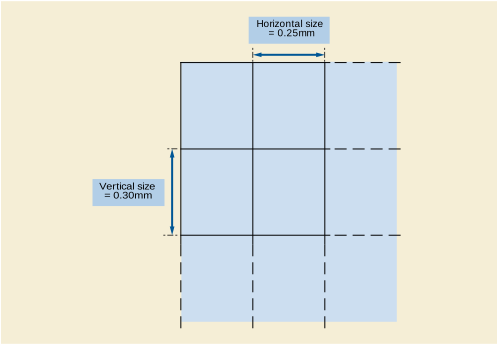
Pixel Aspect Ratio = Vertical Size \ Horizontal Size = 0.30 mm \0.25 mm. Thus the Pixel Aspect Ratio could be represented as the multi-valued integer string "6\5", "60\50", or any equivalent integer ratio.
Table C.7-12 specifies the Attributes that describe the contrast /bolus used in the acquisition of the Image.
Table C.7-12. Contrast/Bolus Module Attributes
|
Attribute Name |
Tag |
Type |
Attribute Description |
|---|---|---|---|
|
Contrast/Bolus Agent |
(0018,0010) |
2 |
Contrast or bolus agent |
|
Contrast/Bolus Agent Sequence |
(0018,0012) |
3 |
Sequence that identifies the contrast agent. One or more Items are permitted in this sequence. |
|
Baseline CID 12 “Radiographic Contrast Agent”. |
|||
|
Contrast/Bolus Route |
(0018,1040) |
3 |
Administration route of contrast agent |
|
Contrast/Bolus Administration Route Sequence |
(0018,0014) |
3 |
Sequence that identifies the route of administration of contrast agent. Only a single Item is permitted in this sequence. |
|
Baseline CID 11 “Route of Administration”. |
|||
|
>Additional Drug Sequence |
(0018,002A) |
3 |
Sequence that identifies any additional drug that is administered with the contrast agent bolus. One or more Items are permitted in this sequence. |
|
No Baseline CID is defined. |
|||
|
Contrast/Bolus Volume |
(0018,1041) |
3 |
Volume injected in milliliters of diluted contrast agent |
|
Contrast/Bolus Start Time |
(0018,1042) |
3 |
Time of start of injection |
|
Contrast/Bolus Stop Time |
(0018,1043) |
3 |
Time of end of contrast injection |
|
Contrast/Bolus Total Dose |
(0018,1044) |
3 |
Total amount in milliliters of the undiluted contrast agent |
|
Contrast Flow Rate |
(0018,1046) |
3 |
Rate(s) of injection(s) in milliliters/sec |
|
Contrast Flow Duration |
(0018,1047) |
3 |
Duration(s) of injection(s) in seconds. Each Contrast Flow Duration value shall correspond to a value of Contrast Flow Rate (0018,1046). |
|
Contrast/Bolus Ingredient |
(0018,1048) |
3 |
Active ingredient of agent. Defined Terms:
|
|
Contrast/Bolus Ingredient Concentration |
(0018,1049) |
3 |
Milligrams of active ingredient per milliliter of (diluted) agent |
Note
Flow duration is an alternate method of specifying stop time
Flow rate allows for stepped injections by being capable of multiple values (1,N) instances.
For a 100 ml injection of 76% Diatrizoate and meglumine/sodium, diluted 1:1,
the Contrast/Bolus Agent would be "76% Diatrizoate" as text
the Contrast/Bolus Volume would be 100 ml,
the Contrast/Bolus Total Dose would be 50 ml,
the Contrast/Bolus Ingredient would be "IODINE",
the Contrast/Bolus Ingredient Concentration would be 370mg/ml.
Table C.7-12b specifies the Attributes that describe the contrast/bolus used in the acquisition of the Image.
Table C.7-12b. Enhanced Contrast/Bolus Module Attributes
|
Attribute Name |
Tag |
Type |
Attribute Description |
|---|---|---|---|
|
Contrast/Bolus Agent Sequence |
(0018,0012) |
1 |
Sequence that identifies one or more contrast agents administered prior to or during the acquisition. One or more Items shall be included in this sequence. |
|
Baseline CID 12 “Radiographic Contrast Agent”. |
|||
|
>Contrast/Bolus Agent Number |
(0018,9337) |
1 |
Identifying number, unique within this SOP Instance, of the agent administered. Used to reference this particular agent from the Contrast/Bolus Functional Group Macro. The number shall be 1 for the first Item and increase by 1 for each subsequent Item. |
|
>Contrast/Bolus Administration Route Sequence |
(0018,0014) |
1 |
Sequence that identifies the route of administration of contrast agent. Only a single Item shall be included in this sequence. |
|
Baseline CID 11 “Route of Administration”. |
|||
|
>Contrast/Bolus Ingredient Code Sequence |
(0018,9338) |
2 |
Active ingredient of agent. Zero or more Items shall be included in this sequence. |
|
>Contrast/Bolus Volume |
(0018,1041) |
2 |
Total volume administered in milliliters of diluted contrast agent. |
|
>Contrast/Bolus Ingredient Concentration |
(0018,1049) |
2 |
Milligrams of active ingredient per milliliter of agent. |
|
>Contrast/Bolus Ingredient Percent by Volume |
(0052,0001) |
3 |
Percentage by volume of active ingredient in the total volume. |
|
>Contrast/Bolus Ingredient Opaque |
(0018,9425) |
3 |
Absorption of the ingredient greater than the absorption of water (tissue). Enumerated Values:
See Section C.7.6.4b.1. |
|
>Contrast/Bolus T1 Relaxivity |
(0018,0013) |
3 |
T1 Relaxivity of the MR Contrast/Bolus used specified in s-1*mmol-1 specified at body temperature in human blood plasma. |
|
>Contrast Administration Profile Sequence |
(0018,9340) |
3 |
Sequence that describes one or more phases of contrast administered. One or more Items are permitted in this sequence. |
|
>>Contrast/Bolus Volume |
(0018,1041) |
2 |
Volume administered during this phase in milliliters of diluted contrast agent. |
|
>>Contrast/Bolus Start Time |
(0018,1042) |
3 |
Time of start of administration. |
|
>>Contrast/Bolus Stop Time |
(0018,1043) |
3 |
Time of end of administration. |
|
>>Contrast Flow Rate |
(0018,1046) |
3 |
Rate of administration in milliliters/sec. Only a single value shall be present. |
|
>>Contrast Flow Duration |
(0018,1047) |
3 |
Duration of injection in seconds. Only a single value shall be present. |
Contrast/Bolus Ingredient Opaque (0018,9425) attribute specifies the type of relative X-Ray absorption of the contrast/bolus ingredient, compared to the X-Ray absorption of water.
Enumerated Values:
- YES
The contrast/bolus ingredient absorbs more X-Ray photons than water
- NO
The contrast/bolus ingredient absorbs less X-Ray photons than water
Note
The Contrast/Bolus Ingredient Opaque (0018,9425) attribute determines the sign of the gradient of X-Ray beam intensity from inside to outside the injected vessel, thus allowing optimal settings of the image processing applications (e.g., vessel edge detection, etc.), see Figure C.7.6.4b-1.
The relative gray level of the injected vessel with respect to the gray level of the water of Pixel Data (7FE0,0010) is determined by the Contrast/Bolus Ingredient Opaque (0018,9425) and by the Pixel Intensity Relationship Sign (0028,1041). For example, if the contrast/bolus ingredient is more radio graphically dense than water (i.e., YES), and the Pixel Intensity Relationship Sign (0028,1041) is -1, then the contrast/bolus ingredient is represented by higher values of Pixel Data than water.
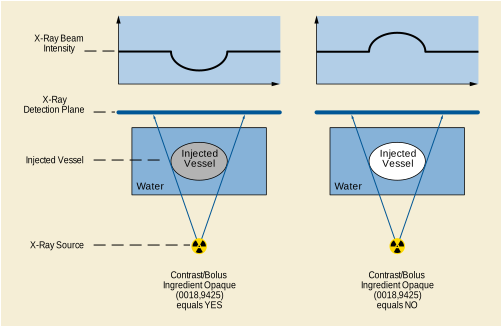
Table C.7-13 specifies the Attributes of a Multi-frame Cine Image.
Table C.7-13. Cine Module Attributes
|
Attribute Name |
Tag |
Type |
Attribute Description |
|---|---|---|---|
|
Preferred Playback Sequencing |
(0018,1244) |
3 |
Describes the preferred playback sequencing for a multi-frame image. Enumerated Values:
|
|
Frame Time |
(0018,1063) |
1C |
Nominal time (in msec) per individual frame. See Section C.7.6.5.1.1 for further explanation. Required if Frame Increment Pointer (0028,0009) points to Frame Time. |
|
Frame Time Vector |
(0018,1065) |
1C |
An array that contains the real time increments (in msec) between frames for a Multi-frame image. See Section C.7.6.5.1.2 for further explanation. Required if Frame Increment Pointer (0028,0009) points to Frame Time Vector. NoteFrame Time Vector arrays may not be properly encoded if Explicit VR transfer syntax is used and the VL of this attribute exceeds 65534 bytes. |
|
Start Trim |
(0008,2142) |
3 |
The frame number of the first frame of the Multi-frame image to be displayed. |
|
Stop Trim |
(0008,2143) |
3 |
The Frame Number of the last frame of a Multi-frame image to be displayed. |
|
Recommended Display Frame Rate |
(0008,2144) |
3 |
Recommended rate at which the frames of a Multi-frame image should be displayed in frames/second. |
|
Cine Rate |
(0018,0040) |
3 |
Number of frames per second. |
|
Frame Delay |
(0018,1066) |
3 |
Time (in msec) from Content Time (0008,0033) to the start of the first frame in a Multi-frame image. |
|
Image Trigger Delay |
(0018,1067) |
3 |
Delay time in milliseconds from trigger (e.g., X-Ray on pulse) to the first frame of a Multi-frame image. |
|
Effective Duration |
(0018,0072) |
3 |
Total time in seconds that data was actually taken for the entire Multi-frame image. |
|
Actual Frame Duration |
(0018,1242) |
3 |
Elapsed time of data acquisition in msec per each frame. |
|
Multiplexed Audio Channels Description Code Sequence |
(003A,0300) |
2C |
Description of any multiplexed audio channels. See Section C.7.6.5.1.3. Zero or more items may be included in this sequence. Required if the Transfer Syntax used to encode the multi-frame image contains multiplexed (interleaved) audio channels, such as is possible with MPEG2 Systems (see [ISO/IEC 13818-1]). |
|
>Channel Identification Code |
(003A,0301) |
1 |
A reference to the audio channel as identified within Transfer Syntax encoded bit stream (1 for the main channel, 2 for the second channel and 3 to 9 to the complementary channels). |
|
>Channel Mode |
(003A,0302) |
1 |
A coded descriptor qualifying the mode of the channel: Enumerated Values:
|
|
>Channel Source Sequence |
(003A,0208) |
1 |
A coded descriptor of the audio channel source. Only a single Item shall be included in this sequence. |
|
Defined CID Audio Channel Source 3000. |
|||
Frame Time (0018,1063) is the nominal time (in milliseconds) between individual frames of a Multi-frame image. If the Frame Increment Pointer points to this Attribute, Frame Time shall be used in the following manner to calculate 'the relative time' for each frame:
Frame 'Relative Time' (n) = Frame Delay + Frame Time * (n-1)
where: n = number of frame within the Multi-frame image and the first frame number is one
Note
When there is only one frame present, Frame Time (0018,1063) may have either a value of 0, or a nominal value that would apply if there were multiple frames.
Frame Time Vector (0018,1065) is an array that contains the time increments (in milliseconds) between the nth frame and the previous frame for a Multi-frame image. The first frame always has a time increment of 0. If the Frame Increment Pointer points to this Attribute, the Frame Time Vector shall be used in the following manner to calculate 'relative time' T(n) for frame n:
where Δti is the ith Frame Time Vector component.
During a video acquisition, audio may be used for voice commentary of what is being observed, as well as to record sound-based physiological information such as Doppler audio.
Some Transfer Syntaxes allow for the multiplexing of interleaved audio with video data, and the Attributes of the Cine Module support this encoding paradigm. They are not intended to describe audio acquired simultaneously when it is encoded in other SOP Instances or within Attributes other than Pixel Data (7FE0,0010) of the same SOP Instance.
Synchronization between audio and video is assumed to be encoded at the Transfer Syntax level (i.e., within the encoded bit stream).
Note
If no audio was recorded, the Multiplexed Audio Channels Description Code Sequence (003A,0300) will be present and contain no sequence items.
Table C.7-14 specifies the Attributes of a Multi-frame pixel data Image.
Table C.7-14. Multi-frame Module Attributes
|
Attribute Name |
Tag |
Type |
Attribute Description |
|---|---|---|---|
|
Number of Frames |
(0028,0008) |
1 |
Number of frames in a Multi-frame Image. See Section C.7.6.6.1.1 for further explanation. |
|
Frame Increment Pointer |
(0028,0009) |
1 |
Contains the Data Element Tag of the attribute that is used as the frame increment in Multi-frame pixel data. See Section C.7.6.6.1.2 for further explanation. |
A Multi-frame Image is defined as a Image whose pixel data consists of a sequential set of individual Image Pixel frames. A Multi-frame Image is transmitted as a single contiguous stream of pixels. Frame headers do not exist within the data stream.
Each individual frame shall be defined (and thus can be identified) by the Attributes in the Image Pixel Module (see Section C.7.6.3). All Image IE Attributes shall be related to the first frame in the Multi-frame image.
The total number of frames contained within a Multi-frame Image is conveyed in the Number of Frames (0028,0008).
The frames within a Multi-frame Image shall be conveyed as a logical sequence. The information that determines the sequential order of the frames shall be identified by the Data Element Tag or tags conveyed by the Frame Increment Pointer (0028,0009). Each specific Image IOD that supports the Multi-frame Module specializes the Frame Increment Pointer (0028,0009) to identify the Attributes that may be used as sequences.
Even if only a single frame is present, Frame Increment Pointer (0028,0009) is still required to be present and have at least one value, each of which shall point to an attribute that is also present in the Data Set and has a value.
Note
For example, in single-frame instance of an IOD that is required to or may contain the Cine Module, it may be appropriate for Frame Time (0018,1063) to be present with a value of 0, and be the only target of Frame Increment Pointer (0028,0009).
When the IOD Permits the use of Multi-frame Functional Groups as a Standard or Standard Extended SOP Class, Frame Increment Pointer may contain the single value of Per-frame Functional Groups Sequence (5200,9230) to indicate that the Functional Groups contain the descriptors of the frames.
Note
For example, the Multi-frame Grayscale Word SC Image IOD requires the Multi-frame Module but also permits the Multi-frame Functional Groups, for example, to describe the plane position of each frame.
Table C.7-15 specifies the attributes of a Frame Pointer Module.
Table C.7-15. Frame Pointers Module Attributes
|
Attribute Name |
Tag |
Type |
Attribute Description |
|---|---|---|---|
|
Representative Frame Number |
(0028,6010) |
3 |
The frame number selected for use as a pictorial representation (e.g., icon) of the Multi-frame Image |
|
Frame Numbers Of Interest (FOI) |
(0028,6020) |
3 |
Frame number(s) selected as frames of interest. A frame number may appear more than once. |
|
Frame Of Interest Description |
(0028,6022) |
3 |
Description of each one of the Frame(s) of Interest selected in (0028,6020). If multiple Frames of Interest are selected and this Attribute is used, it shall contain the same number of values as are in Frame Numbers of Interest (0028,6020). |
|
Frame of Interest Type |
(0028,6023) |
3 |
A Defined Term for each one of the Frame(s) of Interest (0028,6020) that identifies the significance of the frame. If multiple Frames of Interest are selected and this Attribute is used, it shall contain the same number of values as are in Frame Numbers of Interest (0028,6020). Defined Terms:
|
Note
Frame numbers begin at 1.
Frame of Interest Description is intended to indicate such frames as Systolic, Diastolic, Stenotic Artery, or trigger label.
Table C.7-16 specifies the Attributes that describe mask operations for a Multi-frame image.
Table C.7-16. Mask Module Attributes
|
Attribute Name |
Tag |
Type |
Attribute Description |
|---|---|---|---|
|
Mask Subtraction Sequence |
(0028,6100) |
1 |
Defines a sequence that describes mask subtraction operations for a Multi-frame Image. One or more items shall be included in this sequence. |
|
>Mask Operation |
(0028,6101) |
1 |
Defined Term identifying the type of mask operation to be performed. See Section C.7.6.10.1 for further explanation. |
|
>Subtraction Item ID |
(0028,9416) |
1C |
Identification of the Subtraction Item used to associate a certain Mask Sub-Pixel Shift (0028,6114) in the Frame Pixel Shift Functional Group. Required if SOP Class UID (0008,0016) equals "1.2.840.10008.5.1.4.1.1.12.1.1" or "1.2.840.10008.5.1.4.1.1.12.2.1". May be present otherwise. |
|
>Applicable Frame Range |
(0028,6102) |
1C |
Each pair of numbers in this multi-valued attribute specify a beginning and ending frame number inclusive of a range where this particular mask operation is valid. Discontinuous ranges are represented by multiple pairs of numbers. Frames in a Multi-frame Image are specified by sequentially increasing number values beginning with 1. If this Attribute is missing in this particular sequence item, then the mask operation is applicable throughout the entire Multi-frame Image, subject to certain limits as described in Section C.7.6.10.1.1. Required if Mask Operation (0028,6101) equals REV_TID. May be present otherwise. |
|
>Mask Frame Numbers |
(0028,6110) |
1C |
Specifies the frame numbers of the pixel data used to generate this mask. Frames in a Multi-frame Image are specified by sequentially increasing number values beginning with 1. Required if Mask Operation (0028,6101) is AVG_SUB. |
|
>Contrast Frame Averaging |
(0028,6112) |
3 |
Specifies the number of contrast frames to average together before performing the mask operation. If the Attribute is missing, no averaging is performed. |
|
>Mask Sub-pixel Shift |
(0028,6114) |
3 |
A pair of floating point numbers specifying the fractional vertical [adjacent row spacing] and horizontal [adjacent column spacing] pixel shift applied to the mask before subtracting it from the contrast frame. See Section C.7.6.10.1.2. NoteWhen the Frame Pixel Shift Functional Group is present the values of the Mask Pixel Shift attribute of that Functional Group prevails over the values specified in this module. |
|
>TID Offset |
(0028,6120) |
2C |
If Mask Operation is TID, specifies the offset to be subtracted from the current frame number in order to locate the mask frame in TID mode. If Mask Operation is REV_TID, specifies the initial offset to be subtracted from the first contrast frame number. See Section C.7.6.10.1.1. If zero length, TID Offset defaults to 1. Required if Mask Operation (0028,6101) is TID or REV_TID. |
|
>Mask Operation Explanation |
(0028,6190) |
3 |
Free form explanation of this particular mask operation. |
|
>Mask Selection Mode |
(0028,9454) |
3 |
Specifies the method of selection of the mask operations of this item. Enumerated Values:
|
|
Recommended Viewing Mode |
(0028,1090) |
2 |
Specifies the recommended viewing protocol(s). Defined Terms:
NoteIf an implementation does not recognize the Defined Term for Recommended Viewing Mode (0028,1090), reverting to native display mode is recommended. |
Note
Frame numbers begin at 1.
Mask Operation (0028,6101) specifies a type of mask operation to be performed.
Defined Terms:
- NONE
(No Subtraction) No mask subtraction operation is specified;
- AVG_SUB
(Average Subtraction) The frames specified by the Mask Frame Numbers (0028,6110) are averaged together, shifted by the amount specified in the Mask Sub-pixel Shift (0028,6114), then subtracted from the contrast frames in the range specified in the Applicable Frame Range (0028,6102). Contrast Frame Averaging (0028,6112) number of frames starting with the current frame are averaged together before the subtraction. If the Applicable Frame Range is not present in this sequence item, the Applicable Frame Range is assumed to end at the last frame number of the image minus Contrast Frame Averaging (0028,6112) plus one;
- TID
(Time Interval Differencing) The mask for each frame within the Applicable Frame Range (0028,6102) is selected by subtracting TID Offset (0028,6120) from the respective frame number. If the Applicable Frame Range is not present in this sequence item, the Applicable Frame Range is assumed to be a range where TID offset subtracted from any frame number with the range results in a valid frame number within the Multi-frame image.
Note
A positive value for TID Offset (0028,6120) means that the mask frame numbers are lower than the subtracted frame numbers. A negative TID Offset means that the mask frame numbers are higher than the subtracted frame numbers.
- REV_TID
(Reversed Time Interval Differencing) The number of the mask frame for each contrast frame within the Applicable Frame Range (0028,6102) is calculated by subtracting TID Offset (0028,6120) from the first frame within the Applicable Frame Range, TID Offset (0028,6120) +2 from the second frame within the Applicable Frame Range, TID Offset (0028,6120) +4 from the third frame and so on. The Applicable Frame Range (0028,6102) shall be present.
When multiple pairs of frame numbers are specified in the Applicable Frame Range attribute, the beginning frame numbers (i.e., the first frame number in each pair) shall be in increasing order.
Algorithm to calculate the Mask Frame Number:
MFN = (FCFN - TID Offset) - (CFN - FCFN)
Where:
MFN = Mask Frame Number
CFN = Contrast Frame Number
FCFN = First Contrast Frame Number, the first frame number of the first pair in the Applicable Frame Range
Note
A positive value for TID Offset (0028,6120) means that the mask frame numbers are lower than the subtracted frame numbers. A negative TID Offset means that the mask frame numbers are higher than the subtracted frame numbers.
Note
Example of TID Offset, see Figure C.7.6.10-1:
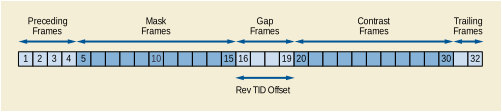
Number of Frames: 32
Applicable Frame Range: 20 to 30
TID Offset: 5
For Calculating the TID Offset for Mask Operation REV_TID see Table C.7.6.10-1.
Table C.7.6.10-1. Example Mask Frame Numbers for Mask Operation REV_TID
|
Contrast Frame Number (CFN) (Absolute value) |
Mask Frame Number (MFN) (Absolute value) |
|---|---|
|
20 |
15 |
|
21 |
14 |
|
22 |
13 |
|
… |
… |
|
28 |
7 |
|
29 |
6 |
|
30 |
5 |
In this example the acquisition of the mask frames starts with frame 5 and ends with frame 15. The acquisition of the contrast frames starts with frame 20 and ends with frame 30 (Applicable Frame Range). The number 5 for TID Offset indicates a gap between "end of mask frames" and "begin of contrast frames" of 4 frames, e.g., injection phase and/or time needed to drive C-arm in reverse. Additionally, in this example, the first 4 frames and the last two frames are not used for this Reversed Time Interval Differencing loop.
A pair of floating point numbers specifying the fractional vertical [adjacent row spacing] and horizontal [adjacent column spacing] pixel shift applied to the mask before subtracting it from the contrast frame. The row offset results in a shift of the pixels along the column axis. The column offset results in a shift of the pixels along the row axis. A positive row offset is a shift toward the pixels of the lower row of the pixel plane. A positive column offset is a shift toward the pixels of the left hand side column of the pixel plane.
The Display shutter is a geometric mask consisting of one or more combined shapes that may be applied on the image for presentation purposes in order to neutralize the display of any of the pixels located outside of the shutter shape. Geometry of the shutter is specified with respect to a row and column coordinate system where the origin is the upper left hand pixel. This origin is specified by the values 1,1 for row/column. A row coordinate represents a row spacing (vertical) and a column coordinate represents a column spacing (horizontal). Up to three different shutter shapes may be used and superimposed.
The manner in which the display area is neutralized (black-out, gray, or other means) is defined by the Attribute Shutter Presentation Value (0018,1622), or undefined if this Attribute is absent or empty.
Table C.7-17a. Display Shutter Macro Attributes
|
Attribute Name |
Tag |
Type |
Attribute Description |
|---|---|---|---|
|
Shutter Shape |
(0018,1600) |
1 |
Shape(s) of the shutter defined for display. Enumerated Values:
This multi-valued Attribute shall contain at most one of each Enumerated Value. When multiple values are present, and the shutter is applied to a displayed image, then all of the shapes shall be combined and applied simultaneously, that is, the least amount of image remaining shall be visible (unoccluded). See Figure C.7-4b. |
|
Shutter Left Vertical Edge |
(0018,1602) |
1C |
Required if Shutter Shape (0018,1600) is RECTANGULAR. Location of the left edge of the rectangular shutter with respect to pixels in the image given as column. |
|
Shutter Right Vertical Edge |
(0018,1604) |
1C |
Required if Shutter Shape (0018,1600) is RECTANGULAR. Location of the right edge of the rectangular shutter with respect to pixels in the image given as column. |
|
Shutter Upper Horizontal Edge |
(0018,1606) |
1C |
Required if Shutter Shape (0018,1600) is RECTANGULAR. Location of the upper edge of the rectangular shutter with respect to pixels in the image given as row. |
|
Shutter Lower Horizontal Edge |
(0018,1608) |
1C |
Required if Shutter Shape (0018,1600) is RECTANGULAR. Location of the lower edge of the rectangular shutter with respect to pixels in the image given as row. |
|
Center of Circular Shutter |
(0018,1610) |
1C |
Required if Shutter Shape (0018,1600) is CIRCULAR. Location of the center of the circular shutter with respect to pixels in the image given as row and column. |
|
Radius of Circular Shutter |
(0018,1612) |
1C |
Required if Shutter Shape (0018,1600) is CIRCULAR. Radius of the circular shutter with respect to pixels in the image given as a number of pixels along the row direction. |
|
Vertices of the Polygonal Shutter |
(0018,1620) |
1C |
Required if Shutter Shape (0018,1600) is POLYGONAL. Multiple Values where the first set of two values are: row of the origin vertexcolumn of the origin vertex Two or more pairs of values follow and are the row and column coordinates of the other vertices of the polygon shutter. Polygon shutters are implicitly closed from the last vertex to the origin vertex and all edges shall be non-intersecting except at the vertices. |
|
Shutter Presentation Value |
(0018,1622) |
3 |
A single gray unsigned value used to replace those parts of the image occluded by the shutter, when rendered on a monochrome display. The units are specified in P-Values, from a minimum of 0000H (black) up to a maximum of FFFFH (white). NoteThe maximum P-Value for this Attribute may be different from the maximum P-Value from the output of the Presentation LUT, which may be less than 16 bits in depth. |
|
Shutter Presentation Color CIELab Value |
(0018,1624) |
3 |
A color triplet value used to replace those parts of the image occluded by the shutter, when rendered on a color display. The units are specified in PCS-Values, and the value is encoded as CIELab. See Section C.10.7.1.1. |
Figure C.7-1, Figure C.7-2, Figure C.7-3, Figure C.7-4 and Figure C.7-4b illustrate the values of coordinate attributes for 1:1 aspect and 2:1 aspect ratio images with rectangular and circular display shutters applied.
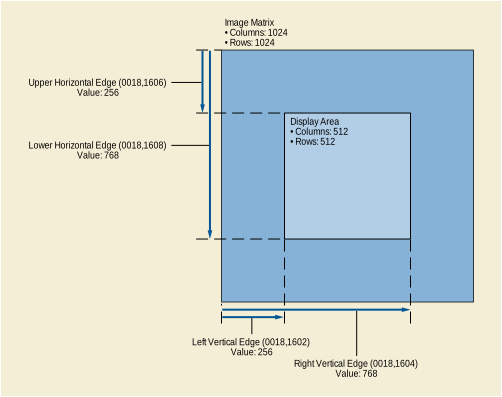
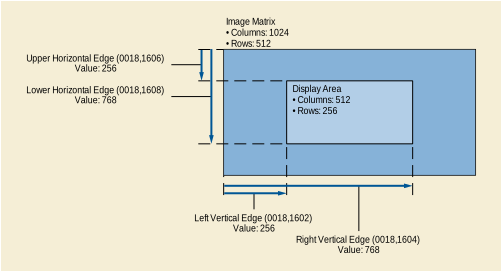
Figure C.7-2. Rectangular Display Shutter (2:1 aspect ratio images as they would appear before interpolation for display)
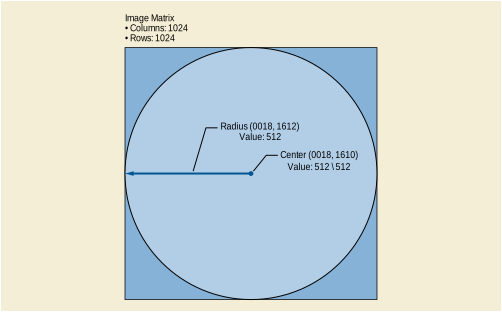
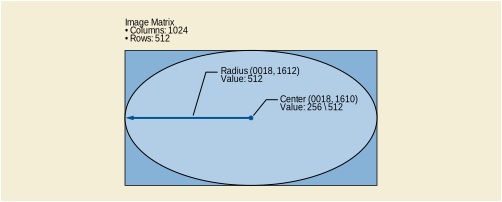
Figure C.7-4. Circular Display Shutter (2:1 aspect ratio images as they would appear before interpolation for display)
Figure C.7-4b illustrates the combined application of rectangular and circular display shutters to show the least amount of visible image.
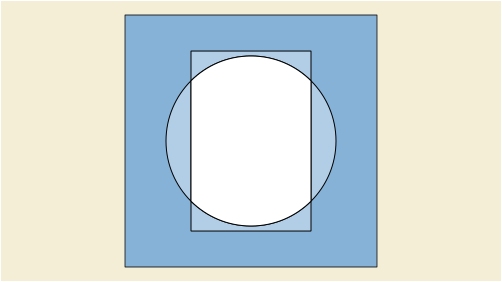
Table C.7-18 describes the Attributes of devices or calibration objects (e.g., catheters, markers, baskets) that are associated with a study and/or image.
Table C.7-18. Device Module Attributes
|
Attribute Name |
Tag |
Type |
Attribute Description |
|---|---|---|---|
|
Device Sequence |
(0050,0010) |
1 |
A sequence of items describing devices used that may be visible in the image. One or more Items shall be included in this Sequence. |
|
Baseline CID 4051 “General Devices”. |
|||
|
>Manufacturer |
(0008,0070) |
3 |
Manufacturer of the device |
|
>Manufacturer's Model Name |
(0008,1090) |
3 |
Manufacturer's model name of the device |
|
>Device Serial Number |
(0018,1000) |
3 |
Manufacturer's serial number of the device |
|
>Device ID |
(0018,1003) |
3 |
User-supplied identifier for the device |
|
>Device Length |
(0050,0014) |
3 |
Length in mm of device. See Section C.7.6.12.1.1. |
|
>Device Diameter |
(0050,0016) |
3 |
Unit diameter of device. See Section C.7.6.12.1.1. |
|
>Device Diameter Units |
(0050,0017) |
2C |
Required if Device Diameter (0050,0016) is present. Defined Terms:
|
|
>Device Volume |
(0050,0018) |
3 |
Volume of device in ml. See Section C.7.6.12.1.1. |
|
>Inter-Marker Distance |
(0050,0019) |
3 |
Distance in mm between markers on calibrated device. See Section C.7.6.12.1.1. |
|
>Device Description |
(0050,0020) |
3 |
Further description in free form text describing the device. |
Depending on the type of device specified by Code Value (0008,0100) in an item of Device Sequence (0050,0010), various device size attributes (e.g., Device Length (0050,0014), Device Diameter (0050,0016), Device Volume (0050,0018), Inter Marker Distance (0050,0019)) may be required to fully characterize the device.
Table C.7-19 describes the Attributes of therapies (e.g., interventions during an angiographic procedure) that are associated with a study and/or image.
Table C.7-19. Intervention Module Attributes
|
Attribute Name |
Tag |
Type |
Attribute Description |
|---|---|---|---|
|
Intervention Sequence |
(0018,0036) |
3 |
Sequence describing interventional therapies or procedures. One or more Items are permitted in this Sequence. |
|
>Intervention Status |
(0018,0038) |
2 |
Temporal relation of SOP Instance to intervention Enumerated Values:
|
|
>Intervention Drug Code Sequence |
(0018,0029) |
3 |
Sequence that identifies the interventional drug. Only a single item is permitted in this Sequence. |
|
Baseline CID 10 “Interventional Drug”. |
|||
|
>Intervention Drug Start Time |
(0018,0035) |
3 |
Time of administration of the interventional drug. |
|
>Intervention Drug Stop Time |
(0018,0027) |
3 |
Time of completion of administration of the intervention drug. |
|
>Administration Route Code Sequence |
(0054,0302) |
3 |
Sequence that identifies the Administration Route. Only a single Item is permitted in this sequence. |
|
Baseline CID 11 “Route of Administration”. |
|||
|
>Intervention Description |
(0018,003A) |
3 |
Further description in free form text describing the therapy or other intervention. |
Note
Therapy Description (0018,0039) was included in this Module in earlier editions, but its use has been retired. See PS3.3-2003.
Table C.7.6.14-1 specifies Attributes for description of the conditions present during data acquisition.
This Module shall not contain descriptions of conditions that replace those that are already described in specific Modules or Attributes that are also contained within the IOD that contains this Module.
Note
Each item of the Acquisition Context Sequence (0040,0555) contains one item of the Concept Name Code Sequence (0040,A043) and one of the mutually-exclusive Observation-value Attributes: Concept Code Sequence (0040,A168), the pair of Numeric Value (0040,A30A) and Measurement Units Code Sequence (0040,08EA), Date (0040,A121), Time (0040,A122), Person Name (0040,A123) or Text Value (0040,A160).
If this SOP Instance is a Multi-frame SOP Instance, each item of the Acquisition Context Sequence (0040,0555) may be configured to describe one frame, all frames, or any specifically enumerated subset set of frames of the Multi-frame SOP Instance.
Table C.7.6.14-1. Acquisition Context Module Attributes
|
Attribute Name |
Tag |
Type |
Attribute Description |
|---|---|---|---|
|
Acquisition Context Sequence |
(0040,0555) |
2 |
A sequence of Items that describes the conditions present during the acquisition of the data of the SOP Instance. Zero or more items shall be included in this sequence. |
|
>Value Type |
(0040,A040) |
3 |
The type of the value encoded in this Item. Defined Terms:
See Section 10.2. |
|
>Concept Name Code Sequence |
(0040,A043) |
1 |
A concept that constrains the meaning of (i.e., defines the role of) the Observation Value. The "Name" component of a Name/Value pair. Only a single Item shall be included in this sequence. |
|
No Baseline Context is defined. |
|||
|
>Referenced Frame Numbers |
(0040,A136) |
1C |
References one or more frames in a Multi-frame SOP Instance. The first frame shall be denoted as frame number one. Required if this SOP Instance is a Multi-frame SOP Instance and the values in this sequence item do not apply to all frames. |
|
>Numeric Value |
(0040,A30A) |
1C |
This is the Value component of a Name/Value pair when the Concept implied by Concept Name Code Sequence (0040,A043) is a set of one or more numeric values. Required if the value that Concept Name Code Sequence (0040,A043) requires (implies) is a set of one or more integers or real numbers. Shall not be present otherwise. |
|
>Floating Point Value |
(0040,A161) |
1C |
The floating point representation of Numeric Value (0040,A30A). The same number of values as Numeric Value (0040,A30A) shall be present. Required if Numeric Value (0040,A30A) has insufficient precision to represent the value as a string. May be present otherwise. |
|
>Rational Numerator Value |
(0040,A162) |
1C |
The integer numerator of a rational representation of Numeric Value (0040,A30A). Encoded as a signed integer value. The same number of values as Numeric Value (0040,A30A) shall be present. Required if Numeric Value (0040,A30A) has insufficient precision to represent a rational value as a string. May be present otherwise. |
|
>Rational Denominator Value |
(0040,A163) |
1C |
The integer denominator of a rational representation of Numeric Value (0040,A30A). Encoded as a non-zero unsigned integer value. The same number of values as Numeric Value (0040,A30A) shall be present. Required if Rational Numerator Value (0040,A162) is present. |
|
>Measurement Units Code Sequence |
(0040,08EA) |
1C |
Units of measurement. Only a single Item shall be included in this Sequence. Required if Numeric Value (0040,A30A) is sent. Shall not be present otherwise. |
|
Baseline CID 82 “Units of Measurement”. |
|||
|
>Date |
(0040,A121) |
1C |
This is the Value component of a Name/Value pair when the Concept implied by Concept Name Code Sequence (0040,A043) is a date. NoteThe purpose or role of the date value could be specified in Concept Name Code Sequence (0040,A043). Required if the value that Concept Name Code Sequence (0040,A043) requires (implies) is a date. Shall not be present otherwise. |
|
>Time |
(0040,A122) |
1C |
This is the Value component of a Name/Value pair when the Concept implied by Concept Name Code Sequence (0040,A043) is a time. NoteThe purpose or role of the time value could be specified in Concept Name Code Sequence (0040,A043). Required if the value that Concept Name Code Sequence (0040,A043) requires (implies) is a time. Shall not be present otherwise. |
|
>Person Name |
(0040,A123) |
1C |
This is the Value component of a Name/Value pair when the Concept implied by Concept Name Code Sequence (0040,A043) is a Person Name. NoteThe role of the person could be specified in Concept Name Code Sequence (0040,A043). Required if the value that Concept Name Code Sequence (0040,A043) requires (implies) is a person name. Shall not be present otherwise. |
|
>Text Value |
(0040,A160) |
1C |
This is the Value component of a Name/Value pair when the Concept implied by Concept Name Code Sequence (0040,A043) is a Text Observation Value. Required if Date (0040,A121), Time (0040,A122), and Person Name (0040,A123) do not fully describe the concept specified by Concept Name Code Sequence (0040,A043). Shall not be present otherwise. |
|
>Concept Code Sequence |
(0040,A168) |
1C |
This is the Value component of a Name/Value pair when the Concept implied by Concept Name Code Sequence (0040,A043) is a Coded Value. Only a single Item shall be included in this sequence. Required if Date (0040,A121), Time (0040,A122), Person Name (0040,A123), Text Value (0040,A160), and the pair of Numeric Value (0040,A30A) and Measurement Units Code Sequence (0040,08EA) are not present. |
|
No Baseline Context is defined. |
|||
|
Acquisition Context Description |
(0040,0556) |
3 |
Free-text description of the image-acquisition context. |
The Bitmap Display Shutter is a bitmap that defines an arbitrary shape that may be applied on the image for presentation purposes in order to neutralize the display of any of the pixels defined in the bitmap.
The manner in which the display area is neutralized (black-out, gray, or other means) is defined by the Attribute Shutter Presentation Value (0018,1622).
The bitmap is specified as a reference to an instance of the Overlay Plane Module Section C.9.2. The referenced Overlay is specialized such that:
Overlay Type (60xx,0040) shall be "G",
Overlay Bits Allocated (60xx,0100) shall be 1,
Overlay Bit Position (60xx,0102) shall be 0 and
Overlay Origin (60xx,0050) shall be 1\1.
Overlay Rows (60xx,0010) and Overlay Columns (60xx,0011) shall be the same as Rows (0028,0010) and Columns (0028,0011) in the image respectively.
A value of 1 in Overlay Data (60xx,3000) shall indicate a pixel to which the shutter is applied, i.e., replaced with Shutter Presentation Value (0018,1622).
The Overlay specified in this Attribute shall not be activated (used as a conventional overlay) by the Overlay Activation Module Section C.11.7.
Table C.7.6.15-1. Bitmap Display Shutter Module Attributes
|
Attribute Name |
Tag |
Type |
Attribute Description |
|---|---|---|---|
|
Shutter Shape |
(0018,1600) |
1 |
Shape of the shutter defined for display. Enumerated Values:
This Attribute shall contain one Value. |
|
Shutter Overlay Group |
(0018,1623) |
1 |
Specifies the Group (60xx) of an Overlay stored within the Presentation State IOD that contains the bitmap data, as defined in the Overlay Plane Module Section C.9.2. |
|
Shutter Presentation Value |
(0018,1622) |
1 |
A single gray unsigned value used to replace those parts of the image occluded by the shutter, when rendered on a monochrome display. The units are specified in P-Values, from a minimum of 0000H (black) up to a maximum of FFFFH (white). NoteThe maximum P-Value for this Attribute may be different from the maximum P-Value from the output of the Presentation LUT, which may be less than 16 bits in depth. |
|
Shutter Presentation Color CIELab Value |
(0018,1624) |
3 |
A color triplet value used to replace those parts of the image occluded by the shutter, when rendered on a color display. The units are specified in PCS-Values, and the value is encoded as CIELab. See Section C.10.7.1.1. |
Table C.7.6.16-1 specifies the attributes of the Multi-frame Functional Groups Module. This module is included in SOP instances even if there is only one frame in the instance.
Table C.7.6.16-1. Multi-frame Functional Groups Module Attributes
|
Attribute Name |
Tag |
Type |
Attribute Description |
|---|---|---|---|
|
Shared Functional Groups Sequence |
(5200,9229) |
1 |
Sequence that contains the Functional Group Macros that are shared for all frames in this SOP Instance and Concatenation. NoteThe contents of this sequence are the same in all SOP Instances that comprise a Concatenation. Only a single Item shall be included in this sequence. See Section C.7.6.16.1.1 for further explanation. |
|
>Include one or more Functional Group Macros that are shared by all frames. The selected Functional Group Macros shall not be present in the Per-frame Functional Groups Sequence (5200,9230). |
For each IOD that includes this module, a table is defined in which the permitted Functional Group Macros and their usage is specified. The Item may be empty if the requirements for inclusion of the Functional Groups are not satisfied. |
||
|
Per-frame Functional Groups Sequence |
(5200,9230) |
1 |
Sequence that contains the Functional Group Sequence Attributes corresponding to each frame of the Multi-frame Image. The first Item corresponds with the first frame, and so on. One or more Items shall be included in this sequence. The number of Items shall be the same as the number of frames in the Multi-frame image. See Section C.7.6.16.1.2 for further explanation. |
|
>Include one or more Functional Group Macros. |
For each IOD that includes this module, a table is defined in which the permitted Functional Group Macros and their usage is specified. An Item may be empty if the requirements for inclusion of the Functional Groups for the corresponding frame are not satisfied. |
||
|
Instance Number |
(0020,0013) |
1 |
A number that identifies this instance. The value shall be the same for all SOP Instances of a Concatenation, and different for each separate Concatenation and for each SOP Instance not within a Concatenation in a series. |
|
Content Date |
(0008,0023) |
1 |
The date the data creation was started. NoteFor instance, this is the date the pixel data is created, not the date the data is acquired. |
|
Content Time |
(0008,0033) |
1 |
The time the data creation was started. NoteFor instance, this is the time the pixel data is created, not the time the data is acquired. |
|
Number of Frames |
(0028,0008) |
1 |
Number of frames in a multi-frame image. See Section C.7.6.6.1.1 for further explanation. |
|
Concatenation Frame Offset Number |
(0020,9228) |
1C |
Offset of the first frame in a multi-frame image of a concatenation. Logical frame numbers in a concatenation can be used across all its SOP instances. This offset can be applied to the implicit frame number to find the logical frame number in a concatenation. The offset is numbered from zero; i.e., the instance of a concatenation that begins with the first frame of the concatenation has a Concatenation Frame Offset Number (0020,9228) of zero. Required if Concatenation UID (0020,9161) is present. |
|
Representative Frame Number |
(0028,6010) |
3 |
The frame number selected for use as a pictorial representation (e.g., icon) of the multi-frame Image. |
|
Concatenation UID |
(0020,9161) |
1C |
Identifier of all SOP Instances that belong to the same concatenation. Required if a group of multi-frame image SOP Instances within a Series are part of a Concatenation. |
|
SOP Instance UID of Concatenation Source |
(0020,0242) |
1C |
The SOP Instance UID of the single composite SOP Instance of which the Concatenation is a part. All SOP Instances of a concatenation shall use the same value for this attribute, see Section C.7.6.16.1.3. NoteMay be used to reference the entire instance rather than individual instances of the concatenation, which may be transient (e.g., from a presentation state). Required if Concatenation UID (0020,9161) is present. |
|
In-concatenation Number |
(0020,9162) |
1C |
Identifier for one SOP Instance belonging to a concatenation. See Section C.7.6.16.2.2.4 for further specification. The first instance in a concatenation (that with the lowest Concatenation Frame Offset Number (0020,9228) value) shall have an In-concatenation Number (0020,9162) value of 1, and subsequent instances shall have values monotonically increasing by 1. Required if Concatenation UID (0020,9161) is present. |
|
In-concatenation Total Number |
(0020,9163) |
3 |
The number of SOP Instances sharing the same Concatenation UID. |
A Functional Group is a set of Attributes that are logically related and may vary together. Functional Groups are defined by editorial convention in Macros. Those Functional Groups that apply to all frames are included in the Shared Functional Groups Sequence (5200,9229). Functional Groups whose attribute values may vary from frame to frame are included in the Per-frame Functional Groups Sequence (5200,9230).
A single Functional Group shall not be included in both the Shared Functional Groups Sequence (5200,9229) and the Per-frame Functional Groups Sequence (5200,9230).
Note
In the case of a SOP Instance containing a single frame, some Functional Groups may be contained in the Shared Functional Groups Sequence (5200,9229) and others in the one Item of the Per-frame Functional Groups Sequence (5200,9230).
Even if there are no Functional Groups in the Per-frame Functional Groups Sequence 5200,9230) an empty Item is encoded for every frame, which an IOD is permitted to specify for a Type 1 Sequence, as described in PS3.5.
It may happen that the Data Set for the Item of a Functional Group Sequence Attribute does not contain any Attributes (e.g., a condition for a single Type 1C attribute in the sequence is not met). In this case, the Item is included but is empty.
Note
PS3.5 describes that an empty Item is permitted for a Type 1 or Type 2 Sequence depending on what the IOD in PS3.3 defines for the Data Set that is defined for that Sequence Item.
It may happen that a Functional Group Sequence Attribute is not required for a particular frame (e.g., an optional Functional Group). In this case the Functional Group Sequence Attribute is not included in the Per-frame Functional Groups Sequence (5200,9230) Item for that frame.
Note
The absence of the sequence attribute corresponding to a particular functional group indicates that the functional group is not used for a particular frame.
Private Functional Groups may be defined. The attributes of such a group may be standard or private attributes. A Private Functional Group may not replicate the attributes of a standard Functional Group.
A Private Functional Group can be added to either the Shared Functional Groups Sequence (5200,9229) or the Per-frame Functional Groups Sequence (5200,9230).
The Per-frame Functional Groups Sequence Attribute (5200,9230) consists of a Sequence of Items. Each Item describes the frame of the same rank in the multi-frame pixel data. The first Item describes frame 1, the second Item describes frame 2, etc. Frames are implicitly numbered starting from 1. See Figure C.7.6.16-1.
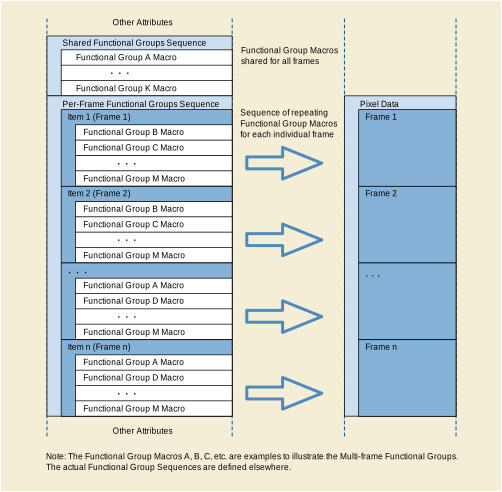
The SOP Instance UID of Concatenation Source (0020,0242) attribute contains the SOP Instance UID of the original, not concatenated, SOP Instance and does not change when a concatenation is created. It is independent of Concatenation UID (0020,9161) because a SOP Instance can be divided into concatenations only during exchange and there can be more than one concatenation with different Concatenation UIDs of an original SOP Instance; See Figure C.7.6.16-1a.
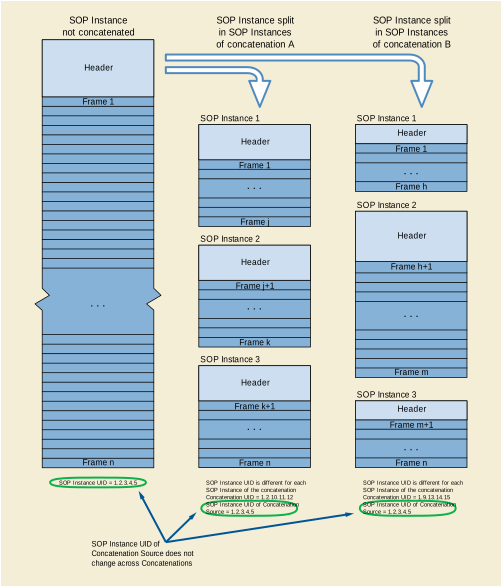
The following sections contain Functional Group Macros common to more than one IOD specification.
Note
The attribute descriptions in the Functional Group Macros are written as if they were applicable to a single frame (i.e., the macro is part of the Per-frame Functional Groups Sequence). If an attribute is applicable to all frames (i.e., the macro is part of the Shared Functional Groups Sequence) the phrase "this frame" in the attribute description shall be interpreted to mean "for all frames".
Table C.7.6.16-2 specifies the attributes of the Pixel Measures Functional Group Macro.
Table C.7.6.16-2. Pixel Measures Macro Attributes
|
Attribute Name |
Tag |
Type |
Attribute Description |
|---|---|---|---|
|
Pixel Measures Sequence |
(0028,9110) |
1 |
Identifies the physical characteristics of the pixels of this frame. Only a single Item shall be included in this sequence. |
|
>Pixel Spacing |
(0028,0030) |
1C |
Physical distance in the imaging target (patient, specimen, or phantom) between the centers of each pixel, specified by a numeric pair - adjacent row spacing (delimiter) adjacent column spacing in mm. See Section 10.7.1.3 for further explanation of the value order. NoteIn the case of CT images with an Acquisition Type (0018,9302) of CONSTANT_ANGLE, the pixel spacing is that in a plane normal to the central ray of the diverging X-Ray beam as it passes through the data collection center. Required if Volumetric Properties (0008,9206) is other than DISTORTED or SAMPLED. May be present otherwise. |
|
>Slice Thickness |
(0018,0050) |
1C |
Nominal reconstructed slice thickness (for tomographic imaging) or depth of field (for optical non-tomographic imaging), in mm. See Section C.7.6.16.2.3.1 for further explanation. NoteDepth of field may be an extended depth of field created by focus stacking (see Section C.8.12.4). Required if Volumetric Properties (0008,9206) is VOLUME or SAMPLED. May be present otherwise. |
Table C.7.6.16-3 specifies the attributes of the Frame Content Functional Group Macro.
This Functional Group Macro may only be part of the Per-frame Functional Groups Sequence (5200,9230) attribute.
Table C.7.6.16-3. Frame Content Macro Attributes
|
Attribute Name |
Tag |
Type |
Attribute Description |
|---|---|---|---|
|
Frame Content Sequence |
(0020,9111) |
1 |
Identifies general characteristics of this frame. Only a single Item shall be included in this sequence. |
|
>Frame Acquisition Number |
(0020,9156) |
3 |
A number identifying the single continuous gathering of data over a period of time that resulted in this frame. |
|
>Frame Reference DateTime |
(0018,9151) |
1C |
The point in time that is most representative of when data was acquired for this frame. See Section C.7.6.16.2.2.1 and Section C.7.6.16.2.2.2 for further explanation. NoteThe synchronization of this time with an external clock is specified in the synchronization Module in Acquisition Time synchronized (0018,1800). Required if Frame Type (0008,9007) Value 1 of this frame is ORIGINAL and the SOP Class UID is not "1.2.840.10008.5.1.4.1.1.2.2" or "1.2.840.10008.5.1.4.1.1.4.4" or "1.2.840.10008.5.1.4.1.1.128.1" (Legacy Converted). May be present otherwise. |
|
>Frame Acquisition DateTime |
(0018,9074) |
1C |
The date and time that the acquisition of data that resulted in this frame started. See Section C.7.6.16.2.2.1 for further explanation. Required if Frame Type (0008,9007) Value 1 of this frame is ORIGINAL and the SOP Class UID is not "1.2.840.10008.5.1.4.1.1.2.2" or "1.2.840.10008.5.1.4.1.1.4.4" or "1.2.840.10008.5.1.4.1.1.128.1" (Legacy Converted). May be present otherwise. |
|
>Frame Acquisition Duration |
(0018,9220) |
1C |
The actual amount of time [in milliseconds] that was used to acquire data for this frame. See Section C.7.6.16.2.2.1 and Section C.7.6.16.2.2.3 for further explanation. Required if Frame Type (0008,9007) Value 1 of this frame is ORIGINAL and the SOP Class UID is not "1.2.840.10008.5.1.4.1.1.2.2" or "1.2.840.10008.5.1.4.1.1.4.4" or "1.2.840.10008.5.1.4.1.1.128.1" (Legacy Converted). May be present otherwise. |
|
>Cardiac Cycle Position |
(0018,9236) |
3 |
Description of the position in the cardiac cycle that is most representative of this frame. Defined Terms:
|
|
>Respiratory Cycle Position |
(0018,9214) |
3 |
Description of the position in the respiratory cycle that is most representative of this frame. Defined Terms:
|
|
>Dimension Index Values |
(0020,9157) |
1C |
Contains the values of the indices defined in the Dimension Index Sequence (0020,9222) for this multi-frame header frame. The number of values is equal to the number of Items of the Dimension Index Sequence and shall be applied in the same order. See Section C.7.6.17.1 for a description. NoteIn Section C.7.6.17.1, the index values are defined to start from 1 and monotonically increase by 1, within the scope of the Dimension Organization UID (0020,9164). Required if the value of Dimension Index Sequence (0020,9222) exists. |
|
>Temporal Position Index |
(0020,9128) |
1C |
Ordinal number (starting from 1) of the frame in the set of frames with different temporal positions. Required if the value of SOP Class UID (0008,0016) equals "1.2.840.10008.5.1.4.1.1.130". May be present otherwise. See Section C.7.6.16.2.2.6. |
|
>Stack ID |
(0020,9056) |
1C |
Identification of a group of frames, with different positions and/or orientations that belong together, within a dimension organization. See Section C.7.6.16.2.2.4 for further explanation. Required if the value of SOP Class UID (0008,0016) equals "1.2.840.10008.5.1.4.1.1.130". May be present otherwise. See Section C.7.6.16.2.2.7. |
|
>In-Stack Position Number |
(0020,9057) |
1C |
The ordinal number of a frame in a group of frames, with the same Stack ID Required if Stack ID (0020,9056) is present. See Section C.7.6.16.2.2.4 for further explanation. |
|
>Frame Comments |
(0020,9158) |
3 |
User-defined comments about the frame. |
|
>Frame Label |
(0020,9453) |
3 |
Label corresponding to a specific dimension index value. Selected from a set of dimension values defined by the application. This attribute may be referenced by the Dimension Index Pointer (0020,9165) attribute in the Multi-frame Dimension Module. See Section C.7.6.16.2.2.5 for further explanation. |
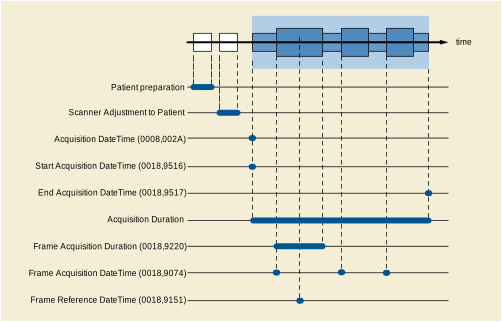
The Frame Reference DateTime (0018,9151) is used to indicate the point in time that is most representative for that specific frame.
Note
For example, in the case of MR it might be the time of acquisition of the data for the ky = 0 line in k-space (the central Fourier segment).
For cardiac gated acquisitions the choice of the Frame Reference DateTime (0018,9151) is influenced by the Nominal Cardiac Trigger Delay Time (0020,9153). For respiratory gated acquisitions the choice of the Frame Reference DateTime (0018,9151) is influenced by the Nominal Respiratory Trigger Delay Time (0020,9255).
The Frame Acquisition Duration (0018,9220) is used to indicate the duration of the acquisition related to this frame.
For SOP Instances or Concatenations of the Enhanced PET Image Storage SOP Class (1.2.840.10008.5.1.4.1.1.130) the Frame Acquisition Duration (0018,9220) is the sum of the portion of each cycle during which data contributing to this frame has actually been acquired for all of the cardiac or respiratory cycles of a gated acquisition (i.e., if Cardiac Synchronization Technique (0018,9037) equals other than NONE, and/or if Respiratory Motion Compensation Technique (0018,9170) equals other than NONE).
Due to implementation specific reasons (such as maximum object size) the information of a multi-frame image may be split into more than one SOP Instance. These SOP Instances form together a Concatenation. This is a group of SOP Instances within a Series that is uniquely identified by Concatenation UID (0020,9161).
The Dimension Index Sequence (0020,9222) for each SOP Instance with the same Concatenation UID (0020,9161) shall contain exactly the same tags and values.
In a Concatenation the Dimension Index Sequence (0020,9222) items of the Shared Functional Groups (5200,9229) shall be identical and have the same values for all individual SOP Instances. The items of the Per-frame Functional Groups (5200,9230) shall be identical for all individual SOP Instances but the values may change per frame. For all other Attributes of all the Modules of the IOD, the same Attributes shall be present and the values shall be identical, with the exception of the following Attributes:
Number of Frames (0028,0008)
Concatenation Frame Offset Number (0020,9228)
In-concatenation Number (0020,9162)
SOP Instance UID (0008,0018)
Instance Creation Time (0008,0013)
Note
The intent of Concatenations is to split what might have been encoded in a single SOP Instance into smaller fragments for more convenient storage or transmission. All the multiple SOP Instances of a Concatenation should be able to be assembled into a valid single SOP Instance. Hence it is not permitted to change such Attributes as Photometric Interpretation (0028,0004), Rows (0028,0010), Columns (0028,0011), etc.
Stacks describe application-specific groups of frames that have a geometric relationship. Stacks have a Stack ID (0020,9056) that contains a descriptive name that identifies the stack. A Stack ID (0020,9056) may be re-used in another SOP Instance even outside a concatenation. The value of Stack ID (0020,9056) is unique within the scope of a particular Dimension Organization UID (0020,9164) if present, otherwise it is unique within the scope of a particular Concatenation UID (0020,9161). See Figure C.7.6.16-3 for an example.
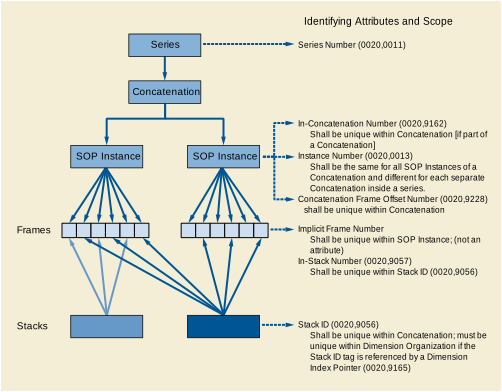
Each frame in a stack has an In-Stack Position Number (0020,9057) that is the ordinal number (starting from 1) of the frame within the set of frames with the same Stack ID (0020,9056), see Figure C.7.6.16-4 for an example.
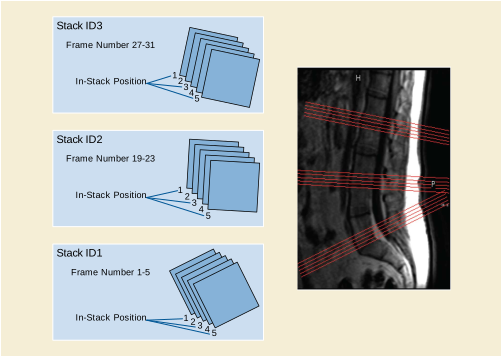
In order to allow interoperable operations on stacks, 2 different frames with the same Stack ID (0020,9056) can only have the same In-Stack Position Number (0020,9057) if they have the same values for the following attributes:
Dimension Organization UID (0020,9164) to qualify the Stack ID
Image Position (Patient) (0020,0032)
Image Orientation (Patient) (0020,0037)
Rows (0028,0010) * first value of Pixel Spacing (0028,0030) (= field of view in the row direction)
Columns (0028,0011) * second value of Pixel Spacing (0028,0030) (= field of view in the column direction)
Slice Thickness (0018,0050)
The Frame Label attribute (0020,9453) can be used to label frames that need to be handled as a group in application. The Dimension Index Pointer (0020,9165) from the Dimension Module may point to this attribute if it is the base of a dimension.
For PET Dynamic images, i.e., images in which Image Type (0008,0008) Value 3 is DYNAMIC, Temporal Position Index is used to distinguish between the multiple acquisitions of the same anatomical area. Similarly, the frames that result from one acquisition over the anatomic area shall be contained in one stack. Thus, for Dynamic images, Temporal Position Index (0020,9128), Stack ID (0020,9056), and In-Stack Position Number (0020,9057) shall be used as three of the dimensions of the image, in that order.
Figure C.7.6.16-4b describes the usage for a PET dynamic image.
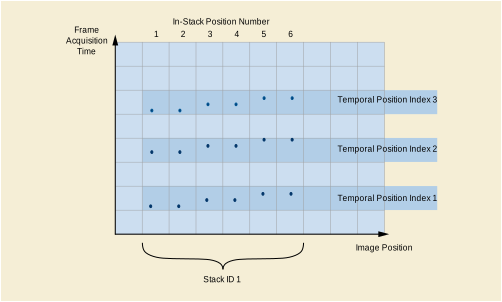
For static and whole body PET images, a single Stack ID (0020,9056) is used to group all of the transverse slices over the entire imaged volume together. That is, a single Stack ID (0020,9056) is used no matter how many acquisition bed positions are involved. In-Stack Position Number (0020,9057) is then used as the spatial dimension index. When rectangular sagittal, coronal or oblique images are created from these, a single Stack ID (0020,9056) is again used.
Similarly, in cardiac or respiratory gated images, the entire volume is again identified by a single Stack ID (0020,9056), and In-Stack Position Number (0020,9057) is the spatial dimension index. The time dimension is indicated by one of the timing attributes, such as trigger delay time or respiratory phase.
Table C.7.6.16-4 specifies the attributes of the Plane Position (Patient) Functional Group Macro.
Table C.7.6.16-4. Plane Position (Patient) Macro Attributes
|
Attribute Name |
Tag |
Type |
Attribute Description |
|---|---|---|---|
|
Plane Position Sequence |
(0020,9113) |
1 |
Identifies the position of the plane of this frame. Only a single Item shall be included in this sequence. |
|
>Image Position (Patient) |
(0020,0032) |
1C |
The x, y, and z coordinates of the upper left hand corner (center of the first voxel transmitted) of the frame, in mm. See Section C.7.6.2.1.1 and Section C.7.6.16.2.3.1 for further explanation. NoteIn the case of CT images with an Acquisition Type (0018,9302) of CONSTANT_ANGLE the image plane is defined to pass through the data collection center and be normal to the central ray of the diverging X-Ray beam. Required if Frame Type (0008,9007) Value 1 of this frame is ORIGINAL and Volumetric Properties (0008,9206) of this frame is other than DISTORTED, may be present otherwise. |
In the case of Volumetric Properties (0008,9206) having a value of SAMPLED, Image Position (0020,0032), Image Orientation (0020,0037) and Slice Thickness (0018,0050) shall represent the volume from which the frame was derived based on the orientation of the sampling performed.
Note
For example in the case of MAX_IP:
The Image Orientation shall be the direction of the ray used for projection of the center of the plane.
The image position shall contain the x, y, and z coordinates of the intersection of the mid-plane of the sampled volume with the ray used to project the upper left hand corner of the frame.
The Slice Thickness shall contain the distance that the ray used for projection of the center of the plane traveled through the volume.
Table C.7.6.16-5 specifies the attributes of the Plane Orientation (Patient) Functional Group Macro.
Table C.7.6.16-5. Plane Orientation (Patient) Macro Attributes
|
Attribute Name |
Tag |
Type |
Attribute Description |
|---|---|---|---|
|
Plane Orientation Sequence |
(0020,9116) |
1 |
Identifies orientation of the plane of this frame. Only a single Item shall be included in this sequence. |
|
>Image Orientation (Patient) |
(0020,0037) |
1C |
The direction cosines of the first row and the first column with respect to the patient. See Section C.7.6.2.1.1 and Section C.7.6.16.2.3.1 for further explanation. Required if Frame Type (0008,9007) Value 1 of this frame is ORIGINAL and Volumetric Properties (0008,9206) of this frame is other than DISTORTED. May be present otherwise. |
Table C.7.6.16-6 specifies the attributes of the Referenced Image Functional Group Macro.
Table C.7.6.16-6. Referenced Image Macro Attributes
|
Attribute Name |
Tag |
Type |
Attribute Description |
|---|---|---|---|
|
Referenced Image Sequence |
(0008,1140) |
2 |
The set of images or other composite SOP Instances used to plan the acquisition, if any, and other significant related images. See Section C.7.6.16.2.5.1 for further explanation. Zero or more Items shall be included in this Sequence. |
|
>Include Table 10-3 “Image SOP Instance Reference Macro Attributes” |
|||
|
>Purpose of Reference Code Sequence |
(0040,A170) |
1 |
Describes the purpose for which the reference is made. Only a single Item shall be included in this sequence. See Section C.7.6.16.2.5.1 for further explanation. |
|
Defined CID 7201 “Referenced Image Purposes of Reference”, or as specified in the IOD invocation of this Functional Group. |
|||
Referenced Image Sequence (0008,1140) shall be used to identify other data objects used to plan the acquisition of this image. Instances referenced for this purpose shall have the same Frame of Reference UID (0020,0052) as this image. For each Item that contains such a reference, the value of Purpose of Reference Code Sequence (0040,A170) shall be ("121311", DCM, "Localizer"). Applications can use the Referenced Image Sequence (0008,1140) in combination with data in Plane Position (Patient) and Plane Orientation (Patient) Macros to provide projections of the position of an image with respect to the referenced image.
The Referenced Image Sequence (0008,1140) may also be present when references to other images (or frames within other images) are required for other reasons, as specified by Purpose of Reference Code Sequence (0040,A170).
Note
An Image may contain references to itself (e.g., to other frames within itself).
Table C.7.6.16-7 specifies the attributes of the Derivation Image Functional Group Macro.
Table C.7.6.16-7. Derivation Image Macro Attributes
|
Attribute Name |
Tag |
Type |
Attribute Description |
|---|---|---|---|
|
Derivation Image Sequence |
(0008,9124) |
2 |
The set of Images or other composite SOP Instances that were used to derive this frame. Zero or more Items shall be included in this Sequence. |
|
>Derivation Description |
(0008,2111) |
3 |
A text description of how this frame data was derived. See Section C.7.6.1.1.3 for further explanation. |
|
>Derivation Code Sequence |
(0008,9215) |
1 |
A coded description of how this frame was derived. See Section C.7.6.1.1.3 for further explanation. One or more Items shall be included in this Sequence. More than one Item indicates that successive derivation steps have been applied. |
|
Defined CID 7203 “Image Derivation”. |
|||
|
>Source Image Sequence |
(0008,2112) |
2 |
The set of Images or other Composite SOP Instances that were used to derive this frame. Zero or more Items shall be included in this Sequence. See Section C.7.6.1.1.4 for further explanation. |
|
>>Include Table 10-3 “Image SOP Instance Reference Macro Attributes” |
|||
|
>>Purpose of Reference Code Sequence |
(0040,A170) |
1 |
Describes the purpose for which the reference is made, that is what role the source image or frame played in the derivation of this image or frame. Only a single Item shall be included in this Sequence. |
|
>>>Include Table 8.8-1 “Code Sequence Macro Attributes” |
|||
|
>>Spatial Locations Preserved |
(0028,135A) |
3 |
The extent to which the spatial locations of all pixels are preserved during the processing of the source image that resulted in the current image or frame. Enumerated Values:
Note
|
|
>>Patient Orientation |
(0020,0020) |
1C |
The Patient Orientation values of the source image. Required if the value of Spatial Locations Preserved (0028,135A) is REORIENTED_ONLY. |
Table C.7.6.16-8 specifies the attributes of the Cardiac Synchronization Functional Group Macro.
Table C.7.6.16-8. Cardiac Synchronization Macro Attributes
|
Attribute Name |
Tag |
Type |
Attribute Description |
|---|---|---|---|
|
Cardiac Synchronization Sequence |
(0018,9118) |
1 |
Sequence that describes the frame specific cardiac synchronization parameters. Only a single Item shall be included in this sequence. |
|
>Nominal Percentage of Cardiac Phase |
(0020,9241) |
1C |
The nominal time relative to the preceding R peak divided by the nominal R-R interval multiplied by 100. Required if used as a dimension index, may be present otherwise. |
|
>Nominal Cardiac Trigger Delay Time |
(0020,9153) |
1 |
The nominal time in ms from the time of the previous R-peak to the value of Frame Reference DateTime (0018,9151) expressed as a positive value. See Section C.7.6.16.2.7.1 for further explanation. |
|
>Actual Cardiac Trigger Delay Time |
(0020,9252) |
1C |
The actual time in ms from the time of the previous R-peak to the value of Frame Reference DateTime (0018,9151) expressed as a positive value. See Section C.7.6.16.2.7.1 for further explanation. Required if Intervals Acquired (0018,1083) is present and has a value of 1. May be present otherwise. |
|
>Nominal Cardiac Trigger Time Prior to R-peak |
(0020,9154) |
3 |
The nominal time in ms from the time of the next R-peak to the value of Frame Reference DateTime (0018,9151) expressed as a negative value. See Section C.7.6.16.2.7.1 for further explanation. |
|
>Actual Cardiac Trigger Time Prior to R-peak |
(0020,9155) |
3 |
The actual time in ms from the time of the next R-peak to the value of Frame Reference DateTime (0018,9151) expressed as a negative value. See Section C.7.6.16.2.7.1 for further explanation. |
|
>Intervals Acquired |
(0018,1083) |
3 |
Number of R-R intervals acquired. |
|
>Intervals Rejected |
(0018,1084) |
3 |
Number of R-R intervals rejected. |
|
>Heart Rate |
(0018,1088) |
3 |
Average number of heart beats per minute for the collection period for this frame. This shall include all accepted beats as well as rejected beats. NoteDuring prolonged acquisitions the average heart rate may differ from the reciprocal of the nominal R-R interval. |
|
>R-R Interval Time Nominal |
(0020,9251) |
1C |
Nominal R-peak - R-peak interval time in ms for the cardiac cycle used for the acquisition of this frame. See Section C.7.6.16.2.7.1 for further explanation. Required if Cardiac Synchronization Technique (0018,9037) equals other than NONE or REALTIME. May be present otherwise. |
|
>Low R-R Value |
(0018,1081) |
3 |
R-R interval low limit for beat rejection, in ms. |
|
>High R-R Value |
(0018,1082) |
3 |
R-R interval high limit for beat rejection, in ms. |
The Nominal Cardiac Trigger Delay Time (0020,9153) is the nominal trigger delay time in ms from the previous R-peak to the value of Frame Reference DateTime (0018,9151). When frames are acquired with prospective gating, that is, the data acquisition actually begins in response to a timed delay from the R-peak, it may be that Actual Cardiac Trigger Delay Time (0020,9252) and the Nominal Cardiac Trigger Delay Time (0020,9153) have the same value.
However, when frames are the result of retrospective gating, that is, the data is continuously acquired and then later compared with a simultaneously acquired ECG waveform and fitted into time slots corresponding to nominal phases of the cardiac cycle, then Nominal Cardiac Trigger Delay Time (0020,9153) and the Actual Cardiac Trigger Delay Time (0020,9252) may have different values. When applicable the same is valid for the Nominal Cardiac Trigger Time Prior to R-peak (0020,9154) and the Actual Cardiac Trigger Time Prior to R-peak (0020,9155) attributes.
When multiple cardiac cycles are averaged together, then the Low R-R Value (0018,1081), and High R-R Value (0018,1082) are an average of the cardiac cycles that were accepted in the frame.
Note
For cardiac gated acquisitions the choice of the Frame Reference DateTime (0018,9151) is influenced by the Nominal Cardiac Trigger Delay Time (0020,9153). For respiratory gated acquisitions the choice of the Frame Reference DateTime (0018,9151) is influenced by the Nominal Respiratory Trigger Delay Time (0020,9255).
Figure C.7.6.16-5a depicts the usage.
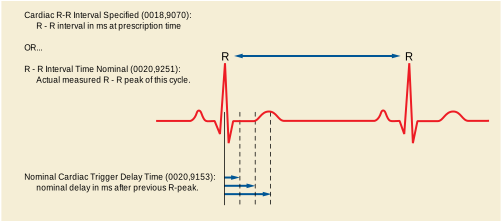
Nominal Cardiac Trigger Time Prior to R-peak (0020,9154) and the Actual Cardiac Trigger Time Prior to R-peak (0020,9155) attributes can be used to store a time of the next R-peak to the value of Frame Reference DateTime (0018,9151) expressed as a negative value. In this case the Actual Cardiac Trigger Delay Time (0020,9252), when present, and the Nominal Cardiac Trigger Delay Time (0020,9153) shall contain a value calculated based on the R-R interval applicable for this frame. See Figure C.7.6.16-5b.
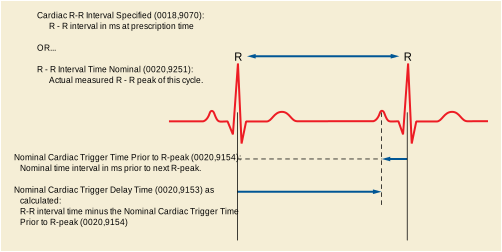
Note
Specifying the time interval prior to the R-peak is relevant for applications such as capturing P- and Q-wave related morphology.
Table C.7.6.16-9 specifies the attributes of the Frame Anatomy Functional Group Macro.
Table C.7.6.16-9. Frame Anatomy Macro Attributes
|
Attribute Name |
Tag |
Type |
Attribute Description |
|---|---|---|---|
|
Frame Anatomy Sequence |
(0020,9071) |
1 |
Identifies anatomic characteristics of this frame. Only a single Item shall be included in this sequence. |
|
>Frame Laterality |
(0020,9072) |
1 |
Laterality of (possibly paired) body parts (as described in Anatomic Region Sequence (0008,2218)) examined. Enumerated Values:
NoteThis Attribute is mandatory, in order to ensure that frames maybe positioned correctly relative to one another for display. Shall be consistent with any laterality information contained in Primary Anatomic Structure Modifier Sequence (0008,2230), if present. |
|
>Include Table 10-5 “General Anatomy Mandatory Macro Attributes” |
Defined CID for the Anatomic Region Sequence (0008,2218) is 4030. Defined CID for Anatomic Region Modifier Sequence (0008,2220) and Primary Anatomic Structure Modifier Sequence (0008,2230) is 2. |
||
Table C.7.6.16-10 specifies the attributes of the Pixel Value Transformation Functional Group Macro.
Note
This Macro is equivalent with the Modality LUT transformation in non Multi-frame IODs.
Table C.7.6.16-10. Pixel Value Transformation Macro Attributes
|
Attribute Name |
Tag |
Type |
Attribute Description |
|---|---|---|---|
|
Pixel Value Transformation Sequence |
(0028,9145) |
1 |
Contains the attributes involved in the transformation of stored pixel values. Only a single Item shall be included in this sequence. |
|
>Rescale Intercept |
(0028,1052) |
1 |
The value b in relationship between stored values (SV) and the output units. Output units = m*SV + b. |
|
>Rescale Slope |
(0028,1053) |
1 |
m in the equation specified by Rescale Intercept (0028,1052). |
|
>Rescale Type |
(0028,1054) |
1 |
Specifies the output units of Rescale Slope (0028,1053) and Rescale Intercept (0028,1052). See Section C.11.1.1.2 for further explanation. Enumerated Values:
|
Note
Window Center (0028,1050) and Window Width (0028,1051) are applied after Rescale Slope (0028,1053) and Rescale Intercept (0028,1054) have been applied to Stored Pixel Values, see Section C.11.2.1.2.
Table C.7.6.16-10b specifies the attributes of the Identity Pixel Value Transformation Functional Group Macro.
Note
This Macro constrains the Modality LUT Transformation step in the grayscale rendering pipeline to be an identity transformation.
Table C.7.6.16-10b. Identity Pixel Value Transformation Macro Attributes
|
Attribute Name |
Tag |
Type |
Attribute Description |
|---|---|---|---|
|
Pixel Value Transformation Sequence |
(0028,9145) |
1 |
Contains the attributes involved in the transformation of stored pixel values. Only a single Item shall be included in this sequence. |
|
>Rescale Intercept |
(0028,1052) |
1 |
The value b in relationship between stored values (SV) and the output units. Output units = m*SV + b. Enumerated Values:
|
|
>Rescale Slope |
(0028,1053) |
1 |
m in the equation specified by Rescale Intercept (0028,1052). Enumerated Values:
|
|
>Rescale Type |
(0028,1054) |
1 |
Specifies the output units of Rescale Slope (0028,1053) and Rescale Intercept (0028,1052). See Section C.11.1.1.2 for further explanation. Enumerated Values:
|
Table C.7.6.16-11 specifies the attributes of the Frame VOI LUT Functional Group Macro.
Table C.7.6.16-11. Frame VOI LUT Macro Attributes
|
Attribute Name |
Tag |
Type |
Attribute Description |
|---|---|---|---|
|
Frame VOI LUT Sequence |
(0028,9132) |
1 |
Window Center and Width values applied to the frame. Only a single item is permitted in this sequence. |
|
>Window Center |
(0028,1050) |
1 |
Window Center for display. See Section C.11.2.1.2 for further explanation. |
|
>Window Width |
(0028,1051) |
1 |
Window Width for display. See Section C.11.2.1.2 for further explanation. |
|
>Window Center & Width Explanation |
(0028,1055) |
3 |
Explanation of the Window Center and Width. Defined Terms for CT:
|
|
>VOI LUT Function |
(0028,1056) |
3 |
Describes a VOI LUT function to apply to the values of Window Center (0028,1050) and Window Width (0028,1051). See Section C.11.2.1.3 for further explanation. Defined Terms:
When this attribute is not present, the interpretation of the values of Window Center (0028,1050) and Window Width (0028,1051) is linear as in Section C.11.2.1.2. |
Table C.7.6.16-11b specifies the attributes of the Frame VOI LUT With LUT Functional Group Macro. This macro contains one or more sets of linear or sigmoid window values and/or one or more sets of lookup tables.
Table C.7.6.16-11b. Frame VOI LUT with LUT Macro Attributes
|
Attribute Name |
Tag |
Type |
Attribute Description |
|---|---|---|---|
|
Frame VOI LUT Sequence |
(0028,9132) |
1 |
The VOI LUT transformations applied to this frame. Only a single item is permitted in this sequence. |
Table C.7.6.16-12 specifies the attributes of the Real World Value Mapping Functional Group Macro.
Table C.7.6.16-12. Real World Value Mapping Macro Attributes
|
Attribute Name |
Tag |
Type |
Attribute Description |
|---|---|---|---|
|
Real World Value Mapping Sequence |
(0040,9096) |
1 |
The mapping of stored values to associated Real World values. One or more Items shall be included in this sequence. |
|
>Include Table C.7.6.16-12b “Real World Value Mapping Item Macro Attributes” |
Defined CID for Measurement Units Code Sequence is 82, or as specified in the macro invocation. |
||
Table C.7.6.16-12b. Real World Value Mapping Item Macro Attributes
|
Attribute Name |
Tag |
Type |
Attribute Description |
|---|---|---|---|
|
Real World Value First Value Mapped |
(0040,9216) |
1 |
Specifies the first stored value mapped for the Real Word Value Intercept (0040,9224) and Real World Value Slope (0040,9225) or Real World Value LUT (0040,9212) of this Item. See Section C.7.6.16.2.11.1 for further explanation. |
|
Real World Value Last Value Mapped |
(0040,9211) |
1 |
Specifies the last stored value mapped for the Real Word Value Intercept (0040,9224) and Real World Value Slope (0040,9225) or Real World Value LUT (0040,9212) of this Item. See Section C.7.6.16.2.11.1 for further explanation. |
|
Real World Value Intercept |
(0040,9224) |
1C |
The Intercept value in relationship between stored values (SV) and the Real World values. See Section C.7.6.16.2.11.1.2 for further explanation. Required if Real World Value LUT Data (0040,9212) is not present. |
|
Real World Value Slope |
(0040,9225) |
1C |
The Slope value in relationship between stored values (SV) and the real world values. See Section C.7.6.16.2.11.1.2 for further explanation. Required if Real World Value LUT Data (0040,9212) is not present. |
|
Real World Value LUT Data |
(0040,9212) |
1C |
LUT Data in this Sequence. Required if Real World Value Intercept (0040,9224) is not present. |
|
LUT Explanation |
(0028,3003) |
1 |
Free form text explanation of the meaning of the transformation in this Item. |
|
LUT Label |
(0040,9210) |
1 |
Label that is used to identify the transformation of this Item. |
|
Measurement Units Code Sequence |
(0040,08EA) |
1 |
Units of measurement. Only a single Item shall be included in this sequence. See Section C.7.6.16.2.11.1 for further explanation. |
|
Defined CID 82 “Units of Measurement”, or as specified in the macro invocation. |
|||
The items in the Real World Value Mapping Sequence (0040,9096) may be used to translate stored values into real world values when there is such a relationship. The Real World Value Mapping Sequence (0040,9096) is independent of the Modality LUT (or Pixel Value Transformation Macro), as illustrated in Figure C.7.6.16-6.
Each item specifies the range of stored values as well as the associated mapping function. Each item can specify either a linear mapping, using Real World Value Slope (0040,9225) and Real World Value Intercept (0040,9224), or a non-linear mapping using Real World Value LUT Data (0040,9212). More than one Real World Value Mapping Item is allowed.
The range of stored pixel values specified by different Real Value World Mapping Sequence (0040,9096) Items can overlap (as illustrated in the example in Figure C.7.6.16-7).
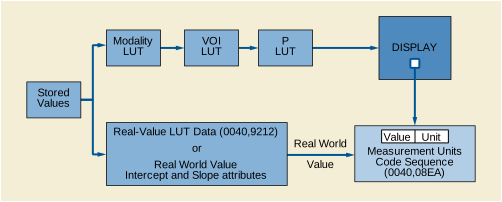
Note
For example, MR images may contain data that is not only the result of the physical/chemical properties of the scanned anatomy, but may also contain information that is representing real world values, such as, temperature [in degrees C], flow [in l/min], speed [in m/sec], relative activity [in %], relative contrast enhancement [in %], diffusion [in sec/mm2], etc.
In some cases the conversion from Stored Values to Real World Values can be linear (through "slope" and "intercept") or non-linear (through look-up tables).
Both transformation methods can be applied to one range of stored values. Overlapped ranges might be used for different representations such as log versus linear scales or for different representations in units such as cm/sec versus mm/sec. Alternative methods can be identified by the labels assigned to the transformations.
The Real World Value First Value Mapped (0040,9216) and Real World Value Last Value Mapped (0040,9211) Attributes describe the range of stored pixel values that are mapped by the Sequence Item. Stored pixel values less than the first value mapped, or greater than the last value mapped have no real value attached.
When the Real World Value Intercept (0040,9224) and Real World Value Slope (0040,9225) attributes are supplied, the stored value (SV) is converted to a real world value (RV) using the equation:
RV = (Real World Value Slope) * SV + Real World Value Intercept
When the Real World Value LUT Data (0040,9212) attribute is supplied, Real World Values are obtained via a lookup operation. The stored pixel value of the first value mapped is mapped to the first entry in the LUT Data. Subsequent stored pixel values are mapped to the subsequent entries in the LUT Data up to a stored pixel value equal to the last value mapped.
The number of entries in the LUT data is given by:
Number of entries = Real World Value Last Value Mapped- Real World Value First Value Mapped + 1
The physical units for the real world values obtained from the sequence item are given by the Measurement Units Code Sequence (0040,08EA).
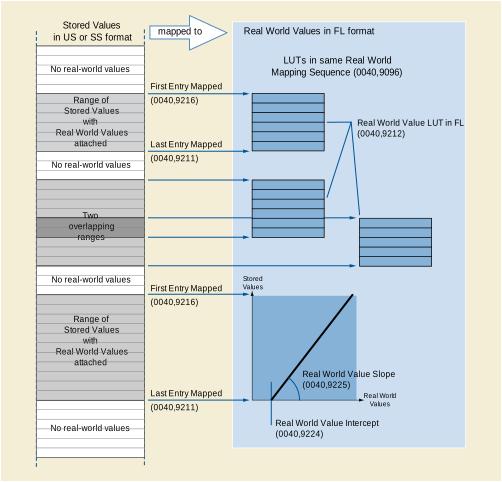
Table C.7.16-13 specifies the attributes of the Contrast/Bolus Usage macro.
Table C.7.16-13. Contrast/Bolus Usage Macro Attributes
|
Attribute Name |
Tag |
Type |
Attribute Description |
|---|---|---|---|
|
Contrast/Bolus Usage Sequence |
(0018,9341) |
1 |
Contains the attributes describing the use of contrast for this frame. One or more Items shall be included in this sequence. |
|
>Contrast/Bolus Agent Number |
(0018,9337) |
1 |
Identifying number corresponding to the agent described in the Enhanced Contrast/Bolus Module. |
|
>Contrast/Bolus Agent Administered |
(0018,9342) |
1 |
The administration of the selected agent had begun by the time this frame was acquired. Enumerated Values:
|
|
>Contrast/Bolus Agent Detected |
(0018,9343) |
2 |
The selected agent was detected in the frame. Enumerated Values:
May only be zero length if the acquisition device is not capable of detecting the presence of this contrast agent in the frame. |
|
>Contrast/Bolus Agent Phase |
(0018,9344) |
2C |
Nominal phase of intravenous contrast administration. Defined Terms:
Required if Contrast/Bolus Administration Route Sequence (0018,0014) for the Contrast/Bolus Agent Number (0018,9337) defined in the Contrast/Bolus Agent Sequence (0018,0012) is (G-D101, SRT, "Intravenous route") or (G-D101, SNM3, "Intravenous route"); may be present otherwise. NoteSRT is the preferred designator for SNOMED, but SNM3 is allowed for backward compatibility. See PS3.16. |
Table C.7.6.16-14 specifies the attributes of the Pixel Intensity Relationship LUT Functional Group Macro.
Table C.7.6.16-14. Pixel Intensity Relationship LUT Macro Attributes
|
Attribute Name |
Tag |
Type |
Attribute Description |
|---|---|---|---|
|
Pixel Intensity Relationship LUT Sequence |
(0028,9422) |
1 |
Defines a sequence of Pixel Intensity Relationship LUTs. One or more items shall be included in this sequence. If Pixel Intensity Relationship (0028,1040) value equals LOG, exactly one item with LUT Function (0028,9474) value TO_LINEAR LUT shall be present; other Items with other values of LUT Function (0028,9474) may be present. |
|
>LUT Descriptor |
(0028,3002) |
1 |
Specifies the format of the LUT Data in this Sequence. See Section C.11.1.1 and Section C.7.6.16.2.13.1 for further explanation. |
|
>LUT Data |
(0028,3006) |
1 |
LUT Data in this Sequence. |
|
>LUT Function |
(0028,9474) |
1 |
The transformation function this LUT applies to the stored pixel values. Defined Terms:
|
The purpose of this Pixel Intensity Relationship LUT Sequence is to provide information to recalculate the pixel values proportional to the X-Ray beam intensity from the stored pixel values. It is intended to be used by any application that needs transformed pixel values (e.g., scaled back to acquired pixel values) pixel values for further processing and not as replacement of the Modality LUT in the display pipeline, see Figure C.7.6.16-7a.
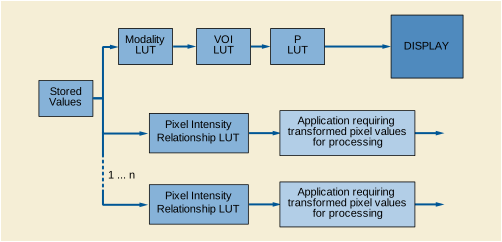
Table C.7.6.16-15 specifies the attributes of the Frame Pixel Shift Functional Group Macro.
Table C.7.6.16-15. Frame Pixel Shift Macro Attributes
|
Attribute Name |
Tag |
Type |
Attribute Description |
|---|---|---|---|
|
Frame Pixel Shift Sequence |
(0028,9415) |
1 |
Sequence containing the pixel shift for a number of masks for this frame. One or more items shall be included in this sequence. |
|
>Subtraction Item ID |
(0028,9416) |
1 |
Identifier of the Subtraction Item in the Mask Subtraction Sequence (0028,6100) to which this pixel shift is associated. |
|
>Mask Sub-pixel Shift |
(0028,6114) |
1 |
A pair of floating point numbers specifying the fractional vertical [adjacent row spacing] and horizontal [adjacent column spacing] pixel shift applied to the mask before subtracting it from this contrast frame. NoteIf no pixel shift has to be applied a pair of zero values should be specified. See Section C.7.6.10.1.2. |
Subtraction Item ID (0028,9416) specifies the ID of a subtraction operation to which the Mask Sub-pixel Shift (0028,6114) is associated. The Subtraction Item ID is also present in the Mask Subtraction Sequence (0028,6100) to allow this association.
When used as per-frame macro, the Subtraction Item ID (0028,9416) allows to specify different values of Mask Sub-pixel Shift (0028,6114) individually frame by frame, and relate them to a single item of the Mask Subtraction Sequence (0028,6100).
Note
There is no restriction in the number of Subtraction Item ID's associated to each contrast frame. The same contrast frame may be present in several items of the Mask Subtraction Sequence, each item having a different value of Subtraction Item ID.
When used as shared macro, the Subtraction Item ID (0028,9416) allows to specify one or more values of Mask Sub-pixel Shift that will be applied to all the frames of the Multi-frame image.
Note
Example of usage of Subtraction Item ID in a per-frame macro, see Figure C.7.6.16-8:
In this example of Multi-frame Image with 3 frames, one Mask Frame (i.e., Frame 1) is applied to the next two frames of the Multi-frame image (i.e., Frames 2 and 3). Therefore, there is only one item in the Mask Subtraction Sequence, containing its own Subtraction Item ID value (i.e., 100). The Frame Pixel Shift Macro allows to define a Mask Sub-Pixel Shift different for each contrast frame.
First Frame Subtracted: Subtraction of Frame 1 (Mask) to Frame 2, with Sub-Pixel Shift 1.3\2.4
Second Frame Subtracted: Subtraction of Frame 1 (Mask) to Frame 3, with Sub-Pixel Shift 1.9\3.0
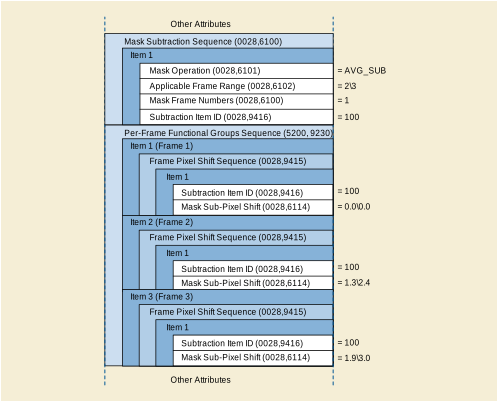
Table C.7.6.16-16 specifies the attributes of the Patient Orientation in Frame Functional Group Macro.
Table C.7.6.16-16. Patient Orientation in Frame Macro Attributes
|
Attribute Name |
Tag |
Type |
Attribute Description |
|---|---|---|---|
|
Patient Orientation in Frame Sequence |
(0020,9450) |
1 |
Sequence containing the row and column directions for this frame in the patient. Only a single Item shall be included in this sequence. |
|
>Patient Orientation |
(0020,0020) |
1 |
Patient direction of the rows and columns of this frame. See Section C.7.6.1.1.1 for further explanation. |
Table C.7.6.16-17 specifies the attributes of the Frame Display Shutter Functional Group Macro.
Table C.7.6.16-17. Frame Display Shutter Macro Attributes
|
Attribute Name |
Tag |
Type |
Attribute Description |
|---|---|---|---|
|
Frame Display Shutter Sequence |
(0018,9472) |
1 |
Sequence containing the display shutter parameters for this frame. Only a single Item shall be included in this sequence. |
Table C.7.6.16-18 specifies the attributes of the Respiratory Synchronization Functional Group Macro.
Table C.7.6.16-18. Respiratory Synchronization Macro Attributes
|
Attribute Name |
Tag |
Type |
Attribute Description |
|---|---|---|---|
|
Respiratory Synchronization Sequence |
(0020,9253) |
1 |
Sequence that describes the frame specific respiratory synchronization parameters. Only a single Item shall be included in this sequence. |
|
>Respiratory Interval Time |
(0020,9254) |
1C |
Measured interval time in ms from maximum respiration peak to the next peak for the respiratory cycle in which this frame occurs. See Section C.7.6.16.2.17.1 for further explanation. Required if Respiratory Motion Compensation Technique (0018,9170) equals other than NONE or REALTIME and Respiratory Trigger Type (0020,9250) is absent or has a value of TIME or BOTH. |
|
>Nominal Percentage of Respiratory Phase |
(0020,9245) |
1C |
The nominal time relative to the preceding respiratory inspiration maximum divided by the nominal respiratory interval multiplied by 100. Required if used as a dimension index, may be present otherwise. |
|
>Nominal Respiratory Trigger Delay Time |
(0020,9255) |
1 |
The nominal time in ms from the beginning of the respiratory interval to the value of Frame Reference DateTime (0018,9151). See Section C.7.6.16.2.17.1 for further explanation. |
|
>Actual Respiratory Trigger Delay Time |
(0020,9257) |
1C |
The actual time in ms from the beginning of the respiratory interval to the value of Frame Reference DateTime (0018,9151). See Section C.7.6.16.2.17.1 for further explanation. Required if Respiratory Trigger Type (0020,9250) is TIME or BOTH. |
|
>Starting Respiratory Amplitude |
(0020,9246) |
1C |
Nominal amplitude of the respiratory signal at which the acquisition of data for this frame begins, in percent of the nominal maximum value (which represents maximum inspiration). Required if Respiratory Trigger Type (0020,9250) is AMPLITUDE or BOTH. |
|
>Starting Respiratory Phase |
(0020,9247) |
1C |
The phase of respiration at which the Starting Respiratory Amplitude (0020,9246) was measured. Enumerated Values:
Required if Starting Respiratory Amplitude (0020,9246) is present. |
|
>Ending Respiratory Amplitude |
(0020,9248) |
1C |
Nominal amplitude of the respiratory signal at which the acquisition of data for this frame ends, in percent of the nominal maximum value (which represents maximum inspiration). Required if Respiratory Trigger Type (0020,9250) is AMPLITUDE or BOTH. |
|
>Ending Respiratory Phase |
(0020,9249) |
1C |
The phase of respiration at which the Ending Respiratory Amplitude (0020,9248) was measured. Enumerated Values:
Required if Ending Respiratory Amplitude (0020,9248) is present. |
For time based respiratory gating, the Nominal Respiratory Trigger Delay Time (0020,9255) is the prescribed trigger delay time in ms from the previous Respiratory-peak to the value of Frame Reference DateTime (0018,9151). When frames are acquired with prospective gating, that is, the data acquisition actually begins in response to a timed delay from the Respiratory trigger, it may be that Actual Respiratory Trigger Delay Time (0020,9257) and the Nominal Respiratory Trigger Delay Time (0020,9255) have the same value.
However, when frames are the result of retrospective gating, that is, the data is continuously acquired and then later compared with a simultaneously acquired respiratory waveform and fitted into bins corresponding to nominal phases of the respiratory cycle, then Nominal Respiratory Trigger Delay Time (0020,9255) and the Actual Respiratory Trigger Delay Time (0020,9257) may have different values.
Figure C.7.6.16-9a and Figure C.7.6.16-9b depict the usage.
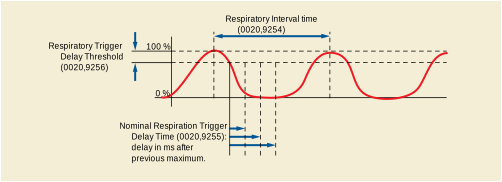
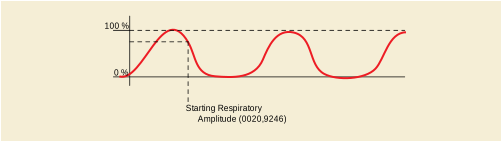
Table C.7.6.16-19 specifies the attributes containing the Irradiation Event Identification Functional Group Macro.
Table C.7.6.16-19. Irradiation Event Identification Macro Attributes
|
Attribute Name |
Tag |
Type |
Attribute Description |
|---|---|---|---|
|
Irradiation Event Identification Sequence |
(0018,9477) |
1 |
Sequence containing the Irradiation Event Identification for this frame. Only a single Item shall be included in this sequence. |
|
>Irradiation Event UID |
(0008,3010) |
1 |
Unique identification of the irradiation event(s) associated with the acquisition of this image. |
Table C.7.6.16.2-20 specifies the attributes of the Radiopharmaceutical Usage Functional Group Macro.
Table C.7.6.16.2-20. Radiopharmaceutical Usage Macro Attributes
|
Attribute Name |
Tag |
Type |
Attribute Description |
|---|---|---|---|
|
Radiopharmaceutical Usage Sequence |
(0018,9737) |
1 |
One or more Items shall be included in this sequence. |
|
>Radiopharmaceutical Agent Number |
(0018,9729) |
1 |
Identifying number corresponding to the radiopharmaceutical described in the Enhanced PET Isotope Module. |
Table C.7.6.16.2-21 specifies the attributes of the Patient Physiological State Functional Group Macro, which describes the physiological state of the patient.
Table C.7.6.16.2-21. Patient Physiological State Macro Attributes
|
Attribute Name |
Tag |
Type |
Attribute Description |
|---|---|---|---|
|
Patient Physiological State Sequence |
(0018,9771) |
1 |
Contains the attributes describing the physiological sate of the patient for this frame. Only a single Item shall be included in this sequence. |
|
>Patient Physiological State Code Sequence |
(0018,9772) |
1 |
The physiological state of the patient. Only a single Item shall be included in this sequence. |
Table C.7.6.16.2.21-1 specifies the attributes of the Plane Position (Volume) Functional Group Macro.
Table C.7.6.16.2.21-1. Plane Position (Volume) Macro Attributes
|
Attribute Name |
Tag |
Type |
Attribute Description |
|---|---|---|---|
|
Plane Position (Volume) Sequence |
(0020,930E) |
1 |
Identifies the position of the plane of this frame. Only a single Item shall be included in this sequence. |
|
>Image Position (Volume) |
(0020,9301) |
1 |
The x, y, and z coordinates, in mm, of the upper left hand corner (center of the first voxel transmitted) of the plane in the Volume Frame of Reference. |
Table C.7.6.16.2.22-1 specifies the attributes of the Plane Orientation (Volume) Functional Group Macro.
Table C.7.6.16.2.22-1. Plane Orientation (Volume) Macro Attributes
|
Attribute Name |
Tag |
Type |
Attribute Description |
|---|---|---|---|
|
Plane Orientation (Volume) Sequence |
(0020,930F) |
1 |
Identifies orientation of the plane of this frame. Only a single Item shall be included in this sequence. |
|
>Image Orientation (Volume) |
(0020,9302) |
1 |
The direction cosines of the first row and the first column of the frame with respect to the Volume Frame of Reference. |
Table C.7.6.16.2.23-1 specifies the attributes of the Temporal Position Functional Group Macro.
Table C.7.6.16.2.23-1. Temporal Position Macro Attributes
|
Attribute Name |
Tag |
Type |
Attribute Description |
|---|---|---|---|
|
Temporal Position Sequence |
(0020,9310) |
1 |
Identifies the temporal position of the plane of this frame. Only a single Item shall be included in this sequence. |
|
>Temporal Position Time Offset |
(0020,930D) |
1 |
Time offset of the frame in the set of frames with different temporal positions, in seconds. |
Table C.7.6.16.2.24-1 specifies the attributes of the Image Data Type Functional Group Macro.
Table C.7.6.16.2.24-1. Image Data Type Macro Attributes
|
Attribute Name |
Tag |
Type |
Attribute Description |
|---|---|---|---|
|
Image Data Type Sequence |
(0018,9807) |
1 |
Identifies the data type characteristics of this frame. Only a single Item shall be included in this sequence. |
|
>Data Type |
(0018,9808) |
1 |
Identification of the data type of a frame. See Section C.7.6.16.2.24.1 for Defined Terms and further explanation. |
|
>Aliased Data Type |
(0018,980B) |
1 |
Indicates whether this data type is "aliased". Enumerated Values:
See Section C.7.6.16.2.24.2 for further explanation. |
|
>Zero Velocity Pixel Value |
(0018,9810) |
1C |
Data value at which velocity is zero. See Section C.7.6.16.2.24.3 for further information. Required if Data Type (0018,9808) is TISSUE_VELOCITY, FLOW_VELOCITY or DIRECTION_POWER. May be present otherwise. |
Data Type (0018,9808) indicates the data type of an image frame. Table C.7.6.16.2.24.1-1 lists Defined Terms for this value.
Table C.7.6.16.2.24.1-1. Data Type Defined Terms
|
Defined Term Name |
Defined Term Description |
|---|---|
|
TISSUE_INTENSITY |
Tissue intensity typically displayed as grayscale (e.g., B-mode) |
|
TISSUE_VELOCITY |
Velocity (Doppler shifts) of tissue |
|
FLOW_VELOCITY |
Velocity (Doppler shifts) of blood flow |
|
FLOW_POWER |
Power contained in the Doppler signal |
|
DIRECTION_POWER |
Directional power contained in the Doppler signal |
|
FLOW_VARIANCE |
Statistical variance of blood velocity relative to mean |
|
ELASTICITY |
Scalar value related to the elastic properties of the tissue |
|
PERFUSION |
Scalar value related to the volume of blood perfusing into tissue |
|
SOUND_SPEED |
Speed of sound in tissue |
|
ATTENUATION |
Reduction in strength of ultrasound signal as the wave traverses through the medium |
Some data types require special treatment when interpolating data values whose type is "aliased", such as FLOW_VELOCITY when derived from discrete data samples as is done for PW Doppler or sampled CW Doppler. Values of these types are "cyclical" in that the maximum value should be considered adjacent to the minimum value in any interpolation algorithm. Aliased Data Type (0018,980B) indicates whether modular arithmetic is necessary for the associated data type.
Note
For example, when Data Type (0018,9808) is FLOW_VELOCITY, Aliased Data Type (0018,980B) should be set to YES indicating that an interpolation algorithm should support aliased data. When several FLOW_VELOCITY values near the maximum or minimum are interpolated, this algorithm should produce a value near the maximum or minimum. It would be incorrect to use an interpolation algorithm such as the arithmetic mean, which would erroneously produce a result near the mid-point of the range.
Certain data types represent velocity that is directional by nature. For these data types, there shall be one particular pixel data value that corresponds to zero velocity. Zero Velocity Pixel Value (0018,9810) indicates the pixel data value corresponding to zero velocity.
The VR of Zero Velocity Pixel Value (0018,9810) corresponds to the value of Pixel Representation (0028,0103): If Pixel Representation (0028,0103) is 0000H (unsigned integer), the VR of Zero Velocity Pixel Value (0018,9810) shall be US; otherwise the VR of Zero Velocity Pixel Value (0018,9810) shall be SS.
Attributes that are present in the Classic images to be converted but that are not defined in specific Modules or specific Functional Groups required or supported by the IOD, or have their values changed during conversion, either may:
be identical in all images, in which case they shall be included in the top level Data Set or in the Unassigned Shared Converted Attributes Sequence, or
only be present in some images, or have a different number of values, or different values, in which case they shall be included in the Unassigned Per-Frame Converted Attributes Sequence.
Note
An example of an Attribute that might be included in the Unassigned Shared Converted Attributes Macro is Filter Type (0018,1160), which typically would be the same for all Classic CT images in a set, and is not included in any modality-specific Module or Functional Group Macro.
An example of an Attribute that might be included in the Unassigned Per-Frame Converted Attributes Macro is Slice Location (0020,1041), which typically would be different for each Classic CT image in a set, and is not included in any modality-specific Module or Functional Group Macro.
An example of an Attribute that might be included in the Unassigned Shared Converted Attributes Macro is Series Number (0020,0011), which typically would be the same for all Classic CT images in a set (but is not required to be), and will be replaced with a different value in the top-level Data Set, and hence if the original is to be preserved, needs to be recorded.
An example of an Attribute that might be included in the Unassigned Per-Frame Converted Attributes Macro is Instance Number (0020,0013), which typically would be different for each Classic CT image in a set, and will be replaced with a different value in the top-level Data Set, and hence if the original is to be preserved, needs to be recorded.
The UIDs of the converted instances are recorded in the Conversion Source Attributes Sequence, and are not included in the Unassigned Shared and Per-Frame Converted Attributes Macros.
For the purpose of comparing values, an Attribute that is not present in a Classic image to be converted is considered the same as an Attribute that is present but has no value. Sequence Attributes match when they have the same number of Items and Item contents in the same order (irrespective of whether the Sequences or Items are encoded with fixed or variable length).
The Unassigned Shared Converted Attributes Sequence, and the Unassigned Per-Frame Converted Attributes Sequence may be absent, if there are no such Attributes available to be included. E.g., there may be no shared Attributes with the same values, all the shared Attributes may be included in the top-level Data Set, there may be no Attributes that vary per-frame or an individual frame may have no such Attribute.
The necessary Private Creator Data Element within each Sequence Item accompanies Private Data Elements. There is no requirement to preserve the private block of Data Elements used in the Classic images to be converted. Nor is there a requirement that a Private Data Element use the same private block in all of the Classic images.
Matching of Private Attribute Values for the purpose of determining whether they are shared or per-frame may be performed using the equivalent meaning if the Value Representation is Explicit and not UN, or known through other means, otherwise, byte matching of the UN VR shall be performed.
Table C.7.6.16.2.25.1-1 specifies the attributes of the Unassigned Shared Converted Attributes Functional Group Macro.
Table C.7.6.16.2.25.1-1. Unassigned Shared Converted Attributes Macro Attributes
|
Attribute Name |
Tag |
Type |
Attribute Description |
|---|---|---|---|
|
Unassigned Shared Converted Attributes Sequence |
(0020,9170) |
1C |
Contains all of the Standard and Private Attributes that are present in all of the converted Classic images, that have the same number of values, that have the same values, and that are not in the top-level Data Set. Only a single Item shall be included in this sequence. Required if any unassigned shared attributes are present. |
Table C.7.6.16.2.25.2-1 specifies the attributes of the Unassigned Per-Frame Converted Attributes Functional Group Macro.
Table C.7.6.16.2.25.2-1. Unassigned Per-Frame Converted Attributes Macro Attributes
|
Attribute Name |
Tag |
Type |
Attribute Description |
|---|---|---|---|
|
Unassigned Per-Frame Converted Attributes Sequence |
(0020,9171) |
1C |
Contains all of the Standard and Private Attributes that are present in only some of the converted Classic images, or that have a different number of values, or that have different values. Only a single Item shall be included in this sequence. Required if any unassigned per-frame attributes are present for this frame. |
Table C.7.6.16.2.25.2-1 specifies the attributes of the Image Frame Conversion Source Functional Group Macro.
Table C.7.6.16.2.25.3-1. Image Frame Conversion Source Macro Attributes
|
Attribute Name |
Tag |
Type |
Attribute Description |
|---|---|---|---|
|
Conversion Source Attributes Sequence |
(0020,9172) |
1 |
The image or other composite SOP Instance that was converted to this frame. Only a single Item shall be included in this sequence. |
|
>Include Table 10-3 “Image SOP Instance Reference Macro Attributes” |
|||
The Multi-frame Dimension Module contains a sequence with items pointing to attributes defining a set of dimensions that are usually known prior to the acquisition commencing. It is up to the generating applications to decide what attributes are important to describe the multi-frame dimensions.
The application that generates the Concatenation or SOP Instances may use the order of Dimension Index Pointers (0020,9165) in the Dimension Index Sequence (0020,9222) to guide the receiving application in determining the order of the presentation of image frames. The first index has the highest ranking, the next index has a lower ranking, etc. Frames with higher values for the dimension with the highest ranking would only be presented after all frames that have values for Dimension Index Pointers (0020,9165) of the lower rankings have been presented.
If the set of Dimension Index Pointers does not provide an attribute set whose values are unique for each frame then the order for the frames with the same value set will be incompletely specified. The receiving application could use the logical frame number to resolve this ambiguity. If the attribute set contains more dimensions than are needed to specify a unique ordering, the lower order ranking attribute(s) will have no effect on the ordering.
Note
For example if there were the following indices in the following order:
Stack ID (1-3)
In-stack Position Number (1-2 for Stack ID 1, 1-4 for Stack ID 2, 1-3 for Stack ID 3)
Effective Echo Time (1-2), i.e., every slice has been scanned with 2 different effective echo's
Then the frames could be presented in the following order:
(Stack ID, In-stack Position, Effective Echo Time)
(1,1,1), (1,1,2), (1,2,1), (1,2,2),
(2,1,1), (2,1,2), (2,2,1), (2,2,2), (2,3,1), (2,3,2), (2,4,1), (2,4,2)
(3,1,1), (3,1,2), (3,2,1), (3,2,2), (3,3,1), (3,3,2)
The actual order of the frames in the object is up to the generating application.
If the effective echo time was not included in the Dimension Index Pointers in the above example then the order of sorting for the frames with the same indices will be undefined - in this case there would be 2 frames with the index set (Stack ID, In-stack Position) = (1,1) and the order of these frames is not specified.
If there were another attribute appended to the Dimension Index Pointers, for example TR, then the TR index would not be used in determining the order of the frames. So the Index Frame Pointers would contain (Stack ID, In-stack Position, Effective Echo Time, TR) but the TR index would be irrelevant for frame ordering purposes.
Table C.7.6.17-1 specifies the attributes of the Multi-frame Dimension Module.
Table C.7.6.17-1. Multi-frame Dimension Module Attributes
|
Attribute Name |
Tag |
Type |
Attribute Description |
|---|---|---|---|
|
Dimension Organization Sequence |
(0020,9221) |
1 |
Sequence that lists the Dimension Organization UIDs referenced by the containing SOP Instance. See Section C.7.6.17.2 for further explanation. One or more Items shall be included in this Sequence. |
|
>Dimension Organization UID |
(0020,9164) |
1 |
Uniquely identifies a set of dimensions referenced within the containing SOP Instance. See Section C.7.6.17.2 for further explanation. |
|
Dimension Organization Type |
(0020,9311) |
3 |
Dimension organization of the instance. Defined Terms:
|
|
Dimension Index Sequence |
(0020,9222) |
1 |
Identifies the sequence containing the indices used to specify the dimension of the multi-frame object. One or more Items shall be included in this sequence. |
|
>Dimension Index Pointer |
(0020,9165) |
1 |
Contains the Data Element Tag that is used to identify the Attribute connected with the index. See Section C.7.6.17.1 for further explanation. |
|
>Dimension Index Private Creator |
(0020,9213) |
1C |
Identification of the creator of a group of private data elements. Required if the Dimension Index Pointer (0020,9165) value is the Data Element Tag of a Private Attribute. |
|
>Functional Group Pointer |
(0020,9167) |
1C |
Contains the Data Element Tag of the Functional Group Sequence that contains the Attribute that is referenced by the Dimension Index Pointer (0020,9165). See Section C.7.6.17.1 for further explanation. Required if the value of Dimension Index Pointer (0020,9165) is the Data Element Tag of an Attribute that is contained within a Functional Group Sequence. |
|
>Functional Group Private Creator |
(0020,9238) |
1C |
Identification of the creator of a group of private data elements. Required if the Functional Group Pointer 0020,9167) value is the Data Element Tag of a Private Attribute. |
|
>Dimension Organization UID |
(0020,9164) |
1C |
Uniquely identifies a set of dimensions referenced within the containing SOP Instance. In particular the dimension described by this sequence item is associated with this Dimension Organization UID. See Section C.7.6.17.2 for further explanation. Required if the value of Dimension Organization Sequence (0020,9221) contains Items |
|
>Dimension Description Label |
(0020,9421) |
3 |
Free text description that explains the meaning of the dimension. |
With the Dimension Index Sequence (0020,9222), Data Element Tags are specified that identify the indices used for a particular SOP Instance.
The actual index values for each frame in a multi-frame header are stored in a single Dimension Index Values Attribute (0020,9157) defined in the Frame Content Functional Group. For each SOP Instance this Attribute has a Value Multiplicity equal to the number of Items in the Sequence. The ordering of the Items in the Sequence defines the ordering in the Dimension Index Values Attribute: Item 1 of the Sequence relates to Value 1, Item 2 to Value 2, etc.
The Dimension Index Pointer (0020,9165) references a single Attribute that describes the actual values that define the dimension. Each Attribute referenced in the Dimension Index Sequence (0020,9222) will have an index stored in the Dimension Index Values (0020,9157) for each frame. Each index value is an ordinal number starting from 1 and monotonically increasing by 1 within the scope of a Dimension Organization UID (0020,9164). These values are independent of the actual values of the attribute referenced by the Dimension Index Pointer (0020,9165), i.e., the index values are logical indices, rather than actual indices. Frames assigned the same index shall contain nominally the same value for the referenced Attribute. If the referenced Attribute is not present for some frames, or is present but has no value, then a single index shall be assigned to indicate the lack of the value (i.e., all such frames shall have the same index value, which is different from other index values). It is at the discretion of the SOP Instance creator whether the Attribute values are equivalent, and therefore appropriate for assignment to the same index value.
The Dimension Index Pointer (0020,9165) shall contain the Data Element Tag (gggg,eeee) of the Attribute being indexed.
Note
Dimension Index Pointer (0020,9165) may point to a Sequence containing a Functional Group. In that case all the Attributes of the Sequence are associated with the index value.
The Dimension Index Pointer (0020,9165) may point to a Data Element Tag (gggg,eeee) that is not present for all frames of an object, or does not have a value for all frames of an object. For such frames, index values are still assigned, as described above.
The indices used in the Dimension Index Values (0020,9157) may or may not be identical to the value of indexed attribute referenced by Dimension Index Pointer (0020,9165). For example, if the referenced Attribute is itself encoded in an index-like fashion (being an ordinal number starting from 1), such as In-Stack Position Number (0020,9057), then index value 1 would typically correspond to In-Stack Position Number (0020,9057) value 1. On the other hand, if the referenced attribute encodes some physical measure, such as a time or distance, or a categorical value, such as a string describing the phase of contrast, or a more complex description such as an entire functional group, then the index value is independent of the encoded value.
The scope of the values of Dimension Index Pointer (0020,9165) is defined to be within a single Dimension Organization UID (0020,9164). If the same Dimension Organization UID (0020,9164) is present in multiple Instances (whether part of a Concatenation or not), at least one of those Instances (though not necessarily every Instance) will contain a value of 1 for the Dimension Index Values (0020,9157).
The Functional Group Pointer (0020,9167) value is the Data Element Tag (gggg,eeee) of the Functional Group Sequence that contains the Attribute being indexed. If the Dimension Index Pointer 0020,9165) contains a Data Element Tag that identifies a Functional Group Sequence then the Functional Group Pointer (0020,9167) shall not be present.
If the Dimension Index Pointer (0020,9165) attribute contains a Private Data Element, then the Dimension Index Private Creator (0020,9213) shall contain the Private Creator of the block of Private Data Elements.
If the Functional Group Pointer (0020,9167) attribute contains a Private Data Element, then the Functional Group Private Creator (0020,9238) shall contain the Private Creator of the block of Private Data Elements.
Note
An example of the usage of the Dimension Index Sequence (0020,9222) and Dimension Index Values (0020,9157) attributes:
Dimension Index Sequence (0020,9222) specifies two indices:
Cardiac Trigger Delay Time (0020,9153)
Image Position (Patient) (0020,0032)
The Dimension Index Sequence (0020,9222) is filled with the following contents:
|
Item |
Attribute |
Value |
|---|---|---|
|
1 |
Dimension Index Pointer |
(0020,9153) |
|
Functional Group Pointer |
(0018,9118) |
|
|
… |
||
|
2 |
Dimension Index Pointer |
(0020,0032) |
|
Functional Group Pointer |
(0020,9113) |
|
|
… |
The Dimension Index Values (0020,9157) (in the Frame Content Functional Group) for each frame consists of two values:
Index of Cardiac Trigger Delay Time \ Index of Image Position
The SOP Instance creator is responsible for maintaining consistency between the actual value of the attribute listed as the Dimension Index Pointer (0020,9165) and the corresponding value in the Dimension Index Values (0020,9157) attribute.
See Figure C.7.6.17-1 for an illustration of this example.
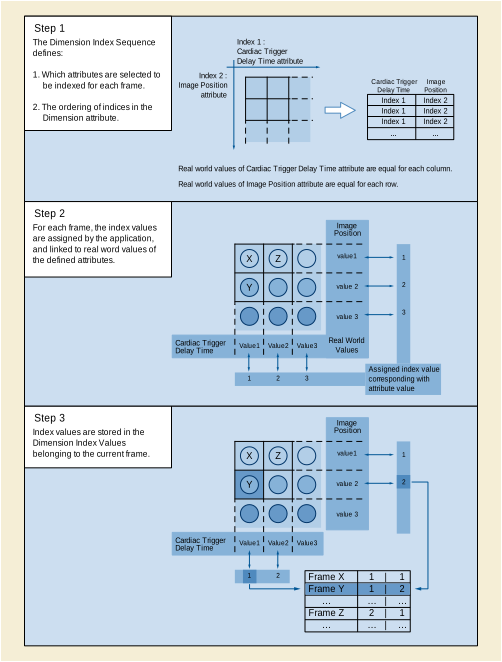
The Dimension Organization UID (0020,9164) value identifies a set of dimensions to which an Item of the Dimension Index Sequence (0020,9222) belongs.
When different SOP Instances share the same Dimension Organization UID (0020,9164) for a particular Item of the Dimension Index Sequence (0020,9222), equivalent indices from the corresponding Dimension Index Values (0020,9157) shall have the same meaning across the SOP Instances.
This mechanism allows an image creator to explicitly specify that indices are intended to convey identical information across SOP Instances.
The Dimension Organization Sequence attribute (0020,9221) contains a summary of all the Dimension Organization UID (0020,9164) values used in a SOP Instance.
Note
Figure C.7.6.17-2 illustrates how this is used for a SOP Instance created by a multi-planar reformat application from a SOP Instance containing three Items in the Dimension Index Sequence. The meaning of the indices for Temporal Position Index (0020,9128), and MR Echo Sequence (0018,9114) were preserved in the derived SOP Instance, so it shares the Dimension Organization UID for these attributes with the original. Since the reformat was performed with a different orientation, the meaning of the In-Stack Position Number (0020,9057) was not preserved. Therefore a new Dimension Organization UID (0020,9164) was created.
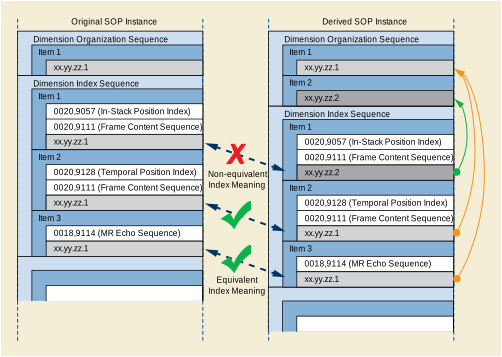
Table C.7.6.18-1 specifies the attributes of the Cardiac Synchronization Module.
Table C.7.6.18-1. Cardiac Synchronization Module Attributes
|
Attribute Name |
Tag |
Type |
Attribute Description |
|---|---|---|---|
|
Cardiac Synchronization Technique |
(0018,9037) |
1C |
Defines if a cardiac synchronization technique was applied during or after the acquisition. Enumerated Values:
Required if Image Type (0008,0008) Value 1 is ORIGINAL or MIXED. May be present otherwise. |
|
Cardiac Signal Source |
(0018,9085) |
1C |
Cardiac Signal Source. Defined Terms:
Required if Image Type (0008,0008) Value 1 is ORIGINAL or MIXED and Cardiac Synchronization Technique (0018,9037) equals other than NONE. Otherwise may be present if Image Type (0008,0008) Value 1 is DERIVED and Cardiac Synchronization Technique (0018,9037) equals other than NONE. |
|
Cardiac RR Interval Specified |
(0018,9070) |
1C |
R-R interval in ms measured prior to or during the scan. Required if Image Type (0008,0008) Value 1 is ORIGINAL or MIXED and Cardiac Synchronization Technique (0018,9037) equals other than NONE. Otherwise may be present if Image Type (0008,0008) Value 1 is DERIVED and Cardiac Synchronization Technique (0018,9037) equals other than NONE. NoteHeart Rate (0018,1088) is not used in this Module, since its value can be derived as 1/ Cardiac RR Interval Specified (0018,9070). |
|
Cardiac Beat Rejection Technique |
(0018,9169) |
1C |
Cardiac arrhythmia rejection technique. Defined Terms:
Required if Image Type (0008,0008) Value 1 is ORIGINAL or MIXED and Cardiac Synchronization Technique (0018,9037) equals PROSPECTIVE or RETROSPECTIVE. Otherwise may be present if Image Type (0008,0008) Value 1 is DERIVED and Cardiac Synchronization Technique (0018,9037) equals PROSPECTIVE or RETROSPECTIVE. |
|
Low R-R Value |
(0018,1081) |
2C |
R-R interval low limit for beat rejection, in ms. Required if Image Type (0008,0008) Value 1 is ORIGINAL or MIXED and Cardiac Synchronization Technique (0018,9037) equals PROSPECTIVE or RETROSPECTIVE. Otherwise may be present if Image Type (0008,0008) Value 1 is DERIVED and Cardiac Synchronization Technique (0018,9037) equals PROSPECTIVE or RETROSPECTIVE. |
|
High R-R Value |
(0018,1082) |
2C |
R-R interval high limit for beat rejection, in ms. Required if Image Type (0008,0008) Value 1 is ORIGINAL or MIXED and Cardiac Synchronization Technique (0018,9037) equals PROSPECTIVE or RETROSPECTIVE. Otherwise may be present if Image Type (0008,0008) Value 1 is DERIVED and Cardiac Synchronization Technique (0018,9037) equals PROSPECTIVE or RETROSPECTIVE. |
|
Intervals Acquired |
(0018,1083) |
2C |
Number of R-R intervals acquired and used to create the image (not including the intervals rejected). Required if Image Type (0008,0008) Value 1 is ORIGINAL or MIXED and Cardiac Synchronization Technique (0018,9037) equals other than NONE. Otherwise may be present if Image Type (0008,0008) Value 1 is DERIVED and Cardiac Synchronization Technique (0018,9037) equals other than NONE. |
|
Intervals Rejected |
(0018,1084) |
2C |
Number of R-R intervals rejected. Required if Image Type (0008,0008) Value 1 is ORIGINAL or MIXED and Cardiac Synchronization Technique (0018,9037) equals other than NONE. Otherwise may be present if Image Type (0008,0008) Value 1 is DERIVED and Cardiac Synchronization Technique (0018,9037) equals other than NONE. |
|
Skip Beats |
(0018,1086) |
3 |
Number of beats prescribed to be skipped after each detected arrhythmia. |
|
Cardiac Framing Type |
(0018,1064) |
1C |
Description of type of framing performed. See Section C.7.6.18.1.1.1 for description and Defined Terms. Required if type of framing is not time forward from trigger, may be present otherwise. |
Note
Low R-R Value (0018,1081), High R-R Value (0018,1082), Intervals Acquired (0018,1083) and Intervals Rejected (0018,1084) in this Module apply to the entire Image. The Cardiac Gating Sequence (0018,9118) in the Cardiac Gating Functional Group uses the same attributes and specifies the values for a single frame.
Table C.7.6.18-2 specifies the attributes of the Respiratory Synchronization Module.
Table C.7.6.18-2. Respiratory Synchronization Module Attributes
|
Attribute Name |
Tag |
Type |
Attribute Description |
|---|---|---|---|
|
Respiratory Motion Compensation Technique |
(0018,9170) |
1C |
Applied technique to reduce respiratory motion artifacts. Defined Terms:
Required if Image Type (0008,0008) Value 1 is ORIGINAL or MIXED. May be present otherwise. |
|
Respiratory Signal Source |
(0018,9171) |
1C |
Signal source from which respiratory motion is derived. Defined Terms:
Required if Image Type (0008,0008) Value 1 is ORIGINAL or MIXED and Respiratory Motion Compensation Technique (0018,9170) equals other than NONE. Otherwise may be present if Image Type (0008,0008) Value 1 is DERIVED and Respiratory Motion Compensation Technique (0018,9170equals other than NONE. |
|
Respiratory Trigger Delay Threshold |
(0020,9256) |
1C |
Respiratory trigger threshold in percent of the chest expansion for the frame relative to the last Respiratory-Peak. See Section C.7.6.16.2.17.1 for further explanation. Required if Respiratory Motion Compensation Technique (0018,9170) equals other than NONE, REALTIME or BREATH_HOLD and if Image Type (0008,0008) Value 1 is ORIGINAL or MIXED. May be present otherwise. |
|
Respiratory Trigger Type |
(0020,9250) |
1C |
Characteristic of the respiratory signal used to the define the respiratory triggering. Defined Terms:
Required if the value is not TIME, may be present otherwise. |
Table C.7.6.18-3 specifies the attributes of the Bulk Motion Synchronization Module.
Table C.7.6.18-3. Bulk Motion Synchronization Module Attributes
|
Attribute Name |
Tag |
Type |
Attribute Description |
|---|---|---|---|
|
Bulk Motion Compensation Technique |
(0018,9172) |
1C |
Applied technique to reduce bulk or other physiology motion artifacts. Defined Terms:
Required if Image Type (0008,0008) Value 1 is ORIGINAL or MIXED. May be present otherwise. |
|
Bulk Motion Signal Source |
(0018,9173) |
1C |
Signal source to measure motion. Defined Terms:
Required if Image Type (0008,0008) Value 1 is ORIGINAL or MIXED and Bulk Motion Compensation Technique (0018,9172) equals other than NONE. Otherwise may be present if Image Type (0008,0008) Value 1 is DERIVED and Bulk Motion Compensation Technique (0018,9172) equals other than NONE. |
This module is used in conjunction with Multi-frame IODs that use RGB color in a number of frames. The value of Pixel Presentation (0008,9205) for such frames equals COLOR.
Table C.7.6.19-1 specifies the Attributes that describe the Lookup table data.
Table C.7.6.19-1. Supplemental Palette Color Table Lookup Module Attributes
|
Attribute Name |
Tag |
Type |
Attribute Description |
|---|---|---|---|
|
Red Palette Color Lookup Table Descriptor |
(0028,1101) |
1 |
Specifies the format of the Red Palette Color Lookup Table Data (0028,1201). See Section C.7.6.3.1.5 for further explanation. |
|
Green Palette Color Lookup Table Descriptor |
(0028,1102) |
1 |
Specifies the format of the Green Palette Color Lookup Table Data (0028,1202). See Section C.7.6.3.1.5 for further explanation. |
|
Blue Palette Color Lookup Table Descriptor |
(0028,1103) |
1 |
Specifies the format of the Blue Palette Color Lookup table Data (0028,1203). See Section C.7.6.3.1.5 for further explanation. |
|
Red Palette Color Lookup Table Data |
(0028,1201) |
1 |
Red Palette Color Lookup Table Data. See Section C.7.6.3.1.6 for further explanation. |
|
Green Palette Color Lookup Table Data |
(0028,1202) |
1 |
Green Palette Color Lookup Table Data. See Section C.7.6.3.1.6 for further explanation. |
|
Blue Palette Color Lookup Table Data |
(0028,1203) |
1 |
Blue Palette Color Lookup Table Data. See Section C.7.6.3.1.6 for further explanation. |
This section describes attributes of the Patient Orientation Module by describing the patient orientation related to gravity and equipment. Table C.7.6.20-1 contains IOD Attributes that describe the Patient Orientation.
Table C.7.6.20-1. Patient Orientation Module Attributes
|
Attribute Name |
Tag |
Type |
Attribute Description |
|---|---|---|---|
This section describes the Image - Equipment Coordinate Relationship module. Table C.7.6.21-1 contains the attributes that specify how the equipment (e.g., gantry) and patient oriented coordinate system (in conjunction with Image Position (Patient) (0020,0032) and Image Orientation (Patient) (0020,0037) attributes) are related.
Table C.7.6.21-1. Image - Equipment Coordinate Relationship Module Attributes
|
Attribute Name |
Tag |
Type |
Attribute Description |
|---|---|---|---|
|
Image to Equipment Mapping Matrix |
(0028,9520) |
1 |
A 4x4 rigid transformation matrix that maps patient coordinate space of the reconstructed image to the equipment defined original coordinate space. Matrix elements shall be listed in row-major order. See Section C.7.6.21.1. |
|
Equipment Coordinate System Identification |
(0028,9537) |
1 |
Identification of the type of equipment coordinate system in which the projection images were acquired. See Section C.7.6.21.2. Defined Terms:
|
The Image to Equipment Mapping Matrix (0028,9520) is used to describe the relationship between the Patient oriented coordinate system and a modality specific equipment coordinate system. This mapping can only be used with systems that have a well-defined equipment coordinate system (such as XA, etc.).
The Image to Equipment Mapping Matrix AMB describes how to transform a point (Bx,By,Bz) with respect to the Patient coordinate system into (Ax,Ay,Az) with respect to the equipment coordinate system according to the equation below.
The Image to Equipment Mapping Matrix is a rigid transformation that involves only translations and rotations. Mathematically, the matrix shall be orthonormal and can describe six degrees of freedom: three translations, and three rotations.
Note
Both the Patient Coordinate System and the Equipment Coordinate System are expressed in millimeters.
The Equipment Coordinate System Identification (0028,9537) identifies the Reference Coordinate System to which the Image to Equipment Mapping Matrix (0028,9520) is related.
The Defined Term ISOCENTER refers to a coordinate reference system where the origin corresponds with the center of rotation of the projections.
Table C.7.6.22-1 specifies the Attributes that identify one or more Specimens being imaged.
Table C.7.6.22-2. Specimen Macro Attributes
|
Attribute Name |
Tag |
Type |
Attribute Description |
|---|---|---|---|
|
Container Identifier |
(0040,0512) |
1 |
The identifier for the container that contains the specimen(s) being imaged. See Section C.7.6.22.1.1. |
|
Issuer of the Container Identifier Sequence |
(0040,0513) |
2 |
Organization that assigned the Container Identifier. Zero or one Item shall be included in this sequence. |
|
>Include Table 10-17 “HL7v2 Hierarchic Designator Macro Attributes” |
|||
|
Alternate Container Identifier Sequence |
(0040,0515) |
3 |
Sequence of alternate identifiers for the container that contains the specimen(s) being imaged. These may have been assigned, e.g., by the manufacturer, or by another institution that collected the specimen. One or more Items are permitted in this sequence. |
|
>Container Identifier |
(0040,0512) |
1 |
The identifier for the container that contains the specimen(s) being imaged. |
|
>Issuer of the Container Identifier Sequence |
(0040,0513) |
2 |
Organization that assigned the Container Identifier. Zero or one Item shall be included in this sequence. |
|
>>Include Table 10-17 “HL7v2 Hierarchic Designator Macro Attributes” |
|||
|
Container Type Code Sequence |
(0040,0518) |
2 |
Type of container that contains the specimen(s) being imaged. Zero or one Item shall be included in this sequence. |
|
Baseline CID 8101 “Container Types”. |
|||
|
Container Description |
(0040,051A) |
3 |
Description of the container. |
|
Container Component Sequence |
(0040,0520) |
3 |
Description of one or more components of the container (e.g., description of the slide and of the coverslip). One or more Items are permitted in this sequence. |
|
>Container Component Type Code Sequence |
(0050,0012) |
1 |
Type of container component. Only a single Item shall be included in this sequence. |
|
Baseline CID 8102 “Container Component Types”. |
|||
|
>Manufacturer |
(0008,0070) |
3 |
Manufacturer of the container component. |
|
>Manufacturer's Model Name |
(0008,1090) |
3 |
Manufacturer's model name of the container component. |
|
>Container Component ID |
(0050,001B) |
3 |
Manufacturer's identifier of the container component, e.g., Lot Number and/or Version. |
|
>Container Component Length |
(0050,001C) |
3 |
Length in mm of container component. |
|
>Container Component Width |
(0050,0015) |
3 |
Width in mm of container component. |
|
>Container Component Diameter |
(0050,001D) |
3 |
Diameter in mm of container component for cylindrical or circular components. |
|
>Container Component Thickness |
(0050,0013) |
3 |
Thickness in mm of container component |
|
>Container Component Material |
(0050,001A) |
3 |
Material of container component. Defined Terms:
|
|
>Container Component Description |
(0050,001E) |
3 |
Container component text description. |
|
Specimen Description Sequence |
(0040,0560) |
1 |
Sequence of identifiers and detailed description of the specimen(s) being imaged. One or more Items shall be included in this sequence. Each specimen imaged in the Pixel Data shall be identified by an Item in this Sequence. Other specimens in/on the container, but not imaged in the Pixel Data, may also be identified by Items in this Sequence. |
|
>Specimen Identifier |
(0040,0551) |
1 |
A departmental information system identifier for the Specimen. See Section C.7.6.22.1.1 and Section C.7.6.22.1.2. If a single specimen is present in a container, the value of the Specimen Identifier and the value of the Container Identifier are typically the same. |
|
>Issuer of the Specimen Identifier Sequence |
(0040,0562) |
2 |
The name or code for the institution that has assigned the Specimen Identifier. Zero or one Item shall be included in this sequence. |
|
>>Include Table 10-17 “HL7v2 Hierarchic Designator Macro Attributes” |
|||
|
>Specimen UID |
(0040,0554) |
1 |
Unique Identifier for Specimen. See Section C.7.6.22.1.2. |
|
>Specimen Type Code Sequence |
(0040,059A) |
3 |
Specimen Type. Only a single Item is permitted in this sequence. |
|
>Specimen Short Description |
(0040,0600) |
3 |
Short textual specimen description (may include ancestor specimen descriptions). |
|
>Specimen Detailed Description |
(0040,0602) |
3 |
Detailed textual specimen description (may include ancestor specimen descriptions). |
|
>Specimen Preparation Sequence |
(0040,0610) |
2 |
Sequence of Items identifying the process steps used to prepare the specimen for image acquisition. This includes description of all processing necessary to interpret the image. Zero or more Items shall be included in this sequence. This Sequence includes description of the specimen sampling step from an ancestor specimen, potentially back to the original part collection. See Section C.7.6.22.1.3. |
|
>>Specimen Preparation Step Content Item Sequence |
(0040,0612) |
1 |
Sequence of Content Items identifying the processes used in one preparation step to prepare the specimen for image acquisition. One or more Items shall be included in this sequence. |
|
>>>Include Table 10-2 “Content Item Macro Attributes Description” |
Baseline TID 8001 “Specimen Preparation” |
||
|
>Include Table 10-8 “Primary Anatomic Structure Macro Attributes” |
Original anatomic location in patient of specimen. This location may be identical to that of the parent specimen, may be further refined by modifiers depending on the sampling procedure for this specimen, or may be a distinct concept. |
||
|
>Specimen Localization Content Item Sequence |
(0040,0620) |
1C |
Sequence of Content Items identifying the location of the specimen in the container and/or in the image. See Section C.7.6.22.1.4. One or more Items shall be included in this sequence. Required if multiple specimens present in the image. May be present otherwise. |
|
>>Include Table 10-2 “Content Item Macro Attributes Description” |
Defined TID is TID 8004 “Specimen Localization”. |
||
"Specimen" is the role played by a discrete physical object (or a collection of objects that are considered as a unit) that is the subject of pathology examination.
A specimen is a physical object (or a collection of objects) when the laboratory considers it a single discrete, uniquely identified unit that is the subject of one or more steps in the laboratory (diagnostic) workflow. This includes objects at all levels of processing, including fresh tissue, dissected organs, tissue embedded in paraffin, sections made from embedded tissue, and liquid preparations.
Specimens are physically managed by being placed in or on a container. The concept of container includes buckets, cassettes, vials, and slides. While there is usually one specimen per container, it is possible, in some laboratory workflows, for multiple specimens to be in/on a container.
Both specimens and specimen containers have logical identifiers for workflow management. The logical identifier of a container is usually conveyed on a label on the container. The specimen itself will typically not be physically labeled with its identifier. For the usual case of a single specimen in/on a container, the logical identifiers may be identical. However, when there are multiple specimens in/on a container, each specimen receives a distinct logical identifier. These identifiers are encoded in the SOP Instance using attributes Container Identifier (0040,0512) and Specimen Identifier (0040,0551).
Note
This definition of "specimen" extends the common definition beyond the part or parts that were submitted for examination (e.g., from surgery) to include any derivative piece that may be separately analyzed or examined, such as a block or slide preparation.
Although many Pathology Information Systems use a hierarchical system for identifying parts, blocks and slides, there should be no assumption made that this will be the case and in particular, there should be no attempt to parse a given Specimen Identifier to retrieve an accession number or other higher level identifier.
Specimen Identifier (0040,0551) must be unique at least within the Study; the actual scope of uniqueness is determined by the departmental information system that assigns the IDs. Each specimen shall also be assigned a globally unique Specimen UID (0040,0554) that allows referencing beyond the scope of a Study. This UID may be used, for instance, if a specimen is sent to another institution for further analysis.
Interpretation of specimen images requires information about the source of the specimen and its preparation (e.g., sampling, fixation, staining). The processing steps used to prepare a specimen are recorded in the Specimen Preparation Sequence (0040,0610). This sequence may include one Item for each processing step (as defined in the laboratory workflow) in the history of the specimen, and those Items are composed of a set of Content Items in the Specimen Preparation Step Content Item Sequence (0040,0612).
The Specimen Preparation Sequence may include description of the original part collected from the patient, the processing of that part, the sampling of tissue from the part and the preparation of that sample, and the further sub-sampling and processing of the tissue. In other words, the description of a specific specimen may include descriptions of the specimen's ancestors.
The Specimen Preparation Sequence Items shall be in ascending chronological order.
When there are multiple specimens in/on a container, the Specimen Localization Content Item Sequence (0040,0620) is used to identify the location of the specimen in the container, as there is no physical label with the Specimen Identifier. This Content Item Sequence, in accordance with TID 8004 “Specimen Localization”, allows the specimen to be localized by a distance in one to three dimensions from a reference point on the container, by an identified physical description such as a colored ink, or by its location as shown in a referenced image of the container. The referenced image may use an overlay, burned-in annotation, or an associated Presentation State SOP Instance to specify the location of the specimen.
Table C.7.6.23-1 specifies the attributes that define data flow through the Enhanced Blending and Display Pipeline. See Section C.7.6.23.1 for an overview of the Enhanced Blending and Display Pipeline.
Table C.7.6.23-1. Enhanced Palette Color Lookup Table Module Attributes
|
Attribute Name |
Tag |
Type |
Attribute Description |
|---|---|---|---|
|
Data Frame Assignment Sequence |
(0028,1401) |
1 |
Sequence of items each assigning frames of one particular value of Data Type (0018,9808) to a data path in the Enhanced Blending and Display Pipeline. One, two, or three items shall be included in this sequence. |
|
>Data Type |
(0018,9808) |
1 |
Identification of the data type of frames using this data path assignment. |
|
>Data Path Assignment |
(0028,1402) |
1 |
The data path to use for this data type in the Enhanced Blending and Display Pipeline. Enumerated Values:
See Section C.7.6.23.2 for usage. |
|
>Bits Mapped to Color Lookup Table |
(0028,1403) |
3 |
The number of most significant bits of each value of Pixel Data (7FE0,0010) from this frame contributing to the Palette Color Lookup Table input. If absent, Bits Stored (0028,0101) bits of each value of Pixel Data (7FE0,0010) from this frame contributes to the Palette Color Lookup Table input. See Section C.7.6.23.3 for usage. |
|
Blending LUT 1 Sequence |
(0028,1404) |
1C |
Specification of the weight of the primary path input to the Blending Operation, i.e., the value that is referred to as "Weight 1" in the Enhanced Blending and Display Pipeline. Only a single item shall be included in this sequence. Required if there are one or more items of the Data Path Assignment Sequence (0028,1402) other than PRIMARY_PVALUES. |
|
>Blending LUT 1 Transfer Function |
(0028,1405) |
1 |
Specifies the algorithm used to determine the output value of Blending LUT 1. Enumerated Values:
See Section C.7.6.23.4 for details. |
|
>Blending Weight Constant |
(0028,1406) |
1C |
Constant value of the Weight input to blending operation. Shall be from 0.0 to 1.0, inclusive. Required if Blending LUT 1 Transfer Function (0028,1405) is CONSTANT. |
|
>Blending Lookup Table Descriptor |
(0028,1407) |
1C |
Specifies the format of Blending Lookup Table Data (0028,1408) in this sequence item. The second value (first stored pixel value mapped) shall be zero. See Section C.7.6.23.5 for further explanation. Required if Blending LUT 1 Transfer Function (0028,1405) is TABLE. |
|
>Blending Lookup Table Data |
(0028,1408) |
1C |
Contains the Blending Lookup Table values for this Weight input to the Blending Operation. Required if Blending LUT 1 Transfer Function (0028,1405) is TABLE. |
|
Blending LUT 2 Sequence |
(0028,140C) |
1C |
Specification of the weight of the secondary path input to the Blending Operation, i.e., the value that is referred to as "Weight 2" in the Enhanced Blending and Display Pipeline. Only a single item shall be included in this sequence. Required if there are one or more items of the Data Path Assignment Sequence (0028,1402) other than PRIMARY_PVALUES. |
|
>Blending LUT 2 Transfer Function |
(0028,140D) |
1 |
Specifies the algorithm used to determine the output value of Blending LUT 2. Enumerated Values:
See Section C.7.6.23.4 for details. |
|
>Blending Weight Constant |
(0028,1406) |
1C |
Constant value of the Weight input to blending operation. Shall be from 0.0 to 1.0, inclusive. Required if Blending LUT 2 Transfer Function (0028,140D) is CONSTANT. |
|
>Blending Lookup Table Descriptor |
(0028,1407) |
1C |
Specifies the format of Blending Lookup Table Data (0028,1408) in this sequence item. The second value (first stored pixel value mapped) shall be zero. See Section C.7.6.23.5 for further explanation. Required if Blending LUT 2 Transfer Function (0028,140D) is TABLE. |
|
>Blending Lookup Table Data |
(0028,1408) |
1C |
Contains the Blending Lookup Table values for this Weight input to the Blending operation. Required if Blending LUT 2 Transfer Function (0028,140D) is TABLE. |
|
Enhanced Palette Color Lookup Table Sequence |
(0028,140B) |
1C |
This sequence contains the Palette Color Lookup Table. One or two items shall be included in this sequence. Required if Data Path Assignment (0028,1402) is present with a value other than PRIMARY_PVALUES. |
|
>Data Path ID |
(0028,140E) |
1 |
Identifier of the data path in which this Palette Color Lookup Table is used. Enumerated Values:
Each item shall have a distinct value of Data Path ID. |
|
>RGB LUT Transfer Function |
(0028,140F) |
1 |
Specifies the mapping that takes place between the input value and RGB input to the Blending Operation. Enumerated Values:
|
|
>Alpha LUT Transfer Function |
(0028,1410) |
1 |
Specifies the transformation that is used to create the Alpha input to the Blending LUTs. NoteDepending on the values of Blending LUT 1 Transfer Function (0028,1405) and Blending LUT 2 Transfer Function (0028,140D) the Alpha LUT value may be ignored. It is recommended that IDENTITY be used if this is the case. Enumerated Values:
|
|
>Red Palette Color Lookup Table Descriptor |
(0028,1101) |
1C |
Specifies the format of the Red Palette Color Lookup Table Data (0028,1201). The second value (first stored pixel value mapped) shall be zero. Required if RGB LUT Transfer Function (0028,140F) is TABLE. |
|
>Green Palette Color Lookup Table Descriptor |
(0028,1102) |
1C |
Specifies the format of the Green Palette Color Lookup Table Data (0028,1202). The second value (first stored pixel value mapped) shall be zero. Required if RGB LUT Transfer Function (0028,140F) is TABLE. |
|
>Blue Palette Color Lookup Table Descriptor |
(0028,1103) |
1C |
Specifies the format of the Blue Palette Color Lookup Table Data (0028,1203). The second value (first stored pixel value mapped) shall be zero. Required if RGB LUT Transfer Function (0028,140F) is TABLE. |
|
>Alpha Palette Color Lookup Table Descriptor |
(0028,1104) |
1C |
Specifies the format of the Alpha Palette Color Lookup Table Data. The second value (first stored pixel value mapped) shall be zero. Required if Alpha LUT Transfer Function (0028,1410) is TABLE. |
|
>Red Palette Color Lookup Table Data |
(0028,1201) |
1C |
Red Palette Color Lookup Table Data. Required if RGB LUT Transfer Function (0028,140F) is TABLE. |
|
>Green Palette Color Lookup Table Data |
(0028,1202) |
1C |
Green Palette Color Lookup Table Data. Required if RGB LUT Transfer Function (0028,140F) is TABLE. |
|
>Blue Palette Color Lookup Table Data |
(0028,1203) |
1C |
Blue Palette Color Lookup Table Data. Required if RGB LUT Transfer Function (0028,140F) is TABLE. |
|
>Alpha Palette Color Lookup Table Data |
(0028,1204) |
1C |
Alpha LUT contains the blending values for the data frames. Required if Alpha LUT Transfer Function (0028,1410) is TABLE. |
|
ICC Profile |
(0028,2000) |
1C |
An ICC Profile encoding the transformation of device-dependent color stored pixel values into PCS-Values. When present, defines the color space of the output of the Enhanced Blending and Display Pipeline. Required if Data Path Assignment (0028,1402) is present and there exists any value other than PRIMARY_PVALUES. |
The Enhanced Blending and Display Pipeline describes a scheme for blending of data frames of different Data Types and a color/grayscale mapping for display recommended by the provider of this information. There are no requirements upon an receiving application to utilize this recommendation in the processing and display of the referenced image.
The blending transformation model in Figure C.7.6.23-1 applies for mapping images derived from one, two, or three data frames with the same image position and orientation but of different values of Data Type (0018,9808) to grayscale P-Values or color PCS-values for presentation. These inputs to the pipeline are frames of pixel values obtained from Pixel Data (7FE0,0010) and structured as described by attributes of the Image Pixel Module. Co-located pixels from each data frame are processed through the Pipeline, resulting in one output sample at that location.
The model utilizes up to two data paths called the Primary and the Secondary data paths. Each input data frame may be initially processed by a Modality LUT and a VOI LUT. If not explicitly specified, the Modality LUT and VOI LUT are assumed to be identity transformations. The Primary path may be used alone to obtain only grayscale transformation without blending. In this case, the Primary data path input after going through the Modality LUT and VOI LUT is mapped through a Presentation LUT to obtain device independent grayscale values (P-Values) for presentation.
Either Primary or Secondary paths alone or both paths together may be used to obtain color transformation with blending. Up to one data frame input in the Primary data path and up to two data frames input in the Secondary data path are allowed for this blending transformation. These frames may be mapped to color using one-input or two-input palette color lookup tables depending on the number of data frames input to the data path. Alternatively if a path has one data frame, values may be converted to RGB (where R=G=B) before blending, if pseudo-color presentation of this data path is not desired. RGB values from Primary and Secondary data paths are combined via a "Blending Operation" in which the RGB color components are multiplied by a corresponding blending weight function (Weight 1 and Weight 2, respectively), and for each color component the two products are added together to produce the blended output value of that component. All inputs to the Blending Operation are normalized to the range 0.0 to 1.0, inclusive, even if they are fixed integer values that had been the entries in a lookup table.
Each of the Weight inputs to the blending operation is the output of a corresponding Blending LUT Transfer Function, which is selectable as either a constant or a derivation of the data frame values as described in Section C.7.6.23.4.
The RGB output from the Blending Operation is clamped to limit each color component (R, G, and B) to fall within the range 0.0 to 1.0, inclusive. The clamping function simply sets the value of any color component to 1.0 if the output from the Blending operation for that component exceeds 1.0. The RGB output of the clamping function is made available for use in rendering and slicing algorithms. Further, the output of the clamping function is transformed by the Profile Connection Space Transformation to device independent color values (PCS-values) for presentation.
If the input data frame values are representative of real world data, then they can be mapped to the real world values and units using the Real World Value Mapping Macro.
Note
Annex QQ “Enhanced US Data Type Blending Examples (Informative)” in PS3.17 describes a number of examples of the Enhanced Blending and Display Pipeline with specific attribute values for each example that invoke particular data flows through the pipeline.
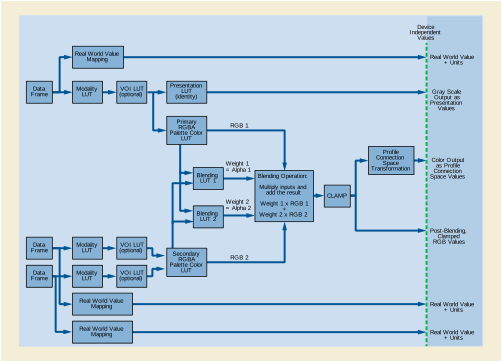
Data Path Assignment (0028,1402) specifies the data path to use in the Enhanced Blending and Display Pipeline for each data frames of a particular data type.
Enumerated Values:
- PRIMARY_PVALUES
Data Frame values are passed through the Presentation LUT to produce grayscale P-Values; no blending is performed
- PRIMARY_SINGLE
Data Frame values are inputs to the Primary Palette Color Lookup Table
- SECONDARY_SINGLE
Data Frame values are inputs to the Secondary Palette Color Lookup Table
- SECONDARY_HIGH
Data Frame values having Data Path Assignment (0028,1402) of SECONDARY_HIGH are concatenated as the most significant bits with Data Frame values having Data Path Assignment of SECONDARY_LOW to form inputs to the Secondary Palette Color Lookup Table
- SECONDARY_LOW
Data Frame values having Data Path Assignment (0028,1402) of SECONDARY_LOW are concatenated as the least significant bits with Data Frame values having Data Path Assignment of SECONDARY_HIGH to form inputs to the Secondary Palette Color Lookup Table
The number of entries of each Palette Color Lookup Table is specified in the Palette Color Lookup Table Descriptors of the lookup table components. As described in Section C.7.6.3.1.5, a maximum of 65,536 (216) data entries is permitted, which would require input values of 16 bits to access all Palette Color Lookup Table entries. For tables with less than the maximum number of Palette Color Lookup Table entries, correspondingly smaller input values are required.
In the Enhanced Blending and Display Pipeline, the Palette Color Lookup Table input values are obtained from one or two data frames, depending on the values of the Data Path Assignment (0028,1402) attributes; for Data Path Assignment (0028,1402) = PRIMARY_SINGLE or SECONDARY_SINGLE, the input values are obtained from stored pixel values of a single data frame (after processing through the Modality LUT and/or VOI LUT), while for Data Path Assignment (0028,1402)= SECONDARY_HIGH and SECONDARY_LOW, the input values are constructed from stored pixel values of two data frames (after processing through Modality LUTs and/or VOI LUTs) as described below.
The number of bits in each data frame stored pixel value is specified by the value of Bits Stored (0028,0101). It is possible that the number of bits in the PRIMARY_SINGLE or SECONDARY_SINGLE data frame or the sum of the numbers of bits in the SECONDARY_HIGH and SECONDARY_LOW data frames is greater than the number of bits needed to address all Palette Color Lookup Table entries. The values of Bits Mapped to Color Lookup Table (0028,1403) specify the number of bits from the corresponding data frame stored pixel values that contribute to the Palette Color Lookup Table input values, as follows:
If Data Path Assignment is PRIMARY_SINGLE or SECONDARY_SINGLE, the input to the Palette Color Lookup Table is the number of most significant bits specified by Bits Mapped to Color Lookup Table (0028,1403) from the data frame stored pixel values. For Data Path Assignment SECONDARY_HIGH or SECONDARY_LOW, the number of most significant bits specified by Bits Mapped to Color Lookup Table (0028,1403) from each data frame's stored pixel values are concatenated to create the Palette Color Lookup Table input values, with the SECONDARY_HIGH frame's bits comprising the most significant part of the input value and the SECONDARY_LOW frame's bits comprising the least significant part of the input value.
If the resulting Palette Color Lookup Table input value is greater than the number of Palette Color Lookup Table entries as specified by the Palette Color Lookup Table Descriptor first value, then the output from the Palette Color Lookup Table shall be the last value in the Palette Color Lookup Table. However, it is recommended that the values of Bits Mapped To Color Lookup Table (0028,1403) and number of Palette Color Lookup Table entries be selected such that all input values are mapped to distinct entries in the Palette Color Lookup Table.
The value of Blending LUT 1 Transfer Function (0028,1405) and Blending LUT 2 Transfer Function (0028,140D) specify the algorithm used to determine the output values of the Blending LUT 1 and Blending LUT 2, respectively.
Enumerated Values:
- CONSTANT
A constant floating point value from 0.0 to 1.0, inclusive
- ALPHA_1
Pass-through the Alpha 1 input value from the Alpha Palette Color Lookup Table of the Primary data path
- ALPHA_2
Pass-through the Alpha 2 input value from the Alpha Palette Color Lookup Table of the Secondary data path
- TABLE
The output of a Table defining a function of the Alphas from both data paths
- ONE_MINUS
The Blending LUT 2 value is (1 - Blending LUT 1 output); used for Blending LUT 2 Transfer Function (0028,140D) only
If the value is TABLE:
The Alpha 1 input value from the Alpha Palette Color Lookup Table of the Primary data path and the Alpha 2 input value from the Alpha Palette Color Lookup Table of the Secondary data are concatenated to form an index into a Lookup Table, with the Alpha 1 value providing the most significant bits of the index and the Alpha 2 value providing the least significant bits of the index.
If the index is too large for the number of entries in the Lookup Table, the last value of the Lookup Table is used for any index value greater than the number of Lookup Table entries. If the index is too small for the number of entries in the Lookup Table, than not all entries in the Lookup Table are accessed. The total number of bits in the index value shall be equal to or less than 16.
The three values of the Blending Lookup Table Descriptor (0028,1407) describe the format of the data in Blending Lookup Table Data (0028,1408).
The first value is the number of entries in the lookup table. When the number of table entries is equal to 65,536 (216), then this value shall be 0. The number of entries shall be equal to the number of possible values in the input.
Note
For example, for 8 bit input to the Blending LUT the tables must have 256 entries, while for 16 bit input to the Blending LUT the tables must have 65,536 entries.
The second value is the first input value mapped, and shall always be 0 for an Blending LUT. This input value is mapped to the first entry in the LUT. Subsequent input values are mapped to the subsequent entries in the LUT Data up to an input value equal to number of entries + first value mapped - 1 that is mapped to the last entry in the LUT Data. There are no input values greater than number of entries - 1.
The third value specifies the number of bits for each entry in the LUT Data. This value shall be between 8 and 16, inclusive. The LUT Data shall be stored in a format equivalent to 16 bits allocated where the high bit is equal to bits stored - 1, where bits stored is the third value.
Image objects containing non-monotonic Palette Color LUTs that are lossy compressed may potentially experience a change in the index values that results in the displayed image having a significantly different appearance than the original image.
Retired. See PS3.3-2004.
Retired. See PS3.3-2004.
Table C.7-22 specifies the Attributes that describe the Lookup table data for images with Palette Color photometric interpretation.
When the Palette Color Lookup Table Module is present in an Image IOD, the conditional requirements for the use of Palette Color Lookup Table Data (0028,1201-1203) and Segmented Palette Color Lookup Table Data (0028,1221-1223), described in Table C.7-22, shall take precedence over the conditional requirements described in the Image Pixel Module (see Section C.7.6.3). When the Palette Color Lookup Table Module is present in a Presentation State IOD or Color Palette IOD, the Palette Color Lookup Table Data (0028,1201-1203) attributes are mandatory and the Segmented Palette Color Lookup Table Data (0028,1221-1223) shall not be present.
When the Palette Color Lookup Table Module is present in a Color Palette IOD, the 3rd value of Palette Color Lookup Table Descriptor (0028,1101-1103) (i.e, the number of bits for each entry in the Lookup Table Data) shall be 8.
Table C.7-22. Palette Color Lookup Table Module Attributes
|
Attribute Name |
Tag |
Type |
Attribute Description |
|---|---|---|---|
|
Include Table C.7-22a “Palette Color Lookup Table Macro Attributes” |
|||
Table C.7-22a. Palette Color Lookup Table Macro Attributes
|
Attribute Name |
Tag |
Type |
Attribute Description |
|---|---|---|---|
|
Red Palette Color Lookup Table Descriptor |
(0028,1101) |
1 |
Specifies the format of the Red Palette Color Lookup Table Data (0028,1201). See Section C.7.6.3.1.5 for further explanation. |
|
Green Palette Color Lookup Table Descriptor |
(0028,1102) |
1 |
Specifies the format of the Green Palette Color Lookup Table Data (0028,1202). See Section C.7.6.3.1.5 for further explanation. |
|
Blue Palette Color Lookup Table Descriptor |
(0028,1103) |
1 |
Specifies the format of the Blue Palette Color Lookup table Data (0028,1203). See Section C.7.6.3.1.5 for further explanation. |
|
Palette Color Lookup Table UID |
(0028,1199) |
3 |
Palette Color Lookup Table UID. See Section C.7.9.1 for further explanation. |
|
Red Palette Color Lookup Table Data |
(0028,1201) |
1C |
Red Palette Color Lookup Table Data. Required if segmented data is NOT used in an Image IOD, or if the IOD is a Presentation State IOD or Color Palette IOD. See Section C.7.6.3.1.6 for further explanation. |
|
Green Palette Color Lookup Table Data |
(0028,1202) |
1C |
Green Palette Color Lookup Table Data. Required if segmented data is NOT used in an Image IOD, or if the IOD is a Presentation State IOD or Color Palette IOD. See Section C.7.6.3.1.6 for further explanation. |
|
Blue Palette Color Lookup Table Data |
(0028,1203) |
1C |
Blue Palette Color Lookup Table Data. Required if segmented data is NOT used in an Image IOD, or if the IOD is a Presentation State IOD or Color Palette IOD. See Section C.7.6.3.1.6 for further explanation. |
|
Segmented Red Palette Color Lookup Table Data |
(0028,1221) |
1C |
Segmented Red Palette Color Lookup Table Data. Required if segmented data is used in an Image IOD; shall not be present in a Presentation State IOD or Color Palette IOD. See Section C.7.9.2 for further explanation. |
|
Segmented Green Palette Color Lookup Table Data |
(0028,1222) |
1C |
Segmented Green Palette Color Lookup Table Data. Required if segmented data is used in an Image IOD; shall not be present in a Presentation State IOD. or Color Palette IOD See Section C.7.9.2 for further explanation. |
|
Segmented Blue Palette Color Lookup Table Data |
(0028,1223) |
1C |
Segmented Blue Palette Color Lookup Table Data. Required if segmented data is used in an Image IOD; shall not be present in a Presentation State IOD or Color Palette IOD. See Section C.7.9.2 for further explanation. |
This data element uniquely identifies a palette color lookup table set (red, green, blue).
Note
This can be used to avoid reloading a palette if a system already has that palette loaded without examining all the data entries in the palette.
If this Attribute is present in a Color Palette IOD, it shall have the same value as the SOP Instance UID.
The Segmented Palette Color Lookup Table Data (0028,1221-1223) is stored as a series of segments, see Table C.7-23. When the segments are expanded into the actual lookup table data, it shall have the number of table entries specified by the first value of the Palette Color Lookup Table Descriptors (0028,1101-1103), Number of Table Entries.
These lookup tables shall be used only when segmented lookup table data use is desirable and there is a single sample per pixel (single image plane) in the image.
There are currently three types of segments: discrete, linear, and indirect. The segments type is identified by the opcodes in Table C.7-24.
The discrete segment is used to represent a series of palette components that are not monotonic with respect to their predecessors or successors. The Segment Length indicates the number of lookup table entries.
The format of the Discrete Segment Type shall be as in Table C.7-25.
Table C.7-25. Discrete Segment Type
|
Segment Opcode = 0 |
|
Segment Length |
|
Segment Length number of lookup table entries |
The linear segment represents a series of palette components whose values may be represented by a straight line.
X = palette address, Y = Value contained in the palette.
(Xo, Yo) = end of the previous segment
(Xo+ Segment Length, Y1) = end of this linear segment
Where: Y1 is contained in the data portion of this segment.
During expansion, the application should "connect" the previous segment's endpoint, (Xo, Yo), with this segment's endpoint, (Xo+ Segment Length, Y1) using a straight line, by computing the values for each point between the endpoints.
Note
Because the linear segment uses the end point from the previous segment, a linear segment can not be the first segment.
The linear segment's format shall be as in Table C.7-26.
The indirect segment allows the re-use of repetitive regions within lookup table without respecifying the segment. The opcode is followed by the number of segments to copy and one offset pointer to the first segment to copy. The byte offset is relative to the beginning of the lookup table. For example, if an indirect segment wants to point to the first segment, then the offset will be zero. The offset is a 32 bit value but is stored in the segment as a least significant 16 bit value followed by a most significant 16 bit value. An indirect segment shall not point to or copy another indirect segment. This avoids the need for recursion and also avoids the possibility of infinite loops.
The indirect segment's format shall be as follows:
Table C.7-27. Indirect Segment Type
|
Segment Opcode = 2 |
|
Number of segments to copy |
|
Least significant 16 bits of byte offset to first segment to copy |
|
Most significant 16 bits of byte offset to first segment to copy |
This Section describes Computed Radiography Series and Image Modules. These Modules contain Attributes that are specific to Computed Radiography images. There is no Computed Radiography Equipment Module.
Table C.8-1 contains IOD Attributes that describe a computed radiography series performed on the patient.
Table C.8-1. CR Series Module Attributes
|
Attribute Name |
Tag |
Type |
Attribute Description |
|---|---|---|---|
|
Body Part Examined |
(0018,0015) |
2 |
Text description of the part of the body examined. See Annex L “Correspondence of Anatomic Region Codes and Body Part Examined Defined Terms” in PS3.16 for Defined Terms |
|
View Position |
(0018,5101) |
2 |
Radiographic view associated with Patient Position (0018,5100). For humans: Defined Terms:
For animals, capitalized versions with hyphens replaced by underscores of the abbreviations defined in "Smallwood et al. A Nomenclature for Radiographic Projections Used In Veterinary Medicine" shall be used. See CID 7484 “DX View for Animals”, in which these abbreviations are listed. Note
|
|
Filter Type |
(0018,1160) |
3 |
Label for the type of filter inserted into the x-ray beam |
|
Collimator/grid Name |
(0018,1180) |
3 |
Label describing any grid inserted. |
|
Focal Spot(s) |
(0018,1190) |
3 |
Size of the focal spot in mm. For devices with variable focal spot or multiple focal spots, small dimension followed by large dimension. |
|
Plate Type |
(0018,1260) |
3 |
Label of the type of storage phosphor plates used in this series |
|
Phosphor Type |
(0018,1261) |
3 |
Label of type of phosphor on the plates |
Table C.8-2 contains IOD Attributes that describe computed radiography images.
Table C.8-2. CR Image Module Attributes
|
Attribute Name |
Tag |
Type |
Attribute Description |
|---|---|---|---|
|
Photometric Interpretation |
(0028,0004) |
1 |
Specifies the intended interpretation of the pixel data. Enumerated Values:
|
|
KVP |
(0018,0060) |
3 |
Peak kilo voltage output of the x-ray generator used |
|
Plate ID |
(0018,1004) |
3 |
The ID or serial number of the sensing plate upon which the image was acquired |
|
Distance Source to Detector |
(0018,1110) |
3 |
Distance in mm from source to detector center. NoteThis value is traditionally referred to as Source Image Receptor Distance (SID). |
|
Distance Source to Patient |
(0018,1111) |
3 |
Distance in mm from source to center of field of view. NoteThis value is traditionally referred to as Source Object Distance (SOD). |
|
Exposure Time |
(0018,1150) |
3 |
Time of x-ray exposure in msec |
|
X-Ray Tube Current |
(0018,1151) |
3 |
X-Ray Tube Current in mA. |
|
Exposure |
(0018,1152) |
3 |
The exposure expressed in mAs, for example calculated from Exposure Time and X-Ray Tube Current. |
|
Exposure in µAs |
(0018,1153) |
3 |
The exposure expressed in µAs, for example calculated from Exposure Time and X-Ray Tube Current. |
|
Imager Pixel Spacing |
(0018,1164) |
3 |
Physical distance measured at the front plane of the Image Receptor housing between the center of each pixel. Specified by a numeric pair - row spacing value (delimiter) column spacing value - in mm. In the case of CR, the front plane is defined to be the external surface of the CR plate closest to the patient and radiation source. |
|
Include Table 10-10 “Basic Pixel Spacing Calibration Macro Attributes” |
|||
|
Generator Power |
(0018,1170) |
3 |
Power in kW to the x-ray generator. |
|
Acquisition Device Processing Description |
(0018,1400) |
3 |
Describes device-specific processing associated with the image (e.g., Organ Description) |
|
Acquisition Device Processing Code |
(0018,1401) |
3 |
Code representing the device-specific processing associated with the image (e.g., CR Organ Filtering code) |
|
Cassette Orientation |
(0018,1402) |
3 |
Orientation of cassette, used to properly position the image for display. Enumerated Values:
|
|
Cassette Size |
(0018,1403) |
3 |
Size of cassette. Defined Terms:
|
|
Exposures on Plate |
(0018,1404) |
3 |
Total number of x-ray exposures that have been made on the plate identified in Plate ID (0018,1004) |
|
Relative X-Ray Exposure |
(0018,1405) |
3 |
Relative x-ray exposure on the plate. Meaning of values is implementation specific. May be used to adjust the dynamic range of the plate digitizer (scanner). NoteThis value is manufacturer-specific. DICOM specifies standard Attributes in Table 10-23 “Exposure Index Macro Attributes”, which are recommended. |
|
Sensitivity |
(0018,6000) |
3 |
Read out sensitivity. NoteThis value is manufacturer-specific. DICOM specifies standard Attributes in Table 10-23 'Exposure Index Macro', which are recommended. |
|
Include Table 10-7 “General Anatomy Optional Macro Attributes” |
Defined CID for the Anatomic Region Sequence is 4009 for humans, and 7482 for animals. |
||
This Section describes the CT Image Module. This Module contains all Attributes that are specific to CT images.
The table in this Section contains IOD Attributes that describe CT images.
Table C.8-3. CT Image Module Attributes
|
Attribute Name |
Tag |
Type |
Attribute Description |
|---|---|---|---|
|
Image Type |
(0008,0008) |
1 |
Image identification characteristics. See Section C.8.2.1.1.1 for specialization. |
|
Samples per Pixel |
(0028,0002) |
1 |
Number of samples (planes) in this image. See Section C.8.2.1.1.2 for specialization. |
|
Photometric Interpretation |
(0028,0004) |
1 |
Specifies the intended interpretation of the pixel data. See Section C.8.2.1.1.3 for specialization. |
|
Bits Allocated |
(0028,0100) |
1 |
Number of bits allocated for each pixel sample. Each sample shall have the same number of bits allocated. See Section C.8.2.1.1.4 for specialization. |
|
Bits Stored |
(0028,0101) |
1 |
Number of bits stored for each pixel sample. Each sample shall have the same number of bits stored. See Section C.8.2.1.1.5 for specialization. |
|
High Bit |
(0028,0102) |
1 |
Most significant bit for pixel sample data. Each sample shall have the same high bit. See Section C.8.2.1.1.6 for specialization. |
|
Rescale Intercept |
(0028,1052) |
1 |
The value b in relationship between stored values (SV) and the output units. Output units = m*SV+b If Image Type (0008,0008) Value 1 is ORIGINAL and Value 3 is not LOCALIZER, output units shall be Hounsfield Units (HU). |
|
Rescale Slope |
(0028,1053) |
1 |
m in the equation specified in Rescale Intercept (0028,1052). |
|
Rescale Type |
(0028,1054) |
1C |
Specifies the output units of Rescale Slope (0028,1053) and Rescale Intercept (0028,1052). See Section C.11.1.1.2 for Defined Terms and further explanation. Required if the Rescale Type is not HU (Hounsfield Units). May be present otherwise. |
|
KVP |
(0018,0060) |
2 |
Peak kilo voltage output of the x-ray generator used |
|
Acquisition Number |
(0020,0012) |
2 |
A number identifying the single continuous gathering of data over a period of time that resulted in this image |
|
Scan Options |
(0018,0022) |
3 |
Parameters of scanning sequence. |
|
Data Collection Diameter |
(0018,0090) |
3 |
The diameter in mm of the region over which data were collected |
|
Data Collection Center (Patient) |
(0018,9313) |
3 |
The x, y, and z coordinates (in the patient coordinate system) in mm of the center of the region in which data were collected. See Section C.8.15.3.6.1. |
|
Reconstruction Diameter |
(0018,1100) |
3 |
Diameter in mm of the region from within which data were used in creating the reconstruction of the image. Data may exist outside this region and portions of the patient may exist outside this region. |
|
Reconstruction Target Center (Patient) |
(0018,9318) |
3 |
The x, y, and z coordinates (in the patient coordinate system) of the reconstruction center target point as used for reconstruction in mm. See Section C.8.15.3.6.1. NoteIf the reconstructed image is not magnified or panned the value corresponds with the Data Collection Center (Patient) (0018,9313) attribute. |
|
Distance Source to Detector |
(0018,1110) |
3 |
Distance in mm from source to detector center. NoteThis value is traditionally referred to as Source Image Receptor Distance (SID). |
|
Distance Source to Patient |
(0018,1111) |
3 |
Distance in mm from source to isocenter (center of field of view). NoteThis value is traditionally referred to as Source Object Distance (SOD). |
|
Gantry/Detector Tilt |
(0018,1120) |
3 |
Nominal angle of tilt in degrees of the scanning gantry. Not intended for mathematical computations. |
|
Table Height |
(0018,1130) |
3 |
The distance in mm of the top of the patient table to the center of rotation; below the center is positive. |
|
Rotation Direction |
(0018,1140) |
3 |
Direction of rotation of the source when relevant, about nearest principal axis of equipment. Enumerated Values:
|
|
Exposure Time |
(0018,1150) |
3 |
Time of x-ray exposure in msec. If Acquisition Type (0018,9302) equals SPIRAL, the value of this attribute shall be Revolution Time (0018,9305) divided by the Spiral Pitch Factor (0018,9311). See Section C.8.15.3.8.1 and Section C.8.15.3.2.1. |
|
X-Ray Tube Current |
(0018,1151) |
3 |
X-Ray Tube Current in mA. |
|
Exposure |
(0018,1152) |
3 |
The exposure expressed in mAs, for example calculated from Exposure Time and X-Ray Tube Current. |
|
Exposure in µAs |
(0018,1153) |
3 |
The exposure expressed in µAs, for example calculated from Exposure Time and X-Ray Tube Current. |
|
Filter Type |
(0018,1160) |
3 |
Label for the type of filter inserted into the x-ray beam. |
|
Generator Power |
(0018,1170) |
3 |
Power in kW to the x-ray generator. |
|
Focal Spot(s) |
(0018,1190) |
3 |
Size of the focal spot in mm. For devices with variable focal spot or multiple focal spots, small dimension followed by large dimension. |
|
Convolution Kernel |
(0018,1210) |
3 |
A label describing the convolution kernel or algorithm used to reconstruct the data |
|
Revolution Time |
(0018,9305) |
3 |
The time in seconds of a complete revolution of the source around the gantry orbit. |
|
Single Collimation Width |
(0018,9306) |
3 |
The width of a single row of acquired data (in mm). NoteAdjacent physical detector rows may have been combined to form a single effective acquisition row. |
|
Total Collimation Width |
(0018,9307) |
3 |
The width of the total collimation (in mm) over the area of active x-ray detection. NoteThis will be equal the number of effective detector rows multiplied by single collimation width. |
|
Table Speed |
(0018,9309) |
3 |
The distance in mm that the table moves in one second during the gathering of data that resulted in this image. |
|
Table Feed per Rotation |
(0018,9310) |
3 |
Motion of the table (in mm) during a complete revolution of the source around the gantry orbit. |
|
Spiral Pitch Factor |
(0018,9311) |
3 |
Ratio of the Table Feed per Rotation (0018,9310) to the Total Collimation Width (0018,9307). |
|
Exposure Modulation Type |
(0018,9323) |
3 |
A label describing the type of exposure modulation used for the purpose of limiting the dose. Defined Terms:
|
|
Estimated Dose Saving |
(0018,9324) |
3 |
A percent value of dose saving due to the use of Exposure Modulation Type (0018,9323). A negative percent value of dose savings reflects an increase of exposure. |
|
CTDIvol |
(0018,9345) |
3 |
Computed Tomography Dose Index (CTDIvol), in mGy according to IEC 60601-2-44, Ed.2.1 (Clause 29.1.103.4), The Volume CTDIvol. It describes the average dose for this image for the selected CT conditions of operation. |
|
CTDI Phantom Type Code Sequence |
(0018,9346) |
3 |
The type of phantom used for CTDI measurement according to IEC 60601-2-44. Only a single Item is permitted in this Sequence. |
|
Defined CID 4052 “Phantom Devices”. |
|||
|
Include Table 10-7 “General Anatomy Optional Macro Attributes” |
Defined CID for the Anatomic Region Sequence is CID 4030 “CT, MR and PET Anatomy Imaged”. |
||
|
Include Table 10-25 “Optional View and Slice Progression Direction Attributes” |
|||
|
Calcium Scoring Mass Factor Patient |
(0018,9351) |
3 |
The calibration factor for the calcium mass score. These factors incorporate the effects of
See Section C.8.2.1.1.7. |
|
Calcium Scoring Mass Factor Device |
(0018,9352) |
3 |
The calibration factors for the calcium mass score of the device. These factors incorporate the effects of
This a multi-value attribute, the first value specifies the mass factor for a small patient size, the second value for a medium patient size and the third value for a large patient size. See Section C.8.2.1.1.7. |
|
Energy Weighting Factor |
(0018,9353) |
1C |
The weighting factor of the data from the primary source in a multiple energy composition image. This factor incorporates the effects of
Required if one Derivation Code Sequence (0008,9215) Item value is (113097, DCM, "Multi-energy proportional weighting"). May be present otherwise. |
|
CT Additional X-Ray Source Sequence |
(0018,9360) |
3 |
Contains the attributes describing additional acquisition parameters beyond the primary source in a multiple X-Ray source system or a multi-energy acquisition. The primary X-Ray source is specified in other attributes of this module. One or more Items are permitted in this sequence. |
|
>KVP |
(0018,0060) |
1 |
Peak kilo voltage output of the X-Ray generator used. |
|
>X-Ray Tube Current in mA |
(0018,9330) |
1 |
Nominal X-Ray tube current in milliamperes. |
|
>Data Collection Diameter |
(0018,0090) |
1 |
The diameter in mm of the region over which data were collected. |
|
>Focal Spot(s) |
(0018,1190) |
1 |
Used nominal size of the focal spot in mm. |
|
>Filter Type |
(0018,1160) |
1 |
Type of filter(s) inserted into the X-Ray beam. |
|
>Filter Material |
(0018,7050) |
1 |
The X-Ray absorbing material used in the filter. |
|
>Exposure in mAs |
(0018,9332) |
3 |
The exposure expressed in milliampere seconds, for example calculated from exposure time and X-Ray tube current. |
|
>Energy Weighting Factor |
(0018,9353) |
1C |
The weighting factor of the data from this additional source in a multiple energy composition image. This factor incorporates the effects of
Required if one Derivation Code Sequence (0008,9215) Item value is (113097, DCM, "Multi-energy proportional weighting"). May be present otherwise. |
|
Isocenter Position |
(300A,012C) |
3 |
Isocenter coordinates (x,y,z), in mm. Specifies the location of the machine isocenter in the patient-based coordinate system associated with the Frame of Reference. It allows transformation from the equipment-based coordinate system to the patient-based coordinate system. |
|
Include Table 10-27 “RT Equipment Correlation Macro Attributes Description” |
|||
For CT Images, Image Type (0008,0008) is specified to be Type 1.
Defined Terms for Value 3:
- AXIAL
identifies a CT Axial Image
- LOCALIZER
dentifies a CT Localizer Image
Note
Axial in this context means any cross-sectional image, and includes transverse, coronal, sagittal and oblique images.
Enumerated Values:
- MONOCHROME1
- MONOCHROME2
See Section C.7.6.3.1.2 for definition of these terms.
For CT Images, High Bit (0028,0102) shall have be one less than the value sent in Bits Stored.
The calibration factors for the Calcium Scoring Mass Factor Patient (0018,9351) and Calcium Scoring Mass Factor Device (0018,9352) attributes are defined by the International Consortium for Multi-Detector CT Evaluation of Coronary Calcium, see McCollough, C.H. "A multi-institutional, multi-manufacturer, international standard for the quantification of coronary artery calcium using cardiac CT".
This Section describes the MR Image Module. This Module contains all Attributes that are specific to MR images.
Table C.8-4 contains the Attributes that describe MR images.
Table C.8-4. MR Image Module Attributes
|
Attribute Name |
Tag |
Type |
Attribute Description |
|---|---|---|---|
|
Image Type |
(0008,0008) |
1 |
Image identification characteristics. See Section C.8.3.1.1.1 for specialization. |
|
Samples per Pixel |
(0028,0002) |
1 |
Number of samples (planes) in this image. See Section C.8.3.1.1.2 for specialization. |
|
Photometric Interpretation |
(0028,0004) |
1 |
Specifies the intended interpretation of the pixel data. See Section C.8.3.1.1.3 for specialization. |
|
Bits Allocated |
(0028,0100) |
1 |
Number of bits allocated for each pixel sample. Each sample shall have the same number of bits allocated. See Section C.8.3.1.1.4 for specialization. |
|
Scanning Sequence |
(0018,0020) |
1 |
Description of the type of data taken. Enumerated Values:
NoteMulti-valued, but not all combinations are valid (e.g., SE/GR, etc.). |
|
Sequence Variant |
(0018,0021) |
1 |
Variant of the Scanning Sequence. Defined Terms:
|
|
Scan Options |
(0018,0022) |
2 |
Parameters of scanning sequence. Defined Terms:
|
|
MR Acquisition Type |
(0018,0023) |
2 |
Identification of data encoding scheme. Enumerated Values:
|
|
Repetition Time |
(0018,0080) |
2C |
The period of time in msec between the beginning of a pulse sequence and the beginning of the succeeding (essentially identical) pulse sequence. Required except when Scanning Sequence (0018,0020) is EP and Sequence Variant (0018,0021) is not SK. |
|
Echo Time |
(0018,0081) |
2 |
Time in ms between the middle of the excitation pulse and the peak of the echo produced (kx=0). In the case of segmented k-space, the TE(eff) is the time between the middle of the excitation pulse to the peak of the echo that is used to cover the center of k-space (i.e.,-kx=0, ky=0). |
|
Echo Train Length |
(0018,0091) |
2 |
Number of lines in k-space acquired per excitation per image. |
|
Inversion Time |
(0018,0082) |
2C |
Time in msec after the middle of inverting RF pulse to middle of excitation pulse to detect the amount of longitudinal magnetization. Required if Scanning Sequence (0018,0020) has values of IR. |
|
Trigger Time |
(0018,1060) |
2C |
Time, in msec, between peak of the R wave and the peak of the echo produced. In the case of segmented k-space, the TE(eff) is the time between the peak of the echo that is used to cover the center of k-space. Required for Scan Options (0018,0022) that include heart gating (e.g., CG, PPG, etc.) |
|
Sequence Name |
(0018,0024) |
3 |
User defined name for the combination of Scanning Sequence (0018,0020) and Sequence Variant (0018,0021). |
|
Angio Flag |
(0018,0025) |
3 |
Angio Image Indicator. Primary image for Angio processing. Enumerated Values:
|
|
Number of Averages |
(0018,0083) |
3 |
Number of times a given pulse sequence is repeated before any parameter is changed |
|
Imaging Frequency |
(0018,0084) |
3 |
Precession frequency in MHz of the nucleus being addressed |
|
Imaged Nucleus |
(0018,0085) |
3 |
Nucleus that is resonant at the imaging frequency. Examples: 31P, 1H |
|
Echo Number(s) |
(0018,0086) |
3 |
The echo number used in generating this image. In the case of segmented k-space, it is the effective Echo Number. |
|
Magnetic Field Strength |
(0018,0087) |
3 |
Nominal field strength of MR magnet, in Tesla |
|
Spacing Between Slices |
(0018,0088) |
3 |
Spacing between slices, in mm. The spacing is measured from the center-to-center of each slice. |
|
Number of Phase Encoding Steps |
(0018,0089) |
3 |
Total number of lines in k-space in the 'y' direction collected during acquisition. |
|
Percent Sampling |
(0018,0093) |
3 |
Fraction of acquisition matrix lines acquired, expressed as a percent. |
|
Percent Phase Field of View |
(0018,0094) |
3 |
Ratio of field of view dimension in phase direction to field of view dimension in frequency direction, expressed as a percent. |
|
Pixel Bandwidth |
(0018,0095) |
3 |
Reciprocal of the total sampling period, in hertz per pixel. |
|
Nominal Interval |
(0018,1062) |
3 |
Average R-R interval used for the scans, in msec |
|
Beat Rejection Flag |
(0018,1080) |
3 |
Beat length sorting has been applied. Enumerated Values:
|
|
Low R-R Value |
(0018,1081) |
3 |
R-R interval low limit for beat rejection, in msec |
|
High R-R Value |
(0018,1082) |
3 |
R-R interval high limit for beat rejection, in msec |
|
Intervals Acquired |
(0018,1083) |
3 |
Number of R-R intervals acquired. |
|
Intervals Rejected |
(0018,1084) |
3 |
Number of R-R intervals rejected. |
|
PVC Rejection |
(0018,1085) |
3 |
Description of type of PVC rejection criteria used. |
|
Skip Beats |
(0018,1086) |
3 |
Number of beats skipped after a detected arrhythmia. |
|
Heart Rate |
(0018,1088) |
3 |
Beats per minute. |
|
Cardiac Number of Images |
(0018,1090) |
3 |
Number of images per cardiac cycle. |
|
Trigger Window |
(0018,1094) |
3 |
Percent of R-R interval, based on Heart Rate (0018,1088), prescribed as a window for a valid/usable trigger. |
|
Reconstruction Diameter |
(0018,1100) |
3 |
Diameter in mm. of the region from within which data were used in creating the reconstruction of the image. Data may exist outside this region and portions of the patient may exist outside this region. |
|
Receive Coil Name |
(0018,1250) |
3 |
Receive coil used. |
|
Transmit Coil Name |
(0018,1251) |
3 |
Transmit coil used. |
|
Acquisition Matrix |
(0018,1310) |
3 |
Dimensions of the acquired frequency /phase data before reconstruction. Multi-valued: frequency rows\frequency columns\phase rows\phase columns. |
|
In-plane Phase Encoding Direction |
(0018,1312) |
3 |
The axis of phase encoding with respect to the image. Enumerated Values:
|
|
Flip Angle |
(0018,1314) |
3 |
Steady state angle in degrees to which the magnetic vector is flipped from the magnetic vector of the primary field. |
|
SAR |
(0018,1316) |
3 |
Calculated whole body Specific Absorption Rate in watts/kilogram. |
|
Variable Flip Angle Flag |
(0018,1315) |
3 |
Flip angle variation applied during image acquisition. Enumerated Values:
|
|
dB/dt |
(0018,1318) |
3 |
The rate of change of the gradient coil magnetic flux density with time (T/s). |
|
Temporal Position Identifier |
(0020,0100) |
3 |
Temporal order of a dynamic or functional set of Images. |
|
Number of Temporal Positions |
(0020,0105) |
3 |
Total number of temporal positions prescribed. |
|
Temporal Resolution |
(0020,0110) |
3 |
Time delta between Images in a dynamic or functional set of Images. |
|
Include Table 10-7 “General Anatomy Optional Macro Attributes” |
Defined CID for the Anatomic Region Sequence is 4030. |
||
|
Include Table 10-25 “Optional View and Slice Progression Direction Attributes” |
|||
|
Isocenter Position |
(300A,012C) |
3 |
Isocenter coordinates (x,y,z), in mm. Specifies the location of the machine isocenter in the patient-based coordinate system associated with the Frame of Reference. It allows transformation from the equipment-based coordinate system to the patient-based coordinate system. |
For MR Images, Image Type (0008,0008) is specified to be Type 1.
Defined Terms for Value 3:
- DENSITY MAP
- DIFFUSION MAP
- IMAGE ADDITION
- MODULUS SUBTRACT
- MPR
- OTHER
- PHASE MAP
- PHASE SUBTRACT
- PROJECTION IMAGE
- T1 MAP
- T2 MAP
- VELOCITY MAP
Enumerated Values:
- MONOCHROME1
- MONOCHROME2
See Section C.7.6.3.1.2 for definition of these terms.
This Section describes Nuclear Medicine Series, Equipment, and Image Modules. These Modules contain Attributes that are specific to the NM Image IOD.
Note
There are some cases where it may be necessary to use several SOP Instances to encode a single NM acquisition. For example, the matrix size must remain constant within a SOP instance. Multiple matrix sizes require multiple SOP instances. Similarly, multiple gated stress levels require separate SOP instances for each stress level. However, a receiving AE is not expected to recombine them.
This Section was defined in a previous version of the DICOM Standard. The Section is now retired.
This Section was defined in a previous version of the DICOM Standard. The Section is now retired.
This Section was defined in a previous version of the DICOM Standard. The Section is now retired.
This Section was defined in a previous version of the DICOM Standard. The Section is now retired.
This Section was defined in a previous version of the DICOM Standard. The Section is now retired.
Table C.8-5 specifies the Attributes that describe the NM/PET Patient Orientation.
Table C.8-5. NM/PET Patient Orientation Module Attributes
|
Attribute Name |
Tag |
Type |
Attribute Description |
|---|---|---|---|
|
Patient Orientation Code Sequence |
(0054,0410) |
2 |
Sequence that describes the orientation of the patient with respect to gravity. See Section C.8.4.6.1.1 for further explanation. Zero or one item shall be included in this sequence. |
|
Baseline CID 19 “Patient Orientation”. The Coding Scheme Designator (0008,0102) shall have an Enumerated Value of "99SDM" for historical reasons. Code Meaning (0008,0104) shall be Type 3 for historical reasons. |
|||
|
>Patient Orientation Modifier Code Sequence |
(0054,0412) |
2C |
Patient Orientation Modifier. Required if needed to fully specify the orientation of the patient with respect to gravity. See Section C.8.4.6.1.2 for further explanation. Zero or one item shall be included in this sequence. |
|
Baseline CID 20 “Patient Orientation Modifier”. The Coding Scheme Designator (0008,0102) shall have an Enumerated Value of "99SDM" for historical reasons. Code Meaning (0008,0104) shall be Type 3 for historical reasons. |
|||
|
Patient Gantry Relationship Code Sequence |
(0054,0414) |
2 |
Describes the orientation of the patient with respect to the gantry. See Section C.8.4.6.1.3 for further explanation. Zero or one item shall be included in this sequence. |
|
Baseline CID 21 “Patient Equipment Relationship”. The Coding Scheme Designator (0008,0102) shall have an Enumerated Value of "99SDM" for historical reasons. Code Meaning (0008,0104) shall be Type 3 for historical reasons. |
|||
The Patient Orientation Code Sequence (0054,0410) is used to describe the orientation of the patient with respect to gravity, and is independent of the position in the gantry.
The Patient Orientation Modifier Code Sequence (0054,0412) is used to modify or enhance the orientation specified by Patient Orientation Code Sequence (0054,0410).
Patient Gantry Relationship Code Sequence (0054,0414) is used to describe the patient direction within the gantry, such as head-first or feet-first. When imaging the extremities, these directions are related to normal anatomic position.
Example: In normal anatomic position, the fingers point towards the feet.
Table C.8-6 specifies the Attributes that describe the pixel data of a NM image.
Table C.8-6. NM Image Pixel Module Attributes
|
Attribute Name |
Tag |
Type |
Attribute Description |
|---|---|---|---|
|
Samples per Pixel |
(0028,0002) |
1 |
Number of samples (color planes) in this image. The value shall be 1. |
|
Photometric Interpretation |
(0028,0004) |
1 |
Specifies the intended interpretation of the pixel data. See Section C.8.4.7.1.1 for further explanation. |
|
Bits Allocated |
(0028,0100) |
1 |
Number of bits allocated for each pixel sample. Each sample shall have the same number of bits allocated. Enumerated Values:
|
|
Bits Stored |
(0028,0101) |
1 |
Number of bits stored for each pixel sample. Each sample shall have the same number of bits stored. The value shall be the same as the value in Bits Allocated (0028,0100). |
|
High Bit |
(0028,0102) |
1 |
Most significant bit for pixel sample data. Each sample shall have the same high bit. Shall be one less than the value in Bits Stored (0028,0101). |
|
Pixel Spacing |
(0028,0030) |
2 |
Physical distance in the patient between the center of each pixel, specified by a numeric pair - adjacent row spacing (delimiter) adjacent column spacing, in mm. See Section 10.7.1.3 for further explanation of the value order. |
Enumerated Values:
- MONOCHROME2
- PALETTE COLOR
See Section C.7.6.3.1.2 for definition of these terms.
Table C.8-7 specifies the Attributes of a NM Multi-frame Image. This module is always included in a NM SOP instance, even if there is only one frame in the image.
A NM Image object is always a multi-dimensional multi-frame image. The order and organization of the frames within each image is defined by the Frame Increment Pointer (0028,0009). The Frame Increment Pointer (0028,0009) references one or more indexing vectors. An indexing vector is a 1 dimensional array with exactly one element for each frame in the image. The value of the nth element in the indexing vector represents the index for the nth frame, in that dimension. Indices are always numbered starting from 1.
Note
The scheme for encoding a multi-dimensional array of frames into a single image object is as follows. First, the definition of the data element called the Frame Increment Pointer is changed so that it can be multi-valued (i.e., its VM is now 1-n). Each value of Frame Increment Pointer represents one of the dimensions of the array, with the last value representing the most rapidly changing index. Each value of Frame Increment Pointer is the tag of a data element that is an indexing vector. An indexing vector is a 1 dimensional array with exactly one element for each frame in the image. The value of the nth element in the indexing vector represents the index for the nth frame, in that dimension. For example, suppose you are encoding a Dynamic image consisting of 2 phases (containing 5 and 2 frames, respectively), from each of two detectors, using one isotope, which gives a total of 14 frames in the image. For a Dynamic image, the Frame Increment Pointer is defined as:Frame Increment Pointer = Energy Window Vector (0054,0010) \ Detector Vector (0054,0020) \ Phase Vector (0054,0030) \ Time Slice Vector (0054,0100). Pixel Data (7FE0,0010) would contain the frames in the following order:
|
Frame |
1 |
2 |
3 |
4 |
5 |
6 |
7 |
8 |
9 |
10 |
11 |
12 |
13 |
14 |
|
Energy Window # |
1 |
1 |
1 |
1 |
1 |
1 |
1 |
1 |
1 |
1 |
1 |
1 |
1 |
1 |
|
Detector # |
1 |
1 |
1 |
1 |
1 |
1 |
1 |
2 |
2 |
2 |
2 |
2 |
2 |
2 |
|
Phase # |
1 |
1 |
1 |
1 |
1 |
2 |
2 |
1 |
1 |
1 |
1 |
1 |
2 |
2 |
|
Time Slice # |
1 |
2 |
3 |
4 |
5 |
1 |
2 |
1 |
2 |
3 |
4 |
5 |
1 |
2 |
and the four vectors would be defined as:
Energy Window Vector = 1,1,1,1,1,1,1,1,1,1,1,1,1,1
Detector Vector = 1,1,1,1,1,1,1,2,2,2,2,2,2,2
Phase Vector = 1,1,1,1,1,2,2,1,1,1,1,1,2,2
Time Slice Vector = 1,2,3,4,5,1,2,1,2,3,4,5,1,2
The receiver can tell the relationship of all the frames from these four vectors. For instance, looking at the 11th value in these four vectors tells you that the 11th frame in this multi-frame object is time slice 4 of phase 1 from detector 2 and isotope 1.
The Energy Window, Detector, Phase, Rotation, R-R Interval, and Time Slot Vectors have corresponding sequence elements that contain exactly one sequence item for each of the index values in the vector. The sequence item contains a set of data elements that are specific to that group of frames, but change from one group to the next. In the above example there would be a detector sequence element, an isotope sequence element and a phase sequence element (for dynamics, no frame sequence element is needed). The detector and phase sequence elements would contain two sequence items (because there were 2 detectors and 2 phases).
Table C.8-7. NM Multi-frame Module Attributes
|
Attribute Name |
Tag |
Type |
Attribute Description |
|---|---|---|---|
|
Frame Increment Pointer |
(0028,0009) |
1 |
Contains the Data Element Tags of one or more frame index vectors. See Section C.8.4.8.1.1 for further specialization. |
|
Energy Window Vector |
(0054,0010) |
1C |
An array that contains the energy window number for each frame. Required if the value of Frame Increment Pointer (0028,0009) includes the Tag for Energy Window Vector (0054,0010). See Section C.8.4.8.1.2 for specialization. |
|
Number of Energy Windows |
(0054,0011) |
1 |
Number of energy window groupings. See Section C.8.4.8.1.2 for specialization. |
|
Detector Vector |
(0054,0020) |
1C |
An array that contains the detector number for each frame. Required if the value of Frame Increment Pointer (0028,0009) includes the Tag for Detector Vector (0054,0020). See Section C.8.4.8.1.3 for specialization. |
|
Number of Detectors |
(0054,0021) |
1 |
Number of detectors. See Section C.8.4.8.1.3 for specialization. |
|
Phase Vector |
(0054,0030) |
1C |
An array that contains the phase number for each frame. Required if the value of Frame Increment Pointer (0028,0009) includes the Tag for Phase Vector (0054,0030). See Section C.8.4.8.1.4 for specialization. |
|
Number of Phases |
(0054,0031) |
1C |
Number of phases. Required if the value of Frame Increment Pointer (0028,0009) includes the Tag for Phase Vector (0054,0030). See Section C.8.4.8.1.4 for specialization. |
|
Rotation Vector |
(0054,0050) |
1C |
An array that contains the rotation number for each frame. Required if the value of Frame Increment Pointer (0028,0009) includes the Tag for Rotation Vector (0054,0050). See Section C.8.4.8.1.5 for specialization. |
|
Number of Rotations |
(0054,0051) |
1C |
Number of rotations. Required if Image Type (0008,0008), Value 3 is TOMO,GATED TOMO,RECON TOMO, or RECON GATED TOMO. See Section C.8.4.8.1.5 for specialization. |
|
R-R Interval Vector |
(0054,0060) |
1C |
An array that contains the R-R interval number for each frame. Required if the value of Frame Increment Pointer (0028,0009) includes the Tag for R-R Interval Vector (0054,0060). See Section C.8.4.8.1.6 for specialization. |
|
Number of R-R Intervals |
(0054,0061) |
1C |
Number of R-R intervals. Required if the value of Frame Increment Pointer (0028,0009) includes the Tag for R-R Interval Vector (0054,0060). See Section C.8.4.8.1.6 for specialization. |
|
Time Slot Vector |
(0054,0070) |
1C |
An array that contains the time slot number for each frame. Required if the value of Frame Increment Pointer (0028,0009) includes the Tag for Time Slot Vector (0054,0070). See Section C.8.4.8.1.7 for specialization. |
|
Number of Time Slots |
(0054,0071) |
1C |
Number of time slots. Required if the value of Frame Increment Pointer (0028,0009) includes the Tag for Time Slot Vector (0054,0070). See Section C.8.4.8.1.7 for specialization. |
|
Slice Vector |
(0054,0080) |
1C |
An array that contains the spatial slice number for each frame. Required if the value of Frame Increment Pointer (0028,0009) includes the Tag for Slice Vector (0054,0080). See Section C.8.4.8.1.8 for specialization. |
|
Number of Slices |
(0054,0081) |
1C |
Number of slices. Required if the value of Frame Increment Pointer (0028,0009) includes the Tag for Slice Vector (0054,0080). See Section C.8.4.8.1.8 for specialization. |
|
Angular View Vector |
(0054,0090) |
1C |
An array that contains the angular view number for each frame. Required if the value of Frame Increment Pointer (0028,0009) includes the Tag for Angular View Vector (0054,0090). See Section C.8.4.8.1.9 for specialization. |
|
Time Slice Vector |
(0054,0100) |
1C |
An array that contains the time slice number for each frame. Required if the value of Frame Increment Pointer (0028,0009) includes the Tag for Time Slice Vector (0054,0100). See Section C.8.4.8.1.10 for specialization. |
Note
Per the rules in PS3.5, if a data element of Type 1C or 2C is not required, it shall not be included.
By definition, NM Images are multi-dimensional Multi-frame Images. The value of Frame Increment Pointer (0028,0009) contains the Tag for one or more frame indexing vectors. This determines the number of dimensions of frame indices in the image, and the order in which these indices vary from one frame to the next, with the last Tag indicating the most rapidly changing index. The Enumerated Values for Frame Increment Pointer (0028,0009) are determined by Image Type (0008,0008) Value 3, as shown in Table C.8-8.
Table C.8-8. Enumerated Values for Frame Increment Pointer
|
Image Type (0008,0008) Value 3 |
Frame Increment Pointer (0028,0009) |
|---|---|
|
STATIC or WHOLE BODY |
0054H 0010H \ 0054H 0020H Sequencing is by Energy Window Vector (0054,0010), Detector Vector (0054,0020). |
|
DYNAMIC |
0054H 0010H \ 0054H 0020H \ 0054H 0030H \ 0054H 0100H Sequencing is by Energy Window Vector (0054,0010), Detector Vector (0054,0020), Phase Vector (0054,0030), Time Slice Vector (0054,0100) |
|
GATED |
0054H 0010H \ 0054H 0020H \ 0054H 0060H \ 0054H 0070H Sequencing is by Energy Window Vector (0054,0010), Detector Vector (0054,0020), R-R Interval Vector (0054,0060), Time Slot Vector (0054,0070) |
|
TOMO |
0054H 0010H \ 0054H 0020H \ 0054H 0050H \ 0054H 0090H Sequencing is by Energy Window Vector (0054,0010), Detector Vector (0054,0020), Rotation Vector (0054,0050), Angular View Vector (0054,0090) |
|
GATED TOMO |
0054H 0010H \ 0054H 0020H \ 0054H 0050H \ 0054H 0060H \ 0054H 0070H \ 0054H 0090H Sequencing is by Energy Window Vector (0054,0010), Detector Vector (0054,0020), Rotation Vector (0054,0050), R-R Interval Vector (0054,0060), Time Slot Vector (0054,0070), Angular View Vector (0054,0090). |
|
RECON TOMO |
0054H 0080H Sequencing is by Slice Vector (0054,0080) |
|
RECON GATED TOMO |
0054H 0060H \ 0054H 0070H \ 0054H 0080H Sequencing is by R-R Interval Vector (0054,0060), Time Slot Vector (0054,0070), Slice Vector (0054,0080) |
Number of Energy Windows (0054,0011) is the number of distinct energy window groupings acquired in this image. See Section C.8.4.10.1. When Image Type (0008,0008), Value 3, is RECON TOMO or RECON GATED TOMO, then the Number of Energy Windows (0054,0011) shall be 1.
Energy Window Vector (0054,0010) is an indexing vector. The value of the nth element of this vector is the energy window number for the nth frame in this image, and shall have a value from 1 to Number of Energy Windows (0054,0011).
Number of Detectors (0054,0021) is the number of separate detectors that differentiate the frames in this image. When Image Type (0008,0008), Value 3, is RECON TOMO or RECON GATED TOMO, then the Number of Detectors (0054,0021) shall be 1.
Note
Number of Detectors (0054,0021) does not necessarily represent the actual number of detectors used during data acquisition.
Example 1: In a TOMO acquisition in which frames from 2 or more detectors are interleaved to form one continuous set of frames, then no distinction is made between frames on the basis of which detector created them. In this case, the Number of Detectors (0054,0021) would be 1.
Example 2: In a WHOLE BODY acquisition in which a single detector acquires anterior and posterior views in two separate passes, the Number of Detectors (0054,0021) would be 2.
Detector Vector (0054,0020) is an indexing vector. The value of the nth element of this vector is the detector number of the nth frame in this image, and shall have a value from 1 to Number of Detectors (0054,0021).
Number of Phases (0054,0031) is the number of dynamic phases, independent of the number of Detectors and Isotopes. See Section C.8.4.14 for definition of a phase.
Phase Vector (0054,0030) is an indexing vector. The value of the nth element of this vector is the phase number of the nth frame in this image, and shall have a value from 1 to Number of Phases (0054,0031).
Number of Rotations (0054,0051) is the number of separate rotations. See Section C.8.4.12 for definition of a rotation. When Image Type (0008,0008), Value 3, is RECON TOMO, GATED TOMO or RECON GATED TOMO, then the Number of Rotations (0054,0051) shall be 1.
Rotation Vector (0054,0050) is an indexing vector. The value of the nth element of this vector is the rotation number of the nth frame in this image, and shall have a value from 1 to Number of Rotations (0054,0051).
Number of R-R Intervals (0054,0061) is the number of ranges of heartbeat durations collected. A gated acquisition may employ one R-R Interval to collect data from normal beats, a second R-R Interval to collect data from ectopic beats, and possibly others. Each R-R Interval accepts beats whose duration is greater than its Low R-R Value (0018,1081) and shorter than its High R-R Value (0018,1082). Beats that do not fall within these ranges may be accepted by another R-R Interval, or may be rejected.
The Number of R-R Intervals (0054,0061) is the total number of such ranges.
R-R Interval Vector (0054,0060) is an indexing vector. The value of the nth element of this vector is the interval number of the nth frame in this image, and shall have a value from 1 to Number of R-R Intervals (0054,0061).
Number of Time Slots (0054,0071) is the number of frames into which each gating event is divided in a gated acquisition. For example, in a cardiac gated acquisition, data from a number of heartbeats are then combined by summing together the first frames from all beats into a summed first frame, all the second frames into a summed second frame, and so on. The result has the same number of frames as the Number of Time Slots in each beat.
Time Slot Vector (0054,0070) is an indexing vector. The value of the nth element of this vector is the time slot number of the nth frame in this image, and shall have a value from 1 to Number of Time Slots (0054,0071).
Number of Slices (0054,0081) is the number of slices in each separate volume.
Note
For images with Image Type (0008,0008), Value 3, equal to RECON GATED TOMO this implies that Number of Slices (0054,0081) is the same for all R-R Intervals and Time Slots.
Slice Vector (0054,0080) is an indexing vector. The value of the nth element of this vector is the slice number of the nth frame in this image, and shall have a value from 1 to Number of Slices (0054,0081).
Angular View Vector (0054,0090) is an indexing vector. The value of the nth element of this vector is the angular view number of the nth frame in this image. If Image Type (0008,0008), Value 3, is TOMO or GATED TOMO, then the value shall be from 1 to Number of Frames in Rotation (0054,0053).
Table C.8-9 contains the Attributes that describe Nuclear Medicine Images.
Table C.8-9. NM Image Module Attributes
|
Attribute Name |
Tag |
Type |
Attribute Description |
|---|---|---|---|
|
Image Type |
(0008,0008) |
1 |
Image identification characteristics. See Section C.8.4.9.1.1 for specialization. |
|
Image ID |
(0054,0400) |
3 |
User or equipment generated Image identifier. |
|
Lossy Image Compression |
(0028,2110) |
1C |
Specifies whether an Image has undergone lossy compression (at a point in its lifetime). Enumerated Values:
Once this value has been set to 01 it shall not be reset. Required if Lossy Compression has been performed on the Image. May be present otherwise. |
|
Counts Accumulated |
(0018,0070) |
2 |
Sum of all gamma events for all frames in the image. See Section C.8.4.9.1.2 for specialization. |
|
Acquisition Termination Condition |
(0018,0071) |
3 |
Description of how the data collection was stopped. Defined Terms:
See Section C.8.4.9.1.3 for specialization. |
|
Table Height |
(0018,1130) |
3 |
The height of the patient table in mm. The range and values of this element are determined by the manufacturer. Should not be included if Image Type (0008,0008), Value 3, is TOMO,GATED TOMO,RECON TOMO or RECON GATED TOMO. |
|
Table Traverse |
(0018,1131) |
3 |
Location of the patient table (or gantry relative to the table) in mm. The range and values of this element are determined by the manufacturer. Should not be included if Image Type (0008,0008), Value 3, is TOMO,GATED TOMO,RECON TOMO or RECON GATED TOMO. |
|
Actual Frame Duration |
(0018,1242) |
1C |
Elapsed time for data acquisition in msec. Required if Image Type (0008,0008) Value 3 is: WHOLE BODY or STATIC. See Section C.8.4.9.1.4 for specialization. |
|
Count Rate |
(0018,1243) |
3 |
Maximum count rate achieved during the acquisition in counts/sec. |
|
Processing Function |
(0018,5020) |
3 |
Code or description of processing functions applied to the data. |
|
Corrected Image |
(0028,0051) |
3 |
One or more values that indicate which, if any, corrections have been applied to the image. Corrections are applied to all frames in the image. Defined Terms:
|
|
Whole Body Technique |
(0018,1301) |
3 |
The type of scan performed. Used only if Image Type (0008,0008), Value 3, contains the value WHOLE BODY. Enumerated Values:
|
|
Scan Velocity |
(0018,1300) |
2C |
The speed of the camera motion over the body in mm/sec. Required if Image Type (0008,0008) Value 3 contains the value WHOLE BODY. |
|
Scan Length |
(0018,1302) |
2C |
Size of the imaged area in the direction of scanning motion, in mm. Required if Image Type (0008,0008) Value 3 contains the value WHOLE BODY. |
|
Trigger Source or Type |
(0018,1061) |
3 |
Text indicating trigger source. Defined Terms:
|
|
Include Table 10-7 “General Anatomy Optional Macro Attributes” |
No Context ID for the Anatomic Region Sequence is defined. |
||
|
Real World Value Mapping Sequence |
(0040,9096) |
3 |
The mapping of stored values to associated real world values. One or more Items are permitted in this sequence. |
|
>Include Table C.7.6.16-12b “Real World Value Mapping Item Macro Attributes” |
Defined CID for Measurement Units Code Sequence is 84 "PET Units for Real World Value Mapping". |
||
|
Scan Progression Direction |
(0054,0501) |
3 |
The anatomical order in which the slices were acquired. Enumerated Values:
|
Note
Content Date (0008,0023) and Content Time (0008,0033) are included in the General Image Module, Table C.7-7, whenever the images are temporally related. For this purpose, all NM Images are considered temporally related, so that these elements are included in an NM Image.
Referenced Overlay Sequence (0008,1130) and Referenced Curve Sequence (0008,1145) were previously included in this Module as optional Attributes but have been retired. See PS3.3-2004. Referenced Image Real World Value Mapping Sequence (0040,9094) was previously used in this Module to enclose the Real World Value Mapping Sequence (0040,9096) but has been retired. See PS3.3-2011.
For NM images, Image Type (0008,0008) Value 3 is specified to be Type 1.
Enumerated Values for Value 3:
- STATIC
- DYNAMIC
- GATED
- WHOLE BODY
- TOMO
- GATED TOMO
- RECON TOMO
- RECON GATED TOMO
Enumerated Values for Value 4:
- EMISSION
- TRANSMISSION
Note
For NM images, Image Type (0008,0008) Value 1 will be ORIGINAL for all raw data and reconstructed images. DERIVED may be appropriate for some other results images.
For NM images, Image Type (0008,0008) Value 2 will be PRIMARY.
Counts Accumulated (0018,0070) is the total of all gamma events accumulated in all frames of this Image. This attribute applies to acquisition data, and often does not apply to processed images (DERIVED, SECONDARY).
Acquisition Termination Condition (0018,0071) is the method of acquisition termination that was actually applied to the data collection.
Defined Terms:
- CNTS
preset count limit was reached
- DENS
preset count density was reached
- MANU
acquisition was terminated manually
- OVFL
acquisition was terminated automatically by pixel data overflow condition
- TIME
preset time limit was reached
- TRIG
preset number of physiological triggers was reached
Table C.8-10 contains Attributes that describe the isotope administered for the acquisition.
Table C.8-10. NM Isotope Module Attributes
|
Attribute Name |
Tag |
Type |
Attribute Description |
|---|---|---|---|
|
Energy Window Information Sequence |
(0054,0012) |
2 |
Sequence of Items that describe the energy window groups used. Zero or more Items shall be included in this sequence. The number of items shall be equal to Number of Energy Windows (0054,0011). The first item corresponds to frames with value of 1 in the Energy Window Vector (0054,0010), the second item with value 2, etc. |
|
>Energy Window Name |
(0054,0018) |
3 |
A user defined name that describes this Energy Window. |
|
>Energy Window Range Sequence |
(0054,0013) |
3 |
Sequence of Items that describes this energy window group. One or more Items are permitted in this Sequence. |
|
>>Energy Window Lower Limit |
(0054,0014) |
3 |
The lower limit of the energy window in KeV. See Section C.8.4.10.1.1 for further explanation. |
|
>>Energy Window Upper Limit |
(0054,0015) |
3 |
The upper limit of the energy window in KeV. See Section C.8.4.10.1.2 for further explanation. |
|
Radiopharmaceutical Information Sequence |
(0054,0016) |
2 |
Sequence of Items that describe isotope information. Zero or more Items shall be included in this sequence. |
|
>Radionuclide Code Sequence |
(0054,0300) |
2 |
Sequence that identifies the radionuclide. Zero or one item shall be included in this sequence. |
|
Baseline CID 18 “Isotopes in Radiopharmaceuticals”. The Coding Scheme Designator (0008,0102) shall have an Enumerated Value of "99SDM" for historical reasons. Code Meaning (0008,0104) shall be Type 3 for historical reasons. |
|||
|
>Radiopharmaceutical Route |
(0018,1070) |
3 |
Route of injection. |
|
>Administration Route Code Sequence |
(0054,0302) |
3 |
Sequence that identifies the administration route for the radiopharmaceutical. Only a single Item is permitted in this sequence. |
|
Baseline CID 11 “Route of Administration”. Code Meaning (0008,0104) shall be Type 3 for historical reasons. |
|||
|
>Radiopharmaceutical Volume |
(0018,1071) |
3 |
Volume of injection in cubic cm. |
|
>Radiopharmaceutical Start Time |
(0018,1072) |
3 |
Time of start of injection. See Section C.8.4.10.1.5 for further explanation. |
|
>Radiopharmaceutical Stop Time |
(0018,1073) |
3 |
Time of end of injection. See Section C.8.4.10.1.6 for further explanation. |
|
>Radionuclide Total Dose |
(0018,1074) |
3 |
Total amount of radionuclide injected. See Section C.8.4.10.1.7 for further explanation. |
|
>Radiopharmaceutical Administration Event UID |
(0008,3012) |
3 |
Unique identification of the administration of the radiopharmaceutical to the patient. NoteThe UID is the same Radiopharmaceutical Administration Event UID that is in the Radiopharmaceutical Radiation Dose Report. |
|
>Calibration Data Sequence |
(0054,0306) |
3 |
Sequence that contains calibration data. One or more Items are permitted in this Sequence. |
|
>>Energy Window Number |
(0054,0308) |
1 |
The Item number in the Energy Window Information Sequence to which the following calibration data relates. The Items are numbered starting from 1. |
|
>>Syringe Counts |
(0018,1045) |
3 |
Pre-injection syringe count rate in counts/sec. See Section C.8.4.10.1.8 for further explanation. |
|
>>Residual Syringe Counts |
(0054,0017) |
3 |
Post-injection residue syringe count rate in counts/sec. See Section C.8.4.10.1.9 for further explanation. |
|
>Radiopharmaceutical |
(0018,0031) |
3 |
Name of the radiopharmaceutical. |
|
>Radiopharmaceutical Code Sequence |
(0054,0304) |
3 |
Sequence that identifies the radiopharmaceutical. Only a single Item is permitted in this sequence. |
|
Baseline CID 25 “Radiopharmaceuticals”. Code Meaning (0008,0104) shall be Type 3 for historical reasons. |
|||
|
Intervention Drug Information Sequence |
(0018,0026) |
3 |
Sequence of Items that describes the intervention drugs used. One or more Items are permitted in this sequence. |
|
>Intervention Drug Name |
(0018,0034) |
3 |
Name of intervention drug. |
|
>Intervention Drug Code Sequence |
(0018,0029) |
3 |
Sequence that identifies the intervention drug name. Only a single Item is permitted in this Sequence. |
|
Baseline CID 10 “Interventional Drug”. Code Meaning (0008,0104) shall be Type 3 for historical reasons. |
|||
|
>Administration Route Code Sequence |
(0054,0302) |
3 |
Sequence that identifies the administration route for the intervention drug. Only a single Item is permitted in this sequence. |
|
Baseline CID 11 “Route of Administration”. Code Meaning (0008,0104) shall be Type 3 for historical reasons. |
|||
|
>Intervention Drug Start Time |
(0018,0035) |
3 |
Time of administration of the intervention drug, using the same time base as for Acquisition Time (0008,0032). |
|
>Intervention Drug Stop Time |
(0018,0027) |
3 |
Time of completion of administration of the intervention drug, using the same time base as for Acquisition Time (0008,0032). |
|
>Intervention Drug Dose |
(0018,0028) |
3 |
Intervention drug dose, in mg. |
Energy Window Lower Limit (0054,0014) is the acquisition energy window lower limit in KeV for acceptance of scintillation events into this Isotope.
Energy Window Upper Limit (0054,0015) is the acquisition energy window upper limit in KeV for acceptance of scintillation events into this Isotope.
Radiopharmaceutical Start Time (0018,1072) is the actual time of radiopharmaceutical administration to the patient for imaging purposes, using the same time base as for Acquisition Time (0008,0032).
Radiopharmaceutical Stop Time (0018,1073) is the actual ending time of radiopharmaceutical administration to the patient for imaging purposes, using the same time base as for Acquisition Time (0008,0032).
Radionuclide Total Dose (0018,1074) is the radiopharmaceutical dose administered to the patient measured in MegaBecquerels (Mbq) at the Radiopharmaceutical Start Time.
Syringe Counts (0018,1045) is the pre-injection syringe acquisition count rate measured in counts/sec, corrected to Acquisition Time (0008,0032) if necessary.
Residual Syringe Counts (0054,0017) is the syringe acquisition count rate following patient injection, measured in counts/sec, corrected to Acquisition Time (0008,0032) if necessary.
Table C.8-11 contains IOD Attributes that describe Nuclear Medicine Detectors used to produce an image.
Table C.8-11. NM Detector Module Attributes
|
Attribute Name |
Tag |
Type |
Attribute Description |
|---|---|---|---|
|
Detector Information Sequence |
(0054,0022) |
2 |
Sequence of Items that describe the detectors used. Zero or more Items shall be included in this sequence. The number of items shall be equal to Number of Detectors (0054,0021). The first item corresponds to frames with value of 1 in Detector Vector (0054,0020), the second item with value 2, etc. |
|
>Collimator/Grid Name |
(0018,1180) |
3 |
Label describing the collimator used (LEAP, hires, etc.) |
|
>Collimator Type |
(0018,1181) |
2 |
Collimator type. Defined Terms:
|
|
>Field of View Shape |
(0018,1147) |
3 |
Shape of the field of view of the Nuclear Medicine detector. Defined Terms:
|
|
>Field of View Dimension(s) |
(0018,1149) |
3 |
Dimensions of the field of view, in mm. If Field of View Shape (0018,1147) is: RECTANGLE: row dimension followed by column. ROUND: diameter. HEXAGONAL: diameter of a circumscribed circle. |
|
>Focal Distance |
(0018,1182) |
2 |
Focal distance, in mm. A value of 0 means infinite distance for parallel collimation. See Section C.8.4.11.1.1 for further specialization. |
|
>X Focus Center |
(0018,1183) |
3 |
Center of focus along a row. See Section C.8.4.11.1.2 for further explanation. |
|
>Y Focus Center |
(0018,1184) |
3 |
Center of focus along a column. See Section C.8.4.11.1.2 for further explanation. |
|
>Zoom Center |
(0028,0032) |
3 |
The amount of offset from (0,0) applied to each pixel in the image before application of the zoom factor, specified by a numeric pair: row value (delimiter) column value (in mm). See Section C.8.4.11.1.3 for further explanation. |
|
>Zoom Factor |
(0028,0031) |
3 |
The amount of magnification applied to each pixel in the image, specified by a numeric pair: row value (delimiter) column value. See Section C.8.4.11.1.4 for further explanation. |
|
>Center of Rotation Offset |
(0018,1145) |
3 |
Average center of rotation offset of Nuclear Medicine detector in mm. See Section C.8.4.11.1.5 for further explanation. |
|
>Gantry/Detector Tilt |
(0018,1120) |
3 |
Angle of tilt in degrees of the detector. See Section C.8.4.11.1.6 for further explanation. |
|
>Distance Source to Detector |
(0018,1110) |
2C |
Distance in mm from transmission source to the detector face. Required if Image Type (0008,0008) Value 4 is TRANSMISSION and Value 3 is not any of TOMO,GATED TOMO,RECON TOMO or RECON GATED TOMO. |
|
>Start Angle |
(0054,0200) |
3 |
Position of the detector about the patient for the start of the acquisition, in degrees. Zero degrees is referenced to the origin at the patient's back. Viewing from the patient's feet, angle increases in a counter-clockwise direction (detector normal rotating from the patient's back towards the patient's left side). Should not be included if Image Type (0008,0008) Value 3 is TOMO, GATED TOMO, RECON TOMO or RECON GATED TOMO. |
|
>Radial Position |
(0018,1142) |
3 |
Radial distance of the detector from the center of rotation, in mm. Should not be included if Image Type (0008,0008) Value 3 is TOMO, GATED TOMO, RECON TOMO or RECON GATED TOMO. |
|
>Image Orientation (Patient) |
(0020,0037) |
2 |
The direction cosines of the first row and the first column with respect to the patient. See Section C.7.6.2.1.1 for further explanation. |
|
>Image Position (Patient) |
(0020,0032) |
2 |
The x, y, and z coordinates of the upper left hand corner (center of the first voxel transmitted) of the image, in mm. See Section C.7.6.2.1.1 for further explanation. |
|
>View Code Sequence |
(0054,0220) |
3 |
Sequence that describes the projection of the anatomic region of interest on the image receptor. Only a single Item is permitted in this sequence. |
|
Baseline CID 26 “Nuclear Medicine Projections”. Code Meaning (0008,0104) shall be Type 3 for historical reasons. |
|||
|
>>View Modifier Code Sequence |
(0054,0222) |
2C |
View Modifier. Required if needed to fully specify the View. Zero or one Item shall be included in this sequence. |
|
>>>Include Table 8.8-1 “Code Sequence Macro Attributes” |
Baseline CID 23 “Cranio-Caudad Angulation”. Code Meaning (0008,0104) shall be Type 3 for historical reasons. |
||
Focal Distance (0018,1182) for NM Image data is the focal distance, in mm for converging or diverging collimators, measured from the front face of the detector to the focus. Positive values indicate converging and negative values indicate diverging collimators. A value of 0 means infinite distance for parallel collimation.
X Focus Center (0018,1183) and Y Focus Center (0018,1184) for NM Image data is used to define the projection of the focus for a converging or diverging collimator within the un-zoomed Field of View. It is defined in mm for row and column relative to the center of the un-zoomed Field of View.
Zoom Center (0028,0032) is the offset between the un-zoomed camera field of view and field of view, measured from the center of the un-zoomed camera field of view to the center the of the zoomed field of view. The offset is measured in mm in the un-zoomed camera FOV dimensions. Positive values are to the right and down from the un-zoomed center, as viewed from the image plane. When this attribute is not given, the Zoom Center is assumed to be 0\0.
Zoom Factor (0028,0031) is the magnification factor that was used during the acquisition. When this attribute is not given, it is assumed to be 1.0\1.0.
Note
Zoom Factor (0028,0031) is informational only. Pixel Spacing (0028,0030) already takes account of this and any other changes to pixel size.
Center of Rotation Offset (0018,1145) is the average amount of offset in mm between the Detector Field of View center and the physical center of rotation of the gantry for circular orbital scans. Positive values indicate the physical center is to the right of the image plane center.
If:
Image Type (0008,0008) Value 3 is TOMO or GATED TOMO, and
Corrected Image (0028,0051) does not include the value "COR", and
Center of Rotation Offset (0018,1145) is non-zero,
then the receiver should assume that Center of Rotation correction has not already been done.
If the Center of Rotation Offset is zero, no correction shall be applied.
This Module applies to a TOMO Multi-frame Image. This module is present when Image Type (0008,0008) Value 3, is equal to TOMO, GATED TOMO, RECON TOMO, or RECON GATED TOMO. The elements found in this module describe the acquisition of the Image.
Table C.8-12. NM Tomo Acquisition Module Attributes
|
Attribute Name |
Tag |
Type |
Attribute Description |
|---|---|---|---|
|
Rotation Information Sequence |
(0054,0052) |
2 |
Sequence of Items that describe TOMO rotational groups. A new rotation is defined whenever the direction of the detector motion changes, or Table Traverse (0018,1131) changes. Zero or more Items shall be included in this sequence. The number of items shall be equal to Number of Rotations (0054,0051). If Rotation Vector (0054,0050) is present, the first item corresponds to frames with value of 1 in Rotation Vector (0054,0050), the second item with value 2, etc. |
|
>Start Angle |
(0054,0200) |
1 |
Position of the detector about the patient for the start of this rotation, in degrees. Zero degrees is referenced to the origin at the patient's back. Viewing from the patient's feet, angle increases in a counter-clockwise direction (detector normal rotating from the patient's back towards the patient's left side). |
|
>Angular Step |
(0018,1144) |
1 |
The angular scan arc step between views of the TOMO acquisition, in degrees. See Section C.8.4.12.1.1 for further explanation. |
|
>Rotation Direction |
(0018,1140) |
1 |
Direction of rotation of the detector about the patient. See Start Angle (0054,0200) for further explanation of direction. Enumerated Values:
|
|
>Scan Arc |
(0018,1143) |
1 |
The effective angular range of the scan data in degrees. The value shall be positive. |
|
>Actual Frame Duration |
(0018,1242) |
1 |
Nominal acquisition time per angular position, in msec. |
|
>Radial Position |
(0018,1142) |
3 |
Radial distance of the detector from the center of rotation, in mm. It shall have a single value that is an average value for this rotation, or it shall have one value per angular view. |
|
>Distance Source to Detector |
(0018,1110) |
2C |
Distance in mm from transmission source to the detector face. Required if Image Type (0008,0008) Value 4 is TRANSMISSION. |
|
>Number of Frames in Rotation |
(0054,0053) |
1 |
Number of angular views in this rotation. |
|
>Table Traverse |
(0018,1131) |
3 |
Location of the patient table (or gantry relative to the table) in mm. The range and values of this element are determined by the manufacturer. |
|
>Table Height |
(0018,1130) |
3 |
The distance in mm of the top of the patient table to the center of rotation. Table height below the center of rotation has a positive value. |
|
Type of Detector Motion |
(0054,0202) |
3 |
Describes the detector motion during acquisition. Enumerated Values:
|
Angular Step (0018,1144) is the nominal frame-to-frame incremental angle for TOMO and GATED TOMO acquisition images, defined in degrees. Angular Step (0018,1144) shall be a positive number. Summation of Angular Step values is not defined to give accurate Angular Position or Scan Arc values. The Angular Step is the effective angular spacing between resultant frames of the Multi-framed planar image data.
Table C.8-13 contains Attributes that describe a multi-gated acquisition image performed on the patient. This refers to frames acquired while the patient is connected to a gating device.
Table C.8-13. NM Multi-Gated Acquisition Module Attributes
|
Attribute Name |
Tag |
Type |
Attribute Description |
|---|---|---|---|
|
Beat Rejection Flag |
(0018,1080) |
3 |
Heart beat duration sorting has been applied. Enumerated Values:
|
|
PVC Rejection |
(0018,1085) |
3 |
Description of type of arrhythmic beat rejection criteria used. |
|
Skip Beats |
(0018,1086) |
3 |
Number of beats skipped after a detected arrhythmia |
|
Heart Rate |
(0018,1088) |
3 |
Average number of heart beats per minute for the collection period for these frames. This shall include all accepted beats as well as rejected beats. |
|
Gated Information Sequence |
(0054,0062) |
2C |
Sequence of Items that describe R-R intervals. Each gated interval is defined by an upper and lower range of heart beat durations. Required if the Frame Increment Pointer (0028,0009) contains the Tag for R-R Interval Vector (0054,0060). Zero or more Items shall be included in this sequence. The number of items shall be equal to Number of R-R Intervals (0054,0061). The first item corresponds to frames with value of 1 in the R-R Interval Vector (0054,0060), the second item with value 2, etc. |
|
>Trigger Time |
(0018,1060) |
3 |
Time interval measured in msec from the start of the R-wave to the beginning of the data taking. |
|
>Cardiac Framing Type |
(0018,1064) |
3 |
Description of type of framing performed. See Section C.7.6.18.1.1.1 for description and Defined Terms. |
|
>Data Information Sequence |
(0054,0063) |
2 |
Sequence of Items that describe gating criteria. Zero or more Items shall be included in this sequence. See Section C.8.4.13.1.1. |
|
>>Frame Time |
(0018,1063) |
1 |
Nominal time per individual frame in msec. |
|
>>Nominal Interval |
(0018,1062) |
3 |
Average duration of accepted beats, in msec. |
|
>>Low R-R Value |
(0018,1081) |
3 |
R-R interval lower limit for beat rejection, in msec |
|
>>High R-R Value |
(0018,1082) |
3 |
R-R interval upper limit for beat rejection, in msec |
|
>>Intervals Acquired |
(0018,1083) |
3 |
Number of heartbeats that fall within Low R-R Value (0018,1081) and High R-R Value (0018,1082), and were therefore accepted and contribute gamma events to this R-R Interval. |
|
>>Intervals Rejected |
(0018,1084) |
3 |
Number of heartbeats that fall outside Low R-R (0018,1081) and High R-R Value (0018,1082), and do not contribute gamma events to this R-R Interval. However, they may contribute gamma events to other R-R Intervals. |
|
>>Time Slot Information Sequence |
(0054,0072) |
2C |
Sequence of Items that describe Time Slot Information. Required if the Frame Increment Pointer (0028,0009) contains the Tag for Time Slot Vector (0054,0070). Zero or more Items shall be included in this sequence. The number of items shall be equal to Number of Time Slots (0054,0071). The first item corresponds to frames with value of 1 in the Time Slot Vector (0054,0070), the second item with value 2, etc. |
|
>>>Time Slot Time |
(0054,0073) |
3 |
The total amount of time, in msec, that the acquisition accumulates gamma events into this frame. See Section C.8.4.13.1.2. |
Data Information Sequence (0054,0063) shall contain a single sequence item that applies to the sum of all angular views, except when Image Type (0008,0008) Value 3 is GATED TOMO. In this case it shall have either a single item that applies to the sum of all angular views, or it shall have one item for each angular view.
The Time Slot Time (0054,0073) records the effective imaging time of each Time Slot. For example, if some of the accepted beats are shorter than others then the last frames may not receive a contribution from the shorter beats. The Time Slot Time for a Time Slot is the total acquisition time for that Time Slot. It is approximately equal to Frame Time (0018,1063) multiplied by the number of accepted beats contributing to the Time Slot.
Table C.8-14 contains Attributes that describe dynamic phases of a dynamic acquisition image performed on the patient. This module is present only when Image Type (0008,0008), Value 3, is equal to DYNAMIC. A phase is defined as a collection of frames in which the acquisition time per frame and the time delay between frames remains constant. A new phase shall be defined whenever there is a change in the time between frames, the acquisition time per frame, or the position of the patient relative to the detector.
Table C.8-14. NM Phase Module Attributes
|
Attribute Name |
Tag |
Type |
Attribute Description |
|---|---|---|---|
|
Phase Information Sequence |
(0054,0032) |
2C |
Sequence of Items that describes each dynamic phase. Required if the Frame Increment Pointer (0028,0009) contains the Tag for Phase Vector (0054,0030). Zero or more Items shall be included in this sequence. The number of items shall be equal to Number of Phases (0054,0031). The first item corresponds to frames with value of 1 in Phase Vector (0054,0030), the second item with value 2, etc. |
|
>Phase Delay |
(0054,0036) |
1 |
Time paused between the last frame of the previous phase and the first frame of this phase, in msec. |
|
>Actual Frame Duration |
(0018,1242) |
1 |
Nominal time of acquisition per individual frame, in msec. |
|
>Pause Between Frames |
(0054,0038) |
1 |
Time paused between each frame of this phase (in msec). |
|
>Number of Frames in Phase |
(0054,0033) |
1 |
Number of frames in this phase. |
|
>Trigger Vector |
(0054,0210) |
3 |
An array of trigger times when gating information is acquired simultaneously with the dynamic image data. See Section C.8.4.14.1.1 for further explanation. |
|
>Number of Triggers in Phase |
(0054,0211) |
1C |
The number of entries in Trigger Vector (0054,0210) for this phase. Required if Trigger Vector (0054,0210) is present. |
|
>Phase Description |
(0054,0039) |
3 |
Description of this phase of the Dynamic image. Enumerated Values:
|
Trigger Vector (0054,0210) is an array containing a list of the inter-trigger interval times in milliseconds in the order in which they were acquired, with the first being measured from the start time of the first frame of the image data in the Phase. If this element is used, the start times are required to be the same so that a mathematical correlation can be made between trigger times and frame start times.
Table C.8-15 contains Attributes that describe Nuclear Medicine reconstructed volumes. Reconstructed volumes are created by applying a transformation (reconstruction) process to the acquired TOMO frames. This module is present only when Image Type (0008,0008) Value 3 is equal to RECON TOMO or RECON GATED TOMO.
Table C.8-15. NM Reconstruction Module Attributes
|
Attribute Name |
Tag |
Type |
Attribute Description |
|---|---|---|---|
|
Spacing Between Slices |
(0018,0088) |
2 |
Spacing between slices, in mm, measured from center-to-center of each slice along the normal to the first image. The sign of the Spacing Between Slices (0018,0088) determines the direction of stacking. The normal is determined by the cross product of the direction cosines of the first row and first column of the first frame, such that a positive spacing indicates slices are stacked behind the first slice and a negative spacing indicates slices are stacked in front of the first slice. See Image Orientation (0020,0037) in the NM Detector module. |
|
Reconstruction Diameter |
(0018,1100) |
3 |
Diameter, in mm, of the region from within which the data was used in creating the reconstruction of the image. Data may exist outside this region and portions of the patient may exist outside this region. |
|
Convolution Kernel |
(0018,1210) |
3 |
A label describing the convolution kernel or algorithm used to reconstruct the data. |
|
Slice Thickness |
(0018,0050) |
2 |
Nominal slice thickness, in mm. |
|
Slice Location |
(0020,1041) |
3 |
Relative position of the image plane expressed in mm. See Section C.7.6.2.1.2 for further explanation. |
|
Slice Progression Direction |
(0054,0500) |
3 |
Describes the anatomical direction that slices are progressing as the slices are considered in order (as defined by Slice Vector (0054,0080)). Meaningful only for cardiac images. When View Code Sequence (0054,0220) indicates a short axis view, then the Enumerated Values are: Enumerated Values:
|
This Section describes Ultrasound Frame of Reference and Image Modules. These Modules contain Attributes that are specific to Ultrasound images.
This Section was defined in a previous version of the DICOM Standard. The Section is now retired.
This Section was defined in a previous version of the DICOM Standard. The Section is now retired.
This Section was defined in a previous version of the DICOM Standard. The Section is now retired.
This Section was defined in a previous version of the DICOM Standard. The Section is now retired. See PS3.3-2003.
The US Region Calibration Module has been introduced into the ultrasound IOD to provide access to the full range of data that may be present in a single US image. US images often contain multiple regions that have independent data regions, e.g., quad screen loops that may have different calibration information. The data presented in the various regions of a US image can represent a multiplicity of physical parameters, e.g., spatial distance, blood velocity, time, volume, etc., and these are often contained in the value of the pixel itself. It is therefore imperative that physical information be available for the various regions of a single region independent of each other.
Table C.8-17 contains IOD Attributes that describe an ultrasound region calibration.
Table C.8-17. US Region Calibration Module Attributes
|
Attribute Name |
Tag |
Type |
Attribute Description |
|---|---|---|---|
|
Sequence of Ultrasound Regions |
(0018,6011) |
1 |
Defines a sequence of Ultrasound Regions. One or more Items shall be included in this Sequence. |
|
>Region Location Min x0 |
(0018,6018) |
1 |
The bounds of a rectangle specifying the location of the region, x0,y0,x1,y1. See Section C.8.5.5.1.14 for further explanation. |
|
>Region Location Min y0 |
(0018,601A) |
1 |
The bounds of a rectangle specifying the location of the region, x0,y0,x1,y1. See Section C.8.5.5.1.14 for further explanation. |
|
>Region Location Max x1 |
(0018,601C) |
1 |
The bounds of a rectangle specifying the location of the region, x0,y0,x1,y1. See Section C.8.5.5.1.14 for further explanation. |
|
>Region Location Max y1 |
(0018,601E) |
1 |
The bounds of a rectangle specifying the location of the region, x0,y0,x1,y1. See Section C.8.5.5.1.14 for further explanation. |
|
>Physical Units X Direction |
(0018,6024) |
1 |
The physical units of the dimensions of the region. See Section C.8.5.5.1.15 for Enumerated Values. |
|
>Physical Units Y Direction |
(0018,6026) |
1 |
The physical units of the dimensions of the region. See Section C.8.5.5.1.15 for Enumerated Values. |
|
>Physical Delta X |
(0018,602C) |
1 |
The physical value increments per positive X pixel increment. The units are as specified in the Physical Units X Direction (0018,6024). See Section C.8.5.5.1.17 for further explanation. |
|
>Physical Delta Y |
(0018,602E) |
1 |
The physical value increments per positive Y pixel increment. The units are as specified in the Physical Units Y Direction (0018,6026). See Section C.8.5.5.1.17 for further explanation. |
|
>Reference Pixel x0 |
(0018,6020) |
3 |
This coordinate pair, x0,y0, defines the location of a virtual "reference" pixel. See Section C.8.5.5.1.16 for further explanation. |
|
>Reference Pixel y0 |
(0018,6022) |
3 |
This coordinate pair, x0,y0, defines the location of a virtual "reference" pixel. See Section C.8.5.5.1.16 for further explanation. |
|
>Reference Pixel Physical Value X |
(0018,6028) |
3 |
The Physical Value at the reference pixel x location. The units are specified in the Physical Units field. |
|
>Reference Pixel Physical Value Y |
(0018,602A) |
3 |
The Physical Value at the reference pixel y location. The units are specified in the Physical Units field. |
|
>Region Spatial Format |
(0018,6012) |
1 |
The spatial organization of the data within the region. See Section C.8.5.5.1.1 for Enumerated Values. |
|
>Region Data Type |
(0018,6014) |
1 |
The type of data within the region. See Section C.8.5.5.1.2 for Enumerated Values. |
|
>Region Flags |
(0018,6016) |
1 |
Flags used for special handling of the region. See Section C.8.5.5.1.3 for Enumerated Values and further explanation. |
|
>Pixel Component Organization |
(0018,6044) |
1C |
Describes how the components of a pixel can be described. Required if pixel component calibration exists for this region. See Section C.8.5.5.1.4 for Enumerated Values and further explanation. |
|
>Pixel Component Mask |
(0018,6046) |
1C |
This value is ANDed with the composite pixel code for each pixel within the region, then shifted right by the number of contiguous least significant zeros in the mask to obtain what will be referred to as the "Shifted Masked Composite Pixel Code" (SMCPC). Required if Pixel Component Organization = Bit aligned. See Section C.8.5.5.1.5 for further explanation. |
|
>Pixel Component Range Start |
(0018,6048) |
1C |
Defines the start of the numeric range of values within the composite pixel where calibration is to be defined by the "pixel physical calibration table". To be used only when ranges are used to describe the portion of the composite pixel. Required if Pixel Component Organization = Ranges. |
|
>Pixel Component Range Stop |
(0018,604A) |
1C |
Defines the stop of the numeric range of values within the composite pixel where calibration is to be defined by the "pixel physical calibration table". To be used only when ranges are used to describe the portion of the composite pixel. Required if Pixel Component Organization = Ranges. |
|
>Pixel Component Physical Units |
(0018,604C) |
1C |
The physical units to be applied to the pixel component. Required if Pixel Component Organization exists. See Section C.8.5.5.1.6 for further explanation. |
|
>Pixel Component Data Type |
(0018,604E) |
1C |
The type of data for the pixel component. Required if Pixel Component Organization exists. See Section C.8.5.5.1.7 for further explanation. |
|
>Number of Table Break Points |
(0018,6050) |
1C |
The number of break point coordinate pairs used to describe a piece wise linear curve. Required if Pixel Component Organization equals 0 or 1. Otherwise not used. See Section C.8.5.5.1.8 for further explanation. |
|
>Table of X Break Points |
(0018,6052) |
1C |
An array of X values used to create the piece wise linear curve. Required if Pixel Component Organization equals 0 or 1. Otherwise not used. See Section C.8.5.5.1.9 for further explanation. |
|
>Table of Y Break Points |
(0018,6054) |
1C |
An array of Y values used to create the piece wise linear curve. Required if Pixel Component Organization equals 0 or 1. Otherwise not used. See Section C.8.5.5.1.9 for further explanation. |
|
>Number of Table Entries |
(0018,6056) |
1C |
The number of entries in the Table of Pixel Values. Required if the value of Pixel Component Organization (0018,6044) is 2 or 3. Otherwise not used. See Section C.8.5.5.1.11 for further explanation. |
|
>Table of Pixel Values |
(0018,6058) |
1C |
A table of Pixel Values used in conjunction with the Table of Parameter Values (0018,605A) or Pixel Value Mapping Code Sequence (0040,9098) to provide a mapping from Pixel Value to a real world value. Required if the Pixel Component Organization equals 2. Otherwise not used. See Section C.8.5.5.1.12 for further explanation. |
|
>Table of Parameter Values |
(0018,605A) |
1C |
A table of Parameter Values used in conjunction with the Table of Pixel Values (0018,6058) to provide a mapping from Pixel Value to Parameter Value. Required if the value of Pixel Component Organization (0018,6044) is 2. Otherwise not used. See Section C.8.5.5.1.13 for further explanation |
|
>Pixel Value Mapping Code Sequence |
(0040,9098) |
1C |
Sequence that, in conjunction with the Table of Pixel Values (0018,6058), provides a mapping from a Pixel Value to an associated Coded Concept. One or more Items shall included in this sequence. The number of Items shall be equal to the value of Number of Table Entries (0018,6056). Required if the value of Pixel Component Organization (0018,6044) is 3 (Code Sequence look up). See Section C.8.5.5.1.18 for further explanation. |
|
For IVUS Baseline CID 3497 “IVUS Arterial Morphology”; no Baseline CID is defined otherwise. |
|||
|
>Transducer Frequency |
(0018,6030) |
3 |
The manufacturer defined description of center frequency of the interrogating ultrasound energy. The units are kilohertz. |
|
>Pulse Repetition Frequency |
(0018,6032) |
3 |
The ultrasound pulse repetition frequency, as defined by the manufacturer, used to collect data in the region. The units are in hertz. |
|
>Doppler Correction Angle |
(0018,6034) |
3 |
The Doppler correction angle. The units are degrees. |
|
>Steering Angle |
(0018,6036) |
3 |
The steering angle, as defined by the manufacturer, used for a steered 2D image. The units are degrees. |
|
>Doppler Sample Volume X Position |
(0018,6039) |
3 |
The x displacement, in pixels, from the Reference pixel to the center of the Doppler sample volume. |
|
>Doppler Sample Volume Y Position |
(0018,603B) |
3 |
The y displacement, in pixels, from the Reference pixel to the center of the Doppler sample volume. |
|
>TM-Line Position x0 |
(0018,603D) |
3 |
The starting and ending coordinates pairs of the m-line. Where the X0,Y0are the starting point and X1,Y1are the end point of the tm-line. See Section C.8.5.5.1.10 for further explanation. |
|
>TM-Line Position y0 |
(0018,603F) |
3 |
The starting and ending coordinates pairs of the m-line. Where the X0,Y0are the starting point and X1,Y1are the end point of the tm-line. See Section C.8.5.5.1.10 for further explanation. |
|
>TM-Line Position x1 |
(0018,6041) |
3 |
The starting and ending coordinates pairs of the m-line. Where the X0,Y0are the starting point and X1,Y1are the end point of the tm-line. See Section C.8.5.5.1.10 for further explanation. |
|
>TM-Line Position y1 |
(0018,6043) |
3 |
The starting and ending coordinates pairs of the m-line. Where the X0,Y0are the starting point and X1,Y1are the end point of the tm-line. See Section C.8.5.5.1.10 for further explanation. |
Values for Region Spatial Format (0018,6012) indicate the spatial organization of the data within the region.
Enumerated Values:
- 0000H
None or not applicable
- 0001H
2D (tissue or flow)
- 0002H
M-Mode (tissue or flow)
- 0003H
Spectral (CW or PW Doppler)
- 0004H
Wave form (physiological traces, Doppler traces,…)
- 0005H
Graphics
Values for Region Data Type (0018,6014) indicate the type of data within the region.
Enumerated Values:
- 0000H
None or not applicable
- 0001H
Tissue
- 0002H
Color Flow
- 0003H
PW Spectral Doppler
- 0004H
CW Spectral Doppler
- 0005H
Doppler Mean Trace
- 0006H
Doppler Mode Trace
- 0007H
Doppler Max Trace
- 0008H
Volume Trace
- 000AH
ECG Trace
- 000BH
Pulse Trace
- 000CH
Phonocardiogram Trace
- 000DH
Gray bar
- 000EH
Color bar
- 000FH
Integrated Backscatter
- 0010H
Area Trace
- 0011H
d(area)/dt
- 0012H
Other Physiological (Amplitude vs. Time) input
Region Flags (0018,6016) specify characteristics of US Regions.
Bit 0 of the Region Flags specifies the relative priority of the pixel component calibration specified by an US Region in the case where the US Region intersects with other US Regions. The calibration supplied by one or more of the regions may not be valid in the area that they intersect.
Enumerated Values for Bit 0 (lsb):
- 1
Region pixels are low priority
- 0
Region pixels are high priority
A high priority region overwrites data of a low priority region when they overlap, thus invalidating any pixel component calibration specified for a low priority region. pixel component calibration of overlapping regions of the same priority is indeterminate where they overlap. Figure C.8-6 shows an example of intersecting regions.
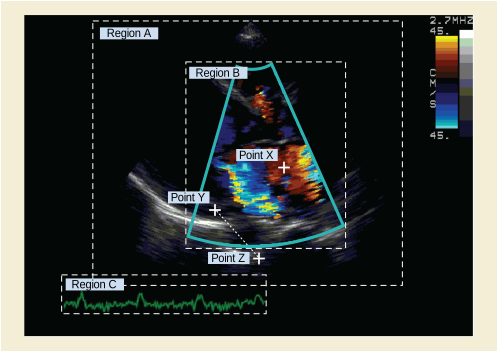
In this example, Region B is Color Flow while Region A is Tissue Echo. If Region B Color Flow values share the same bit planes as Region A Tissue Echo values, then it is indeterminate whether a pixel in this region is a Color Flow pixel or a Tissue Echo pixel. Since the pixels of the Color Flow region overwrite those of the Tissue Echo region, the Region Flag of the Tissue Echo region is assigned low priority and the Region Flag of the color region is assigned high priority. This means that if both the Tissue Echo and Color Flow regions define pixel component calibration that only the calibration specified by the Color Flow region can be applied to the pixel data value at Point X.
The measurement in Figure C.8-6 is a line between Point Y and Point Z. Both points are in Region A so the distance between them can be calculated using the Region A scaling (assuming that Region A defines both the Physical Units X Direction and Y Direction as being cm). If the points are in Region B, and hence also in Region A, it is still possible to calculate the distance because the region scaling is identical in both regions. The lower priority of Region B only applies to its pixel component calibration, not its X and Y direction scaling.
Enumerated Values for Bit 1 Scaling Protection:
- 1
Protected
- 0
Not Protected
Ultrasound systems should set this to 1 if the image is scaled automatically by the ultrasound system. If the image is frame-grabbed and scaling is not available then it should be set to 0. If the region is protected, the region can not be manually rescaled. That is the data defined by the region calibration Module can not be overridden by a reader of that image.
Enumerated Values for Bit 2 Doppler Scale Type:
- 1
Frequency
- 0
Velocity
Valid for PW and CW regions only. Indicates which type of Doppler scale is used.
Enumerated Values for Bit 3-4 Scrolling Region:
- 00
Unspecified
- 01
Scrolling
- 10
Sweeping
- 11
Sweeping then Scrolling
Bit 5-31 Reserved for future use, shall be set to zero.
Pixel Component Organization (0018,6044) provides an Enumerated Value describing how the components of a pixel can be described. The absence of this data element means that pixel component calibration does not exist for this region.
Enumerated Values:
- 0
Bit aligned positions
- 1
Ranges
- 2
Table look up
- 3
Code Sequence look up
Other values reserved for future use.
Pixel Component Organization defines the way in which the composite pixel values are mapped into real world values with physical units, as illustrated in Figure C.8-7.
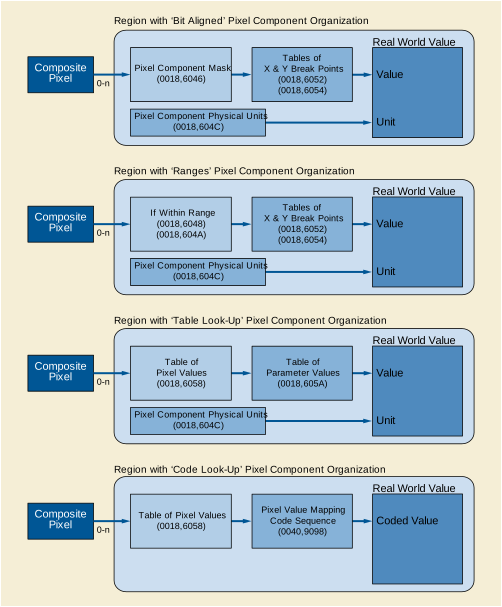
An example of Component Calibration for an ultrasound image is shown in Figure C.8-8.
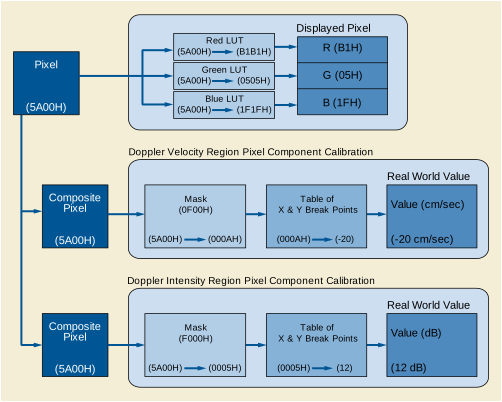
In this example, some pixels lie within two Regions. One Region specifies pixel component calibration for Doppler velocity values. The second Region specifies pixel component calibration for Doppler magnitude. A particular Pixel Data (7FE0,0010) value will thus map to a displayed value, a Doppler velocity and magnitude value.
The example has a Palette Color Photometric Interpretation with 16 Bits Allocated and Bits Stored per sample. The Palette Color Lookup Tables also have 16 bits for each entry. The fact that the example has just one sample per pixel means that each composite pixel value is identical to the single Pixel Data value. An example Pixel Data value is shown in brackets along with the output values resulting from each step where it is processed.
The Pixel Data value is mapped to red, green, and blue values from the supplied Palette Color Lookup Tables before being displayed. The display device supports 8 bits per sample and thus requires the scaling of the output values from the 16 bit per entry LUTs.
The Doppler Velocity Region maps each pixel value in the Region to the Doppler velocity. The Pixel Component Organization (0018,6044) has a value of zero, indicating bit aligned positions with a bit mask. The Pixel Component Mask (0018,6046) specifies that the least significant 4 bits of the most significant byte convey the Doppler velocity of each pixel. The Pixel Component Physical Units (0018,604C) are cm/sec, and the Pixel Component Data Type (0018,604E) indicates color flow velocity. The Table of X Break Points (0018,6052) and Table of Y Break Points (0018,6054) map each masked composite pixel value to a Doppler velocity value in cm/sec.
The Doppler Magnitude Region maps each pixel value in the Region to the Doppler magnitude. The Pixel Component Organization (0018,6044) has a value of zero, indicating bit aligned positions with a bit mask. The Pixel Component Mask (0018,6046) specifies that the most significant 4 bits of the most significant byte convey the Doppler magnitude of each pixel. The Pixel Component Physical Units (0018,604C) is set to dB, and the Pixel Component Data Type (0018,604E) indicates color flow magnitude. The Table of X Break Points (0018,6052) and Table of Y Break Points (0018,6054) map each masked composite pixel value to a Doppler magnitude value in dB.
Pixel Component Mask (0018,6046) is ANDed with the Composite Pixel Code (see Section C.7.6.3.1.1) for each pixel within the region, then shifted right by the number of contiguous least significant zeros in the mask to obtain what will be referred to as the "Shifted Masked Composite Pixel Code".
The mask will most likely (but not necessarily) contain a block of contiguous ones, surrounded by leading and trailing zeros. The purpose of this mask is to keep only those bits within the composite pixel code that pertain to the region. It is to be used only when Pixel Organization is bit aligned positions.
Enumerated Values:
- 0000H
None or not applicable
- 0001H
Percent
- 0002H
dB
- 0003H
cm
- 0004H
seconds
- 0005H
hertz(seconds-1)
- 0006H
dB/seconds
- 0007H
cm/sec
- 0008H
cm2
- 0009H
cm2/sec
- 000AH
cm3
- 000BH
cm3/sec
- 000CH
degrees
Enumerated Values:
- 0000H
None or not applicable
- 0001H
Tissue
- 0002H
Spectral Doppler
- 0003H
Color Flow Velocity
- 0004H
Color Flow Variance
- 0005H
Color Flow Intensity
- 0006H
Gray bar
- 0007H
Color bar
- 0008H
Integrated Backscatter
- 0009H
Computed Border
- 000AH
Tissue Classification
The Number of Table Break Points (0018,6050) gives the number of entries in each of two tables: the Table of X Break Points (0018,6052) and Table of Y Break Points (0018,6054). These tables are used to designate a curve mapping the value of a pixel component to its actual physical value, as described in Section C.8.5.5.1.9.
Table of X Break Points (0018,6052) and Table of Y Break Points (0018,6054) are individual arrays of coordinates that interpreted together are used to create a piecewise linear curve. Each X value from the Table of X Break Points is matched with the corresponding Y value from the Table of Y Break Points yielding an (X,Y) coordinate. The set of (X,Y) coordinates describes a piecewise linear curve mapping the value of a pixel component to its actual physical value (in units defined in Pixel Component Physical Units data element (0018,604C)).
The X direction on the curve has no units, and represents actual pixel component values. If the Pixel Component Organization (0018,6044) is "Bit aligned positions", and the width of the Pixel Component Mask is n bits then the X coordinates are in the range 0 through 2n-1. If the Pixel Component Organization is Ranges, then the X coordinates are in the range 0 through 2 number of bits in the composite pixel- 1.
Note
The X value is NOT relative to the Pixel Component Range Start (0018,6048). Not all possible X values in the range need be covered by the curve.
For any pixel component value in the range of the curve described by this table, the corresponding Y value is the actual physical value for that pixel, in units specified in Pixel Component Physical Units (0018,604C). If the pixel component value is NOT within the range of specified X values for the curve, then no pixel calibration is defined by this region. It may be possible for pixel calibration to be defined by other spatial regions intersecting this one.
The TM-Line Position X0 (0018,603D) and TM-Line Position Y0 (0018,603F) are the coordinates of the starting point and TM-Line Position X1 (0018,6041), TM-Line Position Y1 (0018,6043) are the coordinates of the end point of the TM-line. The coordinate is defined as the displacement, in pixels, from the Reference pixel. Typically used for M-mode line and CW Doppler.
The Number of Table Entries (0018,6056) gives the number of entries in the Table of Pixel Values, the number of entries in the Table of Parameter Values (0018,605A), if present, and the number of items in the Pixel Value Mapping Code Sequence (0040,9098), if present.
The Table of Pixel Values (0018,6058) specifies the pixel values that are mapped to real world parameter values or coded concepts (tissue characterizations). The number of entries in the table is given by Number of Table Entries (0018,6056).
A pixel is calibrated (mapped to a real-world value) by finding an entry in the Table of Pixel Values that matches its Composite Pixel Code (see Section C.7.6.3.1.1). The offset index of this entry is used as an index into the Parameter Value Table (0018,605A) or as a sequence item number in the Pixel Value Mapping Code Sequence (0040,9098) to select the real world value. The first Table of Pixel Values entry corresponds to sequence item 1.
Note
If a Composite Pixel Code has no matching value in the Pixel Value Table then there is no unambiguous way to determine the corresponding Parameter Value. A method may exist to determine a valid Parameter Value but the specification of such a method is outside the scope of the DICOM standard. No assumption should be made that linear interpolation will produce a valid result.
The Table of Parameter Values (0018,605A) provides the real world values for pixel values identified in the Table of Pixel Values (0018,6058). The number of table entries is given by Number of Table Entries (0018,6056) and the physical units are given by Pixel Component Physical Units (0018,604C). Values may repeat when a parameter value is associated with more than one Composite Pixel Code value.
These attributes specify the location of the region, Region Location Min X0 (0018,6018), Region Location Min Y0 (0018,601A), Region Location Max X1 (0018,601C), Region Location Max Y1 (0018,601E) expressed as offsets to the pixel coordinates. The upper left corner of the entire image is x=0,y=0 and the lower right corner is x=image width - 1, and y=image length - 1. Thus, a region will be specified as within these bounds. Where x0,y0 is the coordinate of the upper left corner of the region and x1,y1 is the coordinate of the lower right corner of the region.
Physical Units X Direction (0018,6024) and Physical Units Y Direction (0018,6026) indicate the physical units of the dimensions of the region.
Enumerated Values:
- 0000H
None or not applicable
- 0001H
Percent
- 0002H
dB
- 0003H
cm
- 0004H
seconds
- 0005H
hertz(seconds-1)
- 0006H
dB/seconds
- 0007H
cm/sec
- 0008H
cm2
- 0009H
cm2/sec
- 000AH
cm3
- 000BH
cm3/sec
- 000CH
degrees
This coordinate pair, Reference Pixel X0 (0018,6020), Reference Pixel Y0 (0018,6022) defines the location of a virtual "reference" pixel. This reference pixel location is used to tie the image's pixel coordinate system to the physical coordinate system. For example, the reference pixel could be defined where a depth of zero centimeters occurs in the 2D image, or it could define where the baseline (i.e.,: zero frequency) resides in a spectral display. The reference pixel location is the relative offset from the Region Location Min X0 (0018,6018) and Region Location Min Y0 (0018,601A), not the image origin. The location is not required to be within the region or even within the image boundary. For this reason, the Reference Pixel X0 and Reference Pixel Y0 values can be positive or negative.
The reference pixel location varies depending on the type and spatial organization of the data within the region.
Tissue data is tissue echo intensity displayed as grayscale. The Region Data Type (0018,6014) value is 0001H (Tissue). Color flow is Doppler signal displayed as color and encoded as some function of Doppler magnitude and velocity of blood flow or tissue motion. The Region Data Type value is 0002H (Color flow). For 2D, the Region Spatial Format (0018,6012) is 0001H (2D), meaning that the region is a tomographic image. For such 2D regions the reference pixel location is typically at the center of the transducer face on the tissue-transducer interface (skin line).
Figure C.8-1 shows 2D attribute values of reference pixel location along with Region Location Min and Region Location Max. for 2D-Tissue and 2D-Color Flow Regions:
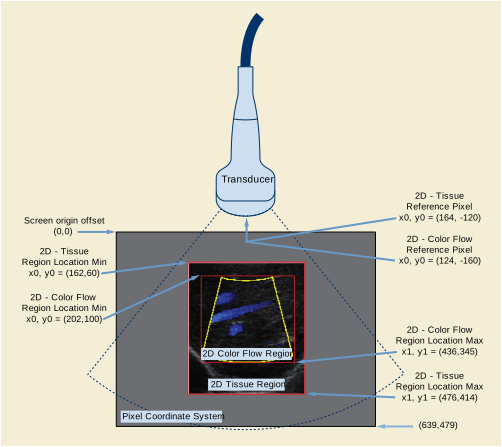
Both the 2D regions-Tissue and Color Flow-share the same physical location at the skin line but the reference pixel location values (Reference Pixel X0 and Reference Pixel Y0) are relative to their respective region origins at the skin line.
Spectral Doppler is the time varying magnitude of Doppler signal as function of frequency. Region Data Type (0018,6014) value is 0003H (pulsed wave Doppler) or 0004H (continuous wave Doppler). Spectral Doppler regions display the magnitude of Doppler signal with frequency or velocity as the vertical dimension and time as the horizontal dimension. Spectral Doppler regions have a Region Spatial Format (0018,6012) of 0003H (Spectral). The time dimension for the Region Spatial Format displays horizontally with data scrolling toward the left or sweeping toward the right. The reference pixel location is the pixel in the frame where:
the time is the time of frame capture (i.e., the time origin for the frame)
and on the Doppler Baseline (i.e., where the velocity and frequency are zero).
Figure C.8-2 shows an example of reference pixel locations in an image with both a Tissue and a scrolling Spectral (CW or PW Doppler) Region. The user adjusts the depth and position of the Doppler sample volume. The system annotates the sample volume position on the 2D region and specifies the location in Doppler Sample Volume X Position (0018,6039) and Doppler Sample Volume Y Position (0018,603B).
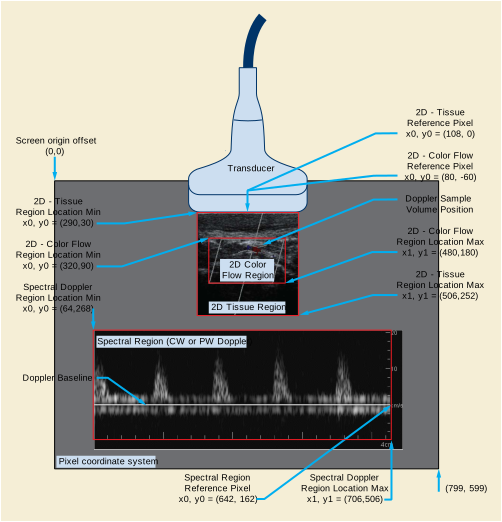
The scrolling Spectral Region reference pixel location specifies the horizontal location at the time of the current image frame. Data to the left of this location in the Spectral Region was acquired in the past. Because time increases to the right, the Physical Delta X (0018,602C) for this Region is positive. To specify the location of the most recent data the Reference Pixel x0specifies the time of acquisition, and the Reference Pixel Physical Value X (0018,6028) specifies the reference time to be zero. The Physical Units X Direction (0018,6024) is seconds. For an explanation of how to handle sweeping regions refer to Section C.8.5.5.1.16.7 Treatment of Sweeping Regions.
The Reference Pixel Physical Value Y (0018,602A) value specifies the baseline where velocity or frequency are zero. Typically spectral Doppler regions display positive velocity (cm/Sec) or frequency shift (Hz) above the baseline. This indicates flow toward the transducer face. Negative velocity or frequency information is displayed below the baseline. This indicates flow away from the transducer face. The Physical Delta Y (0018,602E) value is therefore negative because vertical coordinates increment downward.
M-Mode is tissue or color flow with a Region Spatial Format (0018,6012) of 0002H (M-mode). The vertical reference pixel location is the transducer face.
The horizontal reference pixel location is the pixel in the frame where:
the time is the time of frame capture (i.e., the time origin for the frame)
and zero depth from the transducer face
Figure C.8-3 shows an example of reference pixel locations for 2D Tissue and M-Mode Regions within the same image frame. The system annotates the sample line position on the 2D tissue region and specifies its position with the TM-Line Position attributes (0018,603D), (0018,603F), (0018,6041) and (0018,6043).
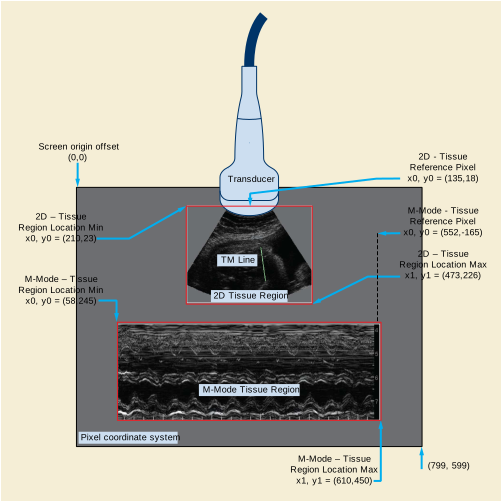
The physical length of the TM-Line corresponds directly to the physical height of the M-Mode Region. The M-Mode region's Reference Pixel y0 can be used to calculate the depth of the M-Mode region and facilitate depth measurements. In this example the M-Mode Region Reference Pixel y0 has a negative value corresponding to the distance between the face of the ultrasound probe and the TM-Line starting point. Note that the negative offset in pixel units is determined using the pixel height-width scaling of the M-Mode - Tissue Region as this could differ from the scaling of the 2D - Tissue Region (as it does in this example).
Waveforms are traces with a Region Spatial Format (0018,6012) value of 0004H (Waveform). The Reference Pixel x0 (0018,6020) specifies the time origin as the time of frame capture. There is typically no baseline position for ECG traces; the Reference Pixel y0 (0018,6022) is arbitrary.
Figure C.8-4 shows an example of reference pixel location for 2D Tissue, M-Mode, and ECG Waveform Regions within the same image frame:
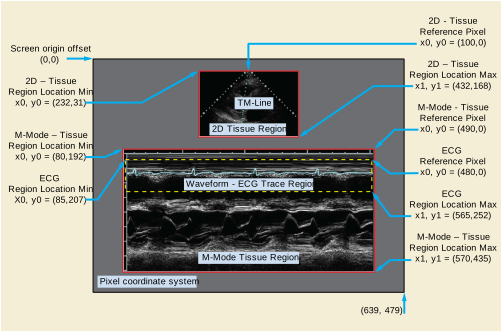
Doppler Traces have a Region Spatial Format (0018,6012) value of 0004H (Waveform) and a Region Data Type value of 0005H (Doppler Mean Trace), 0006H (Doppler Mode Trace) or 0007H (Doppler Max Trace). The Reference Pixel x0 (0018,6020) specifies the time origin as the time of frame capture. The Reference Pixel y0 (0018,6022) is the Doppler Baseline position (zero velocity / frequency position).
For regions with Region Spatial Format (0018,6012) value of 0005H (Graphics) the reference pixel location has no meaning.
Time-based display of data may scroll the acquired data from a fixed horizontal location to the left. Alternatively, sweep-based display increments the horizontal location of the acquired data, overwriting previously acquired data to the right. When the horizontal location corresponding to zero time has completely swept over the older data, writing wraps from the left of the region. Thus, sweep-based displays have a time discontinuity. The measurement of time intervals across the discontinuity requires special treatment. The time interval between two points across the discontinuity is equal to the region's time width minus the point separation. The sweeping area can be treated as a single region. The Reference Pixel x0 should indicate the time origin for the multi-frame image, which will be the location of the sweeping region's discontinuity line for the first frame of the multi-frame image. In order to specify that this is actually the location of the discontinuity line, the Reference Pixel Physical Value X (0018,6028) must be set to 0 seconds. This indicates that this location corresponds to the time at which the first frame was acquired.
It is useful to be able to calculate the location of the discontinuity line for subsequent frames of a multi-frame image. This is necessary if one is to determine whether two points are on opposite sides of the discontinuity line and also to correctly calculate the difference in time between such points. The x-axis location of the discontinuity line, x, for a given frame number, y, can be calculated from the Reference Pixel x0, x0, the Reference Pixel x1, x1, the time offset for frame y, t, (determined from the Frame Time Vector (0018,1065) or Frame Time (0018,1063)) and the Physical Delta X (0018,602C), px, as follows:
x = x0 + modulus((t / px) / (x1 - x0))
Alternatively, two regions can be used, one on each side of the time discontinuity. Figure C.8-5 shows the use of two regions. Note that the two region approach is not valid for multi-frame images, as the same region scaling must apply to all the frames.
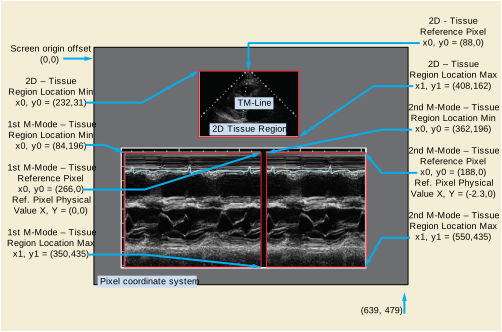
The two region approach may also be used in Doppler or physiological sweeping regions.
Time-based display of data may also be a combination of sweeping and scrolling. Sweep-based display is used at the start of acquisition, incrementing the horizontal location of the acquired data from left to right. After the horizontal location corresponding to zero time has completely swept to the right hand limit of the region, writing scrolls to the left from the right hand limit rather than wrapping from the left. A single region should be specified when this combination of behavior is used. The x-axis (zero time) location, x, for a given frame number, y, can be calculated from the Reference Pixel x0, x0, the Reference Pixel x1, x1, the time offset for frame y, t, (determined from the Frame Time Vector (0018,1065) or Frame Time (0018,1063)) and the Physical Delta X, px, as follows:
X = Min (x0 + (t / px), x1)
The Physical Delta X (0018,602C) is the physical value increment per positive X pixel increment, which is left to right. The Physical Delta Y (0018,602E) is the physical value increment per positive Y pixel increment, which is top to bottom.
Note
When displaying Doppler data, ultrasound applications typically display the Doppler strip horizontally, with data sweeping (moving time origin) from left (oldest) to right (newest) or scrolling (static time origin) from right to left. The default display of positive velocity values normally indicates flow toward the transducer; negative velocity values indicate flow away from the transducer. In this case a negative Physical Delta Y is required to specify that the direction of positive velocities or frequencies is upward.
The Pixel Value Mapping Code Sequence (0040,9098) provides the real world values for pixel values identified in the Table of Pixel Values (0018,6058). The number of items in the sequence is given by Number of Table Entries (0018,6056).
Note
Pixel Component Physical Units (0018,604C) does not apply to Sequence of Pixel Value Codes and should be set to 0000H (none or not applicable).
Table C.8-18 specifies the Attributes that describe ultrasound images.
Table C.8-18. US Image Module Attributes
|
Attribute Name |
Tag |
Type |
Attribute Description |
|---|---|---|---|
|
Samples Per Pixel |
(0028,0002) |
1 |
Number of samples (planes) in this image. See Section C.8.5.6.1.12 for specialization |
|
Photometric Interpretation |
(0028,0004) |
1 |
Specifies the intended interpretation of the pixel data. See Section C.8.5.6.1.2 for specialization. |
|
Bits Allocated |
(0028,0100) |
1 |
Number of bits allocated for each pixel sample. See Section C.8.5.6.1.13 for specialization. |
|
Bits Stored |
(0028,0101) |
1 |
Number of bits stored for each pixel sample. See Section C.8.5.6.1.14 for specialization. |
|
High Bit |
(0028,0102) |
1 |
Most significant bit for pixel sample data. See Section C.8.5.6.1.15 for specialization. |
|
Planar Configuration |
(0028,0006) |
1C |
Indicates whether the pixel data are sent color-by-plane or color-by-pixel. Required if Samples per Pixel (0028,0002) has a value greater than 1. See Section C.8.5.6.1.16 for specialization. |
|
Pixel Representation |
(0028,0103) |
1 |
Data representation of pixel samples. See Section C.8.5.6.1.3 for specialization. |
|
Frame Increment Pointer |
(0028,0009) |
1C |
Contains the Data Element Tag of the attribute that is used as the frame increment in Multi-frame pixel data (see Section C.7.6.6). Required if Number of Frames is sent. See Section C.8.5.6.1.4 for specialization. |
|
Image Type |
(0008,0008) |
2 |
Image identification characteristics. See Section C.8.5.6.1.1 for specialization. |
|
Lossy Image Compression |
(0028,2110) |
1C |
Specifies whether an Image has undergone lossy compression (at a point in its lifetime). Enumerated Values:
Once this value has been set to 01 it shall not be reset. Required if Lossy Compression has been performed on the Image. May be present otherwise. |
|
Number of Stages |
(0008,2124) |
2C |
Number of Stages in this protocol. Required if image was acquired in a Staged protocol. |
|
Number of Views in Stage |
(0008,212A) |
2C |
Number of views in this Stage. Required if image was acquired in a Staged protocol. |
|
R Wave Time Vector |
(0018,6060) |
3 |
The time offset(s) of the reported R Wave peaks, each relative to the time of the start of the acquisition of the first frame in msec. Multi-valued, with one value per reported R Wave. |
|
Ultrasound Color Data Present |
(0028,0014) |
3 |
This element indicates if any ultrasound color data is present in an image. Enumerated Values:
|
|
Stage Name |
(0008,2120) |
3 |
A Stage is a particular time slice of a protocol in which a set of images are collected. The names can be free form text. Recommended text for Stress Echo stage names:
|
|
Stage Code Sequence |
(0040,000A) |
3 |
Sequence of items describing the performed Ultrasound Protocol Stage(s). One or more Items are permitted in this Sequence. |
|
Stage Number |
(0008,2122) |
3 |
A number that identifies the Stage. Stage Number starts at one. |
|
View Name |
(0008,2127) |
3 |
A View is a particular combination of the position and orientation when a set of images are acquired. Images are acquired at the same View in different Stages for the purpose of comparison. |
|
View Number |
(0008,2128) |
3 |
A number that identifies the View. View Number starts at one. |
|
Number of Event Timers |
(0008,2129) |
3 |
The number of event timers used at the time of acquisition of a Multi-frame image. |
|
Event Elapsed Time(s) |
(0008,2130) |
3 |
An array of values associated with each event timer. Units in milliseconds. |
|
Event Timer Name(s) |
(0008,2132) |
3 |
Name that identifies the event timer. |
|
Include Table 10-7 “General Anatomy Optional Macro Attributes” |
For intravascular ultrasound, Defined CID 3010 “Cardiovascular Anatomic Locations” and Defined CID 3015 “Coronary Arteries” are specified for the Anatomic Region Sequence and Defined CID 3019 “Cardiovascular Anatomic Location Modifiers” is specified for the Anatomic Region Modifier Sequence. No other Context IDs are specified. |
||
|
Include Table 10-25 “Optional View and Slice Progression Direction Attributes” |
See Section C.8.5.6.1.19 for Context Group IDs. |
||
|
Acquisition DateTime |
(0008,002A) |
1C |
The date and time that the acquisition of data that resulted in this image started. Required if Modality (0008,0060) = IVUS May be present otherwise. NoteThe synchronization of this time with an external clock is specified in the Synchronization Module in Acquisition Time Synchronized (0018,1800). |
|
Trigger Time |
(0018,1060) |
3 |
Time interval measured in msec from the start of the R-wave to the beginning of data taking |
|
Nominal Interval |
(0018,1062) |
3 |
Average R-R interval used for these data, in msec |
|
Beat Rejection Flag |
(0018,1080) |
3 |
Beat length sorting has been applied. Enumerated Values:
|
|
Low R-R Value |
(0018,1081) |
3 |
R-R interval low limit for beat rejection, in msec |
|
High R-R Value |
(0018,1082) |
3 |
R-R interval high limit for beat rejection, in msec |
|
Heart Rate |
(0018,1088) |
3 |
Beats per minute. |
|
IVUS Acquisition |
(0018,3100) |
1C |
Defined Terms:
Required if Modality (0008,0060) = IVUS |
|
IVUS Pullback Rate |
(0018,3101) |
1C |
Required if IVUS Acquisition (0018,3100) value is MOTOR_PULLBACK. Specified in units of mm/sec. |
|
IVUS Gated Rate |
(0018,3102) |
1C |
Required if IVUS Acquisition (0018,3100) value is GATED_PULLBACK. Specified in units of mm/beat. |
|
IVUS Pullback Start Frame Number |
(0018,3103) |
1C |
Required if IVUS Acquisition (0018,3100) value is MOTOR_PULLBACK or GATED_PULLBACK. |
|
IVUS Pullback Stop Frame Number |
(0018,3104) |
1C |
Required if IVUS Acquisition (0018,3100) value is MOTOR_PULLBACK or GATED_PULLBACK. |
|
Lesion Number |
(0018,3105) |
3 |
Identifier(s) of the lesion(s) of interest imaged within the current SOP Instance. Each lesion shall have a unique numeric integer identifier within the study. See Section C.8.5.6.1.26. |
|
Output Power |
(0018,5000) |
3 |
Manufacturer defined character string description of ultrasound output level(s) used in generating a given image. Data may be expressed in dB, %, W/cm2, etc. |
|
Transducer Data |
(0018,5010) |
3 |
Manufacturer defined code or description of ultrasound transducer used. |
|
Transducer Type |
(0018,6031) |
3 |
Defined Terms:
|
|
Focus Depth |
(0018,5012) |
3 |
The depth, from the transducer face, of the manufacturer defined beam focus used for the image, in cm. |
|
Processing Function |
(0018,5020) |
3 |
Manufacturer defined description of processing of echo information. Data may include code or description of gain (initial, overall, TGC, dynamic range, etc.), preprocessing, postprocessing, Doppler processing parameters, e.g., cutoff filters, etc., as used in generating a given image. |
|
Mechanical Index |
(0018,5022) |
3 |
See Section C.8.5.6.1.8 for Description. |
|
Bone Thermal Index |
(0018,5024) |
3 |
See Section C.8.5.6.1.8 for Description. |
|
Cranial Thermal Index |
(0018,5026) |
3 |
See Section C.8.5.6.1.8 for Description. |
|
Soft Tissue Thermal Index |
(0018,5027) |
3 |
See Section C.8.5.6.1.8 for Description. |
|
Soft Tissue-focus Thermal Index |
(0018,5028) |
3 |
See Section C.8.5.6.1.8 for Description. |
|
Soft Tissue-surface Thermal Index |
(0018,5029) |
3 |
See Section C.8.5.6.1.8 for Description. |
|
Depth of Scan Field |
(0018,5050) |
3 |
The depth, in mm, from the transducer face to the deepest point included in the displayed image- the field of view. |
|
Overlay Subtype |
(60xx,0045) |
3 |
Defined Term that identifies the intended purpose of the ROI Overlay Type. See Section C.8.5.6.1.11 for specialization. |
Note
Referenced Overlay Sequence (0008,1130) and Referenced Curve Sequence (0008,1145) were previously included in this Module as optional Attributes but have been retired. See PS3.3-2004.
For US Images, Image Type (0008,0008) is specified to be Type 2.
Defined Terms for Value 3:
- ABDOMINAL
- BREAST
- CHEST
- ENDOCAVITARY
- ENDORECTAL
- ENDOVAGINAL
- EPICARDIAL
- FETAL HEART
- GYNECOLOGY
- INTRACARDIAC
- INTRAOPERATIVE
- INTRAVASCULAR
- MUSCULOSKELETAL
- NEONATAL HEAD
- OBSTETRICAL
- OPHTHALMIC
- PEDIATRIC
- PELVIC
- RETROPERITONEAL
- SCROTAL
- SMALL PARTS
- TEE
- THYROID
- TRANSCRANIAL
- TTE
- US BIOPSY
- VASCULAR
Value 4 is constructed as a modality bit map to allow for a description of multi-modality displays. In using this bit map, the sum of the values of the various modalities will unambiguously determine the constituent modalities.
Bit Map Values for Value 4:
- 0001
2D Imaging
- 0002
M-Mode
- 0004
CW Doppler
- 0008
PW Doppler
- 0010
Color Doppler
- 0020
Color M-Mode
- 0040
3D Rendering
- 0100
Color Power Mode
- 0200
Tissue Characterization
- 0400
Spatially-related frames
Note
All Values are hexadecimal encoded as a CS. See PS3.5.
For example, Color Flow with CW spectral Doppler would have a value 4 = 0015. Note that no assumption should be made in Color Doppler or Color M-Mode regarding underlying B or M-Mode, respectively.
See Section A.59.1 for the relationship between a 3D volume set and the 3D Rendering, 3D MPR View, and Spatially-related frames image types. In the case of "3D Rendering", Derivation Code Sequence (0008,9215) should be used to describe the specific type of 3D rendering (volume rendering, surface rendering, multiplanar reformatting, etc.).
Defined Terms:
- MONOCHROME2
- PALETTE COLOR
- RGB
- ARGB
(retired)
- YBR_FULL
- YBR_FULL_422
- YBR_PARTIAL_422
- YBR_RCT
- YBR_ICT
- YBR_PARTIAL_420
Note
It is recommended that future implementations should not use ARGB photometric interpretation.
See PS3.5 for restrictions imposed by compressed Transfer Syntaxes.
For US Images, Pixel Representation (0028,0103) is specified to use the following.
Enumerated Values:
- 0000H
unsigned integer
For US Multi-frame images, the Attribute Frame Increment Pointer (0028,0009) of the Multi-frame Module (see Section C.7.6.6) is specified by the following.
Defined Terms:
- 00181063
sequencing by Frame Time (0018,1063)
- 00181065
sequencing by Frame Time Vector (0018,1065)
The thermal and/or mechanical indices, when made available by a manufacturer, are defined according to the Standard for Real-Time Display of Thermal and Mechanical Acoustic Output Indices on Diagnostic Ultrasound Equipment, a voluntary performance standard jointly published by AIUM and NEMA.
This section was defined in a previous version of the DICOM Standard. The Section is now retired. See PS3.3-2003.
Note
This data element can be used to indicate if an image contains any Ultrasound color data.
For example: Some Ultrasound images may have a Photometric Interpretation equal to RGB but the image will have no color information if R=G=B for all pixels.
For consistency within a particular implementation Monochrome Ultrasound images may be coded using a color photometric interpretation. In that case inclusion of this data element can significantly speed up processing. Since all components are known to be equal only one need be handled. The enhancements can be significant when compressed Transfer Syntaxes are used.
Defined Terms:
- ACTIVE 2D/BMODE IMAGE AREA
identification of the active area of a 2D/B-mode image
For US Images, Samples Per Pixel (0028,0002) is specified to use the following values for specific Photometric Interpretations:
Table C.8-19. US Samples Per Pixel
|
Photometric Interpretation |
Samples Per Pixel Value |
|---|---|
|
MONOCHROME2 |
1 |
|
RGB |
3 |
|
YBR_FULL |
3 |
|
YBR_FULL_422 |
3 |
|
YBR_PARTIAL_422 |
3 |
|
YBR_RCT |
3 |
|
YBR_ICT |
3 |
|
YBR_PARTIAL_420 |
3 |
|
PALETTE COLOR |
1 |
For US Images, Bits Allocated (0028,0100) is specified to use the following values for specific Photometric Interpretations:
Table C.8-20. US Bits Allocated
|
Photometric Interpretation |
Bits Allocated Value |
|---|---|
|
MONOCHROME2 |
8 |
|
RGB |
8 |
|
YBR_FULL |
8 |
|
YBR_FULL_422 |
8 |
|
YBR_PARTIAL_422 |
8 |
|
YBR_RCT |
8 |
|
YBR_ICT |
8 |
|
YBR_PARTIAL_420 |
8 |
|
PALETTE COLOR |
8 - 8 bit palette, or 16 - 16 bit palette |
For US Images, Bits Stored (0028,0101) is specified to use the following values for specific Photometric Interpretations:
Table C.8-21. US Bits Stored
|
Photometric Interpretation |
Bits Stored Value |
|---|---|
|
MONOCHROME2 |
8 |
|
RGB |
8 |
|
YBR_FULL |
8 |
|
YBR_FULL_422 |
8 |
|
YBR_PARTIAL_422 |
8 |
|
YBR_RCT |
8 |
|
YBR_ICT |
8 |
|
YBR_PARTIAL_420 |
8 |
|
PALETTE COLOR |
8 - 8 bit palette, or 16 - 16 bit palette |
For US Images, High Bit (0028,0102) is specified to use the following values for specific Photometric Interpretations:
Table C.8-22. US High Bit
|
Photometric Interpretation |
High Bit Value |
|---|---|
|
MONOCHROME2 |
7 |
|
RGB |
7 |
|
YBR_FULL |
7 |
|
YBR_FULL_422 |
7 |
|
YBR_PARTIAL_422 |
7 |
|
YBR_RCT |
7 |
|
YBR_ICT |
7 |
|
YBR_PARTIAL_420 |
7 |
|
PALETTE COLOR |
7 - 8 bit palette, or 15 - 16 bit palette |
For US Images, Planar Configuration (0028,0006) is specified to use the following values for specific Photometric Interpretations:
Table C.8-23. US Planar Configuration
|
Photometric Interpretation |
Planar Configuration Value |
|---|---|
|
RGB |
0 - color-by-pixel, or 1 - color-by-plane |
|
YBR_FULL |
1 |
|
YBR_FULL_422 |
0 |
|
YBR_PARTIAL_422 |
0 |
|
YBR_RCT |
0 |
|
YBR_ICT |
0 |
|
YBR_PARTIAL_420 |
0 |
The view of the patient anatomy may be described using coded terminology in the View Code Sequence (0054,0220). The view is typically specified by transducer position relative to the patient anatomy and/or transducer orientation,
The view may be described by a single Code Sequence Item, or by combination of post-coordinated Code Sequence Items. The principal coded item is specified in View Code Sequence, and modifier terms in the View Modifier Code Sequence (0054,0222). The Baseline CIDs for post-coordinated encoding of view are:
CID 4 “Anatomic Region” (typically used for the primary coded item)
Any of these Context Groups may be used in either the View Code Sequence or the View Modifier Code Sequence.
For cardiac imaging, a Baseline CID with pre-coordinated view codes is specified:
Note
Transducer Position Sequence (0008,2240) and Transducer Orientation Sequence (0008,2244), defined in this module in an earlier edition of the Standard (see PS3.3-2004), are retired.
Defined Terms:
- MOTOR_PULLBACK
The IVUS imaging catheter is positioned in the blood vessel under examination distal to the anatomical structures to be examined. Then the catheter is attached to a motorized mechanism capable of withdrawing the catheter through the vessel at a constant velocity specified by the attribute IVUS Pullback Rate (0018,3101) from the defined IVUS Pullback Start Frame Number (0018,3103) (see Section C.8.5.6.1.24) to the IVUS Pullback Stop Frame Number (0018,3104) (see Section C.8.5.6.1.25).
- MANUAL_PULLBACK
The IVUS imaging catheter is positioned in the blood vessel under examination distal to the anatomical structures to be examined. Then the catheter is manually withdrawn through the vessel region of interest.
- SELECTIVE
The IVUS imaging catheter is positioned in the blood vessel under examination near the anatomical structures to be examined. Then the catheter is manually withdrawn or advanced through the vessel region of interest.
- GATED_PULLBACK
The IVUS imaging catheter is positioned in the blood vessel under examination distal to the anatomical structures to be examined. Then the catheter is attached to a motorized mechanism capable of withdrawing the catheter through the vessel at a rate specified by the attribute IVUS Gated Rate (0018,3102), once per heart cycle, from the defined IVUS Pullback Start Frame Number (0018,3103) (see Section C.8.5.6.1.24) to the IVUS Pullback Stop Frame Number (0018,3104) (see Section C.8.5.6.1.25).
The attribute IVUS Pullback Rate (0018,3101) is required when IVUS Acquisition (0018,3100) is MOTOR_PULLBACK and it specifies the velocity of withdrawal of the IVUS imaging catheter in millimeters per second.
The attribute IVUS Gated Rate (0018,3102) is required when IVUS Acquisition (0018,3100) is GATED_PULLBACK and it specifies the velocity of withdrawal of the IVUS imaging catheter in millimeters per beat.
The IVUS Pullback Start Frame Number (0018,3103) specifies the frame number of a IVUS multi-frame acquisition upon which motorized or gated pullback begins.
The IVUS Pullback Stop Frame Number (0018,3104) specifies the frame number of a IVUS multi-frame acquisition upon which motorized or gated pullback ends.
Attribute Lesion Number identifies the lesion(s) of interest imaged within the current SOP Instance. Each lesion shall have a unique numeric integer identifier within the study. If during a study the same lesion is imaged more than once, the same Lesion Number should be used for both SOP Instances.
Note
Lesion Number is not a DICOM UID.
An IVUS pullback may contain multiple values in Lesion Number.
This Module describes equipment used to convert images into a DICOM format.
Table C.8-24. SC Equipment Module Attributes
|
Attribute Name |
Tag |
Type |
Attribute Description |
|---|---|---|---|
|
Conversion Type |
(0008,0064) |
1 |
Describes the kind of image conversion. Defined Terms:
|
|
Modality |
(0008,0060) |
3 |
Source equipment for the image. This type definition shall override the definition in the General Series Module. See Section C.7.3.1.1.1 for Defined Terms. |
|
Secondary Capture Device ID |
(0018,1010) |
3 |
User defined identification of the device that converted the image |
|
Secondary Capture Device Manufacturer |
(0018,1016) |
3 |
Manufacturer of the Secondary Capture Device |
|
Secondary Capture Device Manufacturer's Model Name |
(0018,1018) |
3 |
Manufacturer's model number of the Secondary Capture Device |
|
Secondary Capture Device Software Versions |
(0018,1019) |
3 |
Manufacturer's designation of software version of the Secondary Capture Device |
|
Video Image Format Acquired |
(0018,1022) |
3 |
Original format of the captured video image (e.g., NTSC, PAL, Videomed-H) |
|
Digital Image Format Acquired |
(0018,1023) |
3 |
Additional information about digital interface used to acquire the image |
Note
The Attributes specified in the General Equipment Module (see Table C.7-6) describe the equipment that created the image being captured. The Attributes of the SC Equipment Module define the equipment that captured the image. The following table illustrates typical scenarios for different conversion types:
Conversion Type (0008,0064)
General Equipment
Secondary Capture Equipment
Digitized Video (DV)
The equipment generating the video signal.
The equipment digitizing the video signal.
Digital Interface (DI)
The equipment on the sending side of the digital interface.
The equipment on the receiving side of the digital interface.
Digitized Film (DF)
The equipment that created the film.
The equipment digitizing the film.
Workstation (WSD)
Application dependent, but often the equipment that placed the image on the workstation screen, or created the modified image.
The equipment that captured the image from the screen, or placed the modified image into a DICOM SOP Instance.
Scanned Document (SD)
The equipment that created the document.
The equipment digitizing the document.
Scanned Image (SI)
The equipment that created the image that was digitized.
The equipment digitizing the image.
Drawing (DRW)
The equipment that created the drawing.
The equipment digitizing (or rasterizing) the drawing.
Synthetic Image (SYN)
The equipment creating the original images from which the synthetic image was derived.
The equipment creating the synthetic image.
Modality (0008,0060) specified in the General Series Module (see Table C.7-5a) has been specialized by this Module and is defined as a Type 3 Attribute.
Table C.8-25 contains IOD Attributes that describe Secondary Capture Images.
Table C.8-25. SC Image Module Attributes
|
Attribute Name |
Tag |
Type |
Attribute Description |
|---|---|---|---|
|
Date of Secondary Capture |
(0018,1012) |
3 |
The date the Secondary Capture Image was captured. |
|
Time of Secondary Capture |
(0018,1014) |
3 |
The time the Secondary Capture Image was captured. |
|
Nominal Scanned Pixel Spacing |
(0018,2010) |
3 |
Physical distance on the media being digitized or scanned between the center of each pixel, specified by a numeric pair - adjacent row spacing (delimiter) adjacent column spacing in mm. See Section 10.7.1.3 for further explanation of the value order. Shall be consistent with Pixel Aspect Ratio (0028,0034), if present. |
|
Document Class Code Sequence |
(0040,E008) |
3 |
Classifications of a scanned document, e.g., for Modality (0008,0060) DOC. Equivalent to HL7 v2.x TXA-2. One or more items are permitted in this sequence. |
|
No Baseline CID is defined. |
|||
|
Include Table 10-10 “Basic Pixel Spacing Calibration Macro Attributes” |
|||
|
Include Table 10-25 “Optional View and Slice Progression Direction Attributes” |
|||
Note
The Attributes specified in the General Image Module (see Table C.7-7) describe this image (i.e., the secondary capture image). For example, Instance Number (0020,0013) is the image number of the secondary capture image. Source Image Sequence (0008,2112) may reference the DICOM image from which this image was generated.
Table C.8-25b contains IOD Attributes that describe SC Multi-frame images.
Table C.8-25b. SC Multi-frame Image Module Attributes
|
Attribute Name |
Tag |
Type |
Attribute Description |
|---|---|---|---|
|
Burned In Annotation |
(0028,0301) |
1 |
Indicates whether or not image contains sufficient burned in annotation to identify the patient and date the image was acquired. Enumerated Values:
|
|
Recognizable Visual Features |
(0028,0302) |
3 |
Indicates whether or not the image contains sufficiently recognizable visual features to allow the image or a reconstruction from a set of images to identify the patient. Enumerated Values:
If this Attribute is absent, then the image may or may not contain recognizable visual features. |
|
Presentation LUT Shape |
(2050,0020) |
1C |
Specifies an identity transformation for the Presentation LUT, such that the output of all grayscale transformations defined in the IOD containing this Module are defined to be P-Values. Enumerated Values:
Required if Photometric Interpretation (0028,0004) is MONOCHROME2, and Bits Stored (0028,0101) is greater than 1. NoteIf the VOI LUT Module is required by the IOD but no VOI LUT Sequence (0028,3010) or Window Center (0028,1050) is present, then the VOI LUT stage is an identity transformation. |
|
Illumination |
(2010,015E) |
3 |
Luminance of a hypothetical viewing device illuminating a piece of monochrome transmissive film, or for the case of reflective media, luminance obtainable from diffuse reflection of the illumination present. Expressed as L0, in candelas per square meter (cd/m2). NoteMay be used together with Reflected Ambient Light (2010,0160) to recover Optical Density information from P-Values. See Section C.8.6.3.1. |
|
Reflected Ambient Light |
(2010,0160) |
3 |
For scanned monochrome transmissive film viewed on a hypothetical viewing device, the luminance contribution due to reflected ambient light. Expressed as La, in candelas per square meter (cd/m2). NoteMay be used together with Illumination (2010,015E) to recover Optical Density information from P-Values. See Section C.8.6.3.1. |
|
Rescale Intercept |
(0028,1052) |
1C |
The value b in the relationship between stored values (SV) in Pixel Data (7FE0,0010) and the output units specified in Rescale Type (0028,1054). Output units = m*SV + b. Required if Photometric Interpretation (0028,0004) is MONOCHROME2, and Bits Stored (0028,0101) is greater than 1. NoteThis specifies an identity Modality LUT transformation. |
|
Rescale Slope |
(0028,1053) |
1C |
m in the equation specified by Rescale Intercept (0028,1052). Required if Photometric Interpretation (0028,0004) is MONOCHROME2, and Bits Stored (0028,0101) is greater than 1. NoteThis specifies an identity Modality LUT transformation. |
|
Rescale Type |
(0028,1054) |
1C |
Specifies the output units of Rescale Slope (0028,1053) and Rescale Intercept (0028,1052). Defined Terms:
Required if Photometric Interpretation (0028,0004) is MONOCHROME2, and Bits Stored (0028,0101) is greater than 1. NoteThis specifies an identity Modality LUT transformation. |
|
Frame Increment Pointer |
(0028,0009) |
1C |
Contains the Data Element Tag of the attribute that is used as the frame increment in Multi-frame pixel data. See Section C.7.6.6.1.2 for further explanation. Shall be present if Number of Frames is greater than 1, overriding (specializing) the Type 1 requirement on this attribute in the Multi-frame Module. |
|
Nominal Scanned Pixel Spacing |
(0018,2010) |
1C |
Physical distance on the media being digitized or scanned between the center of each pixel, specified by a numeric pair - adjacent row spacing (delimiter) adjacent column spacing in mm. See Section 10.7.1.3 for further explanation of the value order. Required if Conversion Type (0008,0064) is DF (Digitized Film). May also be present if Conversion Type (0008,0064) is SD (Scanned Document) or SI (Scanned Image). Shall be consistent with Pixel Aspect Ratio (0028,0034), if present. |
|
Include Table 10-10 “Basic Pixel Spacing Calibration Macro Attributes” |
|||
|
Digitizing Device Transport Direction |
(0018,2020) |
3 |
Enumerated Values:
|
|
Rotation of Scanned Film |
(0018,2030) |
3 |
Angle of the edge of the film relative to the transport direction in degrees greater than or equal to -45 and less than or equal to +45. |
Illumination (2010,015E) and Reflected Ambient Light (2010,0160) may be used to recover Optical Density information from P-Values.
Monochrome media that is being digitized is often measured in Optical Density values. These values need to be converted to P-Values for storage and display. The P-Values used in an image correspond to the perception of a human observer viewing the film on a hypothetical viewing device (such as a light box), using the specified values of Illumination (2010,015E) and Reflected Ambient Light (2010,0160).
The Grayscale Standard Display Function defined in PS3.14 is used to convert Luminance to P-Values. In the case of scanned film, the Luminance is derived from Optical Density using the specified values of Illumination (2010,015E) and Reflected Ambient Light (2010,0160). An example of this derivation, as well as typical "default" values for these parameters, is specified in PS3.14.
Table C.8-25c contains IOD Attributes that may be the target of the Frame Increment Pointer (0028,0009) for SC Multi-frame images.
Table C.8-25c. SC Multi-frame Vector Module Attributes
|
Attribute Name |
Tag |
Type |
Attribute Description |
|---|---|---|---|
|
Frame Time Vector |
(0018,1065) |
1C |
An array that contains the real time increments (in msec) between frames for a Multi-frame image. See Section C.7.6.5.1.2 for further explanation. Required if Frame Increment Pointer (0028,0009) points to Frame Time Vector (0018,1065). NoteFrame Time Vector arrays may not be properly encoded if Explicit VR transfer syntax is used and the VL of this attribute exceeds 65534 bytes. |
|
Page Number Vector |
(0018,2001) |
1C |
An array that contains, for each of the image frames, the corresponding page numbers of the original document. Required if Frame Increment Pointer (0028,0009) points to Page Number Vector (0018,2001). |
|
Frame Label Vector |
(0018,2002) |
1C |
An array that contains, for each of the image frames, a descriptive label. Required if Frame Increment Pointer (0028,0009) points to Frame Label Vector (0018,2002). |
|
Frame Primary Angle Vector |
(0018,2003) |
1C |
An array that contains, for each of the image frames, the primary angle of rotation about an undefined axis, in degrees. May be used for annotative purposes for "cine loops" of 3D reprojected images Required if Frame Increment Pointer (0028,0009) points to Frame Primary Angle Vector (0018,2003). |
|
Frame Secondary Angle Vector |
(0018,2004) |
1C |
An array that contains, for each of the image frames, the secondary angle of rotation about an undefined axis that is orthogonal to that used for Frame Primary Angle Vector (0018,2003), in degrees. May be used for annotative purposes for "cine loops" of 3D reprojected images Required if Frame Increment Pointer (0028,0009) points to Frame Secondary Angle Vector (0018,2004). |
|
Slice Location Vector |
(0018,2005) |
1C |
An array that contains, for each of the image frames, the relative position of the image plane expressed in mm, as defined for Slice Location (0020,1041). See Section C.7.6.2.1.2 for further explanation. Required if Frame Increment Pointer (0028,0009) points to Slice Location Vector (0018,2005). |
|
Display Window Label Vector |
(0018,2006) |
1C |
An array that contains, for each of the image frames, a label or number of the display window of a graphical user interface from which the frame was captured. Required if Frame Increment Pointer (0028,0009) points to Display Window Label Vector (0018,2006). |
This Section describes Modules used in one or more X-Ray IODs. These Modules contain Attributes that are specific to X-Ray images.
Table C.8-26. X-Ray Image Module Attributes
|
Attribute Name |
Tag |
Type |
Attribute Description |
|---|---|---|---|
|
Frame Increment Pointer |
(0028,0009) |
1C |
Required if Multi-frame Image. Contains the Data Element Tag of the attribute that is used as the Frame increment in Multi-frame image pixel data (see Section C.7.6.6). Enumerated Values:
|
|
Lossy Image Compression |
(0028,2110) |
1C |
Specifies whether an Image has undergone lossy compression (at a point in its lifetime). Enumerated Values:
Once this value has been set to 01 it shall not be reset. Required if Lossy Compression has been performed on the Image. May be present otherwise. |
|
Image Type |
(0008,0008) |
1 |
Image identification characteristics. See Section C.8.7.1.1.1 for specialization. |
|
Pixel Intensity Relationship |
(0028,1040) |
1 |
The relationship between the Pixel sample values and the X-Ray beam intensity. See Section C.8.7.1.1.2. |
|
Samples per Pixel |
(0028,0002) |
1 |
Number of samples (color planes) in this image shall have a value of 1. |
|
Photometric Interpretation |
(0028,0004) |
1 |
Specifies the intended interpretation of the pixel data. Only MONOCHROME2 may be used. |
|
Bits Allocated |
(0028,0100) |
1 |
Number of bits allocated for each pixel sample. See Section C.8.7.1.1.6. |
|
Bits Stored |
(0028,0101) |
1 |
Number of bits stored for each pixel sample. See Section C.8.7.1.1.7. |
|
High Bit |
(0028,0102) |
1 |
Most significant bit for pixel sample data. See Section C.8.7.1.1.8. |
|
Pixel Representation |
(0028,0103) |
1 |
Data representation of the pixel samples. Shall have the value: 0000H = Unsigned Integer. |
|
Scan Options |
(0018,0022) |
3 |
Parameters of scanning sequence. See Section C.8.7.1.1.4. |
|
Include Table 10-7 “General Anatomy Optional Macro Attributes” |
No Context ID for the Anatomic Region Sequence is defined. |
||
|
R Wave Pointer |
(0028,6040) |
3 |
Marks the location(s) of the R Wave in the cardiac cycles by referencing frame numbers; frame numbers begin with 1. |
|
Referenced Image Sequence |
(0008,1140) |
1C |
Other images significantly related to this image. Shall be present if Image Type (0008,0008) Value 3 is BIPLANE A or BIPLANE B. May be present otherwise. One or more items shall be included in this sequence. See Section C.8.7.1.1.13. |
|
>Include Table 10-3 “Image SOP Instance Reference Macro Attributes” |
|||
|
>Purpose of Reference Code Sequence |
(0040,A170) |
3 |
Describes the purpose for which the reference is made. Only a single Item is permitted in this Sequence. |
|
Derivation Description |
(0008,2111) |
3 |
A text description of how this image was derived. See Section C.8.7.1.1.5 for further explanation. |
|
Acquisition Device Processing Description |
(0018,1400) |
3 |
Indicates any visual processing performed on the images prior to exchange. See Section C.8.7.1.1.3. |
|
Frame Label Vector |
(0018,2002) |
3 |
A multi-valued attribute that contains a descriptive label for each of the image frames. The number of values shall equal the number of frames. |
|
Frame Dimension Pointer |
(0028,000A) |
3 |
Contains the Data Element Tags of one or more attributes that vary or increment for the frames of a multi-frame image. See Section C.8.7.1.1.12. Shall not be present if it would contain only one value and that value would be Frame Time (0018,1063) or Frame Time Vector (0018,1065). |
|
Calibration Image |
(0050,0004) |
3 |
Indicates whether a reference object (phantom) of known size is present in the image and was used for calibration. Enumerated Values:
Device is identified using the Device module. See Section C.7.6.12. |
The Image Type attribute identifies important image characteristics in a multiple valued data element. For X-Ray, Image Type is specialized as follows:
Value 1 shall identify the Pixel Data Characteristics in accordance with Section C.7.6.1.1.2
Enumerated Values:
- ORIGINAL
- DERIVED
Note
X-Ray images generally use PRIMARY value for images captured from patient exposure.
Value 2 shall identify the Patient Examination Characteristics in accordance with Section C.7.6.1.1.2
Enumerated Values:
- PRIMARY
- SECONDARY
Value 3 shall identify the image set in terms of the imaging planes.
Enumerated Values:
- SINGLE PLANE
Image is a single plane acquisition
- BIPLANE A
Image is the first plane (e.g., Frontal) of a Bi-plane acquisition
- BIPLANE B
Image is the second plane (e.g., Lateral) of a Bi-plane acquisition
Other Values are implementation specific (optional).
Pixel Intensity Relationship (0028,1040) shall identify the relationship of the pixel values to the X-Ray beam intensity.
Defined Terms:
- LIN
Approximately proportional to X-Ray beam intensity;
- LOG
Non-linear "Log Function"; A Modality LUT shall be included with the image to allow it to be scaled back to its proportional value to X-Ray beam intensity;
- DISP
Ready to be displayed; A Modality LUT may be included with the image to allow it to be scaled back to its proportional value to X-Ray beam intensity. The Attribute Acquisition Device Processing Description may be used to provide some indication on the pre-processing performed to create the ready to be displayed image.
Acquisition Device Processing Description (0018,1400) provides some indication in human readable text of the digital processing on the images before exchange. Examples of this processing are: edge enhanced, subtracted, time filtered, gamma corrected, convolved (spatially filtered).
The Scan Options attribute identifies any acquisition technique that was used during the acquisition of the image.
Defined Terms:
- EKG
EKG Event Trigger
- PHY
Physiological Event Trigger
- TOMO
Tomography
- CHASE
Bolus Chasing
- ROTA
Rotation
If an Image is identified to be a Derived image (see Section C.8.7.1.1.1), Derivation Description (0008,2111) is an optional and implementation specific text description of the way the image was derived from an original image. As applied to X-Ray images, it may be used to describe derivation operations such as edge enhancement, temporal filtering, digital subtraction, or other linear and non-linear transformations.
For X-Ray Images, High Bit (0028,0102) shall be one less than the value in Bit Stored.
The synchronization of a multi-frame X-Ray image with a waveform (e.g., ECG, pressure, or respiration) encoded in a different SOP Instance is managed through the attributes of the Synchronization Module (see Section C.7.4.2) of the Frame of Reference IE.
Note
The use of a Curve IE within the X-Ray IODs was previously defined in DICOM (see PS3.3-2004). That use has been retired in favor of encoding waveform data in a separate IOD.
Frame Dimension Pointer (0028,000A) identifies attributes that vary or increment with each frame, and are clinically significant for viewing or processing the image. This is intended for SOP Instances whose preferred clinical presentation is dependent on frame relationships other than simply time.
Defined Terms for multi-frame cine from the Cine Module (see Section C.7.6.5) are:
- 00181063H
Frame Time (0018,1063)
- 00181065H
Frame Time Vector (0018,1065)
Defined Terms for rotational acquisition from the XA Positioner Module (see Section C.8.7.5) are:
- 00181520H
Positioner Primary Angle Increment (0018,1520)
- 00181521H
Positioner Secondary Angle Increment (0018,1521)
Defined Terms for stepped acquisition from the X-Ray Table Module (see Section C.8.7.4) are:
- 00181135H
Table Vertical Increment (0018,1135)
- 00181137H
Table Longitudinal Increment (0018,1137)
- 00181136H
Table Lateral Increment (0018,1136)
Defined Terms for an arbitrary labeled increment:
- 00182002H
Frame Label Vector (0018,2002)
Note
Previous editions of the standard did not include the optional Frame Dimension Pointer (0028,000A), but instead depended entirely on the mandatory Frame Increment Pointer (0028,0009), and envisaged that only time and no other dimension would relate frames. Image creators that add the Frame Dimension Pointer (0028,000A) must anticipate that many implementations will ignore or discard this attribute when displaying or storing images and continue to assume that frames are temporally related.
Frame Time (0018,1063) or Frame Time Vector (0018,1065) will also be present and will contain appropriate values consistent with the times of acquisition of the frames.
When Image Type (0008,0008) Value 3 is BIPLANE A or BIPLANE B, Referenced Image Sequence (0008,1140) shall be used to identify the corresponding SOP Instance of the Biplane acquisition. In this case, either:
only a single item shall be present, or
multiple items may be present, each with the Purpose of Reference Code Sequence (0040,A170) present, and only the first item having the Purpose of Reference value (121314, DCM, "Other image of biplane pair").
The Referenced Frame Number (0008,1160) attribute shall not be present in the Item that references the corresponding SOP Instance of the Biplane acquisition.
Table C.8-27. X-Ray Acquisition Module Attributes
|
Attribute Name |
Tag |
Type |
Attribute Description |
|---|---|---|---|
|
KVP |
(0018,0060) |
2 |
Peak kilo voltage output of the X-Ray generator used. |
|
Radiation Setting |
(0018,1155) |
1 |
Identify the general level of X-Ray dose exposure. Enumerated Values:
|
|
X-Ray Tube Current |
(0018,1151) |
2C |
X-Ray Tube Current in mA. Required if Exposure (0018,1152) is not present. May be present otherwise. |
|
X-Ray Tube Current in µA |
(0018,8151) |
3 |
X-Ray Tube Current in µA. |
|
Exposure Time |
(0018,1150) |
2C |
Duration of X-Ray exposure in msec. See 8.7.2.1.1. Required if Exposure (0018,1152) is not present. May be present otherwise. |
|
Exposure Time in µS |
(0018,8150) |
3 |
Duration of X-Ray exposure in µsec. |
|
Exposure |
(0018,1152) |
2C |
The exposure expressed in mAs, for example calculated from Exposure Time and X-Ray Tube Current. Required if either Exposure Time (0018,1150) or X-Ray Tube Current (0018,1151) are not present. May be present otherwise. |
|
Exposure in mAs |
(0018,9332) |
3 |
The exposure expressed in mAs, for example calculated from Exposure Time and X-Ray Tube Current. |
|
Grid |
(0018,1166) |
3 |
Identify the grid. Only a single value shall be present. Defined Terms:
|
|
Average Pulse Width |
(0018,1154) |
3 |
Average width of X-Ray pulse in msec. |
|
Radiation Mode |
(0018,115A) |
3 |
Specifies X-Ray radiation mode. Defined Terms:
|
|
Type of Filters |
(0018,1161) |
3 |
Type of filter(s) inserted into the X-Ray beam (e.g., wedges). |
|
Intensifier Size |
(0018,1162) |
3 |
Diameter of X-Ray intensifier in mm |
|
Field of View Shape |
(0018,1147) |
3 |
Shape of the Image Intensifier Field of View. See Section C.8.7.2.1.2. Defined Terms:
|
|
Field of View Dimension(s) |
(0018,1149) |
3 |
Dimensions of the Image Intensifier Field of View in mm. If Rectangle, row dimension followed by column; if Round, diameter. |
|
Imager Pixel Spacing |
(0018,1164) |
3 |
Physical distance measured at the front plane of the Image Receptor housing between the center of each pixel specified by a numeric pair - row spacing value(delimiter) column spacing value in mm. See Section 10.7.1.3 for further explanation of the value order. The value of this attribute shall never be adjusted to account for correction for the effect of geometric magnification or calibration against an object of known size; Pixel Spacing (0028,0030) is specified for that purpose. |
|
Include Table 10-10 “Basic Pixel Spacing Calibration Macro Attributes” |
|||
|
Focal Spot(s) |
(0018,1190) |
3 |
Nominal focal spot size in mm used to acquire this image. |
|
Image and Fluoroscopy Area Dose Product |
(0018,115E) |
3 |
X-Ray dose, measured in dGy*cm*cm, to which the patient was exposed for the acquisition of this image plus any non-digitally recorded fluoroscopy that may have been performed to prepare for the acquisition of this image. NoteThe sum of the area dose product of all images of a Series or a Study may not result in the total area dose product to which the patient was exposed. |
Exposure time is the cumulative time the patient received X-Ray exposure during this image (Multi-frame image acquisition). Calculation is pulse width * number of frames.
The Field of View Attribute describes the shape and dimensions of the Image Receptor Field of View, applicable to both Image Intensifier and Digital Detector. This could be further restricted by the Collimator. See Section C.8.7.3.
An X-Ray Collimator is a device placed close to the X-Ray Source to restrict the span of the X-Ray beam. It is often made of lead shutters. Figure C.8-9 presents in a graphical form its relationship with the Field Of View Dimensions (0018,1149).
Geometry of the collimator is specified with respect to a row and column coordinate system where the origin is the upper left hand pixel. This origin is specified by the values 1,1 for row/column. A row coordinate represent a number of raw spacing (vertical) and a column coordinate represents a column spacing (horizontal). Up to three different collimator shapes may be used and superimposed.
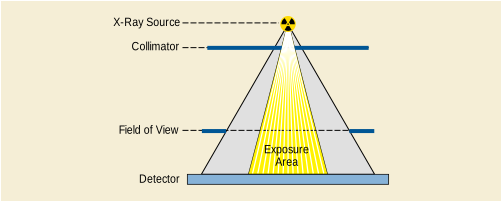
Table C.8-28. X-Ray Collimator Module Attributes
|
Attribute Name |
Tag |
Type |
Attribute Description |
|---|---|---|---|
|
Collimator Shape |
(0018,1700) |
1 |
Shape(s) of the collimator. Enumerated Values:
This multi-valued Attribute shall contain at most one of each Enumerated Value. |
|
Include Table C.8-28b “X-Ray Collimator Dimensions Macro Attributes” |
|||
Table C.8-28b. X-Ray Collimator Dimensions Macro Attributes
|
Attribute Name |
Tag |
Type |
Attribute Description |
|---|---|---|---|
|
Collimator Left Vertical Edge |
(0018,1702) |
1C |
Required if a value of Collimator Shape (0018,1700) is RECTANGULAR. Location of the left edge of the rectangular collimator with respect to pixels in the image given as column. See Section C.8.7.3.1.1. |
|
Collimator Right Vertical Edge |
(0018,1704) |
1C |
Required if a value of Collimator Shape (0018,1700) is RECTANGULAR. Location of the right edge of the rectangular collimator with respect to pixels in the image given as column. See Section C.8.7.3.1.1. |
|
Collimator Upper Horizontal Edge |
(0018,1706) |
1C |
Required if a value of Collimator Shape (0018,1700) is RECTANGULAR. Location of the upper edge of the rectangular collimator with respect to pixels in the image given as row. See Section C.8.7.3.1.1. |
|
Collimator Lower Horizontal Edge |
(0018,1708) |
1C |
Required if a value of Collimator Shape (0018,1700) is RECTANGULAR. Location of the lower edge of the rectangular collimator with respect to pixels in the image given as row. See Section C.8.7.3.1.1. |
|
Center of Circular Collimator |
(0018,1710) |
1C |
Required if a value of Collimator Shape (0018,1700) is CIRCULAR. Location of the center of the circular collimator with respect to pixels in the image given as row and column. See Section C.8.7.3.1.1. |
|
Radius of Circular Collimator |
(0018,1712) |
1C |
Required if a value of Collimator Shape (0018,1700) is CIRCULAR. Radius of the circular collimator with respect to pixels in the image given as a number of pixels along the row direction. See Section C.8.7.3.1.1. |
|
Vertices of the Polygonal Collimator |
(0018,1720) |
1C |
Required if a value of Collimator Shape (0018,1700) is POLYGONAL. Multiple Values where the first set of two values are: row of the origin vertex; column of the origin vertex. Two or more pairs of values follow and are the row and column coordinates of the other vertices of the polygon collimator. Polygon collimators are implicitly closed from the last vertex to the origin vertex and all edges shall be non-intersecting except at the vertices. |
These attributes specify the pixel row or column where the X-Ray beam is fully obscured by a rectangular collimator:
if the left edge of the collimator is not visible, Collimator Left Vertical Edge (0018,1702) shall have a value of 0;
if the right edge of the collimator is not visible, Collimator Right Vertical Edge (0018,1704) value shall be 1 greater than the value of Columns (0028,0011) attribute;
if the top edge of the collimator is not visible, Collimator Upper Horizontal Edge (0018,1706) shall have a value of 0;
if the bottom edge of the collimator is not visible, Collimator Lower Horizontal Edge (0018,1708) value shall be 1 greater than the value of Rows (0028,0010) attribute.
Table C.8-29 contains Attributes that describe X-Ray images acquired with movement of the patient imaging table.
Table C.8-29. X-Ray Table Module Attributes
|
Attribute Name |
Tag |
Type |
Attribute Description |
|---|---|---|---|
|
Table Motion |
(0018,1134) |
2 |
Defined Terms:
|
|
Table Vertical Increment |
(0018,1135) |
2C |
Incremental change in Vertical position of the table relative to first frame of Multi-frame image given in mm. Required if Table Motion is DYNAMIC. |
|
Table Longitudinal Increment |
(0018,1137) |
2C |
Incremental change in Longitudinal position of the table relative to first frame of Multi-frame image in mm. Table motion towards +90°position of the primary angle of the positioner is positive. See Section C.8.7.4.1.2. Required if Table Motion is DYNAMIC. |
|
Table Lateral Increment |
(0018,1136) |
2C |
Incremental change in Lateral position of the table relative to first frame of Multi-frame image given in mm. Table motion towards +90°position of the secondary angle of the positioner is positive. See Section C.8.7.4.1.3. Required if Table Motion is DYNAMIC. |
|
Table Angle |
(0018,1138) |
3 |
Angle of table plane in degrees relative to horizontal plane [Gravity plane]. Positive values indicate that the head of the table is upwards. |
This section is replaced by Section C.8.7.4.1.4
The direction of the longitudinal movement is perpendicular to the primary axis of rotation of the positioner. A positive value of Table Longitudinal Increment (0018,1137) attributes indicates a movement towards the +90° position of the positioner, see Figure C.8-9a.
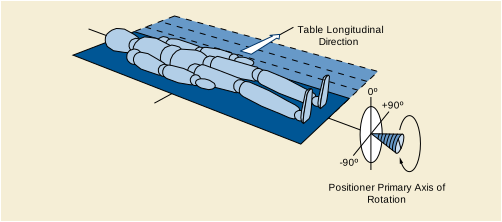
The direction of the lateral movement is perpendicular to the secondary axis of rotation of the positioner. A positive value of Table Lateral Increment (0018,1136) attributes indicates a movement towards the +90° position of the positioner, see Figure C.8-9b.
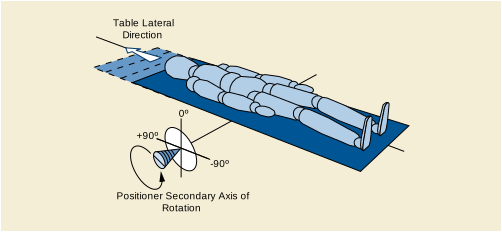
Note
The terms "longitudinal" and "lateral" are relative to an operator standing tableside, and facing the patient. Thus lateral movement is to the left and right of the operator, and longitudinal movement is towards or away from the operator.
The table moves the Patient with respect to the imaging chain. This is being tracked as a motion of the imaging chain with respect to a coordinate system (X, Y, Z) attached to the patient (assumption is that the patient does not move with respect to the table). The coordinate system origin is fixed with respect to the patient at the time of the first frame. The X-axis is increasing to the left hand side of the patient. The Y-axis is increasing to the posterior side of the patient. The Z-axis is increasing toward the head of the patient (see Section C.7.6.2.1.1). The Patient Plane is then defined by the X and Z-axes as drawn in Figure C.8-10).
Note
Table motion causes the apparent locus of imaging to move in the opposite direction. For instance, with the patient supine and the table motion towards +90°of the primary axis of rotation of the positioner, the area of the patient imaged moves toward the right hand side of the patient.
When the patient is positioned prone or supine (Figure C.8-2 showing the supine position) the Table Longitudinal Increment (0018,1137) table motion takes place along the patient X-axis and the Table Lateral Increment (0018,0036) along the Z-axis. For patient positioned left or right decubitus, the Table Longitudinal Increment takes place along the Y-axis, the other direction is not changed.
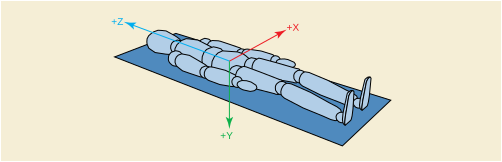
Table C.8-30 contains IOD Attributes that describe a c-arm positioner typically used in acquiring X-Ray Angiographic Images. The coordinate system used to track the positioner is defined in reference to the patient. The definition of coordinates with respect to the equipment is not supported. Furthermore, this module does not describe the movement of the Patient.
Note
The scope of the XA IOD is to address images produced on acquisition equipment equipped with an X-Ray source and an image Receptor positioned by what is general called a c-arm. For clinical areas other than Angiography that are using a c-arm to position the X-Ray source and image receptor (e.g., Interventional Procedures and Myelography and Biopsy/Localization), the X-Ray Angiography Image Object should be also used. Although the object is optimized for c-arm systems, it may also be used by other systems that support a similar coordinate system, such as some RF systems.
Table C.8-30. XA Positioner Module Attributes
|
Attribute Name |
Tag |
Type |
Attribute Description |
|---|---|---|---|
|
Distance Source to Patient |
(0018,1111) |
3 |
Distance in mm from source to center of field of view. Note
|
|
Distance Source to Detector |
(0018,1110) |
3 |
Distance in mm from source to detector center. NoteThis value is traditionally referred to as Source Image Receptor Distance (SID). |
|
Estimated Radiographic Magnification Factor |
(0018,1114) |
3 |
Ratio of Source Image Receptor Distance (SID) over Source Object Distance (SOD). |
|
Positioner Motion |
(0018,1500) |
2C |
Used to describe the activity of the imaging devices. Defined Terms:
See Section C.8.7.5.1.1. Required if Pixel Data (7FE0,0010) contains more than one frame. May be present otherwise. |
|
Positioner Primary Angle |
(0018,1510) |
2 |
Position of the X-Ray Image Intensifier about the patient from the RAO to LAO direction where movement from RAO to vertical is positive. See Section C.8.7.5.1.2. |
|
Positioner Secondary Angle |
(0018,1511) |
2 |
Position of the X-Ray Image Intensifier about the patient from the CAU to CRA direction where movement from CAU to vertical is positive. |
|
Positioner Primary Angle Increment |
(0018,1520) |
2C |
Incremental change in primary positioner angle for each frame. See Section C.8.7.5.1.3. Required if Positioner Motion (0018,1500) equals DYNAMIC. |
|
Positioner Secondary Angle Increment |
(0018,1521) |
2C |
Incremental change in secondary positioner angle for each frame. See Section C.8.7.5.1.3. Required if Positioner Motion (0018,1500) equals DYNAMIC. |
|
Detector Primary Angle |
(0018,1530) |
3 |
Angle of the X-Ray beam in the row direction in degrees relative to the normal to the detector plane. Positive values indicate that the X-Ray beam is tilted towards higher numbered columns. Negative values indicate that the X-Ray beam is tilted towards lower numbered columns. See Section C.8.7.5.1.4. |
|
Detector Secondary Angle |
(0018,1531) |
3 |
Angle of the X-Ray beam in the column direction in degrees relative to the normal to the detector plane. Positive values indicate that the X-Ray beam is tilted towards lower numbered rows. Negative values indicate that the X-Ray beam is tilted towards higher numbered rows. See Section C.8.7.5.1.4. |
Positioner Motion (0018,1500) attribute is STATIC if the imaging table moves during a multi-frame acquisition, but the X-Ray positioner do not move.
If Pixel Data (7FE0,0010) contains a single frame and a value of Positioner Motion (0018,1500) is provided, the value shall be STATIC.
Note
If the positioner undergoes translation (non-rotational movement) during the acquisition, then that motion shall be described by an opposite table motion (see Section C.8.7.4).
The definitions of Positioner Angles shall be with respect to the patient as illustrated in Figure C.8-11 and Figure C.8-12. Zero degree is referenced to the origin perpendicular to the patient's chest. The Positioner Primary Angle definition is like longitude (in the equatorial plan); the Positioner Secondary Angle definition is like latitude (in the sagittal plane). The Positioner Angle attributes apply to the first frame of a multi-frame image. The valid range of Primary Positioner Angle is -180 to +180 degrees and the Secondary Positioner Angle range is -90 to + 90 degrees.
The Patient Plane is defined by the isocenter of the imaging device and slices through the patient such that it is perpendicular to the sagittal plane of the body. The Primary Axis of rotation is defined at the intersection of the Patient Plane and of the Sagittal Plane. The Positioner Primary Angle is defined in the transaxial plane at the isocenter with zero degrees in the direction perpendicular to the patient's chest and + 90 degrees at the Patient left hand side (LAO) and -90 at the Patient right hand side (RAO). The valid range of Primary Positioner Angle is -180 to +180 degrees.
The Secondary Axis is in the Patient Plane and is perpendicular to the Primary Axis at the isocenter. The Positioner Secondary Angle is defined in the Sagittal Plane at the isocenter with zero degrees in the direction perpendicular to the patient's chest. +90 degrees corresponds to the cranial direction. The Secondary Positioner Angle range is -90 to + 90 degrees.
At a 0 angle for both Primary Angle (0018,1510) and Secondary Angle (0018,1511), the patient faces the Image Intensifier.
The Positioner Primary Angle (0018,1510) and Secondary Angle (0018,1511) apply to the first frame of a multi-frame image.
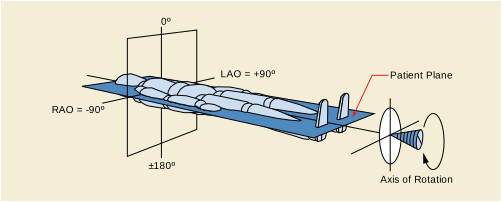
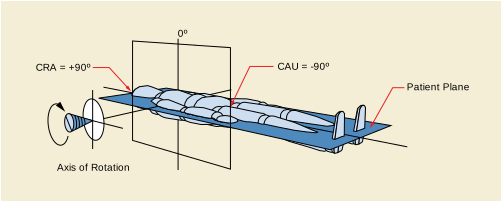
If the positioner angles change during acquisition of a multi-frame image, the Positioner Angle Increment attributes describe the angular change per frame.
If the change in positioner angle is nominally constant for each frame, these fields may contain a single value of the average angular change per frame. Alternatively, the fields may contain a vector of offsets from the (initial) Positioner Angle attributes, with one value for each frame in the multi-frame image. The number of values in the Positioner Angle Increment attributes must be one, or must be equal to Number of Frames (0028,0008) in the Multi-frame Module (see Section C.7.6.6).
Note
It is permissible to generate a vector of the absolute positioner angles in the Positioner Angle Increment attributes, and set the Positioner Primary and Secondary Angle attributes to value 0.
Detector Angles are defined in a fashion similar to the positioner angles, except that the angle of the central x-ray beam vector is relative to the detector plane rather than the patient plane. The central x-ray beam vector is defined as the vector from the x-ray source through the isocenter to the detector plane. Zero degree is referenced to the normal to the detector plane pointing away from the x-ray source. The Detector Angle attributes apply to the first frame of a multi-frame image. The valid range of the Detector Angles is -90 to + 90 degrees.
The Primary Axis of rotation is defined along the line in the column direction of the detector plane that intersects the central x-ray beam vector. The Detector Primary Angle is defined in the plane perpendicular to the Primary Axis of rotation at the point where the central x-ray beam vector intersects the detector plane, with zero degrees in the direction normal to the detector plane and -90 degrees at the left hand side of the image (i.e., toward column 1) and +90 at the right hand side of the image (i.e., toward the highest numbered column). The valid range of Primary Detector Angle is -90 to +90 degrees.
The Secondary Axis is in the detector plane and is perpendicular to the Primary Axis at the intersection of the beam vector with the detector plane (i.e., it is along the row direction). The Detector Secondary Angle is defined in the plane perpendicular to the Secondary Axis at the point where the central x-ray beam vector intersects the detector plane, with zero degrees in the direction normal to the detector plane. +90 degrees corresponds to the direction toward the top of the image. The Secondary Detector Angle range is -90 to + 90 degrees.
Table C.8-31. XRF Positioner Module Attributes
|
Attribute Name |
Tag |
Type |
Attribute Description |
|---|---|---|---|
|
Distance Source to Detector |
(0018,1110) |
3 |
Distance in mm from source to detector center. NoteThis value is traditionally referred to as Source Image Receptor Distance (SID). |
|
Distance Source to Patient |
(0018,1111) |
3 |
Distance in mm from source to center of field of view. NoteThis value is traditionally referred to as Source Object Distance (SOD). |
|
Estimated Radiographic Magnification Factor |
(0018,1114) |
3 |
Ratio of SID (Source Image Receptor Distance) over SOD (Source Object Distance). |
|
Column Angulation |
(0018,1450) |
3 |
Angle of the X-Ray beam in degree relative to an orthogonal axis to the detector plane. Positive values indicate that the tilt is towards the head of the table. NoteThe detector plane is assumed to be parallel to the table plane. |
This Module describes the attributes of a Tomography acquisition (translation of X-Ray source during the acquisition of a single frame image).
Table C.8-32. X-Ray Tomography Acquisition Module Attributes
|
Attribute Name |
Tag |
Type |
Attribute Description |
|---|---|---|---|
|
Tomo Layer Height |
(0018,1460) |
1 |
Distance in mm between the table surface and the sharp image plane. |
|
Tomo Angle |
(0018,1470) |
3 |
Angle span in degrees of rotation of X-Ray Source during X-Ray acquisition. |
|
Tomo Time |
(0018,1480) |
3 |
Time in seconds the source has taken to rotate the Tomo Angle during X-Ray acquisition. |
|
Tomo Type |
(0018,1490) |
3 |
Type of tomography. Defined Terms:
|
|
Tomo Class |
(0018,1491) |
3 |
Form of tomography: Defined Terms:
|
|
Number of Tomosynthesis Source Images |
(0018,1495) |
3 |
The number of source images used to construct this tomosynthetic image. Only meaningful if Tomo Class (0018,1491) is TOMOSYNTHESIS. These may be listed in Source Image Sequence (0008,2112) of the General Image Module. |
This Module describes the attributes related to dose delivery from an X-Ray source during the acquisition of an X-Ray image.
Table C.8-33. X-Ray Acquisition Dose Module Attributes
|
Attribute Name |
Tag |
Type |
Attribute Description |
|---|---|---|---|
|
KVP |
(0018,0060) |
3 |
Peak kilo voltage output of the X-Ray generator used. |
|
X-Ray Tube Current |
(0018,1151) |
3 |
X-Ray Tube Current in mA. |
|
X-Ray Tube Current in µA |
(0018,8151) |
3 |
X-Ray Tube Current in µA. |
|
Exposure Time |
(0018,1150) |
3 |
Duration of X-Ray exposure in msec. |
|
Exposure Time in µS |
(0018,8150) |
3 |
Duration of X-Ray exposure in µsec. |
|
Exposure |
(0018,1152) |
3 |
The exposure expressed in mAs, for example calculated from Exposure Time and X-Ray Tube Current. |
|
Exposure in µAs |
(0018,1153) |
3 |
The exposure expressed in µAs, for example calculated from Exposure Time and X-Ray Tube Current. |
|
Distance Source to Detector |
(0018,1110) |
3 |
Distance in mm from source to detector center. NoteThis value is traditionally referred to as Source Image Receptor Distance (SID). |
|
Distance Source to Patient |
(0018,1111) |
3 |
Distance in mm from source to the table, support or bucky side that is closest to the Imaging Subject, as measured along the central ray of the X-Ray beam. Note
|
|
Image and Fluoroscopy Area Dose Product |
(0018,115E) |
3 |
X-Ray dose, measured in dGy*cm*cm, to which the patient was exposed for the acquisition of this image plus any non-digitally recorded fluoroscopy that may have been performed to prepare for the acquisition of this image. Note
|
|
Body Part Thickness |
(0018,11A0) |
3 |
The average thickness in mm of the body part examined when compressed, if compression has been applied during exposure. |
|
Relative X-Ray Exposure |
(0018,1405) |
3 |
Indication of the applied dose, in manufacturer specific units. Note
|
|
Entrance Dose |
(0040,0302) |
3 |
Average entrance dose value measured in dGy at the surface of the patient during the acquisition of this image. NoteThis may be an estimated value based on assumptions about the patient's body size and habitus. |
|
Entrance Dose in mGy |
(0040,8302) |
3 |
Average entrance dose value measured in mGy at the surface of the patient during the acquisition of this image. NoteThis may be an estimated value based on assumptions about the patient's body size and habitus. |
|
Exposed Area |
(0040,0303) |
3 |
Typical dimension of the exposed area at the detector plane. If Rectangular: row dimension followed by column; if Round: diameter. Measured in cm. Note
|
|
Distance Source to Entrance |
(0040,0306) |
3 |
Distance in mm from the source to the surface of the patient closest to the source during the acquisition of this image. NoteThis may be an estimated value based on assumptions about the patient's body size and habitus. |
|
Comments on Radiation Dose |
(0040,0310) |
3 |
User-defined comments on any special conditions related to radiation dose encountered during the acquisition of this image. |
|
X-Ray Output |
(0040,0312) |
3 |
The X-Ray output at the patient entrance surface and kVp used to acquire the image, measured in mGy/mAs. NoteThis value may be a calibrated value rather than measured during the exposure. |
|
Half Value Layer |
(0040,0314) |
3 |
The thickness of Aluminum in mm required to reduce the X-Ray Output (0040,0312) by a factor of two. NoteThis value may be a calibrated value rather than measured during the exposure. |
|
Organ Dose |
(0040,0316) |
3 |
Average organ dose value measured in dGy during the acquisition of this image. NoteThis may be an estimated value. |
|
Organ Exposed |
(0040,0318) |
3 |
Organ to which Organ Dose (0040,0316) applies. Defined Terms:
NoteThe anatomic regions described by these terms are those that are particularly radiosensitive and for which it is conventional to obtain organ specific dose parameters. |
|
Anode Target Material |
(0018,1191) |
3 |
The primary material in the anode of the X-Ray source. Defined Terms:
|
|
Rectification Type |
(0018,1156) |
3 |
Type of rectification used in the X-Ray generator. Defined Terms:
|
This Module describes the attributes related to generation of X-Rays during the acquisition of an X-Ray image.
Table C.8-34. X-Ray Generation Module Attributes
|
Attribute Name |
Tag |
Type |
Attribute Description |
|---|---|---|---|
|
KVP |
(0018,0060) |
3 |
Peak kilo voltage output of the X-Ray generator used. |
|
X-Ray Tube Current |
(0018,1151) |
3 |
X-Ray Tube Current in mA. |
|
X-Ray Tube Current in µA |
(0018,8151) |
3 |
X-Ray Tube Current in µA. |
|
Exposure Time |
(0018,1150) |
3 |
Duration of X-Ray exposure in msec. |
|
Exposure Time in µS |
(0018,8150) |
3 |
Duration of X-Ray exposure in µsec. |
|
Exposure |
(0018,1152) |
3 |
The exposure expressed in mAs, for example calculated from Exposure Time and X-Ray Tube Current. |
|
Exposure in µAs |
(0018,1153) |
3 |
The exposure expressed in µAs, for example calculated from Exposure Time and X-Ray Tube Current. |
|
Exposure Control Mode |
(0018,7060) |
3 |
Type of exposure control. Defined Terms:
|
|
Exposure Control Mode Description |
(0018,7062) |
3 |
Text description of the mechanism of exposure control. May describe the number and type of exposure sensors or position of the sensitive area of the imaging detector. |
|
Exposure Status |
(0018,7064) |
3 |
Whether the exposure was normally completed or not. Defined Terms:
|
|
Phototimer Setting |
(0018,7065) |
3 |
Nominal percentage phototimer setting, where a more positive value indicates greater exposure and a more negative value indicates less exposure. |
|
Focal Spot(s) |
(0018,1190) |
3 |
Nominal focal spot size in mm used to acquire this image. |
|
Anode Target Material |
(0018,1191) |
3 |
The primary material in the anode of the X-Ray source. Defined Terms:
|
|
Rectification Type |
(0018,1156) |
3 |
Type of rectification used in the X-Ray generator. Defined Terms:
|
|
Generator ID |
(0018,1005) |
3 |
Identifier of the generator |
This Module describes the attributes related to the filtration of X-Rays during the acquisition of an X-Ray image.
Table C.8-35a. X-Ray Filtration Macro Attributes
|
Attribute Name |
Tag |
Type |
Attribute Description |
|---|---|---|---|
|
Filter Type |
(0018,1160) |
3 |
Type of filter(s) inserted into the X-Ray beam (e.g., wedges). Defined Terms:
NoteMultiple type of filters can be expressed by a combination, e.g., BUTTERFLY+WEDGE. |
|
Filter Material |
(0018,7050) |
3 |
The X-Ray absorbing material used in the filter. May be multi-valued. Defined Terms:
|
|
Filter Thickness Minimum |
(0018,7052) |
3 |
The minimum thickness in mm of the X-Ray absorbing material used in the filters. May be multi-valued, with values corresponding to the respective values in Filter Material (0018,7050). |
|
Filter Thickness Maximum |
(0018,7054) |
3 |
The maximum thickness in mm of the X-Ray absorbing material used in the filters. May be multi-valued, with values corresponding to the respective values in Filter Material (0018,7050). |
|
Filter Beam Path Length Minimum |
(0018,7056) |
3 |
The minimum length (in mm) of the X-Ray beam path in the Filter Material that is not blocked by collimation. May be multi-valued, with values corresponding to the respective values in Filter Material (0018,7050). |
|
Filter Beam Path Length Maximum |
(0018,7058) |
3 |
The maximum length (in mm) of the X-Ray beam path in the Filter Material that is not blocked by collimation. May be multi-valued, with values corresponding to the respective values in Filter Material (0018,7050). |
This Module describes the attributes related to the use of a grid to reduce scatter of X-Rays during the acquisition of an X-Ray image.
Table C.8-36. X-Ray Grid Module Attributes
|
Attribute Name |
Tag |
Type |
Attribute Description |
|---|---|---|---|
|
Grid |
(0018,1166) |
3 |
Identifies the grid. May be multi-valued. Defined Terms:
|
|
Include Table C.8-36b “X-Ray Grid Description Macro Attributes” |
|||
Table C.8-36b. X-Ray Grid Description Macro Attributes
|
Attribute Name |
Tag |
Type |
Attribute Description |
|---|---|---|---|
|
Grid Absorbing Material |
(0018,7040) |
3 |
The X-Ray absorbing material used in the grid. |
|
Grid Spacing Material |
(0018,7041) |
3 |
The spacing material used in the grid. |
|
Grid Thickness |
(0018,7042) |
3 |
The thickness in mm of the X-Ray absorbing material used in the grid. |
|
Grid Pitch |
(0018,7044) |
3 |
The pitch in mm of the X-Ray absorbing material used in the grid. |
|
Grid Aspect Ratio |
(0018,7046) |
3 |
Ratio of the vertical spacing and horizontal spacing of the X-Ray absorbing material used in the grid. Specified by a pair of integer values where the first value is the vertical size, and the second value is the horizontal size. |
|
Grid Period |
(0018,7048) |
3 |
Period in mSec of reciprocation cycle. Only meaningful if a value of Grid (0018,1166) is RECIPROCATING. |
|
Grid Focal Distance |
(0018,704C) |
3 |
Focal distance in mm of a FOCUSED grid. |
|
Grid ID |
(0018,1006) |
3 |
Identifier of the grid |
This Section describes Radiotherapy-specific modules.
Modules defined here make reference to "IEC" coordinate systems and standards. These standards are defined in IEC Standard 61217, "Radiotherapy Equipment - Coordinates, Movements and Scales" (Reference CEI/IEC 61217: 1996).
Note
IEC document 62C/269/CDV "Amendment to IEC 61217: Radiotherapy Equipment - Coordinates, movements and scales" also defines a patient-based coordinate system, and specifies the relationship between the DICOM Patient Coordinate System (see Section C.7.6.2.1.1) and the IEC PATIENT Coordinate System. Rotating the IEC PATIENT Coordinate System described in IEC 62C/269/CDV (1999) by 90 degrees counter-clockwise (in the negative direction) about the x-axis yields the DICOM Patient Coordinate System, i.e., (XDICOM, YDICOM, ZDICOM) = (XIEC, -ZIEC, YIEC). Refer to the latest IEC documentation for the current definition of the IEC PATIENT Coordinate System.
Many of the dosimetry concepts referred to in this document can be found in ICRU Report 50, Prescribing, Recording, and Reporting Photon Beam Therapy, International Commission on Radiation Units and Measurements, 1993.
There exist significant differences in the manner in which RT objects as compared to diagnostic objects. An RT object can be one of several types, and a series of a given object type may be created over a temporal span of several weeks. The RT Series Module has been created to satisfy the requirements of the standard DICOM Query/Retrieve model while including only those attributes relevant to the identification and selection of radiotherapy objects.
Table C.8-37. RT Series Module Attributes
|
Attribute Name |
Tag |
Type |
Attribute Description |
|---|---|---|---|
|
Modality |
(0008,0060) |
1 |
Type of equipment that originally acquired the data. Enumerated Values:
See Section C.8.8.1.1. |
|
Series Instance UID |
(0020,000E) |
1 |
Unique identifier of the series. |
|
Series Number |
(0020,0011) |
2 |
A number that identifies this series. |
|
Series Date |
(0008,0021) |
3 |
Date the Series started. |
|
Series Time |
(0008,0031) |
3 |
Time the Series started. |
|
Series Description |
(0008,103E) |
3 |
Description of the series. |
|
Series Description Code Sequence |
(0008,103F) |
3 |
A coded description of the Series. Only a single Item is permitted in this sequence. |
|
No Baseline CID is defined. |
|||
|
Operators' Name |
(0008,1070) |
2 |
Name(s) of the operator(s) supporting the Series. |
|
Referenced Performed Procedure Step Sequence |
(0008,1111) |
3 |
Uniquely identifies the Performed Procedure Step SOP Instance to which the Series is related. One or more items are permitted in this sequence. |
|
>Include Table 10-11 “SOP Instance Reference Macro Attributes” |
|||
|
Request Attributes Sequence |
(0040,0275) |
3 |
Sequence that contains attributes from the Imaging Service Request. One or more Items are permitted in this sequence. |
|
No Baseline CID is defined. |
|||
|
Include Table 10-16 “Performed Procedure Step Summary Macro Attributes” |
No Baseline CID is defined. |
||
The Enumerated Value for Modality (0008,0060) shall determined by the IOD.
Enumerated Values if RT Image IOD:
- RTIMAGE
Enumerated Values if RT Dose IOD:
- RTDOSE
Enumerated Values if RT Structure Set IOD:
- RTSTRUCT
Enumerated Values if RT Plan IOD or RT Ion Plan IOD:
- RTPLAN
Enumerated Values if RT Beams Treatment Record IOD, RT Ion Beams Treatment Record IOD, RT Brachy Treatment Record IOD, or RT Treatment Summary Record IOD:
- RTRECORD
Note
DICOM specifies that a given series shall contain objects of only one Modality, and shall be created by a single device (described in the General Equipment Module). However, in general there may be many series defined for a given modality/device pair. Note that a radiotherapy series is generally created over an extended time interval (unlike in radiology, where all images in an image series are generally created together).
Table C.8-38 contains attributes that describe RT-specific characteristics of a projection image. The image described by these attributes must be a radiotherapy image acquired or calculated using a conical imaging geometry.
Table C.8-38. RT Image Module Attributes
|
Attribute Name |
Tag |
Type |
Attribute Description |
|---|---|---|---|
|
Samples per Pixel |
(0028,0002) |
1 |
Number of samples (planes) in this image. See Section C.8.8.2.6.1 for specialization. |
|
Photometric Interpretation |
(0028,0004) |
1 |
Specifies the intended interpretation of the pixel data. See Section C.8.8.2.6.2 for specialization. |
|
Bits Allocated |
(0028,0100) |
1 |
Number of bits allocated for each pixel sample. Each sample shall have the same number of bits allocated. See Section C.8.8.2.6.3 for specialization. |
|
Bits Stored |
(0028,0101) |
1 |
Number of bits stored for each pixel sample. Each sample shall have the same number of bits stored. See Section C.8.8.2.6.4 for specialization. |
|
High Bit |
(0028,0102) |
1 |
Most significant bit for each pixel sample. Each sample shall have the same high bit. See Section C.8.8.2.6.5 for specialization. |
|
Pixel Representation |
(0028,0103) |
1 |
Data representation of the pixel samples. Each sample shall have the same pixel representation. See Section C.8.8.2.6.6 for specialization. |
|
Pixel Intensity Relationship |
(0028,1040) |
3 |
The relationship between the Pixel sample values and the X-Ray beam intensity. Enumerated Values:
See Section C.8.11.3.1.2 for further explanation. |
|
Pixel Intensity Relationship Sign |
(0028,1041) |
1C |
The sign of the relationship between the Pixel sample values stored in Pixel Data (7FE0,0010) and the X-Ray beam intensity. Required if Pixel Intensity Relationship (0028,1040) is present. Enumerated Values:
See Section C.8.11.3.1.2 for further explanation. |
|
RT Image Label |
(3002,0002) |
1 |
User-defined label for RT Image. |
|
RT Image Name |
(3002,0003) |
3 |
User-defined name for RT Image. |
|
RT Image Description |
(3002,0004) |
3 |
User-defined description of RT Image. |
|
Image Type |
(0008,0008) |
1 |
Image identification characteristics (see Section C.7.6.1.1.2). Defined Terms for Value 3:
|
|
Conversion Type |
(0008,0064) |
2 |
Describes the kind of image conversion. Defined Terms:
|
|
Reported Values Origin |
(3002,000A) |
2C |
Describes the origin of the parameter values reported in the image. Required if Value 3 of Image Type (0008,0008) is SIMULATOR or PORTAL. Enumerated Values:
|
|
RT Image Plane |
(3002,000C) |
1 |
Describes whether or not image plane is normal to beam axis. Enumerated Values:
|
|
X-Ray Image Receptor Translation |
(3002,000D) |
3 |
Position in (x,y,z) coordinates of origin of IEC X-RAY IMAGE RECEPTOR System in the IEC GANTRY coordinate system (mm). See Note 2. |
|
X-Ray Image Receptor Angle |
(3002,000E) |
2 |
X-Ray Image Receptor Angle i.e., orientation of IEC X-RAY IMAGE RECEPTOR coordinate system with respect to IEC GANTRY coordinate system (degrees). See Section C.8.8.2.2. |
|
RT Image Orientation |
(3002,0010) |
2C |
The direction cosines of the first row and the first column with respect to the IEC X-RAY IMAGE RECEPTOR coordinate system. Required if RT Image Plane (3002,000C) is NON_NORMAL. May be present otherwise. |
|
Image Plane Pixel Spacing |
(3002,0011) |
2 |
Physical distance (in mm) between the center of each image pixel, specified by a numeric pair - adjacent row spacing (delimiter) adjacent column spacing. See Section C.8.8.2.3 and Section 10.7.1.3 for further explanation. |
|
RT Image Position |
(3002,0012) |
2 |
The x and y coordinates (in mm) of the upper left hand corner of the image, in the IEC X-RAY IMAGE RECEPTOR coordinate system. This is the center of the first pixel transmitted. See Section C.8.8.2.7. |
|
Radiation Machine Name |
(3002,0020) |
2 |
User-defined name identifying radiation machine used in acquiring or computing image (i.e., name of conventional simulator, electron accelerator, X-Ray device, or machine modeled when calculating DRR). |
|
Primary Dosimeter Unit |
(300A,00B3) |
2 |
Measurement unit of machine dosimeter. Enumerated Values:
|
|
Radiation Machine SAD |
(3002,0022) |
2 |
Radiation source to Gantry rotation axis distance of radiation machine used in acquiring or computing image (mm). |
|
Radiation Machine SSD |
(3002,0024) |
3 |
Source to patient surface distance (in mm) of radiation machine used in acquiring or computing image. |
|
RT Image SID |
(3002,0026) |
2 |
Distance from radiation machine source to image plane (in mm) along radiation beam axis. See Section C.8.8.2.3. |
|
Source to Reference Object Distance |
(3002,0028) |
3 |
Source to reference object distance (in mm), as used for magnification calculation of RADIOGRAPH and SIMULATOR images. |
|
Referenced RT Plan Sequence |
(300C,0002) |
3 |
Sequence of one Class/Instance pair describing RT Plan associated with image. Only a single item is permitted in this sequence. |
|
>Include Table 10-11 “SOP Instance Reference Macro Attributes” |
|||
|
Referenced Beam Number |
(300C,0006) |
3 |
Uniquely identifies the corresponding N-segment treatment beam specified by Beam Number (300A,00C0) within Beam Sequence in RT Beams Module within the RT Plan referenced in Referenced RT Plan Sequence (300C,0002). |
|
Referenced Fraction Group Number |
(300C,0022) |
3 |
Identifier of Fraction Group within RT Plan referenced in Referenced RT Plan Sequence (300C,0002). |
|
Fraction Number |
(3002,0029) |
3 |
Fraction Number of fraction during which image was acquired, within Fraction Group referenced by Referenced Fraction Group Number (300C,0022) within RT Plan referenced in Referenced RT Plan Sequence (300C,0002). |
|
Start Cumulative Meterset Weight |
(300C,0008) |
3 |
Cumulative Meterset Weight within Beam referenced by Referenced Beam Number (300C,0006) at which image acquisition starts. |
|
End Cumulative Meterset Weight |
(300C,0009) |
3 |
Cumulative Meterset Weight within Beam referenced by Referenced Beam Number (300C,0006) at which image acquisition ends. |
|
Exposure Sequence |
(3002,0030) |
3 |
Sequence of Exposure parameter sets, corresponding to exposures used in generating the image. One or more items are permitted in this sequence. See Section C.8.8.2.4. |
|
>Referenced Frame Number |
(0008,1160) |
1C |
Identifies corresponding image frame in multi-frame image. Required if there is more than one item in Exposure Sequence (3002,0030), and image is a multi-frame image. |
|
>KVP |
(0018,0060) |
2C |
Peak kilo voltage output (kV) of X-Ray generator used to acquire image. Required if Value 3 of Image Type (0008,0008) is PORTAL, SIMULATOR or RADIOGRAPH. |
|
>Primary Fluence Mode Sequence |
(3002,0050) |
3 |
Sequence defining whether the primary fluence of the treatment beam uses a non-standard fluence-shaping. Only a single Item is permitted in this sequence. |
|
>>Fluence Mode |
(3002,0051) |
1 |
Describes whether the fluence shaping is the standard mode for the beam or an alternate. Enumerated Values:
|
|
>>Fluence Mode ID |
(3002,0052) |
1C |
Identifier for the specific fluence-shaping mode. Required if Fluence Mode (3002,0051) has value NON_STANDARD. |
|
>X-Ray Tube Current |
(0018,1151) |
2C |
Imaging device X-Ray Tube Current (mA). Required if Value 3 of Image Type (0008,0008) is SIMULATOR or RADIOGRAPH. May be present otherwise. |
|
>X-Ray Tube Current in mA |
(0018,9330) |
3 |
X-Ray Tube Current in mA. An average in the case of fluoroscopy (continuous radiation mode). |
|
>Exposure Time |
(0018,1150) |
2C |
Time of X-Ray exposure (msec). Required if Value 3 of Image Type (0008,0008) is SIMULATOR or RADIOGRAPH. May be present otherwise. |
|
>Exposure Time in ms |
(0018,9328) |
3 |
Duration of X-Ray exposure in msec. |
|
>Meterset Exposure |
(3002,0032) |
2C |
Treatment machine Meterset duration over which image has been acquired, specified in Monitor units (MU) or minutes as defined by Primary Dosimeter Unit (300A,00B3). Required if Value 3 of Image Type (0008,0008) is PORTAL. |
|
>Diaphragm Position |
(3002,0034) |
3 |
Positions of diaphragm jaw pairs (in mm) in IEC BEAM LIMITING DEVICE coordinate axis in the IEC order X1, X2, Y1, Y2. |
|
>Beam Limiting Device Sequence |
(300A,00B6) |
3 |
Sequence of beam limiting device (collimator) jaw or leaf (element) positions for given exposure. One or more items are permitted in this sequence. |
|
>>RT Beam Limiting Device Type |
(300A,00B8) |
1 |
Type of beam limiting device (collimator). Enumerated Values:
|
|
>>Source to Beam Limiting Device Distance |
(300A,00BA) |
3 |
Radiation source to beam limiting device (collimator) distance (mm). |
|
>>Number of Leaf/Jaw Pairs |
(300A,00BC) |
1 |
Number of leaf (element) or jaw pairs (equal to 1 for standard beam limiting device jaws). |
|
>>Leaf Position Boundaries |
(300A,00BE) |
2C |
Boundaries (in mm) of beam limiting device (collimator) leaves (elements) in IEC BEAM LIMITING DEVICE coordinate axis appropriate to RT Beam Limiting Device Type (300A,00B8), i.e., X-axis for MLCY, Y-axis for MLCX. Contains N+1 values, where N is the Number of Leaf/Jaw Pairs (300A,00BC), starting from Leaf (Element) Pair 1. Required if RT Beam Limiting Device Type (300A,00B8) is MLCX or MLCY. May be present otherwise. |
|
>>Leaf/Jaw Positions |
(300A,011C) |
1 |
Positions of beam limiting device (collimator) leaf or jaw (element) pairs (in mm) in IEC BEAM LIMITING DEVICE coordinate axis appropriate to RT Beam Limiting Device Type (300A,00B8), e.g., X-axis for MLCX, Y-axis for MLCY). Contains 2N values, where N is the Number of Leaf/Jaw Pairs (300A,00BC), in IEC leaf (element) subscript order 101, 102, … 1N, 201, 202, … 2N. |
|
>Gantry Angle |
(300A,011E) |
3 |
Treatment machine gantry angle, i.e., orientation of IEC GANTRY coordinate system with respect to IEC FIXED REFERENCE coordinate system (degrees). |
|
>Gantry Pitch Angle |
(300A,014A) |
3 |
Gantry Pitch Angle. i.e., the rotation of the IEC GANTRY coordinate system about the X-axis of the IEC GANTRY coordinate system (degrees). See Section C.8.8.25.6.5. |
|
>Beam Limiting Device Angle |
(300A,0120) |
3 |
Treatment machine beam limiting device (collimator) angle, i.e., orientation of IEC BEAM LIMITING DEVICE coordinate system with respect to IEC GANTRY coordinate system (degrees). |
|
>Patient Support Angle |
(300A,0122) |
3 |
Patient Support angle, i.e., orientation of IEC PATIENT SUPPORT coordinate system with respect to IEC FIXED REFERENCE coordinate system (degrees). |
|
>Table Top Pitch Angle |
(300A,0140) |
3 |
Table Top Pitch Angle, i.e., the rotation of the IEC TABLE TOP coordinate system about the X-axis of the IEC TABLE TOP coordinate system (degrees). See Section C.8.8.25.6.2. |
|
>Table Top Roll Angle |
(300A,0144) |
3 |
Table Top Roll Angle, i.e., the rotation of the IEC TABLE TOP coordinate system about the Y-axis of the IEC TABLE TOP coordinate system (degrees). See Section C.8.8.25.6.2. |
|
>Table Top Vertical Position |
(300A,0128) |
3 |
Table Top Vertical position in IEC TABLE TOP coordinate system (mm). |
|
>Table Top Longitudinal Position |
(300A,0129) |
3 |
Table Top Longitudinal position in IEC TABLE TOP coordinate system (mm). |
|
>Table Top Lateral Position |
(300A,012A) |
3 |
Table Top Lateral position in IEC TABLE TOP coordinate system (mm). |
|
>Applicator Sequence |
(300A,0107) |
3 |
Sequence of Applicators associated with Beam. Only a single item is permitted in this sequence. |
|
>>Applicator ID |
(300A,0108) |
1 |
User or machine supplied identifier for Applicator. |
|
>>Accessory Code |
(300A,00F9) |
3 |
An identifier for the accessory intended to be read by a device such as a bar-code reader. |
|
>>Applicator Type |
(300A,0109) |
1 |
Type of Applicator. Defined Terms:
|
|
>>Applicator Geometry Sequence |
(300A,0431) |
3 |
Describes the applicator aperture geometry. Only a single Item is permitted in this sequence. |
|
>>>Applicator Aperture Shape |
(300A,0432) |
1 |
Aperture shape of the applicator. Defined Terms:
|
|
>>>Applicator Opening |
(300A,0433) |
1C |
Opening (in mm) of the applicator's aperture in IEC BEAM LIMITING DEVICE coordinate system. In case of square-shaped applicator contains the length of the sides of the square. In case of circular-shaped applicators, contains the diameter of the circular aperture. Required if Applicator Aperture Shape (300A,0432) is SYM_SQUARE or SYM_CIRCULAR. |
|
>>>Applicator Opening X |
(300A,0434) |
1C |
Opening (in mm) of the applicator's aperture in IEC BEAM LIMITING DEVICE coordinate system in X-Direction. Required if Applicator Aperture Shape (300A,0432) is SYM_RECTANGLE. |
|
>>>Applicator Opening Y |
(300A,0435) |
1C |
Opening (in mm) of the applicator's aperture in IEC BEAM LIMITING DEVICE coordinate system in Y-Direction. Required if Applicator Aperture Shape (300A,0432) is SYM_RECTANGLE. |
|
>> Source to Applicator Mounting Position Distance |
(300A,0436) |
3 |
Radiation source to applicator mounting position distance (in mm) for current applicator. |
|
>>Applicator Description |
(300A,010A) |
3 |
User-defined description for Applicator. |
|
>General Accessory Sequence |
(300A,0420) |
3 |
Sequence of General Accessories associated with the beam producing this image. One or more items are permitted in this sequence. |
|
>>General Accessory Number |
(300A,0424) |
1 |
Identification Number of the General Accessory. The value shall be unique within the sequence. |
|
>>General Accessory ID |
(300A,0421) |
1 |
User or machine supplied identifier for General Accessory. |
|
>>General Accessory Description |
(300A,0422) |
3 |
User supplied description of General Accessory. |
|
>>General Accessory Type |
(300A,0423) |
3 |
Specifies the type of accessory. Defined Terms:
|
|
>>Accessory Code |
(300A,00F9) |
3 |
Machine-readable identifier for this accessory |
|
>>Source to General Accessory Distance |
(300A,0425) |
3 |
Radiation source to general accessory distance (in mm) for current accessory. |
|
>Number of Blocks |
(300A,00F0) |
1 |
Number of shielding blocks associated with Beam. |
|
>Block Sequence |
(300A,00F4) |
2C |
Sequence of blocks associated with Beam. Required if Number of Blocks (300A,00F0) is non-zero. Zero or more items shall be included in this sequence. |
|
>>Block Tray ID |
(300A,00F5) |
3 |
User-supplied identifier for block tray. |
|
>>Accessory Code |
(300A,00F9) |
3 |
An identifier for the accessory intended to be read by a device such as a bar-code reader. |
|
>>Source to Block Tray Distance |
(300A,00F6) |
2 |
Radiation Source to attachment edge of block tray assembly (mm). |
|
>>Block Type |
(300A,00F8) |
1 |
Type of block. Enumerated Values:
|
|
>>Block Divergence |
(300A,00FA) |
2 |
Indicates presence or otherwise of geometrical divergence Enumerated Values:
|
|
>>Block Mounting Position |
(300A,00FB) |
3 |
Indicates on which side of the Block Tray the block is mounted. Enumerated Values:
|
|
>>Block Number |
(300A,00FC) |
1 |
Identification Number of the Block. The value of Block Number (300A,00FC) shall be unique within the Beam in which it is created. |
|
>>Block Name |
(300A,00FE) |
3 |
User-defined name for block. |
|
>>Material ID |
(300A,00E1) |
2 |
User-supplied identifier for material used to manufacture Block. |
|
>>Block Thickness |
(300A,0100) |
3 |
Physical thickness of block (in mm) parallel to radiation beam axis. |
|
>>Block Number of Points |
(300A,0104) |
2 |
Number of (x,y) pairs defining the block edge. |
|
>>Block Data |
(300A,0106) |
2 |
A data stream of (x,y) pairs that comprise the block edge. The number of pairs shall be equal to Block Number of Points (300A,0104), and the vertices shall be interpreted as a closed polygon. Coordinates are projected onto the machine isocentric plane in the IEC BEAM LIMITING DEVICE coordinate system (mm). |
|
Fluence Map Sequence |
(3002,0040) |
1C |
A Sequence of data describing the fluence map attributes for a radiotherapy beam. Only a single item shall be included in this sequence. Required if the third value of Image Type (0008,0008) is FLUENCE. |
|
>Fluence Data Source |
(3002,0041) |
1 |
Source of fluence data. Enumerated Values:
|
|
>Fluence Data Scale |
(3002,0042) |
3 |
The Meterset corresponding with a fluence map cell value of 1.0 expressed in units specified by Primary Dosimeter Units (300A,00B3). This is the Meterset value used for treatment, not the Meterset used to expose the film as defined by Meterset Exposure (3002,0032). |
|
Gantry Angle |
(300A,011E) |
3 |
Treatment machine gantry angle, i.e., orientation of IEC GANTRY coordinate system with respect to IEC FIXED REFERENCE coordinate system (degrees). |
|
Gantry Pitch Angle |
(300A,014A) |
3 |
Gantry Pitch Angle. i.e., the rotation of the IEC GANTRY coordinate system about the X-axis of the IEC GANTRY coordinate system (degrees). See Section C.8.8.25.6.5. |
|
Beam Limiting Device Angle |
(300A,0120) |
3 |
Treatment machine beam limiting device (collimator) angle, i.e., orientation of IEC BEAM LIMITING DEVICE coordinate system with respect to IEC GANTRY coordinate system (degrees). |
|
Patient Support Angle |
(300A,0122) |
3 |
Patient Support angle, i.e., orientation of IEC PATIENT SUPPORT coordinate system with respect to IEC FIXED REFERENCE coordinate system (degrees). |
|
Table Top Eccentric Axis Distance |
(300A,0124) |
3 |
Distance (positive) from the IEC PATIENT SUPPORT vertical axis to the IEC TABLE TOP ECCENTRIC vertical axis (mm). |
|
Table Top Eccentric Angle |
(300A,0125) |
3 |
Table Top (non-isocentric) angle, i.e., orientation of IEC TABLE TOP ECCENTRIC coordinate system with respect to IEC PATIENT SUPPORT system (degrees). |
|
Table Top Pitch Angle |
(300A,0140) |
3 |
Table Top Pitch Angle, i.e., the rotation of the IEC TABLE TOP coordinate system about the X-axis of the IEC TABLE TOP coordinate system (degrees). See Section C.8.8.25.6.2. |
|
Table Top Roll Angle |
(300A,0144) |
3 |
Table Top Roll Angle, i.e., the rotation of the IEC TABLE TOP coordinate system about the Y-axis of the IEC TABLE TOP coordinate system (degrees). See Section C.8.8.25.6.2. |
|
Table Top Vertical Position |
(300A,0128) |
3 |
Table Top Vertical position in IEC TABLE TOP coordinate system (mm). |
|
Table Top Longitudinal Position |
(300A,0129) |
3 |
Table Top Longitudinal position in IEC TABLE TOP coordinate system (mm). |
|
Table Top Lateral Position |
(300A,012A) |
3 |
Table Top Lateral position in IEC TABLE TOP coordinate system (mm). |
|
Isocenter Position |
(300A,012C) |
3 |
Isocenter coordinates (x,y,z), in mm. Specifies the location of the machine isocenter in the patient-based coordinate system associated with the Frame of Reference. It allows transformation from the equipment-based IEC coordinate system to the patient-based coordinate system. |
|
Patient Position |
(0018,5100) |
1C |
Patient position descriptor relative to the patient support device. Required if Isocenter Position (300A,012C) is present. May be present otherwise. See Section C.8.8.12.1.2 for Defined Terms and further explanation. NoteThe orientation of the patient relative to the patient support device is denoted in the same manner as in the RT Patient Setup module. It defines the relation of the patient-based DICOM coordinate system identified by the frame of reference module of the RT Image to the IEC coordinate system and together with Isocenter Position (300A,012C) allows the RT Image to be placed into the patient frame of reference. It also allows a system using an RT Image to verify that the patient is setup in a similar position relative to the patient support device. |
Note
The numeric beam data parameters recorded with the RT Image correspond to the parameters as they were known at the time the image was created or taken. The parameters may or may not correspond to an actual RT Plan instance that is created for a patient. If the Reported Values Origin (3002,000A) has an Enumerated Value of OPERATOR or ACTUAL and there is an RT Plan reference present, the numeric beam data parameters may or may not be the same in the two objects.
The Z coordinate of the X-Ray Image Receptor Translation (3002,000D) will be equal to the Radiation Machine SAD (3002,0022) minus the RT Image SID (3002,0026). If the image receptor is further from the beam source than the machine isocenter, the Z coordinate will be negative (see IEC 61217).
In either multiple exposure multi-frame images or cine images, only the attributes inside Exposure Sequence (3002,0030) shall differ between frames. For example, attributes such as beam limiting device (collimator) leaf (element) positions and block information may change, whereas attributes such as gantry and beam limiting device (collimator) angle shall not change.
The X-Ray Image Receptor Angle (3002,000E) specifies the rotation of the image receptor device in the IEC X-RAY IMAGE RECEPTOR PLANE. A positive angle corresponds to a counter-clockwise rotation of the X-Ray Image Receptor as viewed from the radiation source in the IEC GANTRY coordinate system. The normal (non-rotated) value for this parameter is zero degrees.
The Image Plane Pixel Spacing (3002,0011) attribute shall always be defined on the image plane, i.e., at the radiation machine source to image plane distance specified by RT Image SID (3002,0026). For images where the source-image distance is undefined or unknown (e.g., DRR images), RT Image SID (3002,0026) shall equal Radiation Machine SAD (3002,0022) and Image Plane Pixel Spacing (3002,0011) shall be defined on this common plane.
Exposure Sequence (3002,0030) allows specification of imaging parameters and aperture definitions for single exposure images (single item sequence), integrated images (multiple item sequence) or multiple exposures (multiple item sequence). An integrated image is a single-frame image (no Cine or Multi-frame Module present) with multiple items in the Exposure Sequence. A Referenced Frame Number (0008,1160) is not provided. A multiple exposure image can be expressed as a multi-frame image containing either a single frame, or more than one frame. Referenced Frame Number (0008,1160) shall be specified for each Exposure Sequence item for multiple exposure images expressed using more than one frame.
Many of the attributes referring to beam parameters can be present both inside Exposure Sequence (3002,0030) and outside the sequence. When a specific attribute is present inside the sequence, that attribute shall supersede the attribute found outside Exposure Sequence (3002,0030). For any item in the sequence, if the attribute is not present, the value of the attribute (if specified) outside the sequence shall be used.
If the Multi-frame Module is present and the Cine Module is not present then the Frame Increment Pointer (0028,0009) shall have the Enumerated Value of 00200013 (Instance Number). If the Multi-frame Module and Cine Module are both present then the Frame Increment Pointer (0028,0009) shall have an Enumerated Value of either 00181063 (Frame Time) or 00181065 (Frame Time Vector).
Enumerated Values when Bits Allocated (0028,0100) is 8:
- 8
Enumerated Values when Bits Allocated (0028,0100) is 16:
- 12
- 13
- 14
- 15
- 16
For RT Images, High Bit (0028,0102) shall be one less than the value sent in Bits Stored (0028,0101).
When RT Image Plane (3002,000C) is NORMAL and RT Image Orientation (3002,0010) is not provided, the orientation is defined as follows: The image viewing direction goes from the radiation source to the image (i.e., in the sense of a beam's eye view, or along the negative Zr direction of the IEC X-RAY IMAGE RECEPTOR coordinate system). The direction of rows goes along the positive Xr direction and the direction of the columns goes along the negative Yr direction of the IEC X-RAY IMAGE RECEPTOR coordinate system. Other interpretations shall be documented in an implementation's conformance statement.
The RT Dose module is used to convey 2D or 3D radiation dose data generated from treatment planning systems or similar devices. The attributes defined within the module support dose for a single radiation beam (potentially comprised of multiple segments, as delivered in a dynamic treatment) or a group of beams comprising either a fraction group (see Section C.8.8.13) or a complete treatment plan (potentially the sum of multiple fraction groups).
The RT Dose module provides the mechanism to transmit a 3D array of dose data as a set of 2D dose planes that may or may not be related to CT or MR image planes. This mechanism works via the DICOM Multi-frame module that is required if multi-frame pixel data are sent.
Table C.8-39. RT Dose Module Attributes
|
Attribute Name |
Tag |
Type |
Attribute Description |
|---|---|---|---|
|
Samples per Pixel |
(0028,0002) |
1C |
Number of samples (planes) in this image. See Section C.8.8.3.4.1 for specialization. Required if Pixel Data (7FE0,0010) is present. |
|
Photometric Interpretation |
(0028,0004) |
1C |
Specifies the intended interpretation of the pixel data. See Section C.8.8.3.4.2 for specialization. Required if Pixel Data (7FE0,0010) is present. |
|
Bits Allocated |
(0028,0100) |
1C |
Number of bits allocated for each pixel sample. Each sample shall have the same number of bits allocated. See Section C.8.8.3.4.3 for specialization. Required Pixel Data (7FE0,0010) is present. |
|
Bits Stored |
(0028,0101) |
1C |
Number of bits stored for each pixel sample. Each sample shall have the same number of bits stored. See Section C.8.8.3.4.4 for specialization. Required if Pixel Data (7FE0,0010) is present. |
|
High Bit |
(0028,0102) |
1C |
Most significant bit for each pixel sample. Each sample shall have the same high bit. See Section C.8.8.3.4.5 for specialization. Required if Pixel Data (7FE0,0010) is present. |
|
Pixel Representation |
(0028,0103) |
1C |
Data representation of the pixel samples. Each sample shall have the same pixel representation. See Section C.8.8.3.4.6 for specialization. Required Pixel Data (7FE0,0010) is present. |
|
Dose Units |
(3004,0002) |
1 |
Units used to describe dose. Enumerated Values:
|
|
Dose Type |
(3004,0004) |
1 |
Type of dose. Defined Terms:
|
|
Spatial Transform of Dose |
(3004,0005) |
3 |
The use of transformation in the calculation of the combined dose. Defined Terms:
|
|
Referenced Spatial Registration Sequence |
(0070,0404) |
2C |
A reference to a Spatial Registration SOP Instance or a Deformable Spatial Registration SOP Instance, which defines the transformation used to transform the dose. Required, if Spatial Transform of Dose (3004,0005) is provided and has a value of RIGID or NON_RIGID. Zero or more items shall be included in this sequence. |
|
>Include Table 10-11 “SOP Instance Reference Macro Attributes” |
|||
|
Instance Number |
(0020,0013) |
3 |
A number that identifies this object instance. |
|
Dose Comment |
(3004,0006) |
3 |
User-defined comments for dose data. |
|
Normalization Point |
(3004,0008) |
3 |
Coordinates (x, y, z) of normalization point in the patient based coordinate system described in Section C.7.6.2.1.1 (mm). See Section C.8.8.3.1. |
|
Dose Summation Type |
(3004,000A) |
1 |
Type of dose summation. Defined Terms:
|
|
Referenced RT Plan Sequence |
(300C,0002) |
1C |
Sequence describing RT Plan associated with dose. Required if Dose Summation Type (3004,000A) is PLAN, MULTI_PLAN, FRACTION, BEAM, BRACHY, FRACTION_SESSION, BEAM_SESSION, BRACHY_SESSION or CONTROL_POINT. Only a single item shall be included in this sequence, unless Dose Summation Type (3004,000A) is MULTI_PLAN, in which case two or more items shall be included in this sequence. See Note 1. |
|
>Include Table 10-11 “SOP Instance Reference Macro Attributes” |
|||
|
>Referenced Fraction Group Sequence |
(300C,0020) |
1C |
Sequence of one Fraction Group containing beams or brachy application setups contributing to dose. Required if Dose Summation Type (3004,000A) is FRACTION, BEAM, BRACHY, FRACTION_SESSION, BEAM_SESSION, BRACHY_SESSION or CONTROL_POINT. Only a single item shall be included in this sequence. See Note 1. |
|
>>Referenced Fraction Group Number |
(300C,0022) |
1 |
Uniquely identifies Fraction Group specified by Fraction Group Number (300A,0071) in Fraction Group Sequence of RT Fraction Scheme Module within RT Plan referenced in Referenced RT Plan Sequence (300C,0002). |
|
>>Referenced Beam Sequence |
(300C,0004) |
1C |
Sequence of Beams in current Fraction Group contributing to dose. Required if Dose Summation Type (3004,000A) is BEAM, BEAM_SESSION or CONTROL_POINT. One or more items shall be included in this sequence. |
|
>>>Referenced Beam Number |
(300C,0006) |
1 |
Uniquely identifies Beam specified by Beam Number (300A,00C0) in Beam Sequence of RT Beams Module within RT Plan referenced in Referenced RT Plan Sequence (300C,0002). |
|
>>>Referenced Control Point Sequence |
(300C,00F2) |
1C |
Sequence defining the Control Points in current Beam contributing to dose. Required if Dose Summation Type (3004,000A) is CONTROL_POINT. Only a single item shall be included in this sequence. |
|
>>>>Referenced Start Control Point Index |
(300C,00F4) |
1 |
Identifies Control Point specified by Control Point Index (300A,0112) within Beam referenced by Referenced Beam Number (300C,0006). This is the first of the two Control Points from which the Dose contribution to the Control Point can be calculated. |
|
>>>>Referenced Stop Control Point Index |
(300C,00F6) |
1 |
Identifies Control Point specified by Control Point Index (300A,0112) within Beam referenced by Referenced Beam Number (300C,0006). This is the second of the two Control Points from which the Dose contribution to the Control Point can be calculated. The Control Point Index (300A,0112) referenced by Referenced Stop Control Point Index (300C,00F6) shall be the Control Point Index (300A,0112) immediately following the Control Point Index (300A,0112) referenced by Referenced Start Control Point Index (300C,00F4) within the Referenced Beam Number (300C,0006). |
|
>>Referenced Brachy Application Setup Sequence |
(300C,000A) |
1C |
Sequence of Brachy Application Setups in current Fraction Group contributing to dose. Required if Dose Summation Type (3004,000A) is BRACHY or BRACHY_SESSION. One or more items shall be included in this sequence. |
|
>>>Referenced Brachy Application Setup Number |
(300C,000C) |
1 |
Uniquely identifies Brachy Application Setup specified by Brachy Application Setup Number (300A,0234) in Brachy Application Setup Sequence (300A,0230) of RT Brachy Application Setups Module within RT Plan referenced in Referenced RT Plan Sequence (300C,0002). |
|
Referenced Treatment Record Sequence |
(3008,0030) |
1C |
Sequence describing RT Beams Treatment Record associated with dose. One or more Items shall be included in this sequence. Required if Dose Summation Type (3004,000A) is RECORD. |
|
>Include Table 10-11 “SOP Instance Reference Macro Attributes” |
|||
|
>Referenced Beam Sequence |
(300C,0004) |
1C |
Sequence of Beams contributing to dose. One or more items shall be included in this sequence. Required, if the dose does not apply to the complete RT Beams Treatment Record referenced in the Referenced Treatment Record Sequence (3008,0030). |
|
>>Referenced Beam Number |
(300C,0006) |
1 |
Uniquely identifies Beam specified by Beam Number (300A,00C0) in Beam Sequence of RT Beams Module within RT Beams Treatment Record referenced in the Referenced Treatment Record Sequence (3008,0030). |
|
Grid Frame Offset Vector |
(3004,000C) |
1C |
An array that contains the dose image plane offsets (in mm) of the dose image frames in a multi-frame dose. Required if multi-frame pixel data are present and Frame Increment Pointer (0028,0009) points to Grid Frame Offset Vector (3004,000C). See Section C.8.8.3.2. |
|
Dose Grid Scaling |
(3004,000E) |
1C |
Scaling factor that when multiplied by the dose grid data found in Pixel Data (7FE0,0010) attribute of the Image Pixel Module, yields grid doses in the dose units as specified by Dose Units (3004,0002). Required if Pixel Data (7FE0,0010) is present. |
|
Tissue Heterogeneity Correction |
(3004,0014) |
3 |
Specifies a list of patient heterogeneity characteristics used for calculating dose. This Attribute shall be multi-valued if beams used to compute the dose have differing correction techniques. Enumerated Values:
|
|
Derivation Code Sequence |
(0008,9215) |
3 |
A coded description of how this dose was derived from other RT Dose and/or RT Plan objects. One or more Items are permitted in this Sequence. More than one Item indicates that successive derivation steps have been applied. |
|
Defined CID 7220 “RT Dose Derivation”. |
|||
|
Referenced Instance Sequence |
(0008,114A) |
3 |
The set of SOP Instances used to derive this RT Dose SOP instance. One or more Items are permitted in this Sequence. |
|
>Include Table 10-11 “SOP Instance Reference Macro Attributes” |
|||
|
>Purpose of Reference Code Sequence |
(0040,A170) |
1 |
Code describing the purpose of the reference to the Instance(s). Only a single Item is permitted in this Sequence. |
Note
In order to prevent misrepresentation of the dose summation:
If the Dose Summation Type (3004,000A) is PLAN, then only a single instance of RT Plan is referenced and the dose will be for the entire plan (i.e., it is not viable to combine only certain fraction groups of different plans).
If the Dose Summation Type (3004,000A) is MULTI_PLAN, then 2 or more instances of RT Plan may be referenced. As above, each reference will be for the entire plan.
If the Dose Summation Type (3004,000A) is FRACTION or FRACTION_SESSION, then only a single instance of RT PLAN and a single Fraction Group are referenced (i.e., component beams or brachy application setups are not referenced).
Normalization Point (3004,0008) aids in the interpretation and subsequent use of the transmitted data. If used, it shall be a point receiving dose contributions from all referenced components of the dose summation.
Grid Frame Offset Vector (3004,000C) shall be provided if a dose distribution is sent as a multi-frame image. Values of the Grid Frame Offset Vector (3004,000C) shall vary monotonically and are to be interpreted as follows:
If Grid Frame Offset Vector (3004,000C) is present and its first element is zero, this attribute contains an array of n elements indicating the plane location of the data in the right-handed image coordinate system, relative to the position of the first dose plane transmitted, i.e., the point at which Image Position (Patient) (0020,0032) is defined, with positive offsets in the direction of the cross product of the row and column directions.
If Grid Frame Offset Vector (3004,000C) is present, its first element is equal to the third element of Image Position (Patient) (0020,0032), and Image Orientation (Patient) (0020,0037) has the value (1,0,0,0,1,0), then Grid Frame Offset Vector contains an array of n elements indicating the plane location (patient z coordinate) of the data in the patient coordinate system.
In future implementations, use of option a) is strongly recommended.
This attribute is conditional since the RT Dose module may be included even if pixel doses are not being transmitted, or the image may be a single-frame image. If the Multi-frame Module is present, Frame Increment Pointer (0028,0009) shall have the Enumerated Value of 3004000C (Grid Frame Offset Vector).
Note
Option (a) can represent a rectangular-parallelepiped dose grid with any orientation with respect to the patient, while option (b) can only represent a rectangular-parallelepiped dose grid whose planes are in the transverse patient dimension and whose x- and y-axes are parallel to the patient x- and y-axes.
Example: Figure C.8.8.3-1 shows an example of plane positions for a dose grid with transverse planes.

For this example, Table C.8-39b gives the values of elements in the Grid Frame Offset Vector (3004,000C) for both relative (option (a)) and absolute (option (b)) interpretations, under the following conditions:
The value of Image Orientation (Patient) (0020,0037) is (1,0,0,0,1,0). I.e., the dose grid is transverse with x- and y-axes parallel to the patient x- and y-axes;
The value of Image Position (Patient) (0020,0032), i.e., the position of the first element of the dose grid, is (4, 5, 6); and
The spacing between adjacent dose grid planes is 2mm (uniform).
Table C.8-39b. Values of Dose Grid Frame Offset Vector Under Relative (A) and Absolute (B) Interpretations
|
Grid Frame Offset Vector Element |
Option (a) Relative Coordinates |
Option (b) Absolute Coordinates |
|---|---|---|
|
Z1 |
0 |
6 |
|
Z2 |
2 |
8 |
|
Z3 |
4 |
10 |
|
ZN |
2(N-1) |
6 + 2(N-1) |
Dose Units are specified in both the RT Dose and RT Dose ROI modules. The attribute Dose Type present in the RT Dose module shall apply to all doses present in the RT Dose IOD.
For RT Doses, Bits Stored (0028,0101) shall be equal to Bits Allocated (0028,0100).
For RT Doses, High Bit (0028,0102) shall be one less than the value sent in Bits Stored (0028,0101).
The RT DVH module provides for the inclusion of differential or cumulative dose volume histogram data. The data contained within this module may supplement dose data in the RT Dose and/or RT Dose ROI modules, or it may be present in the absence of other dose data.
Table C.8-40. RT DVH Module Attributes
|
Attribute Name |
Tag |
Type |
Attribute Description |
|---|---|---|---|
|
Referenced Structure Set Sequence |
(300C,0060) |
1 |
Sequence of one class/instance pair describing Structure Set containing structures that are used to calculate Dose-Volume Histograms (DVHs). Only a single item shall be included in this sequence. See Section C.8.8.4.1. |
|
>Include Table 10-11 “SOP Instance Reference Macro Attributes” |
|||
|
DVH Normalization Point |
(3004,0040) |
3 |
Coordinates (x, y, z) of common DVH normalization point in the patient based coordinate system described in Section C.7.6.2.1.1 (mm). |
|
DVH Normalization Dose Value |
(3004,0042) |
3 |
Dose Value at DVH Normalization Point (3004,0040) used as reference for individual DVHs when Dose Units (3004,0002) is RELATIVE. |
|
DVH Sequence |
(3004,0050) |
1 |
Sequence of DVHs. One or more items shall be included in this sequence. |
|
>DVH Referenced ROI Sequence |
(3004,0060) |
1 |
Sequence of referenced ROIs used to calculate DVH. One or more items shall be included in this sequence. |
|
>>Referenced ROI Number |
(3006,0084) |
1 |
Uniquely identifies ROI used to calculate DVH specified by ROI Number (3006,0022) in Structure Set ROI Sequence (3006,0020) in Structure Set Module within RT Structure Set referenced by referenced RT Plan in Referenced RT Plan Sequence (300C,0002) in RT Dose Module. |
|
>>DVH ROI Contribution Type |
(3004,0062) |
1 |
Specifies whether volume within ROI is included or excluded in DVH. See Section C.8.8.4.2. Enumerated Values:
|
|
>DVH Type |
(3004,0001) |
1 |
Type of DVH. Enumerated Values:
|
|
>Dose Units |
(3004,0002) |
1 |
Dose axis units. Enumerated Values:
|
|
>Dose Type |
(3004,0004) |
1 |
Type of dose. Defined Terms:
|
|
>DVH Dose Scaling |
(3004,0052) |
1 |
Scaling factor that when multiplied by the dose bin widths found in DVH Data (3004,0058), yields dose bin widths in the dose units as specified by Dose Units (3004,0002). |
|
>DVH Volume Units |
(3004,0054) |
1 |
Volume axis units. Defined Terms:
|
|
>DVH Number of Bins |
(3004,0056) |
1 |
Number of bins n used to store DVH Data (3004,0058). |
|
>DVH Data |
(3004,0058) |
1 |
A data stream describing the dose bin widths Dnand associated volumes Vnin DVH Volume Units (3004,0054) in the order D1V1, D2V2, … DnVn. NoteDVH Data arrays may not be properly encoded if Explicit VR transfer syntax is used and the VL of this attribute exceeds 65534 bytes. |
|
>DVH Minimum Dose |
(3004,0070) |
3 |
Minimum calculated dose to ROI(s) described by DVH Referenced ROI Sequence (3004,0060). |
|
>DVH Maximum Dose |
(3004,0072) |
3 |
Maximum calculated dose to ROI(s) described by DVH Referenced ROI Sequence (3004,0060). |
|
>DVH Mean Dose |
(3004,0074) |
3 |
Mean calculated dose to ROI(s) described by DVH Referenced ROI Sequence (3004,0060). |
The Referenced Structure Set Sequence (300C,0060) is required for direct cross-reference of the dose bin data with the corresponding ROI(s) from which they were derived. ROIs referenced by the DVH Referenced ROI Sequence (3004,0050) shall only contain contours with a Contour Geometric Type (3006,0042) of POINT or CLOSED_PLANAR.
The volume used to calculate the DVH shall be the geometric union of ROIs where DVH ROI Contribution Type (3004,0062) is INCLUDED, minus the geometric union of ROIs where DVH ROI Contribution Type (3004,0062) is EXCLUDED.
A structure set defines a set of areas of significance. Each area can be associated with a Frame of Reference and zero or more images. Information that can be transferred with each region of interest (ROI) includes geometrical and display parameters, and generation technique.
Table C.8-41. Structure Set Module Attributes
|
Attribute Name |
Tag |
Type |
Attribute Description |
|---|---|---|---|
|
Structure Set Label |
(3006,0002) |
1 |
User-defined label for Structure Set. |
|
Structure Set Name |
(3006,0004) |
3 |
User-defined name for Structure Set. |
|
Structure Set Description |
(3006,0006) |
3 |
User-defined description for Structure Set. |
|
Instance Number |
(0020,0013) |
3 |
A number that identifies this object instance. |
|
Structure Set Date |
(3006,0008) |
2 |
Date at which Structure Set was last modified. |
|
Structure Set Time |
(3006,0009) |
2 |
Time at which Structure Set was last modified. |
|
Referenced Frame of Reference Sequence |
(3006,0010) |
3 |
Sequence describing Frames of Reference in which the ROIs are defined. One or more items are permitted in this sequence. See Section C.8.8.5.1. |
|
>Frame of Reference UID |
(0020,0052) |
1 |
Uniquely identifies Frame of Reference within Structure Set. |
|
>RT Referenced Study Sequence |
(3006,0012) |
3 |
Sequence of Studies containing series to be referenced. One or more items are permitted in this sequence. See Section C.8.8.5.4. |
|
>>Include Table 10-11 “SOP Instance Reference Macro Attributes” |
|||
|
>>RT Referenced Series Sequence |
(3006,0014) |
1 |
Sequence describing series of images within the referenced study that are used in defining the Structure Set. One or more items shall be included in this sequence. |
|
>>>Series Instance UID |
(0020,000E) |
1 |
Unique identifier for the series containing the images. |
|
>>>Contour Image Sequence |
(3006,0016) |
1 |
Sequence of items describing images in a given series used in defining the Structure Set (typically CT or MR images). One or more items shall be included in this sequence. |
|
>>>>Include Table 10-3 “Image SOP Instance Reference Macro Attributes” |
|||
|
Structure Set ROI Sequence |
(3006,0020) |
1 |
ROIs for current Structure Set. One or more items shall be included in this sequence. |
|
>ROI Number |
(3006,0022) |
1 |
Identification number of the ROI. The value of ROI Number (3006,0022) shall be unique within the Structure Set in which it is created. |
|
>Referenced Frame of Reference UID |
(3006,0024) |
1 |
Uniquely identifies Frame of Reference in which ROI is defined, specified by Frame of Reference UID (0020,0052) in Referenced Frame of Reference Sequence (3006,0010). |
|
>ROI Name |
(3006,0026) |
2 |
User-defined name for ROI. |
|
>ROI Description |
(3006,0028) |
3 |
User-defined description for ROI. |
|
>ROI Volume |
(3006,002C) |
3 |
Volume of ROI (cubic centimeters). |
|
>ROI Generation Algorithm |
(3006,0036) |
2 |
Type of algorithm used to generate ROI. Defined Terms:
|
|
>ROI Generation Description |
(3006,0038) |
3 |
User-defined description of technique used to generate ROI. |
|
>Derivation Code Sequence |
(0008,9215) |
3 |
A coded description of how this ROI was derived. One or more items are permitted in this Sequence. See Section C.8.8.5.3 for further explanation. |
|
>>Include Table 8.8-1 “Code Sequence Macro Attributes”. |
Enumerated Value (113085, DCM, "Spatial resampling"). |
||
|
Predecessor Structure Set Sequence |
(3006,0018) |
3 |
The Structure Set that has been used to derive the current Structure Set. Only a single item is permitted in this sequence. |
|
>Include Table 10-11 “SOP Instance Reference Macro Attributes” |
|||
The Referenced Frame of Reference Sequence (3006,0010) describes a set of frames of reference in which some or all of the ROIs are expressed. Since the Referenced Frame of Reference UID (3006,0024) is required for each ROI, each frame of reference used to express the coordinates of an ROI shall be listed in the Referenced Frame of Reference Sequence (3006,0010) once and only once.
Note
As an example, a set of ROIs defined using a single image series would list the image series in a single Referenced Frame of Reference Sequence (3006,0010) item, providing the UID for this referenced frame of reference (obtained from the source images), and listing all pertinent images in the Contour Image Sequence (3006,0016).
Retired. See PS3.3-2011.
The concept of definition of registered frame of references using the Frame of Reference Relationship Sequence (3006,00C0) formerly present in the standard is retired. The use of Registration IODs is advised since the introduction of Spatial Registration IOD, which is a much stronger and more general concept, and independent from the specifics of RT Structure Sets. Additionally it is of importance that registrations are decoupled from image and segmentation objects.
If an ROI is created by re-sampling an existing ROI that is either (a) present in a different Frame of Reference (FoR) and has been resampled to align with the image series referenced by the current structure set, or (b) present in the same FoR, but its contours are referenced to a different image series, it is useful to be able to identify that the ROI is resampled. The Derivation Code Sequence (0008,9215) shall be used with code (113085, DCM, "Spatial resampling") to indicate the resampled ROI.
Since RT Referenced Study Sequence (3006,0012) is Type 3, the attribute may be omitted.
If RT Referenced Study Sequence (3006,0012) is present with an Item, the SOP Class UID of the Detached Study Management SOP Class (Retired) may be used in Referenced SOP Class UID (0008,1150).
In general, a ROI can be defined by either a sequence of overlays or a sequence of contours. This module, if present, is used to define the ROI as a set of contours. Each ROI contains a sequence of one or more contours, where a contour is either a single point (for a point ROI) or more than one point (representing an open or closed polygon).
Table C.8-42. ROI Contour Module Attributes
|
Attribute Name |
Tag |
Type |
Attribute Description |
|---|---|---|---|
|
ROI Contour Sequence |
(3006,0039) |
1 |
Sequence of Contour Sequences defining ROIs. One or more items shall be included in this sequence. |
|
>Referenced ROI Number |
(3006,0084) |
1 |
Uniquely identifies the referenced ROI described in the Structure Set ROI Sequence (3006,0020). |
|
>ROI Display Color |
(3006,002A) |
3 |
RGB triplet color representation for ROI, specified using the range 0-255. |
|
>Contour Sequence |
(3006,0040) |
3 |
Sequence of Contours defining ROI. One or more items are permitted in this sequence. |
|
>>Contour Number |
(3006,0048) |
3 |
Identification number of the contour. The value of Contour Number (3006,0048) shall be unique within the Contour Sequence (3006,0040) in which it is defined. No semantics or ordering shall be inferred from this attribute. |
|
>>Attached Contours |
(3006,0049) |
3 |
List of Contour Number (3006,0048) defining lower-numbered contour(s) to which the current contour is connected. |
|
>>Contour Image Sequence |
(3006,0016) |
3 |
Sequence of images containing the contour. One or more items are permitted in this sequence. |
|
>>>Include Table 10-3 “Image SOP Instance Reference Macro Attributes” |
|||
|
>>Contour Geometric Type |
(3006,0042) |
1 |
Geometric type of contour. See Section C.8.8.6.1. Enumerated Values:
|
|
>>Contour Slab Thickness |
(3006,0044) |
3 |
Thickness of slab (in mm) represented by contour, where Contour Data (3006,0050) defines a plane in the center of the slab, offset by the Contour Offset Vector (3006,0045) if it is present. See Section C.8.8.6.2. |
|
>>Contour Offset Vector |
(3006,0045) |
3 |
Vector (x,y,z) in the patient based coordinate system described in Section C.7.6.2.1.1 that is normal to plane of Contour Data (3006,0050), describing direction and magnitude of the offset (in mm) of each point of the central plane of a contour slab from the corresponding original point of Contour Data (3006,0050). See Section C.8.8.6.2. |
|
>>Number of Contour Points |
(3006,0046) |
1 |
Number of points (triplets) in Contour Data (3006,0050). |
|
>>Contour Data |
(3006,0050) |
1 |
Sequence of (x,y,z) triplets defining a contour in the patient based coordinate system described in Section C.7.6.2.1.1 (mm). See Section C.8.8.6.1 and Section C.8.8.6.3. NoteContour Data may not be properly encoded if Explicit VR transfer syntax is used and the VL of this attribute exceeds 65534 bytes. |
A contour can be one of the following geometric types:
A Contour Geometric Type (3006,0042) of POINT indicates that the contour is a single point, defining a specific location of significance.
A Contour Geometric Type (3006,0042) of OPEN_PLANAR indicates that the last vertex shall not be connected to the first point, and that all points in Contour Data (3006,0050) shall be coplanar.
A Contour Geometric Type (3006,0042) of OPEN_NONPLANAR indicates that the last vertex shall not be connected to the first point, and that the points in Contour Data (3006,0050) may be non-coplanar. Contours having a Geometric Type (3006,0042) of OPEN_NONPLANAR can be used to represent objects best described by a single, possibly non-coplanar curve, such as a brachytherapy applicator.
A Contour Geometric Type (3006,0042) of CLOSED_PLANAR indicates that the last point shall be connected to the first point, where the first point is not repeated in Contour Data (3006,0050). All points in Contour Data (3006,0050) shall be coplanar.
A set of Contour slabs may define a multi-slab Volume of Interest. Contour Slab Thickness (3006,0044) shall specify the thickness of a slab, the central plane of which shall be defined by the set of points offset from Contour Data (3006,0050) by the value of Contour Offset Vector (3006,0045). One contour slab may contain one to many sets of Contour Data (3006,0050) that may define regions of one complex Volume of Interest. If no valid value of Contour Slab Thickness (3006,0044) is sent, then the offset value shall be (0,0,0) and the original Contour Data (3006,0050) shall define the central plane of the Contour slab.
When a single ROI describes an excluded inner volume, this can be encoded with a single contour, using a "keyhole" technique. In this method, an arbitrarily narrow channel is used to connect the outer contour to the inner contour, so that it is drawn as a single contour. An example of such a structure is shown in Figure C.8.8.6-1
Points in space lying along the path defined by the contour are considered to be inside the ROI.

RT Dose ROI provides ancillary dose-related information to the ROI data defined within the Structure Set and ROI Contour modules, which may be included in the RT Dose IOD composite object. These modules in combination provide for the definition of dose data in the form of isodose curves or named or unnamed dose points. Isodose curves in radiation oncology are simply contours identifying a set of points with the same dose value.
Table C.8-43. RT Dose ROI Module Attributes
|
Attribute Name |
Tag |
Type |
Attribute Description |
|---|---|---|---|
|
RT Dose ROI Sequence |
(3004,0010) |
1 |
Sequence specifying dose levels for isodose curves or dose points described in the ROI module. One or more items shall be included in this sequence. See Section C.8.8.7.1. |
|
>Referenced ROI Number |
(3006,0084) |
1 |
Uniquely identifies the referenced ROI within the current RT Dose. See Note 1 and Section C.8.8.7.2. |
|
>Dose Units |
(3004,0002) |
1 |
Units used for ROI Dose. Enumerated Values:
|
|
>Dose Value |
(3004,0012) |
1 |
Dose value for ROI, in units defined by Dose Units (3004,0002). See Section C.8.8.7.3. |
Note
The Structure Set ROI Sequence (3006,0020) defining the dose point and surfaces is defined in the Structure Set module. ROI Number (3006,0022) is unique within the Structure Set ROI Sequence, and is referenced from the RT Dose ROI module using Referenced ROI Number (3006,0084).
The RT Dose ROI module defines the attributes that describe references to ROIs contained within the associated Structure Set and RT ROI Contour modules. Note that the RT Dose module table specifies that either all or none of the modules Structures Set, ROI Contour, and RT Dose ROI must be present in the RT Dose IOD.
ROIs referenced in the RT Dose ROI Module shall have a Contour Geometric Type (3006,0042) of POINT, OPEN_PLANAR or CLOSED_PLANAR.
There shall be a one-to-one correspondence between Referenced ROI Number (3006,0084) and the sequence of ROIs defined in the Structure Set and ROI Contour modules. The RT Dose ROI module shall only contain references to structures that are dose-related (i.e., dose points and isodose curves).
The RT ROI Observations module specifies the identification and interpretation of an ROI specified in the Structure Set and ROI Contour modules.
Table C.8-44. RT ROI Observations Module Attributes
|
Attribute Name |
Tag |
Type |
Attribute Description |
|---|---|---|---|
|
RT ROI Observations Sequence |
(3006,0080) |
1 |
Sequence of observations related to ROIs defined in the ROI Module. One or more items shall be included in this sequence. |
|
>Observation Number |
(3006,0082) |
1 |
Identification number of the Observation. The value of Observation Number (3006,0082) shall be unique within the RT ROI Observations Sequence (3006,0080). |
|
>Referenced ROI Number |
(3006,0084) |
1 |
Uniquely identifies the referenced ROI described in the Structure Set ROI Sequence (3006,0020). |
|
>ROI Observation Label |
(3006,0085) |
3 |
User-defined label for ROI Observation. |
|
>ROI Observation Description |
(3006,0088) |
3 |
User-defined description for ROI Observation. |
|
>RT Related ROI Sequence |
(3006,0030) |
3 |
Sequence of significantly related ROIs, e.g., CTVs contained within a PTV. One or more items are permitted in this sequence. |
|
>>Referenced ROI Number |
(3006,0084) |
1 |
Uniquely identifies the related ROI described in the Structure Set ROI Sequence (3006,0020). |
|
>>RT ROI Relationship |
(3006,0033) |
3 |
Relationship of referenced ROI with respect to referencing ROI. Defined Terms:
|
|
>Segmented Property Category Code Sequence |
(0062,0003) |
3 |
Sequence defining the general category of this ROI. Only a single Item is permitted in this sequence. See Note 1. |
|
No Baseline CID is defined. |
|||
|
>RT ROI Identification Code Sequence |
(3006,0086) |
3 |
Sequence containing Code used to identify ROI. Only a single Item is permitted in this sequence. See Note 2. |
|
No Baseline CID is defined. |
|||
|
>Additional RT ROI Identification Code Sequence |
(3006,00B9) |
3 |
Sequence containing Code used to identify ROI for a particular purpose. One or more items may be present in this sequence. See Section C.8.8.8.2. |
|
No Baseline CID is defined. |
|||
|
>>Purpose of Reference Code Sequence |
(0040,A170) |
1 |
Describes the purpose for which the identification code is assigned. |
|
>>>Include Table 8.8-1 “Code Sequence Macro Attributes” |
No Baseline CID is defined. There shall be a private code scheme defined why there is an ROI identification code. |
||
|
>Related RT ROI Observations Sequence |
(3006,00A0) |
3 |
Sequence of related ROI Observations. One or more items are permitted in this sequence. |
|
>>Observation Number |
(3006,0082) |
1 |
Uniquely identifies a related ROI Observation. |
|
>RT ROI Interpreted Type |
(3006,00A4) |
2 |
Type of ROI. See Section C.8.8.8.1. Defined Terms:
|
|
>ROI Interpreter |
(3006,00A6) |
2 |
Name of person performing the interpretation. |
|
>Material ID |
(300A,00E1) |
3 |
User-supplied identifier for ROI material. |
|
>ROI Physical Properties Sequence |
(3006,00B0) |
3 |
Sequence describing physical properties associated with current ROI interpretation. One or more items are permitted in this sequence. |
|
>>ROI Physical Property |
(3006,00B2) |
1 |
Physical property specified by ROI Physical Property Value (3006,00B4). Defined Terms:
|
|
>>ROI Elemental Composition Sequence |
(3006,00B6) |
1C |
The elemental composition of the ROI and the atomic mass fraction of the elements in the ROI. Required if ROI Physical Property (3006,00B2) equals ELEM_FRACTION. One or more items shall be included in this sequence. |
|
>>>ROI Elemental Composition Atomic Number |
(3006,00B7) |
1 |
The atomic number of the element for which the ROI Elemental Composition Sequence (3006,00B6) is sent. |
|
>>>ROI Elemental Composition Atomic Mass Fraction |
(3006,00B8) |
1 |
The fractional weight of the element for which the ROI Elemental Composition Sequence (3006,00B6) is sent. The sum of all ROI Elemental Composition Atomic Mass Fractions (3006,00B8) sent in the ROI Elemental Composition Sequence (3006,00B6) shall equal 1.0 within acceptable limits of floating point precision. |
|
>>ROI Physical Property Value |
(3006,00B4) |
1 |
User-assigned value for physical property. NoteThe value has no meaning when ROI Physical Property (3006,00B2) has the value ELEM_FRACTION. Therefore this attribute may contain any value and receivers may ignore that value. |
Note
This attribute allows preserving information by copying the content of Segmented Property Category Code Sequence (0062,0003) in case a Segmentation object is re-encoded as an RT Structure Set or vice-versa.
In case of re-encoding a Segmentation object as an RT Structure Set or vice-versa it is suggested, that the Segmented Property Type Code Sequence (0062,000F) is mapped to RT ROI Identification Code Sequence (3006,0086).
RT ROI Interpreted Type (3006,00A4) shall describe the class of ROI (e.g., CTV, PTV). Individual instances of each class of structure (e.g., CTV1, CTV2) can be distinguished using ROI Observation Label (3006,0085).
The Additional RT ROI Identification Code Sequence (3006,00B9) is to provide the facility to annotate the ROI with additional codes. Such additional codes are positioned to support cross-institutional, cross-application classification for clinical workflow, automated treatment planning, DVH analysis etc. The code provided in the Purpose of Reference Code Sequence (0040,A170) allows to identify the scope of use of the Additional RT ROI Identification Code (e.g., data registries and clinical trials, cross-institutional, cross-application classification for clinical workflow, automated treatment planning).
Table C.8-45. RT General Plan Module Attributes
|
Attribute Name |
Tag |
Type |
Attribute Description |
|---|---|---|---|
|
RT Plan Label |
(300A,0002) |
1 |
User-defined label for treatment plan. |
|
RT Plan Name |
(300A,0003) |
3 |
User-defined name for treatment plan. |
|
RT Plan Description |
(300A,0004) |
3 |
User-defined description of treatment plan. |
|
Instance Number |
(0020,0013) |
3 |
A number that identifies this object instance. |
|
RT Plan Date |
(300A,0006) |
2 |
Date treatment plan was last modified. |
|
RT Plan Time |
(300A,0007) |
2 |
Time treatment plan was last modified. |
|
Treatment Protocols |
(300A,0009) |
3 |
Planned treatment protocols. |
|
Plan Intent |
(300A,000A) |
3 |
Intent of this plan. Defined Terms:
|
|
Treatment Sites |
(300A,000B) |
3 |
Planned treatment sites. |
|
RT Plan Geometry |
(300A,000C) |
1 |
Describes whether RT Plan is based on patient or treatment device geometry. See Section C.8.8.9.1. Defined Terms:
|
|
Referenced Structure Set Sequence |
(300C,0060) |
1C |
The RT Structure Set on which the RT Plan is based. Only a single item shall be included in this sequence. Required if RT Plan Geometry (300A,000C) is PATIENT. |
|
>Include Table 10-11 “SOP Instance Reference Macro Attributes” |
|||
|
Referenced Dose Sequence |
(300C,0080) |
3 |
Related instances of RT Dose (for grids and named/unnamed point doses). One or more items are permitted in this sequence. See Note 1. |
|
>Include Table 10-11 “SOP Instance Reference Macro Attributes” |
|||
|
Referenced RT Plan Sequence |
(300C,0002) |
3 |
Related instances of RT Plan. One or more items are permitted in this sequence. |
|
>Include Table 10-11 “SOP Instance Reference Macro Attributes” |
|||
|
>RT Plan Relationship |
(300A,0055) |
1 |
Relationship of referenced plan with respect to current plan. Defined Terms:
|
Note
An RT Dose IOD referenced within the Referenced Dose Sequence (300C,0080) can be used for storing grid-based (pixel) data, individual dose points (with optional dose point names), isodose curves, and DVHs.
An RT Plan Geometry (300A,000C) of PATIENT shall signify that an RT Structure Set has been defined upon which the plan geometry is based, and this RT Structure Set shall be specified in the Referenced Structure Set Sequence (300C,0060). An RT Plan Geometry (300A,000C) of TREATMENT_DEVICE shall indicate that no patient geometry is available, and that the RT Plan is being defined with respect to the IEC FIXED Coordinate System.
Table C.8-46. RT Prescription Module Attributes
|
Attribute Name |
Tag |
Type |
Attribute Description |
|---|---|---|---|
|
Prescription Description |
(300A,000E) |
3 |
User-defined description of treatment prescription. |
|
Dose Reference Sequence |
(300A,0010) |
3 |
Sequence of Dose References. One or more items are permitted in this sequence. |
|
>Dose Reference Number |
(300A,0012) |
1 |
Identification number of the Dose Reference. The value of Dose Reference Number (300A,0012) shall be unique within the RT Plan in which it is created. |
|
>Dose Reference UID |
(300A,0013) |
3 |
A unique identifier for a Dose Reference that can be used to link the same entity across multiple RT Plan objects. |
|
>Dose Reference Structure Type |
(300A,0014) |
1 |
Structure type of Dose Reference. Defined Terms:
|
|
>Dose Reference Description |
(300A,0016) |
3 |
User-defined description of Dose Reference. |
|
>Referenced ROI Number |
(3006,0084) |
1C |
Uniquely identifies ROI representing the dose reference specified by ROI Number (3006,0022) in Structure Set ROI Sequence (3006,0020) in Structure Set Module within RT Structure Set in Referenced Structure Set Sequence (300C,0060) in RT General Plan Module. Required if Dose Reference Structure Type (300A,0014) is POINT or VOLUME. |
|
>Dose Reference Point Coordinates |
(300A,0018) |
1C |
Coordinates (x,y,z) of Reference Point in the patient based coordinate system described in Section C.7.6.2.1.1 (mm). Required if Dose Reference Structure Type (300A,0014) is COORDINATES. |
|
>Nominal Prior Dose |
(300A,001A) |
3 |
Dose (in Gy) from prior treatment to this Dose Reference (e.g., from a previous course of treatment). |
|
>Dose Reference Type |
(300A,0020) |
1 |
Type of Dose Reference. Defined Terms:
|
|
>Constraint Weight |
(300A,0021) |
3 |
Relative importance of satisfying constraint, where high values represent more important constraints. |
|
>Delivery Warning Dose |
(300A,0022) |
3 |
The dose (in Gy) that when reached or exceeded should cause some action to be taken. |
|
>Delivery Maximum Dose |
(300A,0023) |
3 |
The maximum dose (in Gy) that can be delivered to the dose reference. |
|
>Target Minimum Dose |
(300A,0025) |
3 |
Minimum permitted dose (in Gy) to Dose Reference if Dose Reference Type (300A,0020) is TARGET. |
|
>Target Prescription Dose |
(300A,0026) |
3 |
Prescribed dose (in Gy) to Dose Reference if Dose Reference Type (300A,0020) is TARGET. |
|
>Target Maximum Dose |
(300A,0027) |
3 |
Maximum permitted dose (in Gy) to Dose Reference if Dose Reference Type (300A,0020) is TARGET. |
|
>Target Underdose Volume Fraction |
(300A,0028) |
3 |
Maximum permitted fraction (in percent) of Target to receive less than the Target Prescription Dose if Dose Reference Type (300A,0020) is TARGET and Dose Reference Structure Type (300A,0014) is VOLUME. See Section C.8.8.10.1. |
|
>Organ at Risk Full-volume Dose |
(300A,002A) |
3 |
Maximum dose (in Gy) to entire Dose Reference if Dose Reference Type (300A,0020) is ORGAN_AT_RISK and Dose Reference Structure Type (300A,0014) is VOLUME. |
|
>Organ at Risk Limit Dose |
(300A,002B) |
3 |
Maximum permitted dose (in Gy) to any part of Dose Reference if Dose Reference Type (300A,0020) is ORGAN_AT_RISK and Dose Reference Structure Type (300A,0014) is VOLUME. |
|
>Organ at Risk Maximum Dose |
(300A,002C) |
3 |
Maximum dose (in Gy) to non-overdosed part of Dose Reference if Dose Reference Type (300A,0020) is ORGAN_AT_RISK and Dose Reference Structure Type (300A,0014) is VOLUME. |
|
>Organ at Risk Overdose Volume Fraction |
(300A,002D) |
3 |
Maximum permitted fraction (in percent) of the Organ at Risk to receive more than the Organ at Risk Maximum Dose if Dose Reference Type (300A,0020) is ORGAN_AT_RISK and Dose Reference Structure Type (300A,0014) is VOLUME. |
Table C.8-47. RT Tolerance Tables Module Attributes
|
Attribute Name |
Tag |
Type |
Attribute Description |
|---|---|---|---|
|
Tolerance Table Sequence |
(300A,0040) |
3 |
Sequence of tolerance tables to be used for delivery of treatment plan. One or more items are permitted in this sequence. See Note 1. |
|
>Tolerance Table Number |
(300A,0042) |
1 |
Identification number of the Tolerance Table. The value of Tolerance Table Number (300A,0042) shall be unique within the RT Plan in which it is created. |
|
>Tolerance Table Label |
(300A,0043) |
3 |
User-defined label for Tolerance Table. |
|
>Gantry Angle Tolerance |
(300A,0044) |
3 |
Maximum permitted difference (in degrees) between planned and delivered Gantry Angle. |
|
>Gantry Pitch Angle Tolerance |
(300A,014E) |
3 |
Maximum permitted difference (in degrees) between planned and delivered Gantry Pitch Angle. |
|
>Beam Limiting Device Angle Tolerance |
(300A,0046) |
3 |
Maximum permitted difference (in degrees) between planned and delivered Beam Limiting Device Angle. |
|
>Beam Limiting Device Tolerance Sequence |
(300A,0048) |
3 |
Sequence of beam limiting device (collimator) tolerances. One or more items are permitted in this sequence. |
|
>>RT Beam Limiting Device Type |
(300A,00B8) |
1 |
Type of beam limiting device (collimator). Enumerated Values:
|
|
>>Beam Limiting Device Position Tolerance |
(300A,004A) |
1 |
Maximum permitted difference (in mm) between planned and delivered leaf (element) or jaw positions for current beam limiting device (collimator). |
|
>Patient Support Angle Tolerance |
(300A,004C) |
3 |
Maximum permitted difference (in degrees) between planned and delivered Patient Support Angle. |
|
>Table Top Eccentric Angle Tolerance |
(300A,004E) |
3 |
Maximum permitted difference (in degrees) between planned and delivered Table Top Eccentric Angle. |
|
>Table Top Pitch Angle Tolerance |
(300A,004F) |
3 |
Maximum permitted difference (in degrees) between the planned and delivered Table Top Pitch Angle. |
|
>Table Top Roll Angle Tolerance |
(300A,0050) |
3 |
Maximum permitted difference (in degrees) between the planned and delivered Table Top Roll Angle. |
|
>Table Top Vertical Position Tolerance |
(300A,0051) |
3 |
Maximum permitted difference (in mm) between planned and delivered Table Top Vertical Position. |
|
>Table Top Longitudinal Position Tolerance |
(300A,0052) |
3 |
Maximum permitted difference (in mm) between planned and delivered Table Top Longitudinal Position. |
|
>Table Top Lateral Position Tolerance |
(300A,0053) |
3 |
Maximum permitted difference (in mm) between planned and delivered Table Top Lateral Position. |
Note
Tolerance Tables may be used to compare planned with delivered machine parameters. If the absolute difference between the planned and delivered values exceeds the Tolerance Table value, treatment may be inhibited or the operator may be warned.
The RT Patient Setup Module contains information describing the positioning of the patient with respect to the treatment machine, along with any fixation devices used. It also describes the shielding devices applied to the patient. The module contains a sequence of patient setup descriptions, each of which may be referenced by one of more beams or brachy application setups.
Table C.8-48. RT Patient Setup Module Attributes
|
Attribute Name |
Tag |
Type |
Attribute Description |
|---|---|---|---|
|
Patient Setup Sequence |
(300A,0180) |
1 |
Sequence of patient setup data for current plan. One or more items shall be included in this sequence. |
|
>Patient Setup Number |
(300A,0182) |
1 |
Identification number of the Patient Setup. The value of Patient Setup Number (300A,0182) shall be unique within the RT Plan in which it is created. |
|
>Patient Setup Label |
(300A,0183) |
3 |
The user-defined label for the patient setup. |
|
>Patient Position |
(0018,5100) |
1C |
Patient position descriptor relative to the equipment. Required if Patient Additional Position (300A,0184) is not present. See Section C.8.8.12.1.2 for Defined Terms and further explanation. |
|
>Patient Additional Position |
(300A,0184) |
1C |
User-defined additional description of patient position. Required if Patient Position (0018,5100) is not present. |
|
>Referenced Setup Image Sequence |
(300A,0401) |
3 |
Sequence of setup verification images for this patient setup. One or more items are permitted in this sequence. |
|
>>Setup Image Comment |
(300A,0402) |
3 |
Comment on the Setup Image. |
|
>>Include Table 10-3 “Image SOP Instance Reference Macro Attributes” |
|||
|
>Fixation Device Sequence |
(300A,0190) |
3 |
Sequence of Fixation Devices used in Patient Setup. One or more items are permitted in this sequence. |
|
>>Fixation Device Type |
(300A,0192) |
1 |
Type of Fixation Device used during in Patient Setup. Defined Terms:
|
|
>>Fixation Device Label |
(300A,0194) |
2 |
User-defined label identifier for Fixation Device. |
|
>>Fixation Device Description |
(300A,0196) |
3 |
User-defined description of Fixation Device. |
|
>>Fixation Device Position |
(300A,0198) |
3 |
Position/Notch number of Fixation Device. |
|
>>Fixation Device Pitch Angle |
(300A,0199) |
3 |
The Fixation Device Pitch Angle, i.e., orientation of PITCHED FIXATION DEVICE coordinate system with respect to IEC PATIENT SUPPORT coordinate system (degrees). Pitching is the rotation around IEC PATIENT SUPPORT X-axis. |
|
>>Fixation Device Roll Angle |
(300A,019A) |
3 |
The Fixation Device Roll Angle, i.e., orientation of ROLLED FIXATION DEVICE coordinate system with respect to IEC PITCHED FIXATION DEVICE coordinate system (degrees). Rolling is the rotation around IEC PATIENT SUPPORT Y-axis. |
|
>>Accessory Code |
(300A,00F9) |
3 |
An identifier for the accessory intended to be read by a device such as a bar-code reader. |
|
>Shielding Device Sequence |
(300A,01A0) |
3 |
Sequence of Shielding Devices used in Patient Setup. One or more items are permitted in this sequence. |
|
>>Shielding Device Type |
(300A,01A2) |
1 |
Type of Shielding Device used in Patient Setup. Defined Terms:
|
|
>>Shielding Device Label |
(300A,01A4) |
2 |
User-defined label for Shielding Device. |
|
>>Shielding Device Description |
(300A,01A6) |
3 |
User-defined description of Shielding Device. |
|
>>Shielding Device Position |
(300A,01A8) |
3 |
Position/Notch number of Shielding Device. |
|
>>Accessory Code |
(300A,00F9) |
3 |
An identifier for the accessory intended to be read by a device such as a bar-code reader. |
|
>Setup Technique |
(300A,01B0) |
3 |
Setup Technique used in Patient Setup. Defined Terms:
|
|
>Setup Technique Description |
(300A,01B2) |
3 |
User-defined description of Setup Technique. |
|
>Setup Device Sequence |
(300A,01B4) |
3 |
Sequence of devices used for patient alignment in Patient Setup. One or more items are permitted in this sequence. |
|
>>Setup Device Type |
(300A,01B6) |
1 |
Type of Setup Device used for Patient alignment. Defined Terms:
|
|
>>Setup Device Label |
(300A,01B8) |
2 |
User-defined label for Setup Device used for patient alignment. |
|
>>Setup Device Description |
(300A,01BA) |
3 |
User-defined description for Setup Device used for patient alignment. |
|
>>Setup Device Parameter |
(300A,01BC) |
2 |
Setup Parameter for Setup Device in appropriate IEC 61217 coordinate system. Units shall be mm for distances and degrees for angles. |
|
>>Setup Reference Description |
(300A,01D0) |
3 |
User-defined description of Setup Reference used for patient alignment. |
|
>>Accessory Code |
(300A,00F9) |
3 |
An identifier for the accessory intended to be read by a device such as a bar-code reader. |
|
>Table Top Vertical Setup Displacement |
(300A,01D2) |
3 |
Vertical Displacement in IEC TABLE TOP coordinate system (in mm) relative to initial Setup Position, i.e., vertical offset between patient positioning performed using setup and treatment position. |
|
>Table Top Longitudinal Setup Displacement |
(300A,01D4) |
3 |
Longitudinal Displacement in IEC TABLE TOP coordinate system (in mm) relative to initial Setup Position, i.e., longitudinal offset between patient positioning performed using setup and treatment position. |
|
>Table Top Lateral Setup Displacement |
(300A,01D6) |
3 |
Lateral Displacement in IEC TABLE TOP coordinate system (in mm) relative to initial Setup Position, i.e., lateral offset between patient positioning performed using setup and treatment position. |
|
>Motion Synchronization Sequence |
(300A,0410) |
3 |
Sequence of Motion Synchronization. One or more items are permitted in this sequence. |
|
>>Respiratory Motion Compensation Technique |
(0018,9170) |
1 |
Technique applied to reduce respiratory motion artifacts. Defined Terms:
|
|
>>Respiratory Signal Source |
(0018,9171) |
1 |
Signal source from which respiratory motion is derived. Defined Terms:
|
|
>>Respiratory Motion Compensation Technique Description |
(0018,9185) |
3 |
Description of respiratory motion compensation technique. |
|
>>Respiratory Signal Source ID |
(0018,9186) |
3 |
Identifies the device providing the respiratory signal. |
Images with modality SC or VL serve as visible light photos for visual setup control. Images with modality RTIMAGE serve as reference images on plan level. RT Images present in this sequence shall not be referenced in the Referenced Reference Image Sequence (300C,0042) of the RT Beams module.
Defined Terms for Patient Position shall be those specified in Section C.7.3.1.1.2, plus the following:
Defined Terms:
- SITTING
In the sitting position, the patient's face is towards the front of the chair
The RT Fraction Scheme module contains attributes that describe a single or multiple scheme of dose descriptions. Each sequence item contains dose specification information, fractionation patterns, and either beam or brachytherapy application setup specifications. The design of the RT Fraction Scheme module allows a beam or brachytherapy application setup to be used in multiple fraction schemes.
Table C.8-49. RT Fraction Scheme Module Attributes
|
Attribute Name |
Tag |
Type |
Attribute Description |
|---|---|---|---|
|
Fraction Group Sequence |
(300A,0070) |
1 |
Sequence of Fraction Groups in current Fraction Scheme. One or more items shall be included in this sequence. |
|
>Fraction Group Number |
(300A,0071) |
1 |
Identification number of the Fraction Group. The value of Fraction Group Number (300A,0071) shall be unique within the RT Plan in which it is created. |
|
>Fraction Group Description |
(300A,0072) |
3 |
The user defined description for the fraction group. |
|
>Referenced Dose Sequence |
(300C,0080) |
3 |
Related instances of RT Dose (for grids, isodose curves and named/unnamed point doses). One or more items are permitted in this sequence. See Note 1. |
|
>>Include Table 10-11 “SOP Instance Reference Macro Attributes” |
|||
|
>Referenced Dose Reference Sequence |
(300C,0050) |
3 |
Sequence of Dose References for the current Fraction Group. One or more items are permitted in this sequence. |
|
>>Referenced Dose Reference Number |
(300C,0051) |
1 |
Uniquely identifies Dose Reference specified by Dose Reference Number (300A,0012) within Dose Reference Sequence (300A,0010) in RT Prescription Module. |
|
>>Constraint Weight |
(300A,0021) |
3 |
Relative importance of satisfying constraint, where high values represent more important constraints. |
|
>>Delivery Warning Dose |
(300A,0022) |
3 |
The dose (in Gy) that when reached or exceeded should cause some action to be taken. |
|
>>Delivery Maximum Dose |
(300A,0023) |
3 |
The maximum dose (in Gy) that can be delivered to the dose reference. |
|
>>Target Minimum Dose |
(300A,0025) |
3 |
Minimum permitted dose (in Gy) to Dose Reference if Dose Reference Type (300A,0020) of referenced Dose Reference is TARGET. |
|
>>Target Prescription Dose |
(300A,0026) |
3 |
Prescribed dose (in Gy) to Dose Reference if Dose Reference Type (300A,0020) of referenced Dose Reference is TARGET. |
|
>>Target Maximum Dose |
(300A,0027) |
3 |
Maximum permitted dose (in Gy) to Dose Reference if Dose Reference Type (300A,0020) of referenced Dose Reference is TARGET. |
|
>>Target Underdose Volume Fraction |
(300A,0028) |
3 |
Maximum permitted fraction (in percent) of Target to receive less than the Target Prescription Dose (300A,0027) if Dose Reference Type (300A,0020) of referenced Dose Reference is TARGET and Dose Reference Structure Type (300A,0014) of referenced Dose Reference is VOLUME. |
|
>>Organ at Risk Full-volume Dose |
(300A,002A) |
3 |
Maximum dose (in Gy) to entire Dose Reference if Dose Reference Type (300A,0020) of referenced Dose Reference is ORGAN_AT_RISK and Dose Reference Structure Type (300A,0014) of referenced Dose Reference is VOLUME. |
|
>>Organ at Risk Limit Dose |
(300A,002B) |
3 |
Maximum permitted dose (in Gy) to any part of Dose Reference if Dose Reference Type (300A,0020) of referenced Dose Reference is ORGAN_AT_RISK and Dose Reference Structure Type (300A,0014) of referenced Dose Reference is VOLUME. |
|
>>Organ at Risk Maximum Dose |
(300A,002C) |
3 |
Maximum dose (in Gy) to non-overdosed part of Dose Reference if Dose Reference Type (300A,0020) of referenced Dose Reference is ORGAN_AT_RISK and Dose Reference Structure Type (300A,0014) of referenced Dose Reference is VOLUME. |
|
>>Organ at Risk Overdose Volume Fraction |
(300A,002D) |
3 |
Maximum permitted fraction (in percent) of Organ at Risk to receive more than the Organ at Risk Maximum Dose if Dose Reference Type (300A,0020) of referenced Dose Reference is ORGAN_AT_RISK and Dose Reference Structure Type (300A,0014) of referenced Dose Reference is VOLUME. |
|
>Number of Fractions Planned |
(300A,0078) |
2 |
Total number of treatments (Fractions) prescribed for current Fraction Group. |
|
>Number of Fraction Pattern Digits Per Day |
(300A,0079) |
3 |
Number of digits in Fraction Pattern (300A,007B) used to represent one day. See Note 2. |
|
>Repeat Fraction Cycle Length |
(300A,007A) |
3 |
Number of weeks needed to describe treatment pattern. See Note 2. |
|
>Fraction Pattern |
(300A,007B) |
3 |
String of 0's (no treatment) and 1's (treatment) describing treatment pattern. Length of string is 7 x Number of Fraction Pattern Digits Per Day x Repeat Fraction Cycle Length. Pattern shall start on a Monday. See Note 2. |
|
>Beam Dose Meaning |
(300A,008B) |
3 |
Indicates the meaning of Beam Dose (300A,0084). Enumerated Values:
|
|
>Number of Beams |
(300A,0080) |
1 |
Number of Beams in current Fraction Group. If Number of Beams is greater then zero, Number of Brachy Application Setups (300A,00A0) shall equal zero. |
|
>Referenced Beam Sequence |
(300C,0004) |
1C |
Sequence of treatment beams in current Fraction Group. One or more items shall be included in this sequence. Required if Number of Beams (300A,0080) is greater than zero. |
|
>>Referenced Beam Number |
(300C,0006) |
1 |
Uniquely identifies Beam specified by Beam Number (300A,00C0) within Beam Sequence (300A,00B0) in RT Beams Module. |
|
>>Beam Dose Specification Point |
(300A,0082) |
3 |
Coordinates (x,y,z) of point at which Beam Dose is specified in the patient based coordinate system described in Section C.7.6.2.1.1 (mm). See Note 3. |
|
>>Beam Dose |
(300A,0084) |
3 |
Dose (in Gy) at Beam Dose Specification Point (300A,0082) due to current Beam. |
|
>>Beam Dose Verification Control Point Sequence |
(300A,008C) |
3 |
Sequence of Items containing Beam Dose Verification Control Points. Two or more items may be included in this sequence. |
|
>>>Cumulative Meterset Weight |
(300A,0134) |
1 |
The cumulative Meterset weight value, at which the beam dose point geometrical parameters apply. |
|
>>>Referenced Control Point Index |
(300C,00F0) |
1C |
Uniquely identifies the Control Point specified by Control Point Index (300A,0112) within Beam referenced by Referenced Beam Number (300C,0006). Required, if the Referenced Cumulative Meterset corresponds to a Control Point in the Control Point Sequence (300A,0111). |
|
>>>Average Beam Dose Point Depth |
(300A,008D) |
2C |
The average depth (in mm) in the patient along a ray from the source to the dose point specified by the Beam Dose Specification Point (300A,0082) from the current Beam Dose Verification Control Point to the next one. Required for all but the last items in that sequence. |
|
>>>Average Beam Dose Point Equivalent Depth |
(300A,008E) |
2C |
The average radiological depth in mm (water-equivalent depth, taking tissue heterogeneity into account) in the patient along a ray from the source to the dose point specified by the Beam Dose Specification Point (300A,0082) from the current Beam Dose Verification Control Point to the next one. Required for all but the last items in that sequence. |
|
>>>Average Beam Dose Point SSD |
(300A,008F) |
2C |
Average Source to patient surface distance in mm along a ray from the source to the dose point specified by the Beam Dose Specification Point (300A,0082) from the current Beam Dose Verification Control Point to the next one. Required for all but the last items in that sequence. |
|
>>Beam Meterset |
(300A,0086) |
3 |
Machine setting to be delivered for current Beam, specified in Monitor Units (MU) or minutes as defined by Primary Dosimeter Unit (300A,00B3) (in RT Beams Module) for referenced Beam. See Note 4. |
|
>>Beam Delivery Duration Limit |
(300A,00C5) |
3 |
The expected maximum delivery time in sec. See Note 7. |
|
>Number of Brachy Application Setups |
(300A,00A0) |
1 |
Number of Brachy Application Setups in current Fraction Group. If Number of Brachy Application Setups is greater then zero, Number of Beams (300A,0080) shall equal zero. |
|
>Referenced Brachy Application Setup Sequence |
(300C,000A) |
1C |
Sequence of treatment Brachy Application Setups in current Fraction Group. Required if Number of Brachy Application Setups (300A,00A0) is greater than zero. One or more items shall be included in this sequence. |
|
>>Referenced Brachy Application Setup Number |
(300C,000C) |
1 |
Uniquely identifies Brachy Application Setup specified by Brachy Application Setup Number (300A,0234) within Brachy Application Setup Sequence (300A,0230) in RT Brachy Application Setups Module. |
|
>>Brachy Application Setup Dose Specification Point |
(300A,00A2) |
3 |
Coordinates (x,y,z) of point in the patient based coordinate system described in Section C.7.6.2.1.1 at which Brachy Application Setup Dose (300A,00A4) is specified (mm). |
|
>>Brachy Application Setup Dose |
(300A,00A4) |
3 |
Dose (in Gy) at Brachy Application Setup Dose Specification Point (300A,00A2) due to current Brachy Application Setup. |
Note
An RT Dose IOD referenced within the Referenced Dose Sequence (300C,0080) can be used for storing grid-based (pixel) data, isodose curves, and/or individual dose points (with optional dose point names) for the current Fraction Group.
The fractionation pattern does not indicate the actual start of treatment, or the order or timing of fraction delivery. If treatment does not commence as outlined in the pattern, it is the application's responsibility to make any necessary adjustments.
Examples of Fractionation Pattern Schemes:
1 fraction group, 1 fraction per day (Monday to Friday):
Number of Fraction Pattern Digits per Day = 1, Repeat Fraction Cycle Length = 1, Fraction Pattern = 1111100
2 fraction groups, 1 fraction per day, first fraction group Monday, Wednesday, and Friday, second fraction group Tuesday and Thursday:
Fraction Group 1: Number of Fraction Pattern Digits Per Day = 1, Repeat Fraction Cycle Length = 1, Fraction Pattern = 1010100
Fraction Group 2: Number of Fraction Pattern Digits Per Day = 1, Repeat Fraction Cycle Length = 1, Fraction Pattern = 0101000
2 fraction groups, 1 fraction per day, alternating fraction groups every day of treatment (Monday to Friday):
Fraction Group 1: Number of Fraction Pattern Digits Per Day = 1, Repeat Fraction Cycle Length = 2, Fraction Pattern = 10101000101000
Fraction Group 2: Number of Fraction Pattern Digits Per Day = 1, Repeat Fraction Cycle Length = 2, Fraction Pattern = 01010001010100
1 fraction group, 2 fractions per day (Monday to Friday):
Fraction Group 1: Number of Fraction Pattern Digits Per Day = 2, Repeat Fraction Cycle Length = 1, Fraction Pattern = 11111111110000
2 fraction groups, 2 fractions per day, alternating fraction groups every treatment (Monday to Friday):
Fraction Group 1: Number of Fraction Pattern Digits Per Day = 1, Repeat Fraction Cycle Length = 1, Fraction Pattern = 1111100
Fraction Group 2: Number of Fraction Pattern Digits Per Day = 2, Repeat Fraction Cycle Length = 1, Fraction Pattern = 11111111110000
The Beam Dose Specification Point (300A,0082) and Brachy Application Setup Dose Specification Point (300A,00A2) contain the coordinates of the single point used for dose normalization. This point is distinct from the Referenced Dose Reference Sequence (300C,0050) in the RT Beams module and the Brachy Referenced Dose Reference Sequence (300C,0055) in the RT Brachy Application Setups module, which are used for plan evaluation and dose tracking.
The Meterset at a given Control Point (see RT Beams Module) is equal to Beam Meterset (300A,0086) multiplied by the Cumulative Meterset Weight (300A,0134) for the Control Point, divided by the Final Cumulative Meterset Weight (300A,010E).
Attribute Referenced Patient Setup Number (300C,006A) was previously defined. Its use in this Module is now retired (see PS3.3-2004).
Attributes Beam Dose Point Depth, Beam Dose Point Equivalent Depth and Beam Dose Point SSD were previously included in this Module as optional Attributes but have been retired. See PS3.3-2011.
The Beam Delivery Duration Limit (300A,00C5) is the maximum time span allowed to deliver a single fraction of a beam to prevent significant over-treatments. Treatment is expected to be terminated upon reaching the Beam Delivery Duration Limit independent of the meterset. This limit represents the expected time span including some increase by a factor greater than 1 to accommodate normal variations in delivery.
The number of items in the Beam Dose Verification Control Point Sequence (300A,008B) is not required to be the same as in the Control Point Sequence (300A,0111). A different sampling can be chosen for the Beam Dose Verification Control Point Sequence, but where the Cumulative Meterset Weight of a Control Point Sequence Item is the same it shall be referenced by the Referenced Control Point Index (300C,00F0).
The values given in Average Beam Dose Point Depth (300A,008D), Average Beam Dose Point Equivalent Depth (300A,008E) and Average Beam Dose Point SSD (300A,008F) shall always contain average values from the current Beam Dose Verification Control Point to the next. In case of e.g., an arc therapy, these values reflect the changing depth parameters. In case these distances do not change, e.g., for a static beam treatment, the average value equals the static value under the given geometric conditions.
The RT Beams Module contains information defining equipment parameters for delivery of external radiation beams.
Table C.8-50. RT Beams Module Attributes
|
Attribute Name |
Tag |
Type |
Attribute Description |
|---|---|---|---|
|
Beam Sequence |
(300A,00B0) |
1 |
Sequence of treatment beams for current RT Plan. One or more items shall be included in this sequence. |
|
>Beam Number |
(300A,00C0) |
1 |
Identification number of the Beam. The value of Beam Number (300A,00C0) shall be unique within the RT Plan in which it is created. See Note 1. |
|
>Beam Name |
(300A,00C2) |
3 |
User-defined name for Beam. See Note 1. |
|
>Beam Description |
(300A,00C3) |
3 |
User-defined description for Beam. See Note 1. |
|
>Beam Type |
(300A,00C4) |
1 |
Motion characteristic of Beam. See Note 5. Enumerated Values:
|
|
>Radiation Type |
(300A,00C6) |
2 |
Particle type of Beam. Defined Terms:
|
|
>Primary Fluence Mode Sequence |
(3002,0050) |
3 |
Sequence defining whether the primary fluence of the treatment beam uses a non-standard fluence-shaping. Only a single item is permitted in this sequence. |
|
>>Fluence Mode |
(3002,0051) |
1 |
Describes whether the fluence shaping is the standard mode for the beam or an alternate. Enumerated Values:
|
|
>>Fluence Mode ID |
(3002,0052) |
1C |
Identifier for the specific fluence-shaping mode. Required if Fluence Mode (3002,0051) has value NON_STANDARD. |
|
>High-Dose Technique Type |
(300A,00C7) |
1C |
Type of high-dose treatment technique. Defined Terms:
Required if treatment technique requires a dose that would normally require overriding of treatment machine safety controls. |
|
>Treatment Machine Name |
(300A,00B2) |
2 |
User-defined name identifying treatment machine to be used for beam delivery. See Note 2. |
|
>Manufacturer |
(0008,0070) |
3 |
Manufacturer of the equipment to be used for beam delivery. |
|
>Institution Name |
(0008,0080) |
3 |
Institution where the equipment is located that is to be used for beam delivery. |
|
>Institution Address |
(0008,0081) |
3 |
Mailing address of the institution where the equipment is located that is to be used for beam delivery. |
|
>Institutional Department Name |
(0008,1040) |
3 |
Department in the institution where the equipment is located that is to be used for beam delivery. |
|
>Manufacturer's Model Name |
(0008,1090) |
3 |
Manufacturer's model name of the equipment that is to be used for beam delivery. |
|
>Device Serial Number |
(0018,1000) |
3 |
Manufacturer's serial number of the equipment that is to be used for beam delivery. |
|
>Primary Dosimeter Unit |
(300A,00B3) |
3 |
Measurement unit of machine dosimeter. See Section C.8.8.14.1. Enumerated Values:
|
|
>Referenced Tolerance Table Number |
(300C,00A0) |
3 |
Uniquely identifies Tolerance Table specified by Tolerance Table Number (300A,0042) within Tolerance Table Sequence in RT Tolerance Tables Module. These tolerances are to be used for verification of treatment machine settings. |
|
>Source-Axis Distance |
(300A,00B4) |
3 |
Radiation source to Gantry rotation axis distance of the equipment that is to be used for beam delivery (mm). |
|
>Beam Limiting Device Sequence |
(300A,00B6) |
1 |
Sequence of beam limiting device (collimator) jaw or leaf (element) sets. One or more items shall be included in this sequence. |
|
>>RT Beam Limiting Device Type |
(300A,00B8) |
1 |
Type of beam limiting device (collimator). Enumerated Values:
|
|
>>Source to Beam Limiting Device Distance |
(300A,00BA) |
3 |
Radiation source to beam limiting device (collimator) distance of the equipment that is to be used for beam delivery (mm). |
|
>>Number of Leaf/Jaw Pairs |
(300A,00BC) |
1 |
Number of leaf (element) or jaw pairs (equal to 1 for standard beam limiting device jaws). |
|
>>Leaf Position Boundaries |
(300A,00BE) |
2C |
Boundaries of beam limiting device (collimator) leaves (in mm) in IEC BEAM LIMITING DEVICE coordinate axis appropriate to RT Beam Limiting Device Type (300A,00B8), i.e., X-axis for MLCY, Y-axis for MLCX. Contains N+1 values, where N is the Number of Leaf/Jaw Pairs (300A,00BC), starting from Leaf (Element) Pair 1. Required if RT Beam Limiting Device Type (300A,00B8) is MLCX or MLCY. May be present otherwise. See Note 3. |
|
>Referenced Patient Setup Number |
(300C,006A) |
3 |
Uniquely identifies Patient Setup to be used for current beam, specified by Patient Setup Number (300A,0182) within Patient Setup Sequence of RT Patient Setup Module. |
|
>Referenced Reference Image Sequence |
(300C,0042) |
3 |
Reference images used for validation of current beam. One or more items are permitted in this sequence. |
|
>>Include Table 10-11 “SOP Instance Reference Macro Attributes” |
|||
|
>>Reference Image Number |
(300A,00C8) |
1 |
Uniquely identifies Reference Image within Referenced Reference Image Sequence (300C,0042). |
|
>>Start Cumulative Meterset Weight |
(300C,0008) |
3 |
Cumulative Meterset Weight within current Beam at which image acquisition starts. |
|
>>End Cumulative Meterset Weight |
(300C,0009) |
3 |
Cumulative Meterset Weight within current Beam at which image acquisition ends. |
|
>Planned Verification Image Sequence |
(300A,00CA) |
3 |
Sequence of planned verification images to be acquired during current beam. One or more items are permitted in this sequence. See Section C.8.8.14.2. |
|
>>Start Cumulative Meterset Weight |
(300C,0008) |
3 |
Cumulative Meterset Weight within current Beam at which image acquisition will start. |
|
>>Meterset Exposure |
(3002,0032) |
3 |
Meterset duration over which image is to be acquired, specified in Monitor units (MU) or minutes as defined by Primary Dosimeter Unit (300A,00B3). |
|
>>End Cumulative Meterset Weight |
(300C,0009) |
3 |
Cumulative Meterset Weight within current Beam at which image acquisition will end. |
|
>>RT Image Plane |
(3002,000C) |
3 |
Describes whether or not image plane is normal to beam axis. Enumerated Values:
|
|
>>X-Ray Image Receptor Angle |
(3002,000E) |
3 |
X-Ray Image Receptor Angle i.e., orientation of IEC X-RAY IMAGE RECEPTOR coordinate system with respect to IEC GANTRY coordinate system (degrees). See Section C.8.8.14.3. |
|
>>RT Image Orientation |
(3002,0010) |
3 |
The direction cosines of the first row and the first column with respect to the IEC X-RAY IMAGE RECEPTOR coordinate system. |
|
>>RT Image Position |
(3002,0012) |
3 |
The x and y coordinates (in mm) of the upper left hand corner of the image, in the IEC X-RAY IMAGE RECEPTOR coordinate system. This is the center of the first pixel transmitted. |
|
>>RT Image SID |
(3002,0026) |
3 |
Radiation machine source to image plane distance (mm). |
|
>>Imaging Device-Specific Acquisition Parameters |
(300A,00CC) |
3 |
User-specified device-specific parameters that describe how the imager will acquire the image. |
|
>>Referenced Reference Image Number |
(300C,0007) |
3 |
Uniquely identifies Reference Image to which planned verification image is related, specified by Reference Image Number (300A,00C8) within Referenced Reference Image Sequence (300C,0042). |
|
>Treatment Delivery Type |
(300A,00CE) |
3 |
Delivery Type of treatment. Defined Terms:
|
|
>Referenced Dose Sequence |
(300C,0080) |
3 |
Related instances of RT Dose (for grids, isodose curves, and named/unnamed point doses). One or more items are permitted in this sequence. |
|
>>Include Table 10-11 “SOP Instance Reference Macro Attributes” |
|||
|
>Number of Wedges |
(300A,00D0) |
1 |
Number of wedges associated with current Beam. |
|
>Wedge Sequence |
(300A,00D1) |
1C |
Sequence of treatment wedges. Required if Number of Wedges (300A,00D0) is non-zero. One or more items shall be included in this sequence. |
|
>>Wedge Number |
(300A,00D2) |
1 |
Identification number of the Wedge. The value of Wedge Number (300A,00D2) shall be unique within the Beam in which it is created. |
|
>>Wedge Type |
(300A,00D3) |
2 |
Type of wedge (if any) defined for Beam. Defined Terms:
|
|
>>Wedge ID |
(300A,00D4) |
3 |
User-supplied identifier for Wedge. |
|
>>Accessory Code |
(300A,00F9) |
3 |
An identifier for the accessory intended to be read by a device such as a bar-code reader. |
|
>>Wedge Angle |
(300A,00D5) |
2 |
Nominal wedge angle (degrees). |
|
>>Wedge Factor |
(300A,00D6) |
2 |
Nominal wedge factor under machine calibration conditions at the beam energy specified by the Nominal Beam Energy (300A,0114) of the first Control Point of the Control Point Sequence (300A,0111). |
|
>>Wedge Orientation |
(300A,00D8) |
2 |
Orientation of wedge, i.e., orientation of IEC WEDGE FILTER coordinate system with respect to IEC BEAM LIMITING DEVICE coordinate system (degrees). |
|
>>Source to Wedge Tray Distance |
(300A,00DA) |
3 |
Radiation source to wedge tray attachment edge distance (in mm) for current wedge. |
|
>Number of Compensators |
(300A,00E0) |
1 |
Number of compensators associated with current Beam. |
|
>Total Compensator Tray Factor |
(300A,00E2) |
3 |
Compensator Tray transmission factor (between 0 and 1), at the beam energy specified by the Nominal Beam Energy (300A,0114) of the first Control Point of the Control Point Sequence (300A,0111). |
|
>Compensator Sequence |
(300A,00E3) |
1C |
Sequence of treatment compensators. One or more items shall be included in this sequence. Required if Number of Compensators (300A,00E0) is non-zero. |
|
>>Compensator Description |
(300A,02EB) |
3 |
User defined description for the compensator. |
|
>>Compensator Number |
(300A,00E4) |
1C |
Identification number of the Compensator. The value of Compensator Number (300A,00E4) shall be unique within the Beam in which it is created. Required if Number of Compensators (300A,00E0) is non-zero. |
|
>>Compensator Type |
(300A,00EE) |
3 |
Type of compensator (if any). Defined Terms:
|
|
>>Material ID |
(300A,00E1) |
2C |
User-supplied identifier for material used to manufacture Compensator. Required if Number of Compensators (300A,00E0) is non-zero. |
|
>>Compensator ID |
(300A,00E5) |
3 |
User-supplied identifier for compensator. |
|
>>Accessory Code |
(300A,00F9) |
3 |
An identifier for the accessory intended to be read by a device such as a bar-code reader. |
|
>>Compensator Tray ID |
(300A,00EF) |
3 |
User-supplied identifier for compensator tray. |
|
>>Source to Compensator Tray Distance |
(300A,00E6) |
2 |
Radiation source to compensator tray attachment edge distance (in mm) for current compensator. |
|
>>Compensator Divergence |
(300A,02E0) |
3 |
Indicates presence or absence of geometrical divergence of the compensator. Enumerated Values:
|
|
>>Compensator Mounting Position |
(300A,02E1) |
3 |
Indicates on which side of the Compensator Tray the compensator is mounted. Enumerated Values:
|
|
>>Compensator Rows |
(300A,00E7) |
1 |
Number of rows in the compensator. A row is defined to be in the X direction of the IEC Beam Limiting Device Coordinate system. |
|
>>Compensator Columns |
(300A,00E8) |
1 |
Number of columns in the compensator. A column is defined to be in the Y direction of the IEC Beam Limiting Device Coordinate system. |
|
>>Compensator Pixel Spacing |
(300A,00E9) |
1 |
Physical distance (in mm) between the center of each pixel projected onto machine isocentric plane. Specified by a numeric pair - adjacent row spacing (delimiter) adjacent column spacing. See Section 10.7.1.3 for further explanation of the value order. |
|
>>Compensator Position |
(300A,00EA) |
1 |
The x and y coordinates of the upper left hand corner (first pixel transmitted) of the compensator, projected onto the machine isocentric plane in the IEC BEAM LIMITING DEVICE coordinate system (mm). |
|
>>Compensator Transmission Data |
(300A,00EB) |
1C |
A data stream of the pixel samples that comprise the compensator, expressed as broad-beam transmission values (between 0 and 1) along a ray line passing through the pixel, at the beam energy specified by the Nominal Beam Energy (300A,0114) of the first Control Point of the Control Point Sequence (300A,0111). The order of pixels sent is left to right, top to bottom, i.e., the upper left pixel is sent first followed by the remainder of the first row, followed by the first pixel of the 2nd row, then the remainder of the 2nd row and so on) when viewed from the radiation source. Required if Material ID (300A,00E1) is zero-length. May be present if Material ID (300A,00E1) is non-zero length. See Section C.8.8.14.10 and Section C.8.8.14.11. NoteCompensator Transmission Data may not be properly encoded if Explicit VR transfer syntax is used and the VL of this attribute exceeds 65534 bytes. |
|
>>Compensator Thickness Data |
(300A,00EC) |
1C |
A data stream of the pixel samples that comprise the compensator, expressed as thicknesses (in mm). The order of pixels sent is left to right, top to bottom, i.e., the upper left pixel is sent first followed by the remainder of the first row, followed by the first pixel of the 2nd row, then the remainder of the 2nd row and so on) when viewed from the radiation source. Required if Material ID (300A,00E1) is non-zero length. May be present if Material ID (300A,00E1) is zero length. See Section C.8.8.14.9 and Section C.8.8.14.10 and Section C.8.8.14.11, “Block and Compensator Precedence for Dosimetric Calculations”. NoteCompensator Thickness Data may not be properly encoded if Explicit VR transfer syntax is used and the VL of this attribute exceeds 65534 bytes. |
|
>>Source to Compensator Distance |
(300A,02E2) |
1C |
A data stream of the pixel samples that comprise the distance from the radiation source to the compensator surface closest to the radiation source (in mm). The order of pixels sent is left to right, top to bottom (upper left pixel, followed by the remainder of row 1, followed by the remainder of the columns). Required if Material ID (300A,00E1) is non-zero length, and Compensator Mounting Position (300A,02E1) is DOUBLE_SIDED. May be present if Material ID (300A,00E1) is zero length and Compensator Mounting Position (300A,02E1) is DOUBLE_SIDED. See Section C.8.8.14.9 and Section C.8.8.14.11. |
|
>Number of Boli |
(300A,00ED) |
1 |
Number of boli associated with current Beam. |
|
>Referenced Bolus Sequence |
(300C,00B0) |
1C |
Sequence of boli associated with Beam. Required if Number of Boli (300A,00ED) is non-zero. One or more items shall be included in this sequence. |
|
>>Referenced ROI Number |
(3006,0084) |
1 |
Uniquely identifies ROI representing the Bolus specified by ROI Number (3006,0022) in Structure Set ROI Sequence (3006,0020) in Structure Set Module within RT Structure Set in Referenced Structure Set Sequence (300C,0060) in RT General Plan Module. |
|
>>Bolus ID |
(300A,00DC) |
3 |
User-supplied identifier for the Bolus. |
|
>>Bolus Description |
(300A,00DD) |
3 |
User-defined description for the Bolus. |
|
>>Accessory Code |
(300A,00F9) |
3 |
An identifier for the accessory intended to be read by a device such as a bar-code reader. |
|
>Number of Blocks |
(300A,00F0) |
1 |
Number of shielding blocks associated with Beam. |
|
>Total Block Tray Factor |
(300A,00F2) |
3 |
Total block tray transmission for all block trays (between 0 and 1) at the beam energy specified by the Nominal Beam Energy (300A,0114) of the first Control Point of the Control Point Sequence (300A,0111). |
|
>Block Sequence |
(300A,00F4) |
1C |
Sequence of blocks associated with Beam. One or more items shall be included in this sequence. Required if Number of Blocks (300A,00F0) is non-zero. |
|
>>Block Tray ID |
(300A,00F5) |
3 |
User-supplied identifier for block tray. |
|
>>Accessory Code |
(300A,00F9) |
3 |
An identifier for the accessory intended to be read by a device such as a bar-code reader. |
|
>>Source to Block Tray Distance |
(300A,00F6) |
2 |
Radiation Source to attachment edge of block tray assembly (mm). |
|
>>Block Type |
(300A,00F8) |
1 |
Type of block. Enumerated Values:
|
|
>>Block Divergence |
(300A,00FA) |
2 |
Indicates presence or otherwise of geometrical divergence. Enumerated Values:
|
|
>>Block Mounting Position |
(300A,00FB) |
3 |
Indicates on which side of the Block Tray the block is mounted. Enumerated Values:
|
|
>>Block Number |
(300A,00FC) |
1 |
Identification number of the Block. The value of Block Number (300A,00FC) shall be unique within the Beam in which it is created. |
|
>>Block Name |
(300A,00FE) |
3 |
User-defined name for block. |
|
>>Material ID |
(300A,00E1) |
2 |
User-supplied identifier for material used to manufacture Block. |
|
>>Block Thickness |
(300A,0100) |
2C |
Physical thickness of block (in mm) parallel to radiation beam axis. Required if Material ID (300A,00E1) is non-zero length. May be present if Material ID (300A,00E1) is zero length. See Section C.8.8.14.4 and Section C.8.8.14.11. |
|
>>Block Transmission |
(300A,0102) |
2C |
Transmission through the block (between 0 and 1) at the beam energy specified by the Nominal Beam Energy (300A,0114) of the first Control Point of the Control Point Sequence (300A,0111). Required if Material ID (300A,00E1) is zero length. May be present if Material ID (300A,00E1) is non-zero length. See Section C.8.8.14.4 and Section C.8.8.14.11. |
|
>>Block Number of Points |
(300A,0104) |
2 |
Number of (x,y) pairs defining the block edge. |
|
>>Block Data |
(300A,0106) |
2 |
A data stream of (x,y) pairs that comprise the block edge. The number of pairs shall be equal to Block Number of Points (300A,0104), and the vertices shall be interpreted as a closed polygon. Coordinates are projected onto the machine isocentric plane in the IEC BEAM LIMITING DEVICE coordinate system (mm). See Note 4. |
|
>Applicator Sequence |
(300A,0107) |
3 |
Sequence of Applicators associated with Beam. Only a single item is permitted in this sequence. |
|
>>Applicator ID |
(300A,0108) |
1 |
User or machine supplied identifier for Applicator. |
|
>>Accessory Code |
(300A,00F9) |
3 |
An identifier for the accessory intended to be read by a device such as a bar-code reader. |
|
>>Applicator Type |
(300A,0109) |
1 |
Type of Applicator. Defined Terms:
|
|
>>Applicator Geometry Sequence |
(300A,0431) |
3 |
Describes the applicator aperture geometry. Only a single Item is permitted in this sequence. |
|
>>>Applicator Aperture Shape |
(300A,0432) |
1 |
Aperture shape of the applicator. Defined Terms:
|
|
>>>Applicator Opening |
(300A,0433) |
1C |
Opening (in mm) of the applicator's aperture in IEC BEAM LIMITING DEVICE coordinate system. In case of square-shaped applicator contains the length of the sides of the square. In case of circular-shaped applicators, contains the diameter of the circular aperture. Required if Applicator Aperture Shape (300A,0432) is SYM_SQUARE or SYM_CIRCULAR. |
|
>>>Applicator Opening X |
(300A,0434) |
1C |
Opening (in mm) of the applicator's aperture in IEC BEAM LIMITING DEVICE coordinate system in X-Direction. Required if Applicator Aperture Shape (300A,0432) is SYM_RECTANGLE. |
|
>>>Applicator Opening Y |
(300A,0435) |
1C |
Opening (in mm) of the applicator's aperture in IEC BEAM LIMITING DEVICE coordinate system in Y-Direction. Required if Applicator Aperture Shape (300A,0432) is SYM_RECTANGLE. |
|
>> Source to Applicator Mounting Position Distance |
(300A,0436) |
3 |
Radiation source to applicator mounting position distance (in mm) for current applicator. |
|
>>Applicator Description |
(300A,010A) |
3 |
User-defined description for Applicator. |
|
>General Accessory Sequence |
(300A,0420) |
3 |
Introduces a Sequence of General Accessories associated with this Beam. One or more items are permitted in this sequence. |
|
>>General Accessory Number |
(300A,0424) |
1 |
Identification Number of the General Accessory. The value shall be unique within the sequence. |
|
>>General Accessory ID |
(300A,0421) |
1 |
User or machine supplied identifier for General Accessory. |
|
>>General Accessory Description |
(300A,0422) |
3 |
User supplied description of General Accessory. |
|
>>General Accessory Type |
(300A,0423) |
3 |
Specifies the type of accessory. Defined Terms:
|
|
>>Accessory Code |
(300A,00F9) |
3 |
Machine-readable identifier for this accessory |
|
>>Source to General Accessory Distance |
(300A,0425) |
3 |
Radiation source to general accessory distance (in mm) for current accessory. |
|
>Final Cumulative Meterset Weight |
(300A,010E) |
1C |
Value of Cumulative Meterset Weight (300A,0134) for final Control Point in Control Point Sequence (300A,0111). Required if Cumulative Meterset Weight is non-null in Control Points specified within Control Point Sequence (300A,0111). See Section C.8.8.14.1. |
|
>Number of Control Points |
(300A,0110) |
1 |
Number of control points in Beam. |
|
>Control Point Sequence |
(300A,0111) |
1 |
Sequence of machine configurations describing treatment beam. Two or more items shall be included in this sequence. See Section C.8.8.14.5 and Section C.8.8.14.6. |
|
>>Control Point Index |
(300A,0112) |
1 |
Index of current Control Point, starting at 0 for first Control Point. |
|
>>Cumulative Meterset Weight |
(300A,0134) |
2 |
Cumulative weight to current control point. Cumulative Meterset Weight for the first item in Control Point Sequence shall always be zero. Cumulative Meterset Weight for the final item in Control Point Sequence shall always be equal to Final Cumulative Meterset Weight. See Section C.8.8.14.1. |
|
>>Referenced Dose Reference Sequence |
(300C,0050) |
3 |
Introduces a sequence of Dose References for current Beam. One or more items are permitted in this sequence. |
|
>>>Referenced Dose Reference Number |
(300C,0051) |
1 |
Uniquely identifies Dose Reference specified by Dose Reference Number (300A,0012) in Dose Reference Sequence (300A,0010) in RT Prescription Module. |
|
>>>Cumulative Dose Reference Coefficient |
(300A,010C) |
2 |
Coefficient used to calculate cumulative dose contribution from this Beam to the referenced Dose Reference at the current Control Point. See Section C.8.8.14.7. |
|
>>Referenced Dose Sequence |
(300C,0080) |
1C |
Sequence describing related instances of RT Dose (for grids, isodose curves, and named/unnamed point doses). One or more items shall be included in this sequence. Required if RT Dose is being sent, and Dose Summation Type (3004,000A) equals CONTROL_POINT. |
|
>>>Include Table 10-11 “SOP Instance Reference Macro Attributes” |
|||
|
>>Nominal Beam Energy |
(300A,0114) |
3 |
Nominal Beam Energy at control point (MV/MeV). |
|
>>Dose Rate Set |
(300A,0115) |
3 |
Dose Rate to be set on treatment machine for segment beginning at current control point (e.g., MU/min). |
|
>>Wedge Position Sequence |
(300A,0116) |
1C |
A Sequence of Items describing Wedge Positions for the current control point. Required for first item of Control Point Sequence if Number of Wedges (300A,00D0) is non-zero, and in subsequent control points if Wedge Position (300A,0118) changes during Beam. See Section C.8.8.14.5. The number of items in this sequence shall equal the value of Number of Wedges (300A,00D0). |
|
>>>Referenced Wedge Number |
(300C,00C0) |
1 |
Uniquely references Wedge described by Wedge Number (300A,00D2) in Wedge Sequence (300A,00D1). |
|
>>>Wedge Position |
(300A,0118) |
1 |
Position of Wedge at current Control Point. Enumerated Values:
|
|
>>Beam Limiting Device Position Sequence |
(300A,011A) |
1C |
Sequence of beam limiting device (collimator) jaw or leaf (element) positions. One or more items shall be included in this sequence. Required for first item of Control Point Sequence, or if Beam Limiting Device changes during Beam. |
|
>>>RT Beam Limiting Device Type |
(300A,00B8) |
1 |
Type of beam limiting device (collimator). The value of this attribute shall correspond to RT Beam Limiting Device Type (300A,00B8) defined in an item of Beam Limiting Device Sequence (300A,00B6). Enumerated Values:
|
|
>>>Leaf/Jaw Positions |
(300A,011C) |
1 |
Positions of beam limiting device (collimator) leaf (element) or jaw pairs (in mm) in IEC BEAM LIMITING DEVICE coordinate axis appropriate to RT Beam Limiting Device Type (300A,00B8), e.g., X-axis for MLCX, Y-axis for MLCY. Contains 2N values, where N is the Number of Leaf/Jaw Pairs (300A,00BC) in Beam Limiting Device Sequence (300A,00B6). Values shall be listed in IEC leaf (element) subscript order 101, 102, … 1N, 201, 202, … 2N. See Note 3. |
|
>>Gantry Angle |
(300A,011E) |
1C |
Gantry angle of radiation source, i.e., orientation of IEC GANTRY coordinate system with respect to IEC FIXED REFERENCE coordinate system (degrees). Required for first item of Control Point Sequence, or if Gantry Angle changes during Beam. See Section C.8.8.14.13. |
|
>>Gantry Rotation Direction |
(300A,011F) |
1C |
Direction of Gantry Rotation when viewing gantry from isocenter, for segment following Control Point. Required for first item of Control Point Sequence, or if Gantry Rotation Direction changes during Beam. See Section C.8.8.14.8. Enumerated Values:
|
|
>>Gantry Pitch Angle |
(300A,014A) |
3 |
Gantry Pitch Angle. i.e., the rotation of the IEC GANTRY coordinate system about the X-axis of the IEC GANTRY coordinate system (degrees). If used, must be present for first item of Control Point Sequence, or if used and Gantry Pitch Rotation Angle changes during Beam, must be present. See Section C.8.8.25.6.5. See Section C.8.8.14.13. |
|
>>Gantry Pitch Rotation Direction |
(300A,014C) |
3 |
Direction of Gantry Pitch Angle when viewing along the positive X-axis of the IEC GANTRY coordinate system, for segment following Control Point. If used, must be present for first item of Control Point Sequence, or if used and Gantry Pitch Rotation Direction changes during Beam, must be present. See Section C.8.8.14.8 and Section C.8.8.25.6.5. Enumerated Values:
|
|
>>Beam Limiting Device Angle |
(300A,0120) |
1C |
Beam Limiting Device angle, i.e., orientation of IEC BEAM LIMITING DEVICE coordinate system with respect to IEC GANTRY coordinate system (degrees). Required for first item of Control Point Sequence, or if Beam Limiting Device Angle changes during Beam. See Section C.8.8.14.13. |
|
>>Beam Limiting Device Rotation Direction |
(300A,0121) |
1C |
Direction of Beam Limiting Device Rotation when viewing beam limiting device (collimator) from radiation source, for segment following Control Point. Required for first item of Control Point Sequence, or if Beam Limiting Device Rotation Direction changes during Beam. See Section C.8.8.14.8. Enumerated Values:
|
|
>>Patient Support Angle |
(300A,0122) |
1C |
Patient Support angle, i.e., orientation of IEC PATIENT SUPPORT (turntable) coordinate system with respect to IEC FIXED REFERENCE coordinate system (degrees). Required for first item of Control Point Sequence, or if Patient Support Angle changes during Beam. See Section C.8.8.14.13. |
|
>>Patient Support Rotation Direction |
(300A,0123) |
1C |
Direction of Patient Support Rotation when viewing table from above, for segment following Control Point. Required for first item of Control Point Sequence, or if Patient Support Rotation Direction changes during Beam. See Section C.8.8.14.8. Enumerated Values:
|
|
>>Table Top Eccentric Axis Distance |
(300A,0124) |
3 |
Distance (positive) from the IEC PATIENT SUPPORT vertical axis to the IEC TABLE TOP ECCENTRIC vertical axis (mm). |
|
>>Table Top Eccentric Angle |
(300A,0125) |
1C |
Table Top (non-isocentric) angle, i.e., orientation of IEC TABLE TOP ECCENTRIC coordinate system with respect to IEC PATIENT SUPPORT coordinate system (degrees). Required for first item of Control Point Sequence, or if Table Top Eccentric Angle changes during Beam. See Section C.8.8.14.13. |
|
>>Table Top Eccentric Rotation Direction |
(300A,0126) |
1C |
Direction of Table Top Eccentric Rotation when viewing table from above, for segment following Control Point. Required for first item of Control Point Sequence, or if Table Top Eccentric Rotation Direction changes during Beam. See Section C.8.8.14.8. Enumerated Values:
|
|
>>Table Top Pitch Angle |
(300A,0140) |
1C |
Table Top Pitch Angle, i.e., the rotation of the IEC TABLE TOP coordinate system about the X-axis of the IEC TABLE TOP coordinate system (degrees). If required by treatment delivery device, shall be present for first item of Control Point Sequence. If required by treatment delivery device and if Table Top Pitch Angle changes during Beam, shall be present in all subsequent items of Control Point Sequence. See Section C.8.8.14.12 and Section C.8.8.14.13. |
|
>>Table Top Pitch Rotation Direction |
(300A,0142) |
1C |
Direction of Table Top Pitch Rotation when viewing the table along the positive X-axis of the IEC TABLE TOP coordinate system, for segment following Control Point. If required by treatment delivery device, shall be present for first item of Control Point Sequence. If required by treatment delivery device and if Table Top Pitch Rotation Direction changes during Beam, shall be present in all subsequent items of Control Point Sequence. See Section C.8.8.14.8 and Section C.8.8.14.12. Enumerated Values:
|
|
>>Table Top Roll Angle |
(300A,0144) |
1C |
Table Top Roll Angle, i.e., the rotation of the IEC TABLE TOP coordinate system about the IEC Y-axis of the IEC TABLE TOP coordinate system (degrees). If required by treatment delivery device, shall be present for first item of Control Point Sequence. If required by treatment delivery device and if Table Top Roll Angle changes during Beam, shall be present in all subsequent items of Control Point Sequence. See Section C.8.8.14.12 and Section C.8.8.14.13. |
|
>>Table Top Roll Rotation Direction |
(300A,0146) |
1C |
Direction of Table Top Roll Rotation when viewing the table along the positive Y-axis of the IEC TABLE TOP coordinate system, for segment following Control Point. If required by treatment delivery device, shall be present for first item of Control Point Sequence. If required by treatment delivery device and if Table Top Roll Rotation Direction changes during Beam, shall be present in all subsequent items of Control Point Sequence. See Section C.8.8.14.8 and Section C.8.8.14.12. Enumerated Values:
|
|
>>Table Top Vertical Position |
(300A,0128) |
2C |
Table Top Vertical position in IEC TABLE TOP coordinate system (mm). Required for first item of Control Point Sequence, or if Table Top Vertical Position changes during Beam. See Section C.8.8.14.6. |
|
>>Table Top Longitudinal Position |
(300A,0129) |
2C |
Table Top Longitudinal position in IEC TABLE TOP coordinate system (mm). Required for first item of Control Point Sequence, or if Table Top Longitudinal Position changes during Beam. See Section C.8.8.14.6. |
|
>>Table Top Lateral Position |
(300A,012A) |
2C |
Table Top Lateral position in IEC TABLE TOP coordinate system (mm). Required for first item of Control Point Sequence, or if Table Top Lateral Position changes during Beam. See Section C.8.8.14.6. |
|
>>Isocenter Position |
(300A,012C) |
2C |
Isocenter coordinates (x,y,z) in the patient based coordinate system described in Section C.7.6.2.1.1 (mm). Required for first item of Segment Control Point Sequence, or if Segment Isocenter Position changes during Beam. |
|
>>Surface Entry Point |
(300A,012E) |
3 |
Patient surface entry point coordinates (x,y,z) in the patient based coordinate system described in Section C.7.6.2.1.1 (mm). |
|
>>Source to Surface Distance |
(300A,0130) |
3 |
Source to Patient Surface distance (mm). |
Note
Beam Number (300A,00C0) is provided to link related information across modules, and its value should not be required to have any real-world interpretation. Beam Name (300A,00C2), a Type 3 attribute, is intended to store the primary beam identifier (often referred to as "field identifier"). Beam Description (300A,00C3), a Type 3 attribute, is intended to store additional beam identifying information (often referred to as "field name"). Equipment supporting both these attributes should state this clearly in the Conformance Statement.
The DICOM standard does not support the transmission of treatment unit modeling information such as depth doses and beam profiles.
Implementers should take note that Leaf Position Boundaries (300A,00BE) are the positions of the mechanical boundaries (projected to the isocentric plane) between beam limiting device (collimator) leaves, fixed for a given beam limiting device (collimator). Leaf/Jaw Positions (300A,011C) are values specific to a given beam control point, specifying the beam limiting device (collimator) leaf (element) openings.
Block coordinates may not be transmitted when such data is not available from the transmitting system. However, the receiving system may not have internal mechanisms to use or store such data. For example, a plan sent from an treatment planning system to a Record and Verify (R&V) system will contain the block data for blocked beams. Subsequent transfer of beam data from the R&V system may omit this data since the R&V system may not have stored it.
Refer to Section C.8.8.14.5 for examples of STATIC and DYNAMIC Beam Type. Note that beams having Wedge Type = DYNAMIC as the only moving parameter are not considered DYNAMIC according to the definition of Beam Type (300A,00C4).
Attributes Beam Dose Point Depth (300A,0088), Beam Dose Point Equivalent Depth (300A,0089), Beam Dose Point SSD (300A,008A) were previously included in this Module but have been retired. See PS3.3-2011.
The Meterset at a given Control Point is equal to Beam Meterset (300A,0086) specified in the Referenced Beam Sequence (300C,0004) of the RT Fraction Scheme Module, multiplied by the Cumulative Meterset Weight (300A,0134) for the Control Point, divided by the Final Cumulative Meterset Weight (300A,010E). The Meterset is specified in units defined by Primary Dosimeter Unit (300A,00B3). If the calculation for Meterset results in a Meterset value that is not an exact multiple of the primary Meterset resolution, then the result shall be rounded to the nearest allowed Meterset value (i.e., less than a half resolution unit shall be rounded down to the nearest resolution unit, and equal or greater than half a resolution unit shall be rounded up to the nearest resolution unit).
Note also that if Final Cumulative Meterset Weight (300A,010E) is equal to 100, then Cumulative Meterset Weight (300A,0134) becomes equivalent to the percentage of Beam Meterset (300A,0086) delivered at each control point. If Final Cumulative Meterset Weight (300A,010E) is equal to Beam Meterset (300A,0086), then the Cumulative Meterset Weight (300A,0134) at each control point becomes equal to the cumulative Meterset delivered at that control point.
The Planned Verification Image Sequence (300A,00CA) contains attributes that describe the planned verification images to be acquired during current beam. The Start Cumulative Meterset Weight (300C,0008) specifies the Cumulative Meterset Weight at which image acquisition is to begin. If Meterset Exposure (3002,0032) is present in a sequence item and End Cumulative Meterset Weight (300C,0009) is not present then a single image shall be acquired using the Meterset duration specified in Meterset Exposure (3002,0032). If End Cumulative Meterset Weight (300C,0009) is present in a sequence item and Meterset Exposure (3002,0032) is not present then a single image shall be acquired over the beam delivery from Start Cumulative Meterset Weight (300C,0008) to End Cumulative Meterset Weight (300C,0009). If both Meterset Exposure (3002,0032) and End Cumulative Meterset Weight (300C,0009) are present in a sequence item then images shall be acquired every Meterset Exposure (3002,0032) from Start Cumulative Meterset Weight (300C,0008) to End Cumulative Meterset Weight (300C,0009). No images shall extend past End Cumulative Meterset Weight (300C,0009).
The X-Ray Image Receptor Angle (3002,000E) specifies the rotation of the image receptor device in the IEC X-RAY IMAGE RECEPTOR PLANE. A positive angle corresponds to a counter-clockwise rotation of the X-Ray Image Receptor as viewed from the radiation source in the IEC GANTRY coordinate system. The normal (non-rotated) value for this parameter is zero degrees.
All blocks with Block Type (300A,00F8) of APERTURE for a given beam shall have equal values of Block Transmission (300A,0102) and/or Block Thickness (300A,0100) if they are specified. The composite aperture shall be evaluated as the union of the individual apertures within a single Block. Shielding block transmission(s) shall be applied multiplicatively after the (composite) aperture has been evaluated.
The DICOM RT Beams Module uses a single beam model to handle static, arc, and dynamic delivery of external beam radiation by a medical accelerator or gamma beam therapy equipment (cobalt unit). All applicable parameters shall be specified at Control Point 0, with the exception of couch positions (see Section C.8.8.14.6). All parameters that change at any control point of a given beam shall be specified explicitly at all control points (including those preceding the change). No assumptions are made about the behavior of machine parameters between specified control points, and communicating devices shall agree on this behavior outside the current standard.
Gantry Rotation Direction (300A,011F), Beam Limiting Device Rotation Direction (300A,0121), Patient Support Rotation Direction (300A,0123), and Table Top Eccentric Rotation Direction (300A,0126) are defined as applying to the segment following the control point, and changes to these parameters during treatment may be specified without use of a "non-irradiation" segment. All other Control Point Sequence attributes are defined only at the control point. To unambiguously encode changes in discrete-valued attributes such as Wedge Position (300A,0118) and Nominal Beam Energy (300A,0114), a non-irradiation segment where Cumulative Meterset Weight (300A,0134) does not change, shall be used.
Some examples of beam specification using control points are as follows:
a) Static delivery:
Control Point 0: All applicable treatment parameters defined, Cumulative Meterset Weight = 0
Control Point 1: Cumulative Meterset Weight = 1, no other parameters defined
b) Arc delivery:
Control Point 0: All applicable treatment parameters defined, Cumulative Meterset Weight = 0, Gantry Rotation Direction = rotation direction, Gantry Angle = initial angle
Control Point 1: Cumulative Meterset Weight = 1, Gantry Rotation Direction = NONE, Gantry Angle = final angle
c) Dynamic delivery of two equally weighted segments:
Control Point 0: All applicable treatment parameters defined, Cumulative Meterset Weight = 0
Control Point 1: All changing treatment parameters defined (including those which do not change at this control point), Cumulative Meterset Weight = 0.5
Control Point 2: All changing treatment parameters defined (including those which do not change at this control point), Cumulative Meterset Weight = 1
d) Dynamic Delivery of two unequally weighted segments with a step change in table angle:
Control Point 0: All applicable treatment parameters defined, Patient Support Angle = initial angle, Patient Support Rotation Direction = NONE, Cumulative Meterset Weight = 0
Control Point 1: All changing parameters defined (including those that do not change at this control point), Cumulative Meterset Weight = 0.3, Patient Support Angle = initial angle, Patient Support Rotation Direction = rotation direction
Control Point 2: All changing parameters defined (although none should change at this control point), Cumulative Meterset Weight = 0.3, Patient Support Angle = new angle, Patient Support Rotation Direction = NONE
Control Point 3: All changing parameters defined (including those that do not change at this control point), Cumulative Meterset Weight = 1, Patient Support Angle = new angle, Patient Support Rotation Direction = NONE
All treatment machine parameters except couch translations are specified in absolute machine coordinates as defined by IEC 61217. For the Table Top Vertical Position (300A,0128), Table Top Longitudinal Position (300A,0129), and Table Top Lateral Position (300A,012A), if the first Control Point contains a value of non-zero length, all subsequent Control Point position values are absolute values in their respective coordinate system. If the first Control Point contains a zero-length value, all subsequent Control Point position values are specified relative to the (unknown) initial value.
The Cumulative Dose Reference Coefficient (300A,010C) is the value by which Beam Dose (300A,0084) is multiplied to obtain the dose to the referenced dose reference site at the current control point (and after previous control points have been successfully administered). The Cumulative Dose Reference Coefficient (300A,010C) is by definition zero for the initial control point. The Cumulative Dose Reference Coefficient (300A,010C) of the final control point multiplied by Beam Dose (300A,0084) results in the final dose to the referenced dose reference site for the current beam. Dose calculation for dose reference sites other than points is not well defined.
For the machine rotation angles Gantry Angle (300A,011E), Beam Limiting Device Angle (300A,0120), Patient Support Angle (300A,0122), and Table Top Eccentric Angle (300A,0125), rotation direction is specified as clockwise (CW), counter-clockwise (CC), or NONE. The maximum permitted rotation between two Control Points is 360 degrees. Examples:
Gantry Angle moves from 5 degrees to 5 degrees, Gantry Rotation Direction = NONE:
No movement.
Gantry Angle moves from 5 degrees to 5 degrees, Gantry Rotation Direction = CW:
Full clockwise rotation (360 degrees).
Table Angle moves from 170 degrees to 160 degrees, Table Rotation Direction = CC:
Counter-clockwise rotation by 350 degrees (note direction of increasing table angle as defined by IEC 61217).
The values stored in Compensator Thickness Data (300A,00EC) and Source to Compensator Distance (300A,02E2) shall be parallel to the radiation beam axis if Compensator Divergence (300A,02E0) equals ABSENT, or divergent according to the beam geometrical divergence if Compensator Divergence (300A,02E0) equals PRESENT. If Compensator Divergence (300A,02E0) is not sent, then the parallel or divergent nature of the thicknesses is as if ABSENT was specified for Compensator Divergence (300A,02E0).
The direction of the rows and columns in Compensator Transmission Data (300A,00EB) and Compensator Thickness Data (300A,00EC) is defined as follows: The direction of rows goes along the positive Xb direction and the direction of the columns does along the negative Yb direction of the IEC X-BEAM LIMITING DEVICE coordinate system. Other interpretations shall be documented in an implementation's conformance statement.
If Block Thickness (300A,0100) and Block Transmission (300A,0102) are present, Block Transmission shall have precedence for dosimetric calculations. If Compensator Transmission Data (300A,00EB) and Compensator Thickness Data (300A,00EC) are present, Compensator Transmission Data shall have precedence for dosimetric calculations.
Pitch and Roll Coordinate Systems of the Table Top are defined in IEC 61217 Edition 1.2 2008-04. These angles are defined as rotations of the IEC Table Top System as indicated below.
The Table Top Pitch Angle is defined as the rotation of the coordinate axes Yt, Zt about axis Xt by an angle ψt; See Figure C.8.8.14-1. An increase in the value of angle ψt corresponds to the clockwise rotation of the Table Top as viewed from the Table Top coordinate system origin along the positive Xt axis.
The Table Top Roll Angle is defined as the rotation of the coordinate axes Xt, Zt about axis Yt by an angle ψt; See Figure C.8.8.14-2. An increase in the value of angle ψt corresponds to the clockwise rotation of the Table Top as viewed from the Table Top coordinate system origin along the positive Yt axis.
It is important to observe that the point of rotation is the origin of the table top system after the rotation of the PATIENT SUPPORT(s) system about Zs by θs after the rotation of the Table top eccentric rotation (e) system about Ze by θe and after the translation of Table top (t) system along Xe Ye Ze. This means that the rotation point of the Pitch and Roll angles is typically not the isocenter. The translational values Xt Yt Zt may need to be adjusted to preserve the patient position at the isocenter. e.g., a rotation of the Pitch angle by a positive angle at a position originally at Xt=0, Yt=100 and Zt=0 will lead to a negative Zt value and a slightly lower Yt if the patient position at isocenter is to be maintained.
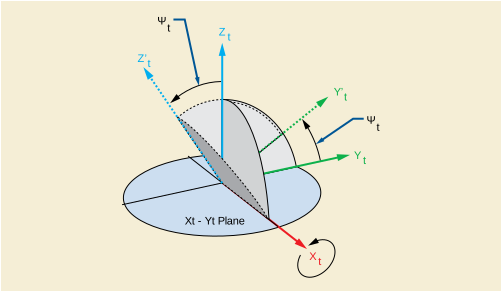
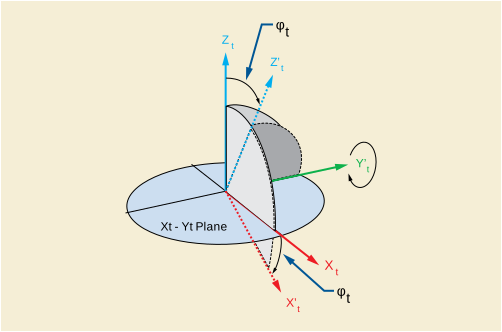
The Attributes that define angles refer to coordinate systems defined by IEC 61217. Where indicated in the DICOM Attribute definition, the angle uses the coordinate system (orientation of the rotation axis and the origin of the rotating coordinate system) defined in IEC 61217, however DICOM makes no restrictions on the range of values stored. IEC 61217 defines restrictions that only apply to user interface presentation.
The RT Brachy Application Setups Module describes the application of a brachytherapy radiotherapy treatment. It contains one or more sources, each associated with one or more Channels. A Channel is a device by which a source is placed in its intended treatment position or positions. A Channel may consist of a Source Applicator plus a Transfer Tube, a Source Applicator alone, a rigid or flexible linear source, or a seed. A number of Channels (for example applicators, sources or seeds) are generally arranged in an Application Setup, which may be considered a "logical" device. It is important not to confuse Application Setup with Applicator. The model used here has been primarily built around the concept of remote afterloading, but extended to support other brachytherapy applications such as manual applicators and molds, seeds, and sources. Additional devices that are not Channels are described as Brachy Accessory Devices. Examples of Accessory Devices include shields that modify the dose distribution from all sources in the treatment. However, Channel shields modify the dose only for the source(s) in that Channel.
The data in the module are arranged as follows:
|
Treatment Machine Sequence |
;treatment machine information (single item) |
|
Source Sequence |
;library of sources used in brachy application |
|
Application Setup Sequence |
;one or more applicators, sources, seeds etc |
|
>Brachy Accessory Device Sequence |
;application level shields etc |
|
>Channel Sequence |
;applicator, line source(s), seed(s) etc |
|
>>Channel Shield Sequence |
;channel-specific shields |
|
>>Brachy Control Point Sequence |
;mechanism to support individual source dwell times |
Table C.8-51. RT Brachy Application Setups Module Attributes
|
Attribute Name |
Tag |
Type |
Attribute Description |
|---|---|---|---|
|
Brachy Treatment Technique |
(300A,0200) |
1 |
Type of brachytherapy treatment technique. Enumerated Values:
See Section C.8.8.15.1. |
|
Brachy Treatment Type |
(300A,0202) |
1 |
Type of brachytherapy treatment. Defined Terms:
|
|
Treatment Machine Sequence |
(300A,0206) |
1 |
Introduces single item sequence describing treatment machine to be used for treatment delivery. Only a single item shall be included in this sequence. |
|
>Treatment Machine Name |
(300A,00B2) |
2 |
User-defined name identifying treatment machine to be used for treatment delivery. |
|
>Manufacturer |
(0008,0070) |
3 |
Manufacturer of the equipment to be used for treatment delivery. |
|
>Institution Name |
(0008,0080) |
3 |
Institution where the equipment is located that is to be used for treatment delivery. |
|
>Institution Address |
(0008,0081) |
3 |
Mailing address of the institution where the equipment is located that is to be used for treatment delivery. |
|
>Institutional Department Name |
(0008,1040) |
3 |
Department in the institution where the equipment is located that is to be used for treatment delivery. |
|
>Manufacturer's Model Name |
(0008,1090) |
3 |
Manufacturer's model name of the equipment that is to be used for treatment delivery. |
|
>Device Serial Number |
(0018,1000) |
3 |
Manufacturer's serial number of the equipment that is to be used for treatment delivery. |
|
Source Sequence |
(300A,0210) |
1 |
Sequence of Sources to be used within Application Setups. One or more items shall be included in this sequence. |
|
>Source Number |
(300A,0212) |
1 |
Identification number of the Source. The value of Source Number (300A,0212) shall be unique within the RT Plan in which it is created. |
|
>Source Serial Number |
(3008,0105) |
3 |
Identifier for the Source Instance. Identifies the actual source instance of the source, to which Source Strength Reference Date (300A,022C) and Source Strength Reference Time (300A,022E) refer. |
|
>Source Model ID |
(300A,021B) |
3 |
Identifier for the Source Model. Identifies the model, the source instance belongs to. |
|
>Source Description |
(300A,021C) |
3 |
Description of the source. |
|
>Source Type |
(300A,0214) |
1 |
Type of Source. Defined Terms:
|
|
>Source Manufacturer |
(300A,0216) |
3 |
Manufacturer of Source. |
|
>Active Source Diameter |
(300A,0218) |
3 |
Diameter of active Source (mm). |
|
>Active Source Length |
(300A,021A) |
3 |
Length of active Source (mm). |
|
>Material ID |
(300A,00E1) |
3 |
User-supplied identifier for encapsulation material of active Source. |
|
>Source Encapsulation Nominal Thickness |
(300A,0222) |
3 |
Nominal thickness of wall of encapsulation (mm). See Section C.8.8.15.12. |
|
>Source Encapsulation Nominal Transmission |
(300A,0224) |
3 |
Nominal transmission through wall of encapsulation (between 0 and 1). See Section C.8.8.15.12 |
|
>Source Isotope Name |
(300A,0226) |
1 |
Name of Isotope. |
|
>Source Isotope Half Life |
(300A,0228) |
1 |
Half-life of Isotope (days). |
|
>Source Strength Units |
(300A,0229) |
1C |
Measurement unit of Source Strength. Required if the source is not a gamma-emitting (photon) source. May be present otherwise. Enumerated Values:
|
|
>Reference Air Kerma Rate |
(300A,022A) |
1 |
Air Kerma Rate in air of Isotope specified at Source Strength Reference Date (300A,022C) and Source Strength Reference Time (300A,022E) (in µGy h-1 at 1 m). Value shall be zero for non-gamma sources. |
|
>Source Strength |
(300A,022B) |
1C |
Source Strength of Isotope at Source Strength Reference Date (300A,022C) and Source Strength Reference Time (300A,022E), in units specified in Source Strength Units (300A,0229). Required if the source is not a gamma-emitting (photon) source. See Section C.8.8.15.13. |
|
>Source Strength Reference Date |
(300A,022C) |
1 |
Reference date for Reference Air Kerma Rate (300A,022A) or Source Strength (300A,022B) of Isotope. |
|
>Source Strength Reference Time |
(300A,022E) |
1 |
Reference time for Air Kerma Rate (300A,022A) or Source Strength (300A,022B) of Isotope. |
|
Application Setup Sequence |
(300A,0230) |
1 |
Sequence of Application Setups for current RT Plan. One or more items shall be included in this sequence. |
|
>Application Setup Type |
(300A,0232) |
1 |
Type of Application Setup. Defined Terms:
|
|
>Application Setup Number |
(300A,0234) |
1 |
Identification number of the Application Setup. The value of Application Setup Number (300A,0234) shall be unique within the RT Plan in which it is created. |
|
>Application Setup Name |
(300A,0236) |
3 |
User-defined name for Application Setup. |
|
>Application Setup Manufacturer |
(300A,0238) |
3 |
Manufacturer of Application Setup. |
|
>Template Number |
(300A,0240) |
3 |
Identification number of the Template. The value of Template Number (300A,0240) shall be unique within the Application Setup in which it is created. |
|
>Template Type |
(300A,0242) |
3 |
User-defined type for Template Device. |
|
>Template Name |
(300A,0244) |
3 |
User-defined name for Template Device. |
|
>Referenced Reference Image Sequence |
(300C,0042) |
3 |
Sequence of reference images used for validation of current Application Setup. One or more items are permitted in this sequence. |
|
>>Include Table 10-11 “SOP Instance Reference Macro Attributes” |
|||
|
>Total Reference Air Kerma |
(300A,0250) |
1 |
Total Reference Air Kerma for current Application Setup, i.e., the product of Air Kerma Rate of all Sources in all Channels with their respective Channel Times (µGy at 1 m). Value shall be zero for non-gamma sources. |
|
>Brachy Accessory Device Sequence |
(300A,0260) |
3 |
Sequence of Brachy Accessory Devices associated with current Application Setup. One or more items are permitted in this sequence. |
|
>>Brachy Accessory Device Number |
(300A,0262) |
2 |
Identification number of the Brachy Accessory Device. The value of Brachy Accessory Device Number (300A,0262) shall be unique within the Application Setup in which it is created. |
|
>>Brachy Accessory Device ID |
(300A,0263) |
2 |
User or machine supplied identifier for Brachy Accessory Device. |
|
>>Brachy Accessory Device Type |
(300A,0264) |
1 |
Type of Brachy Accessory Device. Defined Terms:
|
|
>>Brachy Accessory Device Name |
(300A,0266) |
3 |
User-defined name for Brachy Accessory Device. |
|
>>Material ID |
(300A,00E1) |
3 |
User-supplied identifier for material of Brachy Accessory Device. See Note. |
|
>>Brachy Accessory Device Nominal Thickness |
(300A,026A) |
3 |
Nominal thickness of Brachy Accessory Device (mm). See Section C.8.8.15.12. |
|
>>Brachy Accessory Device Nominal Transmission |
(300A,026C) |
3 |
Nominal Transmission through Brachy Accessory Device (between 0 and 1). See Section C.8.8.15.12. |
|
>>Referenced ROI Number |
(3006,0084) |
2 |
Uniquely identifies ROI representing the Brachy Accessory specified by ROI Number (3006,0022) in Structure Set ROI Sequence (3006,0020) in Structure Set Module within RT Structure Set referenced by Referenced RT Structure Set Sequence (300C,0060) in RT General Plan Module. See Section C.8.8.15.2. |
|
>Channel Sequence |
(300A,0280) |
1 |
Sequence of Channels for current Application Setup. One or more items shall be included in this sequence. |
|
>>Channel Number |
(300A,0282) |
1 |
Identification number of the Channel. The value of Channel Number (300A,0282) shall be unique within the Application Setup in which it is created. |
|
>>Channel Length |
(300A,0284) |
2 |
Length of Channel (mm). See Section C.8.8.15.3. |
|
>>Channel Total Time |
(300A,0286) |
1 |
Total amount of time between first and final Control Points of the Brachy Control Point Sequence (300A,02D0) for current Channel (sec). Channel Total Time calculation is based upon the Reference Air Kerma Rate (300A,022A) of the Referenced Source Number (300C,000E). |
|
>>Source Movement Type |
(300A,0288) |
1 |
Type of Source movement. See Section C.8.8.15.4. Defined Terms:
|
|
>>Number of Pulses |
(300A,028A) |
1C |
Number of Pulses per fraction for current Channel. Required if Brachy Treatment Type (300A,0202) is PDR. |
|
>>Pulse Repetition Interval |
(300A,028C) |
1C |
Pulse repetition interval (sec) for current Channel. Required if Brachy Treatment Type (300A,0202) is PDR. |
|
>>Source Applicator Number |
(300A,0290) |
3 |
Identification number of the Source Applicator. The value of Source Applicator Number (300A,0290) shall be unique within the Channel in which it is created. |
|
>>Source Applicator ID |
(300A,0291) |
2C |
User or machine supplied identifier for Source Applicator. Required if Source Applicator Number (300A,0290) is sent. |
|
>>Source Applicator Type |
(300A,0292) |
1C |
Type of Source Applicator. Required if Source Applicator Number (300A,0290) is sent. Defined Terms:
|
|
>>Source Applicator Name |
(300A,0294) |
3 |
User-defined name for Source Applicator. |
|
>>Source Applicator Length |
(300A,0296) |
1C |
Length of Source Applicator (mm), defined as the distance between the connector of the applicator and the distal-most position of the source. Required if Source Applicator Number (300A,0290) is sent. |
|
>>Source Applicator Manufacturer |
(300A,0298) |
3 |
Manufacturer of Source Applicator. |
|
>>Material ID |
(300A,00E1) |
3 |
User-supplied identifier for material of Source Applicator wall. See Note. |
|
>>Source Applicator Wall Nominal Thickness |
(300A,029C) |
3 |
Nominal Thickness of Source Applicator wall (mm). See Section C.8.8.15.12. |
|
>>Source Applicator Wall Nominal Transmission |
(300A,029E) |
3 |
Nominal Transmission through Source Applicator wall (between 0 and 1). See Section C.8.8.15.12. |
|
>>Source Applicator Step Size |
(300A,02A0) |
1C |
Distance of path along channel (in mm) between adjacent (potential) dwell positions. Required if Source Movement Type (300A,0288) is STEPWISE. |
|
>>Referenced ROI Number |
(3006,0084) |
2C |
Uniquely identifies ROI representing the Source Applicator specified by ROI Number (3006,0022) in Structure Set ROI Sequence (3006,0020) in Structure Set Module within RT Structure Set referenced by Referenced RT Structure Set Sequence (300C,0060) in RT General Plan Module. Required if Source Applicator Number (300A,0290) is sent. See Section C.8.8.15.2. |
|
>>Transfer Tube Number |
(300A,02A2) |
2 |
Identification number of the Transfer Tube. The value of Transfer Tube Number (300A,02A2) shall be unique within the Channel in which it is created. |
|
>>Transfer Tube Length |
(300A,02A4) |
2C |
Length of Transfer Tube of current afterloading Channel (mm). Required if value Transfer Tube Number (300A,02A2) is non-null. |
|
>>Channel Shield Sequence |
(300A,02B0) |
3 |
Sequence of Channel Shields associated with current Channel. One or more items are permitted in this sequence. See Section C.8.8.15.5. |
|
>>>Channel Shield Number |
(300A,02B2) |
1 |
Identification number of the Channel Shield. The value of Channel Shield Number (300A,02B2) shall be unique within the Channel in which it is created. |
|
>>>Channel Shield ID |
(300A,02B3) |
2 |
User or machine supplied identifier for Channel Shield. |
|
>>>Channel Shield Name |
(300A,02B4) |
3 |
User-defined name for Channel Shield. |
|
>>>Material ID |
(300A,00E1) |
3 |
User-supplied identifier for material of Channel Shield. See Note. |
|
>>>Channel Shield Nominal Thickness |
(300A,02B8) |
3 |
Nominal Thickness of Channel Shield (mm). See Section C.8.8.15.12. |
|
>>>Channel Shield Nominal Transmission |
(300A,02BA) |
3 |
Nominal Transmission of Channel Shield (between 0 and 1). See Section C.8.8.15.12. |
|
>>>Referenced ROI Number |
(3006,0084) |
2 |
Uniquely identifies ROI representing the Channel Shield specified by ROI Number (3006,0022) in Structure Set ROI Sequence (3006,0020) in Structure Set Module within RT Structure Set referenced by Referenced RT Structure Set Sequence (300C,0060) in RT General Plan Module. See Section C.8.8.15.2. |
|
>>Referenced Source Number |
(300C,000E) |
1 |
Uniquely identifies the referenced Source within Source Sequence (300A,0210) for current Application Setup. |
|
>>Number of Control Points |
(300A,0110) |
1 |
Number of control points in Channel. For an N-segment Channel there will be 2N (stepwise movement) or N+1 (continuous movement) control points. |
|
>>Final Cumulative Time Weight |
(300A,02C8) |
1C |
Value of Cumulative Time Weight (300A,02D6) for final Control Point in Brachy Control Point Sequence (300A,02D0). Required if Cumulative Time Weight (300A,02D6) is non-null in Control Points specified within Brachy Control Point Sequence (300A,02D0). See Section C.8.8.15.6. |
|
>>Brachy Control Point Sequence |
(300A,02D0) |
1 |
Sequence of machine configurations describing this Channel. Two or more items shall be included in this sequence. See Section C.8.8.15.7. |
|
>>>Control Point Index |
(300A,0112) |
1 |
Index of current Control Point, starting at 0 for first Control Point. |
|
>>>Cumulative Time Weight |
(300A,02D6) |
2 |
Cumulative time weight to current Control Point (where the weighting is proportional to time values delivered). Cumulative Time Weight for first item in Brachy Control Point Sequence (300A,02D0) is always zero. See Section C.8.8.15.6 and Section C.8.8.15.8. |
|
>>>Control Point Relative Position |
(300A,02D2) |
1 |
Distance between current Control Point Position and the distal-most possible Source position in current Channel (mm). See Section C.8.8.15.9. |
|
>>>Control Point 3D Position |
(300A,02D4) |
3 |
Coordinates (x, y, z) of Control Point in the patient based coordinate system described in Section C.7.6.2.1.1 (mm). See Section C.8.8.15.10. |
|
>>>Control Point Orientation |
(300A,0412) |
3 |
(x,y,z) component of the direction vector of the brachy source or seed at the Control Point 3D Position (300A,02D4). See Section C.8.8.15.14. |
|
>>>Brachy Referenced Dose Reference Sequence |
(300C,0055) |
3 |
Introduces a sequence of Dose References for current Channel. One or more items are permitted in this sequence. |
|
>>>>Referenced Dose Reference Number |
(300C,0051) |
1 |
Uniquely identifies Dose Reference described in Dose Reference Sequence. (300A,0010) within RT Prescription Module of current RT Plan. |
|
>>>>Cumulative Dose Reference Coefficient |
(300A,010C) |
1 |
Coefficient used to calculate cumulative dose contribution from this Source to the referenced Dose Reference at the current Control Point. See Section C.8.8.15.11. |
Note
Material ID (300A,00E1) may also be specified within a referenced ROI, if an ROI is used to describe the object.
In permanent implant techniques the value for Channel Total Time (300A,0286) shall be mean life time of the isotope. The Brachy Control Point Sequence (300A,02D0) shall consist of two items: the first having Cumulative Time Weight (300A,02D6) = 0 and the second having Cumulative Time Weight (300A,02D6) = Final Cumulative Time Weight (300A,02C8).
The Structure Set ROI shall be used in the Brachy Application Setups Module to describe the 3D coordinates of Accessory Devices, Applicators and Channel Shields, but not individual source positions (see Section C.8.8.15.9 and Section C.8.8.15.10).
If specified, Channel Length (300A,0284) shall be the sum of the Source Applicator Length (300A,0296) and Transfer Tube Length (300A,02A4).
In brachytherapy treatment techniques involving oscillating source movement (i.e., when Source Movement Type (300A,0288) is OSCILLATING), the Brachy Control Point Sequence (300A,02D0) shall consist of two items. The first Control Point shall have Cumulative Time Weight (300A,02D6) = 0, and Control Point Relative Position (300A,02D2) equal to one end point of the oscillation. The second Control Point shall have Cumulative Time Weight (300A,02D6) = Final Cumulative Time Weight (300A,02C8), and Control Point Relative Position (300A,02D2) equal to the other end point of the oscillation. Transit time shall not be modeled explicitly for oscillating techniques.
The effect of Channel Shields on dose contributions shall be specific to the Channel for which they are specified. There shall be no effect of these shields on the dose contributions from any other Channels.
The treatment time at a given Control Point is equal to the Channel Total Time (300A,0286), multiplied by the Cumulative Time Weight (300A,02D6) for the Control Point, divided by the Final Cumulative Time Weight (300A,02C8). If the calculation for treatment time results in a time value that is not an exact multiple of the timer resolution, then the result shall be rounded to the nearest allowed timer value (i.e., less than a half resolution unit shall be rounded down to the nearest resolution unit, and equal or greater than half a resolution unit shall be rounded up to the nearest resolution unit).
Note also that if Final Cumulative Time Weight (300A,02C8) is equal to 100, then Cumulative Time Weight (300A,02D6) becomes equivalent to the percentage of Channel Total Time (300A,0286) delivered at each control point. If Final Cumulative Time Weight (300A,02C8) is equal to Channel Total Time (300A,0286), then the Cumulative Time Weight (300A,02D6) at each control point becomes equal to the cumulative treatment time delivered at that control point.
If Treatment Type (300A,0202) is PDR, then the Channel Total Time (3008,0286) shall specify the duration of a single pulse.
The Control Points shall be arranged such that the first Control Point for a particular Channel describes the first dwell position and the final Control Point for the Channel describes the final dwell position. If Brachy Treatment Type (300A,0202) is PDR, the Brachy Control Point Sequence (300A,02D0) shall specify the sequence of machine configurations for a single pulse. Similarly, if Source Movement Type (300A,0288) is OSCILLATING, the Brachy Control Point Sequence (300A,02D0) shall specify the sequence of machine configurations for a single period.
Some examples of Brachytherapy specification using control points are as follows:
a) Stepwise motion; Four equally weighted dwell positions; Step size = 10; Final Cumulative Time Weight = 100:
Control Point 0: Control Point Relative Position = 30, Cumulative Time Weight = 0
Control Point 1: Control Point Relative Position = 30, Cumulative Time Weight = 25
Control Point 2: Control Point Relative Position = 20, Cumulative Time Weight = 25
Control Point 3: Control Point Relative Position = 20, Cumulative Time Weight = 50
Control Point 4: Control Point Relative Position = 10, Cumulative Time Weight = 50
Control Point 5: Control Point Relative Position = 10, Cumulative Time Weight = 75
Control Point 6: Control Point Relative Position = 0, Cumulative Time Weight = 75
Control Point 7: Control Point Relative Position = 0, Cumulative Time Weight = 100
b) Fixed (manually placed) sources; Final Cumulative Time Weight = 100:
Control Point 0: Control Point Relative Position = 0, Control Point 3D Position = (x,y,z), Cumulative Time Weight = 0
Control Point 1: Control Point Relative Position = 0, Control Point 3D Position = (x,y,z), Cumulative Time Weight = 100
c) Oscillating movement; Final Cumulative Time Weight = 100:
Control Point 0: Control Point Relative Position = 100, Cumulative Time Weight = 0
Control Point 1: Control Point Relative Position = 0, Cumulative Time Weight = 100
d) Unidirectional movement; Final Cumulative Time Weight = 100:
Control Point 0: Control Point Relative Position = 0, Cumulative Time Weight = 0
Control Point 1: Control Point Relative Position = 100, Cumulative Time Weight = 100
e) Stepwise motion with consideration of source transit times between dwell positions; Three equally weighted dwell positions; Step size = 10; Final Cumulative Time Weight = 79:
Control Point 0: Control Point Relative Position = 30, Cumulative Time Weight = 0
Control Point 1: Control Point Relative Position = 30, Cumulative Time Weight = 25
Control Point 2: Control Point Relative Position = 20, Cumulative Time Weight = 27
Control Point 3: Control Point Relative Position = 20, Cumulative Time Weight = 52
Control Point 4: Control Point Relative Position = 10, Cumulative Time Weight = 54
Control Point 5: Control Point Relative Position = 10, Cumulative Time Weight = 79
f) Stepwise motion with consideration of source transit times between dwell positions and to first and from last dwell position; Three equally weighted dwell positions; Step size = 10; Final Cumulative Time Weight = 383:
Control Point 0: Control Point Relative Position = 1200, Cumulative Time Weight = 0
Control Point 1: Control Point Relative Position = 30, Cumulative Time Weight = 150
Control Point 2: Control Point Relative Position = 30, Cumulative Time Weight = 175
Control Point 3: Control Point Relative Position = 20, Cumulative Time Weight = 177
Control Point 4: Control Point Relative Position = 20, Cumulative Time Weight = 202
Control Point 5: Control Point Relative Position = 10, Cumulative Time Weight = 204
Control Point 6: Control Point Relative Position = 10, Cumulative Time Weight = 229
Control Point 7: Control Point Relative Position = 1200, Cumulative Time Weight = 383
The Source transit times between dwell positions of a remote afterloader may be considered by specifying a non-zero increment in the Cumulative Time Weight (300A,02D6) when the Source moves between Control Points. In this case the Channel Total Time (300A,0286) shall include the overall Source transit time for the Channel.
Control Point Relative Position (300A,02D2) shall describe where a given source in a channel is located with respect to the end of the channel. This position shall correspond to the end of the afterloader applicator, not the "safe position".
Control Point 3D Position (300A,02D4) shall describe the absolute 3D coordinates of a source. This position shall correspond to the center of a source in an applicator during a remote or manually controlled afterloading treatment.
The Cumulative Dose Reference Coefficient (300A,010C) is the value by which Brachy Application Setup Dose (300A,00A4) is multiplied to obtain the dose to the referenced dose reference site at the current control point (and after previous control points have been successfully administered). The Cumulative Dose Reference Coefficient (300A,010C) is by definition zero for the initial control point. The Cumulative Dose Reference Coefficient (300A,010C) of the final control point multiplied by Brachy Application Setup Dose (300A,00A4) results in the final dose to the referenced dose reference site for the current channel. Dose calculation for dose reference sites other than points is not well defined.
If Treatment Type (300A,0202) is PDR, then the Cumulative Dose Reference Coefficient (3008,010C) shall specify the dose delivered to the dose reference during a single pulse. The total dose delivered to the dose reference shall then be expressed by Cumulative Dose Reference Coefficient (3008,010C) multiplied by Number of Pulses (300A,028A) multiplied by Brachy Application Setup Dose (300A,00A4).
If provided, Source Encapsulation Nominal Thickness (300A,0222), Brachy Accessory Device Nominal Thickness (300A,026A), Source Applicator Wall Nominal Thickness (300A,029C), and Channel Shield Nominal Thickness (300A,02B8) shall indicate that the related objects are of uniform thickness with the specified value. If this is not the case, these attributes shall not be provided.
If provided, Source Encapsulation Nominal Transmission (300A,0224), Brachy Accessory Device Nominal Transmission (300A,026C), Source Applicator Wall Nominal Transmission (300A,029E), and Channel Shield Nominal Transmission (300A,02BA) shall indicate that the related objects are of uniform transmission with the specified value. If this is not the case, these attributes shall not be provided.
No assumptions are made about the source characteristics beyond the parameters specified here.
For beta emitting isotopes, Source Strength (300A,022B) shall be defined at reference point (r0,θ0), where r0 is the radial distance of 2 mm from the source longitudinal axis, and θ0 is the angle of 90 degrees between the source longitudinal axis and the line defined by the center of the source and the reference point. Refer to:
IEC 60601-2-17 (Medical electrical equipment - Particular requirements for the safety of automatically-controlled brachytherapy afterloading equipment), where the beta source strength is defined as: ABSORBED DOSE RATE [Gy s-1] in water at 2 mm along the perpendicular bisector from a RADIOACTIVE SOURCE emitting beta RADIATION.
Nath et. al.: Intravascular brachytherapy physics: Report of the AAPM Radiation Therapy Committee Task Group No. 60, Med. Phys 26 (2) Feb 1999, pp 119-152.
The Control Point Orientation (300A,0412) shall be used to define the orientation of an anisotropic brachytherapy source or seed for the purpose of calculating the effect of the anisotropy on the dose calculation. The Control Point Orientation (300A,0412) shall be given by the direction vector of the long axis of the Brachy source or seed in the insertion direction, in the DICOM Patient Coordinate System. The direction vector shall be oriented from the source center as defined by the Control Point 3D Position (300A,02D4) along the long axis of the source and in the insertion direction.
Table C.8-52. Approval Module Attributes
|
Attribute Name |
Tag |
Type |
Attribute Description |
|---|---|---|---|
|
Approval Status |
(300E,0002) |
1 |
Approval status at the time the SOP Instance was created. Enumerated Values:
|
|
Review Date |
(300E,0004) |
2C |
Date on which object was reviewed. Required if Approval Status (300E,0002) is APPROVED or REJECTED. |
|
Review Time |
(300E,0005) |
2C |
Time at which object was reviewed. Required if Approval Status (300E,0002) is APPROVED or REJECTED. |
|
Reviewer Name |
(300E,0008) |
2C |
Name of person who reviewed object. Required if Approval Status (300E,0002) is APPROVED or REJECTED. |
Table C.8-53. RT General Treatment Record Module Attributes
|
Attribute Name |
Tag |
Type |
Attribute Description |
|---|---|---|---|
|
Instance Number |
(0020,0013) |
1 |
Instance number identifying this particular instance of the object. |
|
Treatment Date |
(3008,0250) |
2 |
Date when current fraction was delivered, or Date last fraction was delivered in case of RT Treatment Summary Record IOD. See Note. |
|
Treatment Time |
(3008,0251) |
2 |
Time when current fraction was delivered (begun), or Time last fraction was delivered (begun) in case of RT Treatment Summary Record IOD. See Note. |
|
Referenced RT Plan Sequence |
(300C,0002) |
2 |
Reference to a RT Plan. Zero or one Item shall be included in this Sequence. |
|
>Include Table 10-11 “SOP Instance Reference Macro Attributes” |
|||
|
Referenced Treatment Record Sequence |
(3008,0030) |
3 |
Reference to RT Treatment Records to which the current RT Treatment Record is significantly related. One or more Items are permitted in this sequence. |
|
>Include Table 10-11 “SOP Instance Reference Macro Attributes” |
|||
Note
Treatment Date (3008,0250) and Treatment Time (3008,0251) can be used to chronologically order a sequence of treatments, where each treatment is represented by an instance of a RT Beams Treatment Record or RT Brachy Treatment Record. In the case of a RT Treatment Summary Record, it can be used to identify the period for which the treatment summary is valid. Therefore, implementers are strongly advised to include values for these attributes whenever possible.
Table C.8-54. RT Treatment Machine Record Module Attributes
|
Attribute Name |
Tag |
Type |
Attribute Description |
|---|---|---|---|
|
Treatment Machine Sequence |
(300A,0206) |
1 |
Sequence describing treatment machine used for treatment delivery. Only a single Item shall be included in this Sequence. |
|
>Treatment Machine Name |
(300A,00B2) |
2 |
User-defined name identifying treatment machine used for treatment delivery. |
|
>Manufacturer |
(0008,0070) |
2 |
Manufacturer of the equipment used for treatment delivery. |
|
>Institution Name |
(0008,0080) |
2 |
Institution where the equipment is located that was used for treatment delivery. |
|
>Institution Address |
(0008,0081) |
3 |
Mailing address of the institution where the equipment is located that was used for treatment delivery. |
|
>Institutional Department Name |
(0008,1040) |
3 |
Department in the institution where the equipment is located that was used for treatment delivery. |
|
>Manufacturer's Model Name |
(0008,1090) |
2 |
Manufacturer's model name of the equipment used for treatment delivery. |
|
>Device Serial Number |
(0018,1000) |
2 |
Manufacturer's serial number of the equipment used for treatment delivery. |
Table C.8-55. Measured Dose Reference Record Module Attributes
|
Attribute Name |
Tag |
Type |
Attribute Description |
|---|---|---|---|
|
Measured Dose Reference Sequence |
(3008,0010) |
1 |
Sequence of doses measured during treatment delivery, summed over entire session. One or more Items shall be included in this sequence. |
|
>Referenced Dose Reference Number |
(300C,0051) |
1C |
Uniquely identifies Dose Reference specified by Dose Reference Number (300A,0012) in Dose Reference Sequence (300A,0010) in RT Prescription Module of referenced RT Plan. Required only if Measured Dose Reference Number (3008,0064) is not sent. It shall not be present otherwise. |
|
>Measured Dose Reference Number |
(3008,0064) |
1C |
Unique identifier of measured dose point. Required only if Referenced Dose Reference Number (300C,0051) is not sent. It shall not be present otherwise. |
|
>Dose Units |
(3004,0002) |
1 |
Units used to describe measured dose. Enumerated Values:
|
|
>Measured Dose Value |
(3008,0016) |
2 |
Measured Dose in units specified by Dose Units (3004,0002). |
|
>Measured Dose Type |
(3008,0014) |
2 |
Type of dose measurement. Defined Terms:
|
|
>Measured Dose Description |
(3008,0012) |
3 |
User-defined description of Dose Reference (e.g., "Exit dose", "Point A"). |
Table C.8-56. Calculated Dose Reference Record Module Attributes
|
Attribute Name |
Tag |
Type |
Attribute Description |
|---|---|---|---|
|
Calculated Dose Reference Sequence |
(3008,0070) |
1 |
Sequence of doses estimated for each treatment delivery. One or more Items shall be included in this sequence. |
|
>Referenced Dose Reference Number |
(300C,0051) |
1C |
Uniquely identifies Dose Reference specified by Dose Reference Number (300A,0012) in Dose Reference Sequence (300A,0010) in RT Prescription Module of referenced RT Plan. Required only if Calculated Dose Reference Number (3008,0072) is not sent. It shall not be present otherwise. |
|
>Calculated Dose Reference Number |
(3008,0072) |
1C |
Unique identifier of dose reference point within RT Treatment Record IOD. Required only if Referenced Dose Reference Number (300C,0051) is not sent. It shall not be present otherwise. |
|
>Calculated Dose Reference Dose Value |
(3008,0076) |
2 |
Calculated Dose (Gy). |
|
>Calculated Dose Reference Description |
(3008,0074) |
3 |
User-defined description of Calculated Dose Reference. |
Table C.8-57. RT Beams Session Record Module Attributes
|
Attribute Name |
Tag |
Type |
Attribute Description |
|---|---|---|---|
|
Referenced Fraction Group Number |
(300C,0022) |
3 |
Identifier of Fraction Group within referenced RT Plan. |
|
Number of Fractions Planned |
(300A,0078) |
2 |
Total number of treatments (Fractions) planned for current Fraction Group. |
|
Primary Dosimeter Unit |
(300A,00B3) |
1 |
Measurement unit of machine dosimeter. Enumerated Values:
|
|
Treatment Session Beam Sequence |
(3008,0020) |
1 |
Sequence of Beams administered during treatment session. One or more Items shall be included in this sequence. |
|
>Referenced Beam Number |
(300C,0006) |
3 |
References Beam specified by Beam Number (300A,00C0) in Beam Sequence (300A,00B0) in RT Beams Module within referenced RT Plan. |
|
>Beam Name |
(300A,00C2) |
3 |
User-defined name for delivered Beam. |
|
>Beam Description |
(300A,00C3) |
3 |
User-defined description for delivered Beam. |
|
>Beam Type |
(300A,00C4) |
1 |
Motion characteristic of delivered Beam. Enumerated Values:
|
|
>Radiation Type |
(300A,00C6) |
1 |
Particle type of delivered Beam. Defined Terms:
|
|
>Primary Fluence Mode Sequence |
(3002,0050) |
3 |
Sequence defining whether the primary fluence of the treatment beam used a non-standard fluence-shaping when the beam was delivered. Only a single item is permitted in this sequence. |
|
>>Fluence Mode |
(3002,0051) |
1 |
Describes whether the fluence shaping is the standard mode for the beam or an alternate. Enumerated Values:
|
|
>>Fluence Mode ID |
(3002,0052) |
1C |
Identifier for the specific fluence-shaping mode. Required if Fluence Mode (3002,0051) has value NON_STANDARD. |
|
>High-Dose Technique Type |
(300A,00C7) |
1C |
Type of high-dose treatment technique. Defined Terms:
Required if treatment technique requires a dose that would normally require overriding of treatment machine safety controls. |
|
>Referenced Verification Image Sequence |
(300C,0040) |
3 |
Sequence of verification images obtained during delivery of current beam. One or more Items are permitted in this sequence. |
|
>>Include Table 10-11 “SOP Instance Reference Macro Attributes” |
|||
|
>>Start Meterset |
(3008,0078) |
3 |
Cumulative Meterset Weight within Beam referenced by Referenced Beam Number at which image acquisition starts. |
|
>>End Meterset |
(3008,007A) |
3 |
Cumulative Meterset Weight within Beam referenced by Referenced Beam Number at which image acquisition ends. |
|
>Referenced Measured Dose Reference Sequence |
(3008,0080) |
3 |
Sequence of doses measured during treatment delivery for current Beam. One or more Items are permitted in this sequence. |
|
>>Referenced Dose Reference Number |
(300C,0051) |
1C |
Uniquely references Dose Reference specified by Dose Reference Number (300A,0012) in Dose Reference Sequence (300A,0010) in RT Prescription Module of referenced RT Plan. Required if Referenced Measured Dose Reference Number (3008,0082) is not sent. It shall not be present otherwise. |
|
>>Referenced Measured Dose Reference Number |
(3008,0082) |
1C |
Uniquely references Measured Dose Reference specified by Measured Dose Reference Number (3008,0064) in Measured Dose Reference Sequence (3008,0010). Required if Referenced Dose Reference Number (300C,0051) is not sent. It shall not be present otherwise. |
|
>>Measured Dose Value |
(3008,0016) |
1 |
Measured Dose in units specified by Dose Units (3004,0002) in sequence referenced by Measured Dose Reference Sequence (3008,0010) or Dose Reference Sequence (300A,0010) in RT Prescription Module of referenced RT Plan as defined above. |
|
>Referenced Calculated Dose Reference Sequence |
(3008,0090) |
3 |
Sequence of doses estimated for each treatment delivery. One or more Items are permitted in this sequence. |
|
>>Referenced Dose Reference Number |
(300C,0051) |
1C |
Uniquely identifies Dose Reference specified by Dose Reference Number (300A,0012) in Dose Reference Sequence (300A,0010) in RT Prescription Module of referenced RT Plan. Required if Referenced Calculated Dose Reference Number (3008,0092) is not sent. |
|
>>Referenced Calculated Dose Reference Number |
(3008,0092) |
1C |
Uniquely identifies Calculated Dose Reference specified by Calculated Dose Reference Number (3008,0072) within Calculated Dose Reference Sequence (3008,0070). Required if Referenced Dose Reference Number (300C,0051) is not sent. |
|
>>Calculated Dose Reference Dose Value |
(3008,0076) |
1 |
Calculated Dose (Gy). |
|
>Source-Axis Distance |
(300A,00B4) |
3 |
Radiation source to gantry rotation axis distance of the equipment that was used for beam delivery (mm). |
|
>Beam Limiting Device Leaf Pairs Sequence |
(3008,00A0) |
1 |
Sequence of beam limiting device (collimator) jaw or leaf (element) leaf pair values. One or more Items shall be included in this sequence. |
|
>>RT Beam Limiting Device Type |
(300A,00B8) |
1 |
Type of beam limiting device (collimator). Enumerated Values:
|
|
>>Number of Leaf/Jaw Pairs |
(300A,00BC) |
1 |
Number of leaf (element) or jaw pairs (equal to 1 for standard beam limiting device jaws). |
|
>Referenced Patient Setup Number |
(300C,006A) |
3 |
Uniquely identifies Patient Setup used within current beam, specified by Patient Setup Number (300A,0182) within Patient Setup Sequence (300A,0180) of RT Treatment Record. |
|
>Number of Wedges |
(300A,00D0) |
1 |
Number of wedges associated with current delivered Beam. |
|
>Recorded Wedge Sequence |
(3008,00B0) |
1C |
Sequence of treatment wedges present during delivered Beam. Required if Number of Wedges (300A,00D0) is non-zero. One or more Items shall be included in this sequence. |
|
>>Wedge Number |
(300A,00D2) |
3 |
Identification number of the Wedge. The value of Wedge Number (300A,00D2) shall be unique within the wedge sequence. |
|
>>Wedge Type |
(300A,00D3) |
2 |
Type of wedge defined for delivered Beam. Defined Terms:
|
|
>>Wedge ID |
(300A,00D4) |
3 |
User-supplied identifier for wedge. |
|
>>Accessory Code |
(300A,00F9) |
3 |
An identifier for the accessory intended to be read by a device such as a bar-code reader. |
|
>>Wedge Angle |
(300A,00D5) |
3 |
Nominal wedge angle delivered (degrees). |
|
>>Wedge Orientation |
(300A,00D8) |
3 |
Orientation of wedge, i.e., orientation of IEC WEDGE FILTER coordinate system with respect to IEC BEAM LIMITING DEVICE coordinate system (degrees). |
|
>Number of Compensators |
(300A,00E0) |
2 |
Number of compensators associated with current delivered Beam. |
|
>Recorded Compensator Sequence |
(3008,00C0) |
3 |
Sequence of treatment compensators associated with current Beam. One or more Items are permitted in this sequence. |
|
>>Referenced Compensator Number |
(300C,00D0) |
1 |
Uniquely identifies compensator specified by Compensator Number (300A,00E4) within Beam referenced by Referenced Beam Number (300C,0006). |
|
>>Compensator Type |
(300A,00EE) |
2 |
Type of compensator (if any). Defined Terms:
|
|
>>Compensator ID |
(300A,00E5) |
3 |
User-supplied identifier for compensator. |
|
>>Accessory Code |
(300A,00F9) |
3 |
An identifier for the accessory intended to be read by a device such as a bar-code reader. |
|
>>Compensator Tray ID |
(300A,00EF) |
3 |
User-supplied identifier for compensator tray. |
|
>Number of Boli |
(300A,00ED) |
2 |
Number of boli used with current Beam. |
|
>Referenced Bolus Sequence |
(300C,00B0) |
3 |
Sequence of boli associated with Beam. One or more Items are permitted in this sequence. |
|
>>Referenced ROI Number |
(3006,0084) |
1 |
Uniquely identifies ROI representing the bolus specified by ROI Number (3006,0022) in Structure Set ROI Sequence (3006,0020) in Structure Set Module within RT Structure Set IOD referenced by referenced RT Plan in Referenced RT Plan Sequence (300C,0002) in RT General Treatment Record Module. |
|
>>Bolus ID |
(300A,00DC) |
3 |
User-supplied identifier for the Bolus. |
|
>>Accessory Code |
(300A,00F9) |
3 |
An identifier for the accessory intended to be read by a device such as a bar-code reader. |
|
>Number of Blocks |
(300A,00F0) |
2 |
Number of shielding blocks or Electron Inserts associated with Beam. |
|
>Recorded Block Sequence |
(3008,00D0) |
3 |
Sequence of blocks associated with current Beam. One or more Items are permitted in this sequence. |
|
>>Block Tray ID |
(300A,00F5) |
3 |
User-supplied identifier for block tray or Electron Insert. |
|
>>Accessory Code |
(300A,00F9) |
3 |
An identifier for the accessory intended to be read by a device such as a bar-code reader. |
|
>>Referenced Block Number |
(300C,00E0) |
3 |
Uniquely identifies block specified by Block Number (300A,00FC) within Beam referenced by Referenced Beam Number (300C,0006). |
|
>>Block Name |
(300A,00FE) |
2 |
User-defined name for block. |
|
>Applicator Sequence |
(300A,0107) |
3 |
Sequence of Applicators associated with Beam. Only a single item is permitted in this sequence. |
|
>>Applicator ID |
(300A,0108) |
1 |
User or machine supplied identifier for Applicator. |
|
>>Accessory Code |
(300A,00F9) |
3 |
An identifier for the accessory intended to be read by a device such as a bar-code reader. |
|
>>Applicator Type |
(300A,0109) |
1 |
Type of Applicator. Defined Terms:
|
|
>>Applicator Geometry Sequence |
(300A,0431) |
3 |
Describes the applicator aperture geometry. Only a single Item is permitted in this sequence. |
|
>>>Applicator Aperture Shape |
(300A,0432) |
1 |
Aperture shape of the applicator. Defined Terms:
|
|
>>>Applicator Opening |
(300A,0433) |
1C |
Opening (in mm) of the applicator's aperture in IEC BEAM LIMITING DEVICE coordinate system. In case of square-shaped applicator contains the length of the sides of the square. In case of circular-shaped applicators, contains the diameter of the circular aperture. Required if Applicator Aperture Shape (300A,0432) is SYM_SQUARE or SYM_CIRCULAR. |
|
>>>Applicator Opening X |
(300A,0434) |
1C |
Opening (in mm) of the applicator's aperture in IEC BEAM LIMITING DEVICE coordinate system in X-Direction. Required if Applicator Aperture Shape (300A,0432) is SYM_RECTANGLE. |
|
>>>Applicator Opening Y |
(300A,0435) |
1C |
Opening (in mm) of the applicator's aperture in IEC BEAM LIMITING DEVICE coordinate system in Y-Direction. Required if Applicator Aperture Shape (300A,0432) is SYM_RECTANGLE. |
|
>> Source to Applicator Mounting Position Distance |
(300A,0436) |
3 |
Radiation source to applicator mounting position distance (in mm) for current applicator. |
|
>>Applicator Description |
(300A,010A) |
3 |
User-defined description for Applicator. |
|
>General Accessory Sequence |
(300A,0420) |
3 |
Introduces a Sequence of General Accessories associated with this Beam. One or more items are permitted in this sequence. |
|
>>General Accessory Number |
(300A,0424) |
1 |
Identification Number of the General Accessory. The value shall be unique within the sequence. |
|
>>General Accessory ID |
(300A,0421) |
1 |
User or machine supplied identifier for General Accessory. |
|
>>General Accessory Description |
(300A,0422) |
3 |
User supplied description of General Accessory. |
|
>>General Accessory Type |
(300A,0423) |
3 |
Specifies the type of accessory. Defined Terms:
|
|
>>Accessory Code |
(300A,00F9) |
3 |
Machine-readable identifier for this accessory |
|
>>Source to General Accessory Distance |
(300A,0425) |
3 |
Radiation source to general accessory distance (in mm) for current accessory. |
|
>Current Fraction Number |
(3008,0022) |
2 |
Fraction number for this beam administration. |
|
>Treatment Delivery Type |
(300A,00CE) |
2 |
Delivery Type of treatment. Defined Terms:
|
|
>Treatment Termination Status |
(3008,002A) |
1 |
Conditions under which treatment was terminated. Enumerated Values:
|
|
>Treatment Termination Code |
(3008,002B) |
3 |
Treatment machine termination code. This code is dependent upon the particular application and equipment. |
|
>Treatment Verification Status |
(3008,002C) |
2 |
Conditions under which treatment was verified by a verification system. Enumerated Values:
|
|
>Specified Primary Meterset |
(3008,0032) |
3 |
Desired machine setting of primary Meterset. |
|
>Specified Secondary Meterset |
(3008,0033) |
3 |
Desired machine setting of secondary Meterset. |
|
>Delivered Primary Meterset |
(3008,0036) |
3 |
Machine setting actually delivered as recorded by primary Meterset. |
|
>Delivered Secondary Meterset |
(3008,0037) |
3 |
Machine setting actually delivered as recorded by secondary Meterset. |
|
>Specified Treatment Time |
(3008,003A) |
3 |
Treatment Time set (sec). |
|
>Delivered Treatment Time |
(3008,003B) |
3 |
Treatment Time actually delivered (sec). |
|
>Number of Control Points |
(300A,0110) |
1 |
Number of control points delivered. |
|
>Control Point Delivery Sequence |
(3008,0040) |
1 |
Sequence of beam control points for current treatment beam. One or more Items shall be included in this sequence. See Section C.8.8.21.1. |
|
>>Referenced Control Point Index |
(300C,00F0) |
3 |
Uniquely identifies Control Point specified by Control Point Index (300A,0112) within Beam referenced by Referenced Beam Number (300C,0006). |
|
>>Treatment Control Point Date |
(3008,0024) |
1 |
Date when the delivery of radiation at this control point began. For the final control point this shall be the Date when the previous control point ended. |
|
>>Treatment Control Point Time |
(3008,0025) |
1 |
Time when the delivery of radiation at this control point began. For the final control point this shall be the Time when the previous control point ended. |
|
>>Specified Meterset |
(3008,0042) |
2 |
Desired machine setting for current control point. See Section C.8.8.21.2. |
|
>>Delivered Meterset |
(3008,0044) |
1 |
Machine setting actually delivered at current control point. See Section C.8.8.21.2. |
|
>>Dose Rate Set |
(300A,0115) |
2 |
Dose Rate set on treatment machine for segment beginning at current control point (Meterset/min). |
|
>>Dose Rate Delivered |
(3008,0048) |
2 |
Dose Rate actually delivered for segment beginning at current control point (Meterset/min). |
|
>>Nominal Beam Energy |
(300A,0114) |
3 |
Nominal Beam Energy at control point. |
|
>>Nominal Beam Energy Unit |
(300A,0015) |
1C |
Units used for Nominal Beam Energy (300A,0114). Required if Nominal Beam Energy (300A,0114) is sent. Defined Terms:
If Radiation Type (300A,00C6) is PHOTON, Nominal Beam Energy Unit (300A,0015) shall be MV. If Radiation Type (300A,00C6) is ELECTRON, Nominal Beam Energy Unit (300A,0015) shall be MEV. |
|
>>Wedge Position Sequence |
(300A,0116) |
3 |
Sequence of Wedge positions for current control point. One or more Items are permitted in this sequence. |
|
>>>Referenced Wedge Number |
(300C,00C0) |
1 |
Uniquely identifies wedge specified by Wedge Number (300A,00D2) within the Recorded Wedge Sequence (3008,00B0). |
|
>>>Wedge Position |
(300A,0118) |
1 |
Position of Wedge at current control point. Enumerated Values:
|
|
>>Beam Limiting Device Position Sequence |
(300A,011A) |
1C |
Sequence of beam limiting device (collimator) jaw or leaf (element) positions. One or more Items shall be included in this sequence. Required for Control Point 0 of Control Point Delivery Sequence (3008,0040) or if beam limiting device (collimator) changes during beam administration. |
|
>>>RT Beam Limiting Device Type |
(300A,00B8) |
1 |
Type of beam limiting device. The value of this attribute shall correspond to RT Beam Limiting Device Type (300A,00B8) defined in an element of Beam Limiting Device Leaf Pairs Sequence (3008,00A0). Enumerated Values:
|
|
>>>Leaf/Jaw Positions |
(300A,011C) |
1 |
Positions of beam limiting device (collimator) leaf (element) or jaw pairs (mm) in IEC BEAM LIMITING DEVICE coordinate axis appropriate to RT Beam Limiting Device Type (300A,00B8), e.g., X-axis for MLCX, Y-axis for MLCY. Contains 2N values, where N is the Number of Leaf/Jaw Pairs (300A,00BC) defined in element of Beam Limiting Device Leaf Pairs Sequence (3008,00A0). Values shall be in IEC leaf subscript order 101, 102, … 1N, 201, 202 … 2N. |
|
>>Gantry Angle |
(300A,011E) |
1C |
Treatment machine gantry angle, i.e., orientation of IEC GANTRY coordinate system with respect to IEC FIXED REFERENCE coordinate system (degrees). Required for Control Point 0 of Control Point Delivery Sequence (3008,0040) or if Gantry Angle changes during beam administration. |
|
>>Gantry Rotation Direction |
(300A,011F) |
1C |
Direction of Gantry Rotation when viewing gantry from isocenter, for segment beginning at current Control Point. Required for Control Point 0 of Control Point Delivery Sequence (3008,0040), or if Gantry Rotation Direction changes during beam administration. Enumerated Values:
|
|
>>Gantry Pitch Angle |
(300A,014A) |
3 |
Gantry Pitch Angle. i.e., the rotation of the IEC GANTRY coordinate system about the X-axis of the IEC GANTRY coordinate system (degrees). If used, must be present for first item of Control Point Sequence, or if used and Gantry Pitch Rotation Angle changes during Beam, must be present. See Section C.8.8.25.6.5. |
|
>>Gantry Pitch Rotation Direction |
(300A,014C) |
3 |
Direction of Gantry Pitch Angle when viewing along the positive X-axis of the IEC GANTRY coordinate system, for segment following Control Point. If used, must be present for first item of Control Point Sequence, or if used and Gantry Pitch Rotation Direction changes during Beam, must be present. See Section C.8.8.14.8 and Section C.8.8.25.6.5. Enumerated Values:
|
|
>>Beam Stopper Position |
(3008,0230) |
3 |
Position of Beam Stopper during beam administration. Enumerated Values:
|
|
>>Beam Limiting Device Angle |
(300A,0120) |
1C |
Beam Limiting Device (collimator) angle, i.e., orientation of IEC BEAM LIMITING DEVICE coordinate system with respect to IEC GANTRY coordinate system (degrees). Required for Control Point 0 of Control Point Delivery Sequence (3008,0040) or if beam limiting device (collimator) angle changes during beam delivery. |
|
>>Beam Limiting Device Rotation Direction |
(300A,0121) |
1C |
Direction of Beam Limiting Device Rotation when viewing beam limiting device (collimator) from radiation source, for segment beginning at current Control Point. Required for Control Point 0 of Control Point Delivery Sequence (3008,0040) or if Beam Limiting Device Rotation Direction changes during beam administration. Enumerated Values:
|
|
>>Patient Support Angle |
(300A,0122) |
1C |
Patient Support angle, i.e., orientation of IEC PATIENT SUPPORT (turntable) coordinate system with respect to IEC FIXED REFERENCE coordinate system (degrees). Required for Control Point 0 of Control Point Delivery Sequence (3008,0040) or if Patient Support Angle changes during beam administration. |
|
>>Patient Support Rotation Direction |
(300A,0123) |
1C |
Direction of Patient Support Rotation when viewing table from above, for segment beginning at current Control Point. Required for Control Point 0 of Control Point Delivery Sequence (3008,0040), or if Patient Support Rotation Direction changes during beam administration. Enumerated Values:
|
|
>>Table Top Eccentric Axis Distance |
(300A,0124) |
3 |
Distance (positive) from the IEC PATIENT SUPPORT vertical axis to the IEC TABLE TOP ECCENTRIC vertical axis (mm). |
|
>>Table Top Eccentric Angle |
(300A,0125) |
1C |
Table Top (non-isocentric) angle, i.e., orientation of IEC TABLE TOP ECCENTRIC coordinate system with respect to IEC PATIENT SUPPORT coordinate system (degrees). Required for Control Point 0 of Control Point Delivery Sequence (3008,0040) or if Table Top Eccentric Angle changes during beam administration. |
|
>>Table Top Eccentric Rotation Direction |
(300A,0126) |
1C |
Direction of Table Top Eccentric Rotation when viewing table from above, for segment beginning at current Control Point. Required for Control Point 0 of Control Point Delivery Sequence (3008,0040) or if Table Top Eccentric Rotation Direction changes during beam administration. Enumerated Values:
|
|
>>Table Top Pitch Angle |
(300A,0140) |
1C |
Table Top Pitch Angle, i.e., the rotation of the IEC TABLE TOP coordinate system about the X-axis of the IEC TABLE TOP coordinate system (degrees). If required by treatment delivery device, shall be present for first item of Control Point Sequence. If required by treatment delivery device and if Table Top Pitch Angle changes during Beam, shall be present in all subsequent items of Control Point Sequence. See Section C.8.8.25.6.2. |
|
>>Table Top Pitch Rotation Direction |
(300A,0142) |
1C |
Direction of Table Top Pitch Rotation when viewing the table along the positive X-axis of the IEC TABLE TOP coordinate system, for segment following Control Point. If required by treatment delivery device, shall be present for first item of Control Point Sequence. If required by treatment delivery device and if Table Top Pitch Rotation Direction changes during Beam, shall be present in all subsequent items of Control Point Sequence. See Section C.8.8.14.8 and Section C.8.8.25.6.2. Enumerated Values:
|
|
>>Table Top Roll Angle |
(300A,0144) |
1C |
Table Top Roll Angle, i.e., the rotation of the IEC TABLE TOP coordinate system about the IEC Y-axis of the IEC TABLE TOP coordinate system (degrees). If required by treatment delivery device, shall be present for first item of Control Point Sequence. If required by treatment delivery device and if Table Top Roll Angle changes during Beam, shall be present in all subsequent items of Control Point Sequence. See Section C.8.8.25.6.2. |
|
>>Table Top Roll Rotation Direction |
(300A,0146) |
1C |
Direction of Table Top Roll Rotation when viewing the table along the positive Y-axis of the IEC TABLE TOP coordinate system, for segment following Control Point. If required by treatment delivery device, shall be present for first item of Control Point Sequence. If required by treatment delivery device and if Table Top Roll Rotation Direction changes during Beam, shall be present in all subsequent items of Control Point Sequence. See Section C.8.8.14.8 and Section C.8.8.25.6.2. Enumerated Values:
|
|
>>Table Top Vertical Position |
(300A,0128) |
2C |
Table Top Vertical position in IEC TABLE TOP coordinate system (mm). This value is interpreted as an absolute, rather than relative, Table setting. Required for Control Point 0 of Control Point Delivery Sequence (3008,0040) or if Table Top Vertical Position changes during beam administration. |
|
>>Table Top Longitudinal Position |
(300A,0129) |
2C |
Table Top Longitudinal position in IEC TABLE TOP coordinate system (mm). This value is interpreted as an absolute, rather than relative, Table setting. Required for Control Point 0 of Control Point Delivery Sequence (3008,0040) or if Table Top Longitudinal Position changes during beam administration. |
|
>>Table Top Lateral Position |
(300A,012A) |
2C |
Table Top Lateral position in IEC TABLE TOP coordinate system (mm). This value is interpreted as an absolute, rather than relative, Table setting. Required for Control Point 0 of Control Point Delivery Sequence (3008,0040) or if Table Top Lateral Position changes during beam administration. |
|
>>Corrected Parameter Sequence |
(3008,0068) |
3 |
Introduces a sequence of items describing any corrections made to any attributes prior to delivery of the next control point. One or more Items are permitted in this sequence. |
|
>>>Parameter Sequence Pointer |
(3008,0061) |
1 |
Contains the Data Element Tag of the parent sequence containing the attribute that was corrected. The value is limited in scope to the Treatment Session Beam Sequence (3008,0020) and all nested sequences therein. |
|
>>>Parameter Item Index |
(3008,0063) |
1 |
Contains the sequence item index (starting at 1) of the corrected attribute within its parent sequence. |
|
>>>Parameter Pointer |
(3008,0065) |
1 |
Contains the Data Element Tag of the attribute that was corrected. |
|
>>>Correction Value |
(3008,006A) |
1 |
The value applied to the attribute that was referenced by the Parameter Sequence Pointer (3008,0061), Parameter Item Index (3008,0063) and Parameter Pointer (3008,0065). |
|
>>Override Sequence |
(3008,0060) |
3 |
Sequence of parameters that were overridden during the administration of the beam segment immediately prior to the current control point. One or more Items are permitted in this sequence. |
|
>>>Override Parameter Pointer |
(3008,0062) |
2 |
Contains the Data Element Tag of the attribute that was overridden. |
|
>>>Parameter Sequence Pointer |
(3008,0061) |
3 |
Contains the Data Element Tag of the parent sequence containing the attribute that was overridden. The value is limited in scope to the Treatment Session Beam Sequence (3008,0020) and all nested sequences therein. |
|
>>>Parameter Item Index |
(3008,0063) |
3 |
Contains the sequence item index (monotonically increasing from 1) of the overridden attributes within its parent sequence. The value is limited in scope to the Treatment Session Beam Sequence (3008,0020) and all nested sequences therein. |
|
>>>Operators' Name |
(0008,1070) |
2 |
Name of operator who authorized override. |
|
>>>Override Reason |
(3008,0066) |
3 |
User-defined description of reason for override of parameter specified by Override Parameter Pointer (3008,0062). |
All treatment machine delivery parameters (including table angles and positions) in the RT Treatment Session Record Module shall be specified as absolute, not relative, values at the Control Point.
The value of Specified Primary Meterset (3008,0032) shall be the value specified by Beam Meterset (300A,0086) in the corresponding Fraction Group of the referenced RT Plan. The referenced RT Plan is found in the Referenced RT Plan Sequence (300C,0002), and within this plan the Fraction Group is found using the Referenced Fraction Group Number (300C,0022) in this module. The Beam is found in the referenced RT Plan using the Referenced Beam Number (300C,0006) in the same item of the Treatment Session Beam Sequence (3008,0020) as the Specified Primary Meterset (3008,0032).
The value of Delivered Primary Meterset (3008,0036) shall be the accumulated value of the delivered Meterset across all Control Points, which is recorded in this item of the Treatment Session Beam Sequence (3008,0020).
Note that, for example, when a partial treatment has occurred and resumption(s) have been delivered that complete delivery of all control points remaining, the sum of the Delivered Primary Meterset (3008,0036) values in all RT Beams Session Records for the beam in question and the fraction being treated will match the specified Meterset for the whole fraction.
Specified Meterset (3008,0042) contains the MU as specified in the corresponding RT Plan at a given control point.
Delivered Meterset (3008,0044) shall contain one of the following three values:
the Meterset value at which the delivery of the current beam started
the Specified Meterset
the Meterset value at which the delivery of the current beam ended
Control points that already have been treated in an earlier session shall contain the Meterset value at which the delivery of the current beam started. Control points that have been completely treated during the current session shall contain the Specified Meterset value for this Control Point. Control Points that have not yet been treated or not completely shall contain the total delivered MU up to the point where the interruption has occurred (i.e., the last control point treated).
This can be expressed by the following equation:
with
- DelMS[CPn]
Delivered Meterset value at control point n
- SpecMS[CPn]
Specified Meterset value at control point n
- StartMS
Meterset value where delivery of current beam started
- EndMS
Meterset value where delivery of current beam ended
By this definition it is unambiguously recorded, which 'segments' of control points have been delivered in case of partial treatments.
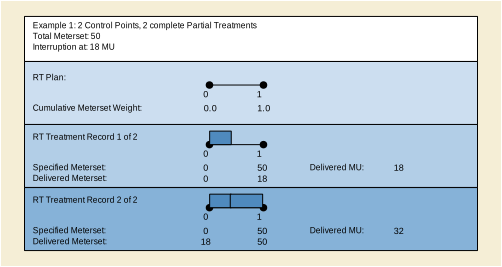
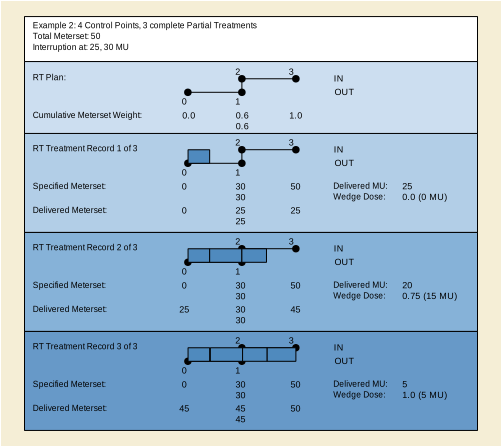
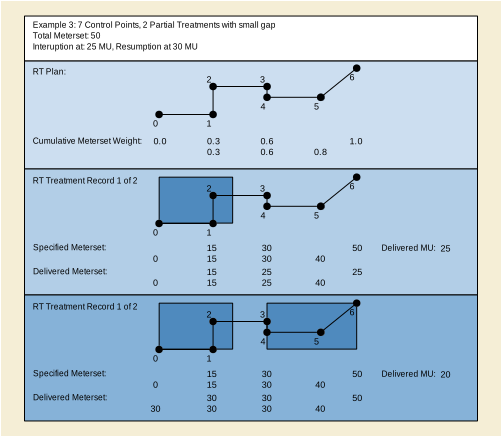
Table C.8-58. RT Brachy Session Record Module Attributes
|
Attribute Name |
Tag |
Type |
Attribute Description |
|---|---|---|---|
|
Referenced Fraction Group Number |
(300C,0022) |
3 |
Identifier of Fraction Group within referenced RT Plan. |
|
Number of Fractions Planned |
(300A,0078) |
2 |
Total number of treatments (Fractions) planned for current Fraction Group. |
|
Brachy Treatment Technique |
(300A,0200) |
1 |
Type of brachytherapy treatment technique. Enumerated Values:
See RT Plan IOD. |
|
Brachy Treatment Type |
(300A,0202) |
1 |
Type of brachytherapy treatment. Defined Terms:
|
|
Recorded Source Sequence |
(3008,0100) |
1 |
Sequence of Sources to be used within Application Setups. One or more Items shall be included in this sequence. |
|
>Source Number |
(300A,0212) |
1 |
Identification number of the Source. The value of Source Number (300A,0212) shall be unique within the Recorded Source Sequence (3008,0100) in which it is created. |
|
>Source Type |
(300A,0214) |
1 |
Type of Source. Defined Terms:
|
|
>Source Manufacturer |
(300A,0216) |
2 |
Manufacturer of source. |
|
>Source Serial Number |
(3008,0105) |
2 |
Serial Number of source. |
|
>Source Isotope Name |
(300A,0226) |
1 |
User-defined name of Isotope. |
|
>Source Isotope Half Life |
(300A,0228) |
1 |
Half-life of Isotope (days). |
|
>Source Strength Units |
(300A,0229) |
1C |
Measurement unit of Source Strength. Required if the source is not a gamma-emitting (photon) source. May be present otherwise. Enumerated Values:
|
|
>Reference Air Kerma Rate |
(300A,022A) |
1 |
Air Kerma Rate in air of Isotope specified at Source Strength Reference Date (300A,022C) and Source Strength Reference Time (300A,022E) (in µGy h-1 at 1 m). Value shall be zero for non-gamma sources. |
|
>Source Strength |
(300A,022B) |
1C |
Source Strength of Isotope at Source Strength Reference Date (300A,022C) and Source Strength Reference Time (300A,022E), in units specified in Source Strength Units (300A,0229). Required if the source is not a gamma-emitting (photon) source. See Section C.8.8.15.13. |
|
>Source Strength Reference Date |
(300A,022C) |
1 |
Reference date for Reference Air Kerma Rate (300A,022A) or Source Strength (300A,022B) of Isotope. |
|
>Source Strength Reference Time |
(300A,022E) |
1 |
Reference time for Air Kerma Rate (300A,022A) or Source Strength (300A,022B) of Isotope. |
|
Treatment Session Application Setup Sequence |
(3008,0110) |
1 |
Sequence of Application Setups for RT Treatment Record for current RT Plan. One or more Items shall be included in this sequence. |
|
>Application Setup Type |
(300A,0232) |
1 |
Type of Application Setup. Defined Terms:
|
|
>Referenced Brachy Application Setup Number |
(300C,000C) |
3 |
References application setup specified by Application Setup Number (300A,0234) in Application Setup Sequence (300A,0230) in RT Brachy Applications Module within referenced RT Plan. |
|
>Application Setup Name |
(300A,0236) |
3 |
User-defined name for Application Setup. |
|
>Application Setup Manufacturer |
(300A,0238) |
3 |
Manufacturer of Application Setup. |
|
>Template Number |
(300A,0240) |
3 |
Identification number of the Template. |
|
>Template Type |
(300A,0242) |
3 |
User-defined type for Template Device. |
|
>Template Name |
(300A,0244) |
3 |
User-defined name for Template Device. |
|
>Application Setup Check |
(3008,0116) |
3 |
Results of check-wire travel through all channels of current Application Setup. Enumerated Values:
|
|
>Referenced Verification Image Sequence |
(300C,0040) |
3 |
Sequence of verification images obtained during delivery of current beam. One or more Items are permitted in this sequence. See Note. |
|
>>Include Table 10-11 “SOP Instance Reference Macro Attributes” |
|||
|
>Total Reference Air Kerma |
(300A,0250) |
1 |
Total Reference Air Kerma for current Application Setup, i.e., the sum of the products of the Air Kerma Rates of each Source in each Channel with its respective Channel Time (µGy at 1 m). Value shall be zero for non-gamma sources. |
|
>Referenced Measured Dose Reference Sequence |
(3008,0080) |
3 |
Sequence of doses measured during treatment delivery, summed over entire session. One or more Items are permitted in this sequence. |
|
>>Referenced Dose Reference Number |
(300C,0051) |
1C |
Uniquely references Dose Reference specified by Dose Reference Number (300A,0012) in Dose Reference Sequence (300A,0010) in RT Prescription Module of referenced RT Plan. Required if Referenced Measured Dose Reference Number (3008,0082) is not sent. It shall not be present otherwise. |
|
>>Referenced Measured Dose Reference Number |
(3008,0082) |
1C |
Uniquely references Measured Dose Reference specified by Measured Dose Reference Number (3008,0064) in Measured Dose Reference Sequence (3008,0010). Required if Referenced Dose Reference Number (300C,0051) is not sent. It shall not be present otherwise. |
|
>>Measured Dose Value |
(3008,0016) |
1 |
Measured Dose in units specified by Dose Units (3004,0002) in sequence referenced by Measured Dose Reference Sequence (3008,0010) or Dose Reference Sequence (300A,0010) in RT Prescription Module of referenced RT Plan as defined above. |
|
>Referenced Calculated Dose Reference Sequence |
(3008,0090) |
3 |
Sequence of doses estimated for each treatment delivery. One or more Items are permitted in this sequence. |
|
>>Referenced Dose Reference Number |
(300C,0051) |
1 |
Uniquely identifies Dose Reference specified by Dose Reference Number (300A,0012) in Dose Reference Sequence (300A,0010) in RT Prescription Module of referenced RT Plan. Required if Referenced Calculated Dose Reference Number (3008,0092) is not sent. It shall not be present otherwise. |
|
>>Referenced Calculated Dose Reference Number |
(3008,0092) |
1C |
Uniquely identifies Calculated Dose Reference specified by Calculated Dose Reference Number (3008,0072) within Calculated Dose Reference Sequence (3008,0070). Required if Referenced Dose Reference Number (300C,0051) is not sent. It shall not be present otherwise. |
|
>>Calculated Dose Reference Dose Value |
(3008,0076) |
1 |
Calculated Dose (Gy). |
|
>Current Fraction Number |
(3008,0022) |
2 |
Fraction number for this application setup. |
|
>Treatment Delivery Type |
(300A,00CE) |
2 |
Delivery Type of treatment. Defined Terms:
|
|
>Treatment Termination Status |
(3008,002A) |
1 |
Conditions under which treatment was terminated. Enumerated Values:
|
|
>Treatment Termination Code |
(3008,002B) |
3 |
Treatment machine termination code. This code is dependent upon the particular application and equipment. |
|
>Treatment Verification Status |
(3008,002C) |
2 |
Conditions under which treatment was verified by a verification system. Enumerated Values:
|
|
>Recorded Brachy Accessory Device Sequence |
(3008,0120) |
3 |
Sequence of Brachy Accessory Devices associated with current Application Setup. One or more Items are permitted in this sequence. |
|
>>Referenced Brachy Accessory Device Number |
(3008,0122) |
2 |
Identification number of the Brachy Accessory Device. The value of Brachy Accessory Device Number (300A,0262) shall be unique within the Application Setup in which it is created. |
|
>>Brachy Accessory Device ID |
(300A,0263) |
2 |
User or machine supplied identifier for Brachy Accessory Device. |
|
>>Brachy Accessory Device Type |
(300A,0264) |
1 |
Type of Brachy Accessory Device. Defined Terms:
|
|
>>Brachy Accessory Device Name |
(300A,0266) |
3 |
User-defined name for Brachy Accessory Device. |
|
>Recorded Channel Sequence |
(3008,0130) |
1 |
Sequence of Channels for current Application Setup. One or more Items shall be included in this sequence. |
|
>>Channel Number |
(300A,0282) |
1 |
Identification number of the Channel. The value of Channel Number (300A,0282) shall be unique within the Application Setup in which it is created. |
|
>>Channel Length |
(300A,0284) |
2 |
Length of Channel (mm). See RT Plan IOD. |
|
>>Specified Channel Total Time |
(3008,0132) |
1 |
Total amount of time in seconds, scaled for the current source delivery strength and other delivery factors, specified to be delivered at the time of treatment between the first Control Point and the final Control Point for the current Channel. In the case of resuming a partially delivered treatment, the Specified Channel Total time will only include the remainder to be treated. See Section C.8.8.22.2. |
|
>>Delivered Channel Total Time |
(3008,0134) |
1 |
Total amount of time in seconds actually delivered between Control Point 0 and final Control Point of the Brachy Control Point Delivered Sequence (3008,0160) for current Channel. |
|
>>Source Movement Type |
(300A,0288) |
1 |
Type of Source movement. Defined Terms:
|
|
>>Specified Number of Pulses |
(3008,0136) |
1C |
Number of Pulses specified per fraction for current Channel. Required if Brachy Treatment Type (300A,0202) is PDR. See Section C.8.8.22.1. |
|
>>Delivered Number of Pulses |
(3008,0138) |
1C |
Number of Pulses actually delivered per fraction for current Channel. Required if Brachy Treatment Type (300A,0202) is PDR. See Section C.8.8.22.1. |
|
>>Specified Pulse Repetition Interval |
(3008,013A) |
1C |
Pulse repetition interval (sec) specified for current Channel. Required if Brachy Treatment Type (300A,0202) is PDR. See Section C.8.8.22.1 |
|
>>Delivered Pulse Repetition Interval |
(3008,013C) |
1C |
Pulse repetition interval (sec) actually delivered for current Channel. Required if Brachy Treatment Type (300A,0202) is PDR. See Section C.8.8.22.1. |
|
>>Referenced Measured Dose Reference Sequence |
(3008,0080) |
3 |
Sequence of doses measured during treatment delivery, summed over entire session. One or more Items are permitted in this sequence. |
|
>>>Referenced Dose Reference Number |
(300C,0051) |
1C |
Uniquely references Dose Reference specified by Dose Reference Number (300A,0012) in Dose Reference Sequence (300A,0010) in RT Prescription Module of referenced RT Plan. Required if Referenced Measured Dose Reference Number (3008,0082) is not sent. It shall not be present otherwise. |
|
>>>Referenced Measured Dose Reference Number |
(3008,0082) |
1C |
References Measured Dose Reference specified by Measured Dose Reference Number (3008,0064) in Measured Dose Reference Sequence (3008,0010). Required if Referenced Dose Reference Number (300C,0051) is not sent. It shall not be present otherwise. |
|
>>>Measured Dose Value |
(3008,0016) |
1 |
Measured Dose. |
|
>>Referenced Calculated Dose Reference Sequence |
(3008,0090) |
3 |
Sequence of doses estimated for each treatment delivery. One or more Items are permitted in this sequence. |
|
>>>Referenced Dose Reference Number |
(300C,0051) |
1C |
Uniquely identifies Dose Reference specified by Dose Reference Number (300A,0012) in Dose Reference Sequence (300A,0010) in RT Prescription Module of referenced RT Plan. Required if Referenced Calculated Dose Reference Number (3008,0092) is not sent. It shall not be present otherwise. |
|
>>>Referenced Calculated Dose Reference Number |
(3008,0092) |
1C |
Uniquely identifies Calculated Dose Reference specified by Calculated Dose Reference Number (3008,0072) within Calculated Dose Reference Sequence (3008,0070). Required if Referenced Dose Reference Number (300C,0051) is not sent. It shall not be present otherwise. |
|
>>>Calculated Dose Reference Dose Value |
(3008,0076) |
1 |
Calculated Dose (Gy). |
|
>>Recorded Source Applicator Sequence |
(3008,0140) |
3 |
Sequence of recorded Source Applicators. One or more Items are permitted in this sequence. |
|
>>>Referenced Source Applicator Number |
(3008,0142) |
2 |
Identification number of the Source Applicator. The value of Source Applicator Number (300A,0290) shall be unique within the Channel in which it is created. |
|
>>>Source Applicator ID |
(300A,0291) |
2 |
User or machine supplied identifier for Source Applicator. |
|
>>>Source Applicator Type |
(300A,0292) |
1 |
Type of Source Applicator. Defined Terms:
|
|
>>>Source Applicator Name |
(300A,0294) |
3 |
User-defined name for Source Applicator. |
|
>>>Source Applicator Length |
(300A,0296) |
1 |
Length of Source Applicator (mm), defined as the distance between the connector of the applicator and the distal-most position of the source. |
|
>>>Source Applicator Manufacturer |
(300A,0298) |
3 |
Manufacturer of Source Applicator. |
|
>>>Source Applicator Step Size |
(300A,02A0) |
1C |
Distance of path along channel (mm) between adjacent (potential) dwell positions. Required if Source Movement Type (300A,0288) is STEPWISE. |
|
>>Transfer Tube Number |
(300A,02A2) |
2 |
Identification number of the Transfer Tube. The value of Transfer Tube Number (300A,02A2) shall be unique within the Channel in which it is created. |
|
>>Transfer Tube Length |
(300A,02A4) |
2C |
Length of Transfer Tube of current afterloading Channel (mm). Required if value Transfer Tube Number (300A,02A2) is not zero length. |
|
>>Recorded Channel Shield Sequence |
(3008,0150) |
3 |
Sequence of Channel Shields associated with current Channel. One or more Items are permitted in this sequence. See RT Plan IOD for description of Channel Shields. |
|
>>>Referenced Channel Shield Number |
(3008,0152) |
2 |
Identification number of the Channel Shield. The value of Channel Shield Number (300A,02B2) shall be unique within the Channel in which it is created. |
|
>>>Channel Shield ID |
(300A,02B3) |
2 |
User or machine supplied identifier for Channel Shield. |
|
>>>Channel Shield Name |
(300A,02B4) |
3 |
User-defined name for Channel Shield. |
|
>>Referenced Source Number |
(300C,000E) |
1 |
Uniquely identifies the referenced Source within the Recorded Source Sequence (3008,0100) for current Application Setup. |
|
>>Safe Position Exit Date |
(3008,0162) |
1C |
Date on which the source(s) exited the safe. Required if Recorded Channel Sequence (3008,0130) is sent and Brachy Treatment Type (300A,0202) is not MANUAL or PDR. |
|
>>Safe Position Exit Time |
(3008,0164) |
1C |
Time on which the source(s) exited the safe. Required if Recorded Channel Sequence (3008,0130) is sent and Brachy Treatment Type (300A,0202) is not MANUAL or PDR. |
|
>>Safe Position Return Date |
(3008,0166) |
1C |
Date on which the source(s) returned to the safe. Required if Recorded Channel Sequence (3008,0130) is sent and Brachy Treatment Type (300A,0202) is not MANUAL or PDR. |
|
>>Safe Position Return Time |
(3008,0168) |
1C |
Time on which the source(s) returned to the safe. Required if Recorded Channel Sequence (3008,0130) is sent and Brachy Treatment Type (300A,0202) is not MANUAL or PDR. |
|
>>Number of Control Points |
(300A,0110) |
1 |
Number of control points in Channel. For an N-segment Channel there will be 2N (stepwise movement) or N+1 (continuous movement) control points. |
|
>>Brachy Control Point Delivered Sequence |
(3008,0160) |
1 |
Sequence of machine configurations describing this Channel. Two or more items shall be included in this sequence. See RT Plan IOD and Section C.8.8.22.1 for description of Brachy Control Point Delivered Sequence. |
|
>>>Referenced Control Point Index |
(300C,00F0) |
3 |
Index of current Control Point, starting at 0 for first Control Point. |
|
>>>Treatment Control Point Date |
(3008,0024) |
1 |
Date when the delivery of radiation at this control point began. For the final control point this shall be the Date when the previous control point ended. |
|
>>>Treatment Control Point Time |
(3008,0025) |
1 |
Time when the delivery of radiation at this control point began. For the final control point this shall be the Time when the previous control point ended. |
|
>>>Control Point Relative Position |
(300A,02D2) |
1 |
Distance in mm between current Control Point Position and the distal-most possible Source position in current Channel. See RT Plan IOD. |
|
>>>Override Sequence |
(3008,0060) |
3 |
Sequence of parameters that were overridden during the administration of the treatment immediately prior to the current control point. One or more Items are permitted in this sequence. |
|
>>>>Override Parameter Pointer |
(3008,0062) |
2 |
Contains the Data Element Tag of the attribute that was overridden. |
|
>>>>Operators' Name |
(0008,1070) |
2 |
Name of operator who authorized override. |
|
>>>>Override Reason |
(3008,0066) |
3 |
User-defined description of reason for override of parameter specified by Override Parameter Pointer (3008,0062). |
|
>>Pulse Specific Brachy Control Point Delivered Sequence |
(3008,0171) |
3 |
Brachy Control Point Delivered Sequence for each PDR treatment pulse. Number of items in the sequence shall be equal to the Delivered Number of Pulses (3008,0138). |
|
>>>Pulse Number |
(3008,0172) |
1 |
Identification Number of this delivered Pulse. The pulse numbers for a treatment start at 1 and increase monotonically by 1. A given SOP instance might only contain some of the pulses of the given treatment. |
|
>>>Safe Position Exit Date |
(3008,0162) |
1 |
Date on which the source(s) exited the safe. |
|
>>>Safe Position Exit Time |
(3008,0164) |
1 |
Time at which the source(s) exited the safe. |
|
>>>Safe Position Return Date |
(3008,0166) |
1 |
Date on which the source(s) returned to the safe. |
|
>>>Safe Position Return Time |
(3008,0168) |
1 |
Time at which the source(s) returned to the safe. |
|
>>>Brachy Pulse Control Point Delivered Sequence |
(3008,0173) |
1 |
List of control points for this pulse. See Section C.8.8.22.1. |
|
>>>>Referenced Control Point Index |
(300C,00F0) |
3 |
Index of current Control Point, starting at 0 for first Control Point in this sequence. |
|
>>>>Treatment Control Point Date |
(3008,0024) |
1 |
Date when the delivery of radiation at this control point began. For the final control point, this shall be the Date when the previous control point ended. |
|
>>>>Treatment Control Point Time |
(3008,0025) |
1 |
Time when the delivery of radiation at this control point began. For the final control point, this shall be the Time when the previous control point ended. |
|
>>>>Control Point Relative Position |
(300A,02D2) |
1 |
Distance in mm between current Control Point Position and the distal-most possible Source position in current Channel. See Section C.8.8.15.9. |
|
>>>>Override Sequence |
(3008,0060) |
3 |
Parameters which were overridden during the administration of the treatment immediately prior to the current control point. One or more Items are permitted in this sequence. |
|
>>>>>Override Parameter Pointer |
(3008,0062) |
2 |
Data Element Tag of the attribute that was overridden. |
|
>>>>>Operators' Name |
(0008,1070) |
2 |
Name of operator who authorized override. |
|
>>>>>Override Reason |
(3008,0066) |
3 |
User-defined description of reason for override. |
Note
The Referenced Verification Image Sequence (300C,0040) may contain either images taken specifically for verification of the brachy application setup or reference images used in place of verification images, as might be done in HDR treatment planning.
In Brachytherapy treatment techniques where Brachy Treatment Type (300A,0202) is PDR, the Brachy Control Point Sequence (300A,02D0) shall consist of 2N items, where N = Delivered Number of Pulses (3008,0138). Each control point pair shall represent a single pulse and consist of the first control point of the pulse and the last control point of the pulse.
The Brachy Pulse Control Point Delivered Sequence (3008,0173) is consistent with the Brachy Control Point Delivered Sequence (3008,0160) as defined in the enclosing Recorded Channel Sequence (3008,0130) except all control points delivered are listed in this sequence as opposed to listing only the start and end control points in the Brachy Control Point Delivered Sequence (3008,0160).
Total time is derived from the Brachy Control Point Sequence (300A,02D0) by scaling times for the current source delivery strength and accounting for other delivery device capabilities influencing the actual delivery.
In brachytherapy treatment techniques where Brachy Treatment Type (300A,0202) is PDR, the Specified Channel Total Time (3008,0132) shall consist of the specified channel total time summed over the Specified Number of Pulses (3008,0136).
The following examples describe the contents of Specified Channel Total Time (3008,0132), Delivered Channel Total Time (3008,0134) and Treatment Termination Status (3008,002A) under normal and interrupted delivery conditions.
Example:
Fraction delivered without interruption
Session 1:
Specified Channel Total Time = 100.0 seconds
Delivered Channel Total Time = 100.0 seconds
Treatment Termination Status = NORMAL
Fraction delivered with interruption. Second session delivered in timely manner such that there is negligible source decay between sessions.
Session 1:
Specified Channel Total Time = 100.0 seconds
Delivered Channel Total Time = 50.0 seconds
Treatment Termination Status = OPERATOR or MACHINE
Session 2:
Specified Channel Total Time = 50.0 seconds
Delivered Channel Total Time = 50.0 seconds
Treatment Termination Status = NORMAL
Fraction delivered with interruption. Second session delivered later such that additional source decay between sessions must be accounted for. In Session 2 the source is at approximately 96% of Session 1 strength.
Session 1:
Specified Channel Total Time = 100.0 seconds
Delivered Channel Total Time = 50.0 seconds
Treatment Termination Status = OPERATOR or MACHINE
Session 2:
Specified Channel Total Time = 52.0 seconds
Delivered Channel Total Time = 52.0 seconds
Treatment Termination Status = NORMAL
Table C.8-59. RT Treatment Summary Record Module Attributes
|
Attribute Name |
Tag |
Type |
Attribute Description |
|---|---|---|---|
|
Current Treatment Status |
(3008,0200) |
1 |
Status of the Treatment at the time the Treatment Summary was created. Enumerated Values:
See Section C.8.8.23.1. |
|
Treatment Status Comment |
(3008,0202) |
3 |
Comment on current treatment status. |
|
First Treatment Date |
(3008,0054) |
2 |
Date of delivery of the first treatment. |
|
Most Recent Treatment Date |
(3008,0056) |
2 |
Date of delivery of the most recent administration. |
|
Fraction Group Summary Sequence |
(3008,0220) |
3 |
Sequence describing current state of planned vs. delivered fraction groups. One or more Items are permitted in this sequence. |
|
>Referenced Fraction Group Number |
(300C,0022) |
3 |
References Fraction Group Number (300A,0071) in Fraction Group Sequence (300A,0070) in the referenced RT Plan. |
|
>Fraction Group Type |
(3008,0224) |
2 |
Indicates type of fraction group. Enumerated Values:
|
|
>Number of Fractions Planned |
(300A,0078) |
2 |
Number of fractions planned for this fraction group. |
|
>Number of Fractions Delivered |
(3008,005A) |
2 |
Number of fractions delivered as of Treatment Summary Report. |
|
>Fraction Status Summary Sequence |
(3008,0240) |
3 |
Sequence describing status of fractions in Fraction Group. One or more Items are permitted in this sequence. |
|
>>Referenced Fraction Number |
(3008,0223) |
1 |
Identifies fraction. |
|
>>Treatment Date |
(3008,0250) |
2 |
Date when fraction was delivered. |
|
>>Treatment Time |
(3008,0251) |
2 |
Time when fraction was delivered. |
|
>>Treatment Termination Status |
(3008,002A) |
2 |
Conditions under which treatment was terminated. Enumerated Values:
|
|
Treatment Summary Measured Dose Reference Sequence |
(3008,00E0) |
3 |
Sequence of references to Measured Dose References. One or more Items are permitted in this sequence. |
|
>Referenced Dose Reference Number |
(300C,0051) |
3 |
Uniquely identifies Dose Reference specified by Dose Reference Number (300A,0012) in Dose Reference Sequence (300A,0010) in RT Prescription Module of referenced RT Plan referenced in Referenced RT Plan Sequence (300C,0002) of RT General Treatment Record Module. |
|
>Dose Reference Description |
(300A,0016) |
3 |
User-defined description of Dose Reference. |
|
>Cumulative Dose to Dose Reference |
(3008,0052) |
1 |
Cumulative Dose delivered to Dose Reference (Gy). |
|
Treatment Summary Calculated Dose Reference Sequence |
(3008,0050) |
3 |
Sequence of references to Calculated Dose References. One or more Items are permitted in this sequence. |
|
>Referenced Dose Reference Number |
(300C,0051) |
3 |
Uniquely identifies Dose Reference specified by Dose Reference Number (300A,0012) in Dose Reference Sequence (300A,0010) in RT Prescription Module of referenced RT Plan referenced in Referenced RT Plan Sequence (300C,0002) of RT General Treatment Record Module. |
|
>Dose Reference Description |
(300A,0016) |
3 |
User-defined description of Dose Reference. |
|
>Cumulative Dose to Dose Reference |
(3008,0052) |
1 |
Cumulative Dose delivered to Dose Reference (Gy). |
Note
The RT Treatment Summary Record IOD may contain references to related RT Treatment Session Record IODs. These references are contained within the Referenced Treatment Record Sequence (3008,0030) of the RT General Treatment Record Module.
Enumerated Values:
- NOT_STARTED
Patient has not yet begun treatment
- ON_TREATMENT
Patient is currently undergoing treatment
- ON_BREAK
Patient is currently not undergoing treatment, but a resumption date is known
- SUSPENDED
Patient is currently not undergoing treatment, but resumption of treatment is planned at an unknown date
- STOPPED
Patient has stopped treatment without completing the planned course
- COMPLETED
Patient completed the planned course of treatment
A change in the Current Treatment Status (or any other field) in a RT Treatment Summary Record Object shall define a new instance of the RT Treatment Summary Record IOD.
The RT Ion Tolerance Tables Module contains information describing the maximum allowed differences between the planned and measured attributes for Ion therapy.
Table C.8.8.24-1. RT Ion Tolerance Tables Module Attributes
|
Attribute Name |
Tag |
Type |
Description |
|---|---|---|---|
|
Ion Tolerance Table Sequence |
(300A,03A0) |
1 |
Sequence of ion tolerance tables to be used for delivery of treatment plan. One or more items shall be included in this sequence. See Note 1. |
|
>Tolerance Table Number |
(300A,0042) |
1 |
Identification number of the Tolerance Table. The value of Tolerance Table Number (300A,0042) shall be unique within the RT Ion Plan in which it is created. |
|
>Tolerance Table Label |
(300A,0043) |
3 |
User-defined label for Tolerance Table. |
|
>Gantry Angle Tolerance |
(300A,0044) |
3 |
Maximum permitted difference (in degrees) between planned and delivered Gantry Angle. |
|
>Beam Limiting Device Angle Tolerance |
(300A,0046) |
3 |
Maximum permitted difference (in degrees) between planned and delivered Beam Limiting Device Angle. |
|
>Beam Limiting Device Tolerance Sequence |
(300A,0048) |
3 |
Sequence of beam limiting device (collimator) tolerances. One or more items are permitted in this sequence. |
|
>>RT Beam Limiting Device Type |
(300A,00B8) |
1 |
Type of beam limiting device (collimator). Enumerated Values:
|
|
>>Beam Limiting Device Position Tolerance |
(300A,004A) |
1 |
Maximum permitted difference (in mm) between planned and delivered leaf (element) or jaw positions for current beam limiting device (collimator). |
|
>Patient Support Angle Tolerance |
(300A,004C) |
3 |
Maximum permitted difference (in degrees) between planned and delivered Patient Support Angle. |
|
>Table Top Vertical Position Tolerance |
(300A,0051) |
3 |
Maximum permitted difference (in mm) between planned and delivered Table Top Vertical Position. |
|
>Table Top Longitudinal Position Tolerance |
(300A,0052) |
3 |
Maximum permitted difference (in mm) between planned and delivered Table Top Longitudinal Position. |
|
>Table Top Lateral Position Tolerance |
(300A,0053) |
3 |
Maximum permitted difference (in mm) between planned and delivered Table Top Lateral Position. |
|
>Table Top Pitch Angle Tolerance |
(300A,004F) |
3 |
Maximum permitted difference (in degrees) between planned and delivered Table Top Pitch Angle. |
|
>Table Top Roll Angle Tolerance |
(300A,0050) |
3 |
Maximum permitted difference (in degrees) between planned and delivered Table Top Roll Angle. |
|
>Snout Position Tolerance |
(300A,004B) |
3 |
Maximum permitted difference (in mm) between planned and delivered Snout Position. |
Note 1: Tolerance Tables may be used to compare planned values to actual machine values. If the absolute difference between the planned and actual values exceeds the Tolerance Table value, treatment may be inhibited or the operator may be warned.
The RT Ion Beams Module contains information defining equipment parameters for delivery of external Ion radiation beams.
Table C.8.8.25-1. RT Ion Beams Module Attributes
|
Attribute Name |
Tag |
Type |
Description |
|---|---|---|---|
|
Ion Beam Sequence |
(300A,03A2) |
1 |
Sequence of setup and/or treatment beams for current RT Ion Plan. One or more items shall be included in this sequence. |
|
>Beam Number |
(300A,00C0) |
1 |
Identification number of the Beam. The value of Beam Number (300A,00C0) shall be unique within the RT Ion Plan in which it is created. See Section C.8.8.25.1. |
|
>Beam Name |
(300A,00C2) |
1 |
User-defined name for Beam. See Section C.8.8.25.1. |
|
>Beam Description |
(300A,00C3) |
3 |
User-defined description for Beam. See Section C.8.8.25.1. |
|
>Beam Type |
(300A,00C4) |
1 |
Motion characteristic of Beam. Enumerated Values:
|
|
>Radiation Type |
(300A,00C6) |
1 |
Particle type of Beam. Defined Terms:
|
|
>Radiation Mass Number |
(300A,0302) |
1C |
Mass number of radiation. Required if Radiation Type (300A,00C6) is ION |
|
>Radiation Atomic Number |
(300A,0304) |
1C |
Atomic number of radiation. Required if Radiation Type (300A,00C6) is ION |
|
>Radiation Charge State |
(300A,0306) |
1C |
Charge state of radiation. Required if Radiation Type (300A,00C6) is ION |
|
>Scan Mode |
(300A,0308) |
1 |
The method of beam scanning to be used during treatment. Defined Terms:
|
|
>Treatment Machine Name |
(300A,00B2) |
2 |
User-defined name identifying treatment machine to be used for beam delivery. See Section C.8.8.25.2. |
|
>Manufacturer |
(0008,0070) |
3 |
Manufacturer of the equipment to be used for beam delivery. |
|
>Institution Name |
(0008,0080) |
3 |
Institution where the equipment is located that is to be used for beam delivery. |
|
>Institution Address |
(0008,0081) |
3 |
Mailing address of the institution where the equipment is located that is to be used for beam delivery. |
|
>Institutional Department Name |
(0008,1040) |
3 |
Department in the institution where the equipment is located that is to be used for beam delivery. |
|
>Manufacturer's Model Name |
(0008,1090) |
3 |
Manufacturer's model name of the equipment that is to be used for beam delivery. |
|
>Device Serial Number |
(0018,1000) |
3 |
Manufacturer's serial number of the equipment that is to be used for beam delivery. |
|
>Primary Dosimeter Unit |
(300A,00B3) |
1 |
Measurement unit of machine dosimeter. Enumerated Values:
|
|
>Referenced Tolerance Table Number |
(300C,00A0) |
3 |
Uniquely identifies Tolerance Table specified by Tolerance Table Number (300A,0042) within Tolerance Table Sequence in RT Ion Tolerance Tables Module. These tolerances are to be used for verification of treatment machine settings. |
|
>Virtual Source-Axis Distances |
(300A,030A) |
1 |
Distance (in mm) from virtual source position to gantry rotation axis or nominal isocenter position (fixed beam-lines) of the equipment to be used for beam delivery. Specified by a numeric pair - the VSAD in the IEC Gantry X direction followed by the VSAD in the IEC Gantry Y direction. The VSAD is commonly used for designing apertures in contrast to the effective source-axis-distance (ESAD) that is commonly used with the inverse square law for calculating the dose decrease with distance. See Section C.8.8.25.4. |
|
>Ion Beam Limiting Device Sequence |
(300A,03A4) |
3 |
Sequence of beam limiting device (collimator) jaw or leaf (element) sets. One or more items are permitted in this sequence. |
|
>>RT Beam Limiting Device Type |
(300A,00B8) |
1 |
Type of beam limiting device (collimator). Enumerated Values:
|
|
>>Isocenter to Beam Limiting Device Distance |
(300A,00BB) |
2 |
Isocenter to beam limiting device (collimator) distance (in mm) of the equipment that is to be used for beam delivery. See Section C.8.8.25.4. |
|
>>Number of Leaf/Jaw Pairs |
(300A,00BC) |
1 |
Number of leaf (element) or jaw pairs (equal to 1 for standard beam limiting device jaws). |
|
>>Leaf Position Boundaries |
(300A,00BE) |
1C |
Boundaries of beam limiting device (collimator) leaves (in mm) in IEC BEAM LIMITING DEVICE coordinate axis appropriate to RT Beam Limiting Device Type (300A,00B8), i.e., X-axis for MLCY, Y-axis for MLCX. Contains N+1 values, where N is the Number of Leaf/Jaw Pairs (300A,00BC), starting from Leaf (Element) Pair 1. Required if RT Beam Limiting Device Type (300A,00B8) is MLCX or MLCY. May be present otherwise. See Section C.8.8.25.3. |
|
>Referenced Patient Setup Number |
(300C,006A) |
3 |
Uniquely identifies Patient Setup to be used for current beam, specified by Patient Setup Number (300A,0182) within Patient Setup Sequence of RT Patient Setup Module. |
|
>Referenced Reference Image Sequence |
(300C,0042) |
3 |
Reference images used for validation of current beam. One or more items are permitted in this sequence. |
|
>>Include Table 10-11 “SOP Instance Reference Macro Attributes” |
|||
|
>>Reference Image Number |
(300A,00C8) |
1 |
Uniquely identifies Reference Image within Referenced Reference Image Sequence (300C,0042). |
|
>Treatment Delivery Type |
(300A,00CE) |
1 |
Delivery Type of treatment. Defined Terms:
|
|
>Referenced Dose Sequence |
(300C,0080) |
3 |
Related instances of RT Dose (for grids, isodose curves, and named/unnamed point doses). One or more items are permitted in this sequence. |
|
>>Include Table 10-11 “SOP Instance Reference Macro Attributes” |
The Referenced Class SOP UID shall be that of the RT Dose SOP Class (1.2.840.10008.5.1.4.1.1.481.2. |
||
|
>Number of Wedges |
(300A,00D0) |
1 |
Number of wedges associated with current beam. |
|
>Total Wedge Tray Water-Equivalent Thickness |
(300A,00D7) |
3 |
Shift of the wedge tray induced on the range of the ion beam as measured in water (in mm). |
|
>Ion Wedge Sequence |
(300A,03AA) |
1C |
Sequence of treatment wedges. Required if Number of Wedges (300A,00D0) is non-zero. The number of items shall be identical to the value of Number of Wedges (300A,00D0). |
|
>>Wedge Number |
(300A,00D2) |
1 |
Identification number of the Wedges. The value of Wedge Number (300A,00D2) shall be unique within the Beam in which it was created. |
|
>>Wedge Type |
(300A,00D3) |
2 |
Type of wedge (if any) defined for Beam. Defined Terms:
|
|
>>Wedge ID |
(300A,00D4) |
3 |
User-supplied identifier for Wedge. |
|
>>Accessory Code |
(300A,00F9) |
3 |
An accessory identifier to be read by a device such as a bar code reader. |
|
>>Wedge Angle |
(300A,00D5) |
2 |
Nominal wedge angle (degrees). |
|
>>Wedge Orientation |
(300A,00D8) |
2 |
Orientation of wedge, i.e., orientation of IEC WEDGE FILTER coordinate system with respect to the IEC BEAM LIMITING DEVICE coordinate systems (degrees). |
|
>>Isocenter to Wedge Tray Distance |
(300A,00D9) |
1 |
Isocenter to downstream edge of wedge tray (mm). |
|
>Number of Compensators |
(300A,00E0) |
1 |
Number of compensators associated with current Beam. |
|
>Total Compensator Tray Water-Equivalent Thickness |
(300A,02E3) |
3 |
Water-Equivalent thickness of the compensator tray (in mm) parallel to radiation beam axis. |
|
>Ion Range Compensator Sequence |
(300A,02EA) |
1C |
Sequence of compensators. Required if Number of Compensators (300A,00E0) is non-zero. The number of items shall be identical to the value of Number of Compensators (300A,00E0). |
|
>>Compensator Description |
(300A,02EB) |
3 |
User defined description for the compensator. |
|
>>Compensator Number |
(300A,00E4) |
1 |
Identification number of the Compensator. The value of Compensator Number (300A,00E4) shall be unique within the Beam in which it is created. |
|
>>Material ID |
(300A,00E1) |
2 |
User-supplied identifier for material used to manufacture Compensator. |
|
>>Compensator ID |
(300A,00E5) |
3 |
User-supplied identifier for the compensator. |
|
>>Accessory Code |
(300A,00F9) |
3 |
An accessory identifier to be read by a device such as a bar code reader. |
|
>>Isocenter to Compensator Tray Distance |
(300A,02E4) |
1C |
Isocenter to compensator tray attachment edge distance (in mm) for current range compensator. Required if Compensator Mounting Position (300A,02E1) is not DOUBLE_SIDED. See Section C.8.8.25.4 |
|
>>Compensator Divergence |
(300A,02E0) |
1 |
Indicates presence or absence of geometrical divergence of the range compensator. Enumerated Values:
|
|
>>Compensator Mounting Position |
(300A,02E1) |
1 |
Indicates on which side of the Compensator Tray the compensator is mounted. Enumerated Values:
|
|
>>Compensator Rows |
(300A,00E7) |
1 |
Number of rows in the range compensator. A row is defined to be in the X direction of the IEC Beam Limiting Device Coordinate system. |
|
>>Compensator Columns |
(300A,00E8) |
1 |
Number of columns in the range compensator. A column is defined to be in the Y direction of the IEC Beam Limiting Device Coordinate system. |
|
>>Compensator Pixel Spacing |
(300A,00E9) |
1 |
Physical distance (in mm) between the center of each pixel projected onto machine isocentric plane. Specified by a numeric pair - adjacent row spacing followed by adjacent column spacing. See Section 10.7.1.3 for further explanation of the value order. |
|
>>Compensator Position |
(300A,00EA) |
1 |
The x and y coordinates of the upper left hand corner (first pixel transmitted) of the range compensator, projected onto the machine isocentric plane in the IEC BEAM LIMITING DEVICE coordinate system (mm). |
|
>>Compensator Column Offset |
(300A,02E5) |
1C |
The offset distance (in mm) applied to the x coordinate of Compensator Position (300A,00EA) for even numbered rows. Required if the compensator pattern is hexagonal. |
|
>>Compensator Thickness Data |
(300A,00EC) |
1 |
A data stream of the pixel samples that comprise the range compensator, expressed as physical thickness (in mm), either parallel to radiation beam axis if Compensator Divergence (300A,02E0) equals ABSENT, or divergent according to the beam geometrical divergence if Compensator Divergence (300A,02E0) equals PRESENT. The order of pixels sent is left to right, top to bottom (upper left pixel, followed by the remainder of row 1, followed by the remainder of the rows). |
|
>>Isocenter to Compensator Distances |
(300A,02E6) |
1C |
A data stream of the pixel samples that comprise the distance from the isocenter to the compensator surface closest to the radiation source (in mm). The order of pixels sent is left to right, top to bottom (upper left pixel, followed by the remainder of row 1, followed by the remainder of the rows). Required if Material ID (300A,00E1) is non-zero length, and Compensator Mounting Position (300A,02E1) is DOUBLE_SIDED. See Section C.8.8.14.9 and Section C.8.8.25.4. |
|
>>Compensator Relative Stopping Power Ratio |
(300A,02E7) |
3 |
Compensator Linear Stopping Power Ratio, relative to water, at the beam energy specified by the Nominal Beam Energy (300A,0114) of the first Control Point of the Ion Control Point Sequence (300A,03A8). |
|
>>Compensator Milling Tool Diameter |
(300A,02E8) |
3 |
The diameter (in mm) of the milling tool to be used to create the compensator. The diameter is expressed as the actual physical size and not a projected size at isocenter. |
|
>Number of Boli |
(300A,00ED) |
1 |
Number of boli associated with current Beam. |
|
>Referenced Bolus Sequence |
(300C,00B0) |
1C |
Sequence of boli associated with Beam. Required if Number of Boli (300A,00ED) is non-zero. The number of items shall be identical to the value of Number of Boli (300A,00ED). |
|
>>Referenced ROI Number |
(3006,0084) |
1 |
Uniquely identifies ROI representing the Bolus specified by ROI Number (3006,0022) in Structure Set ROI Sequence (3006,0020) in Structure Set Module within RT Structure Set in Referenced Structure Set Sequence (300C,0060) in RT General Plan Module. |
|
>>Accessory Code |
(300A,00F9) |
3 |
An accessory identifier to be read by a device such as a bar code reader. |
|
>Number of Blocks |
(300A,00F0) |
1 |
Number of shielding blocks associated with Beam. |
|
>Total Block Tray Water-Equivalent Thickness |
(300A,00F3) |
3 |
Water-Equivalent thickness of the block tray (in mm) parallel to radiation beam axis. |
|
>Ion Block Sequence |
(300A,03A6) |
1C |
Sequence of blocks associated with Beam. Required if Number of Blocks (300A,00F0) is non-zero. The number of items shall be identical to the value of Number of Blocks (300A,00F0). |
|
>>Block Tray ID |
(300A,00F5) |
3 |
User-supplied identifier for block tray. |
|
>>Accessory Code |
(300A,00F9) |
3 |
An accessory identifier to be read by a device such as a bar code reader. |
|
>>Isocenter to Block Tray Distance |
(300A,00F7) |
1 |
Isocenter to downstream edge of block tray (mm). See Section C.8.8.25.4 |
|
>>Block Type |
(300A,00F8) |
1 |
Type of block. See Section C.8.8.14.4. Enumerated Values:
|
|
>>Block Divergence |
(300A,00FA) |
1 |
Indicates presence or otherwise of geometrical divergence. Enumerated Values:
|
|
>>Block Mounting Position |
(300A,00FB) |
1 |
Indicates on which side of the Block Tray the block is mounted. Enumerated Values:
|
|
>>Block Number |
(300A,00FC) |
1 |
Identification number of the Block. The value of Block Number (300A,00FC) shall be unique within the Beam in which it is created. |
|
>>Block Name |
(300A,00FE) |
3 |
User-defined name for block. |
|
>>Material ID |
(300A,00E1) |
2 |
User-supplied identifier for material used to manufacture Block. |
|
>>Block Thickness |
(300A,0100) |
1 |
Physical thickness of block (in mm) parallel to radiation beam axis. See Section C.8.8.14.4. |
|
>>Block Number of Points |
(300A,0104) |
1 |
Number of (x,y) pairs defining the block edge. |
|
>>Block Data |
(300A,0106) |
1 |
A data stream of (x,y) pairs that comprise the block edge. The number of pairs shall be equal to Block Number of Points (300A,0104), and the vertices shall be interpreted as a closed polygon. Coordinates are projected onto the machine isocentric plane in the IEC BEAM LIMITING DEVICE coordinate system (mm). |
|
>Snout Sequence |
(300A,030C) |
3 |
Sequence of Snouts associated with Beam. Only a single item is permitted in this sequence. |
|
>>Snout ID |
(300A,030F) |
1 |
User or machine supplied identifier for Snout. |
|
>>Accessory Code |
(300A,00F9) |
3 |
An accessory identifier to be read by a device such as a bar code reader. |
|
>Applicator Sequence |
(300A,0107) |
3 |
Sequence of Applicators associated with Beam. Only a single item is permitted in this sequence. |
|
>>Applicator ID |
(300A,0108) |
1 |
User or machine supplied identifier for Applicator. |
|
>>Accessory Code |
(300A,00F9) |
3 |
An accessory identifier to be read by a device such as a bar code reader. |
|
>>Applicator Type |
(300A,0109) |
1 |
Type of applicator. Defined Terms:
|
|
>>Applicator Description |
(300A,010A) |
3 |
User-defined description for Applicator. |
|
>General Accessory Sequence |
(300A,0420) |
3 |
Introduces a Sequence of General Accessories associated with this Beam. One or more items are permitted in this sequence. |
|
>>General Accessory Number |
(300A,0424) |
1 |
Identification Number of the General Accessory. The value shall be unique within the sequence. |
|
>>General Accessory ID |
(300A,0421) |
1 |
User or machine supplied identifier for General Accessory. |
|
>>General Accessory Description |
(300A,0422) |
3 |
User supplied description of General Accessory. |
|
>>General Accessory Type |
(300A,0423) |
3 |
Specifies the type of accessory. Defined Terms:
|
|
>>Accessory Code |
(300A,00F9) |
3 |
Machine-readable identifier for this accessory |
|
>>Source to General Accessory Distance |
(300A,0425) |
3 |
Radiation source to general accessory distance (in mm) for current accessory. |
|
>Number of Range Shifters |
(300A,0312) |
1 |
Number of range shifters associated with current beam. |
|
>Range Shifter Sequence |
(300A,0314) |
1C |
Sequence of range shifters associated with Beam. Required if Number of Range Shifters (300A,0312) is non-zero. The number of items shall be identical to the value of Number of Range Shifters (300A,0312). |
|
>>Range Shifter Number |
(300A,0316) |
1 |
Identification number of the Range Shifter. The value of Range Shifter Number (300A,0316) shall be unique within the Beam in which it is created. |
|
>>Range Shifter ID |
(300A,0318) |
1 |
User or machine supplied identifier for Range Shifter. |
|
>>Accessory Code |
(300A,00F9) |
3 |
An accessory identifier to be read by a device such as a bar code reader. |
|
>>Range Shifter Type |
(300A,0320) |
1 |
Type of Range Shifter. Defined Terms:
|
|
>>Range Shifter Description |
(300A,0322) |
3 |
User defined description of Range Shifter. |
|
>Number of Lateral Spreading Devices |
(300A,0330) |
1 |
Number of lateral spreading devices associated with current beam. |
|
>Lateral Spreading Device Sequence |
(300A,0332) |
1C |
Sequence of lateral spreading devices associated with Beam. Required if Number of Lateral Spreading Devices (300A,0330) is non-zero. The number of items shall be identical to the value of Number of Lateral Spreading Devices (300A,0330). |
|
>>Lateral Spreading Device Number |
(300A,0334) |
1 |
Identification number of the Lateral Spreading Device. The value of Lateral Spreading Device Number (300A,0334) shall be unique within the Beam in which it is created. |
|
>>Lateral Spreading Device ID |
(300A,0336) |
1 |
User or machine supplied identifier for Lateral Spreading Device. |
|
>>Accessory Code |
(300A,00F9) |
3 |
An accessory identifier to be read by a device such as a bar code reader. |
|
>>Lateral Spreading Device Type |
(300A,0338) |
1 |
Type of Lateral Spreading Device. Defined Terms:
|
|
>>Lateral Spreading Device Description |
(300A,033A) |
3 |
User-defined description for lateral spreading device. |
|
>Number of Range Modulators |
(300A,0340) |
1 |
Number of range modulators associated with current beam. |
|
>Range Modulator Sequence |
(300A,0342) |
1C |
Sequence of range modulators associated with Beam. Required if Number of Range Modulators (300A,0340) is non-zero. The number of items shall be identical to the value of Number of Range Modulators (300A,0340). |
|
>>Range Modulator Number |
(300A,0344) |
1 |
Identification number of the Range Modulator. The value of Range Modulator Number (300A,0344) shall be unique within the Beam in which it is created. |
|
>>Range Modulator ID |
(300A,0346) |
1 |
User or machine supplied identifier for Range Modulator. |
|
>>Accessory Code |
(300A,00F9) |
3 |
An accessory identifier to be read by a device such as a bar code reader. |
|
>>Range Modulator Type |
(300A,0348) |
1 |
Type of Range Modulator. Defined Terms:
Only one item in the Range Modulator Sequence (300A,0342) can have a Range Modulator Type (300A,0348) of WHL_MODWEIGHTS. |
|
>>Range Modulator Description |
(300A,034A) |
3 |
User-defined description of Range Modulator. |
|
>>Beam Current Modulation ID |
(300A,034C) |
1C |
User-supplied identifier for the beam current modulation pattern. Required if Range Modulator Type (300A,0348) is WHL_MODWEIGHTS |
|
>Include Table C.8.8.28-1 “Patient Support Identification Macro Attributes” |
|||
|
>Fixation Light Azimuthal Angle |
(300A,0356) |
3 |
Azimuthal angle (degrees) of the fixation light coordinate around IEC BEAM LIMITING DEVICE Y-axis. Used for eye treatments. See Section C.8.8.25.6.4. |
|
>Fixation Light Polar Angle |
(300A,0358) |
3 |
Polar angle (degrees) of the fixation light coordinate. Used for eye treatments. See Section C.8.8.25.6.4. |
|
>Final Cumulative Meterset Weight |
(300A,010E) |
1C |
Value of Cumulative Meterset Weight (300A,0134) for final Control Point in Ion Control Point Sequence (300A,03A8). Required if Cumulative Meterset Weight is non-null in Control Points specified within Ion Control Point Sequence. See Section C.8.8.14.1. |
|
>Number of Control Points |
(300A,0110) |
1 |
Number of control points in Beam. Value shall be greater than or equal to 2. |
|
>Ion Control Point Sequence |
(300A,03A8) |
1 |
Sequence of machine configurations describing Ion treatment beam. The number of items shall be identical to the value of Number of Control Points (300A,0110). See Section C.8.8.25.7. |
|
>>Control Point Index |
(300A,0112) |
1 |
Index of current Control Point, starting at 0 for first Control Point. |
|
>>Cumulative Meterset Weight |
(300A,0134) |
2 |
Cumulative weight to current control point. Cumulative Meterset Weight for the first item in Control Point Sequence shall always be zero. Cumulative Meterset Weight for the final item in Ion Control Point Sequence shall always be equal to Final Cumulative Meterset Weight. |
|
>>Referenced Dose Reference Sequence |
(300C,0050) |
3 |
Introduces a sequence of Dose References for current Beam. One or more items are permitted in this sequence. |
|
>>>Referenced Dose Reference Number |
(300C,0051) |
1 |
Uniquely identifies Dose Reference specified by Dose Reference Number (300A,0012) in Dose Reference Sequence (300A,0010) in RT Prescription Module. |
|
>>>Cumulative Dose Reference Coefficient |
(300A,010C) |
2 |
Coefficient used to calculate cumulative dose contribution from this Beam to the referenced Dose Reference at the current Control Point. |
|
>>Nominal Beam Energy |
(300A,0114) |
1C |
Nominal Beam Energy at control point in MeV per nucleon. Defined at nozzle entrance before all Beam Modifiers. Required for first item of Control Point Sequence, or if Nominal Beam Energy changes during Beam, and KVP (0018,0060) is not present. |
|
>>KVP |
(0018,0060) |
1C |
Peak kilo voltage output of the setup X-Ray generator to be used. Required for first item of Control Point Sequence, or if kVp changes during setup, and Nominal Beam Energy (300A,0114) is not present. |
|
>>Meterset Rate |
(300A,035A) |
3 |
Specifies the speed of delivery of the specified dose in units specified by Primary Dosimeter Unit (300A,00B3) per minute. |
|
>>Ion Wedge Position Sequence |
(300A,03AC) |
1C |
Sequence of Wedge positions for current control point. Required for first item of Ion Control Point Sequence if Number of Wedges (300A,00D0) is non-zero, and in subsequent control points if Wedge Position (300A,0118) or Wedge Thin Edge Position (300A,00DB) changes during beam. The number of items shall be identical to the value of Number of Wedges (300A,00D0). |
|
>>>Referenced Wedge Number |
(300C,00C0) |
1 |
Uniquely references Wedge described by Wedge Number (300A,00D2) in Wedge Sequence (300A,00D1). |
|
>>>Wedge Position |
(300A,0118) |
1 |
Position of Wedge at current Control Point. Enumerated Values:
|
|
>>>Wedge Thin Edge Position |
(300A,00DB) |
1C |
Closest distance from the central axis of the beam along a wedge axis to the thin edge as projected to the machine isocentric plane (mm). Value is positive is the wedge does not cover the central axis, negative if it does. Required if Wedge Type (300A,00D3) of the wedge referenced by Referenced Wedge Number (300C,00C0) is PARTIAL_STANDARD or PARTIAL_MOTORIZ. See Section C.8.8.25.6.4. |
|
>>Range Shifter Settings Sequence |
(300A,0360) |
1C |
Sequence of Range Shifter settings for the current control point. One or more items shall be included in this sequence. Required for first item of Control Point Sequence if Number of Range Shifters (300A,0312) is non-zero, or if Range Shifter Setting (300A,0362) changes during Beam. |
|
>>>Referenced Range Shifter Number |
(300C,0100) |
1 |
Uniquely references Range Shifter described by Range Shifter Number (300A,0316) in Range Shifter Sequence (300A,0314). |
|
>>>Range Shifter Setting |
(300A,0362) |
1 |
Machine specific setting attribute for the range shifter. The specific encoding of this value should be documented in a Conformance Statement. See Section C.8.8.25.5. |
|
>>>Isocenter to Range Shifter Distance |
(300A,0364) |
3 |
Isocenter to downstream edge of range shifter (mm) at current control point. See Section C.8.8.25.4 |
|
>>>Range Shifter Water Equivalent Thickness |
(300A,0366) |
3 |
Water equivalent thickness (in mm) of the range shifter at the central axis for the beam energy incident upon the device. |
|
>>Lateral Spreading Device Settings Sequence |
(300A,0370) |
1C |
Sequence of Lateral Spreading Device settings for the current control point. One or more items shall be included in this sequence. Required for first item of Control Point Sequence if Number of Lateral Spreading Devices (300A,0330) is non-zero, or if Lateral Spreading Device Setting (300A,0372) changes during Beam. |
|
>>>Referenced Lateral Spreading Device Number |
(300C,0102) |
1 |
Uniquely references Lateral Spreading Device described by Lateral Spreading Device Number (300A,0334) in Lateral Spreading Device Sequence (300A,0332). |
|
>>>Lateral Spreading Device Setting |
(300A,0372) |
1 |
Machine specific setting attribute for the lateral spreading device. The specific encoding of this value should be documented in a Conformance Statement. See Section C.8.8.25.5. |
|
>>>Isocenter to Lateral Spreading Device Distance |
(300A,0374) |
3 |
Isocenter to downstream edge of Lateral Spreading Device (mm) at current control point. See Section C.8.8.25.4 |
|
>>>Lateral Spreading Device Water Equivalent Thickness |
(300A,033C) |
3 |
Water equivalent thickness (in mm) of the lateral spreading device at the central axis for the beam energy incident upon the device. |
|
>>Range Modulator Settings Sequence |
(300A,0380) |
1C |
Sequence of Range Modulator Settings for current control point. One or more items shall be included in this sequence. Required for first item of Control Point Sequence if Number of Range Modulators (300A,0340) is non-zero, or if Range Modulator Setting changes during Beam. |
|
>>>Referenced Range Modulator Number |
(300C,0104) |
1 |
Uniquely references Range Modulator described by Range Modulator Number (300A,0344) in Range Modulator Sequence (300A,0342). |
|
>>>Range Modulator Gating Start Value |
(300A,0382) |
1C |
Start position defines the range modulator position at which the beam is switched on. Required if Range Modulator Type (300A,0348) of the range modulator referenced by Referenced Range Modulator Number (300C,0104) is WHL_MODWEIGHTS or WHL_FIXEDWEIGHTS |
|
>>>Range Modulator Gating Stop Value |
(300A,0384) |
1C |
Stop position defines the range modulator position at which the beam is switched off. Required if Range Modulator Type (300A,0348) of the range modulator referenced by Referenced Range Modulator Number (300C,0104) is WHL_MODWEIGHTS or WHL_FIXEDWEIGHTS |
|
>>>Range Modulator Gating Start Water Equivalent Thickness |
(300A,0386) |
3 |
If Range Modulator Type (300A,0348) is WHL_MODWEIGHTS or WHL_FIXEDWEIGHTS: Water equivalent thickness (in mm) of the range modulator at the position specified by Range Modulator Gating Start Value (300A,0382). If Range Modulator Type (300A,0348) is FIXED: Minimum water equivalent thickness (in mm) of the range modulator. |
|
>>>Range Modulator Gating Stop Water Equivalent Thickness |
(300A,0388) |
3 |
If Range Modulator Type (300A,0348) is WHL_MODWEIGHTS or WHL_FIXEDWEIGHTS: Water equivalent thickness (in mm) of the range modulator at the position specified by Range Modulator Gating Stop Value (300A,0384). If Range Modulator Type (300A,0348) is FIXED: Maximum water equivalent thickness (in mm) of the range modulator. |
|
>>>Isocenter to Range Modulator Distance |
(300A,038A) |
3 |
Isocenter to downstream edge of range modulator (mm) at current control point. See Section C.8.8.25.4 |
|
>>Include Table C.8.8.27-1 “Beam Limiting Device Position Macro Attributes” |
|||
|
>>Gantry Angle |
(300A,011E) |
1C |
Gantry angle of radiation source, i.e., orientation of IEC GANTRY coordinate system with respect to IEC FIXED REFERENCE coordinate system (degrees). Required for first item of Control Point Sequence, or if Gantry Angle changes during Beam. |
|
>>Gantry Rotation Direction |
(300A,011F) |
1C |
Direction of Gantry Rotation when viewing gantry from isocenter, for segment following Control Point. Required for first item of Control Point Sequence, or if Gantry Rotation Direction changes during Beam. See Section C.8.8.14.8. Enumerated Values:
|
|
>>Gantry Pitch Angle |
(300A,014A) |
2C |
Gantry Pitch Angle of the radiation source, i.e., the rotation of the IEC GANTRY coordinate system about the X-axis of the IEC GANTRY coordinate system (degrees). Required for first item of Control Point Sequence, or if Gantry Pitch Rotation Angle changes during Beam. See Section C.8.8.25.6.5. |
|
>>Gantry Pitch Rotation Direction |
(300A,014C) |
2C |
Direction of Gantry Pitch Angle when viewing along the positive X-axis of the IEC GANTRY coordinate system, for segment following Control Point. Required for first item of Control Point Sequence, or if Gantry Pitch Rotation Direction changes during Beam. See Section C.8.8.14.8 and Section C.8.8.25.6.5. Enumerated Values:
|
|
>>Beam Limiting Device Angle |
(300A,0120) |
1C |
Beam Limiting Device angle, i.e., orientation of IEC BEAM LIMITING DEVICE coordinate system with respect to IEC GANTRY coordinate system (degrees). Required for first item of Control Point Sequence, or if Beam Limiting Device Angle changes during Beam. |
|
>>Beam Limiting Device Rotation Direction |
(300A,0121) |
1C |
Direction of Beam Limiting Device Rotation when viewing beam limiting device (collimator) from radiation source, for segment following Control Point. Required for first item of Control Point Sequence, or if Beam Limiting Device Rotation Direction changes during Beam. See Section C.8.8.14.8. Enumerated Values:
|
|
>>Scan Spot Tune ID |
(300A,0390) |
1C |
User-supplied or machine code identifier for machine configuration to produce beam spot. This may be the nominal spot size or some other machine specific value. Required if Scan Mode (300A,0308) is MODULATED. |
|
>>Number of Scan Spot Positions |
(300A,0392) |
1C |
Number of spot positions used to specify scanning pattern for current segment beginning at control point. Required if Scan Mode (300A,0308) is MODULATED. |
|
>>Scan Spot Position Map |
(300A,0394) |
1C |
The x and y coordinates of the scan spots are defined as projected onto the machine isocentric plane in the IEC GANTRY coordinate system (mm). Required if Scan Mode (300A,0308) is MODULATED. Contains 2N values where N is the Number of Scan Spot Positions (300A,0392). |
|
>>Scan Spot Meterset Weights |
(300A,0396) |
1C |
A data set of Meterset weights corresponding to scan spot positions. The order of weights matches the positions in Scan Spot Positions (300A,0394). The sum contained in all Meterset weights shall match the difference of the cumulative Meterset weight of the current control point to the following control point. Required if Scan Mode (300A,0308) is MODULATED. |
|
>>Scanning Spot Size |
(300A,0398) |
3 |
The Scanning Spot Size as calculated using the Full Width Half Maximum (FWHM). Specified by a numeric pair - the size measured in air at isocenter in IEC GANTRY X direction followed by the size in the IEC GANTRY Y direction (mm). |
|
>>Number of Paintings |
(300A,039A) |
1C |
The number of times the scan pattern given by Scan Spot Position Map (300A,0394) and Scan Spot Meterset Weights (300A,0396) shall be applied at the current control point. To obtain the Meterset weight per painting, the values in the Scan Spot Meterset Weights (300A,0396) should be divided by the value of this attribute. Required if Scan Mode (300A,0308) is MODULATED. |
|
>>Patient Support Angle |
(300A,0122) |
1C |
Patient Support angle, i.e., orientation of IEC PATIENT SUPPORT (turntable) coordinate system with respect to IEC FIXED REFERENCE coordinate system (degrees). Required for first item of Control Point Sequence, or if Patient Support Angle changes during Beam. |
|
>>Patient Support Rotation Direction |
(300A,0123) |
1C |
Direction of Patient Support Rotation when viewing table from above, for segment following Control Point. Required for first item of Control Point Sequence, or if Patient Support Rotation Direction changes during Beam. See Section C.8.8.14.8. Enumerated Values:
|
|
>>Table Top Pitch Angle |
(300A,0140) |
2C |
Table Top Pitch Angle, i.e., the rotation of the IEC TABLE TOP coordinate system about the X-axis of the IEC TABLE TOP coordinate system (degrees). Required for first item of Control Point Sequence, or if Table Top Pitch Angle changes during Beam. See Section C.8.8.25.6.2. |
|
>>Table Top Pitch Rotation Direction |
(300A,0142) |
2C |
Direction of Table Top Pitch Rotation when viewing the table along the positive X-axis of the IEC TABLE TOP coordinate system, for segment following Control Point. Required for first item of Control Point Sequence, or if Table Top Pitch Rotation Direction changes during Beam. See Section C.8.8.14.8 and Section C.8.8.25.6.2. Enumerated Values:
|
|
>>Table Top Roll Angle |
(300A,0144) |
2C |
Table Top Roll Angle, i.e., the rotation of the IEC TABLE TOP coordinate system about the Y-axis of the IEC TABLE TOP coordinate system (degrees). Required for first item of Control Point Sequence, or if Table Top Roll Angle changes during Beam. See Section C.8.8.25.6.2. |
|
>>Table Top Roll Rotation Direction |
(300A,0146) |
2C |
Direction of Table Top Roll Rotation when viewing the table along the positive Y-axis of the IEC TABLE TOP coordinate system, for segment following Control Point. Required for first item of Control Point Sequence, or if Table Top Roll Rotation Direction changes during Beam. See Section C.8.8.14.8 and Section C.8.8.25.6.2. Enumerated Values:
|
|
>>Head Fixation Angle |
(300A,0148) |
3 |
Angle (in degrees) of the head fixation for eye treatments with respect to the Table Top Pitch Angle (300A,0140) coordinate system. Positive head fixation angle is the same direction as positive Table Top pitch. See Section C.8.8.25.6.4. |
|
>>Table Top Vertical Position |
(300A,0128) |
2C |
Table Top Vertical position in IEC TABLE TOP coordinate system (mm). Required for first item of Control Point Sequence, or if Table Top Vertical Position changes during Beam. See Section C.8.8.14.6. |
|
>>Table Top Longitudinal Position |
(300A,0129) |
2C |
Table Top Longitudinal position in IEC TABLE TOP coordinate system (mm). Required for first item of Control Point Sequence, or if Table Top Longitudinal Position changes during Beam. See Section C.8.8.14.6. |
|
>>Table Top Lateral Position |
(300A,012A) |
2C |
Table Top Lateral position in IEC TABLE TOP coordinate system (mm). Required for first item of Control Point Sequence, or if Table Top Lateral Position changes during Beam. See Section C.8.8.14.6. |
|
>>Snout Position |
(300A,030D) |
2C |
Axial position of the snout (in mm) measured from isocenter to the downstream side of the snout (without consideration of variable length elements such as blocks, MLC and/or compensators). Required for first item in Control Point Sequence, or if Snout Position changes during Beam. |
|
>>Isocenter Position |
(300A,012C) |
2C |
Isocenter coordinates (x,y,z) in the patient based coordinate system described in Section C.7.6.2.1.1 (mm). Required for first item of Segment Control Point Sequence, or if Segment Isocenter Position changes during Beam. |
|
>>Surface Entry Point |
(300A,012E) |
3 |
Patient surface entry point coordinates (x,y,z), along the central axis of the beam, in the patient based coordinate system described in Section C.7.6.2.1.1 (mm). |
Beam Number (300A,00C0) is provided to link related information across modules, and its value has no real-world interpretation. Beam Name (300A,00C2), a Type 1 attribute, is intended to store the primary beam identifier (often referred to as "Field ID"). Beam Description (300A,00C3), a Type 3 attribute, is intended to store additional beam identifying information (often referred to as "Field Name").
The DICOM standard does not support the transmission of treatment unit modeling information such as depth doses and beam profiles. In the case of Ion therapy, the Treatment Machine Name attribute is used to uniquely identify a treatment port (or beam line), since there is in effect only one treatment machine (i.e., synchrotron).
The Leaf Position Boundaries (300A,00BE) shall be the positions of the mechanical boundaries (projected to the isocentric plane) between beam limiting device (collimator) leaves, fixed for a given beam limiting device (collimator). Leaf/Jaw positions (300A,011C) are values specific to a given control point, specifying the beam limiting device (collimator) leaf (element) openings.
In an RT Ion Plan, the Virtual SAD can have different values along the X/Y axes (see Section C.8.8.25.4). Thus the effects of possibly different X/Y SADs shall be taken into account when leaf position boundaries and leaf/jaw positions are projected from the virtual source to the plane of isocenter.
Leaf Position Boundaries (300A,00BE), are outside the control point sequence, which may define a collimator rotation. Therefore their values shall be defined for a collimator angle of 0 Deg IEC nominal position). For rotated collimators, the leaf position calculation is as follows: Define Mx and My as the magnification factors for the scaling of the leaf positions from their real space position to the isocenter plane. Mx and My are calculated from the virtual SADs VSADx or VSADy, respectively, and the Isocenter to Beam Limiting Device Distance (300A,00BB).
The magnification factor Mα for an arbitrary beam limiting device angle a then becomes:
Snout Position (300A,030D) may be changed between beams, and possibly between control points as well. This results in different effective isocenter to beam limiting device distances and thus leaf position boundaries for the same physical beam limiting device for each beam and possibly control points.
The values for Beam Limiting Device Distances (300A,00BB) and Leaf Position Boundaries (300A,00BE) are defined outside the control point sequence. Therefore the Isocenter to Beam Limiting Device Distance (300A,00BB) and the Leaf Position Boundaries (300A,00BE) shall be defined to apply to the first control point of the respective beam. If the snout position changes for subsequent control points, this must be taken into account for the projection of the leaf/jaw positions (i.e., replace IsocenterToBeamLimitingDeviceDistance in the above formula by the effective distance as calculated from the shift in snout position).
The apparent source position in ion therapy is not constant or can be different in x or y direction. The apparent source position (as measured from field size projections) shall be called Virtual Source, the distance from the virtual source to isocenter the Virtual SAD.
Most of the cases, no trays are used for blocks, compensators and wedges. However, the concept of trays together with the mounting position is useful for specifying exactly at which point the position of these devices shall be measured. Therefore, trays shall always be sent, even though they are only virtual trays.
Figure C.8.8.25-1 shows an example.
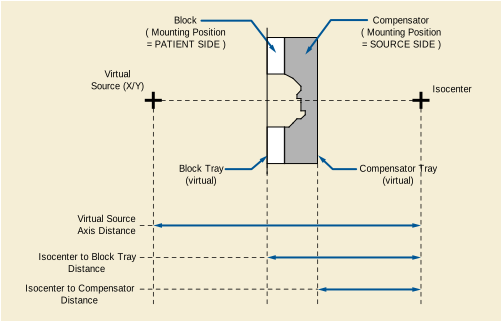
Examples: The use of the above attributes for snout positioning and block/compensator manufacturing:
Snout positioning:
The mounting positions as depicted in the drawing are only examples. As the block tray does not really exist in most of the cases, it is only used as a reference position. As some machines use the downstream face of the block as a reference position for their snout positioning, it could make sense to define for example that the block mounting position must be SOURCE_SIDE. In this case, one uses the downstream face of the block as the reference position, which is the same side as used by the machine. This definition is always independent of the actual thickness of the block. The Isocenter-Block Distance is defined and the machine can deduce the position of the snout from this value.
Scaling of block/compensator data for manufacturing
The Isocenter position is always used as the reference position for all distances measured 'from isocenter'. Real size block and compensator manufacturing should be based on the distance from the Virtual Source (X/Y) to the device, i.e., VirtualSourceToDeviceDistance = VirtualSAD - IsocenterToDeviceDistance.
The Range Shifter and Lateral Spreading Device Settings attributes are used to capture machine specific values related to these devices. For example, some machines may specify the Range Shifter setting as the desired Water-Equivalent Thickness (in mm). Others contain a series of interchangeable plates, whose position in or out of the beam is specified by a series of ones and zeros (i.e., 100010 would specify that plates #1 and #5 are in the beam. If the device does not a specific setting, but rather is defined by the ID, then the Enumerated Values IN/OUT shall be used for the setting.
Where explicitly specified, the coordinate systems defined by IEC 61217 shall be applied, with the exception of the IEC Patient Coordinate System.
In addition, the following sections define the coordinate systems to be used in situations where IEC 61217 coordinate systems are not applicable. No other coordinate systems shall be used.
The direction of fixed beam-line can be described as a gantry system, provided that the position of the (virtual) gantry bearing is defined. The relation between their patient support coordinate system axes and the choice of the 'gantry' angle, e.g., 90 or 270 deg, shall be consistent with a standard gantry coordinate system. All coordinate systems derived from the IEC GANTRY coordinate system (BEAM LIMITING DEVICE, WEDGE, X-RAY IMAGE RECEPTOR) automatically follow in the same way as defined in a 'real' gantry system.
The IEC PATIENT SUPPORT system is linked to the IEC GANTRY coordinate system through its common parent system, the IEC FIXED coordinate system. The Y-axis of IEC GANTRY points towards the (virtual) gantry bearing. The Y-axis of the IEC FIXED coordinate system has to point in the same direction. Z-axis in IEC FIXED coordinate system is always pointing upwards. With Y and Z-axes defined, the X-axis of IEC FIXED is also given.
Figure C.8.8.25-2a and Figure C.8.8.25-2b show IEC FIXED (F), GANTRY (G) and PATIENT SUPPORT (S) coordinate systems for a horizontal fixed beam-line.
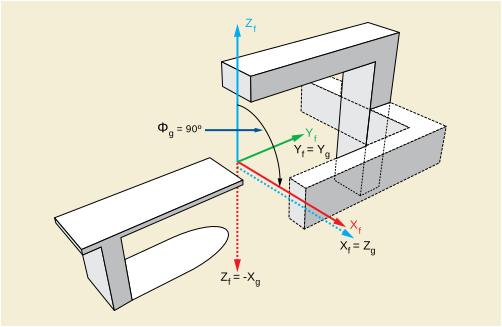
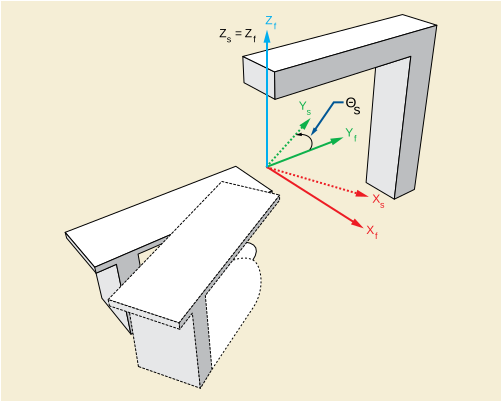
For further information, see Section C.8.8.14.12.
RT Ion Plan contains an attribute Patient Support Type (300A,0350), which can be CHAIR or TABLE. The patient support type CHAIR does not change the coordinate axes of the patient support coordinate systems relative to their parent systems. It is more an attribute of the type like the patient position in imaging (i.e., HFS, HFP, …).
The orientation of the treatment chair shall be defined with the chair positioned in such way, that the patient looks towards the gantry bearing (or along the Y axis of the IEC FIXED system) if all angles, especially IEC PATIENT SUPPORT angle are 0°. All other parameters follow straight forward, once this definition is accepted. i.e., chair rotation is a rotation of IEC PATIENT SUPPORT coordinate system; a backward tilt of the chair is a positive rotation of the PITCHED TABLE TOP coordinate system. A translation of the chair is a translation of the IEC TABLE TOP system.
The roll angle is typically 0º.
For a seated treatment on a horizontal beam-line, the following angles are therefore defined:If IEC GANTRY angle is 90º (270º), IEC PATIENT SUPPORT angle is 270º (90º) for the position where the patient looks into the beam port.
Eye treatments on the gantry shall use all existing IEC coordinate systems with their standard definition. This applies especially to IEC BEAM LIMITING DEVICE, IEC WEDGE FILTER, IEC X-RAY IMAGE RECEPTOR.
IEC PATIENT SUPPORT, and IEC TABLE TOP coordinate systems are defined as above. Additionally, a rotation of the head fixation device is possible. The Head Fixation Angle (300A,0148) shall be defined as the angle of the head fixation device with respect to the TABLE TOP coordinate system. Positive head fixation angle is in the same direction as positive PATIENT SUPPORT pitch, i.e., backwards.
Proton eye treatments require an additional coordinate system for the placement of the fixation light. Since it is usually mounted onto the beam port the 'natural' coordinate system for devices mounted there is the IEC BEAM LIMITING DEVICE coordinate system. The angles for the fixation light positions shall therefore be defined as follows:
Rotation of the fixation light about the IEC BEAM LIMITING DEVICE Z-axis (Zb) is defined as Azimuthal Angle. The Azimuthal Angle is equal to 0° when the fixation light is positioned on the axis Xb of the IEC BEAM LIMITING DEVICE coordinate system. An increase in the value of the Azimuthal Angle corresponds to clockwise rotation of the fixation light as view along the axis Zb towards the virtual source.
The polar angle is always positive and defined as the angle between IEC BEAM LIMITING DEVICE Z-axis and the line connecting isocenter with the fixation light position.
Proton eye treatments require the wedge thin edge position as one additional. The wedge thin edge position allows the specification of a wedge, which does not cover the full open field. The wedge thin edge position is positive, if the wedge does not cover the isocenter position and negative, if it does cover.
Figure C.8.8.25-5 and Figure C.8.8.25-6 show the angles and attributes as described above.
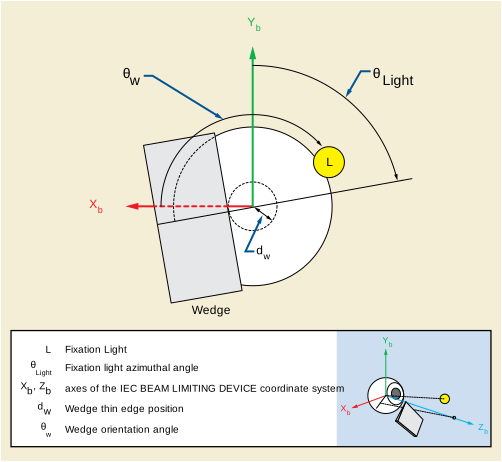
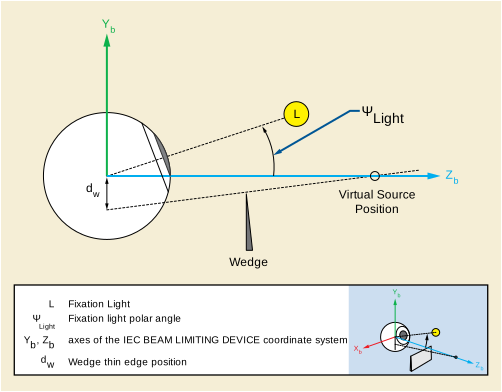
The coordinate systems for the treatment chair are defined above and shall also be applied to seated eye treatments.
In this case, it is recommended that a beam limiting device angle of 90º be formally applied (provided the gantry angle is defined to be 90º (and not 270º). This results in the same coordinates of the fixation light and wedge relative to the patient as in the treatment situation with the patient lying on the table.
The Gantry Pitch Angle is not defined in IEC 61217. This angle is defined in the DICOM standard in a way compatible with the current notion of IEC by introducing it as rotation of the IEC GANTRY System as indicated below.
The Gantry Pitch Angle is defined as the rotation of the coordinate axes Yg, Zg about axis Xg by an angle ψg; See Figure C.8.8.25-7. An increase in the value of angle ψg corresponds to the clockwise rotation as viewed from the isocenter along the positive Xg axis
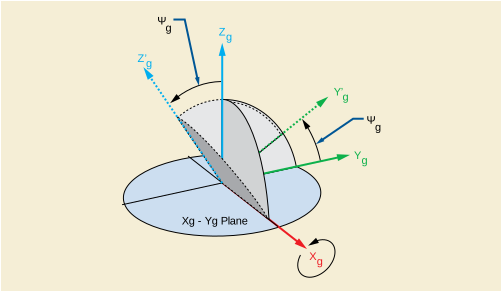
The control point sequence for RT Ion Beams is defined using the same rule set as in the RT Beams module (see Section C.8.8.14.5). Specifically, the following rules apply:
All parameters that change at any control point of a given beam shall be specified explicitly at all control points (including those preceding the change).
All parameters of an irradiation segment (i.e., with values of the Cumulative Meterset Weight (300A,0134) different at the beginning and at the end of the segment) shall therefore be specified in 2 separate control points denoting the beginning and at the end of this segment. Each irradiation segment is therefore represented by 2 control points.
Parameters changing during the segment shall be represented by their different values at those control points. Parameters that do not change during the segment shall be represented with equal values at both control points (unless they are constant for all control points of the beam). For example, a beam delivery involving two independent irradiation segments will require 4 control points. Control Points 0 and 1 define the first irradiation segment. Between control points 1 and 2, no radiation is given (Meterset is constant), but other parameters may change. Finally, the second irradiation segment occurs between control points 2 and 3.
This definition allows unambiguous and explicit determination of those parameters changing while irradiation is occurring, as opposed to those parameters that change between irradiation segments. No assumptions are made about the behavior of machine parameters between specified control points, and communicating devices shall agree on this behavior outside the standard.
The following example illustrates this rule (not all parameters are shown), in the case of a scanning beam with 2 segments and Total Cumulative Meterset of 70.
Control Point 0: All applicable treatment parameters defined, Cumulative Meterset Weight = 0 Nominal Energy: 200 Scan Spot Position Map: -40, -35, -40, -30 (Positions for 1st segment) Scan Spot Meterset Weight: 0.5, 0.3, 1.2, (Values add up to Meterset difference between Control Points 0 and 1)
Control Point 1: All applicable treatment parameters defined, Cumulative Meterset Weight = 30.0 Nominal Energy: 200 Scan Spot Position Map: -40, -35, -40, -30 (Positions for 1st segment) Scan Spot Meterset Weight:0.0, 0.0, 0.0, … (All values are 0.0, because Meterset Weight difference between Control Point 1 and 2 is 0.0)
Control Point 2: All applicable treatment parameters defined, Cumulative Meterset Weight = 30.0 Nominal Energy: 180 Scan Spot Position Map: -55, -40, -55, -35, (Positions for 2nd segment) Spot Meterset Weight: 0.7, 0.8, 1.5 (Values add up to Meterset difference between Control Points 2 and 3)
Control Point 3: All applicable treatment parameters defined, Cumulative Meterset Weight = 70.0 Nominal Energy: 180 Scan Spot Position Map: -55, -40, -55, -35, (Positions for 2nd segment) Spot Meterset Weight: 0.0, 0.0, 0.0, (All values are 0.0, because there is no following control point (end of sequence).
Table C.8.8.26-1 specifies the Attributes that describe the measured and recorded settings acquired during Ion Radiation Treatments.
Table C.8.8.26-1. RT Ion Beams Session Record Module Attributes
|
Attribute Name |
Tag |
Type |
Description |
|---|---|---|---|
|
Referenced Fraction Group Number |
(300C,0022) |
3 |
Identifier of fraction group within referenced RT Ion Plan. |
|
Number of Fractions Planned |
(300A,0078) |
2 |
Total number of treatments (fractions) planned for current fraction group. |
|
Primary Dosimeter Unit |
(300A,00B3) |
1 |
Measurement unit of the machine dosimeter. Enumerated Values:
|
|
Treatment Session Ion Beam Sequence |
(3008,0021) |
1 |
Sequence of setup and/or treatment beams administered during treatment session. One or more items shall be included in this sequence. |
|
>Referenced Beam Number |
(300C,0006) |
1 |
References Beam specified by Beam Number (300A,00C0) in Ion Beam Sequence (300A,03A2) in RT Ion Beams Module within the referenced RT Ion Plan. |
|
>Beam Name |
(300A,00C2) |
1 |
User-defined name for Beam. See Section C.8.8.25.1. |
|
>Beam Description |
(300A,00C3) |
3 |
User-defined description for Beam. See Section C.8.8.25.1. |
|
>Beam Type |
(300A,00C4) |
1 |
Motion characteristic of Beam. Enumerated Values:
|
|
>Radiation Type |
(300A,00C6) |
1 |
Particle type of Beam. Defined Terms:
|
|
>Radiation Mass Number |
(300A,0302) |
1C |
Mass number of radiation. Required if Radiation Type (300A,00C6) is ION |
|
>Radiation Atomic Number |
(300A,0304) |
1C |
Atomic number of radiation. Required if Radiation Type (300A,00C6) is ION |
|
>Radiation Charge State |
(300A,0306) |
1C |
Charge state of radiation. Required if Radiation Type (300A,00C6) is ION |
|
>Scan Mode |
(300A,0308) |
1 |
The method of beam scanning used during treatment. Defined Terms:
|
|
>Referenced Tolerance Table Number |
(300C,00A0) |
3 |
Uniquely identifies Ion Tolerance Table specified by Tolerance Table Number (300A,0042) within Ion Tolerance Table Sequence in RT Ion Tolerance Tables Module. These tolerances are to be used for verification of treatment machine settings. |
|
>Beam Limiting Device Leaf Pairs Sequence |
(3008,00A0) |
3 |
Sequence of beam limiting device (collimator) jaw or leaf (element) sets. One or more items are permitted in this sequence. |
|
>>RT Beam Limiting Device Type |
(300A,00B8) |
1 |
Type of beam limiting device (collimator). Enumerated Values:
|
|
>>Number of Leaf/Jaw Pairs |
(300A,00BC) |
1 |
Number of leaf (element) or jaw pairs (equal to 1 for standard beam limiting device jaws). |
|
>Referenced Patient Setup Number |
(300C,006A) |
3 |
Uniquely identifies Ion Patient Setup to be used for current beam, specified by Patient Setup Number (300A,0182) within Patient Setup Sequence of RT Patient Setup Module. |
|
>Referenced Verification Image Sequence |
(300C,0040) |
3 |
Sequence of verification images obtained during delivery of current beam. One or more items are permitted in this sequence. See Section C.8.8.14.2. |
|
>>Include Table 10-11 “SOP Instance Reference Macro Attributes” |
|||
|
>Referenced Measured Dose Reference Sequence |
(3008,0080) |
3 |
Sequence of doses measured during treatment delivery for current Beam. One or more Items are permitted in this sequence. |
|
>>Referenced Dose Reference Number |
(300C,0051) |
1C |
Uniquely references Dose Reference specified by Dose Reference Number (300A,0012) in Dose Reference Sequence (300A,0010) in RT Prescription Module of referenced RT Ion Plan. Required if Referenced Measured Dose Reference Number (3008,0082) is not sent. |
|
>>Referenced Measured Dose Reference Number |
(3008,0082) |
1C |
Uniquely references Measured Dose Reference specified by Measured Dose Reference Number (3008,0064) in Measured Dose Reference Sequence (3008,0010). Required if Referenced Dose Reference Number (300C,0051) is not sent. |
|
>>Measured Dose Value |
(3008,0016) |
1 |
Measured Dose in units specified by Dose Units (3004,0002) in sequence referenced by Measured Dose Reference Sequence (3008,0010) or Dose Reference Sequence (300A,0010) in RT Prescription Module of Referenced RT Ion Plan as defined above. |
|
>Referenced Calculated Dose Reference Sequence |
(3008,0090) |
3 |
Sequence of doses estimated for each treatment delivery. One or more Items are permitted in this sequence. |
|
>>Referenced Dose Reference Number |
(300C,0051) |
1C |
Uniquely identifies Dose Reference specified by Dose Reference Number (300A,0012) in Dose Reference Sequence (300A,0010) in RT Prescription Module of referenced RT Ion Plan. Required if Referenced Calculated Dose Reference Number (3008,0092) is not sent. |
|
>>Referenced Calculated Dose Reference Number |
(3008,0092) |
1C |
Uniquely identifies Calculated Dose Reference specified by Calculated Dose Reference Number (3008,0072) within Calculated Dose Reference Sequence (3008,0070). Required if Referenced Dose Reference Number (300C,0051) is not sent. |
|
>>Calculated Dose Reference Dose Value |
(3008,0076) |
1 |
Calculated Dose (Gy). |
|
>Number of Wedges |
(300A,00D0) |
1 |
Number of wedges associated with current beam. |
|
>Recorded Wedge Sequence |
(3008,00B0) |
1C |
Sequence of treatment wedges. Required if Number of Wedges (300A,00D0) is non-zero. One or more items shall be included in this sequence. The number of items shall be identical to the value of Number of Wedges (300A,00D0). |
|
>>Wedge Number |
(300A,00D2) |
1 |
Identification number of the Wedges. The value of Wedge Number (300A,00D2) shall be unique within the Beam in which it was created. |
|
>>Wedge Type |
(300A,00D3) |
2 |
Type of wedge (if any) defined for Beam. Defined Terms:
|
|
>>Wedge ID |
(300A,00D4) |
3 |
User-supplied identifier for Wedge. |
|
>>Accessory Code |
(300A,00F9) |
3 |
An accessory identifier to be read by a device such as a bar code reader. |
|
>>Wedge Angle |
(300A,00D5) |
2 |
Nominal wedge angle (degrees). |
|
>>Wedge Orientation |
(300A,00D8) |
2 |
Orientation of wedge, i.e., orientation of IEC WEDGE FILTER coordinate system with respect to the IEC BEAM LIMITING DEVICE coordinate systems (degrees). |
|
>Number of Compensators |
(300A,00E0) |
1 |
Number of range compensators associated with current Beam. |
|
>Recorded Compensator Sequence |
(3008,00C0) |
1C |
Sequence of treatment compensators. Required if Number of Compensators (300A,00E0) is non-zero. One or more items shall be included in this sequence. The number of items shall be identical to the value of Number of Compensators (300A,00E0). |
|
>>Referenced Compensator Number |
(300C,00D0) |
1 |
Uniquely identifies compensator specified by Compensator Number (300A,00E4) within Beam referenced by Referenced Beam Number (300C,0006). |
|
>>Compensator ID |
(300A,00E5) |
3 |
User-supplied identifier for compensator. |
|
>>Accessory Code |
(300A,00F9) |
3 |
An accessory identifier to be read by a device such as a bar code reader. |
|
>Number of Boli |
(300A,00ED) |
1 |
Number of boli associated with current Beam. |
|
>Referenced Bolus Sequence |
(300C,00B0) |
1C |
Sequence of boli associated with Beam. Required if Number of Boli (300A,00ED) is non-zero. One or more items shall be included in this sequence. The number of items shall be identical to the value of Number of Boli (300A,00ED). |
|
>>Referenced ROI Number |
(3006,0084) |
1 |
Uniquely identifies ROI representing the Bolus specified by ROI Number (3006,0022) in Structure Set ROI Sequence (3006,0020) in Structure Set Module within RT Structure Set in Referenced Structure Set Sequence (300C,0060) in RT General Plan Module. |
|
>>Accessory Code |
(300A,00F9) |
3 |
An accessory identifier to be read by a device such as a bar code reader. |
|
>Number of Blocks |
(300A,00F0) |
1 |
Number of shielding blocks associated with Beam. |
|
>Recorded Block Sequence |
(3008,00D0) |
1C |
Sequence of blocks associated with Beam. Required if Number of Blocks (300A,00F0) is non-zero. One or more items shall be included in this sequence. The number of items shall be identical to the value of Number of Blocks (300A,00F0). |
|
>>Block Tray ID |
(300A,00F5) |
3 |
User-supplied identifier for block tray. |
|
>>Accessory Code |
(300A,00F9) |
3 |
An accessory identifier to be read by a device such as a bar code reader. |
|
>>Referenced Block Number |
(300C,00E0) |
1 |
Uniquely identifies block specified by Block Number (300A,00FC) within Beam referenced by Referenced Beam Number (300C,0006). |
|
>>Block Name |
(300A,00FE) |
3 |
User-defined name for block. |
|
>Recorded Snout Sequence |
(3008,00F0) |
1C |
Sequence of Snouts associated with Beam. Required if Snout Sequence (300A,030C) is included in the RT Ion Plan referenced within the Referenced RT Plan Sequence (300C,0002). Only a single item shall be included in this sequence. |
|
>>Snout ID |
(300A,030F) |
1 |
User or machine supplied identifier for Snout. |
|
>>Accessory Code |
(300A,00F9) |
3 |
An accessory identifier to be read by a device such as a bar code reader. |
|
>Applicator Sequence |
(300A,0107) |
1C |
Sequence of Applicators associated with Beam. Required if Applicator Sequence (300A,0107) is included in the RT Ion Plan referenced within the Referenced RT Plan Sequence (300C,0002). Only a single item shall be included in this sequence. |
|
>>Applicator ID |
(300A,0108) |
1 |
User or machine supplied identifier for Applicator. |
|
>>Accessory Code |
(300A,00F9) |
3 |
An accessory identifier to be read by a device such as a bar code reader. |
|
>>Applicator Type |
(300A,0109) |
1 |
Type of applicator. Defined Terms:
|
|
>>Applicator Description |
(300A,010A) |
3 |
User-defined description for Applicator. |
|
>General Accessory Sequence |
(300A,0420) |
3 |
Introduces a Sequence of General Accessories associated with this Beam. One or more items are permitted in this sequence. |
|
>>General Accessory Number |
(300A,0424) |
1 |
Identification Number of the General Accessory. The value shall be unique within the sequence. |
|
>>General Accessory ID |
(300A,0421) |
1 |
User or machine supplied identifier for General Accessory. |
|
>>General Accessory Description |
(300A,0422) |
3 |
User supplied description of General Accessory. |
|
>>General Accessory Type |
(300A,0423) |
3 |
Specifies the type of accessory. Defined Terms:
|
|
>>Accessory Code |
(300A,00F9) |
3 |
Machine-readable identifier for this accessory |
|
>>Source to General Accessory Distance |
(300A,0425) |
3 |
Radiation source to general accessory distance (in mm) for current accessory. |
|
>Number of Range Shifters |
(300A,0312) |
1 |
Number of range shifters associated with current beam. |
|
>Recorded Range Shifter Sequence |
(3008,00F2) |
1C |
Sequence of range shifters recorded with Beam. Required if Number of Range Shifters (300A,0312) is non-zero. One or more items shall be included in this sequence. The number of items shall be identical to the value of Number of Range Shifters (300A,0312). |
|
>>Referenced Range Shifter Number |
(300C,0100) |
1 |
Uniquely identifies range shifter specified by Range Shifter Number (300A,0316) within Beam referenced by Referenced Beam Number (300C,0006). |
|
>>Range Shifter ID |
(300A,0318) |
1 |
User or machine supplied identifier for Range Modulator. |
|
>>Accessory Code |
(300A,00F9) |
3 |
An accessory identifier to be read by a device such as a bar code reader. |
|
>Number of Lateral Spreading Devices |
(300A,0330) |
1 |
Number of lateral spreading devices associated with current beam. |
|
>Recorded Lateral Spreading Device Sequence |
(3008,00F4) |
1C |
Sequence of lateral spreading devices associated with Beam. Required if Number of Lateral Spreading Devices (300A,0330) is non-zero. One or more items shall be included in this sequence. The number of items shall be identical to the value of Number of Lateral Spreading Devices (300A,0330). |
|
>>Referenced Lateral Spreading Device Number |
(300C,0102) |
1 |
Uniquely identifies lateral spreading device specified by Lateral Spreading Device Number (300A,0334) within Beam referenced by Referenced Beam Number (300C,0006). |
|
>>Lateral Spreading Device ID |
(300A,0336) |
1 |
User or machine supplied identifier for Lateral Spreading Device. |
|
>>Accessory Code |
(300A,00F9) |
3 |
An accessory identifier to be read by a device such as a bar code reader. |
|
>Number of Range Modulators |
(300A,0340) |
1 |
Number of range modulators associated with current beam. |
|
>Recorded Range Modulator Sequence |
(3008,00F6) |
1C |
Sequence of range modulators associated with Beam. Required if Number of Range Modulators (300A,0340) is non-zero. One or more items shall be included in this sequence. The number of items shall be identical to the value of Number of Range Modulators (300A,0340). |
|
>>Referenced Range Modulator Number |
(300C,0104) |
1 |
Uniquely identifies range modulator specified by Range Modulator Number (300A,0344) within Beam referenced by Referenced Beam Number (300C,0006). |
|
>>Range Modulator ID |
(300A,0346) |
1 |
User or machine supplied identifier for Range Modulator. |
|
>>Accessory Code |
(300A,00F9) |
3 |
An accessory identifier to be read by a device such as a bar code reader. |
|
>>Range Modulator Type |
(300A,0348) |
1 |
Type of Range Modulator. Defined Terms:
Only one item in the Recorded Range Modulator Sequence (3008,00F6) can have a Range Modulator Type (300A,0348) of WHL_MODWEIGHTS. |
|
>>Beam Current Modulation ID |
(300A,034C) |
1C |
User-supplied identifier for the beam current modulation pattern. Required if Range Modulator Type (300A,0348) is WHL_MODWEIGHTS |
|
>Include Table C.8.8.28-1 “Patient Support Identification Macro Attributes” |
|||
|
>Fixation Light Azimuthal Angle |
(300A,0356) |
3 |
Azimuthal angle (degrees) of the fixation light coordinate around IEC PATIENT SUPPORT Y-axis. Used for eye treatments. See Section C.8.8.25.6.4. |
|
>Fixation Light Polar Angle |
(300A,0358) |
3 |
Polar angle (degrees) of the fixation light coordinate. Used for eye treatments. See Section C.8.8.25.6.4. |
|
>Current Fraction Number |
(3008,0022) |
2 |
Fraction number for this beam administration. |
|
>Treatment Delivery Type |
(300A,00CE) |
2 |
Delivery Type of treatment. Defined Terms:
|
|
>Treatment Termination Status |
(3008,002A) |
1 |
Conditions under which treatment was terminated. Enumerated Values:
|
|
>Treatment Termination Code |
(3008,002B) |
3 |
Treatment machine termination code. This code is dependent upon the particular application and equipment. |
|
>Treatment Verification Status |
(3008,002C) |
2 |
Conditions under which treatment was verified by a verification system. Enumerated Values:
|
|
>Specified Primary Meterset |
(3008,0032) |
3 |
Desired machine setting of primary Meterset in units specified by Primary Dosimeter Unit (300A,00B3). See Section C.8.8.26.1. |
|
>Specified Secondary Meterset |
(3008,0033) |
3 |
Desired machine setting of secondary Meterset. See Section C.8.8.26.1. |
|
>Delivered Primary Meterset |
(3008,0036) |
3 |
Machine setting actually delivered as recorded by primary Meterset in units specified by Primary Dosimeter Unit (300A,00B3). See Section C.8.8.26.1. |
|
>Delivered Secondary Meterset |
(3008,0037) |
3 |
Machine setting actually delivered as recorded by secondary Meterset. See Section C.8.8.26.1. |
|
>Specified Treatment Time |
(3008,003A) |
3 |
Treatment Time set (sec). |
|
>Delivered Treatment Time |
(3008,003B) |
3 |
Treatment Time actually delivered (sec). |
|
>Number of Control Points |
(300A,0110) |
1 |
Number of control points in Beam. |
|
>Ion Control Point Delivery Sequence |
(3008,0041) |
1 |
Sequence of beam control points for current ion treatment beam. One or more items shall be included in this sequence. The number of items shall be identical to the value of Number of Control Points (300A,0110). See Section C.8.8.21.1. |
|
>>Referenced Control Point Index |
(300C,00F0) |
1 |
Uniquely identifies Control Point specified by Control Point Index (300A,0112) within the Beam referenced by Referenced Beam Number (300C,0006). |
|
>>Treatment Control Point Date |
(3008,0024) |
1 |
Date when the delivery of radiation at this control point began. For the final control point this shall be the Date when the previous control point ended. |
|
>>Treatment Control Point Time |
(3008,0025) |
1 |
Time when the delivery of radiation at this control point began. For the final control point this shall be the Time when the previous control point ended. |
|
>>Specified Meterset |
(3008,0042) |
2 |
Desired machine setting for current control point in units specified by Primary Dosimeter Unit (300A,00B3). |
|
>>Delivered Meterset |
(3008,0044) |
1 |
Machine setting actually delivered at current control point in units specified by Primary Dosimeter Unit (300A,00B3). |
|
>>Meterset Rate Set |
(3008,0045) |
3 |
The specified speed of delivery of the specified dose in units specified by Primary Dosimeter Unit (300A,00B3) per minute. |
|
>>Meterset Rate Delivered |
(3008,0046) |
3 |
The delivered speed of delivery of the specified dose in units specified by Primary Dosimeter Unit (300A,00B3) per minute. |
|
>>Nominal Beam Energy |
(300A,0114) |
1C |
Nominal Beam Energy at control point in MeV per nucleon. Defined at nozzle entrance before all Beam Modifiers. Required for Control Point 0 of Ion Control Point Delivery Sequence (3008,0041) or if Nominal Beam Energy (300A,0114) changes during beam administration, and KVP (0018,0060) is not present. |
|
>>KVP |
(0018,0060) |
1C |
Peak kilo voltage output of the setup X-Ray generator used. Required for Control Point 0 of Ion Control Point Delivery Sequence (3008,0041), or if kVp changes during setup, and Nominal Beam Energy (300A,0114) is not present. |
|
>>Ion Wedge Position Sequence |
(300A,03AC) |
1C |
Sequence of Wedge positions for current control point. Required for first item of Ion Control Point Sequence if Number of Wedges (300A,00D0) is non-zero, and in subsequent control points if Wedge Position (300A,0118) or Wedge Thin Edge Position (300A,00DB) changes during beam. One or more items shall be included in this sequence. The number of items shall be identical to the value of Number of Wedges (300A,00D0). |
|
>>>Referenced Wedge Number |
(300C,00C0) |
1 |
Uniquely references Wedge described by Wedge Number (300A,00D2) in Wedge Sequence (300A,00D1). |
|
>>>Wedge Position |
(300A,0118) |
1 |
Position of Wedge at current control point. Enumerated Values:
|
|
>>>Wedge Thin Edge Position |
(300A,00DB) |
1C |
Closest distance from the central axis of the beam along a wedge axis to the thin edge as projected to the machine isocentric plane (mm). Value is positive is the wedge does not cover the central axis, negative if it does. Required if Wedge Type (300A,00D3) of the wedge referenced by Referenced Wedge Number (300C,00C0) is PARTIAL_STANDARD or PARTIAL_MOTORIZ. See Section C.8.8.25.6.4. |
|
>>Include Table C.8.8.27-1 “Beam Limiting Device Position Macro Attributes” |
|||
|
>>Range Shifter Settings Sequence |
(300A,0360) |
1C |
Sequence of Range Shifter settings for the current control point. One or more items shall be included in this sequence. Required for Control Point 0 of Ion Control Point Delivery Sequence (3008,0041) or if Range Shifter Setting (300A,0362) changes during beam administration,and Number of Range Shifters (300A,0312) is non-zero. |
|
>>>Referenced Range Shifter Number |
(300C,0100) |
1 |
Uniquely references Range Shifter described by Range Shifter Number (300A,0316) in Range Shifter Sequence (300A,0314). |
|
>>>Range Shifter Setting |
(300A,0362) |
1 |
Machine specific setting attribute for the range shifter. The specific encoding of this value should be documented in a Conformance Statement. See Section C.8.8.25.5. |
|
>>Lateral Spreading Device Settings Sequence |
(300A,0370) |
1C |
Sequence of Lateral Spreading Device settings for the current control point. One or more items shall be included in this sequence. Required for Control Point 0 of Ion Control Point Delivery Sequence (3008,0041) or if Lateral Spreading Device Setting (300A,0372) changes during beam administration, and Number of Lateral Spreading Devices (300A,0330) is non-zero. |
|
>>>Referenced Lateral Spreading Device Number |
(300C,0102) |
1 |
Uniquely references Lateral Spreading Device described by Lateral Spreading Device Number (300A,0334) in Lateral Spreading Device Sequence (300A,0332). |
|
>>>Lateral Spreading Device Setting |
(300A,0372) |
1 |
Machine specific setting attribute for the lateral spreading device. The specific encoding of this value should be documented in a Conformance Statement. See Section C.8.8.25.5. |
|
>>Range Modulator Settings Sequence |
(300A,0380) |
1C |
Sequence of Range Modulator Settings for current control point. One or more items shall be included in this sequence. Required for Control Point 0 of Ion Control Point Delivery Sequence (3008,0041), or if Range Modulator Settings change during beam administration, and Number of Range Modulators (300A,0340) is non-zero. |
|
>>>Referenced Range Modulator Number |
(300C,0104) |
1 |
Uniquely references Range Modulator described by Range Modulator Number (300A,0344) in Range Modulator Sequence (300A,0342). |
|
>>>Range Modulator Gating Start Value |
(300A,0382) |
1C |
Start position defines the range modulator position at which the beam is switched on. Required if Range Modulator Type (300A,0348) of the range modulator referenced by Referenced Range Modulator Number (300C,0104) is WHL_MODWEIGHTS or WHL_FIXEDWEIGHTS |
|
>>>Range Modulator Gating Stop Value |
(300A,0384) |
1C |
Stop position defines the range modulator position at which the beam is switched off. Required if Range Modulator Type (300A,0348) of the range modulator referenced by Referenced Range Modulator Number (300C,0104) is WHL_MODWEIGHTS or WHL_FIXEDWEIGHTS |
|
>>Gantry Angle |
(300A,011E) |
1C |
Treatment machine gantry angle, i.e., orientation of IEC GANTRY coordinate system with respect to IEC FIXED REFERENCE coordinate system (degrees). Required for Control Point 0 of Ion Control Point Delivery Sequence (3008,0041) or if Gantry Angle changes during beam administration. |
|
>>Gantry Rotation Direction |
(300A,011F) |
1C |
Direction of Gantry Rotation when viewing gantry from isocenter, for segment beginning at current Control Point. Required for Control Point 0 of Ion Control Point Delivery Sequence (3008,0041), or if Gantry Rotation Direction changes during beam administration. Enumerated Values:
|
|
>>Gantry Pitch Angle |
(300A,014A) |
2C |
Gantry Pitch Angle. i.e., the rotation of the IEC GANTRY coordinate system about the X-axis of the IEC GANTRY coordinate system (degrees). Required for first item of Control Point Sequence, or if Gantry Pitch Rotation Angle changes during Beam. See Section C.8.8.25.6.5. |
|
>>Gantry Pitch Rotation Direction |
(300A,014C) |
2C |
Direction of Gantry Pitch Angle when viewing along the positive X-axis of the IEC GANTRY coordinate system, for segment following Control Point. Required for first item of Control Point Sequence, or if Gantry Pitch Rotation Direction changes during Beam. See Section C.8.8.14.8 and Section C.8.8.25.6.5. Enumerated Values:
|
|
>>Beam Limiting Device Angle |
(300A,0120) |
1C |
Beam Limiting Device (collimator) angle, i.e., orientation of IEC BEAM LIMITING DEVICE coordinate system with respect to IEC GANTRY coordinate system (degrees). Required for Control Point 0 of Ion Control Point Delivery Sequence (3008,0041) or if beam limiting device (collimator) angle changes during beam administration. |
|
>>Beam Limiting Device Rotation Direction |
(300A,0121) |
1C |
Direction of Beam Limiting Device Rotation when viewing beam limiting device (collimator) from radiation source, for segment beginning at current Control Point. Required for Control Point 0 of Ion Control Point Delivery Sequence (3008,0041) or if Beam Limiting Device Rotation Direction changes during beam administration. Enumerated Values:
|
|
>>Scan Spot Tune ID |
(300A,0390) |
1C |
User-supplied or machine code identifier for machine configuration to produce beam spot. This may be the nominal spot size or some other machine specific value. Required if Scan Mode (300A,0308) is MODULATED. |
|
>>Number of Scan Spot Positions |
(300A,0392) |
1C |
Number of spot positions used to specify scanning pattern for current segment beginning at control point. Required if Scan Mode (300A,0308) is MODULATED. |
|
>>Scan Spot Position Map |
(300A,0394) |
1C |
The x and y coordinates of the scan spots are defined as projected onto the machine isocentric plane in the IEC GANTRY coordinate system (mm). Required if Scan Mode (300A,0308) is MODULATED. Contains 2N values were N is the Number of Scan Spot Positions (300A,0392). |
|
>>Scan Spot Metersets Delivered |
(3008,0047) |
1C |
A data set of Metersets delivered to the scan spot positions. The order of Metersets matches the positions in Scan Spot Position Map (300A,0394). The sum contained in all Metersets shall match the difference of the Delivered Meterset of the current control point to the following control point. Required if Scan Mode (300A,0308) is MODULATED. |
|
>>Scanning Spot Size |
(300A,0398) |
3 |
The Scanning Spot Size as calculated using the Full Width Half Maximum (FWHM). Specified by a numeric pair - the size measured in air at isocenter in IEC GANTRY X direction followed by the size in the IEC GANTRY Y direction (mm). |
|
>>Number of Paintings |
(300A,039A) |
1C |
The intended number of times the scan pattern given by Scan Spot Position Map (300A,0394) and Scan Spot Meterset Weights (300A,0396) in the Referenced RT Plan was to be applied at the current control point. NoteThe actual number of paintings is not known or recorded. The Scan Spot Metersets Delivered (3008,0047) contains the sum of all complete and partial repaints. Required if Scan Mode (300A,0308) is MODULATED. |
|
>>Patient Support Angle |
(300A,0122) |
1C |
Patient Support angle, i.e., orientation of IEC PATIENT SUPPORT (turntable) coordinate system with respect to IEC FIXED REFERENCE coordinate system (degrees). Required for Control Point 0 of Ion Control Point Delivery Sequence (3008,0041) or if Patient Support Angle changes during beam administration. |
|
>>Patient Support Rotation Direction |
(300A,0123) |
1C |
Direction of Patient Support Rotation when viewing table from above, for segment beginning at current Control Point. Required for Control Point 0 of Ion Control Point Delivery Sequence (3008,0041), or if Patient Support Rotation Direction changes during beam administration. Enumerated Values:
|
|
>>Table Top Pitch Angle |
(300A,0140) |
2C |
Table Top Pitch Angle, i.e., the rotation of the IEC TABLE TOP coordinate system about the X-axis of the IEC TABLE TOP coordinate system (degrees). Required for first item of Control Point Sequence, or if Table Top Pitch Angle changes during Beam. See Section C.8.8.25.6.2. |
|
>>Table Top Pitch Rotation Direction |
(300A,0142) |
2C |
Direction of Table Top Pitch Rotation when viewing the table along the positive X-axis of the IEC TABLE TOP coordinate system, for segment following Control Point. Required for first item of Control Point Sequence, or if Table Top Pitch Rotation Direction changes during Beam. See Section C.8.8.14.8 and Section C.8.8.25.6.2. Enumerated Values:
|
|
>>Table Top Roll Angle |
(300A,0144) |
2C |
Table Top Roll Angle, i.e., the rotation of the IEC TABLE TOP coordinate system about the Y-axis of the IEC TABLE TOP coordinate system (degrees). Required for first item of Control Point Sequence, or if Table Top Roll Angle changes during Beam. See Section C.8.8.25.6.2. |
|
>>Table Top Roll Rotation Direction |
(300A,0146) |
2C |
Direction of Table Top Roll Rotation when viewing the table along the positive Y-axis of the IEC TABLE TOP coordinate system, for segment following Control Point. Required for first item of Control Point Sequence, or if Table Top Roll Rotation Direction changes during Beam. See Section C.8.8.14.8 and Section C.8.8.25.6.2. Enumerated Values:
|
|
>>Head Fixation Angle |
(300A,0148) |
3 |
Angle (in degrees) of the head fixation for eye treatments with respect to the Table Top Pitch Angle (300A,0140) coordinate system. Positive head fixation angle is the same direction as positive Table Top Pitch. See Section C.8.8.25.6.4. |
|
>>Table Top Vertical Position |
(300A,0128) |
2C |
Table Top Vertical position in IEC TABLE TOP coordinate system (mm). This value is interpreted as an absolute, rather than relative, Table setting. Required for Control Point 0 of Ion Control Point Delivery Sequence (3008,0041) or if Table Top Vertical Position changes during beam administration. |
|
>>Table Top Longitudinal Position |
(300A,0129) |
2C |
Table Top Longitudinal position in IEC TABLE TOP coordinate system (mm). This value is interpreted as an absolute, rather than relative, Table setting. Required for Control Point 0 of Ion Control Point Delivery Sequence (3008,0041) or if Table Top Longitudinal Position changes during beam administration. |
|
>>Table Top Lateral Position |
(300A,012A) |
2C |
Table Top Lateral position in IEC TABLE TOP coordinate system (mm). This value is interpreted as an absolute, rather than relative, Table setting. Required for Control Point 0 of Ion Control Point Delivery Sequence (3008,0041) or if Table Top Lateral Position changes during beam administration. |
|
>>Snout Position |
(300A,030D) |
2C |
Axial position of the snout (in mm) measured from isocenter to the downstream side of the snout (without consideration of variable length elements such as blocks, MLC and/or compensators). Required for Control Point 0 of Ion Control Point Delivery Sequence (3008,0041) or if Snout Position changes during beam administration. |
|
>>Corrected Parameter Sequence |
(3008,0068) |
3 |
Introduces a sequence of items describing corrections made to any attributes prior to delivery of the next control point. One or more Items are permitted in this sequence. |
|
>>>Parameter Sequence Pointer |
(3008,0061) |
1 |
Contains the Data Element Tag of the parent sequence containing the attribute that was corrected. The value is limited in scope to the Treatment Session Ion Beam Sequence (3008,0021) and all nested sequences therein. |
|
>>>Parameter Item Index |
(3008,0063) |
1 |
Contains the ones-based sequence item index of the corrected attribute within its parent sequence as indicated by Parameter Sequence Pointer (3008,0061). |
|
>>>Parameter Pointer |
(3008,0065) |
1 |
Contains the Data Element Tag of the attribute that was corrected. |
|
>>>Correction Value |
(3008,006A) |
1 |
The value that was added the value referenced by the Parameter Sequence Pointer (3008,0061), Parameter Item Index (3008,0063) and Parameter Pointer (3008,0065). |
|
>>Override Sequence |
(3008,0060) |
3 |
Sequence of parameters that were overridden during the administration of the beam segment immediately prior to the current control point. One or more Items are permitted in this sequence. |
|
>>>Parameter Sequence Pointer |
(3008,0061) |
1 |
Contains the Data Element Tag of the parent sequence containing the attribute that was overriden. The value is limited in scope to the Treatment Session Ion Beam Sequence (3008,0021) and all nested sequences therein. |
|
>>>Override Parameter Pointer |
(3008,0062) |
1 |
Contains the Data Element Tag of the attribute that was overridden. |
|
>>>Parameter Item Index |
(3008,0063) |
1 |
Contains the ones-based sequence item index of the overriden attributes within it's parent sequence. The value is limited in scope to the Treatment Session Ion Beam Sequence (3008,0021) and all nested sequences therein. |
|
>>>Operators' Name |
(0008,1070) |
2 |
Name of operator who authorized override. |
|
>>>Override Reason |
(3008,0066) |
3 |
User-defined description of reason for override of parameter specified by Override Parameter Pointer (3008,0062). |
Specified and Delivered Meterset values on beam and control point level shall be handled as specified for RT Beams Session records in Section C.8.8.21.2.
Table C.8.8.27-1 specifies the attributes that specify the Beam Limiting Device Sequence.
Table C.8.8.27-1. Beam Limiting Device Position Macro Attributes
|
Attribute Name |
Tag |
Type |
Description |
|---|---|---|---|
|
Beam Limiting Device Position Sequence |
(300A,011A) |
1C |
Sequence of beam limiting device (collimator) jaw or leaf (element) positions. One or more items shall be included in this sequence. Required if Ion Beam Limiting Device Sequence (300A,03A4) or Beam Limiting Device Leaf Pairs Sequence (3008,00A0) is included in this SOP instance and for first item of Ion Control Point Sequence, or if Beam Limiting Device changes during Beam. |
|
>RT Beam Limiting Device Type |
(300A,00B8) |
1 |
Type of beam limiting device (collimator). The value of this attribute shall correspond to RT Beam Limiting Device Type (300A,00B8) defined in an item of Ion Beam Limiting Device Sequence (300A,03A4). Enumerated Values:
|
|
>Leaf/Jaw Positions |
(300A,011C) |
1 |
Positions of beam limiting device (collimator) leaf (element) or jaw pairs (in mm) in IEC BEAM LIMITING DEVICE coordinate axis appropriate to RT Beam Limiting Device Type (300A,00B8), e.g., X-axis for MLCX, Y-axis for MLCY. Contains 2N values, where N is the Number of Leaf/Jaw Pairs (300A,00BC) in Ion Beam Limiting Device Sequence (300A,03A4). Values shall be listed in IEC leaf (element) subscript order 101, 102, … 1N, 201, 202, … 2N. See Section C.8.8.25.3. |
Table C.8.8.28-1 specifies the attributes that identify the Patient Support System.
Table C.8.8.28-1. Patient Support Identification Macro Attributes
|
Attribute Name |
Tag |
Type |
Description |
|---|---|---|---|
|
Patient Support Type |
(300A,0350) |
1 |
Defined Terms:
See Section C.8.8.25.6.3. |
|
Patient Support ID |
(300A,0352) |
3 |
User-specified identifier for manufacturer specific patient support devices. |
|
Patient Support Accessory Code |
(300A,0354) |
3 |
A Patient Support accessory identifier to be read by a device such as a bar code reader. |
The RT Beams Delivery Instruction Module contains additional information required by a Treatment Delivery System (TDS) when specifying delivery of an external beam radiotherapy treatment. This information is supplied by a Treatment Management System (TMS) when it creates an RT Beams Delivery Instruction SOP Instance, a composite SOP Instance in turn referenced by a Unified Procedure Step (UPS) in the Unified Procedure Step model.
The RT Beams Delivery Instruction Module consists of a sequence of one or more beam tasks, where each beam task may also specify one or more Delivery Verification images to be acquired prior to, during, or after the treatment delivery.
Table C.8.8.29-1. RT Beams Delivery Instruction Module Attributes
|
Attribute Name |
Tag |
Type |
Description |
|---|---|---|---|
|
Referenced RT Plan Sequence |
(300C,0002) |
1 |
Reference to a single RT Plan or RT Ion Plan SOP Instance (whose UID is also supplied in the Input Information Sequence - see PS3.4) containing all the Beams and the Fraction Group referenced in this SOP Instance. Only a single item shall be included in this sequence. |
|
>Include Table 10-11 “SOP Instance Reference Macro Attributes” |
|||
|
Beam Task Sequence |
(0074,1020) |
1 |
Specification of beams to be delivered and/or verified. One or more Items shall be included in this sequence. |
|
>Beam Task Type |
(0074,1022) |
1 |
Indication whether beam is to be verified, treated (delivered), or both. Enumerated Values:
|
|
>Treatment Delivery Type |
(300A,00CE) |
1 |
Delivery Type of treatment. Enumerated Values:
|
|
>Primary Dosimeter Unit |
(300A,00B3) |
1C |
Measurement unit of machine dosimeter. Enumerated Values:
This value shall be the same as in the referenced RT Plan. It applies only to the Continuation Start Meterset (0074,0120) and Continuation End Meterset (0074,0121). Required if Treatment Delivery Type (300A,00CE) is CONTINUATION. |
|
>Continuation Start Meterset |
(0074,0120) |
1C |
Meterset within Beam referenced by Referenced Beam Number (300C,0006) at which treatment delivery starts, in units specified by Primary Dosimeter Unit (300A,00B3). Required if Treatment Delivery Type (300A,00CE) is CONTINUATION. |
|
>Continuation End Meterset |
(0074,0121) |
1C |
Meterset within Beam referenced by Referenced Beam Number (300C,0006) at which treatment delivery ends, in units specified by Primary Dosimeter Unit (300A,00B3). Required if Treatment Delivery Type (300A,00CE) is CONTINUATION. |
|
>Current Fraction Number |
(3008,0022) |
1 |
The index of the fraction that is to be delivered or completed in this session. See Section C.8.8.29.1. |
|
>Referenced Fraction Group Number |
(300C,0022) |
1C |
Indicates which fraction group of the referenced plan is to be treated in the treatment session. Only one Fraction Group shall be specified per Delivery Instruction SOP Instance. Required if the referenced plan has more than one Fraction Group Sequence (300A,0070) item. |
|
>Referenced Beam Number |
(300C,0006) |
1 |
Uniquely identifies the Beam that is specified by Beam Number (300A,00C0) within Beam Sequence (300A,00B0) in RT Beams Module of referenced RT Plan or RT Ion Plan. |
|
>Beam Order Index |
(0074,1324) |
3 |
Identifies required ordering of beam delivery, monotonically increasing by 1, starting from 1. See Section C.8.8.29.5. |
|
>Autosequence Flag |
(0074,1025) |
3 |
Enumerated Values:
See Section C.8.8.29.6. |
|
>Table Top Vertical Adjusted Position |
(0074,1026) |
2 |
Adjusted Table Top Vertical position in the IEC TABLE TOP coordinate system in mm for patient setup. See Section C.8.8.29.2. |
|
>Table Top Longitudinal Adjusted Position |
(0074,1027) |
2 |
Adjusted Table Top Longitudinal position in the IEC TABLE TOP coordinate system in mm for patient setup. See Section C.8.8.29.2. |
|
>Table Top Lateral Adjusted Position |
(0074,1028) |
2 |
Adjusted Table Top Lateral position in the IEC TABLE TOP coordinate system in mm for patient setup. See Section C.8.8.29.2. |
|
>Patient Support Adjusted Angle |
(0074,102A) |
2 |
Adjusted Patient Support angle for patient setup, i.e., orientation of the IEC PATIENT SUPPORT coordinate system with respect to the IEC FIXED REFERENCE coordinate system in degrees. See Section C.8.8.29.2. |
|
>Table Top Eccentric Adjusted Angle |
(0074,102B) |
2 |
Adjusted Table Top (non-isocentric) angle for patient setup, i.e., orientation of the IEC TABLE TOP ECCENTRIC coordinate system with respect to the IEC PATIENT SUPPORT system in degrees. See Section C.8.8.29.2. |
|
>Table Top Pitch Adjusted Angle |
(0074,102C) |
2 |
Adjusted Table Top Pitch Angle for patient setup, i.e., the rotation of the IEC TABLE TOP coordinate system about the X-axis of the IEC TABLE TOP coordinate system in degrees. See Section C.8.8.29.2. |
|
>Table Top Roll Adjusted Angle |
(0074,102D) |
2 |
Adjusted Table Top Roll Angle for patient setup, i.e., the rotation of the IEC TABLE TOP coordinate system about the Y-axis of the IEC TABLE TOP coordinate system in degrees. See Section C.8.8.29.2. |
|
>Table Top Vertical Setup Displacement |
(300A,01D2) |
2 |
Vertical Displacement in the IEC TABLE TOP coordinate system in mm relative to initial Setup Position, i.e., vertical offset between patient positioning performed using setup and treatment position. |
|
>Table Top Longitudinal Setup Displacement |
(300A,01D4) |
2 |
Longitudinal Displacement in the IEC TABLE TOP coordinate system in mm relative to initial Setup Position, i.e., longitudinal offset between patient positioning performed using setup and treatment position. |
|
>Table Top Lateral Setup Displacement |
(300A,01D6) |
2 |
Lateral Displacement in the IEC TABLE TOP coordinate system in mm relative to initial Setup Position, i.e., lateral offset between patient positioning performed using setup and treatment position. |
|
>Delivery Verification Image Sequence |
(0074,1030) |
2C |
Beam verification images to be acquired for current beam. Required if Beam Task Type (0074,1022) is VERIFY or VERIFY_AND_TREAT. Zero or one Item shall be included in this sequence if Beam Task Type (0074,1022) is VERIFY. Zero or more Items shall be included in this sequence if Beam Task Type (0074,1022) is VERIFY_AND_TREAT. |
|
>>Verification Image Timing |
(0074,1032) |
1 |
Indicates the temporal relationship of the verification image with respect to the current treatment beam delivery. Value shall be DURING_BEAM for Beams with a Beam Task Type (0074,1022) of VERIFY. Enumerated Values:
|
|
>>Start Cumulative Meterset Weight |
(300C,0008) |
1C |
Cumulative Meterset Weight within current Beam at which image acquisition will start. Required if Verification Image Timing (0074,1032) is DURING_BEAM. |
|
>>Meterset Exposure |
(3002,0032) |
2C |
Treatment machine Meterset duration over which image is to be acquired, specified in Monitor units (MU) or minutes as defined by Primary Dosimeter Unit (300A,00B3) specified in the Referenced RT Plan Sequence (300C,0002). Required if Verification Image Timing (0074,1032) is BEFORE_BEAM or AFTER_BEAM. See Section C.8.8.29.3. |
|
>>End Cumulative Meterset Weight |
(300C,0009) |
2C |
Cumulative Meterset Weight within current Beam at which image acquisition will end. Required if Verification Image Timing (0074,1032) is DURING_BEAM. |
|
>>Double Exposure Flag |
(0074,1034) |
1 |
Indicates whether the current verification image is a single or double exposure. Enumerated Values:
|
|
>>Double Exposure Ordering |
(0074,1036) |
1C |
Indicates the ordering of the open (double exposure) field with respect to the primary (collimated) field in a double exposure. Defined Terms:
Required if Double Exposure Flag (0074,1034) is DOUBLE. |
|
>>Double Exposure Meterset |
(0074,1338) |
2C |
If this field is present, an additional exposure with the indicated Meterset is requested. Required if Double Exposure Flag (0074,1034) is DOUBLE. |
|
>>Double Exposure Field Delta |
(0074,133A) |
2C |
Offsets of field-defining edges in mm for the double exposure in the IEC BEAM LIMITING DEVICE coordinate system in the IEC order X1, X2, Y1, Y2. Negative values for X1 and Y1 indicate an enlarged field, negative values for X2 and Y2 indicate a reduced field. Required if Double Exposure Flag (0074,1034) is DOUBLE. See Section C.8.8.29.4. |
|
>>X-Ray Image Receptor Translation |
(3002,000D) |
2 |
Position in (x,y,z) coordinates in mm of origin of the IEC X-RAY IMAGE RECEPTOR System in the IEC GANTRY coordinate system. |
|
>>Related Reference RT Image Sequence |
(0074,1040) |
3 |
Uniquely identifies Reference Images to which planned verification image is related. All items in this sequence shall be RT Image SOP Instances. One or more items are permitted in this sequence. |
|
>>>Include Table 10-11 “SOP Instance Reference Macro Attributes” |
|||
For beams with a Treatment Delivery Type (300A,00CE) of CONTINUATION, the Current Fraction Number (3008,0022) is that of the original fraction to be completed by the current beam.
Adjusted Table positions and angles serve as a facility to communicate a shift (often systematic) that has been detected from previous treatments. They define a new initial patient position, which is near and aligned to the actual patient position during beam delivery. These attributes do not affect the original relationship between the beams and the planning image patient anatomy.
Meterset Exposure (3002,0032) can be interpreted as the 'maximum' Meterset duration in cases where an automatic exposure is taken.
The following diagram illustrates the case where the second X aperture in a double exposure is larger than the initial aperture. In this case ΔX1 is negative and ΔX2 is positive. If a field edge is defined by a multileaf collimator, then the field delta is to be applied to the most open leaf, such that all leaves can be moved to that position.
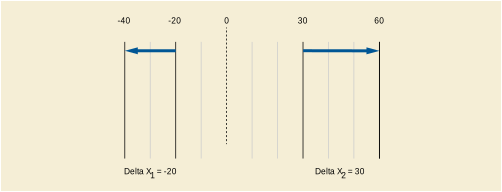
If the Beam Order Index (0074,1324) is present for any item in the Beam Task Sequence (0074,1020), it shall be provided for all items in that sequence.
Autosequence Flag (0074,1025) shall not be present when the Beam Order Index (0074,1324) is not present. The first treatment Beam (Beam Task Type (0074,1022) is not VERIFY) as specified by the Beam Order Index (0074,1324), shall have an Autosequence Flag (0074,1025) value of NO.
This Section describes Positron Emission Tomography series and image Modules. These Modules contain Attributes that are specific to Positron Emission Tomography images.
Table C.8-60 contains IOD Attributes that describe a PET Series.
Table C.8-60. PET Series Module Attributes
|
Attribute Name |
Tag |
Type |
Attribute Description |
|---|---|---|---|
|
Series Date |
(0008,0021) |
1 |
Date the Series started. See Section C.8.9.1.1.2 for specialization. |
|
Series Time |
(0008,0031) |
1 |
Time the Series started. See Section C.8.9.1.1.2 for specialization. |
|
Units |
(0054,1001) |
1 |
Pixel value units. See Section C.8.9.1.1.3 for explanation. Defined Terms:
|
|
SUV Type |
(0054,1006) |
3 |
Type of Standardized Uptake Value (SUV). Enumerated Values:
If absent, and the Units (0054,1001) are GML, then the type of SUV shall be assumed to be BW. NoteThe type of SUV cannot reliably be deduced from the units alone, i.e., SUVbw, SUVibw and SUVlbm all have units of GML. |
|
Counts Source |
(0054,1002) |
1 |
The primary source of counts. The primary source leads to the underlying image Units (0054,1001), as opposed to secondary sources that are used during reconstruction correction. Enumerated Values:
|
|
Series Type |
(0054,1000) |
1 |
A multi-valued indicator of the type of Series. See Section C.8.9.1.1.4 for explanation. Value 1 Enumerated Values:
Value 2 Enumerated Values:
|
|
Reprojection Method |
(0054,1004) |
2C |
Method for projecting volumetric data onto planar projection. Required if Series Type (0054,1000), Value 2 is REPROJECTION. Defined Terms:
|
|
Number of R-R Intervals |
(0054,0061) |
1C |
The maximum number of R-R Intervals that may exist in this Series. Required if Series Type (0054,1000), Value 1 is GATED. |
|
Number of Time Slots |
(0054,0071) |
1C |
The maximum number of Time Slots that may exist in this Series. Required if Series Type (0054,1000), Value 1 is GATED. |
|
Number of Time Slices |
(0054,0101) |
1C |
The maximum number of Time Slices that may exist in this Series. Required if Series Type (0054,1000), Value 1 is DYNAMIC. |
|
Number of Slices |
(0054,0081) |
1 |
The maximum number of Slices that may exist in this Series. |
|
Corrected Image |
(0028,0051) |
2 |
One or more values that indicate which, if any, corrections have been applied to the images in this series. Defined Terms:
|
|
Randoms Correction Method |
(0054,1100) |
3 |
Type of randoms correction processing. Defined Terms:
|
|
Attenuation Correction Method |
(0054,1101) |
3 |
A textual description of the attenuation correction processing. e.g., measured vs. calculated, transmission source type (ring, line, point), assumed patient geometry (polygon, ellipse, segmented, attenuation coefficient, skull thickness), post-injection transmission, smoothing. |
|
Scatter Correction Method |
(0054,1105) |
3 |
A textual description of the scatter correction processing. e.g., convolution-subtraction, dual energy window, model-based, use of attenuation data. |
|
Decay Correction |
(0054,1102) |
1 |
The real-world event to which images in this Series were decay corrected. See Section C.8.9.1.1.5 for explanation. Defined Terms:
|
|
Reconstruction Diameter |
(0018,1100) |
3 |
Diameter, in mm, of the region within which the data was used in creating the reconstruction of the image. Data may exist outside this region and portions of the patient may exist outside this region. |
|
Convolution Kernel |
(0018,1210) |
3 |
Textual description of the convolution kernel(s) used to reconstruct the data (e.g., name, cutoff, radial/axial/angular, mathematical form, DC handling) |
|
Reconstruction Method |
(0054,1103) |
3 |
Textual description of reconstruction processing, e.g., 2D filtered backprojection, 2D iterative, 3D PROMIS, 3D FAVOR, 3D iterative. |
|
Detector Lines of Response Used |
(0054,1104) |
3 |
Textual description of which detector lines of response were used, mashed, or otherwise processed during tomographic reconstruction. |
|
Acquisition Start Condition |
(0018,0073) |
3 |
Description of how the data collection was started. Defined Terms:
See Section C.8.9.1.1.6 for explanation. |
|
Acquisition Start Condition Data |
(0018,0074) |
3 |
Count density, change in count density, or physiological triggers causing data collection to start. |
|
Acquisition Termination Condition |
(0018,0071) |
3 |
Description of how the data collection for the series was stopped. Defined Terms:
See Section C.8.4.9.1.3 for explanation. |
|
Acquisition Termination Condition Data |
(0018,0075) |
3 |
Number of counts, count density, change in count density, or physiological triggers causing the termination. |
|
Field of View Shape |
(0018,1147) |
3 |
Shape of the field of view of the PET camera. Defined Terms:
|
|
Field of View Dimensions |
(0018,1149) |
3 |
Dimensions of the field of view, in mm. Transverse detector diameter followed by axial width. |
|
Gantry/Detector Tilt |
(0018,1120) |
3 |
Angle of tilt in degrees of the gantry. See Section C.8.9.1.1.7 for explanation. |
|
Gantry/Detector Slew |
(0018,1121) |
3 |
Angle of slew in degrees of the gantry. Positive slew is moving the gantry on the patient's left toward the patient's superior, when the patient is supine. |
|
Type of Detector Motion |
(0054,0202) |
3 |
Describes the detector motion during acquisition. Defined Terms:
|
|
Collimator Type |
(0018,1181) |
2 |
Collimator Type. Defined Terms:
|
|
Collimator/Grid Name |
(0018,1180) |
3 |
Label describing the collimator used. |
|
Axial Acceptance |
(0054,1200) |
3 |
Maximum axial angle accepted, in degrees. |
|
Axial Mash |
(0054,1201) |
3 |
Number of adjacent axial lines of response mashed together. See Section C.8.9.1.1.8 for explanation. |
|
Transverse Mash |
(0054,1202) |
3 |
Number of adjacent transverse lines of response mashed together. See Section C.8.9.1.1.9 for explanation. |
|
Detector Element Size |
(0054,1203) |
3 |
Size of an individual detector element, in mm. Transverse dimension followed by axial dimension. For a discrete crystal, this is the crystal size. For a continuous detector, this is the pixel bin size. |
|
Coincidence Window Width |
(0054,1210) |
3 |
The width of the coincidence timing window, in nsec. The maximum time difference accepted between two single events. |
|
Energy Window Range Sequence |
(0054,0013) |
3 |
Sequence of Items that describes the energy windows used for this Series. One or more Items are permitted in this sequence. See Section C.8.9.1.1.10 for explanation. |
|
>Energy Window Lower Limit |
(0054,0014) |
3 |
The lower limit of the energy window, in KeV. |
|
>Energy Window Upper Limit |
(0054,0015) |
3 |
The upper limit of the energy window, in KeV. |
|
Secondary Counts Type |
(0054,1220) |
3 |
Array defining the type of additional counts accumulated during acquisition. Defined Terms:
|
|
Scan Progression Direction |
(0054,0501) |
3 |
The anatomical order in which the slices were acquired. Enumerated Values:
|
Note
The formulas for the determination of SUVbw, SUVbsa, SUVlbm and SUVibw are defined in Sugawara et al. Reevaluation of the Standardized Uptake Value for FDG: Variations with Body Weight and Methods for Correction. Radiology, 1999 at http://radiology.rsna.org/content/213/2/521. See also CID 84 “PET Units for Real World Value Mapping” in PS3.16.
Note
The meaning of a General Series in DICOM is determined by the attributes in the General Series Module and by the Source Entities (Patient, Study, Frame of Reference, Equipment) that originate the Series. The Source Entities are the single-valued entities of the 1->n relationship, where the Series is the multi-valued entity. Therefore, a Series is a group of images that: are from the same patient and study; are from the same Equipment; and, are from the same spatial Frame of Reference.
The PET Image IOD further refines a PET Series IE by the attributes in the PET Series Module, the PET Isotope Module, the PET Multi-gated Acquisition Module and the Acquisition Context Module. These are the attributes that shall not change from Image to Image. Therefore, in addition to the criteria above for a General Series (same patient, study, frame of reference, equipment), the attributes in the PET Series IE define a PET series as a group of images that: are from the same temporal frame of reference; have the same fundamental meaning (e.g., same units: either activity density, metabolism, or attenuation); are derived from the same activity source (emission or transmission); are from the same isotope and radiopharmaceutical; were derived from the same reconstruction processing; and, originated from the same acquisition setup and parameters, including the patient conditions (cardiac stress or rest) if applicable.
For PET Series, the following Image Pixel Module attributes shall not vary from Image to Image:
Photometric Interpretation (0028,0004)
Rows (0028,0010)
Columns (0028,0011)
Bits Allocated (0028,0100)
Bits Stored (0028,0101)
Pixel Representation (0028,0103)
For PET Series, the following Image Plane Module attributes shall not vary from Image to Image:
Pixel Spacing (0028,0030)
For PET Series where Series Type (0054,1000), Value 2 is IMAGE, the following Image Plane Module attributes shall not vary from Image to Image:
Image Orientation (Patient) (0020,0037)
Note
This means that for a Series Type (0054,1000) Value 2 of IMAGE, all images in the PET Series lie on parallel planes. The images, however, may have non-uniform spacing along the normals to the planes.
For PET Series where Series Type (0054,1000), Value 2 is REPROJECTION, Image Orientation (0020,0037) shall vary such that the images rotate about a single axis. Geometrically, the normal to each image plane is defined by the cross product of its row and column vectors. Each reprojection image has one Center Normal that passes through the center of the image. Reprojection images within a PET Series shall have their Center Normals be co-planar and pass through a single point.
For PET Series, Series Date (0008,0021) and Series Time (0008,0031) are specified to be Type 1. Series Date (0008,0021) and Series Time (0008,0031) are used as the reference time for all PET Image attributes that are temporally related, including activity measurements. Series Date (0008,0021) and Series Time (0008,0031) are not tied to any real-world event (e.g., acquisition start, radiopharmaceutical administration) and their real-world meaning are implementation dependent.
The units of the pixel values obtained after conversion from the stored pixel values (SV) (Pixel Data (7FE0,0010)) to pixel value units (U), as defined by Rescale Intercept (0028,1052) and Rescale Slope (0028,1053).
Defined Terms:
- CNTS
counts
- NONE
unitless
- CM2
centimeter**2
- PCNT
percent
- CPS
counts/second
- BQML
Becquerels/milliliter
- MGMINML
milligram/minute/milliliter
- UMOLMINML
micromole/minute/milliliter
- MLMING
milliliter/minute/gram
- MLG
milliliter/gram
- 1CM
1/centimeter
- UMOLML
micromole/milliliter
- PROPCNTS
proportional to counts
- PROPCPS
proportional to counts/sec
- MLMINM
milliliter/minute/milliliter
- MLML
milliliter/milliliter
- GML
grams/milliliter
- STDDEV
standard deviations
Series Type (0054,1000) Value 1 is used to identify the spatial location and temporal nature of the images within a PET Series.
Enumerated Values for Value 1:
- STATIC
a group of images at varying spatial locations at the same time
- DYNAMIC
a group of images at a set of spatial locations (e.g., slices) at varying time slices, with all spatial locations acquired at all time slices
- GATED
a group of images at the same spatial location, same starting and ending time, but acquired in different time slots of (possibly) different R-R intervals
- WHOLE BODY
same as STATIC, except covering multiple transverse fields of view (and therefore acquired at a different time)
Note
Using this definition and the comments in Section C.8.9.1.1.1, here are some examples of PET series and the encoding of Series Type (0054,1000) Value 1.
Static acquisition: a group of n transverse images at varying superior<->inferior locations, all acquired between the same starting and ending time. Series Type = STATIC.
Dynamic acquisition: a group of n*m transverse images at n superior<->inferior locations, acquired with m different starting and ending times. Series Type = DYNAMIC.
Gated acquisition: a group of n*m*p transverse images at n superior<->inferior locations, all acquired between the same starting and ending time, acquired in m different R-R Intervals (as determined by Low R-R Value (0018,1081) and High R-R Value (0018,1082)),and acquired in p time slots of a given R-R Interval (as determined by Trigger Time (0054,1000)). Series Type = GATED.
Whole body acquisition: a group of n transverse images at varying superior<->inferior locations covering a significant fraction of the entire body. Series Type = WHOLE BODY.
Multiple transverse fields of view: a group of n transverse images at varying superior<->inferior locations. Series Type = WHOLE BODY.
Interleaved: group of 2*n transverse images acquired at overlapped AFOVs to increase transverse sampling. Series Type = WHOLE BODY.
Sagittal (Coronal, Oblique): sagittal (coronal, oblique) re-sliced images derived by reformatting transverse images. The Series Type is STATIC, DYNAMIC, GATED, or WHOLE BODY depending on source Series Type.
Arithmetic: images derived by an arithmetic operation on operand images. The Series Type is STATIC, DYNAMIC, GATED, or WHOLE BODY depending on source Series Type.
Metabolic: images derived by a metabolic model. The Series Type is STATIC, DYNAMIC, GATED, or WHOLE BODY depending on source Series Type.
Using this definition, here are some images that are not stored in the same PET Series:
Two images from the same scan that were reconstructed differently.
Emission and transmission images for the same Patient and Study, even if acquired simultaneously (because emission and transmission images have different reconstruction processing).
Two images of same patient, one after NH3 injection and one after FDG injection.
Two images: an original image created from reconstructed scan data and its derived image based on a metabolic model.
Series Type (0054,1000) Value 2 is used to identify the volumetric meaning of the images within a PET Series.
Enumerated Values for Value 2:
- IMAGE
a tomographic image slice
- REPROJECTION
a projection image derived from forward projection through slices of tomographic images, using the algorithm defined in Reprojection Method (0054,1004)
Decay Correction (0054,1102) is the real-world event to which images in this Series were decay corrected. If decay correction is applied, all images in the Series shall be decay corrected to the same time.
Defined Terms:
- NONE
no decay correction
- START
acquisition start time, Acquisition Time (0008,0032)
- ADMIN
radiopharmaceutical administration time, Radiopharmaceutical Start Time (0018,1072)
The time to which images have been decay corrected can be derived from Decay Factor (0054,1321), Frame Reference Time (0054,1300), Radionuclide Half Life (0018,1075), Series Date (0008,0021) and Series Time (0008,0031).
Acquisition Start Condition (0018,0073) is the method of starting acquisition data collection.
Defined Terms:
- DENS
preset count density (counts/sec) was reached
- RDD
preset relative count density difference (change in counts/sec) was reached
- MANU
acquisition was started manually
- TIME
preset time limit was reached
- AUTO
start automatically, when ready
- TRIG
preset number of physiological triggers was reached
Gantry/Detector Tilt (0018,1120) for PET Image data is the angle in degrees of the gantry relative to the patient's major (Head to Feet) axis (or the table supporting the patient). Positive tilt is moving the top of the gantry towards the patient's feet.
Axial Mash (0054,1201) is multi-valued and is defined as the number of unique axial Lines of Response (LOR) that were mashed together (center of the axial field of view only). Value 1 is the number of LORs mashed for an odd slice. Value 2 is the number of LORs mashed for an even slice. For discrete crystal scanners, each unique LOR corresponds to a pair of crystals. For continuous detectors whose bin size is variable, the number of LORs mashed is determined by the actual bin size divided by the Detector Element Size (0054,1203), Value 2. The value of Axial Mash (0054,1201) is the same regardless of whether the mashing was done during acquisition or reconstruction.
Note
As an example on a discrete crystal scanner, if a ring difference of -2,0,+2 are binned as an odd slice and a ring difference of -1,+1 are binned as an even slice, then Axial Mash (0054,1201) is equal to 3\2.
Transverse Mash (0054,1202) is defined as the number of unique transverse Lines of Response (LOR) that were mashed together. For discrete crystal scanners, each unique LOR corresponds to a pair of crystals. For continuous detectors whose bin size is variable, the number of LORs mashed is determined by the actual bin size divided by the Detector Element Size (0054,1203), Value 1. The value of Transverse Mash (0054,1202) is the same regardless of whether the mashing was done during acquisition or reconstruction.
Multiple energy windows are allowed in order to allow coincidence events based on additional Energy Windows (e.g., Compton events scattered in the detector). All energy windows are assumed to contribute to all images in the PET Series.
Figure C.8.9.1.1.11-1a and Figure C.8.9.1.1.11-1b show the temporal relationships of images within a PET Series.
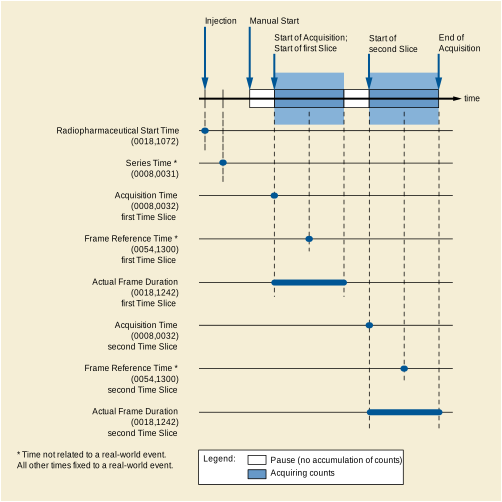
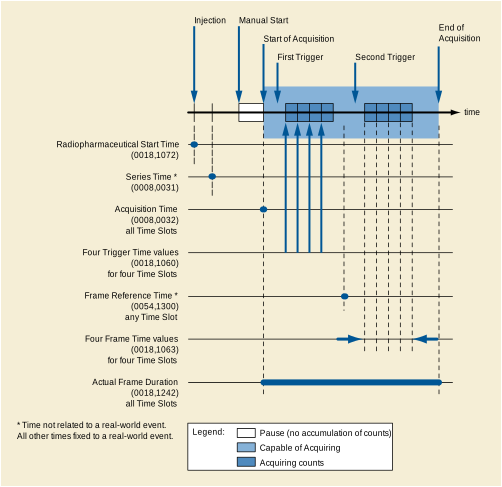
Table C.8-61 contains IOD Attributes that describe a PET Isotope.
Table C.8-61. PET Isotope Module Attributes
|
Attribute Name |
Tag |
Type |
Attribute Description |
|---|---|---|---|
|
Radiopharmaceutical Information Sequence |
(0054,0016) |
2 |
Sequence of Items that describe isotope information. Zero or more Items shall be included in this sequence. |
|
>Radionuclide Code Sequence |
(0054,0300) |
2 |
Sequence that identifies the radionuclide. Zero or one item shall be included in this sequence. |
|
Baseline CID 4020 “PET Radionuclide”. |
|||
|
>Radiopharmaceutical Route |
(0018,1070) |
3 |
Route of administration. |
|
>Administration Route Code Sequence |
(0054,0302) |
3 |
Sequence that identifies the administration route of the radiopharmaceutical. Only a single Item is permitted in this sequence. |
|
Baseline CID 11 “Route of Administration”. |
|||
|
>Radiopharmaceutical Volume |
(0018,1071) |
3 |
Volume of administered radiopharmaceutical in cubic cm. |
|
>Radiopharmaceutical Start Time |
(0018,1072) |
3 |
Time of start of administration. The actual time of radiopharmaceutical administration to the patient for imaging purposes, using the same time base as Series Time (0008,0031). The use of this Attribute is deprecated in favor of Radiopharmaceutical Start DateTime (0018,1078). NoteThe use of a time alone can cause confusion when the procedure spans midnight. |
|
>Radiopharmaceutical Start DateTime |
(0018,1078) |
3 |
Date and time of start of administration. The actual date and time of radiopharmaceutical administration to the patient for imaging purposes, using the same time base as Series Time (0008,0031). |
|
>Radiopharmaceutical Stop Time |
(0018,1073) |
3 |
Time of end of administration. The actual ending time of radiopharmaceutical administration to the patient for imaging purposes, using the same time base as Series Time (0008,0031). The use of this Attribute is deprecated in favor of Radiopharmaceutical Stop DateTime (0018,1079). NoteThe use of a time alone can cause confusion when the procedure spans midnight. |
|
>Radiopharmaceutical Stop DateTime |
(0018,1079) |
3 |
Date and time of end of administration. The actual ending date and time of radiopharmaceutical administration to the patient for imaging purposes, using the same time base as Series Time (0008,0031). |
|
>Radionuclide Total Dose |
(0018,1074) |
3 |
The radiopharmaceutical dose administered to the patient measured in Becquerels (Bq) at the Radiopharmaceutical Start Time (0018,1072). NoteIn other IODs, such as the NM IOD, this same attribute is specified in MegaBecquerels (MBq). |
|
>Radiopharmaceutical Administration Event UID |
(0008,3012) |
3 |
Unique identification of the administration of the radiopharmaceutical to the patient. NoteThe UID is the same Radiopharmaceutical Administration Event UID that is in the Radiopharmaceutical Radiation Dose Report. |
|
>Radionuclide Half Life |
(0018,1075) |
3 |
The radionuclide half life, in seconds, that was used in the correction of this image. |
|
>Radionuclide Positron Fraction |
(0018,1076) |
3 |
The radionuclide positron fraction (fraction of decays that are by positron emission) that was used in the correction of this image. |
|
>Radiopharmaceutical Specific Activity |
(0018,1077) |
3 |
The activity per unit mass of the radiopharmaceutical, in Bq/micromole, at the Radiopharmaceutical Start Time (0018,1072). |
|
>Radiopharmaceutical |
(0018,0031) |
3 |
Name of the radiopharmaceutical. |
|
>Radiopharmaceutical Code Sequence |
(0054,0304) |
3 |
Sequence that identifies the radiopharmaceutical. Only a single Item is permitted in this sequence. |
|
Baseline CID 4021 “PET Radiopharmaceutical”. |
|||
|
Intervention Drug Information Sequence |
(0018,0026) |
3 |
Sequence of Items that describes the intervention drugs used. One or more items are permitted in this sequence. |
|
>Intervention Drug Name |
(0018,0034) |
3 |
Name of the intervention drug. |
|
>Intervention Drug Code Sequence |
(0018,0029) |
3 |
Sequence that identifies the intervention drug name. Only a single Item is permitted in this Sequence. |
|
Baseline CID 10 “Interventional Drug”. |
|||
|
>Intervention Drug Start Time |
(0018,0035) |
3 |
Time of administration of the intervention drug, using the same time base as for Series Time (0008,0031). |
|
>Intervention Drug Stop Time |
(0018,0027) |
3 |
Time of completion of administration of the intervention drug, using the same time base as for Series Time (0008,0031). |
|
>Intervention Drug Dose |
(0018,0028) |
3 |
Intervention drug dose, in mg. |
Table C.8-62 contains IOD Attributes that describe a PET Multi-gated Acquisition.
Table C.8-62. PET Multi-Gated Acquisition Module Attributes
|
Attribute Name |
Tag |
Type |
Attribute Description |
|---|---|---|---|
|
Beat Rejection Flag |
(0018,1080) |
2 |
Heart beat duration sorting has been applied. Enumerated Values:
|
|
Trigger Source or Type |
(0018,1061) |
3 |
Text indicating trigger source. Defined Terms:
|
|
PVC Rejection |
(0018,1085) |
3 |
Description of the type of PVC rejection criteria used. |
|
Skip Beats |
(0018,1086) |
3 |
Number of beats skipped after a detected arrhythmia. |
|
Heart Rate |
(0018,1088) |
3 |
Average number of heart beats per minute for the collection period for this image. This shall include all accepted beats as well as rejected beats. |
|
Cardiac Framing Type |
(0018,1064) |
3 |
Description of type of framing performed. See Section C.7.6.18.1.1.1 for description and Defined Terms. |
Table C.8-63 contains IOD Attributes that describe PET images.
Table C.8-63. PET Image Module Attributes
|
Attribute Name |
Tag |
Type |
Attribute Description |
|---|---|---|---|
|
Image Type |
(0008,0008) |
1 |
Image identification characteristics. See Section C.8.9.4.1.1 for specialization. |
|
Samples per Pixel |
(0028,0002) |
1 |
Number of samples (planes) in this image. This value shall be 1. |
|
Photometric Interpretation |
(0028,0004) |
1 |
Specifies the intended interpretation of the pixel data. See Section C.8.9.4.1.2 for specialization. |
|
Bits Allocated |
(0028,0100) |
1 |
Number of bits allocated for each pixel sample. Each sample shall have the same number of bits allocated. Enumerated Values:
|
|
Bits Stored |
(0028,0101) |
1 |
Number of bits stored for each pixel sample. Each sample shall have the same number of bits stored. The value shall be the same as the value in Bits Allocated (0028,0100). |
|
High Bit |
(0028,0102) |
1 |
Most significant bit for pixel sample data. Each sample shall have the same high bit. Shall be one less than the value in Bits Stored (0028,0101). |
|
Rescale Intercept |
(0028,1052) |
1 |
The value b in relationship between stored values (SV) and pixel value units (U) defined in Units (0054,1001): U = m*SV+b. The Rescale Intercept is always zero for PET images. |
|
Rescale Slope |
(0028,1053) |
1 |
m in the equation specified in Rescale Intercept (0028,1052). |
|
Frame Reference Time |
(0054,1300) |
1 |
The time that the pixel values in the image occurred. Frame Reference Time is the offset, in msec, from the Series reference time. See explanation in Section C.8.9.4.1.5. |
|
Trigger Time |
(0018,1060) |
1C |
Time interval, in msec, from the start of the trigger to the beginning of data acquisition for this image. Required if Series Type (0054,1000), Value 1 is GATED. |
|
Frame Time |
(0018,1063) |
1C |
Nominal duration per individual frame, in msec. Required if Series Type (0054,1000), Value 1 is GATED. See Section C.8.9.4.1.3 for explanation. |
|
Low R-R Value |
(0018,1081) |
1C |
R-R interval lower limit for beat rejection, in msec. Required if Series Type (0054,1000), Value 1 is GATED and Beat Rejection Flag (0018,1080) is Y. |
|
High R-R Value |
(0018,1082) |
1C |
R-R interval upper limit for beat rejection, in msec. Required if Series Type (0054,1000), Value 1 is GATED and Beat Rejection Flag (0018,1080) is Y. |
|
Lossy Image Compression |
(0028,2110) |
1C |
Specifies whether an Image has undergone lossy compression (at a point in its lifetime). Enumerated Values:
Once this value has been set to 01 it shall not be reset. See Section C.7.6.1.1.5. Required if Lossy Compression has been performed on the image. May be present otherwise. |
|
Image Index |
(0054,1330) |
1 |
An index identifying the position of this image within a PET Series. See Section C.8.9.4.1.9 for explanation. |
|
Acquisition Date |
(0008,0022) |
2 |
The date the acquisition of data that resulted in this image started. See Section C.8.9.4.1.4 for specialization. |
|
Acquisition Time |
(0008,0032) |
2 |
The time the acquisition of data that resulted in this image started. See Section C.8.9.4.1.4 for specialization. |
|
Actual Frame Duration |
(0018,1242) |
2 |
Elapsed time of the data acquisition for this image, in msec. See Section C.8.9.4.1.6 for explanation. |
|
Nominal Interval |
(0018,1062) |
3 |
Average duration of accepted beats, in msec, of the R-R interval. |
|
Intervals Acquired |
(0018,1083) |
3 |
Number of heartbeats that fall within Low R-R Value (0018,1081) and High R-R Value (0018,1082), and were therefore accepted and contribute coincidence events to this R-R Interval. |
|
Intervals Rejected |
(0018,1084) |
3 |
Number of heartbeats that fall outside Low R-R Value (0018,1081) and High R-R Value (0018,1082), and do not contribute coincidence events to this R-R Interval. However, they may contribute coincidence events to other R-R Intervals. |
|
Primary (Prompts) Counts Accumulated |
(0054,1310) |
3 |
The sum of events that occur in the primary event channel. The counts include Trues +Scatter+ Randoms if Randoms Correction Method (0054,1100) is NONE; otherwise the counts are Trues +Scatter. |
|
Secondary Counts Accumulated |
(0054,1311) |
3 |
Sum of counts accumulated in secondary channels. See Section C.8.9.4.1.7 for explanation. |
|
Slice Sensitivity Factor |
(0054,1320) |
3 |
The slice-to-slice sensitivity correction factor that was used to correct this image. The value shall be one if no slice sensitivity correction was applied. |
|
Decay Factor |
(0054,1321) |
1C |
The decay factor that was used to scale this image. Required if Decay Correction (0054,1102) is other than NONE. If decay correction is applied, all images in the Series shall be decay corrected to the same time. |
|
Dose Calibration Factor |
(0054,1322) |
3 |
Factor that was used to scale this image from counts/sec to Bq/ml using a dose calibrator. The value shall be one if no dose calibration was applied. See Section C.8.9.4.1.8 for explanation. |
|
Scatter Fraction Factor |
(0054,1323) |
3 |
An estimate of the fraction of acquired counts that were due to scatter and were corrected in this image. The value shall be zero if no scatter correction was applied. |
|
Dead Time Factor |
(0054,1324) |
3 |
The average dead time correction factor that was applied to this image. The value shall be one if no dead time correction was applied. |
|
Include Table 10-7 “General Anatomy Optional Macro Attributes” |
No Context ID for the Anatomic Region Sequence is defined. |
||
|
Include Table 10-25 “Optional View and Slice Progression Direction Attributes” |
|||
|
Isocenter Position |
(300A,012C) |
3 |
Isocenter coordinates (x,y,z), in mm. Specifies the location of the machine isocenter in the patient-based coordinate system associated with the Frame of Reference. It allows transformation from the equipment-based coordinate system to the patient-based coordinate system. |
Note
Referenced Overlay Sequence (0008,1130) and Referenced Curve Sequence (0008,1145) were previously included in this Module as optional Attributes but have been retired. See PS3.3-2004.
For PET Images, Image Type (0008,0008) is specified to be Type 1.
Note
For PET images, Image Type (0008,0008) Value 1 will be ORIGINAL for reconstructed images. DERIVED may be appropriate for some other results images. For PET images, Image Type (0008,0008) Value 2 will be PRIMARY.
Enumerated Values:
- MONOCHROME2
See Section C.7.6.3.1.2 for definition of this term.
Frame Time (0018,1063) is the explicit duration of the gated frame when Cardiac Framing Type (0018,1064) is equal to FORW or BACK. Frame Time (0018,1063) is the nominal duration of the gated frame when Cardiac Framing Type (0018,1064) is equal to PCNT.
For PET Images, Acquisition Date (0008,0022) and Acquisition Time (0008,0032) are specified to be Type 2. Acquisition Date (0008,0022) and Acquisition Time (0008,0032) use the same time base as Series Time (0008,0031).
For Series Type (0054,1000) Value 1 equal to STATIC, WHOLE BODY, or DYNAMIC, Acquisition Time (0008,0032) is the real-world beginning of the accumulation of events into this Image. For STATIC, WHOLE BODY, or DYNAMIC Series, Acquisition Time (0008,0032) may vary from Image to Image within a PET Series.
For Series Type (0054,1000) Value 1 equal to GATED, Acquisition Time (0008,0032) is the real-world beginning of the capability of accumulating events into this Image. (The actual accumulation of events has only occurred during an R-R Interval.) For GATED Series, Acquisition Time (0008,0032) shall not vary from Image to Image within a PET Series.
Frame Reference Time (0054,1300) is the time that the pixel values in the Image occurred. Frame Reference Time is defined as the time offset, in msec, from the Series Reference Time, where the Series Reference Time is defined by the combination of Series Date (0008,0021) and Series Time (0008,0031).
Note
Frame Reference Time (0054,1300) is implementation dependent and may or may not be tied to any real-world event. To illustrate the meaning of Frame Reference Time (0054,1300), the following are some examples of possible implementations:
Example 1: For a long-lived radionuclide and a non-time-varying radiopharmaceutical distribution, an implementation sets the Frame Reference Time (0054,1300) to the midpoint of the Actual Frame Duration (0018,1242).
Example 2: For a short-lived radionuclide and a non-time-varying radiopharmaceutical distribution, an implementation sets the Frame Reference Time (0054,1300) to the time at which the average activity occurs for a decaying radionuclide, Tave. If image acquisition started at the Series Reference Time and the image has not been decay corrected, then Tave will be:
where:
lambda = decay constant = (ln 2) / T1/2
T1/2 = Radionuclide Half Life (0018,1075)
T = Actual Frame Duration (0018,1242)
Note that Tave will be sooner than the midpoint of the Actual Frame Duration (0018,1242).
Example 3: For a short-lived radionuclide and a time-varying radiopharmaceutical distribution, an implementation with supplementary data (e.g., scanner count rates or blood sample data) sets the Frame Reference Time (0054,1300) to a derived time determined to be its best estimate of the time that the pixel values occurred.
The accumulation of counts for a PET Image shall occur entirely between:
the acquisition starting time (as specified by Acquisition Date (0008,0022) and Acquisition Time (0008,0032)), and
the acquisition ending time, which is equal to the acquisition starting time in (1) plus the Actual Frame Duration (0018,1242).
If Series Type (0054,1000) Value 1 is GATED, then the actual accumulation of counts has only occurred during an R-R Interval.
Secondary Counts Accumulated (0054,1311) is multi-valued and, if supplied, has Values corresponding to the Secondary Counts Type (0054,1220). The number and order of the Values in Secondary Counts Accumulated (0054,1311) shall be the same as Secondary Counts Type (0054,1220).
The Dose Calibration Factor (0054,1322) is the factor that was used to scale this image from counts/sec to Bq/ml using an external dose calibrator. The value shall be one if no dose calibration was applied. The application of a dose calibration correction is specified by Corrected Image (0028,0051) equal to DCAL.
Note
Dose Calibration Factor (0054,1322) is not equal to the inverse of the sensitivity (kcps/Bq/ml) of the scanner, which is usually measured for a given radiopharmaceutical distribution and excluding the effects of attenuation.
Image Index (0054,1330) is an index identifying the position of this image within a PET Series.
Note
The scheme for encoding Image Index (0054,1330) is as follows. Images within a PET Series can be viewed as a multi-dimensional array whose possible dimensions include R-R Intervals, Time Slots, Time Slices, and Slices. The dimensions of the array are defined by Series Type (0054,1000) Value 1. Each dimension of the array has an index that identifies the position of this image in the array. The indices are: R-R Interval Index, Time Slot Index, Time Slice Index, Slice Index. The indices are calculated as follows:
|
Index |
Range of Index |
Order of Images along that Dimension |
|---|---|---|
|
R-R Interval Index |
1 to Number of R-R Intervals (0054,0061) |
Increasing Low R-R Value (0018,1081) |
|
Time Slot Index |
1 to Number of Time Slots (0054,0071) |
Increasing Trigger Time (0018,1060) |
|
Time Slice Index |
1 to Number of Time Slices (0054,0101) |
Increasing Frame Reference Time (0054,1300) |
|
Slice Index |
1 to Number of Slices (0054,0081) |
If Series Type (0054,1000) Value 2 is IMAGE:Order is in increasing position along the normal, where the normal is determined by the cross product of the direction cosines of the row and column of the image. See Image Orientation (0020,0037) in the Image Plane Module. If Series Type (0054,1000) Value 2 is REPROJECTION:Order is in increasing or decreasing angle of the normal, where the normal is determined by the cross product of the direction cosines of the row and column of the image. See Image Orientation (0020,0037) in the Image Plane Module. (Note that reprojection images rotate about only a single axis as described in Section C.8.9.1.1.1. Therefore, all normals are co-planar and make a single angle with respect to each other.) |
Using these index values the position of this image within the multi-dimensional array (Image Index (0054,1330)) is calculated as follows:
|
Series Type (0054,1000), Value 1 |
Dimensions of Array (Last dimension is most rapidly changing) |
Encoding of Image Index (0054,1330) |
|---|---|---|
|
STATIC |
Slice |
Slice Index |
|
WHOLE BODY |
Slice |
Slice Index |
|
DYNAMIC |
Time Slice \Slice |
((Time Slice Index - 1) * (Number of Slices (0054,0081))) + Slice Index |
|
GATED |
R-R Interval \Time Slot \Slice |
((R-R Interval Index - 1) * (Number of Time Slots (0054,0071)) * (Number of Slices (0054,0081))) + ((Time Slot Index - 1) * (Number of Slices (0054,0081))) + Slice Index |
Retired. See PS3.3-2004.
Retired. See PS3.3-2004.
The Digital X-Ray IODs use the General Series module described in Section C.7.3.1, specialized by the DX Series Module, to describe the DICOM Series Entity described in Section A.1.2.3, and to define what constitutes a Series for the context of projection Digital X-Ray.
Note
In an abstract sense, a series may be viewed from the perspective of an acquisition device or a display device.
In the former case, it is convenient to group images related by commonality of acquisition parameters, such as the imaging subject's physical relationship to the equipment (such as a patient lying in a particular position with respect to the equipment), a single acquisition initiation (such as an MR pulse sequence or spiral CT run), or a single workflow action on the part of the operator (such as the reading of a collection of CR plates from the same examination).
In the latter case, it is often convenient to organize images for viewing or browsing into series based upon other criteria such as physical or temporal proximity that may not necessarily correspond with the order or grouping in which the images were acquired.
This conflict is most apparent in the existing CR Image IOD Section C.8.1, where the definition of View Position at the Series Level in CR Series Section C.8.1.1 implies, for example, that a Lateral and PA Chest X-Ray may not be grouped into a single series. While this may be in keeping with the traditional CT and MR notions that a change in an imaging subject's physical orientation with respect to the imaging equipment implies a new series, it is most unnatural from the point of view of a reader viewing or browsing a collection of projection radiographic images.
A similar example pertains in the case of the traditional set of views of the maxillary and mandibular dentition, in which all the images are logically grouped in one sequence, but the imaging equipment moves with respect to the imaging subject, and the size of the detector may vary between images.
Accordingly, the constraint (apparent from the CT, MR and CR IODs) that a change in position, detector, body part or laterality implies a new series has been relaxed in the DX IODs, through the use of the DX Anatomy Imaged Module and the DX Positioning Module, which define Attributes at the Image level that specify these concepts with finer granularity. This approach is consistent with that used in the XA, XRF, US and NM IODs.
Images within a series are still required, if the Condition for the inclusion of the Frame of Reference Module is met, to be relative to the same Frame of Reference.
Table C.8-68 specifies the Attributes that identify and describe general information about the DX Series.
Table C.8-68. DX Series Module Attributes
|
Attribute Name |
Tag |
Type |
Attribute Description |
|---|---|---|---|
|
Modality |
(0008,0060) |
1 |
Type of equipment that originally acquired the data used to create the images in this Series. Enumerated Values:
See Section C.7.3.1.1.1 for further explanation. |
|
Referenced Performed Procedure Step Sequence |
(0008,1111) |
1C |
Uniquely identifies the Performed Procedure Step SOP Instance to which the Series is related. Only a single Item shall be included in this sequence. Required if a Performed Procedure Step SOP Class was involved in the creation of this Series. |
|
>Include Table 10-11 “SOP Instance Reference Macro Attributes” |
|||
|
Presentation Intent Type |
(0008,0068) |
1 |
Identifies the intent of the images that are contained within this Series. Enumerated Values:
See Section C.8.11.1.1.1 for further explanation. |
Presentation Intent Type (0008,0068) shall identify the intent for the purposes of display or other presentation of all Images within this Series.
Note
Since this is a Series level attribute, all Images within a Series have the same value for this Attribute.
The intent of this restriction is to ensure that FOR PRESENTATION and FOR PROCESSING images are placed in separate Series, so that no confusion can arise as to which images are suitable for diagnostic reading as determined by local policy.
A Series of Images intended for viewing by an observer, after application of any grayscale transformations specified in the image object such as VOI LUT, shall have an Enumerated Value of FOR PRESENTATION.
Note
These images may still be of Image Type (0008,0008) ORIGINAL rather than DERIVED despite the possibility that they may have undergone some processing, such as unsharp masking. In this case a DERIVED image would have undergone yet further processing to make it substantially different from the original. See Figure C.8-13.
These images may still be subjected to processing or further processing, if appropriate, depending on the application.
These images are intended for display on a device, without (further) processing, since that device may not be capable of image processing. The quality of the displayed image or its suitability for any purpose is beyond the scope of the DICOM Standard.
Images that have been corrected to account for characteristics of the detector but are intended to be further processed before being displayed, shall have an Enumerated Value of FOR PROCESSING.
Note
This type is provided to allow the functions of image acquisition and image processing for presentation to be separated and yet have images conveyed between the two processes using a DICOM object. Individual sites or users may choose to substitute their own specialized processing in place of that supplied by the implementer.
Images available at this stage of processing may be useful for quality control and problem solving purposes, as well as academic research.
Images of this type may also be archived, retrieved and processed with different algorithms or parameters in order to alter the appearance of specific features for clinical purposes.
The nature of the detector correction that may have been applied before sending an image of type FOR PROCESSING is not specified. In particular, acquisitions that acquire several sets of matrices of pixel values (such as image data, gain offset and a defect map) must perform some processing (detector correction) before a DX Image object can be instantiated.
The nature of the processing that may have been applied before sending an image of type FOR PRESENTATION is also not specified.
It is expected that individual implementers will use Private Attributes to convey specifics of the processing applied that may be of use for further processing by those aware of the parameters and algorithms. The diversity of detector types and processing algorithms make it undesirable to standardize such parameters.
Whether or not the spatial locations of all pixels are preserved during the processing of the source image that resulted in the current image can be indicated by Spatial Locations Preserved (0028,135A) in a Source Image Sequence (0008,2112) reference from the FOR PRESENTATION image to a FOR PROCESSING predecessor.
If images from the same exposure exist with different Values of Presentation Intent Type (0008,0068), then they shall have different SOP Instance UIDs.
Note
Source Image Sequence (0008,2112) may be used to relate these images.
The SOP Class UIDs of the two images will also be different.
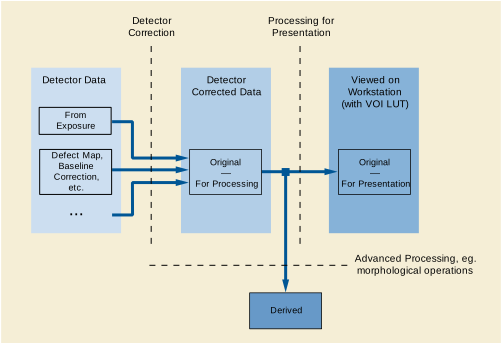
Table C.8-69 contains IOD Attributes that describe the anatomy contained in a DX IOD.
Table C.8-69. DX Anatomy Imaged Module Attributes
|
Attribute Name |
Tag |
Type |
Attribute Description |
|---|---|---|---|
|
Image Laterality |
(0020,0062) |
1 |
Laterality of (possibly paired) body part (as described in Anatomic Region Sequence (0008,2218)) examined. Enumerated Values:
NoteThis Attribute is mandatory, in order to ensure that images may be positioned correctly relative to one another for display. Shall be consistent with any laterality information contained in Primary Anatomic Structure Modifier Sequence (0008,2230), if present. NoteLaterality (0020,0060) is a Series level Attribute and must be the same for all Images in the Series, hence it must be absent. |
|
Include Table 10-6 “General Anatomy Required Macro Attributes” |
Defined CID for the Anatomic Region Sequence is 4009 for humans, and 7482 for animals. This is the anatomic region that is placed on the table or bucky for examination. NoteIt is strongly recommended that Anatomic Region Sequence (0008,2218) be sent with a value, in order to ensure that images may be positioned correctly relative to one another for display. |
||
The Attributes in this Module extend the function of Body Part Examined (0018,0015) as used in other IODs, and are intended to be used to facilitate the management of images and series in terms of routing, storage and display, as well as to dictate certain Conditions on Attributes and Modules in the DX IOD.
Table C.8-70 contains IOD Attributes that describe a DX Image by specializing Attributes of the General Image and Image Pixel Modules, and adding additional Attributes.
Table C.8-70. DX Image Module Attributes
|
Attribute Name |
Tag |
Type |
Attribute Description |
|---|---|---|---|
|
Image Type |
(0008,0008) |
1 |
Image identification characteristics. See Section C.8.11.3.1.1 for specialization. |
|
Samples per Pixel |
(0028,0002) |
1 |
Number of samples in this image. Enumerated Values:
|
|
Photometric Interpretation |
(0028,0004) |
1 |
Specifies the intended interpretation of the pixel data. Enumerated Values:
|
|
Bits Allocated |
(0028,0100) |
1 |
Number of bits allocated for each pixel sample. Enumerated Values:
|
|
Bits Stored |
(0028,0101) |
1 |
Number of bits stored for each pixel sample. Enumerated Values:
|
|
High Bit |
(0028,0102) |
1 |
Most significant bit for pixel sample data. Shall be one less than the value in Bit Stored (0028,0101). |
|
Pixel Representation |
(0028,0103) |
1 |
Data representation of the pixel samples. Enumerated Values:
|
|
Pixel Intensity Relationship |
(0028,1040) |
1 |
The relationship between the Pixel sample values and the X-Ray beam intensity. Enumerated Values:
See Section C.8.11.3.1.2 for further explanation. |
|
Pixel Intensity Relationship Sign |
(0028,1041) |
1 |
The sign of the relationship between the Pixel sample values stored in Pixel Data (7FE0,0010) and the X-Ray beam intensity. Enumerated Values:
See Section C.8.11.3.1.2 for further explanation. |
|
Rescale Intercept |
(0028,1052) |
1 |
The value b in the relationship between stored values (SV) in Pixel Data (7FE0,0010) and the output units specified in Rescale Type (0028,1054). Output units = m*SV + b. Enumerated Values:
See Section C.8.11.3.1.2 for further explanation. |
|
Rescale Slope |
(0028,1053) |
1 |
m in the equation specified by Rescale Intercept (0028,1052). Enumerated Values:
See Section C.8.11.3.1.2 for further explanation. |
|
Rescale Type |
(0028,1054) |
1 |
Specifies the output units of Rescale Slope (0028,1053) and Rescale Intercept (0028,1052). Enumerated Values:
See Section C.8.11.3.1.2 for further explanation. |
|
Presentation LUT Shape |
(2050,0020) |
1 |
Specifies an identity transformation for the Presentation LUT, other than to account for the value of Photometric Interpretation (0028,0004), such that the output of all grayscale transformations defined in the IOD containing this Module are defined to be P-Values. Enumerated Values:
See Section C.8.11.3.1.2 for further explanation. |
|
Lossy Image Compression |
(0028,2110) |
1 |
Specifies whether an Image has undergone lossy compression (at a point in its lifetime). Enumerated Values:
Once this value has been set to 01 it shall not be reset. See Section C.7.6.1.1.5. |
|
Lossy Image Compression Ratio |
(0028,2112) |
1C |
Describes the approximate lossy compression ratio(s) that have been applied to this image. See Section C.7.6.1.1.5 for further explanation. May be multi-valued if successive lossy compression steps have been applied; the value order shall correspond to the values of Lossy Image Compression Method (0028,2114). Note
Required if Lossy Image Compression (0028,2110) is "01". |
|
Derivation Description |
(0008,2111) |
3 |
A text description of how this image was derived. See Section C.8.11.3.1.4 for further explanation. |
|
Acquisition Device Processing Description |
(0018,1400) |
3 |
Indicates any visual processing performed on the images prior to exchange. See Section C.8.11.3.1.3 for further explanation. |
|
Acquisition Device Processing Code |
(0018,1401) |
3 |
Code representing the device-specific processing associated with the image (e.g., Organ Filtering code) NoteThis Code is manufacturer specific but provides useful annotation information to the knowledgeable observer. |
|
Patient Orientation |
(0020,0020) |
1C |
Patient direction of the rows and columns of the image. See Section C.7.6.1.1.1 for further explanation. Required if View Code Sequence (0054,0220) is not present or is present with an Item value other than (G-8300, SRT, "tissue specimen") or (G-8310, SRT, "tissue specimen from breast"). May be present otherwise. |
|
Calibration Image |
(0050,0004) |
3 |
Indicates whether a reference object (phantom) of known size is present in the image and was used for calibration. Enumerated Values:
Device is identified using the Device module. See Section C.7.6.12 for further explanation. |
|
Burned In Annotation |
(0028,0301) |
1 |
Indicates whether or not image contains sufficient burned in annotation to identify the patient and date the image was acquired. Enumerated Values:
|
|
VOI LUT Sequence |
(0028,3010) |
1C |
Defines a sequence of VOI LUTs. See Section C.8.11.3.1.5 for further explanation. One or more Items shall be included in this Sequence. Required if Presentation Intent Type (0008,0068) is FOR PRESENTATION and Window Center (0028,1050) is not present. May also be present if Window Center (0028,1050) is present. |
|
>LUT Descriptor |
(0028,3002) |
1 |
Specifies the format of the LUT Data in this Sequence. See Section C.8.11.3.1.5 for further explanation. |
|
>LUT Explanation |
(0028,3003) |
3 |
Free form text explanation of the meaning of the LUT. |
|
>LUT Data |
(0028,3006) |
1 |
LUT Data in this Sequence. |
|
Window Center |
(0028,1050) |
1C |
Defines a Window Center for display. See Section C.8.11.3.1.5 for further explanation. Required if Presentation Intent Type (0008,0068) is FOR PRESENTATION and VOI LUT Sequence (0028,3010) is not present. May also be present if VOI LUT Sequence (0028,3010) is present. |
|
Window Width |
(0028,1051) |
1C |
Window Width for display. See Section C.8.11.3.1.5 for further explanation. Required if Window Center (0028,1050) is sent. |
|
Window Center & Width Explanation |
(0028,1055) |
3 |
Free form explanation of the meaning of the Window Center and Width. Multiple values correspond to multiple Window Center and Width values. |
Value 1 shall identify the Pixel Data Characteristics in accordance with Section C.7.6.1.1.2 where the Enumerated Values are defined to be ORIGINAL or DERIVED.
Note
DX images may still be of type ORIGINAL rather than DERIVED despite the possibility that they may have undergone some processing. In this case a DERIVED image would have undergone yet further processing to make it substantially different from the original.
Value 2 shall identify the Patient Examination Characteristics in accordance with Section C.7.6.1.1.2 where the Enumerated Values are defined to be PRIMARY or SECONDARY.
Note
DX images generally use PRIMARY value for images captured from patient exposure.
If images from the same exposure exist with different Values of Image Type, then they shall have different SOP Instance UIDs.
Note
Source Image Sequence (0008,2112) may be used to relate these images.
Value 3 (which is specific to the IOD) shall be present and have zero length (null value).
Other Values (4 and beyond) are optional and implementation specific.
Pixel Intensity Relationship (0028,1040) and Pixel Intensity Relationship Sign (0028,1041) describe how the stored pixel values in Pixel Data (7FE0,0010) are related to the X-Ray beam intensity incident on the detector.
They do not define a transformation intended to be applied to the pixel data for presentation.
Note
For example, if Pixel Intensity Relationship (0028,1040) is LIN and Pixel Intensity Relationship Sign (0028,1041) is -1, then lower values of Pixel Data (7FE0,0010) indicate higher X-Ray beam intensities corresponding to less radiographically dense regions projected on the image such as through air, and higher values of Pixel Data (7FE0,0010) indicate lower X-Ray beam intensities corresponding to more radiographically dense regions projected on the image such as through bone and radio-opaque contrast agents.
The transformation to be applied to the pixel data for presentation is defined by the successive application of the conceptual Modality LUT, the VOI Attributes and the conceptual Presentation LUT. This shall result in the output of P-Values.
Rescale Slope (0028,1053) and Rescale Intercept (0028,1052) define a linear subset of a conceptual Modality LUT transformation. For IODs that include this Module, these Attributes define an identity transformation. IODs that include the DX Image Module shall not include the Modality LUT Module.
The Presentation LUT Shape (2050,0020) defines a subset of a conceptual Presentation LUT. For IODs that include this Module, this Attribute defines an identity transformation or inverse identity transformation. IODs that include the DX Image Module shall not include the Presentation LUT Module.
Photometric Interpretation (0028,0004) indicates whether lower values that are the output of the VOI Attributes should be displayed as darker or lighter. Since the output of the equivalent of a conceptual Presentation LUT is in P-Values, which are defined in PS3.14 such that lower values correspond to lower luminance levels, then the definition of the Presentation LUT Shape (2050,0020), otherwise intended to be an identity transformation, must take into account the effect of the value specified for Photometric Interpretation (0028,0004).
Note
Regardless of the values of Pixel Intensity Relationship (0028,1040) and Pixel Intensity Relationship Sign (0028,1041), the grayscale transformations to be applied to Pixel Data (7FE0,0010) are defined by the equivalent of the Modality LUT (Rescale Slope (0028,1053) and Rescale Intercept (0028,1052)), Value of Interest Attributes, Photometric Interpretation (0028,0004) and the equivalent of the Presentation LUT (Presentation LUT Shape (2050,0020)). However, the combination of the grayscale transformations and the description of the pixel intensity relationship, together define whether, for example, air is expected to be displayed as black or white.
Acquisition Device Processing Description (0018,1400) provides some indication in human readable text of the digital processing on the images before exchange. Examples of this processing are: edge enhanced, subtracted, time filtered, gamma corrected, convolved (spatially filtered).
If an Image is identified to be a Derived image in Image Type (0008,0008), Derivation Description (0008,2111) is an optional and implementation specific text description of the way the image was derived from an original image. As applied to DX images, it may be used to describe derivation operations such as edge enhancement, temporal filtering, digital subtraction, or other linear and non-linear transformations.
The Attributes of the VOI LUT Module (C.11.2) are specialized in the DX Image Module.
Window Center (0028,1050) and Window Width (0028,1051) specify a linear conversion (unless otherwise specified by the value of VOI LUT Function (0028,1056); See Section C.11.2.1.3) from the output of the (conceptual) Modality LUT values to the input to the (conceptual) Presentation LUT. Window Center contains the value that is the center of the window. Window Width contains the width of the window.
The application of Window Center (0028,1050) and Window Width (0028,1051) shall not produce a signed result.
Note
If the Presentation LUT Shape (2050,0020) is IDENTITY, then the result of applying Window Center (0028,1050) and Window Width (0028,1051) is P-Values.
If multiple values are present, both Attributes shall have the same number of values and shall be considered as pairs. Multiple values indicate that multiple alternative views should be presented.
The VOI LUT Sequence specifies a (potentially non-linear) conversion from the output of the (conceptual) Modality LUT values to the input to the (conceptual) Presentation LUT.
If multiple items are present in VOI LUT Sequence (0028,3010), only one shall be applied. Multiple items indicate that multiple alternative views should be presented.
If any VOI LUT Attributes are included by an Image, a Window Width and Window Center or the VOI LUT Table, but not both,shall be applied to the Image for display. Inclusion of both indicates that multiple alternative views should be presented.
The three values of LUT Descriptor (0028,3002) describe the format of LUT Data (0028,3006).
The first value is the number of entries in the lookup table.
The second value is the first stored pixel value mapped. This pixel value is mapped to the first entry in the LUT. All image pixel values less than the first value mapped are also mapped to the first entry in the LUT Data. An image pixel value one greater than the first value mapped is mapped to the second entry in the LUT Data. Subsequent image pixel values are mapped to the subsequent entries in the LUT Data up to an image pixel value equal to number of entries + first value mapped - 1 that is mapped to the last entry in the LUT Data. Image pixel values greater than number of entries + first value mapped are also mapped to the last entry in the LUT Data.
The third value specifies the number of bits for each entry in the LUT Data (analogous to "bits stored"). It shall be between 10-16. The LUT Data shall be stored in a format equivalent to 16 "bits allocated" and "high bit" equal to "bits stored" - 1. The third value conveys the range of LUT entry values. These unsigned LUT entry values shall range between 0 and 2n-1, where n is the third value of the LUT Descriptor.
Note
The third value is restricted in the VOI LUT Module to 8 or 16 but is specialized here.
The first and second values are not specialized and are the same as in the VOI LUT Module.
LUT Data (0028,3006) contains the LUT entry values.
Table C.8-71 contains IOD Attributes that describe a DX detector.
Table C.8-71. DX Detector Module Attributes
|
Attribute Name |
Tag |
Type |
Attribute Description |
|---|---|---|---|
|
Include Table C.8-71b “Digital X-Ray Detector Macro Attributes” |
|||
|
Detector Active Time |
(0018,7014) |
3 |
Time in mSec that the detector is active during acquisition of this image. NoteThis activation window overlaps the time of the X-Ray exposure as defined by Exposure Time (0018,1150) and Detector Activation Offset From Exposure (0018,7016). |
|
Detector Activation Offset From Exposure |
(0018,7016) |
3 |
Offset time in mSec that the detector becomes active after the X-Ray beam is turned on during acquisition of this image. May be negative. |
|
Field of View Shape |
(0018,1147) |
3 |
Shape of the Field of View, that is the image pixels stored in Pixel Data (7FE0,0010). Enumerated Values:
|
|
Field of View Dimension(s) |
(0018,1149) |
3 |
Dimensions in mm of the Field of View, that is the image pixels stored in Pixel Data (7FE0,0010). If Field of View Shape (0018,1147) is: RECTANGLE: row dimension followed by column. ROUND: diameter. HEXAGONAL: diameter of a circumscribed circle. |
|
Field of View Origin |
(0018,7030) |
1C |
Offset of the TLHC of a rectangle circumscribing the Field of View, that is the image pixels stored in Pixel Data (7FE0,0010), before rotation or flipping, from the TLHC of the physical detector area measured in physical detector pixels as a row offset followed by a column offset. Required if Field of View Rotation (0018,7032) or Field of View Horizontal Flip (0018,7034) is present. See Section C.8.11.4.1.1 for further explanation. |
|
Field of View Rotation |
(0018,7032) |
1C |
Clockwise rotation in degrees of Field of View, that is the image pixels stored in Pixel Data (7FE0,0010), relative to the physical detector. Enumerated Values:
Required if Field of View Horizontal Flip (0018,7034) is present. See Section C.8.11.4.1.1 for further explanation. |
|
Field of View Horizontal Flip |
(0018,7034) |
1C |
Whether or not a horizontal flip has been applied to the Field of View, that is the image pixels stored in Pixel Data (7FE0,0010), after rotation relative to the physical detector as described in Field of View Rotation (0018,7032). Enumerated Values:
Required if Field of View Rotation (0018,7032) is present. See Section C.8.11.4.1.1 for further explanation. |
|
Imager Pixel Spacing |
(0018,1164) |
1 |
Physical distance measured at the front plane of the detector housing between the center of each image pixel specified by a numeric pair - row spacing value(delimiter) column spacing value in mm. See Section 10.7.1.3 for further explanation of the value order. The value of this attribute shall never be adjusted to account for correction for the effect of geometric magnification or calibration against an object of known size; Pixel Spacing (0028,0030) is specified for that purpose. |
|
Include Table 10-10 “Basic Pixel Spacing Calibration Macro Attributes” |
|||
|
Cassette ID |
(0018,1007) |
3 |
Identifier of the cassette that contains the photostimulable phosphor plate, for CR acquisitions. |
|
Plate ID |
(0018,1004) |
3 |
Identifier of the photostimulable phosphor plate, for CR acquisitions. |
Table C.8-71b contains common attributes that describe digital X-Ray detector.
Table C.8-71b. Digital X-Ray Detector Macro Attributes
|
Attribute Name |
Tag |
Type |
Attribute Description |
|---|---|---|---|
|
Detector Type |
(0018,7004) |
2 |
The type of detector used to acquire this image. Defined Terms:
|
|
Detector Configuration |
(0018,7005) |
3 |
The physical configuration of the detector. Defined Terms:
|
|
Detector Description |
(0018,7006) |
3 |
Free text description of detector. |
|
Detector Mode |
(0018,7008) |
3 |
Text description of operating mode of detector (implementation specific). |
|
Detector ID |
(0018,700A) |
3 |
The ID or serial number of the detector used to acquire this image. |
|
Date of Last Detector Calibration |
(0018,700C) |
3 |
The date on which the detector used to acquire this image as identified in Detector ID (0018,700A) was last calibrated. |
|
Time of Last Detector Calibration |
(0018,700E) |
3 |
The time at which the detector used to acquire this image as identified in Detector ID (0018,700A) was last calibrated. |
|
Exposures on Detector Since Last Calibration |
(0018,7010) |
3 |
Total number of X-Ray exposures that have been made on the detector used to acquire this image as identified in Detector ID (0018,700A) since it was calibrated. |
|
Exposures on Detector Since Manufactured |
(0018,7011) |
3 |
Total number of X-Ray exposures that have been made on the detector used to acquire this image as identified in Detector ID (0018,700A) since it was manufactured. |
|
Detector Time Since Last Exposure |
(0018,7012) |
3 |
Time in Seconds since an exposure was last made on this detector prior to the acquisition of this image. |
|
Detector Binning |
(0018,701A) |
3 |
Number of active detectors used to generate a single pixel. Specified as number of row detectors per pixel then column. |
|
Detector Manufacturer Name |
(0018,702A) |
3 |
Name of the manufacturer of the detector component of the acquisition system |
|
Detector Manufacturer's Model Name |
(0018,702B) |
3 |
Model name of the detector component of the acquisition system |
|
Detector Conditions Nominal Flag |
(0018,7000) |
3 |
Whether or not the detector is operating within normal tolerances during this image acquisition. Enumerated Values:
NoteThis flag is intended to indicate whether or not there may have been some compromise of the diagnostic quality of the image due to some condition such as over-temperature, etc. |
|
Detector Temperature |
(0018,7001) |
3 |
Detector temperature during exposure in degrees Celsius. |
|
Sensitivity |
(0018,6000) |
3 |
Detector sensitivity in manufacturer specific units. Note
|
|
Detector Element Physical Size |
(0018,7020) |
3 |
Physical dimensions of each detector element that comprises the detector matrix, in mm. Expressed as row dimension followed by column. NoteThis may not be the same as Detector Element Spacing (0018,7022) due to the presence of spacing material between detector elements. |
|
Detector Element Spacing |
(0018,7022) |
3 |
Physical distance between the center of each detector element, specified by a numeric pair - row spacing value(delimiter) column spacing value in mm. See Section 10.7.1.3 for further explanation of the value order. NoteThis may not be the same as the Imager Pixel Spacing (0018,1164), and should not be assumed to describe the stored image. |
|
Detector Active Shape |
(0018,7024) |
3 |
Shape of the active area. Enumerated Values:
NoteThis may be different from the Field of View Shape (0018,1147), and should not be assumed to describe the stored image. |
|
Detector Active Dimension(s) |
(0018,7026) |
3 |
Dimensions in mm of the active area. If Detector Active Shape (0018,7024) is: RECTANGLE: row dimension followed by column. ROUND: diameter. HEXAGONAL: diameter of a circumscribed circle. NoteThis may be different from the Field of View Dimensions (0018,1149), and should not be assumed to describe the stored image. |
|
Detector Active Origin |
(0018,7028) |
3 |
Offset of the TLHC of a rectangle circumscribing the active detector area from the TLHC of a rectangle circumscribing the physical detector area, measured in physical detector pixels as a row offset followed by a column offset. See Section C.8.11.4.1.1 for further explanation. |
The relationship between the Physical Detector Area, the Active Detector Area, the Field of View (what is stored in Pixel Data (7FE0,0010)), the Exposed Area (after X-Ray Collimation) and the Displayed Area is illustrated in the following diagrams.
Note
Some of these Attributes relate the image data to manufacturer specific characteristics of the detector that may be used for quality control purposes, e.g., correlation of image artifacts with a detector defect map, analysis of noise performance, etc.
The Displayed Area is defined in pixel coordinates relative to the stored image pixel values by the Attributes of the Display Shutter Module (see Section C.7.6.11). If this Module is not present or supported, then the Displayed Area is equal to the Field of View.
The Exposed Area is defined in pixel coordinates relative to the stored image pixel values by the Attributes of the X-Ray Collimator Module (see Section C.8.7.3).
For the Digital X-Ray IODs, the Field of View is usually rectangular in shape and usually has the same size as the stored Pixel Data (7FE0,0010). The shape and size of the Field of View and the spacing of the pixels are defined by the following Attributes:
Field of View Shape (0018,1147),
Field of View Dimensions (0018,1149),
Imager Pixel Spacing (0018,1164),
Rows (0028,0010),
Columns (0028,0011).
In the case where the Field of View has the same size as the stored Pixel Data (7FE0,0010) the following relationships are verified:
If the Field of View Shape (0018,1147) attribute equals RECTANGLE:
Field of View Dimensionsrow dimension = Imager Pixel Spacingrow spacing * Rows
Field of View Dimensionscolumn dimension = Imager Pixel Spacingcolumn spacing * Columns
If the Field of View Shape (0018,1147) attribute equals ROUND or HEXAGONAL:
Field of View Dimensionsdiameter = Imager Pixel Spacingrow spacing * Rows
Field of View Dimensionsdiameter = Imager Pixel Spacingcolumn spacing * Columns
The following Attributes define the relationship of the Field of View to the Physical Detector Area:
Field of View Origin (0018,7030),
Field of View Rotation (0018,7032),
Field of View Horizontal Flip (0018,7034).
For the Digital X-Ray IODs, the Active Area, i.e., that part of the detector matrix that was activated for this exposure, is usually rectangular in shape. The shape and size of the Active Area and the size and spacing of the detectors are defined by the following Attributes:
Detector Active Shape (0018,7024),
Detector Active Dimensions (0018,7026),
Detector Element Physical Size (0018,7020),
Detector Element Spacing (0018,7022).
Note
The Detector Element Physical Size (0018,7020) and Detector Element Spacing (0018,7022) may be different if there are insensitive regions between each detector.
This model of description is not able to accurately describe multiple matrices of detectors that are "tiled" to produce a single image.
The following optional Attribute defines the relationship of the Active Area to the Physical Detector Area:
Detector Active Origin (0018,7028).
In the case where the Field of View has the same size as the stored Pixel Data (7FE0,0010), the relationship between detectors and stored image pixels is defined by Detector Binning (0018,701A), which specifies how many detectors, in each of the row and column directions, contribute to (are pooled or averaged to form) a single stored image pixel.
Note
Detector Binning (0018,701A) may have values less than one if sub-sampling is used to derive an image with higher spatial resolution than the detector matrix.
The detector binning results in the size of a stored image pixel being different from the contributing physical detector pixels. In this case it is important to notice that the Field Of View Origin (0018,7030) is defined with respect to the center of the detector element located at the TLHC of the Field of View.
For images where the Field of View describes an area not equal to the size (rows and columns) of the stored Pixel Data (7FE0,0010), Detector Binning (0018,701A) does not fully specify the relationship between the contributing physical detector pixels and the stored image pixels.
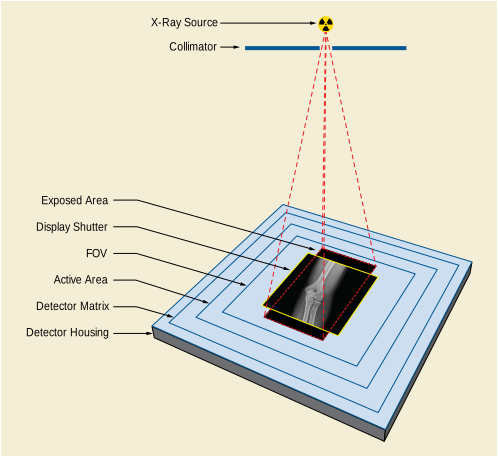
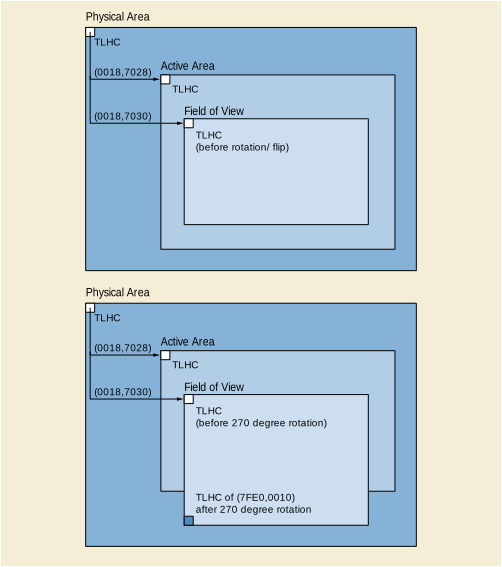
Table C.8-72 contains IOD Attributes that describe the positioning used in acquiring Digital X-Ray Images.
Table C.8-72. DX Positioning Module Attributes
|
Attribute Name |
Tag |
Type |
Attribute Description |
|---|---|---|---|
|
Projection Eponymous Name Code Sequence |
(0018,5104) |
3 |
A Sequence that describes the radiographic method of patient, tube and detector positioning to achieve a well described projection or view. Only a single Item is permitted in this Sequence. Shall be consistent with the other Attributes in this Module, if present, but may more specifically describe the image acquisition. |
|
Baseline CID 4012 “Projection Eponymous Name”. |
|||
|
Patient Position |
(0018,5100) |
3 |
Description of imaging subject's position relative to the equipment. See Section C.7.3.1.1.2 for Defined Terms and further explanation. If present, shall be consistent with Patient Gantry Relationship Code Sequence (0054,0414) and Patient Orientation Modifier Code Sequence (0054,0412). |
|
View Position |
(0018,5101) |
3 |
Radiographic view of the image relative to the imaging subject's orientation. Shall be consistent with View Code Sequence (0054,0220). See Section C.8.11.5.1.1 for further explanation. |
|
View Code Sequence |
(0054,0220) |
3 |
Sequence that describes the projection of the anatomic region of interest on the image receptor. NoteIt is strongly recommended that this Attribute be present, in order to ensure that images may be positioned correctly relative to one another for display. Shall be consistent with View Position (0018,5101). See Section C.8.11.5.1.1 for further explanation. Only a single Item is permitted in this Sequence. |
|
Baseline CID 4010 “DX View”. |
|||
|
>View Modifier Code Sequence |
(0054,0222) |
3 |
View modifier. One or more Items are permitted in this Sequence. |
|
Baseline CID 4011 “DX View Modifier”. |
|||
|
Patient Orientation Code Sequence |
(0054,0410) |
3 |
Sequence that describes the orientation of the patient with respect to gravity. See Section C.8.11.5.1.2 for further explanation. Only a single Item is permitted in this Sequence. |
|
Baseline CID 19 “Patient Orientation”. |
|||
|
>Patient Orientation Modifier Code Sequence |
(0054,0412) |
3 |
Patient Orientation Modifier. Required if needed to fully specify the orientation of the patient with respect to gravity. Only a single Item is permitted in this Sequence. |
|
Baseline CID 20 “Patient Orientation Modifier”. |
|||
|
Patient Gantry Relationship Code Sequence |
(0054,0414) |
3 |
Sequence that describes the orientation of the patient with respect to the gantry. Only a single Item is permitted in this Sequence. |
|
Baseline CID 21 “Patient Equipment Relationship”. |
|||
|
Distance Source to Patient |
(0018,1111) |
3 |
Distance in mm from source to the table, support or bucky side that is closest to the Imaging Subject, as measured along the central ray of the X-Ray beam. Note
See Section C.8.11.7 for explanation if Positioner Type (0018,1508) is MAMMOGRAPHIC. |
|
Distance Source to Detector |
(0018,1110) |
3 |
Distance in mm from source to detector center. NoteThis value is traditionally referred to as Source Image Receptor Distance (SID). See Section C.8.11.7 for explanation if Positioner Type (0018,1508) is MAMMOGRAPHIC. |
|
Estimated Radiographic Magnification Factor |
(0018,1114) |
3 |
Ratio of Source Image Receptor Distance (SID) over Source Object Distance (SOD). |
|
Positioner Type |
(0018,1508) |
2 |
Defined Terms:
Note
|
|
Positioner Primary Angle |
(0018,1510) |
3 |
Position of the X-Ray beam about the patient from the RAO to LAO direction where movement from RAO to vertical is positive, if Positioner Type (0018,1508) is CARM. See Section C.8.7.5 for further explanation if Positioner Type (0018,1508) is CARM. See Section C.8.11.7 for explanation if Positioner Type (0018,1508) is MAMMOGRAPHIC. |
|
Positioner Secondary Angle |
(0018,1511) |
3 |
Position of the X-Ray beam about the patient from the CAU to CRA direction where movement from CAU to vertical is positive, if Positioner Type (0018,1508) is CARM. See Section C.8.7.5 for further explanation if Positioner Type (0018,1508) is CARM. See Section C.8.11.7 for explanation if Positioner Type (0018,1508) is MAMMOGRAPHIC. |
|
Detector Primary Angle |
(0018,1530) |
3 |
Angle of the X-Ray beam in the row direction in degrees relative to the normal to the detector plane. Positive values indicate that the X-Ray beam is tilted toward higher numbered columns. Negative values indicate that the X-Ray beam is tilted toward lower numbered columns. See Section C.8.7.5 for further explanation. See Section C.8.11.7 for explanation if Positioner Type (0018,1508) is MAMMOGRAPHIC. |
|
Detector Secondary Angle |
(0018,1531) |
3 |
Angle of the X-Ray beam in the column direction in degrees relative to the normal to the detector plane. Positive values indicate that the X-Ray beam is tilted toward lower numbered rows. Negative values indicate that the X-Ray beam is tilted toward higher numbered rows. See Section C.8.7.5 for further explanation. See Section C.8.11.7 for explanation if Positioner Type (0018,1508) is MAMMOGRAPHIC. |
|
Column Angulation |
(0018,1450) |
3 |
Angle of the X-Ray beam in degree relative to an orthogonal axis to the detector plane. Positive values indicate that the tilt is toward the head of the table. NoteThe detector plane is assumed to be parallel to the table plane. Only meaningful if Positioner Type (0018,1508) is COLUMN. |
|
Table Type |
(0018,113A) |
3 |
Defined Terms:
|
|
Table Angle |
(0018,1138) |
3 |
Angle of table plane in degrees relative to horizontal plane [Gravity plane]. Positive values indicate that the head of the table is upward. Only meaningful if Table Type (0018,113A) is TILTING. |
|
Body Part Thickness |
(0018,11A0) |
3 |
The average thickness in mm of the body part examined when compressed, if compression has been applied during exposure. |
|
Compression Force |
(0018,11A2) |
3 |
The compression force applied to the body part during exposure, measured in Newtons. |
|
Paddle Description |
(0018,11A4) |
3 |
Description of the compression paddle, if compression was applied to the body part during exposure. |
View Code Sequence (0054,0220) replaces the function of View Position (0018,5101), and describes the radiographic view of the image relative to the real-world patient orientation as described in Annex A “Explanation of Patient Orientation (Normative)” in PS3.17.
Table C.8-73 specifies the Attributes that identify and describe general information about a Digital Mammography Series.
Table C.8-73. Mammography Series Module Attributes
|
Attribute Name |
Tag |
Type |
Attribute Description |
|---|---|---|---|
|
Modality |
(0008,0060) |
1 |
Type of equipment that originally acquired the data used to create the images in this Series. Enumerated Values:
See Section C.7.3.1.1.1 for further explanation. |
|
Request Attributes Sequence |
(0040,0275) |
3 |
Sequence that contains attributes from the Imaging Service Request. One or more Items are permitted in this sequence. |
|
For Reason for Requested Procedure Code Sequence (0040,100A) the Baseline CIDs are CID 6051 “Breast Procedure Reason” and CID 6055 “Breast Clinical Finding Or Indicated Problem”. No Baseline CIDs are defined for other Attributes. NoteFor example, Reason for Requested Procedure Code Sequence (0040,100A) may be used to convey whether the images in the Series were taken for screening or diagnostic purposes, if the information cannot be found in Reason For Performed Procedure Code Sequence (0040,1012) in the General Study Module. |
|||
Table C.8-74 contains IOD Attributes that describe a Digital Mammography X-Ray Image including its acquisition and positioning.
Table C.8-74. Mammography Image Module Attributes
|
Attribute Name |
Tag |
Type |
Attribute Description |
|---|---|---|---|
|
Image Type |
(0008,0008) |
1 |
Image identification characteristics. See Section C.8.11.7.1.4 for specialization. |
|
Positioner Type |
(0018,1508) |
1 |
Enumerated Values:
|
|
Distance Source to Detector |
(0018,1110) |
3 |
Distance in mm from source to detector center on the chest wall line Note
|
|
Distance Source to Patient |
(0018,1111) |
3 |
Distance in mm from source to the breast support side that is closest to the Imaging Subject, as measured along the X-Ray beam vector. Note
|
|
Positioner Primary Angle |
(0018,1510) |
3 |
Signed position in degrees of the X-Ray beam vector in the coronal anatomical plane as if the patient were standing facing the equipment where vertical is zero. |
|
Positioner Primary Angle Direction |
(0018,9559) |
3 |
The interpretation of the sign of the Positioner Primary Angle (0018,1510). Enumerated Values:
See Section C.8.31.2.1. |
|
Positioner Secondary Angle |
(0018,1511) |
3 |
Position in degrees of the X-Ray beam vector in the sagittal anatomical plane as if the patient were standing where movement of the X-Ray source from anterior to posterior is positive, and vertical is zero. |
|
Image Laterality |
(0020,0062) |
1 |
Laterality of the region examined. Enumerated Values:
|
|
Organ Exposed |
(0040,0318) |
1 |
Organ to which Organ Dose (0040,0316) applies. Enumerated Values:
NoteIn the Mammography IOD, Organ Dose (0040,0316) refers to the mean glandular dose. |
|
Breast Implant Present |
(0028,1300) |
3 |
Whether or not the imaged breast contains a breast implant regardless of the visibility of a breast implant in the Pixel Data. Enumerated Values:
NoteThe value is expected to be YES for all images acquired on a breast that contains a breast implant, even when a breast implant is displaced during image acquisition. |
|
Partial View |
(0028,1350) |
3 |
Indicates whether this image is a partial view, that is a subset of a single view of the breast. Enumerated Values:
If this Attribute is absent, then the image may or may not be a partial view. NoteThis may occur when a breast is larger than the active area of the detector. If this Attribute is present, its value shall be NO if there is a View Modifier Code Sequence (0054,0222) Item of value (R-102D6, SRT, "Magnification") or (R-102D7, SRT, "Spot Compression"). NoteSRT is the preferred designator for SNOMED, but SNM3 is allowed for backward compatibility. See PS3.16. |
|
Partial View Description |
(0028,1351) |
3 |
Free text description of the portion of the breast captured in a partial view image. This Attribute shall not be present if there is a View Modifier Code Sequence (0054,0222) Item of value (R-102D6, SRT, "Magnification") or (R-102D7, SRT, "Spot Compression"). NoteSRT is the preferred designator for SNOMED, but SNM3 is allowed for backward compatibility. See PS3.16. |
|
Partial View Code Sequence |
(0028,1352) |
3 |
Sequence that describes the portion or section of the breast captured in a partial view image. Only one or two Items are permitted in this sequence. See Section C.8.11.7.1.3. If this Attribute is absent, then the image may or may not be a partial view. This Attribute shall not be present if there is a View Modifier Code Sequence (0054,0222) Item of value (R-102D6, SRT, "Magnification") or (R-102D7, SRT, "Spot Compression"). NoteSRT is the preferred designator for SNOMED, but SNM3 is allowed for backward compatibility. See PS3.16. |
|
Include Table 10-5 “General Anatomy Mandatory Macro Attributes” |
Defined CID for the Anatomic Region Sequence is CID 4013 “Anatomic Region for Mammography”. |
||
|
View Code Sequence |
(0054,0220) |
1 |
Sequence that describes the projection of the anatomic region of interest on the image receptor. Only a single Item shall be included in this Sequence. |
|
Defined CID 4014 “View for Mammography”. |
|||
|
>View Modifier Code Sequence |
(0054,0222) |
2 |
View modifier. Zero or more Items shall be included in this Sequence. |
|
Biopsy Target Sequence |
(0018,2041) |
3 |
Sequence that identifies the targets of a biopsy procedure. One or more Items are permitted in this sequence, where the coordinate system is the same for all Items within a pair of stereo images. |
|
>Target UID |
(0018,2042) |
1 |
Unique identifier for the target. NoteTo identify the same target in corresponding minus and plus stereo images. |
|
>Localizing Cursor Position |
(0018,2043) |
1 |
Coordinates of localizing cursor position with respect to pixels in the image specified by a column (delimiter) row pair. The values shall be in the range 0\0 (TLHC) to Columns\Rows (BRHC). |
|
>Calculated Target Position |
(0018,2044) |
1 |
The calculated target position (x, y, z) in mm in an equipment relative right-handed coordinate system where the origin is under the central X-Ray beam at the chest wall, and a z value of zero is located at the surface that the breast is in contact with that is closest to the detector. X is parallel to the chest wall, y is positive toward the patient's nipple, and z is positive toward the X-Ray source. |
|
>Displayed Z Value |
(0018,2046) |
1 |
The z value in mm displayed to the user at the time of biopsy. Note
|
|
>Target Label |
(0018,2045) |
3 |
Target description. |
Figure C.8.11.7-1 shows the X-Ray beam for a digital mammography system. The X-Ray beam vector is defined from the Focal Spot to the center of the chest wall line of the Image Detection device.
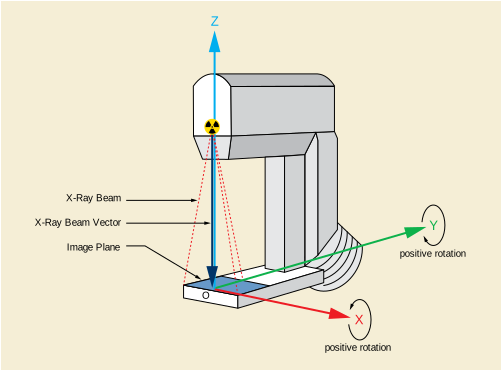
Detector Angles are defined in a fashion similar to the positioner angles, except that the angle of the x-ray beam vector is relative to the detector plane rather than the patient plane. Zero degrees is referenced to the normal of the detector plane pointing toward the x-ray source. The valid range of the Detector Angles is -90 to + 90 degrees.
The Primary Axis of rotation is defined along the line in the column direction of the detector plane that intersects the x-ray beam vector. The Detector Primary Angle is defined in the plane perpendicular to the Primary Axis of rotation at the point where the x-ray beam vector intersects the detector plane, with zero degrees in the direction normal to the detector plane and +90 in the direction of the higher numbered columns of the detector in that plane. The valid range of Detector Primary Angle is -90 to +90 degrees.
The Secondary Axis is in the detector plane and is perpendicular to the Primary Axis at the intersection of the beam vector with the detector plane (i.e., it is along the row direction). The Detector Secondary Angle is defined in the plane perpendicular to the Secondary Axis at the point where the x-ray beam vector intersects the detector plane, with zero degrees in the direction normal to the detector plane. +90 degrees corresponds to the direction of the lower numbered rows of the detector in that plane. The Detector Secondary Angle range is -90 to + 90 degrees.
Combinations of coded terms may be used in the Partial View Code Sequence (0028,1352) to express the breast section imaged. Figure C.8.11.7-2 shows examples for the right and left FB, XCC, XCCL and XCCM views, and Figure C.8.11.7-3 shows examples for the right and left ML, MLO, LM, LMO, SIO and ISO views.
|
Partial View Code Sequence Items (Code Meaning) |
Partial View Images (A, B, C, D, E) |
|---|---|
|
A) item 1 = Lateral B) item 1 = Medial |

|
|
A) item 1 = Posterior B) item 1 = Anterior |

|
|
A) item 1 = Lateral, item 2 = Posterior B) item 1 = Medial, item 2 = Posterior C) item1 = Anterior |

|
|
A) item 1 = Lateral, item 2 = Posterior B) item 1 = Medial, item 2 = Posterior C) item 1 = Lateral, item 2 = Anterior D) item 1 = Medial, item 2 = Anterior |

|
|
A) item 1 = Lateral, item 2 = Posterior B) item 1 = Central, item 2 = Posterior C) item 1 = Medial, item 2 = Posterior D) item 1 = Lateral, item 2 = Anterior E) item 1 = Medial, item 2 = Anterior |
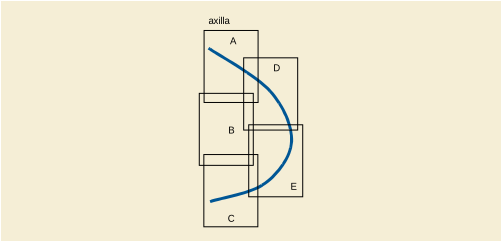
|
Figure C.8.11.7-2. CC, FB, XCCL and XCCM partial views
Note
If six images are required, then the "Central, Anterior" combination would be added.
|
Partial View Code Sequence Items (Code Meaning) |
Partial View Images (A, B, C, D, E) |
|---|---|
|
A) item 1 = Superior B) item 1 = Inferior |

|
|
A) item 1 = Posterior B) item 1 = Anterior |

|
|
A) item 1 = Superior, item 2 = Posterior B) item1 = Inferior, item 2 = Posterior C) item 1 = Anterior |

|
|
A) item 1 = Superior, item 2 = Posterior B) item 1 = Inferior, item 2 = Posterior C) item 1 = Superior, item 2 = Anterior D) item 1 = Inferior, item 2 = Anterior |

|
|
A) item 1 = Superior, item 2 = Posterior B) item 1 = Central, item 2 = Posterior C) item 1 = Inferior, item 2 = Posterior D) item 1 = Superior, item 2 = Anterior E) item 1 = Inferior, item 2 = Anterior |
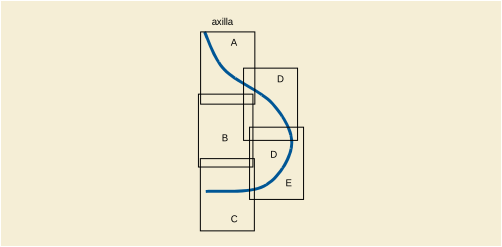
|
Figure C.8.11.7-3. ML, MLO, LM, LMO, SIO and ISO partial views
Note
If six images are required, then the "Central, Anterior" combination would be added.
Image Type (0008,0008) Value 1 and Value 2 shall identify the Pixel Data Characteristics in accordance with Section C.8.11.3.1.1.
Value 3 shall be present and have zero length (null value), except when used to identify a stereotactic mammography image, digital breast tomosynthesis projection or generated 2D image, or contrast enhanced image.
Note
In a previous version of PS3.3, Value 3 was required to be zero length (null value). If Value 3 is zero length, the image may or may not be a stereotactic mammography image, digital breast tomosynthesis projection or generated 2D image, or contrast enhanced image, if the Instance was created before these terms were defined.
The Enumerated Values for Value 3 of stereotactic mammography images are listed in Table C.8-74a.
Table C.8-74a. Enumerated Values of Image Type (0008,0008) Value 3 for Stereotactic Mammography
|
Enumerated Value |
Definition |
ACR MQCM Equivalent |
|---|---|---|
|
STEREO_SCOUT |
A localizer image for a stereotactic acquisition. |
…SC |
|
STEREO_MINUS |
The paired image obtained with the X-Ray source angle decreased from the scout position, to determine positioning coordinates prior to needle positioning. |
…ST- |
|
STEREO_PLUS |
The paired image obtained with the X-Ray source angle increased from the scout position, to determine positioning coordinates prior to needle positioning. |
…ST+ |
|
PREFIRE_MINUS |
The paired image obtained with the X-Ray source angle decreased from the scout position, with the biopsy needle in position prior to needle deployment. |
…PRF- |
|
PREFIRE_PLUS |
The paired image obtained with the X-Ray source angle increased from the scout position, with the biopsy needle in position prior to needle deployment. |
…PRF+ |
|
POSTFIRE_MINUS |
The paired image obtained with the X-Ray source angle decreased from the scout position, with the biopsy needle in position following needle deployment through the targeted lesion. |
…POF- |
|
POSTFIRE_PLUS |
The paired image obtained with the X-Ray source angle increased from the scout position, with the biopsy needle in position following needle deployment through the targeted lesion. |
…POF+ |
|
POSTBIOPSY_MINUS |
The image obtained following tissue acquisition with the X-Ray source angle decreased from the scout position. |
…POB- |
|
POSTBIOPSY_PLUS |
The image obtained following tissue acquisition with the X-Ray source angle increased from the scout position. |
…POB+ |
|
POSTBIOPSY |
The image obtained following tissue acquisition with the X-Ray source in the scout position. |
…POB |
|
POSTMARKER_MINUS |
The image obtained following micromarker placement with the X-Ray source angle decreased from the scout position. |
…POM- |
|
POSTMARKER_PLUS |
The image obtained following micromarker placement with the X-Ray source angle increased from the scout position. |
…POM+ |
|
POSTMARKER |
The image obtained following micromarker placement with the X-Ray source in the scout position. |
…POM |
The Enumerated Values for Value 3 of digital breast tomosynthesis projection images and mathematically generated 2D images are:
Table C.8-74b. Enumerated Values of Image Type (0008,0008) Value 3 for Digital Breast Tomosynthesis Projection and Generated 2D Images
|
Enumerated Value |
Definition |
ACR MQCM Equivalent |
|---|---|---|
|
TOMO_PROJ |
Identifies the image as a digital breast tomosynthesis projection image. |
n/a |
|
TOMOSYNTHESIS |
Identifies the image as digital breast tomosynthesis; shall be used only for generated 2D images when no other Value 3 takes precedence. |
n/a |
|
TOMO_SCOUT |
A localizer image that may be used to determine positioning coordinates prior to needle positioning. |
…SC |
|
PREFIRE |
The image obtained with the biopsy needle in position prior to needle deployment. |
…PRF |
|
POSTFIRE |
The image obtained with the biopsy needle in position following needle deployment through the targeted lesion. |
…POF |
|
POSTBIOPSY |
The image obtained following tissue acquisition with the X-Ray source in the scout position. |
…POB |
|
POSTMARKER |
The image obtained following micromarker placement with the X-Ray source in the scout position. |
…POM |
Note
Digital breast tomosynthesis projection images acquired as part of a biopsy procedure (and resulting derived images such as mathematically generated 2D) omit the _MINUS and _PLUS endings because a single digital breast tomosynthesis acquisition produces a set of projection images that replaces the _MINUS and _PLUS image pair used in conventional 2D breast biopsy imaging.
The Enumerated Values for Value 3 of contrast enhanced images are:
Table C.8-74c. Enumerated Values of Image Type (0008,0008) Value 3 for Contrast Enhanced Images
|
Enumerated Value |
Definition |
|---|---|
|
PRE_CONTRAST |
Collected before contrast was administered. |
|
POST_CONTRAST |
Collected during or after contrast was administered. |
If more than one characteristic (biopsy, tomosynthesis, contrast enhanced) applies to an image, Value 3 shall contain the biopsy image type. If biopsy is not involved, Value 3 shall contain the tomosynthesis image type.
Note
For example, attributes of the Contrast/Bolus module may be used to identify contrast enhanced characteristics of a biopsy and/or tomosynthesis projection or generated 2D image that is also contrast enhanced.
Value 4 shall be present for images acquired using contrast enhanced digital x-ray imaging of the breast (but may be empty if none of the Defined Terms applies), and for mathematically generated 2D images. For other images Value 4 remains optional and implementation specific.
Table C.8-74d. Defined Terms of Image Type (0008,0008) Value 4 for Contrast Enhanced and Generated 2D Images
|
Enumerated Value |
Definition |
|---|---|
|
GENERATED_2D |
Mathematically generated 2D view. |
|
ADDITION |
Created through Pixel by pixel addition operation. |
|
SUBTRACTION |
Created through Pixel by pixel subtraction operation. |
If more than one characteristic (contrast enhanced, tomosynthesis) applies to an image, Value 4 shall contain the contrast enhanced image type. If contrast enhanced is not involved, Value 4 shall contain the generated 2D image type.
Value 5 shall be present for images acquired using contrast enhanced digital x-ray imaging of the breast, but may be empty if none of the Defined Terms applies. For non-contrast images Value 5 remains optional and implementation specific.
Table C.8-74e. Defined Terms of Image Type (0008,0008) Value 5 for Contrast Enhanced 2D Images
|
Enumerated Value |
Definition |
|---|---|
|
LOW_ENERGY |
Low energy image. |
|
HIGH_ENERGY |
High energy image. |
Note
A recipient may use the different values for biopsy, tomosynthesis and contrast views to determine how to display them, for example in hanging protocols:
|
Image Type Value 3 |
Image Type Value 4 |
Image Type Value 5 |
|
|---|---|---|---|
|
Conventional 2D mammography |
empty |
- |
- |
|
Stereotactic post-biopsy |
POSTBIOPSY |
- |
- |
|
Pre-contrast 2D |
PRE_CONTRAST |
empty |
empty |
|
Post-contrast 2D low energy |
POST_CONTRAST |
- |
LOW_ENERGY |
|
Post-contrast 2D addition |
POST_CONTRAST |
ADDITION |
empty |
|
Stereotactic scout pre-contrast |
STEREO_SCOUT |
empty |
empty |
|
Stereotactic stereo post-contrast high energy |
STEREO_PLUS |
empty |
HIGH_ENERGY |
|
Stereotactic post-fire post-contrast subtraction |
POSTFIRE_MINUS |
SUBTRACTION |
empty |
|
Tomosynthesis generated 2D |
TOMOSYNTHESIS |
GENERATED_2D |
- |
|
Tomosynthesis biopsy scout generated 2D |
TOMO_SCOUT |
GENERATED_2D |
- |
|
Tomosynthesis generated 2D post-contrast low energy |
TOMOSYNTHESIS |
GENERATED_2D |
LOW_ENERGY |
|
Tomosynthesis generated 2D post-contrast subtraction |
TOMOSYNTHESIS |
SUBTRACTION |
empty |
|
Tomosynthesis projection |
TOMO_PROJ |
- |
- |
|
Tomosynthesis projection post-biopsy |
POSTBIOPSY |
- |
- |
|
Tomosynthesis projection post-biopsy post-contrast subtraction |
POSTBIOPSY |
SUBTRACTION |
empty |
Table C.8-75 specifies the Attributes that identify and describe general information about a Digital Intra-Oral X-Ray Series.
Table C.8-75. Intra-Oral Series Module Attributes
|
Attribute Name |
Tag |
Type |
Attribute Description |
|---|---|---|---|
|
Modality |
(0008,0060) |
1 |
Type of equipment that originally acquired the data used to create the images in this Series. Enumerated Values:
See Section C.7.3.1.1.1 for further explanation. |
Table C.8-76 contains IOD Attributes that describe a Digital Intra-Oral X-Ray Image including its acquisition and positioning.
Table C.8-76. Intra-Oral Image Module Attributes
|
Attribute Name |
Tag |
Type |
Attribute Description |
|---|---|---|---|
|
Positioner Type |
(0018,1508) |
1 |
Enumerated Values:
|
|
Image Laterality |
(0020,0062) |
1 |
Laterality of the region examined. Enumerated Values:
|
|
Anatomic Region Sequence |
(0008,2218) |
1 |
Sequence that identifies the anatomic region of interest in this image. Only a single Item shall be included in this Sequence. |
|
Defined CID 4016 “Anatomic Region for Intra-oral Radiography”. |
|||
|
>Anatomic Region Modifier Sequence |
(0008,2220) |
1C |
Sequence that refines the anatomic region of interest in this image. Required if Primary Anatomic Structure Sequence (0008,2228) is not sent. Only a single Item shall be included in this Sequence. |
|
Defined CID 4017 “Anatomic Region Modifier for Intra-oral Radiography”. |
|||
|
Primary Anatomic Structure Sequence |
(0008,2228) |
1C |
Sequence that describes the primary anatomic structures of interest in this image. See Section C.8.11.9.1.1 for further explanation. Required if Anatomic Region Modifier Sequence (0008,2220) is not sent. One or more Items shall be included in this Sequence. |
|
Defined CID 4018 “Primary Anatomic Structure for Intra-oral Radiography (permanent Dentition - Designation of Teeth)” or CID 4019 “Primary Anatomic Structure for Intra-oral Radiography (Deciduous Dentition - Designation of Teeth)”. See Section C.8.11.9.1.1 for further explanation. |
|||
Code Value (0008,0100) shall be drawn from the DICOM Content Mapping Resource, CID 4018 “Primary Anatomic Structure for Intra-oral Radiography (permanent Dentition - Designation of Teeth)”, for permanent dentition, or CID 4019 “Primary Anatomic Structure for Intra-oral Radiography (Deciduous Dentition - Designation of Teeth)” for deciduous dentition.
These Context Groups correspond to ISO 3950-1984 that describes a designation of permanent and deciduous dentition using a two digit code, the first digit of which designates a quadrant, and the second digit a tooth.
The teeth imaged shall be listed as multiple Items in the Primary Anatomic Structure Sequence (0008,2228).
The Breast Tomosynthesis Image IOD uses the General Series module described in Section C.7.3.1, specialized by the Enhanced Mammography Series Module, to describe the DICOM Series Entity described in Section A.1.2.3, and to define what constitutes a Series for the context of a Breast Tomosynthesis device.
Table C.8-76b specifies the Attributes that identify and describe general information about the Enhanced Mammography Series.
Table C.8-76b. Enhanced Mammography Series Module Attributes
|
Attribute Name |
Tag |
Type |
Attribute Description |
|---|---|---|---|
|
Modality |
(0008,0060) |
1 |
Type of equipment that originally acquired the data used to create the images in this Series. Enumerated Values:
See Section C.7.3.1.1.1 for further explanation. |
|
Referenced Performed Procedure Step Sequence |
(0008,1111) |
1C |
Uniquely identifies the Performed Procedure Step SOP Instance to which the Series is related. Only a single Item shall be included in this sequence. Required if a Performed Procedure Step SOP Class was involved in the creation of this Series. |
|
>Include Table 10-11 “SOP Instance Reference Macro Attributes” |
|||
|
Request Attributes Sequence |
(0040,0275) |
3 |
Sequence that contains attributes from the Imaging Service Request. One or more Items are permitted in this sequence. |
|
For Reason for Requested Procedure Code Sequence (0040,100A) the Baseline CIDs are CID 6051 “Breast Procedure Reason” and CID 6055 “Breast Clinical Finding Or Indicated Problem”. No Baseline CIDs are defined for other Attributes. NoteFor example, Requested Procedure Code Sequence (0040,100A) may be used to convey whether the images in the Series were taken for screening or diagnostic purposes. |
|||
Table C.8-77 specifies the Attributes that describe a VL Image produced by Endoscopy (ES), General Microscopy (GM), Automated-Stage Microscopy (SM), External-camera Photography (XC), or other VL imaging Modalities.
Table C.8-77. VL Image Module Attributes
|
Attribute Name |
Tag |
Type |
Attribute Description |
|---|---|---|---|
|
Image Type |
(0008,0008) |
1 |
Image identification characteristics. See Section C.8.12.1.1.6 for specialization. |
|
Photometric Interpretation |
(0028,0004) |
1 |
Specifies the intended interpretation of the pixel data. See Section C.8.12.1.1.1 for specialization of this Attribute. |
|
Bits Allocated |
(0028,0100) |
1 |
Number of bits allocated for each pixel sample. Each sample shall have the same number of bits allocated. See Section C.8.12.1.1.2 for specialization of this Attribute. See PS3.5 for further explanation. |
|
Bits Stored |
(0028,0101) |
1 |
Number of bits stored for each pixel sample. Each sample shall have the same number of bits stored. See Section C.8.12.1.1.2 for specialization of this Attribute. See PS3.5 for further explanation. |
|
High Bit |
(0028,0102) |
1 |
Most significant bit for pixel sample data. Each sample shall have the same high bit. See Section C.8.12.1.1.2 for specialization of this Attribute. See PS3.5 for further explanation. |
|
Pixel Representation |
(0028,0103) |
1 |
Data representation of the pixel samples. Each sample shall have the same pixel representation. See Section C.8.12.1.1.3 for specialization of this Attribute. |
|
Samples per Pixel |
(0028,0002) |
1 |
Number of samples (planes) per image. See Section C.8.12.1.1.4 for specialization of this Attribute. |
|
Planar Configuration |
(0028,0006) |
1C |
Indicates whether the pixel data are sent color-by-plane or color-by-pixel. Required if Samples per Pixel (0028,0002) has a value greater than 1. See Section C.8.12.1.1.5 for specialization of this Attribute. |
|
Content Time |
(0008,0033) |
1C |
The time the image pixel data creation started. Required if the Image is part of a series in which the images are temporally related. NoteThis Attribute was formerly known as Image Time. |
|
Lossy Image Compression |
(0028,2110) |
2 |
Specifies whether an Image has undergone lossy compression (at a point in its lifetime). Enumerated Values:
Once this value has been set to 01 it shall not be reset. |
|
Referenced Image Sequence |
(0008,1140) |
1C |
A Sequence that references other images significantly related to this image. One or more items are permitted in this sequence. Required if Image Type (0008,0008) Value 3 is present and has a value of "STEREO L" or "STEREO R". May also be present otherwise. See Section C.8.12.1.1.7. |
|
>Include Table 10-3 “Image SOP Instance Reference Macro Attributes” |
|||
|
>Purpose of Reference Code Sequence |
(0040,A170) |
2 |
Describes the purpose for which the reference is made. Zero or one item shall be included in this sequence. |
|
Window Center |
(0028,1050) |
3 |
Window Center for display. See Section C.11.2.1.2 for further explanation. Meaningful only if Photometric Interpretation (0028,0004) is MONOCHROME2. |
|
Window Width |
(0028,1051) |
1C |
Window Width for display. See Section C.11.2.1.2 for further explanation. Required if Window Center (0028,1050) is present. |
|
Anatomic Region Sequence |
(0008,2218) |
1C |
Sequence that identifies the anatomic region of interest in this image (i.e., external anatomy, surface anatomy, or general region of the body). Only a single Item shall be included in this sequence. Required if Number of Frames (0028,0008) is present and Specimen Description Sequence (0040,0560) is absent. May be present otherwise. |
|
Defined CID 4040 “Endoscopy Anatomic Regions” is defined for the Video Endoscopic IOD. For other IODs, no Context ID is defined. |
|||
|
>Anatomic Region Modifier Sequence |
(0008,2220) |
3 |
Sequence of Items that modifies the anatomic region of interest of this image One or more Items are permitted in this Sequence. |
|
Baseline CID 2 “Anatomic Modifier”. |
|||
|
Include Table 10-8 “Primary Anatomic Structure Macro Attributes” |
No Context ID is defined. These Type 3 Attributes are not appropriate when Specimen Description Sequence (0040,0560) is present, as it includes the Primary Anatomic Structure Macro for each specimen in the image. |
||
|
Channel Description Code Sequence |
(0022,001A) |
3 |
Describes the light color used for each channel to generate the image. If Photometric Interpretation (0028,0004) has one of the YBR values, the meaning is for pixel data in an equivalent RGB encoding. NoteInterpretation and representation of RGB images rely on the assumption that the red channel really contains the red wavelength range of illumination light, the blue channel the blue wavelength range, etc. Some modalities use the RGB Photometric Interpretation as a container representing 3 channels of any illumination wavelength. Shall have the same number of items as the value of Samples per Pixel (0028,0002). The channels shall be described in the order in which the channels are encoded. |
|
Pixel Spacing |
(0028,0030) |
3 |
Physical distance in the imaging target (patient or specimen) between the center of each pixel, specified as a numeric pair - adjacent row spacing \ adjacent column spacing, in mm. See Section 10.7.1.3. |
Enumerated Values:
- MONOCHROME2
- RGB
- YBR_FULL_422
- YBR_PARTIAL_420
- YBR_RCT
- YBR_ICT
Note
There is no formal color space defined, hence "false" color applications that encode near-visible light images may be encoded, for example, as RGB.
Enumerated Values of Bits Allocated (0028,0100):
- 8
Enumerated Values of Bits Stored (0028,0101):
- 8
Enumerated Values of High Bit (0028,0102):
- 7
Enumerated Values when Photometric Interpretation (0028,0004) is MONOCHROME2:
- 1
Enumerated Values when Photometric Interpretation (0028,0004) is RGB or YBR_FULL_422 or YBR_PARTIAL_420 or YBR_RCT or YBR_ICT:
- 3
This value shall be present if Samples per Pixel (0028,0002) has a value greater than 1.
Enumerated Values:
- 0
The Image Type attribute identifies important image characteristics in a multiple valued data element. For Visible Light, Image Type is specialized as follows:
Value 1 shall identify the Pixel Data Characteristics in accordance with Section C.7.6.1.1.2.
Enumerated Values:
- ORIGINAL
- DERIVED
Value 2 shall identify the Patient Examination Characteristics in accordance with Section C.7.6.1.1.2.
Enumerated Values:
- PRIMARY
- SECONDARY
Value 3 may be absent, but if present shall identify the members of a stereo pair, in which case Referenced Image Sequence (0008,1140) is used to identify the other member of the pair.
Enumerated Values:
- STEREO L
Image is the left image (relative to the observer's left) of a stereo pair acquisition
- STEREO R
Image is the right image (relative to the observer's right) of a stereo pair acquisition
Other Values are implementation specific (optional).
When Image Type (0008,0008) Value 3 is STEREO L or STEREO R, Referenced Image Sequence (0008,1140) shall be used to identify the corresponding SOP Instance of the Stereoscopic acquisition. In this case, either:
only a single item shall be present, or
multiple items may be present, each with the Purpose of Reference Code Sequence (0040,A170) present, and only the first item having the Purpose of Reference value (121315, DCM, "Other image of stereoscopic pair").
The table in this Section contains Attributes that describe Slide Coordinates. Slide Coordinates provide a means to locate an image within a given Frame of Reference.
Note
A Frame of Reference (identified by a Frame of Reference UID) typically only applies to a single mounting of a slide on a particular microscope stage; there is no guarantee that a subsequent mounting of the slide, even on the same equipment, will allow reproducible positioning to the exact same location. These attributes allow consistent location of multiple images within the Series of a single Frame of Reference.
There is no a priori correspondence of pixels to Slide Coordinates. Therefore, the geometrical symmetry point through the pixel plane of the digital microscope may not correspond to the center of a pixel. The geometrical symmetry point could be between pixels.
This module formerly included a Type 3 attribute Pixel Spacing Sequence (0040,08D8), and subsidiary attributes; see PS3.3-2009. Pixel spacing is an attribute of the image acquisition, not the slide coordinates, and is inappropriate for this Module. It is now conveyed by Pixel Spacing (0028,0030) in the VL Image Module or the Pixel Measures Functional Group.
Table C.8-78. Slide Coordinates Module Attributes
|
Attribute Name |
Tag |
Type |
Attribute Description |
|---|---|---|---|
|
Image Center Point Coordinates Sequence |
(0040,071A) |
2 |
The coordinates of the center point of the Image in the Slide Coordinate System Frame of Reference. Zero or one item shall be included in this sequence. See Section C.8.12.2.1.1 for further explanation. |
|
>X Offset in Slide Coordinate System |
(0040,072A) |
1 |
The X offset in millimeters from the Origin of the Slide Coordinate System. See Figure C.8-16. |
|
>Y Offset in Slide Coordinate System |
(0040,073A) |
1 |
The Y offset in millimeters from the Origin of the Slide Coordinate System. See Figure C.8-16. |
|
>Z Offset in Slide Coordinate System |
(0040,074A) |
2 |
The Z offset in microns from the image substrate reference plane (i.e., utilized surface of a glass slide). |
This Section defines the Slide Coordinate System and specifies the Attributes that shall be used to describe the location of the center point of the Image pixel plane (as captured through a microscope) in the Slide Coordinate System Frame of Reference.
Note
In Slide Microscopy (SM), the Microscope is equipped with a moveable Stage and position sensors that enable storage of the location of the center point of the displayed image with respect to the examined Specimen.
The Stage is the part of the Microscope to which the Slide is attached for viewing. The Objective Lens is the lens that is closest to the Specimen. The Top Surface of the Slide is the surface of the Slide on which the Specimen is mounted. The Bottom Surface of the Slide is the opposite surface. This Specification presumes that: 1) the Slide is rectangular; 2) the Top Surface of the Slide is oriented toward the Objective Lens of the Microscope; and 3) the Bottom Surface of the Slide is in perfect contact with the Microscope Stage when the Slide is attached to the Stage for viewing.
Note
The Label of the Slide is presumed to be mounted-on or written-on the Top Surface of the Slide.
Specification of the mechanical form, function, or tolerances of the Microscope are outside the scope of this Standard.
Figure C.8-16 depicts the Top Surface of the Slide on the Microscope Stage from the perspective of the Objective Lens. This is Reference Slide Orientation. The X, Y, and Z axes of the Slide Coordinate System in Reference Slide Orientation are defined as follows. The Y-axis is a line that nominally represents the Left Edge of the Slide. The X-axis is a line that is orthogonal to the Y-axis and nominally represents the Specimen Edge of the Slide. The Z-axis is a line that passes through the intersection of the X-axis and Y-axis and is orthogonal to the Microscope Stage. The Origin (0,0,0) of the Slide Coordinate System is the point of intersection of the X, Y, and Z axes.
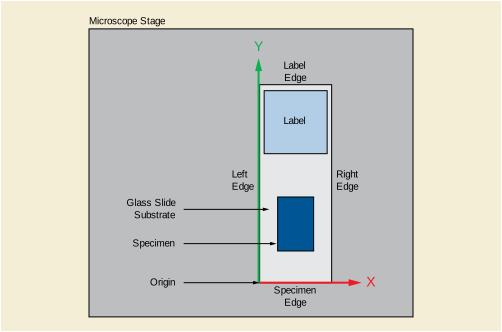
Note
An improperly-placed coverslip or Specimen that overlaps an Edge of a Slide is not considered part of the Edge a Slide for purposes of defining the Slide Coordinate System. However, such objects may cause inaccurate positioning of the Slide on the Stage.
If the Left Edge and Specimen Edge of the Slide are not orthogonal (e.g., the Slide is damaged or defective or the Specimen Edge is curvilinear), then the lower left-hand corner of the Slide may not be located at the Origin.
The definitions of X, Y, and Z axes are the same for inverted microscopes, with the Top Surface of the slide (i.e., Specimen side of the Slide) still being closest to the Objective Lens.
The origin of a Frame of Reference is arbitrary (see Section C.7.4.1), but its nominal location for consistency of slide coordinates is defined in this section.
Figure C.8-17 depicts the Z-axis center point location. The X-axis value of Image Center Point Location (0040,073A) shall increase from the Origin toward the Right Edge in Reference Slide Orientation. The Y-axis value of Image Center Point Location (0040,073A) shall increase from the Origin toward the Label Edge in Reference Slide Orientation. The Z-axis value of Image Center Point Location (0040,073A) shall be nominally referenced as zero at the image substrate reference plane (i.e., the top surface of a glass slide) and shall increase in a positive fashion coincident with increased distance from the substrate surface.
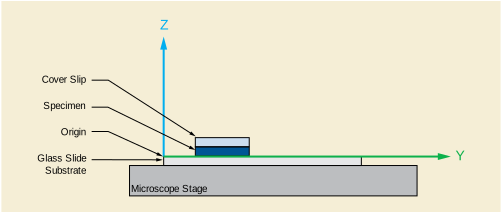
Table C.8.12.3-1 specifies attributes for the VL Whole Slide Microscopy Series Module, including specialization of attributes in the General Series Module for use in the VL Whole Slide Microscopy Series Module.
Table C.8.12.3-1. VL Whole Slide Microscopy Series Module Attributes
|
Attribute Name |
Tag |
Type |
Attribute Description |
|---|---|---|---|
|
Modality |
(0008,0060) |
1 |
Type of equipment that originally acquired the data used to create the images in this Series. Enumerated Values:
See Section C.7.3.1.1.1 for further explanation. |
|
Referenced Performed Procedure Step Sequence |
(0008,1111) |
1C |
Uniquely identifies the Performed Procedure Step SOP Instance to which the Series is related. Only a single Item shall be included in this sequence. Required if a Performed Procedure Step SOP Class was involved in the creation of this Series. |
|
>Include Table 10-11 “SOP Instance Reference Macro Attributes” |
|||
Table C.8.12.4-1 specifies the Attributes that describe the VL Whole Slide Microscopy Image Module.
Table C.8.12.4-1. VL Whole Slide Microscopy Image Module Attributes
|
Attribute Name |
Tag |
Type |
Attribute Description |
|---|---|---|---|
|
Image Type |
(0008,0008) |
1 |
Image identification characteristics. See Section C.8.12.4.1.1 for specialization. |
|
Imaged Volume Width |
(0048,0001) |
1 |
Width of total imaged volume (distance in the direction of rows in each frame) in mm. See Section C.8.12.4.1.2 |
|
Imaged Volume Height |
(0048,0002) |
1 |
Height of total imaged volume (distance in the direction of columns in each frame) in mm. See Section C.8.12.4.1.2 |
|
Imaged Volume Depth |
(0048,0003) |
1 |
Depth of total imaged volume (distance in the Z direction of focal planes) in µm. See Section C.8.12.4.1.2 |
|
Total Pixel Matrix Columns |
(0048,0006) |
1 |
Total number of columns in pixel matrix; i.e., width of total imaged volume in pixels. See Section C.8.12.4.1.3 |
|
Total Pixel Matrix Rows |
(0048,0007) |
1 |
Total number of rows in pixel matrix; i.e., height of total imaged volume in pixels. See Section C.8.12.4.1.3 |
|
Total Pixel Matrix Origin Sequence |
(0048,0008) |
1 |
Location of pixel 1\1 of the total pixel matrix in the Slide Coordinate System Frame of Reference. Only a single Item shall be included in this sequence. See Section C.8.12.4.1.4 and Section C.8.12.2.1.1 for further explanation |
|
>X Offset in Slide Coordinate System |
(0040,072A) |
1 |
The X offset in millimeters from the Origin of the Slide Coordinate System. |
|
>Y Offset in Slide Coordinate System |
(0040,073A) |
1 |
The Y offset in millimeters from the Origin of the Slide Coordinate System. |
|
Image Orientation (Slide) |
(0048,0102) |
1 |
The direction cosines of the first row and the first column of the total pixel matrix with respect to the Slide Coordinate System Frame of Reference. See Section C.8.12.4.1.4 |
|
Samples Per Pixel |
(0028,0002) |
1 |
Number of samples (color planes) per frame in this image. Enumerated Values:
See Section C.8.12.4.1.5 for further explanation. |
|
Photometric Interpretation |
(0028,0004) |
1 |
Specifies the intended interpretation of the pixel data. See Section C.8.12.4.1.5 for Enumerated Values. |
|
Planar Configuration |
(0028,0006) |
1C |
Indicates whether the pixel data are sent color-by-plane or color-by-pixel. Required if Samples per Pixel (0028,0002) has a value greater than 1. Enumerated Values:
|
|
Number of Frames |
(0028,0008) |
1 |
Number of frames in a multi-frame image. Enumerated Values if Image Type (0008,0008) Value 3 is LOCALIZER or LABEL:
|
|
Bits Allocated |
(0028,0100) |
1 |
Number of bits allocated for each pixel sample. Enumerated Values:
|
|
Bits Stored |
(0028,0101) |
1 |
Number of bits stored for each pixel sample. Enumerated Values:
|
|
High Bit |
(0028,0102) |
1 |
Most significant bit for pixel sample data. Enumerated Values:
|
|
Pixel Representation |
(0028,0103) |
1 |
Data representation of pixel samples. Enumerated Values:
|
|
Acquisition DateTime |
(0008,002A) |
1 |
The date and time that the acquisition of data that resulted in this image started. |
|
Acquisition Duration |
(0018,9073) |
1 |
Duration of the image acquisition in seconds. |
|
Lossy Image Compression |
(0028,2110) |
1 |
Specifies whether an Image has undergone lossy compression (at a point in its lifetime). Enumerated Values:
Once this value has been set to 01 it shall not be reset. |
|
Lossy Image Compression Ratio |
(0028,2112) |
1C |
Describes the approximate lossy compression ratio(s) that have been applied to this image. See Section C.7.6.1.1.5 for further explanation. May be multi-valued if successive lossy compression steps have been applied; the value order shall correspond to the values of Lossy Image Compression Method (0028,2114). Note
Required if Lossy Image Compression (0028,2110) is "01". |
|
Lossy Image Compression Method |
(0028,2114) |
1C |
A label for the lossy compression method(s) that have been applied to this image. See Section C.7.6.1.1.5 for further explanation. May be multi-valued if successive lossy compression steps have been applied; the value order shall correspond to the values of Lossy Image Compression Ratio (0028,2112). NoteFor historical reasons, the lossy compression method may also be described in Derivation Description (0008,2111). Required if Lossy Image Compression (0028,2110) is "01". |
|
Presentation LUT Shape |
(2050,0020) |
1C |
Specifies an identity transformation for the Presentation LUT, such that the output of all grayscale transformations defined in the IOD containing this Module are defined to be P-Values. Enumerated Values:
Required if Photometric Interpretation (0028,0004) is MONOCHROME2. |
|
Rescale Intercept |
(0028,1052) |
1C |
The value b in relationship between stored values (SV) and the output units. Output units = m*SV + b. Required if Photometric Interpretation (0028,0004) is MONOCHROME2. Enumerated Values:
|
|
Rescale Slope |
(0028,1053) |
1C |
m in the equation specified by Rescale Intercept (0028,1052). Required if Photometric Interpretation (0028,0004) is MONOCHROME2. Enumerated Values:
|
|
Volumetric Properties |
(0008,9206) |
1 |
Indication if geometric manipulations are possible with frames in the SOP Instance. See Section C.8.16.2.1.2. Enumerated Values:
|
|
Specimen Label in Image |
(0048,0010) |
1 |
Indicates whether the specimen label is captured in the image. Enumerated Values:
|
|
Burned In Annotation |
(0028,0301) |
1 |
Indicates whether or not image contains sufficient burned in annotation to identify the patient. Enumerated Values:
NoteIf Specimen Label in Image (0048,0010) value is YES, Burned In Annotation (0028,0301) might be NO if the label includes only a specimen identifier and not patient identifying data. |
|
Focus Method |
(0048,0011) |
1 |
Method of focusing image Enumerated Values:
|
|
Extended Depth of Field |
(0048,0012) |
1 |
Image pixels were created through combining of image acquisition at multiple focal planes (focus stacking). Enumerated Values:
|
|
Number of Focal Planes |
(0048,0013) |
1C |
Number acquisition focal planes used for extended depth of field. Required if Extended Depth of Field (0048,0012) value is YES |
|
Distance Between Focal Planes |
(0048,0014) |
1C |
Distance between acquisition focal planes used for extended depth of field, in µm. Required if Extended Depth of Field (0048,0012) value is YES |
|
Acquisition Device Processing Description |
(0018,1400) |
3 |
Description of visual processing performed on the image prior to exchange. Examples of this processing are: edge enhanced, gamma corrected, convolved (spatially filtered) |
|
Convolution Kernel |
(0018,1210) |
3 |
Label for convolution kernel used in acquisition device visual processing |
|
Recommended Absent Pixel CIELab Value |
(0048,0015) |
3 |
A color value with which it is recommended to display the pixels of the Total Pixel Matrix that are not encoded. The units are specified in PCS-Values, and the value is encoded as CIELab. See Section C.10.7.1.1. |
Image Type (0008,0008) is specified to be Type 1 with the following constraints:
Value 1 shall have a value of ORIGINAL or DERIVED
Value 2 shall have a value of PRIMARY
Value 3 (Image Flavor) shall have the Defined Terms in Table C.8.12.4-2.
Table C.8.12.4-2. VL Whole Slide Microscopy Image Flavors
|
LOCALIZER |
Collected for the purpose of planning or navigating other images. |
|
VOLUME |
Set of frames that define a regularly sampled volume |
|
LABEL |
Purpose of image is to capture the slide label; any non-label area captured is incidental to that purpose. |
Value 4 (Derived Pixel) shall have the Defined Terms specified in Table C.8.12.4-3.
Table C.8.12.4-3. VL Whole Slide Microscopy Derived Pixels
|
NONE |
No derivation of pixels (original) |
|
RESAMPLED |
Pixels were derived by down sampling a higher resolution image |
No additional values shall be present.
The full physical extent of the whole slide image target volume is described in the attributes Imaged Volume Width (0048,0001), Imaged Volume Height (0048,0002), and Imaged Volume Depth (0048,0003). These values reflect the maximum extent in these dimensions. There is no requirement that this entire extent is actually encoded in frames of the Image SOP Instance.
The value of Imaged Volume Depth (0048,0003) shall not be 0. If only a single focal plane is imaged, the Imaged Volume Depth may be the optical depth of field as encoded in Slice Thickness (0018,0050) of the Pixel Measures Functional Group (see Section C.7.6.16.2.1).
Total Pixel Matrix Columns (0048,0006) and Total Pixel Matrix Rows (0048,0007) describe the size of the entire imaged volume as a single extent across all frames (tiles).
The extent would be as described in these attributes if the whole volume would be imaged and encoded as a non-sparse pixel matrix with the pixel spacing as specified in Pixel Spacing (0028,0030) of the Pixel Measures Functional Group (see Section C.7.6.16.2.1).
Total Pixel Matrix Origin Sequence (0048,0008) specifies the location of the top leftmost pixel of the pixel matrix, and Image Orientation (Slide) (0048,0102) specifies the direction cosines of the first row and the first column of the pixel matrix, both with respect to the Slide Coordinate System Frame of Reference (see Section C.8.12.2). Although the image acquisition may vary the true row and column orientation at the pixel scale to account for local variation in the physical specimen, this attribute describes the orientation as if the Pixel Matrix were flat.
Note
Typically, Image Orientation (Slide) will describe only a planar rotation, as the image plane is usually nominally parallel to the slide surface.
See Section C.7.6.3.1.2.
Enumerated Values for Photometric Interpretation (0028,0004):
- MONOCHROME2
- RGB
- YBR_FULL_422
- YBR_ICT
- YBR_RCT
The value shall be appropriate to the compression transfer syntax used, if any, and shall be MONOCHROME2 or RGB for uncompressed or lossless compressed transfer syntaxes that do not involve color space transformations, YBR_ICT for irreversible JPEG 2000 transfer syntaxes, YBR_RCT for reversible JPEG 2000 transfer syntaxes, and YBR_FULL_422 for other lossy compressed transfer syntaxes.
Note
Future lossless and lossy transfer syntaxes may lead to the need for new definitions and choices for Photometric Interpretation. The Enumerated Values may therefore be extended with additional Photometric Interpretation values directly associated with new transfer syntaxes that are negotiated, and hence do not render existing implementations non-conformant.
Multi-spectral images may be encoded as a single wavelength band (color) in each frame using MONOCHROME2, or with up to three bands in each frame using one of the color Photometric Interpretations.
Enumerated Values for Samples per Pixel (0028,0002) when Photometric Interpretation (0028,0004) is MONOCHROME2:
- 1
Enumerated Values for Samples per Pixel (0028,0002) when Photometric Interpretation (0028,0004) is not MONOCHROME2:
- 3
Table C.8.12.5-1 specifies the attributes of the optical paths used in the VL imaging. Each optical path is a combination of illumination, filters, lenses, and sensors, and each combination is identified for possible reference by attributes in other modules. Additional optical path parameters may be specified in the Acquisition Context Module.
Table C.8.12.5-1. Optical Path Module Attributes
|
Attribute Name |
Tag |
Type |
Attribute Description |
|---|---|---|---|
|
Optical Path Sequence |
(0048,0105) |
1 |
Describes the optical paths used during the acquisition of this image. One or more Items shall be included in this sequence. |
|
>Optical Path Identifier |
(0048,0106) |
1 |
Identifier for the optical path specified in the Sequence Item. The identifier shall be unique for each Item within the Optical Path Sequence. |
|
>Optical Path Description |
(0048,0107) |
3 |
Description of the optical path specified in the Sequence Item. |
|
>Illuminator Type Code Sequence |
(0048,0100) |
3 |
Type of illuminator. Only a single Item is permitted in this sequence. |
|
Context ID may be defined in the IOD constraints. |
|||
|
>Illumination Wave Length |
(0022,0055) |
1C |
Nominal wavelength of the illuminator in nm. Required if Illumination Color Code Sequence (0048,ee08) is not present. May be present otherwise. |
|
>Illumination Color Code Sequence |
(0048,0108) |
1C |
Color of the illuminator. Only a single Item shall be included in this sequence. Required if Illumination Wave Length (0022,0055) is not present. May be present otherwise. |
|
Context ID may be defined in the IOD constraints. |
|||
|
>Illumination Type Code Sequence |
(0022,0016) |
1 |
Coded value for illumination method. See Section C.8.12.5.1.2. One or more Items shall be included in this sequence. |
|
Context ID may be defined in the IOD constraints. |
|||
|
>Light Path Filter Type Stack Code Sequence |
(0022,0017) |
3 |
Filters used in the light source (excitation) path. One or more Items are permitted in this sequence. See Section C.8.12.5.1.3. |
|
Context ID may be defined in the IOD constraints. |
|||
|
>Light Path Filter Pass-Through Wavelength |
(0022,0001) |
3 |
Nominal pass-through wavelength of light path filter(s) in nm |
|
>Light Path Filter Pass Band |
(0022,0002) |
3 |
Pass band of light path filter(s) in nm. This Attribute has two Values. The first is the shorter and the second the longer wavelength relative to the peak. The values are for the - 3dB nominal (1/2 of peak) pass through intensity. One of the two Values may be zero length, in which case it is a cutoff filter. |
|
>Image Path Filter Type Stack Code Sequence |
(0022,0018) |
3 |
Describes stack of filters used in image (emission) path between the imaging target and the optical sensor. One or more items are permitted in this sequence. See Section C.8.12.5.1.3. |
|
Context ID may be defined in the IOD constraints. |
|||
|
>Image Path Filter Pass-Through Wavelength |
(0022,0003) |
3 |
Nominal pass-through wavelength of image path filter(s) in nm |
|
>Image Path Filter Pass Band |
(0022,0004) |
3 |
Pass band of image path filter(s) in nm. This Attribute has two Values. The first is the shorter and the second the longer wavelength relative to the peak. The values are for the - 3dB nominal (1/2 of peak) pass through intensity. One of the two Values may be zero length, in which case it is a cutoff filter |
|
>Lenses Code Sequence |
(0022,0019) |
3 |
Lenses that were used in this optical path. One or more items are permitted in this sequence. |
|
Context ID may be defined in the IOD constraints. |
|||
|
>Condenser Lens Power |
(0048,0111) |
3 |
Nominal power of the condenser lens |
|
>Objective Lens Power |
(0048,0112) |
3 |
Nominal power of the objective lens. If a single lens is used as both condenser and objective, its power is specified in this attribute. |
|
>Objective Lens Numerical Aperture |
(0048,0113) |
3 |
Nominal numerical aperture of the objective lens. |
|
>Channel Description Code Sequence |
(0022,001A) |
1C |
Describes the light color sensed for each channel to generate the image. Required if this differs from the natural interpretation. Note
Shall have the same number of Items as the value of Samples per Pixel Used (0028,0003) if present, or otherwise the value of Samples per Pixel (0028,0002). The channels shall be described in the order in which the channels are encoded. |
|
Context ID may be defined in the IOD constraints. |
|||
|
>Palette Color Lookup Table Sequence |
(0048,0120) |
3 |
For MONOCHROME2 images, provides a transform of the pixel values with this optical path into an RGB color representation. The LUT provides a mapping to an appropriate color or pseudo-color for display purposes. Only a single Item is permitted in this sequence. |
|
>>Include Table C.7-22a “Palette Color Lookup Table Macro Attributes” |
|||
|
>ICC Profile |
(0028,2000) |
1C |
An ICC Profile encoding the transformation of device-dependent stored pixel values into PCS-Values. See Section C.8.12.5.1.4 Required if Photometric Interpretation (0028,0004) is not MONOCHROME2, or if Palette Color Lookup Table Sequence (0048,0120) is present. |
The Optical Path Sequence (0048,0105) shall include an Item for every optical path used in the acquisition of the current image.
For single frame images that do not include the Multi-frame Functional Groups Module, this Sequence shall include only one Item.
For images that use the Multi-frame Functional Groups Module, the optical path associated with each frame is identified by reference to the Optical Path Identifier (0048,0106) of this Sequence (see Optical Path Identification Sequence (0048,0207) in Section C.8.12.6.2). The Optical Path Sequence may include Items for defined optical paths that are not referenced by any frame.
For Whole Slide Microscopy Image LOCALIZER images (see Section C.8.12.4.1.1 and Section C.8.12.7), all the optical paths associated with referenced images shall be described in Items of this Optical Path Sequence. The optical path associated with each referenced frame is identified in the Referenced Image Navigation Sequence (0048,0200) by reference to an Optical Path Identifier (0048,0106) of this Sequence. The Optical Path Identifiers used in the LOCALIZER image do not have to be identical to those used in the referenced images.
Note
For example, each of four referenced images may use a different optical path (color), and within each of those image SOP Instances the single Optical Path Sequence Item is identified as "1", although the meaning of optical path "1" is different for each image. The LOCALIZER, however, must include all four optical paths with distinct identifiers "1", "2", "3", and "4".
The Optical Path Identifier is not necessarily numeric; it is a string of up to 16 characters (VR SH).
Illumination Type Code Sequence (0022,0016) specifies the type of illumination of the imaging target. This attribute may include multiple Items, as some techniques may involve multiple methods, or some method identifiers may not be completely descriptive.
Note
For example, this attribute might include two items, (111741, DCM, "Transmission illumination") and (111748, DCM, "Differential interference contrast") to indicate "Transmission DIC".
The type of illumination often prescribes the set of optical path components such as filters and prisms, and their arrangement in the optical path.
Note
For instance, phase contrast illumination will utilize a condenser annulus and a phase contrast plate; this may be indicated by an item (111747, DCM, "Phase contrast illumination") in this attribute, but with no further specification in the filters and lenses identification attributes.
In some optical imaging methods, e.g., epifluorescence, there may be a single light path with its associated imaging components that is used in both illumination/excitation of the imaging target and in the transmitted/emitted path to the imaging sensor. In this case, the optical components are to be specified in the Image Path Filter Type Stack Code Sequence (0022,0018).
ICC Profile (0028,2000) provides the transform for mapping stored color pixel values into ICC standard color Profile Connection Space (PCS). For MONOCHROME2 pixels that have a preferred color rendering through the Palette Color Lookup Table Sequence (0048,0120), this attribute provides a mapping of that preferred RGB color rendering into PCS. The ICC Profile shall follow the requirements specified in Section C.11.15.1.1.
The following sections contain Functional Group Macros specific to the VL Whole Slide Microscopy Image IOD.
Note
The attribute descriptions in the Functional Group Macros are written as if they were applicable to a single frame (i.e., the macro is part of the Per-frame Functional Groups Sequence). If an attribute is applicable to all frames (i.e., the macro is part of the Shared Functional Groups Sequence) the phrase "this frame" in the attribute description shall be interpreted to mean "for all frames".
Table C.8.12.6.1-1 specifies the attributes of the Plane Position (Slide) Functional Group Macro.
Table C.8.12.6.1-1. Plane Position (Slide) Macro Attributes
|
Attribute Name |
Tag |
Type |
Attribute Description |
|---|---|---|---|
|
Plane Position (Slide) Sequence |
(0048,021A) |
1 |
Describes position of frame in the Total Pixel Matrix and in the Slide Coordinate System Frame of Reference. Only a single Item shall be included in this Sequence. |
|
>Column Position In Total Image Pixel Matrix |
(0048,021E) |
1 |
The column position of the top left hand pixel of the frame in the Total Pixel Matrix (see Section C.8.12.4.1.1). The column position of the top left pixel of the Total Pixel Matrix is 1. |
|
>Row Position In Total Image Pixel Matrix |
(0048,021F) |
1 |
The row position of the top left hand pixel of the frame in the Total Pixel Matrix (see Section C.8.12.4.1.1). The row position of the top left pixel of the Total Pixel Matrix is 1. |
|
>X Offset in Slide Coordinate System |
(0040,072A) |
1 |
The X offset in mm from the Origin of the Slide Coordinate System. See Figure C.8-16. |
|
>Y Offset in Slide Coordinate System |
(0040,073A) |
1 |
The Y offset in mm from the Origin of the Slide Coordinate System. See Figure C.8-16. |
|
>Z Offset in Slide Coordinate System |
(0040,074A) |
1 |
The Z offset in µm from the Origin of the Slide Coordinate System, nominally the surface of the glass slide substrate. See Figure C.8-17 NoteRequired even if only a single focal plane was acquired. |
Table C.8.12.6.2-1 specifies the attributes of the Optical Path Identification Functional Group Macro.
Table C.8.12.6.2-1. Optical Path Identification Macro Attributes
|
Attribute Name |
Tag |
Type |
Attribute Description |
|---|---|---|---|
|
Optical Path Identification Sequence |
(0048,0207) |
1 |
Identifies the optical path characteristics of this frame. Only a single Item shall be included in this sequence. |
|
>Optical Path Identifier |
(0048,0106) |
1 |
Uniquely identifies the path described in the Optical Path Sequence (0048,0105) by reference to an Item with the same Optical Path Identifier (0048,0106) value. See Section C.8.12.5. |
Table C.8.12.6.3-1 specifies the attributes of the Specimen Reference Functional Group Macro. This allows association of the frame with specific specimens imaged on the same slide (e.g., tissue micro-arrays).
Table C.8.12.6.3-1. Specimen Reference Macro Attributes
|
Attribute Name |
Tag |
Type |
Attribute Description |
|---|---|---|---|
|
Specimen Reference Sequence |
(0048,0110) |
2 |
Identifies specimens that may be visible in this frame, and are fully identified in the Specimen Description Sequence (0040,0560). Zero or more Items shall be included in this sequence. |
|
>Specimen UID |
(0040,0554) |
1 |
Unique Identifier for Specimen. See Section C.7.6.22.1.2. |
Table C.8.12.7-1 specifies the Attributes that describe the Multi-Resolution Navigation Module, used in Whole Slide Microscopy LOCALIZER images.
Table C.8.12.7-1. Multi-Resolution Navigation Module Attributes
|
Attribute Name |
Tag |
Type |
Attribute Description |
|---|---|---|---|
|
Referenced Image Navigation Sequence |
(0048,0200) |
1 |
Identification of correspondence between areas of Pixel Data (07FE,0010) and frames of higher resolution images. One or more Items shall be included in this sequence. |
|
>Include Table 10-11 “SOP Instance Reference Macro Attributes” |
Referenced Image Instance |
||
|
>Referenced Frame Number |
(0008,1160) |
1 |
Referenced Frame Number within Referenced Image. Only a single value shall be present. |
|
>Top Left Hand Corner of Localizer Area |
(0048,0201) |
1 |
Top Left Hand Corner of Localizer image pixel area corresponding to referenced frame,specified as column\row. Column is the horizontal offset and row is the vertical offset. |
|
>Bottom Right Hand Corner of Localizer Area |
(0048,0202) |
1 |
Bottom Right Hand Corner of Localizer image pixel area corresponding to referenced frame,specified as column\row. Column is the horizontal offset and row is the vertical offset. |
|
>Pixel Spacing |
(0028,0030) |
1 |
Pixel Spacing in Referenced Image,specified as a numeric pair - adjacent row spacing \ adjacent column spacing, in mm. |
|
>Z Offset in Slide Coordinate System |
(0040,074A) |
1 |
The Z offset of the referenced frame from the Slide Coordinates System reference plane, in microns |
|
>Samples per Pixel |
(0028,0002) |
1 |
The number of samples (color planes) containing information in the referenced image. |
|
>Optical Path Identifier |
(0048,0106) |
1 |
Identifies the optical path used in acquiring the referenced Frame by reference to an Item in the Optical Path Sequence (0048,0105) of the current SOP Instance. See Section C.8.12.5. |
Table C.8.12.8-1 specifies the Attributes that describe the interpretation of a scanned Slide Label.
Table C.8.12.8-1. Slide Label Module Attributes
|
Attribute Name |
Tag |
Type |
Attribute Description |
|---|---|---|---|
|
Barcode Value |
(2200,0005) |
2 |
Barcode interpreted from the scanned slide label. NoteThis may be the same as Container Identifier (0040,0512). |
|
Label Text |
(2200,0002) |
2 |
Label text interpreted from the scanned slide label, e.g., by optical character recognition. |
This section describes the specific modules for the Enhanced MR Image IOD.
This section describes the Enhanced MR Image Module.
Table C.8-79 specifies the attributes of the Enhanced MR Image module.
Table C.8-79. Enhanced MR Image Module Attributes
|
Attribute Name |
Tag |
Type |
Attribute Description |
|---|---|---|---|
|
Include Table C.8-83 “MR Image and Spectroscopy Instance Macro Attributes” |
|||
|
Image Type |
(0008,0008) |
1 |
Image characteristics. See Section C.8.16.1 and Section C.8.13.1.1.1. |
|
Include Table C.8-131 “Common CT/MR Image Description Macro Attributes” |
|||
|
Include Table C.8-84 “MR Image Description Macro Attributes” |
|||
|
Samples per Pixel |
(0028,0002) |
1 |
Number of samples (planes) in this image. For Enumerated Values See Section C.8.13.1.1.2. |
|
Photometric Interpretation |
(0028,0004) |
1 |
Specifies the intended interpretation of the pixel data. Enumerated Values are specified in the IOD that invokes this Module. See Section C.7.6.3.1.2 for definition of this term. |
|
Bits Allocated |
(0028,0100) |
1 |
Number of bits allocated for each pixel sample. Each sample shall have the same number of bits allocated. For Enumerated Values See Section C.8.13.1.1.2. |
|
Bits Stored |
(0028,0101) |
1 |
Number of bits stored for each pixel sample. Each sample shall have the same number of bits stored. For Enumerated Values See Section C.8.13.1.1.2. |
|
High Bit |
(0028,0102) |
1 |
Most significant bit for pixel sample data. Each sample shall have the same high bit. Shall be one less than the value in Bits Stored (0028,0101). |
|
Pixel Representation |
(0028,0103) |
1 |
Data representation of the pixel samples. Each sample shall have the same pixel representation. For Enumerated Values See Section C.8.13.1.1.2 |
|
Planar Configuration |
(0028,0006) |
1C |
Indicates whether the pixel data are sent color-by-plane or color-by-pixel. Required if Samples per Pixel (0028,0002) has a value greater than 1. See Section C.7.6.3.1.3 and Section C.8.13.1.1.2 for further explanation. |
|
Spacing Between Slices |
(0018,0088) |
3 |
Value of the prescribed spacing to be applied between the slices in a volume that is to be acquired. The spacing in mm is defined as the center-to-center distance of adjacent slices. |
|
Burned In Annotation |
(0028,0301) |
1C |
Indicates whether or not the image contains sufficient burned in annotation to identify the patient and date the image was acquired. Enumerated Values:
This means that images that contain this Module shall not contain such burned in annotations. Required if SOP Class UID is not "1.2.840.10008.5.1.4.1.1.4.4" (Legacy Converted), may be present otherwise. |
|
Recognizable Visual Features |
(0028,0302) |
3 |
Indicates whether or not the image contains sufficiently recognizable visual features to allow the image or a reconstruction from a set of images to identify the patient. Enumerated Values:
If this Attribute is absent, then the image may or may not contain recognizable visual features. |
|
Lossy Image Compression |
(0028,2110) |
1C |
Specifies whether an Image has undergone lossy compression (at a point in its lifetime). Enumerated Values:
Once this value has been set to 01 it shall not be reset. See Section C.7.6.1.1.5. Required if SOP Class UID is not "1.2.840.10008.5.1.4.1.1.4.4" (Legacy Converted). May be present otherwise. |
|
Lossy Image Compression Ratio |
(0028,2112) |
1C |
Describes the approximate lossy compression ratio(s) that have been applied to this image. See Section C.7.6.1.1.5 for further explanation. May be multi-valued if successive lossy compression steps have been applied; the value order shall correspond to the values of Lossy Image Compression Method (0028,2114). Note
Required if Lossy Image Compression (0028,2110) is "01". |
|
Lossy Image Compression Method |
(0028,2114) |
1C |
A label for the lossy compression method(s) that have been applied to this image. See Section C.7.6.1.1.5 for further explanation. May be multi-valued if successive lossy compression steps have been applied; the value order shall correspond to the values of Lossy Image Compression Ratio (0028,2112). NoteFor historical reasons, the lossy compression method may also be described in Derivation Description (0008,2111). Required if Lossy Image Compression (0028,2110) is "01". |
|
Presentation LUT Shape |
(2050,0020) |
1C |
Specifies an identity transformation for the Presentation LUT, such that the output of all grayscale transformations defined in the IOD containing this Module are defined to be P-Values. Enumerated Values:
Required if Photometric Interpretation (0028,0004) is MONOCHROME2. |
|
Icon Image Sequence |
(0088,0200) |
3 |
This icon image is representative of the Image. Only a single Item is permitted in this Sequence. |
|
See Section C.7.6.1.1.6. |
|||
|
Include Table 10-25 “Optional View and Slice Progression Direction Attributes” |
|||
Image Type (0008,0008) and Frame Type (0008,9007) are not included in this Macro but one or the other is always included in the Module or Macro that invokes this Macro, and they are therefore described here.
In addition to the requirements specified in Section C.8.16.1 Image Type and Frame Type, the following additional requirements and Defined Terms are specified.
Value 1 of Image Type (0008,0008) and Frame Type (0008,9007) is discussed in Section C.8.16.1.1. No additional requirements or Defined Terms.
Value 2 of Image Type (0008,0008) and Frame Type (0008,9007) is discussed in Section C.8.16.1.2. No additional requirements or Defined Terms.
Table C.8-80 specifies the Defined Terms for MR additional to those defined in Section C.8.16.1.3 for Value 3 for Image Type (0008,0008) and Frame Type (0008,9007).
Table C.8-80. MR-Specific Image Type and Frame Type Value 3
|
Defined Term Name |
Defined Term Description |
|---|---|
|
ANGIO_TIME |
Angio time acquisition (peripheral vascular/carotid) |
|
ASL |
Arterial Spin Labeling |
|
CINE |
Cardiac CINE |
|
DIFFUSION |
Collected to show diffusion effects. |
|
DIXON |
Dixon Water Fat Imaging Techniques. |
|
FLOW_ENCODED |
Flow Encoded |
|
FLUID_ATTENUATED |
Fluid Attenuated T2 weighted |
|
FMRI |
Collected for functional imaging calculations. |
|
MAX_IP |
Maximum Intensity Projection |
|
MIN_IP |
Minimum Intensity Projection |
|
M_MODE |
Image line over time |
|
METABOLITE_MAP |
Metabolite Maps from spectroscopy data |
|
MULTIECHO |
Multiple echoes with different contrast weighting (e.g., proton density and T2 weighted) |
|
PROTON_DENSITY |
Proton density weighted |
|
REALTIME |
Real-time collection of single slices |
|
STIR |
Short Tau Inversion Recovery |
|
TAGGING |
Images with superposition of thin saturation bands |
|
TEMPERATURE |
Images record temperature |
|
T1 |
T1 weighted |
|
T2 |
T2 weighted |
|
T2_STAR |
T2* weighted |
|
TOF |
Time Of Flight weighted |
|
VELOCITY |
Velocity encoded |
Table C.8-81 specifies the Defined Terms for MR additional to those defined in Section C.8.16.1.4 for Value 4 for Image Type (0008,0008) and Frame Type (0008,9007).
Table C.8-81. MR-Specific Image Type and Frame Type Value 4
|
Defined Term Name |
Defined Term Description |
|---|---|
|
ADC |
Apparent Diffusion Coefficient |
|
DIFFUSION |
Diffusion weighted |
|
DIFFUSION_ANISO |
Diffusion Anisotropy |
|
DIFFUSION_ATTNTD |
Diffusion Attenuated. Derived by removing the T2 contributions from a Diffusion Weighted image. |
|
DIFFUSION_ISO |
Isotropic images derived from Directional Diffusion images |
|
FAT |
Fat images derived using Dixon or other techniques |
|
FAT_FRACTION |
Fat Fraction images derived using Dixon or other techniques |
|
FIELD_MAP |
Field Map images derived using Dixon or other techniques |
|
IN_PHASE |
Water/Fat In Phase images derived using Dixon or other techniques |
|
METABOLITE_MAP |
Metabolite Maps from spectroscopy data |
|
NEI |
Created through Negative Enhancement Integral operation |
|
OUT_OF_PHASE |
Water/Fat Out of phase images derived using Dixon or other techniques |
|
PERFUSION_ASL |
Perfusion from an ASL series obtained by subtraction of control and label data |
|
R_COEFFICIENT |
R-Coefficient Map (fMRI) |
|
R2_MAP |
R2 Map |
|
R2_STAR_MAP |
R2* Map images derived using Dixon or other techniques |
|
RHO |
Proton Density map |
|
SCM |
Signal Change Map |
|
SNR_MAP |
Signal to Noise Map |
|
T1_MAP |
T1 Map |
|
T2_STAR_MAP |
T2* Map images derived using Dixon or other techniques |
|
T2_MAP |
T2 Map |
|
TCS |
Time Course of Signal |
|
TEMPERATURE |
Temperature encoded |
|
VELOCITY |
Velocity encoded |
|
WATER |
Water images derived using Dixon or other techniques |
|
WATER_FRACTION |
Water fraction images derived using Dixon or other techniques |
Table C.8-82 specifies the Enumerated Values and allowed combinations of Samples per Pixel (0028,0002), Planar Configuration (0028,0006), Pixel Representation (0028,0103), Bits Allocated (0028,0100) and Bits Stored (0028,0101) for each allowable Photometric Interpretation allowed by the IOD that invokes this Module.
Table C.8-82. Allowed Combinations of Attribute Values for Photometric Interpretation, Samples Per Pixel, Planar Configuration, Pixel Representation, Bits Allocated and Bits Stored
|
Photometric Interpretation |
Samples per Pixel |
Planar Configuration |
Pixel Representation |
Bits Allocated |
Bits Stored |
|---|---|---|---|---|---|
|
MONOCHROME2 |
1 |
- |
0 or 1 |
8 |
8 |
|
MONOCHROME2 |
1 |
- |
0 or 1 |
16 |
12, 16 |
|
RGB |
3 |
0 |
0 |
8 |
8 |
|
YBR_ICT |
3 |
0 |
0 |
8 |
8 |
|
YBR_RCT |
3 |
0 |
0 |
8 |
8 |
|
YBR_PARTIAL_420 |
3 |
0 |
0 |
8 |
8 |
|
YBR_FULL_422 |
3 |
0 |
0 |
8 |
8 |
See Section C.8.16.2.1.1. No additional requirements or Defined Terms.
See Section C.8.16.2.1.2. No additional requirements or Defined Terms.
See Section C.8.16.2.1.3. No additional requirements or Defined Terms.
Table C.8-83 specifies the common attributes Enhanced MR Image Module and MR Spectroscopy Module.
Table C.8-83. MR Image and Spectroscopy Instance Macro Attributes
|
Attribute Name |
Tag |
Type |
Attribute Description |
|---|---|---|---|
|
Acquisition Number |
(0020,0012) |
3 |
A number identifying the single continuous gathering of data over a period of time that resulted in this image. NoteThis number is not required to be unique across SOP Instances in a series. See also the description of the Referenced Raw Data Sequence (0008,9121). |
|
Acquisition DateTime |
(0008,002A) |
1C |
The date and time that the acquisition of data started. NoteThe synchronization of this time with an external clock is specified in the synchronization Module in Acquisition Time synchronized (0018,1800). Required if Image Type (0008,0008) Value 1 is ORIGINAL or MIXED and SOP Class UID is not "1.2.840.10008.5.1.4.1.1.4.4" (Legacy Converted). May be present otherwise. |
|
Acquisition Duration |
(0018,9073) |
1C |
The time in seconds needed to run the prescribed pulse sequence. See Section C.7.6.16.2.2.1 for further explanation. Required if Image Type (0008,0008) Value 1 is ORIGINAL or MIXED and SOP Class UID is not "1.2.840.10008.5.1.4.1.1.4.4" (Legacy Converted). May be present otherwise. |
|
Referenced Raw Data Sequence |
(0008,9121) |
3 |
The Raw data that was used to derive this Image. One or more Items are permitted in this Sequence. NoteThe items of in this sequence may identify raw data that has not been stored or encoded as a DICOM object. This allows recognition that images and spectra in different instances have been reconstructed from the same raw data. |
|
>Include Table C.17-3 “Hierarchical SOP Instance Reference Macro Attributes” |
|||
|
Referenced Waveform Sequence |
(0008,113A) |
3 |
References to waveforms acquired in conjunction with this image. These Waveforms may or may not be temporally synchronized with this image. One or more Items are permitted in this Sequence. |
|
>Include Table C.17-3 “Hierarchical SOP Instance Reference Macro Attributes” |
|||
|
Referenced Image Evidence Sequence |
(0008,9092) |
1C |
Full set of Composite SOP Instances referred to inside the Referenced Image Sequences of this Enhanced MR Image SOP Instance. See Section C.8.13.2.1.2 for further explanation. One or more Items shall be included in this sequence. Required if the Referenced Image Sequence (0008,1140) is present. |
|
>Include Table C.17-3 “Hierarchical SOP Instance Reference Macro Attributes” |
|||
|
Source Image Evidence Sequence |
(0008,9154) |
1C |
Full set of Composite SOP Instances referred to inside the Source Image Sequences of this Enhanced MR Image SOP Instance. See Section C.8.13.2.1.2 for further explanation. One or more Items shall be included in this sequence. Required if the Source Image Sequence (0008,2112) is present. |
|
>Include Table C.17-3 “Hierarchical SOP Instance Reference Macro Attributes” |
|||
|
Referenced Presentation State Sequence |
(0008,9237) |
1C |
References to Presentation State instances acquired in conjunction with this instance. NoteMay only be used to reference Presentation States belonging to the acquired data and not to reference Presentation States generated subsequently such as during interpretation. One or more Items shall be included in this sequence. Required if Presentation State is generated during acquisition, shall not be present otherwise. |
|
>Include Table C.17-3 “Hierarchical SOP Instance Reference Macro Attributes” |
|||
|
Content Qualification |
(0018,9004) |
1C |
Content Qualification Indicator Enumerated Values:
See Section C.8.13.2.1.1 for further explanation. Required if SOP Class UID is not "1.2.840.10008.5.1.4.1.1.4.4" (Legacy Converted), may be present otherwise. |
|
Resonant Nucleus |
(0018,9100) |
1C |
Nucleus that is resonant at the transmitter frequency. Defined Terms:
Required if Image Type (0008,0008) Value 1 is ORIGINAL or MIXED and SOP Class UID is not "1.2.840.10008.5.1.4.1.1.4.4" (Legacy Converted). May be present otherwise. |
|
k-space Filtering |
(0018,9064) |
1C |
Describes k-space filtering applied. Shall be NONE if no k-space filter. Defined Terms:
Required if Image Type (0008,0008) Value 1 is ORIGINAL or MIXED and SOP Class UID is not "1.2.840.10008.5.1.4.1.1.4.4" (Legacy Converted). May be present otherwise. |
|
Magnetic Field Strength |
(0018,0087) |
1C |
Nominal field strength of the MR Magnet, in Tesla. Required if Image Type (0008,0008) Value 1 is ORIGINAL or MIXED and SOP Class UID is not "1.2.840.10008.5.1.4.1.1.4.4" (Legacy Converted). May be present otherwise. |
|
Applicable Safety Standard Agency |
(0018,9174) |
1C |
Agency that established MR safety standard applicable to the acquisition of this Instance. Defined Terms:
Required if SOP Class UID is not "1.2.840.10008.5.1.4.1.1.4.4" (Legacy Converted). May be present otherwise. |
|
Applicable Safety Standard Description |
(0018,9175) |
3 |
Name and Version of the applicable standard. |
|
Image Comments |
(0020,4000) |
3 |
User-defined comments about the image. |
|
Isocenter Position |
(300A,012C) |
3 |
Isocenter coordinates (x,y,z), in mm. Specifies the location of the machine isocenter in the patient-based coordinate system associated with the Frame of Reference. It allows transformation from the equipment-based coordinate system to the patient-based coordinate system. |
Content Qualification (0018,9004) shall have the value PRODUCT if the content (image or Spectroscopy data) was produced with approved hardware and software. It shall have the value RESEARCH or SERVICE if there is any doubt as to whether the content was produced with approved hardware and software.
If data with Content Qualification (0018,9004) of RESEARCH or SERVICE is used to derive other content then it is expected that this derived content will also have Content Qualification (0018,9004) set to RESEARCH or SERVICE.
The intent of this element is to allow annotation of an advisory message that indicates that this content may not be suitable for clinical interpretation.
The intent of the Referenced Image Evidence Sequence (0008,9092) and Source Image Evidence Sequence (0008,9154) is to provide a list of all unique SOP Instances listed in the Referenced Image Sequence (0008,1140) and Source Image Sequence (0008,2112) attributes respectively.
This section describes the MR Image Description Macro.
Table C.8-84 specifies the attributes of the MR Image Description Macro.
Table C.8-84. MR Image Description Macro Attributes
|
Attribute Name |
Tag |
Type |
Attribute Description |
|---|---|---|---|
|
Complex Image Component |
(0008,9208) |
1C |
Representation of complex data of frames in the SOP Instance. See Section C.8.13.3.1.1 for a description and Defined Terms. Required if SOP Class UID is not "1.2.840.10008.5.1.4.1.1.4.4" (Legacy Converted). May be present otherwise. |
|
Acquisition Contrast |
(0008,9209) |
1C |
Indication of acquisition contrast used with frames in the SOP Instance. See Section C.8.13.3.1.2 for a description and Defined Terms. Required if SOP Class UID is not "1.2.840.10008.5.1.4.1.1.4.4" (Legacy Converted). May be present otherwise. |
The value of Complex Image Component attribute (0008,9208) shall be used to indicate which component of the complex representation of the signal is represented in the pixel data.
Table C.8-85 specifies the Defined Terms for Complex Image Component (0008,9208).
Table C.8-85. Complex Image Component Attribute Values
|
Defined Term Name |
Defined Term Description |
|---|---|
|
MAGNITUDE |
The magnitude component of the complex image data. |
|
PHASE |
The phase component of the complex image data. |
|
REAL |
The real component of the complex image data. |
|
IMAGINARY |
The imaginary component of the complex image data. |
|
MIXED |
Used only as a value in Complex Image Component (0008,9208) in the Enhanced MR Image Module if frames within the image SOP Instance contain different values for the Complex Image Component attribute in the MR Frame Type Functional Group. |
Table C.8-86 specifies the Defined Terms for Acquisition Contrast (0008,9209).
Table C.8-86. Acquisition Contrast Values
|
Defined Term Name |
Defined Term Description |
|---|---|
|
DIFFUSION |
Diffusion weighted contrast |
|
FLOW_ENCODED |
Flow Encoded contrast |
|
FLUID_ATTENUATED |
Fluid Attenuated T2 weighted contrast |
|
PERFUSION |
Perfusion weighted contrast |
|
PROTON_DENSITY |
Proton Density weighted contrast |
|
STIR |
Short Tau Inversion Recovery |
|
TAGGING |
Superposition of thin saturation bands onto image |
|
T1 |
T1 weighted contrast |
|
T2 |
T2 weighted contrast |
|
T2_STAR |
T2* weighted contrast |
|
TOF |
Time Of Flight weighted contrast |
|
UNKNOWN |
Value should be UNKNOWN if acquisition contrasts were combined resulting in an unknown contrast. Also this value should be used when the contrast is not known. |
|
MIXED |
Used only as a value in Acquisition Contrast (0008,9209) attribute in the Enhanced MR Image Type Module if frames within the image SOP Instance contain different values for the Acquisition Contrast attribute in the MR Frame Type Functional Group. |
The primary purpose of this module is to identify the pulse sequence and variations on that, which was used in creation of the image. Terminology is intended to be neutral, and allow equivalent sequences provided by different vendors to be classified the same.
Table C.8-87 specifies the attributes of the MR Pulse Sequence Module.
Table C.8-87. MR Pulse Sequence Module Attributes
|
Attribute Name |
Tag |
Type |
Attribute Description |
|---|---|---|---|
|
Pulse Sequence Name |
(0018,9005) |
1C |
Name of the pulse sequence for annotation purposes. Potentially vendor-specific name. Required if Image Type (0008,0008) Value 1 is ORIGINAL or MIXED. May be present otherwise. |
|
MR Acquisition Type |
(0018,0023) |
1C |
Identification of spatial data encoding scheme. Defined Terms:
Required if Image Type (0008,0008) Value 1 is ORIGINAL or MIXED. May be present otherwise. |
|
Echo Pulse Sequence |
(0018,9008) |
1C |
Echo category of pulse sequences. Enumerated Values:
Required if Image Type (0008,0008) Value 1 is ORIGINAL or MIXED. May be present otherwise. |
|
Multiple Spin Echo |
(0018,9011) |
1C |
Multiple Spin Echo category of pulse sequence used to collect different lines in k-space for a single frame. Enumerated Values:
Required if Image Type (0008,0008) Value 1 is ORIGINAL or MIXED and Echo Pulse Sequence (0018,9008) equals SPIN or BOTH. Otherwise may be present if Image Type (0008,0008) Value 1 is DERIVED and Echo Pulse sequence (0018,9008) equals SPIN or BOTH. |
|
Multi-planar Excitation |
(0018,9012) |
1C |
Technique that simultaneously excites several volumes. Enumerated Values:
Required if Image Type (0008,0008) Value 1 is ORIGINAL or MIXED. May be present otherwise. |
|
Phase Contrast |
(0018,9014) |
1C |
Phase Contrast Pulse sequence is a pulse sequence in which the flowing spins are velocity encoded in phase. Enumerated Values:
Required if Image Type (0008,0008) Value 1 is ORIGINAL or MIXED. May be present otherwise. |
|
Velocity Encoding Acquisition Sequence |
(0018,9092) |
1C |
Velocity encoding directions used for acquisition. Required if Phase Contrast (0018,9014) equals YES. One or more Items shall be included in this sequence. |
|
>Velocity Encoding Direction |
(0018,9090) |
1 |
The direction cosines of the velocity encoding vector with respect to the patient. See Section C.7.6.2.1.1 for further explanation. |
|
Time of Flight Contrast |
(0018,9015) |
1C |
Time of Flight contrast is created by the inflow of blood in the saturated plane. Enumerated Values:
Required if Image Type (0008,0008) Value 1 is ORIGINAL or MIXED. May be present otherwise. |
|
Arterial Spin Labeling Contrast |
(0018,9250) |
1C |
Arterial Spin Labeling contrast technique. Enumerated Values:
Required if Image Type (0008,0008) Value 3 is ASL. May be present otherwise. |
|
Steady State Pulse Sequence |
(0018,9017) |
1C |
Steady State Sequence. Defined Terms:
Required if Image Type (0008,0008) Value 1 is ORIGINAL or MIXED. May be present otherwise. |
|
Echo Planar Pulse Sequence |
(0018,9018) |
1C |
Echo Planar category of Pulse Sequences. Enumerated Values:
Required if Image Type (0008,0008) Value 1 is ORIGINAL or MIXED. May be present otherwise. |
|
Saturation Recovery |
(0018,9024) |
1C |
Saturation recovery pulse sequence. Enumerated Values:
Required if Image Type (0008,0008) Value 1 is ORIGINAL or MIXED. May be present otherwise. |
|
Spectrally Selected Suppression |
(0018,9025) |
1C |
Spectrally Selected Suppression. Defined Terms:
Required if Image Type (0008,0008) Value 1 is ORIGINAL or MIXED. May be present otherwise. |
|
Oversampling Phase |
(0018,9029) |
1C |
Oversampling Phase. Enumerated Values:
Required if Image Type (0008,0008) Value 1 is ORIGINAL or MIXED. May be present otherwise. |
|
Geometry of k-Space Traversal |
(0018,9032) |
1C |
Geometry category of k-Space traversal. Defined Terms:
Required if Image Type (0008,0008) Value 1 is ORIGINAL or MIXED. May be present otherwise. |
|
Rectilinear Phase Encode Reordering |
(0018,9034) |
1C |
Rectilinear phase encode reordering. Defined Terms:
Required if Image Type (0008,0008) Value 1 is ORIGINAL or MIXED and Geometry of k-Space Traversal (0018,9032) equals RECTILINEAR. Otherwise may be present if Image Type (0008,0008) Value 1 is DERIVED and Geometry of k-Space Traversal (0018,9032) equals RECTILINEAR. |
|
Segmented k-Space Traversal |
(0018,9033) |
1C |
Segmented k-Space traversal. If Geometry of k-Space Traversal is rectilinear, multiple lines can be acquired at one time. If Geometry of k-Space Traversal is spiral or radial, paths can be interleaved and acquired at one time. Enumerated Values:
Required if Image Type (0008,0008) Value 1 is ORIGINAL or MIXED. May be present otherwise. |
|
Coverage of k-Space |
(0018,9094) |
1C |
Coverage of k-Space in the ky-kz plane. Defined Terms:
Required if Image Type (0008,0008) Value 1 is ORIGINAL or MIXED and MR Acquisition Type (0018,0023) equals 3D. Otherwise may be present if Image Type (0008,0008) Value 1 is DERIVED and MR Acquisition Type (0018,0023) equals 3D. |
|
Number of k-Space Trajectories |
(0018,9093) |
1C |
Number of interleaves or shots. Required if Image Type (0008,0008) Value 1 is ORIGINAL or MIXED. May be present otherwise. |
The following sections contain Functional Group Macros specific to the Enhanced MR Image IOD.
Note
The attribute descriptions in the Functional Group Macros are written as if they were applicable to a single frame (i.e., the macro is part of the Per-frame Functional Groups Sequence). If an attribute is applicable to all frames (i.e., the macro is part of the Shared Functional Groups Sequence) the phrase "this frame" in the attribute description shall be interpreted to mean " for all frames".".
Table C.8-88 specifies the attributes of the MR Image Frame Type Functional Group Macro.
Table C.8-88. MR Image Frame Type Macro Attributes
|
Attribute Name |
Tag |
Type |
Attribute Description |
|---|---|---|---|
|
MR Image Frame Type Sequence |
(0018,9226) |
1 |
Identifies the characteristics of this frame. Only a single Item shall be included in this sequence. |
|
>Frame Type |
(0008,9007) |
1 |
Type of Frame. A multi-valued attribute analogous to Image Type (0008,0008). Enumerated Values and Defined Terms are the same as those for the four values of Image Type (0008,0008), except that the value MIXED is not allowed unless the SOP Class UID is "1.2.840.10008.5.1.4.1.1.4.4" (Legacy Converted). See Section C.8.16.1 and Section C.8.13.1.1.1. |
|
>Include Table C.8-131 “Common CT/MR Image Description Macro Attributes” |
|||
|
>Include Table C.8-84 “MR Image Description Macro Attributes” |
|||
Table C.8-89 specifies the attributes of the MR Timing and Related Parameters Functional Group Macro.
Table C.8-89. MR Timing and Related Parameters Macro Attributes
|
Attribute Name |
Tag |
Type |
Attribute Description |
|---|---|---|---|
|
MR Timing and Related Parameters Sequence |
(0018,9112) |
1 |
Identifies the timing and safety information of this frame. Only a single Item shall be included in this sequence. |
|
>Repetition Time |
(0018,0080) |
1C |
The time in ms between two successive excitations of the same volume. Shall be 0 (zero) if there is a single excitation per volume. Required if Frame Type (0008,9007) Value 1 of this frame is ORIGINAL. May be present otherwise. |
|
>Flip Angle |
(0018,1314) |
1C |
Steady state angle in degrees to which the magnetic vector is flipped from the magnetic vector of the primary field. Required if Frame Type (0008,9007) Value 1 of this frame is ORIGINAL. May be present otherwise. |
|
>Echo Train Length |
(0018,0091) |
1C |
Number of lines in k-space acquired per excitation of the same volume regardless of the type of echo or the number of frames derived from them. See Section C.8.13.5.2.1. Required if Frame Type (0008,9007) Value 1 of this frame is ORIGINAL. May be present otherwise. |
|
>RF Echo Train Length |
(0018,9240) |
1C |
Number of RF echoes collected per RF shot (or excitation) per frame. A value of zero shall correspond to a pure gradient echo frame. Note that this value corresponds to the current frame. Several frames may be derived from the same shot. See Section C.8.13.5.2.1. Required if Frame Type (0008,9007) Value 1 of this frame is ORIGINAL. May be present otherwise. |
|
>Gradient Echo Train Length |
(0018,9241) |
1C |
Number of gradient echoes collected per RF echo per shot (or excitation) per frame. A value of zero shall correspond to a pure RF echo frame. If RF Echo Train Length (0018,9240) is non zero and Gradient Echo Train Length is as well then only the central echo will be an RF Spin Echo, all others will be gradient echoes. See Section C.8.13.5.2.1. Required if Frame Type (0008,9007) Value 1 of this frame is ORIGINAL. May be present otherwise. |
|
>Specific Absorption Rate Sequence |
(0018,9239) |
1C |
Sequence containing the methods of SAR calculation and the corresponding values. One or more Items shall be included in this sequence. Required if the system is capable of calculating Specific Absorption Rate (0018,9181). |
|
>>Specific Absorption Rate Definition |
(0018,9179) |
1 |
Specification of the method of SAR calculation as defined in Applicable Safety Standard Description (0018,9174). Defined Terms:
|
|
>>Specific Absorption Rate Value |
(0018,9181) |
1 |
Specific Absorption Rate in W/kg. |
|
>Gradient Output Type |
(0018,9180) |
1C |
Definition of gradient output unit, for which the value is stored in Gradient Output (0018,9182). Defined Terms:
Required if the system is capable of calculating Gradient Output (0018,9182). |
|
>Gradient Output |
(0018,9182) |
1C |
Unit is defined by Gradient Output Type (0018,9180). Required if the system is capable of calculating Gradient Output (0018,9182). |
|
>Operating Mode Sequence |
(0018,9176) |
1C |
Sequence of operating mode information relating to the frame/SOP instance as required to adhere to the Applicable Safety Standard Agency (0018,9174) regulations. One or more Items shall be included in this sequence. Required if required by law or regulations. May be present otherwise. |
|
>>Operating Mode Type |
(0018,9177) |
1 |
Defined Terms:
|
|
>>Operating Mode |
(0018,9178) |
1 |
Operating mode applicable for the defined by the applicable standard. Defined Terms:
|
The three Echo Train Length attributes all specify information related to the pulse sequence, one or more frames, and the echo type. The following examples illustrate their usage.
For a sequence with each excitation/shot producing 2 spin echoes that produce a line of k-Space for 2 different frames, the following values would be used for each frame:
|
Echo Train Length |
2 |
|
Gradient Echo Train Length |
0 |
|
RF Echo Train Length |
1 |
For a sequence with each excitation/shot producing 2 gradient echoes that produce a line of k-Space for 2 different frames, the following values would be used:
|
Echo Train Length |
2 |
|
Gradient Echo Train Length |
1 |
|
RF Echo Train Length |
0 |
For a sequence with each excitation/shot producing 8 spin echoes that produce 8 lines of k-Space for 1 frame, the following values would be used:
|
Echo Train Length |
8 |
|
Gradient Echo Train Length |
0 |
|
RF Echo Train Length |
8 |
Table C.8-90 specifies the attributes of the MR FOV/Geometry Functional Group Macro.
Table C.8-90. MR FOV/Geometry Macro Attributes
|
Attribute Name |
Tag |
Type |
Attribute Description |
|---|---|---|---|
|
MR FOV/Geometry Sequence |
(0018,9125) |
1 |
Identifies the geometry parameters of this frame. Only a single Item shall be included in this sequence. |
|
>In-plane Phase Encoding Direction |
(0018,1312) |
1C |
The axes of the in-plane phase encoding with respect to the frame. Enumerated Values:
Required if Frame Type (0008,9007) Value 1 of this frame is ORIGINAL. May be present otherwise. |
|
>MR Acquisition Frequency Encoding Steps |
(0018,9058) |
1C |
Number of Frequency Encoding steps (kx) acquired Required if Frame Type (0008,9007) Value 1 is ORIGINAL. May be present otherwise. |
|
>MR Acquisition Phase Encoding Steps in-plane |
(0018,9231) |
1C |
Number of In-Plane Phase Encoding steps (ky) acquired Required if Frame Type (0008,9007) Value 1 is ORIGINAL. May be present otherwise. |
|
>MR Acquisition Phase Encoding Steps out-of-plane |
(0018,9232) |
1C |
Number of Out-of-Plane Phase Encoding steps (kz) acquired Required if MR Acquisition Type (0018,0023) equals 3D and Frame Type (0008,9007) Value 1 is ORIGINAL. May be present otherwise. |
|
>Percent Sampling |
(0018,0093) |
1C |
Fraction of acquisition matrix lines acquired, expressed as a percent. Required if Frame Type (0008,9007) Value 1 of this frame is ORIGINAL. May be present otherwise. |
|
>Percent Phase Field of View |
(0018,0094) |
1C |
Ratio of field of view dimension in phase direction to field of view dimension in frequency direction, expressed as a percent. Required if Frame Type (0008,9007) Value 1 of this frame is ORIGINAL. May be present otherwise. |
Table C.8-91 specifies the attributes of the MR Echo Functional Group Macro.
Table C.8-91. MR Echo Macro Attributes
|
Attribute Name |
Tag |
Type |
Attribute Description |
|---|---|---|---|
|
MR Echo Sequence |
(0018,9114) |
1 |
Identifies echo timing of this frame. Only a single Item shall be included in this sequence. |
|
>Effective Echo Time |
(0018,9082) |
1C |
The time in ms between the middle of the excitation pulse and the peak of the echo produced for kx=0. Required if Frame Type (0008,9007) Value 1 of this frame is ORIGINAL. May be present otherwise. |
Table C.8-92 specifies the attributes of the MR Modifier Functional Group Macro.
Table C.8-92. MR Modifier Macro Attributes
|
Attribute Name |
Tag |
Type |
Attribute Description |
|---|---|---|---|
|
MR Modifier Sequence |
(0018,9115) |
1 |
Identifies general acquisition parameters of this frame. Only a single Item shall be included in this sequence. |
|
>Inversion Recovery |
(0018,9009) |
1C |
Inversion Recovery preparatory sequence. Enumerated Values:
Required if Frame Type (0008,9007) Value 1 of this frame is ORIGINAL. May be present otherwise. |
|
>Inversion Times |
(0018,9079) |
1C |
Times in ms after the middle of inverting RF pulse to middle of excitation pulse to detect the amount of longitudinal magnetization. Required if Frame Type (0008,9007) Value 1 of this frame is ORIGINAL and Inversion Recovery (0018,9009) equals YES. Otherwise may be present if Frame Type (0008,9007) Value 1 is DERIVED and Inversion Recovery (0018,9009) equals YES. |
|
>Flow Compensation |
(0018,9010) |
1C |
Flow Compensation. Defined Terms:
Required if Frame Type (0008,9007) Value 1 of this frame is ORIGINAL. May be present otherwise. |
|
>Flow Compensation Direction |
(0018,9183) |
1C |
Flow Compensation Direction. Enumerated Values:
Required if Frame Type (0008,9007) Value 1 of this frame is ORIGINAL and Flow Compensation (0018,9010) equals other than NONE. Otherwise may be present if Frame Type (0008,9007) Value 1 is DERIVED and Flow Compensation (0018,9010) equals other than NONE. |
|
>Spoiling |
(0018,9016) |
1C |
Spoiling. Enumerated Values:
Required if Frame Type (0008,9007) Value 1 of this frame is ORIGINAL and Echo Pulse Sequence (0018,9008) equals GRADIENT or BOTH. Otherwise may be present if Frame Type (0008,9007) Value 1 is DERIVED and Echo Pulse Sequence (0018,9008) equals GRADIENT or BOTH. |
|
>T2 Preparation |
(0018,9021) |
1C |
T2 prepared Pulse Sequence. Enumerated Values:
Required if Frame Type (0008,9007) Value 1 of this frame is ORIGINAL. May be present otherwise. |
|
>Spectrally Selected Excitation |
(0018,9026) |
1C |
Spectrally Selected Excitation. Enumerated Values:
Required if Frame Type (0008,9007) Value 1 of this frame is ORIGINAL. May be present otherwise. |
|
>Spatial Pre-saturation |
(0018,9027) |
1C |
Spatial Pre-saturation. Defined Terms:
Required if Frame Type (0008,9007) Value 1 of this frame is ORIGINAL. May be present otherwise. |
|
>Partial Fourier |
(0018,9081) |
1C |
Partial Fourier. Enumerated Values:
Required if Frame Type (0008,9007) Value 1 of this frame is ORIGINAL. May be present otherwise. |
|
>Partial Fourier Direction |
(0018,9036) |
1C |
Direction of Partial Fourier. Enumerated Values:
Required if Frame Type (0008,9007) Value 1 of this frame is ORIGINAL and Partial Fourier (0018,9081) equals YES. Otherwise may be present if Frame Type (0008,9007) Value 1 is DERIVED and Partial Fourier (0018,9081) equals YES. |
|
>Parallel Acquisition |
(0018,9077) |
1C |
Parallel acquisition has been used to reduce measurement time. Enumerated Values:
Required if Frame Type (0008,9007) Value 1 of this frame is ORIGINAL. May be present otherwise. |
|
>Parallel Acquisition Technique |
(0018,9078) |
1C |
Parallel acquisition characteristics. Defined Terms:
Required if Frame Type (0008,9007) Value 1 of this frame is ORIGINAL and Parallel Acquisition (0018,9077) equals YES. Otherwise may be present if Frame Type (0008,9007) Value 1 is DERIVED and Parallel Acquisition (0018,9077) equals YES. |
|
>Parallel Reduction Factor In-plane |
(0018,9069) |
1C |
Measurement time reduction factor expressed as ratio of original and reduced measurement time for the in-plane direction. Required if Frame Type (0008,9007) Value 1 of this frame is ORIGINAL and Parallel Acquisition (0018,9077) equals YES. Otherwise may be present if Frame Type (0008,9007) Value 1 is DERIVED and Parallel Acquisition (0018,9077) equals YES. |
|
>Parallel Reduction Factor out-of-plane |
(0018,9155) |
1C |
Measurement time reduction factor expressed as ratio of original and reduced measurement time for the out-of-plane direction Required if Frame Type (0008,9007) Value 1 of this frame is ORIGINAL and Parallel Acquisition (0018,9077) equals YES. Otherwise may be present if Frame Type (0008,9007) Value 1 is DERIVED and Parallel Acquisition (0018,9077) equals YES. |
|
>Parallel Reduction Factor Second In-plane |
(0018,9168) |
1C |
Measurement time reduction factor expressed as ratio of original and reduced measurement time for the second in-plane direction. Only required for MR Spectroscopy SOP Instances. Required if Frame Type (0008,9007) Value 1 of this frame is ORIGINAL and Parallel Acquisition (0018,9077) equals YES. Otherwise may be present if Frame Type (0008,9007) Value 1 is DERIVED and Parallel Acquisition (0018,9077) equals YES. |
Table C.8-93 specifies the attributes of the MR Imaging Modifier Functional Group Macro.
Table C.8-93. MR Imaging Modifier Macro Attributes
|
Attribute Name |
Tag |
Type |
Attribute Description |
|---|---|---|---|
|
MR Imaging Modifier Sequence |
(0018,9006) |
1 |
Identifies sequence containing MR modifier Sequence Attributes. Only a single item shall be included in this sequence. |
|
>Magnetization Transfer |
(0018,9020) |
1C |
Magnetization Transfer pulse sequence. Enumerated Values:
Required if Frame Type (0008,9007) Value 1 is ORIGINAL. May be present otherwise. |
|
>Blood Signal Nulling |
(0018,9022) |
1C |
Blood Signal Nulling ("Black Blood") preparatory pulse sequence. Enumerated Values:
Required if Frame Type (0008,9007) Value 1 is ORIGINAL. May be present otherwise. |
|
>Tagging |
(0018,9028) |
1C |
Tagging. Defined Terms:
Required if Frame Type (0008,9007) Value 1 is ORIGINAL. May be present otherwise. |
|
>Tag Spacing First Dimension |
(0018,9030) |
1C |
Space between lines in mm. Required if Frame Type (0008,9007) Value 1 of this frame is ORIGINAL and Tagging (0018,9028) is GRID or LINE. Otherwise may be present if Frame Type (0008,9007) Value 1 is DERIVED and Tagging (0018,9028) is GRID or LINE. |
|
>Tag Spacing Second Dimension |
(0018,9218) |
1C |
Space between the lines in mm in the other direction. Required if Frame Type (0008,9007) Value 1 of this frame is ORIGINAL and Tagging (0018,9028) is GRID. Otherwise may be present if Frame Type (0008,9007) Value 1 is DERIVED and Tagging (0018,9028) is GRID. |
|
>Tag Angle First Axis |
(0018,9019) |
1C |
Angle of the tag lines relative to the rows axis (left to right) of the image, with a range of 0-180 degrees. The angle is increasing in clockwise direction. Required if Frame Type (0008,9007) Value 1 of this frame is ORIGINAL and Tagging (0018,9028) is GRID or LINE. Otherwise may be present if Frame Type (0008,9007) Value 1 is DERIVED and Tagging (0018,9028) is GRID or LINE. |
|
>Tag Angle Second Axis |
(0018,9219) |
1C |
Angle of the tag lines relative to the rows axis (left to right) of the image, with a range of 0-180 degrees. The angle is increasing in clockwise direction. Required if Frame Type (0008,9007) Value 1 of this frame is ORIGINAL and Tagging (0018,9028) is GRID. Otherwise may be present if Frame Type (0008,9007) Value 1 is DERIVED and Tagging (0018,9028) is GRID. |
|
>Tag Thickness |
(0018,9035) |
1C |
Thickness of the line in mm. Required if Frame Type (0008,9007) Value 1 of this frame is ORIGINAL and Tagging (0018,9028) is GRID or LINE. Otherwise may be present if Frame Type (0008,9007) Value 1 is DERIVED and Tagging (0018,9028) is GRID or LINE. |
|
>Tagging Delay |
(0018,9184) |
3 |
Delay time in ms of the beginning of the application of the tagging pattern relative to the last R-peak. |
|
>Transmitter Frequency |
(0018,9098) |
1C |
Center transmitter frequency in MHz. Required if Frame Type (0008,9007) Value 1 is ORIGINAL. May be present otherwise. |
|
>Pixel Bandwidth |
(0018,0095) |
1C |
Reciprocal of the effective sampling period, in hertz per pixel. Required if Frame Type (0008,9007) Value 1 is ORIGINAL. May be present otherwise. |
Table C.8-94 specifies the attributes of the MR Receive Coil Functional Group Macro.
Table C.8-94. MR Receive Coil Macro Attributes
|
Attribute Name |
Tag |
Type |
Attribute Description |
|---|---|---|---|
|
MR Receive Coil Sequence |
(0018,9042) |
1 |
A sequence that provides information about each receive coil used. Only a single Item shall be included in this sequence. |
|
>Receive Coil Name |
(0018,1250) |
1C |
Name of receive coil used. Required if Frame Type (0008,9007) Value 1 of this frame is ORIGINAL. May be present otherwise. |
|
>Receive Coil Manufacturer Name |
(0018,9041) |
2C |
Name of manufacturer of receive coil. Required if Frame Type (0008,9007) Value 1 of this frame is ORIGINAL. May be present otherwise. |
|
>Receive Coil Type |
(0018,9043) |
1C |
Type of receive coil used. Required if Frame Type (0008,9007) Value 1 of this frame is ORIGINAL. May be present otherwise. Defined Terms:
|
|
>Quadrature Receive Coil |
(0018,9044) |
1C |
Indicates whether the receive coil is quadrature. Required if Frame Type (0008,9007) Value 1 of this frame is ORIGINAL. May be present otherwise. Enumerated Values:
|
|
>Multi-Coil Definition Sequence |
(0018,9045) |
1C |
A sequence that provides information regarding each element of a multi-coil. It should include attributes for all elements, whether used in the current acquisition or not. One or more Items shall be included in this sequence. Required if Frame Type (0008,9007) Value 1 of this frame is ORIGINAL and Receive Coil Type (0018,9043) equals MULTICOIL. May be present otherwise only if Receive Coil Type (0018,9043) equals MULTICOIL. |
|
>>Multi-Coil Element Name |
(0018,9047) |
1 |
Name of element of multi-coil. |
|
>>Multi-Coil Element Used |
(0018,9048) |
1 |
Indicates whether the multi-coil element was used in the current acquisition. Enumerated Values:
|
|
>Multi-Coil Configuration |
(0018,9046) |
3 |
A textual description of the configuration of multi-coil elements that was used in the current acquisition. |
Table C.8-95 specifies the attributes of the MR Transmit Coil Functional Group Macro.
Table C.8-95. MR Transmit Coil Macro Attributes
|
Attribute Name |
Tag |
Type |
Attribute Description |
|---|---|---|---|
|
MR Transmit Coil Sequence |
(0018,9049) |
1 |
A sequence that provides information about the transmit coil used. Only a single Item shall be included in this sequence. |
|
>Transmit Coil Name |
(0018,1251) |
1C |
Name of transmit coil used. Required if Frame Type (0008,9007) Value 1 of this frame is ORIGINAL. May be present otherwise. |
|
>Transmit Coil Manufacturer Name |
(0018,9050) |
2C |
Name of manufacturer of transmit coil. Required if Frame Type (0008,9007) Value 1 of this frame is ORIGINAL. May be present otherwise. |
|
>Transmit Coil Type |
(0018,9051) |
1C |
Type of transmit coil used. Required if Frame Type (0008,9007) Value 1 of this frame is ORIGINAL. May be present otherwise. Defined Terms:
|
Table C.8-96 specifies the attributes of the MR Diffusion Functional Group Macro.
Table C.8-96. MR Diffusion Macro Attributes
|
Attribute Name |
Tag |
Type |
Attribute Description |
|---|---|---|---|
|
MR Diffusion Sequence |
(0018,9117) |
1 |
Identifies the diffusion parameters of this frame. Only a single Item shall be included in this sequence. |
|
>Diffusion b-value |
(0018,9087) |
1C |
Diffusion sensitization factor in sec/mm2. This is the actual b-value for original frames and those derived from frames with the same b-value, or the most representative b-value when derived from images with different b-values. Required if Frame Type (0008,9007) Value 1 of this frame is ORIGINAL. May be present otherwise. |
|
>Diffusion Directionality |
(0018,9075) |
1C |
Specifies whether diffusion conditions for the frame are directional, or isotropic with respect to direction. Defined Terms:
Required if Frame Type (0008,9007) Value 1 of this frame is ORIGINAL. May be present otherwise. |
|
>Diffusion Gradient Direction Sequence |
(0018,9076) |
1C |
Sequence containing orientations of all diffusion sensitization gradients that were applied during the acquisition of this frame. Only a single Item shall be included in this sequence. Required if Diffusion Directionality (0018,9075) equals DIRECTIONAL May be present if Diffusion Directionality (0018,9075) equals BMATRIX. |
|
>>Diffusion Gradient Orientation |
(0018,9089) |
1C |
The direction cosines of the diffusion gradient vector with respect to the patient Required if Frame Type (0008,9007) Value 1 of this frame is ORIGINAL. May be present otherwise. |
|
>Diffusion b-matrix Sequence |
(0018,9601) |
1C |
The directional diffusion sensitization expressed as a 3x3 matrix with diagonal symmetry (with six unique elements from which the other elements can be derived). The rows and columns of the matrix are the X (right to left), Y (anterior to posterior) and Z (foot to head) patient-relative orthogonal axes as defined in Section C.7.6.2.1.1. The values are in units of ms/mm2. Only a single Item shall be included in this sequence. Required if Diffusion Directionality (0018,9075) equals BMATRIX. |
|
>>Diffusion b-value XX |
(0018,9602) |
1 |
The value of b[X,X]. |
|
>>Diffusion b-value XY |
(0018,9603) |
1 |
The value of b[X,Y]. |
|
>>Diffusion b-value XZ |
(0018,9604) |
1 |
The value of b[X,Z]. |
|
>>Diffusion b-value YY |
(0018,9605) |
1 |
The value of b[Y,Y]. |
|
>>Diffusion b-value YZ |
(0018,9606) |
1 |
The value of b[Y,Z]. |
|
>>Diffusion b-value ZZ |
(0018,9607) |
1 |
The value of b[Z,Z]. |
|
>Diffusion Anisotropy Type |
(0018,9147) |
1C |
Class of diffusion anisotropy calculation. Defined Terms:
Required if Frame Type (0008,9007) value 4 equals DIFFUSION_ANISO. |
Table C.8-97 specifies the attributes of the MR Averages Functional Group Macro.
Table C.8-97. MR Averages Macro Attributes
|
Attribute Name |
Tag |
Type |
Attribute Description |
|---|---|---|---|
|
MR Averages Sequence |
(0018,9119) |
1 |
Identifies the averaging parameters of this frame. Only a single Item shall be included in this sequence. |
|
>Number of Averages |
(0018,0083) |
1C |
Maximum number of times any point in k-space is acquired. Required if Frame Type (0008,9007) Value 1 of this frame is ORIGINAL. May be present otherwise. |
Table C.8-98 specifies the attributes of the MR Spatial Saturation Functional Group Macro.
Table C.8-98. MR Spatial Saturation Macro Attributes
|
Attribute Name |
Tag |
Type |
Attribute Description |
|---|---|---|---|
|
MR Spatial Saturation Sequence |
(0018,9107) |
2 |
A sequence that provides the position of spatial saturation bands deposited as part of the pulse sequence. Zero or more Items shall be included in this sequence. |
|
>Slab Thickness |
(0018,9104) |
1 |
Thickness of slab in mm. |
|
>Slab Orientation |
(0018,9105) |
1 |
The direction cosines of a normal vector perpendicular to the saturation plane with respect to the patient. See Section C.7.6.2.1.1 for further explanation. |
|
>Mid Slab Position |
(0018,9106) |
1 |
The x, y, and z coordinates of the midpoint of the slab plane in mm with respect to the patient. See Section C.7.6.2.1.1 for further explanation. |
Table C.8-99 specifies the attributes of the MR Metabolite Map Functional Group Macro.
Table C.8-99. MR Metabolite Map Macro Attributes
|
Attribute Name |
Tag |
Type |
Attribute Description |
|---|---|---|---|
|
MR Metabolite Map Sequence |
(0018,9152) |
1 |
Describes the chemical shift parameters used to measure the resonant peaks from which the MR metabolite map represented by this frame was derived. Only a single Item shall be included in this sequence. |
|
>Metabolite Map Description |
(0018,9080) |
1C |
Text describing the Metabolite Map. Required if Frame Type (0008,9007) Value 1 of this frame is ORIGINAL. May be present otherwise. |
|
>Metabolite Map Code Sequence |
(0018,9083) |
3 |
When the measured peaks or their ratios can be related to metabolite substances, this sequence may be used to describe the metabolite substance whose resonant peaks are mapped in the Metabolite Map, or the ratio of substance resonant peaks that is mapped. Only a single Item shall be included in this sequence. |
|
>Chemical Shift Sequence |
(0018,9084) |
3 |
The list of frequencies that were used to create the Metabolite Map. One or more Items are permitted in this sequence. |
|
>>Chemical Shift Minimum Integration Limit in ppm |
(0018,9295) |
1 |
Minimal value of Chemical Shift Frequency in ppm. |
|
>>Chemical Shift Maximum Integration Limit in ppm |
(0018,9296) |
1 |
Maximum value of Chemical Shift Frequency in ppm. |
Table C.8-100 specifies the attributes of the MR Velocity Encoding Functional Group Macro. This Functional Group contains the velocity encoding values as valid for the reconstructed Images, rather than for their acquisition. The velocity encoding directions for acquisition are described in the Velocity Encoding Acquisition Sequence (0018,9092) defined in the MR Pulse Sequence Module Section C.8.13.4.
Table C.8-100. MR Velocity Encoding Macro Attributes
|
Attribute Name |
Tag |
Type |
Attribute Description |
|---|---|---|---|
|
MR Velocity Encoding Sequence |
(0018,9197) |
1 |
Identifies the velocity encoding of this frame. One or more Items shall be included in this sequence. |
|
>Velocity Encoding Direction |
(0018,9090) |
1C |
The direction cosines of the velocity encoding vector with respect to the patient. See Section C.7.6.2.1.1 and Section C.8.13.5.13.1 for further explanation. Required if Frame Type (0008,9007) Value 1 of this frame is ORIGINAL. May be present otherwise. |
|
>Velocity Encoding Minimum Value |
(0018,9091) |
1C |
Minimum velocity in cm/s. Required if Frame Type (0008,9007) Value 1 of this frame is ORIGINAL. May be present otherwise. |
|
>Velocity Encoding Maximum Value |
(0018,9217) |
1C |
Maximum velocity in cm/s. Required if Frame Type (0008,9007) Value 1 of this frame is ORIGINAL. May be present otherwise. |
The direction of the flow in a flow image is defined by the direction of the relevant flow vector in the MR Velocity Encoding Sequence (0018,9197).
The actual flow value (as specified in the Real World Value Mapping Sequence (0040,9096)) has a positive sign when the flow direction coincides with the Velocity Encoding Direction (0018,9090) vector.
Table C.8-100b specifies the attributes of the MR Arterial Spin Labeling Functional Group Macro.
Table C.8-100b. MR Arterial Spin Labeling Macro Attributes
|
Attribute Name |
Tag |
Type |
Attribute Description |
|---|---|---|---|
|
MR Arterial Spin Labeling Sequence |
(0018,9251) |
1 |
A sequence that provides the position of Arterial Spin Labeling regions deposited as part of the pulse sequence. One or more items shall be included in this sequence. |
|
>ASL Technique Description |
(0018,9252) |
2 |
Text describing the used labeling technique in more detail. |
|
>ASL Context |
(0018,9257) |
1C |
The purpose of the Arterial Spin Labeling. Enumerated Values:
Required if Frame Type (0008,9007) is ORIGINAL. May be present otherwise. See Section C.8.13.5.14.1 for further explanation. |
|
>ASL Slab Sequence |
(0018,9260) |
1C |
Sequence describing the ASL Slab geometry and anatomical region. One or more Items shall be included in this sequence. Required if ASL Context (0018,9257) is CONTROL or LABEL. May be present otherwise. |
|
>>ASL Slab Number |
(0018,9253) |
1 |
Consecutive number identifying the different slabs used for labeling, starting with 1. |
|
>>Include Table 10-7 “General Anatomy Optional Macro Attributes” |
The anatomical region where the slab is positioned. Defined CID for the Anatomic Region Sequence (0008,2218) is CID 4030 “CT, MR and PET Anatomy Imaged”. Defined CID for Anatomic Region Modifier Sequence (0008,2220) and Primary Anatomic Structure Modifier Sequence (0008,2230) is CID 2 “Anatomic Modifier”. |
||
|
>>ASL Slab Thickness |
(0018,9254) |
1 |
Thickness of slab in mm. |
|
>>ASL Slab Orientation |
(0018,9255) |
1 |
The direction cosines of a normal vector perpendicular to the ASL slab with respect to the patient. See Section C.7.6.2.1.1 for further explanation. |
|
>>ASL Mid Slab Position |
(0018,9256) |
1 |
The x, y, and z coordinates of the midpoint of the slab in mm with respect to the patient. See Section C.7.6.2.1.1 for further explanation. |
|
>>ASL Pulse Train Duration |
(0018,9258) |
1 |
Duration (in milliseconds) of the Label or Control pulse. See Section C.8.13.5.14.3 for further explanation. |
|
>ASL Crusher Flag |
(0018,9259) |
1 |
Indicates if an ASL Crusher Method has been used. Enumerated Values:
See Section C.8.13.5.14.2 for further explanation. |
|
>ASL Crusher Flow Limit |
(0018,925A) |
1C |
Maximum Flow Limit (in cm/s). Required if ASL Crusher Flag (0018,9259) is YES. |
|
>ASL Crusher Description |
(0018,925B) |
1C |
Description of the ASL Crusher Method. Required if ASL Crusher Flag (0018,9259) is YES. |
|
>ASL Bolus Cut-off Flag |
(0018,925C) |
1 |
Indicates if a Bolus Cut-off technique is used. Enumerated Values:
|
|
>ASL Bolus Cut-off Timing Sequence |
(0018,925D) |
1C |
Sequence that specifies the timing of the Bolus Cut-off technique and possibly its (scientific) description. Only a single Item shall be included in this sequence. Required if ASL Bolus Cut-off Flag (0018,925C) is YES. |
|
>>ASL Bolus Cut-off Delay Time |
(0018,925F) |
1 |
Bolus Cut-off pulse delay time (in ms). See Section C.8.13.5.14.3 for further explanation. |
|
>>ASL Bolus Cut-off Technique |
(0018,925E) |
2 |
Text describing the cut-off technique. |
The attribute ASL Context (0018,9257) categorize the Original ASL images according to three contexts. This categorization allows post processing applications to select the correct type of image.
LABEL: Images are acquired with magnetically labeled arterial blood supply.
CONTROL: Images are acquired with a 'control' pulse in the proximal vessels.
M_ZERO_SCAN: Images are acquired with no label or control pulse in the proximal vessels.
In order to quantify the perfusion accurately, it may be necessary to suppress signals within the macroscopic blood vessels (crushing). This can be used to separate the arterial input function from the brain parenchymal signal. The ASL Crusher Flag (0018,9259) indicates the application of an ASL crushing technique.
Note
Frames with and without crushing may be present in one SOP Instance.
The general description of the ASL Acquisition technique requires a number of time related attributes that are depicted in Figure C.8.13.5.14-1.
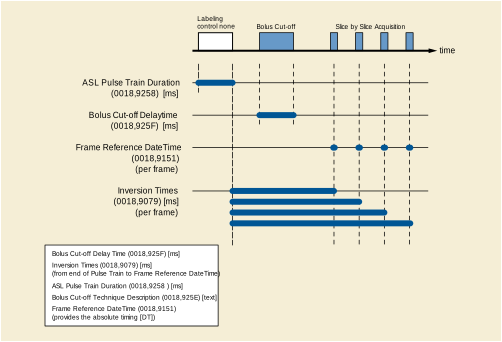
The MR IODs use the General Series module described in Section C.7.3.1, specialized by the MR Series Module, to describe the DICOM Series Entity described in Section A.1.2.3, and to define what constitutes a Series for the context of MR device.
Table C.8-101 specifies the Attributes that identify and describe general information about the MR Series.
Table C.8-101. MR Series Module Attributes
|
Attribute Name |
Tag |
Type |
Attribute Description |
|---|---|---|---|
|
Modality |
(0008,0060) |
1 |
Type of equipment that originally acquired the data used to create the images in this Series. Enumerated Values:
See Section C.7.3.1.1.1 for further explanation. |
|
Referenced Performed Procedure Step Sequence |
(0008,1111) |
1C |
Uniquely identifies the Performed Procedure Step SOP Instance to which the Series is related. Only a single Item shall be included in this sequence. Required if a Performed Procedure Step SOP Class was involved in the creation of this Series. |
|
>Include Table 10-11 “SOP Instance Reference Macro Attributes” |
|||
This section describes the MR Spectroscopy Modules.
Note
Many attributes have names and descriptions that include the terms "pixel" and "image". Although MR spectroscopy is not pixel based, some of these "pixel" and "image" attributes encode concepts that are still relevant for this technique. Where such attributes appear in the MR Spectroscopy IOD, it may be helpful to consider the term "pixel" to be equivalent to a spectroscopy "voxel", and the term "image" to be equivalent to "MR Spectroscopy SOP Instance".
Table C.8-102 specifies the attributes of the MR Spectroscopy Module.
Table C.8-102. MR Spectroscopy Module Attributes
|
Attribute Name |
Tag |
Type |
Attribute Description |
|---|---|---|---|
|
Include Table C.8-83 “MR Image and Spectroscopy Instance Macro Attributes” |
|||
|
Image Type |
(0008,0008) |
1 |
Spectroscopy data characteristics. See Section C.8.14.5.1.1. |
|
Include Table C.8-107 “MR Spectroscopy Description Macro Attributes” |
|||
|
Transmitter Frequency |
(0018,9098) |
1C |
Precession frequency in MHz of the nucleus being addressed for each spectral axis. See Section C.8.14.1.1 for further explanation of the ordering. Required if Image Type (0008,0008) Value 1 is ORIGINAL. May be present otherwise. |
|
Spectral Width |
(0018,9052) |
1C |
Spectral width in Hz. See Section C.8.14.1.1 for further explanation of the ordering. Required if Image Type (0008,0008) Value 1 is ORIGINAL or MIXED. May be present otherwise. |
|
Chemical Shift Reference |
(0018,9053) |
1C |
The chemical shift at the transmitter frequency in ppm. See Section C.8.14.1.1 for further explanation of the ordering. Required if Image Type (0008,0008) Value 1 is ORIGINAL or MIXED. May be present otherwise. |
|
Volume Localization Technique |
(0018,9054) |
1C |
Name of volume localization technique used. Shall be "NONE" if no spatial localization was performed. Defined Terms:
Required if Image Type (0008,0008) Value 1 is ORIGINAL or MIXED. May be present otherwise. |
|
Volume Localization Sequence |
(0018,9126) |
1C |
A sequence of Items that provide the position of RF excitations used to select a volume of tissue. The selected volume is described by the intersection of the sequence Items. One or more Items shall be included in this sequence. Required if Image Type (0008,0008) Value 1 is ORIGINAL or MIXED and Volume Localization Technique (0018,9054) is other than NONE. May be present if Volume Localization Technique (0018,9054) is other than NONE. |
|
>Slab Thickness |
(0018,9104) |
1 |
Thickness of slab in mm. |
|
>Slab Orientation |
(0018,9105) |
1 |
The direction cosines of a normal vector perpendicular to the selection plane with respect to the patient. See Section C.7.6.2.1.1 for further explanation. |
|
>Mid Slab Position |
(0018,9106) |
1 |
The x, y, and z coordinates of the mid-point of the slab in mm. See Section C.7.6.2.1.1 for further explanation. |
|
De-coupling |
(0018,9059) |
1C |
Indicates whether de-coupling was active. Enumerated Values:
Required if Image Type (0008,0008) Value 1 is ORIGINAL or MIXED. May be present otherwise. |
|
De-coupled Nucleus |
(0018,9060) |
1C |
Nucleus being de-coupled. Defined Terms:
See Section C.8.14.1.1 for further explanation of the ordering. Required if De-coupling (0018,9059) equals YES. |
|
De-coupling Frequency |
(0018,9061) |
1C |
The center frequency (Hz) for the de-coupling. See Section C.8.14.1.1 for further explanation of the ordering. Required if De-coupling (0018,9059) equals YES. |
|
De-coupling Method |
(0018,9062) |
1C |
The de-coupling modulation scheme used. Defined Terms:
Required if De-coupling (0018,9059) equals YES. |
|
De-coupling Chemical Shift Reference |
(0018,9063) |
1C |
The chemical shift in ppm at the de-coupling frequency. See Section C.8.14.1.1 for further explanation of the ordering. Required if De-coupling (0018,9059) equals YES. |
|
Time Domain Filtering |
(0018,9065) |
1C |
Describes time domain filtering or apodization applied. Shall be NONE if no filtering operations were applied to the time domain data. Defined Terms:
See Section C.8.14.1.1 for further explanation of the ordering. Required if Image Type (0008,0008) Value 1 is ORIGINAL or MIXED. May be present otherwise. |
|
Number of Zero Fills |
(0018,9066) |
1C |
Number of zero fills added to the time domain data before FT. Shall be 0 (zero) if no zero filling performed. See Section C.8.14.1.1 for further explanation of the ordering. See Section C.8.14.1.2 for further explanation on Zero Fills. Required if Image Type (0008,0008) Value 1 is ORIGINAL or MIXED. May be present otherwise. |
|
Baseline Correction |
(0018,9067) |
1C |
Describes baseline correction techniques. Shall be NONE if no baseline correction was performed. Defined Terms:
Required if Image Type (0008,0008) Value 1 is ORIGINAL or MIXED. May be present otherwise. |
|
Frequency Correction |
(0018,9101) |
1C |
Specifies whether operations were performed to correct resonant frequency of metabolite peaks due to B0 field inhomogeneities. Enumerated Values:
Required if Image Type (0008,0008) Value 1 is ORIGINAL or MIXED. May be present otherwise. |
|
First Order Phase Correction |
(0018,9198) |
1C |
Describes whether a first order (frequency dependent) phase correction was applied to the spectral data. Enumerated Values:
Required if Image Type (0008,0008) Value 1 is ORIGINAL or MIXED. May be present otherwise. |
|
Water Referenced Phase Correction |
(0018,9199) |
1C |
Indicates if the images or spectra were created using Water Reference time domain data for phase correction. Enumerated Values:
Required if Image Type (0008,0008) Value 1 is ORIGINAL or MIXED. May be present otherwise. See Section C.8.14.1.3 for relation between Water Reference data and other Spectroscopic objects. |
|
Water Referenced Acquisition |
(0018,9297) |
3 |
Describes the relation to Water Reference data for this instance. Enumerated Values:
See Section C.8.14.1.4 for description of enumerated values. |
|
Referenced Instance Sequence |
(0008,114A) |
1C |
References to SOP Instances significantly related to the current SOP Instance, including water reference data. Required if Water Reference Acquisition (0018,9297) equals REFERENCED. May be present otherwise. One or more Items shall be present in this Sequence. |
|
>Include Table 10-3 “Image SOP Instance Reference Macro Attributes” |
|||
|
>Purpose of Reference Code Sequence |
(0040,A170) |
1 |
Describes the purpose for which the reference is made. Only a single Item shall be included in this sequence. |
|
>>Include Table 8.8-1 “Code Sequence Macro Attributes”. |
|||
The following attributes may have a Value Multiplicity of one or two depending whether one or two frequency axes are used as specified by the value of Data Point Rows (0028,9001):
Transmitter Frequency (0018,9098)
Resonant Nucleus (0018,9100)
Spectral Width (0018,9052)
Chemical Shift Reference (0018,9053)
De-coupled Nucleus (0018,9060)
De-coupling Frequency (0018,9061)
De-coupling Chemical Shift Reference (0018,9063)
Time Domain Filtering (0018,9065)
Number of Zero Fills (0018,9066)
Value 1 shall contain the value corresponding to the sampling time axis (the axis along a data point row).
Value 2, if present, shall contain the value corresponding to the evolution time axis (the axis along a data point column).
Zero filling is a data processing technique where zero points are appended to the time domain data before Fourier transformation. The effect of zero filling is to increase the digital resolution in the spectrum. Since the zeros contain no new information, there is no new information added to the spectrum. It is artificially increasing the acquisition time after the data collection without adding any new information or true resolution to the spectrum. See Figure C.8.14.1-1, Figure C.8.14.1-2 and Figure C.8.14.1-3.
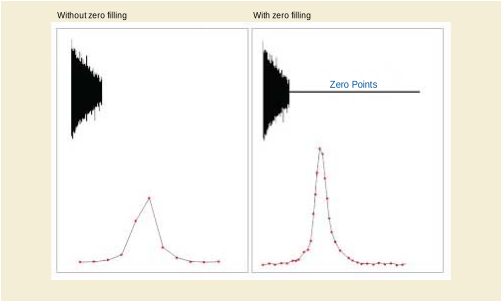
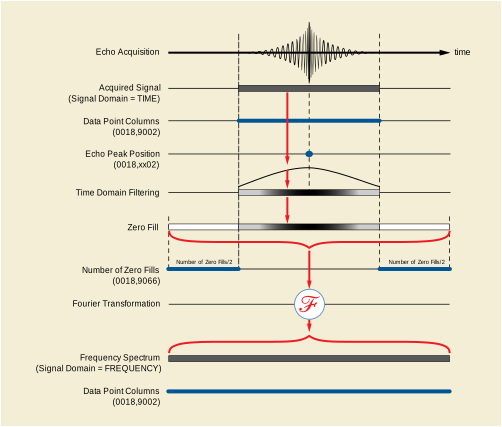
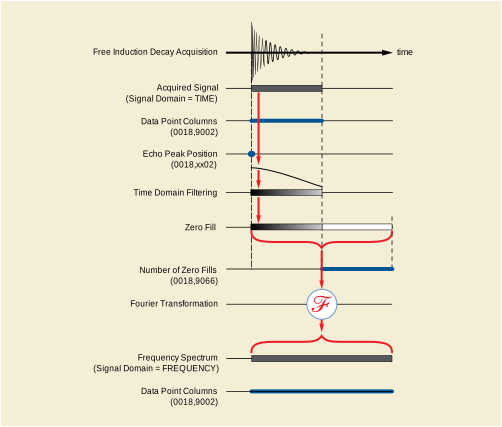
MR Spectroscopy is using diagnostic data and water reference data. The water reference data is acquired and used to correct the phase of the diagnostic time domain data before the Fourier transformation to the frequency domain. The relation between the different spectroscopy objects is given in Figure C.8.14.1-4.
When Water Reference Acquisition (0018,9297) equals REFERENCED, it means that instances are available that were or can be used for Water Phase Correction. All other values mean that there are no instances available although data might have been used for water phase correction, see Water Referenced Phase Correction (0018,9199).
The water reference data can also be used for quantification of the signal strength of the diagnostic data.
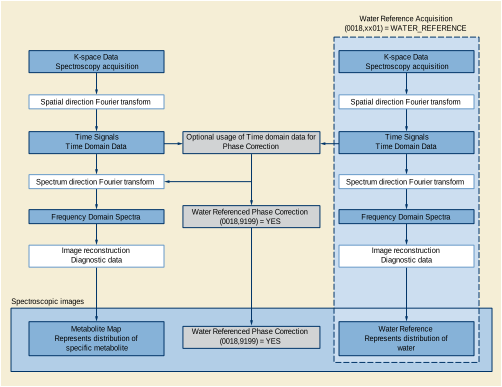
The value of Water Reference Acquisition (0018,9297) specifies the intent of the spectroscopy data acquired.
Enumerated Values:
- WATER_REFERENCE
This instance is acquired to be used as water reference and can be used by other spectroscopy data in the study for water phase correction.
- USED_DISCARDED
The phase of this spectroscopic instance is corrected with water reference data. The water reference data used is discarded after correction and no longer available.
- REFERENCED
This spectroscopic instance has water reference data available for phase correction or the phase is already corrected with water reference data. The water reference data shall be specified in the Referenced Instance sequence (0008,114A).
- NONE
This spectroscopic instance has not been corrected for the water phase signal and water reference data has not been acquired.
The primary purpose of this module is to identify the pulse sequence and variations that were used in creation of the spectroscopic data. Terminology is intended to be neutral, and allow equivalent sequences provided by different vendors to be classified together.
Table C.8-103 specifies the attributes of the MR Spectroscopy Pulse Sequence Module.
Table C.8-103. MR Spectroscopy Pulse Sequence Module Attributes
|
Attribute Name |
Tag |
Type |
Attribute Description |
|---|---|---|---|
|
Pulse Sequence Name |
(0018,9005) |
1C |
Name of the pulse sequence for annotation purposes. Potentially vendor-specific name. Required if Image Type (0008,0008) Value 1 is ORIGINAL or MIXED. May be present otherwise. |
|
MR Spectroscopy Acquisition Type |
(0018,9200) |
1C |
Identification of data encoding scheme. Defined Terms:
Required if Image Type (0008,0008) Value 1 is ORIGINAL or MIXED. May be present otherwise. |
|
Echo Pulse Sequence |
(0018,9008) |
1C |
Echo category of pulse sequences. Enumerated Values:
Required if Image Type (0008,0008) Value 1 is ORIGINAL or MIXED. May be present otherwise. |
|
Multiple Spin Echo |
(0018,9011) |
1C |
Multiple Spin Echo category of pulse sequence used to collect different lines in k-space for a single frame. Enumerated Values:
Required if Image Type (0008,0008) Value 1 is ORIGINAL or MIXED and Echo Pulse Sequence (0018,9008) equals SPIN or BOTH. Otherwise may be present if Image Type (0008,0008) Value 1 is DERIVED and Echo Pulse Sequence (0018,9008) equals SPIN or BOTH. |
|
Multi-planar Excitation |
(0018,9012) |
1C |
Technique that simultaneously excites several volumes. Enumerated Values:
Required if Image Type (0008,0008) Value 1 is ORIGINAL or MIXED. May be present otherwise. |
|
Steady State Pulse Sequence |
(0018,9017) |
1C |
Steady State Sequence. Defined Terms:
Required if Image Type (0008,0008) Value 1 is ORIGINAL or MIXED. May be present otherwise. |
|
Echo Planar Pulse Sequence |
(0018,9018) |
1C |
Echo Planar category of pulse-sequences. Enumerated Values:
Required if Image Type (0008,0008) Value 1 is ORIGINAL or MIXED. May be present otherwise. |
|
Spectrally Selected Suppression |
(0018,9025) |
1C |
Spectrally Selected Suppression. Defined Terms:
Required if Image Type (0008,0008) Value 1 is ORIGINAL or MIXED. May be present otherwise. |
|
Geometry of k-Space Traversal |
(0018,9032) |
1C |
Geometry category of k-Space traversal. Defined Terms:
Required if Image Type (0008,0008) Value 1 is ORIGINAL or MIXED. May be present otherwise. |
|
Rectilinear Phase Encode Reordering |
(0018,9034) |
1C |
Rectilinear phase encode reordering. Defined Terms:
Required if Required if Image Type (0008,0008) Value 1 is ORIGINAL or MIXED and Geometry of k-Space Traversal (0018,9032) equals RECTILINEAR. Otherwise may be present if Image Type (0008,0008) Value 1 is DERIVED and Geometry of k-Space Traversal (0018,9032) equals RECTILINEAR. |
|
Segmented k-Space Traversal |
(0018,9033) |
1C |
Segmented k-Space traversal. If Geometry of k-Space Traversal is rectilinear, multiple lines can be acquired at one time. If Geometry of k-Space Traversal is spiral or radial, paths can be interleaved and acquired at one time. Enumerated Values:
Required if Image Type (0008,0008) Value 1 is ORIGINAL or MIXED. May be present otherwise. |
|
Coverage of k-Space |
(0018,9094) |
1C |
Coverage of k-Space. Defined Terms:
Required if Image Type (0008,0008) Value 1 is ORIGINAL or MIXED and MR Spectroscopy Acquisition Type (0018,9200) equals VOLUME. Otherwise may be present if Image Type (0008,0008) Value 1 is DERIVED and MR Spectroscopy Acquisition Type (0018,9200) equals VOLUME. |
|
Number of k-Space Trajectories |
(0018,9093) |
1C |
Number of interleaves or shots. Required if Image Type (0008,0008) Value 1 is ORIGINAL or MIXED. May be present otherwise. |
|
Echo Peak Position |
(0018,9298) |
3 |
Number specifying the sample that coincides with the echo peak used during acquisition of the data. First sample will be numbered 1. |
The following sections contain Functional Group Macro's specific to the MR Spectroscopy IOD.
Note
The attribute descriptions in the Functional Group Macros are written as if they were applicable to a single frame (i.e., the macro is part of the Per-frame Functional Groups Sequence). If an attribute is applicable to all frames (i.e., the macro is part of the Shared Functional Groups Sequence) the phrase "this frame" in the attribute description shall be interpreted to mean " for all frames".".
Table C.8-104 specifies the attributes of the MR Spectroscopy Frame Type Functional Group Macro.
Table C.8-104. MR Spectroscopy Frame Type Macro Attributes
|
Attribute Name |
Tag |
Type |
Attribute Description |
|---|---|---|---|
|
MR Spectroscopy Frame Type Sequence |
(0018,9227) |
1 |
Identifies sequence containing Frame Type Attributes. Only a single Item shall be included in this sequence. |
|
>Frame Type |
(0008,9007) |
1 |
Spectroscopy data characteristics. See Section C.8.14.5.1.1. |
|
>Include Table C.8-107 “MR Spectroscopy Description Macro Attributes” |
|||
Table C.8-105 specifies the attributes of the MR Spectroscopy FOV/Geometry Functional Group Macro.
Table C.8-105. MR Spectroscopy FOV/Geometry Macro Attributes
|
Attribute Name |
Tag |
Type |
Attribute Description |
|---|---|---|---|
|
MR Spectroscopy FOV/Geometry Sequence |
(0018,9103) |
1 |
Identifies the geometry parameters of this frame. Only a single Item shall be included in this sequence. |
|
>Spectroscopy Acquisition Data Columns |
(0018,9127) |
1C |
Number of data points in the columns direction. Required if Frame Type (0008,9007) Value 1 is ORIGINAL. May be present otherwise. |
|
>Spectroscopy Acquisition Phase Rows |
(0018,9095) |
1C |
Number of Phase Encoding Rows. Required if Frame Type (0008,9007) Value 1 is ORIGINAL. May be present otherwise. |
|
>Spectroscopy Acquisition Phase Columns |
(0018,9234) |
1C |
Number of Phase Encoding Columns. Required if Frame Type (0008,9007) Value 1 is ORIGINAL. May be present otherwise. |
|
>Spectroscopy Acquisition Out-of-plane Phase Steps |
(0018,9159) |
1C |
Number of out-of-plane Phase Encoding steps. Required if MR Spectroscopy Acquisition Type (0018,9200) equals PLANE and Frame Type (0008,9007) Value 1 is ORIGINAL. May be present otherwise. |
|
>Percent Sampling |
(0018,0093) |
1C |
Fraction of acquisition matrix lines acquired, expressed as a percent. Required if Frame Type (0008,9007) Value 1 of this frame is ORIGINAL. May be present otherwise. |
|
>Percent Phase Field of View |
(0018,0094) |
1C |
Ratio of field of view dimension in phase direction to field of view dimension in frequency direction, expressed as a percent. Required if Frame Type (0008,9007) Value 1 of this frame is ORIGINAL. May be present otherwise. |
Table C.8-106 specifies the attributes that describe the Spectroscopy Data.
Table C.8-106. MR Spectroscopy Data Module Attributes
|
Attribute Name |
Tag |
Type |
Attribute Description |
|---|---|---|---|
|
Rows |
(0028,0010) |
1 |
Number of voxels in the vertical direction in the frame. |
|
Columns |
(0028,0011) |
1 |
Number of voxels in the horizontal direction in the frame. |
|
Data Point Rows |
(0028,9001) |
1 |
Number of rows of data points in spectroscopic data. |
|
Data Point Columns |
(0028,9002) |
1 |
Number of columns of data points in spectroscopic data. |
|
Data Representation |
(0028,9108) |
1 |
Data representation of the data points. Each data point shall have the same representation. Enumerated Values:
|
|
Signal Domain Columns |
(0028,9003) |
1 |
Domain of represented signal in column direction. Enumerated Values:
|
|
Signal Domain Rows |
(0028,9235) |
1C |
Domain of represented signal in row direction. Enumerated Values:
Required if Data Point Rows (0028,9001) has a value of more than 1. |
|
First Order Phase Correction Angle |
(5600,0010) |
1C |
First Order Phase Correction Angle. Number of values is determined by Row*Column*Number of Frames. Required if First Order Phase Correction (0018,9198) equals YES |
|
Spectroscopy Data |
(5600,0020) |
1 |
A data stream of the signal intensities that comprise the spectroscopic data. See Section C.8.14.4.1 for further explanation. |
The Spectroscopy Data attribute (5600,0020) contains the Signal intensities for the spectra. The order of voxels sent for each spectral plane is left to right, top to bottom, i.e., the upper left voxel (labeled 1,1) is sent first followed by the remainder of row 1, followed by the first voxel of row 2 (labeled 2,1) then the remainder of row 2 and so on. Each "voxel" represents an entire spectrum. The complete spectral data from each voxel is sent, followed by the spectral data from the next voxel position.
The number of voxels on each frame are described by Rows (0028,0010) and Columns (0028,0011). The number of frames is described by Number of Frames (0028,0008). The frames may represent different locations in a 3D acquisition, or the same position at a different point of time, or a difference of some other combination of attributes.
Note
Either Rows or Columns or both may have a value of 1 (e.g., for single voxel spectroscopy). A value of zero for the corresponding value of Pixel Spacing in the Pixel Measures Macro is permitted under these circumstances. See Section 10.7.1.3.
The spectral data points are ordered from high frequencies to low frequencies for a fixed static magnetic field strength, in the case that the Signal Domain Columns (0028,9003) or Signal Domain Rows (0028,9235) attributes contain the value FREQUENCY.
The spectral data points are ordered in sequence of increasing time in the case that the Signal Domain Columns (0028,9003) or Signal Domain Rows (0028,9235) attributes contain the value TIME.
The apparent rotation of magnetization in a quadrature representation shall be counterclockwise (from the (positive) real part to the (positive) imaginary part) for positive relative frequencies.
Note
When Complex time data points are transformed by a straightforward Fourier transformation to complex spectral data points, these are ordered from low frequency to high frequency.
For two-dimensional spectral acquisitions, the ordering is such that all data points from a row (corresponding to all data points acquired in an individual sampling period), are followed by all data points from the successive sampling period. Following all data of the rows from a given voxel position, the data from the subsequent voxel position are sent. The axis parallel to the row direction corresponds to the sampling time axis. The axis parallel to the column direction corresponds to the evolution time axis.
The dimensions of each spectrum that make up a voxel are described by Data Point Rows (0028,9001) and Data Point Columns (0028,9002). In the case of 1D spectra, the number of Data Point Rows shall be 1.
For a Data Representation (0028,9108) value of COMPLEX, the order of data points is real channel followed by imaginary channel for each spectral data point. For the other Data Representation values (REAL, IMAGINARY and MAGNITUDE), each spectral data point contains only a single value.
The Figure C.8-18 depicts 6 frames each made up of 4 rows and 4 columns of voxels. Specific values for Data Point Rows (0028,9001) and Data Point Columns (0028,9002) of these voxels are not depicted.
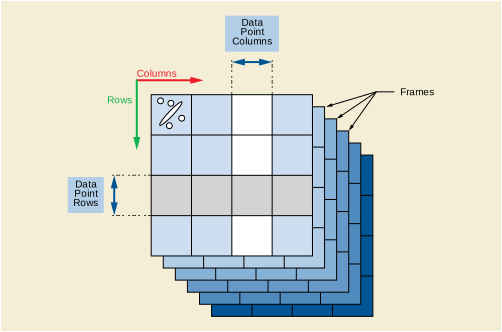
Table C.8-107 specifies the attributes that describe the Spectroscopy.
Table C.8-107. MR Spectroscopy Description Macro Attributes
|
Attribute Name |
Tag |
Type |
Attribute Description |
|---|---|---|---|
|
Volumetric Properties |
(0008,9206) |
1 |
Indication if geometric manipulations are possible with frames in the SOP Instance. See Section C.8.14.5.1.2 for a description and Enumerated Values. |
|
Volume Based Calculation Technique |
(0008,9207) |
1 |
Method used for volume calculations with frames in the SOP Instance. See Section C.8.14.5.1.3 for a description and Defined Terms. |
|
Complex Image Component |
(0008,9208) |
1 |
Representation of complex data of frames in the SOP Instance. See Section C.8.14.5.1.4 for a description and Defined Terms. |
|
Acquisition Contrast |
(0008,9209) |
1 |
Indication of acquisition contrast used with frames in the SOP Instance. See Section C.8.14.5.1.5 for a description and Defined Terms. |
Image Type (0008,0008) and Frame Type (0008,9007) are not included in this Macro but one or the other is always included in the Module or Macro that invokes this Macro, and they are therefore described here.
In addition to the requirements specified in Section C.8.16.1 Image Type and Frame Type, the following additional requirements and Defined Terms are specified.
See Section C.8.16.1.1. No additional requirements or Defined Terms.
See Section C.8.16.1.2. No additional requirements or Defined Terms.
See Section C.8.16.1.3 for requirements, but not Defined Terms.
Table C.8-108 specifies the Defined Terms for MR Spectroscopy for Value 3 for Image Type (0008,0008) and Frame Type (0008,9007).
Table C.8-108. MR Spectroscopy Image Type and Frame Type Value 3
|
Defined Term Name |
Defined Term Description |
|---|---|
|
SPECTROSCOPY |
Spectroscopy |
See Section C.8.16.1.4 for requirements, but not Defined Terms.
Table C.8-109 specifies the Defined Terms for Value 4 for Image Type (0008,0008) and Frame Type (0008,9007).
Table C.8-109. MR Spectroscopy Image Type and Frame Type Value 4
|
Defined Term Name |
Defined Term Description |
|---|---|
|
ADDITION |
Created through point by point addition operation |
|
DIVISION |
Created through point by point division operation |
|
MAXIMUM |
Created through point by point maximum operation |
|
MEAN |
Created through point by point mean operation |
|
MINIMUM |
Created through point by point minimum operation |
|
MULTIPLICATION |
Created through point by point multiplication operation |
|
STD_DEVIATION |
Standard Deviation |
|
SUBTRACTION |
Created through point by point subtraction operation |
|
NONE |
Not calculated |
|
MIXED |
Used only as value in Image Type (0008,0008) if frames within the spectroscopy SOP Instance contain different values for value 4 in their Frame Type (0008,9007) attribute. |
See Section C.8.16.2.1.2. No additional requirements or Defined Terms.
See Section C.8.16.2.1.3 for requirements, but not Defined Terms.
Table C.8-110 specifies the Defined Terms for the Volume Based Calculation Technique (0008,9207) attribute.
Table C.8-110. Volume Based Calculation Technique Attribute Values
|
Defined Term Name |
Defined Term Description |
|---|---|
|
MAX_IP |
Maximum Intensity Projection |
|
MIN_IP |
Minimum Intensity Projection |
|
NONE |
Pixels not derived geometrically |
|
MIXED |
Used only as a value in Volume Based Calculation Technique (0008,9207) attribute in the MR Spectroscopy Module if frames within the image SOP Instance contain different terms for the Volume Based Calculation Technique attribute in MR Spectroscopy Frame Type Functional Group. |
The value of Complex Image Component attribute (0008,9208) shall be used to indicate which component of the complex representation of the signal is represented in the spectroscopy data.
Table C.8-111 specifies the Defined Terms for Complex Image Component (0008,9208).
Table C.8-111. Complex Image Component Attribute Values
|
Defined Term Name |
Defined Term Description |
|---|---|
|
MAGNITUDE |
The magnitude component of the complex spectroscopy data. |
|
PHASE |
The phase component of the complex spectroscopy data. |
|
REAL |
The real component of the complex spectroscopy data. |
|
IMAGINARY |
The imaginary component of the complex spectroscopy data. |
|
COMPLEX |
The real and imaginary components of the complex spectroscopy data |
|
MIXED |
Used only as a value in Complex Image Component (0008,9208) in the MR Spectroscopy Module if frames within the image SOP Instance contain different values for the Complex Image Component attribute in the MR Spectroscopy Frame Type Functional Group. |
Table C.8-112 specifies the Defined Terms for Acquisition Contrast (0008,9209).
Table C.8-112. Acquisition Contrast Values
|
Defined Term Name |
Defined Term Description |
|---|---|
|
PROTON_DENSITY |
Proton Density weighted contrast |
|
T1 |
T1 weighted contrast |
|
T2 |
T2 weighted contrast |
|
UNKNOWN |
Value should be UNKNOWN if acquisition contrasts were combined resulting in an unknown contrast. Also this value should be used when the contrast is not known. |
|
MIXED |
Used only as a value in Acquisition Contrast (0008,9209) attribute in the MR Spectroscopy Module if frames within the SOP Instance contain different values for the Acquisition Contrast attribute in the MR Spectroscopy Frame Type Functional Group. |
This section describes the specific modules for the Enhanced CT Image IOD.
The CT IODs use the General Series module described in Section C.7.3.1, specialized by the CT Series Module, to describe the DICOM Series Entity described in Section A.1.2.3, and to define what constitutes a Series for the context of CT device.
Table C.8-113 specifies the Attributes that identify and describe general information about the CT Series.
Table C.8-113. CT Series Module Attributes
|
Attribute Name |
Tag |
Type |
Attribute Description |
|---|---|---|---|
|
Modality |
(0008,0060) |
1 |
Type of equipment that originally acquired the data used to create the images in this Series. Enumerated Values:
See Section C.7.3.1.1.1 for further explanation. |
|
Referenced Performed Procedure Step Sequence |
(0008,1111) |
1C |
Uniquely identifies the Performed Procedure Step SOP Instance to which the Series is related. Only a single Item shall be included in this sequence. Required if a Performed Procedure Step SOP Class was involved in the creation of this Series. |
|
>Include Table 10-11 “SOP Instance Reference Macro Attributes” |
|||
This section describes the Enhanced CT Image Module. Table C.8-114 specifies the attributes of the Enhanced CT Image Module.
Table C.8-114. Enhanced CT Image Module Attributes
|
Attribute Name |
Tag |
Type |
Attribute Description |
|---|---|---|---|
|
Image Type |
(0008,0008) |
1 |
Image characteristics. See Section C.8.16.1 and Section C.8.15.2.1.1. |
|
Include Table C.8-131 “Common CT/MR Image Description Macro Attributes” |
|||
|
Acquisition Number |
(0020,0012) |
3 |
A number identifying the single continuous gathering of data over a period of time that resulted in this image. NoteThis number is not required to be unique across SOP Instances in a series. See also the description of the Referenced Raw Data Sequence (0008,9121). |
|
Acquisition DateTime |
(0008,002A) |
1C |
The date and time that the acquisition of data started. Note
Required if Image Type (0008,0008) Value 1 of this frame is ORIGINAL or MIXED and SOP Class UID is not "1.2.840.10008.5.1.4.1.1.2.2" (Legacy Converted), may be present otherwise. |
|
Acquisition Duration |
(0018,9073) |
1C |
The time in seconds needed to complete the acquisition of data. See Section C.7.6.16.2.2.1 for further explanation. Required if Image Type (0008,0008) Value 1 of this frame is ORIGINAL or MIXED and SOP Class UID is not "1.2.840.10008.5.1.4.1.1.2.2" (Legacy Converted), may be present otherwise. |
|
Referenced Raw Data Sequence |
(0008,9121) |
3 |
The Raw data that was used to derive this Image. One or more Items are permitted in this Sequence. NoteThe items of in this sequence may identify raw data that has not been stored or encoded as a DICOM object. This allows recognition that images in different instances have been reconstructed from the same raw data. |
|
>Include Table C.17-3 “Hierarchical SOP Instance Reference Macro Attributes” |
|||
|
Referenced Waveform Sequence |
(0008,113A) |
3 |
References to waveforms acquired in conjunction with this image. These Waveforms may or may not be temporally synchronized with this image. One or more Items are permitted in this sequence. |
|
>Include Table C.17-3 “Hierarchical SOP Instance Reference Macro Attributes” |
|||
|
Referenced Image Evidence Sequence |
(0008,9092) |
1C |
Full set of Composite SOP Instances referring to image SOP Instances inside the frames of this Enhanced CT Image SOP Instance. See Section C.8.13.2.1.2 for further explanation. One or more Items shall be included in this sequence. Required if the Referenced Image Sequence (0008,1140) is present. |
|
>Include Table C.17-3 “Hierarchical SOP Instance Reference Macro Attributes” |
|||
|
Source Image Evidence Sequence |
(0008,9154) |
1C |
Full set of Composite SOP Instances used as source image SOP Instances inside the frames of this Enhanced CT Image SOP Instance. See Section C.8.13.2.1.2 for further explanation. One or more Items shall be included in this sequence. Required if the Source Image Sequence (0008,2112) is present. |
|
>Include Table C.17-3 “Hierarchical SOP Instance Reference Macro Attributes” |
|||
|
Referenced Presentation State Sequence |
(0008,9237) |
1C |
References to Presentation State instances acquired in conjunction with this instance. NoteMay only be used to reference Presentation States belonging to the acquired data and not to reference Presentation States generated subsequently such as during interpretation. One or more Items shall be included in this sequence. Required if Presentation State is generated during acquisition, shall not be present otherwise. |
|
>Include Table C.17-3 “Hierarchical SOP Instance Reference Macro Attributes” |
|||
|
Samples per Pixel |
(0028,0002) |
1 |
Number of samples (planes) in this image. This value shall be 1. |
|
Photometric Interpretation |
(0028,0004) |
1 |
Specifies the intended interpretation of the pixel data. Enumerated Values:
See Section C.7.6.3.1.2 for definition of this term. |
|
Bits Allocated |
(0028,0100) |
1 |
Number of bits allocated for each pixel sample. Each sample shall have the same number of bits allocated. This value shall be 16. |
|
Bits Stored |
(0028,0101) |
1 |
Number of bits stored for each pixel sample. Each sample shall have the same number of bits stored. This value shall be 12 or16. |
|
High Bit |
(0028,0102) |
1 |
Most significant bit for pixel sample data. Each sample shall have the same high bit. Shall be one less than the value in Bits Stored (0028,0101). |
|
Content Qualification |
(0018,9004) |
1C |
Content Qualification Indicator Enumerated Values:
See Section C.8.13.2.1.1 for further explanation. Required if SOP Class UID is not "1.2.840.10008.5.1.4.1.1.2.2" (Legacy Converted), may be present otherwise. |
|
Image Comments |
(0020,4000) |
3 |
User-defined comments about the image |
|
Burned In Annotation |
(0028,0301) |
1C |
Indicates whether or not the image contains sufficient burned in annotation to identify the patient and date the image was acquired. Enumerated Values:
This means that images that contain this Module shall not contain such burned in annotations. Required if SOP Class UID is not "1.2.840.10008.5.1.4.1.1.2.2" (Legacy Converted), may be present otherwise. |
|
Recognizable Visual Features |
(0028,0302) |
3 |
Indicates whether or not the image contains sufficiently recognizable visual features to allow the image or a reconstruction from a set of images to identify the patient. Enumerated Values:
If this Attribute is absent, then the image may or may not contain recognizable visual features. |
|
Lossy Image Compression |
(0028,2110) |
1C |
Specifies whether an Image has undergone lossy compression (at a point in its lifetime). Enumerated Values:
Once this value has been set to 01 it shall not be reset. See Section C.7.6.1.1.5. Required if SOP Class UID is not "1.2.840.10008.5.1.4.1.1.2.2" (Legacy Converted). May be present otherwise. |
|
Lossy Image Compression Ratio |
(0028,2112) |
1C |
Describes the approximate lossy compression ratio(s) that have been applied to this image. See Section C.7.6.1.1.5 for further explanation. May be multi-valued if successive lossy compression steps have been applied; the value order shall correspond to the values of Lossy Image Compression Method (0028,2114). Note
Required if Lossy Image Compression (0028,2110) is "01". |
|
Lossy Image Compression Method |
(0028,2114) |
1C |
A label for the lossy compression method(s) that have been applied to this image. See Section C.7.6.1.1.5 for further explanation. May be multi-valued if successive lossy compression steps have been applied; the value order shall correspond to the values of Lossy Image Compression Ratio (0028,2112). NoteFor historical reasons, the lossy compression method may also be described in Derivation Description (0008,2111). Required if Lossy Image Compression (0028,2110) is "01". |
|
Presentation LUT Shape |
(2050,0020) |
1 |
Specifies an identity transformation for the Presentation LUT, such that the output of all grayscale transformations defined in the IOD containing this Module are defined to be P-Values. Enumerated Values:
|
|
Icon Image Sequence |
(0088,0200) |
3 |
This icon image is representative of the Image. Only a single Item is permitted in this Sequence. |
|
See Section C.7.6.1.1.6. |
|||
|
Include Table 10-25 “Optional View and Slice Progression Direction Attributes” |
|||
|
Isocenter Position |
(300A,012C) |
3 |
Isocenter coordinates (x,y,z), in mm. Specifies the location of the machine isocenter in the patient-based coordinate system associated with the Frame of Reference. It allows transformation from the equipment-based coordinate system to the patient-based coordinate system. |
|
Include Table 10-27 “RT Equipment Correlation Macro Attributes Description” |
|||
In addition to the requirements specified in Section C.8.16.1 Image Type and Frame Type, the following additional requirements and Defined Terms are specified.
These requirements and Defined Terms are also applicable to Frame Type (0008,9007).
Value 1 of Image Type (0008,0008) and Frame Type (0008,9007) is discussed in Section C.8.16.1.1. No additional requirements or Defined Terms.
Value 2 of Image Type (0008,0008) and Frame Type (0008,9007) is discussed in Section C.8.16.1.2. No additional requirements or Defined Terms.
Table C.8-115 specifies the Defined Terms for CT additional to those defined in Section C.8.16.1.3 for Value 3 for Image Type (0008,0008) and Frame Type (0008,9007).
Table C.8-115. Image Type and Frame Type Value 3 for CT
|
Defined Term Name |
Defined Term Description |
|---|---|
|
ATTENUATION |
Collected for the purpose of performing attenuation corrections (e.g., PET attenuation correction) |
|
CARDIAC_CTA |
Images of the heart collected for the purpose of CT Coronary Angiography (CTA) |
|
CARDIAC_CASCORE |
Images of the heart collected for the purpose of CT Coronary Calcium Scoring |
|
REFERENCE |
Collected for anatomical reference for PET or SPECT |
Table C.8-116 specifies the Defined Terms for CT additional to those defined in Section C.8.16.1.4 for Value 4 for Image Type (0008,0008) and Frame Type (0008,9007).
Table C.8-116. Image Type and Frame Type Value 4 for Ct
|
Defined Term Name |
Defined Term Description |
|---|---|
|
FILTERED |
An image filter has been applied |
|
MEDIAN |
Pixel by pixel median |
|
ENERGY_PROP_WT |
Image pixels created through proportional weighting of multiple acquisitions at distinct X-Ray energies. |
The following sections contain Functional Group Macros specific to the Enhanced CT Image IOD.
Note
The attribute descriptions in the Functional Group Macros are written as if they were applicable to a single frame (i.e., the macro is part of the Per-frame Functional Groups Sequence). If an attribute is applicable to all frames (i.e., the macro is part of the Shared Functional Groups Sequence) the phrase "this frame" in the attribute description shall be interpreted to mean " for all frames".
Table C.8-117 specifies the attributes of the CT Image Frame Type Functional Group Macro.
Table C.8-117. CT Image Frame Type Macro Attributes
|
Attribute Name |
Tag |
Type |
Attribute Description |
|---|---|---|---|
|
CT Image Frame Type Sequence |
(0018,9329) |
1 |
Identifies the characteristics of this frame. Only a single Item shall be included in this sequence. |
|
>Frame Type |
(0008,9007) |
1 |
Type of Frame. A multi-valued attribute analogous to Image Type (0008,0008). Enumerated Values and Defined Terms are the same as those for the four values of Image Type (0008,0008), except that the value MIXED is not allowed unless the SOP Class UID is "1.2.840.10008.5.1.4.1.1.2.2" (Legacy Converted). See Section C.8.16.1 and Section C.8.15.2.1.1.1. |
|
>Include Table C.8-131 “Common CT/MR Image Description Macro Attributes” |
|||
Table C.8-118 specifies the attributes of the CT Acquisition Type Functional Group Macro.
Table C.8-118. CT Acquisition Type Macro Attributes
|
Attribute Name |
Tag |
Type |
Attribute Description |
|---|---|---|---|
|
CT Acquisition Type Sequence |
(0018,9301) |
1 |
Contains the attributes defining the CT acquisition mode. Only a single Item shall be included in this sequence. |
|
>Acquisition Type |
(0018,9302) |
1C |
Description of the method used during acquisition of this frame. See Section C.8.15.3.2.1 for Defined Terms. Required if Frame Type (0008,9007) Value 1 of this frame is ORIGINAL. May be present otherwise. |
|
>Tube Angle |
(0018,9303) |
1C |
The constant angle at which the x-ray source is located during acquisition. 0 degrees means that the source is located at the highest point of the gantry orbit. Degrees increase from 0 to positive 360 in a clockwise direction as viewed when facing the gantry where the table enters the gantry. Required if Frame Type (0008,9007) Value 1 of this frame is ORIGINAL and Acquisition Type (0018,9302) is CONSTANT_ANGLE. May be present otherwise if Frame Type (0008,9007) Value 1 of this frame is DERIVED and Acquisition Type (0018,9302) is CONSTANT_ANGLE. |
|
>Constant Volume Flag |
(0018,9333) |
1C |
Identifies that the acquisition was performed by repetitively acquiring the same volume set over a period of time. NoteAcquisition Type (0018,9302) may be SEQUENCED, SPIRAL or STATIONARY depending on whether table movement is necessary to cover the volume. Enumerated Values:
Required if Frame Type (0008,9007) Value 1 of this frame is ORIGINAL. May be present otherwise. |
|
>Fluoroscopy Flag |
(0018,9334) |
1C |
Identifies that near real-time display of a block of continuously acquired data was performed, which may result in a lower than usual image quality. Enumerated Values:
Required if Frame Type (0008,9007) Value 1 of this frame is ORIGINAL. May be present otherwise. |
Defined Terms:
- SEQUENCED
identifies that the acquisition was performed by acquiring single or multi detector data while rotating the source about the gantry while the table is not moving; additional slices may be acquired by incrementing the table position and again rotating the source about the gantry while the table is not moving
- SPIRAL
identifies that the acquisition was performed by acquiring data while rotating the source about the gantry while continuously moving the table
- CONSTANT_ANGLE
identifies that the acquisition was performed by holding the source at a constant angle and moving the table to obtain a projection image (e.g., a localizer image)
- STATIONARY
identifies that the acquisition was performed by holding the table at a constant position and performing one or more acquisitionsover time at the same location
- FREE
identifies that the acquisition was performed while rotating the source about the gantry while the table movement is under direct control of a human operator or under the control of an analysis application (e.g., fluoroscopic image)
Table C.8-119 specifies the attributes of the CT Acquisition Details Functional Group Macro.
Table C.8-119. CT Acquisition Details Macro Attributes
|
Attribute Name |
Tag |
Type |
Attribute Description |
|---|---|---|---|
|
CT Acquisition Details Sequence |
(0018,9304) |
1 |
Contains the attributes defining the details of the acquisition. Only a single Item shall be included in this sequence. |
|
>Rotation Direction |
(0018,1140) |
1C |
Direction of rotation of the source about the gantry, as viewed while facing the gantry where the table enters the gantry. Enumerated Values:
Required if Frame Type (0008,9007) Value 1 of this frame is ORIGINAL and Acquisition Type (0018,9302) is other than CONSTANT_ANGLE. Otherwise may be present if Frame Type (0008,9007) Value 1 of this frame is DERIVED and Acquisition Type (0018,9302) is other than CONSTANT_ANGLE. |
|
>Revolution Time |
(0018,9305) |
1C |
The time in seconds of a complete revolution of the source around the gantry orbit. This value is independent of the Reconstruction Angle (0018,9319) of the frame. Required if Frame Type (0008,9007) Value 1 of this frame is ORIGINAL and Acquisition Type (0018,9302) is other than CONSTANT_ANGLE. Otherwise may be present if Frame Type (0008,9007) Value 1 of this frame is DERIVED and Acquisition Type (0018,9302) is other than CONSTANT_ANGLE. |
|
>Single Collimation Width |
(0018,9306) |
1C |
The width of a single row of acquired data (in mm). NoteAdjacent physical detector rows may have been combined to form a single effective acquisition row. Required if Frame Type (0008,9007) Value 1 of this frame is ORIGINAL. May be present otherwise. |
|
>Total Collimation Width |
(0018,9307) |
1C |
The width of the total collimation (in mm) over the area of active x-ray detection. NoteThis will be equal to the number of effective detector rows multiplied by single collimation width. Required if Frame Type (0008,9007) Value 1 of this frame is ORIGINAL. May be present otherwise. |
|
>Table Height |
(0018,1130) |
1C |
The distance in mm from the top of the patient table to the center of rotation of the source (i.e., the data collection center or isocenter). The distance is positive when the table is below the data collection center. Required if Frame Type (0008,9007) Value 1 of this frame is ORIGINAL. May be present otherwise. |
|
>Gantry/Detector Tilt |
(0018,1120) |
1C |
Nominal angle of tilt in degrees of the scanning gantry. Not intended for mathematical computations. Zero degrees means the gantry is not tilted, negative degrees are when the top of the gantry is tilted away from where the table enters the gantry. Required if Frame Type (0008,9007) Value 1 of this frame is ORIGINAL. May be present otherwise. |
|
>Data Collection Diameter |
(0018,0090) |
1C |
The diameter in mm of the region over which data were collected. See Section C.8.15.3.6.1. NoteIn the case of an Acquisition Type (0018,9302) of CONSTANT_ANGLE, the diameter is that in a plane normal to the central ray of the diverging X-Ray beam as it passes through the data collection center. Required if Frame Type (0008,9007) Value 1 of this frame is ORIGINAL. May be present otherwise. |
Table C.8-120 specifies the attributes of the CT Table Dynamics Functional Group Macro.
Table C.8-120. CT Table Dynamics Macro Attributes
|
Attribute Name |
Tag |
Type |
Attribute Description |
|---|---|---|---|
|
CT Table Dynamics Sequence |
(0018,9308) |
1 |
Contains the attributes defining the movement of the CT table. Only a single Item shall be included in this sequence. |
|
>Table Speed |
(0018,9309) |
1C |
The distance in mm that the table moves in one second during the gathering of data that resulted in this frame. Required if Frame Type (0008,9007) Value 1 of this frame is ORIGINAL and Acquisition Type (0018,9302) is SPIRAL or CONSTANT_ANGLE. May be present otherwise if Frame Type (0008,9007) Value 1 of this frame is DERIVED and Acquisition Type (0018,9302) is SPIRAL or CONSTANT_ANGLE. |
|
>Table Feed per Rotation |
(0018,9310) |
1C |
Motion of the table (in mm) during a complete revolution of the source around the gantry orbit. Required if Frame Type (0008,9007) Value 1 of this frame is ORIGINAL and Acquisition Type (0018,9302) is SPIRAL. May be present otherwise if Frame Type (0008,9007) Value 1 of this frame is DERIVED and Acquisition Type (0018,9302) is SPIRAL. |
|
>Spiral Pitch Factor |
(0018,9311) |
1C |
Ratio of the Table Feed per Rotation (0018,9310) to the Total Collimation Width (0018,9307). See Section C.8.15.3.4.1 for further explanation and some examples. Required if Frame Type (0008,9007) Value 1 of this frame is ORIGINAL and Acquisition Type (0018,9302) is SPIRAL. May be present otherwise if Frame Type (0008,9007) Value 1 of this frame is DERIVED and Acquisition Type (0018,9302) is SPIRAL. |
The formula for Spiral Pitch Factor (0018,9311) in terms of Table Feed per Rotation (0018,9310) and Total Collimation Width (0018,9307) is:
Spiral Pitch Factor = (Table Feed per Rotation (mm))/(Total Collimation Width (mm))
An example calculation of Spiral Pitch Factor (0018,9311) for a single slice spiral acquisition of an image with a Total Collimation Width of 2.5mm and a Table Feed per Rotation of 10mm is:
Spiral Pitch Factor = (10 mm) / (2.5 mm) = 4.0
An example calculation of Spiral Pitch Factor (0018,9311) for a multiple slice spiral acquisition having a Total Collimation Width of 20mm and a Table Feed per Rotation of 10mm is:
Spiral Pitch Factor = (10 mm) / (20 mm) = 0.5
Table C.8-121 specifies the attributes of the CT Position Functional Group Macro.
Table C.8-121. CT Position Macro Attributes
|
Attribute Name |
Tag |
Type |
Attribute Description |
|---|---|---|---|
|
CT Position Sequence |
(0018,9326) |
1 |
Contains the attributes defining the CT geometry. Only a single Item shall be included in this sequence. |
|
>Table Position |
(0018,9327) |
1C |
Relative longitudinal position of acquisition location of this frame in mm from an implementation specific reference point. Shall be relative to the same reference point for all frames in this SOP Instance, but may be different from the reference point in other SOP Instances. Positions as the table moves into the gantry viewed from the front are more negative. Note
Required if Frame Type (0008,9007) Value 1 of this frame is ORIGINAL. May be present otherwise. |
|
>Data Collection Center (Patient) |
(0018,9313) |
1C |
The x, y, and z coordinates (in the patient coordinate system) in mm of the center of the region in which data were collected. See Section C.8.15.3.6.1. Required if Frame Type (0008,9007) Value 1 of this frame is ORIGINAL. May be present otherwise. |
|
>Reconstruction Target Center (Patient) |
(0018,9318) |
1C |
The x, y, and z coordinates (in the patient coordinate system) of the reconstruction center target point as used for reconstruction in mm. See Section C.8.15.3.6.1. NoteIf the reconstructed image is not magnified or panned the value corresponds with the Data Collection Center (0018,9313) attribute. Required if Frame Type (0008,9007) Value 1 of this frame is ORIGINAL. May be present otherwise. |
Table C.8-122 specifies the attributes of the CT Geometry Functional Group Macro.
Table C.8-122. CT Geometry Macro Attributes
|
Attribute Name |
Tag |
Type |
Attribute Description |
|---|---|---|---|
|
CT Geometry Sequence |
(0018,9312) |
1 |
Contains the attributes defining the CT geometry. Only a single Item shall be included in this sequence. |
|
>Distance Source to Detector |
(0018,1110) |
1C |
Distance in mm from source to detector center. See Section C.8.15.3.6.1. NoteThis value is traditionally referred to as Source Image Receptor Distance (SID). Required if Frame Type (0008,9007) Value 1 of this frame is ORIGINAL. May be present otherwise. |
|
>Distance Source to Data Collection Center |
(0018,9335) |
1C |
Distance in mm from source to data collection center. See Section C.8.15.3.6.1. Required if Frame Type (0008,9007) Value 1 of this frame is ORIGINAL. May be present otherwise. |
In Figure C.8-19 the relationship of the Geometric Attributes within the CT Geometry and CT Reconstruction functional groups is shown. Figure C.8-19, viewed from the front of the gantry (where the table enters the gantry), is informative only and is not meant to represent a standardization of an equipment-based frame of reference.
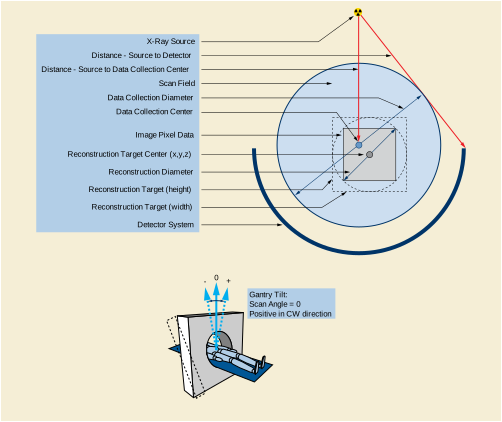
Table C.8-123 specifies the attributes of the CT Reconstruction Functional Group Macro.
Table C.8-123. CT Reconstruction Macro Attributes
|
Attribute Name |
Tag |
Type |
Attribute Description |
|---|---|---|---|
|
CT Reconstruction Sequence |
(0018,9314) |
1 |
Contains the attributes holding information about the reconstruction techniques used. Only a single Item shall be included in this sequence. |
|
>Reconstruction Algorithm |
(0018,9315) |
1C |
Description of the algorithm used when reconstructing the image from the data acquired during the acquisition process. Defined Terms:
Required if Frame Type (0008,9007) Value 1 of this frame is ORIGINAL. May be present otherwise. |
|
>Convolution Kernel |
(0018,1210) |
1C |
A label describing the convolution kernel or algorithm used to reconstruct the data. A single value shall be present. Required if Frame Type (0008,9007) Value 1 of this frame is ORIGINAL. May be present otherwise. |
|
>Convolution Kernel Group |
(0018,9316) |
1C |
A label describing the group to which Convolution Kernel (0018,1210). Defined Terms:
Required if Convolution Kernel (0018,1210) is present. May be present otherwise. |
|
>Reconstruction Diameter |
(0018,1100) |
1C |
The diameter in mm of the region from which data were used in creating the reconstruction of the image. Data may exist outside this region and portions of the patient may exist outside this region. See Section C.8.15.3.6.1. Required if Frame Type (0008,9007) Value 1 of this frame is ORIGINAL and Reconstruction Field of View (0018,9317) is not present. Otherwise may be present if Frame Type (0008,9007) Value 1 of this frame is DERIVED and Reconstruction Field of View (0018,9317) is not present. |
|
>Reconstruction Field of View |
(0018,9317) |
1C |
The field of view width (x-dimension) followed by height (y-dimension) as used for reconstruction in mm. Required if Frame Type (0008,9007) Value 1 of this frame is ORIGINAL and Reconstruction Diameter (0018,1100) is not present. Otherwise may be present if Frame Type (0008,9007) Value 1 of this frame is DERIVED and Reconstruction Diameter (0018,1100) is not present. |
|
>Reconstruction Pixel Spacing |
(0018,9322) |
1C |
Physical distance in the patient between the center of each reconstructed pixel, specified by a numeric pair - adjacent row spacing (delimiter) adjacent column spacing in mm. See Section 10.7.1.3 for further explanation of the value order. Required if Frame Type (0008,9007) Value 1 of this frame is ORIGINAL. May be present otherwise. |
|
>Reconstruction Angle |
(0018,9319) |
1C |
Angle (in degrees) over which the data from which the frame was reconstructed was collected, where 360 degrees signifies a complete revolution of the source around the gantry orbit. It is possible, in the case of over-scanning that the Reconstruction Angle is greater than 360 degrees. Shall be 0 if Acquisition Type (0018,9302) is CONSTANT_ANGLE. Required if Frame Type (0008,9007) Value 1 of this frame is ORIGINAL. May be present otherwise. |
|
>Image Filter |
(0018,9320) |
1C |
A label describing the filter applied to the reconstructed image after the original reconstruction has been completed. NoteWhen Frame Type (0008,9007) Value 1 of this frame is DERIVED and Frame Type (0008,9007) Value 4 is FILTERED the type of filtration is described in Derivation Image Macro. Required if Frame Type (0008,9007) Value 1 of this frame is ORIGINAL. |
Table C.8-124 specifies the attributes of the CT Exposure Functional Group Macro.
Table C.8-124. CT Exposure Macro Attributes
|
Attribute Name |
Tag |
Type |
Attribute Description |
|---|---|---|---|
|
CT Exposure Sequence |
(0018,9321) |
1 |
Contains the attributes defining exposure information. Only a single Item shall be included in this sequence. |
|
>Exposure Time in ms |
(0018,9328) |
1C |
Duration of exposure for this frame in milliseconds. If Acquisition Type (0018,9302) equals SPIRAL the duration of the exposure time for this frame shall be Revolution Time (0018,9305) divided by the Spiral Pitch Factor (0018,9311). See Section C.8.15.3.8.1. Required if Frame Type (0008,9007) Value 1 of this frame is ORIGINAL. May be present otherwise. |
|
>X-Ray Tube Current in mA |
(0018,9330) |
1C |
Nominal X-Ray tube current in milliamperes. Required if Frame Type (0008,9007) Value 1 of this frame is ORIGINAL. May be present otherwise. |
|
>Exposure in mAs |
(0018,9332) |
1C |
The exposure expressed in milliampere seconds, for example calculated from exposure time and X-Ray tube current. Required if Frame Type (0008,9007) Value 1 of this frame is ORIGINAL. May be present otherwise. |
|
>Exposure Modulation Type |
(0018,9323) |
1C |
A label describing the type of exposure modulation used for the purpose of limiting the dose. Defined Terms:
Required if Frame Type (0008,9007) Value 1 of this frame is ORIGINAL. May be present otherwise. |
|
>Estimated Dose Saving |
(0018,9324) |
2C |
A percent value of dose saving due to the use of Exposure Modulation Type (0018,9323). A negative percent value of dose savings reflects an increase of exposure. Required if Frame Type (0008,9007) Value 1 of this frame is ORIGINAL and Exposure Modulation Type (0018,9323) is not equal to NONE. Otherwise may be present if Frame Type (0008,9007) Value 1 of this frame is DERIVED and Exposure Modulation Type (0018,9323) is not equal to NONE. |
|
>CTDIvol |
(0018,9345) |
2C |
Computed Tomography Dose Index (CTDIvol), in mGy according to IEC 60601-2-44, Ed.2.1 (Clause 29.1.103.4), The Volume CTDIvol. It describes the average dose for this frame for the selected CT conditions of operation. Required if Frame Type (0008,9007) Value 1 of this frame is ORIGINAL. May be present otherwise. |
|
>CTDI Phantom Type Code Sequence |
(0018,9346) |
3 |
The type of phantom used for CTDI measurement according to IEC 60601-2-44. Only a single Item is permitted in this Sequence. |
|
Defined CID 4052 “Phantom Devices”. |
|||
Note
The dose that a patient receives in a given procedure may be reported in one or more instances of the Radiation Dose Report SOP Class using TID 10011 “CT Radiation Dose”.
An example of how the value of Exposure Time in ms (0018,9328) can be calculated:
The Exposure Time Texposuretime of a volume shall be the time of the X-Ray radiation in position with this volume. It depends on the travel speed and the total collimation width.
Texposuretime of the volume represented by a distinguished frame of a Spiral Scan can be calculated as follows:
Texposuretime = N x S / Vtravelspeed
CTpitchfactor = DD / N x S
Vtravelspeed = DD / Trevolutiontime
From this the exposure time can be derived:
Texposuretime = N x S x Trevolutiontime / DD = Trevolutiontime / CTpitchfactor
Legend:
DD = Table Feed per Rotation (0018,9310) in mm distance moved by the patient support in the z direction per 360° revolution in Spiral scanning
S = collimation of a single slice in mm
N = number slices
N x S = Total Collimation Width (0018,9307) in mm
Vtravelspeed = Table Speed (0018,9309) in mm/second, travel speed of the patient table
Trevolutiontime = Revolution time (0018,9305) in seconds
CTpitchfactor = Spiral Pitch Factor (0018,9311)
Table C.8-125 specifies the attributes of the CT X-Ray Details Functional Group Macro.
Table C.8-125. CT X-Ray Details Sequence Macro Attributes
|
Attribute Name |
Tag |
Type |
Attribute Description |
|---|---|---|---|
|
CT X-Ray Details Sequence |
(0018,9325) |
1 |
Contains the attributes defining the x-ray information. Only a single Item shall be included in this sequence. |
|
>KVP |
(0018,0060) |
1C |
Peak kilo voltage output of the x-ray generator used. Required if Frame Type (0008,9007) Value 1 of this frame is ORIGINAL. May be present otherwise. |
|
>Focal Spot(s) |
(0018,1190) |
1C |
Used nominal size of the focal spot in mm. The attribute may only have one or two values, for devices with variable focal spot, small dimension followed by large dimension Required if Frame Type (0008,9007) Value 1 of this frame is ORIGINAL. May be present otherwise. |
|
>Filter Type |
(0018,1160) |
1C |
Type of filter(s) inserted into the X-Ray beam. Defined Terms:
NoteMultiple type of filters can be expressed by a combination, e.g., BUTTERFLY+WEDGE. Required if Frame Type (0008,9007) Value 1 of this frame is ORIGINAL. May be present otherwise. |
|
>Filter Material |
(0018,7050) |
1C |
The X-Ray absorbing material used in the filter. May be multi-valued. Defined Terms:
NoteMIXED may be used to indicate a filter type of complex composition for which listing the individual materials would be excessive or undesirable; it is not intended to mean "unknown". Required if Frame Type (0008,9007) Value 1 of this frame is ORIGINAL and the value of Filter Type (0018,1160) is other than NONE. May be present otherwise. |
|
>Calcium Scoring Mass Factor Patient |
(0018,9351) |
3 |
The calibration factor for the calcium mass score. These factors incorporate the effects of
See Section C.8.2.1.1.7. |
|
>Calcium Scoring Mass Factor Device |
(0018,9352) |
3 |
The calibration factors for the calcium mass score of the device. These factors incorporate the effects of
This a multi-value attribute, the first value specifies the mass factor for a small patient size, the second value for a medium patient size and the third value for a large patient size. See Section C.8.2.1.1.7. |
|
>Energy Weighting Factor |
(0018,9353) |
1C |
The weighting factor of the data from the primary source in a multiple energy composition image. This factor incorporates the effects of
Required if Required if Frame Type (0008,9007) Value 4 of this frame is ENERGY_PROP_WT. May be present otherwise. |
Table C.8-126 specifies the attributes of the CT Pixel Value Transformation Functional Group Macro.
Note
This Macro is equivalent to the Modality LUT transformation in non Multi-frame IODs.
This in effect specializes the Section C.7.6.16.2.9 Pixel Value Transformation Macro.
Table C.8-126. CT Pixel Value Transformation Macro Attributes
|
Attribute Name |
Tag |
Type |
Attribute Description |
|---|---|---|---|
|
Pixel Value Transformation Sequence |
(0028,9145) |
1 |
Contains the attributes involved in the transformation of stored pixel values. Only a single Item shall be included in this sequence. |
|
>Rescale Intercept |
(0028,1052) |
1 |
The value b in relationship between stored values (SV) and the output units. Output units = m*SV + b. |
|
>Rescale Slope |
(0028,1053) |
1 |
m in the equation specified by Rescale Intercept (0028,1052). |
|
>Rescale Type |
(0028,1054) |
1 |
Specifies the output units of Rescale Slope (0028,1053) and Rescale Intercept (0028,1052). See Section C.11.1.1.2 for further explanation. If Frame Type (0008,9007) Value 1 of this frame is ORIGINAL and Frame Type (0008,9007) Value 3 is not LOCALIZER, the value shall be HU (Hounsfield Units). |
Table C.8-126b specifies the attributes of the CT Additional X-Ray Source Macro. This sequence may be multi-valued, depending on the number of additional active X-Ray sources. It defines the X-Ray source parameters beyond the basic system.
Table C.8-126b. CT Additional X-Ray Source Macro Attributes
|
Attribute Name |
Tag |
Type |
Attribute Description |
|---|---|---|---|
|
CT Additional X-Ray Source Sequence |
(0018,9360) |
1 |
Contains the attributes defining the data acquisition in a multiple X-Ray source system beyond the primary source. The primary X-Ray source is specified in the CT X-Ray Details Sequence. One or more Items shall be included in this sequence. |
|
>KVP |
(0018,0060) |
1 |
Peak kilo voltage output of the X-Ray generator used. |
|
>X-Ray Tube Current in mA |
(0018,9330) |
1 |
Nominal X-Ray tube current in milliamperes. |
|
>Data Collection Diameter |
(0018,0090) |
1 |
The diameter in mm of the region over which data were collected. |
|
>Focal Spot(s) |
(0018,1190) |
1 |
Used nominal size of the focal spot in mm. |
|
>Filter Type |
(0018,1160) |
1 |
Type of filter(s) inserted into the X-Ray beam. See Section C.8.15.3.9. |
|
>Filter Material |
(0018,7050) |
1 |
The X-Ray absorbing material used in the filter. |
|
>Exposure in mAs |
(0018,9332) |
1 |
The exposure expressed in milliampere seconds, for example calculated from exposure time and X-Ray tube current. |
|
>Energy Weighting Factor |
(0018,9353) |
1C |
The weighting factor of the data from this additional source in a multiple energy composition image. This factor incorporates the effects of
Required if Required if Frame Type (0008,9007) Value 4 of this frame is ENERGY_PROP_WT. May be present otherwise. |
This section contains descriptions of Macros and Attributes used in Modules and Functional Group Macros that are common to the Enhanced CT Image, Enhanced MR Images and MR Spectroscopy IODs.
Image Type (0008,0008) and associated Image Type related attributes provide a high level description of a multi-frame SOP Instance. These attributes describe properties that provide key summary information to users of the SOP Instance. Image Type (0008,0008) contains the highest level summary of what is in the SOP Instance.
Frame Type (0008,9007) mirrors the corresponding Image Type attribute and applies to the frame level rather than to the image level.
If more than one value is used by the set of frames for a given Frame Type (0008,9007) attribute value or associated attribute value then the corresponding value of Image Type (0008,0008) or associated attribute shall contain a value of MIXED. This indicates that a mixed set of values exists within the multi-frame SOP Instance.
The value MIXED shall only be used in Image Type (0008,0008) when the corresponding values for the individual frames are not equal. When a value of an attribute is equal for all frames, the same value shall be used for the corresponding value of Image Type (0008,0008). Values 2 and 3 of Image Type (0008,0008) are an exception to the rule for MIXED: Values 2 and 3 may never have the value of MIXED as described in Section C.8.16.1.2 and Section C.8.16.1.3.
Image Type (0008,0008) and Frame Type (0008,9007) shall consist of four non-zero length values.
Value 1 of Image Type (0008,0008) and Frame Type (0008,9007) shall use one of the following Enumerated Values from Table C.8-127.
Value 1 of Image Type (0008,0008) and Value 1 of Frame Type (0008,9007) shall not be zero length.
Table C.8-127. Image Type and Frame Type Value 1
|
Enumerated Value Name |
Enumerated Value Description |
|---|---|
|
ORIGINAL |
An image or frame is original if its pixel data was directly reconstructed from the original data that is obtained from the sensors of the imaging equipment, Image Type (0008,0008) Value 4 is NONE, and Volume Based Calculation Technique (0008,9207) is NONE. Note
|
|
DERIVED |
An image or frame is derived if its pixel data was calculated from original or other derived pixel data (i.e., it is not original). |
|
MIXED |
Used only as a value in Image Type (0008,0008) if frames within the SOP Instance contain different values for Value 1 in their Frame Type (0008,9007). |
Value 2 for Image Type (0008,0008) and Frame Type (0008,9007) follows the standard definition and shall have the following Enumerated Value from Table C.8-128.
Value 2 of Image Type (0008,0008) and Value 2 of Frame Type (0008,9007) shall not be zero length.
Table C.8-128. Image Type and Frame Type Value 2
|
Enumerated Value Name |
Enumerated Value Description |
|---|---|
|
PRIMARY |
Value 3 is an overall representation of the image type. This value may be a summary of several other attributes or a duplication of one of the other attributes to indicate the most important aspect of this image. Value 3 Image Flavor is to be used with Value 4 Derived Pixel Contrast to indicate the nature of the image set.
Note
For example Value 3 = DIFFUSION together with Value 4 = NONE indicates that the image set was originally collected for DIFFUSION.
If Value 3 = DIFFUSION together with Value 4 = DIFFUSION this indicates that the object contains DIFFUSION weighted post processed images.
Value 3 of Image Type (0008,0008) shall not be zero length.
Value 3 of Frame Type (0008,9007) may have the same value as found in Value 3 of Image Type (0008,0008), or may have a different value or may be of zero length.
The attribute value may not be MIXED as this value needs to be a summary of the primary purpose of the images, whether the frames have the same value or not.
Table C.8-129 specifies the Defined Terms for Value 3 for Image Type (0008,0008) and Frame Type (0008,9007) that are common to CT and MR. Additional Defined Terms are defined in the modality-specific Module and Macro definitions.
Table C.8-129. Image Type and Frame Type Value 3 Common
|
Defined Term Name |
Defined Term Description |
|---|---|
|
ANGIO |
Collected for the purpose of angiography |
|
CARDIAC |
Images of the heart |
|
CARDIAC_GATED |
Cardiac gated images, other than of the heart |
|
CARDRESP_GATED |
Cardiac and respiratory gated images |
|
DYNAMIC |
An image in which the same anatomical volume is imaged at multiple times in order to capture images of a non-cyclic, time varying event. For example, imaging of the uptake of a tracer or contrast in a specific organ over time. NoteThis is different from gating techniques, in which the same anatomical volume is imaged during some portion of a cyclic event, e.g., inspiration or R-R Interval. |
|
FLUOROSCOPY |
Real-time collection of single slices (e.g., CT or MR Fluoroscopy) |
|
LOCALIZER |
Collected for the purpose of planning other images. |
|
MOTION |
Collected for looking at body motion |
|
PERFUSION |
Collected for the purposes of perfusion calculations. |
|
PRE_CONTRAST |
Collected before contrast was administered |
|
POST_CONTRAST |
Collected during or after contrast was administered |
|
RESP_GATED |
Respiratory gated images |
|
REST |
Cardiac rest image set |
|
STATIC |
A group of frames at varying spatial locations acquired at the same time. |
|
STRESS |
Cardiac stress image set |
|
VOLUME |
Set of frames that define a regularly sampled volume |
|
NON_PARALLEL |
Set of frames that are not parallel |
|
PARALLEL |
Set of frames that are parallel but do not constitute a regularly sampled volume |
|
WHOLE_BODY |
A group of frames of the whole body; the frames may be acquired at various times (as distinct from STATIC). |
Value 4 shall be used to indicate derived pixel contrast - generally, contrast created by combining or processing images with the same geometry. Value 4 shall have a value of NONE when Value 1 is ORIGINAL.
Note
If more than one of the following derived types is applicable, then it is up to the generating application to specify the value that best characterizes the derived image.
Value 4 of Image Type (0008,0008) and Value 4 of Frame Type (0008,9007) shall not be zero length unless the SOP Class UID is "1.2.840.10008.5.1.4.1.1.2.2" or "1.2.840.10008.5.1.4.1.1.4.4" or "1.2.840.10008.5.1.4.1.1.128.1" (Legacy Converted).
Table C.8-130 specifies the Defined Terms for Value 4 for Image Type (0008,0008) and Frame Type (0008,9007) that are common to CT and MR. Additional Defined Terms are defined in the modality-specific Module and Macro definitions.
Table C.8-130. Image Type and Frame Type Value 4 Common
|
Defined Term Name |
Defined Term Description |
|---|---|
|
ADDITION |
Created through Pixel by pixel addition operation |
|
DIVISION |
Created through Pixel by pixel division operation |
|
MASKED |
Created through Pixel by pixel masking operation |
|
MAXIMUM |
Created through Pixel by Pixel Maximum operation |
|
MEAN |
Created through Pixel by pixel mean operation |
|
MINIMUM |
Created through Pixel by Pixel Minimum operation |
|
MTT |
Mean Transit Time |
|
MULTIPLICATION |
Created through Pixel by pixel multiplication operation |
|
RCBF |
Regional Cerebral Blood Flow (rCBF) |
|
RCBV |
Regional Cerebral Blood Volume (rCBV) |
|
RESAMPLED |
Pixels have been spatially re-sampled, e.g., MPR |
|
STD_DEVIATION |
Standard Deviation |
|
SUBTRACTION |
Created through Pixel by pixel subtraction operation |
|
T_TEST |
Student's T-Test |
|
TTP |
Time To Peak map |
|
Z_SCORE |
Z-Score Map |
|
NONE |
Not a calculated image |
|
MIXED |
Used only as value in Image Type (0008,0008) if frames within the image SOP Instance contain different values for value 4 in their Frame Type (0008,9007) attribute. |
This section describes the Common CT/MR Image Description Macro.
Table C.8-131 specifies the attributes of the Common CT/MR Image Description Macro.
Table C.8-131. Common CT/MR Image Description Macro Attributes
|
Attribute Name |
Tag |
Type |
Attribute Description |
|---|---|---|---|
|
Pixel Presentation |
(0008,9205) |
1 |
Indication of the presence or absence of color information that may be used during rendering. See Section C.8.16.2.1.1 for a description and Enumerated Values. |
|
Volumetric Properties |
(0008,9206) |
1 |
Indication if geometric manipulations are possible with frames in the SOP Instance. See Section C.8.16.2.1.2 for a description and Enumerated Values. |
|
Volume Based Calculation Technique |
(0008,9207) |
1 |
Method used for volume calculations with frames in the SOP Instance. See Section C.8.16.2.1.3 for a description and Defined Terms. |
Table C.8-132. Pixel Presentation Attribute Values
|
Enumerated Value Name |
Enumerated Value Description |
|---|---|
|
COLOR |
Image is best displayed in color using Supplemental Palette Color LUTs, but can be displayed in grayscale if current display does not support color. See Section C.8.16.2.1.1.1. |
|
MONOCHROME |
Image is intended to be displayed in grayscale only. No Supplemental Palette Color LUTs are supplied. |
|
MIXED |
Used only as a value in Pixel Presentation (0008,9205) in the Enhanced MR Image Module or Enhanced CT Image Module if frames within the image SOP Instance contain different values for the Pixel Presentation attribute in the MR Image Frame Type Functional Group or CT Image Frame Type Functional Group. |
|
TRUE_COLOR |
Image can be displayed in color only |
Figure C.8-20 presents two separate image visualization pipelines that can be used for interpreting the stored pixel values.
If Pixel Presentation (0008,9205) equals COLOR, the stored values are split into two ranges. The stored values up to one less than the second value of the Red, Green and Blue Palette Color Lookup Table Descriptor (0028,1101-1103) are passed through the gray scale visualization pipeline. The values equal to or greater than the second value of the Red, Green and Blue Palette Color Lookup Table Descriptor (0028,1101-1103) are mapped by the Palette Color LUTs.
Note
Some images may be purely color, and there will be no grayscale range of stored pixel values "below" those that are passed through the color lookup tables.
Images containing Supplemental Palette Color LUTs cannot be irreversibly (lossy) compressed, since that would potentially change the index values and result in different colors being rendered.
The complete range of stored pixel values can also be displayed via the grayscale visualization pipeline only, but the information content may be less useful because the color information is not available.
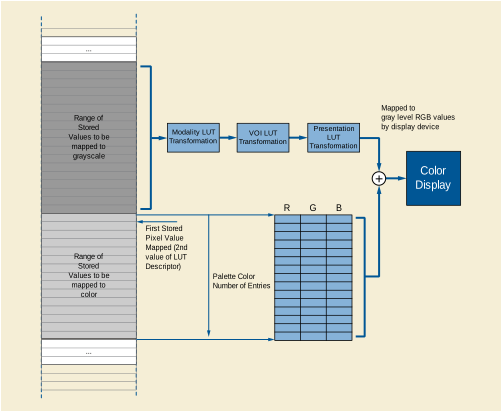
The value of Volumetric Properties (0008,9206) allows applications doing geometric manipulations (e.g., MAX_IP or MPR or planning) to determine if the image is an appropriate candidate for an operation without having to know all the details of the generating application.
Table C.8-133 specifies the Enumerated Values for Volumetric Properties (0008,9206).
Table C.8-133. Volumetric Properties Attribute Values
|
Enumerated Value Name |
Enumerated Value Description |
|---|---|
|
VOLUME |
Image contains pixels that represent the volume specified for the image (Examples: Volume Based Calculation Technique (0008,9207) is NONE or MPR). |
|
SAMPLED |
The specified frame or each frame within the image will not contain a representation of the average information in the slice direction because the frame was calculated by the non-linear re-sampling of a volume where each pixels of the resulting frame does not contain an average representation of the voxel represented by the frame's pixel. For example a projection (MAX_IP) frame uses the maximum value along a ray for each pixel rather than the average value of the represented voxel. |
|
DISTORTED |
Image contains significantly distorted information from what is specified by the image volume attributes. For example this image should not be used in planning or for 3D volume. An example of this image type is a curved reformatted image (CURVED_MPR). |
|
MIXED |
Used only as a value in Volumetric Properties (0008,9206) in the Enhanced MR Image Type Module or Enhanced CT Image Type Module if frames within the image SOP Instance contain different values for Volumetric Properties (0008,9206) in the MR Image Frame Type Functional Group or CT Frame Type Functional Group. |
Note
A value of MIXED may be necessary if creating a Legacy Converted Enhanced image and insufficient information is present to specify a more specific value.
The value of Volume Based Calculation Technique (0008,9207) shall be used to indicate the method used for calculating pixels based on geometry.
Shall have a value of NONE when Value 1 of Image Type (0008,0008) or Value 1 of Frame Type (0008,9007) is ORIGINAL.
Table C.8-134 specifies the Defined Terms for the Volume Based Calculation Technique (0008,9207) attribute.
Table C.8-134. Volume Based Calculation Technique Attribute Values
|
Defined Term Name |
Defined Term Description |
|---|---|
|
MAX_IP |
Maximum Intensity Projection |
|
MIN_IP |
Minimum Intensity Projection |
|
VOLUME_RENDER |
Volume Rendering Projection Volume Rendering Image represents 3D voluminar information constructed from measured voxel intensities covering a 3D volume. |
|
SURFACE_RENDER |
Surface Rendering Projection Surface Rendering Image represents 3D surface information constructed from measured voxel intensities covering a 3D volume. |
|
MPR |
Multi-Planar Reformat |
|
CURVED_MPR |
Curved Multi-Planar Reformat |
|
NONE |
Pixels not derived geometrically |
|
MIXED |
Used only as a value in Volume Based Calculation Technique (0008,9207) attribute in the Enhanced MR Image Module or MR Spectroscopy Module if frames within the image SOP Instance contain different terms for the Volume Based Calculation Technique attribute in MR Frame Type Functional Group or MR Spectroscopy Frame Type Functional Group. |
Note
A value of MIXED may be necessary if creating a Legacy Converted Enhanced image and insufficient information is present to specify a more specific value.
Table C.8.17.1-1 specifies the attributes that describe an Ophthalmic Photography Series.
Table C.8.17.1-1. Ophthalmic Photography Series Module Attributes
|
Attribute Name |
Tag |
Type |
Attribute Description |
|---|---|---|---|
|
Modality |
(0008,0060) |
1 |
Source equipment that produced the Ophthalmic Photography Series. Enumerated Values:
|
Table C.8.17.2-1 specifies the Attributes that describe an Ophthalmic Photography Image produced by Ophthalmic Photography equipment (OP) imaging Modalities.
Table C.8.17.2-1. Ophthalmic Photography Image Module Attributes
|
Attribute Name |
Tag |
Type |
Attribute Description |
|---|---|---|---|
|
Image Type |
(0008,0008) |
1 |
Image identification characteristics. See Section C.8.17.2.1.4 for specialization. |
|
Instance Number |
(0020,0013) |
1 |
A number that identifies this image. |
|
Samples per Pixel |
(0028,0002) |
1 |
Number of samples (planes) in this image. Enumerated Values:
See Section C.8.17.2.1.2 for further explanation. |
|
Samples per Pixel Used |
(0028,0003) |
1C |
The number of samples (planes) containing information. Enumerated Values:
Required if different from Samples per Pixel (0028,0002). |
|
Photometric Interpretation |
(0028,0004) |
1 |
Specifies the intended interpretation of the pixel data. |
|
Pixel Representation |
(0028,0103) |
1 |
Data representation of the pixel samples. Enumerated Values:
|
|
Planar Configuration |
(0028,0006) |
1C |
Indicates whether the pixel data are sent color-by-plane or color-by-pixel. Required if Samples per Pixel (0028,0002) has a value greater than 1. Enumerated Values:
|
|
Pixel Spacing |
(0028,0030) |
1C |
Nominal physical distance at the focal plane (in the retina) between the center of each pixel, specified by a numeric pair - adjacent row spacing (delimiter) adjacent column spacing in mm. See Section 10.7.1.3 for further explanation of the value order. NoteThese values are specified as nominal because the physical distance may vary across the field of the images and the lens correction is likely to be imperfect. Required when Acquisition Device Type Code Sequence (0022,0015) contains an item with the value (SRT, R-1021A,"Fundus Camera"). May be present otherwise. |
|
Content Time |
(0008,0033) |
1 |
The time the image pixel data creation started. |
|
Content Date |
(0008,0023) |
1 |
The date the image pixel data creation started. |
|
Acquisition DateTime |
(0008,002A) |
1C |
The date and time that the acquisition of data started. NoteThe synchronization of this time with an external clock is specified in the synchronization Module in Acquisition Time Synchronized (0018,1800). Required if Image Type (0008,0008) Value 1 is ORIGINAL. May be present otherwise. |
|
Source Image Sequence |
(0008,2112) |
2C |
A Sequence that identifies the Images that were used to derive this Image. Required if Image Type Value 1 is DERIVED. Zero or more items shall be included in this sequence. See Section C.7.6.1.1.4 for further explanation. |
|
>Include Table 10-3 “Image SOP Instance Reference Macro Attributes” |
|||
|
>Purpose of Reference Code Sequence |
(0040,A170) |
1 |
Describes the purpose for which the reference is made, that is what role the source image or frame(s) played in the derivation of this image. Only a single Item shall be included in this sequence. |
|
>>Include Table 8.8-1 “Code Sequence Macro Attributes”. |
|||
|
Lossy Image Compression |
(0028,2110) |
1 |
Specifies whether an Image has undergone lossy compression (at a point in its lifetime). Enumerated Values:
Once this value has been set to 01 it shall not be reset. See Section C.7.6.1.1.5. |
|
Lossy Image Compression Ratio |
(0028,2112) |
1C |
Describes the approximate lossy compression ratio(s) that have been applied to this image. See Section C.7.6.1.1.5 for further explanation. May be multi-valued if successive lossy compression steps have been applied; the value order shall correspond to the values of Lossy Image Compression Method (0028,2114). Note
Required if Lossy Image Compression (0028,2110) is "01". |
|
Lossy Image Compression Method |
(0028,2114) |
1C |
A label for the lossy compression method(s) that have been applied to this image. See Section C.7.6.1.1.5 for further explanation. May be multi-valued if successive lossy compression steps have been applied; the value order shall correspond to the values of Lossy Image Compression Ratio (0028,2112). NoteFor historical reasons, the lossy compression method may also be described in Derivation Description (0008,2111). Required if Lossy Image Compression (0028,2110) is "01". |
|
Presentation LUT Shape |
(2050,0020) |
1C |
Specifies an identity transformation for the Presentation LUT, such that the output of all grayscale transformations defined in the IOD containing this Module are defined to be P-Values. Enumerated Values:
Required if Photometric Interpretation (0028,0004) is MONOCHROME2 |
|
Calibration Image |
(0050,0004) |
3 |
Indicates whether a reference object (phantom) of known size is present in the image and was used for calibration. Enumerated Values:
|
|
Burned In Annotation |
(0028,0301) |
1 |
Indicates whether or not image contains sufficient burned in annotation to identify the patient and date the image was acquired. Enumerated Values:
|
|
Recognizable Visual Features |
(0028,0302) |
3 |
Indicates whether or not the image contains sufficiently recognizable visual features to allow the image or a reconstruction from a set of images to identify the patient. Enumerated Values:
If this Attribute is absent, then the image may or may not contain recognizable visual features. |
The Referenced Image Sequence (0008,1140) in the General Image Module (Section C.7.6.1) shall not convey stereoscopic information, which instead shall be encoded using the Stereometric Relationship IOD.
Samples per Pixel (0028,0002) shall be 1 or 3.
Cameras producing 2-color images are required to use a value of 3 for Samples per Pixel (0028,0002) and a value of 2 for Samples per Pixel Used (0028,0003). For 2-color images with a RGB Photometric Interpretation, the R and G channel shall be used and the B channel shall have all values set to zero.
Note
In the case of Photometric Interpretations typically used for compression such as YBR_FULL_422, the encoding will be as if the RGB values were transformed to YCbCr.
Specifies the intended interpretation of the pixel data.
Enumerated Values:
- MONOCHROME2
- RGB
- YBR_FULL_422
- YBR_PARTIAL_420
- YBR_ICT
- YBR_RCT
The Image Type attribute (0008,0008) (General Image Module, Section C.7.6.1) identifies important image characteristics in a multiple valued data element. For the Ophthalmic Photography Image IOD, Image Type is specified as a Type 1 attribute and further specialized as follows:
Value 1 shall identify the Pixel Data Characteristics in accordance with Section C.7.6.1.1.2.
Enumerated Values for Value 1:
- ORIGINAL
- DERIVED
Value 2 shall identify the Patient Examination Characteristics in accordance with Section C.7.6.1.1.2.
Enumerated Values for Value 2:
- PRIMARY
Value 3 shall only be present if Value 1 is DERIVED.
Defined Terms for Value 3:
- MONTAGE
Value 4 (optionally present) shall identify the type of test performed for image acquisition.
Defined Terms for Value 4:
- COLOR
a picture take at "white" light; no filters applied
- REDFREE
a picture take at "green" illumination light; or just the green channel of a color sensor
- RED
a picture take at "red" illumination light; or just the red channel of a color sensor
- BLUE
a picture take at "blue" illumination light; or just the blue channel of a color sensor
- FA
fluorescein injected; a picture taken at fluorescein exciting illumination light; a filter passing just the emitted wavelength to sensor applied
- ICG
Indocyanine green injected; a picture taken at Indocyanine green exciting illumination light; a filter passing just the emitted wavelength to sensor applied
Note
A Montage Image is constructed out of several individual images, which also can be exchanged separately. The images used to create the montage image will be included in the source image sequence if those images are also exchanged. A Montage Image is identified as Image Type DERIVED\PRIMARY\MONTAGE
This Module describes equipment used to create original images.
Table C.8.17.3-1. Ophthalmic Photographic Parameters Module Attributes
|
Attribute Name |
Tag |
Type |
Attribute Description |
|---|---|---|---|
|
Acquisition Device Type Code Sequence |
(0022,0015) |
1 |
Describes the type of acquisition device Only a single item shall be included in this sequence. |
|
Baseline CID 4202 “Ophthalmic Photography Acquisition Device”. |
|||
|
Illumination Type Code Sequence |
(0022,0016) |
2 |
Coded value for illumination Zero or one item shall be included in this sequence. |
|
Light Path Filter Type Stack Code Sequence |
(0022,0017) |
2 |
Filters used in the light source path Zero or more items shall be included in this sequence. |
|
Baseline CID 4204 “Ophthalmic Filter”. |
|||
|
Light Path Filter Pass-Through Wavelength |
(0022,0001) |
3 |
Nominal pass-through wavelength of light path filter in nm |
|
Light Path Filter Pass Band |
(0022,0002) |
3 |
Pass band of light path filter in nm. This Attribute has two Values. The first is the shorter and the second the longer wavelength relative to the peak. The values are for the - 3dB nominal (1/2 of peak) pass through intensity One of the two Values may be zero length, in which case it is a cutoff filter. |
|
Image Path Filter Type Stack Code Sequence |
(0022,0018) |
2 |
Describes stack of filters used in image path Zero or more items shall be included in this sequence. |
|
Baseline CID 4204 “Ophthalmic Filter”. |
|||
|
Image Path Filter Pass-Through Wavelength |
(0022,0003) |
3 |
Nominal pass-through wavelength of image path filter in nm |
|
Image Path Filter Pass Band |
(0022,0004) |
3 |
Pass band of image path filter in nm. This Attribute has two Values. The first is the shorter and the second the longer wavelength relative to the peak. The values are for the - 3dB nominal (1/2 of peak) pass through intensity One of the two Values may be zero length, in which case it is a cutoff filter |
|
Lenses Code Sequence |
(0022,0019) |
2 |
Lenses that were used during the image acquisition Zero or more items shall be included in this sequence. |
|
Baseline CID 4205 “Ophthalmic Lens”. |
|||
|
Detector Type |
(0018,7004) |
2 |
Type of detector used for creating this image. Defined Terms:
|
|
Channel Description Code Sequence |
(0022,001A) |
1C |
Describes the light color used for each channel to generate the image. Required if this differs from the natural interpretation. NoteInterpretation and representation of RGB images rely on the assumption that the red channel really contains the red wavelength range of illumination light, the blue channel the blue wavelength range, etc. Some modalities use the RGB Photometric Interpretation as a container representing 3 channels of any illumination wavelength. Shall have the same number of items as the Value of Samples per Pixel Used (0028,0003) if present, or otherwise the value of Samples per Pixel (0028,0002). The channels shall be described in the order in which the channels are encoded. |
|
Camera Angle of View |
(0022,001E) |
3 |
The aperture angle of the camera, in degrees |
This Module describes patient clinical conditions related to the image acquisition.
Table C.8.17.4-1. Ophthalmic Photography Acquisition Parameters Module Attributes
|
Attribute Name |
Tag |
Type |
Attribute Description |
|---|---|---|---|
|
Patient Eye Movement Commanded |
(0022,0005) |
2 |
Enumerated Values:
|
|
Patient Eye Movement Command Code Sequence |
(0022,0006) |
1C |
Coded value for patient movement or orientation, which is the intent, and not necessarily the result, based on what the patient is capable of. Required if the value of Patient Eye Movement Commanded (0022,0005) is YES. Only a single item shall be included in this sequence. |
|
Baseline CID 4201 “Patient Eye Movement Command”. |
|||
|
Include Table C.8.17.8-2 “Ophthalmic Acquisition Parameters Macro Attributes” |
|||
Table C.8.17.5-1 contains IOD Attributes that describe the anatomy contained in an Ophthalmic Photography or Ophthalmic Tomography IOD.
Table C.8.17.5-1. Ocular Region Imaged Module Attributes
|
Attribute Name |
Tag |
Type |
Attribute Description |
|---|---|---|---|
|
Image Laterality |
(0020,0062) |
1 |
Laterality of object imaged (as described in Anatomic Region Sequence (0008,2218)) examined. Enumerated Values:
Shall be consistent with any laterality information contained in Primary Anatomic Structure Modifier Sequence (0008,2230), if present. NoteLaterality (0020,0060) is a Series level Attribute and must be the same for all Images in the Series. Since most Ophthalmic Photographic Image studies contain images of both eyes, the series level attribute will rarely be present. |
|
Relative Image Position Code Sequence |
(0022,001D) |
3 |
The position of this image on the retina (as defined by a specified nomenclature; the nomenclature is implicit in the code used). Only a single Item is permitted in this sequence. |
|
Baseline CID 4207 “Ophthalmic Image Position”. |
|||
|
Include Table 10-5 “General Anatomy Mandatory Macro Attributes” |
Defined CID 4209 “Ophthalmic Anatomic Structure Imaged” for Anatomic Region Sequence |
||
Table C.8.17.6-1 specifies the Attributes that identify and describe general information about the Ophthalmic Tomography Series.
Table C.8.17.6-1. Ophthalmic Tomography Series Module Attributes
|
Attribute Name |
Tag |
Type |
Attribute Description |
|---|---|---|---|
|
Modality |
(0008,0060) |
1 |
Type of equipment that originally acquired the data used to create the images in this Series. Enumerated Values:
See Section C.7.3.1.1.1 for further explanation. |
|
Series Number |
(0020,0011) |
1 |
A number that identifies this Series. |
|
Referenced Performed Procedure Step Sequence |
(0008,1111) |
1C |
Uniquely identifies the Performed Procedure Step SOP Instance to which the Series is related. Only a single Item shall be included in this sequence. Required if a Performed Procedure Step SOP Class was involved in the creation of this Series. |
|
>Include Table 10-11 “SOP Instance Reference Macro Attributes” |
|||
Table C.8.17.7-1 specifies the Attributes that describe an Image produced by Ophthalmic Tomography imaging modalities.
Table C.8.17.7-1. Ophthalmic Tomography Image Module Attributes
|
Attribute Name |
Tag |
Type |
Attribute Description |
|---|---|---|---|
|
Image Type |
(0008,0008) |
1 |
Image identification characteristics. See Section C.7.6.1.1.2 for Enumerated Values and Defined Terms and further explanation. |
|
Samples Per Pixel |
(0028,0002) |
1 |
Number of samples (planes) in this image. See Section C.7.6.3.1.1 for further explanation. Enumerated Values:
|
|
Acquisition DateTime |
(0008,002A) |
1 |
The date and time that the acquisition of data started. NoteThe synchronization of this time with an external clock is specified in the synchronization Module in Acquisition Time synchronized (0018,1800). |
|
Acquisition Duration |
(0018,9073) |
1C |
The scan time in seconds used to create all frames of an Ophthalmic Tomography image. Required if Image Type (0008,0008) Value 1 is ORIGINAL. May be present otherwise. |
|
Acquisition Number |
(0020,0012) |
1 |
A number identifying the single continuous gathering of data over a period of time that resulted in this image. |
|
Photometric Interpretation |
(0028,0004) |
1 |
Specifies the intended interpretation of the pixel data. Enumerated Values:
|
|
Pixel Representation |
(0028,0103) |
1 |
Data representation of pixel samples. Enumerated Values:
|
|
Bits Allocated |
(0028,0100) |
1 |
Number of bits allocated for each pixel sample. Each sample shall have the same number of bits allocated. Enumerated Values:
|
|
Bits Stored |
(0028,0101) |
1 |
Number of bits stored for each pixel sample. Each sample shall have the same number of bits stored. Enumerated Values:
|
|
High Bit |
(0028,0102) |
1 |
Most significant bit for pixel sample data. Each sample shall have the same high bit. High Bit (0028,0102) shall be one less than Bits Stored |
|
Presentation LUT Shape |
(2050,0020) |
1 |
Specifies an identity transformation for the Presentation LUT, such that the output of all grayscale transformations defined in the IOD containing this Module are defined to be P-Values. Enumerated Values:
|
|
Lossy Image Compression |
(0028,2110) |
1 |
Specifies whether an Image has undergone lossy compression (at a point in its lifetime). Enumerated Values:
Once this value has been set to 01 it shall not be reset. See Section C.7.6.1.1.5. |
|
Lossy Image Compression Ratio |
(0028,2112) |
1C |
Describes the approximate lossy compression ratio(s) that have been applied to this image. See Section C.7.6.1.1.5 for further explanation. May be multi-valued if successive lossy compression steps have been applied; the value order shall correspond to the values of Lossy Image Compression Method (0028,2114). Note
Required if Lossy Image Compression (0028,2110) is "01". |
|
Lossy Image Compression Method |
(0028,2114) |
1C |
A label for the lossy compression method(s) that have been applied to this image. See Section C.7.6.1.1.5 for further explanation. May be multi-valued if successive lossy compression steps have been applied; the value order shall correspond to the values of Lossy Image Compression Ratio (0028,2112). NoteFor historical reasons, the lossy compression method may also be described in Derivation Description (0008,2111). Required if Lossy Image Compression (0028,2110) is "01". |
|
Burned In Annotation |
(0028,0301) |
1 |
Indicates whether or not image contains sufficient burned in annotation to identify the patient and date the image was acquired. Enumerated Values:
|
|
Recognizable Visual Features |
(0028,0302) |
3 |
Indicates whether or not the image contains sufficiently recognizable visual features to allow the image or a reconstruction from a set of images to identify the patient. Enumerated Values:
If this Attribute is absent, then the image may or may not contain recognizable visual features. |
|
Concatenation Frame Offset Number |
(0020,9228) |
1 |
Offset of the first frame in a multi-frame image of a concatenation. Enumerated Values:
|
|
In-concatenation Number |
(0020,9162) |
1 |
Identifier for one SOP Instance belonging to a concatenation. Enumerated Values:
|
|
In-concatenation Total Number |
(0020,9163) |
1 |
The number of SOP Instances sharing the same Concatenation UID (0020,9161). Enumerated Values:
|
|
Image Comments |
(0020,4000) |
3 |
User-defined comments about the image |
The value constraints on Concatenation Frame Offset Number (0020,9228), In-concatenation Number (0020,9162), and In-concatenation Total Number (0020,9163) have the effect of requiring the entire image to be in one concatenation.
Table C.8.17.8-1 describes patient clinical conditions related to an Ophthalmic Tomography image acquisition.
Table C.8.17.8-1. Ophthalmic Tomography Acquisition Parameters Module Attributes
|
Attribute Name |
Tag |
Type |
Attribute Description |
|---|---|---|---|
|
Axial Length of the Eye |
(0022,0030) |
2 |
Axial length of the eye in mm. |
|
Horizontal Field of View |
(0022,000C) |
2 |
The horizontal field of view in degrees |
|
Include Table C.8.17.8-2 “Ophthalmic Acquisition Parameters Macro Attributes” |
|||
Table C.8.17.8-2. Ophthalmic Acquisition Parameters Macro Attributes
|
Attribute Name |
Tag |
Type |
Attribute Description |
|---|---|---|---|
|
Refractive State Sequence |
(0022,001B) |
2 |
The refractive state of the imaged eye at the time of acquisition. Zero or one Itemshall be included in this sequence. Zero length means the refractive state was not measured. |
|
>Spherical Lens Power |
(0022,0007) |
1 |
Sphere value in diopters |
|
>Cylinder Lens Power |
(0022,0008) |
1 |
Cylinder value in diopters |
|
>Cylinder Axis |
(0022,0009) |
1 |
Axis value in degrees |
|
Emmetropic Magnification |
(0022,000A) |
2 |
Emmetropic magnification value (dimensionless). Zero length means the emmetropic magnification was not measured. |
|
Intra Ocular Pressure |
(0022,000B) |
2 |
Value of intraocular pressure in mmHg. Zero length means the pressure was not measured |
|
Pupil Dilated |
(0022,000D) |
2 |
Whether or not the patient's pupils were pharmacologically dilated for this acquisition. Enumerated Values:
If this tag is empty, no information is available. |
|
Mydriatic Agent Sequence |
(0022,0058) |
2C |
Information about the agent administered. Zero or more items shall be included in this sequence. NoteAn empty sequence indicates that an agent was used for dilation, but the name was not entered. Required if the value of Pupil Dilated (0022,000D) is YES. |
|
>Mydriatic Agent Code Sequence |
(0022,001C) |
1 |
The actual agent administered to dilate the pupil. Only a single Item shall be included in this sequence. |
|
Baseline CID 4208 “Mydriatic Agent”. |
|||
|
>Mydriatic Agent Concentration |
(0022,004E) |
3 |
The concentration of the agent. |
|
>Mydriatic Agent Concentration Units Sequence |
(0022,0042) |
1C |
Units of measure for the Mydriatic Agent Concentration. Only a single Item shall be included in this sequence. Required if Mydriatic Agent Concentration (0022,004E) is present. |
|
Defined CID 82 “Units of Measurement”. |
|||
|
Degree of Dilation |
(0022,000E) |
2C |
The degree of the dilation in mm. Required if the value of Pupil Dilated (0022,000D) is YES. |
Table C.8.17.9-1 describes the parameters and characteristics of the acquisition device related to an Ophthalmic Tomography image acquisition.
Table C.8.17.9-1. Ophthalmic Tomography Parameters Module Attributes
|
Attribute Name |
Tag |
Type |
Attribute Description |
|---|---|---|---|
|
Acquisition Device Type Code Sequence |
(0022,0015) |
1 |
Describes the type of acquisition device. Only a single item shall be included in this sequence. |
|
Baseline CID 4210 “Ophthalmic Tomography Acquisition Device”. |
|||
|
Light Path Filter Type Stack Code Sequence |
(0022,0017) |
2 |
Filters used in the light source path. Zero or more items shall be included in this sequence. |
|
Baseline CID 4204 “Ophthalmic Filter”. |
|||
|
>Light Path Filter Pass-Through Wavelength |
(0022,0001) |
3 |
Nominal pass-through wavelength of light path filter in nm |
|
>Light Path Filter Pass Band |
(0022,0002) |
3 |
Pass band of light path filter in nm. This Attribute has two Values. The first is the shorter and the second the longer wavelength relative to the peak. The values are for the - 3dB nominal (1/2 of peak) pass through intensity. One of the two Values may be zero length, in which case it is a cutoff filter. |
|
Detector Type |
(0018,7004) |
1 |
Type of detector used for creating this image. Defined Terms:
|
|
Illumination Wave Length |
(0022,0055) |
1C |
Wavelength of the illuminator in nm. Required if Acquisition Device Type Code Sequence (0022,0015) contains an item with the value (A-00FBE, SRT, "Optical Coherence Tomography Scanner"). May be present otherwise. |
|
Illumination Power |
(0022,0056) |
1C |
Power of the illuminator in microwatts at corneal plane. Required if Acquisition Device Type Code Sequence (0022,0015) contains an item with the value (SRT, A-00FBE,"Optical Coherence Tomography Scanner"). May be present otherwise. |
|
Illumination Bandwidth |
(0022,0057) |
1C |
Bandwidth of the illuminator in nm. Required if Acquisition Device Type Code Sequence (0022,0015) contains an item with the value (A-00FBE, SRT, "Optical Coherence Tomography Scanner"). May be present otherwise. |
|
Depth Spatial Resolution |
(0022,0035) |
1C |
The inherent limiting resolution in microns for depth of the acquisition equipment for high contrast objects for the data gathering and reconstruction technique chosen. If variable, the value at the center of the scanning volume. Required if Acquisition Device Type Code Sequence (0022,0015) contains an item with the value (A-00FBE, SRT, "Optical Coherence Tomography Scanner"). May be present otherwise. |
|
Maximum Depth Distortion |
(0022,0036) |
1C |
Maximum distortion in depth direction in % of Depth Spatial Resolution. Required if Acquisition Device Type Code Sequence (0022,0015) contains an item with the value (SRT, A-00FBE,"Optical Coherence Tomography Scanner"). May be present otherwise. |
|
Along-scan Spatial Resolution |
(0022,0037) |
1C |
The inherent limiting resolution in microns of the acquisition equipment in the direction of a row. Required if Acquisition Device Type Code Sequence (0022,0015) contains an item with the value (A-00FBE, SRT, "Optical Coherence Tomography Scanner"). May be present otherwise. |
|
Maximum Along-scan Distortion |
(0022,0038) |
1C |
Maximum distortion in along-scan direction in % of Along-scan Spatial Resolution. Required if Acquisition Device Type Code Sequence (0022,0015) contains an item with the value (A-00FBE, SRT, "Optical Coherence Tomography Scanner"). May be present otherwise. |
|
Across-scan Spatial Resolution |
(0022,0048) |
1C |
The inherent limiting resolution in microns of the acquisition equipment perpendicular to the slice. Required if Acquisition Device Type Code Sequence (0022,0015) contains an item with the value (A-00FBE, SRT, "Optical Coherence Tomography Scanner"). May be present otherwise. |
|
Maximum Across-scan Distortion |
(0022,0049) |
1C |
Maximum distortion in across-scan direction in % of cross-scan Spatial Resolution. Required if Acquisition Device Type Code Sequence (0022,0015) contains an item with the value (A-00FBE, SRT, "Optical Coherence Tomography Scanner"). May be present otherwise. |
Table C.8.17.10-1 specifies the attributes of the Ophthalmic Frame Location Functional Group Macro. This is used to provide a frame location relative to one or more referenced images. This macro describes a frame perpendicular or parallel to the reference image; it describes column locations for frames that are scanned either uniformly along a line segment, or with a non-uniform spacing along any trajectory in the reference image.
Table C.8.17.10-1. Ophthalmic Frame Location Macro Attributes
|
Attribute Name |
Tag |
Type |
Attribute Description |
|---|---|---|---|
|
Ophthalmic Frame Location Sequence |
(0022,0031) |
1 |
Specifies the column locations for this frame in terms of locations on a referenced image. One or more Items shall be included in this sequence. |
|
>Include Table 10-3 “Image SOP Instance Reference Macro Attributes” |
|||
|
>Purpose of Reference Code Sequence |
(0040,A170) |
3 |
Describes the purpose for which the reference is made. Only a single Item is permitted in this sequence. |
|
Defined Code Concept for Purpose of Reference is (121311, DCM, "Localizer") |
|||
|
>Reference Coordinates |
(0022,0032) |
1 |
Image coordinates for the points on the referenced image that correspond to the points on this frame. See Section C.8.17.10.1.1. |
|
>Depth of Transverse Image |
(0022,0041) |
2C |
Relative position in microns signifying the location of a Transverse image in the z-axis. Required if Ophthalmic Image Orientation (0022,0039) is TRANSVERSE. |
|
>Ophthalmic Image Orientation |
(0022,0039) |
1 |
Enumerated Values:
|
A frame can be described in terms of its "position" on another image. In the case of ophthalmic tomography (OPT) images with longitudinal orientation, the OPT image corresponds to a vertical slice along a trajectory on the referenced image. Each column of the OPT frame is nominally perpendicular to the image. Therefore, each column of the OPT frame can also correspond to a particular pixel on an associated image. It is normal in OPT analysis to indicate the location of the OPT slice by showing the corresponding pixel locations on the image. For Transverse frames, the position is indicated by two corners of a rectangle.
Note
The simple geometric relationship modules are not practical to use for describing the relationship between OPT and retinal photography images. The retinal surface is highly curved, and the optical path is influenced by the lens and other eye structures. It is impractical to measure all of the geometric and optical properties of the eye to the degree needed to establish the relationship by geometric computation. It is easy to capture a retinal image and the slice path on that image as part of the OPT acquisition.
The OPT columns for a retinal slice are not strictly perpendicular to the retina and there are minor systematic distortions as a result. This DICOM functional group does not attempt to capture the data needed to measure or correct for these effects, except for the presence of the Maximum Along-scan Distortion Attribute (0022,0038).
The relationship between the columns in the image frame and the reference image are illustrated in Figure C.8.17.10-1.
Frames can be captured using a linear scan with uniform column spacing. This permits the column position to be described by giving the endpoints of the line segment that was scanned. Figure C.8.17.10-1 shows such a scan labeled as "OCT Frame 1". When describing this frame using the Linear Column Locations Functional Group Macro, the sequence attributes would contain:
The Attributes of the Image SOP Instance Reference Macro would point to a frame of the reference image.
Reference Coordinates (0022,0032) would contain values that give the row and column coordinates for the image pixel on the referenced image that corresponds to the first column of the OPT Frame 1 and the row and column coordinates that corresponds to the last column of the OPT Frame 1.
Frames can also be taken along curved paths, or with non-uniform spacing. These frames cannot be described by just the two endpoints. These frames are described by specifying the referenced image pixel coordinates for each column in the frame. The frame labeled "OCT Frame 2" illustrates this kind of relationship. The Non-linear Column Locations Functional Group Macro description for this frame would contain:
The Attributes of the Image SOP Instance Reference Macro would point to a frame of the reference image.
Reference Coordinates (0022,0032) would contain 2N integer values. Their contents would be:
1-2 (e,f)
… other values
2L-1, 2L (g,h)
… other values
2N-1, 2N (x,y)
A three dimensional OPT raster scan image would be described by a series of Linear Column Location Sequences, one for each frame.
Note
One expected use of column location is the automatic generation of annotation graphics display. The slice location can be indicated and dynamically controlled on the reference image while examining the observed slices. This replaces the relatively inflexible practice of creating a modified retinal image with burned in annotation to indicate the slice locations.
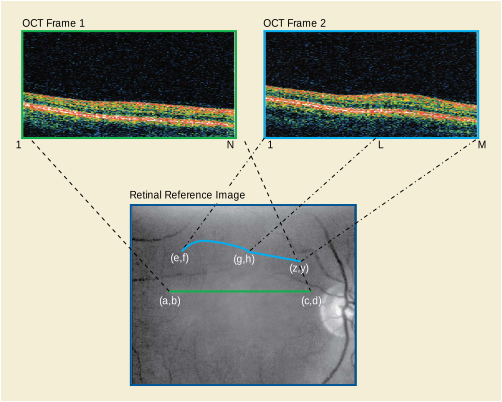
Figure C.8.17.10-1. Relationship of Longitudinal (Nominally Perpendicular) OCT Frames to Reference Frame
In the case of ophthalmic tomography (OPT) images with a transverse orientation, the OPT image corresponds to a sub-rectangle of the reference image. See Figure C.8.17.10-2. The OPT frame is nominally parallel to the reference image. Therefore, each corner of the OPT frame can also correspond to a particular pixel on an associated image. It is assumed that the edges of OPT frame are exactly parallel to the edges of the reference image.
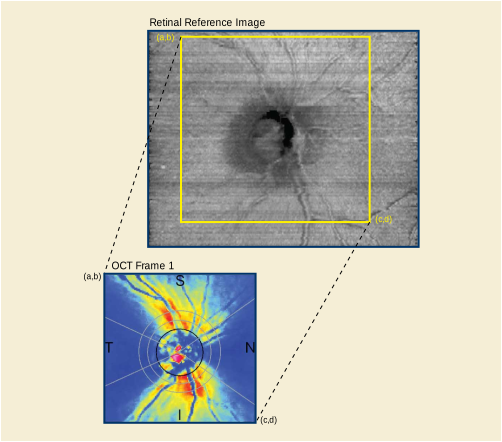
Table C.8.18.1-1 specifies the Attributes that describe a Stereometric Series produced by Ophthalmic Photography equipment (OP) imaging Modalities.
Table C.8.18.1-1. Stereometric Series Module Attributes
|
Attribute Name |
Tag |
Type |
Attribute Description |
|---|---|---|---|
|
Modality |
(0008,0060) |
1 |
Source equipment that produced the Stereometric Series. Enumerated Values:
|
The stereometric relationship module is used to identify pairs of images that may be viewed in stereo. It is possible that the same image or frame may be a member of multiple pairs. The images forming a pair shall be in different SOP Instances. The images forming a pair can be in different Series. All Instances referenced in this Module shall be in the same Study as the Instance in which the Module occurs.
Table C.8.18.2-1. Stereometric Relationship Module Attributes
|
Attribute Name |
Tag |
Type |
Attribute Description |
|---|---|---|---|
|
Stereo Pairs Sequence |
(0022,0020) |
1 |
Sequence of items identifying pairs of images. One or more items shall be included in this sequence. |
|
>Stereo Baseline Angle |
(0022,0010) |
3 |
Stereo separation angle in degrees |
|
>Stereo Baseline Displacement |
(0022,0011) |
3 |
Horizontal displacement of instrument between left and right image in mm |
|
>Stereo Horizontal Pixel Offset |
(0022,0012) |
3 |
Horizontal displacement of right image relative to left image in pixels for optimal display. Offset of right image to right means positive value. |
|
>Stereo Vertical Pixel Offset |
(0022,0013) |
3 |
Vertical displacement of right image relative to left image in pixels for optimal display. Offset of right image downwards means positive value. |
|
>Stereo Rotation |
(0022,0014) |
3 |
Rotation of right image relative to left image in degrees for optimal display. The rotation of the right image against the left image counterclockwise is positive, rotation around the center is assumed. |
|
>Left Image Sequence |
(0022,0021) |
1 |
Left Image of the Pair. Only a single Item shall be included in this sequence. |
|
>>Include Table 10-3 “Image SOP Instance Reference Macro Attributes” |
The Referenced SOP Instance UID (0008,1155) shall not be the same as the Referenced SOP Instance UID (0008,1155) of the Right Image Sequence (0022,0022). |
||
|
>Right Image Sequence |
(0022,0022) |
1 |
Right Image of the Pair. Only a single Item shall be included in this sequence. |
|
>>Include Table 10-3 “Image SOP Instance Reference Macro Attributes” |
The Referenced SOP Instance UID (0008,1155) shall not be the same as the Referenced SOP Instance UID (0008,1155) of the Left Image Sequence (0022,0021). |
||
The images referenced by the Left Image Sequence (0022,0021) and Right Image Sequence (0022,0022) in a single Stereo Pairs Sequence Item shall have the same values for Rows (0028,0010) and the same values for Columns (0028,0011).
The reference may be to images with a single frame, all the frames of images with multiple frames, or one or more selected frames within an image with multiple frames. If multiple frames are selected, the same number of frames shall be referenced from both sequences.
The XA/XRF X-Ray IODs use the General Series module described in Section C.7.3.1, specialized by the XA/XRF Series Module, to describe the DICOM Series Entity specified in Section A.47 and Section A.48. It is defining what constitutes a Series for the context of projection XA/XRF device.
Table C.8.19.1-1 specifies the Attributes that identify and describe general information about the XA/XRF Series.
Table C.8.19.1-1. XA/XRF Series Module Attributes
|
Attribute Name |
Tag |
Type |
Attribute Description |
|---|---|---|---|
|
Modality |
(0008,0060) |
1 |
Type of equipment that originally acquired the data used to create the images in this Series. Enumerated Values:
See Section C.7.3.1.1.1 for further explanation. |
|
Series Number |
(0020,0011) |
1 |
A number that identifies this Series. |
|
Referenced Performed Procedure Step Sequence |
(0008,1111) |
1C |
Uniquely identifies the Performed Procedure Step SOP Instance to which the Series is related. Only a single Item shall be included in this sequence. Required if a Performed Procedure Step SOP Class was involved in the creation of this Series. |
|
>Include Table 10-11 “SOP Instance Reference Macro Attributes” |
|||
This section describes the Enhanced XA/XRF Image Module. Table C.8.19.2-1 contains IOD Attributes that describe a XA/XRF Image by specializing Attributes of the General Image and Image Pixel Modules, and adding additional Attributes.
Table C.8.19.2-1. Enhanced XA/XRF Image Module Table
|
Attribute Name |
Tag |
Type |
Attribute Description |
|---|---|---|---|
|
Image Type |
(0008,0008) |
1 |
Image identification characteristics. See Section C.8.19.2.1.1 for specialization. |
|
Planes in Acquisition |
(0018,9410) |
1 |
The multiplicity of planes used simultaneously during the acquisition. See Section C.8.19.2.1.3. |
|
Plane Identification |
(0018,9457) |
1C |
Identification of the plane used to acquire this image. Defined Terms:
Note
Required if Planes in Acquisition (0018,9410) is not equal to UNDEFINED. |
|
Acquisition Number |
(0020,0012) |
3 |
A number identifying the single continuous gathering of data over a period of time that resulted in this image. |
|
Acquisition DateTime |
(0008,002A) |
1 |
The date and time that the acquisition of data that resulted in this image started. NoteThe synchronization of this time with an external clock is specified in the Synchronization Module in Acquisition Time Synchronized (0018,1800). |
|
Bits Allocated |
(0028,0100) |
1 |
Number of bits allocated for each pixel sample. Each sample shall have the same number of bits allocated. Enumerated Values:
|
|
Bits Stored |
(0028,0101) |
1 |
Number of bits stored for each pixel sample. Each sample shall have the same number of bits stored. Enumerated Values:
See Section C.8.19.2.1.2 for specialization. |
|
High Bit |
(0028,0102) |
1 |
Most significant bit for pixel sample data. Each sample shall have the same high bit. Shall be one less than the value in Bits Stored (0028,0101). |
|
Samples per Pixel |
(0028,0002) |
1 |
Number of samples (color planes) in this image shall have a value of 1. |
|
Pixel Representation |
(0028,0103) |
1 |
Data representation of the pixel samples. Shall have the value: 0000H = Unsigned Integer. |
|
Photometric Interpretation |
(0028,0004) |
1 |
Specifies the intended interpretation of the pixel data. Enumerated Values:
|
|
Acquisition Protocol Name |
(0018,9423) |
3 |
User defined name of the protocol used to acquire this image. |
|
Acquisition Protocol Description |
(0018,9424) |
3 |
User defined description of the protocol used to acquire this image. |
|
Scan Options |
(0018,0022) |
3 |
Identifies any acquisition technique that was used during the acquisition of the image. Defined Terms:
|
|
Content Qualification |
(0018,9004) |
1 |
Content Qualification Indicator Enumerated Values:
See Section C.8.13.2.1.1 for further explanation. |
|
Patient Orientation Code Sequence |
(0054,0410) |
1C |
Sequence that describes the orientation of the patient with respect to gravity. See Section C.8.11.5.1.2 for further explanation. Only a single Item shall be included in this Sequence. Required if Positioner Type (0018,1508) equals CARM and C-arm Positioner Tabletop Relationship (0018,9474) equals YES. May be present otherwise. |
|
Baseline CID 19 “Patient Orientation”. |
|||
|
>Patient Orientation Modifier Code Sequence |
(0054,0412) |
1C |
Patient Orientation Modifier. Required if needed to fully specify the orientation of the patient with respect to gravity. Only a single Item shall be included in this Sequence. |
|
Baseline CID 20 “Patient Orientation Modifier”. |
|||
|
Patient Gantry Relationship Code Sequence |
(0054,0414) |
2C |
Sequence that describes the orientation of the patient with respect to the head of the table. See Section C.8.4.6.1.3 for further explanation. Zero or one item shall be included in this sequence. Required if Positioner Type (0018,1508) equals CARM and C-arm Positioner Tabletop Relationship (0018,9474) equals YES. May be present otherwise. |
|
Baseline CID 21 “Patient Equipment Relationship”. |
|||
|
Examined Body Thickness |
(0010,9431) |
3 |
Body thickness in mm at examination location perpendicular to the table top for this series. Note
|
|
Burned In Annotation |
(0028,0301) |
1 |
Indicates whether or not the image contains sufficient burned in annotation to identify the patient and date the image was acquired. Enumerated Values:
|
|
Recognizable Visual Features |
(0028,0302) |
3 |
Indicates whether or not the image contains sufficiently recognizable visual features to allow the image or a reconstruction from a set of images to identify the patient. Enumerated Values:
If this Attribute is absent, then the image may or may not contain recognizable visual features. |
|
Lossy Image Compression |
(0028,2110) |
1 |
Specifies whether an Image has undergone lossy compression (at a point in its lifetime). Enumerated Values:
Once this value has been set to 01 it shall not be reset. See Section C.7.6.1.1.5. |
|
Lossy Image Compression Ratio |
(0028,2112) |
1C |
Describes the approximate lossy compression ratio(s) that have been applied to this image. See Section C.7.6.1.1.5 for further explanation. May be multi-valued if successive lossy compression steps have been applied; the value order shall correspond to the values of Lossy Image Compression Method (0028,2114). Note
Required if Lossy Image Compression (0028,2110) is "01". |
|
Lossy Image Compression Method |
(0028,2114) |
1C |
A label for the lossy compression method(s) that have been applied to this image. See Section C.7.6.1.1.5 for further explanation. May be multi-valued if successive lossy compression steps have been applied; the value order shall correspond to the values of Lossy Image Compression Ratio (0028,2112). NoteFor historical reasons, the lossy compression method may also be described in Derivation Description (0008,2111). Required if Lossy Image Compression (0028,2110) is "01". |
|
Referenced Other Plane Sequence |
(0008,9410) |
1C |
The images of the corresponding plane for a Biplane acquisition device. Only a single Item shall be included in this Sequence. Required if Planes in Acquisition (0018,9410) is BIPLANE. |
|
>Include Table 10-3 “Image SOP Instance Reference Macro Attributes” |
|||
|
Referenced Image Evidence Sequence |
(0008,9092) |
1C |
Full set of Composite SOP Instances referred to inside the Referenced Image Sequences of this SOP Instance. See Section C.8.13.2.1.2 for further explanation. One or more Items shall be included in this sequence. Required if the Referenced Image Sequence (0008,1140) is present. |
|
>Include Table C.17-3 “Hierarchical SOP Instance Reference Macro Attributes” |
|||
|
Source Image Evidence Sequence |
(0008,9154) |
1C |
Full set of Composite SOP Instances referred to inside the Source Image Sequences of this SOP Instance. See Section C.8.13.2.1.2 for further explanation. One or more Items shall be included in this sequence. Required if the Source Image Sequence (0008,2112) is present. |
|
>Include Table C.17-3 “Hierarchical SOP Instance Reference Macro Attributes” |
|||
|
Referenced Instance Sequence |
(0008,114A) |
3 |
Non-image Composite SOP Instances that are significantly related to this Image, including waveforms that may or may not be temporally synchronized with this image. One or more Items are permitted in this sequence. |
|
>Include Table 10-11 “SOP Instance Reference Macro Attributes” |
|||
|
>Purpose of Reference Code Sequence |
(0040,A170) |
1 |
Code describing the purpose of the reference to the SOP Instances. Only a single Item shall be included in this sequence. |
|
Defined CID 7004 “Waveform Purposes of Reference” for referenced waveforms. |
|||
|
Image Comments |
(0020,4000) |
3 |
User-defined comments about the image. |
|
Quality Control Image |
(0028,0300) |
3 |
Indicates whether or not this image is a quality control or phantom image. Enumerated Values:
If this Attribute is absent, then the image may or may not be a quality control or phantom image. |
|
Icon Image Sequence |
(0088,0200) |
3 |
This icon image is representative of the Image. Only a single Item is permitted in this Sequence. |
|
See Section C.7.6.1.1.6 for further explanation. |
|||
|
Presentation LUT Shape |
(2050,0020) |
1 |
Specifies a predefined identity transformation for the Presentation LUT such that the output of all grayscale transformations, if any, are defined to be in P-Values. Enumerated Values:
|
In addition to the requirements specified in Section C.8.16.1 Image Type, the following additional requirements and Defined Terms are specified.
Value 1 of Image Type (0008,0008) and Frame Type (0008,9007) is discussed in Section C.8.16.1.1. No additional requirements or Defined Terms.
Value 2 of Image Type (0008,0008) and Frame Type (0008,9007) is discussed in Section C.8.16.1.2. No additional requirements or Defined Terms.
Value 3 of Image Type (0008,0008) and Frame Type (0008,9007) is discussed in Section C.8.16.1.3. No additional requirements or Defined Terms.
Value 4 of Image Type (0008,0008) and Frame Type (0008,9007) is discussed in Section C.8.16.1.4. The value shall be NONE.
Table C.8.19.2-2 specifies the allowed combinations of Bits Allocated (0028,0100) and Bits Stored (0028,0101).
Table C.8.19.2-2. Allowed Combinations of Attribute Values for Bits Allocated and Bits Stored
|
Bits Allocated |
Bits Stored |
|---|---|
|
8 |
8 |
|
16 |
9 to 16 |
The Planes in Acquisition (0018,9410) attribute identifies the multiplicity of planes used simultaneously during the acquisition.
Enumerated Values:
- SINGLE PLANE
Image is a single plane acquisition
- BIPLANE
Image is part of a Bi-plane acquisition
- UNDEFINED
Image is created by using data from one or two planes (e.g., reconstructed projection). May only be used when Image Type Value 1 equals DERIVED.
Table C.8.19.3-1 specifies the attributes of the XA/XRF Acquisition Module.
Table C.8.19.3-1. XA/XRF Acquisition Module Attributes
|
Attribute Name |
Tag |
Type |
Attribute Description |
|---|---|---|---|
|
KVP |
(0018,0060) |
1 |
Average of the peak kilo voltage outputs of the X-Ray generator used for all frames. |
|
Radiation Setting |
(0018,1155) |
1 |
Identify the general level of X-Ray dose exposure. Enumerated Values:
|
|
X-Ray Tube Current in mA |
(0018,9330) |
1C |
Average of the nominal X-Ray tube currents in milliamperes for all frames. Required if Exposure in mAs (0018,9332) is not present. May be present otherwise. |
|
Exposure Time in ms |
(0018,9328) |
1C |
Duration of X-Ray exposure in milliseconds. See Section C.8.7.2.1.1. Required if Exposure in mAs (0018,9332) is not present. May be present otherwise. |
|
Exposure in mAs |
(0018,9332) |
1C |
The exposure expressed in milliampereseconds, for example calculated from Exposure Time and X-Ray Tube Current. Required if either Exposure Time in ms (0018,9328) or X-Ray Tube Current in mA (0018,9330) are not present. May be present otherwise. |
|
Average Pulse Width |
(0018,1154) |
1 |
Average width of X-Ray pulse in msec. |
|
Acquisition Duration |
(0018,9073) |
1 |
The time in seconds needed for the complete acquisition. See Section C.7.6.16.2.2.1 for further explanation |
|
Radiation Mode |
(0018,115A) |
1 |
Specifies X-Ray radiation mode. Defined Terms:
|
|
Focal Spot(s) |
(0018,1190) |
3 |
Nominal focal spot size in mm used to acquire this image. |
|
Anode Target Material |
(0018,1191) |
3 |
The primary material in the anode of the X-Ray source. Defined Terms:
|
|
Rectification Type |
(0018,1156) |
3 |
Type of rectification used in the X-Ray generator. Defined Terms:
|
|
X-Ray Receptor Type |
(0018,9420) |
1 |
Identifies with type of X-Ray receptor is used. Enumerated Values:
|
|
Distance Receptor Plane to Detector Housing |
(0018,9426) |
2 |
Distance in mm between the receptor plane and the detector housing. The direction of the distance is positive from receptor plane to X-Ray source. Note
|
|
Positioner Type |
(0018,1508) |
1 |
Defined Terms:
Note
|
|
C-arm Positioner Tabletop Relationship |
(0018,9474) |
1C |
Describes for C-arm positioner type systems if positioner and tabletop has the same geometrical reference system. Enumerated Values:
NoteThe value NO is intended for mobile systems where there is no table fixed to the system Required if Positioner Type (0018,1508) equals CARM. |
|
Acquired Image Area Dose Product |
(0018,9473) |
2 |
X-Ray dose, measured in dGy*cm*cm, to which the patient was exposed for the acquisition of this image only. Note
|
Table C.8.19.4-1 specifies the attributes of the X-Ray Image Intensifier Module.
Table C.8.19.4-1. X-Ray Image Intensifier Module Attributes
|
Attribute Name |
Tag |
Type |
Attribute Description |
|---|---|---|---|
|
Intensifier Size |
(0018,1162) |
1 |
Physical diameter of the maximum active area X-Ray intensifier in mm. NoteThis attribute does not specify the field of view. The attribute Field of View Dimension(s) in Float (0018,9461) is intended for this value. |
|
Intensifier Active Shape |
(0018,9427) |
1 |
Shape of the active area used for acquiring this image. Enumerated Values:
NoteThis may be different from the Field of View Shape (0018,1147), and should not be assumed to describe the stored image. |
|
Intensifier Active Dimension(s) |
(0018,9428) |
1 |
Dimensions in mm of the active area used for acquiring this image. If Intensifier Active Shape (0018,9427) is: RECTANGLE: row dimension followed by column. ROUND: diameter. HEXAGONAL: diameter of the circle circumscribing the hexagon. NoteThis may be different from the Field of View Dimension(s) in Float (0018,9461), and should not be assumed to describe the stored image. |
Table C.8.19.5-1 contains IOD Attributes that describe an X-Ray detector.
Table C.8.19.5-1. X-Ray Detector Module Attributes
|
Attribute Name |
Tag |
Type |
Attribute Description |
|---|---|---|---|
|
Include Table C.8-71b “Digital X-Ray Detector Macro Attributes” |
|||
|
Physical Detector Size |
(0018,9429) |
1 |
Dimensions of the physical detector measured in mm as a row size followed by a column size. |
|
Position of Isocenter Projection |
(0018,9430) |
1C |
Position of the Isocenter projection on the detector plane measured in fractional physical detector elements as a distance along the column direction followed by a distance along the row direction from the center of the TLHC detector element of a rectangle circumscribing the physical detector area. Required if Isocenter Reference System Sequence (0018,9462) is present. |
The following sections contain Functional Group Macros specific to the Enhanced XA Image IOD.
Note
The attribute descriptions in the Functional Group Macros are written as if they were applicable to a single frame (i.e., the macro is part of the Per-frame Functional Groups Sequence). If an attribute is applicable to all frames (i.e., the macro is part of the Shared Functional Groups Sequence) the phrase "this frame" in the attribute description shall be interpreted to mean " for all frames".".
Table C.8.19.6-1 specifies the attributes of the XA/XRF Frame Characteristics Functional Group Macro.
Table C.8.19.6-1. X-Ray Frame Characteristics Macro Attributes
|
Attribute Name |
Tag |
Type |
Attribute Description |
|---|---|---|---|
|
XA/XRF Frame Characteristics Sequence |
(0018,9412) |
1 |
A sequence that describes general characteristics of this frame. Only a single Item shall be included in this sequence. |
|
>Derivation Description |
(0008,2111) |
3 |
A text description of how this frame was derived. See Section C.8.7.1.1.5 for further explanation. |
|
>Derivation Code Sequence |
(0008,9215) |
3 |
A coded description of how this frame was derived. See Section C.7.6.1.1.3 for further explanation. One or more Items are permitted in this Sequence. More than one Item indicates that successive derivation steps have been applied. |
|
Defined CID 7203 “Image Derivation”. |
|||
|
>Acquisition Device Processing Description |
(0018,1400) |
3 |
Indicates any visual processing performed on the frame prior to exchange. See Section C.8.7.1.1.3. |
|
>Acquisition Device Processing Code |
(0018,1401) |
3 |
Code representing the device-specific processing associated with the frame (e.g., Organ Filtering code) NoteThis Code is manufacturer specific but provides useful annotation information to the knowledgeable observer. |
Table C.8.19.6-2 specifies the attributes of the X-Ray Field of View Functional Group Macro.
Table C.8.19.6-2. X-Ray Field of View Macro Attributes
|
Attribute Name |
Tag |
Type |
Attribute Description |
|---|---|---|---|
|
Field of View Sequence |
(0018,9432) |
1 |
Sequence containing the field of view for this frame. Only a single item shall be included in this sequence. |
|
>Field of View Shape |
(0018,1147) |
3 |
Shape of the Field of View, that is the image pixels stored in Pixel Data (7FE0,0010). Enumerated Values:
|
|
>Field of View Dimension(s) in Float |
(0018,9461) |
3 |
Dimensions in mm of the Field of View, that is the image pixels stored in Pixel Data (7FE0,0010). If Field of View Shape (0018,1147) is: RECTANGLE: row dimension followed by column. ROUND: diameter. HEXAGONAL: diameter of the circle circumscribing the hexagon. |
|
>Field of View Origin |
(0018,7030) |
1C |
Offset of the TLHC of a rectangle circumscribing the Field of View, i.e., the image pixels stored in Pixel Data (7FE0,0010) before rotation or flipping, from the TLHC of the physical detector area measured in physical detector pixels as a row offset followed by a column offset. See Section C.8.11.4.1.1 for further explanation. Required if X-Ray Receptor Type (0018,9420) is present and equals DIGITAL_DETECTOR. May be present otherwise. |
|
>Field of View Rotation |
(0018,7032) |
1 |
Clockwise rotation in degrees of Field of View, i.e., the image pixels stored in Pixel Data (7FE0,0010), relative to the physical detector. Enumerated Values:
See Section C.8.11.4.1.1 for further explanation. |
|
>Field of View Horizontal Flip |
(0018,7034) |
1 |
Whether or not a horizontal flip has been applied to the Field of View, i.e., the image pixels stored in Pixel Data (7FE0,0010), after rotation relative to the physical detector as described in Field of View Rotation (0018,7032). Enumerated Values:
See Section C.8.11.4.1.1 for further explanation. |
|
>Field of View Description |
(0018,9433) |
3 |
Manufacturer defined description of the field of view selected during acquisition. |
Table C.8.19.6-3 specifies the attributes that describe the region targeted as area where the x-ray dose value is estimated.
Table C.8.19.6-3. X-Ray Exposure Control Sensing Regions Macro Attributes
|
Attribute Name |
Tag |
Type |
Attribute Description |
|---|---|---|---|
|
Exposure Control Sensing Regions Sequence |
(0018,9434) |
1 |
Sequence containing the Exposure Control Sensing Region for this frame. One or more items shall be included in this sequence. |
|
>Exposure Control Sensing Region Shape |
(0018,9435) |
1 |
Shape of the Exposure Control Sensing Region. Enumerated Values:
|
|
>Exposure Control Sensing Region Left Vertical Edge |
(0018,9436) |
1C |
Required if Exposure Control Sensing Region Shape (0018,9435) is RECTANGULAR. Location of the left edge of the rectangular Exposure Control Sensing Region expressed as effective pixel column. See Section C.8.19.6.3.1. |
|
>Exposure Control Sensing Region Right Vertical Edge |
(0018,9437) |
1C |
Required if Exposure Control Sensing Region Shape (0018,9435) is RECTANGULAR. Location of the right edge of the rectangular Exposure Control Sensing Region expressed as effective pixel column. See Section C.8.19.6.3.1. |
|
>Exposure Control Sensing Region Upper Horizontal Edge |
(0018,9438) |
1C |
Required if Exposure Control Sensing Region Shape (0018,9435) is RECTANGULAR. Location of the upper edge of the rectangular Exposure Control Sensing Region expressed as effective pixel row. See Section C.8.19.6.3.1. |
|
>Exposure Control Sensing Region Lower Horizontal Edge |
(0018,9439) |
1C |
Required if Exposure Control Sensing Region Shape (0018,9435) is RECTANGULAR. Location of the lower edge of the rectangular Exposure Control Sensing Region expressed as effective pixel row. See Section C.8.19.6.3.1. |
|
>Center of Circular Exposure Control Sensing Region |
(0018,9440) |
1C |
Required if Exposure Control Sensing Region Shape (0018,9435) is CIRCULAR. Location of the center of the circular Exposure Control Sensing Region expressed as effective pixel row and column. See Section C.8.19.6.3.1. |
|
>Radius of Circular Exposure Control Sensing Region |
(0018,9441) |
1C |
Required if Exposure Control Sensing Region Shape (0018,9435) is CIRCULAR. Radius of the circular Exposure Control Sensing Region expressed as effective number of pixels along the row direction. See Section C.8.19.6.3.1. |
|
>Vertices of the Polygonal Exposure Control Sensing Region |
(0018,9442) |
1C |
Required if Exposure Control Sensing Region Shape (0018,9435) is POLYGONAL. Multiple Values where the first set of two values are: row of the origin vertex; column of the origin vertex. Two or more pairs of values follow and are the effective pixel row and column coordinates of the other vertices of the polygon Exposure Control Sensing Region. Polygon Exposure Control Sensing Regions are implicitly closed from the last vertex to the origin vertex and all edges shall be non-intersecting except at the vertices. See Section C.8.19.6.3.1. |
The Exposure Control Sensing Region Left Vertical Edge (0018,9436), Exposure Control Sensing Region Right Vertical Edge (0018,9437), Exposure Control Sensing Region Upper Horizontal Edge (0018,9438), Exposure Control Sensing Region Lower Horizontal Edge (0018,9439) and Center of Circular Exposure Control Sensing Region (0018,9440) may have a negative value when the point defined by the attribute lies outside the left or upper border of the pixel data matrix. The top left pixel of the image has a pixel row and column value of 1.
Table C.8.19.6-4 specifies the attributes of the X-Ray Frame Pixel Data Properties Functional Group Macro.
Table C.8.19.6-4. X-Ray Frame Pixel Data Properties Macro Attributes
|
Attribute Name |
Tag |
Type |
Attribute Description |
|---|---|---|---|
|
Frame Pixel Data Properties Sequence |
(0028,9443) |
1 |
Sequence containing the pixel data properties for this frame. Only a single Item shall be included in this sequence. |
|
>Frame Type |
(0008,9007) |
1 |
Type of Frame. A multi-valued attribute analogous to Image Type (0008,0008). Enumerated Values and Defined Terms are the same as those for the values of Image Type (0008,0008). See Section C.8.19.2.1.1. |
|
>Pixel Intensity Relationship |
(0028,1040) |
1 |
The relationship between the Pixel and the X-Ray beam intensity. See Section C.8.19.6.4.1.1. |
|
>Pixel Intensity Relationship Sign |
(0028,1041) |
1 |
The sign of the relationship between the Pixel sample values stored in Pixel Data (7FE0,0010) and the X-Ray beam intensity. Enumerated Values:
See Section C.8.11.3.1.2 for further explanation. |
|
>Imager Pixel Spacing |
(0018,1164) |
1C |
Physical distance measured at the receptor plane of the detector between the centers of each pixel specified by a numeric pair - row spacing value (delimiter) column spacing value in mm. See Section 10.7.1.3 for further explanation of the value order. The value of this attribute shall never be adjusted to account for calibration against an object of known size; Pixel Spacing (0028,0030) is specified for that purpose. It is only allowed to be adjusted to compensate for the change of the Field of View Dimension(s) in Float (0018,9461) attribute. See Section C.8.19.6.4.1.2 Required if Image Type (0008,0008) Value 1 equals ORIGINAL. May be present otherwise. NoteThese values are the actual pixel spacing distances of the stored pixel values of an image. |
|
>Pixel Data Area Origin Relative To FOV |
(0018,7036) |
3 |
Offset of the TLHC of the image stored in Pixel Data (7FE0,0010) from the TLHC of the Field Of View Area after FOV rotation and Flip. It is measured in image stored pixels as a row offset followed by a column offset. NoteDue to the differences in image stored pixel and detector element spacing, one may expect this attribute to have non-integer values. |
|
>Pixel Data Area Rotation Angle Relative To FOV |
(0018,7038) |
3 |
Angle clockwise of the row direction of the image stored in Pixel Data (7FE0,0010) relative to the row direction of the Field Of View Area after FOV rotation and Flip. It is measured in degrees. |
|
>Geometrical Properties |
(0028,9444) |
1 |
Geometrical characteristics of the pixel data to indicate whether pixel spacing is uniform for all pixels or not. Enumerated Values:
|
|
>Geometric Maximum Distortion |
(0028,9445) |
2C |
The percentage of the maximum deviation of the pixel spacing values of images for which the geometric properties are non-uniform. NoteThis attribute may be used to judge the result of measurements, 3D reconstructions, etc. Required if Geometrical Properties (0028,9444) equals NON_UNIFORM. |
|
>Image Processing Applied |
(0028,9446) |
1 |
The type or a combination of types of image processing applied to the pixel data before being stored. Defined Terms:
|
Pixel Intensity Relationship (0028,1040) shall identify the relationship of the pixel values to the X-Ray beam intensity.
Defined Terms:
- LIN
Approximately proportional to X-Ray beam intensity.
- LOG
Non-linear "Log Function"; A Pixel Intensity Relationship LUT shall be included with the image to allow it to be mapped back to its proportional value to X-Ray beam intensity.
- OTHER
Not proportional to X-Ray beam intensity. If a TO_LINEAR Pixel Intensity Relationship LUT item is supplied, scaling back to X-Ray beam intensity is possible.
Note
When the relationship can be better defined (e.g., square root data) a more precise Defined Term can be used than OTHER.
Providing a TO_LINEAR Pixel Intensity Relationship LUT is encouraged.
The two values of the Imager Pixel Spacing (0018,1164) attribute are related to the value(s) of the Field of View Dimension(s) in Float (0018,9461) attribute in the X-Ray Field of View Functional Group of this frame and the values of the Rows (0028,0010) and Columns (0028,0011) attributes.
The value(s) of Field of View Dimension(s) in Float (0018,9461) may change on a frame by frame base. The values of the Rows and Columns attributes are equal for all frames. The relationship between the attributes depends on the Field of View Shape (0018,1147) attribute:
If the Field of View Shape (0018,1147) attribute equals RECTANGLE:
Imager Pixel Spacingrow spacing = FOV Dimensionrow dimension / Rows
Imager Pixel Spacingcolumn spacing = FOV Dimensioncolumn dimension / Columns
If the Field of View Shape (0018,1147) attribute equals ROUND or HEXAGONAL:
Imager Pixel Spacingrow spacing = FOV Dimensiondiameter / Rows
Imager Pixel Spacingcolumn spacing = FOV Dimensiondiameter / Columns
In the case where the Field of View does not have the same size as the stored Pixel Data (7FE0,0010), the stored Pixel Data (7FE0,0010) may be the result of cropping, rotation, resizing and/or padding of the Field of View. The following Attributes specify the relationship of the Pixel Data area to the Field Of View Area:
Pixel Data Area Origin Relative to FOV (0018,7036)
Pixel Data Area Rotation Angle Relative to FOV (0018,7038)
Note
In order to make use of the Pixel Data Area Origin Relative to FOV (0018,7036), the Imager Pixel Spacing (0018,1164) is needed.
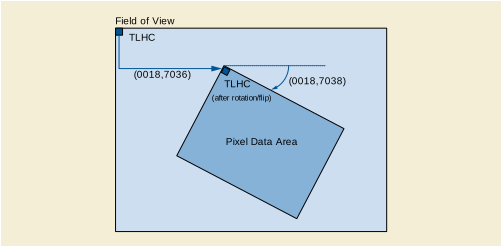
Table C.8.19.6-5 specifies the attributes containing the X-Ray Frame Detector Parameters Functional Group Macro.
Table C.8.19.6-5. X-Ray Frame Detector Parameters Macro Attributes
|
Attribute Name |
Tag |
Type |
Attribute Description |
|---|---|---|---|
|
Frame Detector Parameters Sequence |
(0018,9451) |
1 |
Sequence containing the detector properties for this frame. Only a single Item shall be included in this sequence. |
|
>Detector Active Time |
(0018,7014) |
3 |
Time in mSec that the detector is active during acquisition of this image. NoteThis activation window overlaps the time of the X-Ray exposure as defined by Exposure Time in ms (0018,9328) and Detector Activation Offset From Exposure (0018,7016). |
|
>Detector Activation Offset From Exposure |
(0018,7016) |
3 |
Offset time in mSec that the detector becomes active after the X-Ray beam is turned on during acquisition of this image. May be negative. |
Table C.8.19.6-6 specifies the attributes containing the X-Ray Calibration Device Usage Functional Group Macro.
Table C.8.19.6-6. X-Ray Calibration Device Usage Macro Attributes
|
Attribute Name |
Tag |
Type |
Attribute Description |
|---|---|---|---|
|
Calibration Sequence |
(0018,9455) |
1 |
Sequence containing the calibration flag for this frame. Only a single Item shall be included in this sequence. |
|
>Calibration Image |
(0050,0004) |
1 |
Indicates whether a reference object (phantom) of known size is present in the frame and was used for calibration. Enumerated Values:
NoteDevice is identified using the Device module. See Section C.7.6.12. |
Table C.8.19.6-7 specifies the attributes containing the X-Ray Object Thickness Group macro.
Table C.8.19.6-7. X-Ray Object Thickness Macro Attributes
|
Attribute Name |
Tag |
Type |
Attribute Description |
|---|---|---|---|
|
Object Thickness Sequence |
(0018,9456) |
1 |
Sequence containing object thickness for this frame. Only a single Item shall be included in this sequence. |
|
>Calculated Anatomy Thickness |
(0018,9452) |
1 |
The physical thickness in mm of the anatomic region of interest as specified in the Anatomic Region Sequence (0008,2218) in the direction of the center of the beam. NoteThe value takes in account the position relative to object and the X-Ray source - detector axis. |
Table C.8.19.6-8 specifies the attributes containing the X-Ray Frame Acquisition Functional Group Macro.
Table C.8.19.6-8. X-Ray Frame Acquisition Macro Attributes
|
Attribute Name |
Tag |
Type |
Attribute Description |
|---|---|---|---|
|
Frame Acquisition Sequence |
(0018,9417) |
1 |
Sequence containing the acquisition parameters for this frame. Only a single Item shall be included in this sequence. |
|
>KVP |
(0018,0060) |
1 |
Exact peak kilo voltage output of the X-Ray generator used for this frame. |
|
>X-Ray Tube Current in mA |
(0018,9330) |
1 |
Exact Nominal X-Ray tube current in milliamperes applied during Acquisition Duration (0018,9220) for this frame. |
These attribute may only be used if the information is available on a frame-by-frame base. The average values for these attributes of all frames shall be stored in the same attribute in the XA/XRF Acquisition Module (Section C.8.19.3).
Table C.8.19.6-9 specifies the attributes of the X-Ray Projection Pixel Calibration Functional Group Macro.
Table C.8.19.6-9. X-Ray Projection Pixel Calibration Macro Attributes
|
Attribute Name |
Tag |
Type |
Attribute Description |
|---|---|---|---|
|
Projection Pixel Calibration Sequence |
(0018,9401) |
1 |
A sequence that describes the geometrical position of the patient relative to the equipment. Only a single Item shall be included in this sequence. |
|
>Distance Object to Table Top |
(0018,9403) |
2 |
Distance between the anatomic region of interest of observation and table top in mm. Note
|
|
>Object Pixel Spacing in Center of Beam |
(0018,9404) |
1C |
Physical distance within the anatomic region of interest in the center of the beam and perpendicular to the beam between the center of each pixel, specified by a numeric pair adjacent row spacing (delimiter) adjacent column spacing in mm. See Section C.8.19.6.9.2. See Section 10.7.1.3 for further explanation of the value order. Required if Distance Object to Table Top (0018,9403) is not empty. NoteThis value is provided besides the values that are the input parameters of the calibration algorithm. |
|
>Table Height |
(0018,1130) |
1C |
The distance of the top of the patient table to the center of rotation of the source (i.e., the isocenter) in mm. A positive value indicates that the tabletop is below the isocenter. NoteAll the distances are measured perpendicular to the Table Top plane. Required if Image Type (0008,0008) Value 1 is ORIGINAL, may be present otherwise. |
|
>Beam Angle |
(0018,9449) |
1C |
The equipment related angle in degrees of the X-Ray beam relative to the perpendicular to the tabletop plane. An angle from 0 to +90 degrees indicates that the X-Ray source is below the table. The valid range is 0 to +180 degrees. Required if Image Type (0008,0008) Value 1 is ORIGINAL, may be present otherwise. |
The X-Ray Projection Pixel Calibration Macro defines the attributes needed to completely describe the specific inputs and results from projection image pixel calibration based on isocenter reference. The attributes are provided to allow usage of calibration result as well as recalibration. Figure C.8.19.6-1 and Figure C.8.19.6-2 illustrate the relationship of the attributes.
In Figure C.8.19.6-1 and Figure C.8.19.6-2, the object of interest of size D (in mm) is projected on the stored image over a distance of #Px (in pixels). The pixel spacing on the stored image is called DPx. The "Source to Isocenter Distance" is called ISO. The "Source Image Receptor Distance" is called SID. The shortest distance from the tabletop plane to the Isocenter and to the object of interest are called respectively TH and TO. The angle between the X-Ray beam and the axis perpendicular to the tabletop plane is called Beam Angle. Finally, the distance from the X-Ray source to the object of interest in the direction of the X-Ray beam is called SOD and is calculated from the other distances.
DPx: Imager Pixel Spacing (0018,1164)
ISO: Source Isocenter Distance (0018,9402)
SID: Distance Source to Detector (0018,1110)
TH: Table Height (0018,1130)
TO: Distance Object to Table Top (0018,9403)
Beam Angle: Beam Angle (0018,9449)
Note
The equipment related Beam Angle attribute (0018,9449) shall be consistent with the patient oriented Positioner Primary Angle (0018,1510) and Positioner Secondary Angle (0018,1511) together with the patient orientation on the table specified in Patient Orientation Code Sequence (0054,0410) attributes.
Figure C.8.19.6-1 and Figure C.8.19.6-2 illustrate the usage of the attributes under the conditions laid out above.
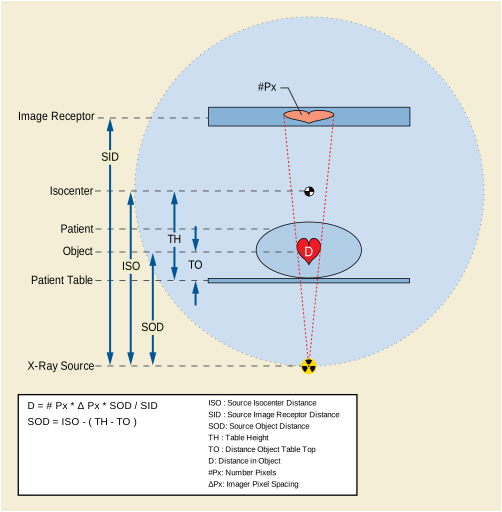
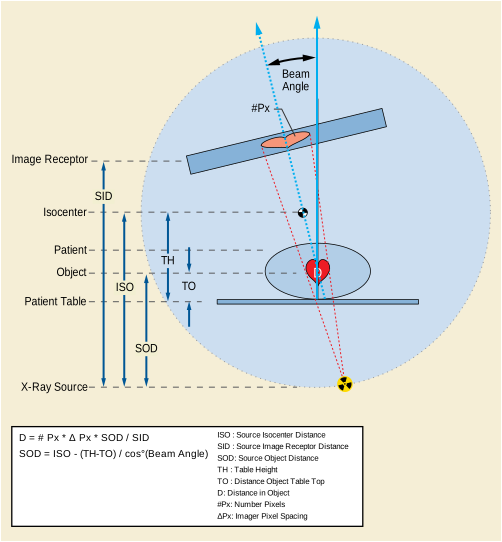
Figure C.8.19.6-2. Project Calibration With Angulation of the X-Ray Beam (Beam Angle Not Equal to 0)
The value provided for Beam Angle (0018,9449) shall correspond to the other attribute values within this module and according to the mathematic terms listed in Section C.8.19.6.9.1.
The terms listed will result in infinite result when used with 90-degree beam angles.
It is outside the scope of this Standard to define reasonable limits for single input values in the above-mentioned terms, or to define the mathematical accuracy of applications using those terms.
Note
It may be reasonable to limit automatic calculations to a narrow range of +/- 60 degrees for Beam Angle and inform users about possible deviations in the calibration result when exceeding such range limits.
Table C.8.19.6-10 specifies the attributes of the X-Ray Positioner Functional Group Macro. If included into the Shared Functional Groups Sequence (5200,9229) no DYNAMIC motion was performed during acquisition. If included in the Per-frame Functional Groups Sequence (5200,9230) the indication of a DYNAMIC motion is given.
Table C.8.19.6-10. X-Ray Positioner Macro Attributes
|
Attribute Name |
Tag |
Type |
Attribute Description |
|---|---|---|---|
|
Positioner Position Sequence |
(0018,9405) |
1 |
A sequence that describes the geometrical position of the positioner. Only a single Item shall be included in this sequence. |
|
>Positioner Primary Angle |
(0018,1510) |
1C |
Position of the X-Ray Image Intensifier about the patient from the RAO to LAO direction where movement from RAO to vertical is positive. See Section C.8.7.5.1.2. Required if Positioner Type (0018,1508) equals CARM. |
|
>Positioner Secondary Angle |
(0018,1511) |
1C |
Position of the X-Ray Image Intensifier about the patient from the CAU to CRA direction where movement from CAU to vertical is positive. Required if Positioner Type (0018,1508) equals CARM. |
|
>Column Angulation (Patient) |
(0018,9447) |
1C |
Angle of the X-Ray beam in degree relative to an orthogonal axis to the detector plane. Positive values indicate that the tilt is towards the head of the patient. Note
Required if Positioner Type (0018,1508) equals COLUMN. |
Table C.8.19.6-11 specifies the attributes of the X-Ray Table Position Functional Group Macro.
Table C.8.19.6-11. X-Ray Table Position Macro Attributes
|
Attribute Name |
Tag |
Type |
Attribute Description |
|---|---|---|---|
|
Table Position Sequence |
(0018,9406) |
1 |
A sequence that describes the geometrical position of the table top. Only a single Item shall be included in this sequence. |
|
>Table Top Vertical Position |
(300A,0128) |
1 |
Table Top Vertical position with respect to an arbitrary chosen reference by the equipment in (mm). Table motion downwards is positive |
|
>Table Top Longitudinal Position |
(300A,0129) |
1 |
Table Top Longitudinal position with respect to an arbitrary chosen reference by the equipment in (mm). Table motion towards LAO is positive assuming that the patient is positioned supine and its head is in normal position. |
|
>Table Top Lateral Position |
(300A,012A) |
1 |
Table Top Lateral position with respect to an arbitrary chosen reference by the equipment in (mm). Table motion towards CRA is positive assuming that the patient is positioned supine and its head is in normal position. |
|
>Table Horizontal Rotation Angle |
(0018,9469) |
1 |
Rotation of the table in the horizontal plane (clockwise when looking from above the table). |
|
>Table Head Tilt Angle |
(0018,9470) |
1 |
Angle of the head-feet axis of the table in degrees relative to the horizontal plane. Positive values indicate that the head of the table is upwards. |
|
>Table Cradle Tilt Angle |
(0018,9471) |
1 |
Angle of the left-right axis of the table in degrees relative to the horizontal plane. Positive values indicate that the left of the table is upwards. |
The Table Top Position attributes of the Table Position Sequence (0018,9406) specify the geometrical position of the Table in the three spatial directions (i.e., Vertical, Longitudinal and Lateral) relative to the Table Top plane (see Figure C.8.19.6-3). The absolute reference point to which the Table positions are related is arbitrarily defined by the manufacturer.
The Table Angle attributes of the Table Position Sequence (0018,9406) specify the rotation and tilt of the Table Top Plane with respect to a plane arbitrarily defined by the manufacturer (usually the horizontal plane).
The Table Top Position attributes allow to describe the incremental translation of the Table top between frames of the same Multi-frame image, and between frames of different images, provided that the Table Angles are not modified between these frames.
When the table angles are modified between two frames, the Table Position Sequence (0018,9406) does not allow to characterize the relationship between the two table positions in an absolute reference coordinate system. For this purpose, the X-Ray Isocenter Reference System Macro has to be used.
Note
The incremental table translation may be used, in conjunction with the Positioner Position Sequence attributes (0018,9405), for simple 2D-2D registration applications (object tracking, pixel shift…), assuming that the patient position is fixed on the table. For more complex registration applications, and in order to properly handle the changes in the table angles, it is recommended to use the X-Ray Isocenter Reference System Macro attributes.
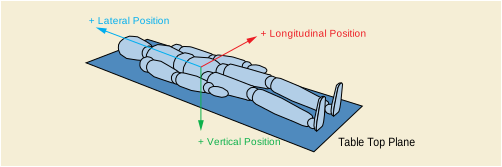
Table C.8.19.6-12 specifies the attributes of the X-Ray Collimator Functional Group Macro.
Table C.8.19.6-12. X-Ray Collimator Macro Attributes
|
Attribute Name |
Tag |
Type |
Attribute Description |
|---|---|---|---|
|
Collimator Shape Sequence |
(0018,9407) |
1 |
A sequence that describes the collimator shape. Only a single Item shall be included in this sequence. |
|
>Collimator Shape |
(0018,1700) |
1 |
Shape(s) of the collimator. Enumerated Values:
This multi-valued Attribute shall contain at most one of each Enumerated Value. |
|
>Collimator Left Vertical Edge |
(0018,1702) |
1C |
Required if Collimator Shape (0018,1700) is RECTANGULAR. Location of the left edge of the rectangular collimator expressed as effective pixel column. See Section C.8.7.3.1.1 and Section C.8.19.6.12.1. |
|
>Collimator Right Vertical Edge |
(0018,1704) |
1C |
Required if Collimator Shape (0018,1700) is RECTANGULAR. Location of the right edge of the rectangular collimator expressed as effective pixel column. See Section C.8.7.3.1.1 and Section C.8.19.6.12.1. |
|
>Collimator Upper Horizontal Edge |
(0018,1706) |
1C |
Required if Collimator Shape (0018,1700) is RECTANGULAR. Location of the upper edge of the rectangular collimator expressed as effective pixel row. See Section C.8.7.3.1.1 and Section C.8.19.6.12.1. |
|
>Collimator Lower Horizontal Edge |
(0018,1708) |
1C |
Required if Collimator Shape (0018,1700) is RECTANGULAR. Location of the lower edge of the rectangular collimator expressed as effective pixel row. See Section C.8.7.3.1.1 and Section C.8.19.6.12.1. |
|
>Center of Circular Collimator |
(0018,1710) |
1C |
Required if Collimator Shape (0018,1700) is CIRCULAR. Location of the center of the circular collimator expressed as effective pixel row and column. See Section C.8.7.3.1.1 and Section C.8.19.6.12.1. |
|
>Radius of Circular Collimator |
(0018,1712) |
1C |
Required if Collimator Shape (0018,1700) is CIRCULAR. Radius of the circular collimator expressed as effective number of pixels along the row direction. See Section C.8.7.3.1.1 and Section C.8.19.6.12.1. |
|
>Vertices of the Polygonal Collimator |
(0018,1720) |
1C |
Required if Collimator Shape (0018,1700) is POLYGONAL. Multiple Values where the first set of two values are: row of the origin vertex; column of the origin vertex. Two or more pairs of values follow and are the effective pixel row and column coordinates of the other vertices of the polygon collimator. Polygon collimators are implicitly closed from the last vertex to the origin vertex and all edges shall be non-intersecting except at the vertices. See Section C.8.19.6.12.1. |
Table C.8.19.6-13 specifies the attributes of the X-Ray Isocenter Reference System Functional Group Macro.
Table C.8.19.6-13. X-Ray Isocenter Reference System Macro Attributes
|
Attribute Name |
Tag |
Type |
Attribute Description |
|---|---|---|---|
|
Isocenter Reference System Sequence |
(0018,9462) |
1 |
A sequence that describes the Isocenter Reference Coordinate System (O, X, Y, Z). Only a single Item shall be included in this sequence. |
|
>Positioner Isocenter Primary Angle |
(0018,9463) |
1 |
Position of the X-Ray center beam in the isocenter reference system in the X direction (deg). See Section C.8.19.6.13.1.2 for further explanation. |
|
>Positioner Isocenter Secondary Angle |
(0018,9464) |
1 |
Position of the X-Ray center beam in the isocenter reference system in the Z direction (deg). See Section C.8.19.6.13.1.2 for further explanation. |
|
>Positioner Isocenter Detector Rotation Angle |
(0018,9465) |
1 |
Rotation of the X-Ray detector plane (deg). See Section C.8.19.6.13.1.2 for further explanation. |
|
>Table X Position to Isocenter |
(0018,9466) |
1 |
X position of the Table Reference Point with respect to the Isocenter (mm). See Section C.8.19.6.13.1.3 for further explanation. |
|
>Table Y Position to Isocenter |
(0018,9467) |
1 |
Y position of the Table Reference Point with respect to the Isocenter (mm). See Section C.8.19.6.13.1.3 for further explanation. |
|
>Table Z Position to Isocenter |
(0018,9468) |
1 |
Z position of the Table Reference Point with respect to the Isocenter (mm). See Section C.8.19.6.13.1.3 for further explanation. |
|
>Table Horizontal Rotation Angle |
(0018,9469) |
1 |
Rotation of the table in the horizontal plane. See Section C.8.19.6.13.1.3 for further explanation. |
|
>Table Head Tilt Angle |
(0018,9470) |
1 |
Angle of the head-feet axis of the table in degrees relative to the horizontal plane. See Section C.8.19.6.13.1.3 for further explanation. |
|
>Table Cradle Tilt Angle |
(0018,9471) |
1 |
Angle of the left-right axis of the table in degrees relative to the horizontal plane. See Section C.8.19.6.13.1.3 for further explanation. |
The Isocenter Reference System Attributes describe the 3D geometry of the X-Ray equipment composed by the X-Ray positioner and the X-Ray table.
These attributes define three coordinate systems in the 3D space:
Isocenter coordinate system
Positioner coordinate system
Table coordinate system
The Isocenter Reference System attributes describe the relationship between the 3D coordinates of a point in the table coordinate system and the 3D coordinates of such point in the positioner coordinate system (both systems moving in the equipment), by using the Isocenter coordinate system that is fixed in the equipment.
Note
Annex FFF “Enhanced XA/XRF Encoding Examples (Informative)” in PS3.17 describes the transformations necessary to transpose between coordinate systems.
The Isocenter coordinate system (O,X,Y,Z) of the equipment is defined as follows:
Origin O is on the System Isocenter
+Y DOWNWARD (gravity)
+X, +Z directions in the horizontal plane (gravity plane). Directions arbitrarily defined by the manufacturer
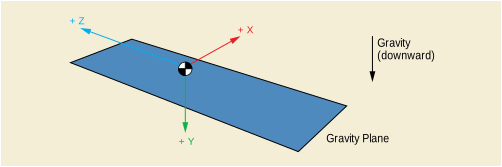
The Positioner Coordinate System (Op, Xp, Yp, Zp) is defined as follows:
Origin Op, is the origin of the Isocenter coordinate system O
Xp axis is parallel to the horizontal scan-lines of the detector (rows). Positive direction from left to right of the detector plane looking towards the source.
Zp axis is parallel to the vertical scan-lines of the detector (columns). Positive direction from bottom to top of the detector plane looking towards the source.
Yp is the axis from the isocenter to the X-Ray source. Positive direction from the Isocenter to the X-Ray Source. This axis is so-called the X-Ray center beam.
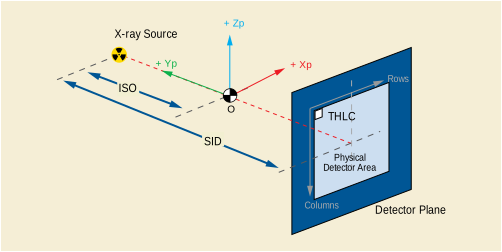
Note
The quantities SID and ISO are specified by the attributes Distance Source to Detector (0018,1110) and Distance Source to Isocenter (0018,9402) respectively.
The Positioner Coordinate System (Op, Xp, Yp, Zp) is characterized, with respect to the Isocenter Coordinate System (O, X, Y, Z), by two angles describing the X-Ray center beam, and a third angle describing the rotation of the X-Ray detector plane. These angles are relative to the Isocenter reference system, and independent from the patient position on the equipment.
Positioner Isocenter Primary Angle (0018,9463) (so-called Ap1 in Figure C.8.19.6-6) is defined in the plane XY, as the angle between the plane YZ and the plane YpZ. The axis of rotation of this angle is the Z axis. Angle from -Y to +X is positive. The valid range of this angle is -180 to +180 degrees.
Positioner Isocenter Secondary Angle (0018,9464) (so-called Ap2 in Figure C.8.19.6-6) is defined in the plane YpZ, as the angle of the X-Ray Center Beam (i.e., Yp) relative to the XY plane. The axis of rotation of this angle is perpendicular to the plane YpZ. Angle from the plane XY to +Z is positive. The valid range of this angle is -180 to +180 degrees.
Positioner Isocenter Detector Rotation Angle (0018,9465) (so-called Ap3 in Figure C.8.19.6-6 and in Figure C.8.19.6-7) is defined in the detector plane, as the angle of the vertical scan-lines of the detector (i.e., Zp) relative to the intersection between the detector plane and the plane YpZ. The sign of this angle is positive clockwise when facing on to the detector plane (see Figure C.8.19.6-7). The valid range of this angle is -180 to +180 degrees.
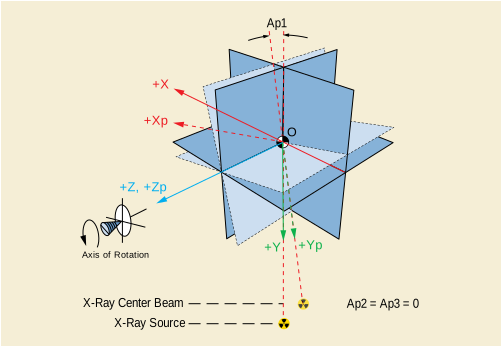
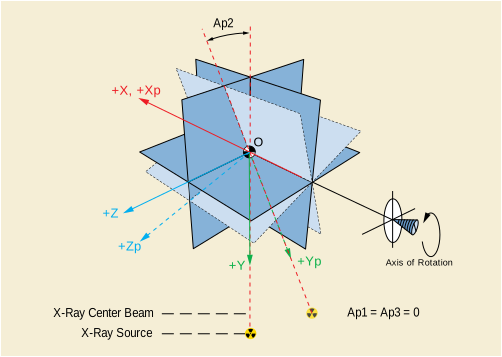
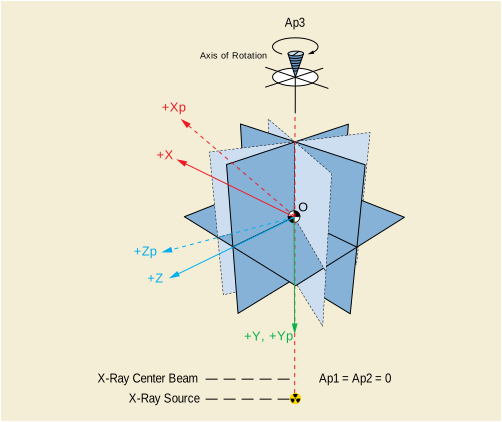
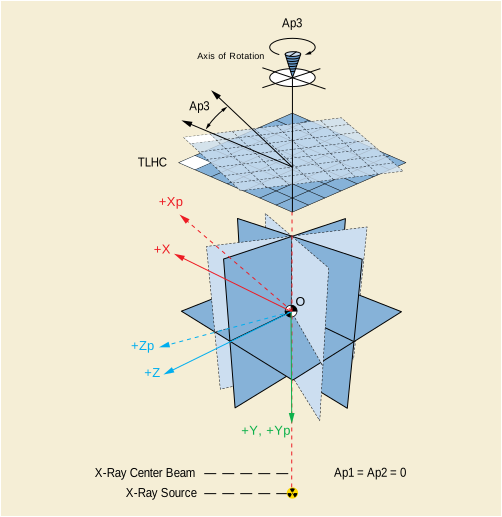
The table coordinate system (Ot, Xt, Yt, Zt) is defined as follows:
- Origin Ot, so-called Table Reference Point, is on the Table Top plane
- +Xt direction to the TABLE LEFT
- +Zt direction to the TABLE HEAD
- +Yt direction to the TABLE DOWN
The table coordinate system (Ot, Xt, Yt, Zt) is characterized, with respect to the Isocenter coordinate system (O, X, Y, Z), by a 3D translation and 3 angles describing the tilting and rotation:
Table X Position to Isocenter(0018,9466) (so-called TX in Figure C.8.19.6-8) is defined as the translation of the Table Reference Point Ot with respect to the Isocenter Coordinate System in the X direction. Table motion toward +X is positive.
Table Y Position to Isocenter(0018,9467) (so-called TY in Figure C.8.19.6-8) is defined as the translation of the Table Reference Point Ot with respect to the Isocenter Coordinate System in the Y direction. Table motion toward +Y is positive.
Table Z Position to Isocenter(0018,9468) (so-called TZ in Figure C.8.19.6-8) is defined as the translation of the Table Reference Point Ot with respect to the Isocenter Coordinate System in the Z direction. Table motion toward +Z is positive.
Note
A translation of ( TX,TY,TZ) = (0, 0, 0) means that the Table Reference Point Ot is at the System Isocenter.
Table Horizontal Rotation Angle (so-called At1 in Figure C.8.19.6-9) is defined in the horizontal plane XZ, as the angle of the projection of the +Zt axis in the XZ plane relative to the +Z axis. The axis of rotation of this angle is the vertical axis crossing the Table Reference Point Ot. Zero value is defined when the projection of +Zt in the XZ plane is equal to +Z. Angle from +Z to +X is positive. The valid range of this angle is -180 to +180 degrees.
Table Head Tilt Angle (so-called At2 in Figure C.8.19.6-9) is defined in the vertical plane containing Zt (i.e., YZt), as the angle of the +Zt axis relative to the horizontal plane XZ. The axis of rotation of this angle is defined as the intersection between the horizontal plane XZ and the plane XtYt. Zero value is defined when +Zt is contained in the horizontal plane XZ. Angle from horizontal (plane XZ) to -Y direction (upwards) is positive,indicating that the head of the table is above the horizontal plane. The valid range of this angle is -45 to +45 degrees.
Table CradleTilt Angle (so-called At3 in Figure C.8.19.6-9) is defined in the XtYt plane, as the angle of the +Xt axis relative to the intersection between the XtYt plane and the horizontal plane XZ. The axis of rotation of this angle is the axis Zt. Zero value is defined when +Xt is contained in the horizontal plane XZ. Angle from horizontal (plane XZ) to -Y direction (upwards) is positive,indicating that the left of the table is above the horizontal plane. The valid range of this angle is -45 to +45 degrees.
Note
The angles At1, At2 and At3 are independent from any specific mechanical design of the table rotation axis defined by a manufacturer. In particular, they don't require the three rotation axis to cross on a single point. If a mechanical rotation axis does not cross the Table Reference Point Ot, a mechanical rotation around this axis will generate a change in one or more table angles as well as a translation of the Table Reference Point.
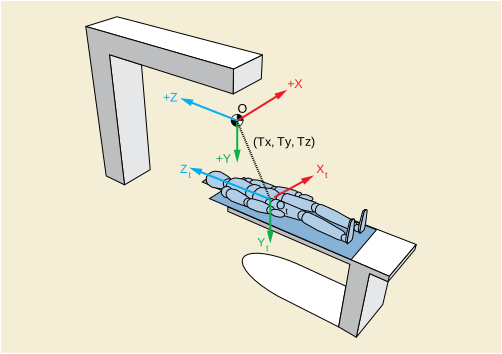
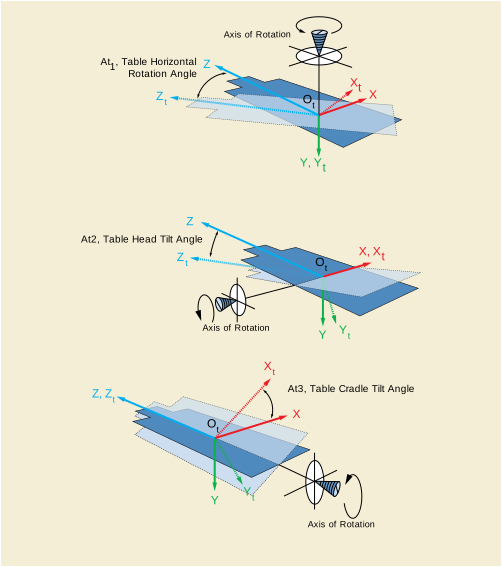
The Isocenter Reference System attributes allow expressing the positioner angulations (i.e., X-Ray Center Beam direction) as a vector in the table coordinate system. If the relationship between the X-Ray table and the patient is known, it is possible to express any vector of the table coordinate system as a direction in the patient.
Therefore, the Isocenter Reference System attributes allow calculating the positioner angulations in the patient-based coordinate system if the following attributes are present:
Patient Orientation Code Sequence (0054,0410)
Patient Orientation Modifier Code Sequence (0054,0412)
Further, the Isocenter Reference System attributes allow calculating the patient anatomical directions (i.e., left, right, head, feet, anterior, posterior) of the rows and columns of the stored image, if the following attributes are present:
Patient Orientation Code Sequence (0054,0410)
Patient Orientation Modifier Code Sequence (0054,0412)
Field of View Rotation (0018,7032)
Field of View Horizontal Flip (0018,7034)
For registration purposes, a given point fixed in the patient (object of interest) that is defined in the table coordinate system can be expressed as row and column coordinates of the stored image if the relationship between the positioner coordinate system and the stored image is fully characterized. Therefore, the Isocenter Reference System attributes allow calculating the projection of a point of the patient as row and column coordinates of the stored image, if the following attributes are present:
Frame of Reference UID (0020,0052) and must be equal for all images involved in the registration
Field of View Rotation (0018,7032)
Field of View Horizontal Flip (0018,7034)
Imager Pixel Spacing (0018,1164)
Distance Source to Isocenter (0018,9402)
Distance Source to Detector (0018,1110)
In addition for a system equipped with a digit al detector the following attributes need to be present:
Detector Element Spacing (0018,7022)
Field of view Origin (0018,7030)
Position of Isocenter Projection (0018,9430)
Table C.8.19.6-14 specifies the attributes containing the X-Ray Geometry Functional Group Macro.
Table C.8.19.6-14. X-Ray Geometry Macro Attributes
|
Attribute Name |
Tag |
Type |
Attribute Description |
|---|---|---|---|
|
X-Ray Geometry Sequence |
(0018,9476) |
1 |
Sequence containing the geometric properties for this frame. Only a single Item shall be included in this sequence. |
|
>Distance Source to Isocenter |
(0018,9402) |
1 |
Distance from source to isocenter in mm. |
|
>Distance Source to Detector |
(0018,1110) |
1 |
Distance from source to receptor plane perpendicular to the receptor plane in mm. NoteThis value is traditionally referred to as Source Image Receptor Distance (SID). |
Table C.8.19.7-1 specifies the Attributes of a XA/XRF Multi-frame Presentation Module.
Table C.8.19.7-1. XA/XRF Multi-frame Presentation Module Attributes
|
Attribute Name |
Tag |
Type |
Attribute Description |
|---|---|---|---|
|
Preferred Playback Sequencing |
(0018,1244) |
3 |
Describes the preferred playback sequencing for a multi-frame image. Enumerated Values:
|
|
Frame Display Sequence |
(0008,9458) |
3 |
Sequence that specifies the display frame rate of a selected set of frames. The Items are ordered in increasing frame number. The range of the frames may not overlap and the ranges shall be adjacent. One or more items are permitted in this sequence. |
|
>Start Trim |
(0008,2142) |
1 |
The Frame Number of the first frame of the set of frames to be displayed in this Item. |
|
>Stop Trim |
(0008,2143) |
1 |
The Frame Number of the last frame of the set of frames to be displayed in this Item. |
|
>Skip Frame Range Flag |
(0008,9460) |
1 |
A flag indicating that the range of frames in this item may be skipped. Defined Terms:
|
|
>Recommended Display Frame Rate in Float |
(0008,9459) |
1 |
Recommended rate at which the frames of this Item should be displayed in frames/second. |
|
>Recommended Viewing Mode |
(0028,1090) |
2 |
Specifies the recommended viewing protocol(s). When this attribute is present with a value, this value shall override the value of Recommended Viewing Mode (0028,1090) specified in the Mask Module. Defined Terms:
NoteIf an implementation does not recognize the Defined Term for Recommended Viewing Mode (0028,1090), reverting to native display mode is recommended. |
|
>Display Filter Percentage |
(0028,9411) |
2 |
Edge enhancement filter percentage that is recommended by the pixel data creator as filter presetting for display purposes. The value of 100 corresponds to the maximum filter strength that can be applied by a specific application displaying the image. |
|
>Mask Visibility Percentage |
(0028,9478) |
1C |
The percentage of visibility of the mask frame during a subtracted display. A value of 0 corresponds to subtracted display, a value of 100 corresponds to un-subtracted display (native). See Section C.8.19.7.1. NoteThe value of 100 is equivalent to Recommended Viewing Mode (0028,1090) having a value of NAT. Required if Recommended Viewing Mode (0028,1090) equals SUB. |
An example of the usage of the Mask Visibility Percentage (0028,9478) attribute is illustrated below.
Assume that Psub is the output pixel level of a subtracted frame,its calculation can be expressed as followed:
Pcontrast: Pixel level of the contrast frame in the logarithmic domain
Pmask: Pixel level of the mask frame in the logarithmic domain
X: Mask Visibility Percentage (0028,9478): 0 <= X <= 100
Psub = Pcontrast- (1- X/100) * Pmask
This section describes the specific modules for the Segmentation IOD.
Table C.8.20-1 defines the general Attributes of the Segmentation Series Module.
Table C.8.20-1. Segmentation Series Module Attributes
|
Attribute Name |
Tag |
Type |
Attribute Description |
|---|---|---|---|
|
Modality |
(0008,0060) |
1 |
Modality Type Enumerated Values:
|
|
Series Number |
(0020,0011) |
1 |
A number that identifies this Series |
|
Referenced Performed Procedure Step Sequence |
(0008,1111) |
1C |
Uniquely identifies the Performed Procedure Step SOP Instance to which the Series is related Only a single Item shall be included in this sequence. Required if a Performed Procedure Step SOP Class was involved in the creation of this Series. |
|
>Include Table 10-11 “SOP Instance Reference Macro Attributes” |
|||
Table C.8.20-2 defines the general Attributes of the Segmentation Image Module.
Table C.8.20-2. Segmentation Image Module Attributes
|
Attribute Name |
Tag |
Type |
Attribute Description |
|---|---|---|---|
|
Image Type |
(0008,0008) |
1 |
Value 1 shall be DERIVED. Value 2 shall be PRIMARY. No other values shall be present. |
|
Include Table 10-12 “Content Identification Macro Attributes” |
|||
|
Samples Per Pixel |
(0028,0002) |
1 |
Enumerated Values:
|
|
Photometric Interpretation |
(0028,0004) |
1 |
Enumerated Values:
|
|
Pixel Representation |
(0028,0103) |
1 |
Enumerated Values:
|
|
Bits Allocated |
(0028,0100) |
1 |
See Section C.8.20.2.1. Enumerated Values if Segmentation Type (0062,0001) is BINARY:
Enumerated Values if Segmentation Type (0062,0001) is not BINARY:
|
|
Bits Stored |
(0028,0101) |
1 |
See Section C.8.20.2.1. Enumerated Values if Segmentation Type (0062,0001) is BINARY:
Enumerated Values if Segmentation Type (0062,0001) is not BINARY:
|
|
High Bit |
(0028,0102) |
1 |
See Section C.8.20.2.1. Enumerated Values if Segmentation Type (0062,0001) is BINARY:
Enumerated Values if Segmentation Type (0062,0001) is not BINARY:
|
|
Lossy Image Compression |
(0028,2110) |
1 |
Specifies whether an Image has undergone lossy compression (at a point in its lifetime), or is derived from lossy compressed images. Enumerated Values:
Once this value has been set to 01 it shall not be reset. See Section C.8.20.2.2 and Section C.7.6.1.1.5, “Lossy Image Compression”. |
|
Lossy Image Compression Ratio |
(0028,2112) |
1C |
Describes the approximate lossy compression ratio(s) that have been applied to this image. See Section C.7.6.1.1.5 for further explanation. May be multi-valued if successive lossy compression steps have been applied; the value order shall correspond to the values of Lossy Image Compression Method (0028,2114). Note
Required if present in the source images or this IOD instance has been compressed. |
|
Lossy Image Compression Method |
(0028,2114) |
1C |
A label for the lossy compression method(s) that have been applied to this image. See Section C.7.6.1.1.5 for further explanation. May be multi-valued if successive lossy compression steps have been applied; the value order shall correspond to the values of Lossy Image Compression Ratio (0028,2112). NoteFor historical reasons, the lossy compression method may also be described in Derivation Description (0008,2111). Required if present in the source images or this IOD instance has been compressed. See Section C.8.20.2.2. |
|
Segmentation Type |
(0062,0001) |
1 |
The type of encoding used to indicate the presence of the segmented property at a pixel/voxel location. Enumerated Values:
See Section C.8.20.2.3. |
|
Segmentation Fractional Type |
(0062,0010) |
1C |
For fractional segmentation encoding, the meaning of the fractional value. Required if Segmentation Type (0062,0001) is FRACTIONAL. See Section C.8.20.2.3 for Enumerated Values. |
|
Maximum Fractional Value |
(0062,000E) |
1C |
Specifies the value that represents 100%. There shall be no values in Pixel Data (7FE0,0010) greater than this value. Required if Segmentation Type (0062,0001) is FRACTIONAL. |
|
Segment Sequence |
(0062,0002) |
1 |
Describes the segments that are contained within the data. One or more Items shall be included in this sequence. |
|
>Include Table C.8.20-4 “Segment Description Macro Attributes” |
|||
|
>Segment Algorithm Name |
(0062,0009) |
1C |
Name of algorithm used to generate the segment. Required if Segment Algorithm Type (0062,0008) is not MANUAL. |
|
>Segment Surface Generation Algorithm Identification Sequence |
(0066,002D) |
3 |
A description of how this segment was derived. Only a single item is permitted in this sequence. |
|
>>Include Table 10-19 “Algorithm Identification Macro Attributes” |
|||
|
>Recommended Display Grayscale Value |
(0062,000C) |
3 |
A default single gray unsigned value in which it is recommended that the maximum pixel value in this segment be rendered on a monochrome display. The units are specified in P-Values from a minimum of 0000H (black) up to a maximum of FFFFH (white). NoteThe maximum P-Value for this Attribute may be different from the maximum P-Value from the output of the Presentation LUT, which may be less than 16 bits in depth. |
|
>Recommended Display CIELab Value |
(0062,000D) |
3 |
A default triplet value in which it is recommended that segment be rendered on a color display. The units are specified in PCS-Values, and the value is encoded as CIELab. See Section C.10.7.1.1. |
As a consequence of the enumerated Bits Allocated and Bits Stored attribute values, single bit pixels shall be packed 8 to a byte as defined by the encoding rules in PS3.5.
If Lossy Image Compression (0028,2110) in any of the source images is "01", the value shall be "01" for the Segmentation instance.
The process of segmentation itself is defined not to be lossy compression, even though it involves loss. If the Segmentation instance is encoded using a lossy compression transfer syntax, then the value shall be set to "01".
Note
It is not advisable to lossy compress a Segmentation SOP Instance. In particular, a binary segmentation should not be lossy compressed.
A Segmentation Type (0062,0001) of BINARY indicates the segmented property is present with a value of 1 and absent with a value of 0.
For a Segmentation Type (0062,0001) of FRACTIONAL the segmented property is defined as a value from zero to the Maximum Fractional Value (0062,000E). A FRACTIONAL segmentation shall be further specified via Segmentation Fractional Type (0062,0010).
Enumerated Values of Segmentation Fractional Type (0062,0010):
- PROBABILITY
Defines the probability, as a percentage, that the segmented property occupies the spatial area defined by the voxel.
- OCCUPANCY
Defines the percentage of the voxel area occupied by the segmented property.
The following sections contain Functional Group Macros specific to the Segmentation IOD.
Note
The attribute descriptions in the Functional Group Macros are written as if they were applicable to a single frame (i.e., the macro is part of the Per-frame Functional Groups Sequence). If an attribute is applicable to all frames (i.e., the macro is part of the Shared Functional Groups Sequence) the phrase "this frame" in the attribute description shall be interpreted to mean "for all frames".
Table C.8.20-3 specifies the attributes of the Segmentation Functional Group Macro.
Table C.8.20-3. Segmentation Macro Attributes
|
Attribute Name |
Tag |
Type |
Attribute Description |
|---|---|---|---|
|
Segment Identification Sequence |
(0062,000A) |
1 |
Identifies the characteristics of this frame. Only a single Item shall be included in this sequence. |
|
>Referenced Segment Number |
(0062,000B) |
1 |
Uniquely identifies the segment described in Segment Sequence (0062,0002) by reference to Segment Number (0062,0004). Referenced Segment Number (0062,000B) shall not be multi-valued. |
The following sections contain macros specific to the Segmentation IOD.
Table C.8.20-4 specifies the attributes of the Segment Description Macro.
Table C.8.20-4. Segment Description Macro Attributes
|
Attribute Name |
Tag |
Type |
Attribute Description |
|---|---|---|---|
|
Segment Number |
(0062,0004) |
1 |
Identification number of the segment. The value of Segment Number (0062,0004) shall be unique within the Segmentation instance in which it is created. See Section C.8.20.2.4. |
|
Segment Label |
(0062,0005) |
1 |
User-defined label identifying this segment. This may be the same as Code Meaning (0008,0104) of Segmented Property Type Code Sequence (0062,000F). |
|
Segment Description |
(0062,0006) |
3 |
User-defined description for this segment. |
|
Segment Algorithm Type |
(0062,0008) |
1 |
Type of algorithm used to generate the segment. Enumerated Values:
|
|
Include Table 10-7 “General Anatomy Optional Macro Attributes” |
May be not be necessary if the anatomy is implicit in the Segmented Property Type Code Sequence. |
||
|
Segmented Property Category Code Sequence |
(0062,0003) |
1 |
Sequence defining the general category of this segment. Only a single item shall be included in this sequence. |
|
Segmented Property Type Code Sequence |
(0062,000F) |
1 |
Sequence defining the specific property type of this segment. Only a single item shall be included in this sequence. |
|
Baseline CID 7151 “Segmentation Property Types”. |
|||
|
>Segmented Property Type Modifier Code Sequence |
(0062,0011) |
3 |
Sequence defining the modifier of the property type of this segment. One or more Items are permitted in this sequence. |
|
Baseline CID 244 “Laterality”. |
|||
This section describes the X-Ray 3D Image Module. Table C.8.21.1-1 contains IOD Attributes that describe a X-Ray 3D Image by specializing Attributes of the General Image and Image Pixel Modules, and adding additional Attributes.
Table C.8.21.1-1. X-Ray 3D Image Module Attributes
|
Attribute Name |
Tag |
Type |
Attribute Description |
|---|---|---|---|
|
Image Type |
(0008,0008) |
1 |
Image identification characteristics. See Section C.8.21.1.1.1 for specialization. |
|
Include Table C.8-131 “Common CT/MR Image Description Macro Attributes” |
|||
|
Bits Allocated |
(0028,0100) |
1 |
Number of bits allocated for each voxel sample. Each sample shall have the same number of bits allocated. Enumerated Values:
|
|
Bits Stored |
(0028,0101) |
1 |
Number of bits stored for each voxel sample. Each sample shall have the same number of bits stored. Enumerated Values:
|
|
High Bit |
(0028,0102) |
1 |
Most significant bit for pixel sample data. Each sample shall have the same high bit. Shall be one less than the value in Bits Stored (0028,0101). |
|
Samples per Pixel |
(0028,0002) |
1 |
Number of samples (color planes) in this image shall have a value of 1. |
|
Photometric Interpretation |
(0028,0004) |
1 |
Specifies the intended interpretation of the voxel data. Enumerated Values:
|
|
Content Qualification |
(0018,9004) |
1 |
Content Qualification Indicator Enumerated Values:
See Section C.8.13.2.1.1 for further explanation. |
|
Burned In Annotation |
(0028,0301) |
1 |
Indicates whether or not the image contains sufficient burned in annotation to identify the patient and date the image was acquired. Enumerated Values:
|
|
Recognizable Visual Features |
(0028,0302) |
3 |
Indicates whether or not the image contains sufficiently recognizable visual features to allow the image or a reconstruction from a set of images to identify the patient. Enumerated Values:
If this Attribute is absent, then the image may or may not contain recognizable visual features. |
|
Lossy Image Compression |
(0028,2110) |
1 |
Specifies whether an Image has undergone lossy compression (at a point in its lifetime). Enumerated Values:
Once this value has been set to 01 it shall not be reset. See Section C.7.6.1.1.5. |
|
Lossy Image Compression Ratio |
(0028,2112) |
1C |
Describes the approximate lossy compression ratio(s) that have been applied to this image. See Section C.7.6.1.1.5 for further explanation. May be multi-valued if successive lossy compression steps have been applied; the value order shall correspond to the values of Lossy Image Compression Method (0028,2114). Note
Required if Lossy Image Compression (0028,2110) is "01". |
|
Lossy Image Compression Method |
(0028,2114) |
1C |
A label for the lossy compression method(s) that have been applied to this image. See Section C.7.6.1.1.5 for further explanation. May be multi-valued if successive lossy compression steps have been applied; the value order shall correspond to the values of Lossy Image Compression Ratio (0028,2112). NoteFor historical reasons, the lossy compression method may also be described in Derivation Description (0008,2111). Required if Lossy Image Compression (0028,2110) is "01". |
|
Referenced Image Evidence Sequence |
(0008,9092) |
1C |
Full set of Composite SOP Instances referred to inside the Referenced Image Sequences of this SOP Instance. See Section C.8.13.2.1.2 for further explanation. One or more Items shall be included in this sequence. Required if the Referenced Image Sequence (0008,1140) is present. |
|
>Include Table C.17-3 “Hierarchical SOP Instance Reference Macro Attributes” |
|||
|
Image Comments |
(0020,4000) |
3 |
User-defined comments about the image. |
|
Quality Control Image |
(0028,0300) |
3 |
Indicates whether or not this image is a quality control or phantom image. Enumerated Values:
If this Attribute is absent, then the image may or may not be a quality control or phantom image. |
|
Icon Image Sequence |
(0088,0200) |
3 |
This icon image is representative of the Image. Only a single Item is permitted in this sequence. |
|
See Section C.7.6.1.1.6 for further explanation. |
|||
|
Presentation LUT Shape |
(2050,0020) |
1 |
Specifies a predefined identity transformation for the Presentation LUT such that the output of all grayscale transformations, if any, are defined to be in P-Values. Enumerated Values:
|
|
Source Irradiation Event Sequence |
(0008,3011) |
3 |
The set of Irradiation Events that were produced in this acquisition context. See C.8.21.1.1.4. One or more Items shall be included in this Sequence. |
|
>Irradiation Event UID |
(0008,3010) |
1 |
Unique identification of the irradiation event(s) associated with the acquisition of this image. |
In addition to the requirements specified in Section C.8.16.1 Image Type, the following additional requirements and Defined Terms are specified.
Value 1 of Image Type (0008,0008) and Frame Type (0008,9007) is discussed in Section C.8.16.1.1. No additional requirements or Defined Terms.
Value 2 of Image Type (0008,0008) and Frame Type (0008,9007) is discussed in Section C.8.16.1.2. No additional requirements or Defined Terms.
Value 3 of Image Type (0008,0008) and Frame Type (0008,9007) is discussed in Section C.8.16.1.3. No additional requirements or Defined Terms.
Value 4 of Image Type (0008,0008) and Frame Type (0008,9007) is discussed in Section C.8.16.1.4. The value shall be NONE.
The value of Volumetric Properties (0008,9206) is discussed in Section C.8.16.2.1.2.
Note
For regularly sampled tomosynthesis slices reconstructed from projection X-Ray data, a value of VOLUME or SAMPLED is appropriate.
For slabs constructed by averaging adjacent regularly sampled tomosynthesis slices to produce thicker slices, a value of SAMPLED is appropriate.
For mathematically generated 2D views (e.g., constructed as Maximum Intensity Projections) of regularly sampled tomosynthesis slices, a value of SAMPLED is appropriate.
The value of Volume Based Calculation Technique (0008,9207) is discussed in Section C.8.16.2.1.3.
Table C.8.21.1.1.3-1 specifies the additional Defined Terms for the Volume Based Calculation Technique (0008,9207) attribute to those in Table C.8-134 in Section C.8.16.2.1.3.
Table C.8.21.1.1.3-1. Additional Volume Based Calculation Technique Attribute Values for X-Ray 3D
|
Defined Term Name |
Defined Term Description |
|---|---|
|
TOMOSYNTHESIS |
Construction of tomographic slices or slabs from limited angle projection data. |
Note
For tomosynthesis slices or slabs reconstructed from projection X-Ray data, a value of TOMOSYNTHESIS is appropriate.
For mathematically generated 2D views constructed as Maximum Intensity Projections of tomosynthesis slices, a value of MAX_IP is appropriate.
The Source Irradiation Event Sequence (0008,3011) contains the Irradiation Event UIDs of all the original projection images that were used in the 3D reconstruction process of this X-Ray 3D Image, regardless whether the projection images are encoded as DICOM images or not. Therefore, it allows relating the reconstructed X-Ray 3D image to its contributing irradiation events contained in the Radiation Dose SR.
The equipment generating the projection images associates these images to one or more Irradiation Event UIDs. All these UIDs are then included in the Radiation Dose SR as well as in the appropriate projection DICOM images. An X-Ray 3D image reconstructed from a set of projection images will include those Irradiation Event UIDs of the images that participated to that 3D reconstruction. In case the projection images are not encoded as DICOM images, the X-Ray equipment is responsible for including the contributing Irradiation Event UIDs in any further X-Ray 3D image reconstructed on that equipment.
An X-Ray 3D image derived from one or more X-Ray 3D images will include in the derived image all the Irradiation Event UIDs of the source images.
This section describes the X-Ray 3D Image Contributing Sources Modules.
Note
These modules supply general information of the sources without the need to have access to all the contributing SOP Instances or when these SOP Instances do not exist.
These modules do not contain specific information of the X-Ray acquisition itself. For this purpose the X-Ray 3D Acquisition Modules may be used.
This section describes the X-Ray 3D Angiographic Image Contributing Sources Module. The attributes in this Module specify the overall characteristics of one or more sources that were used to create a X-Ray 3D Angiographic Image SOP Class instance. Table C.8.21.2.1-1 contains the relevant IOD Attributes that describe X-Ray 3D Angiographic Image Contributing Sources.
Table C.8.21.2.1-1. X-Ray 3D Angiographic Image Contributing Sources Module Attributes
|
Attribute Name |
Tag |
Type |
Attribute Description |
|---|---|---|---|
|
Contributing Sources Sequence |
(0018,9506) |
1 |
A sequence that describes characteristics of the sources that are used to create a derived SOP Instance. One or more Items shall be included in this sequence. |
|
>Include Table 10-13 “General Contributing Sources Macro Attributes” |
|||
|
>Include Table 10-14 “Contributing Image Sources Macro Attributes” |
|||
|
>Acquisition Device Processing Description |
(0018,1400) |
1C |
Indicates any visual processing performed on the frame prior to exchange. See Section C.8.7.1.1.3. Required if present and consistent in the contributing SOP Instances. |
|
>Acquisition Device Processing Code |
(0018,1401) |
1C |
Code representing the device-specific processing associated with the frame (e.g., Organ Filtering code) Required if present and have an equal value in the contributing SOP Instances. |
|
>Plane Identification |
(0018,9457) |
1C |
Identification of the plane used to acquire this image. Defined Terms:
Required if present and consistent in the contributing SOP Instances. |
|
>Imager Pixel Spacing |
(0018,1164) |
1C |
Physical distance measured at the receptor plane of the detector between the centers of each pixel specified by a numeric pair - row spacing value (delimiter) column spacing value in mm. Required if present and consistent in the contributing SOP Instances. |
This section describes the X-Ray 3D Craniofacial Image Contributing Sources Module. The attributes in this Module specify the overall characteristics of one or more sources that were used to create a X-Ray 3D Craniofacial Image SOP Class instance. Table C.8.21.2.2-1 contains the relevant IOD Attributes that describe X-Ray 3D Craniofacial Image Contributing Sources.
Table C.8.21.2.2-1. X-Ray 3D Craniofacial Image Contributing Sources Module Attributes
|
Attribute Name |
Tag |
Type |
Attribute Description |
|---|---|---|---|
|
Contributing Sources Sequence |
(0018,9506) |
1 |
A sequence that describes characteristics of the sources that are used to create a derived SOP Instance. One or more Items shall be included in this sequence. |
|
>Include Table 10-13 “General Contributing Sources Macro Attributes” |
|||
|
>Include Table 10-14 “Contributing Image Sources Macro Attributes” |
|||
|
>Acquisition Device Processing Description |
(0018,1400) |
1C |
Indicates any visual processing performed on the frame prior to exchange. See Section C.8.7.1.1.3. Required if present and consistent in the contributing SOP Instances. |
|
>Acquisition Device Processing Code |
(0018,1401) |
1C |
Code representing the device-specific processing associated with the frame (e.g., Organ Filtering code). Required if present and have an equal value in the contributing SOP Instances. |
|
>Imager Pixel Spacing |
(0018,1164) |
1C |
Physical distance measured at the receptor plane of the detector between the centers of each pixel specified by a numeric pair - row spacing value (delimiter) column spacing value in mm. Required if present and consistent in the contributing SOP Instances. |
This section describes the Breast Tomosynthesis Contributing Sources Module. The attributes in this Module specify the overall characteristics of one or more source images that were used to create a Breast Tomosynthesis Image SOP Class instance. Table C.8.21.2.3-1 contains the IOD Attributes that describe Breast Tomosynthesis Contributing Sources.
Note
The intention of this module is to supply acquisition information without the need to have access to all the source projection images.
Table C.8.21.2.3-1. Breast Tomosynthesis Contributing Sources Module Attributes
|
Attribute Name |
Tag |
Type |
Attribute Description |
|---|---|---|---|
|
Contributing Sources Sequence |
(0018,9506) |
1 |
A sequence that describes characteristics of the sources that are used to create a derived SOP Instance. One or more Items shall be included in this sequence. |
|
>Include Table 10-13 “General Contributing Sources Macro Attributes” |
|||
|
>Include Table 10-14 “Contributing Image Sources Macro Attributes” |
|||
|
>Detector Type |
(0018,7004) |
1 |
The type of detector used to acquire this image. Defined Terms:
|
|
>Detector ID |
(0018,700A) |
1 |
The ID or serial number of the detector used to acquire this image. |
|
>Date of Last Detector Calibration |
(0018,700C) |
1 |
The date on which the detector used to acquire this image as identified in Detector ID (0018,700A) was last calibrated. |
|
>Time of Last Detector Calibration |
(0018,700E) |
1 |
The time at which the detector used to acquire this image as identified in Detector ID (0018,700A) was last calibrated. |
|
>Detector Element Spacing |
(0018,7022) |
1 |
Physical distance between the center of each detector element, specified by a numeric pair: row spacing value (delimiter) column spacing value in mm. See Section 10.7.1.3 for further explanation of the value order. NoteThis may not be the same as the Imager Pixel Spacing (0018,1164), and should not be assumed to describe the stored image. |
This section describes the X-Ray 3D Acquisition Modules and Macros to specify the acquisition context information used as input for one or more reconstructions. The Macros in this section define the attributes that are common for all modalities. The Macros are used in the modality specific Modules.
The attributes of each item in the X-Ray 3D Acquisition Sequence (0018,9507) define the acquisition characteristics of the projection images that were used to create one or more reconstructions.
Note
The intention of this sequence is to supply acquisition information without the need to have access to all the contributing SOP Instances or when these SOP Instances do not exist.
The number of frames referenced in this sequence is not necessarily the same as the number of projection images.
For each item of the X-Ray 3D Reconstruction Sequence (0018,9530) in the X-Ray 3D Reconstruction Module, the values of Acquisition Index (0020,9518) specify the items in the X-Ray 3D Acquisition Sequence (0018,9507) that contribute to the reconstruction.
Note
For example, a SOP Instance consists of two volumes in two sets of frames. The first volume is calculated from an acquisition without contrast and a second volume is calculated from the acquisitions with and without contrast. In this case the X-Ray 3D Acquisition Sequence (0018,9507) contains two items. The first Item describes the acquisition details of the frames that are acquired without contrast. The second Item describes the acquisition details of the frames that are acquired with contrast. For the frames of the second volume both acquisitions contribute to the calculation. See Figure C.8.21.3-1, Figure C.8.21.3-2, Figure C.8.21.3-3, Figure C.8.21.3-4 and Figure C.8.21.3-5.
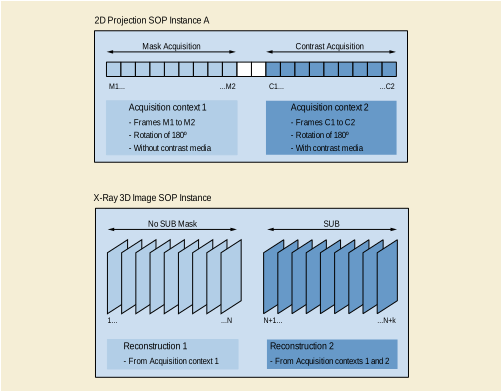
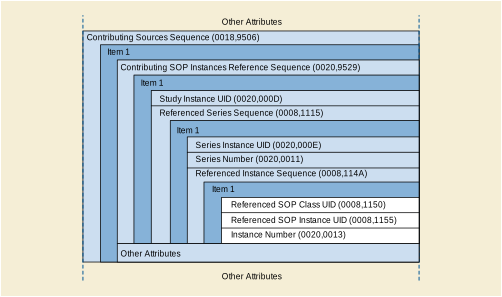
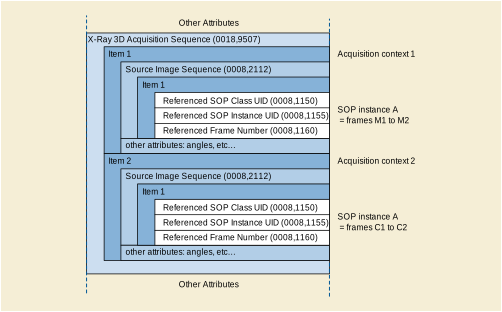
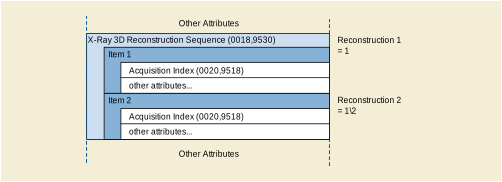
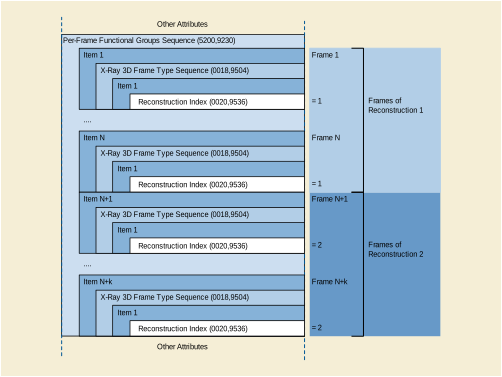
This section describes the X-Ray 3D General Acquisition Macros. These macros specify the attributes of the acquisition context common for the family of X-Ray 3D image SOP Classes.
Table C.8.21.3.1.1-1 describes the X-Ray 3D General Shared Acquisition Macro that specifies the attributes that are applicable for all the projection images belonging to this acquisition context.
Table C.8.21.3.1.1-1. X-Ray 3D General Shared Acquisition Macro Attributes
|
Attribute Name |
Tag |
Type |
Attribute Description |
|---|---|---|---|
|
Source Image Sequence |
(0008,2112) |
1C |
A Sequence that identifies the set of Images that constitute this acquisition context. Required if the reconstruction is created from DICOM SOP Instances. NoteThe attribute is absent in the case where the images used to create the volume are not available as SOP Instances, e.g., the volume was directly generated by acquisition system. One or more Items shall be included in this Sequence. |
|
>Include Table 10-3 “Image SOP Instance Reference Macro Attributes” |
|||
|
Field of View Dimension(s) in Float |
(0018,9461) |
1C |
Dimensions in mm of the Field of View in the source projection images. If Field of View Shape (0018,1147) is: RECTANGLE: row dimension followed by column. ROUND: diameter. HEXAGONAL: diameter of the circle circumscribing the hexagon. Required if present and consistent in the contributing SOP Instances. Required if Modality (0008,0060) is MG. |
|
Field of View Origin |
(0018,7030) |
1C |
Offset of the TLHC of a rectangle circumscribing the Field of View in the referenced images, before rotation or flipping, from the TLHC of the physical detector area measured in physical detector pixels as a row offset followed by a column offset. See Section C.8.11.4.1.1 for further explanation. Required if X-Ray Receptor Type (0018,9420) is present and equals DIGITAL_DETECTOR. |
|
Field of View Rotation |
(0018,7032) |
1C |
Clockwise rotation in degrees of Field of View in the referenced images, relative to the physical detector. Enumerated Values:
See Section C.8.11.4.1.1 for further explanation. Required if present and consistent in the contributing SOP Instances. |
|
Field of View Horizontal Flip |
(0018,7034) |
1C |
Whether or not a horizontal flip has been applied to the Field of View in the referenced images, after rotation relative to the physical detector as described in Field of View Rotation (0018,7032). Enumerated Values:
See Section C.8.11.4.1.1 for further explanation. Required if present and consistent in the contributing SOP Instances. |
|
Grid |
(0018,1166) |
1C |
Identifies the grid. May be multi-valued. See Attribute Description in Section C.8.7.11 for Defined Terms. Required if present and consistent in the contributing SOP Instances. Required if Modality (0008,0060) is MG. |
|
Include Table C.8-36b “X-Ray Grid Description Macro Attributes” |
|||
|
KVP |
(0018,0060) |
1C |
Average of the peak kilo voltage outputs of the X-Ray generator used for all frames. Required if present and consistent in the contributing SOP Instances. Required if Modality (0008,0060) is MG. |
|
X-Ray Tube Current in mA |
(0018,9330) |
1C |
Average of the nominal X-Ray tube currents in milliamperes for all frames. Required if present and consistent in the contributing SOP Instances. Required if Modality (0008,0060) is MG. |
|
Exposure Time in ms |
(0018,9328) |
1C |
Total (cumulative) duration of X-Ray exposure for all frames in milliseconds. See Section C.8.7.2.1.1. Required if present and consistent in the contributing SOP Instances. Required if Modality (0008,0060) is MG. |
|
Exposure in mAs |
(0018,9332) |
1C |
The total (cumulative) exposure for all frames expressed in milliampereseconds, for example calculated from Exposure Time and X-Ray Tube Current. Required if present and consistent in the contributing SOP Instances. Required if Modality (0008,0060) is MG. |
|
Contrast/Bolus Agent |
(0018,0010) |
1C |
Contrast or bolus agent. Required if present and consistent in the contributing SOP Instances. |
|
Contrast/Bolus Agent Sequence |
(0018,0012) |
1C |
Sequence that identifies the contrast agent. One or more Items shall be included in this sequence. Required if present and consistent in the contributing SOP Instances. Required if Modality (0008,0060) is MG and contrast media was applied. |
|
Baseline CID 12 “Radiographic Contrast Agent”. |
|||
|
Start Acquisition DateTime |
(0018,9516) |
1C |
Start date and time of that part of an acquisition used for this acquisition context. Required if present and consistent in the contributing SOP Instances. |
|
End Acquisition DateTime |
(0018,9517) |
1C |
End date and time of that part of an acquisition used for this acquisition context. Required if present and consistent in the contributing SOP Instances. |
Table C.8.21.3.1.2-1 describes the X-Ray 3D General Per Projection Acquisition Macro that specifies the attributes that are applicable for a single projection belonging to this acquisition context.
Table C.8.21.3.1.2-1. X-Ray 3D General Per Projection Acquisition Macro Attributes
|
Attribute Name |
Tag |
Type |
Attribute Description |
|---|---|---|---|
|
KVP |
(0018,0060) |
1C |
Exact peak kilo voltage output of the X-Ray generator used for this projection. Required if present and consistent in the contributing SOP Instances. Required if Modality (0008,0060) is MG. |
|
X-Ray Tube Current in mA |
(0018,9330) |
1C |
Exact Nominal X-Ray tube current in milliamperes applied during the Frame Acquisition Duration (0018,9220) for this projection. Required if present and consistent in the contributing SOP Instances. Required if Modality (0008,0060) is MG. |
|
Frame Acquisition Duration |
(0018,9220) |
1C |
The actual amount of time [in milliseconds] that was used to acquire data for this projection. See Section C.7.6.16.2.2.1 and Section C.7.6.16.2.2.3 for further explanation. Required if present and consistent in the contributing SOP Instances. |
|
Collimator Shape |
(0018,1700) |
1C |
Shape(s) of the collimator. Enumerated Values:
This multi-valued Attribute shall contain at most one of each Enumerated Value. Required if present and consistent in the contributing SOP Instances. |
|
Include Table C.8-28b “X-Ray Collimator Dimensions Macro Attributes” |
|||
Table C.8.21.3.1.3-1 describes the X-Ray 3D General Positioner Movement Macro that specifies the Attributes that describe the movement of a positioner during the acquisition of more than one projection.
Table C.8.21.3.1.3-1. X-Ray 3D General Positioner Movement Macro Attributes
|
Attribute Name |
Tag |
Type |
Attribute Description |
|---|---|---|---|
|
Primary Positioner Scan Arc |
(0018,9508) |
1C |
Total amount of rotation of the primary positioner in degrees. Required if present and consistent in the contributing SOP Instances. Required if Modality (0008,0060) is MG. |
|
Primary Positioner Scan Start Angle |
(0018,9510) |
1C |
Start position of the primary positioner in degrees. See Section C.8.7.5.1.2 or Section C.8.11.7, depending on modality and positioner type. Required if present and consistent in the contributing SOP Instances. Required if Modality (0008,0060) is MG. |
|
Primary Positioner Increment |
(0018,9514) |
1C |
Constant increment of the primary positioner angle in degrees. Positive increment indicates an increasing value of the primary positioner angle. See Section C.8.7.5.1.2 or Section C.8.11.7 for the sign conventions depending on modality and positioner type. See Section C.8.21.3.1.3.1 for further explanation. Required if present and consistent in the contributing SOP Instances. |
|
Primary Positioner Increment Sign |
(0018,9518) |
3 |
Direction of the primary positioner rotation. Defined Terms:
See Section C.8.7.5.1.2 or Section C.8.11.7 for the sign conventions depending on modality and positioner type. See Section C.8.21.3.1.3.1 for further explanation. |
|
Secondary Positioner Scan Arc |
(0018,9509) |
1C |
Total amount of rotation of the secondary positioner in degrees. Required if present and consistent in the contributing SOP Instances. |
|
Secondary Positioner Scan Start Angle |
(0018,9511) |
1C |
Start position of the secondary positioner in degrees. See Section C.8.7.5.1.2 or Section C.8.11.7, depending on modality and positioner type. Required if present and consistent in the contributing SOP Instances. |
|
Secondary Positioner Increment |
(0018,9515) |
1C |
Constant increment of the secondary positioner angle in degrees. Positive increment indicates an increasing value of the secondary positioner angle. See Section C.8.7.5.1.2 or Section C.8.11.7 for the sign conventions depending on modality and positioner type. See Section C.8.21.3.1.3.1 for further explanation. Required if present and consistent in the contributing SOP Instances. |
|
Secondary Positioner Increment Sign |
(0018,9519) |
3 |
Direction of the secondary positioner rotation. Defined Terms:
See Section C.8.7.5.1.2 or Section C.8.11.7 for the sign conventions depending on modality and positioner type. See Section C.8.21.3.1.3.1 for further explanation. |
If the increments of the positioner angles are constant during the acquisition of the X-Ray projections, the attributes Primary Positioner Increment (0018,9514) and the Secondary Positioner Increment (0018,9515) describe this angular change between projections.
If the change in positioner angle is not constant between the projections, omit the Positioner Angle Increment attributes and record the individual positioner angle values in the Positioner Angle attributes within each Item of the Per Projection Acquisition Sequence (0018,9538). In such case, the attributes Primary Positioner Increment Sign (0018,9518) and Secondary Positioner Increment Sign (0018,9519) are used to describe the direction of the positioner rotation.
This section describes the X-Ray 3D Angiographic Acquisition Module.
Table C.8.21.3.2-1. X-Ray 3D Angiographic Acquisition Module Attributes
|
Attribute Name |
Tag |
Type |
Attribute Description |
|---|---|---|---|
|
X-Ray 3D Acquisition Sequence |
(0018,9507) |
1 |
Each item represents an acquisition context related to one or more reconstructions. The values of Acquisition Index (0020,9518) may be used as index to Items in this sequence. One or more Items shall be included in this sequence. |
|
>Field of View Shape |
(0018,1147) |
1C |
Shape of the Field of View in the referenced images. Enumerated Values:
Required if present and consistent in the contributing SOP Instances. |
|
>X-Ray Receptor Type |
(0018,9420) |
1C |
Identifies the type of X-Ray receptor used. Enumerated Values:
Required if present and consistent in the contributing SOP Instances. |
|
>Include Table C.8.21.3.1.1-1 “X-Ray 3D General Shared Acquisition Macro Attributes” |
|||
|
>Include Table C.8-71b “Digital X-Ray Detector Macro Attributes” |
|||
|
>Physical Detector Size |
(0018,9429) |
1C |
Dimensions of the physical detector measured in mm as a row size followed by a column size. Required if present and consistent in the contributing SOP Instances. |
|
>Position of Isocenter Projection |
(0018,9430) |
1C |
Position of the Isocenter measured in physical detector elements as a row offset followed by a column offset from the TLHC of a rectangle circumscribing the physical detector area. Required if Isocenter Reference System Sequence (0018,9462) is present and if the values are present and consistent in the contributing SOP Instances. |
|
>Distance Source to Detector |
(0018,1110) |
1C |
Distance from source to receptor plane perpendicular to the receptor plane in mm or distance in mm from source to detector center on the chest wall line. See Section C.8.11.7.1.1. Required if present and consistent in the contributing SOP Instances. NoteThis value is traditionally referred to as Source Image Receptor Distance (SID). |
|
>Distance Source to Isocenter |
(0018,9402) |
1C |
Distance from source to isocenter in mm. Required if present and consistent in the contributing SOP Instances. |
|
>Focal Spot(s) |
(0018,1190) |
1C |
Nominal focal spot size in mm used to acquire this image. Required if present and consistent in the contributing SOP Instances. |
|
>Filter Type |
(0018,1160) |
1C |
Type of filter(s) inserted into the X-Ray beam (e.g., wedges). See Attribute Description in Section C.8.7.10 for Defined Terms. NoteMultiple type of filters can be expressed by a combination, e.g., BUTTERFLY+WEDGE. Required if present and consistent in the contributing SOP Instances. |
|
>Filter Material |
(0018,7050) |
1C |
The X-Ray absorbing material used in the filter. May be multi-valued. See Attribute Description in Section C.8.7.10 for Defined Terms. Required if present and consistent in the contributing SOP Instances. |
|
>Filter Thickness Minimum |
(0018,7052) |
1C |
See Attribute Description in Section C.8.7.10. Required if present and consistent in the contributing SOP Instances. |
|
>Filter Thickness Maximum |
(0018,7054) |
1C |
See Attribute Description in Section C.8.7.10. Required if present and consistent in the contributing SOP Instances. |
|
>Filter Beam Path Length Minimum |
(0018,7056) |
1C |
See Attribute Description in Section C.8.7.10. Required if present and consistent in the contributing SOP Instances. |
|
>Filter Beam Path Length Maximum |
(0018,7058) |
1C |
See Attribute Description in Section C.8.7.10. Required if present and consistent in the contributing SOP Instances. |
|
>Table X Position to Isocenter |
(0018,9466) |
3 |
X position of the Table Reference Point with respect to the Isocenter (mm). See Section C.8.19.6.13.1.3 for further explanation. |
|
>Table Y Position to Isocenter |
(0018,9467) |
3 |
Y position of the Table Reference Point with respect to the Isocenter (mm). See Section C.8.19.6.13.1.3 for further explanation. |
|
>Table Z Position to Isocenter |
(0018,9468) |
3 |
Z position of the Table Reference Point with respect to the Isocenter (mm). See Section C.8.19.6.13.1.3 for further explanation. |
|
>Table Horizontal Rotation Angle |
(0018,9469) |
3 |
Rotation of the table in the horizontal plane. See Section C.8.19.6.13.1.3 for further explanation. |
|
>Table Head Tilt Angle |
(0018,9470) |
3 |
Angle of the head-feet axis of the table in degrees relative to the horizontal plane. See Section C.8.19.6.13.1.3 for further explanation. |
|
>Table Cradle Tilt Angle |
(0018,9471) |
3 |
Angle of the left-right axis of the table in degrees relative to the horizontal plane. See Section C.8.19.6.13.1.3 for further explanation. |
|
>Include Table C.8.21.3.1.3-1 “X-Ray 3D General Positioner Movement Macro Attributes” |
|||
|
>Per Projection Acquisition Sequence |
(0018,9538) |
1C |
Sequence containing detailed acquisition context of each individual projection used in this acquisition context. One or more Items shall be included in this sequence. Required if present and consistent in the contributing SOP Instances. |
|
>>Include Table C.8.21.3.1.2-1 “X-Ray 3D General Per Projection Acquisition Macro Attributes” |
|||
|
>>Positioner Isocenter Primary Angle |
(0018,9463) |
1C |
Position of the X-Ray center beam for this projection in the isocenter reference system in the X direction (deg). See Section C.8.19.6.13.1.2 for further explanation. Required if present and consistent in the contributing SOP Instances. |
|
>>Positioner Isocenter Secondary Angle |
(0018,9464) |
1C |
Position of the X-Ray center beam for this projection in the isocenter reference system in the Z direction (deg). See Section C.8.19.6.13.1.2 for further explanation. Required if present and consistent in the contributing SOP Instances. |
|
>>Positioner Isocenter Detector Rotation Angle |
(0018,9465) |
1C |
Rotation of the X-Ray detector plane for this projection (deg). See Section C.8.19.6.13.1.2 for further explanation. Required if present and consistent in the contributing SOP Instances. |
|
>>Positioner Primary Angle |
(0018,1510) |
3 |
Position of the X-Ray Image Intensifier about the patient from the RAO to LAO direction where movement from RAO to vertical is positive. See Section C.8.7.5.1.2 for further explanation. |
|
>>Positioner Secondary Angle |
(0018,1511) |
3 |
Position of the X-Ray Image Intensifier about the patient from the CAU to CRA direction where movement from CAU to vertical is positive. See Section C.8.7.5.1.2 for further explanation. |
This section describes the X-Ray 3D Craniofacial Acquisition Module.
Table C.8.21.3.3-1. X-Ray 3D Craniofacial Acquisition Module Attributes
|
Attribute Name |
Tag |
Type |
Attribute Description |
|---|---|---|---|
|
X-Ray 3D Acquisition Sequence |
(0018,9507) |
1 |
Each item represents a acquisition context related to a set of frames of SOP Instance defined by this IOD, The values of Acquisition Index (0020,9518) may be used as index to Items in this sequence. One or more Items shall be included in this sequence. |
|
>Field of View Shape |
(0018,1147) |
1C |
Shape of the Field of View in the referenced images. Enumerated Values:
Required if present and consistent in the contributing SOP Instances. |
|
>X-Ray Receptor Type |
(0018,9420) |
1C |
Identifies the type of X-Ray receptor used. Enumerated Values:
Required if present and consistent in the contributing SOP Instances. |
|
>Include Table C.8.21.3.1.1-1 “X-Ray 3D General Shared Acquisition Macro Attributes” |
|||
|
>Include Table C.8-71b “Digital X-Ray Detector Macro Attributes” |
|||
|
>Per Projection Acquisition Sequence |
(0018,9538) |
1C |
Sequence containing detailed acquisition context of each individual projection used in this acquisition context. One or more Items shall be included in this sequence. Required if present and consistent in the contributing SOP Instances. |
|
>>Include Table C.8.21.3.1.2-1 “X-Ray 3D General Per Projection Acquisition Macro Attributes” |
|||
This section describes the Breast Tomosynthesis Acquisition Module.
Table C.8.21.3.4-1. Breast Tomosynthesis Acquisition Module Attributes
|
Attribute Name |
Tag |
Type |
Attribute Description |
|---|---|---|---|
|
X-Ray 3D Acquisition Sequence |
(0018,9507) |
1 |
Each Item represents an acquisition context related to one or more reconstructions. The values of Acquisition Index (0020,9518) may be used as index in this sequence. One or more Items shall be included in this sequence. |
|
>Field of View Shape |
(0018,1147) |
1 |
Shape of the Field of View in the source projection images. Enumerated Values:
|
|
>X-Ray Receptor Type |
(0018,9420) |
1 |
Identifies the type of X-Ray receptor used. Enumerated Values:
|
|
>Include Table C.8.21.3.1.1-1 “X-Ray 3D General Shared Acquisition Macro Attributes” |
|||
|
>Include Table C.8.21.3.1.3-1 “X-Ray 3D General Positioner Movement Macro Attributes” |
|||
|
>Distance Source to Detector |
(0018,1110) |
1 |
Distance in mm from source to detector center on the chest wall line. Note
|
|
>Distance Source to Patient |
(0018,1111) |
1 |
Distance in mm from source to the breast support side that is closest to the Imaging Subject, as measured along the X-Ray beam vector. Note
|
|
>Estimated Radiographic Magnification Factor |
(0018,1114) |
1 |
Ratio of Source Image Receptor Distance (SID) over Source Object Distance (SOD). |
|
>Anode Target Material |
(0018,1191) |
1 |
The primary material in the anode of the X-Ray source. Defined Terms:
|
|
>Body Part Thickness |
(0018,11A0) |
1 |
The average thickness in mm of the body part examined when compressed, if compression has been applied during exposure. |
|
>Exposure Control Mode |
(0018,7060) |
1 |
Type of exposure control. Defined Terms:
|
|
>Exposure Control Mode Description |
(0018,7062) |
1 |
Text description of the mechanism of exposure control. May describe the number and type of exposure sensors or position of the sensitive area of the imaging detector. |
|
>Half Value Layer |
(0040,0314) |
1 |
The thickness of Aluminum in mm required to reduce the X-Ray Output (0040,0312) by a factor of two. NoteThis value may be a calibrated value rather than measured during the exposure. |
|
>Organ Dose |
(0040,0316) |
3 |
Organ dose value measured in dGy representing the collective total for all acquired frames described in this sequence item. NoteThis may be an estimated value. |
|
>Entrance Dose in mGy |
(0040,8302) |
3 |
Entrance dose value measured in mGy at the surface of the patient representing the collective total for all acquired frames described in this sequence item. NoteThis may be an estimated value based on assumptions about the patient's body size and habitus. |
|
>Focal Spot(s) |
(0018,1190) |
1 |
Nominal focal spot size in mm used to acquire the projection images. |
|
>Detector Binning |
(0018,701A) |
1C |
Number of active detectors used to generate a single pixel. Specified as number of row detectors per pixel then column. Required if detector binning was applied to the projection images. |
|
>Detector Temperature |
(0018,7001) |
1 |
Detector temperature during exposure in degrees Celsius. |
|
>Filter Type |
(0018,1160) |
1 |
Type of filter(s) inserted into the X-Ray beam (e.g., wedges). See Attribute Description in Section C.8.7.10 for Defined Terms. |
|
>Filter Material |
(0018,7050) |
1 |
The X-Ray absorbing material used in the filter. May be multi-valued. See Attribute Description in Section C.8.7.10 for Defined Terms. |
|
>Filter Thickness Minimum |
(0018,7052) |
3 |
See Attribute Description in Section C.8.7.10. |
|
>Filter Thickness Maximum |
(0018,7054) |
3 |
See Attribute Description in Section C.8.7.10. |
|
>Filter Beam Path Length Minimum |
(0018,7056) |
3 |
See Attribute Description in Section C.8.7.10. |
|
>Filter Beam Path Length Maximum |
(0018,7058) |
3 |
See Attribute Description in Section C.8.7.10. |
|
>Compression Force |
(0018,11A2) |
1 |
The compression force applied to the body part during exposure, measured in Newtons. |
|
>Paddle Description |
(0018,11A4) |
1 |
Description of the compression paddle, if compression was applied to the body part during exposure. |
|
>Per Projection Acquisition Sequence |
(0018,9538) |
1 |
Sequence containing detailed acquisition context of each individual projection used in this acquisition context. One or more Items shall be included in this sequence. |
|
>>Include Table C.8.21.3.1.2-1 “X-Ray 3D General Per Projection Acquisition Macro Attributes” |
|||
|
>>Positioner Primary Angle |
(0018,1510) |
1 |
Signed position in degrees of the X-Ray beam vector in the coronal anatomical plane as if the patient were standing facing the equipment where vertical is zero. |
|
>>Positioner Primary Angle Direction |
(0018,9559) |
3 |
The interpretation of the sign of the Positioner Primary Angle (0018,1510). Enumerated Values:
See Section C.8.31.2.1. |
|
>>Positioner Secondary Angle |
(0018,1511) |
1C |
Position in degrees of the X-Ray beam vector in the sagittal anatomical plane as if the patient were standing where movement of the X-Ray source from anterior to posterior is positive, and vertical is zero. Required if secondary positioner was used during acquisition. |
|
>>Exposure Time in ms |
(0018,9328) |
1 |
Duration of X-Ray exposure in milliseconds. See Section C.8.7.2.1.1. |
|
>>Exposure in mAs |
(0018,9332) |
1 |
The exposure expressed in milliampereseconds, for example calculated from Exposure Time and X-Ray Tube Current. |
|
>>Relative X-Ray Exposure |
(0018,1405) |
1 |
Indication of the applied dose, in manufacturer specific units. Note
|
|
>>Organ Dose |
(0040,0316) |
3 |
Average organ dose value measured in dGy. NoteThis may be an estimated value. |
|
>>Entrance Dose in mGy |
(0040,8302) |
3 |
Average entrance dose value measured in mGy at the surface of the patient during the acquisition of this projection image. NoteThis may be an estimated value based on assumptions about the patient's body size and habitus. |
|
>>Irradiation Event UID |
(0008,3010) |
3 |
Unique identification of the irradiation event(s) associated with the acquisition of this image. |
This section describes the X-Ray 3D Reconstruction Module. Table C.8.21.4-1 contains IOD Attributes that describe the reconstructions used to create this SOP Instance. A single SOP Instance may contain the result of one or more reconstructions (e.g., a set of volumes). Each item in the X-Ray 3D Reconstruction Sequence specifies the characteristics of such a result.
Table C.8.21.4-1. X-Ray 3D Reconstruction Module Attributes
|
Attribute Name |
Tag |
Type |
Attribute Description |
|---|---|---|---|
|
X-Ray 3D Reconstruction Sequence |
(0018,9530) |
1 |
A sequence of Items each describing the characteristics of one 3D reconstruction included in this SOP instance. One or more Items shall be included in this sequence. |
|
>Reconstruction Description |
(0018,9531) |
3 |
Free text description of the purpose of the reconstruction, e.g., mask volume. |
|
>Application Name |
(0018,9524) |
1 |
Name of the application that created the reconstruction. |
|
>Application Version |
(0018,9525) |
1 |
Version of the application that created the reconstruction. |
|
>Application Manufacturer |
(0018,9526) |
1 |
Name of the manufacturer of the application that created the reconstruction. |
|
>Algorithm Type |
(0018,9527) |
1 |
Type of algorithm used to create the reconstruction. Defined Terms:
|
|
>Algorithm Description |
(0018,9528) |
3 |
Description of the algorithm used to create the reconstruction. |
|
>Acquisition Index |
(0020,9518) |
1 |
The Item number(s) of the X-Ray 3D Acquisition Sequence (0018,9507) that describes the acquisition context(s) contributing to this reconstruction. |
The following sections contain Functional Group Macros specific to the X-Ray 3D IOD.
Note
The attribute descriptions in the Functional Group Macros are written as if they were applicable to a single frame (i.e., the macro is part of the Per-frame Functional Groups Sequence). If an attribute is applicable to all frames (i.e., the macro is part of the Shared Functional Groups Sequence) the phrase "this frame" in the attribute description shall be interpreted to mean " for all frames".".
Table C.8.21.5.1-1 specifies the attributes of the X-Ray 3D Frame Type Functional Group Macro.
Table C.8.21.5.1-1. X-Ray 3D Frame Type Macro Attributes
|
Attribute Name |
Tag |
Type |
Attribute Description |
|---|---|---|---|
|
X-Ray 3D Frame Type Sequence |
(0018,9504) |
1 |
A sequence that describes general characteristics of this frame. Only a single Item shall be included in this sequence. |
|
>Frame Type |
(0008,9007) |
1 |
Type of Frame. A multi-valued attribute analogous to Image Type (0008,0008). Enumerated Values and Defined Terms are the same as those for the four values of Image Type (0008,0008), except that the value MIXED is not allowed. See Section C.8.21.1.1.1. For Breast Tomosynthesis Image See Section C.8.21.6.1.1. |
|
>Include Table C.8-131 “Common CT/MR Image Description Macro Attributes” |
|||
|
>Reconstruction Index |
(0020,9536) |
1C |
The Item number of the X-Ray 3D Reconstruction Sequence (0018,9530) that describes the characteristics of the 3D Reconstruction to which this frame is part of. Required if the X-Ray 3D Reconstruction Sequence (0018,9530) is present. |
Table C.8.21.6-1 contains IOD Attributes that describe the view of a digital breast tomosynthesis image.
Table C.8.21.6-1. Breast View Module Attributes
|
Attribute Name |
Tag |
Type |
Attribute Description |
|---|---|---|---|
|
Image Type |
(0008,0008) |
1 |
Image identification characteristics. See Section C.8.21.6.1.1 for specialization. |
|
View Code Sequence |
(0054,0220) |
1 |
Sequence that describes the view of the patient anatomy in this image. Only a single Item shall be included in this sequence. |
|
Defined CID 4014 “View for Mammography”. |
|||
|
>View Modifier Code Sequence |
(0054,0222) |
2 |
Sequence that provides modifiers for the view of the patient anatomy. Zero or more Items shall be included in this sequence. |
|
>>Include Table 8.8-1 “Code Sequence Macro Attributes”. |
|||
|
Breast Implant Present |
(0028,1300) |
1C |
Whether or not the imaged breast contains a breast implant regardless of the visibility of a breast implant in the Pixel Data. Enumerated Values:
Required if Modality (0008,0060) is MG. May be present otherwise. NoteThe value is expected to be YES for all images acquired on a breast that contains a breast implant, even when a breast implant is displaced during image acquisition. |
|
Partial View |
(0028,1350) |
3 |
Indicates whether this image is a partial view, that is a subset of a single view of the breast. Enumerated Values:
If this Attribute is absent, then the image may or may not be a partial view. NoteThis may occur when a breast is larger than the active area of the detector. If this Attribute is present, its value shall be NO if there is a View Modifier Code Sequence (0054,0222) Item of value (R-102D6, SRT, "Magnification") or (R-102D7, SRT, "Spot Compression"). |
|
Partial View Code Sequence |
(0028,1352) |
1C |
Sequence that describes the portion or section of the breast captured in a partial view image. One or two Items shall be included in this sequence. See Section C.8.11.7.1.3. Required if Partial View (0028,1350) is present with a value of YES. |
In addition to the requirements specified in Section C.8.21.1.1.1 Image Type and Frame Type, the following Defined Terms are specified for Value 3 of Image Type (0008,0008) and Frame Type (0008,9007):
Table C.8.21.6-1a. Defined Terms of Image Type (0008,0008) Value 3 for Contrast Enhanced, Tomosynthesis and Biopsy
|
Defined Term |
Definition |
ACR MQCM Equivalent |
|---|---|---|
|
Contrast |
||
|
PRE_CONTRAST |
Collected before contrast was administered. |
n/a |
|
POST_CONTRAST |
Collected during or after contrast was administered. |
n/a |
|
Tomosynthesis |
||
|
TOMO_PROJ |
Identifies the image as a digital breast tomosynthesis projection image. |
n/a |
|
TOMOSYNTHESIS |
Tomographic reconstruction from limited angle projection data. |
n/a |
|
Biopsy |
||
|
TOMO_SCOUT |
A localizer image set that may be used to determine positioning coordinates prior to needle positioning. |
…SC |
|
PREFIRE |
An image set obtained with the biopsy needle in position prior to needle deployment. |
…PRF |
|
POSTFIRE |
An image set obtained with the biopsy needle in position following needle deployment through the targeted lesion. |
…POF |
|
POSTBIOPSY |
An image set obtained following tissue acquisition with the X-Ray source in the scout position. |
…POB |
|
POSTMARKER |
An image set obtained following micromarker placement with the X-Ray source in the scout position. |
…POM |
Note
There is no need for _MINUS or _PLUS because a single digital breast tomosynthesis acquisition produces a projection and/or reconstruction image set that replaces the _MINUS and _PLUS image pair used in conventional 2D breast biopsy imaging (see Section C.8.11.7.1.4).
If more than one characteristic (biopsy, tomosynthesis, contrast enhanced) applies to an image, Value 3 shall contain the biopsy image type. If biopsy is not involved, Value 3 shall contain the tomosynthesis image type.
Note
For example, attributes of the Enhanced Contrast/Bolus Module may be used to identify contrast enhanced characteristics of a biopsy and/or tomosynthesis image that is also contrast enhanced.
Value 4 shall be NONE except for applicable contrast enhanced images, mathematically generated 2D images and other tomosynthesis reconstructions. The following Defined Terms are specified for Value 4 of Image Type (0008,0008) and Frame Type (0008,9007). For additional Defined Terms see Section C.8.16.1.4.
Table C.8.21.6-1b. Defined Terms of Image Type (0008,0008) Value 4 for Contrast Enhanced and Tomosynthesis
|
Defined Term |
Definition |
|---|---|
|
Tomosynthesis |
|
|
GENERATED_2D |
Mathematically generated 2D view. |
|
MAXIMUM |
Created through Pixel by pixel maximum operation. |
|
MEAN |
Created through Pixel by pixel mean operation. |
|
Contrast |
|
|
ADDITION |
Created through Pixel by pixel addition operation. |
|
SUBTRACTION |
Created through Pixel by pixel subtraction operation. |
If more than one characteristic (contrast enhanced, tomosynthesis) applies to an image, Value 4 shall contain the contrast enhanced image type. If contrast enhanced is not involved, Value 4 shall contain the tomosynthesis image type.
Value 5 shall be present for images acquired using contrast enhanced digital X-Ray imaging of the breast, but may be empty if none of the Defined Terms applies. For non-contrast images Value 5 remains optional and implementation specific.
Table C.8.21.6-1c. Defined Terms of Image Type (0008,0008) Value 5 for Contrast Enhanced Images
|
Enumerated Value |
Definition |
|---|---|
|
LOW_ENERGY |
Low energy image. |
|
HIGH_ENERGY |
High energy image. |
Note
A recipient may use the different values for biopsy, tomosynthesis and contrast views to determine how to display them, for example in hanging protocols:
|
Image Type Value 3 |
Image Type Value 4 |
Image Type Value 5 |
|
|---|---|---|---|
|
Tomosynthesis thin reconstructed slices |
TOMOSYNTHESIS |
NONE |
- |
|
Tomosynthesis thick reconstructed slices |
TOMOSYNTHESIS |
MAXIMUM |
- |
|
Tomosynthesis generated 2D |
TOMOSYNTHESIS |
GENERATED_2D |
- |
|
Tomosynthesis projections |
TOMO_PROJ |
NONE |
- |
|
Tomosynthesis thin reconstructed slices biopsy post-fire |
POSTFIRE |
NONE |
- |
|
Tomosynthesis thick reconstructed slices post-biopsy |
POSTBIOPSY |
MEAN |
- |
|
Tomosynthesis generated 2D biopsy pre-fire |
PREFIRE |
GENERATED_2D |
- |
|
Tomosynthesis projections biopsy scout |
TOMO_SCOUT |
NONE |
- |
|
Tomosynthesis thick reconstructed slices pre-contrast |
TOMOSYNTHESIS |
MAXIMUM |
empty |
|
Tomosynthesis thin reconstructed slices post-contrast subtraction |
TOMOSYNTHESIS |
SUBTRACTION |
empty |
|
Tomosynthesis thick reconstructed slices post-contrast subtraction |
TOMOSYNTHESIS |
SUBTRACTION |
empty |
|
Tomosynthesis generated 2D post-contrast addition |
TOMOSYNTHESIS |
ADDITION |
empty |
|
Tomosynthesis generated 2D post-contrast low energy |
TOMOSYNTHESIS |
GENERATED_2D |
LOW_ENERGY |
|
Tomosynthesis projections post-contrast high energy |
TOMO_PROJ |
NONE |
HIGH_ENERGY |
|
Tomosynthesis thick reconstructed slices biopsy scout pre-contrast |
TOMO_SCOUT |
MAXIMUM |
empty |
|
Tomosynthesis thin reconstructed slices biopsy pre-fire post-contrast subtraction |
PREFIRE |
SUBTRACTION |
empty |
|
Tomosynthesis thick reconstructed slices biopsy post-fire post-contrast subtraction |
POSTFIRE |
SUBTRACTION |
empty |
|
Tomosynthesis generated 2D post-biopsy post-contrast addition |
POSTBIOPSY |
ADDITION |
empty |
|
Tomosynthesis generated 2D biopsy scout post-contrast low energy |
TOMO_SCOUT |
GENERATED_2D |
LOW_ENERGY |
|
Tomosynthesis projections post-biopsy post-contrast high energy |
POSTBIOPSY |
NONE |
HIGH_ENERGY |
This section describes the specific modules for the Enhanced PET Image IOD.
The Enhanced PET IODs use the General Series module described in Section C.7.3.1, specialized by the Enhanced PET Series Module, to describe the DICOM Series Entity described in Section A.1.2.3, and to define what constitutes a Series for the context of PET device.
Table C.8.22-1 specifies the Attributes that identify and describe general information about the Enhanced PET Series.
Table C.8.22-1. Enhanced PET Series Module Attributes
|
Attribute Name |
Tag |
Type |
Attribute Description |
|---|---|---|---|
|
Modality |
(0008,0060) |
1 |
Type of equipment that originally acquired the data used to create the images in this Series. Enumerated Values:
See Section C.7.3.1.1.1 for further explanation. |
|
Referenced Performed Procedure Step Sequence |
(0008,1111) |
1C |
Uniquely identifies the Performed Procedure Step SOP Instance to which the Series is related. Only a single Item shall be included in this sequence. Required if a Performed Procedure Step SOP Class was involved in the creation of this Series. |
|
>Include Table 10-11 “SOP Instance Reference Macro Attributes” |
|||
|
Related Series Sequence |
(0008,1250) |
1C |
Identifying the series that was used for attenuation purposes. See Section C.7.3.1 Required if another series was used to perform attenuation correction and the SOP Class UID is not "1.2.840.10008.5.1.4.1.1.128.1" (Legacy Converted). May be present otherwise. One or more Items shall be included in this sequence. |
|
>Study Instance UID |
(0020,000D) |
1 |
Instance UID of Study to which the related Series belongs |
|
>Series Instance UID |
(0020,000E) |
1 |
Instance UID of Related Series |
|
>Purpose of Reference Code Sequence |
(0040,A170) |
2 |
Describes the purpose for which the reference is made. Zero or more Items shall be included in this sequence. When absent, implies that the reason for the reference is unknown. |
Table C.8.22-2 specifies the Attributes that describe PET Acquisitions.
Table C.8.22-2. Enhanced PET Acquisition Module Attributes
|
Attribute Name |
Tag |
Type |
Attribute Description |
|---|---|---|---|
|
Acquisition Start Condition |
(0018,0073) |
1C |
Description of how the data collection was started. See Section C.8.22.2.1.1 for Defined Terms. Required if Image Type (0008,0008) Value 1 is ORIGINAL. May be present otherwise. |
|
Start Density Threshold |
(0018,9715) |
1C |
The count density that triggered the start of the acquisition, in counts/sec. Required if Acquisition Start Condition (0018,0073) equals DENS. |
|
Start Relative Density Difference Threshold |
(0018,9716) |
1C |
The relative count density that triggered the start of the acquisition, in counts/sec. Required if Acquisition Start Condition (0018,0073) equals RDD. |
|
Start Cardiac Trigger Count Threshold |
(0018,9717) |
1C |
The number of cardiac triggers that occurred before starting the acquisition. Required if Acquisition Start Condition (0018,0073) equals CARD_TRIG. |
|
Start Respiratory Trigger Count Threshold |
(0018,9718) |
1C |
The number of respiratory triggers that occurred before starting the acquisition. Required if Acquisition Start Condition (0018,0073) equals RESP_TRIG. |
|
Acquisition Termination Condition |
(0018,0071) |
1C |
Description of how the data collection for the series was stopped. See Section C.8.22.2.1.2 for Defined Terms. Required if Image Type (0008,0008) Value 1 is ORIGINAL. May be present otherwise. |
|
Termination Counts Threshold |
(0018,9719) |
1C |
The count value that triggered the termination of the acquisition. Required if Acquisition Termination Condition (0018,0071) equals CNTS. |
|
Termination Density Threshold |
(0018,9720) |
1C |
The count density that triggered the termination of the acquisition, in counts/sec. Required if Acquisition Termination Condition (0018,0071) equals DENS. |
|
Termination Relative Density Threshold |
(0018,9721) |
1C |
The count relative density that triggered the termination of the acquisition, in counts/sec. Required if Acquisition Termination Condition (0018,0071) equals RDD. |
|
Termination Time Threshold |
(0018,9722) |
1C |
The time duration after which the acquisition was terminated, in sec. Required if Acquisition Termination Condition (0018,0071) equals TIME |
|
Termination Cardiac Trigger Count Threshold |
(0018,9723) |
1C |
The number of cardiac triggers that triggered the termination of the acquisition. Required if Acquisition Termination Condition (0018,0071) equals CARD_TRIG |
|
Termination Respiratory Trigger Count Threshold |
(0018,9724) |
1C |
The number of respiratory triggers that triggered the termination of the acquisition. Required if Acquisition Termination Condition (0018,0071) equals RESP_TRIG |
|
Type of Detector Motion |
(0054,0202) |
1C |
Describes the type of detector motion during acquisition. Defined Terms:
Required if Image Type (0008,0008) Value 1 is ORIGINAL. May be present otherwise. |
|
Detector Geometry |
(0018,9725) |
1C |
Physical arrangement of the detectors in the acquisition system. The radiation entrance surface of a detector may be curved or flat. A curved surface is referred to as cylindrical. Detectors may simultaneously subtend all possible transverse angles from the center of the field of view. Detectors that do not are referred to as partial. Defined Terms:
Required if Image Type (0008,0008) Value 1 is ORIGINAL and Type of Detector Motion (0054,0202) equals STATIONARY. May be present otherwise, if Image Type (0008,0008) Value 1 is DERIVED and Type of Detector Motion (0054,0202) equals STATIONARY. |
|
Transverse Detector Separation |
(0018,9726) |
1C |
Distance between opposing detectors, in mm. Required if Image Type (0008,0008) Value 1 is ORIGINAL. May be present otherwise. |
|
Axial Detector Dimension |
(0018,9727) |
1C |
Axial detector size in mm. Size of the detector along the table axis. Required if Image Type (0008,0008) Value 1 is ORIGINAL May be present otherwise. |
|
Collimator Type |
(0018,1181) |
1C |
Collimator Type. Defined Terms:
Required if Image Type (0008,0008) Value 1 is ORIGINAL. May be present otherwise. |
|
Coincidence Window Width |
(0054,1210) |
1C |
The width of the coincidence-timing window, in nanoseconds. The maximum time difference between two single events in two opposing detectors that will be accepted as a coincidence event. Required if Image Type (0008,0008) Value 1 is ORIGINAL. May be present otherwise. |
|
Energy Window Range Sequence |
(0054,0013) |
1C |
Sequence of Items that describes the energy windows used for this Image. One or more items shall be included in this sequence. See Section C.8.22.2.1.3 for explanation. Required if Image Type (0008,0008) Value 1 is ORIGINAL. May be present otherwise. |
|
>Energy Window Lower Limit |
(0054,0014) |
1 |
The lower limit of the energy window, in KeV. |
|
>Energy Window Upper Limit |
(0054,0015) |
1 |
The upper limit of the energy window, in KeV. |
|
Table Motion |
(0018,1134) |
1 |
Enumerated Values:
|
|
Time of Flight Information Used |
(0018,9755) |
1 |
Specifies whether or not Time-of-Flight information was used in creation of the image. Enumerated Values:
|
|
Include Table 10-24 “Mandatory View and Slice Progression Direction Attributes” |
|||
|
Isocenter Position |
(300A,012C) |
3 |
Isocenter coordinates (x,y,z), in mm. Specifies the location of the machine isocenter in the patient-based coordinate system associated with the Frame of Reference. It allows transformation from the equipment-based coordinate system to the patient-based coordinate system. |
|
Scan Progression Direction |
(0054,0501) |
3 |
The anatomical order in which the slices were acquired. Enumerated Values:
|
Acquisition Start Condition (0018,0073) is the method of starting acquisition data collection.
Defined Terms:
- DENS
preset count density (counts/sec) was reached
- RDD
preset relative count density difference (change in counts/sec) was reached
- MANU
acquisition was started manually
- AUTO
start automatically, when ready
- CARD_TRIG
preset number of cardiac triggers was reached
- RESP_TRIG
preset number of respiratory triggers was reached
Acquisition Termination Condition (0018,0071) is the method of acquisition termination that has actually applied to the data collection.
Defined Terms:
- CNTS
preset counts was reached
- DENS
preset count density (counts/sec) was reached
- RDD
preset relative count density difference (change in counts/sec) was reached
- MANU
acquisition was terminated manually
- OVFL
data overflow occurred
- TIME
preset time limit was reached
- CARD_TRIG
preset number of cardiac triggers was reached
- RESP_TRIG
preset number of respiratory triggers was reached
Table C.8.22-3 specifies the attributes of the Enhanced PET Image Module.
Table C.8.22-3. Enhanced PET Image Module Attributes
|
Attribute Name |
Tag |
Type |
Attribute Description |
|---|---|---|---|
|
Image Type |
(0008,0008) |
1 |
Image characteristics. See Section C.8.22.3.1.1. |
|
Include Table C.8-131 “Common CT/MR Image Description Macro Attributes” |
|||
|
Acquisition Number |
(0020,0012) |
3 |
A number identifying the single continuous gathering of data over a period of time that resulted in this image, which may include multiple bed positions. NoteThis number is not required to be unique across SOP Instances in a series. See also the description of the Referenced Raw Data Sequence (0008,9121). |
|
Acquisition DateTime |
(0008,002A) |
1C |
The date and time that the acquisition of data started. Note
Required if Image Type (0008,0008) Value 1 of this frame is ORIGINAL and SOP Class UID is not "1.2.840.10008.5.1.4.1.1.128.1" (Legacy Converted), may be present otherwise. |
|
Acquisition Duration |
(0018,9073) |
1C |
The time in seconds needed to complete the acquisition of data. See Section C.7.6.16.2.2.1 for further explanation. Required if Image Type (0008,0008) Value 1 of this frame is ORIGINAL and SOP Class UID is not "1.2.840.10008.5.1.4.1.1.128.1" (Legacy Converted), may be present otherwise. |
|
Referenced Raw Data Sequence |
(0008,9121) |
3 |
A sequence that identifies the set of Raw Data SOP Class/Instance pairs of the Raw data that were used to derive this Image. One or more Items are permitted in this Sequence. NoteThe items of in this sequence may identify raw data that has not been stored or encoded as a DICOM object. This allows recognition that images and spectra in different instances have been reconstructed from the same raw data. For such items the SOP Class UID would be "1.2.840.10008.5.1.4.1.1.66" (Raw Data SOP Class) and the SOP Instance UID would be any appropriate UID. |
|
>Include Table C.17-3 “Hierarchical SOP Instance Reference Macro Attributes” |
|||
|
Referenced Waveform Sequence |
(0008,113A) |
3 |
References to waveforms acquired in conjunction with this image. These Waveforms may or may not be temporally synchronized with this image. One or more Items are permitted in this sequence. |
|
>Include Table C.17-3 “Hierarchical SOP Instance Reference Macro Attributes” |
|||
|
Referenced Image Evidence Sequence |
(0008,9092) |
1C |
Full set of Composite SOP Instances referring to image SOP Instances inside the frames of this Enhanced PET Image SOP Instance. See Section C.8.13.2.1.2 for further explanation. One or more Items shall be included in this sequence. Required if the Referenced Image Sequence (0008,1140) is present. |
|
>Include Table C.17-3 “Hierarchical SOP Instance Reference Macro Attributes” |
|||
|
Source Image Evidence Sequence |
(0008,9154) |
1C |
Full set of Composite SOP Instances used as source image SOP Instances inside the frames of this Enhanced PET Image SOP Instance. See Section C.8.13.2.1.2 for further explanation. One or more Items shall be included in this sequence. Required if the Source Image Sequence (0008,2112) is present. |
|
>Include Table C.17-3 “Hierarchical SOP Instance Reference Macro Attributes” |
|||
|
Samples per Pixel |
(0028,0002) |
1 |
Number of samples (planes) in this image. This value shall be 1. |
|
Photometric Interpretation |
(0028,0004) |
1 |
Specifies the intended interpretation of the pixel data. Enumerated Values:
See Section C.7.6.3.1.2 for definition of this term. |
|
Bits Allocated |
(0028,0100) |
1 |
Number of bits allocated for each pixel sample. Each sample shall have the same number of bits allocated. This value shall be 16. |
|
Bits Stored |
(0028,0101) |
1 |
Number of bits stored for each pixel sample. Each sample shall have the same number of bits stored. This value shall be 16. |
|
High Bit |
(0028,0102) |
1 |
Most significant bit for pixel sample data. Each sample shall have the same high bit. Shall be one less than the value in Bits Stored (0028,0101). |
|
Content Qualification |
(0018,9004) |
1 |
Content Qualification Indicator Enumerated Values:
See Section C.8.13.2.1.1 for further explanation. |
|
Image Comments |
(0020,4000) |
3 |
User-defined comments about the image |
|
Burned in Annotation |
(0028,0301) |
1C |
Indicates that the image does not contain burned in annotations. Enumerated Values:
This means that images that contain this Module shall not contain burned in annotations. Required if SOP Class UID is not "1.2.840.10008.5.1.4.1.1.128.1" (Legacy Converted), may be present otherwise. |
|
Recognizable Visual Features |
(0028,0302) |
3 |
Indicates whether or not the image contains sufficiently recognizable visual features to allow the image or a reconstruction from a set of images to identify the patient. Enumerated Values:
If this Attribute is absent, then the image may or may not contain recognizable visual features. |
|
Lossy Image Compression |
(0028,2110) |
1C |
Specifies whether an Image has undergone lossy compression (at a point in its lifetime). Enumerated Values:
Once this value has been set to 01 it shall not be reset. See Section C.7.6.1.1.5. Required if SOP Class UID is not "1.2.840.10008.5.1.4.1.1.128.1" (Legacy Converted). May be present otherwise. |
|
Lossy Image Compression Ratio |
(0028,2112) |
1C |
Describes the approximate lossy compression ratio(s) that have been applied to this image. See Section C.7.6.1.1.5 for further explanation. May be multi-valued if successive lossy compression steps have been applied; the value order shall correspond to the values of Lossy Image Compression Method (0028,2114). Note
Required if Lossy Image Compression (0028,2110) is "01". |
|
Lossy Image Compression Method |
(0028,2114) |
1C |
A label for the lossy compression method(s) that have been applied to this image. See Section C.7.6.1.1.5 for further explanation. May be multi-valued if successive lossy compression steps have been applied; the value order shall correspond to the values of the Lossy Compression Ratio (0028,2112). NoteFor historical reasons, the lossy compression method may also be described in Derivation Description (0008,2111). Required if Lossy Image Compression (0028,2110) is "01". |
|
Presentation LUT Shape |
(2050,0020) |
1 |
Specifies an identity transformation for the Presentation LUT, such that the output of all grayscale transformations defined in the IOD containing this Module are defined to be P-Values. Enumerated Values:
|
|
Icon Image Sequence |
(0088,0200) |
3 |
This icon image is representative of the Image. Only a single Item is permitted in this sequence. |
|
See Section C.7.6.1.1.6 for further explanation. |
|||
The Image Type Attribute (0008,0008) and Frame Type (0008,9007) identifies important image characteristics in a multiple valued data element. In addition to the requirements specified in Section C.8.16.1 Image Type and Frame Type, the following additional requirements and Defined Terms are specified:
Value 1 of Image Type (0008,0008) and Frame Type (0008,9007) is discussed in Section C.8.16.1.1. No additional requirements or Defined Terms.
Value 2 of Image Type (0008,0008) and Frame Type (0008,9007) is discussed in Section C.8.16.1.2. No additional requirements or Defined Terms.
Value 3 of Image Type (0008,0008) and Frame Type (0008,9007) is discussed in Section C.8.16.1.3. No additional requirements or Defined Terms.
Value 4 of Image Type (0008,0008) and Frame Type (0008,9007) is discussed in Section C.8.16.1.4. No additional requirements or Defined Terms.
The attribute Attenuation Correction Source (0018,9738) contains the source of the attenuation map information used for attenuation correction.
Defined Terms:
- CT
- MR
- POSITRON SOURCE
- SINGLE PHOTON
- CALCULATED
Emission data is used to calculate the correction map.
The attribute Attenuation Correction Temporal Relationship (0018,9770) specifies the temporal relationship between the attenuation correction source image and the PET image data.
Defined Terms:
- CONCURRENT
The attenuation correction source image is acquired at approximately the same time and with the patient in the same body position as the PET image; for example, as acquired on a hybrid scanner
- SEPARATE
The attenuation correction source image is acquired at a different time, on a different system, or the patient has been moved significantly enough to cause soft tissue movement; for example, an attenuation correction source image acquired on a separate CT scanner, so that the patient must move from one bed to another
- SIMULTANEOUS
The attenuation correction source image is acquired at the same time and with the patient in the same body position as the PET image
Table C.8.22-9 contains IOD Attributes that describe a PET Isotope.
Table C.8.22-9. Enhanced PET Isotope Module Attributes
|
Attribute Name |
Tag |
Type |
Attribute Description |
|---|---|---|---|
|
Radiopharmaceutical Information Sequence |
(0054,0016) |
1 |
Sequence of Items that describe isotope information. One or more items shall be included in this sequence. |
|
>Radiopharmaceutical Agent Number |
(0018,9729) |
1 |
Identifying number, unique within this SOP Instance, of the agent administered. Used to reference this particular agent from the Radiopharmaceutical Functional Group Macro. The number shall be 1 for the first item and increase by 1 for each subsequent Item. |
|
>Radionuclide Code Sequence |
(0054,0300) |
1 |
Sequence that identifies the radionuclide. Only a single Item shall be included in this sequence. |
|
Baseline CID 4020 “PET Radionuclide”. |
|||
|
>Administration Route Code Sequence |
(0054,0302) |
1 |
Sequence that identifies the administration route of the radiopharmaceutical. Only a single Item shall be included in this sequence. |
|
Baseline CID 11 “Route of Administration”. |
|||
|
>Radiopharmaceutical Volume |
(0018,1071) |
3 |
Volume of administered radiopharmaceutical in cubic cm. |
|
>Radiopharmaceutical Start DateTime |
(0018,1078) |
1 |
Time of start of administration. The actual time of radiopharmaceutical administration to the patient for imaging purposes. |
|
>Radiopharmaceutical Stop DateTime |
(0018,1079) |
3 |
Time of end of administration. The actual ending time of radiopharmaceutical administration to the patient for imaging purposes. |
|
>Radionuclide Total Dose |
(0018,1074) |
2 |
The radiopharmaceutical dose administered to the patient measured in MegaBecquerels (MBq) at the Radiopharmaceutical Start DateTime (0018,1078). |
|
>Radiopharmaceutical Administration Event UID |
(0008,3012) |
3 |
Unique identification of the administration of the radiopharmaceutical to the patient. NoteThe UID is the same Radiopharmaceutical Administration Event UID that is in the Radiopharmaceutical Radiation Dose Report. |
|
>Radionuclide Half Life |
(0018,1075) |
1 |
The radionuclide half life, in seconds, that was used in the correction of this image. |
|
>Radionuclide Positron Fraction |
(0018,1076) |
1 |
The radionuclide positron fraction (fraction of decays that are by positron emission) that was used in the correction of this image. |
|
>Radiopharmaceutical Specific Activity |
(0018,1077) |
3 |
The activity per unit mass of the radiopharmaceutical, in Bq/micromole, at the Radiopharmaceutical Start DateTime (0018,1078). |
|
>Radiopharmaceutical Code Sequence |
(0054,0304) |
1 |
Sequence that identifies the radiopharmaceutical. Only a single Item shall be included in this sequence. |
|
Baseline CID 4021 “PET Radiopharmaceutical”. |
|||
The following sections contain Functional Group Macros specific to the Enhanced PET Image IOD.
Note
The attribute descriptions in the Functional Group Macros are written as if they were applicable to a single frame (i.e., the macro is part of the Per-frame Functional Groups Sequence). If an attribute is applicable to all frames (i.e., the macro is part of the Shared Functional Groups Sequence) the phrase "this frame" in the attribute description shall be interpreted to mean " for all frames".
Table C.8.22-10 specifies the attributes of the PET Frame Type Functional Group Macro.
Table C.8.22-10. PET Frame Type Macro Attributes
|
Attribute Name |
Tag |
Type |
Attribute Description |
|---|---|---|---|
|
PET Frame Type Sequence |
(0018,9751) |
1 |
A sequence that describes general characteristics of this frame. Only a single Item shall be included in this sequence. |
|
>Frame Type |
(0008,9007) |
1 |
Type of Frame. A multi-valued attribute analogous to Image Type (0008,0008). Enumerated Values and Defined Terms are the same as those for the four values of Image Type (0008,0008) attribute, except that the value MIXED is not allowed unless the SOP Class UID is "1.2.840.10008.5.1.4.1.1.128.1" (Legacy Converted). See Section C.8.16.1 and Section C.8.22.3.1. |
|
>Include Table C.8-131 “Common CT/MR Image Description Macro Attributes” |
|||
Table C.8.22-11 specifies the attributes of the PET Frame Acquisition Functional Group Macro.
Table C.8.22-11. PET Frame Acquisition Macro Attributes
|
Attribute Name |
Tag |
Type |
Attribute Description |
|---|---|---|---|
|
PET Frame Acquisition Sequence |
(0018,9732) |
1 |
Contains the attributes defining the PET acquisition mode. Only a single Item shall be included in this sequence. |
|
>Table Height |
(0018,1130) |
1 |
The distance in mm from the top of the patient table to the data collection center. The distance is positive when the table is below the data collection center. |
|
>Gantry/Detector Tilt |
(0018,1120) |
1 |
Nominal angle of tilt in degrees of the scanning gantry. Not intended for mathematical computations. Zero degrees means the gantry is not tilted, negative degrees are when the top of the gantry is tilted away from where the table enters the gantry. |
|
>Gantry/Detector Slew |
(0018,1121) |
1 |
Nominal angle of slew in degrees of the gantry. Not intended for mathematical computations. Zero degrees means the gantry is no slewed. Positive slew is moving the gantry on the patient's left toward the patient's superior, when the patient is supine. |
|
>Data Collection Diameter |
(0018,0090) |
1 |
The diameter in mm of the region over which data were collected. See Section C.8.22.5.4.1. |
Table C.8.22-12 specifies the attributes of the PET Detector Motion Details Functional Group Macro.
Table C.8.22-12. PET Detector Motion Details Macro Attributes
|
Attribute Name |
Tag |
Type |
Attribute Description |
|---|---|---|---|
|
PET Detector Motion Details Sequence |
(0018,9733) |
1 |
Contains the attributes defining the details of the motion of the Detector. Only a single Item shall be included in this sequence. |
|
>Rotation Direction |
(0018,1140) |
1 |
Direction of rotation of the detector about the gantry, as viewed while facing the gantry where the table enters the gantry. Enumerated Values:
|
|
>Revolution Time |
(0018,9305) |
1 |
The time in seconds of a complete revolution of the detector around the gantry orbit. |
Table C.8.22-14 specifies the attributes of the PET Position Functional Group Macro.
Table C.8.22-14. PET Position Macro Attributes
|
Attribute Name |
Tag |
Type |
Attribute Description |
|---|---|---|---|
|
PET Position Sequence |
(0018,9735) |
1 |
Contains the attributes defining the PET geometry. Only a single Item shall be included in this sequence. |
|
>Table Position |
(0018,9327) |
1C |
Relative longitudinal position of acquisition location of this frame in mm from an implementation specific reference point. Shall be relative to the same reference point for all frames in this SOP Instance, but may be different from the reference point in other SOP Instances. Positions as the table moves into the gantry viewed from the front are more negative. Note
Required if Frame Type (0008,9007) Value 1 of this frame is ORIGINAL. May be present otherwise. |
|
>Data Collection Center (Patient) |
(0018,9313) |
1C |
The x, y, and z coordinates (in the patient coordinate system) in mm of the center of the region in which data were collected. See Section C.8.22.5.4.1. Required if Frame Type (0008,9007) Value 1 equals ORIGINAL. May be present otherwise. |
|
>Reconstruction Target Center (Patient) |
(0018,9318) |
1C |
The x, y, and z coordinates (in the patient coordinate system) of the reconstruction center target point as used for reconstruction in mm. See Section C.8.22.5.4.1. NoteIf the reconstructed image is not magnified or panned the value corresponds with the Data Collection Center (0018,9313) attribute. Required if Frame Type (0008,9007) Value 1 equals ORIGINAL. May be present otherwise. |
In Figure C.8.22-1 the relationship of the Geometric Attributes within the PET Geometry and PET Reconstruction functional groups is shown. Figure C.8.22-1, viewed from the front of the gantry (where the table enters the gantry), is informative only and is not meant to represent a standardization of an equipment-based frame of reference.
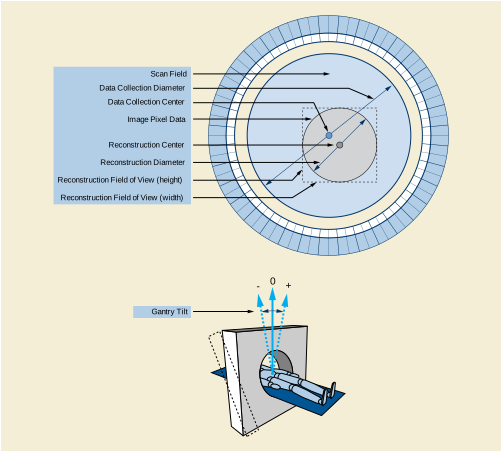
Table C.8.22-15 specifies the attributes of the PET Frame Correction Factors Functional Group Macro.
Table C.8.22-15. PET Frame Correction Factors Macro Attributes
|
Attribute Name |
Tag |
Type |
Attribute Description |
|---|---|---|---|
|
PET Frame Correction Factors Sequence |
(0018,9736) |
1 |
Contains the attributes that describe the correction factors applied to this frame. Only a single Item shall be included in this sequence. |
|
>Primary (Prompts) Counts Accumulated |
(0054,1310) |
1C |
The sum of events that occur in the primary event channel. The counts include Trues +Scatter+ Randoms if Corrected Image (0028,0051) includes RAN; otherwise the counts are Trues +Scatter. Required if Frame Type (0008,9007) Value 1 is ORIGINAL. May be present otherwise. |
|
>Slice Sensitivity Factor |
(0054,1320) |
1C |
The slice-to-slice sensitivity correction factor that was used to correct this frame. The value shall be one if no slice sensitivity correction was applied. Required if Frame Type (0008,9007) Value 1 is ORIGINAL. May be present otherwise. |
|
>Decay Factor |
(0054,1321) |
1C |
The decay factor that was used to scale this frame. Required if Decay Corrected (0018,9758) equals YES. |
|
>Scatter Fraction Factor |
(0054,1323) |
1C |
An estimate of the fraction of acquired counts that were due to scatter and that were corrected in this frame. The value shall be zero if no scatter correction was applied. Required if Frame Type (0008,9007Value 1 is ORIGINAL. May be present otherwise. |
|
>Dead Time Factor |
(0054,1324) |
1C |
The average dead time correction factor that was applied to this frame. The value shall be one if no dead time correction was applied. Required if Frame Type (0008,9007) Value 1 is ORIGINAL. May be present otherwise. |
Table C.8.22-17 specifies the attributes of the PET Reconstruction Functional Group Macro, which describe the method used to reconstruct this image.
Table C.8.22-17. PET Reconstruction Macro Attributes
|
Attribute Name |
Tag |
Type |
Attribute Description |
|---|---|---|---|
|
PET Reconstruction Sequence |
(0018,9749) |
1 |
Contains the attributes describing the reconstruction process for this frame. Only a single Item shall be included in this sequence. |
|
>Reconstruction Type |
(0018,9756) |
1C |
Description of the type of algorithm used when reconstructing the image from the data acquired during the acquisition process. Defined Terms:
Required if Frame Type (0008,9007) Value 1 equals ORIGINAL. May be present otherwise. |
|
>Reconstruction Algorithm |
(0018,9315) |
1C |
Description of the algorithm used when reconstructing the image from the data acquired during the acquisition process. Defined Terms:
Required if Frame Type (0008,9007) Value 1 of this frame is ORIGINAL. May be present otherwise. |
|
>Iterative Reconstruction Method |
(0018,9769) |
1 |
Iterative Reconstruction Method used. Enumerated Values:
|
|
>Number of Iterations |
(0018,9739) |
1C |
Number of iterations. Required if Frame Type (0008,9007) Value 1 equals ORIGINAL and Iterative Reconstruction Method (0018,9769) equals YES. May be present otherwise. |
|
>Number of Subsets |
(0018,9740) |
1C |
Number of subsets. Required if Frame Type (0008,9007)) Value 1 equals ORIGINAL and Iterative Reconstruction Method (0018,9769) equals YES. May be present otherwise. |
|
>Reconstruction Diameter |
(0018,1100) |
1C |
The diameter in mm of the region from which data were used in creating the reconstruction of the image. Data may exist outside this region and portions of the patient may exist outside this region. See Section C.8.22.5.4.1. Required if Frame Type (0008,9007) Value 1 equals ORIGINAL and Reconstruction Field of View (0018,9317) is not present. Otherwise may be present if Frame Type (0008,9007) Value 1 equals DERIVED and Reconstruction Field of View (0018,9317) is not present. |
|
>Reconstruction Field of View |
(0018,9317) |
1C |
The field of view width (x-dimension) followed by height (y-dimension) as used for reconstruction in mm. Required if Image Type (0008,9007) Value 1 equals ORIGINAL and Reconstruction Diameter (0018,1100) is not present. Otherwise may be present if Frame Type (0008,9007) Value 1 equals DERIVED and Reconstruction Diameter (0018,1100) is not present. |
Table C.8.22-18 specifies the attributes of the PET Table Dynamics Functional Group Macro, which describes the table motion during acquisition of the data.
Table C.8.22-18. PET Table Dynamics Macro Attributes
|
Attribute Name |
Tag |
Type |
Attribute Description |
|---|---|---|---|
|
PET Table Dynamics Sequence |
(0018,9734) |
1 |
Contains the attributes describing the movement of the PET Table. Only a single Item shall be included in this sequence. |
|
>Table Speed |
(0018,9309) |
1 |
The distance in mm that the Table moves in one second during the gathering of data that resulted in this frame. |
Table C.8.22-19 specifies the attributes of the Enhanced PET Corrections Module.
Table C.8.22-19. Enhanced PET Corrections Module Attributes
|
Attribute Name |
Tag |
Type |
Attribute Description |
|---|---|---|---|
|
Counts Source |
(0054,1002) |
1 |
The primary source of counts. Enumerated Values:
|
|
Decay Corrected |
(0018,9758) |
1 |
Decay (DECY) correction has been applied to image. Enumerated Values:
|
|
Attenuation Corrected |
(0018,9759) |
1 |
Attenuation (ATTN) correction has been applied to image. Enumerated Values:
|
|
Scatter Corrected |
(0018,9760) |
1 |
Scatter (SCAT) correction has been applied to image. Enumerated Values:
|
|
Dead Time Corrected |
(0018,9761) |
1 |
Dead time (DTIM) correction has been applied to image. Enumerated Values:
|
|
Gantry Motion Corrected |
(0018,9762) |
1 |
Gantry motion (MOTN) correction has been applied to image. Enumerated Values:
|
|
Patient Motion Corrected |
(0018,9763) |
1 |
Patient motion (PMOT) correction has been applied to image. Enumerated Values:
|
|
Count Loss Normalization Corrected |
(0018,9764) |
1 |
Count loss (CLN) normalization correction has been applied to image. Enumerated Values:
|
|
Randoms Corrected |
(0018,9765) |
1 |
Randoms (RAN) correction has been applied to image. Enumerated Values:
|
|
Non-uniform Radial Sampling Corrected |
(0018,9766) |
1 |
Non-uniform radial sampling (RADL) correction has been applied to image. Enumerated Values:
|
|
Sensitivity Calibrated |
(0018,9767) |
1 |
Image is sensitivity calibrated using a dose calibrator (DCAL). Enumerated Values:
|
|
Detector Normalization Correction |
(0018,9768) |
1 |
Detector normalization (NORM) correction has been applied to image. Enumerated Values:
|
|
Randoms Correction Method |
(0054,1100) |
1C |
Type of randoms correction processing. Defined Terms:
Required if Randoms Corrected (0018,9765) equals YES. |
|
Attenuation Correction Source |
(0018,9738) |
1C |
Contains the source of the attenuation map information used for attenuation correction. See Section C.8.22.3.1.2 Required if Attenuation Corrected (0018,9759) equals YES. |
|
Attenuation Correction Temporal Relationship |
(0018,9770) |
1C |
Contains the temporal relationship between the attenuation correction source image and the PET image data. See Section C.8.22.3.1.3 Required if Attenuation Corrected (0018,9759) equals YES. |
|
Scatter Correction Method |
(0054,1105) |
1C |
A textual description of the scatter correction processing. e.g., convolution-subtraction, dual energy window, model-based, use of attenuation data. Required if Scatter Corrected (0018,9760) equals YES. |
|
Decay Correction DateTime |
(0018,9701) |
1C |
The date and time to which all frames in this Image were decay corrected. Required if Decay Corrected (0018,9758) equals YES. |
This section describes the specific modules for the Surface Segmentation IOD.
Table C.8.23-1 defines the general Attributes of the Surface Segmentation Module.
Table C.8.23-1. Surface Segmentation Module Attributes
|
Attribute Name |
Tag |
Type |
Attribute Description |
|---|---|---|---|
|
Include Table 10-12 “Content Identification Macro Attributes” |
|||
|
Content Date |
(0008,0023) |
1 |
The date the content creation started. |
|
Content Time |
(0008,0033) |
1 |
The time the content creation started. |
|
Segment Sequence |
(0062,0002) |
1 |
Describes the segments that are contained within the data. One or more Items shall be included in this sequence. |
|
>Include Table C.8.20-4 “Segment Description Macro Attributes” |
|||
|
>Surface Count |
(0066,002A) |
1 |
The number of surfaces that comprise this segment. Shall be greater than zero. |
|
>Referenced Surface Sequence |
(0066,002B) |
1 |
Sequence referencing the surfaces composed to construct this segment. One or more Items shall be included in this sequence. The number of Items shall equal the value of Surface Count (0066,002A). |
|
>>Referenced Surface Number |
(0066,002C) |
1 |
Identifies the Surface Number (0066,0003) within the Surface Sequence (0066,0002) to which this reference applies. |
|
>>Segment Surface Generation Algorithm Identification Sequence |
(0066,002D) |
1 |
A description of how this segment surface was derived. Only a single Item shall be included in this sequence. |
|
>>>Include Table 10-19 “Algorithm Identification Macro Attributes” |
For Algorithm Family Code Sequence (0066,002F) Baseline CID 7162 “Surface Processing Algorithm Families”. |
||
|
>>Segment Surface Source Instance Sequence |
(0066,002E) |
2 |
A Sequence that identifies the set of Instances by their SOP Class/Instance pair that were used to derive this segment surface. Zero or more items shall be included in this Sequence. |
|
>>>Include Table 10-3 “Image SOP Instance Reference Macro Attributes” |
|||
Table C.8.24.1-1 specifies attributes for the Enhanced US Series Module, including specialization of attributes in the General Series Module for use in the Enhanced US Series Module.
Table C.8.24.1-1. Enhanced US Series Module Attributes
|
Attribute Name |
Tag |
Type |
Attribute Description |
|---|---|---|---|
|
Modality |
(0008,0060) |
1 |
Type of equipment that originally acquired the data used to create the images in this Series. Enumerated Values:
See Section C.7.3.1.1.1 for further explanation. |
|
Referenced Performed Procedure Step Sequence |
(0008,1111) |
1C |
Uniquely identifies the Performed Procedure Step SOP Instance to which the Series is related. Only a single Item shall be included in this sequence. Required if a Performed Procedure Step SOP Class was involved in the creation of this Series. |
|
>Include Table 10-11 “SOP Instance Reference Macro Attributes” |
|||
|
Performed Protocol Code Sequence |
(0040,0260) |
1C |
Sequence describing a Protocol being followed for this Procedure Step. Only a single Item shall be included in this sequence. Required if a Protocol is controlling the creation of this Series. May be present otherwise. |
|
Baseline CID 12001 “Ultrasound Protocol Types”. |
|||
|
>Protocol Context Sequence |
(0040,0440) |
3 |
Sequence that specifies the context for the Performed Protocol Code Sequence Item. One or more items are permitted in this sequence. |
|
>>Include Table 10-2 “Content Item Macro Attributes Description” |
No Baseline TID is defined. |
||
|
>>Content Item Modifier Sequence |
(0040,0441) |
3 |
Sequence that specifies modifiers for a Protocol Context Content Item. One or more items are permitted in this sequence. See Section C.4.10.1. |
|
>>>Include Table 10-2 “Content Item Macro Attributes Description” |
No Baseline TID is defined. |
||
|
Performed Protocol Type |
(0040,0261) |
1C |
Type of protocol performed. Enumerated Values:
Required if Performed Protocol Code Sequence (0040,0260) is present. |
Table C.8.24.2-1 specifies the attributes of the Ultrasound Frame Of Reference Module. See Section C.8.24.2.1.
Table C.8.24.2-1. Ultrasound Frame of Reference Module Attributes
|
Attribute Name |
Tag |
Type |
Attribute Description |
|---|---|---|---|
|
Volume Frame of Reference UID |
(0020,9312) |
1 |
Uniquely identifies this Volume Frame of Reference. |
|
Ultrasound Acquisition Geometry |
(0020,9307) |
1 |
Characteristic of the ultrasound acquisition geometry. Defined Terms:
|
|
Apex Position |
(0020,9308) |
1C |
Position of the apex (or phase center) of the acquisition geometry, encoded as xA, yA, and zA in mm units in the Volume Frame of Reference. The apex (xA, yA, zA) may be located in the volume or exterior to it. Required if value of Ultrasound Acquisition Geometry (0020,9307) is APEX. |
|
Volume to Transducer Relationship |
(0020,930B) |
1C |
Relationship between the transducer and the acquired volume. Enumerated Values:
Required if the transducer position and/or orientation relative to the volume is not constant. May be present otherwise. |
|
Volume to Transducer Mapping Matrix |
(0020,9309) |
1 |
A 4x4 rigid transformation matrix that maps the Volume Frame of Reference homogeneous coordinate system (XV, YV, ZV) to the Transducer Frame of Reference homogeneous coordinate system (XX,YX, ZX). Matrix elements shall be listed in row-major order. See Section C.8.24.2.1 for details. |
|
Patient Frame of Reference Source |
(0020,930C) |
1C |
Indicates how the supplied Image Position (Patient) (0020,0032) and Image Orientation (Patient) (0020,0037) values are obtained. Enumerated Values:
Required if either Image Position (Patient) (0020,0032) or Image Orientation (Patient) (0020,0037) is present. |
|
Table Frame of Reference UID |
(0020,9313) |
1C |
Uniquely identifies this Table Frame of Reference. Required if Patient Frame of Reference Source (0020,930C) is TABLE. |
|
Volume to Table Mapping Matrix |
(0020,930A) |
1C |
A 4x4 rigid transformation matrix that maps the Volume Frame of Reference homogeneous coordinate system (XV,YV, ZV) to the Table Frame of Reference homogeneous coordinate system (XT,YT, ZT). Matrix elements shall be listed in row-major order. See Section C.8.24.2.2 for details. Required if Patient Frame of Reference Source (0020,930C) is TABLE. |
The Ultrasound Frame of Reference Module is used to relate the image planes to a frame of reference appropriate for the ultrasound modality, most notably a volume-based frame of reference. There are many different transducer scan acquisition geometries used in 3D ultrasound imaging. Regardless of the acquisition geometry, after acquisition of the initial scan images comprising the volume, the ultrasound (US) scanner will assemble (reformat) the data into a proper Cartesian volume with the assumption that the data are related through a Right-Hand Coordinate System (RHCS). x-positions are defined in mm with positive values increasing towards the right. y-positions are defined in mm with positive values in the direction of increasing image depth. z-positions are defined in mm with positive values in the direction as defined in a right-hand coordinate system.
A Cartesian volume will consist of a series of 1 to n parallel planes. The image planes comprising the Cartesian volume are typically oriented during creation of the volume so that the best image quality is in the XY plane. Table C.8.24.2-1 specifies the attributes of the Ultrasound Frame of Reference Module. There are three levels of detail for the Ultrasound Frame of Reference: Volume, Transducer and Table.
The Volume Frame of Reference is a Right-hand Coordinate System consisting of a Volume Origin at the location (0,0,0) and mutually orthogonal XV, YV, and ZV axes in a Right-Hand Coordinate System. The particular IOD using the Volume Frame of Reference may constrain the alignment of frames with respect to the axes of the Volume Frame of Reference. For example, Figure C.8.24.2-1 illustrates the use of the Volume Frame of Reference with frames whose rows are parallel to the XV axis and columns are parallel to the YV axis and whose origins lie on the ZV axis.
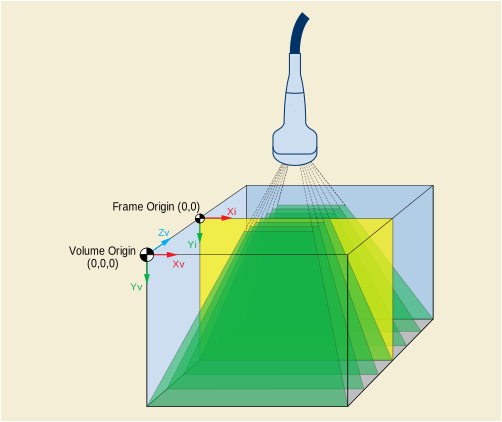
The Transducer Frame of Reference is a Right-hand Coordinate System consisting XX, YX, and ZX axes originating at a reference "Transducer Origin" defined as the geometric center of the transducer face.
The orientation of the Transducer Frame of Reference relative to the Volume Origin is such that the YX axis is normal to the transducer face and the "direction reference" (i.e., transducer tactile marker or zero reference) is aligned with the positive XX axis. A transformation is specified between the Volume Frame of Reference and the Transducer Frame of Reference to define the position of the transducer relative to the volume. This transformation is specified by the Volume to Transducer Mapping Matrix (0020,9309).
The Transducer Frame of Reference recognizes two types of scan geometry: 1) a scan geometry with a real apex such as would be the case for a pyramid, toroid or rotational volume acquisition, or 2) a scan geometry for which there is no specific apex. The point (xA, yA, zA) is the apex (or phase center) of the acquisition volume geometry in the Volume Frame of Reference. The apex (xA, yA, zA) may be located in the volume or exterior to it.
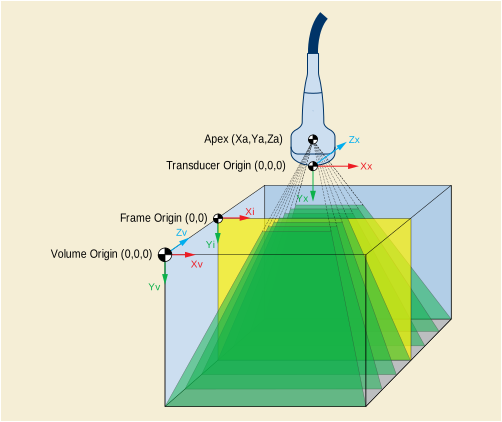
In some acquisition modalities, the transducer position and/or orientation changes during acquisition and a single transducer mapping matrix is insufficient to describe the relationship between transducer and volume. In this case, Volume to Transducer Relationship (0020,930B) is required and specifies the nature of the relationship Transducer Frame of Reference and the Volume Frame of Reference.
There also may exist a fixed equipment reference called the Table Frame of Reference, a Right-hand Coordinate System consisting of XT, YT, and ZT axes originating at a reference "Table Origin". See Figure C.8.24.2-3.
Note
In this context the Table Frame of Reference refers to a fixed coordinate system in space that may be provided by a variety of source devices such as coordinates from a magnetic position sensor, LED sensor array, a physical scanner gantry, or similar device.
A transformation may be specified between the Volume Frame of Reference and the Table Frame of Reference to define the position and orientation of the volume relative to this external frame of reference. This transformation is specified by the Volume to Table Mapping Matrix (0020,930A).
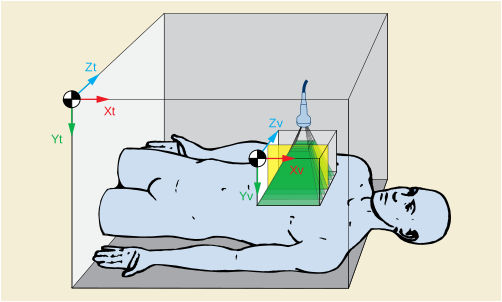
The Volume to Transducer Mapping Matrix (0020,9309) is used to describe the relationship between the Transducer Frame of Reference coordinate system and the Volume Frame of Reference coordinate system.
The Volume to Transducer Mapping Matrix ([MTV] = [P]*[Q]) describes how to transform a point (XV, YV, ZV) in the Volume coordinate system into (XX,YX, ZX) in the Transducer coordinate system according to the equation below.
Where:
- XVYVZV
The voxel location (in mm) in the Volume Frame of Reference
- XXYXZX
The voxel location (in mm) in the Transducer Frame of Reference
- Pij,Pij,Pij
A 3x3 matrix of direction cosine values as measured to the Transducer origin from the volume origin.
- Qx,Qy,Qz
The translation values (in mm) describe the location in mm of the Transducer Frame of Reference (XX,YX, ZX) origin from the Volume Reference Origin (XV,YV, ZV) measured in millimeters along the Volume axes i.e., to the transducer origin from the volume origin.
The Volume to Table Mapping Matrix (0020,930A) is used to describe the relationship between the Volume Frame of Reference coordinate system and a modality specific equipment coordinate system. This mapping can be used only with systems that have a well-defined equipment coordinate system.
The Volume to Table Mapping Matrix([MVG] = [R]*[S]) describes how to transform a point (XVYVZV) in the Volume coordinate system into (XT, YT, ZT) in the Table coordinate system according to the equation below.
Where:
- XVYVZV
The voxel location (in mm) in the Volume Frame of Reference
- XTYTZT
The voxel location (in mm) in the Table Frame of Reference
- Rij,Rij,Rij
A 3x3 matrix of direction cosine values as measured to the gantry origin from the volume origin.
- Sx,Sy,Sz
The translation values (in mm) describe the location in mm of the Table Frame of Reference (XT, YT, ZT) origin from the Volume Reference Origin (XV,YV, ZV) measured in millimeters along the table axes i.e., to the table origin from the volume origin.
Note
The Mapping Matrices are rigid transformations that involve only translations and rotations. Mathematically, the matrix is orthonormal and describes six degrees of freedom: three translations, and three rotations.
Table C.8.24.3-1 specifies the Attributes that describe the Enhanced US Image Module. As described in Section A.1.2.6, the Attributes in this Module apply to the first frame of a multi-frame image; any or all of this information may be overridden by Attributes in Per-frame Functional Groups.
Table C.8.24.3-1. Enhanced US Image Module Attributes
|
Attribute Name |
Tag |
Type |
Attribute Description |
|---|---|---|---|
|
Image Type |
(0008,0008) |
1 |
Image identification characteristics. See Section C.8.24.3.2 for specialization. |
|
Samples Per Pixel |
(0028,0002) |
1 |
Number of samples per pixel in this image. Enumerated Values:
|
|
Photometric Interpretation |
(0028,0004) |
1 |
Specifies the intended interpretation of the pixel data. Enumerated Values:
|
|
Bits Allocated |
(0028,0100) |
1 |
Number of bits allocated for each pixel sample. Enumerated Values:
|
|
Bits Stored |
(0028,0101) |
1 |
Number of bits stored for each pixel sample. Enumerated Values:
|
|
High Bit |
(0028,0102) |
1 |
Most significant bit for pixel sample data. Enumerated Values:
|
|
Pixel Representation |
(0028,0103) |
1 |
Data representation of pixel samples. The constrained Enumerated Value implies the VR of all Palette Color Lookup Table Descriptors be US (and not SS). Enumerated Values:
See Section C.8.24.3.1 for specialization. |
|
Dimension Organization Type |
(0020,9311) |
1 |
Dimension organization of the instance. Enumerated Values:
See Section C.8.24.3.3 for details. |
|
Acquisition DateTime |
(0008,002A) |
1 |
The date and time that the acquisition of data that resulted in this image started. |
|
Acquisition Duration |
(0018,9073) |
1 |
Duration of the image acquisition in seconds. |
|
Pixel Spacing |
(0028,0030) |
1 |
Physical distance in the patient between the centers of adjacent pixels, specified by a numeric pair - adjacent row spacing (delimiter) adjacent column spacing, in mm. See Section 10.7.1.3 for further explanation of the value order. |
|
Position Measuring Device Used |
(0018,980C) |
1C |
Describes the type of position measuring device used in the acquisition of the image, if any. This gives an indication of the degree of precision of Pixel Spacing (0028,0030) and the spacing between adjacent planes. Enumerated Values:
Required if Volumetric Properties (0008,9206) is VOLUME and Volume Based Calculation Technique (0008,9207) is NONE. May be present otherwise. |
|
Lossy Image Compression |
(0028,2110) |
1 |
Specifies whether an Image has undergone lossy compression (at a point in its lifetime). Enumerated Values:
Once this value has been set to 01 it shall not be reset. See Section C.7.6.1.1.5. |
|
Lossy Image Compression Ratio |
(0028,2112) |
1C |
Describes the approximate lossy compression ratio(s) that have been applied to this image. See Section C.7.6.1.1.5 for further explanation. May be multi-valued if successive lossy compression steps have been applied; the value order shall correspond to the values of Lossy Image Compression Method (0028,2114). Note
Required if Lossy Image Compression (0028,2110) is "01". |
|
Lossy Image Compression Method |
(0028,2114) |
1C |
A label for the lossy compression method(s) that have been applied to this image. See Section C.7.6.1.1.5 for further explanation. May be multi-valued if successive lossy compression steps have been applied; the value order shall correspond to the values of Lossy Image Compression Ratio (0028,2112). NoteFor historical reasons, the lossy compression method may also be described in Derivation Description (0008,2111). Required if Lossy Image Compression (0028,2110) is "01". |
|
Presentation LUT Shape |
(2050,0020) |
1 |
Specifies an identity transformation for the Presentation LUT, such that the output of all grayscale transformations defined in the IOD containing this Module are defined to be P-Values. Enumerated Values:
|
|
Rescale Intercept |
(0028,1052) |
1 |
The value b in relationship between stored values (SV) and the output units. Output units = m*SV + b. Enumerated Values:
|
|
Rescale Slope |
(0028,1053) |
1 |
m in the equation specified by Rescale Intercept (0028,1052). Enumerated Values:
|
|
Source Image Sequence |
(0008,2112) |
1C |
A Sequence that identifies the set of Image SOP Class/Instance pairs of the Images that were used to derive this Image. One or more Items shall be included in this Sequence. See Section C.7.6.1.1.4 for further explanation. Required if Image Type (0008,0008) Value 1 is DERIVED. |
|
>Include Table 10-3 “Image SOP Instance Reference Macro Attributes” |
|||
|
>Purpose of Reference Code Sequence |
(0040,A170) |
1 |
Describes the purpose for which the reference is made. Only a single item shall be included in this sequence. |
|
Referenced Image Sequence |
(0008,1140) |
3 |
A sequence that references other images significantly related to this image. (e.g., an image containing spatially related frames) One or more Items are permitted in this sequence. |
|
>Include Table 10-3 “Image SOP Instance Reference Macro Attributes” |
|||
|
>Purpose of Reference Code Sequence |
(0040,A170) |
1 |
Describes the purpose for which the reference is made. Only a single item shall be included in this sequence. |
|
Referenced Raw Data Sequence |
(0008,9121) |
3 |
A sequence that identifies the set of Raw Data SOP Class/Instance pairs of the raw data that were used to derive this Image. One or more Items are permitted in this Sequence. |
|
>Include Table C.17-3 “Hierarchical SOP Instance Reference Macro Attributes” |
|||
|
Referenced Instance Sequence |
(0008,114A) |
1C |
A sequence that provides reference to a set of non-image SOP Class/Instance pairs significantly related to this Image, including waveforms that may or may not be temporally synchronized with this image. One or more Items shall be included in this sequence. Required if waveforms are acquired in conjunction with image acquisition. May be present otherwise. |
|
>Include Table 10-11 “SOP Instance Reference Macro Attributes” |
|||
|
>Purpose of Reference Code Sequence |
(0040,A170) |
1 |
Code describing the purpose of the reference to the Instance(s). Only a single Item shall be included in this sequence. |
|
Defined CID 7004 “Waveform Purposes of Reference” for referenced waveforms. |
|||
|
Number of Stages |
(0008,2124) |
1C |
Number of stages in this protocol. Required if Performed Protocol Type (0040,0261) is present with value STAGED. |
|
Stage Number |
(0008,2122) |
1C |
A number that identifies the Stage. Stage Number starts at one. Required if Performed Protocol Type (0040,0261) is present with value STAGED. |
|
Stage Code Sequence |
(0040,000A) |
1C |
Sequence describing the performed Ultrasound Protocol Stage. Only a single item shall be included in this sequence. Required if Performed Protocol Type (0040,0261) is present with value STAGED. |
|
Include Table 10-24 “Mandatory View and Slice Progression Direction Attributes” |
See Section C.8.5.6.1.19 for Context Group ID's. |
||
|
Event Timer Sequence |
(0008,2133) |
3 |
Sequence of time intervals of significance to this image. Each item describes one time interval either beginning or ending at Acquisition DateTime (0008,002A). One or more Items are permitted in this Sequence. |
|
>Event Time Offset |
(0008,2134) |
1 |
Signed value of the time between Acquisition DateTime (0008,002A) and the event, in milliseconds. Positive values indicate the event occurs after Acquisition DateTime (0008,002A). |
|
>Event Code Sequence |
(0008,2135) |
1 |
Type of event. Only a single item shall be included in this sequence. |
|
Defined CID 12031 “Protocol Interval Events”. |
|||
|
>Event Timer Name(s) |
(0008,2132) |
3 |
Name that identifies the event timer. May be used in addition to Event Time Code Sequence to offer site-specific user-readable event time names. Only a single value shall be included. |
|
Include Table 10-5 “General Anatomy Mandatory Macro Attributes” |
No Context IDs are specified. |
||
|
Burned In Annotation |
(0028,0301) |
1 |
Indicates whether or not image contains sufficient burned in annotation to identify the patient and date the image was acquired. Enumerated Values:
|
|
Recognizable Visual Features |
(0028,0302) |
3 |
Indicates whether or not the image contains sufficiently recognizable visual features to allow the image or a reconstruction from a set of images to identify the patient. Enumerated Values:
If this Attribute is absent, then the image may or may not contain recognizable visual features. |
|
Icon Image Sequence |
(0088,0200) |
3 |
This icon image is representative of the image. Only a single item is permitted in this sequence. |
|
See Section C.7.6.1.1.6 for further explanation. |
|||
|
Transducer Data |
(0018,5010) |
3 |
Manufacturer defined code or description |
|
Transducer Scan Pattern Code Sequence |
(0018,9809) |
1 |
The scan pattern the transducer is capable of. Only a single item shall be included in this sequence. See Section C.8.24.3.4 for further explanation. |
|
Defined CID 12032 “Transducer Scan Pattern”. |
|||
|
Transducer Geometry Code Sequence |
(0018,980D) |
1 |
Geometric structure of the transducer. Only a single item shall be included in this sequence. See Section C.8.24.3.4 for further explanation. |
|
Transducer Beam Steering Code Sequence |
(0018,980E) |
1 |
Technique used by the transducer for beam steering. One or more items shall be included in this sequence. If more than one item is present, the order is significant from plane-forming technique to volume-forming technique. See Section C.8.24.3.4 for further explanation. |
|
Transducer Application Code Sequence |
(0018,980F) |
1 |
The primary clinical application of the transducer. Only a single Item shall be included in this sequence. See Section C.8.24.3.4 for further explanation. |
|
Processing Function |
(0018,5020) |
3 |
Manufacturer defined description of processing of echo information. Data may include code or description of gain (initial, overall, TGC, dynamic range, etc.), pre-processing, post-processing, Doppler processing parameters, e.g., cutoff filters, etc., as used in generating a given image. |
|
Mechanical Index |
(0018,5022) |
1 |
See Section C.8.5.6.1.8 for Description. |
|
Bone Thermal Index |
(0018,5024) |
1 |
See Section C.8.5.6.1.8 for Description. |
|
Cranial Thermal Index |
(0018,5026) |
1 |
See Section C.8.5.6.1.8 for Description. |
|
Soft Tissue Thermal Index |
(0018,5027) |
1 |
See Section C.8.5.6.1.8 for Description. |
|
Depth(s) of Focus |
(0018,9801) |
1 |
The depth or depths from the transducer face, of the manufacturer defined beam focus points used for the image, in mm. |
|
Depth of Scan Field |
(0018,5050) |
1 |
The depth, in mm, from the transducer face to the deepest point included in the image- the field of view. |
Pixel Representation (0028,0103) is specified to be Type 1 with the constraint that VR for all the pixel data will always be unsigned (US) and not signed (SS).
Enumerated Values:
- 0000H
unsigned integer
Note
The real-world values that are inherently signed (e.g., Flow Velocity, Tissue Velocity, Variance) are represented as unsigned, unitless pixel values and may be mapped to signed real-world quantities via the Real World Value Mapping Macro.
Image Type (0008,0008) is specified to be Type 1 with the following constraints:
Enumerated Values for Value 1:
- ORIGINAL
- DERIVED
Enumerated Values for Value 2:
- PRIMARY
Value 3 (Image Flavor) and Value 4 are not used
Dimension Organization Type (0020,9311) specifies the general structure of the image. The concept of "multi-frame dimensions" as specified by the Dimension Index Sequence (0020,9222) and per-frame Dimension Index Values (0020,9157) shall be used to specify the relationships of frames within that general structure.
If Dimension Organization Type (0020,9311) has values of 3D or 3D_TEMPORAL, then the Dimension Index Sequence (0020,9222) shall have exactly three items, with the dimension values described in Table C.8.24.3.3-1.
Table C.8.24.3.3-1. Dimension Definition for US Acquisition 3D Images
|
Item |
Attribute |
Tag |
Value |
|---|---|---|---|
|
Dimension Index Sequence |
(0020,9222) |
||
|
1st |
>Dimension Index Pointer |
(0020,9165) |
Tag of attribute specifying temporal position of frames |
|
>Functional Group Pointer |
(0020,9167) |
Tag of sequence containing above attribute |
|
|
… |
|||
|
2nd |
>Dimension Index Pointer |
(0020,9165) |
(0020,9301) Image Position (Volume) |
|
>Functional Group Pointer |
(0020,9167) |
(0020,930E) Plane Position (Volume) Sequence |
|
|
… |
|||
|
3rd |
>Dimension Index Pointer |
(0020,9165) |
(0018,9808) Data Type |
|
>Functional Group Pointer |
(0020,9167) |
(0018,9807) Image Data Type Sequence |
|
|
… |
|||
The Dimension Index Values (0020,9157) corresponding to these dimension variables positively associate frames with different Data Type values at the same spatial and temporal position. Figure C.8.24.3.3-1 illustrates the use of Dimensions to associate frames with temporal, spatial, and Data Type dimensions.
These Dimension values shall be used even if there is only one possible value for a Dimension.
Note
For example, if Dimension Organization Type (0020,9311) has the value 3D, the temporal position dimension is present and the dimension index of the temporal attribute is the same in every frame of the image. Similarly, if the Data Type attribute is in the Shared Functional Group and all frames in the object are of Data Type TISSUE_INTENSITY, the Data Type dimension is present and the dimension index of the Data Type dimension is the same in every frame of the image.
Each plane in the volume consists of one or more frames each with a distinct value of Data Type (0018,9808). Adjacent planes in the volume shall be equally spaced in the Z direction.
Each frame comprising a volume shall have the same value of the temporal dimension attribute. Any appropriate physiological event temporal attribute may be used to specify the temporal position. If there is no specific physiological event to which the temporal position of frames is referenced, then Temporal Position Time Offset (0020,930D) in the Temporal Position Sequence (0020,9310) may be used as the temporal dimension attribute. If all frames are at the same temporal position, any temporal attribute may be referenced.
Note
For example, the attribute specifying temporal position of frames may be any appropriate temporal attribute, such as Nominal Cardiac Trigger Delay Time (0020,9153) or Nominal Percentage of Cardiac Phase (0020,9241) in the Cardiac Synchronization Sequence (0018,9118) if the temporal position of frames is referenced to the cardiac R-wave, or Nominal Respiratory Trigger Delay Time (0020,9255) or Nominal Percentage of Respiratory Phase (0020,9245) in the Respiratory Synchronization Sequence (0020,9253) if the temporal position of frames is referenced to the latest inspiration maximum.
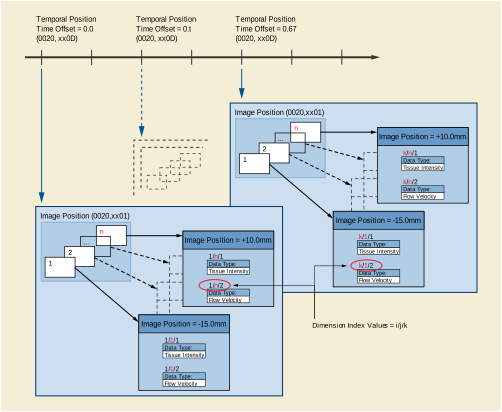
The following elements together describe the type of transducer used to acquire the image. These are characteristics of the transducer itself rather than its specific use in the acquisition of this image. In other words, these attribute values are determined from the construction and design of the transducer and a given transducer generally has the same values of these attributes in every image it is used to create.
Transducer Scan Pattern Code Sequence (0018,9809)
The shape of the acoustic scan field the transducer is capable of.
Transducer Geometry Code Sequence (0018,980D)
The physical scan aperture from which acoustic pulses are emitted and received.
Transducer Beam Steering Code Sequence (0018,980E)
The method used to steer acoustic beam.
Transducer Application Code Sequence (0018,980F)
The placement on the subject for which the transducer is designed.
Each probe model has a unique set of values of these attributes. For example, these sample probes have the following characteristics, which are encoded in the attributes above:
Table C.8.24.3.4-1. Sample Transducer Characteristics
|
Model |
Scan Pattern |
Geometry |
Beam Steering |
Application |
|---|---|---|---|---|
|
Pedoff CW |
Line |
NonImaging |
Fixed direction |
External |
|
Phased array sector probe |
Plane |
Sector |
Phased |
External |
|
Steerable TEE |
Plane |
Sector |
Phased, Mechanical |
Transesophogeal |
|
Curved Linear Abdominal |
Plane |
Curved Linear |
Phased |
External |
|
Endovaginal |
Plane |
Curved Linear |
Phased |
Endovaginal |
|
Mechanical 3D |
Volume |
Sector |
Phased, Mechanical |
External |
|
Phased 3D |
Volume |
Sector |
Phased |
External |
|
Endovaginal 3D |
Volume |
Curved Linear |
Phased, Mechanical |
Endovaginal |
Table C.8.24.4-1 specifies the Attributes of an IVUS Module.
Table C.8.24.4-1. IVUS Image Module Attributes
|
Attribute Name |
Tag |
Type |
Attribute Description |
|---|---|---|---|
|
IVUS Acquisition |
(0018,3100) |
1 |
Defined Terms:
|
|
IVUS Pullback Rate |
(0018,3101) |
1C |
Required if IVUS Acquisition (0018,3100) value is MOTOR_PULLBACK. Specified in units of mm/sec. |
|
IVUS Gated Rate |
(0018,3102) |
1C |
Required if IVUS Acquisition (0018,3100) value is GATED_PULLBACK. Specified in units of mm/beat. |
|
IVUS Pullback Start Frame Number |
(0018,3103) |
1C |
Required if IVUS Acquisition (0018,3100) value is MOTOR_PULLBACK or GATED_PULLBACK. |
|
IVUS Pullback Stop Frame Number |
(0018,3104) |
1C |
Required if IVUS Acquisition (0018,3100) value is MOTOR_PULLBACK or GATED_PULLBACK. |
The Excluded Intervals Module indicates those periods within Acquisition Duration (0018,9073) during which no volume acquisition takes place. It provides information not available at the frame level or image level, since individual frames of the volume may have been built-up over a time period within which some intervals were excluded from acquisition. Further, it provides information that is not specific to associated waveform objects since the fact that volume acquisition was excluded during these intervals is a characteristic of the volume, not the associated waveform(s), see Figure C.8.24.5-1. Table C.8.24.5-1 specifies the attributes of the Excluded Intervals Module.
Note
For example, if the imaging device performing a gated volume acquisition excludes volume data acquired during an ectopic beat, the Excluded Intervals attributes would be used to mark this interval in an associated physio waveform display.
Table C.8.24.5-1. Excluded Intervals Module Attributes
|
Attribute Name |
Tag |
Type |
Attribute Description |
|---|---|---|---|
|
Excluded Intervals Sequence |
(0018,9803) |
1C |
List of excluded intervals. One or more items shall be included in this sequence. Required if one or more intervals was excluded. |
|
>Exclusion Start DateTime |
(0018,9804) |
1 |
Time-point of the exclusion start in the same Synchronization Frame of Reference as Acquisition DateTime (0008,002A). |
|
>Exclusion Duration |
(0018,9805) |
1 |
Duration of the exclusion in ms. |
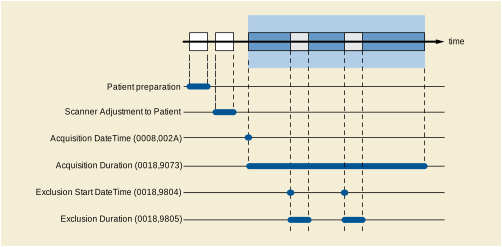
The following sections contain Functional Group Macros specific to the Enhanced US Volume IOD.
Note
The attribute descriptions in the Functional Group Macros are written as if they were applicable to a single frame (i.e., the macro is part of the Per-frame Functional Groups Sequence). If an attribute is applicable to all frames (i.e., the macro is part of the Shared Functional Groups Sequence) the phrase "this frame" in the attribute description shall be interpreted to mean " for all frames".
Table C.8.24.6.1-1 specifies the attributes of the US Image Description Functional Group Macro.
Table C.8.24.6.1-1. US Image Description Macro Attributes
|
Attribute Name |
Tag |
Type |
Attribute Description |
|---|---|---|---|
|
US Image Description Sequence |
(0018,9806) |
1 |
A sequence that describes a general description of this image or frame. Only a single Item shall be included in this sequence. |
|
>Frame Type |
(0008,9007) |
1 |
Type of Frame. A multi-valued attribute analogous to Image Type (0008,0008). Enumerated Values and Defined Terms are the same as those for the four values of Image Type (0008,0008), except that the value MIXED is not allowed. See Section C.8.24.3.2. |
|
>Volumetric Properties |
(0008,9206) |
1 |
Indication if geometric manipulations are possible with frames in the SOP Instance. See Section C.8.16.2.1.2 for a description and Enumerated Values. |
|
>Volume Based Calculation Technique |
(0008,9207) |
1 |
Method used for volume calculations with frames in the SOP Instance. See Section C.8.16.2.1.3 for a description and Defined Terms. |
If Volumetric Properties (0008,9206) is VOLUME and Volume Based Calculation Technique (0008,9207) is NONE, all frames in the frame set shall be spaced the same Z-distance from adjacent frames (i.e., spacing between slices is constant).
The Lensometry Measurements IODs use the General Series module described in Section C.7.3.1, specialized by the Lensometry Measurements Series Module, to describe the DICOM Series Entity described in Section A.1.2.3, and to define what constitutes a Series for the context of Ophthalmic device.
Table C.8.25.1-1 specifies the Attributes that identify and describe general information about the Lensometry Measurements Series.
Table C.8.25.1-1. Lensometry Measurements Series Module Attributes
|
Attribute Name |
Tag |
Type |
Attribute Description |
|---|---|---|---|
|
Modality |
(0008,0060) |
1 |
Type of equipment that originally acquired the data used to create the images in this Series. Enumerated Values:
See Section C.7.3.1.1.1 for further explanation. |
|
Referenced Performed Procedure Step Sequence |
(0008,1111) |
1C |
Uniquely identifies the Performed Procedure Step SOP Instance to which the Series is related. Only a single Item shall be included in this sequence. Required if a Performed Procedure Step SOP Class was involved in the creation of this Series. |
|
>Include Table 10-11 “SOP Instance Reference Macro Attributes” |
|||
The Autorefraction Measurements IODs use the General Series module described in Section C.7.3.1, specialized by the Autorefraction Measurements Series Module, to describe the DICOM Series Entity described in Section A.1.2.3, and to define what constitutes a Series for the context of Ophthalmic device.
Table C.8.25.2-1 specifies the Attributes that identify and describe general information about the Autorefraction Measurements Series.
Table C.8.25.2-1. Autorefraction Measurements Series Module Attributes
|
Attribute Name |
Tag |
Type |
Attribute Description |
|---|---|---|---|
|
Modality |
(0008,0060) |
1 |
Type of equipment that originally acquired the data used to create the images in this Series. Enumerated Values:
See Section C.7.3.1.1.1 for further explanation. |
|
Referenced Performed Procedure Step Sequence |
(0008,1111) |
1C |
Uniquely identifies the Performed Procedure Step SOP Instance to which the Series is related. Only a single Item shall be included in this sequence. Required if a Performed Procedure Step SOP Class was involved in the creation of this Series. |
|
>Include Table 10-11 “SOP Instance Reference Macro Attributes” |
|||
The Keratometry Measurements IODs use the General Series module described in Section C.7.3.1, specialized by the Keratometry Measurements Series Module, to describe the DICOM Series Entity described in Section A.1.2.3, and to define what constitutes a Series for the context of Ophthalmic device.
Table C.8.25.3-1 specifies the Attributes that identify and describe general information about the Keratometry Measurements Series.
Table C.8.25.3-1. Keratometry Measurements Series Module Attributes
|
Attribute Name |
Tag |
Type |
Attribute Description |
|---|---|---|---|
|
Modality |
(0008,0060) |
1 |
Type of equipment that originally acquired the data used to create the images in this Series. Enumerated Values:
See Section C.7.3.1.1.1 for further explanation. |
|
Referenced Performed Procedure Step Sequence |
(0008,1111) |
1C |
Uniquely identifies the Performed Procedure Step SOP Instance to which the Series is related. Only a single Item shall be included in this sequence. Required if a Performed Procedure Step SOP Class was involved in the creation of this Series. |
|
>Include Table 10-11 “SOP Instance Reference Macro Attributes” |
|||
The Subjective Refraction Measurements IODs use the General Series module described in Section C.7.3.1, specialized by the Subjective Refraction Measurements Series Module, to describe the DICOM Series Entity described in Section A.1.2.3, and to define what constitutes a Series for the context of Ophthalmic device.
Table C.8.25.4-1 specifies the Attributes that identify and describe general information about the Subjective Refraction Measurements Series.
Table C.8.25.4-1. Subjective Refraction Measurements Series Module Attributes
|
Attribute Name |
Tag |
Type |
Attribute Description |
|---|---|---|---|
|
Modality |
(0008,0060) |
1 |
Type of equipment that originally acquired the data used to create the images in this Series. Enumerated Values:
See Section C.7.3.1.1.1 for further explanation. |
|
Referenced Performed Procedure Step Sequence |
(0008,1111) |
1C |
Uniquely identifies the Performed Procedure Step SOP Instance to which the Series is related. Only a single Item shall be included in this sequence. Required if a Performed Procedure Step SOP Class was involved in the creation of this Series. |
|
>Include Table 10-11 “SOP Instance Reference Macro Attributes” |
|||
The Visual Acuity Measurements IODs use the General Series module described in Section C.7.3.1, specialized by the Visual Acuity Measurements Series Module, to describe the DICOM Series Entity described in Section A.1.2.3, and to define what constitutes a Series for the context of Ophthalmic device.
Table C.8.25.5-1 specifies the Attributes that identify and describe general information about the Visual Acuity Measurements Series.
Table C.8.25.5-1. Visual Acuity Measurements Series Module Attributes
|
Attribute Name |
Tag |
Type |
Attribute Description |
|---|---|---|---|
|
Modality |
(0008,0060) |
1 |
Type of equipment that originally acquired the data used to create the images in this Series. Enumerated Values:
See Section C.7.3.1.1.1 for further explanation. |
|
Referenced Performed Procedure Step Sequence |
(0008,1111) |
1C |
Uniquely identifies the Performed Procedure Step SOP Instance to which the Series is related. Only a single Item shall be included in this sequence. Required if a Performed Procedure Step SOP Class was involved in the creation of this Series. |
|
>Include Table 10-11 “SOP Instance Reference Macro Attributes” |
|||
Table C.8.25.6.1-1 describes the attributes for the Cylinder Sequence Macro
Table C.8.25.6.1-1. Cylinder Sequence Macro Attributes
|
Attribute Name |
Tag |
Type |
Attribute Description |
|---|---|---|---|
|
Cylinder Sequence |
(0046,0018) |
1C |
A sequence that specifies lens measurements to correct for astigmatism or measurements of an eye that has astigmatism. Required if astigmatic correction or astigmatism is measured. Only a single item shall be included in this sequence. NoteWhen astigmatism is present the power is NOT the same in all meridians, but has its minimum and maximum power in meridians separated by 90 degrees. |
|
>Cylinder Power |
(0046,0147) |
1 |
The power that is present at the power meridian (90 degrees from the axis), in diopters. |
|
>Cylinder Axis |
(0022,0009) |
1 |
The meridian, defined in degrees, that is 90 degrees from the power meridian. |
Table C.8.25.6.2-1 describes the attributes for the Prism Sequence Macro
Table C.8.25.6.2-1. Prism Sequence Macro Attributes
|
Attribute Name |
Tag |
Type |
Attribute Description |
|---|---|---|---|
|
Prism Sequence |
(0046,0028) |
1C |
A sequence that specifies prism that is measured in a lens, or that is required to correct for a patient's ocular misalignment. Required if prism is measured in the lens or if this part of a refraction is done for a patient. Only a single item shall be included in this sequence. NoteA prism is a wedge shaped lens that deviates light toward the base and shifts the apparent image toward its apex. |
|
>Horizontal Prism Power |
(0046,0030) |
1 |
The power of a prism to bend light in the horizontal direction, in prism diopters. |
|
>Horizontal Prism Base |
(0046,0032) |
1 |
Direction of the base of the measured prism -- either in (toward the nose), or out (away from the nose) Enumerated Values:
|
|
>Vertical Prism Power |
(0046,0034) |
1 |
The power of a prism to bend light in the vertical direction, in prism diopters. |
|
>Vertical Prism Base |
(0046,0036) |
1 |
Direction of the base of the measured prism -- either up, or down. Enumerated Values:
|
Table C.8.25.7-1 defines the General Ophthalmic Refractive Measurements module attributes.
Table C.8.25.7-1. General Ophthalmic Refractive Measurements Module Attributes
|
Attribute Name |
Tag |
Type |
Attribute Description |
|---|---|---|---|
|
Instance Number |
(0020,0013) |
1 |
A number that identifies these measurements. |
|
Content Date |
(0008,0023) |
1 |
The date the measurements data creation started. |
|
Content Time |
(0008,0033) |
1 |
The time the measurements data creation started. |
|
Image Comments |
(0020,4000) |
3 |
User-defined comments about this SOP Instance. |
|
Referenced Refractive Measurements Sequence |
(0046,0145) |
2C |
A sequence that specifies Ophthalmic Refractive Measurements SOP Instances that are relevant to the interpretation of this SOP Instance. Zero or more items shall be included in this sequence. See Section C.8.25.7.1.1 for further explanation. Required if Visual Acuity Type Code Sequence (0046,0121) is present. May be present otherwise. |
|
>Include Table 10-11 “SOP Instance Reference Macro Attributes” |
|||
Whenever visual acuity is measured it is necessary to know the conditions under which it was measured. If the vision was measured with the patient's habitual correction in place, this attribute is used to reference a lensometry measurements SOP instance for the current glasses. If the measurements are of the patient's best-corrected vision, this attribute may reference the SOP instance that describes the correction that resulted in that vision, which may for example be the subjective refraction, or the autorefraction.
This attribute enables a receiver of this SOP instance to identify the results of measurements from a lensometer, autorefractor, or automated phoropter (subjective refraction) that are relevant to interpretation.
Table C.8.25.8-1 defines the Attributes used to capture the refractive measurements by a lensometer for spectacles. This is typically for a pair of lenses, but sometimes for just one. Sometimes a single lens is measured with an unknown laterality.
Table C.8.25.8-1. Lensometry Measurements Module Attributes
|
Attribute Name |
Tag |
Type |
Attribute Description |
|---|---|---|---|
|
Lens Description |
(0046,0012) |
2 |
A free text description of the lens and lens general comments. NoteA common example is to identify the specific spectacles measured |
|
Right Lens Sequence |
(0046,0014) |
1C |
A sequence that specifies measurements of a patient's right lens. Required if the right lens is measured. Only a single Item shall be included in this sequence. |
|
>Include Table C.8.25.8-2 “Lensometry Measurements Macro Attributes” |
|||
|
Left Lens Sequence |
(0046,0015) |
1C |
A sequence that specifies measurements of a patient's left lens. Required if the left lens is measured. Only a single Item shall be included in this sequence. |
|
>Include Table C.8.25.8-2 “Lensometry Measurements Macro Attributes” |
|||
|
Unspecified Laterality Lens Sequence |
(0046,0016) |
1C |
A sequence that specifies measurements of one lens of unknown laterality. Only a single Item shall be included in this sequence. Shall not be included if Attribute Right Lens Sequence (0046,0014) or Left Lens Sequence (0046,0015) is present. Required if a single lens of unknown laterality is measured. |
|
>Include Table C.8.25.8-2 “Lensometry Measurements Macro Attributes” |
|||
Table C.8.25.8-2 describes the attributes for the Lensometry Measurements Macro.
Table C.8.25.8-2. Lensometry Measurements Macro Attributes
|
Attribute Name |
Tag |
Type |
Attribute Description |
|---|---|---|---|
|
Sphere Power |
(0046,0146) |
1 |
Refractive power of the lens that is the same in all meridians, measured at distance (optical infinity), in diopters. |
|
Include Table C.8.25.6.1-1 “Cylinder Sequence Macro Attributes” |
|||
|
Add Near Sequence |
(0046,0100) |
1C |
A sequence that specifies refractive measurements of the lens to correct for inability to focus at near while wearing the distance prescription. Only a single item shall be included in this sequence. Required if Add Near is measured in the lens. |
|
>Add Power |
(0046,0104) |
1 |
Additional power relative to the distance correction, expressed in diopters, that allows best corrected visual acuity at the defined viewing distance. |
|
>Viewing Distance |
(0046,0106) |
3 |
The distance, in cm, for testing visual acuity corresponding to the value of Add Power (0046,0104) in this sequence. |
|
Add Intermediate Sequence |
(0046,0101) |
1C |
A sequence that specifies refractive measurements of the lens to correct for inability to focus at intermediate distance while wearing the distance prescription. Only a single item shall be included in this sequence. Required if Add intermediate is measured in the lens. |
|
>Add Power |
(0046,0104) |
1 |
Additional power relative to the distance correction, expressed in diopters, that allows best corrected visual acuity at the defined viewing distance. |
|
>Viewing Distance |
(0046,0106) |
3 |
The distance, in cm, for testing visual acuity corresponding to the value of Add Power (0046,0104) in this sequence item. |
|
Include Table C.8.25.6.2-1 “Prism Sequence Macro Attributes” |
|||
|
Lens Segment Type |
(0046,0038) |
3 |
The type of segment of a lens containing the "add" power, as described above Enumerated Values:
|
|
Optical Transmittance |
(0046,0040) |
3 |
The fraction of light that passes through the measured lens optical media, in percent. |
|
Channel Width |
(0046,0042) |
3 |
In a progressive lens, the width in mm of that portion of the lens where there is gradual or progressive increase in "add" power. NoteSee Attributes, Add Near Sequence (0046,0100) and Add Intermediate Sequence (0046,0101) for description of"add". |
Table C.8.25.9-1 defines the Attributes used to represent the refractive measurements by an autorefractor of a patient's eyes. Usually both eyes are measured, but sometimes just one.
Table C.8.25.9-1. Autorefraction Measurements Module Attributes
|
Attribute Name |
Tag |
Type |
Attribute Description |
|---|---|---|---|
|
Autorefraction Right Eye Sequence |
(0046,0050) |
1C |
A sequence that specifies refractive measurements of a patient's right eye. Only a single item shall be included in this sequence. Required if the right eye is measured. |
|
>Sphere Power |
(0046,0146) |
1 |
Refractive power of the eye that is the same in all meridians, measured at distance (optical infinity), in diopters. |
|
>Include Table C.8.25.6.1-1 “Cylinder Sequence Macro Attributes” |
|||
|
>Pupil Size |
(0046,0044) |
3 |
The horizontal diameter measurement of the pupil, in mm. |
|
>Corneal Size |
(0046,0046) |
3 |
The horizontal diameter measurement of the cornea, in mm. |
|
Autorefraction Left Eye Sequence |
(0046,0052) |
1C |
A sequence that specifies refractive measurements of a patient's left eye. Only a single item shall be included in this sequence. Required if the left eye is measured. |
|
>Sphere Power |
(0046,0146) |
1 |
Refractive power of the eye that is the same in all meridians, measured at distance (optical infinity), in diopters. |
|
>Include Table C.8.25.6.1-1 “Cylinder Sequence Macro Attributes” |
|||
|
>Pupil Size |
(0046,0044) |
3 |
The horizontal diameter measurement of the pupil, in mm. |
|
>Corneal Size |
(0046,0046) |
3 |
The horizontal diameter measurement of the cornea, in mm. |
|
Distance Pupillary Distance |
(0046,0060) |
3 |
Distance in mm between the pupils when the patient's object of regard is in the distance, as measured by an autorefractor. |
|
Near Pupillary Distance |
(0046,0062) |
3 |
Distance in mm between the pupils when the patient's object of regard is at near, as measured by an autorefractor. |
Table C.8.25.10-1 defines the Attributes used to represent the keratometric measurements by a keratometer of a patient's eyes. Usually both eyes are measured, but sometimes just one.
Table C.8.25.10-1. Keratometry Measurements Module Attributes
|
Attribute Name |
Tag |
Type |
Attribute Description |
|---|---|---|---|
|
Keratometry Right Eye Sequence |
(0046,0070) |
1C |
A sequence that specifies keratometric measurements of a patient's right eye, defining principal meridians wherein the steepest meridian is separated by 90 degrees from the flattest. Only a single item shall be included in this sequence. Required if the right eye is measured. NoteConsideration for steep, flat, and spherical meridians is made. For instances where spherical keratometric measurements are obtained, values specified in the steep and flat Attributes are equivalent. |
|
>Include Table C.8.25.10-2 “Keratometric Measurements Macro Attributes” |
|||
|
Keratometry Left Eye Sequence |
(0046,0071) |
1C |
A sequence that specifies keratometric measurements of a patient's left eye, defining principal meridians wherein the steepest meridian is separated by 90 degrees from the flattest. Only a single item shall be included in this sequence. Required if the left eye is measured. NoteSee Note for attribute Keratometry Right Eye Sequence (0046,0070) |
|
>Include Table C.8.25.10-2 “Keratometric Measurements Macro Attributes” |
|||
Table C.8.25.10-2 describes the attributes for the Keratometric Measurements Macro.
Table C.8.25.10-2. Keratometric Measurements Macro Attributes
|
Attribute Name |
Tag |
Type |
Attribute Description |
|---|---|---|---|
|
Steep Keratometric Axis Sequence |
(0046,0074) |
1 |
A sequence that specifies the steepest meridian as defined by the greatest power of curvature and shortest radius of curvature. Only a single item shall be included in this sequence. |
|
>Radius of Curvature |
(0046,0075) |
1 |
The radius of curvature of the principal meridians of the cornea, measured in mm. |
|
>Keratometric Power |
(0046,0076) |
1 |
The refractive power of the cornea at the principal meridians, measured in diopters. |
|
>Keratometric Axis |
(0046,0077) |
1 |
The meridian where the keratometric radius of curvature or power is measured, in degrees. |
|
Flat Keratometric Axis Sequence |
(0046,0080) |
1 |
A sequence that specifies the flattest meridian as defined by the least power of curvature and longest radius of curvature. Only a single item shall be included in this sequence. |
|
>Radius of Curvature |
(0046,0075) |
1 |
The radius of curvature of the principal meridians of the cornea, measured in mm. |
|
>Keratometric Power |
(0046,0076) |
1 |
The refractive power of the cornea at the principal meridians, measured in diopters. |
|
>Keratometric Axis |
(0046,0077) |
1 |
The meridian where the keratometric radius of curvature or power is measured, in degrees. |
Table C.8.25.11-1 defines the Attributes used to represent the subjective refractive measurements of a patient's eyes. Usually both eyes are measured, but sometimes just one.
Table C.8.25.11-1. Subjective Refractive Measurements Module Attributes
|
Attribute Name |
Tag |
Type |
Attribute Description |
|---|---|---|---|
|
Subjective Refraction Right Eye Sequence |
(0046,0097) |
1C |
A sequence that specifies the subjective refractive measurements of a patient's right eye. Only a single item shall be included in this sequence. Required if the right eye is measured. |
|
>Include Table C.8.25.11-2 “Subjective Refractive Measurements Macro Attributes” |
|||
|
Subjective Refraction Left Eye Sequence |
(0046,0098) |
1C |
A sequence that specifies the subjective refractive measurements of a patient's left eye. Only a single item shall be included in this sequence. Required if the left eye is measured. |
|
>Include Table C.8.25.11-2 “Subjective Refractive Measurements Macro Attributes” |
|||
|
Distance Pupillary Distance |
(0046,0060) |
3 |
Distance in mm between the pupils when the patient's object of regard is in the distance, as measured by a phoropter. |
|
Near Pupillary Distance |
(0046,0062) |
3 |
Distance in mm between the pupils when the patient's object of regard is at near, as measured by a phoropter. |
|
Intermediate Pupillary Distance |
(0046,0063) |
3 |
Distance in mm between the pupils when the patient's object of regard is at an intermediate distance, as measured by a phoropter. |
|
Other Pupillary Distance |
(0046,0064) |
3 |
Distance in mm between the pupils when the patient's object of regard is at the distance specified in the attribute Add Other Sequence (0046,0102), as measured by a phoropter. |
Table C.8.25.11-2 describes the attributes used for the Subjective Refractive Measurements Macro
Table C.8.25.11-2. Subjective Refractive Measurements Macro Attributes
|
Attribute Name |
Tag |
Type |
Attribute Description |
|---|---|---|---|
|
Sphere Power |
(0046,0146) |
1 |
Refractive power of the eye that is the same in all meridians, measured at distance (optical infinity), in diopters. |
|
Include Table C.8.25.6.1-1 “Cylinder Sequence Macro Attributes” |
|||
|
Include Table C.8.25.6.2-1 “Prism Sequence Macro Attributes” |
|||
|
Add Near Sequence |
(0046,0100) |
1C |
A sequence that specifies refractive measurements of the eye to correct for inability to focus at near while wearing the distance prescription. Only a single item shall be included in this sequence. Required if near point refraction is done. |
|
>Add Power |
(0046,0104) |
1 |
Additional power relative to the distance correction, expressed in diopters, that allows best corrected visual acuity at the defined viewing distance. |
|
>Viewing Distance |
(0046,0106) |
3 |
The distance, in cm, for testing visual acuity corresponding to the value of Add Power (0046,0104) in this sequence. |
|
Add Intermediate Sequence |
(0046,0101) |
1C |
A sequence that specifies refractive measurements of the eye to correct for inability to focus at intermediate distance while wearing the distance prescription. Only a single item shall be included in this sequence. Required if intermediate point refraction is done. |
|
>Add Power |
(0046,0104) |
1 |
Additional power relative to the distance correction, expressed in diopters, that allows best corrected visual acuity at the defined viewing distance. |
|
>Viewing Distance |
(0046,0106) |
3 |
The distance, in cm, for testing visual acuity using the value of Add Power (0046,0104) in this sequence item. |
|
Add Other Sequence |
(0046,0102) |
1C |
A sequence that specifies refractive measurements of the eye to correct for inability to focus at the below specified distance while wearing the distance prescription. Only a single item shall be included in this sequence. Required if refraction is done at less than distance (optical infinity), but at a distance other than "near" or "intermediate". |
|
>Add Power |
(0046,0104) |
1 |
Additional power relative to the distance correction, expressed in diopters, that allows best corrected visual acuity at the defined viewing distance. |
|
>Viewing Distance |
(0046,0106) |
3 |
The distance, in cm, for testing visual acuity corresponding to the value of Add Power (0046,0104) in this sequence item. |
Table C.8.25.12-1 defines the Attributes used to represent the subjective measurements of a patient's visual acuity. Usually each eye is measured individually, but sometimes only one eye is measured; sometimes the visual acuity of both eyes working together is measured. The visual acuity may be measured uncorrected, or with various refractive corrections, such as best corrected distance, pinhole, habitual near, etc
Table C.8.25.12-1. Visual Acuity Measurements Module Attributes
|
Attribute Name |
Tag |
Type |
Attribute Description |
|---|---|---|---|
|
Viewing Distance Type |
(0046,0125) |
1 |
The viewing distance conditions under which a patient's vision was measured. Enumerated Values:
|
|
Visual Acuity Type Code Sequence |
(0046,0121) |
1 |
A sequence that specifies the conditions under which a patient's vision was measured. Only a single item shall be included in this sequence. |
|
>Include Table 8.8-1 “Code Sequence Macro Attributes”. Defined CID 4216 “Ophthalmic Visual Acuity Type”. |
|||
|
Background Color |
(0046,0092) |
1 |
The color of the background upon which optotypes are displayed for measurements of visual acuity. Defined Terms:
|
|
Optotype |
(0046,0094) |
1 |
The standardized test type (standard object of regard) used in measurements of visual acuity. Defined Terms:
|
|
Optotype Detailed Definition |
(0046,0139) |
1C |
Required if the Optotype (0046,0094) Attribute value is LETTERS or NUMBERS or PICTURES. Provides additional information to define what optotype was used. NoteLetters, numbers, and pictures are commonly used but poorly standardized. The tumbling E and Landolt C are well defined. |
|
Optotype Presentation |
(0046,0095) |
1 |
Specifies whether single or multiple optotypes were presented. Enumerated Values:
|
|
Visual Acuity Right Eye Sequence |
(0046,0122) |
1C |
A sequence that specifies the subjective measurement of a patient's visual acuity for the right eye. Only a single item shall be included in this sequence. Required if the right eye is measured. |
|
>Include Table C.8.25.12-2 “Visual Acuity Measurements Macro Attributes” |
|||
|
Visual Acuity Left Eye Sequence |
(0046,0123) |
1C |
A sequence that specifies the subjective measurements of a patient's visual acuity for the left eye. Only a single item shall be included in this sequence. Required if the left eye is measured. |
|
>Include Table C.8.25.12-2 “Visual Acuity Measurements Macro Attributes” |
|||
|
Visual Acuity Both Eyes Open Sequence |
(0046,0124) |
3 |
A sequence that specifies a patient's subjective visual acuity measurements with both eyes open. Only a single item is permitted in this sequence. |
|
>Include Table C.8.25.12-2 “Visual Acuity Measurements Macro Attributes” |
|||
Table C.8.25.12-2 describes the attributes for the Visual Acuity Measurements Macro.
Table C.8.25.12-2. Visual Acuity Measurements Macro Attributes
|
Attribute Name |
Tag |
Type |
Attribute Description |
|---|---|---|---|
|
Decimal Visual Acuity |
(0046,0137) |
1 |
A patient's visual acuity specified in decimal. The value is derived from two values in a fraction where the numerator of the fraction is the nominal distance to the chart that the patient is reading. The denominator represents the line of smallest optotypes of which the patient can see more than half. Note
|
|
Visual Acuity Modifiers |
(0046,0135) |
3 |
The first value is a positive or negative integer numeric value such as +1, +2, +3, 0, -1, -2, or -3 used to indicate that the patient missed letters on the line referenced, or saw additional letters on the next smaller line. The second value is a positive or negative integer numeric value such as +1, +2, +3, 0, -1, -2, or -3, which in combination with the first value indicates that the patient both saw additional letters on the next smaller line and missed letters on the line referenced. Note
|
Table C.8.25.13-1 specifies the Attributes that identify and describe general information about the Ophthalmic Axial Measurements Series.
Table C.8.25.13-1. Ophthalmic Axial Measurements Series Module Attributes
|
Attribute Name |
Tag |
Type |
Attribute Description |
|---|---|---|---|
|
Modality |
(0008,0060) |
1 |
Type of equipment that originally acquired the data used to create the measurements in this Series. Enumerated Values:
See Section C.7.3.1.1.1 for further explanation. |
|
Referenced Performed Procedure Step Sequence |
(0008,1111) |
1C |
Uniquely identifies the Performed Procedure Step SOP Instance to which the Series is related. Only a single Item shall be included in this sequence. Required if a Performed Procedure Step SOP Class was involved in the creation of this Series. |
|
>Include Table 10-11 “SOP Instance Reference Macro Attributes” |
|||
Table C.8.25.14-1 defines the Attributes used to encode axial measurements of the eye made by an axial measurements device. This is typically done for both eyes, but may be for just one.
Table C.8.25.14-1. Ophthalmic Axial Measurements Module Attributes
|
Attribute Name |
Tag |
Type |
Attribute Description |
|---|---|---|---|
|
Ophthalmic Axial Measurements Device Type |
(0022,1009) |
1 |
Describes the type of ophthalmic axial measurement acquisition device. Defined Terms:
|
|
Ophthalmic Ultrasound Method Code Sequence |
(0022,1044) |
1C |
The method used for obtaining axial measurements of the eye. Only a single Item shall be included in this sequence. Required if Ophthalmic Axial Measurements Device Type (0022,1009) is ULTRASOUND. |
|
>Defined CID 4230 “Ophthalmic Ultrasound Axial Measurements Type” |
|||
|
Anterior Chamber Depth Definition Code Sequence |
(0022,1125) |
3 |
The definition of anterior chamber depth for this instrument. Only a single Item is permitted in this sequence. |
|
Ophthalmic Axial Measurements Right Eye Sequence |
(0022,1007) |
1C |
Axial measurements of a patient's right eye. Only a single Item shall be included in this sequence. Required if the right eye is measured. |
|
>Include Table C.8.25.14-2 “Ophthalmic Axial Measurements Macro Attributes” |
|||
|
>Include Table C.8.25.14-5 “Ophthalmic Axial Measurements Selected Macro Attributes” |
|||
|
Ophthalmic Axial Measurements Left Eye Sequence |
(0022,1008) |
1C |
Axial measurements of a patient's left eye. Only a single Item shall be included in this sequence. Required if the left eye is measured. |
|
>Include Table C.8.25.14-2 “Ophthalmic Axial Measurements Macro Attributes” |
|||
|
>Include Table C.8.25.14-5 “Ophthalmic Axial Measurements Selected Macro Attributes” |
|||
Table C.8.25.14-2 describes the attributes for the Ophthalmic Axial Measurements Macro.
Table C.8.25.14-2. Ophthalmic Axial Measurements Macro Attributes
|
Attribute Name |
Tag |
Type |
Attribute Description |
|---|---|---|---|
|
Lens Status Code Sequence |
(0022,1024) |
1 |
Lens status of the eye. See Section C.8.25.14.1.1.1 for further explanation. Only a single Item shall be included in this sequence. |
|
Defined CID 4231 “Lens Status” |
|||
|
Lens Status Description |
(0022,1065) |
3 |
A free form text description of Lens Status (0022,1024). |
|
Vitreous Status Code Sequence |
(0022,1025) |
1 |
Status of the vitreous cavity. See Section C.8.25.14.1.1.2 for further explanation. Only a single Item shall be included in this sequence. |
|
Defined CID 4232 “Vitreous Status” |
|||
|
Vitreous Status Description |
(0022,1066) |
3 |
A free form text description of Vitreous Status (0022,1025). |
|
Pupil Dilated |
(0022,000D) |
2 |
Whether or not the patient's pupils were pharmacologically dilated for this acquisition Enumerated Values:
If this tag is empty, no information is available. |
|
Degree of Dilation |
(0022,000E) |
2C |
The degree of the dilation in mm. Required if the value of Pupil Dilated (0022,000D) is YES. |
|
Mydriatic Agent Sequence |
(0022,0058) |
2C |
Information about the agent administered. Zero or more Items shall be included in this sequence. NoteAn empty sequence indicates that an agent was used for dilation, but the name was not entered. Required if the value of Pupil Dilated (0022,000D) is YES. |
|
>Mydriatic Agent Code Sequence |
(0022,001C) |
1 |
The actual agent administered to dilate the pupil. Only a single Item shall be included in this sequence. |
|
>>Include Table 8.8-1 “Code Sequence Macro Attributes”. |
Baseline CID 4208 “Mydriatic Agent”. |
||
|
>Mydriatic Agent Concentration |
(0022,004E) |
3 |
The concentration of the agent. |
|
>Mydriatic Agent Concentration Units Sequence |
(0022,0042) |
1C |
Units of measure for the Mydriatic Agent Concentration. Only a single Item shall be included in this sequence. Required if Mydriatic Agent Concentration (0022,004E) is present. |
|
Ophthalmic Axial Length Measurements Sequence |
(0022,1050) |
1 |
Measurements of the axial length of a patient's eye. One or more items shall be included in this sequence. |
|
>Ophthalmic Axial Length Measurements Type |
(0022,1010) |
1 |
Identifies whether measuring the total axial length of the patient's eye or a segment of the eye for which a discrete measurement was obtained. Enumerated Values:
|
|
>Ophthalmic Axial Length Measurements Total Length Sequence |
(0022,1210) |
1C |
The axial length of a patient's eye, in mm. One or more items shall be included in this sequence. Required if Ophthalmic Axial Length Measurements Type (0022,1010) is TOTAL LENGTH. See Section C.8.25.14.1.1.4 for further explanation. |
|
>>Ophthalmic Axial Length |
(0022,1019) |
1 |
The axial length measurement acquired, in mm. The type of measurement is specified in the Ophthalmic Axial Length Measurements Type (0022,1010). See Section C.8.25.14.1.1.3 and Section C.8.25.14.1.1.4 for further explanation. |
|
>>Ophthalmic Axial Length Measurement Modified |
(0022,1140) |
1 |
Whether or not the clinician intervened to modify the output of the device. For example by forcing it to select a different peak in the display. Enumerated Values:
|
|
>>Referenced Ophthalmic Axial Length Measurement QC Image Sequence |
(0022,1330) |
1 |
Reference to the quality control image associated with this measurement. Only a single Item shall be included in this sequence. See Section C.8.25.14.1.1.6 for further explanation. |
|
>>Include Table C.8.25.14-4 “Ophthalmic Axial Measurements Related Information Macro Attributes” |
|||
|
>Ophthalmic Axial Length Measurements Length Summation Sequence |
(0022,1212) |
1C |
Axial length of a patient's eye, in mm, when it is calculated by summation of multiple segmental axial length measurements. One or more items shall be included in this sequence. Required if Ophthalmic Axial Length Measurements Type (0022,1010) is LENGTH SUMMATION. See Section C.8.25.14.1.1.4 for further explanation. |
|
>>Ophthalmic Axial Length |
(0022,1019) |
1 |
The axial length measurement acquired, in mm. The type of measurement is specified in the Ophthalmic Axial Length Measurements Type (0022,1010). See Section C.8.25.14.1.1.3 and Section C.8.25.14.1.1.4 for further explanation. |
|
>>Ophthalmic Axial Length Measurement Modified |
(0022,1140) |
1 |
Whether or not the clinician intervened to modify the output of the device. For example by forcing it to select a different peak in the display. Enumerated Values:
|
|
>>Referenced Ophthalmic Axial Length Measurement QC Image Sequence |
(0022,1330) |
1 |
Reference to the quality control image associated with this measurement. Only a single Item shall be included in this sequence. See Section C.8.25.14.1.1.6 for further explanation. |
|
>>Ophthalmic Axial Length Measurements Segmental Length Sequence |
(0022,1211) |
1 |
Segmental axial length measurements of a patient's eye that contribute to an aggregate axial length measurement. One or more items shall be included in this sequence. See Section C.8.25.14.1.1.4 for further explanation. |
|
>>>Include Table C.8.25.14-3 “Ophthalmic Axial Length Segmental Measurements Macro Attributes” |
|||
|
>Ophthalmic Axial Length Measurements Segmental Length Sequence |
(0022,1211) |
1C |
Segmental axial length measurement of a patient's eye. Only a single Item shall be included in this sequence. Required if Ophthalmic Axial Length Measurements Type (0022,1010) is SEGMENTAL LENGTH. See Section C.8.25.14.1.1.4 for further explanation. |
|
>>Include Table C.8.25.14-3 “Ophthalmic Axial Length Segmental Measurements Macro Attributes” |
|||
Lens Status Code Sequence (0022,1024) refers to either the natural lens of the eye (phakic), or various types of lens implants inserted in cataract surgery, or lack of a lens in the eye (aphakic).
Vitreous Status Code Sequence (0022,1025) refers to either the natural status of the vitreous cavity (vitreous only) or to various possible states after vitreous surgery.
If Ophthalmic Axial Measurements Device Type (0022,1009) is ULTRASOUND, the Ophthalmic Axial Length (0022,1019) measurement is taken from the anterior vertex of the cornea to the anterior surface of the retina (internal limiting membrane).
If Ophthalmic Axial Measurements Device Type (0022,1009) is OPTICAL, the Ophthalmic Axial Length (0022,1019) measurement is taken from the anterior vertex of the cornea to the level of the photoreceptors in the retina and compensated to adjust for the thickness of the retina to mimic the ultrasound technique.
This difference is an inherent property of the measurement method. Since optical devices measure to retinal pigment epithelium and ultrasound devices measure to internal limiting membrane, the difference must be subtracted to obtain comparable results for use in intraocular lens calculation formulas. The difference is the thickness of the retina, which has been determined empirically and varies with the axial length of the eye.
The intent is to measure along the patient's visual axis.
When the acquisition device type is ultrasound, the Ophthalmic Axial Length (0022,1019) may represent distance calculated using a single time value and an average presumed velocity for the entire eye. Alternatively it may represent the sum of multiple segmental axial length measurements with each distance value calculated using a different time value and a presumed velocity specific to that segment of the eye.
When the acquisition device type is optical, the whole length can be measured instead of measuring and summing up different segments of the eye. Nevertheless, optical axial measurement devices can also measure segments of the eye independently(e.g., the Anterior Chamber depth).
Each segment of the eye that is measured shall be identified by the Ophthalmic Axial Length Measurements Segment Name Code Sequence (0022,1101).
For attribute Observer Type (0040,A084), Ultrasound axial length measurement devices take many measurements in rapid sequence. The machine can be set to select a good quality measurement automatically, or it can be set so that the user presses a footswitch when he/she sees a quality measurement based on the graphical display.
The attribute Referenced Ophthalmic Axial Length Measurement QC Image Sequence (0022,1330) references a quality control image that is a secondary capture of the presentation of a one dimensional waveform produced when performing ophthalmic axial measurements. It is acquired by the modality creating the ophthalmic axial measurements. The purpose of these images is to judge the quality of an axial length measurement for use in calculating the power of intraocular lens to place in a patient's eye in cataract surgery. The image is used for quality control and not for diagnostic purposes. See PS3.17.
The SOP Instance for the quality control image will meet the following requirements:
Frame Increment Pointer (0028,0009) is set to 00182002 = sequencing by Frame Label Vector (0018,2002).
Note
The frame number is the recommended value for the label.
The attribute Reference Instance Sequence (0008,114A) is conveyed and only a single item is used. The item in Reference Instance Sequence (0008,114A) contains the value "1.2.840.10008.5.1.4.1.1.78.7" = (this SOP Class) for attribute Referenced SOP Class UID (0008,0050) and attribute Reference SOP Instance UID (0008,1155) will reference this measurement SOP Instance.
Burned In Annotation (0028,0301) is set to NO.
The attribute Burned In Annotation (0028,0301) defines whether patient demographics have been burned into the image. This attribute does not prohibit non-demographic burned in annotation, such as position of gates, for image or waveform annotations that are very important to a user. Such annotations are expected to be conveyed and displayed.
Quality Control Image (0028,0300) is set to YES.
Table C.8.25.14-3 describes the attributes for the Ophthalmic Axial Length Segmental Measurements Macro.
Table C.8.25.14-3. Ophthalmic Axial Length Segmental Measurements Macro Attributes
|
Attribute Name |
Tag |
Type |
Attribute Description |
|---|---|---|---|
|
Ophthalmic Axial Length |
(0022,1019) |
1 |
The axial length measurement, in mm. The type of measurement is specified in the Ophthalmic Axial Length Measurements Type (0022,1010). See Section C.8.25.14.1.1.3 and Section C.8.25.14.1.1.4 for further explanation. |
|
Ophthalmic Axial Length Measurement Modified |
(0022,1140) |
1 |
Whether or not the clinician intervened to modify the output of the device. For example by forcing it to select a different peak in the display. Enumerated Values:
|
|
Ophthalmic Axial Length Measurements Segment Name Code Sequence |
(0022,1101) |
1 |
The name of the segment measured. See Section C.8.25.14.1.1.4 for further explanation. Only a single Item shall be included in this sequence. |
|
Defined CID 4233 “Ophthalmic Axial Length Measurements Segment Names” |
|||
|
Include Table C.8.25.14-4 “Ophthalmic Axial Measurements Related Information Macro Attributes” |
|||
Table C.8.25.14-4 describes the attributes for the Ophthalmic Axial Measurements Related Information Macro.
Table C.8.25.14-4. Ophthalmic Axial Measurements Related Information Macro Attributes
|
Attribute Name |
Tag |
Type |
Attribute Description |
|---|---|---|---|
|
Ultrasound Ophthalmic Axial Length Measurements Sequence |
(0022,1220) |
1C |
Related information about an axial length measurement being performed on an ultrasound device. Only a single Item shall be included in this sequence. Required if Ophthalmic Axial Measurements Device Type (0022,1009) is ULTRASOUND. |
|
>Ophthalmic Axial Length Velocity |
(0022,1059) |
1 |
The sound velocity used in calculating the Ophthalmic Axial Length Measurement Value (0022,1019), in m/sec. |
|
>Observer Type |
(0040,A084) |
1 |
Method used to select which acquired axial length measurement values are kept. Enumerated Values:
See Section C.8.25.14.1.1.5 for further explanation. |
|
>Ophthalmic Axial Length Data Source Code Sequence |
(0022,1150) |
1 |
Source of the value recorded in Ophthalmic Axial Length (0022,1019). Only a single Item shall be included in this sequence. |
|
Defined CID 4240 “Ophthalmic Measurement Or Calculation Data Source” |
|||
|
>Ophthalmic Axial Length Data Source Description |
(0022,1159) |
3 |
A free text description of the axial length measurement data source. |
|
Optical Ophthalmic Axial Length Measurements Sequence |
(0022,1225) |
1C |
Related information about an axial length measurement being performed on an optical device. Only a single Item shall be included in this sequence. Required if Ophthalmic Axial Measurements Device Type (0022,1009) is OPTICAL. |
|
>Signal to Noise Ratio |
(0022,1155) |
1C |
The ratio of signal power to the background noise power (Psignal / Pnoise). Required if Ophthalmic Axial Length Measurements Type (0022,1010) is TOTAL LENGTH. May be present otherwise. |
|
>Ophthalmic Axial Length Data Source Code Sequence |
(0022,1150) |
1 |
The source of the value in Ophthalmic Axial Length (0022,1019). Only a single Item shall be included in this sequence. |
|
Defined CID 4240 “Ophthalmic Measurement Or Calculation Data Source” |
|||
|
>Ophthalmic Axial Length Data Source Description |
(0022,1159) |
3 |
A free text description of the axial length measurement data source. |
Table C.8.25.14-5 describes the attributes for the Ophthalmic Axial Measurements Selected Macro. These are the attributes of the Ophthalmic Axial Length (0022,1019) selected for use in IOL calculations.
Table C.8.25.14-5. Ophthalmic Axial Measurements Selected Macro Attributes
|
Attribute Name |
Tag |
Type |
Attribute Description |
|---|---|---|---|
|
Ultrasound Selected Ophthalmic Axial Length Sequence |
(0022,1230) |
1C |
Information related to the selected axial length measurement of the patient's eye when acquired on an ultrasound device. Only a single Item shall be included in this sequence. Required if Ophthalmic Axial Measurements Device Type (0022,1009) is ULTRASOUND. |
|
>Ophthalmic Axial Length |
(0022,1019) |
1 |
The axial length measurement, in mm. The type of measurement is specified in the Ophthalmic Axial Length Measurements Type (0022,1010). See Section C.8.25.14.1.1.4 for further explanation. |
|
>Ophthalmic Axial Length Selection Method Code Sequence |
(0022,1250) |
1 |
Method used to derive the value recorded in Ophthalmic Axial Length (0022,1019). Only a single Item shall be included in this sequence. |
|
>>Include Table 8.8-1 “Code Sequence Macro Attributes”. Defined CID 4241 “Ophthalmic Axial Length Selection Method”. |
|||
|
>Referenced Ophthalmic Axial Length Measurement QC Image Sequence |
(0022,1330) |
1 |
References to the quality control image associated with this measurement. Only a single Item shall be included in this sequence. See Section C.8.25.14.1.1.6 for further explanation. |
|
>Ophthalmic Axial Length Quality Metric Sequence |
(0022,1262) |
1 |
Information about the quality metric applied to Ophthalmic Axial Length (0022,1019). Only a single Item shall be included in this sequence. |
|
>>Include Table C.8.25.14-6 “Ophthalmic Axial Length Quality Metric Macro Attributes” |
|||
|
>Selected Segmental Ophthalmic Axial Length Sequence |
(0022,1257) |
1C |
Segmental axial length measurements of a patient's eye that are summed to derive a total axial length for the eye. One or more items shall be included in this sequence. Required if Ophthalmic Axial Length Measurements Type (0022,1010) is LENGTH SUMMATION. |
|
>>Ophthalmic Axial Length |
(0022,1019) |
1 |
The axial length measurement, in mm. The type of measurement is specified in the Ophthalmic Axial Length Measurements Type (0022,1010). See Section C.8.25.14.1.1.3 and Section C.8.25.14.1.1.4 for further explanation. |
|
>>Ophthalmic Axial Length Measurements Segment Name Code Sequence |
(0022,1101) |
1 |
Name of the segment measured. See Section C.8.25.14.1.1.4 for further explanation. Only a single Item shall be included in this sequence. |
|
>>>Include Table 8.8-1 “Code Sequence Macro Attributes” |
Defined CID 4233 “Ophthalmic Axial Length Measurements Segment Names” |
||
|
Optical Selected Ophthalmic Axial Length Sequence |
(0022,1255) |
1C |
Information related to the selected axial length measurement(s) of the patient's eye when acquired on an optical device. One or more items shall be included in this sequence. Required if Ophthalmic Axial Measurements Device Type (0022,1009) is OPTICAL. |
|
>Selected Total Ophthalmic Axial Length Sequence |
(0022,1260) |
1C |
Total axial length measurement selected for the patient's eye. Required if Ophthalmic Axial Length Measurements Type (0022,1010) is TOTAL LENGTH. Only a single Item shall be included in this sequence. |
|
>>Ophthalmic Axial Length |
(0022,1019) |
1 |
The axial length measurement, in mm. The type of measurement is specified in the Ophthalmic Axial Length Measurements Type (0022,1010). See Section C.8.25.14.1.1.3 and Section C.8.25.14.1.1.4 for further explanation. |
|
>>Referenced Ophthalmic Axial Length Measurement QC Image Sequence |
(0022,1330) |
1 |
Reference to the quality control image associated with this measurement. Only a single Item shall be included in this sequence. See Section C.8.25.14.1.1.6 for further explanation. |
|
> >>Include Table C.8.25.16-6 “Ophthalmic Axial Measurements Quality Image SOP Instance Reference Macro Attributes” |
|||
|
>>Ophthalmic Axial Length Quality Metric Sequence |
(0022,1262) |
1 |
Information about the quality metric applied to Ophthalmic Axial Length (0022,1019). Only a single Item shall be included in this sequence. |
|
>>>Include Table C.8.25.14-6 “Ophthalmic Axial Length Quality Metric Macro Attributes” |
|||
|
>Selected Segmental Ophthalmic Axial Length Sequence |
(0022,1257) |
1C |
Segmental axial length measurement(s) selected for the patient's eye. One or more items shall be included in this sequence. Required if Ophthalmic Axial Length Measurements Type (0022,1010) is SEGMENTAL LENGTH. May be present otherwise. |
|
>>Ophthalmic Axial Length Measurements Segment Name Code Sequence |
(0022,1101) |
1 |
Name of the segment measured. See Section C.8.25.14.1.1.4 for further explanation. Only a single Item shall be included in this sequence. |
|
>>>Include Table 8.8-1 “Code Sequence Macro Attributes” |
Defined CID 4233 “Ophthalmic Axial Length Measurements Segment Names” |
||
|
>>Ophthalmic Axial Length |
(0022,1019) |
1 |
The axial length measurement, in mm. The type of measurement is specified in the Ophthalmic Axial Length Measurements Type (0022,1010). See Section C.8.25.14.1.1.3 and Section C.8.25.14.1.1.4 for further explanation. |
|
>>Referenced Ophthalmic Axial Length Measurement QC Image Sequence |
(0022,1330) |
3 |
Reference to the quality control image associated with this measurement. Only a single Item is permitted in this sequence. See Section C.8.25.14.1.1.6 for further explanation. |
|
>>Ophthalmic Axial Length Quality Metric Sequence |
(0022,1262) |
3 |
Information about the quality metric applied to Ophthalmic Axial Length (0022,1019). Only a single Item is permitted in this sequence. |
|
>>>Include Table C.8.25.14-6 “Ophthalmic Axial Length Quality Metric Macro Attributes” |
|||
Table C.8.25.14-6 describes the attributes for the Ophthalmic Axial Length Quality Metric Macro.
Table C.8.25.14-6. Ophthalmic Axial Length Quality Metric Macro Attributes
|
Attribute Name |
Tag |
Type |
Attribute Description |
|---|---|---|---|
|
Concept Name Code Sequence |
(0040,A043) |
1 |
Type of metric used to evaluate the quality of the ophthalmic axial length. Only a single Item shall be included in this sequence. |
|
Defined CID 4243 “Ophthalmic Axial Length Quality Metric Type” |
|||
|
Numeric Value |
(0040,A30A) |
1 |
Value for quality metric applied to axial length values. |
|
Measurement Units Code Sequence |
(0040,08EA) |
1 |
Units of Numeric Value (0040,A30A). Only a single Item shall be included in this sequence. |
|
Defined CID 82 “Units of Measurement”. |
|||
Table C.8.25.15-1 specifies the Attributes that identify and describe general information about the Intraocular Lens Calculations Series.
Table C.8.25.15-1. Intraocular Lens Calculations Series Module Attributes
|
Attribute Name |
Tag |
Type |
Attribute Description |
|---|---|---|---|
|
Modality |
(0008,0060) |
1 |
Specific equipment on which the software that performed the calculations in this Series resides. Enumerated Values:
See Section C.7.3.1.1.1 for further explanation. |
|
Referenced Performed Procedure Step Sequence |
(0008,1111) |
1C |
Uniquely identifies the Performed Procedure Step SOP Instance to which the Series is related. Only a single Item shall be included in this sequence. Required if a Performed Procedure Step SOP Class was involved in the creation of this Series. |
|
>Include Table 10-11 “SOP Instance Reference Macro Attributes” |
|||
Table C.8.25.16-1 defines the Attributes used to calculate the power of an intraocular lens to be placed in a patient's eye. This is typically done for both eyes for comparison, but may be for just one eye. Values used may be measurements acquired using the axial length measurements device, manually entered, or derived from a referenced SOP class or other data source.
Table C.8.25.16-1. Intraocular Lens Calculations Module Attributes
|
Attribute Name |
Tag |
Type |
Attribute Description |
|---|---|---|---|
|
Intraocular Lens Calculations Right Eye Sequence |
(0022,1300) |
1C |
Calculations of intraocular lens power for a patient's right eye. One or more Items shall be included in this sequence. Required if the device calculated intraocular lens power for the right eye. |
|
>Include Table C.8.25.16-2 “Intraocular Lens Calculations Macro Attributes” |
|||
|
Intraocular Lens Calculations Left Eye Sequence |
(0022,1310) |
1C |
Calculations of intraocular lens power for a patient's left eye. One or more Items shall be included in this sequence. Required if the device calculated intraocular lens power for the left eye. |
|
>Include Table C.8.25.16-2 “Intraocular Lens Calculations Macro Attributes” |
|||
Data in an IOL Calculations SOP Instance will frequently be gathered from other SOP instances, such as ophthalmic axial measurements SOP Instances or refractive measurements SOP Instances. If this occurs, a reference to the SOP instances is desired in attribute Referenced SOP Sequence (0008,1199).
Table C.8.25.16-2 describes the attributes for the Intraocular Lens Calculations Macro.
Table C.8.25.16-2. Intraocular Lens Calculations Macro Attributes
|
Attribute Name |
Tag |
Type |
Attribute Description |
|---|---|---|---|
|
Target Refraction |
(0022,1037) |
1 |
The desired postoperative refractive error, in diopters. |
|
Refractive Procedure Occurred |
(0022,1039) |
2 |
Whether or not a patient has had refractive surgery. Enumerated Values:
|
|
Refractive Surgery Type Code Sequence |
(0022,1040) |
2C |
Type of refractive surgery a patient has had. Zero or more Items shall be included in this sequence. Required if the value of Refractive Procedure Occurred (0022,1039) is YES. |
|
Refractive Error Before Refractive Surgery Code Sequence |
(0022,1103) |
2C |
The patient's refractive error before any of the refractive surgeries listed in Refractive Surgery Type Code Sequence (0022,1040) were performed. Zero or one Item shall be included in this sequence. Required if the value of Refractive Procedure Occurred (0022,1039) is YES. |
|
Corneal Size |
(0046,0046) |
3 |
The horizontal diameter measurement of the cornea, in mm. |
|
Lens Thickness Sequence |
(0022,1127) |
3 |
Lens thickness value and source. Only a single Item is permitted in this sequence. |
|
>Lens Thickness |
(0022,1130) |
1 |
The value for axial length of the lens in a patient's eye, in mm. |
|
>Source of Lens Thickness Data Code Sequence |
(0022,1132) |
1 |
Source of the value of Lens Thickness (0022,1130). Only a single Item shall be included in this sequence. |
|
Defined CID 4240 “Ophthalmic Measurement Or Calculation Data Source” |
|||
|
>Referenced SOP Sequence |
(0008,1199) |
1C |
SOP Instance that is relevant to the interpretation of this SOP Instance. Only a single Item shall be included in this sequence. See Section C.8.25.16.1.1 for further explanation. Required if Source of Lens Thickness Data Code Sequence (0022,1132) contains an item with the value (111782, DCM, "Axial Measurements SOP Instance"). |
|
>>Include Table 10-11 “SOP Instance Reference Macro Attributes” |
|||
|
Anterior Chamber Depth Sequence |
(0022,1128) |
3 |
Anterior chamber depth value and source. Only a single Item is permitted in this sequence. |
|
>Anterior Chamber Depth |
(0022,1131) |
1 |
The value for axial length of the anterior chamber, in mm. |
|
>Source of Anterior Chamber Depth Data Code Sequence |
(0022,1133) |
1 |
Source of the value of Anterior Chamber Depth (0022,1131). Only a single Item shall be included in this sequence. |
|
Defined CID 4240 “Ophthalmic Measurement Or Calculation Data Source” |
|||
|
>Referenced SOP Sequence |
(0008,1199) |
1C |
SOP Instance that is relevant to the interpretation of this SOP Instance. Only a single Item shall be included in this sequence. See Section C.8.25.16.1.1 for further explanation. Required if Source of Anterior Chamber Depth Data Code Sequence (0022,1133) contains an item with the value (111782, DCM, "Axial Measurements SOP Instance"). |
|
>>Include Table 10-11 “SOP Instance Reference Macro Attributes” |
|||
|
Refractive State Sequence |
(0022,001B) |
2 |
Refractive state of the imaged eye at the time of acquisition. Zero or one Item shall be included in this sequence. |
|
>Spherical Lens Power |
(0022,0007) |
1 |
Sphere value in diopters. |
|
>Cylinder Lens Power |
(0022,0008) |
1 |
Cylinder value in diopters. |
|
>Cylinder Axis |
(0022,0009) |
1 |
Axis value in degrees. |
|
>Source of Refractive Measurements Sequence |
(0022,1134) |
1 |
Refractive measurements source. Only a single Item shall be included in this sequence. |
|
>>Source of Refractive Measurements Code Sequence |
(0022,1135) |
1 |
Source of values in Refractive State Sequence (0022,101B). Only a single Item shall be included in this sequence. |
|
>>>Include Table 8.8-1 “Code Sequence Macro Attributes” |
Defined CID 4240 “Ophthalmic Measurement Or Calculation Data Source” |
||
|
>>Referenced SOP Sequence |
(0008,1199) |
1C |
SOP Instances that are relevant to the interpretation of this SOP Instance. One or more items shall be included in this sequence. See Section C.8.25.16.1.1 for further explanation. Required if Source of Refractive Measurements Code Sequence (0022,1135) contains an item with the value (111783, DCM, "Refractive Measurements SOP Instance"). |
|
>>>Include Table 10-11 “SOP Instance Reference Macro Attributes” |
|||
|
IOL Formula Code Sequence |
(0022,1028) |
1 |
Formula used to calculate IOL power. Only a single Item shall be included in this sequence. |
|
IOL Formula Detail |
(0022,1029) |
3 |
A free form text description of the of the IOL Formula Code Sequence (0022,1028) (e.g., a reference to the mathematical equation). |
|
Include Table C.8.25.16-4 “IOL Ophthalmic Axial Length Macro Attributes” |
|||
Table C.8.25.16-3 describes the attributes for the Keratometry Macro.
Table C.8.25.16-3. Keratometry Macro Attributes
|
Attribute Name |
Tag |
Type |
Attribute Description |
|---|---|---|---|
|
Steep Keratometric Axis Sequence |
(0046,0074) |
1 |
Steepest meridian as defined by the greatest power of curvature and shortest radius of curvature. Only a single Item shall be included in this sequence. |
|
>Radius of Curvature |
(0046,0075) |
1 |
The radius of curvature of the principal meridians of the cornea, measured in mm. |
|
>Keratometric Power |
(0046,0076) |
2 |
The refractive power of the cornea at the principal meridians, measured in diopters. |
|
>Keratometric Axis |
(0046,0077) |
2 |
The meridian where the keratometric radius of curvature or power is measured, in degrees. |
|
Flat Keratometric Axis Sequence |
(0046,0080) |
1 |
Flattest meridian as defined by the least power of curvature and longest radius of curvature. Only a single Item shall be included in this sequence. |
|
>Radius of Curvature |
(0046,0075) |
1 |
The radius of curvature of the principal meridians of the cornea, measured in mm. |
|
>Keratometric Power |
(0046,0076) |
2 |
The refractive power of the cornea at the principal meridians, measured in diopters. |
|
>Keratometric Axis |
(0046,0077) |
2 |
The meridian where the keratometric radius of curvature or power is measured, in degrees. |
|
Keratometry Measurement Type Code Sequence |
(0022,1096) |
2 |
Descriptors relevant to keratometry data. Zero or one Item shall be included in this sequence. |
|
Keratometer Index |
(0022,1033) |
2 |
The translation factor specific to each keratometer that derives a number for power from the measured radius of curvature of the cornea. |
Table C.8.25.16-4 describes the attributes for the IOL Ophthalmic Axial Length Macro.
Table C.8.25.16-4. IOL Ophthalmic Axial Length Macro Attributes
|
Attribute Name |
Tag |
Type |
Attribute Description |
|---|---|---|---|
|
Ophthalmic Axial Length Sequence |
(0022,1012) |
1 |
Axial length value and source that was used in calculation of IOL power. Only a single Item shall be included in this sequence. |
|
>Ophthalmic Axial Length |
(0022,1019) |
1 |
The axial length of a patient's eye, in mm, that was used in calculation of IOL power. |
|
>Ophthalmic Axial Length Selection Method Code Sequence |
(0022,1250) |
1 |
Method used to select the value recorded in Ophthalmic Axial Length (0022,1019). Only a single Item shall be included in this sequence. |
|
>Source of Ophthalmic Axial Length Code Sequence |
(0022,1035) |
1 |
Source of the value of Ophthalmic Axial Length (0022,1019). Only a single Item shall be included in this sequence. |
|
Defined CID 4240 “Ophthalmic Measurement Or Calculation Data Source” |
|||
|
>Referenced SOP Sequence |
(0008,1199) |
1C |
SOP Instances that are relevant to the interpretation of this SOP Instance. One or more items shall be included in this sequence. See Section C.8.25.16.1.1 for further explanation. Required if Source of Ophthalmic Axial Length Code Sequence (0022,1035) contains an item with the value (111782, DCM, "Axial Measurements SOP Instance"). |
|
>>Include Table 10-11 “SOP Instance Reference Macro Attributes” |
|||
|
>Ophthalmic Ultrasound Method Code Sequence |
(0022,1044) |
1C |
Method used for obtaining axial measurements of the eye. Required if Ophthalmic Axial Measurements Device Type (0022,1009) is ULTRASOUND. Only a single Item shall be included in this sequence. |
|
Defined CID 4230 “Ophthalmic Ultrasound Axial Measurements Type” |
|||
Table C.8.25.16-5 describes the attributes for the Calculated IOL Macro.
Table C.8.25.16-5. Calculated IOL Macro Attributes
|
Attribute Name |
Tag |
Type |
Attribute Description |
|---|---|---|---|
|
IOL Manufacturer |
(0022,1093) |
1 |
Name of the manufacturer that produced the lens. |
|
Implant Name |
(0022,1095) |
1 |
The (product) name of the lens. |
|
Lens Constant Sequence |
(0022,1092) |
1 |
Constants used in calculation of intraocular lens power. These constants are a characteristic of the model of intraocular lens being considered for use in cataract surgery. One or more Items shall be included in this sequence. |
|
>Concept Name Code Sequence |
(0040,A043) |
1 |
Constant type used in calculation of intraocular lens power. Only a single Item shall be included in this sequence. |
|
Defined CID 4237 “Lens Constant Type” |
|||
|
>Numeric Value |
(0040,A30A) |
1 |
The value of the constant used. |
|
IOL Power Sequence |
(0022,1090) |
1 |
Information needed to select the intraocular lens power for cataract surgery. One or more Items shall be included in this sequence. |
|
>IOL Power |
(0022,1053) |
1 |
The intraocular lens power, in diopters. |
|
>Predicted Refractive Error |
(0022,1054) |
1 |
The predicted postoperative refractive error (i.e., amount of near or far sightedness), in diopters. |
|
>Implant Part Number |
(0022,1097) |
2 |
The (product) identifier of the lens. |
|
IOL Power for Exact Emmetropia |
(0022,1121) |
2 |
The IOL power that would be required to achieve exact emmetropia, or no need for glasses at distance after surgery, in diopters. |
|
IOL Power for Exact Target Refraction |
(0022,1122) |
2 |
The IOL power that would be required to exactly achieve Target Refraction (0022,1037), in diopters. |
Table C.8.25.16-6 describes the attributes for the Ophthalmic Axial Measurements Quality Image SOP Instance Reference Macro
Table C.8.25.16-6. Ophthalmic Axial Measurements Quality Image SOP Instance Reference Macro Attributes
|
Attribute Name |
Tag |
Type |
Attribute Description |
|---|---|---|---|
|
Referenced SOP Class UID |
(0008,1150) |
1 |
Uniquely identifies the referenced SOP Class. Enumerated Values:
|
|
Referenced SOP Instance UID |
(0008,1155) |
1 |
Uniquely identifies the referenced SOP Instance. |
|
Referenced Frame Number |
(0008,1160) |
1 |
Identifies the frame number within the Referenced SOP Instance to which the reference applies. The first frame shall be denoted as frame number 1. Only a single value shall exist. NoteThis Attribute is a multi-value field but for this Macro it can only contain one value. |
Table C.8.26.1-1 specifies the Attributes that identify and describe general information about the Visual Field Static Perimetry Measurements Series.
Table C.8.26.1-1. Visual Field Static Perimetry Measurements Series Module Attributes
|
Attribute Name |
Tag |
Type |
Attribute Description |
|---|---|---|---|
|
Modality |
(0008,0060) |
1 |
Type of equipment that originally acquired the data used to create the measurements in this Series. Enumerated Values:
See Section C.7.3.1.1.1 for further explanation. |
|
Referenced Performed Procedure Step Sequence |
(0008,1111) |
1C |
Uniquely identifies the Performed Procedure Step SOP Instance to which the Series is related. Only a single Item shall be included in this sequence. Required if a Performed Procedure Step SOP Class was involved in the creation of this Series. |
|
>Include Table 10-11 “SOP Instance Reference Macro Attributes” |
|||
|
Request Attributes Sequence |
(0040,0275) |
3 |
Sequence that contains attributes from the Imaging Service Request. One or more Items are permitted in this sequence. |
|
In this Module Reason for Requested Procedure Code Sequence (0040,100A) has the Defined CID 4256 “Visual Field Procedure Modifier”. NoteReason for Requested Procedure Code Sequence (0040,100A) may be used to provide whether the test in the Series was taken for screening or diagnostic (quantitative) purposes. In this Module Scheduled Protocol Code Sequence (0040,0008) has the Defined CIDs 4250 and 4251. NoteScheduled Protocol Code Sequence (0040,0008) may be used to provide test pattern and test strategy. No Baseline CIDs are defined for other Attributes. |
|||
|
Include Table 10-16 “Performed Procedure Step Summary Macro Attributes” |
In this Module attribute Performed Protocol Code Sequence (0040,0260) is Type 1 and the Defined CID 4250 “Visual Field Static Perimetry Test Patterns” and CID 4251 “Visual Field Static Perimetry Test Strategies”. NotePerformed Protocol Code Sequence (0040,0260) is used to provide test pattern and test strategy. In this Module attribute Protocol Context Sequence (0040,0440) is Type 1 and the Defined CID 4256 “Visual Field Procedure Modifier”. NoteProtocol Context Sequence (0040,0440) is used to provide whether the test in the Series were taken for screening or diagnostic purposes. No Baseline CIDs are defined for other Attributes. |
||
Table C.8.26.2-1 defines the Attributes used to represent the parameters used during a patient's visual field test.
Table C.8.26.2-1. Visual Field Static Perimetry Test Parameters Module Attributes
|
Attribute Name |
Tag |
Type |
Attribute Description |
|---|---|---|---|
|
Visual Field Horizontal Extent |
(0024,0010) |
1 |
The maximum horizontal angular subtend (diameter or width) of the tested visual field, in degrees. |
|
Visual Field Vertical Extent |
(0024,0011) |
1 |
The maximum vertical angular subtend (diameter or height) of the tested visual field, in degrees. |
|
Visual Field Shape |
(0024,0012) |
1 |
The shape of the visual field tested. Defined Terms:
|
|
Screening Test Mode Code Sequence |
(0024,0016) |
1C |
Mode used to determine how the starting luminance values and expected thresholds are chosen. Only a single Item shall be included in this sequence. Required if Content Item Modifier Sequence (0040,0441) within Performed Protocol Code Sequence (0040,0260) contains an item with the value (R-42453, SRT, "Screening"). May be present otherwise. |
|
Defined CID 4252 “Visual Field Static Perimetry Screening Test Modes” |
|||
|
Maximum Stimulus Luminance |
(0024,0018) |
1 |
Maximum luminance of stimulus, in candelas per square meter (cd/m²). |
|
Background Luminance |
(0024,0020) |
1 |
Background luminance of the device, in candelas per square meter (cd/m²). NoteThis value is easily convertible to apostilb, which is used only in perimetry and is not a standardized unit. |
|
Stimulus Color Code Sequence |
(0024,0021) |
1 |
Color of light stimulus presented to the patient. Only a single Item shall be included in this sequence. |
|
Background Illumination Color Code Sequence |
(0024,0024) |
1 |
Color of the background illumination of the visual field device. Only a single Item shall be included in this sequence. |
|
Stimulus Area |
(0024,0025) |
1 |
Area of light stimulus presented to the patient, in degrees squared. |
|
Stimulus Presentation Time |
(0024,0028) |
1 |
The duration of time that a light stimulus is presented to a patient per each individual test point, in milliseconds. NoteThis time is the same for each stimulus presentation. |
Table C.8.26.3-1 defines the Attributes used to represent the test reliability parameters determined during a patient's visual field test.
Table C.8.26.3-1. Visual Field Static Perimetry Test Reliability Module Attributes
|
Attribute Name |
Tag |
Type |
Attribute Description |
|---|---|---|---|
|
Fixation Sequence |
(0024,0032) |
1 |
The patient's gaze stability information during the visual field test. Only a single Item shall be included in this sequence. |
|
>Fixation Monitoring Code Sequence |
(0024,0033) |
1 |
The device strategy used to monitor the patient's fixation. One or more Items shall be included in this sequence. |
|
Defined CID 4253 “Visual Field Static Perimetry Fixation Strategy”. |
|||
|
>Fixation Checked Quantity |
(0024,0035) |
1C |
The number of times that the patient's gaze fixation is checked. Required if Fixation Monitoring Code Sequence (0024,0033) contains an item with the value (111844, DCM, "Blind Spot Monitoring") or (111845, DCM, "Macular Fixation Testing"). May be present otherwise. |
|
>Patient Not Properly Fixated Quantity |
(0024,0036) |
1C |
The number of times the patient's gaze is not properly fixated. Required if Fixation Monitoring Code Sequence (0024,0033) contains an item with the value (111844, DCM, "Blind Spot Monitoring") or (111845, DCM, "Macular Fixation Testing"). May be present otherwise. |
|
>Excessive Fixation Losses Data Flag |
(0024,0039) |
1 |
Whether the device was able to determine excessive fixation losses. Enumerated Values:
|
|
>Excessive Fixation Losses |
(0024,0040) |
1C |
The number of fixation losses is outside of implementation-specific limits. Enumerated Values:
Required if Excessive Fixation Losses Data Flag (0024,0039) is YES. |
|
Visual Field Catch Trial Sequence |
(0024,0034) |
1 |
The reliability of the patient's responses to the visual field test. Only a single Item shall be included in this sequence. |
|
>Catch Trials Data Flag |
(0024,0055) |
1 |
Whether catch trials data were performed. Enumerated Values:
|
|
>Negative Catch Trials Quantity |
(0024,0048) |
1C |
Total number of times the patient's visual attention was tested using stimuli brighter than previously seen luminance (negative catch trials). Required if Catch Trials Data Flag (0024,0055) is YES. |
|
>False Negatives Quantity |
(0024,0050) |
1C |
Total number of stimuli that were not seen by the patient but were previously seen at a lower luminance earlier in the visual field test (false negatives). Required if Catch Trials Data Flag (0024,0055) is YES. |
|
>False Negatives Estimate Flag |
(0024,0045) |
1 |
Whether the device was able to estimates false negatives. Enumerated Values:
|
|
>False Negatives Estimate |
(0024,0046) |
1C |
Estimated percentage of all stimuli that were not seen by the patient but were previously seen at a lower luminance earlier in the visual field test (false negative responses), as percent. Required if False Negatives Estimate Flag (0024,0045) is YES. |
|
>Excessive False Negatives Data Flag |
(0024,0051) |
1 |
Whether the device was able to determine excessive false negatives. Enumerated Values:
|
|
>Excessive False Negatives |
(0024,0052) |
1C |
The false negative estimate is outside of implementation-specific limits. Enumerated Values:
Required if Excessive False Negatives Data Flag (0024,0051) is YES. |
|
>Positive Catch Trials Quantity |
(0024,0056) |
1C |
The total number of times the device behaved as if it was going to present a visual stimulus but did not actually present the stimulus (positive catch trials). Required if Catch Trials Data Flag (0024,0055) is YES. |
|
>False Positives Quantity |
(0024,0060) |
1C |
The total number of patient responses that occurred at a time when no visual stimulus was present (false positive responses). Required if Catch Trials Data Flag (0024,0055) is YES. |
|
>False Positives Estimate Flag |
(0024,0053) |
1 |
Whether the device was able to estimate false positives. Enumerated Values:
|
|
>False Positives Estimate |
(0024,0054) |
1C |
Estimated percentage of all patient responses that occurred at a time when no visual stimulus was present (false positive responses), as percent. Required if False Positives Estimate Flag (0024,0053) is YES. |
|
>Excessive False Positives Data Flag |
(0024,0061) |
1 |
Whether the device was able to determine excessive false positives. Enumerated Values:
|
|
>Excessive False Positives |
(0024,0062) |
1C |
The false positive estimate is outside of implementation-specific limit. Enumerated Values:
Required if Excessive False Positives Data Flag (0024,0061) is YES. |
|
Stimuli Retesting Quantity |
(0024,0042) |
3 |
Total number of times in the course of a visual field exam that any location had to be retested at the same magnitude. NoteAn example is that the patient received 20 stimuli and blinked twice, therefore need to present the stimuli two additional times in which case the value is 2. |
|
Patient Reliability Indicator |
(0024,0069) |
3 |
Vendor implementation specific text to provide an analysis and/or summary of patient reliability indicator/indices. |
|
Comments on Patient's Performance of Visual Field |
(0024,0044) |
3 |
Operator's (test administrator) subjective comment on patient's performance. |
|
Visual Field Test Reliability Global Index Sequence |
(0024,0317) |
3 |
Information about various visual field indices related to test reliability. One or more Items are permitted in this sequence. |
|
>Include Table C.8.26.3-2 “Ophthalmic Visual Field Global Index Macro Attributes” |
|||
Table C.8.26.3-2 describes the attributes for the Ophthalmic Visual Field Global Index Macro.
Table C.8.26.3-2. Ophthalmic Visual Field Global Index Macro Attributes
|
Attribute Name |
Tag |
Type |
Attribute Description |
|---|---|---|---|
|
Data Observation Sequence |
(0024,0325) |
1 |
Information about various visual field global indexes. Only a single Item shall be included in this sequence. |
|
>Include Table 10-2 “Content Item Macro Attributes Description” |
Value Type (0040,A040) shall be NUMERIC or CODE. Concept Name Code Sequence (0040,A043) shall use CID 4257 “Visual Field Global Index Name”. Concept Code Sequence (0040,A168) shall use CID 4254 “Visual Field Static Perimetry Test Analysis Results”. |
||
|
Index Normals Flag |
(0024,0338) |
1 |
Whether normative data exists for this index. Enumerated Values:
|
|
Index Probability Sequence |
(0024,0344) |
1C |
Probability value and software algorithm used to provide the index. Only a single Item shall be included in this sequence. Required if Index Normals Flag (0024,0338) is YES. |
|
>Index Probability |
(0024,0341) |
1 |
Probability for the index value within the normal population, in percent. |
|
>Include Table 10-19 “Algorithm Identification Macro Attributes” |
|||
Table C.8.26.4-1 defines the Attributes used to represent the test measurement values determined during a patient's visual field test.
Table C.8.26.4-1. Visual Field Static Perimetry Test Measurements Module Attributes
|
Attribute Name |
Tag |
Type |
Attribute Description |
|---|---|---|---|
|
Measurement Laterality |
(0024,0113) |
1 |
Laterality of body part (eye) examined. See Section C.8.26.4.1.1 for further explanation. Enumerated Values:
NoteThis Attribute is mandatory, in order to ensure that measurements may be positioned correctly relative to one another for display. NoteLaterality (0020,0060) is a Series level Attribute and must be the same for all Measurements in the Series, hence it must be absent if multiple instances from different eyes are encoded. |
|
Presented Visual Stimuli Data Flag |
(0024,0037) |
1 |
Whether the device was able to determine presented visual stimuli. Enumerated Values:
|
|
Number of Visual Stimuli |
(0024,0038) |
1C |
The total number of visual stimuli presented to the patient. This includes the number of stimuli repetitions. Required if Presented Visual Stimuli Data Flag (0024,0037) is YES. |
|
Visual Field Test Duration |
(0024,0088) |
1 |
Total time the visual field machine was actively presenting visual stimuli to patient, in seconds. |
|
Foveal Sensitivity Measured |
(0024,0086) |
1 |
Whether foveal sensitivity was measured. Enumerated Values:
|
|
Foveal Sensitivity |
(0024,0087) |
1C |
Foveal Sensitivity is the reciprocal of foveal threshold (1/foveal threshold), in dB. Foveal Threshold is the minimum amount of luminance increment on a uniform background that can be detected by the patient at coordinates 0,0 (relative to the center of the patient's fixation). See Section C.8.26.4.1.2 for further explanation. Required if the value for Foveal Sensitivity Measured (0024,0086) is YES. |
|
Foveal Point Normative Data Flag |
(0024,0117) |
1 |
Existence of normative data base for the foveal point sensitivity. Enumerated Values:
|
|
Foveal Point Probability Value |
(0024,0118) |
1C |
The percentile of the foveal point sensitivity within an age corrected normal visual field, in percent. Required if the value for Foveal Sensitivity Measured (0024,0086) is YES and Foveal Point Normative Data Flag (0024,0117) is YES. |
|
Screening Baseline Measured |
(0024,0120) |
1 |
Whether visual field screening baseline was measured. Enumerated Values:
|
|
Screening Baseline Measured Sequence |
(0024,0122) |
1C |
Information about the starting luminance screening values. One or more Items shall be included in this sequence. Required if the value for Screening Baseline Measured (0024,0120) is YES. |
|
>Screening Baseline Type |
(0024,0124) |
1 |
Method used to determine starting luminance screening values. Enumerated Values:
|
|
>Screening Baseline Value |
(0024,0126) |
1 |
Visual Field screening baseline value, in dB. |
|
Blind Spot Localized |
(0024,0106) |
1 |
Whether the blind spot was measured. Enumerated Values:
|
|
Blind Spot X-Coordinate |
(0024,0107) |
1C |
The horizontal coordinate of the patient's blind spot relative to the center of the patient's fixation, in degrees, such that toward the right is positive. Required if the value for Blind Spot Localized (0024,0106) is YES. See Section C.8.26.4.1.3 for further explanation. |
|
Blind Spot Y-Coordinate |
(0024,0108) |
1C |
The vertical coordinate of the patient's blind spot relative to the center of the patient fixation, in degrees, such that up is positive. Required if the value for Blind Spot Localized (0024,0106) is YES. See Section C.8.26.4.1.3 for further explanation. |
|
Minimum Sensitivity Value |
(0024,0105) |
1 |
The minimum sensitivity value generated by the equipment used for this visual field test, in dB. |
|
Test Point Normals Data Flag |
(0024,0057) |
1 |
Existence of normative data base for this set of test points. Enumerated Values:
|
|
Test Point Normals Sequence |
(0024,0058) |
1C |
Normative data base used for this test sequence. Only a single Item shall be included in this sequence. Required if Test Point Normals Data Flag (0024,0057) is YES. |
|
>Include Table 10-22 “Data Set Identification Macro Attributes” |
|||
|
Age Corrected Sensitivity Deviation Algorithm Sequence |
(0024,0065) |
1C |
Software algorithm used to provide the probability that the age corrected sensitivity deviation values at each test point belong to a normal visual field. Only a single Item shall be included in this sequence. Required if Test Point Normals Data Flag (0024,0057) is YES. |
|
>Include Table 10-19 “Algorithm Identification Macro Attributes” |
|||
|
Generalized Defect Sensitivity Deviation Algorithm Sequence |
(0024,0067) |
1C |
Software algorithm used to provide the probability that the sensitivity deviation values at each test point belong to a normal visual field. Only a single Item shall be included in this sequence. Required if Test Point Normals Data Flag (0024,0057) is YES. |
|
>Include Table 10-19 “Algorithm Identification Macro Attributes” |
|||
|
Visual Field Test Point Sequence |
(0024,0089) |
1 |
Information for each test point in the visual field. One or more items shall be included in this sequence. |
|
>Visual Field Test Point X-Coordinate |
(0024,0090) |
1 |
The horizontal coordinate of a single test point relative to the center of the patient fixation, in degrees, such that toward the right is positive. |
|
>Visual Field Test Point Y-Coordinate |
(0024,0091) |
1 |
The vertical coordinate of a single test point relative to the center of the patient fixation, in degrees, such that up is positive. |
|
>Stimulus Results |
(0024,0093) |
1 |
Whether the patient saw a stimulus presented at a luminance other than maximum, a presentation at maximum luminance, or did not see any presented stimulus. Enumerated Values:
NoteSEEN AT MAX is a value only relevant to Screening tests. |
|
>Sensitivity Value |
(0024,0094) |
1C |
If Stimulus Results (0024,0093) is SEEN then this value is the sensitivity, in dB. Required if Content Item Modifier Sequence (0040,0441) within Performed Protocol Code Sequence (0040,0260) contains an item with the value (R-408C3, SRT, "Diagnostic"). May be present otherwise. NoteIf this is not present, refer to the attribute Minimum Sensitivity Value (0024,0105). |
|
>Retest Stimulus Seen |
(0024,0095) |
3 |
Whether the retested stimulus presented was seen by the patient. Enumerated Values:
|
|
>Retest Sensitivity Value |
(0024,0096) |
3 |
If the Retest Stimulus Seen (0024,0095) is YES, then this value is the sensitivity, in dB. NoteIf this is not present, refer to the attribute Minimum Sensitivity Value (0024,0105). |
|
>Quantified Defect |
(0024,0098) |
3 |
Difference between the expected and the determined sensitivity, each in dB. NoteThis field is only useful when the sensitivity is quantified. Some examples include Test Strategy Code Sequence (0024,0015) with items providing values such as Quantity-Defects, 2LT-Dynamic, 2LT-Normal. |
|
>Visual Field Test Point Normals Sequence |
(0024,0097) |
1C |
Information about normal values for each visual field test point. One or more items shall be included in this sequence. Required if Test Point Normals Data Flag (0024,0057) is YES. |
|
>>Age Corrected Sensitivity Deviation Value |
(0024,0092) |
1 |
Difference between the patient's local sensitivity and the age corrected normal sensitivity, in dB. |
|
>>Age Corrected Sensitivity Deviation Probability Value |
(0024,0100) |
1 |
The percentile of the age corrected sensitivity deviation within the normal population of visual field, in percent. |
|
>> Generalized Defect Corrected Sensitivity Deviation Flag |
(0024,0102) |
1 |
Whether generalized defect corrected data are available for this point. Enumerated Values:
|
|
>>Generalized Defect Corrected Sensitivity Deviation Value |
(0024,0103) |
1C |
The age corrected sensitivity deviation after correction for the Generalized Defect, in dB. Generalized defect is proportional to the loss in sensitivity shared by all points in the visual field. Required if Generalized Defect Corrected Sensitivity Deviation Flag (0024,0102) is YES. |
|
>>Generalized Defect Corrected Sensitivity Deviation Probability Value |
(0024,0104) |
1C |
The percentile of the generalized defect corrected sensitivity deviation within the normal population of visual field, in percent. Required if Generalized Defect Corrected Sensitivity Deviation Flag (0024,0102) is YES. |
When B (both left and right together) eyes are provided for Measurement Laterality (0024,0113) it shall mean that both eyes are open during the test (binocular). It shall not be used to provide two monocular tests (i.e., one for the left eye and one for the right). Two monocular tests require two SOP Instances and two monocular tests with one binocular test require three SOP Instances.
For Foveal Sensitivity (0024,0087), the terminology commonly used for perimetric measurements is employed, with reference to visual thresholds designated by a decibel (dB) scale. The decibel scale for conventional perimetry is based on the maximum stimulus luminance that can be superimposed on a uniform background, and it is given a value of 0 dB of sensitivity. Sensitivity is the inverse of threshold (sensitivity = 1/threshold) and vice versa. In other disciplines, visual threshold is usually defined by the probability of seeing a difference in luminance, brightness, hue or saturation, or a difference in some other attribute exhibited by a given set of stimuli. As such, a threshold is usually described in terms of the minimum amount of luminance, contrast, hue or other attribute that can be minimally detected. However, many sources that refer to perimetry have described threshold in terms of decibel (dB) values rather than attributing the dB measures to sensitivity. It would be advisable to check each individual device to determine how dB is defined.
For Blind Spot X-Coordinate (0024,0107) and Blind Spot Y-Coordinate (0024,0108), the convention described below for the Cartesian coordinate system specifies that to the right is positive on the x axis and up is positive on the Y axis. Figure C.8.26.4.1-1 illustrates how visual fields are displayed in standard format with the temporal visual field from the right eye displayed to the right and the nasal visual field from the right eye to the left.
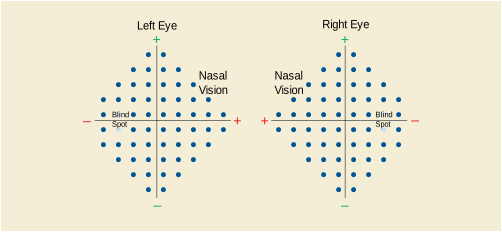
Table C.8.26.5-1 defines the Attributes used to interpret the test results of a patient's visual field test.
Table C.8.26.5-1. Visual Field Static Perimetry Test Results Module Attributes
|
Attribute Name |
Tag |
Type |
Attribute Description |
|---|---|---|---|
|
Visual Field Mean Sensitivity |
(0024,0070) |
1C |
Average sensitivity of the test points of the visual field, in dB. Required if Content Item Modifier Sequence (0040,0441) within the Performed Protocol Code Sequence (0040,0260) contains an item with the value (R-408C3, SRT, "Diagnostic"). May be present otherwise. |
|
Visual Field Test Normals Flag |
(0024,0063) |
1 |
Whether normals exist for this patient's results. Enumerated Values:
|
|
Results Normals Sequence |
(0024,0064) |
1C |
Information that represents the statistically normal results for patients from a referenced data base. Only a single Item shall be included in this sequence. Required if Visual Field Test Normals Flag (0024,0063) is YES. |
|
>Include Table 10-22 “Data Set Identification Macro Attributes” |
|||
|
>Global Deviation from Normal |
(0024,0066) |
1 |
Weighted average deviation from the age corrected normal field, in dB. |
|
>Global Deviation Probability Normals Flag |
(0024,0059) |
1 |
Whether normals exist for the global deviation probability. Enumerated Values:
|
|
>Global Deviation Probability Sequence |
(0024,0083) |
1C |
Probability value and software algorithm used to provide the normality for the global deviation. Only a single Item shall be included in this sequence. Required if Global Deviation Probability Normals Flag (0024,0059) is YES. |
|
>>Global Deviation Probability |
(0024,0071) |
1 |
The percentile of the Global Deviation from Normal (0024,0066) value within the normal population, in percent.0024 |
|
>>Include Table 10-19 “Algorithm Identification Macro Attributes” |
|||
|
>Localized Deviation From Normal |
(0024,0068) |
1 |
Weighted square root of loss variance, in dB. |
|
>Local Deviation Probability Normals Flag |
(0024,0072) |
1 |
Whether normals exist for the local deviation probability. Enumerated Values:
|
|
>Localized Deviation Probability Sequence |
(0024,0085) |
1C |
Probability value and software algorithm used to provide the normality for the local deviation. Only a single Item shall be included in this sequence. Required if Local Deviation Probability Normals Flag (0024,0072) is YES. |
|
>>Localized Deviation Probability |
(0024,0073) |
1 |
The percentile of the Localized Deviation From Normal (0024,0068) value within the normal population, in percent. |
|
>>Include Table 10-19 “Algorithm Identification Macro Attributes” |
|||
|
Short Term Fluctuation Calculated |
(0024,0074) |
1 |
Whether the short term fluctuation was calculated. Enumerated Values:
|
|
Short Term Fluctuation |
(0024,0075) |
1C |
Average deviation of sensitivity for the repeated test locations, in dB. This is used to determine the consistency of the patient's responses. Required if Short Term Fluctuation Calculated (0024,0074) is YES. |
|
Short Term Fluctuation Probability Calculated |
(0024,0076) |
1 |
Whether the short term fluctuation probability was calculated. Enumerated Values:
|
|
Short Term Fluctuation Probability |
(0024,0077) |
1C |
The percentile of the Short Term Fluctuation (0024,0075) value within the normal population, in percent. Required if Short Term Fluctuation Probability Calculated (0024,0076) is YES. |
|
Corrected Localized Deviation From Normal Calculated |
(0024,0078) |
1 |
Whether the corrected localized deviation from normal was calculated. Enumerated Values:
|
|
Corrected Localized Deviation From Normal |
(0024,0079) |
1C |
Weighted square root of loss variance corrected for short term fluctuation, in dB. Required if Corrected Localized Deviation From Normal Calculated (0024,0078) is YES. |
|
Corrected Localized Deviation From Normal Probability Calculated |
(0024,0080) |
1 |
Whether the corrected localized deviation from Normal probability was calculated. Enumerated Values:
|
|
Corrected Localized Deviation From Normal Probability |
(0024,0081) |
1C |
The percentile of the Corrected Localized Deviation From Normal (0024,0079) value within the normal population, in percent. Required if Corrected Localized Deviation From Normal Probability Calculated (0024,0080) is YES. |
|
Visual Field Global Results Index Sequence |
(0024,0320) |
3 |
Information about various visual field indexes related to test results. One or more Items are permitted in this sequence. |
|
>Include Table C.8.26.3-2 “Ophthalmic Visual Field Global Index Macro Attributes” |
|||
Table C.8.26.6-1 defines the Attributes used to represent a patient's clinical parameters during an ophthalmic test.
Table C.8.26.6-1. Ophthalmic Patient Clinical and Test Lens Parameters Module Attributes
|
Attribute Name |
Tag |
Type |
Attribute Description |
|---|---|---|---|
|
Ophthalmic Patient Clinical Information Left Eye Sequence |
(0024,0114) |
1C |
Information used to represent a patient's clinical parameters during an ophthalmic test. Only a single Item shall be included in this sequence. Required if Measurement Laterality (0024,0113) is L or B. |
|
>Include Table C.8.26.6-2 “Ophthalmic Patient Clinical Information and Test Lens Parameters Macro Attributes” |
|||
|
Ophthalmic Patient Clinical Information Right Eye Sequence |
(0024,0115) |
1C |
Information used to represent a patient's clinical parameters during an ophthalmic test. Only a single Item shall be included in this sequence. Required if Measurement Laterality (0024,0113) is R or B. |
|
>Include Table C.8.26.6-2 “Ophthalmic Patient Clinical Information and Test Lens Parameters Macro Attributes” |
|||
Table C.8.26.6-2 describes the attributes for the Ophthalmic Patient Clinical and Test Lens Parameters Macro.
Table C.8.26.6-2. Ophthalmic Patient Clinical Information and Test Lens Parameters Macro Attributes
|
Attribute Name |
Tag |
Type |
Attribute Description |
|---|---|---|---|
|
Refractive Parameters Used on Patient Sequence |
(0024,0112) |
2 |
Refractive parameters used when performing visual field test. Zero or one Item shall be included in this sequence. |
|
>Spherical Lens Power |
(0022,0007) |
1 |
Sphere value in diopters. |
|
>Cylinder Lens Power |
(0022,0008) |
1 |
Cylinder value in diopters. |
|
>Cylinder Axis |
(0022,0009) |
1 |
Axis value in degrees. |
|
Pupil Size |
(0046,0044) |
2 |
The horizontal diameter measurement of the pupil, in mm. |
|
Pupil Dilated |
(0022,000D) |
2 |
The patient's pupils were pharmacologically dilated for this acquisition. Enumerated Values:
If this tag is empty, no information is available. |
|
Intra Ocular Pressure |
(0022,000B) |
3 |
Value of intraocular pressure in mmHg. |
|
Visual Acuity Measurement Sequence |
(0024,0110) |
3 |
Measurements of a patient's visual acuity. Only a single Item is permitted in this sequence. |
|
>Include Table C.8.25.12-2 “Visual Acuity Measurements Macro Attributes” |
|||
Table C.8.27.1-1 specifies the Attributes that identify and describe general information about the Intravascular Optical Coherence Tomography Series.
Table C.8.27.1-1. Intravascular OCT Series Module Attributes
|
Attribute Name |
Tag |
Type |
Attribute Description |
|---|---|---|---|
|
Modality |
(0008,0060) |
1 |
Type of equipment that originally acquired the data used to create the images in this Series. Enumerated Values:
See Section C.7.3.1.1.1 for further explanation. |
|
Series Number |
(0020,0011) |
1 |
A number that identifies this Series. |
|
Referenced Performed Procedure Step Sequence |
(0008,1111) |
1C |
Uniquely identifies the Performed Procedure Step SOP Instance to which the Series is related. Only a single Item shall be included in this sequence. Required if a Performed Procedure Step SOP Class was involved in the creation of this Series. |
|
>Referenced SOP Class UID |
(0008,1150) |
1 |
Uniquely identifies the referenced SOP Class. |
|
>Referenced SOP Instance UID |
(0008,1155) |
1 |
Uniquely identifies the referenced SOP Instance. |
|
Presentation Intent Type |
(0008,0068) |
1 |
Identifies the intent of the images that are contained within this Series. Enumerated Values:
|
Presentation Intent Type (0008,0068) identifies the intent for the purposes of display or other presentation of all Images within this Series.
Note
Since this is a Series level attribute, all Images within a Series have the same value for this Attribute.
The intent of this restriction is to ensure that FOR PRESENTATION and FOR PROCESSING images are placed in separate Series, so that no confusion can arise as to which images are suitable for diagnostic reading as determined by local policy.
A Series of Images intended for viewing by an observer shall have an Enumerated Value of FOR PRESENTATION. The value shall not be set to FOR PRESENTATION unless Z Offset correction, refractive index correction and polar to rectangular conversion have been applied
Images or individual frames of a FOR PRESENTATION image shall reference their associated source FOR PROCESSING frames, if any exist, using the Derivation Image Functional Group Macro, with the Derivation Code (113093, DCM, "Polar to Rectangular Scan Conversion") and the Purpose of Reference Code (121358, DCM, "For Processing Image").
Note
FOR PRESENTATION images are still be of Image Type (0008,0008) and Frame Type (0008,9007) ORIGINAL rather than DERIVED despite having undergone processing, such as corrections for Z Offset, Refractive index and Polar to Rectangular conversion. In this case a DERIVED image would have undergone yet further processing to make it substantially different from the original. See Figure C.8.27-1. The Derivation Image Functional Group Macro may be used even if Image Type (0008,0008) and Frame Type (0008,9007) is ORIGINAL.
FOR PRESENTATION images may still be subjected to processing or further processing, if appropriate, depending on the application.
FOR PRESENTATION images are intended for display on a device, without (further) processing, since that device may not be capable of image processing. The quality of the displayed image or its suitability for any purpose is beyond the scope of the DICOM Standard.
If all of the frames of a FOR PRESENTATION image are created by processing all of the frames of a FOR PROCESSING image, then a reference to the FOR PROCESSING SOP Instance only, without reference to specific frame numbers, in the Shared Functional Group Sequence avoids the need for a frame-by-frame reference in each Per-Frame Functional Group, though there is no requirement that the order of the frames or the number of frames in the FOR PROCESSING and FOR PRESENTATION instances correspond.
FOR PROCESSING images may have Z Offset correction applied to the A-line data and/or Refractive Index applied to A-line Pixel Spacing (0052,0014). However, due to irreversible loss of information, images that have had Polar to Rectangular scan conversion applied shall not be stored as FOR PROCESSING images.
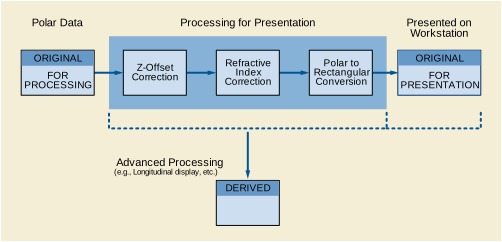
Table C.8.27.2-1 specifies the Attributes that describe an Image produced by Intravascular OCT imaging modalities.
Table C.8.27.2-1. Intravascular OCT Image Module Attributes
|
Attribute Name |
Tag |
Type |
Attribute Description |
|---|---|---|---|
|
Image Type |
(0008,0008) |
1 |
Image identification characteristics. See Section C.8.27.2.1 for specialization. |
|
Volumetric Properties |
(0008,9206) |
1 |
Indication if geometric manipulations are possible with frames in the SOP Instance. See Section C.8.27.2.2. |
|
Pixel Presentation |
(0008,9205) |
1 |
Indication of the presence or absence of color information that may be used during rendering. See Section C.8.27.2.3 for a description and Enumerated Values. |
|
Samples Per Pixel |
(0028,0002) |
1 |
Number of samples (planes) in this image. Enumerated Values:
|
|
Acquisition DateTime |
(0008,002A) |
1 |
The date and time that the acquisition of data started. NoteThe synchronization of this time with an external clock is specified in the synchronization Module in Acquisition Time synchronized (0018,1800). |
|
Acquisition Duration |
(0018,9073) |
1C |
The scan time in seconds used to create all frames of an Intravascular Optical Coherence Tomography image. Required if Image Type (0008,0008) Value 1 is ORIGINAL. May be present otherwise. |
|
Acquisition Number |
(0020,0012) |
1 |
A number identifying the single continuous gathering of data over a period of time that resulted in this image. |
|
Photometric Interpretation |
(0028,0004) |
1 |
Specifies the intended interpretation of the pixel data. Enumerated Values:
|
|
Pixel Representation |
(0028,0103) |
1 |
Data representation of pixel samples. Enumerated Values:
|
|
Bits Allocated |
(0028,0100) |
1 |
Number of bits allocated for each pixel sample. See Section C.8.27.2.4 for specialization. |
|
Bits Stored |
(0028,0101) |
1 |
Number of bits stored for each pixel sample. See Section C.8.27.2.4 for specialization. |
|
High Bit |
(0028,0102) |
1 |
Most significant bit for pixel sample data. High Bit (0028,0102) shall be one less than Bits Stored (0028,0101). |
|
Presentation LUT Shape |
(2050,0020) |
1C |
Specifies an identity transformation for the Presentation LUT, such that the output of all grayscale transformations defined in the IOD containing this Module are defined to be P-Values. Enumerated Values:
Required if Presentation Intent Type (0008,0068) equals FOR PRESENTATION. |
|
Lossy Image Compression |
(0028,2110) |
1 |
Specifies whether an Image has undergone lossy compression (at a point in its lifetime). Enumerated Values:
Once this value has been set to 01 it shall not be reset. See Section C.7.6.1.1.5. |
|
Lossy Image Compression Ratio |
(0028,2112) |
1C |
Describes the approximate lossy compression ratio(s) that have been applied to this image. See Section C.7.6.1.1.5 for further explanation. May be multi-valued if successive lossy compression steps have been applied; the value order shall correspond to the values of Lossy Image Compression Method (0028,2114). Note
Required if Lossy Image Compression (0028,2110) is "01". |
|
Lossy Image Compression Method |
(0028,2114) |
1C |
A label for the lossy compression method(s) that have been applied to this image. See Section C.7.6.1.1.5 for further explanation. May be multi-valued if successive lossy compression steps have been applied; the value order shall correspond to the values of Lossy Image Compression Ratio (0028,2112). Required if Lossy Image Compression (0028,2110) is "01". NoteFor historical reasons, the lossy compression method may also be described in Derivation Description (0008,2111). |
|
Burned In Annotation |
(0028,0301) |
1 |
Indicates whether or not image contains sufficient burned in annotation to identify the patient and date the image was acquired. Enumerated Values:
|
|
Recognizable Visual Features |
(0028,0302) |
1 |
Indicates whether or not the image contains sufficiently recognizable visual features to allow the image or a reconstruction from a set of images to identify the patient. Enumerated Values:
|
|
Referenced Instance Sequence |
(0008,114A) |
3 |
A sequence that provides reference to a set of non-image SOP Class/Instance pairs significantly related to this Image, including waveforms that may or may not be temporally synchronized with this image. One or more Items are permitted in this sequence. |
|
>Include Table 10-11 “SOP Instance Reference Macro Attributes” |
|||
|
>Purpose of Reference Code Sequence |
(0040,A170) |
1 |
Code describing the purpose of the reference to the SOP Instances. Only a single Item shall be included in this sequence. |
|
Defined CID is CID 7004 “Waveform Purposes of Reference” for referenced waveforms. |
|||
|
Image Comments |
(0020,4000) |
3 |
User-defined comments about the image. |
|
Recommended Display Frame Rate |
(0008,2144) |
3 |
Recommended rate at which the frames of an Intravascular OCT image should be displayed in frames/second. |
|
Interpolation Type |
(0052,0039) |
1C |
The type of interpolation used for the Polar to Cartesian scan-conversion. Defined Terms:
Required if Presentation Intent Type (0008,0068) equals FOR PRESENTATION. |
|
Referenced Color Palette Instance UID |
(0028,0304) |
1C |
The identifier of a color palette (i.e., an instance of the Color Palette Storage SOP Class "1.2.840.10008.5.1.4.39.1") that may be used during rendering. See PS3.4 Color Palette Storage Service Class and PS3.6 Well-Known Color Palettes. Required if Pixel Presentation (0008,9205) is COLOR_REF. |
In addition to the requirements specified in Section C.8.16.1 Image Type, the following additional requirements and Defined Terms are specified.
Value 1 of Image Type (0008,0008) and Frame Type (0008,9007) is discussed in Section C.8.16.1.1. No additional requirements or Defined Terms.
Value 2 of Image Type (0008,0008) and Frame Type (0008,9007) is discussed in Section C.8.16.1.2. No additional requirements or Defined Terms.
Value 3 of Image Type (0008,0008) and Frame Type (0008,9007) is discussed in Section C.8.16.1.3.
Table C.8.27.2-2 specifies the Defined Terms for IVOCT for Value 3 for Image Type (0008,0008) and Frame Type (0008,9007).
Table C.8.27.2-2. IVOCT Image Type and Frame Type Value 3
|
Defined Term Name |
Defined Term Description |
|---|---|
|
AXIAL |
An image that has an orientation that is perpendicular to the long axis of the vessel. (i.e., cross-sectional). |
|
LONGITUDINAL |
An image that has an orientation that is parallel to the long axis of the vessel. |
Value 4 of Image Type (0008,0008) and Frame Type (0008,9007) is discussed in Section C.8.16.1.4. No additional requirements or Defined Terms.
The value of Volumetric Properties attribute (0008,9206) allows applications doing geometric manipulations to determine if the image is an appropriate candidate for an operation without having to know all the details of the generating application.
Table C.8.27.2-3 specifies the Enumerated Values for Volumetric Properties (0008,9206).
Table C.8.27.2-3. Volumetric Properties Attribute Values
|
Enumerated Value Name |
Enumerated Value Description |
|---|---|
|
DISTORTED |
Frames do not represent the true geometry of the vessel. |
Pixel Presentation (0008,9205) is used to indicate whether a color tint is intended to be applied to the IVOCT image. See Table C.8.27.2-4.
Table C.8.27.2-4. Pixel Presentation Attribute Values
|
Enumerated Value Name |
Enumerated Value Description |
|---|---|
|
COLOR |
Image is intended to be displayed in color using Supplemental Palette Color LUTs, but can be displayed in grayscale if current display does not support color or with a user selected LUT. See Section C.8.16.2.1.1.1. |
|
COLOR_REF |
Image is intended to be displayed in color using an externally defined Palette Color LUTs, but can be displayed in grayscale if current display does not support color, or with a user selected LUT. I.e., the encoded pixel values are still continuous grayscale values (and not arbitrarily order indices into a lookup table). |
|
MONOCHROME |
Image is intended to be displayed in grayscale only. |
For IVOCT images, Bits Allocated (0028,0100), Bits Stored (0028,0101) Samples Per Pixel (0028,0002) are specified to use the following values for Presentation Intent Type (0008,0068) attribute:
Table C.8.27.2-5. Bits Allocated/Stored
|
Presentation Intent Type |
Bits Allocated / Bits Stored |
Samples Per Pixel |
|---|---|---|
|
FOR PRESENTATION |
8/8, 16/12 or 16/16 |
1 |
|
FOR PROCESSING |
8/8, 16/12 or 16/16 |
1 |
Table C.8.27.3-1 describes the parameters used to acquire an Intravascular Optical Coherence Tomography image.
Table C.8.27.3-1. Intravascular OCT Acquisition Parameters Module Attributes
|
Attribute Name |
Tag |
Type |
Attribute Description |
|---|---|---|---|
|
OCT Focal Distance |
(0052,0002) |
2 |
Distance from focal point to center of catheter, in mm (measured in air). |
|
Beam Spot Size |
(0052,0003) |
2 |
The full width at half maximum (FWHM) of the point spread function (PSF) or line spread function (LSF), in µm (measured in air). Also known as Transverse Resolution. |
|
Effective Refractive Index |
(0052,0004) |
2C |
Index of refraction of the tissue and flush medias used during the Intravascular OCT acquisition. Required if Presentation Intent Type (0008,0068) is FOR PROCESSING. May be present otherwise. |
|
OCT Acquisition Domain |
(0052,0006) |
1 |
The type of OCT acquisition domain. Defined Terms:
|
|
OCT Optical Center Wavelength |
(0052,0007) |
2 |
Center optical wavelength of the OCT light source, in µm. |
|
Axial Resolution |
(0052,0008) |
2 |
The full width at half maximum (FWHM) of the axial plane response function, in µm (measured in air) |
|
Ranging Depth |
(0052,0009) |
1 |
Maximum detectable sample-to-reference path displacement, in mm (measured in air). This is the radius of the FOR PRESENTATION image in air. NoteRanging Depth is distinct from Penetration Depth, which is the depth to which one can obtain an OCT signal in tissue. |
|
A-line Rate |
(0052,0011) |
1 |
The number of IVOCT A-lines acquired per second in Hz. |
|
A-lines Per Frame |
(0052,0012) |
1 |
Number of A-lines acquired in an IVOCT frame, including unused (padded) A-lines. NoteWill be the same as Rows (0028,0010) for a FOR PROCESSING image. |
Table C.8.27.4-1 describes the parameters used for processing an Intravascular Optical Coherence Tomography polar data image.
Table C.8.27.4-1. Intravascular OCT Processing Parameters Module Attributes
|
Attribute Name |
Tag |
Type |
Attribute Description |
|---|---|---|---|
|
OCT Z Offset Applied |
(0052,0026) |
1 |
Indicates whether or not Z offset correction was applied to the OCT image frames. Enumerated Values:
|
|
Refractive Index Applied |
(0052,003A) |
1 |
Indicates whether or not Refractive Index correction was applied. Enumerated Values:
See Section C.8.27.4.1 for further explanation. |
|
A-line Pixel Spacing |
(0052,0014) |
1 |
Spacing of pixels in the A-line (X-axis), in mm. |
|
Pixel Intensity Relationship |
(0028,1040) |
1 |
The relationship between the pixel sample values and the IVOCT A-line intensity. See Section C.8.27.4.2. |
|
First A-line Location |
(0052,0034) |
1 |
Orientation in degrees at which the 1st A-line in the frame should be displayed. Value shall be between 0 and 360, with zero representing vertical. |
For Refractive Index Applied (0052,003A) a value of YES indicates that Effective Refractive Index (0052,0004) correction has been applied to the reported A-line Pixel Spacing (0052,0014) attribute. A value of NO indicates that Effective Refractive Index (0052,0004) correction has not been applied (i.e., A-line Pixel Spacing corresponds to the pixel spacing in air).
Pixel Intensity Relationship (0028,1040) shall identify the relationship of the pixel values to the IVOCT A-line intensity.
Defined Terms:
- LIN
Approximately proportional to A-line intensity.
- LOG
Non-linear "Log Function"; A Pixel Intensity Relationship LUT shall be included with the image to allow it to be scaled back to its proportional A-line intensity value.
Table C.8.27.5-1 describes the parameters and characteristics of an intravascular image acquisition. These parameters are common to both IVUS and IVOCT.
Table C.8.27.5-1. Intravascular Image Acquisition Parameters Module Attributes
|
Attribute Name |
Tag |
Type |
Attribute Description |
|---|---|---|---|
|
IVUS Acquisition |
(0018,3100) |
1 |
Type of Intravascular Image Acquisition. Enumerated Values:
See Section C.8.27.5.1. |
|
IVUS Pullback Rate |
(0018,3101) |
1C |
Intravascular imaging catheter pullback rate. Specified in units of mm/sec. Required if IVUS Acquisition (0018,3100) value is MOTORIZED. See Section C.8.27.5.2. |
|
IVUS Pullback Start Frame Number |
(0018,3103) |
1C |
Frame number at which the motorized portion of the acquisition begins. Required if IVUS Acquisition (0018,3100) value is MOTORIZED. See Section C.8.27.5.1. |
|
IVUS Pullback Stop Frame Number |
(0018,3104) |
1C |
Frame number at which the motorized portion of the acquisition is complete. Required if IVUS Acquisition (0018,3100) value is MOTORIZED. See Section C.8.27.5.1. |
|
Catheter Direction of Rotation |
(0052,0031) |
1C |
Direction of rotation of the Intravascular rotating catheter during acquisition, from the perspective of the motor, proximal to distal. Enumerated Values:
Required if rotational catheter is used. |
|
Catheter Rotational Rate |
(0052,0013) |
1C |
Rate of rotation of the Intravascular rotating catheter during acquisition, in Hz. Required if rotational catheter is used. |
|
Mode of Percutaneous Access Sequence |
(0052,0016) |
2 |
Mode of access of the Intravascular Imaging Catheter. Zero or one Item shall be included in this sequence. |
|
Defined CID 3746 “Percutaneous Entry Site”. |
|||
The attribute IVUS Acquisition (0018,3100) denotes the method used to acquire the Intravascular Images.
MOTORIZED: The Intravascular imaging catheter is positioned in the blood vessel proximal or distal to the anatomical structures to be examined. The catheter is attached to a motorized mechanism capable of either pushing forward or pulling back the catheter through the vessel at a constant velocity, as specified by the IVUS Pullback Rate (0018,3101). The motorized acquisition takes place during the time between acquisition of the IVUS Pullback Start Frame Number (0018,3103), and acquisition of the IVUS Pullback Stop Frame Number (0018,3104).
MANUAL: The Intravascular imaging catheter is positioned in the blood vessel proximal or distal to the anatomical structures to be examined. The catheter is then manually pulled back or pushed forward through the vessel segment of interest.
SELECTIVE: The Intravascular imaging catheter is positioned in the blood vessel. The catheter is then manually pushed forward and/or pulled back to examine the anatomical structures in the vessel.
MEASURED: The Intravascular imaging catheter is positioned in the blood vessel near the anatomical structures to be examined. The catheter is then pulled back or pushed forward through the vessel segment of interest. The longitudinal movement between each acquired frame is measured and recorded. See Section C.8.27.6.2 for more information.
The attribute IVUS Pullback Rate (0018,3101) specifies the constant velocity of longitudinal movement of the Intravascular imaging catheter. Positive values indicate movement from Distal to Proximal (pulling back). Negative values indicate movement from Proximal to Distal (pushing forward).
The following sections contain Functional Group Macros specific to the Intravascular OCT IOD.
Table C.8.27.6.1-1 specifies the attributes of the Intravascular OCT Frame Type Functional Group.
Table C.8.27.6.1-1. Intravascular OCT Frame Type Macro Attributes
|
Attribute Name |
Tag |
Type |
Attribute Description |
|---|---|---|---|
|
Intravascular OCT Frame Type Sequence |
(0052,0025) |
1 |
Identifies characteristics of this frame. Only a single Item shall be included in this sequence. |
|
>Frame Type |
(0008,9007) |
1 |
Type of Frame. A multi-valued attribute analogous to Image Type (0008,0008). Enumerated Values and Defined Terms are the same as those for the four values of Image Type (0008,0008), except that the value MIXED is not allowed. See Section C.8.27.2.1. |
Table C.8.27.6.2-1 specifies the attributes of the Intravascular Frame Content Functional Group.
Table C.8.27.6.2-1. Intravascular Frame Content Macro Attributes
|
Attribute Name |
Tag |
Type |
Attribute Description |
|---|---|---|---|
|
Intravascular Frame Content Sequence |
(0052,0027) |
1 |
A sequence that describes a general description of this image or frame. Only a single Item shall be included in this sequence. |
|
>Intravascular Longitudinal Distance |
(0052,0028) |
1C |
Longitudinal distance in millimeters between this frame and the previous acquired frame. Positive values indicate movement is from Distal to Proximal (pull back). Negative values indicate movement is from Proximal to Distal (push forward). Required if Intravascular Acquisition (0018,3100) equals MEASURED. |
|
>Seam Line Location |
(0052,0033) |
2C |
Clockwise rotational orientation (in degrees) at which the seam line in the frame is displayed, relative to vertical (zero degrees). Required if Presentation Intent Type (0008,0068) equals FOR PRESENTATION. |
Table C.8.27.6.3-1 specifies the attributes of the Intravascular OCT Frame Content Functional Group.
Table C.8.27.6.3-1. Intravascular OCT Frame Content Macro Attributes
|
Attribute Name |
Tag |
Type |
Attribute Description |
|---|---|---|---|
|
Intravascular OCT Frame Content Sequence |
(0052,0029) |
1 |
A sequence that describes a general description of this image or frame. Only a single Item shall be included in this sequence. |
|
>OCT Z Offset Correction |
(0052,0030) |
1 |
The amount to shift the frame along the axial direction, in pixels, to correct for interferometer path-length mismatch. See Section C.8.27.6.3.1 for further explanation. |
|
>Seam Line Index |
(0052,0036) |
1 |
The A-line number (zero index) that coincides with the seam line as indicated with the First A-line Location (0052,0034) attribute. |
|
>Number of Padded A-lines |
(0052,0038) |
1C |
The number of padded A-lines contained in the FOR PROCESSING image frame. Required if the FOR PROCESSING image contains padded A-lines. See Section C.8.27.6.3.2 for further explanation. |
OCT Z Offset Correction (0052,0030) specifies the number of pixels to shift the A-lines of the frame to correct for the path length difference between the OCT Sample arm and Reference arm (in air). A positive value of Z Offset correction means pixels are shifted further away from the catheter optics. A negative value of Z Offset correction means pixels are shifted closer to the catheter optics. See Figure C.8.27-2
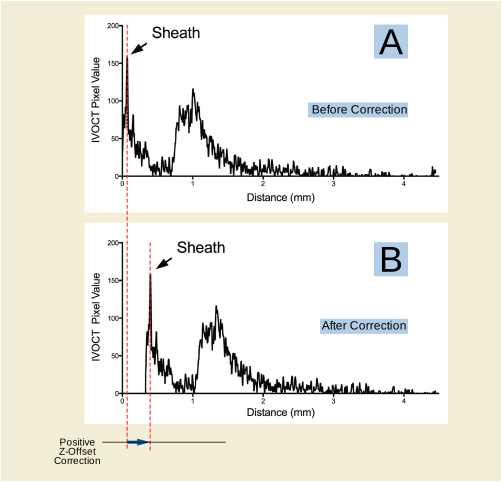
Table C.8.28.1-1 specifies the Attributes that identify and describe general information about the Ophthalmic Thickness Map Series.
Table C.8.28.1-1. Ophthalmic Thickness Map Series Module Attributes
|
Attribute Name |
Tag |
Type |
Attribute Description |
|---|---|---|---|
|
Modality |
(0008,0060) |
1 |
Type of equipment that created the maps in this Series. Enumerated Values:
See Section C.7.3.1.1.1 for further explanation. |
|
Referenced Performed Procedure Step Sequence |
(0008,1111) |
1C |
Uniquely identifies the Performed Procedure Step SOP Instance to which the Series is related. Only a single Item shall be included in this sequence. Required if a Performed Procedure Step SOP Class was involved in the creation of this Series. |
|
>Include Table 10-11 “SOP Instance Reference Macro Attributes” |
|||
Table C.8.28.2-1 specifies the Attributes that describe an Image produced by ophthalmic thickness mapping devices.
Table C.8.28.2-1. Ophthalmic Thickness Map Module Attributes
|
Attribute Name |
Tag |
Type |
Attribute Description |
|---|---|---|---|
|
Ophthalmic Mapping Device Type |
(0022,1415) |
1 |
Describes the type of ophthalmic mapping acquisition device. See Section C.8.28.2.1.3 for further explanation. Defined Terms
|
|
Acquisition Method Code Sequence |
(0022,1420) |
1 |
The acquisition method used for obtaining ophthalmic thickness mapping. Only a single Item shall be included in this sequence. |
|
Acquisition Method Algorithm Sequence |
(0022,1423) |
1C |
Software algorithm used to provide acquisition method. Required if Acquisition Method Code Sequence (0022,1420) contains an item with the value of (111923, DCM, "Corneal birefringence compensation") May be present otherwise. Only a single Item shall be included in this sequence. |
|
>Include Table 10-19 “Algorithm Identification Macro Attributes” |
|||
|
Instance Number |
(0020,0013) |
1 |
A number that identifies this instance. |
|
Content Date |
(0008,0023) |
1 |
The date the data creation was started. |
|
Content Time |
(0008,0033) |
1 |
The time the data creation was started. |
|
Acquisition DateTime |
(0008,002A) |
1 |
The date and time that the acquisition of data that resulted in this image started. NoteThe synchronization of this time with an external clock is specified in the Synchronization Module in Acquisition Time Synchronized (0018,1800). |
|
Image Type |
(0008,0008) |
1 |
Image identification characteristics. See Section C.8.28.2.1.1 for specialization. |
|
Samples Per Pixel |
(0028,0002) |
1 |
Number of samples (planes) in this image. See Section C.7.6.3.1.1 for further explanation. Enumerated Values:
|
|
Photometric Interpretation |
(0028,0004) |
1 |
Specified the intended interpretation of the pixel data. See Section C.7.6.3.1.2 for further explanation. Enumerated Values:
|
|
Pixel Representation |
(0028,0103) |
1 |
Data representation of pixel samples. Enumerated Values:
|
|
Pixel Spacing |
(0028,0030) |
1 |
Physical distance in the patient between the center of each pixel, specified by a numeric pair - adjacent row spacing (delimiter) adjacent column spacing in mm. NoteSince a patient's retina is curved, there can be a small error in using Pixel Spacing (0028,0030) for distance measurements in the periphery of the image. See Section 10.7.1.3 for further explanation. |
|
Pixel Aspect Ratio |
(0028,0034) |
1 |
Ratio of the vertical size and horizontal size of the pixels in the image specified by a pair of integer values where the first value is the vertical pixel size, and the second value is the horizontal pixel size. |
|
Bits Allocated |
(0028,0100) |
1 |
Number of bits allocated for each pixel sample. Each sample shall have the same number of bits allocated. See PS3.5 for further explanation. Enumerated Values:
|
|
Bits Stored |
(0028,0101) |
1 |
Number of bits stored for each pixel sample. Enumerated Values:
|
|
High Bit |
(0028,0102) |
1 |
Most significant bit for pixel sample data. Each sample shall have the same high bit. See PS3.5 for further explanation. Enumerated Values:
|
|
Pixel Presentation |
(0008,9205) |
1 |
The source of the color information for use during rendering. Enumerated Values:
|
|
Referenced Color Palette Instance UID |
(0028,0304) |
1C |
The identifier of the color palette (i.e., an instance of the Color Palette Storage SOP Class "1.2.840.10008.5.1.4.39.1") for use during rendering. Required if Pixel Presentation (0008,9205) is COLOR_REF. |
|
Lossy Image Compression |
(0028,2110) |
1 |
Specifies whether an Image has undergone lossy compression (at a point in its lifetime). Enumerated Values:
Once this value has been set to 01 it shall not be reset. See Section C.7.6.1.1.5. |
|
Lossy Image Compression Ratio |
(0028,2112) |
1C |
Describes the approximate lossy compression ratio(s) that have been applied to this image. See Section C.7.6.1.1.5 for further explanation. May be multi-valued if successive lossy compression steps have been applied; the value order shall correspond to the values of Lossy Image Compression Method (0028,2114). Note
Required if Lossy Image Compression (0028,2110) is "01". |
|
Lossy Image Compression Method |
(0028,2114) |
1C |
A label for the lossy compression method(s) that have been applied to this image. See Section C.7.6.1.1.5 for further explanation. May be multi-valued if successive lossy compression steps have been applied; the value order shall correspond to the values of Lossy Image Compression Ratio (0028,2112). NoteFor historical reasons, the lossy compression method may also be described in Derivation Description (0008,2111). Required if Lossy Image Compression (0028,2110) is "01". |
|
Burned In Annotation |
(0028,0301) |
1 |
Indicates that the image does not contain burned in annotation to identify the patient and date the image was acquired. Enumerated Values:
|
|
Recognizable Visual Features |
(0028,0302) |
1 |
Indicates whether or not the image contains sufficiently recognizable visual features to allow the image or a reconstruction from a set of images to identify the patient. Enumerated Values:
|
|
Image Laterality |
(0020,0062) |
1 |
Laterality of object imaged (as described in Anatomic Region Sequence (0008,2218)) examined. Enumerated Values:
NoteThis Attribute is mandatory, in order to ensure that images may be positioned correctly relative to one another for display. Shall be consistent with any laterality information contained in Primary Anatomic Structure Modifier Sequence (0008,2230), if present. NoteLaterality (0020,0060) is a Series level Attribute and must be the same for all Images in the Series, hence it must be absent. |
|
Ophthalmic Thickness Map Type Code Sequence |
(0022,1436) |
1 |
The type of ophthalmic thickness map encoded in this SOP Instance. It specifies the meaning of the pixel values. Only a single Item shall be included in this sequence. |
|
Include Table C.7.6.16-12 “Real World Value Mapping Macro Attributes” if Ophthalmic Thickness Map Type Code Sequence (0022,1436) contains an item with the value (111930, DCM, "Absolute ophthalmic thickness") or (111932, DCM, "Thickness deviation from normative data"). May be present otherwise. |
Defined CID for Measurement Units Code Sequence is 4260 |
||
|
Pixel Value Mapping to Coded Concept Sequence |
(0022,1450) |
1C |
Provides a pixel value and the mapping of that pixel value to an associated Coded Concept. Required if Ophthalmic Thickness Map Type Code Sequence (0022,1436) contains an item with the value (111931, DCM, "Thickness deviation category from normative data"). May be present otherwise. One or more Items shall be present. |
|
>Mapped Pixel Value |
(0022,1452) |
1 |
Pixel value to be mapped. |
|
>Pixel Value Mapping Code Sequence |
(0040,9098) |
1 |
The mapping from Mapped Pixel Value (0022,1452) to an associated Coded Concept. Only a single Item shall be included in this sequence. |
|
Defined CID 4265 “Ophthalmic Thickness Deviation Categories”. |
|||
|
>Pixel Value Mapping Explanation |
(0022,1454) |
3 |
Free form text explanation of the Coded Concept. |
|
Ophthalmic Thickness Mapping Normals Sequence |
(0022,1443) |
1C |
Identifies the data set used for mapping values from a normative data base. Required if Ophthalmic Thickness Map Type Code Sequence (0022,1436) contains an item with the value or (111931, DCM, "Thickness deviation category from normative data") or (111932, DCM, "Thickness deviation from normative data"). May be present otherwise. Only a single Item shall be included in this sequence. |
|
>Include Table 10-22 “Data Set Identification Macro Attributes” |
|||
|
Relevant OPT Attributes Sequence |
(0022,1472) |
1C |
Attributes from the OPT image that provide critical context for the interpretation of this ophthalmic map SOP Instance. Required if Ophthalmic Mapping Device Type (0022,1415) is OCT. Only a single Item shall be included in this sequence |
|
>Depth Spatial Resolution |
(0022,0035) |
1 |
The inherent limiting resolution in microns for depth of the acquisition equipment for high contrast objects for the data gathering and reconstruction technique chosen. If variable, the value at the center of the scanning volume. |
|
>Maximum Depth Distortion |
(0022,0036) |
1 |
Maximum distortion in depth direction in % of Depth Spatial Resolution. |
|
Source Image Sequence |
(0008,2112) |
1C |
The Image SOP Class/Instance pair of the Image that was used to generate this Image. Required if Ophthalmic Mapping Device Type (0022,1415) is OCT. May be present otherwise. Only a single Item shall be included in this sequence |
|
>Include Table 10-3 “Image SOP Instance Reference Macro Attributes” |
|||
|
>Purpose of Reference Code Sequence |
(0040,A170) |
1 |
Describes the purpose for which the reference is made, (i.e., the role the source image or frame(s) played in the generation of this image). Only a single Item shall be included in this sequence. |
|
Referenced Instance Sequence |
(0008,114A) |
1C |
A sequence that provides reference to a set of SOP Class/Instance pairs identifying images or other composite SOP Instances to plan the acquisition or significant related information. Required if Ophthalmic Photography Reference Image available. May be present otherwise. See Section C.7.6.16.2.5.1 for further explanation. Zero or more Items may be included in this Sequence. |
|
>Include Table 10-11 “SOP Instance Reference Macro Attributes” |
|||
|
>Purpose of Reference Code Sequence |
(0040,A170) |
1 |
Code describing the purpose of the reference to the Instance(s). Only a single Item shall be included in this sequence. |
|
Registration to Localizer Sequence |
(0022,1465) |
3 |
Registration of current instance to a localizer SOP Instance referenced in Attribute Referenced Instance Sequence (0008,114A). See Section C.8.28.2.1.2 for an example. |
|
>Registered Localizer Units |
(0022,1466) |
1 |
Units of measure for the axes of the registered localizer image. Enumerated Values:
|
|
>Registered Localizer Top Left Hand Corner |
(0022,1467) |
1 |
Location of the Top Left Hand Corner (TLHC) of the registered localizer in Registered Localizer Units (0022,1466), given as column\row. Column is the horizontal offset and row is the vertical offset. |
|
>Registered Localizer Bottom Right Hand Corner |
(0022,1468) |
1 |
Location of the Bottom Right Hand Corner (BRHC) of the registered localizer in which Registered Localizer Units (0022,1466), given as column\row. Column is the horizontal offset and row is the vertical offset. |
|
Include Table 10-5 “General Anatomy Mandatory Macro Attributes” |
The concept code for Anatomic Region Sequence (0008,2218) shall be (T-AA000, SRT, "Eye"), and Defined CID 244 “Laterality” shall be used for Anatomic Region Modifier Sequence (0008,2220). Defined CID 4266 “Ophthalmic Anatomic Structure Reference Point” shall be used for Primary Anatomic Structure Sequence (0008,2228). Only a single Item shall be included in this sequence. NoteAlthough Primary Anatomic Structure Sequence (0008,2228) is Type 3, it is important to convey this information if able to be determined. |
||
|
Relative Image Position Code Sequence |
(0022,001D) |
3 |
The position of this image on the retina (as defined by a specified nomenclature; the nomenclature is implicit in the code used). Only a single Item is permitted in this sequence. |
|
Baseline CID 4207 “Ophthalmic Image Position”. |
|||
|
Anatomic Structure Reference Point |
(0022,1463) |
1C |
Location of a point in the image identified by an anatomic structure. This is used in ophthalmology for a landmark within a patient's eye. Given as column\row. Column is the horizontal offset and row is the vertical offset. Image relative position specified with sub-pixel resolution such that the origin at the Top Left Hand Corner (TLHC) of the TLHC pixel is 0.0\0.0, the Bottom Right Hand Corner (BRHC) of the TLHC pixel is 1.0\1.0, and the BRHC of the BRHC pixel is Columns\Rows (see Figure C.10.5-1). The values must be within the range 0\0 to Columns\Rows. Required if Primary Anatomic Structure Sequence (0008,2228) contains an item with the value (T-AA621, SRT "Fovea centralis") or (T-AA630, SRT, "Optic nerve head") or (M-01000, SRT, "Lesion") or (111934, DCM, "Disc-Fovea"). May be present otherwise. |
|
Retinal Thickness Definition Code Sequence |
(0022,1445) |
1C |
The definition of the retinal thickness for this image. Required if Attribute Image Type (0008,0008) value 3 is RETINAL_THICK. Only a single Item shall be included in this sequence. |
For Ophthalmic Thickness Maps, Image Type (0008,0008) is specified to be Type 1 and uses one of the following Defined Terms for Value 3:
Defined Terms:
- ONH
identifies a topographic map of an optic nerve head
- RETINAL_THICK
identifies a Thickness Map for retinal layers or combination of several sub-layers
Note
The images created based upon the source data of the patient examination would be ORIGINAL\PRIMARY.
If the value is specified as "RETINAL_THICK", the definition of the retinal thickness is in Retinal Thickness Definition Code Sequence (0022,1445).
Equipment generating an ophthalmic map (OPM) image, may also obtain an accompanying "reference/localizer" image. This "reference/localizer" image serves the purpose of orienting and registering the OPM image to the actual retinal location. For example, a fundus photo may be obtained with ophthalmic tomography (OPT). When the retinal thickness map is generated based on OPT data, the OPM is registered with pixel precision to the fundus photo. This "reference/localizer" image is referenced in the OPM SOP Instance using the attribute Referenced Instance Sequence (0008,114A).
An example of a "reference/localizer" image and its relationship to an OPM image is shown in Figure C.8.28.2.1-1. Legend: ( A) a fundus photo is taken as the "reference/localizer" image. The green box indicates the area the OPT scans are obtained. ( B) The retinal thickness map (OPM object) is overlaid on the "reference/localizer" fundus photo to show the correspondence. These examples could be referenced from different types of SOP Classes, such as Color Softcopy Presentation State Storage (referencing the OP SOP Instance of a fundus photo), True Color Secondary Capture Image Storage, Encapsulated PDF, etc. The Purpose of Reference Code Sequence (0040,A170) code is set to (DCM, 121311, Localizer) for example A. Registration to Localizer Sequence (0022,1465) would be used for example B.
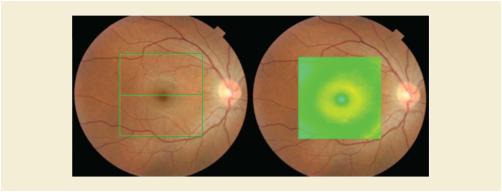
For Ophthalmic Mapping Device Type (0022,1415), Scanning Laser Ophthalmoscopy Tomography (SLO_TOMO) produces a topographical representation of the optic nerve head (ONH) rather than a thickness depiction. However, the topographical depiction can be considered as "thickness" measurements of multiple points of the ONH surface relative to an assigned datum plane. For this reason, the topographical image is included in the ophthalmic thickness map module.
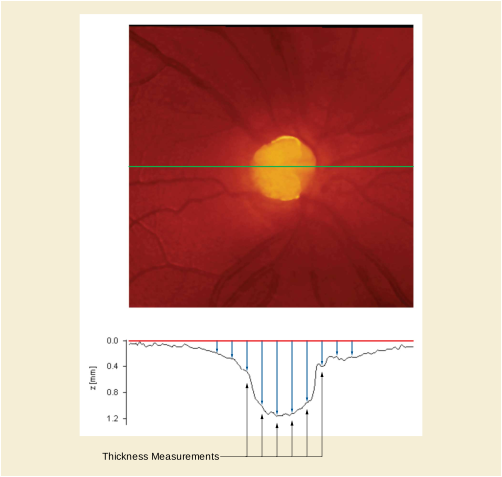
For Ophthalmic Mapping Device Type (0022,1415), Polarimetric Tomography (POLARIMETRY) produces a thickness depiction based on birefringent phase shifts. This is a thickness measure but does not use typical international system of units such as micrometer, etc. Due to this, the unit of measurement is defined by the implementation, such as 'p-um'.
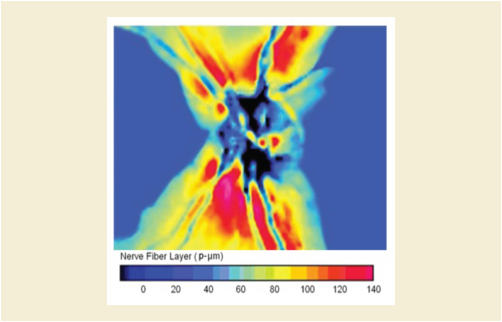
Table C.8.28.3-1 specifies the Attributes that describe the quality rating for the ophthalmic mapping.
Table C.8.28.3-1. Ophthalmic Thickness Map Quality Rating Module Attributes
|
Attribute Name |
Tag |
Type |
Attribute Description |
|---|---|---|---|
|
Ophthalmic Thickness Map Quality Rating Sequence |
(0022,1470) |
1 |
Type of metric and metric value used to evaluate the quality of the ophthalmic mapping for grading and diagnostic purposes for this SOP Instance. Only a single Item shall be included in this sequence. |
|
Defined CID 4243 “Ophthalmic Axial Length Quality Metric Type” shall be used for Concept Name Code Sequence (0040,A043) |
|||
|
>Ophthalmic Thickness Map Quality Threshold Sequence |
(0022,1458) |
1 |
Quality threshold value and software algorithm used to provide the ophthalmic thickness map quality rating for this SOP Instance. Only a single Item shall be included in this sequence. |
|
>>Ophthalmic Thickness Map Threshold Quality Rating |
(0022,1460) |
1 |
Quality rating threshold value for acceptable ophthalmic map. NoteThe units of this Attribute is the same as defined in Measurement Unit Code Sequence (0040,08EA) of the Ophthalmic Thickness Map Quality Rating Sequence (0022,1470). The threshold value is not the same as the attribute Numeric Value (0049,A30A) of the Ophthalmic Thickness Map Quality Rating Sequence (0022,1470). Therefore, it conveys the least stringent value that is acceptable, not the actual rating for this SOP Instance. |
|
>>Include Table 10-19 “Algorithm Identification Macro Attributes” |
|||
This Section describes Optical Surface Scanner Modules. These Modules contain Attributes that are specific to Optical Surface Scanner scans.
Table C.8.29-1 contains IOD Attributes that describe an optical surface scan series performed on the patient.
Table C.8.29-1. Optical Surface Scanner Series Module Attributes
|
Attribute Name |
Tag |
Type |
Attribute Description |
|---|---|---|---|
|
Modality |
(0008,0060) |
1 |
Type of equipment that originally acquired the data used to create the images in this Series. Enumerated Values:
See Section C.7.3.1.1.1 for further explanation. |
|
Referenced Performed Procedure Step Sequence |
(0008,1111) |
1C |
Uniquely identifies the Performed Procedure Step SOP Instance to which the Series is related. Only a single Item shall be included in this sequence. Required if a Performed Procedure Step SOP Class was involved in the creation of this Series. |
|
>Include Table 10-11 “SOP Instance Reference Macro Attributes” |
|||
|
Referenced Surface Data Sequence |
(0080,0013) |
2 |
Lists the predecessor surfaces and/or point clouds instances. Zero or more Items shall be included in this sequence. |
|
>Include Table 10-11 “SOP Instance Reference Macro Attributes” |
|||
Table C.8.29-2 specifies the Attributes of the Scan Procedure Module.
Table C.8.29-2. Scan Procedure Attributes
|
Attribute Name |
Tag |
Type |
Attribute Description |
|---|---|---|---|
|
Surface Scan Acquisition Type Code Sequence |
(0080,0001) |
1 |
Specify the type of acquisition method. For evaluation of the characteristics or quality of the data. Only a single Item shall be included in this sequence. |
|
Surface Scan Mode Code Sequence |
(0080,0002) |
2 |
Used scan mode. Zero or more Items shall be included in this sequence. |
|
Baseline CID 8202 “Surface Scan Mode Types”. |
|||
|
Registration Method Code Sequence |
(0080,0003) |
1C |
Method for registering multiple shots. Required if the IOD stores data that has been derived from multiple shots. Only a single Item shall be included in this sequence. |
|
Instance Number |
(0020,0013) |
1 |
A number that identifies this shot. Shall start at 1 and monotonically increase by 1 within a single acquisition. |
|
Acquisition Number |
(0020,0012) |
1 |
A number identifying the single continuous gathering of data over a period of time that resulted in this instance. |
|
Acquisition DateTime |
(0008,002A) |
1 |
The date and time that the acquisition of data that resulted in this instance started. |
|
Shot Duration Time |
(0080,0004) |
1 |
The time in seconds from the start of this shot until the end of this shot. |
|
Shot Offset Time |
(0080,0005) |
3 |
The time in seconds from the Acquisition DateTime to the start of this shot. |
Figure C.8.29.2-1 depicts the usages of some of the attributes of the Scan Procedure Module.
The Shot Offset Time is the time required for the detection of focus points and exposure time settings.
The Shot Duration Time is the time required to acquire a surface from the scanned object.
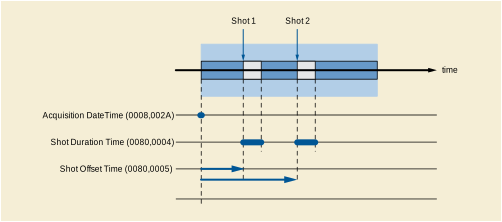
Table C.8.30.1-1 specifies the Attributes that identify and describe general information about the Corneal Topography Map Series.
Table C.8.30.1-1. Corneal Topography Map Series Module Attributes
|
Attribute Name |
Tag |
Type |
Attribute Description |
|---|---|---|---|
|
Modality |
(0008,0060) |
1 |
Type of equipment that created the maps in this Series. Enumerated Values:
See Section C.7.3.1.1.1 for further explanation. |
|
Referenced Performed Procedure Step Sequence |
(0008,1111) |
1C |
Uniquely identifies the Performed Procedure Step SOP Instance to which the Series is related (e.g., a Modality or General-Purpose Performed Procedure Step SOP Instance). Only a single Item shall be permitted in this sequence. Required if the Modality Performed Procedure Step SOP Class, or General Purpose Performed Procedure Step SOP Class is supported. |
|
>Include Table 10-11 “SOP Instance Reference Macro Attributes” |
|||
|
Body Part Examined |
(0018,0015) |
1 |
Text description of the part of the body examined. Enumerated Values:
NoteSome IODs support the Anatomic Region Sequence (0008,2218), which can provide a more comprehensive mechanism for specifying the body part being examined. |
Table C.8.30.2-1 specifies the Attributes that describe an Image produced by corneal topography mapping devices.
Table C.8.30.2-1. Corneal Topography Map Image Module Attributes
|
Attribute Name |
Tag |
Type |
Attribute Description |
|---|---|---|---|
|
Instance Number |
(0020,0013) |
1 |
A number that identifies this instance. |
|
Content Date |
(0008,0023) |
1 |
The date the data creation was started. |
|
Content Time |
(0008,0033) |
1 |
The time the data creation was started. |
|
Acquisition DateTime |
(0008,002A) |
1 |
The date and time that the acquisition of data that resulted in this image started. NoteThe synchronization of this time with an external clock is specified in the Synchronization Module in Acquisition Time Synchronized (0018,1800). |
|
Image Type |
(0008,0008) |
1 |
Image identification characteristics. See Section C.8.30.2.1.1 for specialization. |
|
Samples Per Pixel |
(0028,0002) |
1 |
Number of samples (planes) in this image. See Section C.7.6.3.1.1 for further explanation. Enumerated Values:
|
|
Photometric Interpretation |
(0028,0004) |
1 |
Specified the intended interpretation of the pixel data. See Section C.7.6.3.1.2 for further explanation. Enumerated Values:
|
|
Pixel Representation |
(0028,0103) |
1 |
Data representation of pixel samples. Enumerated Values:
|
|
Include Table 10-10 “Basic Pixel Spacing Calibration Macro Attributes” |
|||
|
Pixel Aspect Ratio |
(0028,0034) |
1 |
Ratio of the vertical size and horizontal size of the pixels in the image specified by a pair of integer values where the first value is the vertical pixel size, and the second value is the horizontal pixel size. |
|
Bits Allocated |
(0028,0100) |
1 |
Number of bits allocated for each pixel sample. Each sample shall have the same number of bits allocated. See PS3.5 for further explanation. Enumerated Values:
|
|
Bits Stored |
(0028,0101) |
1 |
Number of bits stored for each pixel sample. Enumerated Values:
|
|
High Bit |
(0028,0102) |
1 |
Most significant bit for pixel sample data. Each sample shall have the same high bit. See PS3.5 for further explanation. Enumerated Values:
|
|
Lossy Image Compression |
(0028,2110) |
1 |
Specifies whether an Image has undergone lossy compression. Enumerated Values:
See Section C.7.6.1.1.5 for further explanation. |
|
Lossy Image Compression Ratio |
(0028,2112) |
1C |
Describes the approximate lossy compression ratio(s) that have been applied to this image. See Section C.7.6.1.1.5 for further explanation. May be multi-valued if successive lossy compression steps have been applied; the value order shall correspond to the values of Lossy Image Compression Method (0028,2114). Note
Required if Lossy Image Compression (0028,2110) is "01". |
|
Lossy Image Compression Method |
(0028,2114) |
1C |
A label for the lossy compression method(s) that have been applied to this image. See Section C.7.6.1.1.5 for further explanation. May be multi-valued if successive lossy compression steps have been applied; the value order shall correspond to the values of Lossy Image Compression Ratio (0028,2112). NoteFor historical reasons, the lossy compression method may also be described in Derivation Description (0008,2111). Required if Lossy Image Compression (0028,2110) is "01". |
|
Burned In Annotation |
(0028,0301) |
1 |
Indicates that the image does not contain burned in annotation to identify the patient and date the image was acquired. Enumerated Values:
|
|
Recognizable Visual Features |
(0028,0302) |
1 |
Indicates whether or not the image contains sufficiently recognizable visual features to allow the image or a reconstruction from a set of images to identify the patient. Enumerated Values:
NoteCorneal topography is similar to finger prints as it is unique to individuals. Therefore, it could be used by a trained person or an expert system to identify the patient. |
|
Image Laterality |
(0020,0062) |
1 |
Laterality of object imaged (as described in Anatomic Region Sequence (0008,2218)) examined. Enumerated Values:
NoteThis Attribute is mandatory, in order to ensure that images may be positioned correctly relative to one another for display. Shall be consistent with any laterality information contained in Primary Anatomic Structure Modifier Sequence (0008,2230), if present. NoteLaterality (0020,0060) is a Series level Attribute and must be the same for all Images in the Series, hence it must be absent. |
|
Include Table C.7.6.16-12 “Real World Value Mapping Macro Attributes” |
Defined CID for Measurement Units Code Sequence is 4267 |
||
|
Include Table 10-5 “General Anatomy Mandatory Macro Attributes” |
The concept code for Anatomic Region Sequence (0008,2218) shall be (T-AA000, SRT, "Eye"), and Defined CID 244 “Laterality” shall be used for Anatomic Region Modifier Sequence (0008,2220). Defined CID 4266 “Ophthalmic Anatomic Structure Reference Point” shall be used for Primary Anatomic Structure Sequence (0008,2228). Only a single Item shall be permitted in this sequence. NoteAlthough Primary Anatomic Structure Sequence (0008,2228) is Type 3, it is important to convey this information if able to be determined. |
||
For Corneal Topography Maps, Image Type (0008,0008) is specified to be Type 1.
Defined Terms for Image Type Value 3:
- CORNEAL_TOPO
Identifies a topographic map of the cornea
The Corneal Topography Map SOP Class supports a sequence of transformations that completely define the conversion of a stored image into a displayed image.
The sequence of transformations from corneal measurements to a displayable image is explicitly defined in Figure C.8.30.2.1-1. Figure C.8.30.2.1-1 also conveys the transformation to display the scaling of the color map using its Real World Value Macro (see Table C.7.6.16-12 for more details on the Real World Value Macro).
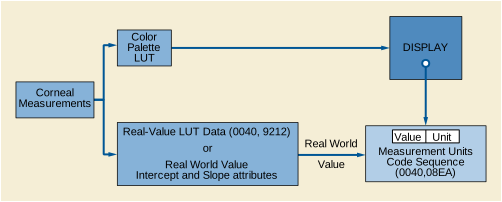
An SCP of the Corneal Topography Map Storage SOP Class, when rendering SOP Instances of the Class shall apply the image transformations (i.e., Palette Color LUT) and the Real World Value LUT to display the annotated color scale. The annotated color scale shall conform to the "ISO Standard 19980 - Ophthalmic instruments - Corneal topographers, second edition, section B.4 Standardized colour Scale."
Table C.8.30.3-1 specifies the Attributes that describe the corneal Topography map analysis.
Table C.8.30.3-1. Corneal Topography Map Analysis Module Attributes
|
Attribute Name |
Tag |
Type |
Attribute Description |
|---|---|---|---|
|
Ophthalmic Mapping Device Type |
(0022,1415) |
1 |
Describes the type of ophthalmic mapping acquisition device. See Section C.8.30.3.1.1 for further explanation. Defined Terms:
|
|
Corneal Vertex Location |
(0046,0202) |
1 |
Location of the corneal vertex. This is used for the reference point for other Attributes within this SOP Instance and determined by the Image referenced in the Attribute Source Image Sequence (0008,2112). Given as column\row. Column is the horizontal offset and row is the vertical offset. Image relative position specified with sub-pixel resolution such that the origin at the Top Left Hand Corner (TLHC) of the TLHC pixel is 0.0\0.0, the Bottom Right Hand Corner (BRHC) of the TLHC pixel is 1.0\1.0, and the BRHC of the BRHC pixel is Columns\Rows (see Figure C.10.5-1). The values must be within the range 0\0 to Columns\Rows. This location shall anchor the corneal vertex at the x, y and z coordinates of 0.0, 0.0, 0.0, in mm. See Section C.8.30.3.1.4 for further explanation. |
|
Corneal Topography Surface |
(0046,0201) |
1 |
Identifies the surface of the corneal topography map. Enumerated Values:
|
|
Pupil Centroid X-Coordinate |
(0046,0203) |
1C |
The horizontal coordinate of the centroid of the pupil relative to location of the cornea vertex specified in the Attribute Corneal Vertex Location (0046,0202), in mm, such that toward the right is positive. See Section C.8.30.3.1.4 for further explanation. Required if Attribute Corneal Topography Surface (0046,0201) is A (Anterior). NoteThis Attribute is conveyed in mm from the corneal vertex because display applications will have zoom and 3-D rotational capabilities. |
|
Pupil Centroid Y-Coordinate |
(0046,0204) |
1C |
The vertical coordinate of the centroid of the pupil relative to location of the cornea vertex specified in the Attribute Corneal Vertex Location (0046,0202), in mm, such that up is positive. See Section C.8.30.3.1.4 for further explanation. Required if Attribute Corneal Topography Surface (0046,0201) is A (Anterior). NoteThis Attribute is conveyed in mm from the corneal vertex because display applications will have zoom and 3-D rotational capabilities. |
|
Equivalent Pupil Radius |
(0046,0205) |
1C |
The average physical distance in mm from the pupil centroid specified in the Attributes Pupil Centroid X-Coordinate (0046,0203) and Pupil Centroid Y-Coordinate (0046,0204) to the measured perimeter of the pupil. Required if Attribute Corneal Topography Surface (0046,0201) is A (Anterior). NoteWhen the pupil is not able to be determined the typical estimate is 4mm. |
|
Vertices of the Outline of Pupil |
(0046,0208) |
1C |
A set of row/column vertices that outline the perimeter of the pupil. Two or more pairs of values follow and are the row and column coordinates of the other vertices that outline the perimeter of the pupil. For a two dimensional curve: X1, Y1, X2, Y2, etc. The first (X) dimension corresponds to the image column (horizontal offset), and the second (Y) dimension corresponds to the image row (vertical offset). This is a Polyline and the points are to be interpreted as an n-tuple list of end points between which straight lines are to be drawn. Required if Attribute Corneal Topography Surface (0046,0201) is A (Anterior). |
|
Include Table C.8.25.10-2 “Keratometric Measurements Macro Attributes” |
|||
|
Minimum Keratometric Sequence |
(0046,0215) |
1 |
A sequence that specifies the lowest power obtained when averaging individual meridian. Only one item shall be permitted. NoteThe measurement is typically taken at 3-4 mm from the corneal vertex. |
|
>Radius of Curvature |
(0046,0075) |
1 |
The radius of curvature of the principal meridian of the cornea, measured in mm. |
|
>Keratometric Power |
(0046,0076) |
1 |
The refractive power of the cornea at the principal meridian, measured in diopters. |
|
>Keratometric Axis |
(0046,0077) |
1 |
The meridian where the keratometric radius of curvature or power is measured, measured in degrees. |
|
Simulated Keratometric Cylinder Sequence |
(0046,0218) |
1 |
A sequence that specifies simulated keratometric cylinder power of the corneal surface, measured in diopters. Only one item shall be permitted. NoteThis information is obtained from the Steep and Flat Keratometric Axis readings. |
|
>Keratometric Power |
(0046,0076) |
1 |
The refractive power of the cornea at the principal meridian, measured in diopters. |
|
>Keratometric Axis |
(0046,0077) |
1 |
The meridian where the keratometric cylinder or power is measured, measured in degrees. |
|
Average Corneal Power |
(0046,0220) |
1 |
The area-corrected average of the corneal power ahead of the entrance pupil, measured in diopters. NoteIt is generally equal to the keratometric spherical equivalent except for decentered refractive surgical procedures. It is used in intraocular lens calculations. |
|
Corneal I-S Value |
(0046,0224) |
1 |
Quantifies the inferior-superior dioptric asymmetry along the vertical meridian to discriminate Keratoconus, measured in diopters. Note
|
|
Analyzed Area |
(0046,0227) |
1 |
The corneal surface area that can be analyzed, measured in mm squared. |
|
Maximum Corneal Curvature Sequence |
(0046,0211) |
3 |
A Sequence to convey the maximum curvature and location of the measured corneal topography. Only a single Item is permitted in this sequence. |
|
>Maximum Corneal Curvature |
(0046,0212) |
1 |
Maximum curvature in diopters of the measured corneal topography. |
|
>Maximum Corneal Curvature Location |
(0046,0213) |
1 |
Location of the corneal maximum curvature. Given as column\row. Column is the horizontal offset and row is the vertical offset. Image relative position specified with sub-pixel resolution such that the origin at the Top Left Hand Corner (TLHC) of the TLHC pixel is 0.0\0.0, the Bottom Right Hand Corner (BRHC) of the TLHC pixel is 1.0\1.0, and the BRHC of the BRHC pixel is Columns\Rows (see Figure C.10.5-1). The values must be within the range 0\0 to Columns\Rows. |
|
Surface Regularity Index |
(0046,0230) |
3 |
Measures local fluctuations in corneal power (i.e., irregular astigmatism) over the pupil (no units). NoteThis value would be about 0.4 for a cornea with good optical quality; at 1.5 and higher, vision falls below normal calculations. |
|
Surface Asymmetry Index |
(0046,0232) |
3 |
This index sums the meridional mire-to-mire power changes over the entire corneal surface, increasing as topographic irregularities increase (no units). |
|
Corneal Eccentricity Index |
(0046,0234) |
3 |
Index used to measure the eccentricity of the cornea (no units). |
|
Keratoconus Prediction Index |
(0046,0236) |
3 |
Index used to indicate the presence of Keratoconus (no units) NoteIt is obtained by discrete analysis of the corneal topographic data. (e.g., Invest Ophthalmol Vis Sci 35:2749-2757, 1994). |
|
Decimal Potential Visual Acuity |
(0046,0238) |
3 |
The range of best spectacle-corrected distance that might be expected from a functionally normal eye with the topographical characteristics of the analyzed cornea, measured in decimal. Note
|
|
Corneal Topography Map Quality Evaluation |
(0046,0242) |
1C |
Identifies the quality of the topography examination. Enumerated Values:
Required if a quality rating value exists for the corneal topography map |
|
Corneal Topography Map Type Code Sequence |
(0046,0207) |
1 |
The type of corneal topography map encoded in this SOP Instance. It specifies the meaning of the pixel values. Only a single Item shall be permitted in this sequence. |
|
Corneal Topography Mapping Normals Sequence |
(0046,0210) |
1C |
Identifies the data set used for corneal topography mapping values from a normative data base. Required if a normative data base was used. Only a single Item shall be permitted in this sequence. |
|
>Include Table 10-22 “Data Set Identification Macro Attributes” |
|||
|
Source Image Sequence |
(0008,2112) |
1 |
The Image SOP Class/Instance pair of the Image that was used to generate this corneal topography map. NoteAttribute Corneal Vertex Location (0046,0202) in this corneal topography map has been generated by the source image and provides the registration of the Corneal Topography Map to the Source Image. See Section C.8.30.3.1.2 for further explanation. Only a single Item shall be permitted in this sequence. |
|
>Include Table 10-3 “Image SOP Instance Reference Macro Attributes” |
|||
|
>Purpose of Reference Code Sequence |
(0040,A170) |
1 |
Describes the purpose for which the reference is made, (i.e., the role the source image or frame(s) played in the generation of this image). Only a single Item shall be permitted in this sequence. |
|
The code used shall be (121322, DCM, "Source image for image processing operation"). |
|||
|
Source Image Corneal Processed Data Sequence |
(0046,0244) |
1 |
Attributes that contain various power, elevation and wavefront measurements at specific points on the cornea of the SOP Instance referenced in Attribute Source Image Sequence (0008,2112). The Attributes are obtained from measurements of curvature or shape of the cornea. See Section C.8.30.3.1.3 for further explanation. One or more Items shall be present. |
|
>Corneal Point Location |
(0046,0247) |
1 |
The x, y, and z coordinate of a point in the image within the cornea, in mm. Where the origin is conveyed by the Attribute Corneal Vertex Location (0046,0202). NoteFor two dimensional maps z=0. |
|
>Corneal Point Estimated |
(0046,0248) |
1 |
The point defined in Attribute Corneal Point Location (0046,0247) is an estimated point (i.e., interpolated or extrapolated; not an actual measured point). Enumerated Values:
|
|
>Axial Power |
(0046,0249) |
1 |
Conveys corneal shape characteristics, in diopters. It is determined from the curvature, r in mm, of the equivalent sphere with the same slope at a given point on the surface. Axial power = Km/r, where Km is the Keratometric Index. |
|
>Tangential Power |
(0046,0250) |
1 |
Determined from the curvature (2nd derivative = d2y/dx2) of a point on the cornea, in diopters; also called Instantaneous Power. Emphasizes irregular astigmatism (large variations in higher order aberrations). |
|
>Refractive Power |
(0046,0251) |
1 |
Conveys the optical refraction properties of the cornea, in diopters. It is determined from ray tracing using Snell's Law to calculate the true refractive power. NoteIt is used to evaluate ocular optics. |
|
>Relative Elevation |
(0046,0252) |
1 |
Relative elevation, in micrometers, is calculated from the corneal surface distance from a reference surface (i.e., a sphere or ellipsoid) that intersects the corneal vertex. This value is determined from z - zref. Where z is conveyed in Attribute Corneal Point Location (0046,0247) and zref is the elevation of the reference surface. |
|
>Corneal Wavefront |
(0046,0253) |
1 |
Corneal wavefront, in micrometers, is calculated from the elevation data by fitting with the Zernike Series expansion. NoteThis permits measurement of both low and higher order aberrations and provides the total amount of distortion of the Corneal Wavefront with a Root Mean Square (RMS) value. |
For Ophthalmic Mapping Device Type (0022,1415), Reflection corneal topography, which measures corneal curvature directly, is based on the reflection of a specific pattern from the corneal surface. Placido-based topographers use variations of circular mires, while grid-based topographers use a rectangular array of point reflections. Slit-based corneal tomography, which measures elevation directly, is based on the projection of multiple slit beams in succession through the cornea (and anterior segment). Some use the Schiempflug optical principle to achieve high resolution over a broad depth of field. Swept source OCT uses high speed scanning to produce its optical sections. Source images for these devices are shown in Figure C.8.30.3.1-1. Example A and B are for reflection types, C is an interferometry type, and D is a slit based type.
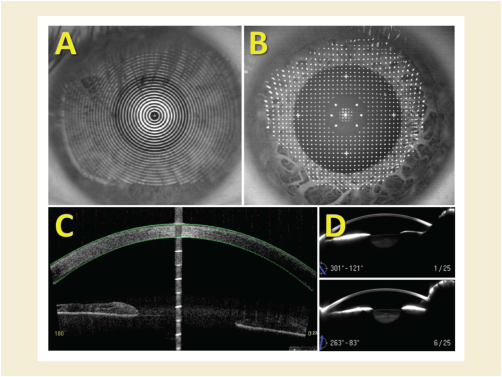
Equipment generating a corneal topography map image first obtains a source image. This image may be single frame or multi-framed such as when the Attribute Ophthalmic Mapping Device Type (0022,1415) is SLIT_BASED or INTERFEROMETRY. From this source image, the necessary measurement data is obtained to build the corneal topography map.
A typical source image may be generated by the Ophthalmic Photography 8 bit or 16 bit SOP Classes for device types of REFLECTION and SLIT_BASED. A typical source image for device type of INTERFEROMETRY would be Ophthalmic Tomography Image SOP Class.
Figure C.8.30.3.1-2 illustrates an example where the source image (left) is generated using a device type of REFLECTION. The corneal topography map and color scale is shown in the center (this is the output of this SOP Class). The right figure shows an example of the corneal topography map and color scale superimposed on the source image.
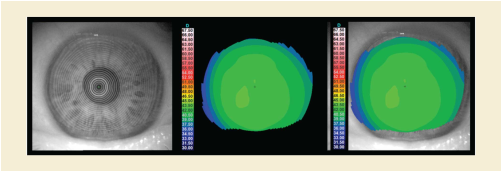
Figure C.8.30.3.1-2. Source Image (left), Corneal Topography Map Image (Center), Corneal Topography Map Presented as an Overlay on the Source Image (right)
The Source Image Corneal Processed Data Sequence (0046,0244) provides power, elevation and wavefront measurements taken at specific points of the Source Image. These Attributes were used to generate the corneal topography map and indices of this SOP Instance. This processed data can also be used to generate other corneal topography maps and indices.
The Corneal Vertex Location (0046,0202) establishes the reference point for the corneal vertex. It is used as the frame of reference that establishes the spatial relationship for the corneal vertex (i.e., used within corneal topography maps) for a set of Images within a Series. It also allows Images across multiple Series to share the same corneal vertex Frame Of Reference. The corneal vertex is the point located at the intersection of the patient's line of sight (visual axis) and the corneal surface. It is represented by the corneal light reflex when the cornea is illuminated coaxially with fixation.
Note
Since the criteria used to group images into a Series is application specific, it is possible for imaging applications to define multiple Series within a Study that share the same imaging space. Therefore the images with the same Frame of Reference UID (0020,0052) Attribute value share the same corneal vertex location within the patient's eye.
Figure C.8.30.3.1-3 illustrates the representation of corneal topography. The corneal vertex lies at the center of the rulers. Typical circular grids are 3, 5, 7, and 9 mm diameters centered on the vertex. The annotations in Figure C.8.30.3.1-3 are R, right; L, left; H = Head; F = Foot.
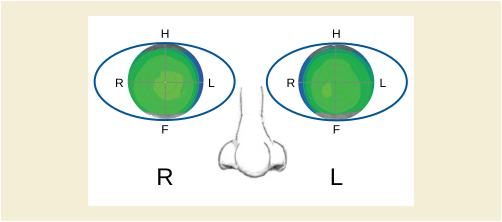
Numerical position data shall use the Cartesian (i.e., two dimensional rectangular) coordinate system. The direction of the axes are determined by Patient Orientation (0020,0020), see Section C.7.6.1.1.1 for further explanation.
Devices that internally capture data in polar coordinates will need to convert to Cartesian coordinates, see Figure C.8.30.3.1-4.
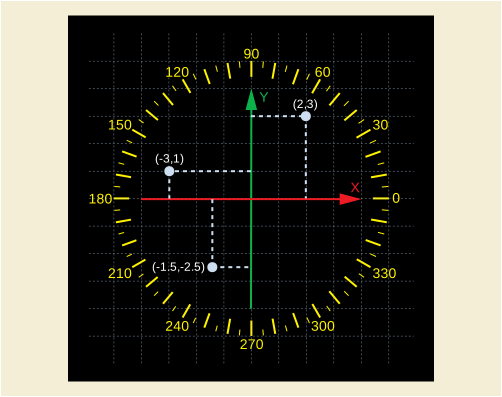
When using the 3 dimensional coordinates (X, Y, Z), the Z axis shall represent corneal elevation. Z shall be measured from the length of a vector normal to the plane that is normal to and intersects the corneal vertex at the intersection of the x, y, z, axes. It is shown in the diagram as "+" (0.0, 0.0, 0.0). The Z axis shall be positive towards the anterior direction of the eye; (i.e., it is a right-hand rule coordinate system. Thus the Z values (see Figure C.8.30.3.1-5) will be predominantly negative, as they are posterior to the plane of the corneal vertex.
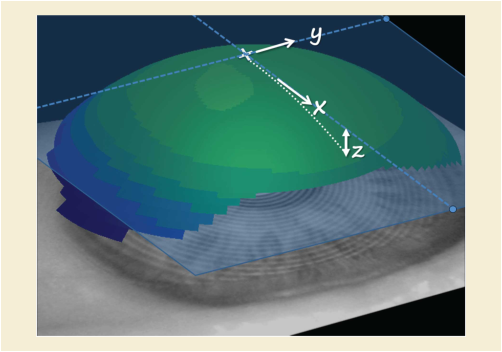
Table C.8.31-1 specifies the Attributes that identify and describe general information about the Enhanced Mammography Image Module.
Table C.8.31-1. Enhanced Mammography Image Module Attributes
|
Attribute Name |
Tag |
Type |
Attribute Description |
|---|---|---|---|
|
Positioner Motion |
(0018,1500) |
1 |
Describes the activity of the X-Ray Source during acquisition. See C.8.31.1.1 for Defined Terms. |
|
Positioner Type |
(0018,1508) |
1 |
Enumerated Values:
|
|
Content Qualification |
(0018,9004) |
1 |
Enumerated Values:
See C.8.13.2.1.1 for further explanation. |
|
Acquisition DateTime |
(0008,002A) |
1 |
The date and time that the acquisition of data that resulted in this image started. NoteThe synchronization of this time with an external clock is specified in the Synchronization Module in Acquisition Time Synchronized (0018,1800). |
|
Acquisition Duration |
(0018,9073) |
1 |
The time in seconds needed for the compete acquisition. See C.7.6.16.2.2.1 for further explanation. |
|
Include Table C.8-71b “Digital X-Ray Detector Macro Attributes” |
|||
|
KVP |
(0018,0060) |
1 |
Average of the peak kilo voltage outputs of the X-Ray generator used for all frames. |
|
X-Ray Tube Current in mA |
(0018,9330) |
1C |
Average of the nominal X-Ray tube currents in milliamperes for all frames. Required if Exposure in mAs (0018,9332) is not present. May be present otherwise. |
|
Exposure Time in ms |
(0018,9328) |
1C |
Total (cumulative) duration of X-Ray exposure for all acquired frames in milliseconds. Required if Exposure in mAs (0018,9332) is not present. May be present otherwise. |
|
Exposure in mAs |
(0018,9332) |
1C |
The total (cumulative) exposure for all acquired frames expressed in mAs, for example calculated from Exposure Time and X-Ray Tube Current. Required if either Exposure Time in ms (0018,9328) or X-Ray Tube Current in mA (0018,9330) is not present. May be present otherwise. |
|
Focal Spot(s) |
(0018,1190) |
1 |
Nominal focal spot size in mm used to acquire all frames. |
|
Anode Target Material |
(0018,1191) |
1 |
The primary material in the anode of the X-Ray source. Defined Terms:
|
|
Body Part Thickness |
(0018,11A0) |
1 |
The average thickness in mm of the body part examined when compressed, if compression has been applied during exposure. |
|
Compression Force |
(0018,11A2) |
1 |
The compression force applied to the body part during exposure, measured in Newtons. |
|
Paddle Description |
(0018,11A4) |
1 |
Description of the compression paddle, if compression was applied to the body part during exposure. |
|
Exposure Control Mode |
(0018,7060) |
1 |
Type of exposure control Defined Terms:
|
|
Exposure Control Mode Description |
(0018,7062) |
1 |
Text description of the mechanism of exposure control. May describe the number and type of exposure sensors or position of the sensitive area of the imaging detector. |
|
Patient Orientation |
(0020,0020) |
1C |
Patient direction of the rows and columns of the most representative frame. Required if View Code Sequence (0054,0220) has an Item value other than one representing a specimen image. May be present otherwise. |
|
Image Comments |
(0020,4000) |
3 |
User-defined comments about the image. |
|
Samples per Pixel |
(0028,0002) |
1 |
Number of samples (planes) in this image. Enumerated Values:
|
|
Photometric Interpretation |
(0028,0004) |
1 |
Specifies the intended interpretation of the pixel data. Enumerated Values:
|
|
Bits Allocated |
(0028,0100) |
1 |
Number of bits allocated for each pixel sample. Each sample shall have the same number of bits allocated. Enumerated Values:
|
|
Bits Stored |
(0028,0101) |
1 |
Number of bits stored for each pixel sample. Each sample shall have the same number of bits stored. Enumerated Values:
|
|
High Bit |
(0028,0102) |
1 |
Most significant bit for pixel sample data. Each sample shall have the same high bit. Shall have an Enumerated Value of one less than the value of Bits Stored (0028,0101). |
|
Pixel Representation |
(0028,0103) |
1 |
Data representation of the pixel samples. Each sample shall have the same pixel representation. Enumerated Values:
|
|
Quality Control Image |
(0028,0300) |
3 |
Indicates whether or not this image is a quality control of phantom image. Enumerated Values:
|
|
Burned in Annotation |
(0028,0301) |
1 |
Indicates whether or not the image contains sufficient burned in annotation to identify the patient and date the image was acquired. Enumerated Values:
|
|
Lossy Image Compression |
(0028,2110) |
1 |
Specifies whether an Image has undergone lossy compression (at a point in its lifetime). Enumerated Values:
Once this value has been set to 01 it shall not be reset. See Section C.7.6.1.1.5. |
|
Lossy Image Compression Ratio |
(0028,2112) |
1C |
Describes the approximate lossy compression ratio(s) that have been applied to this image. See Section C.7.6.1.1.5 for further explanation. May be multi-valued if successive lossy compression steps have been applied; the value order shall correspond to the values of Lossy Image Compression Method (0028,2114). Note
Required if Lossy Image Compression (0028,2110) is "01". |
|
Lossy Image Compression Method |
(0028,2114) |
1C |
A label for the lossy compression method(s) that have been applied to this image. See Section C.7.6.1.1.5 for further explanation. May be multi-valued if successive lossy compression steps have been applied; the value order shall correspond to the values of Lossy Image Compression Ratio (0028,2112). NoteFor historical reasons, the lossy compression method may also be described in Derivation Description (0008,2111). Required if Lossy Image Compression (0028,2110) is "01". |
|
Organ Dose |
(0040,0316) |
1 |
Organ dose value measured in dGy representing the collective total for all acquired frames. NoteThis may be an estimated value. |
|
Entrance Dose in mGy |
(0040,8302) |
1 |
Entrance dose value measured in mGy at the surface of the patient representing the collective total for all acquired frames. NoteThis may be an estimated value based on assumptions about the patient's body size and habitus. |
|
Type of Detector Motion |
(0054,0202) |
1 |
Describes the activity of the Detector during acquisition. See C.8.31.1.1 for Defined Terms. |
|
Icon Image Sequence |
(0088,0200) |
3 |
This icon image is representative of the Image. Only a single Item is permitted in this Sequence. |
|
See C.7.6.1.1.6 for further explanation. |
|||
|
Presentation LUT Shape |
(2050,0020) |
1 |
Specifies a transformation for the Presentation LUT such that the output of all grayscale transformations, if any, is defined to be in P-Values. Enumerated Values:
|
Positioner Motion (0018,1500) and Type of Detector Motion (0054,0202) shall have the Defined Terms specified in Table C.8.31.1.1-1.
Table C.8.31.1.1-1. Types of Positioner and Detector Motion
|
STATIONARY |
No motion |
|
ROTATION_STEP |
Circular arc motion, stepped, acquire only while stationary |
|
ROTATION_CONT |
Circular arc motion, continuous during acquisition |
|
TRANSLATION_STEP |
Linear motion, stepped, acquire only while stationary |
|
TRANSLATION_CONT |
Linear motion, continuous during acquisition |
|
COMPLEX_STEP |
Complex motion, stepped, acquire only while stationary |
|
COMPLEX_CONT |
Complex motion, continuous during acquisition |
Complex motion is defined as that which is not simply described by linear translation or rotation around an axis.
Table C.8.31.2-1 specifies the Attributes of the Breast X-Ray Positioner Functional Group Macro.
Table C.8.31.2-1. Breast X-Ray Positioner Macro Attributes
|
Attribute Name |
Tag |
Type |
Attribute Description |
|---|---|---|---|
|
Positioner Position Sequence |
(0018,9405) |
1 |
A sequence that describes the geometrical position of the positioner. Only a single Item shall be included in this sequence. |
|
>Positioner Primary Angle |
(0018,1510) |
1C |
Signed position in degrees of the X-Ray beam vector in the coronal anatomical plane as if the patient were standing facing the equipment where vertical is zero. Required if X-Ray source can be moved in the coronal anatomical plane. May be present otherwise. |
|
>Positioner Primary Angle Direction |
(0018,9559) |
1C |
The interpretation of the sign of the Positioner Primary Angle (0018,1510). Enumerated Values:
See Figure C.8.31.2-1. Required if Positioner Primary Angle (0018,1510) is present. |
|
>Positioner Secondary Angle |
(0018,1511) |
1C |
Position in degrees of the X-Ray beam vector in the sagittal anatomical plane as if the patient were standing where movement of the X-Ray source from anterior to posterior is positive, and vertical is zero. Required if the X-Ray source can be moved in the sagittal anatomical plane. May be present otherwise. |
Figure C.8.31.2-1 illustrates the Defined Terms for Positioner Primary Angle Direction (0018,9559), indicating which C-arm movement direction defines a positive value for Positioner Primary Angle (0018,1510).
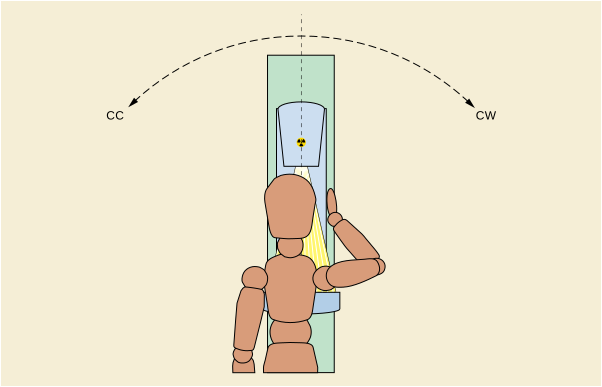
Table C.8.31.3-1 specifies the Attributes of the Breast X-Ray Detector Functional Group Macro.
Table C.8.31.3-1. Breast X-Ray Detector Macro Attributes
|
Attribute Name |
Tag |
Type |
Attribute Description |
|---|---|---|---|
|
Detector Position Sequence |
(0018,9541) |
1 |
A sequence that describes the geometrical position of the detector. Only a single Item shall be included in this sequence. |
|
>Detector Primary Angle |
(0018,1530) |
1C |
Angle of the X-Ray beam in the row direction in degrees relative to the normal to the detector plane. Positive values indicate that the X-Ray beam is tilted toward higher numbered columns. Negative values indicate that the X-Ray beam is tilted toward lower numbered columns. See C.8.11.7.1.2. Required if the detector can be moved in the row direction. May be present otherwise. |
|
>Detector Secondary Angle |
(0018,1531) |
1C |
Angle of the X-Ray beam in the column direction in degrees relative to the normal to the detector plane. Positive values indicate that the X-Ray beam is tilted toward lower numbered rows. Negative values indicate that the X-Ray beam is tilted toward higher numbered rows. See C.8.11.7.1.2. Required if the detector can be moved in the column direction. May be present otherwise. |
Table C.8.31.4-1 specifies the Attributes of the Breast X-Ray Geometry Functional Group Macro.
Table C.8.31.4-1. Breast X-Ray Geometry Macro Attributes
|
Attribute Name |
Tag |
Type |
Attribute Description |
|---|---|---|---|
|
X-Ray Geometry Sequence |
(0018,9476) |
1 |
Sequence containing the geometric properties for this frame or set of frames. Only a single Item shall be included in this sequence. |
|
>Distance Source to Detector |
(0018,1110) |
1C |
Distance in mm from source to detector center on the chest wall line. Required if Presentation Intent Type (0008,0068) = FOR PROCESSING. May be present otherwise. Note
|
|
>Distance Source to Patient |
(0018,1111) |
1C |
Distance in mm from source to the Breast Support side that is closest to the Imaging Subject, as measured along the X-Ray beam vector. Required if Presentation Intent Type (0008,0068) = FOR PROCESSING. May be present otherwise. Note
|
|
>Distance Source to Isocenter |
(0018,9402) |
1C |
Distance from source to isocenter in mm. Required if Presentation Intent Type (0008,0068) = FOR PROCESSING. May be present otherwise. |
|
>Distance Source to Entrance |
(0040,0306) |
3 |
Distance in mm from the source to the surface of the patient closest to the source during the acquisition of this image. NoteThis may be an estimated value based on assumptions about the patient's body size and habitus. |
|
>Estimated Radiographic Magnification Factor |
(0018,1114) |
1 |
Ratio of Source Image Distance (SID) over Source Object Distance (SOD). |
Table C.8.31.5-1 specifies the Attributes of the X-Ray Acquisition Dose Functional Group Macro.
Table C.8.31.5-1. Breast X-Ray Acquisition Dose Macro Attributes
|
Attribute Name |
Tag |
Type |
Attribute Description |
|---|---|---|---|
|
X-Ray Acquisition Dose Sequence |
(0018,9542) |
1 |
Sequence containing the X-Ray exposure information for this frame. Only a single Item shall be included in this sequence. |
|
>Exposure Time in ms |
(0018,9328) |
1 |
Duration of X-Ray exposure in milliseconds. |
|
>Exposure in mAs |
(0018,9332) |
1 |
The exposure expressed in mAs, for example calculated from Exposure Time and X-Ray Tube Current. |
|
>Relative X-Ray Exposure |
(0018,1405) |
3 |
Indication of the applied dose, in manufacturer specific units. Note
|
|
>Half Value Layer |
(0040,0314) |
3 |
The thickness of Aluminum in mm required to reduce the X-Ray Output (0040,0312) by a factor of two. NoteThis value may be a calibrated value rather than measured during the exposure. |
|
>Organ Dose |
(0040,0316) |
1 |
Average organ dose value measured in dGy during the acquisition of this image. NoteThis may be an estimated value. |
|
>Entrance Dose in mGy |
(0040,8302) |
1 |
Average entrance dose value measured in mGy at the surface of the patient during the acquisition of this image. NoteThis may be an estimated value based on assumptions about the patient's body size and habitus. |
Table C.8.31.6-1 specifies the Attributes of the Breast X-Ray Isocenter Reference System Functional Group Macro.
Table C.8.31.6-1. Breast X-Ray Isocenter Reference System Macro Attributes
|
Attribute Name |
Tag |
Type |
Attribute Description |
|---|---|---|---|
|
Isocenter Reference System Sequence |
(0018,9462) |
1 |
A sequence that describes the Isocenter Reference Coordinate System (O, X, Y, Z). Only a single Item shall be included in this sequence. |
|
>X-Ray Source Isocenter Primary Angle |
(0018,9543) |
1 |
Primary angle of the X-Ray source in the isocenter reference system (deg). See C.8.31.6.1.2 for further explanation. |
|
>X-Ray Source Isocenter Secondary Angle |
(0018,9544) |
1 |
Secondary angle of the X-Ray source in the isocenter reference system (deg). See C.8.31.6.1.2 for further explanation. |
|
>Breast Support Isocenter Primary Angle |
(0018,9545) |
1 |
Primary angle of the Breast Support in the isocenter reference system (deg). See C.8.31.6.1.3 for further explanation. |
|
>Breast Support Isocenter Secondary Angle |
(0018,9546) |
1 |
Secondary angle of the Breast Support in the isocenter reference system (deg). See C.8.31.6.1.3 for further explanation. |
|
>Breast Support X Position to Isocenter |
(0018,9547) |
1C |
X position of the Breast Support Reference Point with respect to the Isocenter (mm). See C.8.31.6.1.3 for further explanation. Required if Presentation Intent Type (0008.0068) = FOR PROCESSING. May be present otherwise. |
|
>Breast Support Y Position to Isocenter |
(0018,9548) |
1C |
Y position of the Breast Support Reference Point with respect to the Isocenter (mm). See C.8.31.6.1.3 for further explanation. Required if Presentation Intent Type (0008.0068) = FOR PROCESSING. May be present otherwise. |
|
>Breast Support Z Position to Isocenter |
(0018,9549) |
1C |
Z position of the Breast Support Reference Point with respect to the Isocenter (mm). See C.8.31.6.1.3 for further explanation. Required if Presentation Intent Type (0008.0068) = FOR PROCESSING. May be present otherwise. |
|
>Detector Isocenter Primary Angle |
(0018,9550) |
1 |
Primary angle of the Detector in the isocenter reference system (deg). See C.8.31.6.1.4 for further explanation. |
|
>Detector Isocenter Secondary Angle |
(0018,9551) |
1 |
Secondary angle of the Detector in the in the isocenter reference system (deg). See C.8.31.6.1.4 for further explanation. |
|
>Detector X Position to Isocenter |
(0018,9552) |
1C |
X position of the Detector Reference Point with respect to the Isocenter (mm). See C.8.31.6.1.4 for further explanation. Required if Presentation Intent Type (0008.0068) = FOR PROCESSING. May be present otherwise. |
|
>Detector Y Position to Isocenter |
(0018,9553) |
1C |
Y position of the Detector Reference Point with respect to the Isocenter (mm). See C.8.31.6.1.4 for further explanation. Required if Presentation Intent Type (0008.0068) = FOR PROCESSING. May be present otherwise. |
|
>Detector Z Position to Isocenter |
(0018,9554) |
1C |
Z position of the Detector Reference Point with respect to the Isocenter (mm). See C.8.31.6.1.4 for further explanation. Required if Presentation Intent Type (0008.0068) = FOR PROCESSING. May be present otherwise. |
|
>Detector Active Area TLHC Position |
(0018,9557) |
1C |
The x, y, and z coordinates in mm of the center of the top left hand corner detector element of the detector active area in the Detector coordinate system. See C.8.31.6.1.5 for further explanation. Required if Presentation Intent Type (0008.0068) = FOR PROCESSING. May be present otherwise. |
|
>Detector Active Area Orientation |
(0018,9558) |
1C |
The direction cosines of the first row and the first column with respect to the Detector coordinate system. See C.8.31.6.1.5 for further explanation. Required if Presentation Intent Type (0008.0068) = FOR PROCESSING. May be present otherwise. |
The Isocenter Reference System Attributes describe the 3D geometry of the X-Ray equipment composed by the X-Ray Source, Breast Support and the Detector.
These attributes define four coordinate systems in the 3D space:
Isocenter coordinate system
X-Ray Source coordinate system
Breast Support coordinate system
Detector coordinate system
The Isocenter Reference System attributes describe the relationship between the 3D coordinates of a point in the Breast Support coordinate system and the 3D coordinates of such point in the X-Ray Source and Detector coordinate systems (which may move in the equipment), by using the Isocenter coordinate system that is fixed in the equipment.
Unlike in X-Ray Angiography, in stereotactic biopsy and breast tomosynthesis the X-Ray source does not move in lock-step with the detector. The detector may be stationary, may translate, or may rotate as the X-Ray source moves. Thus for the purpose of stereotactic biopsy and breast tomosynthesis, the X-Ray Source and Detector Coordinate Systems are defined separately, and each of the potential detector positionings is considered separately.
Note
Annex Z “X-Ray Isocenter Reference Transformations (Informative)” in PS3.17 describes the transformations necessary to transpose between coordinate systems.
The detector is anterior to the patient standing upright and facing the front of the gantry, as shown in Figure C.8.31.6-1.
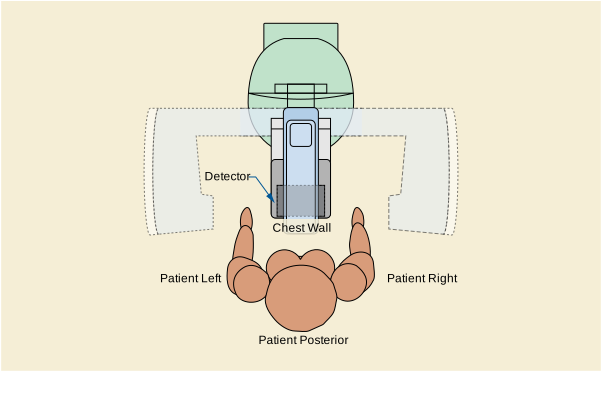
As breast projection X-Ray imaging traditionally uses devices with similar physical appearance, the following terms are defined for the purpose of helping later convey the geometry associated with breast projection X-Ray imaging:
|
GANTRY FRONT |
The side of the equipment closest to the patient when the patient is standing, positioned for breast projection X-Ray imaging. |
|
|
GANTRY RIGHT |
The right-hand side of the equipment when the patient is standing facing GANTRY FRONT. |
|
|
GANTRY LEFT |
The left-hand side of the equipment when the patient is standing facing GANTRY FRONT. |
|
|
GANTRY REAR |
The side of the equipment furthest from the patient when the patient is standing, positioned for breast projection X-Ray imaging. |
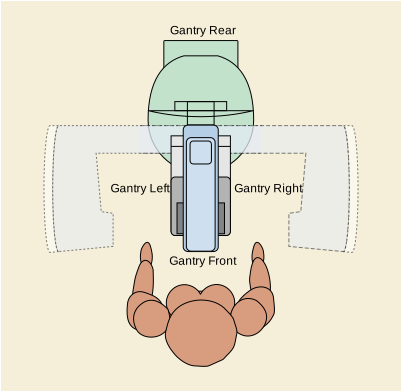
The Isocenter coordinate system (O,X,Y,Z) of the equipment is defined as follows (see Figure C.8.31.6-3) :
Origin O is the System Isocenter, which is the point where the plane of motion of the X-Ray Source spot intersects the axis of rotation of the X-Ray Source.
+X direction is from GANTRY LEFT to GANTRY RIGHT in the horizontal plane (gravity plane).
+Y direction is from GANTRY FRONT to GANTRY REAR in the horizontal plane (gravity plane).
+Z direction is upward (anti-gravity).
The isocenter coordinate system does not rotate when the tube head or C-arm rotates.
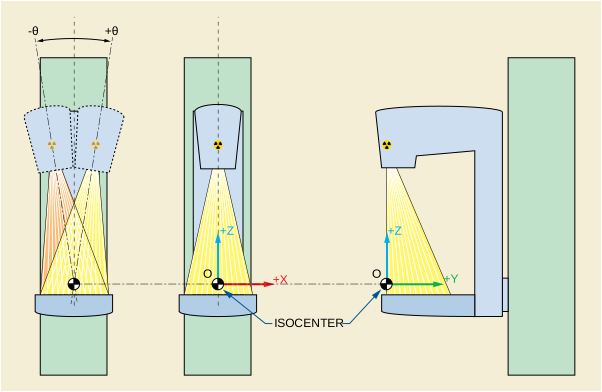
The X-Ray Source coordinate system (Os, Xs, Ys, Zs) is defined as follows (see Figure C.8.31.6-4):
Origin Os is identical to the origin of the Isocenter coordinate system O.
Xs axis is in the plane normal to the axis of rotation of the X-Ray source through Os and is perpendicular to the X-Ray source. Positive direction is from GANTRY LEFT to GANTRY RIGHT when the X-Ray source is overhead (As1 equals 0°).
Ys axis is the axis of rotation of the X-ray source. Positive direction is from GANTRY FRONT to GANTRY REAR.
Zs axis is normal to the Xs Ys plane. The +Zs direction is generally toward the X-ray source, defined by the right-hand rule from +Xs and +Ys.
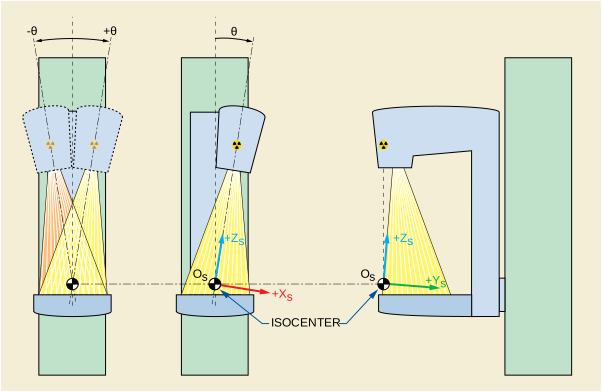
The X-Ray Source coordinate system (Os, Xs, Ys, Zs) is characterized with respect to the Isocenter coordinate system (O, X, Y, Z), by two angles describing the X-Ray center beam. These angles are relative to the Isocenter reference system, and independent from the patient position on the equipment.
X-Ray Source Isocenter Primary Angle (0018,9543) (so-called As1 in Figure C.8.31.6-5) is defined as the angle between the YZ plane and the YZs plane. The angle from +Zs toward +Xs is positive.
X-Ray Source Isocenter Secondary Angle (0018,9544) (so-called As2 in Figure C.8.31.6-5) is defined as the angle between the XZ plane and the XZs plane. The angle from +Zs toward +Ys is positive.
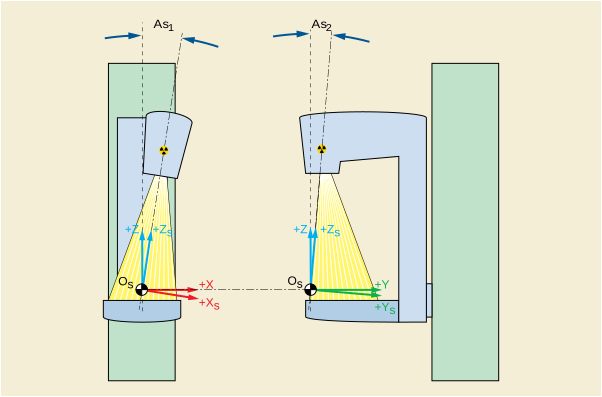
The Breast Support (see Figure C.8.31.6-6) is the housing over the detector onto which the breast is placed before imaging. For the purpose of this description, Breast Support top surface refers to the patient contact surface of the Breast Support, closest to the X-Ray source.
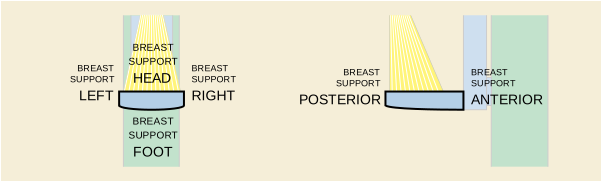
The Breast Support coordinate system (Ob, Xb, Yb, Zb) is defined as follows (see Figure C.8.31.6-7):
Origin Ob, the so-called Breast Support Reference Point, is an arbitary point, as defined by the equipment manufacturer, on the axis of the center of rotation of the Breast Support.
Xb axis lies parallel to the Breast Support top surface, passes through Ob, and is parallel to X when the Breast Support top surface is normal to gravity. The +Xb direction is toward BREAST SUPPORT RIGHT.
Yb axis lies parallel to the Breast Support top surface, passes through Ob, and is perpendicular to the Xb axis. The +Yb direction is toward BREAST SUPPORT ANTERIOR.
Zb axis is normal to the Breast Support top surface and passes through Ob. The +Zb direction is toward BREAST SUPPORT HEAD.
The Breast Support coordinate system (Ob, Xb, Yb, Zb) is characterized, with respect to the Isocenter coordinate system (O, X, Y, Z), by two rotations that describe the Breast Support tilt and a 3D translation (see Figure C.8.31.6-7). It is the most common convention in breast projection X-Ray system design to have the Breast Support rotate identically and in synchronization with the system C-arm (they are most often rigidly integrated):
Breast Support Isocenter Primary Angle (0018,9545) (so-called Ab1) is defined as the angle between the YZ plane and the YZb plane. The angle is positive when the Breast Support Right end of the Breast Support is lower than the Breast Support Left end of the Breast Support, and is 0° when the Breast Support surface is normal to the +Z direction. In digital breast tomosynthesis, because the X-Ray source moves independently of the Breast Support, the Breast Support Isocenter Primary Angle is the principal place where the user's perception of the C-arm angle is encoded.
Breast Support Isocenter Secondary Angle (0018,9546) (so-called Ab2) is defined as the angle between the XY plane and the XYb plane. The angle is positive when the Breast Support Anterior side of the Breast Support is lower than the Breast Support Posterior end of the Breast Support, and is 0° when the Breast Support surface is normal to the +Z axis. In most breast projection X-Ray imaging equipment the value of Ab2 is 0°.
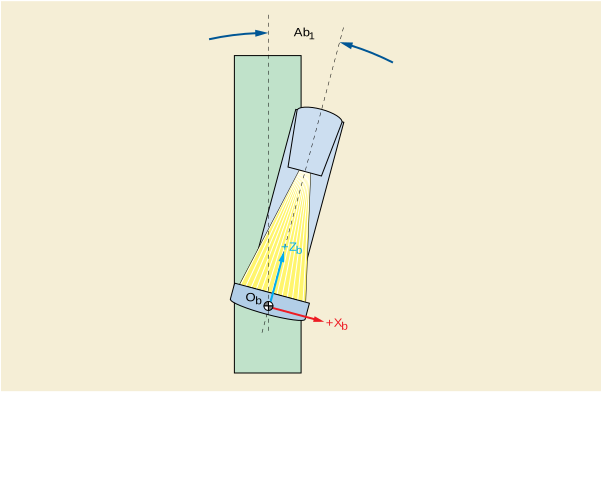
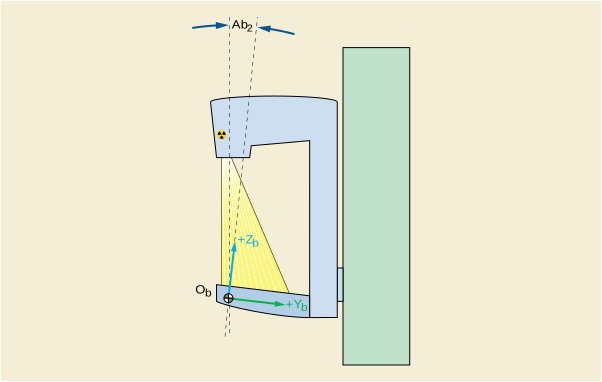
Breast Support X Position to Isocenter (0018,9547) (so-called BX) is defined as the translation of the Breast Support Reference Point Ob with respect to the Isocenter coordinate system in the +X axis direction. Breast support translation toward +X is positive.
Breast Support Y Position to Isocenter (0018,9548) (so-called BY) is defined as the translation of the Breast Support Reference Point Ob with respect to the Isocenter coordinate system in the +Y axis direction. Breast support translation toward +Y is positive.
Breast Support Z Position to Isocenter (0018,9459) (so-called BZ) is defined as the translation of the Breast Support Reference Point Ob with respect to the Isocenter coordinate system in the +Z axis direction. Breast support translation toward +Z is positive.
Note
A translation of (BX, BY, BZ) = (0, 0, 0) means that the Breast Support Reference Point Ob is at the System Isocenter.
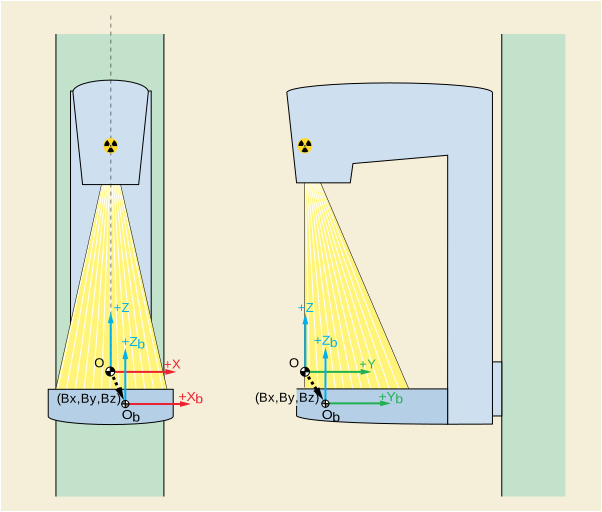
A detector coordinate system is defined that allows the detector to be either stationary or in motion. For clarity of understanding and interoperability, detector motion terms that may be used during image acquisition are defined, as indicated in Type of Detector Motion (0054,0202):
Stationary Detector
Rotating Detector
Translating Detector
Complex Detector
An infinite variation of detector motions is possible through time- and angle- dependent combinations of detector rotation and detector translation.
At any given point in time during image acquisition the detector origin Od may be translated with respect to the system isocenter and/or the detector coordinate system rotated with respect to the isocenter coordinate system. The detector coordinate system (Od, Xd, Yd, Zd) is defined as follows (see Figure C.8.31.6-9):
Detector Reference Point Od, is an arbitrary point, defined by the equipment manufacturer, that lies on the axis of rotation of the detector, if any.
Xd axis lies in the plane parallel to the detector surface, through the point Od, and perpendicular to the axis of rotation. The +Xd direction is in the same direction as the +X direction when the detector surface is normal to gravity.
Yd axis is the axis of rotation of the detector and is parallel to Y. The +Yd direction is in the same direction as the +Y direction when the detector surface is normal to gravity.
Zd axis is normal to the detector surface and through the point Od. The +Zd direction is upward, defined by the right-hand rule from +Xd and +Yd.
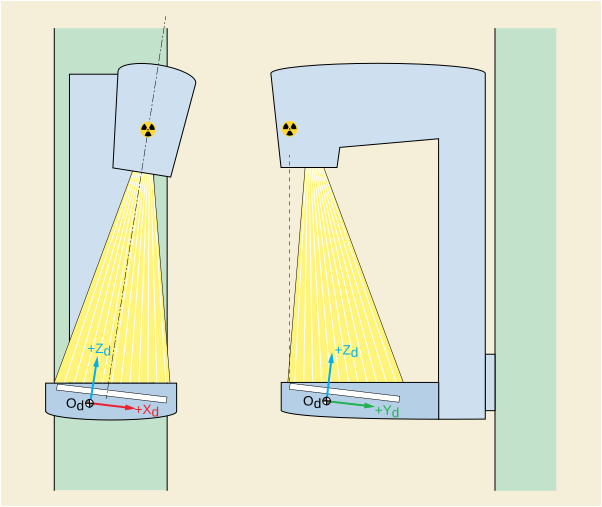
The Detector coordinate system (Od, Xd, Yd, Zd) is characterized with respect to the Isocenter coordinate system (O, X, Y, Z), by two angles describing the tilt of the detector. These angles are relative to the Isocenter reference system, and independent from the patient position on the equipment.
Detector Isocenter Primary Angle (0018,9550) (so-called Ad1) is defined as the angle between the YZ plane and the YZd plane. The angle is positive when the +Xd axis is lower than the -Xd axis with respect to Z, and is 0°when the detector surface is normal to the +Z axis.
Detector Isocenter Secondary Angle (0018,9551) (so-called Ad2) is defined as the angle between the plane XZ and the plane XZd. The angle is positive when the +Yd axis is lower than the -Yd axis with respect to Z. In most cases this angle is 0°, inferring that the XZ plane is parallel to the Xd plane.
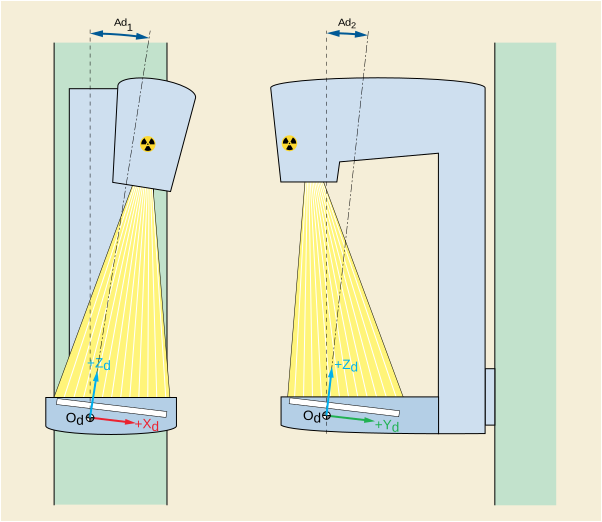
Detector X Position to Isocenter (0018,9552) (so-called DX) is defined as the translation of the Detector Reference Point Od with respect to the Isocenter coordinate system in the X direction. A translation of DX toward Breast Support Right from Detector Od is positive.
Detector Y Position to Isocenter (0018,9553) (so-called DY) is defined as the translation of the Detector Reference Point Od with respect to the Isocenter coordinate system in the Y direction. A translation of DY toward Breast Support Anterior from Detector Od is positive.
Detector Z Position to Isocenter (0018,9554) (so-called DZ) is defined as the translation of the Detector Reference Point Od with respect to the Isocenter coordinate system in the Z direction. A translation of DZ toward Breast Support Head from Detector Od is positive.
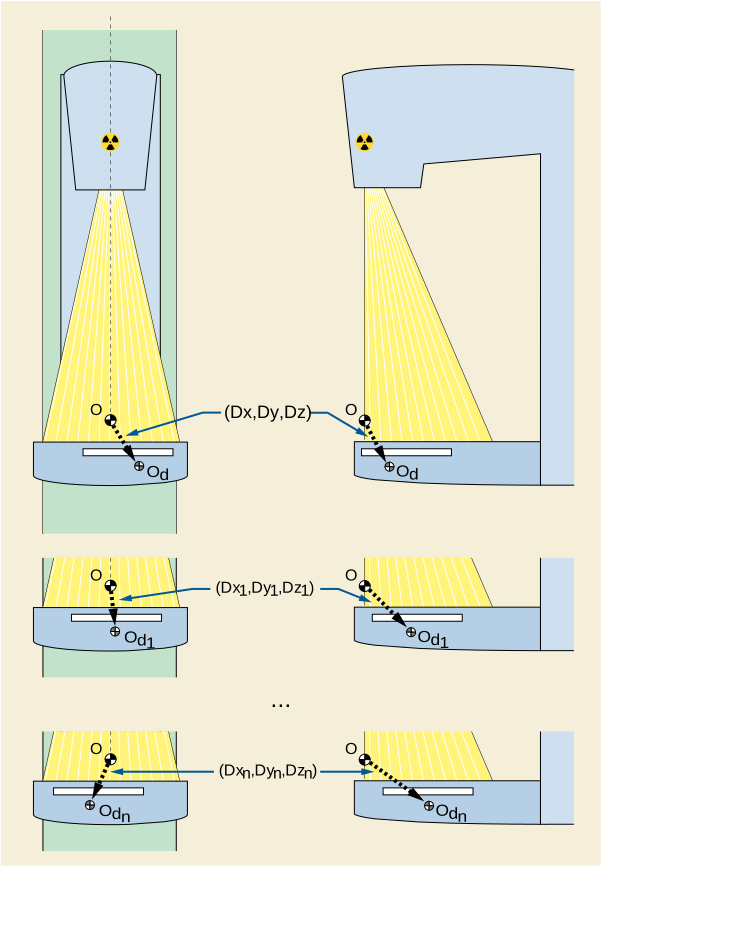
Although not shown in Figure C.8.31.6-11, translation of the detector moves the Detector Origin Od relative to the Isocenter. Thus during translation of the detector, at least one of DX, DY and DZ will change.
Note
A translation of (DX, DY, DZ) = (0, 0, 0) means that the Detector Reference Point Od is at the System Isocenter.
The case where the detector is stationary during image acquisition is a degenerate case, but still defined in the same manner.
Note
An angulation of (Ad1, Ad2) = (0, 0) means that the Detector is not rotated relative to the System Isocenter coordinate system.
A translation of (DX, DY, DZ) = (0, 0, 0) means that the Detector Reference Point Od is at the System Isocenter.
The image and planes in conventional mammography and digital breast tomosynthesis are expressed in relation to Detector FOV and Detector Active area (see C.8.11.4.1.1). As manufacturers design their systems differently, the detector may be mounted or positioned differently in different breast imaging systems. As a result, the TLHC position of the Detector Active Area, together with row and column directions, must be specified (see Figure C.8.31.6-12). The relationship between the Detector Active Area TLHC, the row and column directions of the Active Area, and the Field of View and Detector Coordinate System (defined in C.8.31.6.1.4) is defined by two attributes.
Detector Active Area TLHC Position (0018,9557) specifies the x, y and z cooordinates in mm of the center of the pixel defined as Detector Active Area TLHC within the Detector coordinate system, where the Z-direction value is always 0 since the detector itself is in XdYd plane. A value of Detector Active Area TLHC Position (0018,9557) = (0,0,0) means that the Detector Active Area TLHC Position is at the origin Od of the Detector coordinate system.
Detector Active Area Orientation (0018,9558) specifies the direction cosines of the first row followed by the direction cosines of the first column within the Detector coordinate system. The first three values contain the cosine of the angle between the first row and the Xd, Yd and Zd axes, respectively. The next three values contain the cosine of the angle between the first column and the Xd, Y d and Zd axes, respectively.
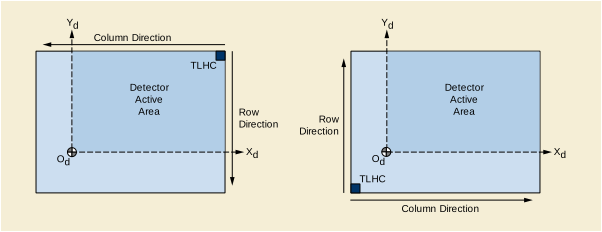
In Figure C.8.31.6-12, the left picture illustrates Detector Active Area Orientation (0018,9558) = (0,-1,0,-1,0,0), while the right picture illustrates Detector Active Area Orientation (0018,9558) = (0,1,0,1,0,0).
Table C.8.31.7-1 specifies the Attributes of the X-Ray Grid Functional Group Macro.
Table C.8.31.7-1. X-Ray Grid Macro Attributes
|
Attribute Name |
Tag |
Type |
Attribute Description |
|---|---|---|---|
|
X-Ray Grid Sequence |
(0018,9555) |
1 |
A sequence that describes the geometrical position of the positioner. Only a single Item shall be included in this sequence. |
|
>Grid |
(0018,1166) |
1 |
Identified the grid. May be multi-valued. Defined Terms:
|
|
Include Table C.8-36b “X-Ray Grid Description Macro Attributes” |
|||
Table C.8.31.8-1 specifies the Attributes of the X-Ray Filter Functional Group Macro.
Table C.8.31.8-1. X-Ray Filter Macro Attributes
|
Attribute Name |
Tag |
Type |
Attribute Description |
|---|---|---|---|
|
X-Ray Filter Sequence |
(0018,9556) |
1 |
A sequence that describes the attributes related to the filtration of X-Rays during image acquisition. Only a single Item shall be included in this sequence. |
Retired. See PS3.3-2004.
Table C.9-2 contains Attributes that describe characteristics of an Overlay Plane.
An Overlay Plane describes graphics or bit-mapped text that is associated with an Image. It may also describe a Region of Interest in an Image.
Each Overlay Plane is one bit deep. Sixteen separate Overlay Planes may be associated with an Image.
Overlay data is stored in Overlay Data (60xx,3000). See the Section Repeating Groups in PS3.5 for a description of permitted values of 60xx.
Note
Overlay data stored in unused bit planes of Pixel Data (7FE0,0010) with Samples Per Pixel (0028,0002) of 1 was previously described in DICOM. This usage has now been retired. See PS3.3-2004 and PS3.5-2004.
Attributes describing display of grayscale and color overlays were defined in a previous version of the DICOM Standard. These have now been retired. How an Overlay Plane is rendered is undefined; specifically there is no mechanism to specify with what color or intensity an Overlay Plane is to be displayed, except when rendered under the control of a Softcopy Presentation State SOP Instance.
Table C.9-2. Overlay Plane Module Attributes
|
Attribute Name |
Tag |
Type |
Attribute Description |
|---|---|---|---|
|
Overlay Rows |
(60xx,0010) |
1 |
Number of Rows in Overlay. |
|
Overlay Columns |
(60xx,0011) |
1 |
Number of Columns in Overlay. |
|
Overlay Type |
(60xx,0040) |
1 |
Indicates whether this overlay represents a region of interest or other graphics. Enumerated Values:
|
|
Overlay Origin |
(60xx,0050) |
1 |
Location of first overlay point with respect to pixels in the image, given as row\column. The upper left pixel of the image has the coordinate 1\1. Column values greater than 1 indicate the overlay plane origin is to the right of the image origin. Row values greater than 1 indicate the overlay plane origin is below the image origin. Values less than 1 indicate the overlay plane origin is above or to the left of the image origin. NoteValues of 0\0 indicate that the overlay pixels start 1 row above and one column to the left of the image pixels. |
|
Overlay Bits Allocated |
(60xx,0100) |
1 |
Number of Bits Allocated in the Overlay. The value of this Attribute shall be 1. NoteFormerly the standard described embedding the overlay data in the Image Pixel Data (7FE0,0010), in which case the value of this Attribute was required to be the same as Bits Allocated (0028,0100). This usage has been retired. See PS3.3-2004. |
|
Overlay Bit Position |
(60xx,0102) |
1 |
The value of this Attribute shall be 0. NoteFormerly the standard described embedding the overlay data in the Image Pixel Data (7FE0,0010), in which case the value of this Attribute specified the bit in which the overlay was stored. This usage has been retired. See PS3.3-2004. |
|
Overlay Data |
(60xx,3000) |
1 |
Overlay pixel data. The order of pixels sent for each overlay is left to right, top to bottom, i.e., the upper left pixel is sent first followed by the remainder of the first row, followed by the first pixel of the 2nd row, then the remainder of the 2nd row and so on. Overlay data shall be contained in this Attribute. See Section C.9.2.1.1 for further explanation. |
|
Overlay Description |
(60xx,0022) |
3 |
User-defined comments about the overlay. |
|
Overlay Subtype |
(60xx,0045) |
3 |
Defined Term that identifies the intended purpose of the Overlay Type. See Section C.9.2.1.3 for further explanation. |
|
Overlay Label |
(60xx,1500) |
3 |
A user defined text string that may be used to label or name this overlay. |
|
ROI Area |
(60xx,1301) |
3 |
Number of pixels in ROI area. See Section C.9.2.1.2 for further explanation. |
|
ROI Mean |
(60xx,1302) |
3 |
ROI Mean. See Section C.9.2.1.2 for further explanation. |
|
ROI Standard Deviation |
(60xx,1303) |
3 |
ROI standard deviation. See Section C.9.2.1.2 for further explanation. |
There are two specific types of overlays. The type is specified in this Attribute.
A Region of Interest (ROI) is a specific use of an Overlay. The overlay bits corresponding to all the pixels included in the ROI shall be set to 1. All other bits are set to 0. This is used to specify an area of the image of particular interest.
A Graphics overlay may express reference marks, graphic annotation, or bit mapped text, etc. A Graphics overlay may be used to mark the boundary of a ROI. If this is the case and the ROI statistical parameters are used, they will only refer to the pixels under the boundaries, not those in the included regions.
The overlay bits corresponding to all the pixels included in the Graphics shall be set to 1. All other bits are set to 0.
These Attributes contain the statistical parameters of the ROI. The values of these parameters are for the overlay pixel values set to 1.
Defined Terms:
- USER
User created graphic annotation (e.g., operator)
- AUTOMATED
Machine or algorithm generated graphic annotation, such as output of a Computer Assisted Diagnosis algorithm
Note
Additional or alternative Defined Terms may be specified in modality specific Modules, such as in the Ultrasound Image Module, Section C.8.5.6.1.11.
Table C.9-3 specifies the Attributes of a Multi-frame overlay.
Table C.9-3. Multi-frame Overlay Module Attributes
|
Attribute Name |
Tag |
Type |
Attribute Description |
|---|---|---|---|
|
Number of Frames in Overlay |
(60xx,0015) |
1 |
Number of Frames in Overlay. Required if Overlay data contains multiple frames. |
|
Image Frame Origin |
(60xx,0051) |
3 |
Frame number of Multi-frame Image to which this overlay applies; frames are numbered from 1. |
A Multi-frame Overlay is defined as an Overlay whose overlay data consists of a sequential set of individual Overlay frames. A Multi-frame Overlay is transmitted as a single contiguous stream of overlay data. Frame delimiters are not contained within the data stream.
Each individual frame shall be defined (and thus can be identified) by the Attributes in the Overlay Plane Module (see Section C.9.2).
The total number of frames contained within a Multi-frame Overlay is conveyed in the Number of Frames in Overlay (60xx,0015).
The frames within a Multi-frame Overlay shall be conveyed as a logical sequence. If Multi-frame Overlays are related to a Multi-frame Image, the order of the Overlay Frames are one to one with the order of the Image frames. Otherwise, no attribute is used to indicate the sequencing of the Overlay Frames. If Image Frame Origin (60xx,0051) is present, the Overlay frames are applied one to one to the Image frames, beginning at the indicated frame number. Otherwise, no attribute is used to indicated the sequencing of the Overlay Frames.
The Number of Frames in Overlay (60xx,0015) plus the Image Frame Origin (60xx,0051) minus 1 shall be less than or equal to the total number of frames in the Multi-frame Image.
Retired. See PS3.3-2004.
Retired. See PS3.3-2004.
Retired. See PS3.3-2004.
Retired. See PS3.3-2004.
This Module describes Attributes required to define a Specified Displayed Area space.
The Specified Displayed Area is that portion of the image displayed on the device.
If Presentation Size Mode (0070,0100) is specified as SCALE TO FIT, then the specified area shall be displayed as large as possible within the available area on the display or window, i.e., magnified or minified if necessary to fit the display or window space available.
If Presentation Size Mode (0070,0100) is specified as TRUE SIZE, then the physical size of the rendered image pixels shall be the same on the screen as specified in Presentation Pixel Spacing (0070,0101).
If Presentation Size Mode (0070,0100) is specified as MAGNIFY, then the factor that shall be used to spatially interpolate image pixels to create pixels on the display is defined.
Note
If this factor is specified as 1.0, then one image pixel will correspond to one displayed pixel, and if the Specified Displayed Area is the entire image, and it fits on the display, then the number of displayed pixels will equal the number of image pixels.
In all modes, the actual area rendered on a display device may be greater than the Specified Display Area, if the ratio of rows and columns of the Specified Display Area differs from the ratio of rows and columns of the display device or window. The Displayed Area relative annotations specified in Section C.10.5 Graphic Annotation Module are rendered relative to the Specified Displayed Area, not the actual rendered displayed area.
Note
The content of a display outside the Specified Display Area is not defined. In particular no padding value (such as black) is specified.
In the TRUE SIZE and MAGNIFY modes, if the entire Specified Displayed Area is not visible, then display relative graphic annotations may be obscured.
This Module explicitly specifies the aspect ratio to be used to display the image, even if it is 1:1, and it may be different from that specified in the referenced image.
Note
Depending on the mode, the aspect ratio is either specified using the Presentation Pixel Aspect Ratio (0070,0102), or derived from the Presentation Pixel Spacing (0070,0101).
This explicit definition of aspect ratio implies that graphic objects that are specified relative to the Specified Display Area will not change their shape regardless of the size or shape of the presentation device (e.g., whether a landscape or portrait monitor is used).
The mechanism of interpolation, if necessary, is not specified.
The image may need to be cropped and scroll bars or a panning mechanism provided in order to provide access to sections of the image that do not fit within the available area on the display or window.
Table C.10-4. Displayed Area Module Attributes
|
Attribute Name |
Tag |
Type |
Attribute Description |
|---|---|---|---|
|
Displayed Area Selection Sequence |
(0070,005A) |
1 |
A sequence of Items each of which describes the displayed area selection for a group of images or frames. Sufficient Items shall be present to describe every image and frame listed in the Presentation State Relationship Module. One or more Items shall be included in this sequence. |
|
>Referenced Image Sequence |
(0008,1140) |
1C |
The subset of images and frames listed in the Presentation State Relationship Module, to which this displayed area selection applies. One or more Items shall be included in this sequence. Required if the displayed area selection in this Item does not apply to all the images and frames listed in the Presentation State Relationship Module. |
|
>>Include Table 10-3 “Image SOP Instance Reference Macro Attributes” |
|||
|
>Pixel Origin Interpretation |
(0048,0301) |
1C |
For a referenced multi-frame image, specifies whether the Displayed Area Top Left Hand Corner (0070,0052) and Displayed Area Bottom Right Hand Corner (0070,0053) are to be interpreted relative to the individual frame pixel origins, or relative to the Total Pixel Matrix origin (see Section C.8.12.4.1.4). Required if the value of Referenced SOP Class UID (0008,1150) within Referenced Image Sequence (0008,1140) is 1.2.840.10008.5.1.4.1.1.77.1.6 (VL Whole Slide Microscopy Image). May be present otherwise. Enumerated Values:
If not present, TLHC and BRHC are defined relative to the frame pixel origins. |
|
>Displayed Area Top Left Hand Corner |
(0070,0052) |
1 |
The top left (after spatial transformation) pixel in the referenced image to be displayed, given as column\row. Column is the horizontal (before spatial transformation) offset (X) and row is the vertical (before spatial transformation) offset (Y) relative to the origin of the pixel data before spatial transformation, which is 1\1. See Figure C.10.4-1. |
|
>Displayed Area Bottom Right Hand Corner |
(0070,0053) |
1 |
The bottom right (after spatial transformation) pixel in the referenced image to be displayed, given as column\row. Column is the horizontal (before spatial transformation) offset (X) and row is the vertical (before spatial transformation) offset (Y) relative to the origin of the pixel data before spatial transformation, which is 1\1. See Figure C.10.4-1. |
|
>Presentation Size Mode |
(0070,0100) |
1 |
Manner of selection of display size. Enumerated Values:
See Section C.10.4 for further explanation. |
|
>Presentation Pixel Spacing |
(0070,0101) |
1C |
Physical distance between the center of each pixel in the referenced image (before spatial transformation), specified by a numeric pair - adjacent row spacing (delimiter) adjacent column spacing in mm. See Section 10.7.1.3 for further explanation of the value order. Note
Required if Presentation Size Mode (0070,0100) is TRUE SIZE, in which case the values will correspond to the physical distance between the center of each pixel on the display device. May be present if Presentation Size Mode (0070,0100) is SCALE TO FIT or MAGNIFY, in which case the values are used to compute the aspect ratio of the image pixels. |
|
>Presentation Pixel Aspect Ratio |
(0070,0102) |
1C |
Ratio of the vertical size and the horizontal size of the pixels in the referenced image, to be used to display the referenced image, specified by a pair of integer values where the first value is the vertical pixel size and the second value is the horizontal pixel size. See Section C.7.6.3.1.7. Required if Presentation Pixel Spacing (0070,0101) is not present. Note
|
|
>Presentation Pixel Magnification Ratio |
(0070,0103) |
1C |
Ratio of displayed pixels to source pixels, specified in one dimension. Required if Presentation Size Mode (0070,0100) is MAGNIFY. Note
|
Note
In scale to fit mode, the Displayed Area Top Left Hand Corner (TLHC) and Bottom Right Hand Corner (BRHC) have the effect of defining how any zoom or magnification and/or pan has been applied to select a region of an image to be displayed (the Specified Displayed Area), without assuming anything about the size of the actual display.
The TLHC and BRHC may be outside the boundaries of the image pixel data (e.g., the TLHC may be 0 or negative, or the BRHC may be greater than Rows or Columns), allowing minification or placement of the image pixel data within a larger Specified Displayed Area. There is no provision to position a zoomed selected sub-area of the image pixel data within a larger Specified Displayed Area.
When Pixel Origin Interpretation (0048,0301) value is VOLUME, the selected Display Area may extend across multiple frames, and may include pixel locations for which there is no pixel data (outside the edge of the imaged volume, not encoded in a sparse encoding, or not within explicitly selected frames).
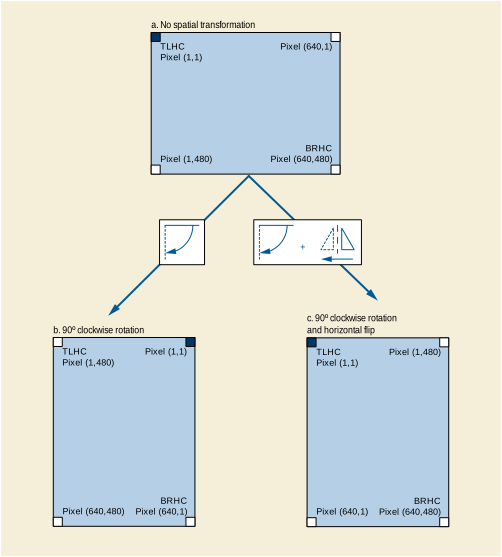
Figure C.10.4-1. Example of Displayed Area Selection Addressing of Pixels Before and After Spatial Transformation
This Module defines Attributes of vector graphics and text annotation that shall be made available by a display device to be applied to an image. The graphics and text are defined in position and size relative to the image pixel coordinates or the Specified Displayed Area space (defined in Section C.10.4). A Graphic Annotation shall be related to an Image.
Table C.10-5. Graphic Annotation Module Attributes
|
Attribute Name |
Tag |
Type |
Attribute Description |
|---|---|---|---|
|
Graphic Annotation Sequence |
(0070,0001) |
1 |
A sequence of Items each of which represents a group of annotations composed of graphics or text or both. One or more Items shall be included in this sequence. |
|
>Referenced Image Sequence |
(0008,1140) |
1C |
The subset of images and frames listed in the Presentation State Relationship Module, to which this graphic annotation applies. One or more Items shall be included in this sequence. Required if graphic annotations in this Item do not apply to all the images and frames listed in the Presentation State Relationship Module. |
|
>>Include Table 10-3 “Image SOP Instance Reference Macro Attributes” |
|||
|
>Graphic Layer |
(0070,0002) |
1 |
The layer defined in the Graphic Layer Module Section C.10.7 in which the graphics or text is to be rendered. |
|
>Text Object Sequence |
(0070,0008) |
1C |
Sequence that describes a text annotation. One or more Items shall be included in this sequence. Either one or both of Text Object Sequence (0070,0008) or Graphic Object Sequence (0070,0009) are required. |
|
>>Bounding Box Annotation Units |
(0070,0003) |
1C |
Units of measure for the axes of the text bounding box. Defines whether or not the annotation is Image or Displayed Area relative. Both dimensions shall have the same units. Enumerated Values:
Required if Bounding Box Top Left Hand Corner (0070,0010) or Bounding Box Bottom Right Hand Corner (0070,0011) is present. |
|
>>Anchor Point Annotation Units |
(0070,0004) |
1C |
Units of measure for the axes of the text anchor point annotation. Enumerated Values for Anchor Point Annotation Units (0070,0004) are the same as for Bounding Box Annotation Units (0070,0003). Required if Anchor Point (0070,0014) is present. |
|
>>Unformatted Text Value |
(0070,0006) |
1 |
Text data that is unformatted and whose manner of display within the defined bounding box or relative to the specified anchor point is implementation dependent. See Section C.10.5.1.1. The text value may contain spaces, as well as multiple lines separated by CR LF, but otherwise no format control characters (such as horizontal or vertical tab and form feed) shall be present, even if permitted by the Value Representation of ST. The text shall be interpreted as specified by Specific Character Set (0008,0005) if present in the SOP Common Module. NoteThe text may contain single or multi-byte characters and use code extension techniques as described in PS3.5 if permitted by the values of Specific Character Set (0008,0005). |
|
>>Include Table C.10-5a “Text Style Sequence Macro Attributes” |
|||
|
>>Bounding Box Top Left Hand Corner |
(0070,0010) |
1C |
Location of the Top Left Hand Corner (TLHC) of the bounding box in which Unformatted Text Value (0070,0006) is to be displayed, in Bounding Box Annotation Units (0070,0003), given as column\row. Column is the horizontal offset and row is the vertical offset. Required if Anchor Point (0070,0014) is not present. May be present otherwise. Required if Bounding Box Bottom Right Hand Corner (0070,0011) is present. |
|
>>Bounding Box Bottom Right Hand Corner |
(0070,0011) |
1C |
Location of the Bottom Right Hand Corner (BRHC) of the bounding box in which Unformatted Text Value (0070,0006) is to be displayed, in Bounding Box Annotation Units (0070,0003), given as column\row. Column is the horizontal offset and row is the vertical offset. Required if Anchor Point (0070,0014) is not present. May be present otherwise. Required if Bounding Box Top Left Hand Corner (0070,0010) is present. |
|
>>Bounding Box Text Horizontal Justification |
(0070,0012) |
1C |
Location of the text relative to the vertical edges of the bounding box. Enumerated Values:
Required if Bounding Box Top Left Hand Corner (0070,0010) is present. |
|
>>Anchor Point |
(0070,0014) |
1C |
Location of a point in the image or Specified Displayed Area to which the Unformatted Text Value (0070,0006) is related, in Anchor Point Annotation Units (0070,0004), given as column\row. Column is the horizontal offset and row is the vertical offset. Required if Bounding Box Top Left Hand Corner (0070,0010) and Bounding Box Bottom Right Hand Corner (0070,0011) are not present. May be present otherwise. |
|
>>Anchor Point Visibility |
(0070,0015) |
1C |
Flag to indicate whether or not a visible indication (such as a line or arrow) of the relationship between the text and the anchor point is to be displayed. Enumerated Values:
Required if Anchor Point (0070,0014) is present. |
|
>>Compound Graphic Instance ID |
(0070,0226) |
3 |
The identifier of the Compound Graphic represented, in part, by this Item. The value of this attribute shall be equal to the value of Compound Graphic Instance ID (0070,0226) of the corresponding Item in the Compound Graphic Sequence (0070,0209). See Section C.10.5.1.3.1. |
|
>>Graphic Group ID |
(0070,0295) |
3 |
A number identifying the group from the Graphic Group Sequence (0070,0234) to which this Item belongs. If this attribute is not present, this Item does not belong to a group. If Compound Graphic Instance ID (0070,0226) is present in this Item, the value of Graphic Group ID (0070,0295) shall be the same as the value of Graphic Group ID (0070,0295) of the corresponding Item in the Compound Graphic Sequence (0070,0209) with the same Compound Graphic Instance ID (0070,0226). |
|
>Graphic Object Sequence |
(0070,0009) |
1C |
Sequence that describes a graphic annotation. One or more Items shall be included in this sequence. Either one or both of Text Object Sequence (0070,0008) or Graphic Object Sequence (0070,0009) are required. |
|
>>Graphic Annotation Units |
(0070,0005) |
1 |
Units of measure for the axes of the graphic annotation. Enumerated Values for Graphic Annotation Units (0070,0005) are the same as for Bounding Box Annotation Units (0070,0003). |
|
>>Graphic Dimensions |
(0070,0020) |
1 |
Enumerated Values:
|
|
>>Number of Graphic Points |
(0070,0021) |
1 |
Number of data points in this graphic. |
|
>>Graphic Data |
(0070,0022) |
1 |
Coordinates that specify this graphic annotation. See Section C.10.5.1.2 for further explanation. |
|
>>Graphic Type |
(0070,0023) |
1 |
The shape of graphic that is to be drawn. See Section C.10.5.1.2. Enumerated Values:
|
|
>>Include Table C.10-5b “Line Style Sequence Macro Attributes” |
|||
|
>>Graphic Filled |
(0070,0024) |
1C |
Whether or not the closed graphics element is displayed as filled (in some unspecified manner that shall be distinguishable from an outline) or as an outline. See Section C.10.5.1.2. Enumerated Values:
Required if Graphic Data (0070,0022) is "closed", that is Graphic Type (0070,0023) is CIRCLE or ELLIPSE, or Graphic Type (0070,0023) is POLYLINE or INTERPOLATED and the first data point is the same as the last data point. |
|
>>Include Table C.10-5c “Fill Style Sequence Macro Attributes” |
|||
|
>>Compound Graphic Instance ID |
(0070,0226) |
3 |
The identifier of the Compound Graphic represented, in part, by this Item. The value of this attribute shall be equal to the value of Compound Graphic Instance ID (0070,0226) of the corresponding Item in the Compound Graphic Sequence (0070,0209). See Section C.10.5.1.3.1. |
|
>>Graphic Group ID |
(0070,0295) |
3 |
A number identifying the group from the Graphic Group Sequence (0070,0234) to which this Item belongs. If this attribute is not present, this Item does not belong to a group. If Compound Graphic Instance ID (0070,0226) is present in this Item, the value of Graphic Group ID (0070,0295) shall be the same as the value of Graphic Group ID (0070,0295) of the corresponding Item in the Compound Graphic Sequence (0070,0209) with the same Compound Graphic Instance ID (0070,0226). |
|
>Compound Graphic Sequence |
(0070,0209) |
3 |
A sequence of Items that describe Compound Graphics. One or more Items are permitted in this sequence. For each Compound Graphic there shall be an alternate rendering encoded as Items in the Text Object Sequence (0070,0008) and Graphic Object Sequence (0070,0009) linked by the Compound Graphic Instance ID (0070,0226). See Section C.10.5.1.3.1. |
|
>>Compound Graphic Instance ID |
(0070,0226) |
1 |
A number that identifies the Compound Graphic described in this Item. The value shall be unique within this SOP instance. See Section C.10.5.1.3.1. |
|
>>Compound Graphic Units |
(0070,0282) |
1 |
Type of dimension used in attributes for the Compound Graphic when specifying distances and locations. Enumerated Values:
|
|
>>Graphic Dimensions |
(0070,0020) |
1 |
Enumerated Values:
|
|
>>Number of Graphic Points |
(0070,0021) |
1 |
Number of data Items, e.g., points, in this Compound Graphic. |
|
>>Graphic Data |
(0070,0022) |
1 |
Numerical data Items that specify this Compound Graphic (points, vectors and scalars). See Section C.10.5.1.3 for further explanation. |
|
>>Compound Graphic Type |
(0070,0294) |
1 |
The shape of this Compound Graphic. See Section C.10.5.1.3. Defined Terms:
NoteImplementers may add private graphic types. |
|
>>Include Table C.10-5a “Text Style Sequence Macro Attributes” |
|||
|
>>Include Table C.10-5b “Line Style Sequence Macro Attributes” |
|||
|
>>Rotation Angle |
(0070,0230) |
3 |
The rotation of this Compound Graphic in degrees. Value shall be in degrees, between 0 and 360. See Section C.10.5.1.3. |
|
>>Rotation Point |
(0070,0273) |
1C |
The rotation point of this Compound Graphic. See Section C.10.5.1.3. Required if Rotation Angle (0070,0230) is present or if Compound Graphic Type (0070,0294) is CUTLINE or INFINITELINE. |
|
>>Gap Length |
(0070,0261) |
1C |
Diameter of the circle around Rotation Point (0070,0273) where the CUTLINE or INFINITELINE is not rendered. Diameter of the circle around the origin, specified by Graphic Data (0070,0022) where the CROSSHAIR is not rendered. The Compound Graphic Units (0070,0282) of Gap Length (0070,0261) shall be DISPLAY. See Section C.10.5.1.3. Required if Compound Graphic Type (0070,0294) equals CUTLINE, INFINITELINE or CROSSHAIR. |
|
>>Diameter of Visibility |
(0070,0262) |
1C |
Diameter of the circle around the CROSSHAIR origin where the CROSSHAIR is visible. The Compound Graphic Units (0070,0282) of the Diameter of Visibility (0070,0262) shall be DISPLAY. Required if Compound Graphic Type (0070,0294) equals CROSSHAIR. |
|
>>Major Ticks Sequence |
(0070,0287) |
1C |
The sequence of major ticks on the AXIS object. Two or more Items shall be present. Required if Compound Graphic Type (0070,0294) equals AXIS. |
|
>>>Tick Position |
(0070,0288) |
1 |
The position of the tick in the range 0.0 (start point) to 1.0 (end point). |
|
>>>Tick Label |
(0070,0289) |
1 |
The label of the tick. |
|
>>Tick Alignment |
(0070,0274) |
1C |
The alignment of the ticks with respect to the line. Enumerated Values:
See Section C.10.5.1.3. Required if Compound Graphic Type (0070,0294) equals RULER, AXIS or CROSSHAIR. |
|
>>Tick Label Alignment |
(0070,0279) |
1C |
The alignment of the label with respect to the tick. Enumerated Values:
See Section C.10.5.1.3. Required if Compound Graphic Type (0070,0294) equals RULER, AXIS. or CROSSHAIR. |
|
>>Show Tick Label |
(0070,0278) |
1C |
Indicates whether the tick label should be initially visible. Enumerated Values:
Required if Compound Graphic Type (0070,0294) equals RULER, AXIS or CROSSHAIR. |
|
>>Graphic Filled |
(0070,0024) |
1C |
Indicates whether or not the Compound Graphics is displayed as filled. Enumerated Values:
Required if Compound Graphic Type (0070,0294) equals RECTANGLE or ELLIPSE. |
|
>>Include Table C.10-5c “Fill Style Sequence Macro Attributes” |
In this Module, attribute Fill Style Sequence (0070,0233) is Type 1C. Required if Graphic Filled (0070,0024) equals Y. |
||
|
>>Graphic Group ID |
(0070,0295) |
3 |
A number that defines the corresponding group object in the Graphic Group Sequence (0070,0234). If the attribute is not present the object does not belong to a group. |
The text shall be displayed if any part of the bounding box or anchor point is within the Specified Display Area.
The text need not be confined to within the bounding box, but shall be rendered in a direction from the Top Left Hand Corner (TLHC) of the bounding box to the Bottom Right Hand Corner (BRHC) of the bounding box, even if these coordinates have been specified in an image relative space and then transformed (rotated, flipped or scaled).
Note
An implementation may render text outside the confines of the bounding box if necessary to display all the specified text.
Alternatively, an implementation may choose to render the text in a scrolling box, or a link to another fixed or popup window as appropriate.
Whether the contents of the bounding box completely opacify the underlying image or whether the box is "transparent" is undefined.
Note
For example, an implementation may choose an "exclusive or" style opacification to be sure that the text is discernible over light and dark portions of the image.
Commonly, the region of the bounding box around the text will be rendered "transparently", i.e., the image will be visible, though some implementations may choose to opacify the bounding box behind the text to improve its readability.
An alternative to specifying a bounding box, is to specify an Anchor Point (0070,0014), i.e., some point in an image or Specified Displayed Area that is related to the text. The semantics of this relationship, and the manner of positioning or linking the text to this point, are unspecified.
Note
For example, a description of a feature may be linked to a point in the image, and when that image is displayed, if it is magnified and panned, the rendered text (and any arrow or line drawn in response to Anchor Point Visibility (0070,0015)) might be repositioned as appropriate so as not to be cropped out of the Specified Displayed Area.
As another example, the text could be rendered in a pop-up window when a hypertext link flagged on the displayed image at the location of Anchor Point (0070,0014) is selected.
The bounding box and anchor point need not be defined with the same axis units, i.e., one can be image pixel relative, and the other displayed area relative.
The size, font and rotation of the individual rendered text characters are unspecified.
Graphic Data (0070,0022) contains the points in the graphic annotation, each dimension for the first point, followed by dimensions for second point, etc. For a two dimensional curve: X1, Y1, X2, Y2, etc. The first (X) dimension corresponds to the image or Specified Displayed Area column (horizontal offset), and the second (Y) dimension corresponds to the image or Specified Displayed Area row (vertical offset). The Value Representation of all components of the N-tuple shall be the same. The image or Specified Displayed Area relative drawing space is defined in Graphic Annotation Units (0070,0005).
If Graphic Type (0070,0023) is POINT, then two values (one point) shall be specified and the single point specified is to be drawn.
If Graphic Type (0070,0023) is POLYLINE, then the points are to be interpreted as an n-tuple list of end points between which straight lines are to be drawn.
If Graphic Type (0070,0023) is INTERPOLATED, then the points are to be interpreted as an n-tuple list of end points between which some form of implementation dependent curved lines are to be drawn. The rendered line shall pass through all the specified points.
If Graphic Type (0070,0023) is CIRCLE, then exactly two points shall be present; the first point is to be interpreted as the center and the second point as a point on the circumference of a circle, some form of implementation dependent representation of which is to be drawn.
If Graphic Type (0070,0023) is ELLIPSE, then exactly four points shall be present; the first two points are to be interpreted as the endpoints of the major axis and the second two points as the endpoints of the minor axis of an ellipse, some form of implementation dependent representation of which is to be drawn.
The notion of "open" or "closed" has no inherent meaning in the context of an arbitrary graphic, other than in the condition for the presence of Graphic Filled (0070,0024). The graphic has no semantic notion of an associated observation such as a region of interest, except that which the unformatted text in the same Item may describe.
The choice of pixel value used to represent the graphic on a display is defined in the Graphic Layer Module Section C.10.7.
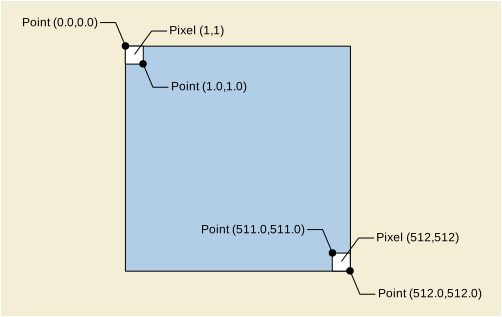
The attributes of the Compound Graphic Sequence (0070,0209) are described within this section.
For point encoding rules of Graphic Data (0070,0022) See Section C.10.5.1.2.
All graphics are applied after the application of the image rendering pipeline.
Every Item in the Compound Graphic Sequence shall have a Compound Graphic Instance ID (0070,0226) with a value that is unique within this sequence.
There shall be one or more Items in the Graphic Object Sequence or Text Object Sequence that represents an alternate rendering of the Compound Object Sequence Item. As a linkage for backward compatibility these Items share the same Compound Graphic Instance ID (0070,0226).
Note
Every Compound Graphic has an equivalent rendering encoded as a set of simple graphic objects linked by the Compound Graphic Instance ID (0070,0226). Simple graphic objects are elements such as points, polylines, interpolated lines, circles and ellipses. The equivalent rendering is a set of simple graphic objects to support an SCP that only understands the simple graphical objects.
All Compound Graphics can be rotated by specifying a Rotation Angle (0070,0230) value and a Rotation Point (0070,0273). The convention for rotation is that positive angle values are defined as counterclockwise around Rotation Point (0070,0273).
For the Compound Graphic Type (0070,0294) ELLIPSE, exactly 2 points shall be present inside Graphic Data (0070,0022). The first point is the top/left hand corner (TLHC) and the second point is the bottom/right hand corner (BRHC) of the bounding rectangle (see Figure C.10.5-2).
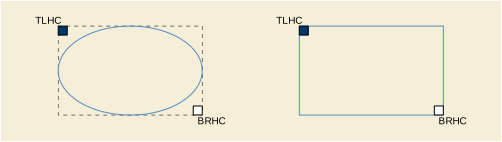
For the Compound Graphic Type (0070,0294) RECTANGLE, exactly 2 points shall be present inside Graphic Data (0070,0022). The first point is the top/left hand corner of the rectangle (TLHC) and the second point is the bottom/right hand corner (BRHC) of the rectangle (see Figure C.10.5-2).
For the Compound Graphic Type (0070,0294) MULTILINE, the list of points inside Graphic Data (0070,0022) is an n-tuple list of start and end points of straight lines to be drawn (see Figure C.10.5-3).
If Rotation Angle (0070,0230) is present, all points in the MULTILINE are rotated around the same Rotation Point (0070,0273).
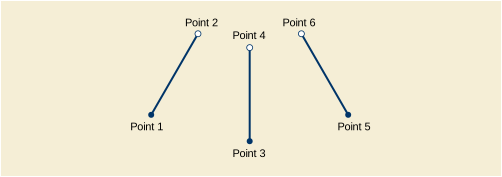
For the Compound Graphic Type (0070,0294) CUTLINE or INFINITELINE, exactly two points shall be present inside Graphic Data (0070,0022). The rendering of these lines always extends to the borders of the render area of a view(see Figure C.10.5-4).
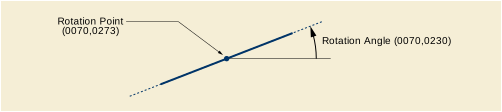
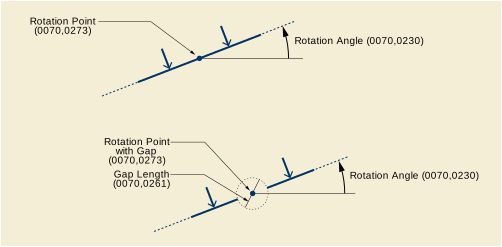
In case of a CUTLINE, two arrows shall be drawn perpendicular to the cutline. The arrows ends shall be positioned at the midpoints of each half of the cutline. The arrow heads shall point toward the cutline and shall be drawn in the positive right half-plane of the cutline before rotation. Typically, the arrows indicate the viewing direction for MPR renderings that are referenced by these lines.
Gap Length (0070,0261) defines the diameter of the circular area where the CUTLINE or INFINITELINE is not rendered. Center of the circular area is Rotation Point (0070,0273). Since the dimension units of the Gap Length is DISPLAY, independent of the value of Compound Graphic Units (0070,0282), the length of the gap is not changed by zoom operations on the image performed by the application.
For the Compound Graphic Type (0070,0294) RANGELINE exactly two points shall be present inside Graphic Data (0070,0022).

For the Compound Graphic Type (0070,0294) RULER, exactly two points shall be present inside Graphic Data (0070,0022) defining the ruler line.
Tick Alignment (0070,0274) defines the alignment of the ticks.
BOTTOM - ticks are aligned to the lower part of the line, where the first point of the line is on the left and the line extends horizontally to the right.
CENTER - ticks are centered on the line.
TOP - ticks are aligned to the upper part of the line, where the first point of the line is on the left and the line extends horizontally to the right.
Tick Label Alignment (0070,0279) defines the alignment of the tick labels.
BOTTOM - labels are aligned to the lower part of the line, where the first point of the line is on the left and the line extends horizontally to the right.
TOP - labels are aligned to the upper part of the line, where the first point of the line is on the left and the line extends horizontally to the right.
The presence, labeling and units of the ticks on the line is application dependent(see Figure C.10.5-7). If present as numerical values, the labels of the ticks shall increase toward the second point.
For the Compound Graphic Type (0070,0294) AXIS, exactly two points shall be present inside Graphic Data (0070,0022) defining the axis line.
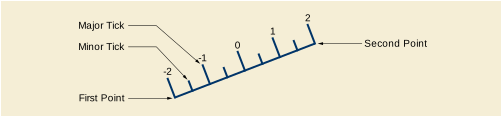
The Major Ticks Sequence (0070,0287) specifies the placement and label of the ticks. The rendering of the minor ticks is left to the application.
Tick Alignment (0070,0274) defines the alignment of the ticks.
BOTTOM - ticks are aligned to the lower part of the line, where the first point of the line is on the left and the line extends horizontally to the right.
CENTER - ticks are centered on the line.
TOP - ticks are aligned to the upper part of the line, where the first point of the line is on the left and the line extends horizontally to the right.
Tick Label Alignment (0070,0279) defines the alignment of the tick labels.
BOTTOM - labels are aligned to the lower part of the line, where the first point of the line is on the left and the line extends horizontally to the right.
TOP - labels are aligned to the upper part of the line, where the first point of the line is on the left and the line extends horizontally to the right.
For Compound Graphic Type (0070,0294) CROSSHAIR, exactly one point shall be present inside Graphic Data (0070,0022). This point is the origin of the CROSSHAIR (see Figure C.10.5-8).
Tick Alignment (0070,0274) and Tick Label Alignment (0070,0279) are also valid for the CROSSHAIR. Tick rendering is application dependent.
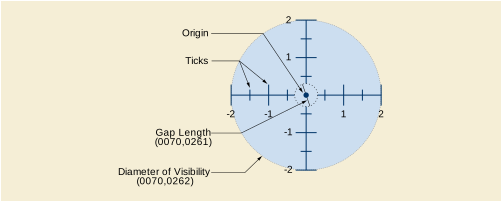
Gap Length (0070,0261) defines the diameter of the circular area around the origin where the CROSSHAIR is not rendered. Since the dimension units of the Gap Length is DISPLAY, independent of the value of Compound Graphics Units (0070,0282), the length of the gap is not changed by zoom operations on the image performed by the application.
Diameter of Visibility (0070,0262) defines the diameter of the circular area around the origin where the CROSSHAIR is rendered. Since the dimension units of the Diameter of Visibility is DISPLAY, independent of the value of Compound Graphic Units (0070,0282), the size of the crosshair is not changed by zoom operations on the image performed by the application.
The value of Tick Alignment (0070,0274) shall be CENTER.
For the Compound Graphic Type (0070,0294) ARROW, two points shall be present inside Graphic Data (0070,0022). The first point is the anchor point, the second point is the foot point of the arrow(see Figure C.10.5-9). The arrow head style at the anchor point is not specified.

Text Style Sequence (0070,0231) contains the text style for each text object. This attribute gives recommendations on how the annotation text should be rendered at the display.
Table C.10-5a specifies the attributes that describe Text Style Sequence Macro.
Table C.10-5a. Text Style Sequence Macro Attributes
|
Attribute Name |
Tag |
Type |
Attribute Description |
|---|---|---|---|
|
Text Style Sequence |
(0070,0231) |
3 |
Sequence that describes the text style. Only a single item shall be included in this sequence. |
|
>Font Name |
(0070,0227) |
3 |
Font name in a standard type. |
|
>Font Name Type |
(0070,0228) |
1C |
Defined Terms:
Required if Font Name (0070,0227) is present. NoteThis is the font naming system used by Adobe PDF and defined in ISO/IEC 14496-22. |
|
>CSS Font Name |
(0070,0229) |
1 |
Generic font name as defined within CSS (Cascading Style Sheets). Default fontname, if the font specified in Font Name (0070,0227) is not present or can not be rendered. |
|
>Text Color CIELab Value |
(0070,0241) |
1 |
A default color triplet value used to specify the text color in which it is recommended that the text be rendered on a color display. The units are specified in PCS-Values, and the value is encoded as CIELab. See Section C.10.7.1.1. This value shall override the Graphic Layer Recommended Display CIELab Value (0070,0401). |
|
>Horizontal Alignment |
(0070,0242) |
3 |
Specifies the horizontal position of the text relative to the vertical edges of the bounding box. Horizontal Alignment shall override the Bounding Box Text Horizontal Justification (0070,0012) of the Text Object Sequence Item. See Section C.10.5.1.3.12.1 Enumerated Values:
Required if Bounding Box Top Left Hand Corner (0070,0010) is present. |
|
>Vertical Alignment |
(0070,0243) |
3 |
Specifies the vertical position of the text relative to the horizontal edges of the bounding box. See Section C.10.5.1.3.12.1 Enumerated Values:
Required if Bounding Box Top Left Hand Corner (0070,0010) is present. |
|
>Shadow Style |
(0070,0244) |
1 |
The shadow style of the text to be displayed. Enumerated Values:
|
|
>Shadow Offset X |
(0070,0245) |
1 |
Floating point value that defines the shadow offset in X direction in Anchor Point Annotation Units (0070,0004) if used in Text Object Sequence Item or in Graphic Annotation Units (0070,0005) if used in Graphic Object Sequence Item. See Section C.10.5.1.3.13.1 |
|
>Shadow Offset Y |
(0070,0246) |
1 |
Floating point value that defines the shadow offset in Y direction in Anchor Point Annotation Units (0070,0004) if used in Text Object Sequence Item or in Graphic Annotation Units (0070,0005) if used in Graphic Object Sequence Item. See Section C.10.5.1.3.13.1 |
|
>Shadow Color CIELab Value |
(0070,0247) |
1 |
A color triplet value used to encode the Shadow Color. The units are specified in PCS-Values, and the value is encoded as CIELab. See Section C.10.7.1.1. |
|
>Shadow Opacity |
(0070,0258) |
1 |
Encodes the shadow opacity. The value is encoded as floating point alpha value (0.0-1.0). |
|
>Underlined |
(0070,0248) |
1 |
Specifies whether or not the text shall be rendered underlined. Enumerated Values:
|
|
>Bold |
(0070,0249) |
1 |
Specifies whether or not the text shall be rendered in bold. Enumerated Values:
|
|
>Italic |
(0070,0250) |
1 |
Specifies whether or not the text shall be rendered italicized. Enumerated Values:
|
Horizontal Alignment (0070,0242) and Vertical Alignment (0070,0243) define the position of the text relative to the bounding box of the text object (see Figure C.10.5-10).
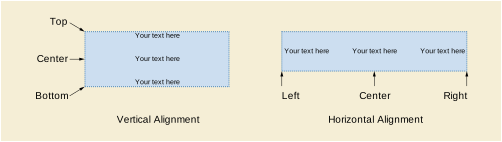
Table C.10-5b specifies the attributes that describe Line Style Sequence Macro.
Table C.10-5b. Line Style Sequence Macro Attributes
|
Attribute Name |
Tag |
Type |
Attribute Description |
|---|---|---|---|
|
Line Style Sequence |
(0070,0232) |
3 |
Sequence that describes the line style. Only a single item shall be included in this sequence. |
|
>Pattern On Color CIELab Value |
(0070,0251) |
1 |
A color triplet value used to encode the foreground. The units are specified in PCS-Values, and the value is encoded as CIELab. See Section C.10.7.1.1. This value shall override the Graphic Layer Recommended Display CIELab Value (0070,0401). |
|
>Pattern Off Color CIELab Value |
(0070,0252) |
3 |
A color triplet value used to encode the color of parts of the line that are off, i.e., the background. The units are specified in PCS-Values, and the value is encoded as CIELab. See Section C.10.7.1.1. |
|
>Pattern On Opacity |
(0070,0284) |
1 |
Encodes the foreground opacity. The value is encoded as floating point alpha value (0.0-1.0). |
|
>Pattern Off Opacity |
(0070,0285) |
3 |
Encodes the background opacity. The value is encoded as floating point alpha value (0.0-1.0). |
|
>Line Thickness |
(0070,0253) |
1 |
Specifies the line thickness. The dimension for this attribute is defined by Graphic Annotation Units (0070,0005) or Compound Graphic Units (0070,0282). |
|
>Line Dashing Style |
(0070,0254) |
1 |
The dashing style of the line to be displayed. Enumerated Values:
|
|
>Line Pattern |
(0070,0255) |
1C |
Pattern that defines the line dashing style. The Line Pattern is a 32 bit value. If the bit inside the pattern is set to 1 the foreground color is drawn, else the background color is drawn. NoteFor example, 00FFH defines the dashes with an equal size. Required if Line Dashing Style (0070,0254) has a value of DASHED. |
|
>Shadow Style |
(0070,0244) |
1 |
The shadow style of the line to be displayed. Enumerated Values:
|
|
>Shadow Offset X |
(0070,0245) |
1 |
Floating point value that defines the shadow offset in X direction in Graphic Annotation Units (0070,0005). See Section C.10.5.1.3.13.2. |
|
>Shadow Offset Y |
(0070,0246) |
1 |
Floating point value that defines the shadow offset in Y direction in Graphic Annotation Units (0070,0005). See Section C.10.5.1.3.13.2. |
|
>Shadow Color CIELab Value |
(0070,0247) |
1 |
A color triplet value used to encode the Shadow Color. The units are specified in PCS-Values, and the value is encoded as CIELab. See Section C.10.7.1.1. |
|
>Shadow Opacity |
(0070,0258) |
1 |
Encodes the shadow opacity. The value is encoded as floating point alpha value (0.0-1.0). |
The Line Dashing Style (0070,0254) value SOLID indicates the line to be drawn with the foreground color, which is specified by Pattern On Color CIELab Value (0070,0251).
The Line Dashing Style (0070,0254) attribute does not apply to shadows, which shall always be rendered in SOLID background color.
Shadow Style (0070,0244) contains one of the values OFF, NORMAL or OUTLINED (see Figure C.10.5-11 and Figure C.10.5-12). Shadow shall be applied after rotation. The coordinate system of the shadow is relative to the line. Shadow Offset X (0070,0245) extends to the right and Shadow Offset Y (0070,0246) extends downward.

The OUTLINED shadow defines a filled outline shadow. The length of the vector given by Shadow Offset X (0070,0245) and Shadow Offset Y (0070,0246) defines the radius of the shadow.

Table C.10-5c specifies the attributes that describe Fill Style Sequence Macro.
Table C.10-5c. Fill Style Sequence Macro Attributes
|
Attribute Name |
Tag |
Type |
Attribute Description |
|---|---|---|---|
|
Fill Style Sequence |
(0070,0233) |
3 |
Sequence that describes the fill style. Only a single item is permitted in this sequence. |
|
>Pattern On Color CIELab Value |
(0070,0251) |
1 |
A color triplet value used to encode the foreground color. The units are specified in PCS-Values, and the value is encoded as CIELab. See Section C.10.7.1.1. This value shall override the Graphic Layer Recommended Display CIELab Value (0070,0401). |
|
>Pattern Off Color CIELab Value |
(0070,0252) |
3 |
A color triplet value used to encode the background color. The units are specified in PCS-Values, and the value is encoded as CIELab. See Section C.10.7.1.1. |
|
>Pattern On Opacity |
(0070,0284) |
1 |
Encodes the foreground opacity. The value is encoded as floating point alpha value (0.0-1.0). |
|
>Pattern Off Opacity |
(0070,0285) |
1 |
Encodes the background opacity. The value is encoded as floating point alpha value (0.0-1.0). |
|
>Fill Mode |
(0070,0257) |
1 |
The texture of the closed object to be displayed. Enumerated Values:
|
|
>Fill Pattern |
(0070,0256) |
1C |
A binary fill pattern. A set bit corresponds to foreground. An unset bit corresponds to background. A 128 byte value defining a 32x32 1 bit matrix. This fill pattern is replicated in tiles inside the boundaries of the graphic type. The most significant bit corresponds to the leftmost pixel in the row. The fill pattern relates to display pixels where one bit value corresponds to one display pixel. Required if Fill Mode (0070,0257) equals STIPPELED. |
This Module defines a manner of rotating an image by increments of ninety degrees and flipping an image.
Table C.10-6. Spatial Transformation Module Attributes
|
Attribute Name |
Tag |
Type |
Attribute Description |
|---|---|---|---|
|
Image Rotation |
(0070,0042) |
1 |
How far to rotate the image clockwise in degrees, before any Image Horizontal Flip (0070,0041) is applied. Enumerated Values:
NoteNegative values are not permitted since the Value Representation is unsigned. |
|
Image Horizontal Flip |
(0070,0041) |
1 |
Whether or not to flip the image horizontally after any Image Rotation has been applied such that the left side of the image becomes the right side. Enumerated Values:
NoteNo vertical flip is specified since the same result can be achieved by a combination of a 180 degree rotation and a horizontal flip. |
Note
Given the definition of the Grayscale Transformation Sequence in PS3.4, it is apparent that the rotation, flipping and magnification will be applied AFTER the application of any bit-mapped overlays or graphic annotations that are specified in the image pixel spaces, but BEFORE the application of graphic annotations that apply in the Specified Displayed Area relative space.
This Module defines the characteristics of the layers in which overlays, graphic and text may be rendered.
Layers group together graphics that are related. It is recommended that a layer be displayed such that it may be distinguished from other layers that have a different value for Graphic Layer Order (0070,0062).
Note
The transparency, opacity, and any other interaction (such as exclusive or) with underlying layers or image data are not specified and are at the discretion of the implementation.
Table C.10-7. Graphic Layer Module Attributes
|
Attribute Name |
Tag |
Type |
Attribute Description |
|---|---|---|---|
|
Graphic Layer Sequence |
(0070,0060) |
1 |
A sequence of Items each of which represents a single layer in which overlays, curves, graphics or text may be rendered. One or more Items shall be included in this sequence. An Item is required for each layer referenced from the Graphic Annotation Module or the Overlay Activation Module. |
|
>Graphic Layer |
(0070,0002) |
1 |
A string that identifies the layer. NoteThis identifier may be used by other Attributes within the same presentation state instance to reference this layer. There is no requirement for the same identifiers to be used in different presentation states, and there is no mechanism for referencing layers in other presentation states. That is, a UID is not required. |
|
>Graphic Layer Order |
(0070,0062) |
1 |
An integer indicating the order in which it is recommended that the layer be rendered, if the display is capable of distinguishing. Lower numbered layers are to be rendered first. |
|
>Graphic Layer Recommended Display Grayscale Value |
(0070,0066) |
3 |
A default single gray unsigned value in which it is recommended that the layer be rendered on a monochrome display. The units are specified in P-Values from a minimum of 0000H (black) up to a maximum of FFFFH (white). NoteThe maximum P-Value for this Attribute may be different from the maximum P-Value from the output of the Presentation LUT, which may be less than 16 bits in depth. |
|
>Graphic Layer Recommended Display CIELab Value |
(0070,0401) |
3 |
A default color triplet value in which it is recommended that the layer be rendered on a color display. The units are specified in PCS-Values, and the value is encoded as CIELab. See Section C.10.7.1.1. |
|
>Graphic Layer Description |
(0070,0068) |
3 |
A free text description of the contents of this layer. |
Note
Graphic Layer Recommended Display RGB Value (0070,0067) was previously used in this Module, but has been retired and its function replaced by Graphic Layer Recommended Display CIELab Value (0070,0401). See PS3.3-2004.
Attributes such as Graphic Layer Recommended Display CIELab Value (0070,0401) consist of three unsigned short values:
An L value linearly scaled to 16 bits, such that 0x0000 corresponds to an L of 0.0, and 0xFFFF corresponds to an L of 100.0.
An a* then a b* value, each linearly scaled to 16 bits and offset to an unsigned range, such that 0x0000 corresponds to an a* or b* of -128.0, 0x8080 corresponds to an a* or b* of 0.0 and 0xFFFF corresponds to an a* or b* of 127.0
Note
This is the same form of encoding as used for the PCS in ICC Profiles.
The table in this section contains Attributes that identify a Waveform as a separate information entity.
Table C.10-8. Waveform Identification Module Attributes
|
Attribute Name |
Tag |
Type |
Attribute Description |
|---|---|---|---|
|
Instance Number |
(0020,0013) |
1 |
A number that identifies this Waveform. |
|
Content Date |
(0008,0023) |
1 |
The date the Waveform data was created. |
|
Content Time |
(0008,0033) |
1 |
The time the Waveform data was created. |
|
Acquisition DateTime |
(0008,002A) |
1 |
The date and time that the acquisition of data that resulted in this waveform started; the reference timestamp for the Multiplex Group Time Offset (0018,1068) for a waveform multiplex group NoteThe synchronization of this time with an external clock is specified in the Synchronization Module in Acquisition Time Synchronized (0018,1800). |
|
Referenced Instance Sequence |
(0008,114A) |
3 |
Composite SOP Instances that are significantly related to this Waveform. One or more Items are permitted in this sequence. |
|
>Include Table 10-11 “SOP Instance Reference Macro Attributes” |
|||
|
>Purpose of Reference Code Sequence |
(0040,A170) |
3 |
Code describing the purpose of the reference to the Instance(s). Only a single Item is permitted in this sequence. |
|
Defined CID 7004 “Waveform Purposes of Reference” for referenced waveforms. |
|||
Note
Acquisition DateTime (0008,002A) is the time of the original waveform data capture. Derived waveforms that are processed (e.g., averaged or filtered) and encoded subsequent to the waveform Acquisition DateTime have a Content Date (0008,0023) and Content Time (0008,0033) representing the time of the processing. In all cases the actual date and time of creation of the SOP Instance for transmission or storage may be recorded in the Instance Creation Date (0008,0012) and Instance Creation Time (0008,0013) (see Section C.12.1).
The table in this section contains Attributes that describe a time-based waveform. A waveform consists of one or more multiplex groups, each encoded into an Item in the Waveform Sequence. All channels within a multiplex group are synchronously digitized at a common sampling frequency.
Table C.10-9. Waveform Module Attributes
|
Attribute Name |
Tag |
Type |
Attribute Description |
|---|---|---|---|
|
Waveform Sequence |
(5400,0100) |
1 |
Sequence of Items, each representing one waveform multiplex group. One or more Items shall be included in this sequence. Ordering of Items in this Sequence is significant for external reference to specific multiplex groups. |
|
>Multiplex Group Time Offset |
(0018,1068) |
1C |
Offset time in milliseconds from a reference time (see Section C.10.9.1.1). Required if Acquisition Time Synchronized (0018,1800) value is Y; may be present otherwise. |
|
>Trigger Time Offset |
(0018,1069) |
1C |
Offset time in milliseconds from a synchronization trigger to the first sample of a waveform multiplex group. May be positive or negative. Required if waveform acquisition is synchronized to a trigger. |
|
>Trigger Sample Position |
(0018,106E) |
3 |
Sample number whose time corresponds to a synchronization trigger (see Section C.10.9.1.2). |
|
>Waveform Originality |
(003A,0004) |
1 |
See Section C.10.9.1.3. Enumerated Values:
|
|
>Number of Waveform Channels |
(003A,0005) |
1 |
Number of channels for this multiplex group. |
|
>Number of Waveform Samples |
(003A,0010) |
1 |
Number of samples per channel in this multiplex group. |
|
>Sampling Frequency |
(003A,001A) |
1 |
Frequency in Hz |
|
>Multiplex Group Label |
(003A,0020) |
3 |
Label for multiplex group |
|
>Channel Definition Sequence |
(003A,0200) |
1 |
Sequence of Items, with one Item per channel (see Section C.10.9.1.4). One or more Items shall be included in this sequence. Ordering of Items in this Sequence is significant for reference to specific channels. |
|
>>Waveform Channel Number |
(003A,0202) |
3 |
Equipment physical channel number used for acquisition. |
|
>>Channel Label |
(003A,0203) |
3 |
Text label for channel, which may be used for display purposes |
|
>>Channel Status |
(003A,0205) |
3 |
One or more values for the status of this channel within this SOP Instance. Defined Terms:
Precise location of a change in status may be noted in an Annotation. |
|
>>Channel Source Sequence |
(003A,0208) |
1 |
A coded descriptor of the waveform channel source (metric, anatomical position, function, and technique). Only a single Item shall be included in this sequence. (see Section C.10.9.1.4.1) |
|
>>>Include Table 8.8-1 “Code Sequence Macro Attributes”. |
Baseline CID determined by IOD specialization |
||
|
>>Channel Source Modifiers Sequence |
(003A,0209) |
1C |
Sequence of Items that further qualify the Waveform Source. One or more Items shall be included in this sequence. Ordering of Items in this Sequence may be semantically significant. Required if Channel Source Sequence (003A,0208) does not fully specify the semantics of the source. |
|
>>>Include Table 8.8-1 “Code Sequence Macro Attributes”. |
Baseline CID determined by IOD specialization |
||
|
>>Source Waveform Sequence |
(003A,020A) |
3 |
A sequence that provides reference to a DICOM waveform from which this channel was derived. One or more Items are permitted in this Sequence. |
|
>>>Include Table 10-11 “SOP Instance Reference Macro Attributes” |
|||
|
>>>Referenced Waveform Channels |
(0040,A0B0) |
1 |
Identifies the waveform multiplex group and channel within the referenced SOP Instance. Pair of values (M,C). |
|
>>Channel Derivation Description |
(003A,020C) |
3 |
Additional description of waveform channel derivation |
|
>>Channel Sensitivity |
(003A,0210) |
1C |
Nominal numeric value of unit quantity of sample. Required if samples represent defined (not arbitrary) units. |
|
>>Channel Sensitivity Units Sequence |
(003A,0211) |
1C |
A coded descriptor of the Units of measure for the Channel Sensitivity. Only a single Item shall be included in this sequence. (see Section C.10.9.1.4.2). Required if Channel Sensitivity (003A,0210) is present. |
|
>>>Include Table 8.8-1 “Code Sequence Macro Attributes” |
Defined CID 82 “Units of Measurement”. |
||
|
>>Channel Sensitivity Correction Factor |
(003A,0212) |
1C |
Multiplier to be applied to encoded sample values to match units specified in Channel Sensitivity (003A,0210) (e.g., based on calibration data) (see Section C.10.9.1.4.2). Required if Channel Sensitivity (003A,0210) is present. |
|
>>Channel Baseline |
(003A,0213) |
1C |
Offset of encoded sample value 0 from actual 0 using the units defined in the Channel Sensitivity Units Sequence (003A,0211). Required if Channel Sensitivity (003A,0210) is present. |
|
>>Channel Time Skew |
(003A,0214) |
1C |
Offset of first sample of channel from waveform multiplex group start time, in seconds (see Section C.10.9.1.4.3) Required if Channel Sample Skew is not present. |
|
>>Channel Sample Skew |
(003A,0215) |
1C |
Offset of first sample of channel from waveform multiplex group start time, in samples (see Section C.10.9.1.4.3) Required if Channel Time Skew is not present. |
|
>>Channel Offset |
(003A,0218) |
3 |
Additional offset of first sample of channel to be used in aligning multiple channels for presentation or analysis, in seconds (see Section C.10.9.1.4.3) |
|
>>Waveform Bits Stored |
(003A,021A) |
1 |
Number of significant bits within the waveform samples (see Section C.10.9.1.4.4) |
|
>>Filter Low Frequency |
(003A,0220) |
3 |
Nominal 3dB point of lower frequency of pass band; in Hz |
|
>>Filter High Frequency |
(003A,0221) |
3 |
Nominal 3dB point of upper frequency of pass band; in Hz |
|
>>Notch Filter Frequency |
(003A,0222) |
3 |
Center frequency of notch filter(s); in Hz |
|
>>Notch Filter Bandwidth |
(003A,0223) |
3 |
Nominal 3dB bandwidth of notch filter(s); in Hz |
|
>>Channel Minimum Value |
(5400,0110) |
3 |
Minimum valid sample value as limited by the acquisition equipment (see Section C.10.9.1.4.5) |
|
>>Channel Maximum Value |
(5400,0112) |
3 |
Maximum valid sample value as limited by the acquisition equipment (see Section C.10.9.1.4.5) |
|
>Waveform Bits Allocated |
(5400,1004) |
1 |
Size of each waveform data sample within the Waveform Data; See Section C.10.9.1.5 |
|
>Waveform Sample Interpretation |
(5400,1006) |
1 |
Data representation of the waveform data points. See Section C.10.9.1.5. |
|
>Waveform Padding Value |
(5400,100A) |
1C |
Value of waveform samples inserted in channels when input is absent or invalid. Required if acquisition equipment inserts padding. See Section C.10.9.1.6. |
|
>Waveform Data |
(5400,1010) |
1 |
Encoded data samples - channel multiplexed. See Section C.10.9.1.7 |
|
Waveform Data Display Scale |
(003A,0230) |
3 |
The recommended time-based waveform data display scale in units of mm/s (see Section C.10.9.1.8). |
|
Waveform Display Background CIELab Value |
(003A,0231) |
3 |
A color triplet value recommended for rendering the waveform display background on a color display. The units are specified in PCS-Values, and the value is encoded as CIELab. See Section C.10.7.1.1. |
|
Waveform Presentation Group Sequence |
(003A,0240) |
3 |
Sequence of Items, each Item describing a Presentation Group of one or more waveform channels to be displayed together. NoteA Presentation Group is conventionally denoted a "display page", and a waveform object may be rendered using several Presentation Groups under user display control. One or more Items are permitted in this sequence. |
|
>Presentation Group Number |
(003A,0241) |
1 |
A number that identifies the Presentation Group. |
|
>Channel Display Sequence |
(003A,0242) |
1 |
Sequence of Items, each Item describing a channel to be displayed in the Presentation Group. One or more Items shall be included in this sequence. |
|
>>Referenced Waveform Channels |
(0040,A0B0) |
1 |
Identifier of the displayed channel, specified as a pair of values (M,C) where the first value is the ordinal of the sequence item of Waveform Sequence (5400,0100) (i.e., the Multiplex Group Number), and the second value is the ordinal of the sequence item of the Channel Definition Sequence (003A,0200) attribute (i.e., the Waveform Channel Number) within the multiplex group. NoteIn the context of a Channel Display Sequence (003A,0242) Item, only a single channel shall be referenced. |
|
>>Channel Offset |
(003A,0218) |
3 |
The offset in seconds from the beginning of the channel waveform data to the first sample to be used for presentation. Value may be negative. |
|
>>Channel Recommended Display CIELab Value |
(003A,0244) |
1 |
A color triplet value recommended for rendering the channel on a color display. The units are specified in PCS-Values, and the value is encoded as CIELab. See Section C.10.7.1.1. |
|
>>Channel Position |
(003A,0245) |
1 |
Position of the Channel within the Presentation Group display area (see Section C.10.9.1.9). |
|
>>Display Shading Flag |
(003A,0246) |
3 |
Specifies display area shading between the displayed waveform channel and another line. The nature of the shading (e.g., solid, or cross-hatching) is implementation dependent. Enumerated Values:
|
|
>>Fractional Channel Display Scale |
(003A,0247) |
1C |
Fraction of the Presentation Group vertical display dimension assigned to the unit quantity (least significant bit) of the Channel samples (see Section C.10.9.1.10). Required if Absolute Channel Display Scale (003A,0248) is not present, may be present otherwise. |
|
>>Absolute Channel Display Scale |
(003A,0248) |
1C |
Nominal vertical display height in mm assigned to the unit quantity (least significant bit) of the Channel samples (see Section C.10.9.1.10). Required if Fractional Channel Display Scale (003A,0247) is not present, may be present otherwise. |
Multiplex Group Time Offset (0018,1068) specifies the offset time in milliseconds from a reference time to the first sample of the multiplex group. The reference time is Acquisition DateTime (0008,002A), if present in the SOP Instance.
In all other cases, the offset is from an arbitrary reference time that is the same for all Multiplex Groups in the SOP Instance; i.e., the Multiplex Group Time Offset allows only relative time synchronization between Multiplex Groups in the SOP Instance. The arbitrary reference time may nominally be assumed to be Content Time (0008,0033).
The Trigger Sample Position (0018,106E) specifies the sample that was digitized at the same time as a synchronization trigger. Sample positions are enumerated by channel, with the first sample enumerated 1. This provides a single trigger sample location for all channels of the multiplex group. Although channels may not have been sampled synchronously (as specified by Channel Time Skew or Channel Sample Skew), for the purpose of determining the location of the trigger with an integer value position, all channels are considered to be synchronous.
Waveform Originality (003A,0004) shall have the value ORIGINAL if the Waveform Data samples are the original or source data, and shall have the value DERIVED if the Waveform Data samples have been derived in some manner from the sample data of other waveforms.
Note
Waveform Originality (003A,0004) is comparable to Image Type (0008,0008) Value 1 (see Section C.7.6.1.1.2). Within a single Multiplex Group, all channels shall have the same Originality value.
Waveform data that has been transcoded from a non-DICOM format may have Waveform Originality value ORIGINAL if the samples are unchanged from the originally acquired waveform samples.
Channel Source Sequence (003A,0208) identifies the metric (quality being measured, e.g., voltage or pressure), the anatomical position of the sensor or probe, the function of the channel (e.g., measurement or stimulus), and any particulars of technique that affect those parameters (e.g., pull-back across multiple anatomic sites, or differential input from two distinct sites). If the full semantics of the source is not carried in a single coded entry (e.g., if it specifies the location but not the metric), additional qualifiers are identified in Channel Source Modifiers Sequence (003A,0209) coded entries.
When a single sensor channel is used to collect a waveform from two (or more) anatomic sites, e.g., in hemodynamic pull-back procedures, multiple Channel Source Modifier items will identify the sequence of sites, if not encoded in the semantics of the Channel Source Coded Entry. Transition times from one site to another may be indicated with an Annotation, or pull-back rate may be indicated with an Acquisition Context Sequence Item (see Section C.7.6.14).
The Baseline CIDs are defined by IOD in accordance with Section A.34. Restrictions in the IOD may also determine the pattern of specification of the waveform source, i.e., which item is to be encoded in the Channel Source sequence, and the order in which Channel Source Modifier items are to be encoded. Unless otherwise specified, pattern of specification of the waveform source shall be:
If the function of the channel is not measurement, the function (and optionally additional parameters of the channel source) shall be encoded in the Channel Source item.
If the function of the channel is measurement of a waveform originating in the patient (the implicit default function), the metric (and optionally additional parameters of the channel source) shall be encoded in the Channel Source item.
If not encoded in the Channel Source item, and a particular technique needs to be encoded, that technique shall be encoded in the first Channel Source Modifier item.
Note
For example, an intracardiac measurement of a pressure waveform across the mitral valve by means of a catheter pullback may be encoded in one of the following three ways (using pseudo-coded terminology), depending on the availability of coded terms with sufficient expressive power:
|
Channel Source |
Channel Source Modifiers |
|
X-2311 "pressure measurement" |
T-7663 "pullback"C-2001 "mitral valve" |
|
X-2123 "pressure measurement, pullback" |
C-2001 "mitral valve" |
|
X-1234 "pressure measurement, mitral valve, pullback" |
(none required) |
Channel Sensitivity is the nominal value of one unit (i.e., the least significant bit) of each waveform sample in Waveform Data (5400,1010). It includes both the amplifier gain and the analog-digital converter resolution. It does not relate the vertical scaling of a waveform on a particular display.
Note
A prior edition specified CID 3082 “Cardiology Units of Measurement (Retired)” as the Defined Context Group for Channel Sensitivity Units Sequence. CID 3082 “Cardiology Units of Measurement (Retired)” was a subset of CID 82 “Units of Measurement”, and has been retired in favor of the more general CID 82 “Units of Measurement”. See PS3.3-2011.
Channel Sensitivity Correction Factor (003A,0212) is the ratio of the actual (calibrated) value to the nominal Channel Sensitivity specified in Data Element (003A,0210). Thus a waveform sample value multiplied by the Channel Sensitivity value provides the nominal measured value in Channel Sensitivity Units, and that nominal value multiplied by the Channel Sensitivity Correction Factor provides the calibrated measured value.
Skew is also known as a sub-sample time delay, typically caused by using a multiplexed analog to digital converter that switches from channel to channel. For analysis it may be important to know if the analog channels were all latched simultaneously or sequentially and then digitized. Skew may be represented as time offset in seconds, or a fractional number of samples.
Separate and additional to skew is an offset time adjustment (sometimes called latency) by which one waveform channel is displaced significantly relative to others before sampling.
Note
As an example, a hemodynamic pressure is measured at the external end of a catheter, and thus its measurement is delayed by the time for the pressure wave to propagate down the catheter. With a dual catheter measurement, two signals may be acquired at the same time, but one arrives by a longer distance (e.g., a pulmonary capillary wedge pressure, compared to a left ventricular pressure). To obtain an accurate comparison of the waveforms (e.g., the gradient across the mitral valve), one waveform has to be offset (perhaps as much as 30 ms) to synchronize them.
Waveform Bits Stored (003A,021A) specifies the number of significant bits within the Waveform Bits Allocated of each sample, for signed or unsigned integers.
If Waveform Sample Value Representation is MB or AB, Waveform Bits Stored shall be 8.
Channel Minimum and Maximum Value attributes (5400,0110) and (5400,0112) may be used to send the analog-to-digital converter limits (i.e., the clipping levels).
Note
These values do not represent the maximum and minimum values in the data set, but rather the valid range of values.
Waveform Bits Allocated (5400,1004) specifies the number of bits allocated for each sample, and Waveform Sample Interpretation (5400,1006) specifies the data representation of each waveform sample. Waveform Bits Allocated shall be a multiple of 8. These data elements are related, and their Defined Terms are specified in Table C.10-10.
Table C.10-10. Waveform Bits Allocated and Waveform Sample Interpretation
|
Waveform Bits Allocated - Defined Terms |
Waveform Sample Interpretation - Defined Terms |
Waveform Sample Interpretation Meaning |
|---|---|---|
|
8 |
SB |
signed 8 bit linear |
|
UB |
unsigned 8 bit linear |
|
|
MB |
8 bit mu-law (in accordance with ITU-T Recommendation G.711) |
|
|
AB |
8 bit A-law (in accordance with ITU-T Recommendation G.711) |
|
|
16 |
SS |
signed 16 bit linear |
|
US |
unsigned 16 bit linear |
Note
The set of valid values from within this table may be constrained by definition of the IOD (see Section A.34).
mu-law and A-law encoding is without the alternate bit inversion used for PCM transmission through the telephone network.
This representation also applies to the Channel Minimum and Maximum Data Values, and Waveform Padding Value.
Equipment that produces digitized waveform curves may encode a specific value when the source is disconnected or otherwise invalid. This value is encoded like the Waveform Data attribute with one sample only.
The Waveform Padding Value need not be within the range specified by the Channel Minimum and Maximum Data Values.
Each sample shall be encoded using the defined Waveform Sample Interpretation (5400,1006), using the defined number of Waveform Bits Stored (003A,021A) right justified in the sample. If the number of Waveform Bits Stored is less than the number of bits in Waveform Bits Allocated, the sign bit shall be extended to the highest order bit of the data sample.
Data values are encoded interleaved, incrementing by channel and then by sample (i.e., C1S1, C2S1,C3S1, … CnS1, C1S2, C2S2, C3S2, … CnSm), with no padding or explicit delimitation between successive samples. Cx denotes the channel defined in the Channel Definition Sequence Item in item number x.
Note
With 8-bit Waveform Data, there may be an odd number of channels and an odd number of samples; see PS3.5 for rules on encoding.
The sign bit extension rule differs from the rules for pixel data, which do not require sign extension.
Waveform Data Display Scale (003A,0230) specifies the recommended display scale in the time dimension for the waveform data in units of mm/s. The display application needs to know the horizontal pixel scaling of the display device to effectively apply this attribute. Waveform Data Display Scale (003A,0230), divided by Sampling Frequency (003A,001A), times the display scaling in pixels/mm gives the number of horizontal pixels between subsequent samples.
Note
This presumes a conventional waveform display with time in the horizontal dimension, and waveform measured quantity in the vertical dimension.
This attribute is useful for size consistency between softcopy display and classical hardcopy ECG printouts. E.g., for the channels of a multiplex group whose Sampling Frequency is 400 Hz, and whose Waveform Data Display Scale (003A,0230) is 25 mm/s, and that is being displayed on a monitor at 4.1 pixels/mm, the horizontal interval between samples is
25 / 400 * 4.1 = 0.25625 pixels
How the display application renders samples at fractional pixel spacing is implementation dependent.
Channel Position (003A,0245) specifies the position of the channel display baseline in the Presentation Group vertical display dimension. The channel position is relative to the top of the display area. Each Presentation Group display area is defined with vertical dimension positions of 0.0 (top of display area) to 1.0 (bottom of display area).
Note
This presumes a conventional waveform display with time in the horizontal dimension, and waveform measured quantity in the vertical dimension.
Compare Bounding Box Annotation Units (0070,0003) value DISPLAY in Section C.10.5.
Channel sample value 0 maps to the Channel Position (003A,0245) display baseline. The real world value associated with the baseline is specified in Channel Baseline (003A,0213).
Multiple channels may overlap, and may share the same Channel Position (003A,0245).
Fractional Channel Display Scale (003A,0247) or Absolute Channel Display Scale (003A,0248) specifies the vertical scaling of the channel display. If both attributes are provided, the selection of which to use for display control is implementation dependent.
Fractional Channel Display Scale (003A,0247) specifies the fraction of the Presentation Group vertical display dimension used to offset each unit of the waveform sample value from the baseline Channel Position (003A,0245). Positive offset values are towards the top of the display area.
Note
E.g., for a channel whose Fractional Channel Display Scale (003A,0247) value is 0.004, and whose Channel Position (003A,0245) value is 0.5, a sample whose value is -37 would be displayed at a position
0.5 - (-37 * 0.004) = 0.648
of the total vertical display dimension below the top of the Presentation Group display area.
Absolute Channel Display Scale (003A,0248) specifies the nominal physical distance on a display device (monitor) used to offset each unit of the waveform sample value from the baseline Channel Position (003A,0245). The display application needs to know the vertical pixel scaling of the display device to effectively apply this attribute. The Channel Sensitivity (003A,0210) value in Channel Sensitivity Units (003A,0211), divided by Absolute Channel Display Scale (003A,0248) value, gives the real-world scaling of the intended display.
Note
This attribute is useful for size consistency between softcopy display and classical hardcopy waveform printed charts. E.g., a channel whose Channel Sensitivity (003A,0210) value is 44 uV (per least significant bit), and whose Absolute Channel Display Scale (003A,0248) value is 0.44 mm, has a real-world display scale of 0.1 mV/mm.
E.g., for a channel whose Absolute Channel Display Scale (003A,0248) value is 0.44 mm, and that is being displayed on a monitor at 4.1 pixels/mm, a sample whose value is 107 would be displayed at a position
107 * 0.44 * 4 = 193.028
pixels above the Channel Position (003A,0245) baseline.
Display for waveform samples that would lie outside the Presentation Group display area is unspecified.
Negative values of Fractional Channel Display Scale (003A,0247) and Absolute Channel Display Scale (003A,0248) are allowed.
The table in this section contains Attributes that identify annotations to the waveform of the current SOP Instance. Each annotation conceptually forms the equivalent of a overlay on a presentation display of the annotated entity. Annotations may represent a measurement or categorization based on the waveform data, identification of regions of interest or particular features of the waveform, or events during the data collection that may affect diagnostic interpretation (e.g., the time at which the subject coughed).
Each Annotation Item shall have the following components:
An annotation Text, Coded Name (only), Coded Name/Coded Value pair, or Coded Name/Numeric Measurement pair (mutually exclusive)
Temporal coordinates in the Waveform to which the annotation applies
Table C.10-11. Waveform Annotation Module Attributes
|
Attribute Name |
Tag |
Type |
Attribute Description |
|---|---|---|---|
|
Waveform Annotation Sequence |
(0040,B020) |
1 |
Sequence of Annotation Items. One or more items shall be included in this sequence. |
|
>Unformatted Text Value |
(0070,0006) |
1C |
Text Observation Value (annotation). Mutually exclusive with Concept Name Code Sequence (0040,A043) |
|
>Concept Name Code Sequence |
(0040,A043) |
1C |
Code representing the fully specified name of the NUMERIC measurement or CODED concept. Only a single Item shall be included in this sequence. Mutually exclusive with Text Value (0070,0006). |
|
Baseline CID may be defined in IOD definition. |
|||
|
>>Modifier Code Sequence |
(0040,A195) |
1C |
A sequence of items modifying or specializing the Concept Name. One or more Items shall be included in this Sequence. Required if the value of Concept Name Code Sequence (0040,A043) does not fully describe the semantics of the measurement or concept. |
|
>>>Include Table 8.8-1 “Code Sequence Macro Attributes” |
Baseline CID may be defined in IOD definition. |
||
|
>Concept Code Sequence |
(0040,A168) |
3 |
A sequence that conveys the categorical coded nominal value. Only a single Item is permitted in this sequence. |
|
Baseline CID may be defined in IOD definition. |
|||
|
>>Modifier Code Sequence |
(0040,A195) |
1C |
A sequence of items modifying or specializing the Concept. One or more Items shall be included in this Sequence. Required if the value of Concept Code Sequence (0040,A168) does not fully describe the semantics of the concept value. |
|
>>>Include Table 8.8-1 “Code Sequence Macro Attributes” |
Baseline CID may be defined in IOD definition. |
||
|
>Numeric Value |
(0040,A30A) |
3 |
Numeric measurement value or values. |
|
>Measurement Units Code Sequence |
(0040,08EA) |
3 |
Units of measurement. Only a single Item is permitted in this sequence. |
|
Baseline CID 82 “Units of Measurement”. |
|||
|
>Referenced Waveform Channels |
(0040,A0B0) |
1 |
List of channels in waveform to which annotation applies. See Section C.10.10.1.1 |
|
>Temporal Range Type |
(0040,A130) |
1C |
See Section C.10.10.1.2 for Enumerated Values. Required if Annotation does not apply to entire Referenced Waveform Channels; shall not be present if Annotation applies to entire temporal extent of referenced channels. |
|
>Referenced Sample Positions |
(0040,A132) |
1C |
List of samples within a multiplex group specifying temporal points for annotation. Position of first sample is 1. Required if Temporal Range Type (0040,A130) is present, and if Referenced Time Offsets (0040,A138) and Referenced DateTime (0040,A13A) are not present. See Section C.10.10.1.3 |
|
>Referenced Time Offsets |
(0040,A138) |
1C |
Specifies temporal points for annotation by number of seconds after start of data. Required if Temporal Range Type (0040,A130) is present, and if Referenced Sample Positions (0040,A132) and Referenced DateTime (0040,A13A) are not present. |
|
>Referenced DateTime |
(0040,A13A) |
1C |
Specifies temporal points for annotation by absolute time. Required if Temporal Range Type (0040,A130) is present, and if Referenced Sample Positions (0040,A132) and Referenced Time Offsets (0040,A138) are not present. |
|
>Annotation Group Number |
(0040,A180) |
3 |
Number identifying associated annotations (see Section C.10.10.1.4). |
Referenced Waveform Channels (0040,A0B0) is a multi-value attribute that lists the channels to which an annotation of a waveform applies. Each channel is specified as a pair of values (M,C), where the first value is the ordinal of the sequence item of Waveform Sequence (5400,0100) (i.e., the Multiplex Group Number), and the second value is the ordinal of the sequence item of the Channel Definition Sequence (003A,0200) attribute (i.e., the Waveform Channel Number) within the multiplex group.
If the specified channel number is 0, the annotation applies to all channels in the multiplex group.
Note
As an example, an annotation that applies to the entire first multiplex group and channels 2 and 3 of the third multiplex group would have Referenced Channels value 0001 0000 0003 0002 0003 0003.
The Temporal Range Type attribute (0040,A130) defines the type of temporal extent of the annotated region of interest. A temporal point (or instant of time) may be defined by a waveform sample offset (for a single waveform multiplex group only), time offset, or absolute time.
Enumerated Values:
- POINT
a single temporal point
- MULTIPOINT
multiple temporal points
- SEGMENT
a range between two temporal points
- MULTISEGMENT
multiple segments, each denoted by two temporal points
- BEGIN
a range beginning at one temporal point, and extending beyond the end of the acquired data
- END
a range beginning before the start of the acquired data, and extending to (and including) the identified temporal point
Referenced Sample Positions (0040,A132) may be used only if Referenced Waveform Channels (0040,A0B0) refers to channels within a single multiplex group. The sample position is by channel, and applies to all channels specified in Referenced Channels (0040,A0B0).
The Annotation Group Number (0040,A180) allows the logical association of multiple annotations within the current SOP Instance. Such linked annotations share an Annotation Group Number, but each annotation is semantically separable. The nature of the association is not defined. The number is not semantically significant.
Note
For instance, the R-wave in several waveform channels may be annotated, and all occurrences of the same R-wave could be linked in an annotation group.
Graphic Group Module provides the label and description for the logical associations made by the Graphic Group ID (0070,0295) of graphic objects.
The grouping concept used in the Graphic Group Module differs from the grouping concept used in the Graphic Layer Module. Graphic Layer Module addresses the rendering order by using the Graphic Layer Order (0070,0062), which specifies which annotations are rendered first. The Graphic Group Module is used to specify which annotations belong together and shall be handled together(e.g., rotate, move) independent of the Graphic Layer to which they are assigned.
Table C.10-12. Graphic Group Module Attributes
|
Attribute Name |
Tag |
Type |
Attribute Description |
|---|---|---|---|
|
Graphic Group Sequence |
(0070,0234) |
1 |
Sequence that describes the combined graphic object. One or more Items shall be included in this sequence. |
|
>Graphic Group ID |
(0070,0295) |
1 |
A unique number identifying the Graphic Group, i.e., the combined graphic object. |
|
>Graphic Group Label |
(0070,0207) |
1 |
Name used to identify the Graphic Group, i.e., the combined graphic object. |
|
>Graphic Group Description |
(0070,0208) |
3 |
Description of the group. |
Table C.11-1 specifies the Attributes that describe the Modality LUT.
Either a Modality LUT Sequence containing a single Item or Rescale Slope and Intercept values shall be present but not both.
Note
This requirement for only a single transformation makes it possible to unambiguously define the input of succeeding stages of the grayscale pipeline such as the VOI LUT.
Table C.11-1b. Modality LUT Macro Attributes
|
Attribute Name |
Tag |
Type |
Attribute Description |
|---|---|---|---|
|
Modality LUT Sequence |
(0028,3000) |
1C |
Defines a sequence of Modality LUTs. Only a single Item shall be included in this sequence. Shall not be present if Rescale Intercept (0028,1052) is present. |
|
>LUT Descriptor |
(0028,3002) |
1C |
Specifies the format of the LUT Data in this Sequence. See Section C.11.1.1 for further explanation. Required if the Modality LUT Sequence (0028,3000) is sent. |
|
>LUT Explanation |
(0028,3003) |
3 |
Free form text explanation of the meaning of the LUT. |
|
>Modality LUT Type |
(0028,3004) |
1C |
Specifies the output values of this Modality LUT. See Section C.11.1.1.2 for further explanation. Required if the Modality LUT Sequence (0028,3000) is sent. |
|
>LUT Data |
(0028,3006) |
1C |
LUT Data in this Sequence. Required if the Modality LUT Sequence (0028,3000) is sent. |
|
Rescale Intercept |
(0028,1052) |
1C |
The value b in relationship between stored values (SV) and the output units specified in Rescale Type (0028,1054). Output units = m*SV + b. Required if Modality LUT Sequence (0028,3000) is not present. Shall not be present otherwise. |
|
Rescale Slope |
(0028,1053) |
1C |
m in the equation specified by Rescale Intercept (0028,1052). Required if Rescale Intercept is present. |
|
Rescale Type |
(0028,1054) |
1C |
Specifies the output units of Rescale Slope (0028,1053) and Rescale Intercept (0028,1052). See Section C.11.1.1.2 for further explanation. Required if Rescale Intercept is present. |
The three values of LUT Descriptor (0028,3002) describe the format of the LUT Data in the corresponding Data Element (0028,3006).
The first value is the number of entries in the lookup table. When the number of table entries is equal to 216 then this value shall be 0.
The second value is the first stored pixel value mapped. The Value Representation of the second value (US or SS) is specified by Pixel Representation (0028,0103). This stored pixel value is mapped to the first entry in the LUT. All stored pixel values less than the first value mapped are also mapped to the first entry in the LUT Data. A stored pixel value one greater than the first value mapped is mapped to the second entry in the LUT Data. Subsequent stored pixel values are mapped to the subsequent entries in the LUT Data up to a stored pixel value equal to number of entries + first value mapped - 1 that is mapped to the last entry in the LUT Data. Stored pixel values greater than or equal to number of entries + first value mapped are also mapped to the last entry in the LUT Data.
The third value specifies the number of bits for each entry in the LUT Data. It shall take the value 8 or 16. The LUT Data shall be stored in a format equivalent to 8 bits allocated when the number of bits for each entry is 8, and 16 bits allocated when the number of bits for each entry is 16, where in both cases the high bit is equal to bits allocated - 1.
Note
Some implementations have encoded 8 bit entries with 16 bits allocated, padding the high bits; this can be detected by comparing the number of entries specified in the LUT Descriptor with the actual value length of the LUT Data entry. The value length in bytes should equal the number of entries if bits allocated is 8, and be twice as long if bits allocated is 16.
The third value also conveys the range of LUT entry values. It shall take the value 8 or 16, corresponding with the LUT entry value range of 256 or 65536.
Note
Since LUT Descriptor (0028,3002) is multi-valued, in an Explicit VR Transfer Syntax, only one value representation (US or SS) may be specified, even though the first and third values are always by definition interpreted as unsigned. The explicit VR actually used is dictated by the VR needed to represent the second value, which will be consistent with Pixel Representation (0028,0103).
The LUT Data contains the LUT entry values.
The output range of the Modality LUT Module depends on whether or not Rescale Slope (0028,1053) and Rescale Intercept (0028,1052) or the Modality LUT Sequence (0028,3000) are used.
In the case where Rescale Slope and Rescale Intercept are used, the output ranges from (minimum pixel value*Rescale Slope+Rescale Intercept) to (maximum pixel value*Rescale Slope+Rescale Intercept), where the minimum and maximum pixel values are determined by Bits Stored and Pixel Representation.
Note
This range may be signed even if Pixel Representation is unsigned.
In the case where the Modality LUT Sequence is used, the output range is from 0 to 2n-1 where n is the third value of LUT Descriptor. This range is always unsigned.
Specifies the units of the output of the Modality LUT or rescale operation.
Defined Terms:
- OD
The number in the LUT represents thousands of optical density. That is, a value of 2140 represents an optical density of 2.140.
- HU
Hounsfield Units (CT)
- US
Unspecified
Other values are permitted, but are not defined by the DICOM Standard.
Table C.11-2 specifies the Attributes that describe the VOI LUT.
Table C.11-2b. VOI LUT Macro Attributes
|
Attribute Name |
Tag |
Type |
Attribute Description |
|---|---|---|---|
|
VOI LUT Sequence |
(0028,3010) |
1C |
Defines a sequence of VOI LUTs. One or more Items shall be included in this sequence. Required if Window Center (0028,1050) is not present. May be present otherwise. |
|
>LUT Descriptor |
(0028,3002) |
1 |
Specifies the format of the LUT Data in this Sequence. See Section C.11.2.1.1 for further explanation. |
|
>LUT Explanation |
(0028,3003) |
3 |
Free form text explanation of the meaning of the LUT. |
|
>LUT Data |
(0028,3006) |
1 |
LUT Data in this Sequence. |
|
Window Center |
(0028,1050) |
1C |
Window Center for display. See Section C.11.2.1.2 for further explanation. Required if VOI LUT Sequence (0028,3010) is not present. May be present otherwise. |
|
Window Width |
(0028,1051) |
1C |
Window Width for display. See Section C.11.2.1.2 for further explanation. Required if Window Center (0028,1050) is sent. |
|
Window Center & Width Explanation |
(0028,1055) |
3 |
Free form explanation of the meaning of the Window Center and Width. Multiple values correspond to multiple Window Center and Width values. |
|
VOI LUT Function |
(0028,1056) |
3 |
Describes a VOI LUT function to apply to the values of Window Center (0028,1050) and Window Width (0028,1051). See Section C.11.2.1.3 for further explanation. Defined Terms:
When this attribute is not present, the interpretation of the values of Window Center (0028,1050) and Window Width (0028,1051) is linear as in Section C.11.2.1.2. |
The three values of LUT Descriptor (0028,3002) describe the format of the LUT Data in the corresponding Data Element (0028,3006).
The first value is the number of entries in the lookup table. When the number of table entries is equal to 216 then this value shall be 0.
The second value is the first input value mapped. The Value Representation of the second value (US or SS) depends on the source of the input to the VOI LUT, and shall be:
the same as specified by Pixel Representation (0028,0103), if there is no Modality LUT or Rescale Slope and Intercept specified;
SS if the possible output range after application of the Rescale Slope and Intercept may be signed;
Note
This is always the case for the CT Image IOD in which the Rescale Type is specified to be Hounsfield Units, which are always signed.
US otherwise.
This input value is mapped to the first entry in the LUT. All input values less than the first value mapped are also mapped to the first entry in the LUT Data. An input value one greater than the first value mapped is mapped to the second entry in the LUT Data. Subsequent input values are mapped to the subsequent entries in the LUT Data up to an input value equal to number of entries + first value mapped - 1 that is mapped to the last entry in the LUT Data. Input values greater than or equal to number of entries + first value mapped are also mapped to the last entry in the LUT Data.
The third value specifies the number of bits for each entry in the LUT Data. If the VOI LUT is included in an Image IOD, the third value of LUT Descriptor (0028,3002) shall be 8 or 16 bits, unless otherwise specialized. If the VOI LUT is included in a Presentation State IOD, the third value of LUT Descriptor (0028,3002) shall be between 8 and 16 inclusive. The LUT Data shall be stored in a format equivalent to 8 bits allocated when the number of bits for each entry is 8, and 16 bits allocated when the number of bits for each entry is 16, where in both cases the high bit is equal to bits stored - 1, and where bits stored is the third value.
Note
Since LUT Descriptor (0028,3002) is multi-valued, in an Explicit VR Transfer Syntax, only one value representation (US or SS) may be specified, even though the first and third values are always by definition interpreted as unsigned. The explicit VR actually used is dictated by the VR needed to represent the second value.
Some implementations have encoded 8 bit entries with 16 bits allocated, padding the high bits; this can be detected by comparing the number of entries specified in the LUT Descriptor with the actual value length of the LUT Data entry. The value length in bytes should equal the number of entries if bits allocated is 8, and be twice as long if bits allocated is 16.
The LUT Data contains the LUT entry values.
The output range is from 0 to 2n-1 where n is the third value of LUT Descriptor. This range is always unsigned.
If VOI LUT Function (0028,1056) is absent or has a value of LINEAR, Window Center (0028,1050) and Window Width (0028,1051) specify a linear conversion from stored pixel values (after any Modality LUT or Rescale Slope and Intercept specified in the IOD have been applied) to values to be displayed. Window Center contains the input value that is the center of the window. Window Width contains the width of the window.
Note
The terms "window center" and "window width" are not consistently used in practice, nor were they defined in previous versions of the standard. The definitions here are presented for the purpose of defining consistent meanings for identity and threshold transformations while preserving the common practice of using integer values for center and width.
Window Width (0028,1051) shall always be greater than or equal to 1.
When Window Width (0028,1051) is greater than 1, these Attributes select the range of input values that are to be mapped to the full range of the displayed output.
When Window Width (0028,1051) is equal to 1, they specify a threshold below which input values will be displayed as the minimum output value.
Note
Whether the minimum output value is rendered as black or white may depend on the value of Photometric Interpretation (0028,0004) or the presence of a Presentation LUT Module.
These Attributes are applied according to the following pseudo-code, where x is the input value, y is an output value with a range from ymin to ymax, c is Window Center (0028,1050) and w is Window Width (0028,1051):
if (x <= c - 0.5 - (w-1) /2), then y = ymin
else if (x > c - 0.5 + (w-1) /2), then y = ymax
else y = ((x - (c - 0.5)) / (w-1) + 0.5) * (ymax- ymin) + ymin
Note
For the purpose of this definition, a floating point calculation without integer truncation is assumed, though the manner of implementation may vary as long as the result is the same.
The pseudo-code function computes a continuous value over the output range without any discontinuity at the boundaries. The value of 0 for w is expressly forbidden, and the value of 1 for w does not cause division by zero, since the continuous segment of the function will never be reached for that case.
For example, for an output range 0 to 255:
c=2048, w=4096 becomes:
if (x <= 0) then y = 0
else if (x > 4095) then y = 255
else y = ((x - 2047.5) / 4095 + 0.5) * (255-0) + 0
c=2048, w=1 becomes:
if (x <= 2047.5) then y = 0
else if (x > 2047.5) then y = 255
else /* not reached */
c=0, w=100 becomes:
if (x <= -50) then y = 0
else if (x > 49) then y = 255
else y = ((x + 0.5) / 99 + 0.5) * (255-0) + 0
c=0, w=1 becomes:
if (x <= -0.5) then y = 0
else if (x > -0.5) then y = 255
else /* not reached */
A Window Center of 2n-1 and a Window Width of 2n selects the range of input values from 0 to 2n-1. This represents an identity VOI LUT transformation in the case where no Modality LUT is specified and the stored pixel data are n bit unsigned integers.
A Window Width of 1 is typically used to represent a "threshold" operation in which those integer input values less than the Window Center are represented as the minimum displayed value and those greater than or equal to the Window Center are represented as the maximum displayed value. A Window Width of 2 will have the same result for integral input values.
The application of Window Center (0028,1050) and Window Width (0028,1051) may select a signed input range. There is no implication that this signed input range is clipped to zero.
The selected input range may exceed the actual range of the input values, thus effectively "compressing" the contrast range of the displayed data into a narrower band of the available contrast range, and "flattening" the appearance. There are no limits to the maximum value of the window width, or to the minimum or maximum value of window level, both of which may exceed the actual or possible range of input values.
Input values "below" the window are displayed as the minimum output value and input values "above" the window are displayed as the maximum output value. This is the common usage of the window operation in medical imaging. There is no provision for an alternative approach in which all values "outside" the window are displayed as the minimum output value.
The output of the Window Center/Width or VOI LUT transformation is either implicitly scaled to the full range of the display device if there is no succeeding transformation defined, or implicitly scaled to the full input range of the succeeding transformation step (such as the Presentation LUT), if present. See Section C.11.6.1.
Fractional values of Window Center and Window Width are permitted (since the VR of these Attributes is Decimal String), and though they are not often encountered, applications should be prepared to accept them.
The Window Center (0028,1050), Window Width (0028,1051) and VOI LUT Function (0028,1056) Attributes shall be used only for Images with Photometric Interpretation (0028,0004) values of MONOCHROME1 and MONOCHROME2. They have no meaning for other Images.
If multiple values are present, both Attributes shall have the same number of values and shall be considered as pairs. Multiple values indicate that multiple alternative views may be presented.
If any VOI LUT Table is included by an Image, a Window Width and Window Center or the VOI LUT Table, but not both, may be applied to the Image for display. Inclusion of both indicates that multiple alternative views may be presented.
If multiple items are present in VOI LUT Sequence (0028,3010), only one may be applied to the Image for display. Multiple items indicate that multiple alternative views may be presented.
If the VOI LUT Module is defined in an IOD and if neither a VOI LUT Sequence nor a Window Width and Window Center are present, then the VOI LUT stage of the grayscale pipeline is defined to be an identity transformation.
Note
This requirement is specified so that IODs that define a particular output space for the grayscale pipeline, such as P-Values, are not in an undefined state when no VOI LUT Sequence or Window Width and Window Center are present.
Despite the Type 3 requirement for VOI LUT Sequence and Window Center, implementations that render images are expected to implement and apply these transformations when they are present in the image, unless overridden by the user, a presentation state, or a hanging protocol, and to allow the user to select which transformation to apply when multiple transformations are present.
The VOI LUT Function (0028,1056) specifies a potentially non-linear conversion for the output of the (conceptual) Modality LUT values to the input of the (conceptual) Presentation LUT.
The behavior for the value LINEAR is defined in Section C.11.2.1.2.1. For all other values, the VOI LUT Function (0028,1056) shall include a unique descriptor of the LUT function to be used. Each descriptor is associated with a bivariate function of Window Center (0028,1050) and Window Width (0028,1051).
If the VOI LUT Function (0028,1056) is present with a value other than LINEAR, the values provided in Window Center (0028,1050) and Window Width (0028,1051) shall not be interpreted as a linear conversion of the (conceptual) Modality LUT values to the input to the (conceptual) Presentation LUT - but as parameters for the function defined by the VOI LUT Function descriptor in (0028,1056).
When defined, each descriptor must provide the functional relationship between the output of the (conceptual) Modality LUT values to the input of the (conceptual) Presentation LUT.
If the value of VOI LUT Function (0028,1056) is SIGMOID, the function to be used to convert the output of the (conceptual) Modality LUT values to the input of the (conceptual) Presentation LUT is given by
where
- IN
is the input value of the LUT (i.e., the output of the (conceptual) Modality LUT).
- WC
is the Window Center defined interactively by the user or by using the values provided in (0028,1050).
- WW
is the Window Width defined interactively by the user or by using the values provided in (0028,1051).
- Output_range
is the maximum output value (see Note below on encoding depth)
Window Width (0028,1051) shall always be greater than 0.
Note
The encoding depth of the input values for the VOI LUT function is given by the number of bits specified in Bits Stored (0028,0101). The output values of the VOI LUT function must be encoded with an appropriate depth to be then used as input for the Presentation LUT (typically this value is 8 bits) and the Output_range parameter allows this scaling. Moreover, Equation C.11-1 is given assuming float values for clarity but the actual implementation must include rounding to output integer values.
Window Width (0028,1051) is required to be greater than zero to prevent division by zero (quite apart from being meaningless).
If the value of VOI LUT Function (0028,1056) is LINEAR_EXACT, the function to be used to convert the output of the (conceptual) Modality LUT values to the input of the (conceptual) Presentation LUT is given by the following pseudo-code, where x is the input value, y is an output value with a range from ymin to ymax, c is Window Center (0028,1050) and w is Window Width (0028,1051):
if (x <= c - w/2), then y = ymin
else if (x > c + w/2), then y = ymax
else y = (x - c) / w * (ymax- ymin) + ymin
Window Width (0028,1051) shall always be greater than 0.
Note
For example, given stored unsigned pixel values from 0 to 65535, a Rescale Intercept of 0 and a Rescale Slope of 1.0/65535, a Window Width of 1.0 and a Window Center of 0.5 would specify the entire range of values (the identity transformation for those rescale values).
Window Width (0028,1051) is required to be greater than zero to prevent division by zero (quite apart from being meaningless).
This section has been retired. See PS3.3-2006.
Table C.11-4 specifies the Attributes that describe the Presentation LUT.
Table C.11-4. Presentation LUT Module Attributes
|
Attribute name |
Tag |
Description |
|---|---|---|
|
Presentation LUT Sequence |
(2050,0010) |
Defines a sequence of Presentation LUTs. Only a single item shall be included in this sequence. |
|
>LUT Descriptor |
(0028,3002) |
Specifies the format of the LUT Data in this Sequence. Required if Presentation LUT Sequence (2050,0010) is sent. See Section C.11.4.1 for further explanation. |
|
>LUT Explanation |
(0028,3003) |
Free form text explanation of the meaning of the LUT. |
|
>LUT Data |
(0028,3006) |
LUT Data in this Sequence. |
|
Presentation LUT Shape |
(2050,0020) |
Specifies pre-defined Presentation LUT shapes. Enumerated Values:
NoteLIN OD is only defined for hardcopy devices and is not applicable to softcopy devices. |
The three values of LUT Descriptor (0028,3002) describe the format of the data in LUT Data (0028,3006).
The first value is the number of entries in the lookup table. When the number of table entries is equal to 216 then this value shall be 0. The number of entries shall be equal to the number of possible values in the input. (For 8 bit input will be 256 entries, for 12 bit input it will be 4096 entries)
The second value is the first input value mapped, and shall always be 0. The Value Representation of the second value is always US. This input value is mapped to the first entry in the LUT. Subsequent input values are mapped to the subsequent entries in the LUT Data up to an input value equal to number of entries + first value mapped - 1 that is mapped to the last entry in the LUT Data. There are no input values greater than number of entries - 1.
The third value specifies the number of bits for each entry in the LUT Data. It shall be between 10 and 16 inclusive. The LUT Data shall be stored in a format equivalent to 16 bits allocated where the high bit is equal to bits stored - 1, where bits stored is the third value.
Note
Since LUT Descriptor (0028,3002) is multi-valued, in an Explicit VR Transfer Syntax, only one value representation (US or SS) may be specified. Since all three values are always by definition interpreted as unsigned, the explicit VR actually used will always be US.
LUT Data (0028,3006) contains the LUT entry values, which are P-Values.
The output range is from 0 to 2n-1 where n is the third value of LUT Descriptor. This range is always unsigned.
This range specifies the output range of the P-Values.
Table C.11.5-1. Image Histogram Module Attributes
|
Attribute name |
Tag |
Type |
Description |
|---|---|---|---|
|
Histogram Sequence |
(0060,3000) |
1 |
Defines a sequence of Histograms. One or more Items shall be included in this Sequence. |
|
>Histogram Number of Bins |
(0060,3002) |
1 |
The number of "bins" (entries) in the histogram. |
|
>Histogram First Bin Value |
(0060,3004) |
1 |
The stored pixel value corresponding to the lowest pixel value counted in the first bin. All image pixel values less than this value are not included in the histogram. NoteThe Value Representation of this Attribute is determined by the value of Pixel Representation (0028,0103). |
|
>Histogram Last Bin Value |
(0060,3006) |
1 |
The stored pixel value corresponding to the highest pixel value counted in the last bin. All image pixel values greater than this value are not included in the histogram. NoteThe Value Representation of this Attribute is determined by the value of Pixel Representation (0028,0103). |
|
>Histogram Bin Width |
(0060,3008) |
1 |
The number of consecutive stored pixel values included in a bin. All bins shall be of equal width. |
|
>Histogram Explanation |
(0060,3010) |
3 |
Free form text explanation of the meaning of the LUT. |
|
>Histogram Data |
(0060,3020) |
1 |
Histogram Data encoded as 32 bit unsigned counts of the number of pixel values in each bin. |
The Image Histogram is a multi-valued sequence representing a sequential count of binned stored image pixel values in ascending order.
Note
One reason to include a histogram with an image is as an aid to image processing applications. For applications that use them, computations of histograms for very large images can be a significant burden on computer resources and can seriously degrade the response time to the user.
The Image Histogram is multi-valued to support multiple histograms per image. One or more regions of interest or value ranges may be separately computed. A description of the region(s) of interest and value range may be included in Histogram Explanation (0060,3010). The Image Histogram may be related to parts or all of a specific image.
The Attributes describing the parameters of the histogram are in image pixel value space, as stored in Pixel Data (7FE0,0010), before the application of any transformation such as Rescale Slope and Intercept or Modality LUT.
The range of stored image pixel value instances is described by the Histogram First Bin Value (0060,3004) and Histogram Last Bin Value (0060,3006). All values outside of this range shall be ignored. The number of histogram bins shall be large enough to contain all of the pixels in the range from the smallest to the largest stored image pixel value in that region of the image from which the histogram has been derived (which may or may not be the whole image).
The Histogram Bin Width (0060,3008) describes how many consecutive stored image pixel values are counted as one. All bins shall be of equal width.
Note
For example, a Histogram Bin Width (0060,3008) of 8 means that counts of pixel values in ascending groups of 8 are added together. If Histogram First Bin Value (0060,3004) were 0, then the first bin would contain the count of pixel values in the range of 0-7, the second bin the count of pixel values in the range of 8-15, etc. If Histogram Number of Bins (0060,3002) were 32, then the last bin would contain the count of pixel values in the range of 248-255 and Histogram Last Bin Value (0060,3006) would be 255 (not 248).
This example is illustrated in Figure C.11.5-1, in which the vertical axis represents the count within each bin and the horizontal axis represents each bin in ascending order.
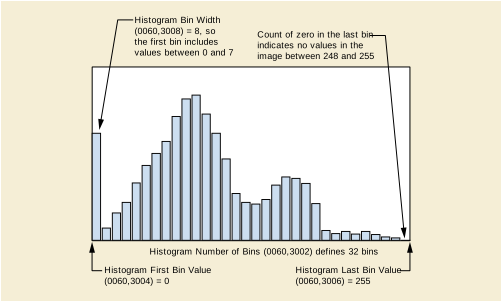
Table C.11.6-1 specifies the Attributes that describe the Softcopy Presentation LUT.
Table C.11.6-1. Softcopy Presentation LUT Module Attributes
|
Attribute name |
Tag |
Type |
Description |
|---|---|---|---|
|
Presentation LUT Sequence |
(2050,0010) |
1C |
Defines a sequence of Presentation LUTs. Only a single item shall be included in this sequence. Required if Presentation LUT Shape (2050,0020) is absent. |
|
>LUT Descriptor |
(0028,3002) |
1 |
Specifies the format of the LUT Data in this Sequence. See Section C.11.6.1.1 for further explanation. |
|
>LUT Explanation |
(0028,3003) |
3 |
Free form text explanation of the meaning of the LUT. |
|
>LUT Data |
(0028,3006) |
1 |
LUT Data in this Sequence. |
|
Presentation LUT Shape |
(2050,0020) |
1C |
Specifies predefined Presentation LUT transformation. Required if Presentation LUT Sequence (2050,0010) is absent. Enumerated Values:
See Section C.11.6.1.2. |
Note
This Module differs from the Presentation LUT Module used in the hardcopy (print) related SOP Classes in that Optical Density is not supported for Presentation LUT Shape (since Optical Density has no meaning for softcopy display devices).
When the Presentation LUT is specified as a Presentation LUT Sequence, then the input range of values is specified by the LUT Descriptor as the first value mapped and the number of entries (values mapped). However, there is an implicit linear scaling of the output range of the preceding transformation (such as the VOI LUT transformation) so that it is always mapped to the specified input range of the Presentation LUT.
When the Presentation LUT is specified as Presentation LUT Shape, then the input range is implicitly specified to be the output range of the preceding transformation (VOI LUT, or if the VOI LUT is identity or absent, the Modality LUT, or if the Modality LUT and VOI LUT are identity or absent, the stored pixel values). In this case, the full range of the output of the preceding transformation will be mapped to the full input range of the display device that receives the output of the Presentation LUT.
Note
The output of the preceding transformation may be signed. This does not mean that signed P-Values actually need to be generated, only that the output of the preceding transformation is to be interpreted by the display device as perceptually linear over the range from the minimum to the maximum values output by the preceding step, and that the minimum value be mapped to the lowest JND Index (and hence luminance) that the display can generate, and the maximum value be mapped to the highest JND Index (and hence luminance) that the display can generate.
In other words, in both cases, the Presentation LUT Module is always implicitly specified to apply over the full range of output of the preceding transformation, and it never selects a subset or superset of the that range (unlike the VOI LUT).
The output bit precision of the VOI LUT Sequence is not required to match the input range of the Presentation LUT Sequence.
Note
For example, if the VOI LUT is specified as a Window Center of 0 and a Window Width of 100, then the range from -50 to +49 is selected to be mapped to the full range of the display or print device (the full range of P-Values) if the Presentation LUT Shape is specified as IDENTITY or INVERSE. This example demonstrates the conventional understanding of the meaning of Window Center and Width to select "values of interest" that are to be displayed across the full range of the output device, without explicitly having to map each choice to P-Values.
For example, if the VOI LUT is specified as a Window Center of 0 and a Window Width of 100, and the Presentation LUT Sequence is sent with a LUT Descriptor first value of 256 and second value of 0, then the range from -50 to +49 is implicitly linearly scaled from 0 to 255 before selecting values from the LUT Data in the Presentation LUT Sequence. This example demonstrates that it is not necessary to send a different Presentation LUT for different Window Center and Width values.
For example, if the VOI LUT is specified as VOI LUT Sequence with a LUT Descriptor with a 3rd Value of 16, then the range from 0 to 216-1 is selected to be mapped to the full range of the display or print device (the full range of P-Values) if the Presentation LUT Shape is specified as IDENTITY or INVERSE. This example demonstrates that a VOI LUT may be specified with the desired precision, without having to explicitly send a Presentation LUT to rescale that precision to whatever range of P-Values is preferred by the display application.
For example, if the VOI LUT is specified as VOI LUT Sequence with a LUT Descriptor with a 3rd Value of 16, and the Presentation LUT Sequence is sent with a LUT Descriptor first value of 4096 and second value of 0, then the range from 0 to 216-1 is implicitly linearly scaled to the range 0 to 4095 before selecting values from the LUT Data in the Presentation LUT Sequence. This example demonstrates the case where, to save space, the Presentation LUT is sent in a compact form that a display application may choose to interpolate more precisely, yet the VOI LUT output may be sent with 16 bit precision.
The three values of LUT Descriptor (0028,3002) describe the format of the LUT Data in the corresponding Data Element (0028,3006).
The first value is the number of entries in the lookup table. When the number of table entries is equal to 216 then this value shall be 0.
The second value is the first implicitly scaled input value mapped, and shall always be 0. The Value Representation of the second value is always US. This implicitly scaled input value is mapped to the first entry in the LUT. There are no implicitly scaled input values less than the first value mapped. An implicitly scaled input value one greater than the first value mapped is mapped to the second entry in the LUT Data. Subsequent implicitly scaled input values are mapped to the subsequent entries in the LUT Data up to an implicitly scaled input value equal to number of entries + first value mapped - 1 that is mapped to the last entry in the LUT Data. There are no implicitly scaled input values greater than number of entries + first value mapped.
The third value specifies the number of bits for each entry in the LUT Data. The third value of LUT Descriptor (0028,3002) shall be between 8 and 16 inclusive. The LUT Data shall be stored in a format equivalent to 8 bits allocated when the number of bits for each entry is 8, and 16 bits allocated when the number of bits for each entry is 16, where the high bit is equal to bits stored - 1, and where bits stored is the third value.
Note
Since LUT Descriptor (0028,3002) is multi-valued, in an Explicit VR Transfer Syntax, only one value representation (US or SS) may be specified. Since all three values are always by definition interpreted as unsigned, the explicit VR actually used will always be US.
Some implementations have encoded 8 bit entries with 16 bits allocated, padding the high bits; this can be detected by comparing the number of entries specified in the LUT Descriptor with the actual value length of the LUT Data entry. The value length in bytes should equal the number of entries if bits allocated is 8, and be twice as long if bits allocated is 16.
The LUT Data contains the LUT entry values, which are P-Values.
The output range is from 0 to 2n-1 where n is the third value of LUT Descriptor. This range is always unsigned.
This range specifies the output range of the P-Values.
A value of INVERSE shall mean the same as a value of IDENTITY, except that the minimum output value shall convey the meaning of the maximum available luminance, and the maximum value shall convey the minimum available luminance. In other words:
P-Value = maximum value - output value
This Module defines a manner of controlling whether or not bit-mapped overlay and curve information are displayed.
If the corresponding Overlay Group activated is present within the Presentation State, then that Overlay shall be activated and any corresponding Overlay in the referenced image(s) ignored, otherwise the Overlay within the referenced image(s) shall be activated.
An Overlay Group referenced in the Bitmap Display Shutter Module described in Section C.7.6.15 shall not be activated using the Overlay Activation Module.
Table C.11.7-1 specifies the Attributes that describe the Overlay Activation Module.
Table C.11.7-1. Overlay Activation Module Attributes
|
Attribute Name |
Tag |
Type |
Attribute Description |
|---|---|---|---|
|
Overlay Activation Layer |
(60xx,1001) |
2C |
The layer (defined in Graphic Layer (0070,0002) of the Graphic Layer Module Section C.10.7) in which the Overlay described in group 60xx shall be displayed. If no layer is specified (zero length) then the overlay shall not be displayed. Required if Group 60xx is present in the referenced image(s) or the Presentation State instance containing this Module. |
Note
Previously, those bits that are stored in Pixel Data (7FE0,0010) above High Bit (0028,0102) could be used as overlay bit planes if they were referenced by an Overlay Bit Position (60xx,0102). This usage has been retired. See PS3.3-2004. Their contents are unspecified in DICOM and should not be displayed. Usually they will be zero, though if the pixel data is signed, i.e., Pixel Representation (0028,0103) is 0001H, then it is possible that the sign bit may be "extended" through these values. Alternatively, they may have been "masked off" even if the value is signed and negative.
Previously, Curve Activation Layer (50xx,1001) was defined in this Module. Its usage has been retired. See PS3.3-2004.
Table C.11.8-1 specifies the Attributes that describe the Softcopy VOI LUT. These Attributes have the same meaning and behavior as defined in the VOI LUT Module Section C.11.2.
Table C.11.8-1. Softcopy VOI LUT Module Attributes
|
Attribute Name |
Tag |
Type |
Attribute Description |
|---|---|---|---|
|
Softcopy VOI LUT Sequence |
(0028,3110) |
1 |
Defines a sequence of VOI LUTs or Window Centers and Widths and to which images and frames they apply. No more than one VOI LUT Sequence containing a single Item or one pair of Window Center/Width values shall be specified for each image or frame. One or more Items shall be included in this sequence. |
|
>Referenced Image Sequence |
(0008,1140) |
1C |
The subset of images and frames listed in the Presentation State Relationship Module, to which this VOI LUT or Window Center and Width applies. One or more Items shall be included in this sequence. Required if the VOI LUT transformation in this Item does not apply to all the images and frames listed in the Presentation State Relationship Module. |
|
>>Include Table 10-3 “Image SOP Instance Reference Macro Attributes” |
|||
Table C.11.9-1 contains Attributes that identify and describe a Presentation Series.
Table C.11.9-1. Presentation Series Module Attributes
|
Attribute Name |
Tag |
Type |
Attribute Description |
|---|---|---|---|
|
Modality |
(0008,0060) |
1 |
Type of equipment that originally acquired the data. Enumerated Values:
See Section C.7.3.1.1.1. |
Note
This implies that presentation states will be in different series from the images to which they apply, which will have different values for Modality.
Table C.11.10-1 contains Attributes that identify a Presentation State.
Table C.11.10-1. Presentation State Identification Module Attributes
|
Attribute Name |
Tag |
Type |
Attribute Description |
|---|---|---|---|
|
Presentation Creation Date |
(0070,0082) |
1 |
Date on which this presentation was created. NoteThis date may be different from the date that the DICOM SOP Instance was created, since the presentation state information contained may have been recorded earlier. |
|
Presentation Creation Time |
(0070,0083) |
1 |
Time at which this presentation was created. NoteThis time may be different from the time that the DICOM SOP Instance was created, since the presentation state information contained may have been recorded earlier. |
|
Include Table 10-12 “Content Identification Macro Attributes” |
NoteThe Content Label value may be used by an application as a Defined Term in order to imply some grouping of different presentation states, i.e., it may have the same value for different presentation state instances that share some common concept. |
||
Table C.11.11-1 contains Attributes that describe the images to which a Presentation State applies.
Table C.11.11-1. Presentation State Relationship Module Attributes
|
Attribute Name |
Tag |
Type |
Attribute Description |
|---|---|---|---|
|
Include Table C.11.11-1b “Presentation State Relationship Macro Attributes” |
|||
Table C.11.11-1b. Presentation State Relationship Macro Attributes
|
Attribute Name |
Tag |
Type |
Attribute Description |
|---|---|---|---|
|
Referenced Series Sequence |
(0008,1115) |
1 |
Sequence of Items where each Item includes the Attributes of one Series to which the Presentation applies. One or more Items shall be included in this sequence. |
|
>Series Instance UID |
(0020,000E) |
1 |
Unique identifier of a Series that is part of the Study defined by the Study Instance UID (0020,000D) in the enclosing data set. NoteThe Study Instance UID (0020,000D) value will be that of the presentation state itself, unless the macro is invoked from Blending Sequence (0070,0402) in the Presentation State Blending Module, in which case it will be explicitly specified. |
|
>Referenced Image Sequence |
(0008,1140) |
1 |
The set of images and frames to which the Presentation applies. These shall be of the Study defined by Study Instance UID (0020,000D) and the Series defined by Series Instance UID (0020,000E). One or more Items shall be included in this sequence. The referenced SOP Class shall be the same for all Images in any Item of this Referenced Series Sequence (0008,1115). |
|
>>Include Table 10-3 “Image SOP Instance Reference Macro Attributes” |
|||
Table C.11.12-1 contains Attributes that specialize Attributes in other Modules included in a Presentation State.
Table C.11.12-1. Presentation State Shutter Module Attributes
|
Attribute Name |
Tag |
Type |
Attribute Description |
|---|---|---|---|
|
Shutter Presentation Value |
(0018,1622) |
1C |
A single grayscale unsigned value used to replace those parts of the image occluded by the shutter, when rendered on a monochrome display. The units are specified in P-Values. Required if the Display Shutter Module or Bitmap Display Shutter Module is present. NoteThe requirement in this module is type 1C, which overrides the type 3 in the Display Shutter Module. |
|
Shutter Presentation Color CIELab Value |
(0018,1624) |
1C |
A color triplet value used to replace those parts of the image occluded by the shutter, when rendered on a color display. The units are specified in PCS-Values, and the value is encoded as CIELab. See Section C.10.7.1.1. Required if the Display Shutter Module or Bitmap Display Shutter Module is present and the SOP Class is other than Grayscale Softcopy Presentation State Storage. NoteThe requirement in this module is type 1C, which overrides the type 3 in the Display Shutter and Bitmap Display Shutter Modules. |
Table C.11.13-1 contains Attributes that specialize the use of masks in a Presentation State.
Table C.11.13-1. Presentation State Mask Module Attributes
|
Attribute Name |
Tag |
Type |
Attribute Description |
|---|---|---|---|
|
Mask Subtraction Sequence |
(0028,6100) |
1C |
Required if Mask Module is present. Only a single Item shall be included in this sequence. Applicable Frame Range (0028,6102) shall not be included in the Sequence Item. See Section C.7.6.10 for a complete definition of the Attributes in the Items of this Sequence other than Mask Operation (0028,6101) and Applicable Frame Range (0028,6102). Note
|
|
>Mask Operation |
(0028,6101) |
1 |
Type of mask operation to be performed Enumerated Values:
See Section C.7.6.10.1 for further explanation. NoteThe requirement in this module is for Enumerated Values, which overrides the requirements of the Mask Module. |
|
>Contrast Frame Averaging |
(0028,6112) |
1C |
Specified the number of contrast frames to average together before performing the mask operation. Required if Mask Frame Numbers (0028,6110) specifies more than one frame (i.e., is multi-valued). NoteThe requirement in this module is conditional and overrides the optional requirements of the Mask Module. |
|
Recommended Viewing Mode |
(0028,1090) |
1C |
Specifies the recommended viewing protocol(s). Enumerated Values:
Required if Mask Subtraction Sequence (0028,6100) is present. NoteThe requirements in this module are type 1C and a specified Enumerated Value, which override the requirements of the Mask Module. |
Table C.11.14-1 contains Attributes that describe the identification of two sets of grayscale images and the grayscale transformations to be applied to them, for the purpose of blending.
Table C.11.14-1. Presentation State Blending Module Attributes
|
Attribute Name |
Tag |
Type |
Attribute Description |
|---|---|---|---|
|
Blending Sequence |
(0070,0402) |
1 |
A Sequence of Items, one identifying and describing transformations upon a set of underlying grayscale images, and the other identifying and describing transformations upon a set of superimposed grayscale images. Two Items shall be included in this sequence See Section C.11.14.1.1. |
|
>Blending Position |
(0070,0405) |
1 |
Whether or not the contents of the Item represent the superimposed or underlying image set. Enumerated Values:
|
|
>Study Instance UID |
(0020,000D) |
1 |
Unique identifier for the Study that contains the images, which may differ from the Study in which the presentation state is contained. |
|
>Include Table C.11.11-1b “Presentation State Relationship Macro Attributes” |
|||
|
>Include Table C.11-1b “Modality LUT Macro Attributes” if a Modality LUT is to be applied to referenced image(s). |
|||
|
>Softcopy VOI LUT Sequence |
(0028,3110) |
1C |
Defines a sequence of VOI LUTs or Window Centers and Widths and to which images and frames they apply. No more than one VOI LUT Sequence containing a single Item or one pair of Window Center/Width values shall be specified for each image or frame. One or more Items shall be included in this sequence. Required if a VOI LUT is to be applied to referenced image(s). |
|
>>Referenced Image Sequence |
(0008,1140) |
1C |
Sequence of Items identifying images that are defined in the enclosing Item of Blending Sequence (0070,0402), to which this VOI LUT or Window Center and Width applies. One or more Items shall be included in this sequence. Required if the VOI LUT transformation in this Item does not apply to all the images and frames in the enclosing Item of Blending Sequence (0070,0402). |
|
>>>Include Table 10-3 “Image SOP Instance Reference Macro Attributes” |
|||
|
>>Include Table C.11-2b “VOI LUT Macro Attributes” |
|||
|
Relative Opacity |
(0070,0403) |
1 |
A value from 0.0 to 1.0 indicating the relative opacity of the pixels of the superimposed image, where 1.0 means that pixels of the superimposed image completely replace the pixels of the underlying image, and 0.0 means that the pixels of the underlying image completely replace the pixels of the superimposed image. See PS3.4 for a detailed description of the blending operation. |
|
Referenced Spatial Registration Sequence |
(0070,0404) |
3 |
A reference to Spatial Registration Instances that may be used to register the underlying and superimposed images. One or more Items are permitted in this sequence. NoteA Spatial Registration Instance may identify registration between frames of reference, or between explicitly identified images. In the latter case, the list of images referenced by the Presentation State, not the list of images referenced by the Spatial Registration Instance, are to be blended. |
|
>Include Table C.17-3 “Hierarchical SOP Instance Reference Macro Attributes” |
|||
Blending Sequence (0070,0402) is used to identify two sets of images, one to be superimposed upon the other.
The sets of images and any subset of the frames therein in the case of multi-frame images are identified by Study, Series, SOP Instance and Frame Number. In the case of a Segmentation image, the subset of segments is identified by the attribute Referenced Segment Number (0062,000B) in the Referenced Image Sequence (0008,1140) invoked in the Presentation State Relationship Macro.
This module specifies no explicit relationship (such as pairing or ordering) between the sets of images and frames defined in the first item for the underlying images, and the second item for the superimposed images. This module does not define how the images are spatially related, and what re-sampling, if any, needs to be performed before the images are blended for rendering.
Note
The images in the two sets may share the same Frame of Reference, in which case the rendering application can spatially relate the two sets of images based on their Image Position (Patient) (0020,0032) and Image Orientation (Patient) (0020,0037) Attributes.
Alternatively, a Spatial Registration SOP Instance may exist that relates either two different Frames of Reference, or two sets of images identified by UID and frame.
Whilst the two sets of images may already be spatially co-registered and oriented in the same plane, or even be sampled at the same in-plane and between-plane resolution, this will frequently not be the case.
See PS3.4 for behavioral requirements that apply to Storage SOP Classes using this Module.
The underlying image for a superimposed Segmentation image need not be the source image for the segmentation.
Table C.11.15-1 contains Attributes that identify and describe an ICC Profile.
Table C.11.15-1. ICC Profile Module Attributes
|
Attribute Name |
Tag |
Type |
Attribute Description |
|---|---|---|---|
|
ICC Profile |
(0028,2000) |
1 |
An ICC Profile encoding the transformation of device-dependent color stored pixel values into PCS-Values. |
ICC Profile (0028,2000) encodes an ICC Input Device Profile that encodes the transformation of device-dependent color stored pixel values into PCS-Values.
Note
Only Input Device profiles are encoded, since display and output device profiles are not interchanged in DICOM, though they may be used internally within display and output devices, for example when they are calibrated.
Since the version of the ICC Profile is encoded within the profile itself, no additional version information is encoded in the ICC Profile Module.
The following constraints on the encoding of the ICC Profile shall be observed:
The profile shall be of the Input Device class, i.e., header bytes 12 through15, Profile Device/Class Signature, shall be "scnr"
The color space of the input shall be RGB, i.e., header bytes 16 through 19, Color Space Signature, shall be "RGB", regardless of the Photometric Interpretation of the image pixel data prior to decompression
PCS shall be CIELab or CIEXYZ, i.e., header bytes 20 through 23, Profile Connection Space, shall be either "Lab" or "XYZ".
Note
In the case of a PCS of CIELab, the profile will contain an N-component LUT-based AtoB0Tag, since three-component matrix based transformations are only possible with a PCS of CIEXYZ. A three-component matrix based transformation might be used to define a well-known rather than device-specific profile for such spaces as sRGB.
Selection of a PCS of CIELab or CIEXYZ within the ICC profile does not impact the DICOM encoding, since all color management systems support both.
The following constraints on the encoding of the ICC Profile are recommended:
The Rendering Intent should be Perceptual.
Note
The rendering intent specifies how rendering will take place when the ICC Input Profile is linked with another Profile for the purpose of display.
A perceptual rendering intent implies that AtoB0Tag and BtoA0Tag tags will be present in the profile. The AtoB0Tag allows mapping from the input values to the PCS. The BtoA0Tag allows mapping from the PCS to the input values, though this is not required for the color rendering pipeline defined in PS3.4.
All LUTs should be represented as 16 bit values, using tag type lut16Type, for greater precision.
The chromaticAdaptationTag should be set if the actual illumination source is not D50.
Note
See the discussion of white point in PS3.4.
Table C.11.16-1 describes the attributes of the Structured Display Module.
Table C.11.16-1. Structured Display Module Attributes
|
Attribute Name |
Tag |
Type |
Attribute Description |
|---|---|---|---|
|
Include Table 10-12 “Content Identification Macro Attributes” |
|||
|
Presentation Creation Date |
(0070,0082) |
1 |
Date on which this structured display was created. NoteThis date may be different from the date that the DICOM SOP Instance was created, since the structured display information contained may have been recorded earlier. |
|
Presentation Creation Time |
(0070,0083) |
1 |
Time at which this structured display was created. NoteThis time may be different from the time that the DICOM SOP Instance was created, since the structured display information contained may have been recorded earlier. |
|
Number of Screens |
(0072,0100) |
1 |
The number of screens for this Structured Display. If SOP Class UID (0008,0016) equals 1.2.840.10008.5.1.4.1.1.131(Basic Structured Display), the value shall be 1. |
|
Nominal Screen Definition Sequence |
(0072,0102) |
1 |
Sequence of items that describes the set of screens for this Structured Display. The number of items shall equal the value of Number of Screens (0072,0100). One or more Items shall be included in this sequence. NoteThe Basic Structured Display IOD limits this Sequence to one Item. |
|
>Include Table C.23.2-2 “Screen Specifications Macro Attributes” |
|||
|
Icon Image Sequence |
(0088,0200) |
3 |
This icon image is representative of the structured display. Only a single item is permitted in this sequence. |
|
See Section C.7.6.1.1.6 for further explanation. |
|||
|
Structured Display Background CIELab Value |
(0072,0420) |
3 |
A value in which it is recommended that Structured Display background (i.e., the area outside of Image Boxes) be rendered on a color display. The units are specified in PCS-Values, and the value is encoded as CIELab. See Section C.10.7.1.1. |
|
Empty Image Box CIELab Value |
(0072,0421) |
3 |
A value in which it is recommended that empty Image Boxes be rendered on a color display. The units are specified in PCS-Values, and the value is encoded as CIELab. See Section C.10.7.1.1. |
Table C.11.17-1 describes the attributes of the Structured Display Image Box Module.
Table C.11.17-1. Structured Display Image Box Attributes
|
Attribute Name |
Tag |
Type |
Attribute Description |
|---|---|---|---|
|
Structured Display Image Box Sequence |
(0072,0422) |
1 |
The image display boxes defined in the display environment, together with the reference to the image to be displayed in each Image Box. One or more Items shall be included in this sequence. |
|
>Display Environment Spatial Position |
(0072,0108) |
1 |
Exactly four dimensionless floating point values, in the range 0.0 to 1.0, indicating the rectangular coordinate position of the Image Box within the Display Environment. NoteFor the Basic Structured Display with a single screen, the Display Environment is coextensive with the screen defined in the Nominal Screen Definition Sequence (0072,0102). |
|
>Image Box Number |
(0072,0302) |
1 |
An integer that is unique across all Items of the Structured Display Image Box Sequence (0072,0422) that identifies the Image Box. |
|
>Image Box Layout Type |
(0072,0304) |
1 |
Type of layout of the Image Box. The types are primarily distinguished by their interaction technique. Defined Terms:
NoteThis value may also be used for non-image objects, such as waveforms and SR documents. |
|
>Image Box Overlap Priority |
(0072,0320) |
3 |
If this Image Box overlaps in spatial position with others, this attribute indicates the layer of this Image Box in relation to the others. The value shall be a positive integer in the range 1 to 100, where 1 = top and 100 = bottom. If this attribute is not present, then the expected behavior is not defined. |
|
>Display Set Horizontal Justification |
(0072,0717) |
3 |
Indicates direction in which to horizontally justify the image within an Image Box that is not the same shape (aspect ratio) as the image. Enumerated Values:
NoteTypically used in mammography display applications in which images from the patient's left and right are displayed "back to back", rather than centered. |
|
>Display Set Vertical Justification |
(0072,0718) |
3 |
Indicates direction in which to vertically justify the image within an Image Box that is not the same shape (aspect ratio) as the image. Enumerated Values:
|
|
>Preferred Playback Sequencing |
(0018,1244) |
1C |
Describes the preferred playback sequencing for the Image Box. Overrides any Preferred Playback Sequencing (0018,1244) value in the image objects being displayed. Required if the value of Image Box Layout Type (0072,0304) is CINE. Enumerated Values:
|
|
>Recommended Display Frame Rate |
(0008,2144) |
1C |
Recommended rate at which the frames of a multi-frame image shall be displayed, in frames/second. Shall have a value greater than zero. Overrides any Recommended Display Frame Rate (0008,2144) value in the image objects being displayed. Required if the value of Image Box Layout Type (0072,0304) is CINE and if Cine Relative to Real-Time (0072,0330) is not present. |
|
>Cine Relative to Real-Time |
(0072,0330) |
1C |
A positive dimensionless floating point numeric factor equal to playback rate divided by acquisition rate. Required if the value of Image Box Layout Type (0072,0304) is CINE and if Recommended Display Frame Rate (0008,2144) is not present. NoteThe acquisition rate may change within the image object, as specified in Frame Time Vector (0018,1065). |
|
>Initial Cine Run State |
(0018,0042) |
1C |
Defined Terms:
Required if the value of Image Box Layout Type (0072,0304) is CINE. |
|
>Start Trim |
(0008,2142) |
2C |
The frame number of the first frame of the multi-frame image to be displayed in a CINE Image Box. Required if the value of Image Box Layout Type (0072,0304) is CINE. |
|
>Stop Trim |
(0008,2143) |
2C |
The Frame Number of the last frame of the multi-frame image to be displayed in a CINE Image Box. Required if the value of Image Box Layout Type (0072,0304) is CINE. |
|
>Referenced First Frame Sequence |
(0072,0427) |
2C |
Reference to the initial frame in a stack to be displayed in this image box. If value is not present, the first image frame to be displayed is not defined by the Standard. Zero or one Item shall be included in this sequence. Required if the value of Image Box Layout Type (0072,0304) is STACK. |
|
>>Include Table 10-3 “Image SOP Instance Reference Macro Attributes” |
|||
|
>Referenced Image Sequence |
(0008,1140) |
2C |
Reference to the Image SOP Instances, or frames from multi-frame Image SOP Instances, to be displayed in this Image Box. Zero or more Items shall be included in this sequence. Required if Referenced Presentation State Sequence (0008,9237), Referenced Stereometric Instance Sequence (0008,1134), and Referenced Instance Sequence (0008,114A) are not present. See Section C.11.17.1.2. |
|
>>Include Table 10-3 “Image SOP Instance Reference Macro Attributes” |
NoteThe order of frames identified in the Referenced Frame Number (0008,1160) attribute affects ordering in STACK Image Box Layout. See Section C.11.17.1.2. |
||
|
>>Referenced Presentation State Sequence |
(0008,9237) |
1C |
Reference to a Softcopy Presentation State SOP Instance to be applied to the referenced image. Only a single Item shall be included in this sequence. Required if presentation controls are to be applied to the image or image frame before rendering in the Structured Display. |
|
>>>Include Table 10-11 “SOP Instance Reference Macro Attributes” |
|||
|
>Referenced Presentation State Sequence |
(0008,9237) |
1C |
Reference to a Softcopy Presentation State SOP Instance whose referenced images are to be displayed in the Image Box using the presentation controls of the referenced SOP Instance. Only a single Item shall be included in this sequence. Required if Referenced Image Sequence (0008,1140), Referenced Stereometric Instance Sequence (0008,1134), and Referenced Instance Sequence (0008,114A) are not present. See Section C.11.17.1.2. |
|
>>Include Table 10-11 “SOP Instance Reference Macro Attributes” |
|||
|
>Referenced Instance Sequence |
(0008,114A) |
1C |
Reference to a non-image SOP Instance (e.g., waveform, SR, encapsulated document) whose content is to be displayed in the Image Box. Only a single Item shall be included in this sequence. Required if Referenced Presentation State Sequence (0008,9237), Referenced Stereometric Instance Sequence (0008,1134), and Referenced Image Sequence (0008,1140) are not present. See Section C.11.17.1.3. |
|
>>Include Table 10-11 “SOP Instance Reference Macro Attributes” |
|||
|
>Referenced Stereometric Instance Sequence |
(0008,1134) |
1C |
Reference to a Stereometric SOP Instance whose referenced images are to be displayed in the Image Box. Only a single Item shall be included in this sequence. Required if Referenced Presentation State Sequence (0008,9237), Referenced Instance Sequence (0008,114A), and Referenced Image Sequence (0008,1140) are not present. See Section C.11.17.1.4. |
|
>>Include Table 10-11 “SOP Instance Reference Macro Attributes” |
|||
|
Image Box Synchronization Sequence |
(0072,0430) |
1C |
Description of synchronized display between two or more Image Boxes. Required if synchronized display is specified between Image Boxes. One or more Items shall be included in this sequence. |
|
>Synchronized Image Box List |
(0072,0432) |
1 |
Multi-valued list of two or more Image Box Number (0072,0302) values. Indicates that the display of multiple image frames within the specified Image Boxes are synchronized. Referenced Image Boxes shall be of same Image Box Layout Type (0072,0304). An Image Box Number value may appear in only one Image Box Synchronization Sequence (0072,0430) item. |
|
>Type of Synchronization |
(0072,0434) |
1 |
Type of synchronization between Image Boxes. Defined Terms:
See Section C.11.17.1.5. |
The Display Environment Spatial Position (0072,0108) specifies the corners of the Image Box relative to the vertical and horizontal dimensions of the Display Environment, specified as Number of Vertical Pixels (0072,0104) and Number of Horizontal Pixels (0072,0106) in the Nominal Screen Definition Sequence (0072,0102).
See also Section C.23.2.1.1.
Within the Image Box, the image (or the area of the image selected for display by the associated Presentation State SOP Instance) shall be scaled to fit the display area under the constraint that the aspect ratio of the image is maintained.
In rendering the Image Box, the Application Entity may render display controls (such as cine speed control, or stack position indication) either within or outside the specified Display Environment Spatial Position (0072,0108).
Image SOP Instances, or frames from multi-frame SOP Instances, to be displayed in an Image Box may be identified either directly by the Referenced Image Sequence (0008,1140), or indirectly through the Referenced Presentation State Sequence (0008,9237).
Referenced Image Sequence (0008,1140) is permitted to be zero length, indicating an empty Image Box.
Note
The recommended display color for an empty Image Box is specified by Empty Image Box CIELab Value (0072,0421).
When displaying a standard template such as a dental full mouth series, an empty image box may be used to indicate that the corresponding view was not taken.
If images are identified indirectly through the Referenced Presentation State Sequence (0008,9237), all of the image frames identified in the top level Referenced Series Sequence (0008,1115) attribute shall be displayed. For images identified indirectly through a Blending Presentation State SOP Instance, all the image frames for which the Blending Position (0070,0405) value is UNDERLYING shall be displayed, with the relevant SUPERIMPOSED images blended as necessary.
If images are to be displayed, the number of frames referenced for display shall be consistent with the value of Image Box Layout Type (0072,0304). If the value of Image Box Layout Type is SINGLE, only a single frame shall be referenced, either directly or indirectly; if the value is CINE, only a single multi-frame SOP Instance shall be referenced.
If the value of Image Box Layout Type is STACK, more than one SOP Instance or frame may be referenced, and the frames constitute a stack to be displayed in the Image Box. For frames identified by the Referenced Image Sequence, the order of stepping through the stack shall be the order of Image SOP Instance references in that Sequence. If multiple frames are selected in Referenced Frame Number (0008,1160), those frames shall be stepped through in the order of their listing in that attribute, within the order of display of their Image SOP Instance.
For a stack whose frames are selected indirectly through an Item of the Referenced Presentation State Sequence, the order of stepping through the stack shall be the order of SOP Instance references in the Referenced Series Sequence (0008,1115) of the referenced Presentation State. For a referenced Blending Softcopy Presentation State, this shall be the Referenced Series Sequence within the Blending Sequence (0070,0402) Item for which the Blending Position (0070,0405) value is UNDERLYING.
Note
Display of images using Blending Softcopy Presentation State must use indirect SOP Instance reference through the Referenced Presentation State Sequence (0008,9237) at the top level of Structured Display Image Box Sequence (0072,0422) Item, and cannot use the Referenced Presentation State Sequence within an item of the Referenced Image Sequence (0008,1140).
A Blending Presentation State that references a blending of a single underlying frame and a single superimposed frame may be associated with a SINGLE Image Box Layout.
A reference to a single display frame, either directly through Referenced Image Sequence or indirectly through Referenced Presentation State Sequence, may be associated with either a STACK or a CINE Image Box Layout as a degenerate case.
There is no requirement for the pixel matrix sizes of the images in the stack, or the image display area as selected by referenced Presentation State SOP Instances, to be identical, nor for the referenced images to be of the same SOP Class.
Referenced Presentation States are an initial presentation control. The rendering Application Entity might allow a user to interactively enable/disable graphic layers, or change the zoom, rotation, window width / window level, or other presentation controls. Any such Application Entity functionality is beyond the scope of the Standard.
The Referenced Instance Sequence (0008,114A) references a non-Image SOP Instance, e.g., a Structured Report, Waveform, or Encapsulated Document SOP Instance, to be displayed in the image box. For such object references, the value of Image Box Layout Type (0072,0304) shall be SINGLE, even if displaying the object will require scrolling or paging (e.g., a multi-page encapsulated document).
The Referenced Stereometric Instance Sequence (0008,1134) references a Stereometric SOP Instance, whose Stereo Pairs Sequence (0022,0020) references image pairs to be displayed in the Image Box. The number of image pairs referenced for display shall be consistent with the value of Image Box Layout Type (0072,0304). If the value of Image Box Layout Type is SINGLE, only a single pair of frames shall be referenced by the Stereo Pairs Sequence in the referenced stereometric instance; if the value is CINE, only a single pair of multi-frame SOP Instances shall be referenced; if the value is STACK, one or more pairs may be referenced constituting a stack to be displayed in the Image Box, and the order of stepping through the stack shall be the order of Items in the Stereo Pairs Sequence. The manner in which a stereo pair is rendered is unspecified.
Note
While the Stereometric IOD allows reference to multiple pairs of multi-frame cine Instances, the CINE Image Box Layout does not support the display of more than one (a "stack" of cines).
Display of stereo pairs typically requires specialized hardware (e.g., polarizing filters and shutter glasses).
Type of Synchronization (0072,0434) specifies the method for synchronizing the display of images in two or more Image Boxes linked through the Synchronized Image Box List (0072,0432).
- FRAME
Stepping of frames in one Image Box is synchronized by the stepping of an identical number of frames in the other Image Boxes.
- POSITION
Stepping of frames in one Image Box is synchronized by the stepping of frames in the other Image Boxes to effect an identical relative positional offset within the patient based coordinate system. This presumes that the referenced images includes Image Position (Patient) (0020,0032) and Image Orientation (Patient) (0020,0037) attributes, and that the stacks have approximately the same orientation relative to the patient based coordinate system.
- TIME
Playback of frames in one Image Box is synchronized by the playback of frames in the other Image Boxes to effect an identical temporal offset from the original displayed frame. This presumes that the referenced images include Frame Time (0018,1063), Frame Time Vector (0018,1065), or Frame Reference DateTime (0018,9151). It also presumes that if the Image Box Layout Type (0072,0304) is STACK, the frames are referenced in a monotonically increasing time order in the stack.
- PHASE
Playback of frames in one Image Box is synchronized by the playback of frames in the other Image Boxes to effect an identical phase offset. This presumes that the referenced frames within each referenced Image Box constitute a uniform sampling across a single "cycle", and that relative position within that cycle is synchronized across all the referenced Image Boxes. For Image Boxes with Image Box Layout Type (0072,0304) value CINE, the set of frames to be displayed as one cycle may be specified either using the Referenced Frame Number (0008,1160) attribute within the Referenced Image Sequence (0008,1140), or if that attribute is not present, using the values of attributes Start Trim (0008,2142) and Stop Trim (0008,2143).
Note
PHASE may be used, for instance, to synchronize display of images representing a single cardiac cycle.
Synchronization of Image Boxes is an initial presentation control. The rendering Application Entity might allow a user to unlink the synchronization, e.g., to navigate to cine frames before the Start Trim (0008,2142) frame or after the Stop Trim (0008,2143) frame. Any such Application Entity functionality is beyond the scope of the Standard.
This Module defines Attributes of text annotation that shall be applied to a Structured Display. The text is defined in position and size relative to the Display Environment.
Note
The text bounding box is specified using the same attribute, Display Environment Spatial Position (0072,0108), that is used for Image Boxes in the Structured Display Module. This attribute uses the coordinates (0.0,0.0) as the bottom left hand corner and (1.0,1.0) as the top right hand corner. In contrast, the image-related text annotations defined in the Graphic Annotation Module in image Presentation State IODs use the attributes Bounding Box Top Left Hand Corner (0070,0010) and Bounding Box Bottom Right Hand Corner (0070,0011), which use the coordinates (0.0,0.0) as the top left hand corner and (1.0,1.0) as the bottom right hand corner.
Annotation of regions of interest in images included in the Structured Display, e.g., circling of a feature of interest, may be done with a Presentation State applied to the image in the Structured Display Image Box Sequence (0072,0422) in the Structured Display Image Box Module. This Structured Display Annotation Module provides only for text annotations, typically as used for captions for the Image Boxes or for the Structured Display as a whole.
Table C.11.18-1 describes the attributes of the Structured Display Annotation Module.
Table C.11.18-1. Structured Display Annotation Attributes
|
Attribute Name |
Tag |
Type |
Attribute Description |
|---|---|---|---|
|
Structured Display Text Box Sequence |
(0072,0424) |
1 |
Sequence that describes a text annotation. One or more Items shall be included in this sequence. |
|
>Unformatted Text Value |
(0070,0006) |
1 |
Text data that is unformatted and whose manner of display within the defined bounding box is implementation dependent. See Section C.11.18.1.1. The text value may contain spaces, as well as multiple lines separated by CR LF, but otherwise no format control characters (such as horizontal or vertical tab and form feed) shall be present, even if permitted by the Value Representation of ST. The text shall be interpreted as specified by Specific Character Set (0008,0005) if present in the SOP Instance. NoteThe text may contain single or multi-byte characters and use code extension techniques as described in PS3.5 if permitted by the values of Specific Character Set (0008,0005). |
|
>Display Environment Spatial Position |
(0072,0108) |
1 |
Exactly four dimensionless floating point values, in the range 0.0 to 1.0, indicating the rectangular coordinate position within the Display Environment of the bounding box in which Unformatted Text Value (0070,0006) is to be displayed. NoteFor the Basic Structured Display with a single screen, the Display Environment is coextensive with thescreen defined in the Nominal Screen Definition Sequence (0072,0102). See Section C.11.16. |
|
>Bounding Box Text Horizontal Justification |
(0070,0012) |
1 |
Location of the text relative to the vertical edges of the bounding box. Enumerated Values:
|
|
>Graphic Layer Recommended Display CIELab Value |
(0070,0401) |
3 |
A value in which it is recommended that Unformatted Text Value (0070,0006) be rendered on a color display. The units are specified in PCS-Values, and the value is encoded as CIELab. See Section C.10.7.1.1. |
The Unformatted Text Value (0070,0006) rendered in Display Environment Spatial Position (0072,0108) need not be confined to the specified bounding box.
Note
An implementation may render text outside the confines of the bounding box if necessary to display all the specified text.
Alternatively, an implementation may choose to render the text in a scrolling box, or a link to another fixed or popup window as appropriate.
When the text bounding box overlaps an Image Box (from the Structured Display Image Box Module), the text box has a higher display priority (i.e., it is on top of the image box). The background color of the bounding box is undefined.
Note
Commonly, the background region of the bounding box around the text will be rendered "transparently", i.e., the image will be visible, though some implementations may choose to opacify the bounding box behind the text to improve its readability.
With a transparent background, for example, an implementation may choose an "exclusive or" style opacification to be sure that the text is discernible over light and dark portions of the image.
The size, font, and rotation of the individual rendered text characters are unspecified.
Table C.11.19-1 specifies the Attributes that describe mask operations for a XA/XRF Multi-frame image.
Table C.11.19-1. XA/XRF Presentation State Mask Module Attributes
|
Attribute Name |
Tag |
Type |
Attribute Description |
|---|---|---|---|
|
Mask Subtraction Sequence |
(0028,6100) |
1 |
Defines a sequence that describes mask subtraction operations for Multi-frame Images. One or more items shall be included in this sequence. |
|
>Referenced Image Sequence |
(0008,1140) |
1C |
A reference to a selected Image. Required if Presentation State Relationship Module references more than one SOP Instance. Only a single itemshall be included in this sequence. |
|
>>Include Table 10-11 “SOP Instance Reference Macro Attributes” |
|||
|
>Mask Operation |
(0028,6101) |
1 |
Defined Term identifying the type of mask operation to be performed. See Section C.7.6.10.1 for further explanation. |
|
>Applicable Frame Range |
(0028,6102) |
1C |
Each pair of numbers in this multi-valued attribute specifies a beginning and ending frame number inclusive of a range where this particular mask operation is valid. Discontinuous ranges are represented by multiple pairs of numbers. Frames in a Multi-frame Image are specified by sequentially increasing number values beginning with 1. If this Attribute is missing in this particular sequence item, then the mask operation is applicable throughout the entire Multi-frame Image, subject to certain limits as described in Section C.7.6.10.1.1. Each frame shall only be associated with a single Item of this sequence. Required if Mask Operation (0028,6101) equals REV_TID. May be present otherwise. |
|
>Mask Frame Numbers |
(0028,6110) |
1C |
Specifies the frame numbers of the pixel data used to generate this mask. Frames in a Multi-frame Image are specified by sequentially increasing number values beginning with 1. Required if the Mask Operation (0028,6101) is AVG_SUB. |
|
>Contrast Frame Averaging |
(0028,6112) |
3 |
Specifies the number of contrast frames to average together before performing the mask operation. If the Attribute is missing, no averaging is performed. |
|
>TID Offset |
(0028,6120) |
2C |
If Mask Operation is TID, specifies the offset to be subtracted from the current frame number in order to locate the mask frame in TID mode. If Mask Operation is REV_TID, specifies the initial offset to be subtracted from the first contrast frame number. See Section C.7.6.10.1.1. If zero length, TID Offset defaults to 1. Required if Mask Operation (0028,6101) is TID or REV_TID. |
|
>Pixel Intensity Relationship LUT Sequence |
(0028,9422) |
1C |
A sequence of Pixel Intensity Relationship LUTs that specifies a transformation to logarithmic space. One or more items shall be included in this sequence. Required if Pixel Intensity Relationship (0028,1040) is not LOG for frames included in this Item of the Mask Subtraction Sequence (0028,6100). |
|
>>LUT Frame Range |
(0028,9507) |
1 |
Each pair of numbers in this multi-valued attribute specifies a beginning and ending frame number inclusive of a range where this LUT operation is specified. Discontinuous ranges are represented by multiple pairs of numbers. Frames in a Multi-frame Image are specified by sequentially increasing number values beginning with 1. NoteThe specified frame numbers must be a part of the frames where this mask operation is valid. |
|
>>LUT Descriptor |
(0028,3002) |
1 |
Specifies the format of the LUT Data in this Sequence. See Section C.11.1.1 and Section C.7.6.16.2.13.1 for further explanation. |
|
>>LUT Data |
(0028,3006) |
1 |
LUT Data in this Sequence |
|
>>LUT Function |
(0028,9474) |
1 |
The transformation function this LUT applies to the stored pixel values. Enumerated Values:
|
|
>Pixel Shift Sequence |
(0028,9501) |
1 |
Sequence containing the pixel shift values for the masks of the specified frame range(s) in the specified region(s). One or more items shall be included in this sequence. |
|
>>Pixel Shift Frame Range |
(0028,9506) |
1 |
Each pair of numbers in this multi-valued attribute specify a beginning and ending contrast frame number inclusive of a range where this pixel shift is specified. Discontinuous ranges are represented by multiple pairs of numbers. Frames in a Multi-frame Image are specified by sequentially increasing number values beginning with 1. Overlapping frame ranges are not permitted. NoteThe specified frame numbers must be a part of the frames where this mask operation is valid. |
|
>>Region Pixel Shift Sequence |
(0028,9502) |
1 |
Sequence containing the pixel shifts for this frame(s). Only one sub region of this frame(s) shall be specified when the pixel shift is applicable for the full size or a single region of the frame(s). More than one sub region of this frame(s) may be specified when pixel shift is different in different regions. The order of Items in this sequence is significant, see Section C.11.19.1.2. One or more items shall be included in this sequence. |
|
>>>Mask Sub-pixel Shift |
(0028,6114) |
1 |
A pair of floating point numbers specifying the fractional vertical [adjacent row spacing] and horizontal [adjacent column spacing] pixel shift applied to the mask before subtracting it from the region of the frame numbers specified by Pixel Shift Frame Range (0028,9506) of this Pixel Shift Sequence (0028,9501) Item. The region is specified by the polygon defined by the Vertices of the Region (0028,9503) attribute. The pixels on the line of the polygon belong to the region. NoteIf no pixel shift has to be applied a pair of zero attribute values (0.0\0.0) should be specified. See Section C.11.19.1.1. |
|
>>>Vertices of the Region |
(0028,9503) |
1C |
Multiple Values where the first set of two values are: row of the origin vertexcolumn of the origin vertex Two or more pairs of values follow and are the row and column coordinates of the other vertices of the polygon region. Each polygon region is implicitly closed from the last vertex to the origin vertex and all edges shall be non-intersecting except at the vertices. See Section C.11.19.1.2. The upper left pixel of the image has the coordinate 1\1. Required if the pixel shift does not apply to the entire set of pixels of the frames. |
A pair of floating point numbers specifying the fractional vertical [adjacent row spacing] and horizontal [adjacent column spacing] pixel shift applied to the mask before subtracting it from the specified region of the contrast frame. The row offset results in a shift of the pixels along the column axis. The column offset results in a shift of the pixels along the row axis. A positive row offset is a shift toward the pixels of the lower row of the pixel plane. A positive column offset is a shift toward the pixels of the left hand side column of the pixel plane.
Each item of the Region Pixel Shift Sequence (0028,9502) specifies both a region of the contrast frame and a mask pixel shift to be applied during the subtraction of that region.
When the Region Pixel Shift Sequence (0028,9502) contains more than one item, each region of the contrast frame is subtracted by applying the corresponding pixel shift specified in that item.
When an item of the sequence does not contain the attribute Vertices of the Region (0028,9503), the applicable region for that item is the whole contrast frame.
The union of all the regions defined in the Region Pixel Shift Sequence (0028,9502) does not cover necessarily the whole contrast frame, in which case the pixels outside the union of all the regions shall be subtracted with no pixel shift.
If a set of pixels of the contrast frame is contained in more than one region, the applicable pixel shift is the one of the last item with the region that contains this set of pixels, as shown in Figure C.11.19-1.
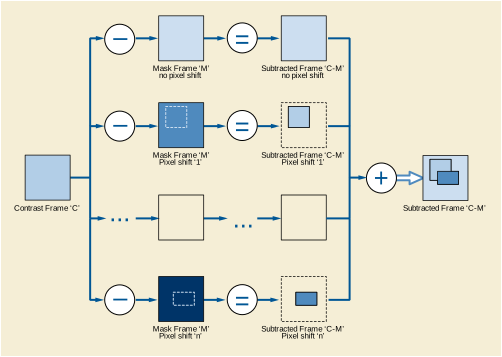
Note
For example, the contrast frames 4 to 10 of a SOP Instance "A" are subtracted to the mask frame 1, the subtraction of the frames 4 to 7 being performed with three different values of mask pixel shift on overlapping rectangular regions: The (row,column) coordinates of the top-left and bottom-right vertices of the regions are 1: (1,1) to (30,60), 2: (10,40) to (50,120) and 3: (20,20) to (70,80). The mask pixel shift to be applied to the pixel (25,50) corresponds to the region 3 because this pixel is contained in the intersection of the three regions (see Figure C.11.19-2 and Figure C.11.19-3).
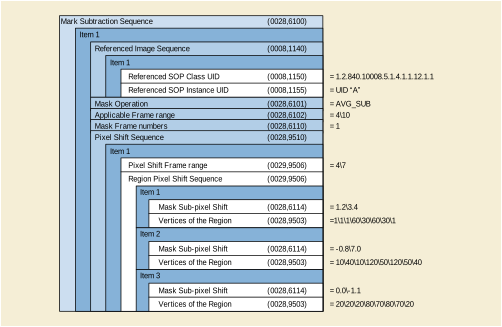
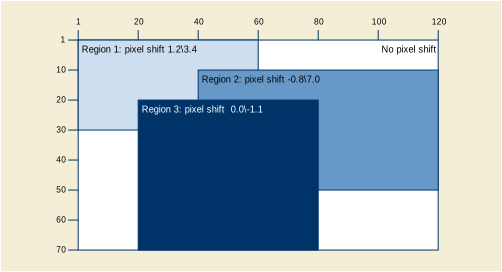
Table C.11.19-1 specifies the Attributes that describe shutter operations for a XA/XRF Multi-frame image.
Table C.11.20-1. XA/XRF Presentation State Shutter Module Attributes
|
Attribute Name |
Tag |
Type |
Attribute Description |
|---|---|---|---|
|
Frame Display Shutter Sequence |
(0018,9472) |
1 |
Sequence of shutter specifications to be applied to groups of frames. One or more Items shall be included in this sequence. |
|
>Referenced Image Sequence |
(0008,1140) |
1C |
Sequence of Items where each Item provides reference to a selected set of Image SOP Class/SOP Instance pairs that are defined in the Presentation State Relationship Module. One or more Items shall be included in this sequence. Required if shutters in this Item do not apply to all the images and frames listed in the Presentation State Relationship Module. |
|
>>Include Table 10-3 “Image SOP Instance Reference Macro Attributes” |
|||
Table C.11.21-1 specifies the Attributes of a XA/XRF Presentation State Presentation Module.
Table C.11.21-1. XA/XRF Presentation State Presentation Module Attributes
|
Attribute Name |
Tag |
Type |
Attribute Description |
|---|---|---|---|
|
Multi-frame Presentation Sequence |
(0028,9505) |
1 |
Describes for one or more SOP Instances the recommended playback and display preferences. One or more Items shall be included in this sequence. |
|
>Referenced Image Sequence |
(0008,1140) |
1C |
Sequence of Items where each Item provides reference to a selected set of Image SOP Class/SOP Instance pairs that are defined in the Presentation State Relationship Module. One or more Items shall be included in this sequence. Required if display sequences in this Item do not apply to all the images listed in the Presentation State Relationship Module. |
|
>>Include Table 10-11 “SOP Instance Reference Macro Attributes” |
|||
|
>Preferred Playback Sequencing |
(0018,1244) |
3 |
Describes the preferred playback sequencing for a multi-frame image. Enumerated Values:
|
|
>Frame Display Sequence |
(0008,9458) |
3 |
Sequence that specifies the display frame rate of a selected set of frames. The Items are ordered in increasing frame number. The range of the frames may not overlap and the ranges shall be adjacent. One or more items are permitted in this sequence. |
|
>>Start Trim |
(0008,2142) |
1 |
The Frame Number of the first frame of the set of frames to be displayed in this Item. |
|
>>Stop Trim |
(0008,2143) |
1 |
The Frame Number of the last frame of the set of frames to be displayed in this Item. |
|
>>Skip Frame Range Flag |
(0008,9460) |
1 |
A flag indicating that the range of frames in this item may be skipped. Defined Terms:
|
|
>>Recommended Display Frame Rate in Float |
(0008,9459) |
1 |
Recommended rate at which the frames of this Item should be displayed in frames/second. |
|
>>Recommended Viewing Mode |
(0028,1090) |
2 |
Specifies the recommended viewing protocol(s). Defined Terms:
NoteIf an implementation does not recognize the Defined Term for Recommended Viewing Mode (0028,1090), reverting to native display mode is recommended. |
|
>>Display Filter Percentage |
(0028,9411) |
2 |
Edge enhancement filter percentage that is recommended by the pixel data creator as filter presetting for display purposes. The value of 100 corresponds to the maximum filter strength that can be applied by a specific application displaying the image. |
|
>>Mask Visibility Percentage |
(0028,9478) |
1C |
The percentage of visibility of the mask frame during a subtracted display. A value of 0 corresponds to subtracted display, a value of 100 corresponds to un-subtracted display (native). See Section C.8.19.7.1. NoteThe value of 100 is equivalent to Recommended Viewing Mode (0028,1090) having a value of NAT. Required if Recommended Viewing Mode (0028,1090) equals SUB. |
The SOP Common Module shall be mandatory for all DICOM IODs.
Table C.12-1 defines the Attributes that are required for proper functioning and identification of the associated SOP Instances. They do not specify any semantics about the Real-World Object represented by the IOD.
Table C.12-1. SOP Common Module Attributes
|
Attribute Name |
Tag |
Type |
Attribute Description |
|---|---|---|---|
|
SOP Class UID |
(0008,0016) |
1 |
Uniquely identifies the SOP Class. See Section C.12.1.1.1 for further explanation. See also PS3.4. |
|
SOP Instance UID |
(0008,0018) |
1 |
Uniquely identifies the SOP Instance. See Section C.12.1.1.1 for further explanation. See also PS3.4. |
|
Specific Character Set |
(0008,0005) |
1C |
Character Set that expands or replaces the Basic Graphic Set. Required if an expanded or replacement character set is used. See Section C.12.1.1.2 for Defined Terms. |
|
Instance Creation Date |
(0008,0012) |
3 |
Date the SOP Instance was created. This is the date that the SOP Instance UID was assigned, and does not change during subsequent coercion of the instance. |
|
Instance Creation Time |
(0008,0013) |
3 |
Time the SOP Instance was created. This is the time that the SOP Instance UID was assigned, and does not change during subsequent coercion of the instance. |
|
Instance Coercion DateTime |
(0008,0015) |
3 |
Date and time that the SOP Instance was last coerced by a Storage SCP (see PS3.4). |
|
Instance Creator UID |
(0008,0014) |
3 |
Uniquely identifies device that created the SOP Instance. |
|
Related General SOP Class UID |
(0008,001A) |
3 |
Uniquely identifies a Related General SOP Class for the SOP Class of this Instance. See PS3.4. |
|
Original Specialized SOP Class UID |
(0008,001B) |
3 |
The SOP Class in which the Instance was originally encoded that has been replaced during a fall-back conversion to the current Related General SOP Class. See PS3.4. |
|
Coding Scheme Identification Sequence |
(0008,0110) |
3 |
Sequence of items that map values of Coding Scheme Designator (0008,0102) to an external coding system registration, or to a private or local coding scheme. One or more Items are permitted in this sequence. |
|
>Coding Scheme Designator |
(0008,0102) |
1 |
The value of a Coding Scheme Designator, used in this SOP Instance, which is being mapped. |
|
>Coding Scheme Registry |
(0008,0112) |
1C |
The name of the external registry where further definition of the identified coding scheme may be obtained. Required if coding scheme is registered. Defined Terms:
|
|
>Coding Scheme UID |
(0008,010C) |
1C |
The coding scheme UID identifier. Required if coding scheme is identified by an ISO 8824 object identifier compatible with the UI VR. |
|
>Coding Scheme External ID |
(0008,0114) |
2C |
The coding scheme identifier as defined in an external registry. Required if coding scheme is registered and Coding Scheme UID (0008,010C) is not present. |
|
>Coding Scheme Name |
(0008,0115) |
3 |
The coding scheme full common name |
|
>Coding Scheme Version |
(0008,0103) |
3 |
The coding scheme version associated with the Coding Scheme Designator (0008,0102). |
|
>Coding Scheme Responsible Organization |
(0008,0116) |
3 |
Name of the organization responsible for the Coding Scheme. May include organizational contact information. |
|
Timezone Offset From UTC |
(0008,0201) |
3 |
Contains the offset from UTC to the timezone for all DA and TM Attributes present in this SOP Instance, and for all DT Attributes present in this SOP Instance that do not contain an explicitly encoded timezone offset. Encoded as an ASCII string in the format "&ZZXX". The components of this string, from left to right, are & = "+" or "-", and ZZ = Hours and XX = Minutes of offset. Leading space characters shall not be present. The offset for UTC shall be +0000; -0000 shall not be used. Note
Time earlier than UTC is expressed as a negative offset. NoteFor example: UTC = 5.00 a.m. Local Time = 3.00 a.m. Offset = -0200 The local timezone offset is undefined if this Attribute is absent. |
|
Contributing Equipment Sequence |
(0018,A001) |
3 |
Sequence of Items containing descriptive attributes of related equipment that has contributed to the acquisition, creation or modification of the composite instance. One or more Items are permitted in this Sequence. See Section C.12.1.1.5 for further explanation. |
|
>Purpose of Reference Code Sequence |
(0040,A170) |
1 |
Describes the purpose for which the related equipment is being reference. Only a single Item shall be included in this sequence. See Section C.12.1.1.5 for further explanation. |
|
Defined CID 7005 “Contributing Equipment Purposes of Reference”. |
|||
|
>Manufacturer |
(0008,0070) |
1 |
Manufacturer of the equipment that contributed to the composite instance. |
|
>Institution Name |
(0008,0080) |
3 |
Institution where the equipment that contributed to the composite instance is located. |
|
>Institution Address |
(0008,0081) |
3 |
Address of the institution where the equipment that contributed to the composite instance is located. |
|
>Station Name |
(0008,1010) |
3 |
User defined name identifying the machine that contributed to the composite instance. |
|
>Institutional Department Name |
(0008,1040) |
3 |
Department in the institution where the equipment that contributed to the composite instance is located. |
|
>Operators' Name |
(0008,1070) |
3 |
Name(s) of the operator(s) of the contributing equipment. |
|
>Operator Identification Sequence |
(0008,1072) |
3 |
Identification of the operator(s) of the contributing equipment. One or more items are permitted in this sequence. The number and order of Items shall correspond to the number and order of values of Operators' Name (0008,1070), if present. |
|
>>Include Table 10-1 “Person Identification Macro Attributes Description” |
|||
|
>Manufacturer's Model Name |
(0008,1090) |
3 |
Manufacturer's model name of the equipment that contributed to the composite instance. |
|
>Device Serial Number |
(0018,1000) |
3 |
Manufacturer's serial number of the equipment that contributed to the composite instance. |
|
>Software Versions |
(0018,1020) |
3 |
Manufacturer's designation of the software version of the equipment that contributed to the composite instance. See Section C.7.5.1.1.3. |
|
>Spatial Resolution |
(0018,1050) |
3 |
The inherent limiting resolution in mm of the acquisition equipment for high contrast objects for the data gathering and reconstruction technique chosen. If variable across the images of the series, the value at the image center. |
|
>Date of Last Calibration |
(0018,1200) |
3 |
Date when the image acquisition device calibration was last changed in any way. Multiple entries may be used for additional calibrations at other times. See Section C.7.5.1.1.1 for further explanation. |
|
>Time of Last Calibration |
(0018,1201) |
3 |
Time when the image acquisition device calibration was last changed in any way. Multiple entries may be used. See Section C.7.5.1.1.1 for further explanation. |
|
>Contribution DateTime |
(0018,A002) |
3 |
The Date & Time when the equipment contributed to the composite instance. |
|
>Contribution Description |
(0018,A003) |
3 |
Description of the contribution the equipment made to the composite instance. |
|
Instance Number |
(0020,0013) |
3 |
A number that identifies this Composite object instance. |
|
SOP Instance Status |
(0100,0410) |
3 |
A flag that indicates the storage status of the SOP Instance. Enumerated Values:
NoteProper use of these flags is specified in Security Profiles. Implementations that do not conform to such Security Profiles may not necessarily handle these flags properly. |
|
SOP Authorization DateTime |
(0100,0420) |
3 |
The date and time when the SOP Instance Status (0100,0410) was set to AO. |
|
SOP Authorization Comment |
(0100,0424) |
3 |
Any comments associated with the setting of the SOP Instance Status (0100,0410) to AO. |
|
Authorization Equipment Certification Number |
(0100,0426) |
3 |
The certification number issued to the Application Entity that set the SOP Instance Status (0100,0410) to AO. |
|
Encrypted Attributes Sequence |
(0400,0500) |
1C |
Sequence of Items containing encrypted DICOM data. One or more Items shall be included in this sequence. Required if application level confidentiality is needed and certain recipients are allowed to decrypt all or portions of the Encrypted Attributes Data Set. See Section C.12.1.1.4.1. |
|
>Encrypted Content Transfer Syntax UID |
(0400,0510) |
1 |
Transfer Syntax used to encode the encrypted content. Only Transfer Syntaxes that explicitly include the VR and use Little Endian encoding shall be used. |
|
>Encrypted Content |
(0400,0520) |
1 |
Encrypted data. See Section C.12.1.1.4.2. |
|
Original Attributes Sequence |
(0400,0561) |
3 |
Sequence of Items containing all attributes that were removed or replaced by other values in the main data set. One or more Items are permitted in this sequence. |
|
>Source of Previous Values |
(0400,0564) |
2 |
The source that provided the SOP Instance prior to the removal or replacement of the values. For example, this might be the Institution from which imported SOP Instances were received. |
|
>Attribute Modification DateTime |
(0400,0562) |
1 |
Date and time the attributes were removed and/or replaced. |
|
>Modifying System |
(0400,0563) |
1 |
Identification of the system that removed and/or replaced the attributes. |
|
>Reason for the Attribute Modification |
(0400,0565) |
1 |
Reason for the attribute modification. Defined Terms:
|
|
>Modified Attributes Sequence |
(0400,0550) |
1 |
Sequence that contains all the Attributes, with their previous values, that were modified or removed from the main data set. Only a single Item shall be included in this sequence. |
|
>>Any Attribute from the main data set that was modified or removed. |
1 |
May include Sequence Attributes and their Items. |
|
|
HL7 Structured Document Reference Sequence |
(0040,A390) |
1C |
Sequence of items defining mapping between HL7 Instance Identifiers of unencapsulated HL7 Structured Documents referenced from the current SOP Instance as if they were DICOM Composite SOP Class Instances defined by SOP Class and Instance UID pairs. May also define a means of accessing the Documents. One or more Items shall be included in this sequence. See Section C.12.1.1.6. Required if unencapsulated HL7 Structured Documents are referenced within the Instance. Every such document so referenced is required to have a corresponding Item in this Sequence. |
|
>Include Table 10-11 “SOP Instance Reference Macro Attributes” |
|||
|
>HL7 Instance Identifier |
(0040,E001) |
1 |
Instance Identifier of the referenced HL7 Structured Document, encoded as a UID (OID or UUID), concatenated with a caret ("^") and Extension value (if Extension is present in Instance Identifier). |
|
>Retrieve URI |
(0040,E010) |
3 |
Retrieval access path to HL7 Structured Document. Includes fully specified scheme, authority, path, and query in accordance with[RFC 3986]. NoteThe VR of this attribute has changed from UT to UR. |
|
Longitudinal Temporal Information Modified |
(0028,0303) |
3 |
Indicates whether or not the date and time attributes in the instance have been modified during de-identification. Enumerated Values:
See PS3.15. |
|
Query/Retrieve View |
(0008,0053) |
1C |
The view requested during the C-MOVE operation that resulted in the transfer of this instance. Enumerated Values:
Required if the instance has ever been converted from its source form as the result of a C-MOVE operation with a specific view. |
|
Conversion Source Attributes Sequence |
(0020,9172) |
1C |
The set of images or other composite SOP Instances that were converted to this instance. If this instance was converted from a specific frame in the source instance, the reference shall include the Frame Number. One or more Items shall be included in this sequence. Required if this instance was created by conversion, and Conversion Source Attributes Sequence (0020,9172) is not present in an Item of Shared Functional Groups Sequence (5200,9229) or Per-Frame Functional Groups Sequence (5200,9230). |
|
>Include Table 10-3 “Image SOP Instance Reference Macro Attributes” |
|||
|
Content Qualification |
(0018,9004) |
3 |
Content Qualification Indicator Enumerated Values:
See Section C.8.13.2.1.1 for further explanation. |
Note
If Issuer of Patient ID (0010,0021) is included in the Modified Attribute Sequence, the context of the prior Patient ID (0010,0020) can be more precisely identified.
The SOP Class UID and SOP Instance UID Attributes are defined for all DICOM IODs. However, they are only encoded in Composite IODs with the Type equal to 1. See Section C.1.2.3. When encoded they shall be equal to their respective Attributes in the DIMSE Services and the File Meta Information header (see PS3.10 Media Storage).
Specific Character Set (0008,0005) identifies the Character Set that expands or replaces the Basic Graphic Set (ISO 646) for values of Data Elements that have Value Representation of SH, LO, ST, PN, LT or UT. See PS3.5.
If the Attribute Specific Character Set (0008,0005) is not present or has only a single value, Code Extension techniques are not used. Defined Terms for the Attribute Specific Character Set (0008,0005), when single valued, are derived from the International Registration Number as per ISO 2375 (e.g., ISO_IR 100 for Latin alphabet No. 1). See Table C.12-2.
Table C.12-2. Defined Terms for Single-Byte Character Sets Without Code Extensions
|
Character Set Description |
Defined Term |
ISO Registration Number |
Number of Characters |
Code Element |
Character Set |
|---|---|---|---|---|---|
|
Default repertoire |
none |
ISO-IR 6 |
94 |
G0 |
ISO 646 |
|
Latin alphabet No. 1 |
ISO_IR 100 |
ISO-IR 100 |
96 |
G1 |
Supplementary set of ISO 8859 |
|
ISO-IR 6 |
94 |
G0 |
ISO 646 |
||
|
Latin alphabet No. 2 |
ISO_IR 101 |
ISO-IR 101 |
96 |
G1 |
Supplementary set of ISO 8859 |
|
ISO-IR 6 |
94 |
G0 |
ISO 646 |
||
|
Latin alphabet No. 3 |
ISO_IR 109 |
ISO-IR 109 |
96 |
G1 |
Supplementary set of ISO 8859 |
|
ISO-IR 6 |
94 |
G0 |
ISO 646 |
||
|
Latin alphabet No. 4 |
ISO_IR 110 |
ISO-IR 110 |
96 |
G1 |
Supplementary set of ISO 8859 |
|
ISO-IR 6 |
94 |
G0 |
ISO 646 |
||
|
Cyrillic |
ISO_IR 144 |
ISO-IR 144 |
96 |
G1 |
Supplementary set of ISO 8859 |
|
ISO-IR 6 |
94 |
G0 |
ISO 646 |
||
|
Arabic |
ISO_IR 127 |
ISO-IR 127 |
96 |
G1 |
Supplementary set of ISO 8859 |
|
ISO-IR 6 |
94 |
G0 |
ISO 646 |
||
|
Greek |
ISO_IR 126 |
ISO-IR 126 |
96 |
G1 |
Supplementary set of ISO 8859 |
|
ISO-IR 6 |
94 |
G0 |
ISO 646 |
||
|
Hebrew |
ISO_IR 138 |
ISO-IR 138 |
96 |
G1 |
Supplementary set of ISO 8859 |
|
ISO-IR 6 |
94 |
G0 |
ISO 646 |
||
|
Latin alphabet No. 5 |
ISO_IR 148 |
ISO-IR 148 |
96 |
G1 |
Supplementary set of ISO 8859 |
|
ISO-IR 6 |
94 |
G0 |
ISO 646 |
||
|
Japanese |
ISO_IR 13 |
ISO-IR 13 |
94 |
G1 |
JIS X 0201: Katakana |
|
ISO-IR 14 |
94 |
G0 |
JIS X 0201: Romaji |
||
|
Thai |
ISO_IR 166 |
ISO-IR 166 |
88 |
G1 |
TIS 620-2533 (1990) |
|
ISO-IR 6 |
94 |
G0 |
ISO 646 |
Note
To use the single-byte code table of JIS X0201, the value of attribute Specific Character Set (0008,0005), value 1 should be ISO_IR 13. This means that ISO-IR 13 is designated as the G1 code element, which is invoked in the GR area. It should be understood that, in addition, ISO-IR 14 is designated as the G0 code element and this is invoked in the GL area.
If the attribute Specific Character Set (0008,0005) has more than one value, Code Extension techniques are used and Escape Sequences may be encountered in all character sets. Requirements for the use of Code Extension techniques are specified in PS3.5. In order to indicate the presence of Code Extension, the Defined Terms for the repertoires have the prefix "ISO 2022", e.g., ISO 2022 IR 100 for the Latin Alphabet No. 1. See Table C.12-3 and Table C.12-4. Table C.12-3 describes single-byte character sets for value 1 to value n of the attribute Specific Character Set (0008,0005), and Table C.12-4 describes multi-byte character sets for value 2 to value n of the attribute Specific Character Set (0008,0005).
Note
A prefix other than "ISO 2022" may be needed in the future if other Code Extension techniques are adopted.
The same character set shall not be used more than once in Specific Character Set (0008,0005).
Note
For example, the values "ISO 2022 IR 100\ISO 2022 IR 100" or "ISO_IR 100\ISO 2022 IR 100" are redundant and not permitted.
Table C.12-3. Defined Terms for Single-Byte Character Sets with Code Extensions
|
Character Set Description |
Defined Term |
Standard for Code Extension |
ESC Sequence |
ISO Registration Number |
Number of Characters |
Code Element |
Character Set |
|---|---|---|---|---|---|---|---|
|
Default repertoire |
ISO 2022 IR 6 |
ISO 2022 |
ESC 02/08 04/02 |
ISO-IR 6 |
94 |
G0 |
ISO 646 |
|
Latin alphabet No. 1 |
ISO 2022 IR 100 |
ISO 2022 |
ESC 02/13 04/01 |
ISO-IR 100 |
96 |
G1 |
Supplementary set of ISO 8859 |
|
ISO 2022 |
ESC 02/08 04/02 |
ISO-IR 6 |
94 |
G0 |
ISO 646 |
||
|
Latin alphabet No. 2 |
ISO 2022 IR 101 |
ISO 2022 |
ESC 02/13 04/02 |
ISO-IR 101 |
96 |
G1 |
Supplementary set of ISO 8859 |
|
ISO 2022 |
ESC 02/08 04/02 |
ISO-IR 6 |
94 |
G0 |
ISO 646 |
||
|
Latin alphabet No. 3 |
ISO 2022 IR 109 |
ISO 2022 |
ESC 02/13 04/03 |
ISO-IR 109 |
96 |
G1 |
Supplementary set of ISO 8859 |
|
ISO 2022 |
ESC 02/08 04/02 |
ISO-IR 6 |
94 |
G0 |
ISO 646 |
||
|
Latin alphabet No. 4 |
ISO 2022 IR 110 |
ISO 2022 |
ESC 02/13 04/04 |
ISO-IR 110 |
96 |
G1 |
Supplementary set of ISO 8859 |
|
ISO 2022 |
ESC 02/08 04/02 |
ISO-IR 6 |
94 |
G0 |
ISO 646 |
||
|
Cyrillic |
ISO 2022 IR 144 |
ISO 2022 |
ESC 02/13 04/12 |
ISO-IR 144 |
96 |
G1 |
Supplementary set of ISO 8859 |
|
ISO 2022 |
ESC 02/08 04/02 |
ISO-IR 6 |
94 |
G0 |
ISO 646 |
||
|
Arabic |
ISO 2022 IR 127 |
ISO 2022 |
ESC 02/13 04/07 |
ISO-IR 127 |
96 |
G1 |
Supplementary set of ISO 8859 |
|
ISO 2022 |
ESC 02/08 04/02 |
ISO-IR 6 |
94 |
G0 |
ISO 646 |
||
|
Greek |
ISO 2022 IR 126 |
ISO 2022 |
ESC 02/13 04/06 |
ISO-IR 126 |
96 |
G1 |
Supplementary set of ISO 8859 |
|
ISO 2022 |
ESC 02/08 04/02 |
ISO-IR 6 |
94 |
G0 |
ISO 646 |
||
|
Hebrew |
ISO 2022 IR 138 |
ISO 2022 |
ESC 02/13 04/08 |
ISO-IR 138 |
96 |
G1 |
Supplementary set of ISO 8859 |
|
ISO 2022 |
ESC 02/08 04/02 |
ISO-IR 6 |
94 |
G0 |
ISO 646 |
||
|
Latin alphabet No. 5 |
ISO 2022 IR 148 |
ISO 2022 |
ESC 02/13 04/13 |
ISO-IR 148 |
96 |
G1 |
Supplementary set of ISO 8859 |
|
ISO 2022 |
ESC 02/08 04/02 |
ISO-IR 6 |
94 |
G0 |
ISO 646 |
||
|
Japanese |
ISO 2022 IR 13 |
ISO 2022 |
ESC 02/0 9 04/09 |
ISO-IR 13 |
94 |
G1 |
JIS X 0201: Katakana |
|
ISO 2022 |
ESC 02/08 04/10 |
ISO-IR 14 |
94 |
G0 |
JIS X 0201: Romaji |
||
|
Thai |
ISO 2022 IR 166 |
ISO 2022 |
ESC 02/13 05/04 |
ISO-IR 166 |
88 |
G1 |
TIS 620-2533 (1990) |
|
ISO 2022 |
ESC 02/08 04/02 |
ISO-IR 6 |
94 |
G0 |
ISO 646 |
Note
If the attribute Specific Character Set (0008,0005) has more than one value and value 1 is empty, it is assumed that value 1 is ISO 2022 IR 6.
Table C.12-4. Defined Terms for Multi-Byte Character Sets with Code Extensions
|
Character Set Description |
Defined Term |
Standard for Code Extension |
ESC Sequence |
ISO Registration Number |
Number of Characters |
Code Element |
Character Set |
|---|---|---|---|---|---|---|---|
|
Japanese |
ISO 2022 IR 87 |
ISO 2022 |
ESC 02/04 04/02 |
ISO-IR 87 |
942 |
G0 |
JIS X 0208:Kanji |
|
ISO 2022 IR 159 |
ISO 2022 |
ESC 02/04 02/08 04/04 |
ISO-IR 159 |
942 |
G0 |
JIS X 0212: Supplementary Kanji set |
|
|
Korean |
ISO 2022 IR 149 |
ISO 2022 |
ESC 02/04 02/09 04/03 |
ISO-IR 149 |
942 |
G1 |
KS X 1001: Hangul and Hanja |
|
Simplified Chinese |
ISO 2022 IR 58 |
ISO 2022 |
ESC 02/04 02/09 04/01 |
ISO-IR 58 |
6,763 |
G1 |
GB 2312-80 China Association for Standardization |
There are multi-byte character sets that prohibit the use of Code Extension Techniques. The following multi-byte character sets prohibit the use of Code Extension Techniques:
The Unicode character set used in ISO 10464, when encoded in UTF
The GB18030 character set, when encoded per the rules of GB18030
The GBK character set encoded per the rules of GBK
These character sets may only be specified as value 1 in the Specific Character Set (0008,0005) attribute and there shall only be one value. The minimal length UTF-8 encoding shall always be used for ISO 10646.
Note
The ISO standards for 10646 now prohibit the use of anything but the minimum length encoding for UTF-8. UTF-8 permits multiple different encodings, but when used to encode Unicode characters in accordance with ISO 10646-1 and 10646-2 (with extensions) only the minimal encodings are legal.
The representation for the characters in the DICOM Default Character Repertoire is the same single byte value for the Default Character Repertoire, ISO 10646 in UTF-8, GB18030 and GBK. It is also the 7-bit US-ASCII encoding.
The GBK character set is a subset of the GB18030 character set, which is restricted in its one- and two-byte code points. In this subset, the GBK character set follows the exactly same encoding rules of GB18030.
Table C.12-5. Defined Terms for Multi-Byte Character Sets Without Code Extensions
|
Character Set Description |
Defined Term |
|---|---|
|
Unicode in UTF-8 |
ISO_IR 192 |
|
GB18030 |
GB18030 |
|
GBK |
GBK |
This Macro allows Digital Signatures to be included in a DICOM Data Set for the purpose of insuring the integrity of the Data Set, and to authenticate the sources of the Data Set. Table C.12-6 defines the Attributes needed to embed a Digital Signature in a Data Set. This Macro may appear in individual sequence items as well as in the main Data Set of the SOP Instance.
Note
Each Item of a Sequence of Items is a Data Set. Thus, individual Sequence items may incorporate their own Digital Signatures in addition to any Digital Signatures added to the Data Set in which the Sequence appears.
The inclusion of this Macro in Sequence Items, other than as specified in this Part of the Standard, may be specified in an application-defined Standard Extended SOP Class or Private SOP Class (see PS3.2).
Table C.12-6. Digital Signatures Macro Attributes
|
Attribute Name |
Tag |
Type |
Attribute Description |
|---|---|---|---|
|
MAC Parameters Sequence |
(4FFE,0001) |
3 |
A sequence of items that describe the parameters used to calculate a MAC for use in Digital Signatures. One or more Items shall be included in this sequence. |
|
>MAC ID Number |
(0400,0005) |
1 |
A number, unique within this SOP Instance, used to identify this MAC Parameters Sequence (4FFE,0001) item from an Item of the Digital Signatures Sequence (FFFA,FFFA). |
|
>MAC Calculation Transfer Syntax UID |
(0400,0010) |
1 |
The Transfer Syntax UID used to encode the values of the Data Elements included in the MAC calculation. Only Transfer Syntaxes that explicitly include the VR and use Little Endian encoding shall be used. NoteCertain Transfer Syntaxes, particularly those that are used with compressed data, allow the fragmentation of the pixel data to change. If such fragmentation changes, Digital Signatures generated with such Transfer Syntaxes could become invalid. |
|
>MAC Algorithm |
(0400,0015) |
1 |
The algorithm used in generating the MAC to be encrypted to form the Digital Signature. Defined Terms:
NoteDigital Signature Security Profiles (see PS3.15) may require the use of a restricted subset of these terms. |
|
>Data Elements Signed |
(0400,0020) |
1 |
A list of Data Element Tags in the order they appear in the Data Set that identify the Data Elements used in creating the MAC for the Digital Signature. See Section C.12.1.1.3.1.1. |
|
Digital Signatures Sequence |
(FFFA,FFFA) |
3 |
Sequence holding Digital Signatures. One or more items are permitted in this sequence. |
|
>MAC ID Number |
(0400,0005) |
1 |
A number used to identify which MAC Parameters Sequence item was used in the calculation of this Digital Signature. |
|
>Digital Signature UID |
(0400,0100) |
1 |
A UID that can be used to uniquely reference this signature. |
|
>Digital Signature DateTime |
(0400,0105) |
1 |
The date and time the Digital Signature was created. The time shall include an offset (i.e., time zone indication) from Coordinated Universal Time. NoteThis is not a certified timestamp, and hence is not completely verifiable. An application can compare this date and time with those of other signatures and the validity date of the certificate to gain confidence in the veracity of this date and time. |
|
>Certificate Type |
(0400,0110) |
1 |
The type of certificate used in (0400,0115). Defined Terms:
NoteDigital Signature Security Profiles (see PS3.15) may require the use of a restricted subset of these terms. |
|
>Certificate of Signer |
(0400,0115) |
1 |
A certificate that holds the identity of the entity producing this Digital Signature, that entity's public key or key identifier, and the algorithm and associated parameters with which that public key is to be used. Algorithms allowed are specified in Digital Signature Security Profiles (see PS3.15). Note
|
|
>Signature |
(0400,0120) |
1 |
The MAC generated as described in Section C.12.1.1.3.1.1 and encrypted using the algorithm, parameters, and private key associated with the Certificate of the Signer (0400,0115). See Section C.12.1.1.3.1.2. |
|
>Certified Timestamp Type |
(0400,0305) |
1C |
The type of certified timestamp used in Certified Timestamp (0400,0310). Required if Certified Timestamp (0400,0310) is present. Defined Terms:
NoteDigital Signature Security Profiles (see PS3.15) may require the use of a restricted subset of these terms. |
|
>Certified Timestamp |
(0400,0310) |
3 |
A certified timestamp of the Digital Signature (0400,0120) Attribute Value, which shall be obtained when the Digital Signature is created. See Section C.12.1.1.3.1.3. |
|
>Digital Signature Purpose Code Sequence |
(0400,0401) |
3 |
The purpose of this Digital Signature. Only a single Item is permitted in this sequence. |
|
Baseline CID 7007 “Signature Purpose”. |
|||
The Data Elements Signed Attribute shall list the Tags of the Data Elements that are included in the MAC calculation. The Tags listed shall reference Data Elements at the same level as the Mac Parameters Sequence (4FFE,0001) Data Element in which the Data Elements Signed Attribute appears. Tags included in Data Elements Signed shall be listed in the order in which they appear within the Data Set.
The following Data Elements shall not be included either implicitly or explicitly in the list of Tags in Data Elements Signed, nor included as part of the MAC calculation:
The Length to End (0008,0001) or any Tag with an element number of 0000 (i.e., no data set or group lengths may be included in MAC calculations)
Tags with a group number less than 0008
Tags associated with Data Elements whose VR is UN
Tags of Data Elements whose VR is SQ, where any Data Element within that Sequence of Items has a VR of UN recursively
Tags with a group number of FFFA (e.g., the Digital Signatures Sequence)
MAC Parameters Sequence (4FFE,0001)
Data Set Trailing Padding (FFFC,FFFC)
Item Delimitation Item (FFFE,E00D)
Note
The Length to End and group lengths can change if non-signed Data Elements change, so it is not appropriate to include them in the MAC calculation.
Since the Data Element Tags that identify a sequence and the start of each item are included in the MAC calculation, there is no need to include the Item Delimitation Item Tags.
If any of the Data Element Tags in the list refer to a Sequence of Items, then the Tags of all Data Elements within all Items of that Sequence shall be implicitly included in the list of Data Elements Signed, except those disallowed above. This implicit list shall also include the Item Tag (FFFE,E000) Data Elements that separate the Sequence Items and the Sequence Delimitation Item (FFFE,E0DD).
Note
It is possible to sign individual items within a sequence by including the Digital Signatures Macro in that sequence item. In fact, this is a highly desirable feature, particular when used in the context of reports. The Digital Signatures Macro is applied at the Data Set level, and Sequences of Items are merely Data Sets embedded within a larger Data Set. Essentially, the Digital Signature Macro may be applied recursively.
An example of nesting Digital Signatures within Data Elements is illustrated in Figure C.12-1.
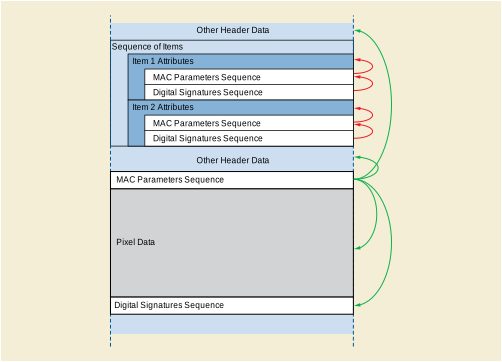
In this example, there is main signature covering the pixel data and a few other Data Elements, plus two individually signed items within a sequence.
For Data Elements with a VR OB (e. g. pixel data) that have an undefined length (i.e., the data is encapsulated as described in PS3.5), the Item Data Element Tags that separate the fragments shall implicitly be included in the list of Data Elements Signed (i.e., a Data Element with a VR of OB is encoded in the same fashion as a Sequence of Items).
To generate the MAC, Data Elements referenced either explicitly or implicitly by the Tags in the Data Elements Signed list shall be encoded using the Transfer Syntax identified by the MAC Calculation Transfer Syntax UID (0400,0010) of the MAC Parameters Sequence item where the Data Elements Signed Attribute appears. Data shall be formed into a byte stream and presented to the MAC Algorithm for computation of the MAC according to the following rules:
For all Data Elements except those with a VR of SQ or with a VR of OB with an undefined length, all Data Element fields, including the Tag, the VR, the reserved field (if any), the Value Length, and the Value, shall be placed into the byte stream in the order encountered.
For Data Elements with a VR of SQ or with a VR of OB with an undefined length, the Tag, the VR, and the reserved field are placed into the byte stream. The Value Length shall not be included. This is followed by each Item Tag in the order encountered, without including the Value Length, followed by the contents of the Value for that item. In the case of an Item within a Data Element whose VR is SQ, these rules are applied recursively to all of the Data Elements within the Value of that Item. After all the Items have been incorporate into the byte stream, a Sequence Delimitation Item Tag (FFFE,E0DD) shall be added to the byte stream presented to the MAC Algorithm, regardless of whether or not it was originally present.
Note
Since the Value Length of Data Elements with a VR of SQ can be either explicit or undefined, the Value Lengths of such Data Elements are left out of the MAC calculation. Similarly, the Value Length of Data Elements with a VR of OB with an undefined length are also left out so that they are handled consistently. If such Data Elements do come with undefined lengths, including the Item Tags that separate the Items or fragments insures that Data Elements cannot be moved between Items or Fragments without compromising the Digital Signature. For those Data Elements with explicit lengths, if the length of an item changes, the added or removed portions would also impact the MAC calculation, so it is not necessary to include explicit lengths in the MAC calculation. It is possible that including the Value Lengths could make cryptanalysis easier.
After the fields of all the Data Elements in the Data Elements Signed list have been placed into the byte stream presented to the MAC Algorithm according to the above rules, all of the Data Elements within the Digital Signatures Sequence item except the Certificate of Signer (0400,0115), Signature (0400,0120), Certified Timestamp Type (0400,0305), and Certified Timestamp (0400,0310) shall also be encoded according to the above rules, and presented to the MAC algorithm (i.e., the Attributes of the Digital Signature Sequence Item for this particular Digital Signature are also implicitly included in the list of Data Elements Signed, except as noted above).
The resulting MAC code after processing this byte stream by the MAC Algorithm is then encrypted as specified in the Certificate of Signer and placed in the Value of the Signature Data Element.
Note
The Transfer Syntax used in the MAC calculation may differ from the Transfer Syntax used to exchange the Data Set.
Digital Signatures require explicit VR in order to calculate the MAC. An Application Entity that receives a Data Set with an implicit VR Transfer Syntax may not be able to verify Digital Signatures that include Private Data Elements or Data Elements unknown to that Application Entity. This also true of any Data Elements whose VR is UN. Without knowledge of the Value Representation, the receiving Application Entity would be unable to perform proper byte swapping or be able to properly parse sequences in order to generate a MAC.
If more than one entity signs, each Digital Signature would appear in its own Digital Signatures Sequence item. The Digital Signatures may or may not share the same MAC Parameters Sequence item.
The notion of a notary public (i.e., someone who verifies the identity of the signer) for Digital Signatures is partially filled by the authority that issued the Certificate of Signer.
To generate a certified timestamp, the Value of the Signature (0400,0120) Attribute is sent to a third party, as specified by the protocol referred to by the Certified Timestamp Type (0400,0305) Attribute. The third party then generates and returns a certified timestamp in the form specified by that protocol. The certified timestamp returned by the third party is encoded as a stream of bytes in the Certified Timestamp Attribute.
Note
The timestamp protocol may be specified by a Profile in PS3.15.
Each Item of the Encrypted Attributes Sequence (0400,0500) contains an encrypted DICOM Data Set containing a single instance of the Encrypted Attributes Data Set (Table C.12-7). It also contains encrypted content-encryption keys for one or more recipients. The encoding is based on the Enveloped-data Content Type of the Cryptographic Message Syntax defined in RFC 2630. It allows to encrypt the embedded Data Set for an arbitrary number of recipients using any of the three key management techniques supported by RFC 2630:
Key Transport: the content-encryption key is encrypted in the recipient's public key;
Key Agreement: the recipient's public key and the sender's private key are used to generate a pairwise symmetric key, then the content-encryption key is encrypted in the pairwise symmetric key; and
Symmetric key-encryption Keys: the content-encryption key is encrypted in a previously distributed symmetric key-encryption key.
A recipient decodes the embedded Encrypted Attributes Data Set by decrypting one of the encrypted content-encryption keys, decrypting the encrypted Data Set with the recovered content-encryption key, and then decoding the DICOM Data Set using the Transfer Syntax specified in Encrypted Content Transfer Syntax UID (0400,0510).
Multiple Items may be present in the Encrypted Attributes Sequence. The different Items may contain Encrypted Attributes Data Sets with the same or different sets of Attributes and may contain encrypted content-encryption keys for the same or different sets of recipients. However, if the same Attribute is contained in more than one embedded Encrypted Attributes Data Set, the value of the Attribute must be identical in all embedded Encrypted Attributes Data Sets in which the Attribute is contained.
Note
If the Encrypted Attributes Sequence contains more than one Item, and a recipient holds the key for more than one of the items, the recipient may either decode any single one or more of the embedded Data Sets at its own discretion. Since the same Attribute is required to have the same value in all embedded Encrypted Attributes Data Sets, it is safe to "overlay" multiple embedded Encrypted Attributes Data Sets in an arbitrary order upon decoding.
Encrypted Content (0400,0520) contains an Enveloped-data content type of the cryptographic message syntax defined in RFC 2630. The encrypted content of the Enveloped-data content type is an instance of the Encrypted Attributes Data Set as shown in Table C.12-7 (i.e., it is a Sequence with a single Item), encoded with the Transfer Syntax specified by the Encrypted Content Transfer Syntax UID (0400,0510) Attribute. Figure C.12-2 shows an example of how the Encrypted Content is encoded. The exact use of this Data Set is defined in the Attribute Confidentiality Profiles in PS3.15.
Since the de-identified SOP Instance is a significantly altered version of the original Data Set, it is a new SOP Instance, with a SOP Instance UID that differs from the original Data Set.
Note
Content encryption may require that the content (the DICOM Data Set) be padded to a multiple of some block size. This shall be performed according to the Content-encryption Process defined in RFC-2630.
Any standard or private Transfer Syntax may be specified in Encrypted Content Transfer Syntax UID (0400,0510) unless encoding is performed in accordance with an Attribute Confidentiality Profile that specifies additional restrictions. In general, an application entity decoding the Encrypted Attributes Sequence may not assume any particular Transfer Syntax or set of Transfer Syntaxes to be used with Encrypted Content Transfer Syntax UID (0400,0510).
For certain applications it might be necessary to "blacken" (remove) identifying information that is burned in to the image pixel data. The Encrypted Attributes Data Set does not specify a means of restoring the original image information without the complete image pixel data being encoded inside the Modified Attributes Sequence (0400,0550). If access to the original, unmodified pixel data is required and the image pixel data cannot be replicated inside the Modified Attributes Sequence (0400,0550) due to resource considerations, the SOP Instance UID may be used to locate the original SOP Instance from which the de-identified version was derived.
There is no guarantee that the original SOP Instance can be reconstructed from the data in Encrypted Content. If access to the original data is required, the (de-encrypted) UIDs may be used to locate the original SOP Instance from which the de-identified version was derived.
Table C.12-7. Encrypted Attributes Data Set Attributes
|
Attribute Name |
Tag |
Type |
Attribute Description |
|---|---|---|---|
|
Modified Attributes Sequence |
(0400,0550) |
1 |
Sequence of Items containing all Attributes that were removed or replaced by "dummy values" in the main Data Set during de-identification of the SOP instance. Upon reversal of the de-identification process, the Attributes are copied back into the main Data Set, replacing any dummy values that might have been created. Only a single Item shall be included in this sequence. |
|
> Any Attribute from the main Data Set that was modified or removed during the de-identification process. |
3 |
||
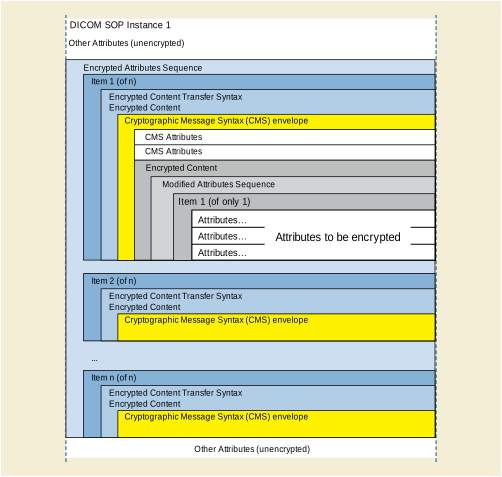
Contributing Equipment Sequence (0018,A001) allows equipment that has contributed towards the creation of the composite instance to be described. The general class of contribution is denoted via a coded entry within the Purpose of Reference Code Sequence (0040,A170).
Note
For example, a post-processing application creating DERIVED images from ORIGINAL images would place its own identification within the Equipment Module and identify the original acquisition equipment as an Item within the Contributing Equipment Sequence (0018,A001). Here, the value of Purpose of Reference Code Sequence (0040,A170) within the Item would be (109101, DCM, "Acquisition Equipment"). Image display applications wishing to annotate images with information related to the acquisition environment would prefer to extract such details from the Contributing Equipment Sequence rather than the Equipment Module.
For example, an image fusion application would place its own identification within the Equipment Module and identify each of the original acquisition equipment as separate Items within the Contributing Equipment Sequence (0018,A001). Here, the value of Purpose of Reference Code Sequence (0040,A170) within each Item would be (109101, DCM, "Acquisition Equipment").
For example, a post-processing application creating DERIVED images from other DERIVED images would place its own identification within the Equipment Module and add the source equipment as an additional Item within the Contributing Equipment Sequence (0018,A001). Here, the value of Purpose of Reference Code Sequence (0040,A170) within the Item would be (109102, DCM, "Processing Equipment").
For example, a gateway device that coerces attributes of existing composite instances (without creating new composite instances) would retain information about the creating equipment within the Equipment Module and provide its own identification as an Item within the Contributing Equipment Sequence (0018,A001). Here, the value of Purpose of Reference Code Sequence (0040,A170) within the Item would be (109103, DCM, "Modifying Equipment").
For example, equipment that has been used for de-identifying could retain information about the creating equipment within the Equipment Module and provide its own identification, and that of its operator, as an Item within Contributing Equipment Sequence (0018,A001). Here, the value of Purpose of Reference Code Sequence (0040,A170) within the Item would be (109104, DCM, "De-identifying Equipment").
The HL7 Structured Document Reference Sequence (0040,A390) identifies instances of Structured Documents defined under an HL7 standard. The HL7 standards that define such documents include the Clinical Document Architecture (CDA) and Structured Product Labeling (SPL) standards.
References to unencapsulated HL7 Structured Documents from within DICOM SOP Instances shall be encoded with a SOP Class UID and SOP Instance UID pair. The Abstract Syntax of an HL7 Structured Document is defined by its Hierarchical Message Description; the Object Identifier of the Hierarchical Message Description shall be used as the SOP Class UID for the Structured Document reference.
Note
The Hierarchical Message Description Object Identifiers are specified in the HL7 OID Registry ( http://hl7.org/oid). The HL7 OIDs for these types of documents are: CDA Release 1 2.16.840.1.113883.1.7.1 CDA Release 2 2.16.840.1.113883.1.7.2 SPL Release 1 2.16.840.1.113883.1.7.3
The Hierarchical Message Description Object Identifiers do not imply a network or media storage service, as do SOP Class UIDs. However, they do identify the Abstract Syntax, similar to SOP Class UIDs.
The HL7 Structured Document instances are natively identified by an attribute using the Instance Identifier (II) Data Type, as defined in HL7 v3 Data Types - Abstract Specification. A UID as defined by the DICOM UI Value Representation is a valid identifier under the II Data Type; however, an II attribute is not always encodable as a UID. Therefore a UID shall be constructed for use within the DICOM Data Set that can be mapped to the native instance identifier encoded as an HL7 II Data Type. This mapping is performed through the combination of the local Referenced SOP Instance UID (0008,1155) and the HL7 Instance Identifier (0040,E001) attributes in the HL7 Structured Document Reference Sequence (0040,A390).
Note
An HL7 II is not encodable as a UID if it exceeds 64 characters, or if it includes an extension. See HL7 v3 DT R1.
Even though an II may contain just a UID, applications should take care to use the II specified in HL7 Instance Identifier (0040,E001) to access the Structured Document. If the instance identifier used natively within the referenced document is encodable using the UI VR, i.e., it is an ISO 8824 OID up to 64 characters without an extension, it is recommended to be used as the Referenced SOP Instance UID within the current Instance.
The Referenced SOP Instance UID used to reference a particular HL7 Structured Document is not necessarily the same in all DICOM Instances. For example, two SR Documents may internally use different SOP Instance UIDs to reference the same HL7 Structured Document, but they will each contain a mapping to the same HL7 Instance Identifier as the external identifier.
The HL7 Instance Identifier is encoded in attribute (0040,E001) as a serialization of the UID and Extension (if any) separated by a caret character. This is the same format adopted in the IHE Cross-Enterprise Document Sharing (XDS) profile (see http://www.ihe.net/).
See Figure C.12-3.
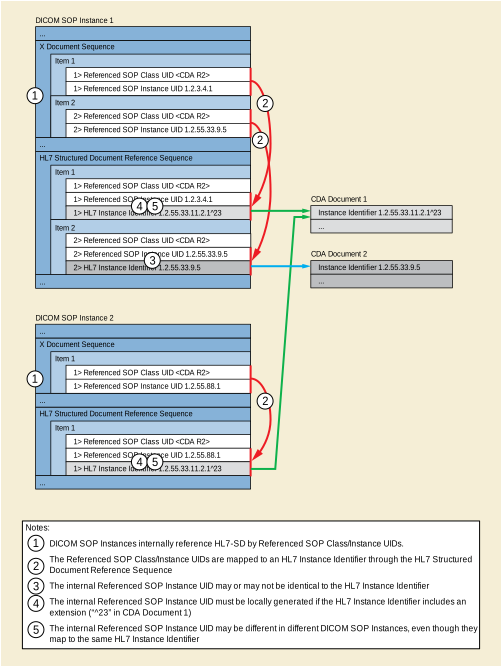
Table C.12-8 defines the Attributes that describe the hierarchical relationships of any SOP Instances referenced from other Modules within the Instance in which this Module occurs.
Table C.12-8. Common Instance Reference Module Attributes
|
Attribute Name |
Tag |
Type |
Attribute Description |
|---|---|---|---|
|
Referenced Series Sequence |
(0008,1115) |
1C |
Sequence of Items each of which includes the Attributes of one Series. One or more Items shall be included in this sequence. Required if this Instance references Instances in this Study. |
|
>Series Instance UID |
(0020,000E) |
1 |
Unique identifier of the Series containing the referenced Instances. |
|
>Referenced Instance Sequence |
(0008,114A) |
1 |
Sequence of Items each providing a reference to an Instance that is part of the Series defined by Series Instance UID (0020,000E) in the enclosing Item. One or more Items shall be included in this sequence. |
|
>>Include Table 10-11 “SOP Instance Reference Macro Attributes” |
|||
|
Studies Containing Other Referenced Instances Sequence |
(0008,1200) |
1C |
Sequence of items each identifying a Study other than the Study of which this Instance is a part, which Studies contain Instances that are referenced elsewhere in this Instance. One or more Items shall be included in this sequence. Required if this Instance references Instances in other Studies. |
|
>Study Instance UID |
(0020,000D) |
1 |
Unique identifier of the Study containing the referenced Instances. |
|
>Include Table 10-4 “Series and Instance Reference Macro Attributes” |
|||
Table C.12-9 defines the Attributes that describe the frames extracted if the SOP Instance was created in response to a Frame-Level retrieve request.
Table C.12-9. Frame Extraction Module Attributes
|
Attribute Name |
Tag |
Type |
Attribute Description |
|---|---|---|---|
|
Frame Extraction Sequence |
(0008,1164) |
1 |
Sequence containing details of how this SOP Instance was extracted from a source multi-frame SOP Instance. If this instance was created from an instance that contains a Frame Extraction Sequence, then this sequence shall contain all of the items from the parent's Frame Extraction Sequence and a new item that describes this extraction. One or more Items shall be included in this sequence. |
|
>Multi-frame Source SOP Instance UID |
(0008,1167) |
1 |
SOP Instance from which the frames of this instance are extracted. |
|
>Simple Frame List |
(0008,1161) |
1C |
A list of Frames that were extracted in the form of a simple list. Required if object extraction is based on a Frame Level Retrieve using the Simple Frame List (0008,1161) attribute. See PS3.4 "Instance and Frame Level Retrieve SOP Classes" |
|
>Calculated Frame List |
(0008,1162) |
1C |
A list of Frames that were extracted in the form of one or more triplets Required if object extraction is based on a Frame Level Retrieve using the Calculated Frame List (0008,1162) attribute. See PS3.4 "Instance and Frame Level Retrieve SOP Classes" |
|
>Time Range |
(0008,1163) |
1C |
The start and end times of the frames that were extracted. Required if object extraction is based on a Frame Level Retrieve using Time Range (0008,1163). See PS3.4 "Instance and Frame Level Retrieve SOP Classes" |
The following Sections specify Modules used for Print Management.
Table C.13-1. Basic Film Session Presentation Module Attributes
|
Attribute name |
Tag |
Attribute Description |
|---|---|---|
|
Number of Copies |
(2000,0010) |
Number of copies to be printed for each film of the film session. |
|
Print Priority |
(2000,0020) |
Specifies the priority of the print job. Enumerated Values:
|
|
Medium Type |
(2000,0030) |
Type of medium on which the print job will be printed. Defined Terms:
|
|
Film Destination |
(2000,0040) |
Film destination. Defined Terms:
|
|
Film Session Label |
(2000,0050) |
Human readable label that identifies the film session |
|
Memory Allocation |
(2000,0060) |
Amount of memory allocated for the film session. Value is expressed in KB |
|
Owner ID |
(2100,0160) |
Identification of the owner of the film session |
Table C.13-2. Basic Film Session Relationship Module Attributes
|
Attribute Name |
Tag |
Attribute Description |
|---|---|---|
|
Referenced Film Box Sequence |
(2000,0500) |
A set of Film Boxes. Zero or more Items shall be included in this Sequence. |
|
>Include Table 10-11 “SOP Instance Reference Macro Attributes” |
||
Note
Proposed Study Sequence (2130,00A0) was previously included in this Module but has been retired. See PS3.3-2004.
Table C.13-3. Basic Film Box Presentation Module Attributes
|
Attribute Name |
Tag |
Attribute Description |
|---|---|---|
|
Image Display Format |
(2010,0010) |
Type of image display format. Enumerated Values:
|
|
Annotation Display Format ID |
(2010,0030) |
Identification of annotation display format. The definition of the annotation display formats and the annotation box position sequence are defined in the Conformance Statement |
|
Film Orientation |
(2010,0040) |
Film orientation. Enumerated Values:
|
|
Film Size ID |
(2010,0050) |
Film size identification. Defined Terms:
Note10INX14IN corresponds with 25.7CMX36.4CM, A4 corresponds with 210 x 297 millimeters, A3 corresponds with 297 x 420 millimeters |
|
Magnification Type |
(2010,0060) |
Interpolation type by which the printer magnifies or decimates the image in order to fit the image in the image box on film. Defined Terms:
|
|
Smoothing Type |
(2010,0080) |
Further specifies the type of the interpolation function. Values are defined in Conformance Statement. Only valid for Magnification Type (2010,0060) = CUBIC |
|
Border Density |
(2010,0100) |
Density of the film areas surrounding and between images on the film. Defined Terms:
i where i represents the desired density in hundredths of OD (e.g., 150 corresponds with 1.5 OD) |
|
Empty Image Density |
(2010,0110) |
Density of the image box area on the film that contains no image. Defined Terms:
i where i represents the desired density in hundredths of OD (e.g., 150 corresponds with 1.5 OD) |
|
Min Density |
(2010,0120) |
Minimum density of the images on the film, expressed in hundredths of OD. If Min Density is lower than minimum printer density than Min Density is set to minimum printer density. |
|
Max Density |
(2010,0130) |
Maximum density of the images on the film, expressed in hundredths of OD. If Max Density is higher than maximum printer density than Max Density is set to maximum printer density. |
|
Trim |
(2010,0140) |
Specifies whether a trim box shall be printed surrounding each image on the film. Enumerated Values:
|
|
Configuration Information |
(2010,0150) |
Character string that contains either the ID of the printer configuration table that contains a set of values for implementation specific print parameters (e.g., perception LUT related parameters) or one or more configuration data values, encoded as characters. If there are multiple configuration data values encoded in the string, they shall be separated by backslashes. The definition of values shall be contained in the SCP's Conformance Statement. Defined Terms:
NoteIt is recommended that for SCPs, CS000 represent the lowest contrast and CS999 the highest contrast levels available. |
|
Illumination |
(2010,015E) |
Luminance of lightbox illuminating a piece of transmissive film, or for the case of reflective media, luminance obtainable from diffuse reflection of the illumination present. Expressed as L0, in candelas per square meter (cd/m2). |
|
Reflected Ambient Light |
(2010,0160) |
For transmissive film, luminance contribution due to reflected ambient light. Expressed as La, in candelas per square meter (cd/m2). |
|
Requested Resolution ID |
(2020,0050) |
Specifies the resolution at which images in this Film Box are to be printed. Defined Terms:
|
|
ICC Profile |
(0028,2000) |
An ICC Profile encoding the transformation of device-dependent color stored pixel values into PCS-Values. See Section C.11.15. NoteThis is an Input Device Profile that describes the characteristics of the pixel data in the film box, not an Output Device Profile that might describe the characteristics of the Print SCP. |
The standard format subdivides a film into image boxes of equal size. Therefore, the film layout is fully symmetrical, i.e., the arrangement of image boxes on film is left-right and top-bottom symmetric.
Example: STANDARD\3,4
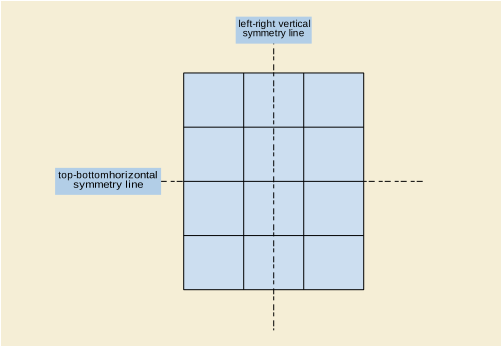
The row symmetric image display format subdivides a film into rows of image boxes of equal size. As a result, the layout is left-right symmetric, the associated symmetry line is vertical (V). There is no top-bottom symmetry.
Example: ROW\2,3
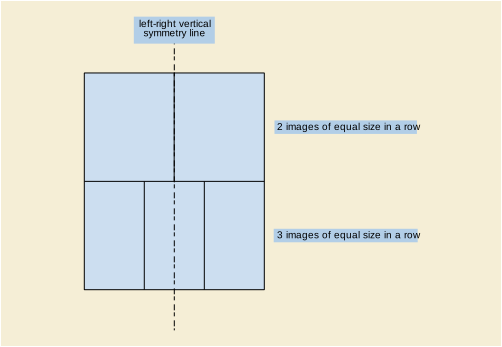
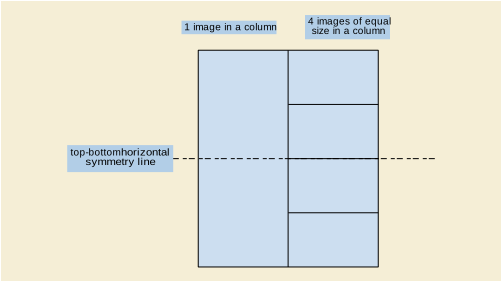
Table C.13-4. Basic Film Box Relationship Module Attributes
|
Attribute Name |
Tag |
Attribute Description |
|---|---|---|
|
Referenced Film Session Sequence |
(2010,0500) |
A Film Session. Only a single Item shall be included in this Sequence. |
|
>Include Table 10-11 “SOP Instance Reference Macro Attributes” |
||
|
Referenced Image Box Sequence |
(2010,0510) |
A set of Image Boxes. One or more Items shall be included in this Sequence. |
|
>Include Table 10-11 “SOP Instance Reference Macro Attributes” |
||
|
Referenced Basic Annotation Box Sequence |
(2010,0520) |
A set of Basic Annotation Boxes. Zero or more Items shall be included in this Sequence. |
|
>Include Table 10-11 “SOP Instance Reference Macro Attributes” |
||
|
Referenced Presentation LUT Sequence |
(2050,0500) |
A Presentation LUT. Only a single Item shall be included in this sequence. |
|
>Include Table 10-11 “SOP Instance Reference Macro Attributes” |
||
Table C.13-5. Image Box Pixel Presentation Module Attributes
|
Attribute Name |
Tag |
Attribute Description |
|---|---|---|
|
Image Box Position |
(2020,0010) |
The position of the image on the film, based on Image Display Format (2010,0010). See Section C.13.5.1 for specification. |
|
Polarity |
(2020,0020) |
Specifies whether minimum pixel values (after VOI LUT transformation) are to printed black or white. Enumerated Values:
If Polarity (2020,0020) is not specified by the SCU, the SCP shall print with NORMAL polarity. |
|
Magnification Type |
(2010,0060) |
Description is the same as in Table C.13-3. Overrides the Magnification Type specified for the Film Box. |
|
Smoothing Type |
(2010,0080) |
Description is the same as in Table C.13-3. Overrides the Smoothing Type specified for the Film Box. |
|
Configuration Information |
(2010,0150) |
See Table C.13-3 for description of Configuration Information. |
|
Requested Image Size |
(2020,0030) |
Width (x-dimension) in mm of the image to be printed. This value overrides the size that corresponds with optimal filling of the Image Box. |
|
Requested Decimate/Crop Behavior |
(2020,0040) |
Specifies whether image pixels are to be decimated or cropped if the image rows or columns is greater than the available printable pixels in an Image Box. Decimation means that a magnification factor <1 is applied to the image. The method of decimation shall be that specified by Magnification Type (2010,0060) or the SCP default if not specified Cropping means that some image rows and/or columns are deleted before printing Enumerated Values:
|
|
Basic Grayscale Image Sequence |
(2020,0110) |
A sequence that provides the content of the grayscale image pixel data to be printed. This is a specialization of the Image Pixel Module defined in Section C.7.6.3. It is encoded as a sequence of Attributes of the Image Pixel Module. Zero or one Item shall be included in this Sequence. See PS3.4 for further description. |
|
>Samples Per Pixel |
(0028,0002) |
See Section C.7.6.3 for description. Enumerated Values:
|
|
>Photometric Interpretation |
(0028,0004) |
See Section C.7.6.3 for description. Enumerated Values:
|
|
>Rows |
(0028,0010) |
See Section C.7.6.3 for description |
|
>Columns |
(0028,0011) |
See Section C.7.6.3 for description |
|
>Pixel Aspect Ratio |
(0028,0034) |
See Section C.7.6.3 for description |
|
>Bits Allocated |
(0028,0100) |
See Section C.7.6.3 for description. Enumerated Values if Bits Stored = 8:
Enumerated Values if Bits Stored = 12:
|
|
>Bits Stored |
(0028,0101) |
See Section C.7.6.3 for description. Enumerated Values:
|
|
>High Bit |
(0028,0102) |
See Section C.7.6.3 for description. Enumerated Values if Bits Stored = 8:
Enumerated Values if Bits Stored = 12:
|
|
>Pixel Representation |
(0028,0103) |
See Section C.7.6.3 for description. Enumerated Values:
|
|
>Pixel Data |
(7FE0,0010) |
See Section C.7.6.3 for description |
|
Basic Color Image Sequence |
(2020,0111) |
A sequence that provides the content of the color image pixel data to be printed. It is a specialization of the Image Pixel Module defined in Section C.7.6.3. It is encoded as a sequence of Attributes of the Image Pixel Module. Zero or one Item shall be included in this Sequence. See PS3.4 for further description. |
|
>Samples Per Pixel |
(0028,0002) |
See Section C.7.6.3 for description. Enumerated Values:
|
|
>Photometric Interpretation |
(0028,0004) |
See Section C.7.6.3 for description. Enumerated Values:
|
|
>Planar Configuration |
(0028,0006) |
See Section C.7.6.3 for description. Enumerated Values:
|
|
>Rows |
(0028,0010) |
See Section C.7.6.3 for description. |
|
>Columns |
(0028,0011) |
See Section C.7.6.3 for description. |
|
>Pixel Aspect Ratio |
(0028,0034) |
See Section C.7.6.3 for description. |
|
>Bits Allocated |
(0028,0100) |
See Section C.7.6.3 for description. Enumerated Values:
|
|
>Bits Stored |
(0028,0101) |
See Section C.7.6.3 for description. Enumerated Values:
|
|
>High Bit |
(0028,0102) |
See Section C.7.6.3 for description. Enumerated Values:
|
|
>Pixel Representation |
(0028,0103) |
See Section C.7.6.3 for description. Enumerated Values:
|
|
>Pixel Data |
(7FE0,0010) |
See Section C.7.6.3 for description |
Note
Referenced Image Overlay Box Sequence (2020,0130) and Original Image Sequence (2130,00C0) were previously included in this Module but have been retired. See PS3.3-2004.
The position of the image on the film; the encoding of the image position sequence is based on the selected Image Display Format (2010,0010). The image position sequence shall be increasing order beginning with the value 1. Image Box Position (2020,0010) is defined as follows:
STANDARD display format: image box sequence shall be major row order (from left-to-right and from top-to-bottom); top left image position shall be equal to 1.
ROW display format: image box sequence shall be major row order (from left-to-right and from top-to-bottom); top left image position shall be set to 1.
COL display format: image box sequence shall be major column order (from top-to-bottom and from left-to-right); top left image position shall be equal to 1.
SLIDE display format: image box sequence shall be major row order (from left-to-right and from top-to-bottom); top left image position shall be set to 1.
SUPERSLIDE display format: image box sequence shall be major row order (from left-to-right and from top-to-bottom); top left image position shall be set to 1.
CUSTOM STANDARD display format: image box sequence shall be defined in the Conformance Statement; top left image position shall be set to 1.
This section was previously defined in DICOM. It is now retired. See PS3.3-1998.
Table C.13-7. Basic Annotation Presentation Module Attributes
|
Attribute Name |
Tag |
Attribute Description |
|---|---|---|
|
Annotation Position |
(2030,0010) |
The position of the annotation box in the parent film box. Annotation position sequence depends on the selected Annotation Display Format ID (2010,0030) |
|
Text String |
(2030,0020) |
Text string |
Table C.13-8. Print Job Module Attributes
|
Attribute Name |
Tag |
Attribute Description |
|---|---|---|
|
Execution Status |
(2100,0020) |
Execution status of print job. Enumerated Values:
|
|
Execution Status Info |
(2100,0030) |
Additional information about Execution Status (2100,0020). Defined Terms if Execution Status (2100,0030) is DONE or PRINTING:
Defined Terms if Execution Status (2100,0030) is FAILURE:
See Section C.13.9.1 for additional Defined Terms when the Execution Status is PENDING or FAILURE. |
|
Creation Date |
(2100,0040) |
Date of print job creation. |
|
Creation Time |
(2100,0050) |
Time of print job creation. |
|
Print Priority |
(2000,0020) |
Priority of print job (see Section C.13.1 for further explanation). |
|
Printer Name |
(2110,0030) |
User defined name identifying the printer. |
|
Originator |
(2100,0070) |
DICOM Application Entity Title that issued the print operation. |
Table C.13-9. Printer Module Attributes
|
Attribute Name |
Tag |
Attribute Description |
|---|---|---|
|
Printer Status |
(2110,0010) |
Printer device status. Enumerated Values:
|
|
Printer Status Info |
(2110,0020) |
Additional information about Printer Status (2110,0010). Defined Terms if Printer Status (2110,0010) is NORMAL:
See Section C.13.9.1 for Defined Terms when the Printer Status is equal to WARNING or FAILURE. |
|
Printer Name |
(2110,0030) |
User defined name identifying the printer. |
|
Manufacturer |
(0008,0070) |
Manufacturer of the printer. |
|
Manufacturer Model Name |
(0008,1090) |
Manufacturer's model number of the printer. |
|
Device Serial Number |
(0018,1000) |
Manufacturer's serial number of the printer. |
|
Software Versions |
(0018,1020) |
Manufacturer's designation of software version of the printer. |
|
Date Of Last Calibration |
(0018,1200) |
Date when the printer was last calibrated. |
|
Time Of Last Calibration |
(0018,1201) |
Time when the printer was last calibrated. |
Additional Defined Terms for Printer Status Info (2110,0020) and Execution Status Info (2100,0030) are:
Table C.13.9.1-1. Defined Terms for Printer and Execution Status Info
|
BAD RECEIVE MGZ |
There is a problem with the film receive magazine. Films from the printer cannot be transported into the magazine. |
|
BAD SUPPLY MGZ |
There is a problem with a film supply magazine. Films from this magazine cannot be transported into the printer. |
|
CALIBRATING |
Printer is performing self calibration, it is expected to be available for normal operation shortly. |
|
CALIBRATION ERR |
An error in the printer calibration has been detected, quality of processed films may not be optimal. |
|
CHECK CHEMISTRY |
A problem with the processor chemicals has been detected, quality of processed films may not be optimal. |
|
CHECK SORTER |
There is an error in the film sorter. |
|
CHEMICALS EMPTY |
There are no processing chemicals in the processor, films will not be printed and processed until the processor is back to normal. |
|
CHEMICALS LOW |
The chemical level in the processor is low, if not corrected, it will probably shut down soon. |
|
COVER OPEN |
One or more printer or processor covers, drawers, doors are open. |
|
ELEC CONFIG ERR |
Printer configured improperly for this job. |
|
ELEC DOWN |
Printer is not operating due to some unspecified electrical hardware problem. |
|
ELEC SW ERROR |
Printer not operating for some unspecified software error. |
|
EMPTY 8X10 |
The 8x10 inch film supply magazine is empty. |
|
EMPTY 8X10 BLUE |
The 8x10 inch blue film supply magazine is empty. |
|
EMPTY 8X10 CLR |
The 8x10 inch clear film supply magazine is empty. |
|
EMPTY 8X10 PAPR |
The 8x10 inch paper supply magazine is empty. |
|
EMPTY 10X12 |
The 10x12 inch film supply magazine is empty. |
|
EMPTY 10X12 BLUE |
The 10x12 inch blue film supply magazine is empty. |
|
EMPTY 10X12 CLR |
The 10x12 inch clear film supply magazine is empty. |
|
EMPTY 10X12 PAPR |
The 10x12 inch paper supply magazine is empty. |
|
EMPTY 10X14 |
The 10x14 inch film supply magazine is empty. |
|
EMPTY 10X14 BLUE |
The 10x14 inch blue film supply magazine is empty. |
|
EMPTY 10X14 CLR |
The 10x14 inch clear film supply magazine is empty. |
|
EMPTY 10X14 PAPR |
The 10x14 inch paper supply magazine is empty. |
|
EMPTY 11X14 |
The 11x14 inch film supply magazine is empty. |
|
EMPTY 11X14 BLUE |
The 11x14 inch blue film supply magazine is empty. |
|
EMPTY 11X14 CLR |
The 11x14 inch clear film supply magazine is empty. |
|
EMPTY 11X14 PAPR |
The 11x14 inch paper supply magazine is empty. |
|
EMPTY 14X14 |
The 14x14 inch film supply magazine is empty. |
|
EMPTY 14X14 BLUE |
The 14x14 inch blue film supply magazine is empty. |
|
EMPTY 14X14 CLR |
The 14x14 inch clear film supply magazine is empty. |
|
EMPTY 14X14 PAPR |
The 14x14 inch paper supply magazine is empty. |
|
EMPTY 14X17 |
The 14x17 inch film supply magazine is empty. |
|
EMPTY 14X17 BLUE |
The 14x17 inch blue film supply magazine is empty. |
|
EMPTY 14X17 CLR |
The 14x17 inch clear film supply magazine is empty. |
|
EMPTY 14X17 PAPR |
The 14x17 inch paper supply magazine is empty. |
|
EMPTY 24X24 |
The 24x24 cm film supply magazine is empty. |
|
EMPTY 24X24 BLUE |
The 24x24 cm blue film supply magazine is empty. |
|
EMPTY 24X24 CLR |
The 24x24 cm clear film supply magazine is empty. |
|
EMPTY 24X24 PAPR |
The 24x24 cm paper supply magazine is empty. |
|
EMPTY 24X30 |
The 24x30 cm film supply magazine is empty. |
|
EMPTY 24X30 BLUE |
The 24x30 cm blue film supply magazine is empty. |
|
EMPTY 24X30 CLR |
The 24x30 cm clear film supply magazine is empty. |
|
EMPTY 24X30 PAPR |
The 24x30 cm paper supply magazine is empty. |
|
EMPTY A4 PAPR |
The A4 paper supply magazine is empty. |
|
EMPTY A4 TRANS |
The A4 transparency supply magazine is empty. |
|
EXPOSURE FAILURE |
The exposure device has failed due to some unspecified reason. |
|
FILM JAM |
A film transport error has occurred and a film is jammed in the printer or processor. |
|
FILM TRANSP ERR |
There is a malfunction with the film transport, there may or may not be a film jam. |
|
FINISHER EMPTY |
The finisher is empty. |
|
FINISHER ERROR |
The finisher is not operating due to some unspecified reason. |
|
FINISHER LOW |
The finisher is low on supplies |
|
LOW 8X10 |
The 8x10 inch film supply magazine is low. |
|
LOW 8X10 BLUE |
The 8x10 inch blue film supply magazine is low. |
|
LOW 8X10 CLR |
The 8x10 inch clear film supply magazine is low. |
|
LOW 8X10 PAPR |
The 8x10 inch paper supply magazine is low. |
|
LOW 10X12 |
The 10x12 inch film supply magazine is low. |
|
LOW 10X12 BLUE |
The 10x12 inch blue film supply magazine is low. |
|
LOW 10X12 CLR |
The 10x12 inch clear film supply magazine is low. |
|
LOW 10X12 PAPR |
The 10x12 inch paper supply magazine is low. |
|
LOW 10X14 |
The 10x14 inch film supply magazine is low. |
|
LOW 10X14 BLUE |
The 10x14 inch blue film supply magazine is low. |
|
LOW 10X14 CLR |
The 10x14 inch clear film supply magazine is low. |
|
LOW 10X14 PAPR |
The 10x14 inch paper supply magazine is low. |
|
LOW 11X14 |
The 11x14 inch film supply magazine is low. |
|
LOW 11X14 BLUE |
The 11x14 inch blue film supply magazine is low. |
|
LOW 11X14 CLR |
The 11x14 inch clear film supply magazine is low. |
|
LOW 11X14 PAPR |
The 11x14 inch paper supply magazine is low. |
|
LOW 14X14 |
The 14x14 inch film supply magazine is low. |
|
LOW 14X14 BLUE |
The 14x14 inch blue film supply magazine is low. |
|
LOW 14X14 CLR |
The 14x14 inch clear film supply magazine is low. |
|
LOW 14X14 PAPR |
The 14x14 inch paper supply magazine is low. |
|
LOW 14X17 |
The 14x17 inch film supply magazine is low. |
|
LOW 14X17 BLUE |
The 14x17 inch blue film supply magazine is low. |
|
LOW 14X17 CLR |
The 14x17 inch clear film supply magazine is low. |
|
LOW 14X17 PAPR |
The 14x17 inch paper supply magazine is low. |
|
LOW 24X24 |
The 24x24 cm film supply magazine is low. |
|
LOW 24X24 BLUE |
The 24x24 cm blue film supply magazine is low. |
|
LOW 24X24 CLR |
The 24x24 cm clear film supply magazine is low. |
|
LOW 24X24 PAPR |
The 24x24 cm paper supply magazine is low. |
|
LOW 24X30 |
The 24x30 cm film supply magazine is low. |
|
LOW 24X30 BLUE |
The 24x30 cm blue film supply magazine is low. |
|
LOW 24X30 CLR |
The 24x30 cm clear film supply magazine is low. |
|
LOW 24X30 PAPR |
The 24x30 cm paper supply magazine is low. |
|
LOW A4 PAPR |
The A4 paper supply magazine is low. |
|
LOW A4 TRANS |
The A4 transparency supply magazine is low. |
|
NO RECEIVE MGZ |
The film receive magazine not available |
|
NO RIBBON |
The ribbon cartridge needs to be replaced. |
|
NO SUPPLY MGZ |
The film supply magazine specified for this job is not available. |
|
CHECK PRINTER |
The printer is not ready at this time, operator intervention is required to make the printer available. |
|
CHECK PROC |
The processor is not ready at this time, operator intervention is required to make the printer available. |
|
PRINTER DOWN |
The printer is not operating due to some unspecified reason. |
|
PRINTER BUSY |
Printer is not available at this time, but should become ready without user intervention. This is to handle non-initialization instances. |
|
PRINT BUFF FULL |
The Printer 's buffer capacity is full. The printer is unable to accept new images in this state. The printer will correct this without user intervention. The SCU should retry later. |
|
PRINTER INIT |
The printer is not ready at this time, it is expected to become available without intervention. For example, it may be in a normal warm-up state. |
|
PRINTER OFFLINE |
The printer has been disabled by an operator or service person. |
|
PROC DOWN |
The processor is not operating due to some unspecified reason. |
|
PROC INIT |
The processor is not ready at this time, it is expected to become available without intervention. For example, it may be in a normal warm-up state. |
|
PROC OVERFLOW FL |
Processor chemicals are approaching the overflow full mark. |
|
PROC OVERFLOW HI |
Processor chemicals have reached the overflow full mark. |
|
QUEUED |
Print Job in Queue |
|
RECEIVER FULL |
The Film receive magazine is full. |
|
REQ MED NOT INST |
The requested film, paper, or other media supply magazine is installed in the printer, but may be available with operator intervention. |
|
REQ MED NOT AVAI |
The requested film, paper, or other media requested is not available on this printer. |
|
RIBBON ERROR |
There is an unspecified problem with the print ribbon. |
|
SUPPLY EMPTY |
The printer is out of film. |
|
SUPPLY LOW |
The film supply is low. |
|
UNKNOWN |
There is an unspecified problem. |
This section was previously defined in DICOM. It is now retired. See PS3.3-1998.
This section was previously defined in DICOM. It is now retired. See PS3.3-1998.
Retired. See PS3.3-2004.
This Module describes Printer Configuration Information.
Table C.13-13. Printer Configuration Module Attributes
|
Attribute Name |
Tag |
Attribute Description |
|---|---|---|
|
Printer Configuration Sequence |
(2000,001E) |
Contains printer configuration information for a single Application Entity title. See Print Management Service Class Structure in PS3.4. The sequence shall contain one item for each physical printer/Meta SOP Class combination supported by the Application Entity title. |
|
>SOP Classes Supported |
(0008,115A) |
The Meta-SOP Class and a list of optional SOP Classes supported. It shall contain one Meta SOP Class UID and 0-n optional SOP Class UIDs. |
|
>Maximum Memory Allocation |
(2000,0061) |
Maximum number of kilobytes of memory that can be allocated for a Film Session. The value shall be 0 if Memory Allocation (2000,0060) is not supported. |
|
>Memory Bit Depth |
(2000,00A0) |
The maximum number of bits for each pixel that can be stored in printer memory. |
|
>Printing Bit Depth |
(2000,00A1) |
The number of bits used by the print engine for internal LUT calculation and printing of each pixel. |
|
>Media Installed Sequence |
(2000,00A2) |
A sequence that specifies the combinations of Medium Type and Film Size IDs available in the printer at this time and the Min and Max Densities supported by these media. The Item Number with the value of 1 is the printer default. There is no significance to other item numbers. One item for each Medium Type and Film Size ID installed shall be included. |
|
>>Item Number |
(0020,0019) |
A number that labels this item. Each item in the sequence shall have a unique number. |
|
>>Medium Type |
(2000,0030) |
See Section C.13.1 |
|
>>Film Size ID |
(2010,0050) |
See Section C.13.3 |
|
>>Min Density |
(2010,0120) |
Minimum density that can be printed, expressed in hundredths of OD. |
|
>>Max Density |
(2010,0130) |
Maximum density that can be printed, expressed in hundredths of OD. |
|
>Other Media Available Sequence |
(2000,00A4) |
A sequence that specifies combinations of Medium Type and Film Size ID for which the printer will accept an N-CREATE of a Film Box, but are not physically installed in the printer at this time. It also specifies the Min and Max Densities supported by these media. User intervention may be required to instal these media in the printer. One item for each Medium Type and Film Size ID available, but not installed shall be included. |
|
>>Medium Type |
(2000,0030) |
See Section C.13.1 |
|
>>Film Size ID |
(2010,0050) |
See Section C.13.3 |
|
>>Min Density |
(2010,0120) |
Minimum density that can be printed, expressed in hundredths of OD. |
|
>>Max Density |
(2010,0130) |
Maximum density that can be printed, expressed in hundredths of OD. |
|
>Supported Image Display Formats Sequence |
(2000,00A8) |
A sequence that specifies the Image Display Formats supported, rows and columns in Image Boxes for each format, pixel spacing, and whether Requested Image Size is supported as a function of Film Orientation, Film Size ID, and Printer Resolution ID. One item for each display format, film orientation, film size, and printer resolution combination shall be included. |
|
>>Rows |
(0028,0010) |
Number of printable rows in an Image Box. |
|
>>Columns |
(0028,0011) |
Number of printable columns in an Image Box |
|
>>Image Display Format |
(2010,0010) |
See Section C.13.3 |
|
>>Film Orientation |
(2010,0040) |
See Section C.13.3 |
|
>>Film Size ID |
(2010,0050) |
See Section C.13.3 |
|
>>Printer Resolution ID |
(2010,0052) |
Printer Resolution identification. Defined Terms are the same as Requested Resolution ID (2020,0050). See Section C.13.3. |
|
>>Printer Pixel Spacing |
(2010,0376) |
Physical distance on the printed film between the center of each pixel, specified by a numeric pair - adjacent row spacing (delimiter) adjacent column spacing in mm. See Section 10.7.1.3 for further explanation of the value order. |
|
>>Requested Image Size Flag |
(2020,00A0) |
Indicates whether the printer supports Requested Image Size (2020,0030) for this display format and film orientation and size combination. Enumerated Values:
|
|
>Default Printer Resolution ID |
(2010,0054) |
The printer's default resolution identification. Defined Terms are the same as Requested Resolution ID (2020,0050). See Section C.13.3. |
|
>Default Magnification Type |
(2010,00A6) |
Printer's default magnification type. See Section C.13.3 for Defined Terms. |
|
>Other Magnification Types Available |
(2010,00A7) |
Other magnification types available in the printer. See Section C.13.3 for Defined Terms. |
|
>Default Smoothing Type |
(2010,00A8) |
Printer's default smoothing type. See Section C.13.3. |
|
>Other Smoothing Types Available |
(2010,00A9) |
Other smoothing types available in the printer. See Section C.13.3. |
|
>Configuration Information Description |
(2010,0152) |
A free form text description of Configuration Information (2010,0150) supported by the printer. |
|
>Maximum Collated Films |
(2010,0154) |
The maximum number of films that can be collated for an N-ACTION of the Film Session. The value shall be 0 if N-ACTION of the Film Session is not supported. |
|
>Decimate/Crop Result |
(2020,00A2) |
Indicates whether the printer will decimate or crop image pixels if the image rows or columns is greater than the available printable pixels in an Image Box. See Section C.13.5. Enumerated Values when the printer does not support Requested Decimate/Crop Behavior (2020,0040):
Enumerated Values when the printer supports Requested Decimate/Crop Behavior (2020,0040):
This value indicates the printer default if the SCU does not create or set Requested Decimate/Crop Behavior for the Image Box. |
Table C.14-1 defines the Attributes for referencing SOP Instances that are contained in a Storage Commitment Request/Response.
Table C.14-1. Storage Commitment Module Attributes
|
Attribute Name |
Tag |
Attribute Description |
|---|---|---|
|
Transaction UID |
(0008,1195) |
Uniquely identifies this Storage Commitment transaction. |
|
Retrieve AE Title |
(0008,0054) |
Application Entity Title where the SOP Instance(s) may be retrieved via a network based retrieve service. |
|
Storage Media File-Set ID |
(0088,0130) |
User or implementation specific human readable identification of a Storage Media on which the SOP Instances reside. |
|
Storage Media File-Set UID |
(0088,0140) |
Uniquely identifies a Storage Media on which the SOP Instances reside. |
|
Referenced SOP Sequence |
(0008,1199) |
A sequence of Items where each Item references a single SOP Instance for which storage commitment is requested / or has been provided. |
|
>Include Table 10-11 “SOP Instance Reference Macro Attributes” |
||
|
>Retrieve AE Title |
(0008,0054) |
Application Entity Title from which the SOP Instance may be retrieved via a network based retrieve service. |
|
>Storage Media File-Set ID |
(0088,0130) |
The user or implementation specific human readable identifier that identifies a Storage Media on which this SOP Instance resides. |
|
>Storage Media File-Set UID |
(0088,0140) |
Uniquely identifies a Storage Media on which this SOP Instance resides. |
|
Failed SOP Sequence |
(0008,1198) |
A sequence of Items where each Item references a single SOP Instance for which storage commitment could not be provided. |
|
>Include Table 10-11 “SOP Instance Reference Macro Attributes” |
||
|
>Failure Reason |
(0008,1197) |
The reason that storage commitment could not be provided for this SOP Instance. See Section C.14.1.1. |
Note
Conditions under which Attributes are required (i.e., Retrieve AE Title, etc.) are defined in the Storage Commitment Service Class in PS3.4.
Referenced Performed Procedure Step Sequence (0008,1111) was included in this Module in earlier versions, but its use here has been retired. See PS3.4-2001, in which the Attribute was formerly known as Referenced Study Component Sequence.
The following values and semantics shall be used for the Failure Reason Attribute:
0110H - Processing failure A general failure in processing the operation was encountered.
0112H - No such object instance One or more of the elements in the Referenced SOP Instance Sequence was not available.
0213H - Resource limitation The SCP does not currently have enough resources to store the requested SOP Instance(s).
0122H - Referenced SOP Class not supported Storage Commitment has been requested for a SOP Instance with a SOP Class that is not supported by the SCP.
0119H - Class / Instance conflict The SOP Class of an element in the Referenced SOP Instance Sequence did not correspond to the SOP class registered for this SOP Instance at the SCP.
0131H - Duplicate transaction UID The Transaction UID of the Storage Commitment Request is already in use.
Retired. See PS3.3-2004.
Retired. See PS3.3-2004.
Table C.17-1 defines the Attributes of the SR Document Series. A Series of SR Documents may contain any number of SR Documents.
Note
Series of SR Documents are separate from Series of Images or other Composite SOP Instances. SR Documents do not reside in a Series of Images or other Composite SOP Instances.
Table C.17-1. SR Document Series Module Attributes
|
Attribute Name |
Tag |
Type |
Attribute Description |
|---|---|---|---|
|
Modality |
(0008,0060) |
1 |
Modality type. Enumerated Values:
|
|
Series Instance UID |
(0020,000E) |
1 |
Unique identifier of the Series. NoteNo SR-specific semantics are specified. |
|
Series Number |
(0020,0011) |
1 |
A number that identifies the Series. NoteNo SR-specific semantics are specified. |
|
Series Date |
(0008,0021) |
3 |
Date the Series started. |
|
Series Time |
(0008,0031) |
3 |
Time the Series started. |
|
Protocol Name |
(0018,1030) |
3 |
Description of the conditions under which the Series was performed. NoteThis may represent the type of analysis used in creation of the SR SOP Instances. |
|
Series Description |
(0008,103E) |
3 |
Description of the Series |
|
Series Description Code Sequence |
(0008,103F) |
3 |
A coded description of the Series. Only a single Item is permitted in this sequence. |
|
No Baseline CID is defined. |
|||
|
Referenced Performed Procedure Step Sequence |
(0008,1111) |
2 |
Uniquely identifies the Performed Procedure Step SOP Instance for which the Series is created. Zero or one item shall be included in this sequence. Note
|
|
>Include Table 10-11 “SOP Instance Reference Macro Attributes” |
|||
Table C.17-2 defines the general Attributes of an SR Document Instance. These Attributes identify the SR Document and provide context for the entire document.
Table C.17-2. SR Document General Module Attributes
|
Attribute Name |
Tag |
Type |
Attribute Description |
|---|---|---|---|
|
Instance Number |
(0020,0013) |
1 |
A number that identifies the SR Document. |
|
Preliminary Flag |
(0040,A496) |
3 |
Indicates whether this SR Document is intended to be regarded as a preliminary or final report. Enumerated Values:
NoteThe definitions of the Enumerated Values are derived from the ACR Practice Guideline for Communication of Diagnostic Imaging Findings, Revised 2005. |
|
Completion Flag |
(0040,A491) |
1 |
The estimated degree of completeness of this SR Document. See Section C.17.2.7. Enumerated Values:
|
|
Completion Flag Description |
(0040,A492) |
3 |
Explanation of the value sent in Completion Flag (0040,A491). |
|
Verification Flag |
(0040,A493) |
1 |
Indicates whether this SR Document is Verified. Enumerated Values:
A value of "VERIFIED" shall be used only when the value of Completion Flag (0040,A491) is "COMPLETE". NoteThe intent of this specification is that the "prevailing final version" of an SR Document is the version having the most recent Verification DateTime (0040,A030), Verification Flag (0040,A493) of VERIFIED and Preliminary Flag (0040,A496) of FINAL. |
|
Content Date |
(0008,0023) |
1 |
The date the document content creation started. |
|
Content Time |
(0008,0033) |
1 |
The time the document content creation started. |
|
Verifying Observer Sequence |
(0040,A073) |
1C |
The person or persons authorized to verify documents of this type and accept responsibility for the content of this document. One or more Items shall be included in this sequence. Required if Verification Flag (0040,A493) is VERIFIED. NoteIn HL7 Structured Documents, the comparable attribute is the "legalAuthenticator". |
|
>Verifying Observer Name |
(0040,A075) |
1 |
The person authorized by the Verifying Organization (0040,A027) to verify documents of this type and who accepts responsibility for the content of this document. |
|
>Verifying Observer Identification Code Sequence |
(0040,A088) |
2 |
Coded identifier of Verifying Observer. Zero or one Item shall be included in this sequence. |
|
No Baseline CID is defined. |
|||
|
>Verifying Organization |
(0040,A027) |
1 |
Organization to which the Verifying Observer Name (0040,A075) is accountable in the current interpretation procedure. |
|
>Verification DateTime |
(0040,A030) |
1 |
Date and Time of verification by the Verifying Observer Name (0040,A075). |
|
Author Observer Sequence |
(0040,A078) |
3 |
The person or device that created the clinical content of this document. This attribute sets the default Observer Context for the root of the content tree. One or more Items are permitted in this sequence. |
|
>Include Table C.17-3b “Identified Person or Device Macro Attributes” |
|||
|
Participant Sequence |
(0040,A07A) |
3 |
Persons or devices related to the clinical content of this document. One or more Items are permitted in this sequence. |
|
>Participation Type |
(0040,A080) |
1 |
Participant's role with respect to the clinical content of this document. See Section C.17.2.5. Defined Terms:
NoteIn HL7 Structured Documents, the participation comparable to Attestor is the "Authenticator". |
|
>Participation DateTime |
(0040,A082) |
2 |
DateTime of participation with respect to the clinical content of this document. |
|
>Include Table C.17-3b “Identified Person or Device Macro Attributes” |
|||
|
Custodial Organization Sequence |
(0040,A07C) |
3 |
Custodial organization for this SR Document instance. Represents the organization from which the document originates and that is in charge of maintaining the document, i.e., the steward of the original source document. NoteThis may or may not be identical to the Institution identified in the Equipment Module. Only a single item is permitted in this sequence. |
|
>Institution Name |
(0008,0080) |
2 |
Name of Custodial Institution or Organization. |
|
>Institution Code Sequence |
(0008,0082) |
2 |
Coded identifier of Custodial Institution or Organization. Zero or one Item shall be included in this sequence. |
|
No Baseline CID is defined. |
|||
|
Predecessor Documents Sequence |
(0040,A360) |
1C |
Shall refer to SR SOP Instances (e.g., prior or preliminary reports) whose content has been wholly or partially included in this document with or without modification. One or more Items shall be included in this sequence. Required if this document includes content from other documents. NoteThe amendment process of an existing SR Document may be described using the Purpose of Reference Code Sequence. |
|
>Include Table C.17-3 “Hierarchical SOP Instance Reference Macro Attributes” |
Defined CID for the Purpose of Reference Code Sequence in the Hierarchical SOP Instance Reference Macro is CID 7009 “Purpose of Reference to Predecessor Report”. |
||
|
Identical Documents Sequence |
(0040,A525) |
1C |
Duplicates of this document, stored with different SOP Instance UIDs. One or more Items shall be included in this sequence. Required if this document is stored with different SOP Instance UIDs in one or more other Studies. See Section C.17.2.2 for further explanation. |
|
>Include Table C.17-3 “Hierarchical SOP Instance Reference Macro Attributes” |
|||
|
Referenced Request Sequence |
(0040,A370) |
1C |
Identifies Requested Procedures that are being fulfilled (completely or partially) by creation of this Document. One or more Items shall be included in this sequence. Required if this Document fulfills at least one Requested Procedure. May be present otherwise. |
|
>Study Instance UID |
(0020,000D) |
1 |
Unique identifier for the Study. |
|
>Referenced Study Sequence |
(0008,1110) |
2 |
Uniquely identifies the Study SOP Instance. Zero or one Item shall be included in this sequence. See Section 10.6.1. |
|
>>Include Table 10-11 “SOP Instance Reference Macro Attributes” |
|||
|
>Accession Number |
(0008,0050) |
2 |
A departmental IS generated number that identifies the order for the Study. |
|
>Issuer of Accession Number Sequence |
(0008,0051) |
3 |
Identifier of the Assigning Authority that issued the Accession Number. Only a single Item is permitted in this sequence. |
|
>>Include Table 10-17 “HL7v2 Hierarchic Designator Macro Attributes” |
|||
|
>Placer Order Number/Imaging Service Request |
(0040,2016) |
2 |
The order number assigned to the Imaging Service Request by the party placing the order. |
|
>Order Placer Identifier Sequence |
(0040,0026) |
3 |
Identifier of the Assigning Authority that issued the Placer Order Number. Only a single Item is permitted in this sequence. |
|
>>Include Table 10-17 “HL7v2 Hierarchic Designator Macro Attributes” |
|||
|
>Filler Order Number/Imaging Service Request |
(0040,2017) |
2 |
The order number assigned to the Imaging Service Request by the party filling the order. |
|
>Order Filler Identifier Sequence |
(0040,0027) |
3 |
Identifier of the Assigning Authority that issued the Filler Order Number. Only a single Item is permitted in this sequence. |
|
>>Include Table 10-17 “HL7v2 Hierarchic Designator Macro Attributes” |
|||
|
>Requested Procedure ID |
(0040,1001) |
2 |
Identifier of the related Requested Procedure |
|
>Requested Procedure Description |
(0032,1060) |
2 |
Institution-generated administrative description or classification of Requested Procedure. |
|
>Requested Procedure Code Sequence |
(0032,1064) |
2 |
A sequence that conveys the requested procedure. Zero or one Item shall be included in this sequence. |
|
No Baseline CID is defined. |
|||
|
>Reason for the Requested Procedure |
(0040,1002) |
3 |
Reason for requesting this procedure. |
|
>Reason for Requested Procedure Code Sequence |
(0040,100A) |
3 |
Coded Reason for requesting this procedure. One or more Items are permitted in this sequence. |
|
No Baseline CID is defined. |
|||
|
Performed Procedure Code Sequence |
(0040,A372) |
2 |
A Sequence that conveys the codes of the performed procedures pertaining to this SOP Instance. Zero or more Items shall be included in this sequence. |
|
No Baseline CID is defined. |
|||
|
Current Requested Procedure Evidence Sequence |
(0040,A375) |
1C |
Full set of Composite SOP Instances, of which the creator is aware, which were created to satisfy the current Requested Procedure(s) for which this SR Document is generated or that are referenced in the content tree. One or more Items shall be included in this sequence. Required if the creator is aware of Composite Objects acquired in order to satisfy the Requested Procedure(s) for which the SR Document is or if instances are referenced in the content tree. May be present otherwise. See Section C.17.2.3 for further explanation. |
|
>Include Table C.17-3 “Hierarchical SOP Instance Reference Macro Attributes” |
|||
|
Pertinent Other Evidence Sequence |
(0040,A385) |
1C |
Other Composite SOP Instances that are considered to be pertinent evidence by the creator of this SR Document. This evidence must have been acquired in order to satisfy Requested Procedures other than the one(s) for which this SR Document is generated. One or more Items shall be included in this sequence. Required if pertinent evidence from other Requested Procedures needs to be recorded. See Section C.17.2.3 for further explanation. |
|
>Include Table C.17-3 “Hierarchical SOP Instance Reference Macro Attributes” |
|||
|
Referenced Instance Sequence |
(0008,114A) |
1C |
Sequence specifying SOP Instances significantly related to the current SOP Instance. Such referenced Instances may include equivalent documents or renderings of this document. One or more Items shall be included in this sequence. Required if the identity of a CDA Document equivalent to the current SOP Instance is known at the time of creation of this SOP Instance (see Section C.17.2.6). May be present otherwise. |
|
>Include Table 10-11 “SOP Instance Reference Macro Attributes” |
|||
|
>Purpose of Reference Code Sequence |
(0040,A170) |
1 |
Code describing the purpose of the reference to the Instance(s). Only a single Item shall be included in this sequence. |
Table C.17-3 specifies the Attributes that reference a list of SOP Instances.
Table C.17-3. Hierarchical SOP Instance Reference Macro Attributes
|
Attribute Name |
Tag |
Type |
Attribute Description |
|---|---|---|---|
|
Study Instance UID |
(0020,000D) |
1 |
Unique identifier for the Study |
|
Referenced Series Sequence |
(0008,1115) |
1 |
Sequence of Items where each Item includes the Attributes of a Series containing referenced Composite Object(s). One or more Items shall be included in this sequence |
|
>Include Table C.17-3a “Hierarchical Series Reference Macro Attributes” |
|||
Table C.17-3a specifies the Attributes that reference a Series of SOP Instances.
Table C.17-3a. Hierarchical Series Reference Macro Attributes
|
Attribute Name |
Tag |
Type |
Attribute Description |
|---|---|---|---|
|
Series Instance UID |
(0020,000E) |
1 |
Unique identifier of a Series that is part of this Study and contains the referenced Composite Object(s). |
|
Retrieve AE Title |
(0008,0054) |
3 |
Title of the DICOM Application Entity where the Composite Object(s) may be retrieved on the network. |
|
Retrieve Location UID |
(0040,E011) |
3 |
Unique identifier of the system where the Composite Object(s) may be retrieved on the network. |
|
Storage Media File-Set ID |
(0088,0130) |
3 |
The user or implementation specific human readable identifier that identifies the Storage Media on which the Composite Object (s) reside. |
|
Storage Media File-Set UID |
(0088,0140) |
3 |
Uniquely identifies the Storage Media on which the Composite Object(s) reside. |
|
Referenced SOP Sequence |
(0008,1199) |
1 |
References to Composite Object SOP Class/SOP Instance pairs that are part of the Study defined by Study Instance UID and the Series defined by Series Instance UID (0020,000E). One or more Items shall be included in this sequence. |
|
>Include Table 10-11 “SOP Instance Reference Macro Attributes” |
|||
|
>Purpose of Reference Code Sequence |
(0040,A170) |
3 |
Describes the purpose for which the reference is made. One or more Items are permitted in this sequence. |
|
Baseline CID may be specified in Macro invocation. |
|||
|
>Referenced Digital Signature Sequence |
(0400,0402) |
3 |
Sequence of references to Digital Signatures in the referenced SOP Instance. One or more Items are permitted in this sequence. NoteThe Attributes in this sequence can be used to detect if the referenced SOP Instance has been altered. |
|
>>Digital Signature UID |
(0400,0100) |
1 |
The Unique Identifier of a Digital Signature held in the referenced SOP Instance. |
|
>>Signature |
(0400,0120) |
1 |
The Signature Value identified by the Digital Signature UID within the Referenced SOP Instance UID. |
|
>Referenced SOP Instance MAC Sequence |
(0400,0403) |
3 |
A MAC Calculation from data in the referenced SOP Instance that can be used as a data integrity check. Only a single Item is permitted in this Sequence. NoteThis Attribute may be used in place of Referenced Digital Signature Sequence (0400,0402), particularly if the SOP Instance does not have appropriate Digital Signatures that can be referenced. |
|
>>MAC Calculation Transfer Syntax UID |
(0400,0010) |
1 |
The Transfer Syntax UID used to encode the values of the Data Elements included in the MAC calculation. When computing the MAC, only Transfer Syntaxes that explicitly include the VR and use Little Endian encoding shall be used. Note
|
|
>>MAC Algorithm |
(0400,0015) |
1 |
The algorithm used in generating the MAC. Defined Terms:
NoteDigital Signature Security Profiles (see PS3.15) may require the use of a restricted subset of these terms. |
|
>>Data Elements Signed |
(0400,0020) |
1 |
A list of Data Element Tags in the order they appear at the top level of the referenced SOP Instance that identify the Data Elements used in creating the MAC. See Section C.12.1.1.3.1.1. |
|
>>MAC |
(0400,0404) |
1 |
The MAC generated as described in Section C.12.1.1.3, but unencrypted and without inclusion of fields from the Digital Signatures Sequence. See Section C.12.1.1.3.1.2. |
If identical copies of an SR Document are to be included in multiple Studies then the entire SR Document shall be duplicated with appropriate changes for inclusion into the different Studies (i.e., Study Instance UID, Series Instance UID, SOP Instance UID, Identical Documents Sequence etc.). The Identical Documents Sequence Attribute in each SOP Instance shall contain references to all other duplicate SOP Instances.
Note
If an SR Document contains an Identical Documents Sequence then it will not be further duplicated without producing a new complete set of duplicate SOP Instances with re-generated Identical Documents Sequences. This is a consequence of the rules for modification of SR Document content in PS3.4. For example, if there are two identical reports and an application is creating a third identical report, then the first two reports must be re-generated in order that their Identical Documents Sequence will reference the new duplicate document and all other identical documents.
If a new SR Document is created using content from an SR Document that contains an Identical Documents Sequence and is part of the same Requested Procedure, then the new SR Document shall only contain a new Identical Documents Sequence if the new SR Document is duplicated. The Predecessor Documents Sequence in all the new SR Documents shall contain references to the original SR Document and all its duplicates as well as any other documents from which content is included.
Note
It is up to an implementation to decide whether a new SR Document is duplicated across multiple Studies. This may require user input to make the decision.
The intent of the Current Requested Procedure Evidence Sequence (0040,A375) is to reference all evidence created in order to satisfy the current Requested Procedure(s) for this SR Document. This shall include, but is not limited to, all current evidence referenced in the content tree.
For a completed SR Document satisfying (i.e., being the final report for) the current Requested Procedure(s), this sequence shall list the full set of Composite SOP Instances created for the current Requested Procedure(s). For other SOP Instances that include the SR Document General Module, this sequence shall contain at minimum the set of Composite SOP Instances from the current Requested Procedure(s) that are referenced in the content tree.
The Pertinent Other Evidence Sequence (0040,A385) attribute is used to reference all other evidence considered pertinent for this SR Document that is not listed in the Current Requested Procedure Evidence Sequence (0040,A375).
This requires that the same SOP Instance shall not be referenced in both of these Sequences.
For the purposes of inclusion in the Current Requested Procedure Evidence Sequence (0040,A375) and the Pertinent Other Evidence Sequence (0040,A385), the set of Composite SOP Instances is defined to include not only the images and waveforms referenced in the content tree, but also all presentation states, real world value maps and other accompanying composite instances that are referenced from the content items.
Table C.17-3b defines the Attributes that identify a person or a device participating as an observer for the context of an SR Instance. This macro contains content equivalent to TID 1002 (see PS3.16).
Table C.17-3b. Identified Person or Device Macro Attributes
|
Attribute Name |
Tag |
Type |
Attribute Description |
|---|---|---|---|
|
Observer Type |
(0040,A084) |
1 |
Enumerated Values:
|
|
Person Name |
(0040,A123) |
1C |
Name of the person observer for this document Instance. Required if Observer Type value is PSN. |
|
Person Identification Code Sequence |
(0040,1101) |
2C |
Coded identifier of person observer. Zero or one Item shall be included in this sequence. Required if Observer Type value is PSN. |
|
No Baseline CID is defined. |
|||
|
Station Name |
(0008,1010) |
2C |
Name of the device observer for this document instance. Required if Observer Type value is DEV. |
|
Device UID |
(0018,1002) |
1C |
Unique identifier of device observer. Required if Observer Type value is DEV. |
|
Manufacturer |
(0008,0070) |
1C |
Manufacturer of the device observer. Required if Observer Type value is DEV. |
|
Manufacturer's Model Name |
(0008,1090) |
1C |
Model Name of the device observer. Required if Observer Type value is DEV. |
|
Institution Name |
(0008,0080) |
2 |
Institution or organization to which the identified person is responsible or accountable, or that manages the identified device. |
|
Institution Code Sequence |
(0008,0082) |
2 |
Institution or organization to which the identified person is responsible or accountable, or that manages the identified device. Zero or one Item shall be included in this Sequence. |
|
No Baseline CID is defined. |
|||
The Verifying Observer Sequence (0040,A073), Author Observer Sequence (0040,A078), and Participant Sequence (0040,A07A) identify significant contributors to the SR document. The Author creates the clinical content of the document. The Verifying Observer verifies and accepts legal responsibility for the content. Other participants may include an Attestor, a person identified as a Participant who "signs" an SR document, but who does not have legal authority to verify the clinical content. E.g., an SR document may be authored and attested by a resident, and then verified by a staff physician; or a document may be authored by a CAD device and attested by a technologist, and then verified by a physician; or a technologist working with a measurement software package may be the author, the package is a Source participant, and the final content is verified by a physician.
An individual shall not be identified in both the Verifying Observer Sequence (as the legal authenticator) and in the Participant Sequence as an Attestor. An individual may be identified in both the Author Observer Sequence and either the Verifying Observer Sequence or the Participant Sequence.
The participation DateTime for the Verifying Observer is conveyed in Verification DateTime (0040,A030) within the Verifying Observer Sequence, for the Author Observer in Observation DateTime (0040,A032) in the main Data Set (see Section C.17.3), and for other participants in Participation DateTime (0040,A082) within the Participant Sequence.
The Referenced Instance Sequence (0008,114A) with a Purpose of Reference Code Sequence value of (121331, DCM, "Equivalent CDA Document") identifies an HL7 Clinical Document Architecture (CDA) Document that contains clinical content equivalent to this SR Document SOP Instance. This referenced CDA Document may be a source document that was transformed to create this SR Document, or it may be a transcoding of the content created simultaneously for both the SR Document and the CDA Document.
Note
Reference to a CDA Document created as a transcoding of the SR Document subsequent to the creation of the SR SOP Instance would not be encodable in that SOP Instance.
There is no requirement that the transform or transcoding between DICOM SR and HL7 CDA be reversible. In particular, some attributes of the DICOM Patient, Study, and Series IEs have no corresponding standard encoding in the HL7 CDA Header, and vice versa. Such data elements, if transcoded, may need to be encoded in implementation-dependent "local markup" (in HL7 CDA) or private data elements (in DICOM SR) in an implementation-dependent manner; some such data elements may not be transcoded at all. It is a responsibility of the transforming application to ensure clinical equivalence.
Due to the inherent differences between DICOM SR and HL7 CDA, a transcoded document should have a different UID than the source document.
The Referenced SOP Instance UID (0008,1155) in Items of this Sequence is mapped to the native HL7 Instance Identifier through the HL7 Structured Document Reference Sequence (0040,A390) of the SOP Common Module (see Section C.12.1).
Completion Flag (0040,A491) describes the estimated degree of completeness of this SR Document.
Completeness of an SR Document is defined in relation to the scope of the Requested Procedure and the scope of the Root Concept Name. E.g., a Completion Flag value of "COMPLETE" may indicate that the document content includes all significant observations within the topic of the root Concept Name (as restricted by any Concept Modifiers) that are related to the Requested Procedure identified in the Referenced Request Sequence (0040,A370).
Note
An X-Ray Radiation Dose SR that documents all the irradiation events within the identified Scope of Accumulation should have a Completion Flag value of "COMPLETE".
The criteria by which the Application Entity determines completeness shall be specified in the Conformance Statement.
Note
The concept of "completeness" is independent of the concept of preliminary or final; see the description of Preliminary Flag (0040,A496). An SR Document may be Complete, but may also be Preliminary pending a laboratory test result.
A Requested Procedure may have multiple Complete SR Documents on different topics. These SR Documents may use the same or different SOP Classes.
For example, an AE might state in its Conformance Statement that it allows an authorized user to check a box on the user interface to indicate that an SR Document is Complete. As another example, an AE might state that an SR Document created from a fully filled in user interface screen will be marked as Complete. As another example, an AE might state that only Verified SR Documents will be marked as Complete.
This section specifies the Attributes contained in the SR Document Content Module. The Attributes in this Module convey the content of an SR Document.
Table C.17-4. SR Document Content Module Attributes
|
Attribute Name |
Tag |
Type |
Attribute Description |
|---|---|---|---|
|
With a Value Type (0040,A040) of CONTAINER |
|||
|
Include Table C.17-6 “Document Relationship Macro Attributes” |
|||
Table C.17-5. Document Content Macro Attributes
|
Attribute Name |
Tag |
Type |
Attribute Description |
|---|---|---|---|
|
Value Type |
(0040,A040) |
1 |
The type of the value encoded in this Content Item. Defined Terms:
See Section C.17.3.2.1 for further explanation. |
|
Concept Name Code Sequence |
(0040,A043) |
1C |
Code describing the concept represented by this Content Item. Also conveys the value of Document Title and section headings in documents. Only a single Item shall be included in this sequence. Required if Value Type (0040,A040) is TEXT, NUM, CODE, DATETIME, DATE, TIME, UIDREF or PNAME. Required if Value Type (0040,A040) is CONTAINER and a heading is present, or this is the Root Content Item. NoteThat is, containers without headings do not require Concept Name Code Sequence Required if Value Type (0040,A040) is COMPOSITE, IMAGE, WAVEFORM, SCOORD, SCOORD3D or TCOORD, and the Purpose of Reference is conveyed in the Concept Name. See Section C.17.3.2.2 for further explanation. |
|
No Baseline CID is defined. |
|||
|
Text Value |
(0040,A160) |
1C |
This is the value of the Content Item. Required if Value Type (0040,A040) is TEXT. Text data that is unformatted and whose manner of display is implementation dependent. The text value may contain spaces, as well as multiple lines separated by CR LF, but otherwise no format control characters (such as horizontal or vertical tab and form feed) shall be present, even if permitted by the Value Representation of UT. The text shall be interpreted as specified by Specific Character Set (0008,0005) if present in the SOP Common Module. NoteThe text may contain single or multi-byte characters and use code extension techniques as described in PS3.5 if permitted by the values of Specific Character Set (0008,0005). |
|
DateTime |
(0040,A120) |
1C |
This is the value of the Content Item. Required if Value Type (0040,A040) is DATETIME. |
|
Date |
(0040,A121) |
1C |
This is the value of the Content Item. Required if Value Type (0040,A040) is DATE. |
|
Time |
(0040,A122) |
1C |
This is the value of the Content Item. Required if Value Type (0040,A040) is TIME. |
|
Person Name |
(0040,A123) |
1C |
This is the value of the Content Item. Required if Value Type (0040,A040) is PNAME. |
|
UID |
(0040,A124) |
1C |
This is the value of the Content Item. Required if Value Type (0040,A040) is UIDREF. |
|
Include Table C.18.1-1 “Numeric Measurement Macro Attributes” if and only if Value Type (0040,A040) is NUM. |
|||
|
Include Table C.18.2-1 “Code Macro Attributes” if and only if Value Type (0040,A040) is CODE. |
|||
|
Include Table C.18.3-1 “Composite Object Reference Macro Attributes” if and only if Value Type (0040,A040) is COMPOSITE. |
|||
|
Include Table C.18.4-1 “Image Reference Macro Attributes” if and only if Value Type (0040,A040) is IMAGE. |
|||
|
Include Table C.18.5-1 “Waveform Reference Macro Attributes” if and only if Value Type (0040,A040) is WAVEFORM. |
|||
|
Include Table C.18.6-1 “Spatial Coordinates Macro Attributes” if and only if Value Type (0040,A040) is SCOORD. |
|||
|
Include Table C.18.9-1 “3D Spatial Coordinates Macro Attributes” if and only if Value Type (0040,A040) is SCOORD3D. |
|||
|
Include Table C.18.7-1 “Temporal Coordinates Macro Attributes” if and only if Value Type (0040,A040) is TCOORD. |
|||
|
Include Table C.18.8-1 “Container Macro Attributes” if and only if Value Type (0040,A040) is CONTAINER. |
|||
Table C.17-6. Document Relationship Macro Attributes
|
Attribute Name |
Tag |
Type |
Attribute Description |
|---|---|---|---|
|
Observation DateTime |
(0040,A032) |
1C |
The date and time on which this Content Item was completed. For the purpose of recording measurements or logging events, completion time is defined as the time of data acquisition of the measurement, or the time of occurrence of the event. Required if the date and time are different from Content Date (0008,0023) and Content Time (0008,0033) or Observation DateTime (0040,A032) defined in higher items. May be present otherwise. NoteWhen Content Items are copied into successor reports, Content Date (0008,0023) and Content Time (0008,0033) of the new report are likely to be different than the date and time of the original observation. Therefore this attribute may need to be included in any copied Content Items to satisfy the condition. |
|
Observation UID |
(0040,A171) |
3 |
Unique identifier for the observation Content Item (and its subsidiary Content Items, if any). The UID represents the semantic content of the observation; an encoding of the same observation with the same context into another representation (e.g., a CDA Entry) may use the same UID. |
|
Content Sequence |
(0040,A730) |
1C |
A potentially recursively nested Sequence of Items that conveys content that is the Target of Relationships with the enclosing Source Content Item. One or more Items shall be included in this sequence. Required if the enclosing Content Item has relationships. Note
See Section C.17.3.2.4 for further explanation. |
|
>Relationship Type |
(0040,A010) |
1 |
The type of relationship between the (enclosing) Source Content Item and the Target Content Item. IODs specify additional constraints on Relationships (including lists of Enumerated Values). Defined Terms:
See Section C.17.3.2.4 for further explanation. |
|
>Include Table C.17-6 “Document Relationship Macro Attributes” if the Target Content Item is included by-value in the Source Content Item. The Macro shall not be present if the relationship is by-reference. |
|||
|
>Include Table C.17-5 “Document Content Macro Attributes” if the Target Content Item is included by-value in the Source Content Item. The Macro shall not be present if the relationship is by-reference. |
|||
|
>Referenced Content Item Identifier |
(0040,DB73) |
1C |
An ordered set of one or more integers that uniquely identifies the Target Content Item of the relationship. The root Content Item is referenced by a single value of 1. Each subsequent integer represents an ordinal position of a Content Item in the Content Sequence (0040,A730) in which it belongs. The Referenced Content Item Identifier is the set of these ordinal positions along the by-value relationship path. The number of values in this Multi-Value Attribute is exactly the number of relationships traversed in the SR content tree plus one. Note
Required if the Target Content Item is denoted by-reference, i.e., the Document Relationship Macro and Document Content Macro are not included. |
The Module consists of a single root Content Item that is the root of the SR Document tree. The root Content Item is of type CONTAINER, and its Content Sequence conveys either directly or indirectly through further nested Content Sequences, all of the other Content Items in the document. This root Content Item shall have a heading in the Concept Name Code Sequence (0040,A043) that conveys the title of the SR Document, i.e., the Document Title.
Figure C.17.3-1 depicts the relationship of SR Documents to Content Items and the relationships of Content Items to other Content Items and to Observation Context.
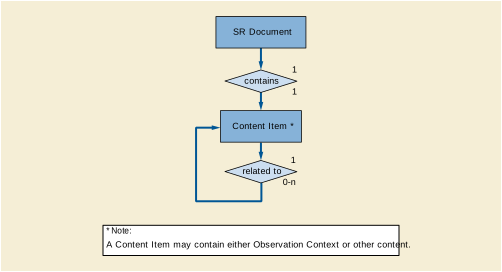
Note
Whether or not relationships by-reference are allowed to ancestor Content Items, is specified in the IOD.
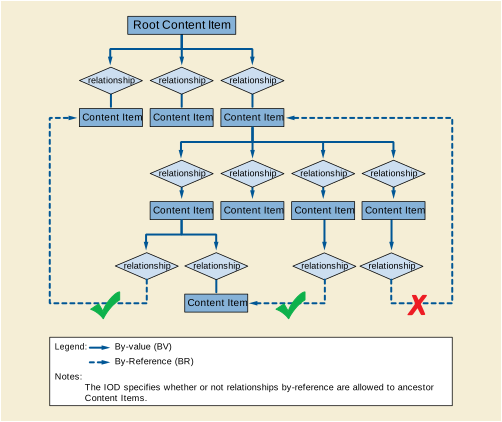
Each Content Item contains:
name/value pair, consisting of
a single Concept Name Code Sequence (0040,A043) that is the name of a name/value pair or a heading,
a value (text, codes, etc.),
references to images, waveforms or other composite objects, with or without coordinates,
relationships to other Items, either
by-value through nested Content Sequences, or
by-reference.
The value of the name/value pair is encoded with one of the Value Types defined in Table C.17.3-7 (the choice of which may be constrained by the IOD in which this Module is contained). Value Type (0040,A040) explicitly conveys the type of Content Item value encoding.
Table C.17.3-7. Value Type Definitions
|
Value Type |
Concept Name |
Concept Value |
Description |
|---|---|---|---|
|
TEXT |
Type of text, e.g., "Findings", or name of identifier, e.g., "Lesion ID" |
Textual expression of the concept |
Free text, narrative description of unlimited length. May also be used to provide a label or identifier value. |
|
NUM |
Type of numeric value or measurement, e.g., "BPD" |
Numeric value and associated Unit of Measurement |
Numeric value fully qualified by coded representation of the measurement name and unit of measurement. |
|
CODE |
Type of code, e.g., "Findings" |
Coded expression of the concept |
Categorical coded value. Representation of nominal or non-numeric ordinal values. |
|
DATETIME |
Type of DateTime, e.g., "Date/Time of onset" |
Concatenated date and time |
Date and time of occurrence of the type of event denoted by the Concept Name. |
|
DATE |
Type of Date, e.g., "Birth Date" |
Calendar date |
Date of occurrence of the type of event denoted by the Concept Name. |
|
TIME |
Type of Time, e.g "Start Time" |
Time of day |
Time of occurrence of the type of event denoted by the Concept Name. |
|
UIDREF |
Type of UID, e.g "Study Instance UID" |
Unique Identifier |
Unique Identifier (UID) of the entity identified by the Concept Name. |
|
PNAME |
Role of person, e.g., "Recording Observer" |
Name of person |
Person name of the person whose role is described by the Concept Name. |
|
COMPOSITE |
Purpose of Reference |
Reference to UIDs of Composite SOP Instances |
A reference to one Composite SOP Instance that is not an Image or Waveform. |
|
IMAGE |
Purpose of Reference |
Reference to UIDs of Image Composite SOP Instances |
A reference to one Image. IMAGE Content Item may convey a reference to a Softcopy Presentation State associated with the Image. |
|
WAVEFORM |
Purpose of Reference |
Reference to UIDs of Waveform Composite SOP Instances |
A reference to one Waveform. |
|
SCOORD |
Purpose of Reference |
Listing of spatial coordinates |
Spatial coordinates of a geometric region of interest in the DICOM image coordinate system. The IMAGE Content Item from which spatial coordinates are selected is denoted by a SELECTED FROM relationship. |
|
SCOORD3D |
Purpose of reference |
Listing of spatial 3D coordinates |
3D spatial coordinates (x,y,z) of a geometric region of interest in a Reference Coordinate System. |
|
TCOORD |
Purpose of Reference |
Listing of temporal coordinates |
Temporal Coordinates (i.e., time or event-based coordinates) of a region of interest in the DICOM waveform coordinate system. The WAVEFORM or IMAGE or SCOORD Content Item from which Temporal Coordinates are selected is denoted by a SELECTED FROM relationship. |
|
CONTAINER |
Document Title or document section heading. Concept Name conveys the Document Title (if the CONTAINER is the Document Root Content Item) or the category of observation. |
The content of the CONTAINER. The value of a CONTAINER Content Item is the collection of Content Items that it contains. |
CONTAINER groups Content Items and defines the heading or category of observation that applies to that content. The heading describes the content of the CONTAINER Content Item and may map to a document section heading in a printed or displayed document. |
Note
It is recommended that drawings and sketches, sometimes used in reports, be represented by IMAGE Content Items that reference separate SOP Instances (e.g., 8-bit, MONOCHROME2, Secondary Capture, or Multi-frame Single Bit Secondary Capture).
Concept Name Code Sequence (0040,A043) conveys the name of the concept whose value is expressed by the value attribute or set of attributes. Depending on the Value Type (0040,A040), the meaning of the Concept Name Code Sequence may reflect specifics of the use of the particular data type (see Table C.17.3-7).
See Section C.18.8.1.1.
Content Sequence (0040,A730) provides the hierarchical structuring of the Content Tree (see Section C.17.3.1) by recursively nesting Content Items. A parent (or source) Content Item has an explicit relationship to each child (or target) Content Item, conveyed by Relationship Type (0040,A010).
Table C.17.3-8 describes the Relationship Types between Source Content Items and the Target Content Items.
Table C.17.3-8. Relationship Type Definitions
|
Relationship Type |
Description |
Definition and Example |
|---|---|---|
|
CONTAINS |
Contains |
Source Item contains Target Content Item. E.g., CONTAINER "History" {CONTAINS: TEXT "mother had breast cancer", CONTAINS: IMAGE} |
|
HAS OBS CONTEXT |
Has Observation Context |
Target Content Items shall convey any specialization of Observation Context needed for unambiguous documentation of the Source Content Item. E.g., CONTAINER "Report" {HAS OBS CONTEXT: PNAME "Recording Observer" = "Smith^John^^Dr^"} |
|
HAS CONCEPT MOD |
Has Concept Modifier |
Used to qualify or describe the Concept Name of the Source Content item, such as to create a post-coordinated description of a concept, or to further describe a concept. E.g., CODE "Chest X-Ray" {HAS CONCEPT MOD: CODE "View = PA and Lateral"} E.g., CODE "Breast" {HAS CONCEPT MOD: TEXT "French Translation" = "Sein"} E.g., CODE "2VCXRPALAT" {HAS CONCEPT MOD: TEXT "Further Explanation" = "Chest X-Ray, Two Views, Postero-anterior and Lateral"} |
|
HAS PROPERTIES |
Has Properties |
Description of properties of the Source Content Item. E.g., CODE "Mass" {HAS PROPERTIES: CODE "anatomic location", HAS PROPERTIES: CODE "diameter", HAS PROPERTIES: CODE "margin", …}. |
|
HAS ACQ CONTEXT |
Has Acquisition Context |
The Target Content Item describes the conditions present during data acquisition of the Source Content Item. E.g., IMAGE {HAS ACQ CONTEXT: CODE "contrast agent", HAS ACQ CONTEXT: CODE "position of imaging subject", …}. |
|
INFERRED FROM |
Inferred From |
Source Content Item conveys a measurement or other inference made from the Target Content Items. Denotes the supporting evidence for a measurement or judgment. E.g., CODE "Malignancy" {INFERRED FROM: CODE "Mass", INFERRED FROM: CODE "Lymphadenopathy",…}. E.g., NUM: "BPD" = "5mm" {INFERRED FROM: SCOORD}. |
|
SELECTED FROM |
Selected From |
Source Content Item conveys spatial or temporal coordinates selected from the Target Content Item(s). E.g., SCOORD "POLYLINE1,1 5,10 5,10 1,10 1,1" {SELECTED FROM: IMAGE}. E.g., TCOORD "SEGMENT 60-200mS" {SELECTED FROM: WAVEFORM}. |
Content Items are identified by their position in the Content Item tree. They have an implicit order as defined by the order of the Sequence Items. When a Content Item is the target of a by-reference relationship, its position is specified in the Referenced Content Item Identifier (0040,DB73) in a Content Sequence Item subsidiary to the source Content Item.
Note
Figure C.17.3-3 illustrates an SR content tree and identifiers associated with each Content Item:
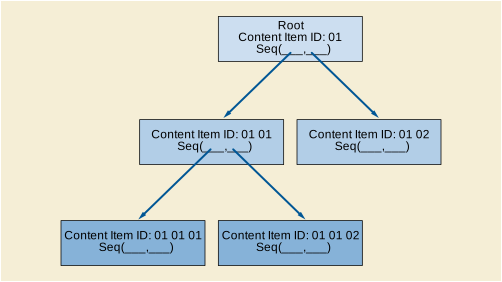
Figure C.17.4-1 depicts the content of an example diagnostic interpretation.
Note
For nodes of type CONTAINER, the contents of the Concept Name Code Sequence are shown in quotes and italicized.
For nodes of Value Type CODE, PNAME, NUM the contents are shown as "Concept Name Code Sequence = Value".
For the nodes of Value Type IMAGE and SCOORD, the contents of the Concept Name Code Sequence indicating the purpose of reference are shown in quotes and italicized.
The root node containing the Document Type is illustrated using a post-coordinated node of "Chest X-Ray", qualified using a HAS CONCEPT MOD relationship by a child with a CODE meaning "Views = PA and Lateral". An alternative would be to use a single pre-coordinated code in one node that applies to the entire concept of a "Two-view (PA and Lateral) Chest X-Ray". However, the use of pre-coordinated terms to describe complex concepts rapidly becomes unwieldy and difficult to search on (in the sense that more specific pre-coordinated codes do not have a visible relationship with more general codes). If it were necessary to include a longer textual description of Document Type, then this could be achieved with a HAS CONCEPT MOD relationship with one or more TEXT nodes, perhaps in different languages.
The Document Type is only a title, and is not being used to convey the Procedure Context, although in this example it does appear to contain a description of some aspects of Procedure Context.
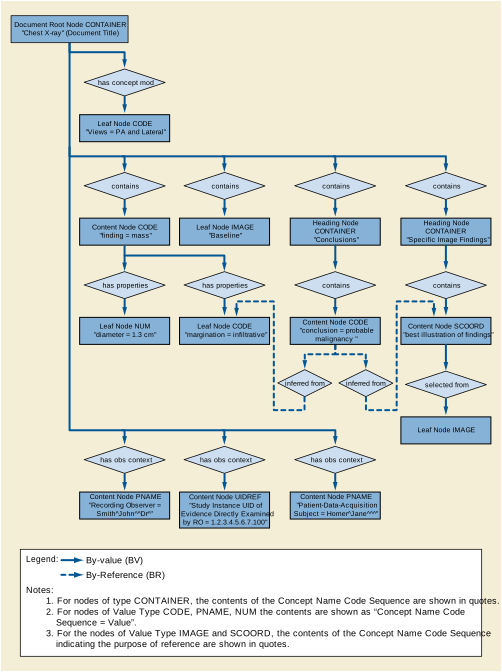
Observation Context describes who or what is performing the interpretation (observer context), whether the examination of evidence is direct or quoted (quotation mode), what procedure generated the evidence that is being interpreted (procedure context), and who or what is the subject of the evidence that is being interpreted (subject context).
Initial Observation Context is defined outside the SR Document Content tree by other modules in the SR IOD. The Patient Module specifies the default Subject Context, the General Study Module specifies the default Procedure Context, and the SR Document General Module specifies the default Observer Context. The default context has the meaning "this Structured Report was produced by the observer identified in the SR Document General module, using direct observation, for the procedure identified in the General Study Module, and is about the patient identified in the Patient Module." Observation Context defined by attributes in these modules applies to all Content Items in the SR Document Content tree and need not be explicitly coded in the tree. The initial Observation Context from outside the tree can be explicitly replaced for the entire tree, or for any sub-tree.
Observer Context is set from the Author Observer Sequence (0040,A078), if present, or secondarily from the Verifying Observer Sequence (0040,A073). If neither is present, the Observer Context is undefined.
Note
In the absence of Observer Context, it may be presumed that the observations were generated by or with the equipment identified in the General Equipment Module.
The Procedure Context is set from the Study Instance UID (0020,000D), Study ID (0020,0010), Accession Number (0008,0050), and Procedure Code Sequence (0008,1032) of the General Study Module. The Referenced Request Sequence (0040,A370) might include an Item with the same Study Instance UID that further elaborates the Procedure Context, e.g., providing Placer Order Number (0040,2016) and/or Filler Order Number (0040,2017). If the Referenced Request Sequence includes Items with different Study Instance UIDs, those shall be treated as Procedure Context only if explicitly encoded in the Content Tree.
Medical or clinical characteristics of the patient specified in the Patient Study Module, such as in attributes Patient's Size (0010,1020) and Patient's Weight (0010,1030), shall not be inherited by the Content Tree as part of the default Patient Context. Such characteristics must be specifically encoded in the Content Tree to be part of the Structured Report.
Note
The Patient Study Module may be included in SR SOP Instances. As part of the Study IE shared by all SOP Instances within a Study, such inclusion should be consistent across all Instances. However, its purpose is to provide a minimum set of clinical context for the (initial) interpretation of the images or waveforms of the study. An SR SOP Instance that documents the interpretation must explicitly describe the relevant clinical context in the SR Content Tree.
If a Content Item in the SR Document Content tree has Observation Context different from the initial context already encoded elsewhere in the IOD, the context information applying to that Content Item shall be encoded as child nodes of the Content Item in the tree using the HAS OBS CONTEXT relationship. That is, Observation Context is a property of its parent Content Item.
The context information specified in the Observation Context child nodes (i.e., target of the HAS OBS CONTEXT relationship) sets the Observation Context of their parent node Content item. Observation Context is encoded in the same manner as any other Content Item.
The Observation Context applies to all the by-value descendant nodes of that parent node regardless of the relationship type between the parent and the descendant nodes, until and unless the context of a descendant node is reset by other Observation Context Content Items. Observation Context shall not be inherited across by-reference relationships. The four dimensions of Observation Context (observer context, quotation mode, procedure context, and subject context) may be reset independently; e.g., resetting the subject context does not reset the observer or procedure context, or the quotation mode. See the example in Figure C.17.5-1.
Note
For example, the "subject context" may be defined by attaching an appropriate content item to the root node with a HAS OBS CONTEXT relationship. This "subject context" then applies not only to the root node, but to all its descendants, until such time as a content item explicitly replaces the "subject context" attribute, the new value of which is then inherited by all of that nodes descendants.
Observation DateTime is not included as part of the HAS OBS CONTEXT relationship, and therefore is not inherited along with other Observation Context. The Observation DateTime Attribute is included in each Content Item, which allows different observation dates and times to be attached to different Content Items.
The IOD may specify restrictions on Content Items and Relationship Types that also constrain the flexibility with which Observation Context may be described.
The IOD may specify Templates that offer or restrict patterns and content in Observation Context.
Note
Node 2 inherits any Observation Context of Node 1, which is then extended or replaced by the additional Observation Context defined in Nodes C1 and C2 (that is C1 and C2 are properties of 2).
Node 3 and its descendents inherit the Observation Context of Node 2, which includes C1 and C2.
Node 4 inherits the Observation Context of Node 2, which includes C1 and C2.
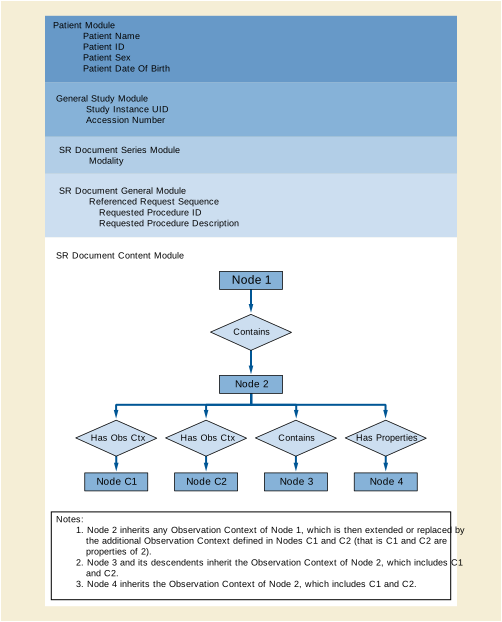
Table C.17.6-1 defines the Attributes of the Key Object Document Series.
Note
Series of Key Object Selection Documents are separate from Series of Images or other Composite SOP Instances. Key Object Documents do not reside in a Series of Images or other Composite SOP Instances.
Table C.17.6-1. Key Object Document Series Module Attributes
|
Attribute Name |
Tag |
Type |
Attribute Description |
|---|---|---|---|
|
Modality |
(0008,0060) |
1 |
Modality type. Enumerated Values:
|
|
Series Instance UID |
(0020,000E) |
1 |
Unique identifier of the Series. NoteNo specific semantics are specified. |
|
Series Number |
(0020,0011) |
1 |
A number that identifies the Series. NoteNo specific semantics are specified. |
|
Series Date |
(0008,0021) |
3 |
Date the Series started. |
|
Series Time |
(0008,0031) |
3 |
Time the Series started. |
|
Protocol Name |
(0018,1030) |
3 |
Description of the conditions under which the Series was performed. NoteThis may represent the type of analysis used in creation of the KO SOP Instances. |
|
Series Description |
(0008,103E) |
3 |
Description of the Series |
|
Series Description Code Sequence |
(0008,103F) |
3 |
A coded description of the Series. Only a single Item is permitted in this sequence. |
|
No Baseline CID is defined. |
|||
|
Referenced Performed Procedure Step Sequence |
(0008,1111) |
2 |
Uniquely identifies the Performed Procedure Step SOP Instance for which the Series is created. Zero or one item shall be included in this sequence. NoteSee notes on this attribute in Section C.17.1 |
|
>Include Table 10-11 “SOP Instance Reference Macro Attributes” |
|||
Table C.17.6-2 defines the general Attributes of a Key Object Selection Document. These Attributes identify and provide context for the Key Object Selection Document.
Table C.17.6-2. Key Object Document Module Attributes
|
Attribute Name |
Tag |
Type |
Attribute Description |
|---|---|---|---|
|
Instance Number |
(0020,0013) |
1 |
A number that identifies the Document. |
|
Content Date |
(0008,0023) |
1 |
The date the document content creation started. |
|
Content Time |
(0008,0033) |
1 |
The time the document content creation started. |
|
Referenced Request Sequence |
(0040,A370) |
1C |
Identifies Requested Procedures to which this Document pertains. One or more Items shall be included in this sequence. Required if this Document pertains to at least one Requested Procedure. |
|
>Study Instance UID |
(0020,000D) |
1 |
Unique identifier for the Study. |
|
>Referenced Study Sequence |
(0008,1110) |
2 |
Uniquely identifies the Study SOP Instance. Zero or one Item shall be included in this sequence. See Section 10.6.1. |
|
>>Include Table 10-11 “SOP Instance Reference Macro Attributes” |
|||
|
>Accession Number |
(0008,0050) |
2 |
A departmental IS generated number that identifies the order for the Study. |
|
>Issuer of Accession Number Sequence |
(0008,0051) |
3 |
Identifier of the Assigning Authority that issued the Accession Number. Only a single Item is permitted in this sequence. |
|
>>Include Table 10-17 “HL7v2 Hierarchic Designator Macro Attributes” |
|||
|
>Placer Order Number/Imaging Service Request |
(0040,2016) |
2 |
The order number assigned to the Imaging Service Request by the party placing the order. |
|
>Order Placer Identifier Sequence |
(0040,0026) |
3 |
Identifier of the Assigning Authority that issued the Placer Order Number. Only a single Item is permitted in this sequence. |
|
>>Include Table 10-17 “HL7v2 Hierarchic Designator Macro Attributes” |
|||
|
>Filler Order Number/Imaging Service Request |
(0040,2017) |
2 |
The order number assigned to the Imaging Service Request by the party filling the order. |
|
>Order Filler Identifier Sequence |
(0040,0027) |
3 |
Identifier of the Assigning Authority that issued the Filler Order Number. Only a single Item is permitted in this sequence. |
|
>>Include Table 10-17 “HL7v2 Hierarchic Designator Macro Attributes” |
|||
|
>Requested Procedure ID |
(0040,1001) |
2 |
Identifier of the related Requested Procedure |
|
>Requested Procedure Description |
(0032,1060) |
2 |
Institution-generated administrative description or classification of Requested Procedure. |
|
>Requested Procedure Code Sequence |
(0032,1064) |
2 |
A sequence that conveys the requested procedure. Zero or one Item shall be included in this sequence. |
|
No Baseline CID is defined. |
|||
|
Current Requested Procedure Evidence Sequence |
(0040,A375) |
1 |
List of all Composite SOP Instances referenced in Content Sequence (0040,A730), including all presentation states, real world value maps and other accompanying composite instances that are referenced from the content items. One or more Items shall be included in this sequence. NoteIn the context of the Key Object Selection, the current evidence is considered to be only the set of instances referenced within the Key Object Selection. |
|
>Include Table C.17-3 “Hierarchical SOP Instance Reference Macro Attributes” |
|||
|
Identical Documents Sequence |
(0040,A525) |
1C |
Duplicates of this document, stored with different SOP Instance UIDs. One or more Items shall be included in this sequence. Required if this Key Object Selection document references instances in more than one Study. See Section C.17.2.2 and Section C.17.6.2.1 for further explanation and conditions. |
|
>Include Table C.17-3 “Hierarchical SOP Instance Reference Macro Attributes” |
|||
If the Current Requested Procedure Evidence Sequence (0040,A375) references SOP Instances both in the current study and in one or more other studies, this document shall be duplicated into each of those other studies, and the duplicates shall be referenced in the Identical Documents Sequence (0040,A525).
Note
Thus a Key Object Selection Document that references images in the current study as well as in a prior or comparison study, would be duplicated into the other study. This allows an application displaying that other study to easily access notes relevant to that study's SOP Instances.
Table C.18.1-1 specifies the Attributes that convey a NUM (numeric measurement) value.
Note
The Measured Value Sequence (0040,A300) may be empty to convey the concept of a measurement whose value is unknown or missing, or a measurement or calculation failure.
Table C.18.1-1. Numeric Measurement Macro Attributes
|
Attribute Name |
Tag |
Type |
Attribute Description |
|---|---|---|---|
|
Measured Value Sequence |
(0040,A300) |
2 |
This is the value of the Content Item. Shall consist of a Sequence of Items conveying the measured value(s), which represent integers or real numbers and units of measurement. Zero or one Item shall be included in this sequence. |
|
>Numeric Value |
(0040,A30A) |
1 |
Numeric measurement value. Only a single value shall be present. |
|
>Floating Point Value |
(0040,A161) |
1C |
The floating point representation of Numeric Value (0040,A30A). Only a single value shall be present. Required if Numeric Value (0040,A30A) has insufficient precision to represent the value as a string. May be present otherwise. |
|
>Rational Numerator Value |
(0040,A162) |
1C |
The integer numerator of a rational representation of Numeric Value (0040,A30A). Encoded as a signed integer value. Only a single value shall be present. Required if Numeric Value (0040,A30A) has insufficient precision to represent a rational value as a string. May be present otherwise. |
|
>Rational Denominator Value |
(0040,A163) |
1C |
The integer denominator of a rational representation of Numeric Value (0040,A30A). Encoded as a non-zero unsigned integer value. Only a single value shall be present. Required if Rational Numerator Value (0040,A162) is present. |
|
>Measurement Units Code Sequence |
(0040,08EA) |
1 |
Units of measurement. Only a single Item shall be included in this sequence. |
|
Defined CID 82 “Units of Measurement”. |
|||
|
Numeric Value Qualifier Code Sequence |
(0040,A301) |
3 |
Qualification of Numeric Value in Measured Value Sequence, or reason for absence of Measured Value Sequence Item. Only a single Item is permitted in this sequence. |
|
Defined CID 42 “Numeric Value Qualifier”. |
|||
Table C.18.2-1 specifies the Attributes that convey a CODE value.
Table C.18.2-1. Code Macro Attributes
|
Attribute Name |
Tag |
Type |
Attribute Description |
|---|---|---|---|
|
Concept Code Sequence |
(0040,A168) |
1 |
This is the value of the Content Item. Only a single Item shall be included in this sequence. |
|
No Baseline CID is defined. |
|||
Table C.18.3-1 specifies the Attributes that convey a reference to a DICOM Composite Object that is not a DICOM Image or Waveform (such as an SR Document), or to an HL7 Structured Document.
Note
If a Softcopy Presentation State is to be applied to an Image, it should be referenced by an Image Reference Macro.
Other SR Documents may be referenced by this macro, but there is no facility to reference individual Content Items within those reports.
HL7 Structured Documents include, in particular, those conforming to the Clinical Document Architecture (CDA). See Section C.12.1.1.6 for further details about this type of referenced object.
Table C.18.3-1. Composite Object Reference Macro Attributes
|
Attribute Name |
Tag |
Type |
Attribute Description |
|---|---|---|---|
|
Referenced SOP Sequence |
(0008,1199) |
1 |
References to Composite Object SOP Class/SOP Instance pairs. Only a single Item shall be included in this Sequence. |
|
>Include Table 10-11 “SOP Instance Reference Macro Attributes” |
|||
Table C.18.4-1 specifies the Attributes that convey a reference to a DICOM image.
Table C.18.4-1. Image Reference Macro Attributes
|
Attribute Name |
Tag |
Type |
Attribute Description |
|---|---|---|---|
|
Include Table C.18.3-1 “Composite Object Reference Macro Attributes” |
|||
|
>Referenced Frame Number |
(0008,1160) |
1C |
Identifies the frame numbers within the Referenced SOP Instance to which the reference applies. The first frame shall be denoted as frame number 1. NoteThis Attribute may be multi-valued. Required if the Referenced SOP Instance is a multi-frame image and the reference does not apply to all frames, and Referenced Segment Number (0062,000B) is not present. |
|
>Referenced Segment Number |
(0062,000B) |
1C |
Identifies the segments to which the reference applies identified by Segment Number (0062,0004). Required if the Referenced SOP Instance is a Segmentation and the reference does not apply to all segments and Referenced Frame Number (0008,1160) is not present. |
|
>Referenced SOP Sequence |
(0008,1199) |
3 |
Reference to a Softcopy Presentation State SOP Class/SOP Instance pair. Only a single Item is permitted in this sequence. |
|
>>Include Table 10-11 “SOP Instance Reference Macro Attributes” |
|||
|
>Referenced Real World Value Mapping Instance Sequence |
(0008,114B) |
3 |
Reference to a Real World Value Mapping SOP Class/SOP Instance pair. Only a single Item is permitted in this sequence. |
|
>>Include Table 10-11 “SOP Instance Reference Macro Attributes” |
|||
|
>Icon Image Sequence |
(0088,0200) |
3 |
This Icon Image is representative of the Image. Only a single Item is permitted in this Sequence. The Icon Image shall be no greater than 128 rows by 128 columns. |
|
See Section C.7.6.1.1.6. |
|||
Table C.18.5-1 specifies the Attributes that convey a reference to a DICOM waveform.
Table C.18.5-1. Waveform Reference Macro Attributes
|
Attribute Name |
Tag |
Type |
Attribute Description |
|---|---|---|---|
|
Include Table C.18.3-1 “Composite Object Reference Macro Attributes” |
|||
|
>Referenced Waveform Channels |
(0040,A0B0) |
1C |
List of channels in Waveform to which the reference applies. See Section C.18.5.1.1 Required if the Referenced SOP Instance is a Waveform that contains multiple Channels and not all Channels in the Waveform are referenced. |
Referenced Waveform Channels (0040,A0B0) is a multi-value attribute that lists the channels referenced. Each channel is specified as a pair of values (M,C), where the first value is the sequence item number of Waveform Sequence (5400,0100) in the referenced object (i.e., the Multiplex Group Number), and the second value is the sequence item number of Channel Definition Sequence (003A,0200) (i.e., the Channel Number) within the multiplex group.
If the specified channel number is 0, the annotation applies to all channels in the multiplex group.
Note
As an example, an annotation that applies to the entire first multiplex group and channels 2 and 3 of the third multiplex group would have Referenced Waveform Channels (0040,A0B0) value 0001 0000 0003 0002 0003 0003.
Table C.18.6-1 specifies the Attributes that convey Spatial Coordinates in an SCOORD Content Item. An SCOORD Content Item shall always be the Source Content Item of one or more SELECTED FROM Relationships with IMAGE Target Content Items. Each IMAGE Target Content Item shall contain a reference to one single frame or multi-frame Image.
Note
The same set of spatial coordinates may be selected from more than one single-frame image, or more than one frame of a multi-frame image when the purpose of reference is applicable to multiple images. For example, the spatial coordinates may specify the outline of a sampling region at the same spatial location on multiple images acquired over time.
Table C.18.6-1. Spatial Coordinates Macro Attributes
|
Attribute Name |
Tag |
Type |
Attribute Description |
|---|---|---|---|
|
Graphic Data |
(0070,0022) |
1 |
An ordered set of (column,row) pairs that denote positions in an image specified with sub-pixel resolution such that the origin at the TLHC of the TLHC pixel is 0.0\0.0, the BRHC of the TLHC pixel is 1.0\1.0, and the BRHC of the BRHC pixel is Columns\Rows. The values must be within the range 0\0 to Columns\Rows. The maximum values are those contained in the referenced image in attributes Columns (0028,0011) and Rows (0028,0010), or in the case of spatial coordinates with Pixel Origin Interpretation (0048,0301) value VOLUME, in attributes Total Pixel Matrix Columns (0048,0006) and Total Pixel Matrix Rows (0048,0007). See Section C.18.6.1.1 for further explanation. |
|
Graphic Type |
(0070,0023) |
1 |
See Section C.18.6.1.2 for Enumerated Values. |
|
Pixel Origin Interpretation |
(0048,0301) |
1C |
For a referenced multi-frame image, specifies whether the Graphic Data (0070,0022) values are to be interpreted relative to the individual frame pixel origins, or relative to the Total Pixel Matrix origin (see Section C.8.12.4.1.4). Required if the value of Referenced SOP Class UID (0008,1150) of the referenced image is 1.2.840.10008.5.1.4.1.1.77.1.6 (VL Whole Slide Microscopy Image). May be present otherwise. Enumerated Values:
If not present, Graphic Data values are defined relative to the frame pixel origin. |
|
Fiducial UID |
(0070,031A) |
3 |
The globally unique identifier for this fiducial item. NoteThe fiducial UID can be used to associate this set of graphics with other Content Items. |
Graphic Data may be used to associate an anatomic or spatial Concept with a defined subset of one or more images. Graphic Data may be explicitly defined as a single point (i.e., to denote the epicenter of an anatomic site or lesion) or more than one point (i.e., representing a set of points or an open or closed polygon).
Note
Spatial coordinates may be used to associate observational data with a set of Image features. Spatial coordinates also may be used to convey coordinates that are input data for a measurement.
When annotation applies to an image, this attribute defines the type of geometry of the annotated region of interest.
Enumerated Values:
- POINT
a single pixel denoted by a single (column,row) pair
- MULTIPOINT
multiple pixels each denoted by an (column,row) pair
- POLYLINE
a series of connected line segments with ordered vertices denoted by (column,row) pairs; if the first and last vertices are the same it is a closed polygon
- CIRCLE
a circle defined by two (column,row) pairs. The first point is the central pixel. The second point is a pixel on the perimeter of the circle.
- ELLIPSE
an ellipse defined by four pixel (column,row) pairs, the first two points specifying the endpoints of the major axis and the second two points specifying the endpoints of the minor axis of an ellipse
Table C.18.7-1 specifies the Attributes that convey TCOORD Content Items. A TCOORD Content Item shall be the Source Content Item of one or more SELECTED FROM relationships with one or more SCOORD Content Items, one or more IMAGE Content Items, or one or more WAVEFORM Content Items.
Note
The same set of temporal coordinates may be selected from more than one single-frame image, or more than one frame of a multi-frame image, or from images and waveforms when the purpose of reference is applicable to multiple objects. For example, the definition of a sampling period at different spatial locations on multiple images and a synchronously acquired waveform.
Temporal coordinates may refer to spatial coordinates, which in turn refer to one or more frames or images, for example to indicate a region localized in both time and space.
Table C.18.7-1. Temporal Coordinates Macro Attributes
|
Attribute Name |
Tag |
Type |
Attribute Description |
|---|---|---|---|
|
Temporal Range Type |
(0040,A130) |
1 |
See Section C.18.7.1.1 for Enumerated Values. |
|
Referenced Sample Positions |
(0040,A132) |
1C |
List of samples within a multiplex group specifying temporal points of the referenced data. Position of first sample is 1. Required if the Referenced SOP Instance is a Waveform and Referenced Time Offsets (0040,A138) and Referenced DateTime (0040,A13A) are not present. May be used only if Referenced Channels (0040,A0B0) refers to channels within a single multiplex group. |
|
Referenced Time Offsets |
(0040,A138) |
1C |
Specifies temporal points for reference by number of seconds after start of data. Required if Referenced Sample Positions (0040,A132) and Referenced DateTime (0040,A13A) are not present. |
|
Referenced DateTime |
(0040,A13A) |
1C |
Specifies temporal points for reference by absolute time. Required if Referenced Sample Positions (0040,A132) and Referenced Time Offsets (0040,A138) are not present. |
This Attribute defines the type of temporal extent of the region of interest. A temporal point (or instant of time) may be defined by a waveform sample offset (for a single waveform multiplex group only), time offset, or absolute time.
Enumerated Values:
- POINT
a single temporal point
- MULTIPOINT
multiple temporal points
- SEGMENT
a range between two temporal points
- MULTISEGMENT
multiple segments, each denoted by two temporal points
- BEGIN
a range beginning at one temporal point, and extending beyond the end of the acquired data
- END
a range beginning before the start of the acquired data, and extending to (and including) the identified temporal point
Table C.18.1-1 specifies the Attributes that convey a CONTAINER content item.
Table C.18.8-1. Container Macro Attributes
|
Attribute Name |
Tag |
Type |
Attribute Description |
|---|---|---|---|
|
Continuity of Content |
(0040,A050) |
1 |
This flag specifies for a CONTAINER whether or not its contained Content Items are logically linked in a continuous textual flow, or are separate items. Enumerated Values:
See Section C.18.8.1.1 for further explanation. |
|
Content Template Sequence |
(0040,A504) |
1C |
Template that describes the content of this Content Item and its subsidiary Content Items. Only a single Item shall be included in this sequence. Required if a template was used to define the content of this Item, and the template consists of a single CONTAINER with nested content, and it is the outermost invocation of a set of nested templates that start with the same CONTAINER (see Section C.18.8.1.2). |
|
>Mapping Resource |
(0008,0105) |
1 |
Mapping Resource that defines the template. See Section 8.4. Defined Terms:
|
|
>Template Identifier |
(0040,DB00) |
1 |
Template identifier. |
Continuity of Content (0040,A050) specifies whether or not all the Content Items contained in a CONTAINER are logically linked in a continuous textual flow, or are separate entities. It only applies to the children contained in the container, and not their children (which if containers themselves, will have the attribute specified explicitly).
Note
This allows the interspersing of measurements, codes, and image references, amongst text. For example, the following: "A mass of diameter = 3 cm was detected." can be represented by the following Content Items in a CONTAINER with a Continuity of Content (0040,A050) of CONTINUOUS:
TEXT "A mass of"
NUM "Diameter" 3 "cm"
TEXT "was detected."
The Continuity of Content applies only to subsidiary Content Items with Relationship Type CONTAINS. Other subsidiary items, e.g., with Relationship Type HAS CONCEPT MOD or HAS OBS CONTEXT, are not part of the Continuity of Content, but apply to the Container as a whole.
A Template for SR Documents defines a set of constraints on the relationships and content (Value Types, Codes, etc.) of Content Items. Specific Templates for SR Documents are defined either by the DICOM Standard (see PS3.16) or by users of the Standard for particular purposes. Usage of Templates for SR Documents may improve comparability of essential data, facilitate data-entry and revisions, enable automatic processing and simplify presentation of information to the user.
An SR Document consists of a Root CONTAINER Content Item with nested content, and as such may be defined by a Template specifying a single CONTAINER with nested content. Sub-trees of an SR Document may similarly be defined by a Template specifying a single CONTAINER with nested content. If created using such a Template, the Root and/or sub-tree shall identify the Template in the CONTAINER Content Item. When a Template invokes (includes) another Template, the outermost invoking Template is the one identified as the defining Template for the CONTAINER in the Content Template Sequence (0040,A504).
The Content Template Sequence (0040,A504) identifies the Template that was used in the creation of the associated Content Item and its subsidiary Content Items. A Template is identified by a Mapping Resource (0008,0105) (the entity that manages or registers the Template), and an identifier of the Template. DICOM Standard Templates are identified in Template Identifier (0040,DB00) using the CS value representation.
The DICOM Template identifier (0040,DB00) is a string of digits, without leading zeroes, and does not include the string "TID".
Table C.18.9-1 specifies the Attributes that convey 3D Spatial Coordinates in an SCOORD3D Content Item.
Table C.18.9-1. 3D Spatial Coordinates Macro Attributes
|
Attribute Name |
Tag |
Type |
Attribute Description |
|---|---|---|---|
|
Referenced Frame of Reference UID |
(3006,0024) |
1 |
Uniquely identifies the Frame of Reference within which the coordinates are defined. NoteThere is no requirement that the Frame of Reference be the same for all SCOORD3D Content Items in the same SR SOP Instance, nor is there any requirement that the Frame of Reference Module be present. |
|
Graphic Data |
(0070,0022) |
1 |
An ordered set of (x,y,z) triplets (in mm and may be negative) that define a region of interest in the patient-relative Reference Coordinate System defined by Referenced Frame of Reference UID (3006,0024). See Reference Coordinate System. See Section C.18.9.1.1 for further explanation. |
|
Graphic Type |
(0070,0023) |
1 |
See Section C.18.9.1.2 for Enumerated Values. |
|
Fiducial UID |
(0070,031A) |
3 |
The globally unique identifier for this fiducial item. NoteThe fiducial UID can be used to associate this set of graphics with other Content Items. |
Graphic Data may be used to associate an anatomic or spatial Concept with a defined set of patient relative 3D locations in a defined frame of reference, independent of any image. Graphic Data may be defined explicitly as a single point (i.e., to denote the epicenter of an anatomic site or lesion) or more than one point (i.e., representing a set of points or an open or closed polygon).
This attribute defines the type of geometry of the region of interest.
Enumerated Values:
- POINT
a single location denoted by a single (x,y,z) triplet
- MULTIPOINT
multiple locations each denoted by an (x,y,z) triplet; the points need not be coplanar
- POLYLINE
a series of connected line segments with ordered vertices denoted by (x,y,z) triplets; the points need not be coplanar
- POLYGON
a series of connected line segments with ordered vertices denoted by (x,y,z) triplets, where the first and last vertices shall be the same forming a polygon; the points shall be coplanar
- ELLIPSE
an ellipse defined by four (x,y,z) triplets, the first two triplets specifying the endpoints of the major axis and the second two triplets specifying the endpoints of the minor axis
- ELLIPSOID
a three-dimensional geometric surface whose plane sections are either ellipses or circles and contains three intersecting orthogonal axes, "a", "b", and "c"; the ellipsoid is defined by six (x,y,z) triplets, the first and second triplets specifying the endpoints of axis "a", the third and fourth triplets specifying the endpoints of axis "b", and the fifth and sixth triplets specifying the endpoints of axis "c"
Note
A circle is a special case of ELLIPSE where the major and minor axis points are equidistant from the center.
Coplanar is in the mathematical sense and is not necessarily related to a specific image instance.
The following Modules are used by the Raw Data IOD.
Table C.19-1 specifies the attributes that describe a raw data stream.
Table C.19-1. Raw Data Module Attributes
|
Attribute Name |
Tag |
Type |
Attribute Description |
|---|---|---|---|
|
Instance Number |
(0020,0013) |
2 |
A number that identifies this raw data. The value shall be unique within a series. |
|
Content Date |
(0008,0023) |
1 |
The date the raw data creation was started. |
|
Content Time |
(0008,0033) |
1 |
The time the raw data creation was started. |
|
Acquisition DateTime |
(0008,002A) |
3 |
The date and time that the acquisition of data started. NoteThe synchronization of this time with an external clock is specified in the synchronization Module in Acquisition Time synchronized (0018,1800). |
|
Image Laterality |
(0020,0062) |
3 |
Laterality of (possibly paired) body part examined. Enumerated Values:
|
|
Creator-Version UID |
(0008,9123) |
1 |
Unique identification of the equipment and version of the software that has created the Raw Data information. The UID allows one to avoid attempting to interpret raw data with an unknown format. |
|
Referenced Instance Sequence |
(0008,114A) |
3 |
Other Instances significantly related to this Instance. One or more Items are permitted in this Sequence. |
|
>Include Table 10-3 “Image SOP Instance Reference Macro Attributes” |
|||
|
>Purpose of Reference Code Sequence |
(0040,A170) |
1 |
Describes the purpose for which the reference is made. Only a single Item shall be included in this sequence. |
|
No Baseline CID is defined. |
|||
|
Include any private attributes that contain Raw Data information. See Section C.19.1.1 for further explanation. |
|||
Table C.20.1-1 defines the general Attributes of the Spatial Registration Series Module.
Table C.20.1-1. Spatial Registration Series Module Attributes
|
Attribute Name |
Tag |
Type |
Attribute Description |
|---|---|---|---|
|
Modality |
(0008,0060) |
1 |
Modality type. Enumerated Values:
|
Table C.20.2-1 defines the general Attributes of the Spatial Registration Module.
Table C.20.2-1. Spatial Registration Module Attributes
|
Attribute Name |
Tag |
Type |
Attribute Description |
|---|---|---|---|
|
Content Date |
(0008,0023) |
1 |
The date the content creation started. |
|
Content Time |
(0008,0033) |
1 |
The time the content creation started. |
|
Include Table 10-12 “Content Identification Macro Attributes” |
|||
|
Registration Sequence |
(0070,0308) |
1 |
A sequence of registration items. Each item defines a spatial registration of the images referenced in that item to the Registered RCS established by this SOP instance. All referenced images are in the same spatial frame of reference or atlas. One or more Items shall be included in this sequence. |
|
>Frame of Reference UID |
(0020,0052) |
1C |
Identifies the Frame of Reference of the referenced data, that may or may not be an image set (e.g., atlas or physical space). See Section C.7.4.1.1.1 for further explanation. Required if Referenced Image Sequence (0008,1140) is absent. May be present otherwise. |
|
>Referenced Image Sequence |
(0008,1140) |
1C |
Identifies the set of images of the referenced data, registered in this sequence item. One or more Items shall be included in this sequence. Required if Frame of Reference UID (0020,0052) is absent. May be present otherwise. |
|
>>Include Table 10-3 “Image SOP Instance Reference Macro Attributes” |
|||
|
>Matrix Registration Sequence |
(0070,0309) |
1 |
A sequence that specifies one spatial registration. Only a single Item shall be included in this sequence. |
|
>>Frame of Reference Transformation Comment |
(3006,00C8) |
3 |
User description or comments about the registration. |
|
>>Registration Type Code Sequence |
(0070,030D) |
2 |
Describes the information input into the registration process. Zero or one Item shall be included in this Sequence. |
|
>>>Include Table 8.8-1 “Code Sequence Macro Attributes” |
Baseline CID 7100 “RCS Registration Method Type”. |
||
|
>>Matrix Sequence |
(0070,030A) |
1 |
Specifies one transformation, that registers the Source RCS/images to the Registered RCS. It is expressible as multiple matrices, each in a separate item of the sequence. One or more Items shall be included in this sequence. The item order is significant and corresponds to matrix multiplication order. See Section C.20.2.1.1. |
|
>>>Frame of Reference Transformation Matrix |
(3006,00C6) |
1 |
A 4x4 affine transformation matrix that registers a homogeneous coordinate system A to B. Matrix elements shall be listed in row-major order. See Section C.20.2.1.1. |
|
>>>Frame of Reference Transformation Matrix Type |
(0070,030C) |
1 |
Type of Frame of Reference Transformation Matrix (3006,00C6). Enumerated Values:
|
|
>Used Fiducials Sequence |
(0070,0314) |
3 |
The fiducials used to determine the Frame of Reference Transformation Matrix. One or more Items are permitted in this sequence. |
|
>>Include Table 10-11 “SOP Instance Reference Macro Attributes” |
Reference to the Spatial Fiducial SOP Instance identifying the Used Fiducial(s) |
||
|
>>Fiducial UID |
(0070,031A) |
1 |
The UID that identifies the fiducial used as registration input. |
|
>Used Segments Sequence |
(0062,0012) |
3 |
The segments used to determine the Frame of Reference Transformation Matrix. One or more Items are permitted in this sequence. |
|
>>Include Table 10-11 “SOP Instance Reference Macro Attributes” |
Reference to the Segmentation or Surface Segmentation SOP Instance identifying the Used Segments. |
||
|
>>Referenced Segment Number |
(0062,000B) |
1 |
Uniquely identifies the segment described in Segment Sequence (0062,0002) by reference to Segment Number (0062,0004). Referenced Segment Number (0062,000B) shall not be multi-valued. |
The Frame of Reference Transformation Matrix (3006,00C6) AMB describes how to transform a point (Bx,By,Bz) with respect to RCSB into (Ax,Ay,Az) with respect to RCSA according to Equation C.20.2-1.
The Matrix Registration is expressible as multiple matrices, each in a separate item of Matrix Sequence (0070,030A). Equation C.20.2-2 specifies the order of the matrix multiplication where M1, M2 and M3 are the first, second and third items in the sequence.
where
Registration often involves two or more RCS, each with a corresponding Frame of Reference Transformation Matrix. For example, another Frame of Reference Transformation Matrix AMC can describe how to transform a point (Cx,Cy,Cz) with respect to RCS C into (Ax,Ay,Az) with respect to RCSA. It is straightforward to find the Frame of Reference Transformation Matrix BMC that describes how to transform the point (Cx,Cy,Cz) with respect to RCSC into the point (Bx,By,Bz) with respect to RCSB. The solution is to invert AMB and multiply by AMC, as shown in Equation C.20.2-3.
If two or more transformation matrices describe the relation between Patient coordinates and a device-centric Well-known Frame of Reference, any calculations assuming transitivity via the Well-known Frame of Reference must be performed with great care to assure that both registrations reflect the same positioning of the patient with respect to the common Well-known Frame of Reference.
There are three types of Registration Matrices:
RIGID: This is a registration involving only translations and rotations. Mathematically, the matrix is constrained to be orthonormal and describes six degrees of freedom: three translations, and three rotations.
RIGID_SCALE: This is a registration involving only translations, rotations and scaling. Mathematically, the matrix is constrained to be orthogonal and describes nine degrees of freedom: three translations, three rotations and three scales. This type of transformation is sometimes used in atlas mapping.
AFFINE: This is a registration involving translations, rotations, scaling and shearing. Mathematically, there are no constraints on the elements of the Frame of Reference Transformation Matrix other than that the last row shall be (0,0,0,1) to preserve the homogeneous coordinates, so it conveys twelve degrees of freedom. This type of transformation is sometimes used in atlas mapping.
Note
The AFFINE value for Frame of Reference Transformation Matrix Type (0070,030C) has the same meaning as the use of the HOMOGENEOUS value for Frame of Reference Transformation Type (3006,00C4) in the Structure Set module. See Section C.8.8.5.
See Annex P “Transforms and Mappings (Informative)” in PS3.17 for more detail.
Table C.20.3-1 defines the general Attributes of the Deformable Spatial Registration Module.
Table C.20.3-1. Deformable Spatial Registration Module Attributes
|
Attribute Name |
Tag |
Type |
Attribute Description |
|---|---|---|---|
|
Content Date |
(0008,0023) |
1 |
The date the vector grid data creation started. |
|
Content Time |
(0008,0033) |
1 |
The time the vector grid data creation started. |
|
Include Table 10-12 “Content Identification Macro Attributes” |
|||
|
Deformable Registration Sequence |
(0064,0002) |
1 |
A sequence of registration items. Each item defines a spatial registration to the referenced images in that item. At least one item shall have a Deformable Registration Grid Sequence (0064,0005) with one item. See Section C.20.3.1.1. One or more Items shall be included in this sequence. |
|
>Source Frame of Reference UID |
(0064,0003) |
1 |
Identifies the Frame of Reference of a Source RCS. The Source RCS may or may not include an image set (e.g., atlas). See Section C.7.4.1.1.1 for further explanation. |
|
>Referenced Image Sequence |
(0008,1140) |
1C |
Identifies the set of images registered in this sequence item. One or more Items shall be included in this sequence. Required if the registration applies to a subset of images within the specified Source Frame of Reference UID (0064,0003). All referenced images shall be in the same spatial frame of reference. |
|
>>Include Table 10-3 “Image SOP Instance Reference Macro Attributes” |
|||
|
>Frame of Reference Transformation Comment |
(3006,00C8) |
3 |
User description or comments about the registration. |
|
>Registration Type Code Sequence |
(0070,030D) |
2 |
Describes the method used for the registration process. Zero or one Item shall be included in this sequence. |
|
Baseline CID 7100 “RCS Registration Method Type”. |
|||
|
>Pre Deformation Matrix Registration Sequence |
(0064,000F) |
1C |
A sequence that specifies one spatial registration to be applied prior to the deformation. Only a single Item shall be included in this sequence. Required if a matrix transformation is to be applied prior to deformation. |
|
>>Frame of Reference Transformation Matrix |
(3006,00C6) |
1 |
A 4x4 homogeneous transformation matrix.Matrix elements shall be listed in row-major order. See Section C.20.2.1.1. |
|
>>Frame of Reference Transformation Matrix Type |
(0070,030C) |
1 |
Type of Frame of Reference Transformation Matrix (3006,00C6). Enumerated Values:
|
|
>Post Deformation Matrix Registration Sequence |
(0064,0010) |
1C |
A sequence that specifies one spatial registration to be applied after the application of the deformation. Only a single Item shall be included in this sequence. Required if matrix transformation is to be performed after application of the deformation. |
|
>>Frame of Reference Transformation Matrix |
(3006,00C6) |
1 |
A 4x4 homogeneous transformation matrix. Matrix elements shall be listed in row-major order. See Section C.20.2.1.1. |
|
>>Frame of Reference Transformation Matrix Type |
(0070,030C) |
1 |
Type of Frame of Reference Transformation Matrix (3006,00C6). Defined Terms:
|
|
>Deformable Registration Grid Sequence |
(0064,0005) |
1C |
Describes the deformation grid used to sample into the Source RCS. Only a single Item shall be included in this sequence. Required if deformation is performed. See Section C.20.3.1.2. |
|
>>Image Orientation (Patient) |
(0020,0037) |
1 |
The direction of cosines of the first row and first column of the Vector Grid Data (0064,0009) with respect to the patient. See Section C.7.6.2.1.1 for further explanation. |
|
>>Image Position (Patient) |
(0020,0032) |
1 |
The x, y, and z coordinates of the upper left hand voxel (center of the first voxel transmitted) of the grid, in mm in the Registered Frame of Reference. See Section C.7.6.2.1.1 for further explanation. |
|
>>Grid Dimensions |
(0064,0007) |
1 |
The dimensions of the grid, in voxels. A triple representing the number of voxels along the X, Y, and Z axes. |
|
>>Grid Resolution |
(0064,0008) |
1 |
The resolution of the grid voxels. A triple representing the size of a deformation voxel in along the X, Y, and Z dimension, in mm. |
|
>>Vector Grid Data |
(0064,0009) |
1 |
A data stream of vectors. See Section C.20.3.1.3 for further explanation. |
|
>Used Fiducials Sequence |
(0070,0314) |
3 |
The fiducials used to determine the registration. One or more Items are permitted in this sequence. |
|
>>Include Table 10-11 “SOP Instance Reference Macro Attributes” |
Reference to the Spatial Fiducial SOP Instance identifying the Used Fiducial(s) |
||
|
>>Fiducial UID |
(0070,031A) |
1 |
The UID that identifies the fiducial used as registration input. |
The registrations in this module are applied to the Registered RCS coordinates in the following order. First, transform the coordinates using the matrix described in the Pre Deformation Matrix Registration Sequence (0064,000F). Next apply the deformation offsets to the resulting coordinates. Finally, transform those coordinates using the matrix described in the Post Deformation Matrix Registration Sequence (0064,0010). The resulting coordinate addresses the sample point within the Source RCS.
Thus a source coordinate may be calculated using Equation C.20.3-1 (this assumes that the center position of each deformation voxel will be transformed).
Where:
|
|
The spatial coordinate in the Source RCS. |
|
|
The start coordinate, in the Registered RCS, of the deformation grid as specified in Image Position (Patient) (0020,0032). |
|
|
The values from the row (X) direction cosine of Image Orientation (Patient) (0020,0037). |
|
|
The values from the column (Y) direction cosine of Image Orientation (Patient) (0020,0037). |
|
|
The cross product between the row (X) direction cosine and the column (Y) direction cosine of Image Orientation (Patient) (0020,0037). |
|
|
|
|
|
The index into the deformation grid in the X, Y, and Z dimension. |
|
|
The resolution of the deformation grid in the X, Y, and Z dimension as specified in Grid Resolution (0064,0008). |
|
|
The deformation specified at index (i,j,k) in the deformation grid. If the Deformation Registration Grid Sequence (0064,0005) has no items, the D values are zero. |
|
MPre
|
The transformation matrix specified in the Pre Deformation Matrix Registration Sequence (0064,000F). |
|
MPost
|
The transformation matrix specified in the Post Deformation Matrix Registration Sequence (0064,0010). |
The vector represents the deformation at the center of the voxel. Deformations between voxel centers shall be determined through interpolation of the surrounding vectors in an implementation dependent manner.
Vector Grid Data (0064,0009) contains the vector data. Each voxel in Vector Grid Data (0064,0009) is represented by an
vector. The vector describes the direction and magnitude of the deformation at the center of the deformation voxel.
The order of vectors sent for each vector plane shall be left to right, top to bottom, i.e., the upper left vector (labeled 1,1) is sent first followed by the remainder of row 1, followed by the first vector of row 2 (labeled 2,1) then the remainder of row 2 and so on.
A vector triple with values of (NaN,NaN,NaN) shall indicate that the transformation at that point of the deformation grid is undefined.
The size of this attribute value is determined by the dimensions specified in Grid Dimensions (0064,0007). For dimensions of XD\YD\ZD, the size of the attribute value can be calculated with Equation C.20.3-2.
Table C.21.1-1 defines the general Attributes of the Spatial Fiducials Series Module.
Table C.21.1-1. Spatial Fiducials Series Module Attributes
|
Attribute Name |
Tag |
Type |
Attribute Description |
|---|---|---|---|
|
Modality |
(0008,0060) |
1 |
Modality type. Enumerated Values:
|
Table C.21.2-1 defines the general Attributes of the Registration.
Table C.21.2-1. Spatial Fiducials Module Attributes
|
Attribute Name |
Tag |
Type |
Attribute Description |
|---|---|---|---|
|
Content Date |
(0008,0023) |
1 |
The date the content creation started. |
|
Content Time |
(0008,0033) |
1 |
The time the content creation started. |
|
Include Table 10-12 “Content Identification Macro Attributes” |
|||
|
Fiducial Set Sequence |
(0070,031C) |
1 |
A sequence of items, each of which is a fiducial set. One or more Items shall be included in this sequence. |
|
>Frame of Reference UID |
(0020,0052) |
1C |
Identifies a Frame of Reference that may or may not be an image set (e.g., an atlas or physical space). See Section C.7.4.1.1.1 for further explanation. Required if Referenced Image Sequence (0008,1140) is absent. May be present otherwise. |
|
>Referenced Image Sequence |
(0008,1140) |
1C |
Identifies the set of images in which the fiducials are located. One or more Items shall be included in this sequence. Required if Frame of Reference UID (0020,0052) is absent. May be present otherwise. All referenced images shall have the same Frame of Reference UID if present in the images. |
|
>>Include Table 10-3 “Image SOP Instance Reference Macro Attributes” |
|||
|
>Fiducial Sequence |
(0070,031E) |
1 |
A sequence that specifies fiducials, one item per fiducial. One or more Items shall be included in this sequence. |
|
>>Fiducial Identifier |
(0070,0310) |
1 |
A fiducial assignment identifier that is unique within this Fiducial Sequence item but may match the fiducial identifier of an equivalent feature in another item. |
|
>>Fiducial Identifier Code Sequence |
(0070,0311) |
1C |
A code sequence for a term that identifies a well-known fiducial type (potentially including methodology, anatomy, tools, etc.). Only a single Item shall be included in this sequence. Required if Identifier (0070,0310) is absent. May be present otherwise. |
|
>>>Include Table 8.8-1 “Code Sequence Macro Attributes” |
Defined CID 7101 “Brain Atlas Fiducials”. |
||
|
>>Fiducial UID |
(0070,031A) |
3 |
Globally unique identifier for the fiducial instance of this fiducial assignment. |
|
>>Fiducial Description |
(0070,030F) |
3 |
User description or comments about the fiducial. |
|
>>Shape Type |
(0070,0306) |
1 |
See Section C.21.2.1.1 for Defined Terms. |
|
>>Number of Contour Points |
(3006,0046) |
1C |
Number of points (triplets) in Contour Data (3006,0050). Required if Contour Data is present. |
|
>>Contour Data |
(3006,0050) |
1C |
Specifies the coordinates of this item's fiducial. One triplet (x,y,z) shall be present for each point in the fiducial. See Section C.21.2.1.2 for further explanation. Required if Frame of Reference UID (0020,0052) is present in this item of the Fiducial Set Sequence (0070,031C). Shall not be present otherwise. NoteContour Data may not be properly encoded if Explicit VR transfer syntax is used and the VL of this attribute exceeds 65534 bytes. |
|
>>Contour Uncertainty Radius |
(0070,0312) |
3 |
The estimated uncertainty radius for the Contour Data in mm. See Section C.21.2.1.3 |
|
>>Graphic Coordinates Data Sequence |
(0070,0318) |
1C |
The image pixel locations of the fiducial's points. One or more Items shall be included in this sequence. More than one item shall be present only if a fiducial spans more than one image. Required if Contour Data is not present. May be present otherwise. |
|
>>>Graphic Data |
(0070,0022) |
1 |
Graphic point coordinates of the fiducial points in the image of the Referenced Image Sequence. If Fiducial's Contour Data (3006,0050) is present, these points correlate to the points in the Contour Data, one row-column pair for each point and in the same order. See Section C.10.5.1.2 for further explanation. |
|
>>>Referenced Image Sequence |
(0008,1140) |
1 |
A sequence that specifies the image containing the fiducial's graphic coordinates. Only a single Item shall be included in this sequence. Shall be an image within the set of the images in the Referenced Image Sequence (0008,1140) of the encapsulating Fiducial Set Sequence (0070,031C) item. |
|
>>>>Include Table 10-3 “Image SOP Instance Reference Macro Attributes” |
|||
For convenient registration, correlated Fiducials exist in each image set of the Registration Sequence. Correlated Fiducials are identified with either Fiducial Identifier (0070,0310) or Fiducial Identifier Code Sequence (0070,0311).
Shape Type (0070,0306) defines the geometric interpretation of Contour Data (3006,0050) and Graphic Data (0070,0022). A point is defined as a triplet (x,y,z) in the case of spatial data or a pair (x,y) in the case of graphic data.
Defined Terms:
- POINT
a single point designating a single fiducial point.
Note
A point may be the epicenter of a more complex shape such as sphere.
- LINE
two points that specify a line or axis such as the inter-orbital line. The point locations have no significance other than identifying the line, i.e., they are not line segment end points.
- PLANE
three points that identify a plane such as the laterality plane
- SURFACE
three or more points (usually many) that reside on, or near, a region of a curved surface. The surface may be flat or curved, closed or open. The point order has no significance.
- RULER
two or more evenly spaced collinear points ordered sequentially along the line, such as a physical ruler placed in the imaging field.
- L_SHAPE
three points of two perpendicular line segments, AB and BC, having a common end point B. The order of the points is: ABC. May represent an L-shaped marker placed in the imaging field.
- T_SHAPE
three points of two perpendicular line segments AB and CD, such that C bisects AB. The order is ABD.
- SHAPE
three or more points that specify the shape of a well-known fiducial type. The term in the Fiducial Identifier Code Sequence (0070,0311) defines the shape and the order of the points that represent it.
Contour Data (3006,0050) is an ordered set of triplets that defines a shape. The triplets (x,y,z) denote points in the Reference Coordinate System of the Registration Instance.
Note
Contours may associate observational data with a set of Image features or specify coordinates that are input data for a measurement.
The following Sections specify Modules used for Media Creation Management.
Table C.22.1-1. Media Creation Management Module Attributes
|
Attribute name |
Tag |
Attribute Description |
|
|---|---|---|---|
|
Storage Media File-Set ID |
(0088,0130) |
User or implementation specific human readable identification of the Storage Media to be created. |
|
|
Storage Media File-Set UID |
(0088,0140) |
Uniquely identifies a Storage Media to be created. |
|
|
Number of Copies |
(2000,0010) |
Number of copies of set of media to be created for storing this file-set. NoteIf the entire request fits on a single piece of media per copy, then this value corresponds to the actual number of pieces of media to be created. |
|
|
Request Priority |
(2200,0020) |
Specifies the priority of the request. Enumerated Values:
|
|
|
Label Using Information Extracted From Instances |
(2200,0001) |
Specifies whether or not to extract label information from the instances. Enumerated Values:
|
|
|
Label Text |
(2200,0002) |
Unformatted free text to include in the label instead of or in addition to information extracted from the instances. |
|
|
Label Style Selection |
(2200,0003) |
An implementation-dependent code string that may be used as a hint to select a particular layout or format of label. |
|
|
Media Disposition |
(2200,0004) |
Unstructured text that describes where and to whom the media is to be sent. |
|
|
Barcode Value |
(2200,0005) |
String that describes the bar code value to be printed on the media label. Note It is SCU responsibility to convey a value for this attribute coherent in length and content with the requested Barcode Symbology (2200,0006). |
|
|
Barcode Symbology |
(2200,0006) |
Code string that describes the bar code symbology that shall be used for printing Barcode Value (2200,0005). See Section C.22.1.1 for Defined Terms. |
|
|
Allow Media Splitting |
(2200,0007) |
A flag indicating if the SCP is allowed to split this request over more than one piece of media. Enumerated Values:
Note
|
|
|
Allow Lossy Compression |
(2200,000F) |
A flag indicating if the SCP is allowed to perform lossy compression. Enumerated Values:
|
|
|
Include Non-DICOM Objects |
(2200,0008) |
A flag indicating if the SCP should include in the media additional Non-DICOM information/objects Defined Terms:
|
|
|
Include Display Application |
(2200,0009) |
A flag indicating if the SCP should include on the media a DICOM Instance Display Application. Enumerated Values:
|
|
|
Preserve Composite Instances After Media Creation |
(2200,000A) |
A flag to indicate whether or not the SCU intends to issue a subsequent media creation request referencing some or all of the instances contained in Referenced SOP Sequence (0008,1199). Enumerated Values:
|
|
|
Referenced SOP Sequence |
(0008,1199) |
A sequence of Items where each Item references a single SOP Instance, the Media Application Profile to be used, and, where applicable, the icon representing the referenced image |
|
|
>Include Table 10-11 “SOP Instance Reference Macro Attributes” |
|||
|
>Requested Media Application Profile |
(2200,000C) |
The Media Application Profile to be used for this SOP Instance. NoteThis is the label of the profile as defined in PS3.11, e.g., "STD-XABC-CD". |
|
|
>Icon Image Sequence |
(0088,0200) |
This Icon Image is representative of the Image. Only a single Item is permitted in this Sequence. |
|
|
See Section C.7.6.1.1.6 for further explanation. |
|||
|
Execution Status |
(2100,0020) |
Execution status of a request. See Section C.22.1.2 for Enumerated Values |
|
|
Execution Status Info |
(2100,0030) |
Additional information about Execution Status (2100,0020). Defined Terms if Execution Status (2100,0020) is DONE, CREATING or IDLE:
See Section C.22.1.3 for Defined Terms when the Execution Status is PENDING or FAILURE. |
|
|
Total Number of Pieces of Media Created |
(2200,000B) |
Number of pieces of media that have been successfully created, in order to store all copies of the requested file-set. NoteIf the entire request fits on a single piece of media per copy, then this value corresponds to the number of copies of media created. |
|
|
Failed SOP Sequence |
(0008,1198) |
A sequence of Items describing SOP Instances for which media creation failed. |
|
|
>Include Table 10-11 “SOP Instance Reference Macro Attributes” |
|||
|
>Requested Media Application Profile |
(2200,000C) |
The Media Application Profile used for this SOP Instance. NoteThis is the label of the profile as defined in PS3.11, e.g., "STD-XABC-CD". |
|
|
>Failure Reason |
(0008,1197) |
The reason that media creation failed for this SOP Instance. See Section C.22.1.4. |
|
|
>Failure Attributes |
(2200,000E) |
Attributes associated with Failure Reason (0008,1197). See Section C.22.1.4. |
|
|
Referenced Storage Media Sequence |
(2200,000D) |
A Sequence describing the identifiers of all pieces of media created to satisfy the request. One or more items are allowed. NoteIf the SCP splits a media creation request across more than one piece of media (e.g., if it doesn't fit on one), then all the created pieces of media will be included in this Sequence. |
|
|
> Storage Media File-Set ID |
(0088,0130) |
User or implementation specific human readable identification of the Storage Media that has been created. |
|
|
> Storage Media File-Set UID |
(0088,0140) |
Uniquely identifies the Storage Media that has been created. |
|
Defined Terms:
- CODE128
ISO/IEC 15417:2000 Information technology - Automatic identification and data capture techniques - Bar code symbology specification - Code128
- CODE39
ISO/IEC 16388:1999 Information technology - Automatic identification and data capture techniques - Bar code symbology specifications - Code 39
- INTER_2_5
ISO/IEC 16390:1999 Information technology - Automatic identification and data capture techniques - Bar code symbology specifications - Interleaved 2 of 5 (also known as USS ITF 2/5, I-2/5, ITF 2of5)
- HIBC
ANSI/HIBC 1-1996 Health Industry Bar Code (HIBC) Provider Applications Standard
Note
This doesn't list all the bar code symbologies in use (there are currently more than 400). Implementations supporting other symbologies can extend this list. Implementation specific code values shall be defined in the Conformance Statement.
Enumerated Values:
- IDLE
The SCP has created the media creation management instance, but it has not been yet scheduled.
- PENDING
This media creation management instance is still scheduled for processing
- CREATING
This media creation management instance is being processed
- DONE
This media creation management instance has been successfully processed
- FAILURE
This media creation management instance failed to be processed
Note
IDLE describes the status of a new media creation management instance (N-CREATE operation performed) for which the N-ACTION action has not been yet issued.
Defined Terms:
- CHECK_MCD_OP
The media creation request could not be accomplished since the device is not ready at this time and needs to be checked by an operator (e.g., covers/doors opened or device jammed)
- CHECK_MCD_SRV
The media creation request could not be accomplished since the device is not ready at this time and needs to be checked by a vendor service engineer (e.g., internal component failure)
- DIR_PROC_ERR
The DICOMDIR building process failed for some unspecified reason (e.g., mandatory attributes or values missing)
- DUPL_REF_INST
Duplicated instances in the Referenced SOP Sequence (0008,1199)
- INST_AP_CONFLICT
One or more of the elements in the Referenced SOP Sequence (0008,1199) are in conflict (e.g., the SOP Class specified is not consistent with the requested Application Profile)
- INST_OVERSIZED
A single instance size exceeds the actual media capacity
- INSUFFIC_MEMORY
There is not enough memory available to complete this request
- MCD_BUSY
Media creation device is not available at this time, but should become ready without user intervention (e.g the media creation device's buffer capacity is full); the SCU should retry later
- MCD_FAILURE
Media creation device fails to operate; this may depend on permanent or transient hardware failures (e.g robot arm broken, DVD writer failed) or because it has been disabled by an operator
- NO_INSTANCE
One or more of the SOP Instances in the Referenced SOP Sequence (0008,1199) are not available
- NOT_SUPPORTED
One or more of the Application Profiles, and/or SOP Classes, referenced in the Referenced SOP Sequence (0008,1199) are not supported by the SCP
- OUT_OF_SUPPLIES
No more supplies (e.g., blank media, labeling ink) are available for the media creation device; operator intervention is required to replenish the supply
- PROC_FAILURE
A general processing failure was encountered
- QUEUED
This Media Creation Management instance is still in queue
- SET_OVERSIZED
The file-set size exceeds the actual media capacity, and the device is not capable of splitting across multiple pieces of media
- UNKNOWN
There is an unspecified problem
Note
With respect to INST_OVERSIZED, DICOM media does not support spanning of instances across volumes.
With respect to OUT_OF_SUPPLIES, This service is not supposed to provide detailed device status information, however sophisticated media creating devices can extend this table to return more information about the supply to be replenished. Implementation specific code values shall be defined in the Conformance Statement.
For most of the above statuses, the SCU can obtain more details about the processing errors (e.g., what are the SOP instances not available) by using Failure Reason (0008,1197) within the Failed SOP Sequence (0008,1198).
Defined Terms:
- 0110H
Processing failure; a general failure in processing the operation was encountered
- 0112H
No such object instance; one or more of the instances listed in the Referenced SOP Sequence (0008,1199) was not available
- 0122H
Referenced SOP Class not supported; a media creation has been requested for a SOP Instance with a SOP Class that is not supported by the SCP
- 0119H
Class/Instance conflict; the SOP Class of an instance in the Referenced SOP Instance Sequence did not correspond to the SOP class of the SOP Instance stored at the SCP
- 0201H
Media Application Profiles conflict; one or more of the Media Application Profiles referenced in the Reference SOP Sequence (0008,1199) are in conflict (e.g., for the same request a STD-GEN-CD and a STD-GEN-DVD is referenced)
- 0202H
Media Application Profile/Instance conflict; the SOP Class of an instance in the Referenced SOP Sequence (0008,1199) did not correspond to a SOP class permitted for the requested or supported Media Application Profiles
- 0203H
Media Application Profile/Compression conflict; the profile for an instance in the Referenced SOP Sequence (0008,1199) specified lossy compression but Allow Lossy Compression (2200,000F) has a value of NO
- 0204H
Media Application Profile not supported; media creation has been requested for an Application Profile that is not supported by the SCP
- 0205H
Instance size exceeded; a single instance size exceeds the actual media capacity
- 0120H
Missing attribute; a required Attribute (e.g., Patient ID) was not supplied; the missing Attribute(s) shall be listed in Failure Attributes (2200,000E)
- 0121H
issing attribute value; a required Attribute Value (e.g., the Content Date for a Structured Report) was not supplied; the Attribute(s) with missing values shall be listed in Failure Attributes (2200,000E)
Note
With respect to 0205H Instance size exceeded, DICOM media does not support spanning of instances across volumes.
The following Sections specify Modules used for Hanging Protocols.
Table C.23.1-1 specifies the Attributes that describe and identify the high level definition of a Hanging Protocol, including its overall purpose, and the types of image sets to which it applies. See Annex V “Hanging Protocols (Informative)” in PS3.17 for further explanation.
Table C.23.1-1. Hanging Protocol Definition Module Attributes
|
Attribute Name |
Tag |
Type |
Attribute Description |
|---|---|---|---|
|
Hanging Protocol Name |
(0072,0002) |
1 |
Short descriptor that identifies the Hanging Protocol. |
|
Hanging Protocol Description |
(0072,0004) |
1 |
Explanation of the objective or intent of the Hanging Protocol. |
|
Hanging Protocol Level |
(0072,0006) |
1 |
Identifies the level at which this Hanging Protocol is defined, and the intended use. Enumerated Values:
|
|
Hanging Protocol Creator |
(0072,0008) |
1 |
Identifies the creator of the Hanging Protocol. |
|
Hanging Protocol Creation DateTime |
(0072,000A) |
1 |
Date and time on which the Hanging Protocol was created. |
|
Hanging Protocol Definition Sequence |
(0072,000C) |
1 |
Sequence that defines the type of imaging studies to which this Hanging Protocol applies. One or more Items shall be included in this sequence. See Section C.23.1.1.1. |
|
>Modality |
(0008,0060) |
1C |
Type of equipment that originally acquired the data used to create images or related objects to which this Hanging Protocol applies. See Section C.7.3.1.1.1 for Defined Terms. Required if Anatomic Region Sequence (0008,2218) is not present. May be present otherwise. |
|
>Anatomic Region Sequence |
(0008,2218) |
1C |
Sequence that identifies the anatomic region of interest to which this Hanging Protocol applies. One or more Items shall be included in this sequence. Required if Modality (0008,0060) is not present. May be present otherwise. |
|
Defined CID 4 “Anatomic Region”. |
|||
|
>Laterality |
(0020,0060) |
2C |
Laterality of the body part to which this Hanging Protocol applies. Enumerated Values:
Zero length means not applicable. Required if Anatomic Region Sequence (0008,2218) is present. |
|
>Procedure Code Sequence |
(0008,1032) |
2 |
Sequence that identifies a procedure to which this Hanging Protocol applies. Zero or more Items shall be included in this sequence. |
|
No Baseline CID is defined. |
|||
|
>Reason for Requested Procedure Code Sequence |
(0040,100A) |
2 |
Sequence that identifies a reason for procedure to which this Hanging Protocol applies. Zero or more Items shall be included in this sequence. |
|
No Baseline CID is defined. |
|||
|
Number of Priors Referenced |
(0072,0014) |
1 |
Identifies the number of prior image sets used in this Hanging Protocol. |
|
Image Sets Sequence |
(0072,0020) |
1 |
Sequence describing one or more types of Image Sets to which the Hanging Protocol applies. One or more Items shall be included in this sequence. See Section C.23.1.1.2. |
|
>Image Set Selector Sequence |
(0072,0022) |
1 |
Sequence containing Image Set selection attributes and values that are used to identify one type of image or object set for the Hanging Protocol. One or more Items shall be included in this sequence. See Section C.23.1.1.3. |
|
>>Image Set Selector Usage Flag |
(0072,0024) |
1 |
Indicates the behavior of matching against an image object when Selector Attribute (0072,0026) is not available in the image object. Enumerated Values:
|
|
>>Selector Attribute |
(0072,0026) |
1 |
Data Element Tag of an Attribute from an Image or other IOD to use for Image Set selection. |
|
>>Selector Attribute VR |
(0072,0050) |
1 |
The Value Representation of Selector Attribute (0072,0026). See PS3.5 for Enumerated Values of Value Representation. |
|
>>Include Table C.23.4-1 “Hanging Protocol Selector Attribute Context Macro Attributes” |
|||
|
>>Include Table C.23.4-2 “Hanging Protocol Selector Attribute Value Macro Attributes” |
|||
|
>>Selector Value Number |
(0072,0028) |
1 |
Positive integer identifying which value of a multi-valued attribute identified by Selector Attribute (0072,0026) is to be used for Image Set selection. The value 1 identifies the first value. The value zero identifies any value. |
|
>Time Based Image Sets Sequence |
(0072,0030) |
1 |
Sequence containing time based Image Set selection categories and values that are used to identify one type of image set for the Hanging Protocol per sequence item. One or more Items shall be included in this sequence. The Image Set Selector Sequence (0072,0022) shall be applied to each sequence item to define an image set. See Section C.23.1.1.2. |
|
>>Image Set Number |
(0072,0032) |
1 |
A monotonically increasing integer, starting from 1, incrementing by one, unique within the Hanging Protocol Instance. NoteEach item of the Display Sets Sequence (0072,0200) references one Image Set Number (0072,0032). |
|
>>Image Set Selector Category |
(0072,0034) |
1 |
Category of the Time Based Image Set selector. Enumerated Values:
|
|
>>Relative Time |
(0072,0038) |
1C |
Exactly two numeric values, indicating the start and end values of a prior range of instance acquisition times relative to the date and time of a current image set. The units shall be specified in Relative Time Units (0072,003A). The value pair 0\0 shall indicate a current image set. The value pair n\n shall indicate "prior from the instance acquisition time of a current image set by n units". Required if the value of Image Set Selector Category (0072,0034) is RELATIVE_TIME. Note
|
|
>>Relative Time Units |
(0072,003A) |
1C |
Units of time for Relative Time (0072,0038). Enumerated Values:
Required if Relative Time (0072,0038) is present. |
|
>>Abstract Prior Value |
(0072,003C) |
1C |
Identifies a prior image set in abstract terms. Exactly two integer values, indicating the range of prior studies to include. Each value shall be greater than zero, where 1 indicates the most recent prior and higher values indicate successively older priors. The special value -1 shall indicate the oldest prior. Note
Required if Image Set Selector Category (0072,0034) is ABSTRACT_PRIOR and Abstract Prior Code Sequence (0072,003E) is not present. |
|
>>Abstract Prior Code Sequence |
(0072,003E) |
1C |
Identifies a prior image set using coded terminology. Only a single Item shall be included in this sequence. Required if Image Set Selector Category (0072,0034) is ABSTRACT_PRIOR and Abstract Prior Value (0072,003C) is not present. |
|
>>>Include Table 8.8-1 “Code Sequence Macro Attributes” |
Defined CID 31 “Abstract Priors”. |
||
|
>>Image Set Label |
(0072,0040) |
3 |
Description of the objective of the image set defined by this sequence item. |
|
Hanging Protocol User Identification Code Sequence |
(0072,000E) |
2 |
Sequence that provides a coded identifier for the person, group, or site for which this Hanging Protocol was defined. Zero or one item shall be included in this sequence. NoteIf a standardized naming schema becomes available, it should be used. Meanwhile, local coding schemes such as employee numbers and department numbers are likely to be used. |
|
No Baseline CID is defined. |
|||
|
Hanging Protocol User Group Name |
(0072,0010) |
3 |
Group or site for which this Hanging Protocol was defined. |
|
Source Hanging Protocol Sequence |
(0072,0012) |
3 |
Sequence that identifies the Hanging Protocol from which this Hanging Protocol was derived, or on which it is based. Only a single Item is permitted in this sequence. |
|
>Include Table 10-11 “SOP Instance Reference Macro Attributes” |
|||
The Hanging Protocol Definition Sequence (0072,000C) provides a collection of one or more sequence items that defines the intent for the Hanging Protocol with respect to modality, anatomy, laterality, procedure and/or reason.
This allows for some degree of flexibility in defining the intent for the Hanging Protocol, while providing a precise structure for query matching using the existing rules for Sequence Matching, as defined in PS3.4.
Note
The Hanging Protocol Definition Sequence (0072,000C) does not imply anything about the related image sets. These are defined in the Image Sets Sequence (0072,0020).
When creating a Hanging Protocol Instance, the values that are used for Procedure Code Sequence (0008,1032) or Reason for Requested Procedure Code Sequence (0040,100A) may come from a variety of sources, but are expected to be consistent throughout the domain in which a Hanging Protocol Instance will be exchanged. The following are recommended as potential sources of values.
Procedure Code Sequence (0008,1032):
SNOMED codes
ICD-10-PCS Procedure Codes
Local Codes
Reason for Requested Procedure Code Sequence (0040,100A):
SNOMED codes
ICD-9-CM
ICD-10-CM
Local Codes
The Image Sets Sequence (0072,0020) within a Hanging Protocol Instance serves to identify the type of image or other object sets to which the Hanging Protocol is intended to apply. Multiple types of image sets may be identified for a Hanging Protocol, to combine, for example, multiple imaging studies for a specific anatomy, or multiple imaging studies performed over a period of time, to monitor the progress of a condition. All image sets shall be for the same patient.
The images to be included in an Image Set may be specified directly by matching attribute values within the images, or indirectly through Key Object Selection Documents or Presentation States by matching their attribute values.
Key Object Selection Documents shall be matched by their SOP Class UID. The available Key Object Selection Documents may be further matched on the values of their other attributes (e.g., Concept Name Code Sequence, Coding Scheme Designator = "DCM" and Code Value = "113003", which has a code meaning of "For Surgery"). When the Hanging Protocol Instance is applied, the image object instances referenced by the matching Key Object Selection Document instances comprise the image set.
Presentation States shall be matched by their SOP Class UID. The available Presentation States may be further matched on the values of their other attributes (e.g., Content Label). When the Hanging Protocol Instance is applied, the image object instances referenced by the matching Presentation State instances comprise the image set.
Note
Image Sets Sequence (0072,0020) allows other objects such as waveforms and SR documents to be identified. However, Hanging Protocol Display module operations such as filtering, reformatting, and sorting are defined only for image objects. The only expectation for non-image objects is to associate the objects with a position on a screen.
Each sequence item in the Image Sets Sequence (0072,0020) shall follow these rules:
Each sequence item in the Time Based Image Sets Sequence (0072,0030) shall identify one image set, based on time criteria.
The Items of the Image Set Selector Sequence (0072,0022) shall collectively identify one type of image set.
One instance of time based criteria combined with the Items of the Image Set Selector Sequence (0072,0022) shall identify one image set.
The number of image sets identified by a sequence item of the Image Sets Sequence (0072,0020) shall equal the number of items in the Time Based Image Sets Sequence (0072,0030).
The value of Image Set Number (0072,0032) in each Time Based Image Sets Sequence (0072,0030) sequence item shall be unique across all sequence items of the Image Sets Sequence (0072,0020).
Note
The identification of a current image set is established by the application prior to selection of a Hanging Protocol Instance. The current image set is not necessarily from a single study.
In mammography screening, for example, the Hanging Protocol defines the current image set plus the screening image set for the patient from the year prior. There would be one sequence item in the Image Sets Sequence (0072,0020). Within this sequence item, the Items of the Image Set Selector Sequence (0072,0022) would identify a mammography screening image set type. The Time Based Image Sets Sequence (0072,0030) would have two sequence items, one to identify the current, and one to identify the prior.
The Image Set Selector Sequence (0072,0022) contains sequence items that specify the DICOM attribute tags and values that shall be used to identify the image or other object set.
The Image Set Selector Usage Flag (0072,0024) indicates whether the attribute identified by Selector Attribute (0072,0026) causes matching to succeed or fail if the attribute is not available in an image object.
Within a sequence item, Selector Attribute (0072,0026) identifies a DICOM attribute tag that is likely to be present in image or other object instances that are desired for the Image Set. If it is a multi-valued attribute, the Selector Value Number (0072,0028) indicates which value is intended to be used for matching. The Selector Attribute VR (0072,0050) identifies the Value Representation of Selector Attribute (0072,0026). The value of Selector Attribute VR (0072,0050) determines which attribute of the Hanging Protocol Selector Attribute Value Macro is required to specify one or more desired values for the DICOM attribute tag. If more than one value is specified for the attribute, or more than one sequence item is specified in the Selector Code Sequence Value (0072,0080), then image object instances with a corresponding attribute that matches any one of the values shall be included in the Image Set.
Note
The values used for Selector Attribute (0072,0026) are intended to identify a type of image set via the general categories of modality, anatomy, procedure intent and/or reason. Therefore the values of the tags represented by Selector Attribute (0072,0026) are likely to be coded terms, Enumerated Values, Defined Terms or free text. The use of free text attributes is less desirable, because their values are less predictable for matching.
In an image object, some attributes occur at the top level, or nested within a Sequence or Functional Group Sequence, or both. In addition, a Private Attribute may be identified as a Selector Attribute (0072,0026). The attributes of the Hanging Protocol Selector Attribute Context Macro identify a Sequence, Functional Group Sequence, or Private Group context for Selector Attribute (0072,0026).
The creator of a Hanging Protocol Instance uses this collection of attributes to identify one type of image set to which the Hanging Protocol is intended to apply. The user of a Hanging Protocol Instance (e.g., softcopy review workstation or pre-fetching application) uses this collection of attributes to match a specific image set to a Hanging Protocol, and/or to determine which image sets need to be retrieved in order to use a Hanging Protocol Instance. The Key Attributes to match against to obtain image sets are specified in Selector Attribute (0072,0026) and its context in each sequence item.
If the value of the tag represented by Selector Attribute (0072,0026) contains a free text description (i.e., Selector Attribute VR = LO, SH, ST, LT, UT), whether exact or partial matching is used to identify a specific image instance when applying a Hanging Protocol Instance is implementation dependent.
Table C.23.2-1 specifies the Attributes that describe and identify the best suited display environment for a Hanging Protocol.
Different viewing styles and interactions may be defined depending on a workstation's capabilities. For example, the hanging preferences for viewing a screening mammogram study on a 1Kx1K screen with a 10 second repaint time versus a 2Kx2.5K screen may differ.
Note
The term Screen is intended to include all types of display devices (e.g., CRT, LCD, etc.).
This information may be used by an application to select a subset of the available screens on which to apply a Hanging Protocol.
Table C.23.2-1. Hanging Protocol Environment Module Attributes
|
Attribute Name |
Tag |
Type |
Attribute Description |
|---|---|---|---|
|
Number of Screens |
(0072,0100) |
2 |
Positive integer indicating the number of screens for which this Hanging Protocol is intended. |
|
Nominal Screen Definition Sequence |
(0072,0102) |
2 |
Sequence that describes the set of screens for which this Hanging Protocol is intended. Zero or more items shall be included in this sequence. |
|
>Include Table C.23.2-2 “Screen Specifications Macro Attributes” |
|||
Table C.23.2-2. Screen Specifications Macro Attributes
|
Attribute Name |
Tag |
Type |
Attribute Description |
|---|---|---|---|
|
Number of Vertical Pixels |
(0072,0104) |
1 |
Positive integer indicating the intended number of rows of the addressable area of the screen in pixels. NoteThe goal is not absolute size matching. |
|
Number of Horizontal Pixels |
(0072,0106) |
1 |
Positive integer indicating the intended number of columns of the addressable area of the screen in pixels. NoteThe goal is not absolute size matching. |
|
Display Environment Spatial Position |
(0072,0108) |
1 |
Exactly four dimensionless floating point values indicating the rectangular coordinate position of the screen within the overall bounding box that encompasses all the screens. See Section C.23.2.1.1. |
|
Screen Minimum Grayscale Bit Depth |
(0072,010A) |
1C |
Positive integer indicating the desired minimum number of grayscale bits per pixel of the screen. Required if Screen Minimum Color Bit Depth (0072,010C) is not present. |
|
Screen Minimum Color Bit Depth |
(0072,010C) |
1C |
Positive integer indicating the desired minimum total number of bits per color channel used to present a pixel. Required if Screen Minimum Grayscale Bit Depth (0072,010A) is not present. NoteA 24-bit color system with 8 bits per color channel (red, green, blue) would have a value of 8. |
|
Application Maximum Repaint Time |
(0072,010E) |
3 |
Positive integer indicating the desired maximum time in milliseconds required by the application to repaint the full screen once (i.e., recalculate all pixels and paint them to the screen). NoteThis is not the screen refresh time. |
For the Display Environment Spatial Position (0072,0108) attribute, the lower left corner of the overall bounding box has Cartesian coordinates of (0.0,0.0). The upper right corner has coordinates of (1.0,1.0). The scale of the box is based on the Number of Vertical Pixels (0072,0104) and Number of Horizontal Pixels (0072,0106), not the physical size of the screens that are part of the workstation. The coordinates of each individual screen's box are defined in absolute coordinates relative to the (0,0) and (1,1) range of the overall box. Position of a box is given by a (x1,y1), (x2,y2) pair that identifies the upper left corner and lower right corner if the box is rectangular.
Note
The goal is not absolute position matching of the image boxes rendered on the screens using Hanging Protocol layout information, but that the relative positioning of the image boxes should be consistent between different workstations.
Figure C.23.2-1 depicts a 1K x 1K screen positioned to the left of a 2K x 2.5K screen. The Display Environment Spatial Position (0072,0108) of the 1K x 1K screen is (0.0,0.4) (0.33,0.0), and the Display Environment Spatial Position (0072,0108) of the 2K x 2.5K screen is (0.33,1.0) (1.0,0.0).
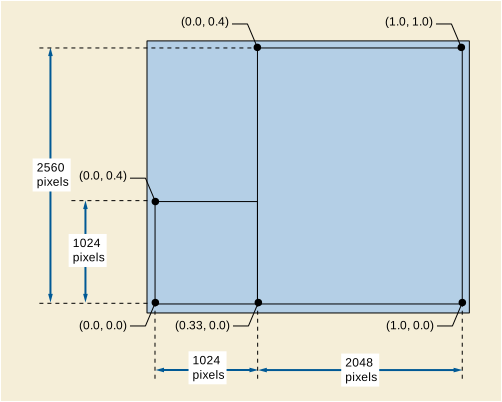
Table C.23.3-1 specifies the Attributes that describe operations (filter, reformat, sort, presentation intent), layout and interactions for a Hanging Protocol. See Annex V “Hanging Protocols (Informative)” in PS3.17 for further explanation.
Table C.23.3-1. Hanging Protocol Display Module Attributes
|
Attribute Name |
Tag |
Type |
Attribute Description |
|---|---|---|---|
|
Display Sets Sequence |
(0072,0200) |
1 |
Sequence that describes one or more display sets used to present the Image Sets defined in the Image Sets Sequence (0072,0020). One or more Items shall be included in this sequence. See Section C.23.3.1. |
|
>Display Set Number |
(0072,0202) |
1 |
A monotonically increasing integer, starting from 1, incrementing by one, unique within the Hanging Protocol Instance. It shall be used to identify linked display sets in the Display Set Scrolling Group (0072,0212). |
|
>Display Set Label |
(0072,0203) |
3 |
Description of the objective of the display set defined by this sequence item. |
|
>Display Set Presentation Group |
(0072,0204) |
1 |
Positive integer value that designates this Display Set as part of a specific presentation group. All Display Sets with the same Display Set Presentation Group (0072,0204) value shall be displayed at the same time. The value 1 shall indicate that this Display Set is part of the initial presentation group. Subsequent values incrementing by 1 shall imply successive temporal ordering of display. |
|
>Image Set Number |
(0072,0032) |
1 |
Image Set Number (0072,0032) value from a Time Based Image Sets Sequence (0072,0030) Item within the Image Sets Sequence (0072,0020) Item that is selected for display by this Display Set. NoteMultiple Image Boxes Sequence (0072,0300) Items within a Display Sets Sequence (0072,0200) Item may be used to spread one image set over multiple image boxes with the same Display Set characteristics. |
|
>Image Boxes Sequence |
(0072,0300) |
1 |
Sequence that defines the image boxes for this Display Set. Only a single Item shall be included in this sequence unless Image Box Layout Type (0072,0304) is TILED, in which case one or more items shall be included in this sequence. |
|
>>Image Box Number |
(0072,0302) |
1 |
A monotonically increasing integer that identifies the order of image boxes for scrolling, starting from 1, incrementing by one, unique within a Display Set Sequence Item. |
|
>>Display Environment Spatial Position |
(0072,0108) |
1 |
Exactly four unitless floating point values indicating the rectangular coordinate position of the image box within the overall bounding box that encompasses all the display space (across all screens). See Section C.23.2.1.1. |
|
>>Image Box Layout Type |
(0072,0304) |
1 |
Type of layout of the image box. All types except for TILED are single rectangles containing a single frame of image pixel data. The types are primarily distinguished by their interaction technique. Defined Terms:
NoteThis value may also be used for non-image objects, such as waveforms and SR documents. |
|
>>Image Box Tile Horizontal Dimension |
(0072,0306) |
1C |
Positive integer defining the horizontal Image Box tile dimension; the number of columns. Required if the value of Image Box Layout Type (0072,0304) is TILED. |
|
>>Image Box Tile Vertical Dimension |
(0072,0308) |
1C |
Positive integer defining the vertical Image Box tile dimension; the number of rows. Required if the value of Image Box Layout Type (0072,0304) is TILED. |
|
>>Image Box Scroll Direction |
(0072,0310) |
1C |
Enumerated Values:
Required if the value of Image Box Layout Type (0072,0304) is TILED, and the value of Image Box Tile Horizontal Dimension (0072,0306) or Image Box Tile Vertical Dimension (0072,0308) is greater than 1. |
|
>>Image Box Small Scroll Type |
(0072,0312) |
2C |
Defines the type of small increment scrolling to be applied to this Image Box. Required if the value of Image Box Layout Type (0072,0304) is TILED, and the value of Image Box Tile Horizontal Dimension (0072,0306) or Image Box Tile Vertical Dimension (0072,0308) is greater than 1. Scrolling is not specified if zero length. Enumerated Values:
NoteIf there are multiple image boxes of different Tile Dimensions in a Display Set, then only IMAGE scrolling applies, and the value of this attribute is ignored. |
|
>>Image Box Small Scroll Amount |
(0072,0314) |
1C |
Defines the positive integer number of pages, rows, columns, or images per small increment scroll, based on the values of Image Box Small Scroll Type (0072,0312) and Image Box Scroll Direction (0072,0310). The value applies to both forward and backward scrolling. Required if Image Box Small Scroll Type (0072,0312) is present with a value. |
|
>>Image Box Large Scroll Type |
(0072,0316) |
2C |
Defines the type of large increment scrolling to be applied to this Image Box. Required if the value of Image Box Layout Type (0072,0304) is TILED, and the value of Image Box Tile Horizontal Dimension (0072,0306) or Image Box Tile Vertical Dimension (0072,0308) is greater than 1. Enumerated Values:
NoteIf there are multiple image boxes of different Tile Dimensions in a Display Set, then only IMAGE scrolling applies, and the value of the attribute is ignored. |
|
>>Image Box Large Scroll Amount |
(0072,0318) |
1C |
Defines the positive integer number of pages, rows, columns, or images per large increment scroll, based on the values of Image Box Large Scroll Type (0072,0316) and Image Box Scroll Direction (0072,0310). The value applies to both forward and backward scrolling. Required if Image Box Large Scroll Type (0072,0316) is present with a value. |
|
>>Image Box Overlap Priority |
(0072,0320) |
3 |
If this Image Box overlaps in spatial position with others, this attribute indicates the layer of this Image Box in relation to the others. The value shall be a positive integer in the range 1 to 100, where 1 = top and 100 = bottom. If this attribute is not present, then the expected behavior is not defined. |
|
>>Preferred Playback Sequencing |
(0018,1244) |
1C |
Describes the preferred playback sequencing for the Image Box. Overrides any Preferred Playback Sequencing (0018,1244) value in the image objects being displayed. Required if the value of Image Box Layout Type (0072,0304) is CINE. Enumerated Values:
|
|
>>Recommended Display Frame Rate |
(0008,2144) |
1C |
Recommended rate at which the frames of a multi-frame image shall be displayed, in frames/second. Shall have a value greater than zero. Overrides any Recommended Display Frame Rate (0008,2144) value in the image objects being displayed. Required if the value of Image Box Layout Type (0072,0304) is CINE and if Cine Relative to Real-Time (0072,0330) is not present. |
|
>>Cine Relative to Real-Time |
(0072,0330) |
1C |
A positive unitless floating point numeric factor equal to playback rate divided by acquisition rate. Required if the value of Image Box Layout Type (0072,0304) is CINE and if Recommended Display Frame Rate (0008,2144) is not present. NoteThe capture rate may change within the image object, as specified in Frame Time (0018,1063) or Frame Time Vector (0018,1065). |
|
>Filter Operations Sequence |
(0072,0400) |
2 |
Sequence that defines filter criteria to be applied to the image set identified by Image Set Number (0072,0032). Zero or more items shall be included in this sequence. See Section C.23.3.1.1. |
|
>>Filter-by Category |
(0072,0402) |
1C |
Category of the filter operation. See Section C.23.3.1.1. Defined Terms:
Required if Selector Attribute (0072,0026) is not present. |
|
>>Filter-by Attribute Presence |
(0072,0404) |
1C |
Operation to be applied based on the presence or absence of the attribute represented by Selector Attribute (0072,0026) in each image of the Image Set. Required if Selector Attribute (0072,0026) is present and Filter-by Operator (0072,0406) is not present. Enumerated Values:
|
|
>>Selector Attribute |
(0072,0026) |
1C |
Data Element Tag of an Attribute from an Image IOD to use as a filter. See Section C.23.3.1.1 for potential attributes. Required if Filter-by Category (0072,0402) is not present. |
|
>>Selector Attribute VR |
(0072,0050) |
1C |
The Value Representation of Selector Attribute (0072,0026). Required if Selector Attribute (0072,0026) or Filter-by Category (0072,0402), and Filter-by Operator (0072,0406) are present. |
|
>>Include Table C.23.4-1 “Hanging Protocol Selector Attribute Context Macro Attributes” |
|||
|
>>Include Table C.23.4-2 “Hanging Protocol Selector Attribute Value Macro Attributes” |
|||
|
>>Selector Value Number |
(0072,0028) |
1C |
Positive integer identifying which value of the attribute identified by Selector Attribute (0072,0026) is to be used for filtering. The value 1 identifies the first value. The value zero identifies any value. Required if Selector Attribute (0072,0026) and Filter-by Operator (0072,0406) are present. |
|
>>Filter-by Operator |
(0072,0406) |
1C |
Operation to be applied between the value(s) in the Hanging Protocol Selector Attribute Value Macro ("selector"), and the value(s) of the attribute identified by Selector Attribute (0072,0026) (or the value implied by the Filter-by Category (0072,0402)) in each image of the Image Set. See Section C.23.3.1.1. Required if Filter-by Category (0072,0402) is present, or if Selector Attribute (0072,0026) is present and Filter-by Attribute Presence (0072,0404) is not present. Enumerated Values:
|
|
>>Image Set Selector Usage Flag |
(0072,0024) |
3 |
Specifies the behavior of the Filter-by Operator (0072,0406) when Selector Attribute (0072,0026) is not available in the image or does not contain a value specified by Selector Value Number (0072,0028). If this attribute is not present in this sequence item, MATCH shall be assumed. Shall be ignored if Filter-by Operator (0072,0406) is not present. Enumerated Values:
|
|
>Sorting Operations Sequence |
(0072,0600) |
2 |
Sequence that defines sorting criteria to be applied to the result of filter and reformat operations, to define the order in which to present the images in the Image Boxes. Zero or more items shall be included in this sequence. See Section C.23.3.1.2. |
|
>>Selector Attribute |
(0072,0026) |
1C |
Data Element Tag of an Attribute from an Image IOD to be used for sorting. See Section C.23.3.1.2 for potential attributes. Required if Sort-by Category (0072,0602) is not present. |
|
>>Include Table C.23.4-1 “Hanging Protocol Selector Attribute Context Macro Attributes” |
|||
|
>>Selector Value Number |
(0072,0028) |
1C |
Positive integer identifying which value of the attribute identified by Selector Attribute (0072,0026) is to be used for sorting. The value of 1 identifies the first value. Shall not be zero. Required if Selector Attribute (0072,0026) is present. |
|
>>Sort-by Category |
(0072,0602) |
1C |
Category of the sorting operation. See Section C.23.3.1.2. Defined Terms:
Required if Selector Attribute (0072,0026) is not present. |
|
>>Sorting Direction |
(0072,0604) |
1 |
Sorting direction to be applied to the value(s) in the image set of the attribute identified by Selector Attribute (0072,0026) or Sort-by Category (0072,0602). Enumerated Values:
|
|
>Blending Operation Type |
(0072,0500) |
3 |
Type of blending of superimposed and underlying images from the image set, performed before reformatting. See Section C.23.3.1.3. Defined Terms:
|
|
>Reformatting Operation Type |
(0072,0510) |
3 |
Reformatting operation to be applied to the Image Set. Defined Terms:
|
|
>Reformatting Thickness |
(0072,0512) |
1C |
The desired thickness of the reformatted images in millimeters. Required if value of Reformatting Operation Type (0072,0510) is SLAB or MPR. May be present otherwise. |
|
>Reformatting Interval |
(0072,0514) |
1C |
The desired spacing of the reformatted images in millimeters. The spacing is measured from the center-to-center of each reconstructed image. Required if value of Reformatting Operation Type (0072,0510) is SLAB or MPR. May be present otherwise. |
|
>Reformatting Operation Initial View Direction |
(0072,0516) |
1C |
Initial view of the reformatted images. Required if the value of Reformatting Operation Type (0072,0510) is MPR or 3D_RENDERING. May be present otherwise. Defined Terms:
|
|
>3D Rendering Type |
(0072,0520) |
1C |
Describes the intended 3D rendering type. One or more values shall be present. The first value shall not be zero length. Required if the value of Reformatting Operation Type (0072,0510) is 3D_RENDERING: Defined Terms for Value 1:
Additional values may be used to identify implementation specific sub-types. |
|
>Display Set Patient Orientation |
(0072,0700) |
3 |
Patient direction of the rows and columns of the images, as intended for display. See Section C.23.3.1.4. |
|
>Display Set Horizontal Justification |
(0072,0717) |
3 |
Indicates direction in which to horizontally justify the image within a viewport that is not the same shape (aspect ratio) as the image. Enumerated Values:
NoteTypically used in mammography display applications in which images from the patient's left and right are displayed "back to back", rather than centered. |
|
>Display Set Vertical Justification |
(0072,0718) |
3 |
Indicates direction in which to vertically justify the image within a viewport that is not the same shape (aspect ratio) as the image. Enumerated Values:
|
|
>VOI Type |
(0072,0702) |
3 |
Expected value of interest transformation for display (e.g., Window Center and Window Width or VOI LUT). Defined Terms:
|
|
>Pseudo-Color Type |
(0072,0704) |
3 |
A category of pseudo-color palette choice to be applied after application of the VOI LUT. If this attribute is not present, a pseudo-color palette shall not be applied. Defined Terms are the values of Content Label (0070,0080) in the list of standard color palettes defined in PS3.6 Well-Known Color Palettes. |
|
>Pseudo-Color Palette Instance Reference Sequence |
(0072,0705) |
1C |
Reference to a Color Palette Storage Instance to be applied after application of the VOI LUT. Only a single Item shall be included in this sequence. The Referenced SOP Class UID (0008,1150) shall be "1.2.840.10008.5.1.4.39.1". If the value of Pseudo-Color Type (0072,0704) is a reference to the Content Label (0070,0080) of a standard palette, the Referenced SOP Instance UID (0008,1155) shall be the corresponding Well-known SOP Instance UID defined in PS3.6. Required if Pseudo-Color Type (0072,0704) is a reference to a standard palette. May be present otherwise if Pseudo-Color Type (0072,0704) is present. |
|
>>Include Table 10-11 “SOP Instance Reference Macro Attributes” |
|||
|
>Show Grayscale Inverted |
(0072,0706) |
3 |
Whether or not to invert the rendered luminance of the displayed values. See Section C.23.3.1.4. Enumerated Values:
Note
|
|
>Show Image True Size Flag |
(0072,0710) |
3 |
Indicates whether or not to display images with the physical size of the rendered image pixel the same on the screen as specified in the image attributes, unless overridden by a Presentation State instance. Enumerated Values:
|
|
>Show Graphic Annotation Flag |
(0072,0712) |
3 |
Indicates whether or not to display items from the Graphic Annotation Sequence (0070,0001) in an applied Presentation State, and the attributes of the Overlay Plane module in the image objects or applied Presentation State. Enumerated Values:
|
|
>Show Patient Demographics Flag |
(0072,0714) |
3 |
Indicates whether or not to display patient and study identification information. Enumerated Values:
|
|
>Show Acquisition Techniques Flag |
(0072,0716) |
3 |
Indicates whether or not to display image acquisition technique information. Enumerated Values:
|
|
>Display Set Presentation Group Description |
(0072,0206) |
3 |
Description of the intent of the Display Set Presentation Group (0072,0204). If present, shall have the same value in all sequence Items assigned the same value for Display Set Presentation Group (0072,0204). |
|
Partial Data Display Handling |
(0072,0208) |
2 |
If one or more Image Sets identified by Image Set Number (0072,0032) in the Display Sets Sequence (0072,0200) Items is not available, indicate whether or not to maintain the expected layout in the absence of complete Image Sets. Enumerated Values:
If this attribute is zero length, then the expected behavior is not defined. |
|
Synchronized Scrolling Sequence |
(0072,0210) |
3 |
Each sequence item of this attribute identifies a group of Display Sets to which synchronized scrolling is to be applied. One or more Items are permitted in this sequence. The dimensions along which the synchronization occurs shall be those specified in the Sorting Operations Sequence (0072,0600). |
|
>Display Set Scrolling Group |
(0072,0212) |
1 |
Multi-valued list of two or more Display Set Number (0072,0202) values. Indicates that the images within the specified Display Sets are scrolled in parallel, to maintain the established synchronization. |
|
Navigation Indicator Sequence |
(0072,0214) |
3 |
Describes a geometric relationship between Display Sets for the purpose of static or interactive localization or navigation. One or more Items are permitted in this sequence. |
|
>Navigation Display Set |
(0072,0216) |
1C |
Display Set Number (0072,0202) of the Display Set where the geometric relationship to the Reference Display Sets (0072,0218) is graphically depicted. Required if there is a one-way interaction such that the location of the Reference Display Sets is indicated on or controlled by the Navigation Display Set. NoteFor example, the graphical representation may indicate either the number of slices displayed or contained in the Reference Display Set(s). |
|
>Reference Display Sets |
(0072,0218) |
1 |
One or more Display Set Number (0072,0202) values. If Navigation Display Set is present, shall list those Display Sets that are controlled by or indicated on the Navigation Display Set. If Navigation Display Set is absent, shall indicate that all of the Reference Display Sets cross-reference each other. |
The attributes of a Display Set Sequence Item shall be applied to the image set represented by the value of Image Set Number (0072,0032) in the following order:
Filter Operations Sequence
Reformatting
Sorting Operations Sequence
Presentation Intent
The items in the Filter Operations Sequence (0072,0400) determine which subset of the images in the identified Image Set are to be displayed in the associated Display Set image boxes. If there are multiple Items in the Filter Operations Sequence (0072,0400), the filter operations shall be applied in Item order, and the output of the preceding filter shall serve as the input to the succeeding filter (i.e., an AND operation).
When Filter-by Category (0072,0402) has a value of IMAGE_PLANE, Selector Attribute VR (0072,0050) shall have a value of "CS", and abstract Enumerated Values shall be used for the value of the associated Selector CS Value (0072,0062) attribute, which may be computed from the values of Image Orientation (Patient) (0020,0037) or Patient Orientation (0020,0020).
Enumerated Values:
- TRANSVERSE
- CORONAL
- SAGITTAL
- OBLIQUE
The MEMBER_OF and NOT_MEMBER_OF values of Filter-by Operator (0072,0406) are then applicable.
Note
Cross-sectional images do not normally contain a categorical description of the image plane, but rather only a patient-relative row and column direction cosines that are unit vectors. The category of image plane can be determined first by categorizing the row and column major directions (or detecting if the orientation is oblique according to a pre-specified threshold), and then using those categories to select a plan category.
The following pseudo-code can be used to determine the major axis (R or L, A or P, H or F) from a single direction cosine that is an (x,y,z) tuple (as defined in Section C.7.6.2.1.1):
if (abs(x) > threshold)
axis = "RL"
else if (abs(y) > threshold)
axis = "AP"
else if (abs(z) > threshold)
axis = "HF"
else
is OBLIQUE
Having determined the major axis of the row and column, the category of plane can be obtained from a table lookup:
|
Row |
|||
|---|---|---|---|
|
Column |
RL |
AP |
HF |
|
RL |
TRANSVERSE |
CORONAL |
|
|
AP |
TRANSVERSE |
SAGITTAL |
|
|
HF |
CORONAL |
SAGITTAL |
|
Alternatively, one can obtain a single vector that is the normal to the orientation (cross product of the row and column unit vectors), then find which of the x, y and z components has the maximum absolute value that is above threshold; if x then SAGITTAL, if y then CORONAL, if z then TRANSVERSE; if all of the components are below threshold then the orientation is OBLIQUE.
Since it is also necessary to determine whether or not to flip or rotate the image into the preferred orientation (as specified by Display Set Patient orientation (0072,0700)) for the category of plane (e.g., sagittals are normally viewed with row direction posteriorly and column direction towards the feet), the categorical row and column direction to use can be obtained as above, additional accounting for the sign of the direction cosine, e.g.:
if x < 0 then orientationX = "R" else orientationX = "L"
if y < 0 then orientationY = "A" else orientationY = "P"
if z < 0 then orientationZ = "F" else orientationZ = "H"
if (abs(x) > threshold)
orientation = orientationX
…
An application that is applying a Hanging Protocol Instance shall support any value for Selector Attribute (0072,0026). The Image Set Selector Usage Flag (0072,0024) specifies whether or not the image is included in the filter output when the attribute or value identified by Selector Attribute (0072,0026) is not available in an image. The attributes of the Hanging Protocol Selector Attribute Context Macro specify whether Selector Attribute (0072,0026) is contained in a Sequence, Functional Group Sequence, or Private Group.
Note
The following attributes from image IODs are examples of some possible values for Selector Attribute (0072,0026) of Filter Operations Sequence (0072,0400). This is not a complete list:
Value 3 of Image Type (0008,0008) or Frame Type (0008,9007)
Anatomic Region Sequence (0008,2218)
Pixel Presentation (0008,9205)
Volume Based Calculation Technique (0008,9207)
Acquisition Contrast (0008,9209)
Contrast/Bolus Agent (0018,0010)
Body Part Examined (0018,0015)
Scanning Sequence (0018,0020)
Intervention Drug Start Time (0018,0035)
Echo Time (0018,0081)
Echo Number(s) (0018,0086)
Protocol Name (0018,1030)
Contrast/Bolus Start Time (0018,1042)
Contrast/Bolus Stop Time (0018,1043)
Trigger Time (0018,1060)
Image Trigger Delay (0018,1067)
Radiopharmaceutical Start Time (0018,1072)
Radiopharmaceutical Stop Time (0018,1073)
Trigger Window (0018,1094)
View Position (0018,5101)
Echo Pulse Sequence (0018,9008)
Phase Contrast (0018,9014)
Effective Echo Time (0018,9082)
Laterality (0020,0060)
Image Laterality (0020,0062)
Slice Location (0020,1041)
View Code Sequence (0054,0220)
For a multi-frame image set, it is the responsibility of the application to apply the filter operations to individual frames within a multi-frame image instance in the image set, versus multiple single frame image instances in the image set that represent individual frames.
The Items in the Sorting Operations Sequence (0072,0600) define the order in which the images resulting from the filter and reformat operations on the Image Set are to be displayed in the associated Image Boxes of the Display Set. The sorting criteria may include the value of a numeric, date, or time Attribute that is expected to be present in each of the image objects in the filtered Image Set, and/or an abstract sorting category. A sorting direction shall be associated with each sorting criterion. If a textual Attribute is used for sorting, then the INCREASING sorting direction indicates alphabetical order, and DECREASING indicates reverse alphabetical order.
If a code sequence Attribute is used for sorting, then Code Meaning (0008,0104) shall be sorted alphabetically. If a string numeric Attribute is used for sorting (VR of IS or DS), then sorting shall be on the numeric value, and padding shall be ignored. When sorting by date or time Attribute, then sorting shall be on the temporal value, not the alphabetic string.
If there are multiple Items in the Sorting Operations Sequence (0072,0600), then the sorting operations shall be applied in Item order. The least rapidly varying attribute for the sorting operation shall be the first Item in the sequence.
Note
For example, a Sorting Operations Sequence (0072,0600) with two Items:
Item #1: (0018,5101) View Position, INCREASING
Item #2: (0008,0020) Study Date, INCREASING
results in the following order, based on these attribute values in the image objects:
|
View Position (0018,5101) |
Study Date (0008,0020) |
|---|---|
|
AP |
20030201 |
|
AP |
20030501 |
|
LL |
20020705 |
|
LL |
20030102 |
|
RL |
20030101 |
|
RL |
20030201 |
When the Sort-by Category (0072,0602) is used with a value of ALONG_AXIS, such as for CT, MR or other cross-sectional image sets, the sorting operation is computed from the values Image Position (Patient) (0020,0032) and Image Orientation (Patient) (0020,0037) in the image objects.
For the image set to be displayed, a "dominant axis" of the set shall be determined. The dominant axis is the normal to Image Orientation (Patient) (0020,0037) (assuming all selected images are parallel), computed as the dot product in a right-handed coordinate system (see Section C.7.6.2.1.1). The INCREASING direction for ALONG_AXIS of the image set shall be in the positive direction along the dominant axis. The DECREASING direction shall be in the negative direction along that axis.
When the Sort-by Category (0072,0602) is used with a value of BY_ACQ_TIME, the sorting operation is computed from appropriate values in the image objects (e.g., Frame Acquisition DateTime, Acquisition Time, Content Time, Acquisition DateTime), since the specific attribute used may vary from one Image Instance or SOP Class to another, yet the Hanging Protocol Instance may be generally applicable.
An application that is applying a Hanging Protocol Instance shall support any value for Selector Attribute (0072,0026), provided that it is present in the referenced Image Set. The attributes of the Hanging Protocol Selector Attribute Context Macro specify whether Selector Attribute (0072,0026) is contained in a Sequence, Functional Group Sequence or Private Group.
Note
The following attributes from image IODs are examples of some possible values for Selector Attribute (0072,0026) of Sorting Operations Sequence (0072,0600). This is not a complete list:
Acquisition DateTime (0008,002A)
Acquisition Time (0008,0032)
Echo Time (0018,0081)
Echo Number(s) (0018,0086)
Trigger Time (0018,1060)
View Position (0018,5101)
Effective Echo Time (0018,9082)
Acquisition Number (0020,0012)
Instance Number (0020,0013)
Slice Location (0020,1041), although Sort-by Category (0072,0602) with value ALONG_AXIS may be more reliable
Trigger Delay Time (0020,9153)
Stage Number (0008,2122)
View Number (0008,2128)
For a multi-frame image set, it is the responsibility of the application to apply the sorting operations to individual frames within a multi-frame image instance in the image set, versus multiple single frame image instances in the image set that represent individual frames.
A Blending Operation Type (0072,0500) of COLOR implies that the filtered selected image set contains two sets of images appropriate for blending, such as CT and PET images defined in the same frame of reference or associated by a spatial registration object. The decision as to which subset are the underlying images and which subset are the superimposed images is left to the discretion of the display application. There is no mechanism to explicitly specify the two subsets.
The relative opacity and color-related aspects of blending are not specified by the Hanging Protocol, and are left to the discretion of the application.
The attributes that indicate the presentation intent for each Display Set of a Hanging Protocol Instance are: Display Set Patient Orientation (0072,0700), VOI Type (0072,0702), Pseudo-color Type (0072,0704), Show Grayscale Inverted (0072,0706), Show Image True Size Flag (0072,0710), Show Graphic Annotation Flag (0072,0712), Show Patient Demographics Flag (0072,0714), and Show Acquisition Techniques Flag (0072,0716).
If one Presentation State instance is defined for the images that are to be displayed, then it shall be applied.
If more than one Presentation State instance is defined for the images that are to be displayed, then the presentation intent attributes, if present, shall be used to select the closest matching Presentation State instance to apply (for example, matching VOI Type (0072,0702) in the Hanging Protocol Instance with Window Center & Width Explanation in the Presentation State instance). Otherwise, the application shall determine which Presentation State instance to apply.
If no Presentation State instance is defined for the images that are to be displayed, then the presentation intent attributes, if present, shall be applied (for example, matching VOI Type (0072,0702) in the Hanging Protocol Instance with Window Center & Width Explanation in the Image). Otherwise, the display related information in the image instances shall be applied.
The intent of VOI Type (0072,0702) is to support generic intensity window settings for the Display Sets in a Hanging Protocol, such as lung, soft tissue, or bone for chest CT. It is expected for most other modalities that the window/center or VOI LUT values, if not provided in a Presentation State instance, would be provided in the image instance rather than by intent in a Hanging Protocol Instance.
The value of Show Grayscale Inverted (0072,0706) shall override any such intent expressed in the images or associated Presentation States to which the Hanging Protocol is applied.
Note
For example, an image may have a MONOCHROME2 Photometric Interpretation (0028,0004) and no Presentation LUT Shape (2050,0020), which implies that maximum values are displayed with maximum available luminance, but the presence of a Show Grayscale Inverted (0072,0706) value of YES in the Hanging Protocol requires maximum values to be displayed with minimum available luminance.
For example, an image may have an applicable Presentation State with a Presentation LUT Shape (2050,0020) of IDENTITY, which implies that maximum values are displayed with maximum available luminance, but the presence of a Show Grayscale Inverted (0072,0706) value of YES in the Hanging Protocol requires maximum values to be displayed with minimum available luminance.
For example, an image may have an applicable Presentation State with a Presentation LUT, in which case the minimum possible LUT output value (i.e., 0) will be interpreted as maximum available luminance if the value of Show Grayscale Inverted (0072,0706) is YES.
The intent of Display Set Patient Orientation (0072,0700) is to describe the preferred image rotation and/or flip for presentation within an image box. Each of the two values shall be an anatomic direction designated by the capital letters: A (anterior), P (posterior), R (right), L (left), H (head), F (foot), or X (unspecified). Each value of the orientation attribute shall contain at least one of these characters. If refinements in the orientation descriptions are to be specified, then they shall be designated by one or two additional letters in each value. Within each value, the letters shall be ordered with the principal orientation designated in the first character. If the value "X" is used for one of the values, the patient direction for that value is not defined.
The first value is the patient direction to be oriented at the right side of the image box for each image. The second value is the patient direction to be positioned at the bottom of the image box for each image. The application shall use the patient orientation information of each image (if available) to compute the best rotate and/or flip operation to be applied within the display set. If the patient orientation of an image is not defined, then this attribute shall be ignored.
Table C.23.4-1 specifies the Attributes that identify the context for a Data Element Tag that is used as a Selector Attribute (0072,0026) in Image Set Selector Sequence (0072,0022), Filter Operations Sequence (0072,0400), or Sorting Operations Sequence (0072,0600). The attribute may be an attribute nested within a Sequence or Functional Group Sequence, and/or a Private Attribute.
Table C.23.4-1. Hanging Protocol Selector Attribute Context Macro Attributes
|
Attribute Name |
Tag |
Type |
Attribute Description |
|---|---|---|---|
|
Selector Sequence Pointer |
(0072,0052) |
1C |
Contains the Data Element Tag of the Sequence that contains the Attribute that is identified by Selector Attribute (0072,0026). Required if Selector Attribute (0072,0026) is nested in a Sequence. Shall not be used to identify code sequence attributes. See Selector Code Sequence Value (0072,0080). |
|
Functional Group Pointer |
(0020,9167) |
1C |
Contains the Data Element Tag of the Functional Group Sequence that contains the Attribute that is identified by Selector Attribute (0072,0026). Required if the value of Selector Attribute (0072,0026) is the Data Element Tag of an Attribute that is contained within a Functional Group Sequence. |
|
Selector Sequence Pointer Private Creator |
(0072,0054) |
1C |
Identification of the creator of a group of private data elements. Required if the Selector Sequence Pointer (0072,0052) value is the Data Element Tag of a Private Attribute. |
|
Functional Group Private Creator |
(0020,9238) |
1C |
Identification of the creator of a group of private data elements. Required if the Functional Group Pointer (0020,9167) value is the Data Element Tag of a Private Attribute. |
|
Selector Attribute Private Creator |
(0072,0056) |
1C |
Identification of the creator of a group of private data elements. Required if the Selector Attribute (0072,0026) value is the Data Element Tag of a Private Attribute. |
The Sequence Attribute in the referenced Image identified by the value of Selector Sequence Pointer (0072,0052) may have more than one Item, in which case the filter or image set selector is applied to the values of the attribute identified by Selector Attribute (0072,0026) in all Items of the Sequence. The Selector shall match the specified value(s) of the specified Attribute in any Item of the Sequence Attribute in the referenced Image.
If the Functional Group Pointer (0020,9167) attribute is not present, then the Sequence Attribute identified by Selector Sequence Pointer (0072,0052) resides in the top level Data Set of the referenced Image.
The Functional Group Sequence is a Sequence Attribute contained within a Shared Functional Groups Sequence (5200,9229) Item or a Per-frame Functional Groups Sequence (5200,9230) Item. See Section C.7.6.16.
The Selector Sequence Pointer (0072,0052) may be used to further nest the reference to a Sequence Attribute within a Functional Group Sequence identified by Functional Group Pointer (0020,9167).
The Functional Group Private Creator (0020,9238), Selector Sequence Pointer Private Creator (0072,0054), and the Selector Attribute Private Creator (0072,0056) each has a value that corresponds to the Private Creator Data Element numbers (gggg,00pp), where gggg is odd and pp ranges from 10 to FF. These identify a block of Private Data Elements within the block (gggg,ppxx). When Selector Attribute (0072,0026), Selector Sequence Pointer (0072,0052) or Functional Group Sequence Pointer (0020,9167) points to a Private Data Element, (gggg,ppxx), it shall have the value (gggg,00xx).
Table C.23.4-2 specifies the Attributes that identify the value(s) for a Data Element Tag that is used as a Selector Attribute (0072,0026) in the Image Set Selector Sequence (0072,0022) or Filter Operations Sequence (0072,0400).
Table C.23.4-2. Hanging Protocol Selector Attribute Value Macro Attributes
|
Attribute Name |
Tag |
Type |
Attribute Description |
|---|---|---|---|
|
Selector AT Value |
(0072,0060) |
1C |
The value(s) of the attribute identified by Selector Attribute (0072,0026). Required if Selector Attribute VR (0072,0050) is present and the value is AT. |
|
Selector CS Value |
(0072,0062) |
1C |
The value(s) of the attribute identified by Selector Attribute (0072,0026). Required if Selector Attribute VR (0072,0050) is present and the value is CS. |
|
Selector IS Value |
(0072,0064) |
1C |
The value(s) of the attribute identified by Selector Attribute (0072,0026). Required if Selector Attribute VR (0072,0050) is present and the value is IS. Some leniency in precision and format (including padding with spaces and leading zeros, e.g., "001" = " 1 " = "1") will be required. |
|
Selector LO Value |
(0072,0066) |
1C |
The value(s) of the attribute identified by Selector Attribute (0072,0026). Required if Selector Attribute VR (0072,0050) is present and the value is LO. |
|
Selector LT Value |
(0072,0068) |
1C |
The value of the attribute identified by Selector Attribute (0072,0026). Required if Selector Attribute VR (0072,0050) is present and the value is LT. |
|
Selector PN Value |
(0072,006A) |
1C |
The value(s) of the attribute identified by Selector Attribute (0072,0026). Required if Selector Attribute VR (0072,0050) is present and the value is PN. |
|
Selector SH Value |
(0072,006C) |
1C |
The value(s) of the attribute identified by Selector Attribute (0072,0026). Required if Selector Attribute VR (0072,0050) is present and the value is SH. |
|
Selector ST Value |
(0072,006E) |
1C |
The value of the attribute identified by Selector Attribute (0072,0026). Required if Selector Attribute VR (0072,0050) is present and the value is ST. |
|
Selector UT Value |
(0072,0070) |
1C |
The value of the attribute identified by Selector Attribute (0072,0026). Required if Selector Attribute VR (0072,0050) is present and the value is UT. |
|
Selector DS Value |
(0072,0072) |
1C |
The value(s) of the attribute identified by Selector Attribute (0072,0026). Required if Selector Attribute VR (0072,0050) is present and the value is DS. Some leniency in precision and format (including padding and scientific notation) will be required. |
|
Selector FD Value |
(0072,0074) |
1C |
The value(s) of the attribute identified by Selector Attribute (0072,0026). Required if Selector Attribute VR (0072,0050) is present and the value is FD. |
|
Selector FL Value |
(0072,0076) |
1C |
The value(s) of the attribute identified by Selector Attribute (0072,0026). Required if Selector Attribute VR (0072,0050) is present and the value is FL. |
|
Selector UL Value |
(0072,0078) |
1C |
The value(s) of the attribute identified by Selector Attribute (0072,0026). Required if Selector Attribute VR (0072,0050) is present and the value is UL. |
|
Selector US Value |
(0072,007A) |
1C |
The value(s) of the attribute identified by Selector Attribute (0072,0026). Required if Selector Attribute VR (0072,0050) is present and the value is US. |
|
Selector SL Value |
(0072,007C) |
1C |
The value(s) of the attribute identified by Selector Attribute (0072,0026). Required if Selector Attribute VR (0072,0050) is present and the value is SL. |
|
Selector SS Value |
(0072,007E) |
1C |
The value(s) of the attribute identified by Selector Attribute (0072,0026). Required if Selector Attribute VR (0072,0050) is present and the value is SS. |
|
Selector Code Sequence Value |
(0072,0080) |
1C |
The value(s) of the attribute identified by Selector Attribute (0072,0026). One or more Items shall be included in this sequence. See Section C.23.4.2.1.2. Required if Selector Attribute VR (0072,0050) is present and the value is SQ, and Selector Attribute (0072,0026) is a code sequence. |
|
No Baseline CID is defined. |
|||
The value of Specific Character Set (0008,0005) in the Image and the Hanging Protocol Instance may differ and shall be taken into account for matching.
The value of Specific Character Set (0008,0005) may influence how matching of text Attributes is performed, in an implementation dependent manner. No requirements are specified for case sensitive or accent sensitive matching, or for ignoring padding.
The matching shall be performed on Coding Scheme Designator (0008,0102) and Code Value (0008,0100). Code Meaning (0008,0104) is required to be present, but shall be ignored for matching purposes. The matching is case sensitive, and leading and trailing spaces are not significant. The Coding Scheme Version (0008,0103) shall be ignored unless Coding Scheme Designator (0008,0102) is not sufficient to identify Code Value (0008,0100) unambiguously.
Table C.24-1 defines the Encapsulated Document Series Attributes.
Table C.24-1. Encapsulated Document Series Module Attributes
|
Attribute Name |
Tag |
Type |
Attribute Description |
|---|---|---|---|
|
Modality |
(0008,0060) |
1 |
The modality appropriate for the encapsulated document. This Type definition shall override the definition in the SC Equipment Module. See Section C.7.3.1.1.1 for Defined Terms. NoteSR may be an appropriate value for an Encapsulated CDA document with a structured XML Body. |
|
Series Instance UID |
(0020,000E) |
1 |
Unique identifier of the Series. |
|
Series Number |
(0020,0011) |
1 |
A number that identifies the Series. |
|
Referenced Performed Procedure Step Sequence |
(0008,1111) |
3 |
Uniquely identifies the Performed Procedure Step SOP Instance for which the Series is created. Only a single Item is permitted in this sequence. NoteThe Performed Procedure Step referred to by this Attribute is the Step during which this Document is generated. |
|
>Include Table 10-11 “SOP Instance Reference Macro Attributes” |
|||
|
Protocol Name |
(0018,1030) |
3 |
Description of the conditions under which the Series was performed. |
|
Series Description |
(0008,103E) |
3 |
Description of the Series |
|
Series Description Code Sequence |
(0008,103F) |
3 |
A coded description of the Series. Only a single Item is permitted in this sequence. |
|
No Baseline CID is defined. |
|||
|
Request Attributes Sequence |
(0040,0275) |
3 |
Sequence that contains attributes from the Imaging Service Request. One or more Items are permitted in this sequence. |
|
No Baseline CID is defined. |
|||
|
Include Table 10-16 “Performed Procedure Step Summary Macro Attributes” |
No Baseline CID is defined. |
||
Table C.24-2 defines the Encapsulated Document Attributes.
Table C.24-2. Encapsulated Document Module Attributes
|
Attribute Name |
Tag |
Type |
Attribute Description |
|---|---|---|---|
|
Instance Number |
(0020,0013) |
1 |
A number that identifies this SOP Instance. The value shall be unique within a series. |
|
Content Date |
(0008,0023) |
2 |
The date the document content creation was started. |
|
Content Time |
(0008,0033) |
2 |
The time the document content creation was started. |
|
Acquisition DateTime |
(0008,002A) |
2 |
The date and time that the original generation of the data in the document started. |
|
Image Laterality |
(0020,0062) |
3 |
Laterality of the (possibly paired) body part that is the subject of the encapsulated document. Enumerated Values:
|
|
Burned In Annotation |
(0028,0301) |
1 |
Indicates whether or not the encapsulated document contains sufficient burned in annotation to identify the patient and date the data was acquired. Enumerated Values:
Identification of patient and date as text in an encapsulated document (e.g., in an XML attribute or element) is equivalent to "burned in annotation". A de-identified document may use the value NO. |
|
Recognizable Visual Features |
(0028,0302) |
3 |
Indicates whether or not the image contains sufficiently recognizable visual features to allow the image or a reconstruction from a set of images to identify the patient. Enumerated Values:
If this Attribute is absent, then the image may or may not contain recognizable visual features. |
|
Source Instance Sequence |
(0042,0013) |
1C |
A sequence that identifies the set of Instances that were used to derive the encapsulated document. One or more Items shall be included in this Sequence. Required if derived from one or more DICOM Instances. May be present otherwise. |
|
>Include Table 10-11 “SOP Instance Reference Macro Attributes” |
|||
|
Document Title |
(0042,0010) |
2 |
The title of the document. NoteIn the case of a PDF encapsulated document, this may be the value of the "Title" entry in the "Document Information Directory" as encoded in the PDF data. |
|
Concept Name Code Sequence |
(0040,A043) |
2 |
A coded representation of the document title. Zero or one Item shall be included in this sequence. |
|
Baseline CID 7020 “Document Titles”. |
|||
|
Document Class Code Sequence |
(0040,E008) |
3 |
Additional classifications of the document, beyond the title represented in Concept Name Code Sequence. Equivalent to HL7 v2.x TXA-2. One or more items are permitted in this sequence. |
|
No Baseline CID is defined. |
|||
|
Verification Flag |
(0040,A493) |
3 |
Indicates whether the Encapsulated Document is Verified. Enumerated Values:
|
|
HL7 Instance Identifier |
(0040,E001) |
1C |
Instance Identifier of the encapsulated HL7 Structured Document, encoded as a UID (OID or UUID), concatenated with a caret ("^") and Extension value (if Extension is present in Instance Identifier). Required if encapsulated document is a CDA document. |
|
MIME Type of Encapsulated Document |
(0042,0012) |
1 |
The type of the encapsulated document stream described using the MIME Media Type (see RFC 2046). |
|
List of MIME Types |
(0042,0014) |
1C |
MIME Types of subcomponents of the encapsulated document. Required if the encapsulated document incorporates subcomponents with MIME types different than the primary MIME Type of the encapsulated document. NoteAn Encapsulated CDA that includes an embedded JPEG image and an embedded PDF would list "image/jpeg\application/pdf". |
|
Encapsulated Document |
(0042,0011) |
1 |
Encapsulated Document stream,containing a document encoded according to the MIME Type. |
Note
One could distinguish four stages in the creation of the Encapsulated Document Object, identified by the following Attributes:
Measurement and/or data collection, identified by Acquisition DateTime (0008,002A) in the Encapsulated Document Module.
Creation of the original documentation of the data collection, identified by Content Date (0008,0023) and Content Time (0008,0033).
Rendering of the original documentation into the format that will be encapsulated, e.g., a PDF document. The rendering time is not captured by any DICOM Attribute, but may be encoded in the rendering.
Encapsulation of the rendering into a DICOM Object, identified by Instance Creation Date (0008,0012) and Instance Creation Time (0008,0013) in the SOP Common Module.
DICOM does not specify requirements for consistency between DICOM attribute values and data in the encapsulated document. It is expected that applications will ensure consistency in a manner appropriate to the application. For example, the Patient ID in an encapsulated CDA document may be that of a different institution, which originated the document, and it may be appropriate for the DICOM attribute value to be different.
For an Encapsulated CDA Document, Document Title (0042,0010) shall have the value of the CDA Document Title, if one is present in the encapsulated document.
Concept Name Code Sequence (0040,A043) shall have the value of the CDA Document Type Code, with transcoding as necessary for converting the HL7 CE Data Type to the DICOM Code Sequence item.
Enumerated Values for MIME Type of Encapsulated Document (0042,0012):
- text/XML
Table C.25.1-1 defines the general Attributes of the Real World Value Mapping Series Module.
Table C.25.1-1. Real World Value Mapping Series Module Attributes
|
Attribute Name |
Tag |
Type |
Attribute Description |
|---|---|---|---|
|
Modality |
(0008,0060) |
1 |
Modality type. Enumerated Values:
|
Table C.25.2-1 defines the general Attributes of the Real World Value Mapping Module.
Table C.25.2-1. Real World Value Mapping Module Attributes
|
Attribute Name |
Tag |
Type |
Attribute Description |
|---|---|---|---|
|
Content Date |
(0008,0023) |
1 |
The date the content creation started. |
|
Content Time |
(0008,0033) |
1 |
The time the content creation started. |
|
Include Table 10-12 “Content Identification Macro Attributes” |
|||
|
Referenced Image Real World Value Mapping Sequence |
(0040,9094) |
1 |
A sequence of real world value mapping items. Each item defines a single mapping and a list of images to which the mapping applies. One or more Items shall be included in this sequence. |
|
>Include Table C.7.6.16-12 “Real World Value Mapping Macro Attributes” |
Defined CID for Measurement Units Code Sequence is 83 "Units for Real World Value Mapping". |
||
|
>Referenced Image Sequence |
(0008,1140) |
1 |
A sequence listing the images to which the mapping applies. One or more Items shall be included in this sequence. |
|
>>Include Table 10-3 “Image SOP Instance Reference Macro Attributes” |
|||
Table C.26-1 specifies the Attributes used to convey the characteristics or parameters of a contrast agent, drug, or device.
Table C.26-1. Product Characteristics Module Attributes
|
Attribute Name |
Tag |
Attribute Description |
|---|---|---|
|
Product Package Identifier |
(0044,0001) |
Identifier of the contrast agent, drug, or device being characterized, typically from a package bar code, RFID, or other materials management ID. This ID might not be globally unique and might conflict with other IDs used within the scope of the institution. |
|
Manufacturer |
(0008,0070) |
Manufacturer of product. |
|
Product Type Code Sequence |
(0044,0007) |
Coded type of product. Only a single Item shall be included in this sequence. |
|
For drugs, a coded terminology in the US is RxNorm For devices, a coded terminology in the US is the FDA CDRH Product Code Classification |
||
|
Product Name |
(0044,0008) |
Trade or generic name of product. NoteMay be multi-valued. |
|
Product Description |
(0044,0009) |
Further description in free form text describing the drug or device. NoteThis attribute is limited by the LT Value Representation to 10240 characters. Larger text descriptions, or graphical descriptions, may be referenced in the Pertinent Documents Sequence (0038,0100). |
|
Product Lot Identifier |
(0044,000A) |
Identifier of the manufacturing batch of which this product is part. |
|
Product Expiration DateTime |
(0044,000B) |
The date and time after which the manufacturer no longer ensures the safety, quality, and/or proper functioning of the material. |
|
Product Parameter Sequence |
(0044,0013) |
Parameters of the product. Zero or more Items shall be included in this sequence. |
|
>Include Table 10-2 “Content Item Macro Attributes Description” |
For drugs or contrast agents, for Concept Name Code Sequence, Baseline CID 4050 “Drug Or Contrast Agent Characteristics” For devices, for Concept Name Code Sequence, Baseline CID 3423 “Numeric Device Characteristics” |
|
|
Pertinent Documents Sequence |
(0038,0100) |
Reference to a Product Label document for the product. Zero or more Items shall be included in this sequence. |
|
>Referenced SOP Class UID |
(0008,1150) |
Unique identifier for the class of an HL7 Structured Product Label document. |
|
>Referenced SOP Instance UID |
(0008,1155) |
Unique identifier for the HL7 Structured Product Label Document as used in DICOM instance references (see Section C.12.1.1.6) |
|
>HL7 Instance Identifier |
(0040,E001) |
Instance Identifier of the referenced HL7 Structured Document, encoded as a UID (OID or UUID), concatenated with a caret ("^") and Extension value (if Extension is present in Instance Identifier). |
|
>Retrieve URI |
(0040,E010) |
Retrieval access path to Product Label Document. Includes fully specified scheme, authority, path, and query in accordance with [RFC 3986] NoteThe VR of this attribute has changed from UT to UR. |
Table C.26-2 specifies the Attributes used to approve the administration of a contrast agent, drug, or device to a patient.
Table C.26-2. Substance Approval Module Attributes
|
Attribute Name |
Tag |
Attribute Description |
|---|---|---|
|
Substance Administration Approval |
(0044,0002) |
Status of request for substance administration. Enumerated Values:
|
|
Approval Status Further Description |
(0044,0003) |
Description of warning or contra-indication, or notes on approval. |
|
Approval Status DateTime |
(0044,0004) |
Timestamp for the Substance Administration Approval response |
Table C.26-3 specifies the Attributes used to describe the act of administration of a contrast agent, drug, or device to a patient.
Table C.26-3. Substance Administration Module Attributes
|
Attribute Name |
Tag |
Attribute Description |
|---|---|---|
|
Administration Route Code Sequence |
(0054,0302) |
Route of administration for drug or contrast. Only a single Item shall be included in this Sequence. |
|
Baseline CID 11 “Route of Administration”. |
||
Table C.26-4 specifies the Attributes used to record the act of administration of a contrast agent, drug, or device to a patient.
Table C.26-4. Substance Administration Log Module Attributes
|
Attribute Name |
Tag |
Attribute Description |
|---|---|---|
|
Patient's Name |
(0010,0010) |
Patient's full name |
|
Patient ID |
(0010,0020) |
Primary identification number or code for the patient. |
|
Admission ID |
(0038,0010) |
Identification number of the visit as assigned by the healthcare provider |
|
Issuer of Admission ID Sequence |
(0038,0014) |
Identifier of the Assigning Authority that issued the Admission ID. Only a single Item shall be included in this sequence. |
|
>Include Table 10-17 “HL7v2 Hierarchic Designator Macro Attributes” |
||
|
Product Package Identifier |
(0044,0001) |
Identifier of the contrast agent, drug, or device administered, typically from a package bar code, RFID, or other materials management ID. This ID might not be globally unique and might conflict with other IDs used within the scope of the institution. |
|
Product Name |
(0044,0008) |
Trade or generic name of product. NoteMay be multi-valued. |
|
Product Description |
(0044,0009) |
Text description of the contrast agent, drug, or device administered. |
|
Substance Administration DateTime |
(0044,0010) |
Date and Time of Substance Administration |
|
Substance Administration Notes |
(0044,0011) |
Comments provided by the operator responsible for the substance administration. |
|
Substance Administration Device ID |
(0044,0012) |
Identifier for a device that controls substance administration, e.g., injector, infusion pump, etc. |
|
Administration Route Code Sequence |
(0054,0302) |
Route of administration for drug or contrast. Only a single Item shall be included in this Sequence. |
|
Baseline CID 11 “Route of Administration”. |
||
|
Substance Administration Parameter Sequence |
(0044,0019) |
Parameters of the substance as administered to the patient, e.g., volume, quantity. Zero or more Items shall be included in this sequence. |
|
>Include Table 10-2 “Content Item Macro Attributes Description” |
For administration of drugs or contrast agents, Baseline Context Group for Concept Name Code Sequence is CID 3410 “Numeric Parameters of Drugs/Contrast”. |
|
|
Operator Identification Sequence |
(0008,1072) |
Person administering the substance to the patient, or legally responsible for the administration, and authorized to add an entry to the Medication Administration Record. One or more Items shall be included in this Sequence. |
|
>Person Identification Code Sequence |
(0040,1101) |
Coded identifier of the person administering the contrast agent, drug, or device. Only a single Item shall be included in this Sequence. |
|
No Baseline CID is defined. The Coding Scheme Designator attribute may indicate a local coding scheme (e.g., with value "L") when it is implicitly that of the institution's employee identifier system. The Code Meaning attribute, though it is encoded with a VR of LO, may be encoded according to the rules of the PN VR (see Section 10.1). |
||
This section describes the specific modules for the Surface IE.
Table C.27-1 specifies the Attributes of the Surface Mesh Module.
Table C.27-1. Surface Mesh Module Attributes
|
Attribute Name |
Tag |
Type |
Attribute Description |
|---|---|---|---|
|
Number of Surfaces |
(0066,0001) |
1 |
Number of surfaces contained in the Instance. Shall be 1 or more. Shall be the same as the number of Items in Surface Sequence (0066,0002). |
|
Surface Sequence |
(0066,0002) |
1 |
The surfaces that are described within the data. One or more Items shall be included in this sequence. There shall be Number of Surfaces (0066,0001) Items in the sequence. See Section C.27.1.1.1. |
|
>Surface Number |
(0066,0003) |
1 |
Identification number of the surface. Uniquely identifies a surface within this SOP instance. Shall start at a value of 1, and increase monotonically by 1. |
|
>Surface Comments |
(0066,0004) |
3 |
User-defined comments describing the surface. |
|
>Surface Processing |
(0066,0009) |
2 |
Specifies whether the surface has been modified subsequent to the original generation of the surface. Enumerated Values:
See Section C.27.1.1.2. |
|
>Surface Processing Ratio |
(0066,000A) |
2C |
The Ratio of Remaining points to Original points after processing. Required if Surface Processing (0066,0009) is YES. |
|
>Surface Processing Description |
(0066,000B) |
3 |
A textual description of the surface processing performed. |
|
>Surface Processing Algorithm Identification Sequence |
(0066,0035) |
2C |
Describes the processing method. Zero or one Item shall be included in this sequence. Required if Surface Processing (0066,0009) is YES. |
|
>>Include Table 10-19 “Algorithm Identification Macro Attributes” |
For Algorithm Family Code Sequence (0066,002F) Baseline CID 7162 “Surface Processing Algorithm Families”. |
||
|
>Recommended Display Grayscale Value |
(0062,000C) |
1 |
A default single gray unsigned value in which it is recommended that the maximum pixel value in this surface be rendered on a monochrome display. The units are specified in P-Values from a minimum of 0000H (black) up to a maximum of FFFFH (white). NoteThe maximum P-Value for this Attribute may be different from the maximum P-Value from the output of the Presentation LUT, which may be less than 16 bits in depth. |
|
>Recommended Display CIELab Value |
(0062,000D) |
1 |
A default triplet value in which it is recommended that the surface be rendered on a color display. The units are specified in PCS-Values, and the value is encoded as CIELab. |
|
>Recommended Presentation Opacity |
(0066,000C) |
1 |
Specifies the opacity in which it is recommended that the surface be rendered. See Section C.27.1.1.3. |
|
>Recommended Presentation Type |
(0066,000D) |
1 |
Specifies the presentation type in which it is recommended that the surface be rendered. See Section C.27.1.1.3. |
|
>Recommended Point Radius |
(0066,0037) |
3 |
Specifies the radius of the vertex points defined in the Long Vertex Point Index List (0066,0043) with which it is recommended that the point be rendered. The units shall be the same as the units of the coordinate system in which the point coordinates are specified. |
|
>Recommended Line Thickness |
(0066,0038) |
3 |
Specifies the thickness of each edge or line defined in the Long Edge Point Index List (0066,0042) or Line Sequence (0066,0028) with which it is recommended that the line be rendered. The units shall be the same as the units of the coordinate system in which the point coordinates are specified. |
|
>Finite Volume |
(0066,000E) |
1 |
Indicates, whether the surface represents a solid ("waterproof") object with an outside and an inside. Enumerated Values:
See Section C.27.1.1.4. |
|
>Manifold |
(0066,0010) |
1 |
Indicates whether the surface is describing an n-1 dimensional manifold in the underlying n-dimensional vector space. Enumerated Values:
See Section C.27.1.1.5. |
|
>Surface Points Sequence |
(0066,0011) |
1 |
The point positions representing vertices of the surface. Only a single item shall be included in this sequence. |
|
>>Include Table C.27-2 “Points Macro Attributes” |
|||
|
>Surface Points Normals Sequence |
(0066,0012) |
2 |
The normals on the surface for each point. Zero or one item shall be included in this sequence. See Section C.27.1.1.6. |
|
>>Include Table C.27-3 “Vectors Macro Attributes” |
Number of Vectors (0066,001E) shall equal Number of Surface Points (0066,0015) in this Surface Sequence Item. Vector Dimensionality (0066,001F) shall be 3. If Finite Volume (0066,000E) is YES, the normals of the vertices shall point toward the outside of the object. If Finite Volume (0066,000E) is not YES, the direction of the normals shall be consistent where possible. |
||
|
>Surface Mesh Primitives Sequence |
(0066,0013) |
1 |
Only a single item shall be included in this sequence. |
|
>>Include Table C.27-4 “Surface Mesh Primitives Macro Attributes” |
The primitives' indices shall not exceed Number of Surface Points (0066,0015) in this Surface Sequence Item. |
||
Surface Sequence (0066,0002) describes individual surfaces. There is no requirement that a surface be contiguous. For example, both kidneys could be described as a single surface consisting of 2 non-contiguous areas.
Surface Processing refers to methods of surface modification such as smoothing operations, which remove redundant vertices, or decimation, which will modify the resolution of the surface. If a surface has been subject to processing, a description of the process may be provided in Surface Processing Description (0066,000B).
Recommended Presentation Opacity (0066,000C) is a fraction between 0.0 and 1.0 encoded as a float value representing the percentage of transmission through the surface.
The Recommended Presentation Type (0066,000D) attribute provides guidance as to the default presentation of the Surface.
Defined Terms:
- SURFACE
Render the surface as a solid, applying the opacity as specified in the Recommended Presentation Opacity (0066,000C) attribute.
- WIREFRAME
Represent the surface as a series of lines connecting the vertices to form the defined primitive faces.
- POINTS
Represent the surface as a cloud of points.
The Finite Volume attribute (0066,000E) shall be YES when the surface mesh generated by the primitives is topologically closed and has an inside and an outside. A surface mesh is closed if it has no rim (every facet has a neighboring facet along each edge). Figure C.27.1.1-1 shows a surface that is not closed on the left, and a closed and waterproof version of the same shape on the right:
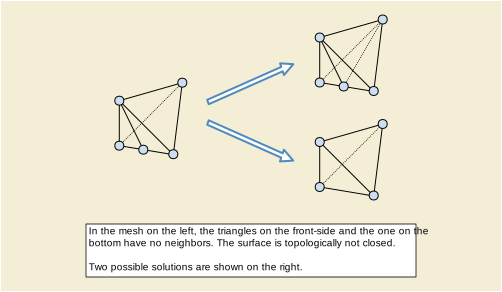
Not all closed surfaces contain a finite volume, for example if the surface self-intersects. Such surfaces do not contain a finite volume. A surface is not required to be contiguous.
A value of NO indicates that the surface is not closed.
A value of UNKNOWN indicates that the transmitting application did not determine if the surface is closed.
The Manifold attribute (0066,0010) shall be YES when the surface mesh is a manifold.
A surface embedded into an n-dimensional vector space is called an n-1 manifold if it resembles an n-1 dimensional Euclidean space in a neighborhood of every point lying on the surface. This means that every point has a neighborhood for which there exists a homeomorphism mapping that neighborhood to the n-1 dimensional Euclidean space.
A sphere in 3-space is a 2-dimensional manifold: Every point has a neighborhood that looks like a plane.
Figure C.27.1.1-2 shows examples of a surface that is not a manifold is given below:
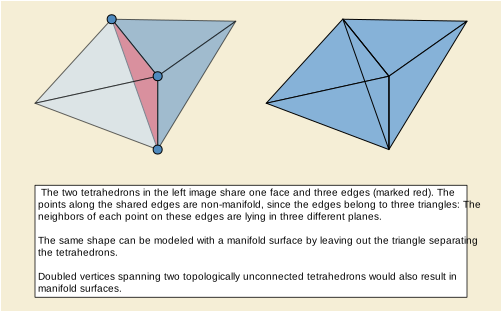
A value of NO indicates that the surface is not a manifold.
A value of UNKNOWN indicates that the transmitting application did not determine if the surface is a manifold.
Surface Points Normals Sequence (0066,0012) provides an explicit normal vector for each point in Surface Points Sequence (0066,0011) in Point Coordinates Data (0066,0016).
If an Item of Surface Points Normals Sequence (0066,0012) is present the normal for a primitive may be computed by combining the normals for each vertex making up the primitive.
If an Item of Surface Points Normals Sequence (0066,0012) is not present the normal for a primitive shall be computed by computing the cross product of two segments of the primitive. The segments shall be formed using the primitive definitions as specified within the Surface Mesh Primitives Sequence (0066,0013). The primitive vertices are taken in the order specified within Long Primitive Point Index List (0066,0040). Figure C.27.1.1-3 shows the method to compute the normal:

The computed normal shall point in the direction of the outside of the surface.
For Triangle Strip or Triangle Fan primitives (see Section C.27.4), the normal direction is determined by the order of the points referenced by the first triangle in the strip or fan. When constructing a list of triangles from a triangle strip, the order of the points must be flipped for every second triangle to maintain consistency in the normal directions for the triangle.
Table C.27-2 specifies the Attributes of the Points Macro.
Table C.27-2. Points Macro Attributes
|
Attribute Name |
Tag |
Type |
Attribute Description |
|---|---|---|---|
|
Number Of Surface Points |
(0066,0015) |
1 |
Specifies the number of points in the point set. See Section C.27.2.1.1. |
|
Point Coordinates Data |
(0066,0016) |
1 |
|
|
Point Position Accuracy |
(0066,0017) |
3 |
A single standard deviation of the error for all the points' spatial positions. The units shall be the same as the units of the coordinate system in which the point coordinates are specified. |
|
Mean Point Distance |
(0066,0018) |
3 |
The mean point distance of the point set. It is given by the mean of the distances to the nearest neighbor over all points. The units shall be the same as the units of the coordinate system in which the point coordinates are specified. |
|
Maximum Point Distance |
(0066,0019) |
3 |
The maximum distance of one point to its nearest neighbor. The units shall be the same as the units of the coordinate system in which the point coordinates are specified. |
|
Points Bounding Box Coordinates |
(0066,001A) |
3 |
Two 3D locations defining the cuboid bounding box, parallel to the coordinate system axes, encompassing the point set. |
|
Axis of Rotation |
(0066,001B) |
3 |
A 3D location that combined with Center of Rotation (0066,001C) specifies the preferred axis of rotation of this object. |
|
Center of Rotation |
(0066,001C) |
1C |
A 3D location defining the preferred center of rotation for this point set. Required if Axis of Rotation (0066,001B) is present. May be present otherwise. |
All Attributes within this module containing points or vectors are in x-y-z order. If multiple elements are encoded, the ordering is x1,y1,z1,…,xn,yn,zn.
The points are in the coordinate system identified by the Frame of Reference UID (0020,0052). To map these points into the coordinate system of another SOP Instance a Spatial Registration Instance can be used.
Table C.27-3 specifies the attributes of the Vectors Macro.
Table C.27-3. Vectors Macro Attributes
|
Attribute Name |
Tag |
Type |
Attribute Description |
|---|---|---|---|
|
Number of Vectors |
(0066,001E) |
1 |
The number of vectors in the Vector Coordinate Data (0066,0021). See Section C.27.3.1. |
|
Vector Dimensionality |
(0066,001F) |
1 |
The dimensionality of the underlying vector field. See Section C.27.3.1. |
|
Vector Accuracy |
(0066,0020) |
3 |
A single standard deviation for all the vectors' coordinates. The units shall be the same as the units of the coordinate system in which the vector coordinates are specified. See Section C.27.3.1. |
|
Vector Coordinate Data |
(0066,0021) |
1 |
A data stream of coordinates encoded as floats. See Section C.27.3.1. |
All Attributes within this module containing points or vectors are encoded as multi-valued floats in an x-y-z ordering. If multiple elements are encoded, the ordering is x1,y1,z1,…,xn,yn,zn.
The vectors encoded in this macro can be anything from 1D to nD objects. The vectors are encoded as a stream of values in the Vector Coordinate Data (0066,0021) Attribute. Vector Dimensionality (0066,001F) defines how many subsequent entries in Vector Coordinate Data (0066,0021) describe one element. Vector Coordinate Data (0066,0021) shall have (Number of Vectors) x (Vector Dimensionality) values.
For measured vectors, Vector Accuracy (0066,0020) describes the error per dimension in a multi-valued float attribute.
Note
The vectors are located at the points specified by the table including this macro.
Table C.27-4 specifies the attributes of the Surface Mesh Primitives Macro.
Table C.27-4. Surface Mesh Primitives Macro Attributes
|
Attribute Name |
Tag |
Type |
Attribute Description |
|---|---|---|---|
|
Long Vertex Point Index List |
(0066,0043) |
2 |
Contains n point indices describing Vertices. See Section C.27.4.1. |
|
Long Edge Point Index List |
(0066,0042) |
2 |
Contains 2n point indices describing unconnected Edges. See Section C.27.4.1. |
|
Long Triangle Point Index List |
(0066,0041) |
2 |
Contains 3n point indices describing unconnected Triangles. See Section C.27.4.1. |
|
Triangle Strip Sequence |
(0066,0026) |
2 |
All Triangle Strips in this Surface. Zero or more Items shall be included in this sequence. |
|
>Long Primitive Point Index List |
(0066,0040) |
1 |
See Section C.27.4.1. |
|
Triangle Fan Sequence |
(0066,0027) |
2 |
All Triangle Fans in this Surface. Zero or more Items shall be included in this sequence. |
|
>Long Primitive Point Index List |
(0066,0040) |
1 |
See Section C.27.4.1. |
|
Line Sequence |
(0066,0028) |
2 |
All Lines in this Surface. Zero or more Items shall be included in this sequence. |
|
>Long Primitive Point Index List |
(0066,0040) |
1 |
See Section C.27.4.1. |
|
Facet Sequence |
(0066,0034) |
2 |
All Facets in this Surface. Each sequence Item describes one facet. Zero or more Items shall be included in this sequence. |
|
>Long Primitive Point Index List |
(0066,0040) |
1 |
See Section C.27.4.1. |
The Surface Mesh Primitives Macro uses point indices to reference the point rather than repeating point coordinates. All of the point coordinates used are specified within the Surface Points Sequence (0066,0011) of the same Surface Sequence (0066,0002) item. Point indices are described in Section C.27.2.1.1.
Note
In a previous edition, other Attributes were used that had an OW VR and a limitation to no more than 65535 points per surface. These have been retired and replaced with new Attributes. See PS 3.3 2014a.
A Surface Mesh shall contain one or more of the following primitive types:
Vertex a single Vertex, referencing a single point
Edge an Edge, referencing two points
Line a series of connected points describing a path
Triangle a Triangle, referencing three points:
Triangle Strip a Triangle Strip with n triangles, referencing n+2 points. The first three referenced points describe the first triangle, the second, third and fourth referenced points describe the second triangle.
Triangle Fan a Triangle Fan with n triangles, referencing n+2 points. The first referenced point is in the center of the fan. Together with two subsequent referenced points, it describes a complete triangle.
Facet a closed planar polygon, referencing n points. The final point in the point index list shall be connected to the first point in the point index list to close the facet.
If the Surface Points Normals Sequence (0066,0012) is not present, the default normals can be derived from the Surface Mesh Primitives.
For the Triangle Strip, Triangle Fan and Facet the Long Primitive Point Index List (0066,0040) the ordering of the point references implies the direction of the primitive's normal: The normal points in the direction from which the referenced points are specified in a counterclockwise order. For finite volumes this shall be the outward direction.
For the Line primitive, the ordering of the point references defines a directed path, starting with the first point and ending with the last point referenced in each Long Primitive Point Index List (0066,0040).
For Primitives of type Triangle Strip or Triangle Fan, the orientation of the normals is given by the order of the points in the first triangle.
Note
These points may be used to compute normals to the primitive. (see Section C.27.1.1.6.) The order these point references are presented in the Long Primitive Point Index List (0066,0040) will affect the direction the computed normal points. If the order of the point references is reversed, the direction of the normals will be reversed as well.
Table C.27.5-1 specifies the Attributes of the Point Cloud Module.
Table C.27.5-1. Point Cloud Module Attributes
|
Attribute Name |
Tag |
Type |
Attribute Description |
|---|---|---|---|
|
Surface Points Sequence |
(0066,0011) |
1 |
The point positions representing vertices of the surface. Only one item shall be included in the sequence. |
|
Surface Point Presentation Value Data |
(0080,0006) |
3 |
Contains a vector of P-Values to assign a gray value to each point. The number of values shall be equal to the value of Number Of Surface Points (0066,0015) in the Points Macro. Each value shall correspond to the respective point in the Point Coordinates Data (0066,0016). |
|
Surface Point Color CIELab Value Data |
(0080,0007) |
3 |
Contains a vector of color triplets to assign colors to each point. The number of triplets shall be equal to the value of Number Of Surface Points (0066,0015) in the Points Macro. The units are PCS-Values, and the value is encoded as CIELab. See Section C.10.7.1.1. Each triplet shall correspond to the respective point in the Point Coordinates Data (0066,0016). |
Table C.27.6-1 specifies the Attributes of the UV Mapping Module.
Table C.27.6-1. UV Mapping Module Attributes
|
Attribute Name |
Tag |
Type |
Attribute Description |
|---|---|---|---|
|
UV Mapping Sequence |
(0080,0008) |
1 |
Maps each point of the Surface Points Sequence (0066,0011) in the Point Cloud Module or the Surface Mesh Module to the coordinates of a VL Photographic Image Instance. One or more Items shall be included in this Sequence. |
|
>Texture Label |
(0080,0009) |
1 |
Contains a label that uniquely identifies this UV map to distinguish it from other items in the sequence. |
|
>U Value Data |
(0080,0010) |
1 |
Contains a vector of column offsets. Each value is normalized to the range of 0.0 to 1.0 pointing in the pixel data of the referenced textures sequence image. Each value shall correspond to the respective point in the Point Coordinates Data (0066,0016). The number of values must be equal to the number of points of the Point Cloud or the Surface Mesh. |
|
>V Value Data |
(0080,0011) |
1 |
Contains a vector of row offsets. Each value is normalized to the range of 0.0 to 1.0 pointing in the pixel data of the referenced textures sequence image. Each value shall correspond to the respective point in the Point Coordinates Data (0066,0016). The number of values must be equal to the number of points of the Point Cloud or the Surface Mesh. |
|
>Referenced Texture Sequence |
(0080,0012) |
1 |
The image that is being mapped to the point cloud or the surface mesh. Only one item shall be included in the Sequence. |
|
>>Include Table 10-3b “Referenced Instances and Access Macro Attributes” |
|||
UV texturing allows a 3D object to be colored with the color from a 2D image. The 2D image therefore is called texture map. During the UV mapping process pixels from the 2D image are assigned to each point in the point cloud or the surface mesh of the object. The 2D image shall fully cover the space of the scanned object. If more than one texture with different resolutions or different exposures is required separate SOP Instances shall be created.
The term U and V is used because X, Y and Z are already assigned to the coordinates of the points of the scanned object.
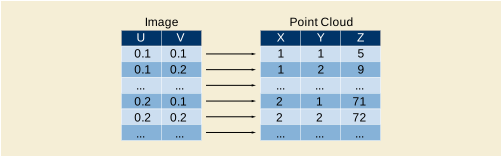
Table C.28.1-1 specifies the Attributes that describe and identify a Color Palette.
Table C.28.1-1. Color Palette Definition Module Attributes
|
Attribute Name |
Tag |
Type |
Attribute Description |
|---|---|---|---|
|
Include Table 10-12 “Content Identification Macro Attributes” |
See Section C.28.1.1.1. |
||
Content Label (0070,0080) is intended to be a short human-readable label for a palette, suitable for rendering in a pick-list for the user to choose from. For standard palettes with well-known SOP Instance UIDs, values for this attribute are pre-defined by the standard.
Descriptions of the palette may also be encoded. A means for providing alternate representations of descriptions for use in specific languages is also provided.
This section describes the specific modules for the Generic Implant Template IOD.
Table C.29.1.1-1 defines the general Attributes of the Generic Implant Template Description Module.
Table C.29.1.1-1. Generic Implant Template Description Module Attributes
|
Attribute Name |
Tag |
Type |
Attribute Description |
|---|---|---|---|
|
Manufacturer |
(0008,0070) |
1 |
Name of the manufacturer that produces the implant. |
|
Frame of Reference UID |
(0020,0052) |
1 |
Defines a 3D Frame of Reference for this component. |
|
Implant Name |
(0022,1095) |
1 |
The (product) name of the implant. |
|
Implant Size |
(0068,6210) |
1C |
The size descriptor of the component. Required if the component exists in different sizes and the size number is not part of the name or identifier. May be present otherwise. See Section C.29.1.1.1.1 for details. |
|
Implant Part Number |
(0022,1097) |
1 |
The (product) identifier of the implant. |
|
Implant Template Version |
(0068,6221) |
1 |
The version code of the implant template. If Implant Type (0068,6223) is DERIVED, this shall have the same value as the Implant Template Version (0068,6221) of the manufacturer's implant template from which this instance was derived. |
|
Replaced Implant Template Sequence |
(0068,6222) |
1C |
Reference to the Implant Template that is replaced by this template. Only a single Item shall be included in this sequence. Required if this Instance replaces another Instance. |
|
>Include Table 10-11 “SOP Instance Reference Macro Attributes” |
|||
|
Implant Type |
(0068,6223) |
1 |
Indicates whether the Implant Template is derived from another Implant Template. Enumerated Values:
|
|
Original Implant Template Sequence |
(0068,6225) |
1C |
Reference to the Implant Template Instance with Implant Type (0068,6223) ORIGINAL from which this Instance was ultimately derived. Only a single Item shall be included in this sequence. Required if Implant Type (0068,6223) is DERIVED. |
|
>Include Table 10-11 “SOP Instance Reference Macro Attributes” |
|||
|
Derivation Implant Template Sequence |
(0068,6224) |
1C |
Reference to Implant Template Instance from which this Instance was directly derived. Only a single Item shall be included in this sequence. Required if Implant Type (0068,6223) is DERIVED. |
|
>Include Table 10-11 “SOP Instance Reference Macro Attributes” |
|||
|
Effective DateTime |
(0068,6226) |
1 |
Date and time from which this Instance is or will be valid. |
|
Implant Target Anatomy Sequence |
(0068,6230) |
3 |
Sequence that identifies the anatomical region the implant is to be implanted to. One or more Items are permitted in this sequence. |
|
>Anatomic Region Sequence |
(0008,2218) |
1 |
Sequence that identifies the anatomic region of interest in this Instance (i.e., external anatomy, surface anatomy, or general region of the body). Only a single Item shall be included in this sequence. |
|
Notification From Manufacturer Sequence |
(0068,6265) |
1C |
Information from the manufacturer concerning a critical notification, recall, or discontinuation of the implant or implant template. One or more Items shall be included in this sequence. Required if such information has been issued. |
|
>Information Issue DateTime |
(0068,6270) |
1 |
Date and Time the information was issued. |
|
>Information Summary |
(0068,6280) |
1 |
Summary of the information. |
|
>Encapsulated Document |
(0042,0011) |
3 |
The complete manufacturer notification describing the template. Encapsulated Document stream, containing a document encoded according to the MIME Type. |
|
>MIME Type of Encapsulated Document |
(0042,0012) |
1C |
The type of the encapsulated document stream described using the MIME Media Type (see RFC 2046). Required if Encapsulated Document (0042,0011) is present in this Sequence item. Enumerated Values:
|
|
Information From Manufacturer Sequence |
(0068,6260) |
3 |
Information from Manufacturer other than described in Notification From Manufacturer Sequence (0068,6265). One or more Items shall be included in this sequence. |
|
>Information Issue DateTime |
(0068,6270) |
1 |
Date and Time the information was issued. |
|
>Information Summary |
(0068,6280) |
1 |
Summary of the information. |
|
>Encapsulated Document |
(0042,0011) |
3 |
Encapsulated Document stream, containing a document encoded according to the MIME Type. The complete manufacturer information. |
|
>MIME Type of Encapsulated Document |
(0042,0012) |
1C |
The type of the encapsulated document stream described using the MIME Media Type (see RFC 2046). Required if Encapsulated Document (0042,0011) is present in this Sequence item. Enumerated Values:
|
|
Implant Regulatory Disapproval Code Sequence |
(0068,62A0) |
1C |
Sequence containing countries and regions in which the implant is not approved for usage. One or more Items shall be included in this sequence. Required if the implant has been disapproved in a country or a region. |
|
Defined CID 5001 “Countries”. |
|||
|
Overall Template Spatial Tolerance |
(0068,62A5) |
2 |
Tolerance in mm applying to all distance measurements and spatial locations in this Implant Template. |
|
Materials Code Sequence |
(0068,63A0) |
1 |
A code sequence specifying the materials the implant was built from. One or more Items shall be included in this Sequence. |
|
Baseline CID 7300 “Implant Materials”. |
|||
|
Coating Materials Code Sequence |
(0068,63A4) |
1C |
A code sequence specifying the materials the implant is coated with. One or more Items shall be included in this Sequence. Required if the implant is coated. |
|
Baseline CID 7300 “Implant Materials”. |
|||
|
Implant Type Code Sequence |
(0068,63A8) |
1 |
Sequence containing a coded description of the type of implant the template reflects. Only a single Item shall be included in this sequence. |
|
Baseline CID 7307 “Implant Component Types”. |
|||
|
Fixation Method Code Sequence |
(0068,63AC) |
1 |
The method that will be used to fixate the implant in the body. Only a single Item shall be included in this sequence. |
|
Baseline CID 7310 “Implant Fixation Method”. |
|||
Implant Size (0068,6210) is the descriptor defined by the manufacturer to distinguish between different sizes of one kind of implant, e.g., size S/M/L/XL.
The Frame of Reference UID (0020,0052) Attribute is used as an identifier for spatial registration in 3D. The Frame Of Reference UID uniquely identifies the spatial frame of reference of all 3D models contained in an Implant Template UID Instance.
If the Frame Of Reference UIDs in two instances are identical, the contained 3D Models are defined in the same 3D space, i.e., require no additional registration.
Table C.29.1.2-1 defines the general Attributes of the Generic Implant Template 2D Drawings Module. This module contains all Attributes required for the inclusion of technical 2D drawings in an IOD, e.g., the Implant Template IOD. The module specification contains the definition of a subset of the HPGL plotter language that is used for the graphical definition of the drawings.
Table C.29.1.2-1. Generic Implant Template 2D Drawings Module Attributes
|
Attribute Name |
Tag |
Type |
Attribute Description |
|---|---|---|---|
|
HPGL Document Sequence |
(0068,62C0) |
1 |
The 2D template representations of this implant. One or more Items shall be included in this sequence. |
|
>HPGL Document ID |
(0068,62D0) |
1 |
Identification number of the HPGL Document. Uniquely identifies an HPGL Document within this SOP instance. The value shall start at 1, and increase monotonically by 1. |
|
>HPGL Document Label |
(0068,62D5) |
3 |
Label describing the document. |
|
>View Orientation Code Sequence |
(0068,62E0) |
1 |
Coded description of the direction of view represented by this 2D template. Only a single Item shall be included in this sequence. |
|
>View Orientation Modifier |
(0068,62F0) |
3 |
View Orientation Modifier. |
|
Baseline CID 7303 “Implant Templates Modified View Orientations”. |
|||
|
>HPGL Document Scaling |
(0068,62F2) |
1 |
Conversion factor (real world mm/printed mm) See Section C.29.1.2.1.1. |
|
>HPGL Document |
(0068,6300) |
1 |
The HPGL document as a byte stream. See Section C.29.1.2.1.2. |
|
>HPGL Contour Pen Number |
(0068,6310) |
1 |
Numeric ID of the pen used in the encapsulated HPGL document for outlines. |
|
>HPGL Pen Sequence |
(0068,6320) |
1 |
Labels for each pen used in the encapsulated HPGL Document. One or more Items shall be included in this sequence. Shall contain one item per pen used in the HPGL document. |
|
>>HPGL Pen Number |
(0068,6330) |
1 |
Numeric ID of the pen in the HPGL document |
|
>>HPGL Pen Label |
(0068,6340) |
1 |
Label of the pen. |
|
>>HPGL Pen Description |
(0068,6345) |
3 |
Description of the kind of information drawn with the pen. |
|
>Recommended Rotation Point |
(0068,6346) |
1 |
Point around which the 2D template is rotated in manual planning, in HPGL coordinates. |
|
>Bounding Rectangle |
(0068,6347) |
1 |
HPGL coordinates of the smallest rectangle parallel to the paper axes that contains the whole drawing. |
HPGL Documents use integer coordinates based on a 25µm grid in the printing space - i.e., the paper to print on - rather than the object space. HPGL Document Scaling (0068,62F2) is used to scale the printed dimensions measured in millimeters to match the real dimensions of the implant measured in millimeters.
Note
For example, if HPGL Document Scaling is 2.5, then a line in HPGL that goes from (0,0) to (0,500) that is 12.5 mm long when printed represents 31.25 mm in the real world.
In HPGL, the origin of the printing space is placed in the lower left corner with the x-axis pointing to the right. No negative coordinates are allowed.
This Attribute does not compensate for any radiographic geometric magnification effect caused by the diverging X-ray beam in the projection patient images used for planning. Such compensation is the responsibility of the application based on calibration of the imaging process.
The HPGL files encapsulated in the Attribute HPGL Document (0068,6300) is restricted to a subset of HPGL commands called DICOM-HPGL specified in this section.
The aim of DICOM-HPGL is to facilitate the storage of 2D template graphics in DICOM implant objects. DICOM-HPGL is a subset of HPGL-2 that is kept as minimal as possible to comply with the needs of 2D implant templates.
DICOM-HPGL documents consist of valid HPGL commands terminated by a semicolon. Commands consist of a two-letter mnemonic and zero or more numeric parameters separated by commas. To separate between commands, line breaks (x0D, x0A or x0Dx0A) or whitespaces (x20) may be used but are not mandatory.
Only the following commands shall be used in a DICOM-HPGL document
Table C.29.1.2-2. Permitted HPGL Commands
|
Command |
Parameter |
Meaning |
|---|---|---|
|
IN |
- |
Initialize. |
|
PA |
[X,Y] |
Plot Absolute. The optional parameter assigns an initial position for the pen. |
|
PC |
Pen Number, Red, Green, Blue |
Set Color of Pen with the given Pen Number. Colors are in RGB, intensities are encoded 0…255. The colors for pen number 0 shall be white and the color for pen number 1 shall be black. It is recommended to use only the pen numbers up to 255 to ensure compatibility with older HPGL viewers. |
|
SP |
Pen Number |
Select Pen It is recommended to use only the pen numbers up to 255 to ensure compatibility with older HPGL viewers. Only pen numbers shall be used to which a color has been specified in a precedent PC command. |
|
PU |
[X,Y,…[,X,Y]] |
Pen Up. The optional sequence of paired parameters describe subsequent pen motions after lifting the pen. |
|
PD |
[X,Y,…[,X,Y]] |
Pen Down. The optional sequence of paired parameters describe subsequent pen motions after lowering the pen. |
According to the parameter definition in HPGL, [] indicate optional parameters. The expression [X,Y,…[,X,Y]] indicates a sequence of arbitrary length of paired parameters X and Y. The commands and their parameters shall be interpreted as specified in the HP PCL/PJL Reference.
Note
This document can be obtained from URL: http://h20000.www2.hp.com/bc/docs/support/SupportManual/bpl13211/bpl13211.pdf
The coordinates in a DICOM-HPGL document are absolute values with respect to the lower left corner of the drawing space. The units of length within HPGL are 25 µm with respect to pen movements in the drawing space.
The DICOM-HPGL Document shall be structured as shown in Figure C.29.1.2-1.
Figure C.29.1.2-2 shows an example for a DICOM-HPGL Document in plain text (as byte stream), and plotted.
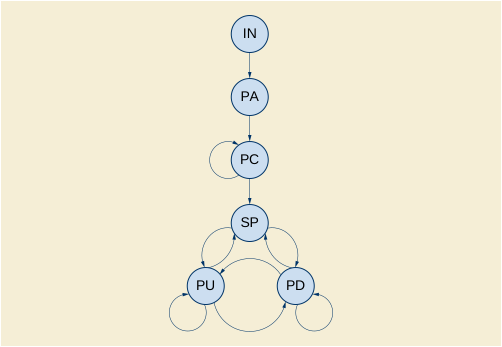
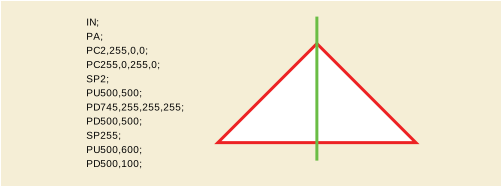
Table C.29.1.3-1 defines the general Attributes of the Generic Implant Template 3D Models Module. This module contains Attributes that add context and scaling information to surfaces specified in the Surface Mesh Module (C.27.1), for 3D Models in an Implant Template Instance.
Table C.29.1.3-1. Generic Implant Template 3D Models Module Attributes
|
Attribute Name |
Tag |
Type |
Attribute Description |
|---|---|---|---|
|
Implant Template 3D Model Surface Number |
(0068,6350) |
1 |
Surface Number (0066,0003) of the surface that represents the shape of the entire implant. |
|
Surface Model Description Sequence |
(0068,6360) |
1 |
The description of the Surface Model. One or more Items shall be included in this sequence. Shall contain one Item per Item in Surface Sequence (0066,0002). |
|
>Referenced Surface Number |
(0066,002C) |
1 |
Reference to a Surface Number (0066,0003) present in Surface Sequence (0066,0002). |
|
>Surface Model Label |
(0068,6380) |
1 |
Label for this surface. |
|
Surface Model Scaling Factor |
(0068,6390) |
1 |
Scaling factor (mm/Surface unit) See Section C.29.1.3.1.1. |
Surface Model Scaling Factor (0068,6390) is used to scale dimensions of the surface mesh representation to match the real dimensions of the implant measured in millimeters.
This Attribute does not compensate for any radiographic geometric magnification effect caused by the diverging X-ray beam in the projection patient images used for planning. Such compensation is the responsibility of the application based on calibration of the imaging process.
Table C.29.1.4-1 defines the general Attributes of the Generic Implant Template Mating Features Module. This module adds coordinate systems that can be utilized to geometrically constrain mating of Implant Templates when planning the implantation of a modular implant.
Note
An Implant Template may contain 2D drawings of the described implant, 3D surface models of the described implant, or both. In this module mating features that constrain the geometric matching of implants in multi-component assemblies are specified. These geometric features (points and axes) can be specified in the 2D drawings as well as the 3D models. Mating features are grouped into mating feature sets (see PS3.17). Based on the existence of 2D drawings and/or 3D models in the Instance, either or both is possible. In this module, there are a number of conditions on attribute use to support the following cases:
Specification of 2D mating features is only possible if at least one 2D drawing is present in the instance.
Specification of 3D mating features is only possible if at least one 3D model is present in the instance.
Table C.29.1.4-1. Generic Implant Template Mating Features Module Attributes
|
Attribute Name |
Tag |
Type |
Attribute Description |
|---|---|---|---|
|
Mating Feature Sets Sequence |
(0068,63B0) |
3 |
Mating feature sets used to combine the implant with other implants. One or more Items shall be included in this sequence. |
|
>Mating Feature Set ID |
(0068,63C0) |
1 |
Identification number of the set. Uniquely identifies a mating feature set within this SOP instance. The value shall start at 1, and increase monotonically by 1 for each Item. |
|
>Mating Feature Set Label |
(0068,63D0) |
1 |
Label of the set. |
|
>Mating Feature Sequence |
(0068,63E0) |
1 |
The mating features of the set. One or more Items shall be included in this sequence. |
|
>>Mating Feature ID |
(0068,63F0) |
1 |
Numeric ID of the mating feature. Uniquely identifies a mating feature within this Sequence Item. |
|
>>3D Mating Point |
(0068,64C0) |
1C |
Origin of the contact system. Required if 2D Mating Feature Coordinates Sequence (0068,6430) is not present and Implant Template 3D Model Surface Number (0068,6350) is present. May be present if 2D Mating Feature Coordinates Sequence (0068,6430) is present and Implant Template 3D Model Surface Number (0068,6350) is present. |
|
>>3D Mating Axes |
(0068,64D0) |
1C |
The Axes of contact described as direction cosines in the 3D coordinate system defined by the Frame Of Reference UID. Required if 3D Mating Point (0068,64C0) is present. |
|
>>2D Mating Feature Coordinates Sequence |
(0068,6430) |
1C |
Coordinates of the mating feature in the HPGL documents. One or more Items shall be included in this sequence. Required if 3D Mating Point (0068,64C0) is not present and HPGL Document Sequence (0068,62C0) is present. May be present if 3D Mating Point (0068,64C0) is present and HPGL Document Sequence (0068,62C0) is present. |
|
>>>Referenced HPGL Document ID |
(0068,6440) |
1 |
Value of the HPGL Document ID (0068,62D0) present in the HPGL Document Sequence (0068,62C0) that contains the 2D Drawing including the Mating Feature. Shall be unique within the sequence. |
|
>>>2D Mating Point |
(0068,6450) |
1 |
Origin of the contact system, in HPGL coordinates. |
|
>>>2D Mating Axes |
(0068,6460) |
1 |
Direction cosines of the contact system. |
|
>>Mating Feature Degree of Freedom Sequence |
(0068,6400) |
3 |
Degrees of freedom in this mating feature. One or more Items are permitted in this sequence. See Section C.29.1.4.1.2. |
|
>>>Degree of Freedom ID |
(0068,6410) |
1 |
Numeric ID of the degree of freedom. Uniquely identifies a degree of freedom within this Sequence Item. The value shall start at 1, and increase monotonically by 1 for each Item. |
|
>>>Degree of Freedom Type |
(0068,6420) |
1 |
Indicates the type of the degree of freedom. Enumerated Values:
See Section C.29.1.4.1.2. |
|
>>>2D Degree of Freedom Sequence |
(0068,6470) |
1C |
Geometric specifications of the degrees of freedom for this HPGL Document. One or more Items shall be included in this sequence. Required if 2D Mating Feature Coordinates Sequence (0068,6430) is present. See Section C.29.1.4.1.2. |
|
>>>>Referenced HPGL Document ID |
(0068,6440) |
1 |
Value of the HPGL Document ID (0068,62D0) present in the HPGL Document Sequence (0068,62C0) that contains the 2D Drawing including the Mating Feature. See Section C.29.1.4.1.2. Shall be unique within the sequence. |
|
>>>>2D Degree Of Freedom Axis |
(0068,64F0) |
1 |
Direction cosines of the axis of the degree of freedom. See Section C.29.1.4.1.2. |
|
>>>>Range of Freedom |
(0068,64A0) |
1 |
Interval of freedom for this degree of freedom. See Section C.29.1.4.1.2. |
|
>>>3D Degree Of Freedom Axis |
(0068,6490) |
1C |
Direction cosines of the axis of the degree of freedom in the Frame of Reference of the template. See Section C.29.1.4.1.2. Required if 3D Mating Point (0068,64C0) is present. |
|
>>>Range of Freedom |
(0068,64A0) |
1C |
Two floating point numbers defining a value range for this degree of freedom. See Section C.29.1.4.1.2. Required if 3D Mating Point (0068,64C0) is present. |
These Attributes establish a Cartesian coordinate system relative to the Frame of Reference of the implant. When two implants are assembled using a pair of mating features, a rigid spatial registration can be established, that transforms one Frame of Reference so that the mating features align.
Mating Feature Degree of Freedom Sequence (0068,6400) is used to specify that a mating feature allows mating with another implant not only in one defined pose, but within a certain range of freedom. One sequence item specifies one degree of freedom that may be a rotation around or a translation along an arbitrary axis. The Degree of Freedom Type (0068,6420) specifies whether the degree of freedom describes a rotation or a translation.
The 3D coordinates of the axis of translation or rotation is specified by 3D Degree Of Freedom Axis (0068,6490) with respect to the Implant Template's Frame of Reference as three-dimensional vector in x-y-z order. Range Of Freedom (0068,64A0) specifies an interval, in millimeters or degrees, by which this 3D coordinate system mating feature may be moved along or around the axis.
For each HPGL Document, the 2D Degree Of Freedom Axis (0068,64F0) may be specified as a 3D vector encoded in x-y-z order, where the z-coordinate is equal to the direction of projection, i.e., equal to the cross product of the x- and y-axis of the printing space. Range Of Freedom (0068,64A0) specifies an interval, in millimeters or degrees, by which the 3D coordinate system of this mating feature may be moved along or around the axis.
Table C.29.1.5-1 defines the general Attributes of the Generic Implant Template Planning Landmarks Module. This module adds planning landmarks, i.e., geometric annotations that constrain implant template registration to anatomical features, to the Implant Template IOD.
Note
An Implant Template may contain 2D drawings from several viewpoints, 3D surface models, or both. The planning landmarks that are specified with this module may occur in all of these, but may also only occur in some of these (due to their invisibility or irrelevance in some drawings or the 3D representation). Each 2D drawing specifies its own 2D drawing space, which requires a separate geometric description for each drawing. The 3D models share one Frame of Reference. Thus, each landmark needs only one 3D representation that then applies to all 3D models contained in one Instance. The Attribute Descriptions of the Attributes that geometrically define landmarks (in Table C.29.1.5-2 and Table C.29.1.5-3 and Table C.29.1.5-4) contain complicated Conditions that express the following constraints:
If 2D drawings are present in an Implant Template Instance, there may be 2D specifications of landmarks present in this Implant Template Instance.
2D specifications of landmarks will refer to HPGL Document Numbers (0068,62D0) that are present in an Implant Template Instance.
Landmarks are not required to be geometrically defined in all existing HPGL documents.
If 3D models are present in a Implant Template Instance, there may be 3D specifications of landmarks present in this Implant Template Instance
2D and 3D specifications may be present for one landmark in an Instance if both, 2D drawings and 3D models are contained in the Instance.
Table C.29.1.5-1. Generic Implant Template Planning Landmarks Module Attributes
|
Attribute Name |
Tag |
Type |
Attribute Description |
|---|---|---|---|
|
Planning Landmark Point Sequence |
(0068,6500) |
3 |
Point landmarks for planning. One or more Items are permitted in this sequence. |
|
>Include Table C.29.1.5-2 “Planning Landmark Point Macro Attributes” |
|||
|
>Planning Landmark ID |
(0068,6530) |
1 |
Numeric ID of the planning landmark. Uniquely identifies a planning landmark within the SOP instance. The value shall start at 1, and increase monotonically by 1 for each Item. |
|
>Planning Landmark Description |
(0068,6540) |
3 |
Purpose or intended use of the landmark. |
|
>Planning Landmark Identification Code Sequence |
(0068,6545) |
2 |
Coded Description of the real-world point that is represented by the landmark. Zero or more Items shall be included in this sequence. |
|
Planning Landmark Line Sequence |
(0068,6510) |
3 |
Line landmarks for planning. One or more Items are permitted in this sequence. |
|
>Include Table C.29.1.5-3 “Planning Landmark Line Macro Attributes” |
|||
|
>Planning Landmark ID |
(0068,6530) |
1 |
Numeric ID of the planning landmark. Uniquely identifies the planning landmark within the SOP instance. The value shall start at 1, and increase monotonically by 1 for each Item. |
|
>Planning Landmark Description |
(0068,6540) |
3 |
Purpose or intended use of this landmark. |
|
>Planning Landmark Identification Code Sequence |
(0068,6545) |
2 |
Coded Description of the real-world line that is represented by this landmark. Zero or more Items shall be included in this sequence. |
|
Planning Landmark Plane Sequence |
(0068,6520) |
3 |
Plane landmarks for planning. One or more Items are permitted in this sequence. |
|
>Include Table C.29.1.5-4 “Planning Landmark Plane Macro Attributes” |
|||
|
>Planning Landmark ID |
(0068,6530) |
1 |
Numeric ID of the planning landmark. Uniquely identifies the planning landmark within the SOP instance. The value shall start at 1, and increase monotonically by 1 for each Item. |
|
>Planning Landmark Description |
(0068,6540) |
3 |
Purpose or intended use of the landmark. |
|
>Planning Landmark Identification Code Sequence |
(0068,6545) |
2 |
Coded Description of the real-world plane that is represented by this landmark. Zero or more Items shall be included in this sequence. |
Table C.29.1.5-2, Table C.29.1.5-3 and Table C.29.1.5-4 contain macros for the definition of landmarks that can be used during planning to align an implant template with patient geometry.
All attributes within these Macros that contain 3D points or vectors are in x, y, z order. If multiple elements are encoded, the ordering is x1y1z, …, xnynzn, The points are in the coordinate system identified by the Frame of Reference UID 0020,0052.
Table C.29.1.5-2. Planning Landmark Point Macro Attributes
|
Attribute Name |
Tag |
Type |
Attribute Description |
|---|---|---|---|
|
2D Point Coordinates Sequence |
(0068,6550) |
1C |
2D coordinates of the point in the HPGL documents. One or more Items shall be included in this sequence. Required if 3D Point Coordinates (0068,6590) is not present and HPGL Document Sequence (0068,62C0) is present. May be present if 3D Point Coordinates (0068,6590) is present and HPGL Document Sequence (0068,62C0) is present. |
|
>Referenced HPGL Document ID |
(0068,6440) |
1 |
Value of the HPGL Document ID (0068,62D0) present in the HPGL Document Sequence (0068,62C0) that contains the 2D Drawing including the planning landmark. Shall be unique within the sequence. |
|
>2D Point Coordinates |
(0068,6560) |
1 |
Coordinates of the point in the HPGL document. Coordinates are measured in millimeters of the printing space. See Section C.29.1.2.1.1. |
|
3D Point Coordinates |
(0068,6590) |
1C |
3D Coordinates of the point. Required if 2D Point Coordinates Sequence (0068,6550) is not present and Implant Template 3D Model Surface Number (0068,6350) is present. May be present if 2D Point Coordinates Sequence (0068,6550) is present and Implant Template 3D Model Surface Number (0068,6350) is present. |
Table C.29.1.5-3. Planning Landmark Line Macro Attributes
|
Attribute Name |
Tag |
Type |
Attribute Description |
|---|---|---|---|
|
2D Line Coordinates Sequence |
(0068,65A0) |
1C |
2D coordinates of the line in the HPGL documents. One or more Items shall be included in this sequence. Required if 3D Line Coordinates (0068,65D0) is not present and HPGL Document Sequence (0068,62C0) is present. May be present if 3D Line Coordinates (0068,65D0) is present and HPGL Document Sequence (0068,62C0) is present. |
|
>Referenced HPGL Document ID |
(0068,6440) |
1 |
Value of the HPGL Document ID (0068,62D0) present in the HPGL Document Sequence (0068,62C0) that contains the 2D Drawing including the planning landmark. Shall be unique within the sequence. |
|
>2D Line Coordinates |
(0068,65B0) |
1 |
Coordinates of the line in the HPGL document. Coordinates are measured in millimeters of the printing space. See Section C.29.1.2.1.1. |
|
3D Line Coordinates |
(0068,65D0) |
1C |
3D Coordinates of the line. Required if 2D Line Coordinates Sequence (0068,65A0) is not present and Implant Template 3D Model Surface Number (0068,6350) is present. May be present, if 2D Line Coordinates Sequence (0068,65A0) is present and Implant Template 3D Model Surface Number (0068,6350) is present. |
Table C.29.1.5-4. Planning Landmark Plane Macro Attributes
|
Attribute Name |
Tag |
Type |
Attribute Description |
|---|---|---|---|
|
2D Plane Coordinates Sequence |
(0068,65E0) |
1C |
2D coordinates of the plane's intersection with the HPGL documents. One or more Items shall be included in this sequence. Required if 3D Plane Origin (0068,6610) is not present and HPGL Document Sequence (0068,62C0) is present. May be present if 3D Plane Origin (0068,6610) is present and HPGL Document Sequence (0068,62C0) is present. |
|
>Referenced HPGL Document ID |
(0068,6440) |
1 |
Value of the HPGL Document ID (0068,62D0) present in the HPGL Document Sequence (0068,62C0) that contains the 2D Drawing including the planning landmark. Shall be unique within the sequence. |
|
>2D Plane Intersection |
(0068,65F0) |
1 |
2D Coordinates of the intersection of the plane with the projection plane. Coordinates are measured in Millimeters of the printing space. See Section C.29.1.2.1.1. |
|
3D Plane Origin |
(0068,6610) |
1C |
3D Coordinates of the plane origin. Required if 2D Plane Coordinates Sequence (0068,65E0) is not present and Implant Template 3D Model Surface Number (0068,6350) is present. May be present if 2D Plane Coordinates Sequence (0068,65E0) is present and Implant Template 3D Model Surface Number (0068,6350) is present. |
|
3D Plane Normal |
(0068,6620) |
1C |
3D Coordinates of the plane normal. Required if 3D Plane Origin (0068,6610) is present. |
The 2D Point Coordinates Sequence (0068,6550) and 2D Line Coordinates Sequence (0068,65A0) contain the positions of point, line or plane landmarks in 2D templates. Each sequence item consists of a reference to one of the 2D templates and the point coordinates of the landmark with respect to that template. The Coordinates are with respect to the origin of the HPGL Document and are specified in Millimeters of the printing space.
This section describes the specific modules for the Implant Assembly Template IOD. This IOD references Instances of the Implant Template IOD.
Table C.29.2-1 defines the general Attributes of the Implant Assembly Template Module.
Table C.29.2-1. Implant Assembly Template Module Attributes
|
Attribute Name |
Tag |
Type |
Attribute Description |
|---|---|---|---|
|
Effective DateTime |
(0068,6226) |
1 |
Date and time from which on this Instance is valid. |
|
Implant Assembly Template Name |
(0076,0001) |
2 |
A name given to the assembly described in this instance. |
|
Implant Assembly Template Issuer |
(0076,0003) |
1 |
The person or organization who issued the assembly template. |
|
Implant Assembly Template Version |
(0076,0006) |
2 |
The version code of the Implant Assembly Template. |
|
Replaced Implant Assembly Template Sequence |
(0076,0008) |
1C |
Reference to the Implant Assembly Template that is replaced by this Instance. Only a single Item shall be included in this sequence. Required if the Instance replaces another Instance. |
|
>Include Table 10-11 “SOP Instance Reference Macro Attributes” |
|||
|
Implant Assembly Template Type |
(0076,000A) |
1 |
Indicates whether the Implant Assembly Template is derived from another Instance. Enumerated Values:
|
|
Original Implant Assembly Template Sequence |
(0076,000C) |
1C |
Reference to the Implant Assembly Template Instance with Implant Assembly Template Type (0076,000A) ORIGINAL from which this Instance was ultimately derived. Only a single Item shall be included in this sequence. Required if Implant Assembly Template Type (0076,000A) is DERIVED. |
|
>Include Table 10-11 “SOP Instance Reference Macro Attributes” |
|||
|
Derivation Implant Assembly Template Sequence |
(0076,000E) |
1C |
Reference to the Implant Template Instance from which this Instance was directly derived. Only a single Item shall be included in this sequence. Required if Implant Assembly Template Type (0076,000A) is DERIVED. |
|
>Include Table 10-11 “SOP Instance Reference Macro Attributes” |
|||
|
Implant Assembly Template Target Anatomy Sequence |
(0076,0010) |
1 |
Identifies the anatomical region the implant assembly is to be implanted to. One or more Items shall be included in this sequence. |
|
>Anatomic Region Sequence |
(0008,2218) |
1 |
Sequence that identifies the anatomic region of interest in this Instance (i.e., external anatomy, surface anatomy, or general region of the body). Only a single Item shall be included in this sequence. |
|
Defined CID 7304 “Implant Target Anatomy”. |
|||
|
Procedure Type Code Sequence |
(0076,0020) |
1 |
Coded description of the procedure by which the assembly is implanted. One or more Items shall be included in this sequence. |
|
Baseline CID 7301 “Intervention Types”. |
|||
|
Surgical Technique |
(0076,0030) |
3 |
The surgical technique associated with this assembly template. |
|
MIME Type of Encapsulated Document |
(0042,0012) |
2 |
The type of the encapsulated document stream described using the MIME Media Type (see RFC 2046). Enumerated Values:
|
|
Encapsulated Document |
(0042,0011) |
2 |
Encapsulated Document stream, containing a document encoded according to the MIME Type. PDF description of the surgical technique. |
|
Component Types Sequence |
(0076,0032) |
1 |
Sets of components of which the assembly is constructed. One or more Items shall be included in this sequence. |
|
>Component Type Code Sequence |
(0076,0034) |
1 |
Label assigned to that type of component. Only a single Item shall be included in this sequence. |
|
Baseline CID 7307 “Implant Component Types”. |
|||
|
>Exclusive Component Type |
(0076,0036) |
1 |
Indicates that only one component of this Component Type shall be used in an assembly. Defined Terms:
|
|
>Mandatory Component Type |
(0076,0038) |
1 |
Indicates that at least one component of this Component Type has to be used in an assembly. Defined Terms:
|
|
>Component Sequence |
(0076,0040) |
1 |
References to implant template components used in the assembly. One or more Items shall be included in this sequence. |
|
>>Include Table 10-11 “SOP Instance Reference Macro Attributes” |
|||
|
>>Component ID |
(0076,0055) |
1 |
Numeric ID of the Implant Template. Uniquely identifies the Implant Template within the SOP instance. The value shall start at 1, and increase monotonically by 1 for each Item. |
|
Component Assembly Sequence |
(0076,0060) |
3 |
Information about how to connect the implants from the component groups. One or more Items are permitted in this sequence. See Section C.29.2.1.1.1 for details. |
|
>Component 1 Referenced ID |
(0076,0070) |
1 |
Value of Component ID (0076,0055) present in Component Sequence (0076,0040) that contains the assembly implant components. The ID selects the first component of the connection. |
|
>Component 1 Referenced Mating Feature Set ID |
(0076,0080) |
1 |
Value of the Mating Feature Set ID (0068,63C0) present in the Mating Feature Set Sequence (0068,63B0) that contains the Mating Feature Sets. The ID selects the Mating Feature Set of the first component of the connection. |
|
>Component 1 Referenced Mating Feature ID |
(0076,0090) |
1 |
Value of the Mating Feature ID (0068,63F0) present in the Mating Feature Sequence (0068,63E0) that contains the Mating Features. The ID selects the Mating Feature of the Mating Feature Set of the first component of the connection. |
|
>Component 2 Referenced ID |
(0076,00A0) |
1 |
Value of Component ID (0076,0055) present in Component Sequence (0076,0040) that contains the assembly implant components. The ID selects the second component of the connection. |
|
>Component 2 Referenced Mating Feature Set ID |
(0076,00B0) |
1 |
Value of the Mating Feature Set ID (0068,63C0) present in the Mating Feature Set Sequence (0068,63B0) that contains the Mating Feature Sets. The ID selects the Mating Feature Set of the second component of the connection. |
|
>Component 2 Referenced Mating Feature ID |
(0076,00C0) |
1 |
Value of the Mating Feature ID (0068,63F0) present in the Mating Feature Sequence (0068,63E0) that contains the Mating Features. The ID selects the Mating Feature of the Mating Feature Set of the second component of the connection. |
This section describes the specific modules for the Implant Template Group IOD.
Table C.29.3-1 contains the Attributes of the Implant Template Group Module.
Table C.29.3-1. Implant Template Group Module Attributes
|
Attribute Name |
Tag |
Type |
Attribute Description |
|---|---|---|---|
|
Effective DateTime |
(0068,6226) |
1 |
Date and time from which on this Instance is valid. |
|
Implant Template Group Name |
(0078,0001) |
1 |
Name of this group |
|
Implant Template Group Description |
(0078,0010) |
3 |
Purpose or intent of this group. |
|
Implant Template Group Issuer |
(0078,0020) |
1 |
Person or Organization that issued this group. |
|
Implant Template Group Version |
(0078,0024) |
2 |
The version code of the Implant Template Group. |
|
Replaced Implant Template Group Sequence |
(0078,0026) |
1C |
Reference to the Implant Template Group that is replaced by this Instance. Only a single Item shall be included in this sequence. Required if this Instance replaces another Instance. |
|
>Include Table 10-11 “SOP Instance Reference Macro Attributes” |
|||
|
Implant Template Group Target Anatomy Sequence |
(0078,0028) |
3 |
Identifies the anatomical region the implant is to be implanted to. One or more Items are permitted in this sequence. |
|
>Anatomic Region Sequence |
(0008,2218) |
1 |
Sequence that identifies the anatomic region of interest in this Instance (i.e., external anatomy, surface anatomy, or general region of the body). Only a single Item shall be included in this sequence. |
|
Defined CID 7304 “Implant Target Anatomy”. |
|||
|
Implant Template Group Members Sequence |
(0078,002A) |
1 |
Contains references to all Implant Template SOP instances that are part of this group. One or more Items shall be included in this sequence. |
|
>Include Table 10-11 “SOP Instance Reference Macro Attributes” |
|||
|
>Implant Template Group Member ID |
(0078,002E) |
1 |
Numeric ID of the Implant Template. Uniquely identifies the Implant Template within the Implant Template Group. The value shall start at 1, and increase monotonically by 1 for each Item. |
|
>3D Implant Template Group Member Matching Point |
(0078,0050) |
1C |
3D inter-component Matching Point. May be present if Number of Surfaces (0066,0001) is present in the Instance referenced in the Implant Template Group Members Sequence Item. |
|
>3D Implant Template Group Member Matching Axes |
(0078,0060) |
1C |
Direction cosines of the Matching Point. Required if 3D Implant Template Group Matching Point (0078,0050) is present. |
|
> Implant Template Group Member Matching 2D Coordinates Sequence |
(0078,0070) |
1C |
One or more Items shall be included in this sequence. May be present if HPGL Document Sequence (0068,62C0) is present in the Instance referenced in the Implant Template Group Members Sequence Item. |
|
>>Referenced HPGL Document ID |
(0068,6440) |
1 |
Value of the HPGL Document ID (0068,62D0) present in the HPGL Document Sequence (0068,62C0) of the Instance that is referenced in the Implant Template Group Members Sequence Item. Shall be unique within the sequence. |
|
>>2D Implant Template Group Member Matching Point |
(0078,0090) |
1 |
2D inter-component Matching Point. See Section C.29.3.1.1.1. |
|
>>2D Implant Template Group Member Matching Axes |
(0078,00A0) |
1 |
Direction cosines of the Matching Point. See Section C.29.3.1.1.1. |
|
Implant Template Group Variation Dimension Sequence |
(0078,00B0) |
1 |
List of all Variation Dimensions that are covered by this group. One or more Items shall be included in this sequence. See Section C.29.3.1.1.2. |
|
>Implant Template Group Variation Dimension Name |
(0078,00B2) |
1 |
Descriptive name of the variation dimension. |
|
>Implant Template Group Variation Dimension Rank Sequence |
(0078,00B4) |
1 |
Order in which the implant group members are sorted according to this dimension. One or more Items shall be included in this sequence. |
|
>> Referenced Implant Template Group Member ID |
(0078,00B6) |
1 |
Value of the Implant Template Group Member ID (0078,002E) present in the Implant Template Group Member Sequence (0078,002A) that contains the Implant Template Group Member Items. Shall be unique within the sequence. |
|
>>Implant Template Group Variation Dimension Rank |
(0078,00B8) |
1 |
The rank of this Implant Template in the Variation Dimension. In one Implant Template Group Variation Dimension Rank Sequence there may be more than one Implant Templates with the same rank. |
Template Groups are used to facilitate browsing through a set of similar implants. The Template Group Member Matching Coordinates is a coordinate system in the Frame of Reference of every member of the group that is used to place and orient the members of the group in a similar way: When a user or a system positioned one member of the group within the Frame of Reference of the patient, then all other members of the family are placed and oriented so that their Template Group Member Matching Coordinates coincide.
The matching coordinates are applied similar to the mating features during implant template mating. An example is found in part 17, Figure C.29.3.1.1.1-1.
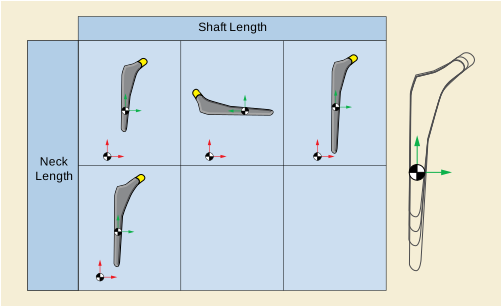
Implant templates in the group can be ordered according to several orthogonal dimensions, e.g., width and length. This is intended to facilitate scrolling through the implant template repository by offering references to the next bigger and smaller templates according to multiple criteria. Figure C.29.3.1.1.2-1 shows how the Variation Dimensions may be used for plates that differ in two dimensions: length and number of holes.
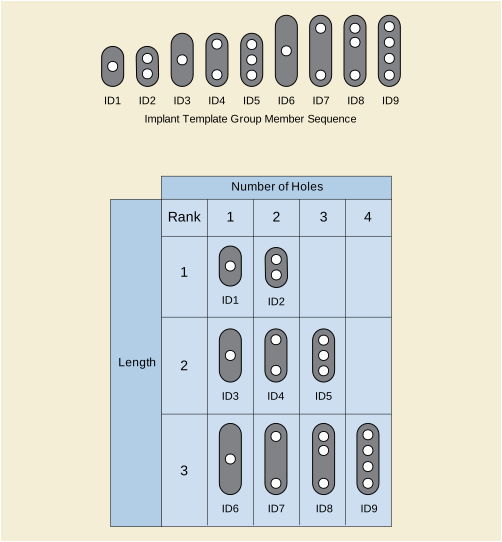
The following Sections specify Modules used for Unified Procedure Steps.
Table C.30.1-1 specifies the Attributes that describe the progress of a Unified Procedure Step (UPS).
Table C.30.1-1. Unified Procedure Step Progress Information Module Attributes
|
Attribute Name |
Tag |
Attribute Description |
|---|---|---|
|
Procedure Step State |
(0074,1000) |
State of the Procedure Step. Enumerated Values:
See PS3.4 for details on Unified Procedure Step states. |
|
Progress Information Sequence |
(0074,1002) |
Information about work progress for the Procedure Step. Zero or one Item shall be included in this sequence. |
|
>Procedure Step Progress |
(0074,1004) |
A numerical indicator of progress expressed as percentage complete. NoteThis is primarily for status rendering (e.g., progress bar). The percentage is not necessarily an accurate indication of total time. |
|
>Procedure Step Progress Description |
(0074,1006) |
A textual description of progress. NoteFor example, it might contain "Annealing complete". |
|
>Procedure Step Communications URI Sequence |
(0074,1008) |
Contact Information to communicate with performers of the Procedure Step. Zero or more Items shall be included in this sequence. |
|
>>Contact URI |
(0074,100A) |
URI to communicate with performer of the procedure in progress. Any URI (telephone number, URL, etc.) is permitted. NoteThe VR of this attribute has changed from UT to UR. |
|
>>Contact Display Name |
(0074,100c) |
Name of the person, department or organization to contact for more information about the performance of the Procedure Step. |
|
>Procedure Step Cancellation DateTime |
(0040,4052) |
Date and Time at which the procedure step was discontinued. |
|
>Reason For Cancellation |
(0074,1238) |
A textual description of the reason a procedure step was discontinued. |
|
>Procedure Step Discontinuation Reason Code Sequence |
(0074,100e) |
Coded Reason(s) for Discontinuing the Procedure Step. Zero or more items shall be included in this sequence. |
Table C.30.2-1 specifies the Attributes that describe the Unified Procedure Step (UPS) to be performed. The UPS may or may not be scheduled for a specific time or device, or may simply represent a piece of work that is intended to be performed.
Table C.30.2-1. Unified Procedure Step Scheduled Procedure Information Module Attributes
|
Attribute Name |
Tag |
Attribute Description |
|---|---|---|
|
Scheduled Procedure Step Priority |
(0074,1200) |
Priority of the scheduled Procedure Step Enumerated Values:
|
|
Scheduled Procedure Step Modification Date and Time |
(0040,4010) |
Date and time when the Scheduled Procedure Information was last modified or first created (whichever is most recent). NoteThis attribute should be automatically updated by the worklist management system whenever any modification is made to Scheduled Procedure Information Module attributes of a Unified Procedure Step. |
|
Worklist Label |
(0074,1202) |
A label identifying the worklist to which the Procedure Step instance belongs. |
|
Procedure Step Label |
(0074,1204) |
A label describing the task of the Procedure Step in text appropriate for displaying in the user selection interface. |
|
Comments on the Scheduled Procedure Step |
(0040,0400) |
User-defined comments on the scheduled Procedure Step. |
|
Scheduled Station Name Code Sequence |
(0040,4025) |
Identifying names within the enterprise of the equipment for which the Procedure Step is scheduled. The names conveyed in Code Value (0008,0100) may be the same as the AE Titles, but do not have to be. Zero or more Items shall be included in this sequence. |
|
No Baseline CID is defined. |
||
|
Scheduled Station Class Code Sequence |
(0040,4026) |
Classes of the equipment for which the Procedure Step is scheduled. Zero or more Items shall be included in this sequence. |
|
No Baseline CID is defined. |
||
|
Scheduled Station Geographic Location Code Sequence |
(0040,4027) |
Geographic locations of the equipment for which the Procedure Step is scheduled. Zero or more Items shall be included in this sequence. |
|
No Baseline CID is defined. |
||
|
Scheduled Human Performers Sequence |
(0040,4034) |
Human performers that are scheduled to be involved or responsible for performing the Procedure Step. Zero or more Items shall be included in this sequence. |
|
>Human Performer Code Sequence |
(0040,4009) |
Human performer that is involved or responsible for performing the Procedure Step. Only a single Item shall be included in this sequence. |
|
No Baseline CID is defined. |
||
|
>Human Performer's Name |
(0040,4037) |
Name of the human performer. |
|
>Human Performer's Organization |
(0040,4036) |
Organization to which the human performer is accountable for the activities in the Procedure Step. |
|
Scheduled Procedure Step Start DateTime |
(0040,4005) |
Date and time at which the Procedure Step is scheduled to start. |
|
Expected Completion DateTime |
(0040,4011) |
Date and time at which the Procedure Step is expected to be completed. |
|
Scheduled Workitem Code Sequence |
(0040,4018) |
Coded description of the Procedure Step. Only a single Item shall be included in this sequence. |
|
Baseline CID is CID 9231 “Workitem Definition”. NoteThis CID has generic workitems. An implementation may choose to define more specific, detailed workitems. |
||
|
Scheduled Processing Parameters Sequence |
(0074,1210) |
Processing parameters to be used by the performing system when carrying out the Procedure Step. Zero or more Items shall be included in this sequence. |
|
>Include Table 10-2 “Content Item Macro Attributes Description” |
No Baseline CIDs are defined for Concept Name Code Sequence or Concept Code Sequence. |
|
|
>Content Item Modifier Sequence |
(0040,0441) |
Sequence that specifies modifiers for a Protocol Context Content Item. One or more Items are permitted in this sequence. |
|
>>Include Table 10-2 “Content Item Macro Attributes Description” |
No Baseline CIDs are defined for Concept Name Code Sequence or Concept Code Sequence. |
|
|
Input Readiness State |
(0040,4041) |
Readiness state of the Input Information Sequence (0040,4021) and the referenced instances. Enumerated Values:
Note
|
|
Input Information Sequence |
(0040,4021) |
References to information objects needed to perform the scheduled Procedure Step. Referencing unencapsulated HL7 documents is described further in Section C.12.1.1.6. See also Input Readiness State (0040,4041). Zero or more Items shall be included in this sequence. |
|
>Include Table 10-3b “Referenced Instances and Access Macro Attributes” |
||
|
Study Instance UID |
(0020,000D) |
Unique Study identification that shall be used for the created Composite SOP Instances resulting from this Unified Procedure Step. |
Table C.30.3-1 specifies the Attributes that describe the performance and results of a Unified Procedure Step (UPS).
Table C.30.3-1. Unified Procedure Step Performed Procedure Information Module Attributes
|
Attribute Name |
Tag |
Attribute Description |
|---|---|---|
|
Unified Procedure Step Performed Procedure Sequence |
(0074,1216) |
Details of the Procedure Step as performed. Zero or one item shall be included in this sequence. |
|
>Actual Human Performers Sequence |
(0040,4035) |
Human performers that are/were actually involved or responsible for performing the Procedure Step. Zero or more Items shall be included in this sequence. NoteInitially this list will be empty. Items may be added to the list at or after the status transition of the Procedure Step State (0074,1000) to "IN PROGRESS" |
|
>>Human Performer Code Sequence |
(0040,4009) |
Human performer that is involved or responsible for performing the Procedure Step. Only a single Item shall be included in this sequence. |
|
>>>Include Table 8.8-1 “Code Sequence Macro Attributes” |
No Baseline CID is defined. |
|
|
>>Human Performer's Name |
(0040,4037) |
Name of the human performer. |
|
>>Human Performer's Organization |
(0040,4036) |
Organization to which the human performer is accountable for the activities in the Procedure Step. |
|
>Performed Station Name Code Sequence |
(0040,4028) |
Names within the enterprise of the equipment that performed the Procedure Step. This name may be the same as the AE Title, but does not have to be. Zero or more Items shall be included in this sequence. |
|
No Baseline CID is defined. |
||
|
>Performed Station Class Code Sequence |
(0040,4029) |
Classes of the equipment that created the Procedure Step. Zero or more Items shall be included in this sequence. |
|
No Baseline CID is defined. |
||
|
>Performed Station Geographic Location Code Sequence |
(0040,4030) |
Geographic locations of the equipment that created Procedure Step. Zero or more Items shall be included in this sequence. |
|
No Baseline CID is defined. |
||
|
>Performed Procedure Step Start DateTime |
(0040,4050) |
Date and Time at which the Procedure Step started. |
|
>Performed Procedure Step Description |
(0040,0254) |
Institution-generated description or classification of the Procedure Step that was performed. |
|
>Comments on the Performed Procedure Step |
(0040,0280) |
User-defined comments on the Performed Procedure Step. |
|
>Performed Workitem Code Sequence |
(0040,4019) |
A sequence that conveys the type of procedure performed. Zero or more items shall be present in this sequence. |
|
Baseline CID is CID 9231 “Workitem Definition”. NoteThis CID has generic workitems. An implementation may choose to define more specific, detailed workitems. |
||
|
>Performed Processing Parameters Sequence |
(0074,1212) |
Parameters used to perform the procedure. Zero or more items shall be present in this sequence |
|
>>Include Table 10-2 “Content Item Macro Attributes Description” |
No Baseline CIDs are defined for Concept Name Code Sequence or Concept Code Sequence. |
|
|
>>Content Item Modifier Sequence |
(0040,0441) |
Sequence that specifies modifiers for a Protocol Context Content Item. One or more Items are permitted in this sequence. |
|
>>>Include Table 10-2 “Content Item Macro Attributes Description” |
No Baseline CIDs are defined for Concept Name Code Sequence or Concept Code Sequence. |
|
|
>Performed Procedure Step End DateTime |
(0040,4051) |
Date and Time at which the Procedure Step ended. |
|
>Output Information Sequence |
(0040,4033) |
References to information created as part of the Procedure Step. Referencing unencapsulated HL7 documents is described further in Section C.12.1.1.6. Zero or more Items shall be included in this sequence. |
|
>>Include Table 10-3b “Referenced Instances and Access Macro Attributes” |
||
Table C.30.4-1 specifies the Attributes that describe the relationship of a Unified Procedure Step (UPS).
Table C.30.4-1. Unified Procedure Step Relationship Module Attributes
|
Attribute Name |
Tag |
Attribute Description |
|---|---|---|
|
Patient's Name |
(0010,0010) |
Patient's full legal name. |
|
Patient ID |
(0010,0020) |
Primary hospital identification number or code for the patient. See Section C.30.4.1 |
|
Other Patient IDs Sequence |
(0010,1002) |
Identification numbers or codes used to identify the patient, which may or may not be human readable, and may or may not have been obtained from an implanted or attached device such as an RFID or barcode. Zero or more Items shall be included in this sequence. |
|
>Patient ID |
(0010,0020) |
An identification number or code used to identify the patient. |
|
>Include Table 10-18 “Issuer of Patient ID Macro Attributes” |
||
|
Patient's Birth Date |
(0010,0030) |
Date of birth of the named patient. |
|
Patient's Sex |
(0010,0040) |
Sex of the named Patient. Enumerated Values:
|
|
Referenced Patient Photo Sequence |
(0010,1100) |
A photo to confirm the identity of a patient. Only a single Item is permitted in this Sequence. See C.2.2.1.1. |
|
>Include Table 10-3b “Referenced Instances and Access Macro Attributes” |
||
|
Admission ID |
(0038,0010) |
Identification number of the visit as assigned by the healthcare provider |
|
Issuer of Admission ID Sequence |
(0038,0014) |
Identifier of the Assigning Authority that issued the Admission ID. Only a single Item shall be included in this sequence. |
|
>Include Table 10-17 “HL7v2 Hierarchic Designator Macro Attributes” |
||
|
Admitting Diagnoses Description |
(0008,1080) |
Description of admitting diagnosis (diagnoses) for the patient. |
|
Admitting Diagnoses Code Sequence |
(0008,1084) |
Coded admitting diagnosis (diagnoses) for the patient. One or more Items shall be included in this Sequence. |
|
No Baseline CID is defined. |
||
|
Referenced Request Sequence |
(0040,A370) |
Requested Procedures to which the Procedure Step contributes. Zero or more Items shall be included in the sequence. |
|
>Study Instance UID |
(0020,000D) |
Unique identifier for the Study. |
|
>Accession Number |
(0008,0050) |
An identifier of the order for the Study. |
|
>Issuer of Accession Number Sequence |
(0008,0051) |
Identifier of the Assigning Authority that issued the Accession Number. Only a single Item shall be included in this sequence. |
|
>>Include Table 10-17 “HL7v2 Hierarchic Designator Macro Attributes” |
||
|
>Requested Procedure Code Sequence |
(0032,1064) |
Procedure Type of the Requested Procedure. Zero or one Item shall be included in this sequence. |
|
No Baseline CID is defined. |
||
|
>Placer Order Number / Imaging Service Request |
(0040,2016) |
The order number assigned to the Service Request by the party placing the order. |
|
>Order Placer Identifier Sequence |
(0040,0026) |
Identifier of the Assigning Authority that issued the Placer Order Number. Only a single Item shall be included in this sequence. |
|
>>Include Table 10-17 “HL7v2 Hierarchic Designator Macro Attributes” |
||
|
>Filler Order Number / Imaging Service Request |
(0040,2017) |
The order number assigned to the Service Request by the party filling the order. |
|
>Order Filler Identifier Sequence |
(0040,0027) |
Identifier of the Assigning Authority that issued the Filler Order Number. Only a single Item shall be included in this sequence. |
|
>>Include Table 10-17 “HL7v2 Hierarchic Designator Macro Attributes” |
||
|
>Requested Procedure ID |
(0040,1001) |
Identifier of the related Requested Procedure. |
|
>Requested Procedure Description |
(0032,1060) |
Institution-generated description or classification of the Requested Procedure. |
|
>Reason for the Requested Procedure |
(0040,1002) |
Reason for requesting this procedure. |
|
> Reason for Requested Procedure Code Sequence |
(0040,100A) |
Coded reason for requesting this procedure. Zero or more Items shall be included in the sequence. |
|
No Baseline CID is defined. |
||
|
>Requested Procedure Comments |
(0040,1400) |
User-defined comments on the Requested Procedure. |
|
>Confidentiality Code |
(0040,1008) |
Confidentiality Constraints on the Requested Procedure by the party filling the order. |
|
>Names of Intended Recipients of Results |
(0040,1010) |
Names of the physicians, who are intended recipients of results. |
|
>Imaging Service Request Comments |
(0040,2400) |
User-defined comments on the Service Request. |
|
>Requesting Physician |
(0032,1032) |
Physician who requested the Service Request. |
|
>Requesting Service |
(0032,1033) |
Institutional department where the request initiated. |
|
>Issue Date of Imaging Service Request |
(0040,2004) |
Date on which the Service Request was issued by the requester. |
|
>Issue Time of Imaging Service Request |
(0040,2005) |
Time at which the Service Request was issued by the requester. |
|
>Referring Physician's Name |
(0008,0090) |
The physician who referred the Patient to the physician or service issuing the Service Request. NoteThis is generally the recipient of any report generated by the Service Request. |
|
Replaced Procedure Step Sequence |
(0074,1224) |
Canceled procedure step(s) that are replaced by this procedure step. Zero or more Items shall be included in the sequence. |
|
>Include Table 10-11 “SOP Instance Reference Macro Attributes” |
||
For workitems that have a patient as the subject or context, the Patient ID, Issuer of Patient ID, Patient's Name, Patient's Sex and Patient's Birth Date shall have appropriate values.
For workitems that have an identifiable subject that is not a patient, for example a phantom to be scanned or a display to be calibrated, the Patient ID shall be filled with an acceptable pseudo-patient value.
Note
For an object with a hospital asset control number or a manufacturer's serial number, that number might be used as the Patient ID. The Issuer of Patient ID would identify the hospital asset control system or the device manufacturer. Alternatively, it is conceivable that a Patient ID could be generated by the ADT or the local John Doe procedure (to avoid conflicting with an ID assigned to a real patient).
The Patient Name might be set to CT^Phantom or ReadingRoom1Display.
Table C.31-1 specifies the attributes used to convey the parameters used in external verification of both conventional radiotherapy (photon or electron) and ion treatment deliveries.
Table C.31-1. RT General Machine Verification Module Attributes
|
Attribute Name |
Tag |
Description |
|---|---|---|
|
Referenced RT Plan Sequence |
(300C,0002) |
A reference to an RT Plan SOP Class/Instance pair. Only a single item shall be included in this sequence. |
|
>Include Table C.10-11 “Waveform Annotation Module Attributes” |
||
|
Referenced Fraction Group Number |
(300C,0022) |
Identifier of Fraction Group within referenced RT Plan. |
|
Patient ID |
(0010,0020) |
Primary hospital identification number or code for the patient. |
|
Treatment Verification Status |
(3008,002C) |
Conditions under which treatment was verified by a verification system. Enumerated Values:
|
|
Failed Parameters Sequence |
(0074,1048) |
List of parameters that failed verification by the MPV. Zero or more items shall be included in this Sequence. See Section C.31.1.1. |
|
Overridden Parameters Sequence |
(0074,104A) |
List of parameters that were overridden by the user. Zero or more items shall be included in this Sequence. See Section C.31.1.1. |
|
>Operators' Name |
(0008,1070) |
Name of operator who authorized override of overridden parameter. |
|
>Override Reason |
(3008,0066) |
User-defined description of reason for override of overridden parameter. |
|
General Machine Verification Sequence |
(0074,1042) |
Sequence containing general machine verification parameters. Zero or one Item shall be included in this sequence. |
|
>Specified Primary Meterset |
(3008,0032) |
Desired machine setting of primary Meterset. The units shall match those specified by Primary Dosimeter Unit (300A,00B3) in the plan specified in the Referenced RT Plan Sequence (300C,0002). |
|
>Specified Secondary Meterset |
(3008,0033) |
Desired machine setting of secondary Meterset. The units shall match those specified for Specified Secondary Meterset (3008,0033) in the plan specified in the Referenced RT Plan Sequence (300C,0002). |
|
>Specified Treatment Time |
(3008,003A) |
Treatment Time set in seconds. |
|
>Beam Limiting Device Leaf Pairs Sequence |
(3008,00A0) |
Beam limiting device (collimator) jaw or leaf (element) leaf pair values. One or more items shall be included in this Sequence. |
|
>>RT Beam Limiting Device Type |
(300A,00B8) |
Type of beam limiting device (collimator). Enumerated Values:
|
|
>>Number of Leaf/Jaw Pairs |
(300A,00BC) |
Number of leaf (element) or jaw pairs (equal to 1 for standard beam limiting device jaws). |
|
>Recorded Wedge Sequence |
(3008,00B0) |
Treatment wedges present during delivered Beam. Zero or more Items shall be included in this sequence. |
|
>>Wedge Number |
(300A,00D2) |
Identification number of the Wedge. The value of Wedge Number (300A,00D2) shall be unique within the wedge sequence. |
|
>>Wedge ID |
(300A,00D4) |
User-supplied identifier for wedge. |
|
>>Wedge Angle |
(300A,00D5) |
Nominal wedge angle delivered in degrees. |
|
>>Wedge Orientation |
(300A,00D8) |
Orientation of wedge, i.e., orientation of the IEC WEDGE FILTER coordinate system with respect to the IEC BEAM LIMITING DEVICE coordinate system, in degrees. |
|
>>Accessory Code |
(300A,00F9) |
An identifier for the accessory intended to be read by a device such as a bar-code reader. |
|
>Recorded Compensator Sequence |
(3008,00C0) |
Treatment compensators associated with current Beam. Zero or more Items shall be included in this sequence. |
|
>>Compensator ID |
(300A,00E5) |
User-supplied identifier for compensator. |
|
>>Accessory Code |
(300A,00F9) |
An identifier for the accessory intended to be read by a device such as a bar-code reader. |
|
>>Compensator Tray ID |
(300A,00EF) |
User-supplied identifier for compensator tray. |
|
>>Referenced Compensator Number |
(300C,00D0) |
Uniquely identifies compensator specified by Compensator Number (300A,00E4) within Beam referenced by Referenced Beam Number (300C,0006). |
|
>Recorded Block Sequence |
(3008,00D0) |
Blocks associated with current Beam. Zero or more Items shall be included in this sequence. |
|
>>Block Tray ID |
(300A,00F5) |
User-supplied identifier for block tray or Electron Insert. |
|
>>Accessory Code |
(300A,00F9) |
An identifier for the accessory intended to be read by a device such as a bar-code reader. |
|
>>Referenced Block Number |
(300C,00E0) |
Uniquely identifies block specified by Block Number (300A,00FC) within Beam referenced by Referenced Beam Number (300C,0006). |
|
>Treatment Machine Name |
(300A,00B2) |
User-defined name identifying treatment machine to be used for beam delivery. See Section C.8.8.25.2. |
|
>Beam Name |
(300A,00C2) |
User-defined name for Beam. |
|
>Radiation Type |
(300A,00C6) |
Particle type of Beam. Enumerated Values:
|
|
>Number of Wedges |
(300A,00D0) |
Number of wedges associated with current Beam. |
|
>Number of Compensators |
(300A,00E0) |
Number of compensators associated with current Beam. |
|
>Number of Boli |
(300A,00ED) |
Number of boli used with current Beam. |
|
>Number of Blocks |
(300A,00F0) |
Number of shielding blocks or Electron Inserts associated with Beam. |
|
>Applicator Sequence |
(300A,0107) |
Applicators associated with Beam. Zero or more Items shall be included in this sequence. |
|
>>Accessory Code |
(300A,00F9) |
An identifier for the accessory intended to be read by a device such as a bar-code reader. |
|
>>Applicator ID |
(300A,0108) |
User or machine supplied identifier for Applicator. |
|
>>Applicator Type |
(300A,0109) |
Type of Applicator. Enumerated Values:
|
|
>Number of Control Points |
(300A,0110) |
Number of control points in Beam. |
|
>Patient Setup Sequence |
(300A,0180) |
Patient setup data for current plan. One or more Items are permitted in this sequence. |
|
>>Patient Setup Number |
(300A,0182) |
Identification number of the Patient Setup. |
|
>>Fixation Device Sequence |
(300A,0190) |
Fixation Devices used in Patient Setup. Zero or more Items shall be included in this sequence. |
|
>>>Accessory Code |
(300A,00F9) |
An identifier for the accessory intended to be read by a device such as a bar-code reader. |
|
>>>Fixation Device Type |
(300A,0192) |
Type of Fixation Device used during Patient Setup. Enumerated Values:
|
|
>Referenced Beam Number |
(300C,0006) |
References Beam specified by Beam Number (300A,00C0) in Ion Beam Sequence (300A,03A2) in RT Ion Beams Module within the referenced RT Ion Plan. |
|
>Referenced Bolus Sequence |
(300C,00B0) |
Boli associated with Beam. Zero or more Items shall be included in this sequence. |
|
>>Referenced ROI Number |
(3006,0084) |
Uniquely identifies ROI representing the Bolus specified by ROI Number (3006,0022) in Structure Set ROI Sequence (3006,0020) in Structure Set Module within RT Structure Set in Referenced Structure Set Sequence (300C,0060) in RT General Plan Module. |
|
>>Accessory Code |
(300A,00F9) |
An accessory identifier to be read by a device such as a bar code reader. |
Each Verify Failed Parameter or Overridden Parameter is used to specify a verification attribute that was either unverified (out of range), or overridden explicitly by the user. To uniquely identify both the context and value item of the attribute occurrence, a special notation is used, described in Section 10.17.
If a Verify Failed Parameter or Overridden Parameter refers to an attribute occurrence within a Control Point Sequence, then that attribute occurrence was failed or overridden during the administration of the beam segment immediately prior to the specified control point.
Table C.31-2 specifies the attributes used to convey the parameters used in external verification of a conventional radiotherapy (photon or electron) treatment delivery.
Table C.31-2. RT Conventional Machine Verification Module Attributes
|
Attribute Name |
Tag |
Description |
|---|---|---|
|
Conventional Machine Verification Sequence |
(0074,1044) |
Sequence containing conventional machine verification parameters. Zero or one Item shall be included in this sequence. |
|
>Conventional Control Point Verification Sequence |
(0074,104C) |
Beam control points for current treatment beam. Only a single Item shall be included in this sequence. |
|
>>Nominal Beam Energy |
(300A,0114) |
Nominal Beam Energy at control point. |
|
>>Dose Rate Set |
(300A,0115) |
Dose Rate to be set on treatment machine for segment beginning at current control point (e.g., MU/min). |
|
>>Wedge Position Sequence |
(300A,0116) |
Wedge Positions for the current control point. One or more Items shall be included in this sequence. See Section C.8.8.14.5. |
|
>>>Wedge Position |
(300A,0118) |
Position of Wedge at current Control Point. Enumerated Values:
|
|
>>>Referenced Wedge Number |
(300C,00C0) |
Uniquely references Wedge described by Wedge Number (300A,00D2) in Wedge Sequence (300A,00D1). |
|
>>Beam Limiting Device Position Sequence |
(300A,011A) |
Beam limiting device (collimator) jaw or leaf (element) positions. One or more Items shall be included in this sequence. |
|
>>>RT Beam Limiting Device Type |
(300A,00B8) |
Type of beam limiting device (collimator). The value of this attribute shall correspond to RT Beam Limiting Device Type (300A,00B8) defined in an item of Beam Limiting Device Sequence (300A,00B6) Enumerated Values:
|
|
>>>Leaf/Jaw Positions |
(300A,011C) |
Positions of beam limiting device (collimator) leaf (element) or jaw pairs in mm in the IEC BEAM LIMITING DEVICE coordinate axis appropriate to RT Beam Limiting Device Type (300A,00B8), e.g., X-axis for MLCX, Y-axis for MLCY. Contains 2N values, where N is the Number of Leaf/Jaw Pairs (300A,00BC) in Beam Limiting Device Sequence (300A,00B6). Values shall be listed in the IEC leaf (element) subscript order 101, 102, … 1N, 201, 202, … 2N. |
|
>>Gantry Angle |
(300A,011E) |
Gantry angle in degrees of radiation source, i.e., orientation of the IEC GANTRY coordinate system with respect to the IEC FIXED REFERENCE coordinate system. |
|
>>Gantry Rotation Direction |
(300A,011F) |
Direction of Gantry Rotation when viewing gantry from isocenter, for segment following Control Point. See Section C.8.8.14.8. Enumerated Values:
|
|
>>Beam Limiting Device Angle |
(300A,0120) |
Beam Limiting Device angle in degrees, i.e., orientation of the IEC BEAM LIMITING DEVICE coordinate system with respect to the IEC GANTRY coordinate system. |
|
>>Beam Limiting Device Rotation Direction |
(300A,0121) |
Direction of Beam Limiting Device Rotation when viewing beam limiting device (collimator) from radiation source, for segment following Control Point. See Section C.8.8.14.8. Enumerated Values:
|
|
>>Patient Support Angle |
(300A,0122) |
Patient Support angle in degrees, i.e., orientation of the IEC PATIENT SUPPORT (turntable) coordinate system with respect to the IEC FIXED REFERENCE coordinate system. |
|
>>Patient Support Rotation Direction |
(300A,0123) |
Direction of Patient Support Rotation when viewing table from above, for segment following Control Point. See Section C.8.8.14.8. Enumerated Values:
|
|
>>Table Top Eccentric Axis Distance |
(300A,0124) |
Distance (positive) in mm from the IEC PATIENT SUPPORT vertical axis to the IEC TABLE TOP ECCENTRIC vertical axis. |
|
>>Table Top Eccentric Angle |
(300A,0125) |
Table Top (non-isocentric) angle, i.e., orientation of the IEC TABLE TOP ECCENTRIC coordinate system with respect to the IEC PATIENT SUPPORT coordinate system, in degrees. |
|
>>Table Top Eccentric Rotation Direction |
(300A,0126) |
Direction of Table Top Eccentric Rotation when viewing table from above, for segment following Control Point. See Section C.8.8.14.8. Enumerated Values:
|
|
>>Table Top Vertical Position |
(300A,0128) |
Table Top Vertical position in mm in the IEC TABLE TOP coordinate system. See Section C.8.8.14.6. |
|
>>Table Top Longitudinal Position |
(300A,0129) |
Table Top Longitudinal position in mm in the IEC TABLE TOP coordinate system. See Section C.8.8.14.6. |
|
>>Table Top Lateral Position |
(300A,012A) |
Table Top Lateral position in mm in the IEC TABLE TOP coordinate system. See Section C.8.8.14.6. |
|
>>Table Top Pitch Angle |
(300A,0140) |
Table Top Pitch Angle in degrees, i.e., the rotation of the IEC TABLE TOP coordinate system about the X-axis of the IEC TABLE TOP coordinate system. See Section C.8.8.25.6.2. |
|
>>Table Top Pitch Rotation Direction |
(300A,0142) |
Direction of Table Top Pitch Rotation when viewing the table along the positive X-axis of the IEC TABLE TOP coordinate system, for segment following Control Point. See Section C.8.8.14.8 and Section C.8.8.25.6.2. Enumerated Values:
|
|
>>Table Top Roll Angle |
(300A,0144) |
Table Top Roll Angle in degrees, i.e., the rotation of the IEC TABLE TOP coordinate system about the Y-axis of the IEC TABLE TOP coordinate system. See Section C.8.8.25.6.2. |
|
>>Table Top Roll Rotation Direction |
(300A,0146) |
Direction of Table Top Roll Rotation when viewing the table along the positive Y-axis of the IEC TABLE TOP coordinate system, for segment following Control Point. See Section C.8.8.14.8 and Section C.8.8.25.6.2. Enumerated Values:
|
|
>>Referenced Control Point Index |
(300C,00F0) |
Uniquely identifies Control Point specified by Control Point Index (300A,0112) within the Beam referenced by Referenced Beam Number (300C,0006). |
Table C.31-3 specifies the Attributes used to convey the parameters used in external verification of a radiotherapy ion treatment delivery.
Table C.31-3. RT Ion Machine Verification Module Attributes
|
Attribute Name |
Tag |
Description |
|---|---|---|
|
Ion Machine Verification Sequence |
(0074,1046) |
Sequence containing ion machine verification parameters. Zero or one Item shall be included in this sequence. |
|
>Ion Control Point Verification Sequence |
(0074,104E) |
Beam control points for current ion treatment beam. Only a single Item shall be included in this sequence. |
|
>>Meterset Rate Set |
(3008,0045) |
The specified speed of delivery of the specified dose in units specified by Primary Dosimeter Unit (300A,00B3) in referenced RT Plan per minute. |
|
>>Nominal Beam Energy |
(300A,0114) |
Nominal Beam Energy at control point. |
|
>>Beam Limiting Device Position Sequence |
(300A,011A) |
Beam limiting device (collimator) jaw or leaf (element) positions. One or more Items shall be included in this sequence. |
|
>>>RT Beam Limiting Device Type |
(300A,00B8) |
Type of beam limiting device (collimator). The value of this attribute shall correspond to RT Beam Limiting Device Type (300A,00B8) defined in an item of Beam Limiting Device Sequence (300A,00B6) Enumerated Values:
|
|
>>>Leaf/Jaw Positions |
(300A,011C) |
Positions of beam limiting device (collimator) leaf (element) or jaw pairs in mm in the IEC BEAM LIMITING DEVICE coordinate axis appropriate to RT Beam Limiting Device Type (300A,00B8), e.g., X-axis for MLCX, Y-axis for MLCY. Contains 2N values, where N is the Number of Leaf/Jaw Pairs (300A,00BC) in Beam Limiting Device Sequence (300A,00B6). Values shall be listed in the IEC leaf (element) subscript order 101, 102, … 1N, 201, 202, … 2N. |
|
>>Gantry Angle |
(300A,011E) |
Gantry angle of radiation source in degrees, i.e., orientation of the IEC GANTRY coordinate system with respect to the IEC FIXED REFERENCE coordinate system. |
|
>>Gantry Rotation Direction |
(300A,011F) |
Direction of Gantry Rotation when viewing gantry from isocenter, for segment following Control Point. See Section C.8.8.14.8. Enumerated Values:
|
|
>>Beam Limiting Device Angle |
(300A,0120) |
Beam Limiting Device angle in degrees, i.e., orientation of the IEC BEAM LIMITING DEVICE coordinate system with respect to the IEC GANTRY coordinate system. |
|
>>Beam Limiting Device Rotation Direction |
(300A,0121) |
Direction of Beam Limiting Device Rotation when viewing beam limiting device (collimator) from radiation source, for segment following Control Point. See Section C.8.8.14.8. Enumerated Values:
|
|
>>Patient Support Angle |
(300A,0122) |
Patient Support angle in degrees, i.e., orientation of the IEC PATIENT SUPPORT (turntable) coordinate system with respect to the IEC FIXED REFERENCE coordinate system. |
|
>>Patient Support Rotation Direction |
(300A,0123) |
Direction of Patient Support Rotation when viewing table from above, for segment following Control Point. See Section C.8.8.14.8. Enumerated Values:
|
|
>>Table Top Vertical Position |
(300A,0128) |
Table Top Vertical position in mm in the IEC TABLE TOP coordinate system. See Section C.8.8.14.6. |
|
>>Table Top Longitudinal Position |
(300A,0129) |
Table Top Longitudinal position in mm in the IEC TABLE TOP coordinate system. See Section C.8.8.14.6. |
|
>>Table Top Lateral Position |
(300A,012A) |
Table Top Lateral position in mm in the IEC TABLE TOP coordinate system. See Section C.8.8.14.6. |
|
>>Table Top Pitch Angle |
(300A,0140) |
Table Top Pitch Angle in degrees, i.e., the rotation of the IEC TABLE TOP coordinate system about the X-axis of the IEC TABLE TOP coordinate system. See Section C.8.8.25.6.2. |
|
>>Table Top Pitch Rotation Direction |
(300A,0142) |
Direction of Table Top Pitch Rotation when viewing the table along the positive X-axis of the IEC TABLE TOP coordinate system, for segment following Control Point. See Section C.8.8.14.8 and Section C.8.8.25.6.2. Enumerated Values:
|
|
>>Table Top Roll Angle |
(300A,0144) |
Table Top Roll Angle in degrees, i.e., the rotation of the IEC TABLE TOP coordinate system about the Y-axis of the IEC TABLE TOP coordinate system. See Section C.8.8.25.6.2. |
|
>>Table Top Roll Rotation Direction |
(300A,0146) |
Direction of Table Top Roll Rotation when viewing the table along the positive Y-axis of the IEC TABLE TOP coordinate system, for segment following Control Point. See Section C.8.8.14.8 and Section C.8.8.25.6.2. Enumerated Values:
|
|
>>Head Fixation Angle |
(300A,0148) |
Angle in degrees of the head fixation for eye treatments with respect to the Table Top Pitch Angle (300A,0140) coordinate system. Positive head fixation angle is the same direction as positive Table Top Pitch. See Section C.8.8.25.6.4. |
|
>>Gantry Pitch Angle |
(300A,014A) |
Gantry Pitch Angle in degrees of the radiation source, i.e., the rotation of the IEC GANTRY coordinate system about the X-axis of the IEC GANTRY coordinate system. See Section C.8.8.25.6.5. |
|
>>Gantry Pitch Rotation Direction |
(300A,014C) |
Direction of Gantry Pitch Angle when viewing along the positive X-axis of the IEC GANTRY coordinate system, for segment following Control Point. See Section C.8.8.14.8 and Section C.8.8.25.6.5. Enumerated Values:
|
|
>>Snout Position |
(300A,030D) |
Axial position in mm of the snout, measured from isocenter to the downstream side of the snout (without consideration of variable length elements such as blocks, MLC and/or compensators). |
|
>>Range Shifter Settings Sequence |
(300A,0360) |
Range Shifter settings for the current control point. One or more Items shall be included in this sequence. |
|
>>>Range Shifter Setting |
(300A,0362) |
Machine specific setting attribute for the range shifter. See Section C.8.8.25.5. |
|
>>>Referenced Range Shifter Number |
(300C,0100) |
Uniquely references Range Shifter described by Range Shifter Number (300A,0316) in Range Shifter Sequence (300A,0314). |
|
>>Lateral Spreading Device Settings Sequence |
(300A,0370) |
Lateral Spreading Device settings for the current control point. One or more Items shall be included in this sequence. |
|
>>>Lateral Spreading Device Setting |
(300A,0372) |
Machine specific setting attribute for the lateral spreading device. See Section C.8.8.25.5. |
|
>>>Referenced Lateral Spreading Device Number |
(300C,0102) |
Uniquely references Lateral Spreading Device described by Lateral Spreading Device Number (300A,0334) in Lateral Spreading Device Sequence (300A,0332). |
|
>>Range Modulator Settings Sequence |
(300A,0380) |
Range Modulator Settings for current control point. One or more Items shall be included in this sequence. |
|
>>>Range Modulator Gating Start Value |
(300A,0382) |
Start position, defining the range modulator position at which the beam is switched on. |
|
>>>Range Modulator Gating Stop Value |
(300A,0384) |
Stop position, defining the range modulator position at which the beam is switched off. |
|
>>>Referenced Range Modulator Number |
(300C,0104) |
Uniquely references Range Modulator described by Range Modulator Number (300A,0344) in Range Modulator Sequence (300A,0342). |
|
>>Ion Wedge Position Sequence |
(300A,03AC) |
Wedge positions for current control point. One or more Items shall be included in this sequence. |
|
>>>Wedge Thin Edge Position |
(300A,00DB) |
Closest distance in mm from the central axis of the beam along a wedge axis to the thin edge as projected to the machine isocentric plane. Value is positive is the wedge does not cover the central axis, negative if it does. See Section C.8.8.25.6.4. |
|
>>>Wedge Position |
(300A,0118) |
Position of Wedge at current Control Point. Enumerated Values:
|
|
>>Referenced Control Point Index |
(300C,00F0) |
Uniquely identifies Control Point specified by Control Point Index (300A,0112 within the Beam referenced by Referenced Beam Number (300C,0006). |
|
>Recorded Snout Sequence |
(3008,00F0) |
Snouts associated with Beam. Only a single Item shall be included in this sequence. |
|
>>Accessory Code |
(300A,00F9) |
An accessory identifier to be read by a device such as a bar code reader. |
|
>>Snout ID |
(300A,030F) |
User or machine supplied identifier for Snout. |
|
>Recorded Range Shifter Sequence |
(3008,00F2) |
Range shifters recorded with Beam. Zero or more Items shall be included in this sequence. |
|
>>Accessory Code |
(300A,00F9) |
An accessory identifier to be read by a device such as a bar code reader. |
|
>>Range Shifter ID |
(300A,0318) |
User or machine supplied identifier for Range Modulator. |
|
>>Referenced Range Shifter Number |
(300C,0100) |
Uniquely identifies range shifter specified by Range Shifter Number (300A,0316) within Beam referenced by Referenced Beam Number (300C,0006). |
|
>Recorded Lateral Spreading Device Sequence |
(3008,00F4) |
Lateral spreading devices associated with Beam. Zero or more Items shall be included in this sequence. |
|
>>Accessory Code |
(300A,00F9) |
An accessory identifier to be read by a device such as a bar code reader. |
|
>>Lateral Spreading Device ID |
(300A,0336) |
User or machine supplied identifier for Lateral Spreading Device. |
|
>>Referenced Lateral Spreading Device Number |
(300C,0102) |
Uniquely identifies lateral spreading device specified by Lateral Spreading Device Number (300A,0334) within Beam referenced by Referenced Beam Number (300C,0006). |
|
>Recorded Range Modulator Sequence |
(3008,00F6) |
Range modulators associated with Beam. Zero or more Items shall be included in this sequence. |
|
>>Accessory Code |
(300A,00F9) |
An accessory identifier to be read by a device such as a bar code reader. |
|
>>Range Modulator ID |
(300A,0346) |
User or machine supplied identifier for Range Modulator. |
|
>>Range Modulator Type |
(300A,0348) |
Type of Range Modulator. See Section C.31.3.1 for Defined Terms. |
|
>>Beam Current Modulation ID |
(300A,034C) |
User-supplied identifier for the beam current modulation pattern. |
|
>>Referenced Range Modulator Number |
(300C,0104) |
Uniquely references Range Modulator described by Range Modulator Number (300A,0344) in Range Modulator Sequence (300A,0342). |
|
>Radiation Mass Number |
(300A,0302) |
Mass number of radiation. |
|
>Radiation Atomic Number |
(300A,0304) |
Atomic number of radiation. |
|
>Radiation Charge State |
(300A,0306) |
Charge state of radiation. |
|
>Scan Mode |
(300A,0308) |
The method of beam scanning to be used during treatment. Enumerated Values:
|
|
>Number of Range Shifters |
(300A,0312) |
Number of range shifters associated with current beam. |
|
>Number of Lateral Spreading Devices |
(300A,0330) |
Number of lateral spreading devices associated with current beam. |
|
>Number of Range Modulators |
(300A,0340) |
Number of range modulators associated with current beam. |
|
>Patient Support Type |
(300A,0350) |
Defined Terms:
See Section C.8.8.25.6.3. |
|
>Patient Support ID |
(300A,0352) |
User-specified identifier for manufacturer specific patient support devices. |
|
>Patient Support Accessory Code |
(300A,0354) |
A Patient Support accessory identifier to be read by a device such as a bar code reader. |
|
>Fixation Light Azimuthal Angle |
(300A,0356) |
Azimuthal angle in degrees of the fixation light coordinate around the IEC BEAM LIMITING DEVICE Y-axis. Used for eye treatments. See Section C.8.8.25.6.4. |
|
>Fixation Light Polar Angle |
(300A,0358) |
Polar angle in degrees of the fixation light coordinate. Used for eye treatments. See Section C.8.8.25.6.4. |
Defined Terms:
- FIXED
Fixed modulation width and weights using ridge filter or constant speed wheel with constant beam current.
- WHL_FIXEDWEIGHTS
Selected wheel/track (Range Modulator ID) is spinning at constant speed. Modulation width is adjusted by switching constant beam current on and off at wheel steps indicated by Range Modulator Interrupt Values.
- WHL_MODWEIGHTS
Selected wheel/track (Range Modulator ID) is spinning at constant speed. Weight per wheel step is adjusted by modulating beam current according to selected Beam Current Modulation ID (300A,034C).
This Module describes the Display System.
Table C.32.1-1. Display System Module Attributes
|
Attribute Name |
Tag |
Description |
|---|---|---|
|
Manufacturer |
(0008,0070) |
Manufacturer of the Display System. |
|
Institution Name |
(0008,0080) |
Institution where the Display System is located. |
|
Institution Address |
(0008,0081) |
Mailing address of institution where the Display System is located. |
|
Device Serial Number |
(0018,1000) |
Manufacturer's serial number of the Display System. NoteThe components of the Display System may also have their own serial numbers. |
|
Station Name |
(0008,1010) |
User defined name identifying the Display System. |
|
Institutional Department Name |
(0008,1040) |
Department name in the institution where the Display System is located. |
|
Manufacturer's Model Name |
(0008,1090) |
Manufacturer's model name of the Display System. |
|
Equipment Administrator Sequence |
(0028,7000) |
Point of contact for problems with the equipment. Zero or more Items shall be included in this sequence. |
|
>Person Name |
(0040,A123) |
Name of the person or role that is administrating the equipment. |
|
>Include Table 10-1 “Person Identification Macro Attributes Description” |
||
|
Number of Display Subsystems |
(0028,7001) |
Number of Display Subsystems in the Display System. |
|
Display Subsystem Sequence |
(0028,7023) |
Description of each Display Subsystem. One or more Items shall be included in this sequence. |
|
>Display Subsystem ID |
(0028,7003) |
Number that identifies a specific display subsystem within a Display System. The value shall be unique within the Display Subsystem Sequence (0028,7023). |
|
>Display Subsystem Name |
(0028,7004) |
User-defined name for the Display Subsystem. |
|
>Display Subsystem Description |
(0028,7005) |
A free text description of the Display Subsystem. |
|
>Display Device Type Code Sequence |
(0028,7022) |
Type of technology used in the Display Device |
|
Baseline CID 8303 “Display Device Type”. |
||
|
>Manufacturer |
(0008,0070) |
Manufacturer of the Display Device in the Display Subsystem. If the Display Subsystem is provided integrated into the Display System (e.g. for a tablet) and the Manufacturer is not otherwise known, the Manufacturer of the Display System may be recorded here. NoteEach Display Subsystem is considered to have a single Display Device. |
|
>Device Serial Number |
(0018,1000) |
Manufacturer's serial number of the Display Device (i.e. monitor device) in the Display Subsystem. If the Display Subsystem is provided integrated into the Display System (e.g. for a tablet) and the Device Serial Number is not otherwise known, the Device Serial Number of the Display System may be recorded here. |
|
>Manufacturer's Model Name |
(0008,1090) |
Manufacturer's model name of the Display Device in the Display Subsystem. If the Display Subsystem is provided integrated into the Display System (e.g. for a tablet) and the Model Name is not otherwise known, the Model Name of the Display System may be recorded here. |
|
>System Status |
(0028,7006) |
Current overall status of the Display Subsystem. See Section C.32.1.1 for Defined Terms. |
|
>System Status Comment |
(0028,7007) |
A free text comment about the status of the Display Subsystem. |
|
>Display Subsystem Configuration Sequence |
(0028,700A) |
Available Display Subsystem Configurations. One or more Items shall be included in this Sequence. |
|
>>Configuration ID |
(0028,700B) |
Number that identifies a specific display subsystem configuration within the Display Subsystem Configuration Sequence (0028,700A). The value shall be unique within the Display Subsystem Configuration Sequence (0028,700A). |
|
>>Configuration Name |
(0028,700C) |
User-defined name for the Display Subsystem Configuration. |
|
>>Configuration Description |
(0028,700D) |
A free text description of the Display Subsystem Configuration. |
|
>>Referenced Target Luminance Characteristics ID |
(0028,700E) |
References the intended luminance characteristics for this Configuration of this Display Subsystem. The value is the Luminance Characteristics ID (0028,7009) within the Target Luminance Characteristics Sequence (0028,7008) of the Luminance Characteristics Module. |
|
>Current Configuration ID |
(0028,7002) |
References the current configuration of the Display Subsystem. The value is the Configuration ID (0028,700B) of the item in the Display Subsystem Configuration Sequence (0028,700A). |
|
>Measurement Equipment Sequence |
(0028,7012) |
Describes measurement equipment (if any) built into the Display Subsystem. Zero or more items shall be included in this sequence. |
|
>>Measurement Functions |
(0028,7013) |
Measurement functions of the measurement equipment. Enumerated Values:
This multi-valued attribute shall contain at most one of each enumerated value. When multiple values are present, the equipment is capable of performing multiple functions. |
|
>>Measured Characteristics |
(0028,7026) |
Characteristic(s) which are measured by the measurement equipment. Enumerated Values:
This multi-valued attribute shall contain at most one of each enumerated value. When multiple values are present, the equipment is capable of measuring multiple characteristics. |
|
>>Measurement Equipment Type |
(0028,7014) |
Type of measurement equipment. See Section C.32.1.2 for Enumerated Values. |
|
>>Manufacturer |
(0008,0070) |
Manufacturer of the measurement equipment. |
|
>>Manufacturer's Model Name |
(0008,1090) |
Manufacturer's model name of the measurement equipment. |
|
>>Device Serial Number |
(0018,1000) |
The measurement equipment serial number. |
|
>>DateTime of Last Calibration |
(0018,1202) |
Date and time of the last calibration of the measurement equipment. NoteThis is likely different than the date of the calibration of the Display Subsystem itself. |
Defined Terms for System Status (0028,7006):
- NORMAL
Device performance is within specified limits
- WARNING
Device performance improvement/re-calibration is appropriate
- ADJUST
Correction required; may be performed by trained staff
- FAILURE
Service required
- UNKNOWN
Unable to obtain status from the device
It is up to the implementation how to set the System Status (0028,7006) based on the contents of the status code sequences.
Enumerated Values for Measurement Equipment Type (0028,7014):
- BUILT_IN_FRONT
The sensor is located on the front of the surface of a display device
- BUILT_IN_BACK
The sensor is located inside the display device
- NEAR_RANGE
The sensor is held at a close distance from the surface of the display device
- TELESCOPIC
The sensor is aimed toward the display device from a distance of about 1 meter
See [IEC 62563-1], Annex B, section B.2.1 to B.2.4 for examples of these types.
This Module is a library of target luminance characteristics to be achieved in the calibration of specific configurations of specific Display Subsystems.
Table C.32.2-1. Target Luminance Characteristics Module Attributes
|
Attribute Name |
Tag |
Description |
|---|---|---|
|
Target Luminance Characteristics Sequence |
(0028,7008) |
Target luminance characteristics to which the Display Subsystem can be calibrated. One or more Items shall be included in this sequence. |
|
>Luminance Characteristics ID |
(0028,7009) |
Number that identifies this Luminance Characteristics item. The value shall be unique within the Target Luminance Characteristics Sequence (0028,7008). |
|
>Display Function Type |
(0028,7019) |
The type of Display Function used to define the target luminance curve. See Section C.32.2.1 for Enumerated Values. |
|
>Target Minimum Luminance |
(0028,701D) |
The minimum luminance value of the target luminance curve, in candelas per square meter (cd/m2). |
|
>Target Maximum Luminance |
(0028,701E) |
The maximum luminance value of the target luminance curve, in candelas per square meter (cd/m2). |
|
>Gamma Value |
(0028,701A) |
The Gamma value for generating the target luminance curve. Required if the value of Display Function Type (0028,7019) is GAMMA. |
|
>Number of Luminance Points |
(0028,701B) |
The number of luminance points in the user defined target luminance curve. Required if the value of Display Function Type (0028,7019) is USER_DEFINED. |
|
>Luminance Response Sequence |
(0028,701C) |
Luminance Response Values for the user defined target luminance curve. The number of Items shall match the value of Number of Luminance Points (0028,701B). Required if the value of Display Function Type (0028,7019) is USER_DEFINED. |
|
>>DDL Value |
(0028,7017) |
The integer Digital Driving Level (DDL) for this luminance value. The DDL Value for the first item in the sequence shall be 0. The DDL Value of the last item in the sequence shall be the maximum DDL value. Two items in the sequence shall not have the same DDL value. The DDL Value of the items in the sequence shall increase monotonically. |
|
>>Luminance Value |
(0028,701F) |
Luminance in candelas per square meter (cd/m2) corresponding to the DDL Value. |
|
>Luminance Response Description |
(0028,7020) |
User defined text to describe the user defined target luminance curve. |
|
>CIExy White Point |
(0028,7018) |
A single measured White Point recorded for the Display Subsystem. The white point is recorded as a CIE xy chromaticity with two dimensionless floating point values where the first is the x value and the second is the y value. |
|
>Reflected Ambient Light |
(2010,0160) |
Reflected ambient light in candelas per square meter (cd/m2) when the measurements were taken. |
|
>Ambient Light Value Source |
(0028,7025) |
Source of the reflected ambient light value. Enumerated Values:
Required if Reflected Ambient Light (2010,0160) is present. |
Enumerated Values for Display Function Type (0028,7019):
- GSDF
Grayscale Display Function; see PS3.14.
- CIELAB
See CIE 1976 (L*,a*,b*) and CIELab Color Space by Gernot Huffman 1948.
- GAMMA
Luminance has a power law response curve.
- LINEAR
Luminance has a linear response curve.
- LOG10
Luminance has a logarithmic response curve
- SRGB
See "A Standard Default Color Space for the Internet - sRGB" - http://www.w3.org/Graphics/Color/sRGB.
- USER_DEFINED
Points of the luminance curve are defined by the user.
This module records the latest results of QA activities, such as calibration, performed on the Display Subsystems.
Table C.32.3-1. QA Results Module Attributes
|
Attribute Name |
Tag |
Description |
|---|---|---|
|
QA Results Sequence |
(0028,700F) |
Results of QA activities. Exactly one item shall be included for each Display Subsystem present in the Display System. |
|
>Display Subsystem ID |
(0028,7003) |
The Display Subsystem ID of the item in the Display Subsystem Sequence (0028,7023) to which these results apply. |
|
>Display Subsystem QA Results Sequence |
(0028,7010) |
Results of QA activities for the identified Display Subsystem. Zero or more items shall be included in this sequence. |
|
>>Configuration ID |
(0028,700B) |
The Configuration ID of the item in the Display Subsystem Configuration Sequence (0028,700A) under which the QA was performed. A given Configuration ID value shall not appear more than once in this sequence. |
|
>>Configuration QA Results Sequence |
(0028,7011) |
Results of QA activities for the identified Display Subsystem in the identified configuration |
|
>>>Display Calibration Result Sequence |
(0028,7016) |
The most recent calibration result. Zero or one item shall be included in this sequence. |
|
>>>>Include Table C.32.3.1-1 “Display QA Result Context Macro Attributes” |
||
|
>>>>Luminance Characteristics ID |
(0028,7009) |
The Luminance Characteristics ID of the item in the Target Luminance Characteristics Sequence (0028,7008) that represents the target values used during this calibration. |
|
>>>Visual Evaluation Result Sequence |
(0028,7015) |
The most recent visual evaluation result. Zero or one item shall be included in this sequence. |
|
>>>>Include Table C.32.3.1-1 “Display QA Result Context Macro Attributes” |
||
|
>>>>Include Table C.32.3.2-1 “Visual Evaluation Result Macro Attributes” |
||
|
>>>Luminance Uniformity Result Sequence |
(0028,7027) |
The most recent luminance uniformity result. Zero or one item shall be included in this sequence. |
|
>>>>Include Table C.32.3.1-1 “Display QA Result Context Macro Attributes” |
||
|
>>>>Include Table C.32.3.3-1 “Luminance Uniformity Result Macro Attributes” |
||
|
>>>Luminance Result Sequence |
(0028,7024) |
The most recent luminance result. Zero or one item shall be included in this sequence. |
|
>>>>Include Table C.32.3.1-1 “Display QA Result Context Macro Attributes” |
||
|
>>>>Include Table C.32.3.4-1 “Luminance Result Macro Attributes” |
||
Note
Several Result Sequences in the above table are permitted to contain zero items. This means that no valid "most recent result" exists. This may be because such results have never been generated, or because the system considers that the most recent result is no longer valid (perhaps due to age or intervening equipment changes). Specifying such policy is outside the scope of DICOM.
This macro records the context for a set of collected display QA results: when they were produced, the person/device that produced them.
Table C.32.3.1-1. Display QA Result Context Macro Attributes
|
Attribute Name |
Tag |
Description |
|---|---|---|
|
Performed Procedure Step Start DateTime |
(0040,4050) |
Date and Time at which the QA job that generated the results started. |
|
Performed Procedure Step End DateTime |
(0040,4051) |
Date and Time at which the QA job that generated the results ended. |
|
Actual Human Performer Sequence |
(0040,4035) |
Human performer(s) responsible for the results. Zero or more Items shall be included in this sequence. |
|
>Human Performer Code Sequence |
(0040,4009) |
Coded identification of the human performer. Only a single Item shall be included in this sequence. |
|
No Baseline Context ID is defined. |
||
|
>Human Performer's Name |
(0040,4037) |
Name of the human performer. |
|
>Human Performer's Organization |
(0040,4036) |
Organization to which the human performer is accountable for the results. |
|
Measurement Equipment Sequence |
(0028,7012) |
Describes the measurement equipment (if any) used in deriving the results. This may describe standalone equipment or may re-iterate details of equipment built into the Display System. Zero or more items shall be included in this sequence. |
|
>Measurement Functions |
(0028,7013) |
Measurement functions of the measurement equipment. Enumerated Values:
This multi-valued attribute shall contain at most one of each enumerated value. When multiple values are present, the equipment is capable of performing multiple functions. |
|
>Measured Characteristics |
(0028,7026) |
Characteristic(s) which are measured by the measurement equipment. Enumerated Values:
This multi-valued attribute shall contain at most one of each enumerated value. When multiple values are present, the equipment is capable of measuring multiple characteristics. |
|
>Measurement Equipment Type |
(0028,7014) |
Type of measurement equipment. See Section C.32.1.2 for Enumerated Values. |
|
>Manufacturer |
(0008,0070) |
Manufacturer of the measurement equipment. |
|
>Manufacturer's Model Name |
(0008,1090) |
Manufacturer's model name of the measurement equipment. |
|
>Device Serial Number |
(0018,1000) |
The measurement equipment serial number. |
|
>DateTime of Last Calibration |
(0018,1202) |
Date and time of the last calibration of the measurement equipment. NoteThis is likely different than the date of the calibration of the Display System itself. |
This macro records the result of a Visual Evaluation QA task by a human for a Display System.
Table C.32.3.2-1. Visual Evaluation Result Macro Attributes
|
Attribute Name |
Tag |
Description |
|---|---|---|
|
Visual Evaluation Test Sequence |
(0028,7028) |
Test Results of a visual evaluation of the display subsystem output. May include evaluation of multiple test pattern images, as long as all items in this sequence are generated in a single QA test session. One or more Items shall be included in this sequence. |
|
>Test Result |
(0028,7029) |
Result of a test. Enumerated Values:
|
|
>Test Result Comment |
(0028,702A) |
User comment on the result or performance of the test. Might include scoring values that are not intended to be machine readable. |
|
>Test Pattern Code Sequence |
(0028,702C) |
Coded identification of the test pattern presented for visual evaluation. Only a single Item shall be included in this sequence. |
|
Baseline CID 8301 “Test Pattern Codes”. |
||
|
>Referenced Image Sequence |
(0008,1140) |
Reference to the image instance containing the test pattern presented for visual evaluation. Only a single Item shall be included in this Sequence. Required if Test Pattern Code Sequence (0028,702C) is absent in this item. May be present otherwise. |
|
>>Test Image Validation |
(0028,702B) |
Indication of whether the test image was validated as matching the characteristics of the display system (e.g., resolution and bit depth). Enumerated Values:
|
|
Visual Evaluation Method Code Sequence |
(0028,702E) |
Coded description of the methodology used during this visual evaluation. Only a single Item shall be included in this sequence. |
|
Baseline CID 8300 “Visual Evaluation Methods”. |
||
This macro records the result of a Luminance Uniformity QA task for a Display Subsystem.
Table C.32.3.3-1. Luminance Uniformity Result Macro Attributes
|
Attribute Name |
Tag |
Description |
|---|---|---|
|
Number of Luminance Points |
(0028,701B) |
The number of luminance measurements recorded. The number depends on the test pattern specified in the Measurement Pattern Code Sequence (0028,702D). NoteMost commonly the value is 5, which is a total of the locations on the faceplate of the Display Device (center and four corners) as defined by the TG18-UNL80 or TG18-UNL10 test pattern. |
|
Measurement Pattern Code Sequence |
(0028,702D) |
Definition of the locations on the display device at which luminance measurements were taken. One measurement is recorded for each location. |
|
Baseline CID 8302 “Measurement Pattern Codes”. |
||
|
DDL Value |
(0028,7017) |
The integer Digital Driving Level (DDL) at which the luminance values were measured. NoteLuminance Uniformity measurement uses the same DDL value for all measurements. |
|
White Point Flag |
(0028,7021) |
Whether white point values were also recorded at each location. Enumerated Values:
|
|
Luminance Response Sequence |
(0028,701C) |
Recorded Luminance Response Values The number of Items shall match the value of Number of Luminance Points (0028, 701B). The Items shall be stored in major row order (from left to right then from top to bottom). |
|
>Luminance Value |
(0028,701F) |
Luminance in candelas per square meter (cd/m2) at the measurement location. NoteEach measured luminance includes both ambient light and light from the display device. |
|
>CIExy White Point |
(0028,7018) |
White Point at the measurement location, The white point is recorded as a CIE xy chromaticity with two dimensionless floating point values where the first is the x value and the second is the y value. |
|
Reflected Ambient Light |
(2010,0160) |
Reflected ambient light in candelas per square meter (cd/m2) when the measurements were taken. |
|
Ambient Light Value Source |
(0028,7025) |
Source of the ambient light value. Enumerated Values:
|
This macro records the result of a Luminance QA task for a Display Subsystem.
Table C.32.3.4-1. Luminance Result Macro Attributes
|
Attribute Name |
Tag |
Description |
|---|---|---|
|
Number of Luminance Points |
(0028,701B) |
The number of luminance measurements recorded. |
|
Luminance Response Sequence |
(0028,701C) |
Measured Luminance Response Values The number of Items shall match the value of Number of Luminance Points (0028,701B). |
|
>DDL Value |
(0028,7017) |
The integer Digital Driving Level (DDL) at which this luminance value was measured. The DDL Value for the first item in the sequence shall be 0. The DDL Value of the last item in the sequence shall be the maximum DDL value. Two items in the sequence shall not have the same DDL value. The DDL Value of the items in the sequence shall increase monotonically. |
|
>Luminance Value |
(0028,701F) |
Luminance in candelas per square meter (cd/m2) at the measurement location. NoteEach measured luminance includes both ambient light and light from the display device. |
|
>CIExy White Point |
(0028,7018) |
A single measured white point recorded for the display subsystem. The white point is recorded as a CIE xy chromaticity with two dimensionless floating point values where the first is the x value and the second is the y value. |
|
Reflected Ambient Light |
(2010,0160) |
Reflected ambient light in candelas per square meter (cd/m2) when the measurements were taken. |
|
Ambient Light Value Source |
(0028,7025) |
Source of the ambient light value. Enumerated Values:
|
Retired. See PS3.16.
Retired. See PS3.17.
The Basic Directory Information Object Definition may be used for DICOM Media Storage (see PS3.10) and the Media Storage Service Class (see PS3.4). It is an abstraction of the information to:
Identify a File-set
Provide a directory that facilitates access to the information stored in the files of a File-set based on key medical information. Such a directory facility relies on a hierarchical information model of medical summary information referencing the content of the Files stored in a File-set on a storage medium. Standardizing such a directory function is a key element to facilitate the interchange of medical imaging data and is intended to support the complete range of modality imaging information.
Note
The directory information has been defined so that a future version may be extended to support the distribution of the directory information among a logical tree of several files (with the DICOMDIR file at its root). However in this version, the entire directory information is specified to be stored in a single File with a DICOMDIR File ID.
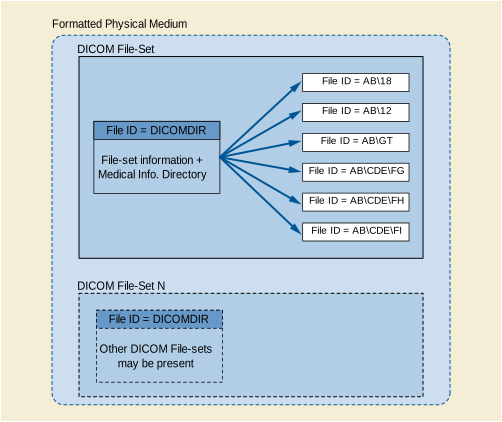
Note
Whether a single File-set or multiple File-sets are allowed on a formatted Physical Media is defined by the Media Format specification (used for each specific Physical Media) in PS3.12.
The DICOMDIR File is identified by a single component File ID, DICOMDIR. Other files in the File-set may have File IDs made of a single component (e.g., "ABGT" in Figure F.1-1) or multiple components (e.g., AB\12 or AB\CDE\FI) not to exceed 8 components (see PS3.10).
This Basic Directory Information Object:
is based on a structure of basic medical information. It is not a file system directory such as the one that may be used by the Media Format Layer;
is simple enough to meet the requirements of elementary Media Interchange applications;
is efficient in supporting update to the directory on rewritable media without a complete rewrite of the entire DICOMDIR File;
is extendible for specific applications with specialized selection keys in addition to the standard keys;
does not mandate any relationship between the hierarchy of the medical information in the DICOM Directory and the hierarchy of the File ID Components;
Note
Such an independence between the structure of the file identifiers, from which no semantic information shall be inferred, and the DICOM Directory that conveys medical imaging information, ensures that the broadest interoperability is possible between conforming DICOM media storage implementations.
The general organization of the Basic Directory IOD is introduced in this Section. A simple example is also provided to illustrate the application of this organization.
The Basic Directory IOD organization is based on a hierarchy of Directory Entities. At the origin of this inverted tree is a root Directory Entity. Each Directory Entity includes one or more Directory Records, which in turn may each reference a lower level Directory Entity.
Directory Records serve to reference objects stored in the Files of the File-set. The organization of the Directory is depicted by the Basic Directory IOD entity/relationship model presented in Figure F.2-1.
Each Directory Record, irrespective of the Directory Entity it is included in, contains four types of information:
A reference to a lower level Directory Entity or Referenced Directory Entity. This reference may be absent if such a lower level Directory Entity does not exist for an instance of a directory record;
A reference to a File of the File-set in which is stored a "Referenced Object" (formally called in DICOM a Referenced SOP Instance). This reference may be absent if no File is referenced. Files may be referenced directly by their File ID;
A set of "selection keys," specific to a Referenced Object, which will allow its selection among all the records included in a given Directory Entity;
A mechanism to chain the various Directory Records that belong to the same Directory Entity.
This generic content of a Directory Record is further specialized based on its specific type in the context the Basic Directory IOD Information Model specified in Section F.4 (e.g., a Study Record, a Series Record, etc.). A Directory Entity may include Directory Records of different Types. By standardizing a number of specific Directory Records (see Section F.5) in the context of the Basic Directory IOD Information Model, one allows the definition of a variety of directory contents while maintaining a framework for interoperability.
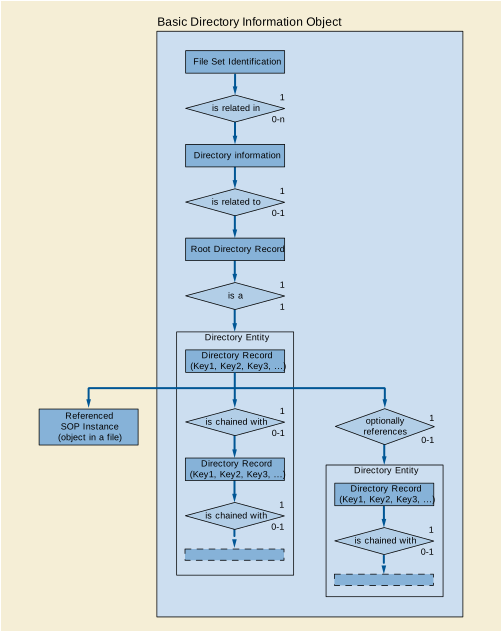
To facilitate the management and update of the Directory Information a number of rules are defined:
Any Lower-Level Directory Entity shall be referenced by at most one higher-level Directory Record. Not allowing multiple higher-level Directory Records to reference the same Lower-Level Directory Entity simplifies the management of the deletion (or inactivation) of Directory Records and Lower-Level Directory Entities and associated Directory Records
Any Directory Record shall belong to a single Directory Entity. This rule and the above rule, makes the Basic Directory IOD itself strictly hierarchical
All files referenced by a Directory shall be present in the same File-Set to which the directory belongs
Non-DICOM files that are not referenced by the Directory may be included in the File-set space. The means of access to such Files and the semantics associated with their absence from the Directory is beyond the scope of the DICOM Standard
If a DICOMDIR contains a Directory Information Module, all DICOM Files of the File-set shall be referenced by a Directory Record
Any File of the File-set shall be directly referenced by at most one Directory Record of the Directory.
Note
Referenced Files may contain SOP Instances of SOP Classes that provide the means to reference by UIDs other SOP Instances that may not be stored in files of the same File-set.
The example provided in this Section is only one simple example of a possible directory content and organization. This Section is not normative in nature. Therefore, this example is not meant to specify a conformant directory nor to restrict the range of possible directory organizations supported by this Part of the DICOM Standard.
The overall organization is illustrated at a logical level in Section F.2.2.1. The actual structure of the content is discussed in Section F.2.2.2. Annex A “Example of DICOMDIR File Content (Informative)” in PS3.10 depicts further details of the encoding of the file content.
A simple directory content is used as an example of Directory organization. It is depicted by Figure F.2-2. The left hand side part of Figure F.2-2 depicts the various Objects stored in Files of the File-set. The right hand side presents an example of organization of the directory that facilitates access to the Files of the File-set.
This example shows how stored Files are referenced by Directory Records that are grouped into Directory Entities. The two Study Directory Records (Study 1 and Study 2) are part of the Directory Entity relative to the Patient A.
Thin curved lines depict the referencing mechanism based on File IDs that allow reference to Files containing stored objects. Thick curved lines depict the internal referencing mechanisms that support the reference to a lower-level Directory Entity by a Directory Record,.
Keys that are used to select a specific Directory Record from among the Directory Records of a Directory Entity are not shown on Figure F.2-2.
One may note in this example that certain Directory Records such as the Series Directory Records do not reference Files containing stored objects. Other Directory Records such as the Image Directory Records do not reference lower level Directory Entities. However, a number of Directory Records reference both one lower level Directory Entity and one File containing a stored object. This flexibility allows the definition of a variety of directories.
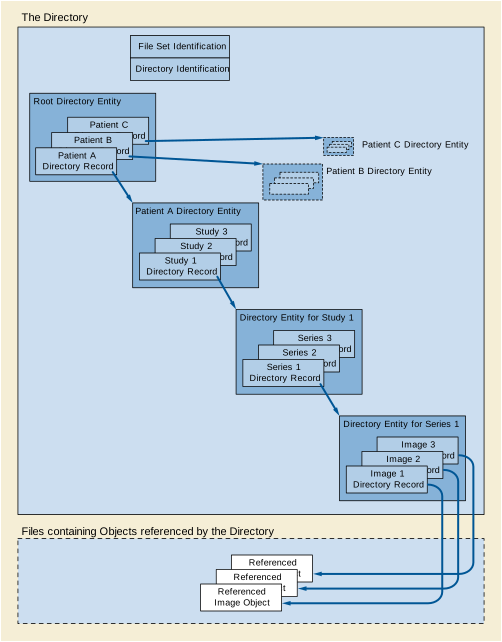
Based on the example discussed in Section F.2.2.1, the internal data structure used by the Basic Directory IOD is depicted in Figure F.2-3. It shows a set of Directory Records where each Directory Record is linked by three different types of "referencing" mechanisms:
The chaining of Directory Records to form a Directory Entity. In particular, this facilitates the addition of new Directory Records at the level of any Directory Entity by placing them at the end of the DICOMDIR File. On Figure F.2-3, this chaining is shown by yellow lines:
#1 shows the chaining of the Directory Records forming the root Directory Entity
#2 shows the chaining of the Directory Records for the Directory Entity related to Patient A
#3 shows the chaining of the Directory Records for the Directory Entity related to Study 1
#4 shows the chaining of the Directory Records for the Directory Entity related to Series 1
Green lines depict the reference by a Directory Record to a lower level Directory Entity
Blue lines depict the reference by a Directory Record to a stored file containing a SOP Class
This example of a DICOMDIR File structure shows one example of a specific order of the Directory Records. Other orderings of Directory Records could result in a functionally equivalent directory.
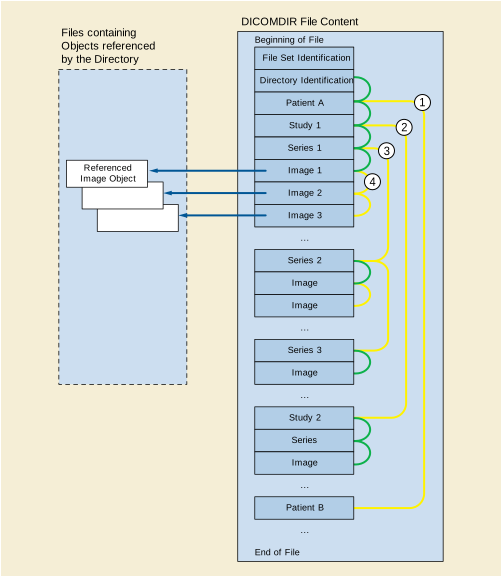
This IOD is based on the Directory Information organization introduced in Section F.2. The model for this Basic Directory IOD is described Section F.2.1 by the Entity/Relationship model in Figure F.2-1. The rules specified in Section F.2.1 apply to this Information Object Definition.
The Basic Directory IOD includes the Modules specified by Table F.3-1.
Table F.3-1. Basic Directory IOD Modules
|
Module |
Reference |
Usage |
Module Description |
|---|---|---|---|
|
File-set Identification |
M |
File-set identification information |
|
|
Directory Information |
U |
Directory Information followed by a Sequence of Directory Records. NoteThe Directory Information Module is optional. This Directory Information Module should be present in all but primitive environments where a directory is not needed. In this case, only the File-set Identification Information is present. |
Attributes of the Basic Directory IOD are defined with a Type designation that indicates if a specific Attribute is required for all Media Storage Operations (see Chapter 5).
Table F.3-2. File-Set Identification Module Attributes
|
Attribute Name |
Tag |
Type |
Attribute Description |
|---|---|---|---|
|
File-set ID |
(0004,1130) |
2 |
User or implementation specific Identifier (up to 16 characters). For definition, see PS3.10. The File-set ID is intended to be a short human readable label to easily (but not necessarily uniquely) identify a specific File-set to facilitate operator manipulation of the physical media on which the File-set is stored. Assignment of Value and semantics are environment specific. |
|
File-set Descriptor File ID |
(0004,1141) |
3 |
ID of a File (in the same File-set) used for user comments related to the File-set (e.g., a README file). The Specific Character set used may be specified in the Specific Character Set of the File-set Descriptor File (0004,1142). NoteThis File is not DICOM formatted (no Preamble, nor DICM Prefix and Meta Information). |
|
Specific Character Set of File-set Descriptor File |
(0004,1142) |
1C |
Character set used in the File-set Descriptor File with a File ID as specified in File-set Descriptor File ID (0004,1141). Required to specify the expanded or replacement character set. If absent, only the Basic Graphic set is used. See Section C.12.1.1.2 for Defined Terms. |
Note
Every File-set is assigned a File-set UID when created. The File-set UID need not be duplicated as a Type 1 Attribute of the File-set Identification Module. It is conveyed as the SOP Instance UID of the Basic Directory IOD. It is included in the DICOMDIR File Meta Information (see PS3.10)
This Module contains a sequence of Directory Records forming one or more Directory Entities. This Module defines at least one Directory Entity, the Root Directory Entity (which may be empty). Each Directory Record is composed of Directory Elements (marked by a ">"). They include:
an offset pointer to another Directory Record of the Same Directory Entity
an offset pointer to a lower level Directory Entity
a Referenced File pointed to by the Directory Record
a set of keys representative of the information contained in the Referenced File
Table F.3-3. Directory Information Module Attributes
|
Attribute Name |
Tag |
Type |
Attribute Description |
|---|---|---|---|
|
Offset of the First Directory Record of the Root Directory Entity |
(0004,1200) |
1 |
Offset of the first byte (of the Item Data Element) of the first Directory Record of the Root Directory Entity. This Offset is a number of bytes starting with the first byte of the File Meta Information. When the Root Directory Entity contains no Directory Record, this offset shall be set to 00000000H. NoteThis offset includes the File Preamble and the DICM Prefix. |
|
Offset of the Last Directory Record of the Root Directory Entity |
(0004,1202) |
1 |
Offset of the first byte (of the Item Data Element) of the last Directory Record of the Root Directory Entity. This Offset is a number of bytes starting with the first byte of the File Meta Information. When the Root Directory Entity contains no Directory Record, this offset shall be set to 00000000H. NoteThis offset includes the File Preamble and the DICM Prefix. |
|
File-set Consistency Flag |
(0004,1212) |
1 |
Enumerated Values:
The value FFFFH shall never be sent. NoteFormerly, this Attribute was intended to signal that the directory was in an inconsistent state with a value of FFFFH. This usage has been retired. See PS3.3-2008. |
|
Directory Record Sequence |
(0004,1220) |
2 |
Sequence of zero or more Items where each Item contains a Directory Record by including the Directory Elements from (0004,1400) to (0004,1511) and Record selection Keys as defined below (marked with a >). A zero length Value indicates that no Directory Records are contained in the Root Directory Entity. |
|
>Offset of the Next Directory Record |
(0004,1400) |
1 |
Offset of the first byte (of the Item Data Element) of the next Directory Record of the same Directory Entity. This Offset is an unsigned integer representing a number of bytes starting with the first byte of the File Meta-information. A zero offset shall be used to mean that there is no other Directory Record in this Directory Entity. This Offset may be used to keep an inactive Record (0004,1410) chained with the next Directory Record of the same Directory Entity. NoteThis offset includes the File Preamble and the DICM Prefix. |
|
>Record In-use Flag |
(0004,1410) |
1 |
Enumerated Values:
The value 0000H shall never be sent. NoteFormerly, this Attribute was intended to facilitate the deletion of files, with a value 0000H signally an inactive record. This usage has been retired. See PS3.3-2008. Other Values are reserved and shall not be set by File-set Creators, but if present shall be interpreted as FFFFH by File-set Readers or Updaters. |
|
>Offset of Referenced Lower-Level Directory Entity |
(0004,1420) |
1 |
Offset of the first byte (of the Item Data Element) of the first Directory Record of the Referenced Lower Level Directory Entity. This Offset is a number of bytes starting with the first byte of the File Meta Information. When no lower-level Directory Entity (containing at least one Directory Record) is referenced, this Attribute shall have a Value of 00000000H. NoteThis offset includes the File Preamble and the DICM Prefix. |
|
>Directory Record Type |
(0004,1430) |
1 |
Defines a specialized type of Directory Record by reference to its position in the Media Storage Directory Information Model (see Section F.4). Enumerated Values:
Note
|
|
>Private Record UID |
(0004,1432) |
1C |
Required if the Directory Record Type (0004,1430) is of Value PRIVATE. This UID is used to define a non-standard type of Directory Record by reference to its position in a private extension to the Basic Directory IOD Information Model (see Section F.5). This UID shall be registered according to the procedures defined in PS3.5. Its meaning may or may not be specified in a Conformance Statement. |
|
>Referenced File ID |
(0004,1500) |
1C |
A Multiple Value (see PS3.5) that represents the ordered components of the File ID containing a "referenced object" or Referenced SOP Instance. A maximum of 8 components, each from 1 to 8 characters shall be used (see Section 8.2). NoteThe Referenced File ID provides the means to "locate" the File through the DICOM File Service provided by the Media Format Layer. All referenced Files shall be with the File-set to which the Directory belongs. Any File within the File-set (to which the Directory belongs) shall be referenced by at most one Directory Record. When the Directory Record does not reference any SOP Instance this attribute shall not be present. |
|
>Referenced SOP Class UID in File |
(0004,1510) |
1C |
Unique ID for the SOP Class of the Instance stored in the referenced File. Required if the Directory Record references a SOP Instance. |
|
>Referenced SOP Instance UID in File |
(0004,1511) |
1C |
Unique Identifier for the SOP Instance stored in the referenced file. Required if the Directory Record references a SOP Instance. |
|
>Referenced Transfer Syntax UID in File |
(0004,1512) |
1C |
Unique Identifier for the Transfer Syntax used to encode the Instance stored in the referenced file. Required if the Directory Record references a SOP Instance. |
|
>Referenced Related General SOP Class UID in File |
(0004,151A) |
1C |
Unique ID for the Related General SOP Class(es) related to the SOP Class of the Instance stored in the referenced file. Required if the Directory Record references a SOP Instance that encodes the Related General SOP Class UID (0008,001A). NoteThis may be useful to an FSR that does not support the SOP Class of the referenced Instance, but does support one of the Related General SOP Classes. |
|
>Record Selection Keys |
See F.5 |
See F.5 |
A number of DICOM Data Elements that contain specific keys defined for each type of Directory Record (0004,1430) defined in Section F.5. |
The Basic Directory IOD Information Model defines the relationship between the various types of Directory Records that may be used in constructing DICOM Directories. This model is based on the DICOM Application Model defined in this part of the DICOM Standard. Entities in this Model correspond to Directory Records (DR). These are shown as rectangular boxes. Each Directory Record in this model is part of a Directory Entity (not shown except for the Root Entity) that is referenced by a Directory Record of a higher-level Directory Entity (e.g., a Study Directory Record references a Directory Entity that includes Directory Records describing the content of the Study).
Each Directory Record has a number of mandatory and optional keys that are not shown on this model. They are defined in Section F.5. Conventions used are those used by this part of the DICOM Standard. The model is depicted as an entity/relationship model in Figure F.4-1. These Directory Record relationships are fully specified in Table F.4-1.
Table F.4-1. Relationship Between Directory Records
|
Directory Record Type |
Section |
Directory Record Types that may be included in the next lower-level directory Entity |
|---|---|---|
|
(Root Directory Entity) |
PATIENT, HANGING PROTOCOL, PALETTE, IMPLANT, IMPLANT ASSY, IMPLANT GROUP, PRIVATE |
|
|
PATIENT |
STUDY, HL7 STRUC DOC, PRIVATE |
|
|
STUDY |
SERIES, PRIVATE |
|
|
SERIES |
IMAGE, RT DOSE, RT STRUCTURE SET, RT PLAN, RT TREAT RECORD, PRESENTATION, WAVEFORM, SR DOCUMENT, KEY OBJECT DOC, SPECTROSCOPY, RAW DATA, REGISTRATION, FIDUCIAL, ENCAP DOC, VALUE MAP, STEREOMETRIC, PLAN, MEASUREMENT, SURFACE, PRIVATE |
|
|
IMAGE |
PRIVATE |
|
|
RT DOSE |
PRIVATE |
|
|
RT STRUCTURE SET |
PRIVATE |
|
|
RT PLAN |
PRIVATE |
|
|
RT TREAT RECORD |
PRIVATE |
|
|
PRESENTATION |
PRIVATE |
|
|
WAVEFORM |
PRIVATE |
|
|
SR DOCUMENT |
PRIVATE |
|
|
KEY OBJECT DOC |
PRIVATE |
|
|
SPECTROSCOPY |
PRIVATE |
|
|
RAW DATA |
PRIVATE |
|
|
REGISTRATION |
PRIVATE |
|
|
FIDUCIAL |
PRIVATE |
|
|
HANGING PROTOCOL |
PRIVATE |
|
|
ENCAP DOC |
PRIVATE |
|
|
HL7 STRUC DOC |
PRIVATE |
|
|
VALUE MAP |
PRIVATE |
|
|
STEREOMETRIC |
PRIVATE |
|
|
PALETTE |
PRIVATE |
|
|
IMPLANT |
PRIVATE |
|
|
IMPLANT ASSY |
PRIVATE |
|
|
IMPLANT GROUP |
PRIVATE |
|
|
PLAN |
PRIVATE |
|
|
MEASUREMENT |
PRIVATE |
|
|
SURFACE |
PRIVATE |
|
|
SURFACE SCAN |
PRIVATE |
|
|
PRIVATE |
PRIVATE, (any of the above as privately defined) |
Note
Directory Record Types PRINT QUEUE, FILM SESSION, FILM BOX, and IMAGE BOX were previously defined in DICOM. They have been retired. See PS3.3-1998.
Directory Record Types OVERLAY, MODALITY LUT, VOI LUT, CURVE, TOPIC, VISIT, RESULTS, INTERPRETATION, STUDY COMPONENT, STORED PRINT and MRDR were previously defined in DICOM. They have been retired. See PS3.3-2004.
The following Sections specify a number of Directory Records that were introduced by the Basic Directory IOD Information Model presented in Section F.4. For each one, it identifies the SOP Classes that may be referenced and the related mandatory keys. Keys are assigned a Type designation that indicates if it is required for all Media Storage Operations of the Directory (see Section 5).
Type 2 and Type 3 Keys may be changed to Type 1 and Type 2 or 3 respectively by Application Profiles defined in PS3.11. Keys based on Private Data Elements, or Private Keys may also be used in addition to Standard defined Keys. However such Private keys may be ignored by any File-set Reader or Updater.
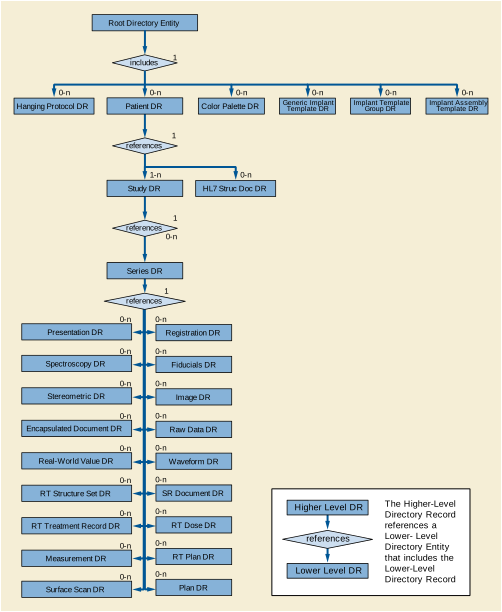
Note
Normalized Print media storage was previously defined in DICOM. It is now retired. See PS3.3-1998.
The Directory Record is based on the specification of Section F.3. It is identified by a Directory Record Type of Value "PATIENT." Table F.5-1 lists the set of keys with their associated Types for such a Directory Record Type. The description of these keys may be found in the Modules related to the Patient IOD or the Patient IE of Image IODs. This Type of Directory Record may reference a Lower-Level Directory Entity that includes one or more Directory Records as defined in Table F.4-1.
Table F.5-1. Patient Keys
|
Key |
Tag |
Type |
Attribute Description |
|---|---|---|---|
|
Specific Character Set |
(0008,0005) |
1C |
Required if an extended or replacement character set is used in one of the keys |
|
Patient's Name |
(0010,0010) |
2 |
|
|
Patient ID |
(0010,0020) |
1 |
|
|
Any other Attribute of the Patient IE Modules |
3 |
||
For a given File-set, the Patient ID shall be unique. This means that it shall not appear in different Patient Directory Records.
The Directory Record is based on the specification of Section F.3. It is identified by a Directory Record Type of Value "STUDY." Table F.5-2 lists the set of keys with their associated Types for such a Directory Record Type. The description of these keys may be found in the Modules related to the Study IE of Composite IODs. This Type of Directory Record may reference a Lower-Level Directory Entity that includes one or more Directory Records as defined in Table F.4-1. Only one Study Directory Record per Study Instance UID shall be present in a Basic Directory Instance; this implies that a study belongs to a single patient and shall be referenced only once for that patient.
Table F.5-2. Study Keys
|
Key |
Tag |
Type |
Attribute Description |
|---|---|---|---|
|
Specific Character Set |
(0008,0005) |
1C |
Required if an extended or replacement character set is used in one of the keys |
|
Study Date |
(0008,0020) |
1 |
|
|
Study Time |
(0008,0030) |
1 |
|
|
Study Description |
(0008,1030) |
2 |
|
|
Study Instance UID |
(0020,000D) |
1C |
Required only if (0004,1511) is absent (see Note). |
|
Study ID |
(0020,0010) |
1 |
|
|
Accession Number |
(0008,0050) |
2 |
|
|
Any other Attribute of the Study IE Modules |
3 |
||
Note
The Study Instance UID shall be present as a mandatory key only if no file is referenced by this Directory Record. In the case where this Directory Record references a file, the Directory Record contains in the Referenced SOP Instance UID in File (0004,1511). In this case (0004,1511) may be used as a "pseudo" Directory Record Key (see Table F.3-3) and need not be duplicated.
The Directory Record is based on the specification of Section F.3. It is identified by a Directory Record Type of Value "SERIES." Table F.5-3 lists the set of keys with their associated Types for such a Directory Record Type. The description of these keys may be found in the Modules related to the Series IE and Equipment IE of Composite IODs. This type of Directory Record may reference a Lower-Level Directory Entity that includes one or more Directory Records as defined in Table F.4-1. Only one Series Directory Record per Series Instance UID shall be present in a Basic Directory Instance; this implies that a series belongs to a single study and shall be referenced only once for that study.
Table F.5-3. Series Keys
|
Key |
Tag |
Type |
Attribute Description |
|---|---|---|---|
|
Specific Character Set |
(0008,0005) |
1C |
Required if an extended or replacement character set is used in one of the keys |
|
Modality |
(0008,0060) |
1 |
|
|
Series Instance UID |
(0020,000E) |
1 |
|
|
Series Number |
(0020,0011) |
1 |
|
|
Icon Image Sequence |
(0088,0200) |
3 |
This Icon Image is representative of the Series. It may or may not correspond to one of the images of the Series. Only a single Item is permitted in this Sequence. |
|
See Section F.7. |
|||
|
Any other Attribute of the Series IE Modules |
3 |
||
The Directory Record is based on the specification of Section F.3. It is identified by a Directory Record Type of Value "IMAGE." Table F.5-4 lists the set of keys with their associated Types for such a Directory Record Type. The description of these keys may be found in the Modules related to the Image IE of Image IODs. This Directory Record shall be used to reference an Image SOP Instance. This type of Directory Record may reference a Lower-Level Directory Entity that includes one or more Directory Records as defined in Table F.4-1.
Table F.5-4. Image Keys
|
Key |
Tag |
Type |
Attribute Description |
|---|---|---|---|
|
Specific Character Set |
(0008,0005) |
1C |
Required if an extended or replacement character set is used in one of the keys. |
|
Instance Number |
(0020,0013) |
1 |
|
|
Icon Image Sequence |
(0088,0200) |
3 |
This Icon Image is representative of the Image. Only a single Item is permitted in this Sequence. |
|
See Section F.7. |
|||
|
Any other Attribute of the Image IE Modules |
3 |
||
Note
Because Referenced SOP Instance UID in File (0004,1511) may be used as a "pseudo" Directory Record Key (see Table F.3-3), it is not duplicated in this list of keys.
Retired. See PS3.3-2004.
Retired. See PS3.3-2004.
Retired. See PS3.3-2004.
Retired. See PS3.3-2004.
Retired. See PS3.3-2004.
Retired. See PS3.3-2004.
Retired. See PS3.3-2004.
Retired. See PS3.3-2004.
Retired. See PS3.3-2004.
This section was previously defined in DICOM. It is now retired. See PS3.3-1998.
This section was previously defined in DICOM. It is now retired. See PS3.3-1998.
This section was previously defined in DICOM. It is now retired. See PS3.3-1998.
This section was previously defined in DICOM. It is now retired. See PS3.3-1998.
Retired. See PS3.3-2004.
This Directory Record is based on the specification of Section F.3. It is identified by a Directory Record Type of Value "RT DOSE". Table F.5-19 lists the set of keys with their associated Types for such a Directory Record Type. The description of these keys may be found in the Modules related to the Dose IE of the RT Dose IOD. This Directory Record shall be used to reference a RT Dose SOP instance. This Type of Directory Record may reference a Lower-Level Directory Entity that includes one or more Directory Records as defined in Table F.4-1.
Table F.5-19. RT Dose Keys
|
Key |
Tag |
Type |
Attribute Description |
|---|---|---|---|
|
Specific Character Set |
(0008,0005) |
1C |
Required if an extended or replacement character set is used in one of the keys. |
|
Instance Number |
(0020,0013) |
1 |
|
|
Dose Summation Type |
(3004,000A) |
1 |
|
|
Dose Comment |
(3004,0006) |
3 |
|
|
Icon Image Sequence |
(0088,0200) |
3 |
This Icon Image is representative of the RT Dose. Only a single Item is permitted in this Sequence. |
|
See Section F.7. |
|||
|
Any other Attribute of the Dose IE Modules |
3 |
||
Note
Because Referenced SOP Instance UID in File (0004,1511) may be used as a "pseudo" Directory Record Key (see Table F.3-3), it is not duplicated in this list of keys.
This Directory Record is based on the specification of Section F.3. It is identified by a Directory Record Type of Value "RT STRUCTURE SET". Table F.5-20 lists the set of keys with their associated Types for such a Directory Record Type. The description of these keys may be found in the Modules related to the Structure Set IE of the RT Structure Set IOD. This Directory Record shall be used to reference a RT Structure Set SOP instance. This Type of Directory Record may reference a Lower-Level Directory Entity that includes one or more Directory Records as defined in Table F.4-1.
Table F.5-20. RT Structure Set Keys
|
Key |
Tag |
Type |
Attribute Description |
|---|---|---|---|
|
Specific Character Set |
(0008,0005) |
1C |
Required if an extended or replacement character set is used in one of the keys. |
|
Instance Number |
(0020,0013) |
1 |
|
|
Structure Set Label |
(3006,0002) |
1 |
|
|
Structure Set Date |
(3006,0008) |
2 |
|
|
Structure Set Time |
(3006,0009) |
2 |
|
|
Any other Attribute of the Structure Set IE Modules |
3 |
||
Note
Because (0004,1511) Referenced SOP Instance UID in File may be used as a "pseudo" Directory Record Key (see Table F.3-3), it is not duplicated in this list of keys.
This Directory Record is based on the specification of Section F.3. It is identified by a Directory Record Type of Value "RT PLAN". Table F.5-21 lists the set of keys with their associated Types for such a Directory Record Type. The description of these keys may be found in the Modules related to the Plan IE of the RT Plan IOD. This Directory Record shall be used to reference a RT Plan SOP instance. This Type of Directory Record may reference a Lower-Level Directory Entity that includes one or more Directory Records as defined in Table F.4-1.
Table F.5-21. RT Plan Keys
|
Key |
Tag |
Type |
Attribute Description |
|---|---|---|---|
|
Specific Character Set |
(0008,0005) |
1C |
Required if an extended or replacement character set is used in one of the keys |
|
Instance Number |
(0020,0013) |
1 |
|
|
RT Plan Label |
(300A,0002) |
1 |
|
|
RT Plan Date |
(300A,0006) |
2 |
|
|
RT Plan Time |
(300A,0007) |
2 |
|
|
Any other Attribute of the Plan IE Modules |
3 |
||
Note
Because Referenced SOP Instance UID in File (0004,1511) may be used as a "pseudo" Directory Record Key (see Table F.3-3), it is not duplicated in this list of keys.
This Directory Record is based on the specification of Section F.3. It is identified by a Directory Record Type of Value "RT TREAT RECORD". Table F.5-22 lists the set of keys with their associated Types for such a Directory Record Type. The description of these keys may be found in the Modules related to the Treatment Record IE of the RT Treatment Record IODs. This Directory Record shall be used to reference an RT Beams Treatment Record SOP instance, RT Brachy Treatment Record SOP instance, or RT Treatment Summary Record SOP instance. This Type of Directory Record may reference a Lower-Level Directory Entity that includes one or more Directory Records as defined in Table F.4-1.
Table F.5-22. RT Treatment Record Keys
|
Key |
Tag |
Type |
Attribute Description |
|---|---|---|---|
|
Specific Character Set |
(0008,0005) |
1C |
Required if an extended or replacement character set is used in one of the keys |
|
Instance Number |
(0020,0013) |
1 |
|
|
Treatment Date |
(3008,0250) |
2 |
|
|
Treatment Time |
(3008,0251) |
2 |
|
|
Any other Attribute of the Treatment Record IE Modules |
3 |
||
Note
Because Referenced SOP Instance UID in File (0004,1511) may be used as a "pseudo" Directory Record Key (see Table F.3-3), it is not duplicated in this list of keys.
The Directory Record is based on the specification of Section F.3. It is identified by a Directory Record Type of Value "PRESENTATION". Table F.5-23 lists the set of keys with their associated Types for such a Directory Record Type. The description of these keys may be found in the Modules related to Softcopy Presentation State Storage and Structured Display IODs. This Directory Record shall be used to reference a Softcopy Presentation State Storage SOP Instance or a Structured Display SOP Instance. This Type of Directory Record may reference a Lower-Level Directory Entity that includes one or more Directory Records as defined in Table F.4-1.
Table F.5-23. Presentation Keys
|
Key |
Tag |
Type |
Attribute Description |
|---|---|---|---|
|
Specific Character Set |
(0008,0005) |
1C |
Required if an extended or replacement character set is used in one of the keys. |
|
Presentation Creation Date |
(0070,0082) |
1 |
Date on which this presentation was created. NoteThis date may be different from the date that the DICOM SOP Instance was created, since the presentation information contained may have been recorded earlier. |
|
Presentation Creation Time |
(0070,0083) |
1 |
Time at which this presentation was created. NoteThis time may be different from the time that the DICOM SOP Instance was created, since the presentation information contained may have been recorded earlier. |
|
Include Table 10-12 “Content Identification Macro Attributes” |
|||
|
Referenced Series Sequence |
(0008,1115) |
1C |
Sequence of Items where each Item includes the Attributes of one Series to which the Presentation applies. One or more Items shall be included in this Sequence. Required if the IOD of the Presentation SOP Instance referenced by this directory record includes the Presentation State Relationship Module. |
|
>Series Instance UID |
(0020,000E) |
1 |
Unique identifier of a Series that is part of this Study. |
|
>Referenced Image Sequence |
(0008,1140) |
1 |
Sequence of Items where each Item provides reference to an Image SOP Instance. One or more Items shall be included in this sequence. |
|
>>Include Table 10-11 “SOP Instance Reference Macro Attributes” |
|||
|
Blending Sequence |
(0070,0402) |
1C |
Sequence of Items where each Item includes the Attributes of a Study to which the Presentation applies. Only two Items shall be included in this sequence. Required if the SOP Instance referenced by this directory record includes Blending Sequence (0070,0402). |
|
>Study Instance UID |
(0020,000D) |
1 |
Unique identifier for a Study that contains the images to which the Presentation applies. |
|
>Referenced Series Sequence |
(0008,1115) |
1 |
Sequence of Items where each Item includes the Attributes of one Series to which the Presentation applies. Only a single item shall be included in this Sequence. |
|
>>Series Instance UID |
(0020,000E) |
1 |
Unique identifier of the Series |
|
>>Referenced Image Sequence |
(0008,1140) |
1 |
Sequence of Items where each Item provides reference to an Image SOP Instance to which the Presentation applies. One or more Items shall be included in this sequence. |
|
>>>Include Table 10-11 “SOP Instance Reference Macro Attributes” |
|||
|
Any other Attribute of the Presentation State IE Modules |
3 |
||
Note
Because Referenced SOP Instance UID in File (0004,1511) may be used as a "pseudo" Directory Record Key (see Table F.3-3), it is not duplicated in this list of keys.
The Directory Record is based on the specification of Section F.3. It is identified by a Directory Record Type of Value "WAVEFORM". Table F.5-24 lists the set of keys with their associated Types for such a Directory Record Type. The description of these keys may be found in PS3.3 of the DICOM Standard in the Modules related to the Waveform IE. This Directory Record shall be used to reference a Waveform SOP Instance. This Type of Directory Record may reference a Lower-Level Directory Entity that includes one or more Directory Records as defined in Table F.4-1.
Table F.5-24. Waveform Keys
|
Key |
Tag |
Type |
Attribute Description |
|---|---|---|---|
|
Specific Character Set |
(0008,0005) |
1C |
Required if an extended or replacement character set is used in one of the keys. |
|
Instance Number |
(0020,0013) |
1 |
|
|
Content Date |
(0008,0023) |
1 |
|
|
Content Time |
(0008,0033) |
1 |
|
|
Any other Attribute of the Waveform IE Modules |
3 |
||
Note
Because Referenced SOP Instance UID in File (0004,1511) may be used as a "pseudo" Directory Record Key (see Table F.3-3), it is not duplicated in this list of keys.
The Directory Record is based on the specification of Section F.3. It is identified by a Directory Record Type of Value "SR DOCUMENT". Table F.5-25 lists the set of keys with their associated Types for such a Directory Record Type. The description of these keys may be found in the Modules related to the Observation IE of Structured Report IOD. This Directory Record shall be used to reference an SR Document. This type of Directory Record may reference a Lower-Level Directory Entity that includes one or more Directory Records as defined in Table F.4-1.
Table F.5-25. SR Document Keys
|
Key |
Tag |
Type |
Attribute Description |
|---|---|---|---|
|
Specific Character Set |
(0008,0005) |
1C |
Required if an extended or replacement character set is used in one of the keys. |
|
Instance Number |
(0020,0013) |
1 |
|
|
Completion Flag |
(0040,A491) |
1 |
|
|
Verification Flag |
(0040,A493) |
1 |
|
|
Content Date |
(0008,0023) |
1 |
|
|
Content Time |
(0008,0033) |
1 |
|
|
Verification DateTime |
(0040,A030) |
1C |
Most recent Date and Time of verification among those defined in the Verifying Observer Sequence (0040,A073). Required if Verification Flag (0040,A493) is VERIFIED. |
|
Concept Name Code Sequence |
(0040,A043) |
1 |
Code describing the concept represented by the root Content Item (Document Title). Only a single Item shall be included in this sequence. |
|
Content Sequence |
(0040,A730) |
1C |
Contains the Target Content Items that modify the Concept Name Code Sequence of the root Content Item (Document Title). One or more Items shall be included in this Sequence. All, and only, Content Items with the HAS CONCEPT MOD relationship from the root Content Item shall be included in this Sequence. Required if the root Content Item is the Source Content Item of HAS CONCEPT MOD relationships. |
|
>Relationship Type |
(0040,A010) |
1 |
Enumerated Values:
|
|
Any Attribute of the Document IE Modules |
3 |
||
Note
Because Referenced SOP Instance UID in File (0004,1511) may be used as a "pseudo" Directory Record Key (see Table F.3-3), it is not duplicated in this list of keys.
The Directory Record is based on the specification of Section F.3. It is identified by a Directory Record Type of Value "KEY OBJECT DOC". Table F.5-25 lists the set of keys with their associated Types for such a Directory Record Type. The description of these keys may be found in the Modules related to the Document IE of the Key Object Selection IOD. This Directory Record shall be used to reference a Key Object Selection Document. This type of Directory Record may reference a Lower-Level Directory Entity that includes one or more Directory Records as defined in Table F.4-1.
Table F.5-26. Key Object Document Keys
|
Key |
Tag |
Type |
Attribute Description |
|---|---|---|---|
|
Specific Character Set |
(0008,0005) |
1C |
Required if an extended or replacement character set is used in one of the keys. |
|
Instance Number |
(0020,0013) |
1 |
|
|
Content Date |
(0008,0023) |
1 |
|
|
Content Time |
(0008,0033) |
1 |
|
|
Concept Name Code Sequence |
(0040,A043) |
1 |
Code describing the concept represented by the root Content Item (Document Title). Only a single Item shall be included in this sequence. |
|
Content Sequence |
(0040,A730) |
1C |
Contains the Target Content Items that modify the Concept Name Code Sequence of the root Content Item (Document Title). One or more Items shall be included in this Sequence. All, and only, Content Items with the HAS CONCEPT MOD relationship from the root Content Item shall be included in this Sequence. Required if the root Content Item is the Source Content Item of HAS CONCEPT MOD relationships. |
|
>Relationship Type |
(0040,A010) |
1 |
Enumerated Values:
|
|
Any Attribute of the Document IE Modules |
3 |
||
Note
Because Referenced SOP Instance UID in File (0004,1511) may be used as a "pseudo" Directory Record Key (see Table F.3-3), it is not duplicated in this list of keys.
The Directory Record is based on the specification of Section F.3. It is identified by a Directory Record Type of Value "SPECTROSCOPY." Table F.5-27 lists the set of keys with their associated Types for such a Directory Record Type. The description of these keys may be found in the Modules related to the MR Spectroscopy IE of MR Spectroscopy IODs. This Directory Record shall be used to reference a Spectroscopy SOP Instance. This type of Directory Record may reference a Lower-Level Directory Entity that includes one or more Directory Records as defined in Table F.4-1.
Table F.5-27. Spectroscopy Keys
|
Key |
Tag |
Type |
Attribute Description |
|---|---|---|---|
|
Specific Character Set |
(0008,0005) |
1C |
Required if an extended or replacement character set is used in one of the keys. |
|
Image Type |
(0008,0008) |
1 |
|
|
Content Date |
(0008,0023) |
1 |
|
|
Content Time |
(0008,0033) |
1 |
|
|
Instance Number |
(0020,0013) |
1 |
|
|
Referenced Image Evidence Sequence |
(0008,9092) |
1C |
Required if present in the spectroscopy instance. One or more Items shall be included in this sequence. |
|
>Include Table C.17-3 “Hierarchical SOP Instance Reference Macro Attributes” |
|||
|
Number of Frames |
(0028,0008) |
1 |
|
|
Rows |
(0028,0010) |
1 |
|
|
Columns |
(0028,0011) |
1 |
|
|
Data Point Rows |
(0028,9001) |
1 |
|
|
Data Point Columns |
(0028,9002) |
1 |
|
|
Icon Image Sequence |
(0088,0200) |
3 |
This Icon Image is representative of the Spectroscopy instance. Only a single Item is permitted in this Sequence. |
|
See Section F.7. |
|||
|
Any other Attribute of the MR Spectroscopy IE Modules |
3 |
||
Note
Because Referenced SOP Instance UID in File (0004,1511) may be used as a "pseudo" Directory Record Key (see Table F.3-3), it is not duplicated in this list of keys.
The Directory Record is based on the specification of Section F.3. It is identified by a Directory Record Type of Value "RAW DATA." Table F.5-28 lists the set of keys with their associated Types for such a Directory Record Type. The description of these keys may be found in the Modules related to the Raw Data IE of Raw Data IODs. This Directory Record shall be used to reference a Raw Data SOP Instance. This type of Directory Record may reference a Lower-Level Directory Entity that includes one or more Directory Records as defined in Table F.4-1.
Table F.5-28. Raw Data Keys
|
Key |
Tag |
Type |
Attribute Description |
|---|---|---|---|
|
Specific Character Set |
(0008,0005) |
1C |
Required if an extended or replacement character set is used in one of the keys. |
|
Content Date |
(0008,0023) |
1 |
|
|
Content Time |
(0008,0033) |
1 |
|
|
Instance Number |
(0020,0013) |
2 |
|
|
Icon Image Sequence |
(0088,0200) |
3 |
This Icon Image is representative of the Raw Data instance. Only a single Item is permitted in this Sequence. |
|
See Section F.7. |
|||
|
Any other Attribute of the Raw Data IE Modules |
3 |
||
Note
Because Referenced SOP Instance UID in File (0004,1511) may be used as a "pseudo" Directory Record Key (see Table F.3-3), it is not duplicated in this list of keys.
The Directory Record is based on the specification of Section F.3. It is identified by a Directory Record Type of Value "REGISTRATION." Table F.5-29 lists the set of keys with their associated Types for such a Directory Record Type. The description of these keys may be found in the Modules related to the Spatial Registration IE of the Spatial Registration IOD. This Directory Record shall be used to reference a Spatial Registration SOP Instance. This type of Directory Record may reference a Lower-Level Directory Entity that includes one or more Directory Records as defined in Table F.4-1.
Table F.5-29. Registration Keys
|
Key |
Tag |
Type |
Attribute Description |
|---|---|---|---|
|
Specific Character Set |
(0008,0005) |
1C |
Required if an extended or replacement character set is used in one of the keys. |
|
Content Date |
(0008,0023) |
1 |
The date the content creation started. |
|
Content Time |
(0008,0033) |
1 |
The time the content creation started. |
|
Include Table 10-12 “Content Identification Macro Attributes” |
|||
|
Any other Attribute of the Spatial Registration IE Modules |
3 |
||
Note
Because Referenced SOP Instance UID in File (0004,1511) may be used as a "pseudo" Directory Record Key (see Table F.3-3), it is not duplicated in this list of keys.
The Directory Record is based on the specification of Section F.3. It is identified by a Directory Record Type of Value "FIDUCIAL." Table F.5-30 lists the set of keys with their associated Types for such a Directory Record Type. The description of these keys may be found in the Modules related to the Spatial Fiducials IE of Spatial Fiducials IOD. This Directory Record shall be used to reference a Spatial Fiducials SOP Instance. This type of Directory Record may reference a Lower-Level Directory Entity that includes one or more Directory Records as defined in Table F.4-1.
Table F.5-30. Fiducial Keys
|
Key |
Tag |
Type |
Attribute Description |
|---|---|---|---|
|
Specific Character Set |
(0008,0005) |
1C |
Required if an extended or replacement character set is used in one of the keys. |
|
Content Date |
(0008,0023) |
1 |
The date the content creation started. |
|
Content Time |
(0008,0033) |
1 |
The time the content creation started. |
|
Include Table 10-12 “Content Identification Macro Attributes” |
|||
|
Any other Attribute of the Spatial Fiducials IE Modules |
3 |
||
Note
Because Referenced SOP Instance UID in File (0004,1511) may be used as a "pseudo" Directory Record Key (see Table F.3-3), it is not duplicated in this list of keys.
The Directory Record is based on the specification of Section F.3. It is identified by a Directory Record Type of Value "HANGING PROTOCOL". Table F.5-31 lists the set of keys with their associated Types for such a Directory Record Type. The description of these keys may be found in the Modules related to the Hanging Protocol IOD. This Directory Record shall be used to reference a Hanging Protocol SOP Instance. This type of Directory Record may reference a Lower-Level Directory Entity that includes one or more Directory Records as defined in Table F.4-1.
Table F.5-31. Hanging Protocol Keys
|
Attribute Name |
Tag |
Type |
Attribute Description |
|---|---|---|---|
|
Specific Character Set |
(0008,0005) |
1C |
Required if an extended or replacement character set is used in one of the keys |
|
Hanging Protocol Name |
(0072,0002) |
1 |
|
|
Hanging Protocol Description |
(0072,0004) |
1 |
|
|
Hanging Protocol Level |
(0072,0006) |
1 |
|
|
Hanging Protocol Creator |
(0072,0008) |
1 |
|
|
Hanging Protocol Creation DateTime |
(0072,000A) |
1 |
|
|
Hanging Protocol Definition Sequence |
(0072,000C) |
1 |
Sequence that defines the type of imaging studies to which this Hanging Protocol applies. One or more Items shall be included in this sequence. |
|
>Modality |
(0008,0060) |
1C |
Required if Anatomic Region Sequence (0008,2218) is not present. May be present otherwise. |
|
>Anatomic Region Sequence |
(0008,2218) |
1C |
One or more Items shall be included in this sequence. Required if Modality (0008,0060) is not present. May be present otherwise. |
|
>Laterality |
(0020,0060) |
2C |
Required if Anatomic Region Sequence (0008,2218) is present. |
|
>Procedure Code Sequence |
(0008,1032) |
2 |
Zero or more Items shall be included in this Sequence. |
|
>Reason for Requested Procedure Code Sequence |
(0040,100A) |
2 |
Zero or more Items shall be included in this sequence. |
|
Number of Priors Referenced |
(0072,0014) |
1 |
|
|
Hanging Protocol User Identification Code Sequence |
(0072,000E) |
2 |
Sequence that provides a coded identifier for the person, group, or site for which this Hanging Protocol was defined. Zero or one Item shall be included in this Sequence. |
|
Any other Attribute of the Hanging Protocol IOD |
3 |
||
Note
Because Referenced SOP Instance UID in File (0004,1511) may be used as a "pseudo" Directory Record Key (see Table F.3-3), it is not duplicated in this list of keys.
The Directory Record is based on the specification of Section F.3. It is identified by a Directory Record Type of Value "ENCAP DOC." Table F.5-32 lists the set of keys with their associated Types for such a Directory Record Type. The description of these keys may be found in the Modules related to the Encapsulated Document IE of Encapsulated IODs. This Directory Record shall be used to reference an Encapsulated Document SOP Instance. This type of Directory Record may reference a Lower-Level Directory Entity that includes one or more Directory Records as defined in Table F.4-1.
Note
Other Encapsulated Document SOP Classes may be added to the standard in the future and these will likely be referenced by this directory record. Therefore, the MIME Type should be checked rather than assuming that the referenced file contains PDF.
Table F.5-32. Encapsulated Document Keys
|
Key |
Tag |
Type |
Attribute Description |
|---|---|---|---|
|
Specific Character Set |
(0008,0005) |
1C |
Required if an extended or replacement character set is used in one of the keys. |
|
Content Date |
(0008,0023) |
2 |
The date the content creation started. |
|
Content Time |
(0008,0033) |
2 |
The time the content creation started. |
|
Instance Number |
(0020,0013) |
1 |
A number that identifies this instance |
|
Document Title |
(0042,0010) |
2 |
The title of the document. |
|
HL7 Instance Identifier |
(0040,E001) |
1C |
Instance Identifier from the referenced HL7 Structured Document, encoded as a UID (OID or UUID), concatenated with a caret ("^") and Extension value (if Extension is present in Instance Identifier). Required if encapsulated document is an HL7 Structured Document. |
|
Concept Name Code Sequence |
(0040,A043) |
2 |
A coded representation of the document title. Zero or one Item shall be included in this sequence. |
|
Baseline CID 7020 “Document Titles”. |
|||
|
MIME Type of Encapsulated Document |
(0042,0012) |
1 |
The type of the encapsulated document stream described using the MIME Media Type (see RFC 2046). |
|
Any other Attribute of the Encapsulated Document Module except Encapsulated Document (0042,0011) |
3 |
||
The Directory Record is based on the specification of Section F.3. It is identified by a Directory Record Type of Value "HL7 STRUC DOC".
Table F.5-33 lists the set of keys with their associated Types for such a Directory Record Type. This Directory Record shall be used to reference an HL7 Structured Document and any of its referenced content stored on the interchange media but not encapsulated in a DICOM SOP Instance. The document may be encoded as an XML document with in-line multimedia content, or may be encoded in a multi-part MIME wrapper (see PS3.10). This type of Directory Record may reference a Lower-Level Directory Entity that includes one or more Directory Records as defined in Table F.4-1.
Table F.5-33. HL7 Structured Document Keys
|
Key |
Tag |
Type |
Attribute Description |
|---|---|---|---|
|
Specific Character Set |
(0008,0005) |
1C |
Required if an extended or replacement character set is used in one of the keys. |
|
HL7 Instance Identifier |
(0040,E001) |
1 |
Instance Identifier from the referenced HL7 Structured Document, encoded as a UID (OID or UUID), concatenated with a caret ("^") and Extension value (if Extension is present in Instance Identifier). |
|
HL7 Document Effective Time |
(0040,E004) |
1 |
Effective Time from the referenced HL7 Structured Document |
|
HL7 Document Type Code Sequence |
(0040,E006) |
1C |
Document Type Code from the referenced HL7 Structured Document. Only a single Item shall be included in this Sequence. Required if the HL7 Structured Document contains a Document Type Code. |
|
No BCID defined |
|||
|
Document Title |
(0042,0010) |
1C |
Document Title from the referenced HL7 Structured Document. Required if the HL7 Structured Document contains a Document Title. |
Note
This directory record points to a CDA document that is stored on this media. The HL7 Document Effective Time and other information can be obtained from the CDA document.
The Directory Record is based on the specification of Section F.3. It is identified by a Directory Record Type of Value "VALUE MAP." Table F.5-34 lists the set of keys with their associated Types for such a Directory Record Type. The description of these keys may be found in the Modules related to the Real World Value Mapping IE of Real World Value Mapping IOD. This Directory Record shall be used to reference a Real World Value Mapping SOP Instance. This type of Directory Record may reference a Lower-Level Directory Entity that includes one or more Directory Records as defined in Table F.4-1.
Table F.5-34. Real World Value Mapping Keys
|
Key |
Tag |
Type |
Attribute Description |
|---|---|---|---|
|
Specific Character Set |
(0008,0005) |
1C |
Required if an extended or replacement character set is used in one of the keys. |
|
Content Date |
(0008,0023) |
1 |
The date the content creation started. |
|
Content Time |
(0008,0033) |
1 |
The time the content creation started. |
|
Include Table 10-12 “Content Identification Macro Attributes” |
|||
|
Any other Attribute of the Real World Value Mapping IE Modules |
3 |
||
Note
Because Referenced SOP Instance UID in File (0004,1511) may be used as a "pseudo" Directory Record Key (see Table F.3-3), it is not duplicated in this list of keys.
The Directory Record is based on the specification of Section F.3. It is identified by a Directory Record Type of Value "STEREOMETRIC". Table F.5-35 lists the set of keys with their associated Types for such a Directory Record Type. The description of these keys may be found in the Modules related to the Stereometric Relationship IE of Stereometric Relationship IOD. This Directory Record shall be used to reference a Stereometric Relationship SOP Instance. This type of Directory Record may reference a Lower-Level Directory Entity that includes one or more Directory Records as defined in Table F.4-1.
Table F.5-35. Stereometric Relationship Keys
|
Key |
Tag |
Type |
Attribute Description |
|---|---|---|---|
|
Specific Character Set |
(0008,0005) |
1C |
Required if an extended or replacement character set is used in one of the keys. |
|
Any other Attribute of the Stereometric Relationship IE Modules |
3 |
||
Note
Because Referenced SOP Instance UID in File (0004,1511) may be used as a "pseudo" Directory Record Key (see Table F.3-3), it is not duplicated in this list of keys.
The Directory Record is based on the specification of Section F.3. It is identified by a Directory Record Type of Value "PALETTE". Table F.5-36 lists the set of keys with their associated Types for such a Directory Record Type. The description of these keys may be found in the Modules related to the Color Palette IOD. This Directory Record shall be used to reference a Color Palette SOP Instance. This type of Directory Record may reference a Lower-Level Directory Entity that includes one or more Directory Records as defined in Table F.4-1.
Table F.5-36. Palette Keys
|
Attribute Name |
Tag |
Type |
Attribute Description |
|---|---|---|---|
|
Specific Character Set |
(0008,0005) |
1C |
Required if an extended or replacement character set is used in one of the keys |
|
Content Label |
(0070,0080) |
1 |
A label that is used to identify the palette. |
|
Content Description |
(0070,0081) |
2 |
A description of the content of the palette. |
|
Any other Attribute of the Color Palette IOD |
3 |
||
Note
Because Referenced SOP Instance UID in File (0004,1511) may be used as a "pseudo" Directory Record Key (see Table F.3-3), it is not duplicated in this list of keys.
The Directory Record is based on the specification of Section F.3. It is identified by a Directory Record Type of Value "IMPLANT". Table F.5-37 lists the set of keys with their associated Types for such a Directory Record Type. The description of these keys may be found in the Generic Implant Template IOD. This Directory Record shall be used to reference a Generic Implant Template SOP Instance.
Table F.5-37. Implant Keys
|
Key |
Tag |
Type |
Attribute Description |
|---|---|---|---|
|
Manufacturer |
(0008,0070) |
1 |
Name of the manufacturer that produces the implant. |
|
Implant Name |
(0022,1095) |
1 |
The (product) name of the implant. |
|
Implant Size |
(0068,6210) |
1C |
The size descriptor of the component. Required if present in the referenced instance. |
|
Implant Part Number |
(0022,1097) |
1 |
The (product) identifier of the implant. |
Note
Because (0004,1511) Referenced SOP Instance UID in File may be used as a "pseudo" Directory Record Key (see Table F.3-3), it is not duplicated in this list of keys.
The Directory Record is based on the specification of Section F.3. It is identified by a Directory Record Type of Value "IMPLANT ASSY". Table F.5-38 lists the set of keys with their associated Types for such a Directory Record Type. The description of these keys may be found in the Implant Assembly Template IOD. This Directory Record shall be used to reference an Implant Assembly Template SOP Instance.
Table F.5-38. Implant Assembly Keys
|
Key |
Tag |
Type |
Attribute Description |
|---|---|---|---|
|
Implant Assembly Template Name |
(0076,0001) |
1 |
A name given to the assembly described in this instance. |
|
Manufacturer |
(0008,0070) |
1 |
Name of the manufacturer that produces the implant. |
|
Procedure Type Code Sequence |
(0076,0020) |
1 |
A code describing the Intervention in which the implant is used. One or more Items shall be included in this sequence. |
Note
Because (0004,1511) Referenced SOP Instance UID in File may be used as a "pseudo" Directory Record Key (see Table F.3-3), it is not duplicated in this list of keys.
The Directory Record is based on the specification of Section F.3. It is identified by a Directory Record Type of Value "IMPLANT GROUP". Table F.5-39 lists the set of keys with their associated Types for such a Directory Record Type. The description of these keys may be found in the Implant Template Group IOD. This Directory Record shall be used to reference an Implant Template Group SOP Instance.
Table F.5-39. Implant Group Keys
|
Key |
Tag |
Type |
Attribute Description |
|---|---|---|---|
|
Implant Template Group Name |
(0078,0001) |
1 |
Name of this group |
|
Implant Template Group Description |
(0078,0010) |
3 |
Purpose or intent of this group. |
|
Implant Template Group Issuer |
(0078,0020) |
1 |
Person or Organization that issued this group. |
Note
Because (0004,1511) Referenced SOP Instance UID in File may be used as a "pseudo" Directory Record Key (see Table F.3-3), it is not duplicated in this list of keys.
The Directory Record is based on the specification of Section F.3. It is identified by a Directory Record Type of Value "PLAN". Table F.5-40 lists the set of keys with their associated Types for such a Directory Record Type. The description of these keys may be found in the Modules related to the Plan IEs of RT Plan IOD and RT Ion Plan IOD. This Directory Record shall be used to reference one of the class of Plan SOP Instances having a Modality (0008,0060) of "PLAN", such as the RT Beams Delivery Instruction IOD. This type of Directory Record may reference a Lower-Level Directory Entity that includes one or more Directory Records as defined in Table F.4-1.
Table F.5-40. Plan Keys
|
Key |
Tag |
Type |
Attribute Description |
|---|---|---|---|
|
Specific Character Set |
(0008,0005) |
1C |
Required if an extended or replacement character set is used in one of the keys. |
|
Any other Attribute of the Plan IE Modules |
3 |
||
Note
Because Referenced SOP Instance UID in File (0004,1511) may be used as a "pseudo" Directory Record Key (see Table F.3-3), it is not duplicated in this list of keys.
The Directory Record is based on the specification of Section F.3. It is identified by a Directory Record Type of Value "MEASUREMENT". Table F.5-41 lists the set of keys with their associated Types for such a Directory Record Type. The description of these keys may be found in the Modules related to the Measurements IE of the Measurement IODs. This Directory Record shall be used to reference a Measurement SOP Instance. This type of Directory Record may reference a Lower-Level Directory Entity that includes one or more Directory Records as defined in Table F.4-1.
Table F.5-41. Measurement Keys
|
Key |
Tag |
Type |
Attribute Description |
|---|---|---|---|
|
Specific Character Set |
(0008,0005) |
1C |
Required if an extended or replacement character set is used in one of the keys. |
|
Content Date |
(0008,0023) |
1 |
The date the content creation started. |
|
Content Time |
(0008,0033) |
1 |
The time the content creation started. |
|
Include Table 10-12 “Content Identification Macro Attributes” |
|||
|
Any other Attribute of the Measurements IE Modules |
3 |
||
Note
Because (0004,1511) Referenced SOP Instance UID in File may be used as a "pseudo" Directory Record Key (see Table F.3-3), it is not duplicated in this list of keys.
The Directory Record is based on the specification of Section F.3. It is identified by a Directory Record Type of Value "SURFACE". Table F.5-42 lists the set of keys with their associated Types for such a Directory Record Type. The description of these keys may be found in the Modules related to the Surface IE of the Surface Segmentation IOD. This Directory Record shall be used to reference a Surface Segmentation SOP Instance. This type of Directory Record may reference a Lower-Level Directory Entity that includes one or more Directory Records as defined in Table F.4-1.
Table F.5-42. Surface Keys
|
Key |
Tag |
Type |
Attribute Description |
|---|---|---|---|
|
Specific Character Set |
(0008,0005) |
1C |
Required if an extended or replacement character set is used in one of the keys. |
|
Content Date |
(0008,0023) |
1 |
The date the content creation started. |
|
Content Time |
(0008,0033) |
1 |
The time the content creation started. |
|
Include Table 10-12 “Content Identification Macro Attributes” |
|||
|
Any other Attribute of the Surface IE Modules |
3 |
||
Note
Because (0004,1511) Referenced SOP Instance UID in File may be used as a "pseudo" Directory Record Key (see Table F.3-3), it is not duplicated in this list of keys.
The Directory Record is based on the specification of Section F.3. It is identified by a Directory Record Type of Value "SURFACE SCAN". Table F.5-43 lists the set of keys with their associated Types for such a Directory Record Type. The description of these keys may be found in the Modules related to the Surface IE of the Surface Scan Mesh and Surface Scan Point Cloud IODs. This Directory Record shall be used to reference a Surface Scan Mesh SOP Instance. This type of Directory Record may reference a Lower-Level Directory Entity that includes one or more Directory Records as defined in Table F.4-1.
Table F.5-43. Surface Scan Keys
|
Key |
Tag |
Type |
Attribute Description |
|---|---|---|---|
|
Specific Character Set |
(0008,0005) |
1C |
Required if an extended or replacement character set is used in one of the keys. |
|
Content Date |
(0008,0023) |
1 |
The date the content creation started. |
|
Content Time |
(0008,0033) |
1 |
The time the content creation started. |
|
Any other Attribute of the Surface IE Modules |
3 |
||
Note
Because (0004,1511) Referenced SOP Instance UID in File may be used as a "pseudo" Directory Record Key (see Table F.3-3), it is not duplicated in this list of keys.
Private Directory Records may also be used in addition to Standard defined Directory Records. Such Private Records shall follow the specification of Section F.2 and Section F.3. In addition, if created by File-set Creators they shall be proper extensions to the DICOM Basic Directory IOD Information Model specified in Section F.4. By proper extensions it is meant that any File-set Creator creating private Directory Records shall still meet the PS3.10 conformance requirements. Thus a File-set Reader or File-set Updater that chooses to ignore such privately defined Directory Records will find a conformant Directory.
Retired. See PS3.3-2004.
An Icon Image may be used as a key representative of an Image, RT Dose, Spectroscopy, Raw Data or Series in a corresponding Directory Record to allow an application to display icons that enable a user to select one or more from amongst several of them. It is based on the general purpose Image Pixel Macro (see Annex C).
The Icon Image Key corresponds to Data Element (0088,0200). It is defined as a Sequence that contains a single Item encapsulating the Data Set made of the Data Elements of the Icon Image. The Data Elements are defined by the Image Pixel Macro (see Section C.7.6.3).
The Image Pixel Macro usage is restricted in a few areas to facilitate general use in Directory Record across various modality environments. These restrictions are:
Only monochrome and palette color images shall be used. Samples per Pixel (0028,0002) shall have a Value of 1, Photometric Interpretation (0028,0004) shall have a Value of either MONOCHROME 1, MONOCHROME 2 or PALETTE COLOR, Planar Configuration (0028,0006) shall not be present.
Note
True color icon images are not supported. This is due to the fact that the reduced size of the Icon Image makes the quality of a palette color image (with 256 colors) sufficient in most cases. This simplifies the handling of Icon Images by File-set Readers and File-set Updaters.
If an FSR/FSU supports Icons (i.e., does not ignore them) then it shall support at least a maximum size of 64 by 64 Icons. An FSC may write Icons of any size. Icons larger than 64 by 64 may be ignored by FSRs and FSUs unless specialized by Application Profiles.
Pixel samples shall have a Value of either 1 or 8 for Bits Allocated (0028,0100) and Bits Stored (0028,0101). High Bit (0028,0102) shall have a Value of one less than the Value used in Bit Stored.
Pixel Representation (0028,0103) shall specify an unsigned integer representation (Value 0000H).
Pixel Aspect Ratio (0028,0034) shall have a Value of 1:1.
If a Palette Color lookup Table is used, Bits Allocated (0028,0100) shall have a Value of 8.
Retired. See PS3.17.
Retired. See Annex C “Waveforms (Informative)” in PS3.17.
Retired. See Annex D “SR Encoding Example (Informative)” in PS3.17.
Retired. See Annex E “Mammography CAD (Informative)” in PS3.17.
Retired. See Annex F “Chest CAD (Informative)” in PS3.17.
Retired. See Annex G “Explanation of Grouping Criteria For Multi-frame Functional Group IODs (Informative)” in PS3.17.